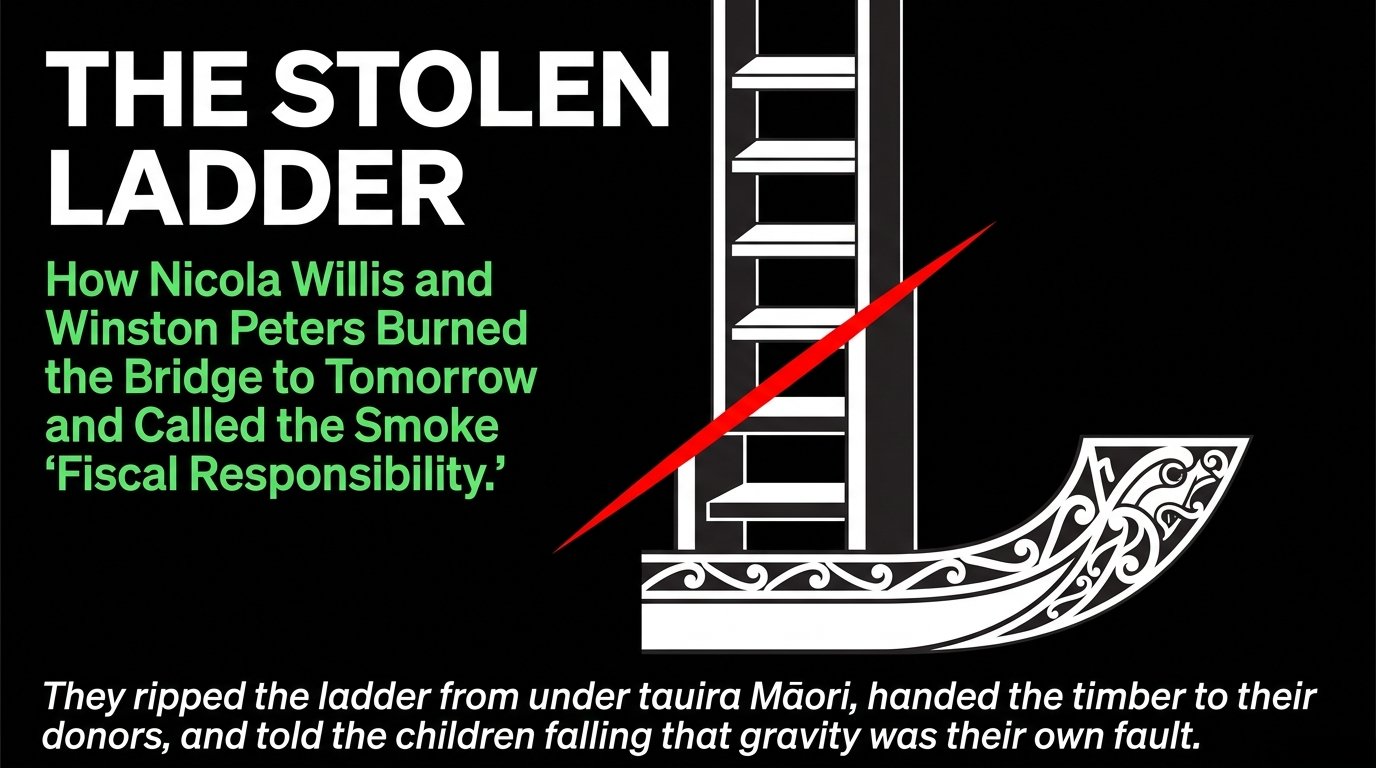
THE LADDER THIEVES: How Nicola Willis and Winston Peters Burned the Bridge to Tomorrow and Called the Smoke "Fiscal Responsibility" - 10 May 2026
They ripped the ladder from under tauira Māori, handed the timber to their donors, and told the children falling that gravity was their own fault.

Mōrena Aotearoa,
This essay examines the National-ACT-NZ First government's decision to scrap Fees Free tertiary education because it directly and measurably affects the educational futures, economic participation, and rangatiratanga of Māori and Pasifika whānau
— constituting a deliberate act of class warfare and racial exclusion dressed in the language of budget management.
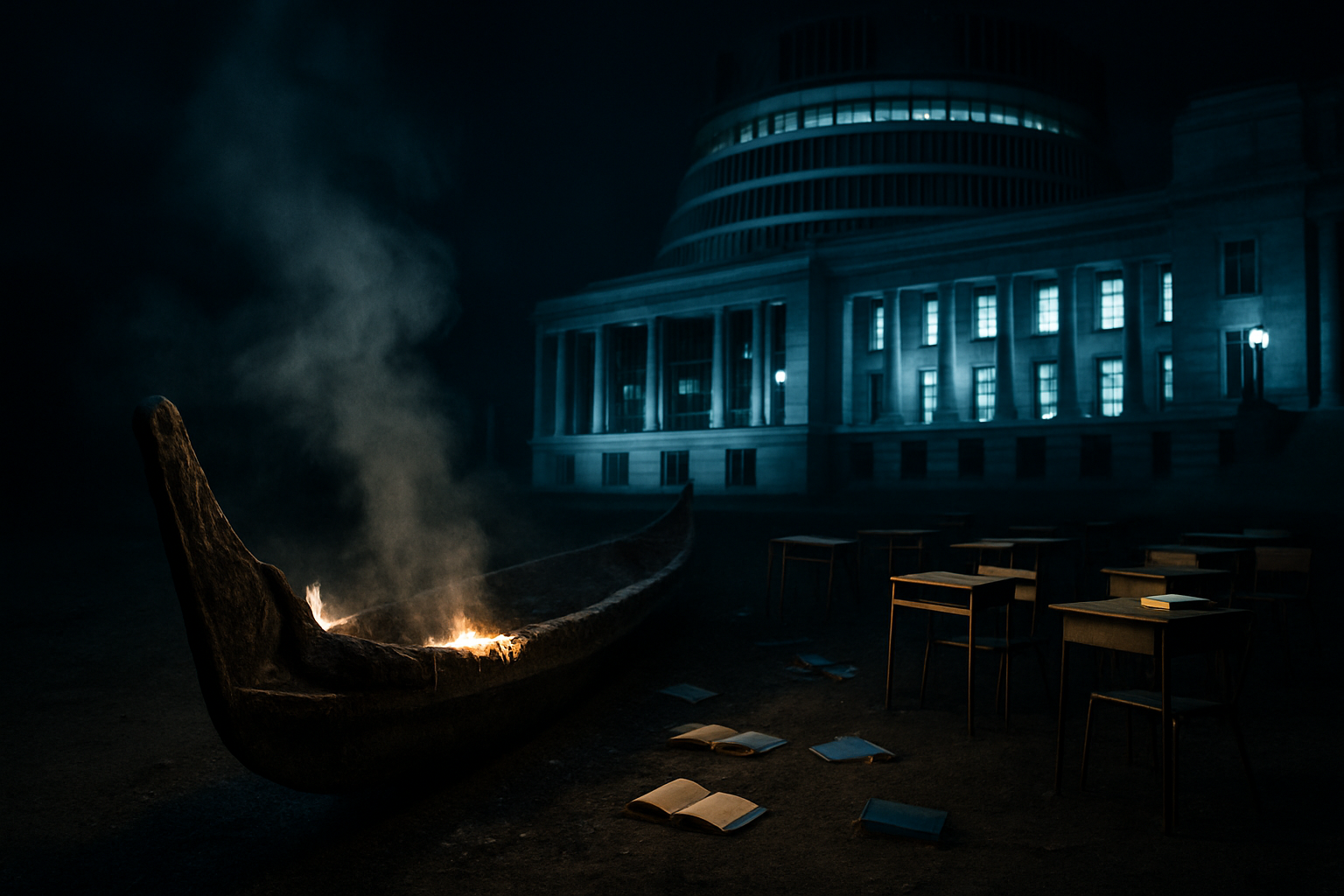
The Metaphor: The Burning of the Waka
Imagine a waka — battered, yes, patched with generations of colonial damage, but moving. Māori tauira are in it, paddling hard against a current that has always run against them. Then, on a Friday evening in May 2026, two men in suits — one who built his career race-baiting Māori for votes, one who manages the Crown's money for the benefit of those who already have it — walk down to the water's edge. Not to help paddle. To set the waka on fire. And then walk back up the hill, pour themselves a drink, and call the burning
"efficiency."
 RNZ News
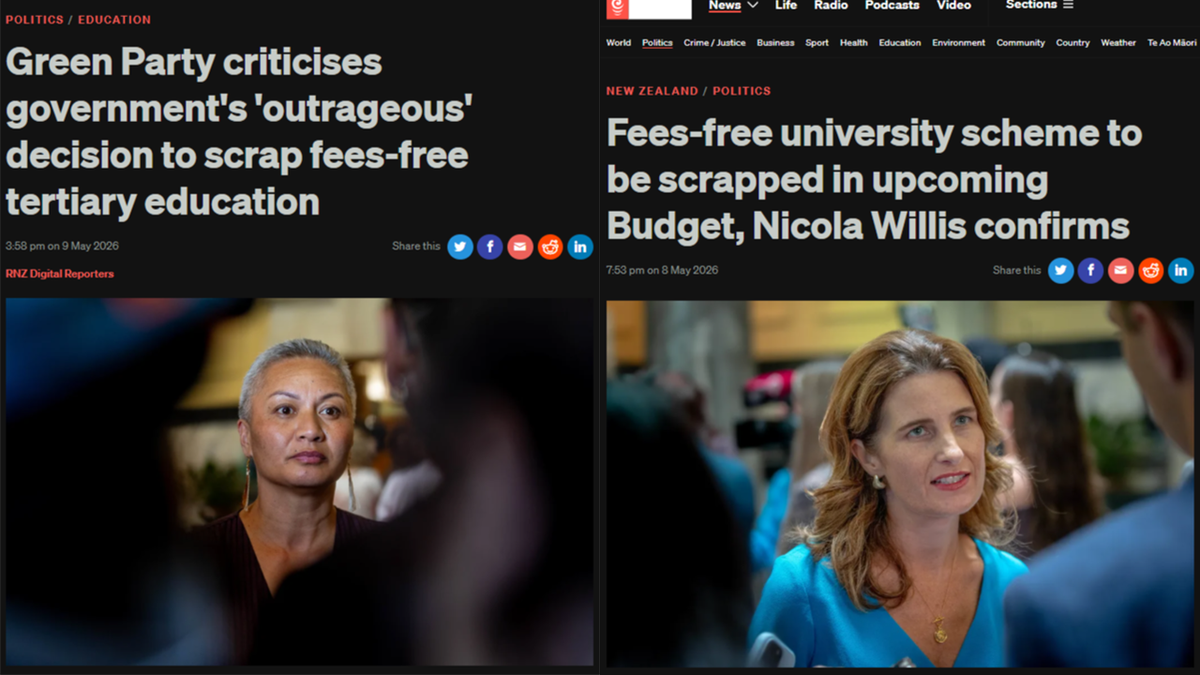
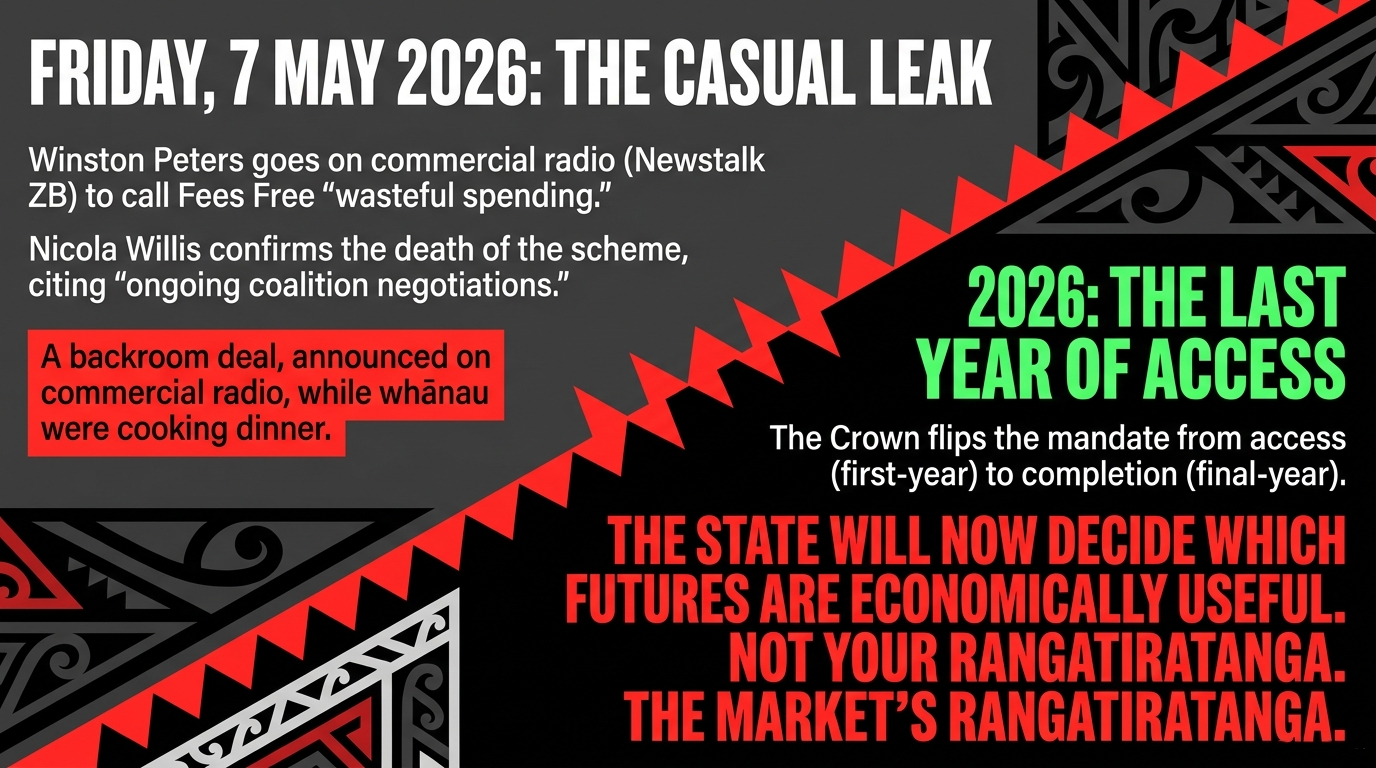
That is what happened when Winston Peters called Fees Free "wasteful spending" on Newstalk ZB on 7 May 2026
— a budget leak announced with the smug satisfaction of a man who has never needed a student loan — as reported by Times Higher Education.
And that is what happened when Nicola Willis, dragged blinking into the light by her coalition partner's arrogance, confirmed the scheme's death, describing it as the product of
"ongoing coalition negotiations," as the ODT reports.
Coalition negotiations. Not evidence. Not research. Not the voices of students. A backroom deal, announced on commercial radio, before Parliament heard a word.
RNZ News
The full Budget drops 28 May 2026 — confirmed by Times Higher Education. But the damage landed Friday evening while whānau were cooking dinner. That is not governance. That is contempt.
The Deep Dive Podcast
Listen to a lively conversation between two hosts, unpacking and connecting topics in the sources of this essay.
What Is Actually Being Destroyed
The Fees Free scheme was not charity. It was correction
— a partial, inadequate, but meaningful correction of the structural exclusion that has kept Māori out of degree-level education for generations.
Introduced by the Ardern government in 2018 as a first-year entitlement, as Te Ao News records, it was designed explicitly to lower the barrier of access for communities who cannot absorb debt at 18 years old.
This coalition had already taken a chainsaw to it at the end of 2024, flipping it from first year
— access — to final year — completion — on the risible logic of "rewarding" students for finishing, as Te Ao News explains.
Now they have taken the stump. As Times Higher Education confirms, 2026 is the last year any student benefits. Peters says the money will be "reshaped" toward trades and industries facing labour shortages.
Translation: the state will now decide which futures are economically useful and fund only those. Not your rangatiratanga. The market's rangatiratanga. Over your life.
The Racial Wound Beneath the Fiscal Rhetoric
The people who will suffer most from this decision are not the children of the people making it. They never are.
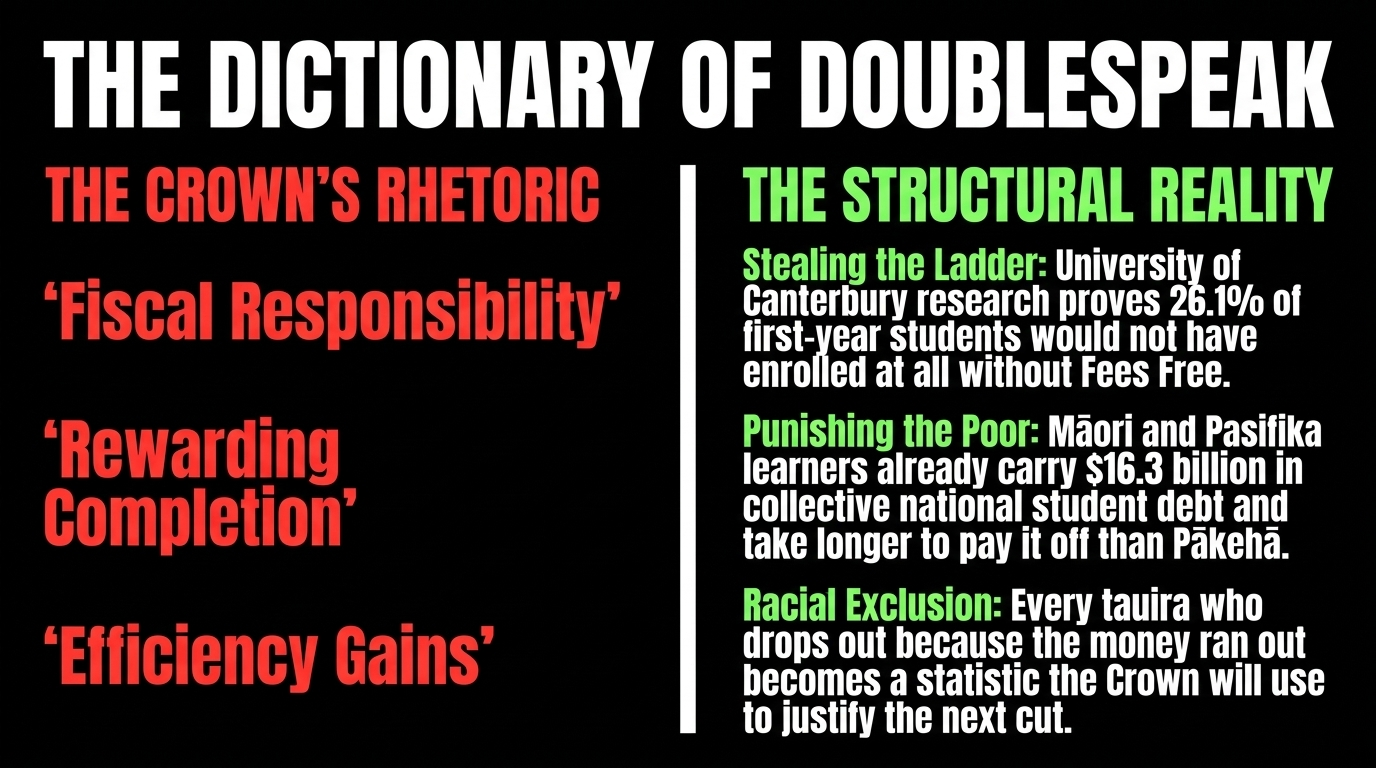
University of Canterbury research — cited in the Fees Free Wikipedia entry — found that 26.1% of first-year students said they would not have enrolled at all without Fees Free, and 60% said it contributed to their decision to enrol.
For Māori tauira without family capital, without inherited property equity, without a parent who can guarantee a loan — that single year removed was the difference between a degree and a debt spiral starting before the first lecture.
And NZUSA research confirms that Māori and Pasifika learners take longer than Pākehā to pay off student loans — carrying $16.3 billion in collective student debt nationally,
a "handbrake on our country's economic future" that has existed only since 1990.
Researchers documented by the ODT have warned for years that rangatahi Māori are being pushed into low-level tertiary courses that rack up an average of $17,000 of student loan debt for qualifications that do not lift earnings
— a "double-bind" of debt and credential that leads nowhere.
The government's response to this structural trap is not to fix it. It is to remove the one access lever that helped some tauira reach degree level in the first place. Every tauira who drops out before completion because the money ran out becomes a statistic the Crown will use to justify the next cut.
The Universities NZ parity research identified that Māori and Pasifika completion rates trail Pākehā by significant margins, and that financial barriers compound non-completion. This is not new information. Willis has been briefed. The decision to scrap Fees Free is not ignorant. It is informed and deliberate.
Three Examples for the Western Mind
1. The Māori Doctor Who Will Not Exist — Access Denied, Community Left Dying
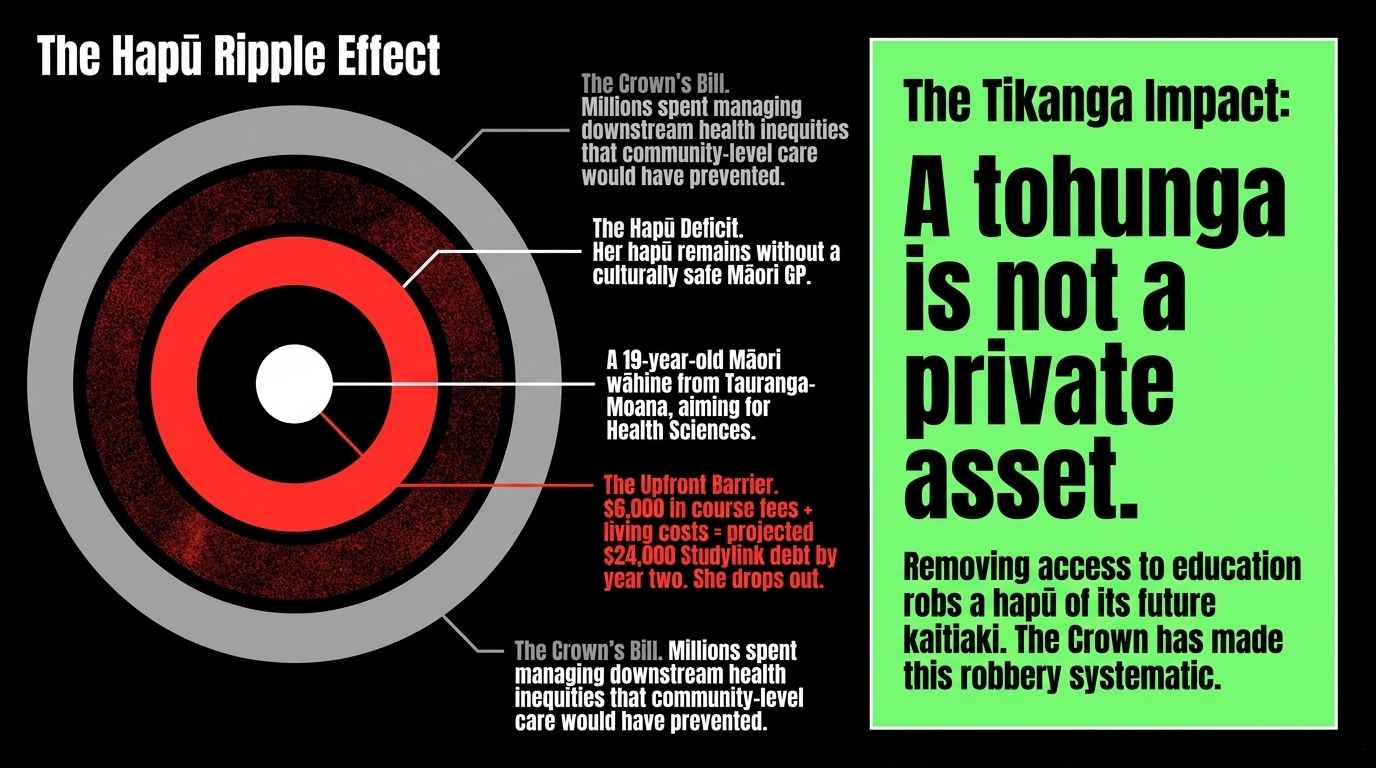
Picture a 19-year-old Māori wāhine from Tauranga-Moana. First in her whānau to sit university entrance. She wants to be a doctor — her hapū has no Māori GP, and the nearest health service is underfunded and culturally alien. She enrols in Health Sciences because Fees Free made year one manageable. Without it, the upfront cost — $6,000 in course fees alone, confirmed by University of Auckland research — plus living costs means $24,000 in Studylink debt by second year, on top of rent in a city her whānau cannot help her afford. She does not finish. Her hapū remains without a Māori doctor. The Crown then spends far more managing the health inequity that a Māori GP would have addressed at community level.
The tikanga impact: In te ao Māori, a tohunga — a person of deep knowledge — is not a private asset. Their knowledge belongs to the community. Removing access to education does not just harm an individual. It robs a hapū of its future tohunga, its future kaitiaki, its future voice in rooms where decisions are made about Māori lives. This government has just made that robbery systematic.
The solution the Greens are offering: The Green Party is the only party committed to restoring and expanding fee-free access. Reinstate first-year Fees Free immediately, with a pathway to full undergraduate fee removal — as exists in Germany, Scotland, and Norway — and pair it with wraparound support that addresses living costs, not just tuition.
2. The $17,000 Debt Trap — Rangatahi Māori Paying for Qualifications That Go Nowhere
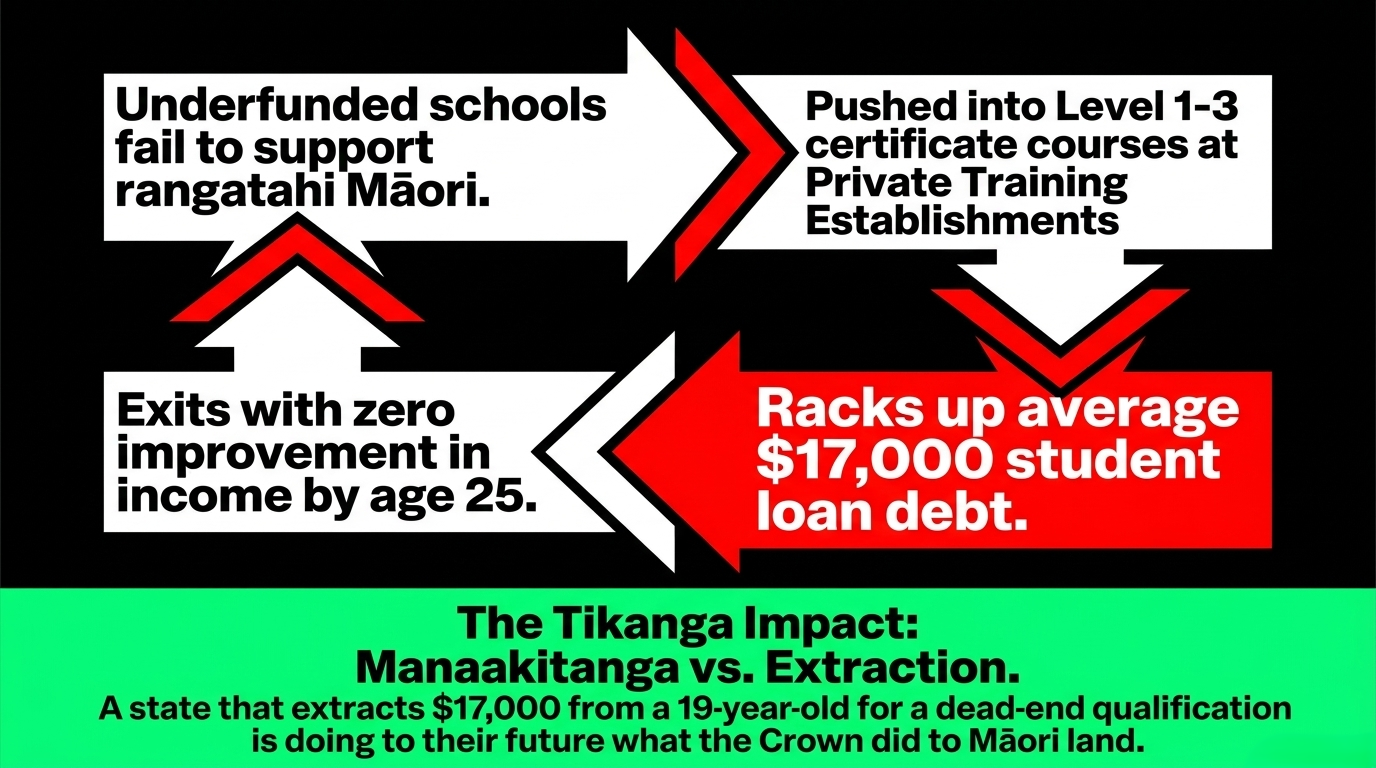
Research documented by the ODT shows that a disproportionate number of rangatahi Māori leave school to enrol in level 1–3 certificate courses at Private Training Establishments — and exit with an average $17,000 in student loan debt and no improvement in their income by age 25 compared to peers who went directly into work. These are not failures of ambition.
They are structural failures: schools that did not support them, employers who would not hire them, and a tertiary system that profited from their enrolment without delivering.
Fees Free, in its first-year form, was one mechanism that could redirect rangatahi toward higher-value, degree-level study before the debt trap closed. Without it, the pipeline from underfunded school to worthless certificate to unrepayable debt runs unchallenged.
The tikanga impact: Manaakitanga — the obligation to care for and uplift one another — is a foundational value. A state that extracts $17,000 from a 19-year-old Māori for a qualification that leads nowhere is not exercising manaakitanga. It is practising extraction. It is doing to rangatahi's futures what the Crown did to Māori land — taking what can be taken, leaving what cannot be sold, and calling the process "opportunity."
The solution: Mandate meaningful quality standards for all tertiary providers receiving public funding. Fund degree-level pathways that lead to real employment and income outcomes. Make the first year of legitimate degree-level study free — not as charity, but as obligation.
3. The Budget Contradiction — $14.9 Billion for the Wealthy, Zero for Students
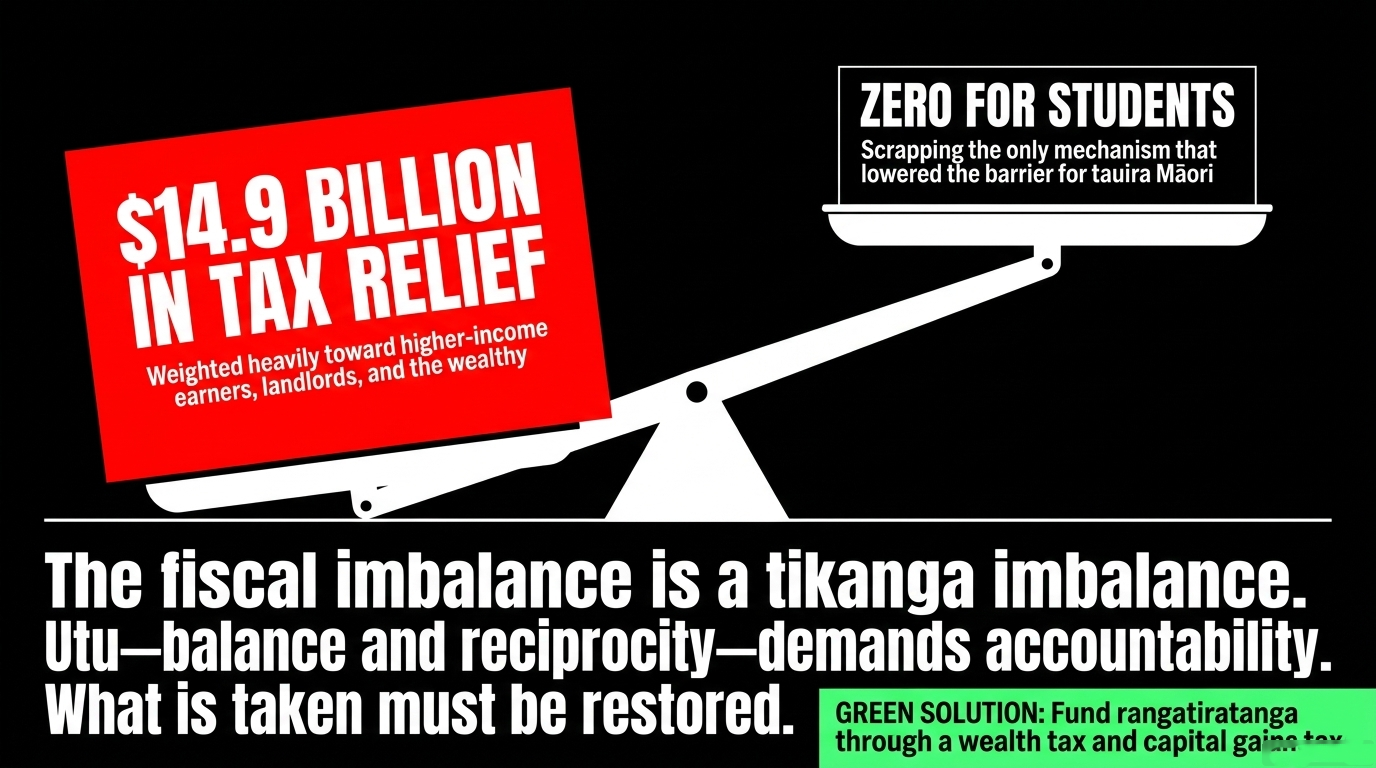
This government has made its priorities legible in numbers.
As The Māori Green Lantern documented in Budget 2025: Smoke and Mirrors for the Rich, Austerity for the Rest, the National-led coalition delivered billions in tax relief weighted heavily toward higher income earners while simultaneously cutting services for the communities most dependent on the state. Willis celebrated Budget 2025 as delivering for Māori — while slashing pay equity, as documented on Te Ao News, and manufacturing a "$825 million Māori Budget package" that, as The Māori Green Lantern exposed, was a repackaging of existing spend. Now Fees Free — which costs a fraction of those tax cuts — is gone.
The tikanga impact: Utu — balance, reciprocity — is not revenge. It is the principle that relationships must be maintained in balance, that what is taken must be restored. This government has taken relentlessly from Māori: land, health infrastructure, housing, educational access. It has restored nothing. The fiscal imbalance is also a tikanga imbalance. Utu demands accountability. This essay is part of that accounting.
The solution: A wealth tax. A capital gains tax. Restore Fees Free from the revenue generated by taxing those who have benefited most from a system built on Māori land. The Green Party's alternative budget showed exactly how this works — and the NZ Initiative attacked it as "fantasy" because funding rangatiratanga has never been in their playbook.
The Greens Stand Alone — And They Are Right
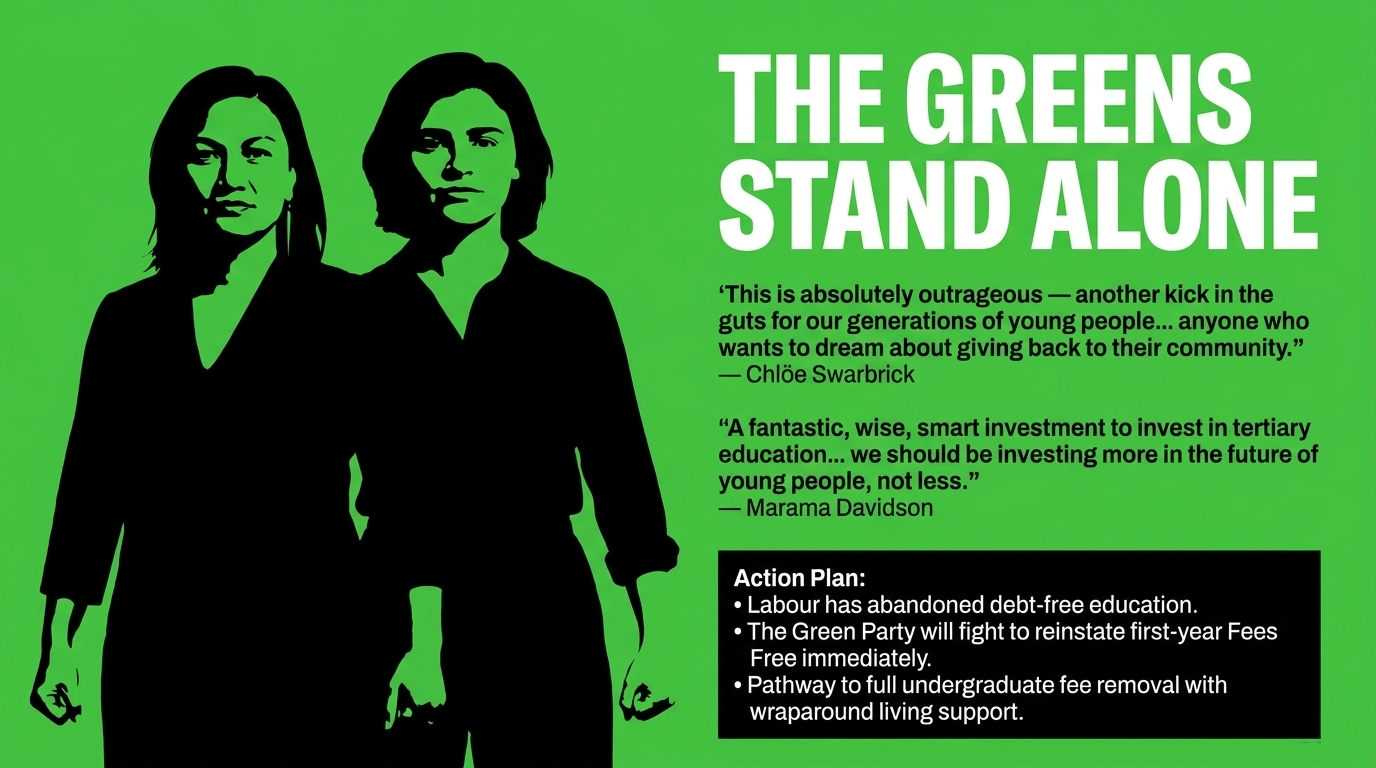
When this announcement broke, the Green Party did not hedge. As the ODT reports, Green co-leader Chlöe Swarbrick called it
"absolutely outrageous — another kick in the guts for our generations of young people particularly and anyone who wants to dream about giving back to their community."
The Greens confirmed they will fight to reinstate the scheme.
As stated on their website, the Greens are now the only political party sticking up for students — because Labour has also abandoned the vision of debt-free undergraduate education.
Swarbrick is right. And the Greens' position is not radical. It is the bare minimum that a society serious about Māori equity, intergenerational wellbeing, and an educated workforce would demand. The NZUSA has been saying the same since 1990.
The tino rangatiratanga movement has been saying the same since 1840.
The Pattern of Deliberate Harm: Previous Exposés by The Māori Green Lantern
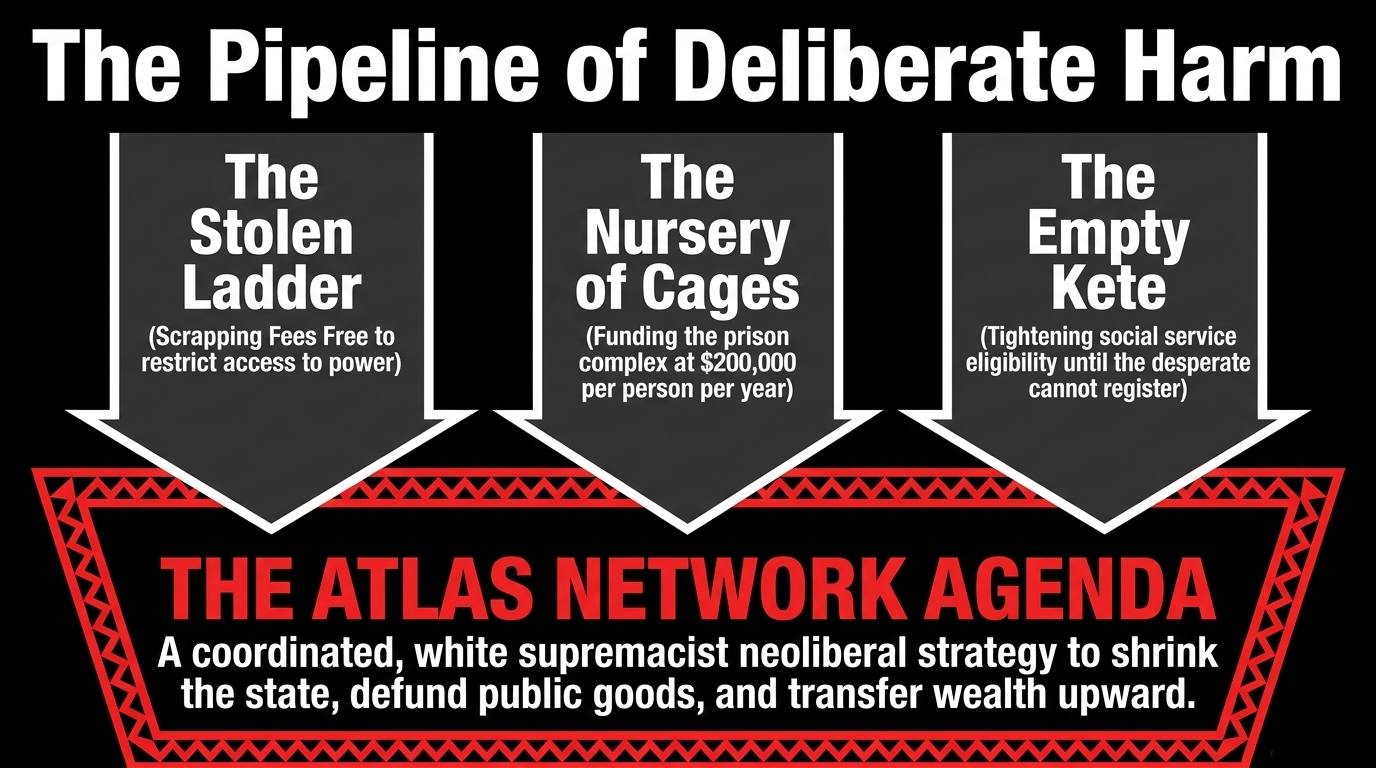
This decision does not stand alone. It is one cut in a death-by-a-thousand-cuts strategy that The Māori Green Lantern has been tracing and exposing since this coalition took power.
In The Nursery of Cages: How a White Supremacist State Built a Factory That Turns Brown Children Into Prisoners, I documented how removing educational opportunity is not a policy gap — it is a pipeline. When Māori tamariki are denied access to quality tertiary education, they are not failing. The state is succeeding in keeping them out of power. The prison complex — costing $200,000 per person per year — is the Crown's preferred alternative investment in Māori futures.
In The Watchdog They Shot: How Paul Goldsmith Handed Sean Plunket a Licence to Hate, published just days before this budget announcement, The Māori Green Lantern traced the ACT Party's direct connection to the Atlas Network — the global architecture of right-wing think tanks whose explicit mission is to shrink the state, defund public goods, and transfer wealth upward. The scrapping of Fees Free is Atlas Network policy executed through coalition agreement.
In Willis's Budget Lockup Lies Exposed (July 2025), the manipulation of budget framing to hide the reallocation of resources away from Māori was documented in detail.
The pattern is consistent: announce support for Māori in press releases; cut it in the fine print; attack anyone who reads the fine print as divisive.
In The Empty Kete: How Dana Kirkpatrick Weaves Lies from the Flax of Dead Whānau Dreams, I exposed how this government celebrates declining social service registers — not because whānau are thriving, but because eligibility criteria have been tightened until the desperate cannot even register.
The same logic applies here. When Māori students stop enrolling in tertiary education because the cost is prohibitive, this government will celebrate "efficiency gains" in tertiary spending. The disappearance of tauira from university rolls will be called a budget success.
Willis's Own Words Condemn Her
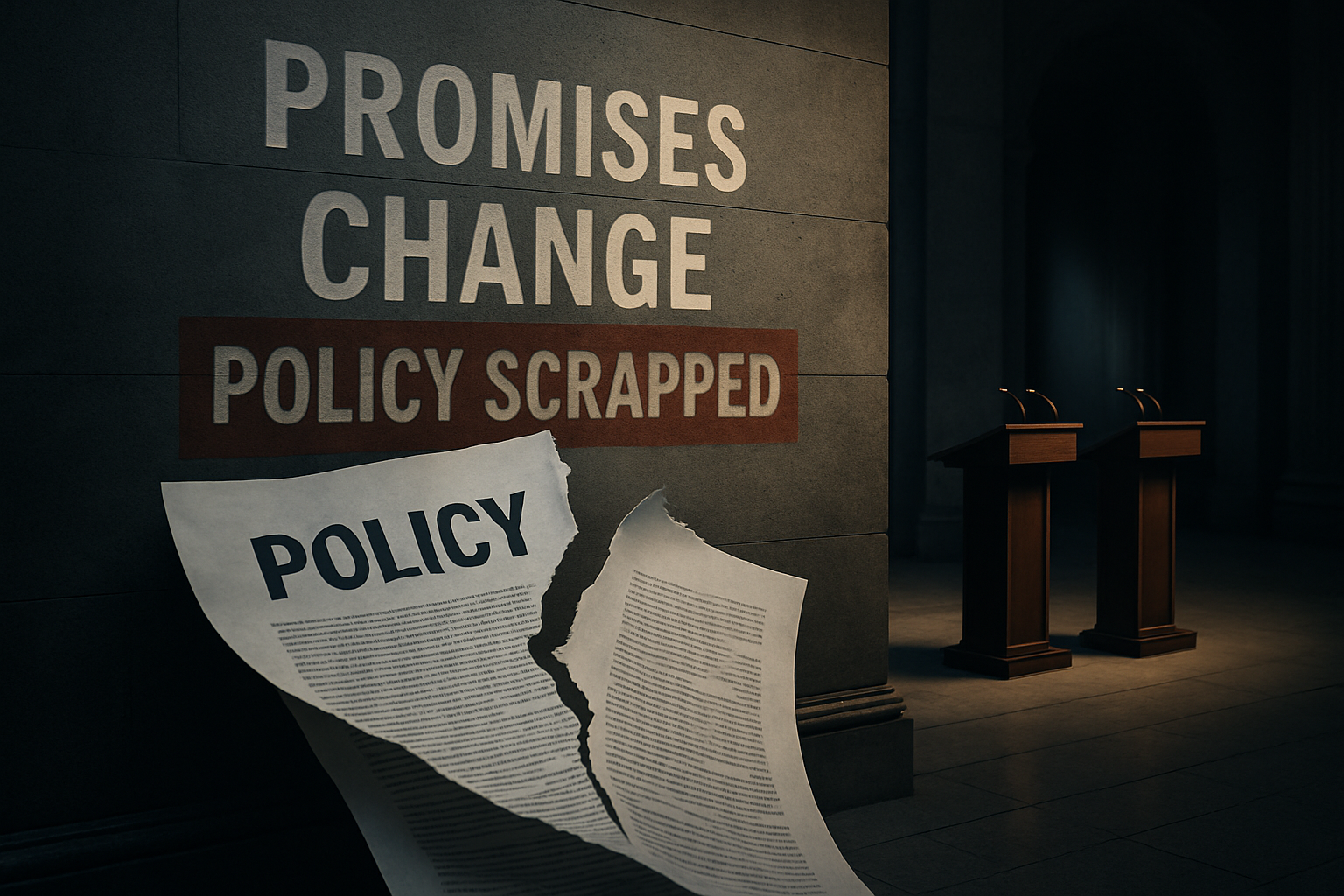
In Budget 2025, Te Ao News recorded Willis saying:
"They should also know their priorities for their tamariki are our priorities, and in particular our education minister has been considering how we can achieve ensure greater student achievement, including for Māori students."
One year later, she has scrapped the one policy that measurably increased Māori student enrolment.
This is not inconsistency. This is colonial doublespeak, performed with a straight face. Say the words. Cut the programme. Blame the deficit. Repeat.
Ko Te Whakakapi — The Moral Verdict
Nicola Willis did not make a technocratic decision. She made a political choice — to protect her coalition, protect the optics of a surplus, and sacrifice the educational futures of the generation least equipped to absorb the blow.
Winston Peters did not leak a budget. He bragged about setting the waka on fire and called it patriotism.
This is a white supremacist neoliberal government — not as an insult, but as a structural description. It systematically defunds the interventions that reduce Māori disadvantage. It consistently transfers public resources toward those who already hold private wealth. It uses the language of fiscal responsibility as a weapon against the communities fiscal irresponsibility — colonial fiscal irresponsibility spanning 185 years — has harmed most.
The Green Party has drawn the line where it must be drawn. Whānau must stand with them, vote for them, fund the accountability they represent, and refuse the framing that calls educational access "waste" while calling tax cuts for the wealthy "investment."
The taiaha is raised. The whakapapa of harm is fully visible. Ko Ivor Jones tōku ingoa. Ko au te Māori Green Lantern. Ka whawhai tonu mātou — ake, ake, ake.
Tautoko This Mahi — Koha for the Taiaha

Every tauira Māori priced out of a degree is a truth-teller the Crown will never have to answer to. Every essay published here is a small act of utu — of restoring balance, naming the harm, and refusing to let the waka burn quietly.
If this essay named a harm you have lived, or exposed a pattern your whānau has felt
— koha signals that rangatiratanga includes the power to fund our own truth-tellers.
Not the Crown's journalists. Not the think tank's commentators. Ours.
Kia kaha, whānau. Stay vigilant. Stay connected. And if you are able, consider a koha to ensure this voice continues — so the next cut, the next betrayal, the next budget leak at 6pm on a Friday does not go unanswered.
If you cannot koha — no worries. Subscribe. Follow. Kōrero. Share with your whānau and friends. That is koha in itself.
Four pathways:
- 💛 Koha directly — Support via Koha platform
- 📬 Subscribe — Receive essays direct to your inbox
- 🏦 Bank transfer — HTDM, account number 03-1546-0415173-000
- 📘 Follow on Facebook — The Māori Green Lantern

Views expressed constitute honest opinion on matters of public interest under the Defamation Act 1992 (NZ) and Durie v Gardiner