"THE NUMBERS ARE A LOADED GUN — AND IT'S POINTED AT YOUR WHĀNAU" - 12 May 2026
How the NZ Herald's Poll of Polls Manufactures Coalition Inevitability While Māori Representation Bleeds Out on the Floor

Kia ora ano Aotearoa,
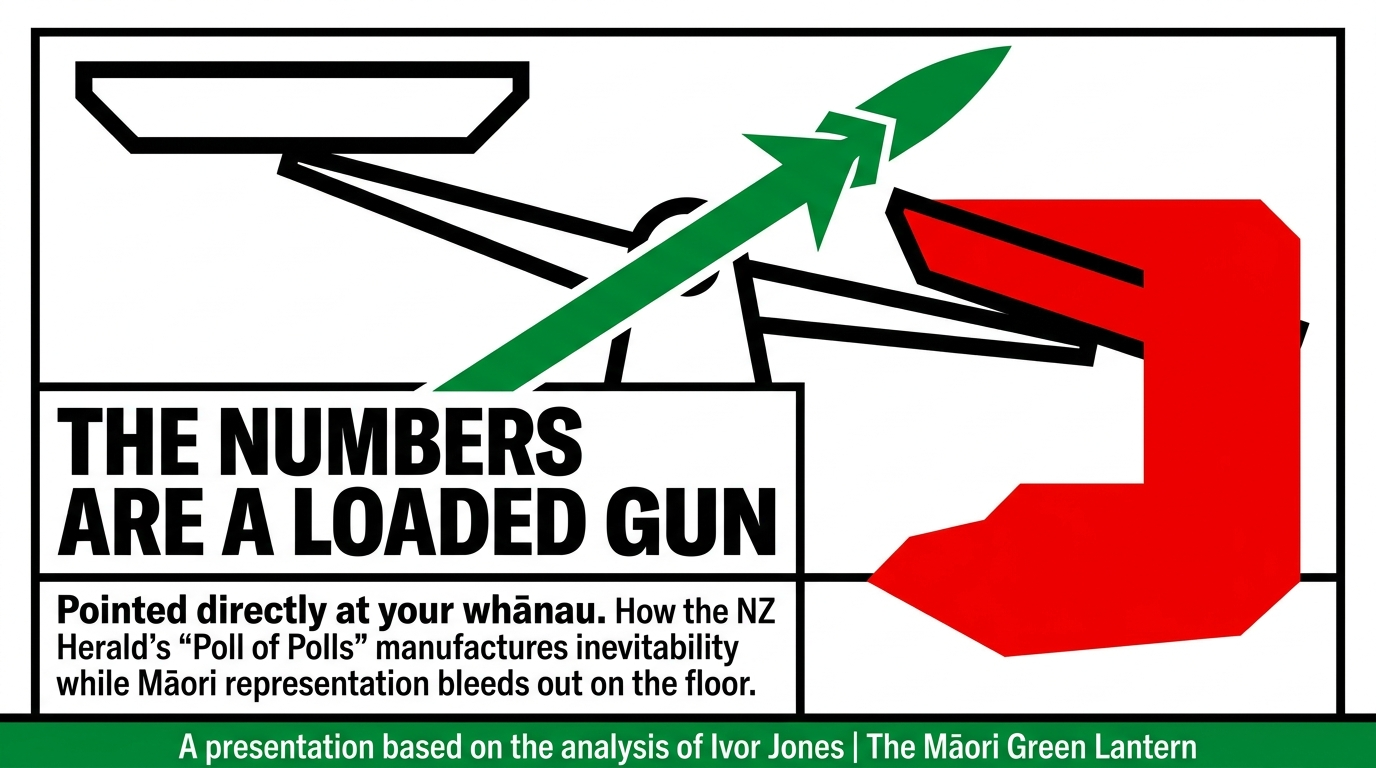
This essay examines the NZ Herald–Motu Research Poll of Polls because it directly affects Māori whānau, democratic rights, and the public accountability of officials whose policies are systematically dismantling every protection tangata whenua have fought generations to build.
The Rigged Scales
Imagine a tangi.
The tūpāpaku is Māori representation — once vital, once present in every corridor of power.
The whānau who loved it are exhausted, broke, and watching from the back row.
At the front of the marae, the undertakers — the Herald, Motu Research, the polling industry — are performing the ceremony with impressive technical precision.
The forms are correct. The model is rigorous. The 4,000 simulations are impressive.
But they built the marae on their land, with their rules, and they called the tangihanga before the tūpāpaku had even drawn its last breath.
The Deep Dive Podcast
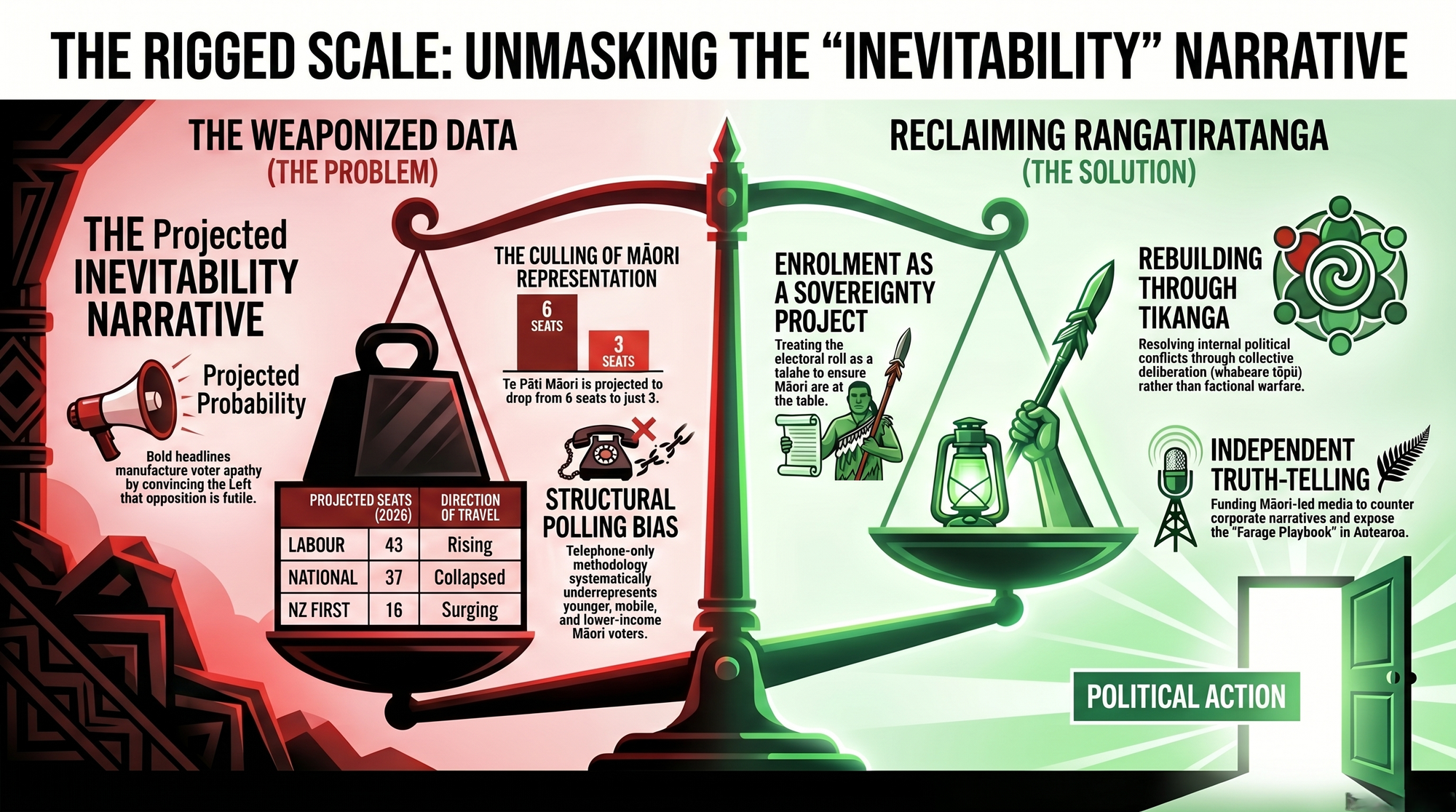
Listen to a lively conversation between two hosts, unpacking and connecting topics in the sources of this essay.
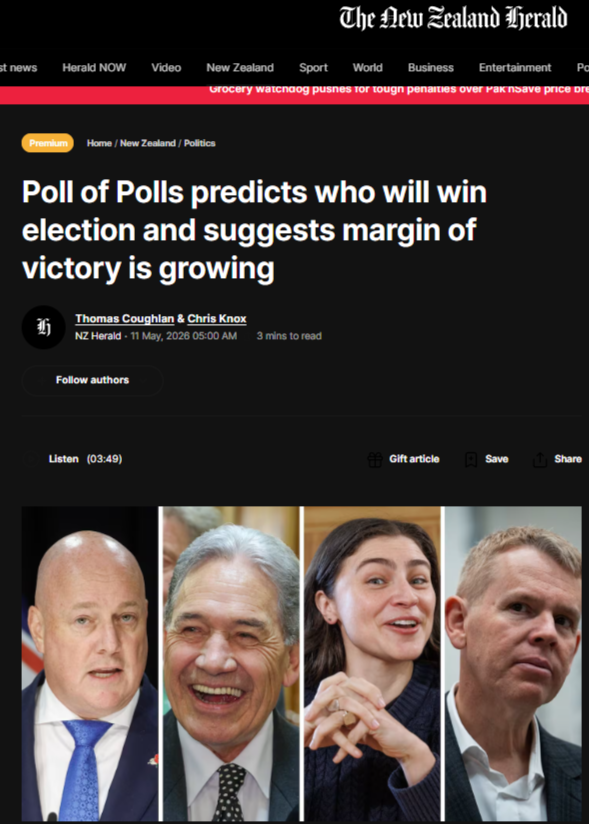
Access the paywalled article here
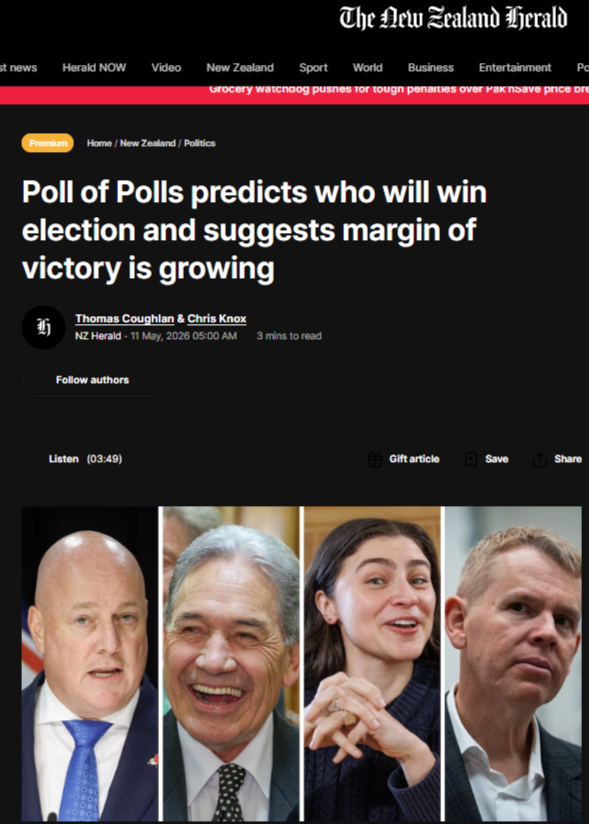
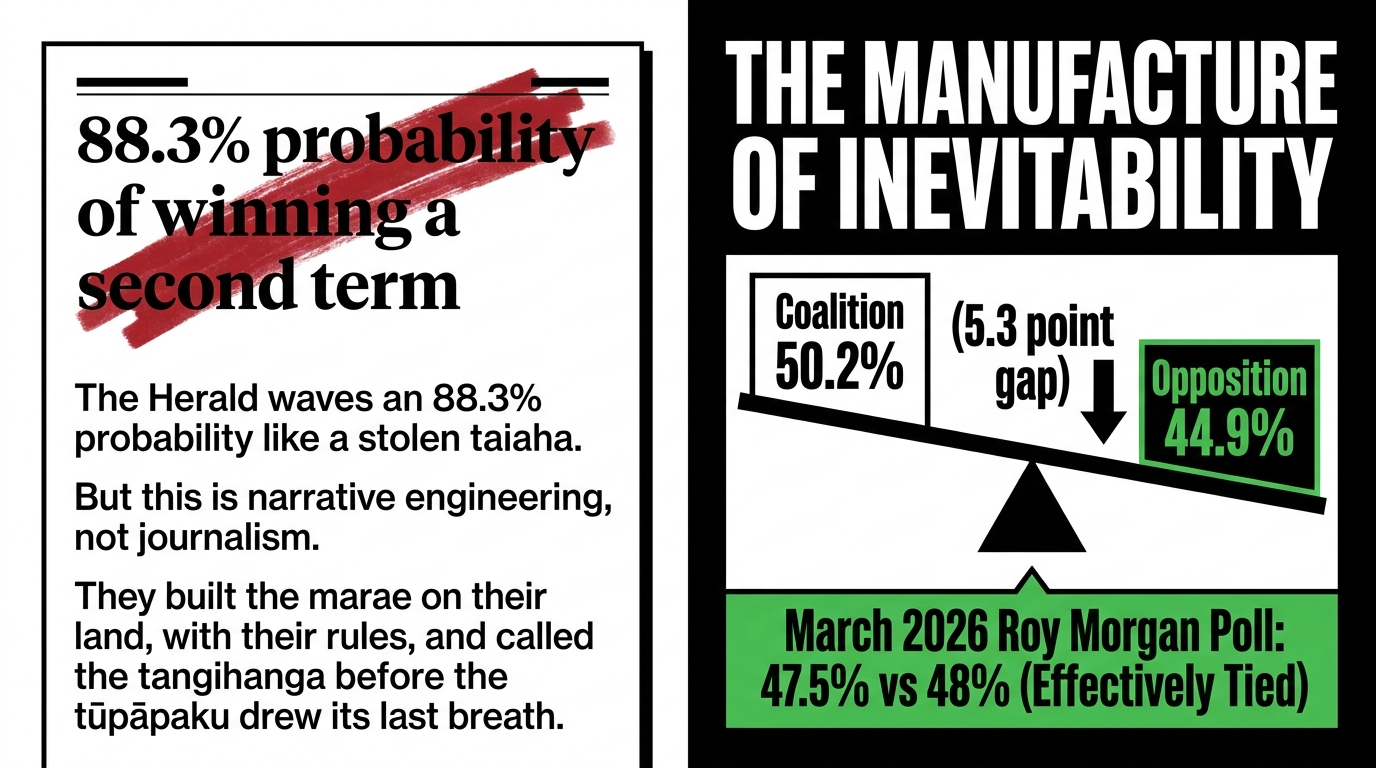
The NZ Herald–Motu Research Poll of Polls gives the Luxon-led coalition an 88.3% probability of winning a second term — and the Herald is waving that number like a taiaha it stole from a museum.
This is not journalism. This is narrative engineering. This is the manufacture of inevitability. And Māori whānau are the ones paying for it.
He Aha Te Kaupeka o Tēnei? | What Are We Actually Looking At?
Before we let the Herald turn this model into a coronation, understand what it is.
The Motu Research model, designed by senior fellow Stuart Donovan, aggregates publicly available polls and election results back to 2014, then runs 4,000 election simulations to derive probabilities.
Donovan himself told the Herald there remains
"a decent chance that they'll lose"
— a qualification buried so deep in the story it may as well not exist.
The model is not propaganda. Motu Research's commitment to publishing its full technical methodology after the election is genuinely commendable.
The propaganda is the headline.
88.3% certainty printed in bold on the front page of the country's largest media company — a company that previously published "The Herald's Dance with Deception: How Discredited Polling Erodes Democracy in Aotearoa" — is not neutral reporting. It is voter suppression with a PhD attached to it.
The MGL has been here before. In December 2024, this publication exposed exactly this methodology in "Pollsters Exposed: Numbers as Weapons in the War on Truth" — documenting how polling numbers become weapons when wielded by media with ideological investments in particular outcomes. Nothing has changed. The gun is just better calibrated.
The Numbers: Whose Waka Is Being Paddled?
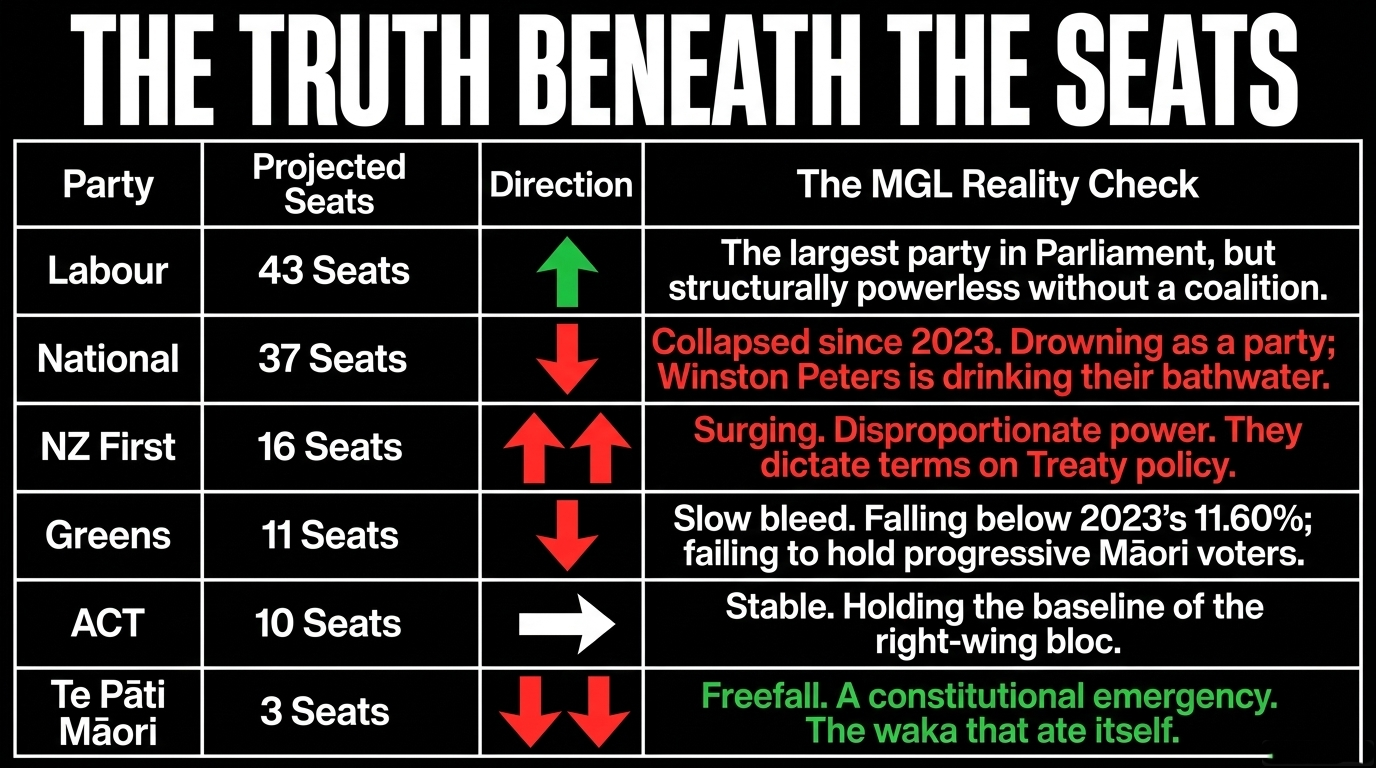
The raw seat projections from the model tell a story the Herald's triumphalist framing doesn't want you to read clearly:
| Party | Projected Seats | Direction of Travel |
|---|---|---|
| Labour | 43 | ↑ Rising steadily |
| National | 37 | ↓ Collapsed since 2023 |
| NZ First | 16 | ↑↑ Surging |
| Greens | 11 | ↓ Slow bleed |
| ACT | 10 | → Stable |
| Te Pāti Māori | 3 | ↓↓ Freefall |
Source: NZ Herald–Motu Research Poll of Polls, May 2026
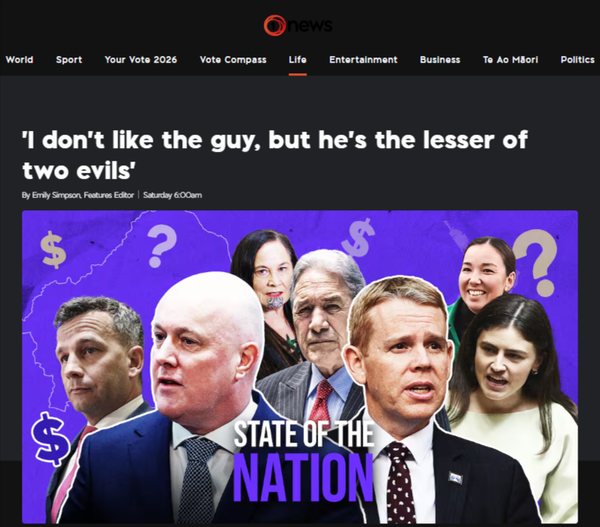
Labour would be the largest party in Parliament and cannot govern. National has collapsed as a party and will govern. Te Pāti Māori, which won 9.7% of the party vote and six electorate seats in 2023, is projected to hold 3 seats.
Read that again.
The party that carries the aspirations of hundreds of thousands of Māori voters is projected to have three seats in a 120-seat Parliament.
This is not politics. This is a culling.
The coalition's average support sits at 50.2% against the Opposition's 44.9% — a 5.3 point gap, up from 3.3 points a year ago.
But that gap is entirely manufactured by NZ First's surge, not National's strength.
Critically, the March 2026 Roy Morgan poll — which the Herald conveniently excluded from its triumphalist narrative — showed the coalition at just 47.5% versus the Opposition at 48%
— effectively tied.
56% of all New Zealanders believe the country is heading in the wrong direction. Consumer confidence is at its lowest since late 2024. This is what was not on the Herald's front page.
Three Examples for the Western Mind
Example 1: The Electoral Roll as Sovereignty (Voter Suppression by Design)
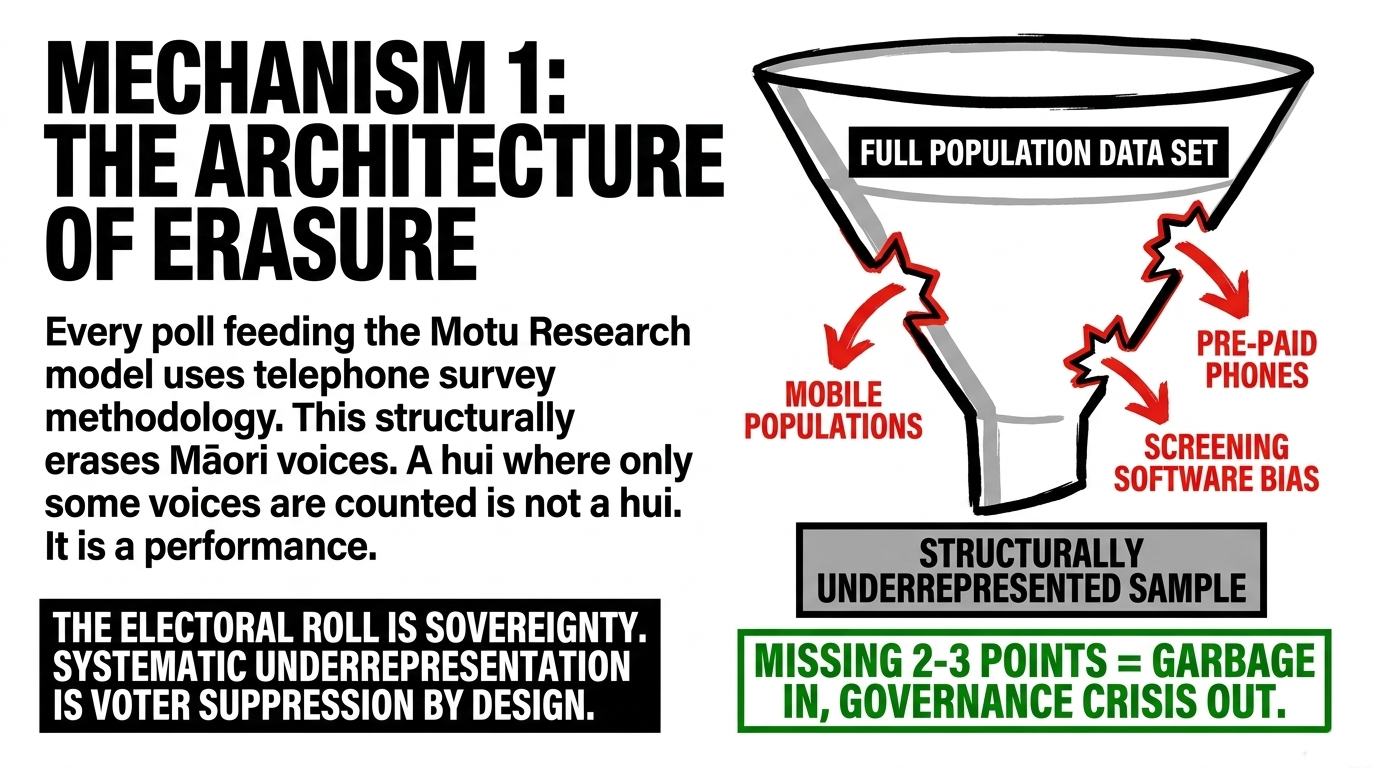
In Western democracies, when Black American voters are systematically removed from electoral rolls, it is recognised as voter suppression. Structural disadvantage produces systematic underrepresentation. That recognition comes only after a century of civil rights struggle.
In Aotearoa in 2026, every poll that feeds the Motu Research model uses telephone survey methodology.
As the MGL's essay "Polling for Power: How the Taxpayers' Union and Curia Hijack Democracy Through Flawed Methodologies and Media Collusion" documented in April 2025, Māori are structurally underrepresented in telephone polling — younger, more mobile, more likely to be on prepaid phones, more likely to live in households that screening software skips.
The Māori electoral roll has historically lower enrolment rates than the general roll, and lower turnout in non-election years.
The harm, quantified: If Māori voter preference is systematically undercounted by even 2–3 points in every poll — a conservative methodological estimate — then the "88.3% certainty" figure for the coalition is built on structurally flawed data. The model cannot be more accurate than the polls that feed it. Garbage in, governance crisis out.
The solution: Te Kāhui Tika Tangata — the Human Rights Commission — should mandate that all published polls report their Māori demographic sample size separately. Without this, polls are not neutral instruments. They are colonial mirrors.
The tikanga impact: In tikanga Māori, whakaaro — considered opinion — must be grounded in the full voice of the whānau. A hui where only some voices are counted is not a hui. It is a performance. Every poll that structurally silences Māori voices while presenting itself as democratic truth is performing the same colonial trick the Sim Report performed in 1867 when it transferred Māori from customary to individual title: making structural dispossession look like administrative neutrality.
Example 2: Shane Jones and the Economics of Scapegoating
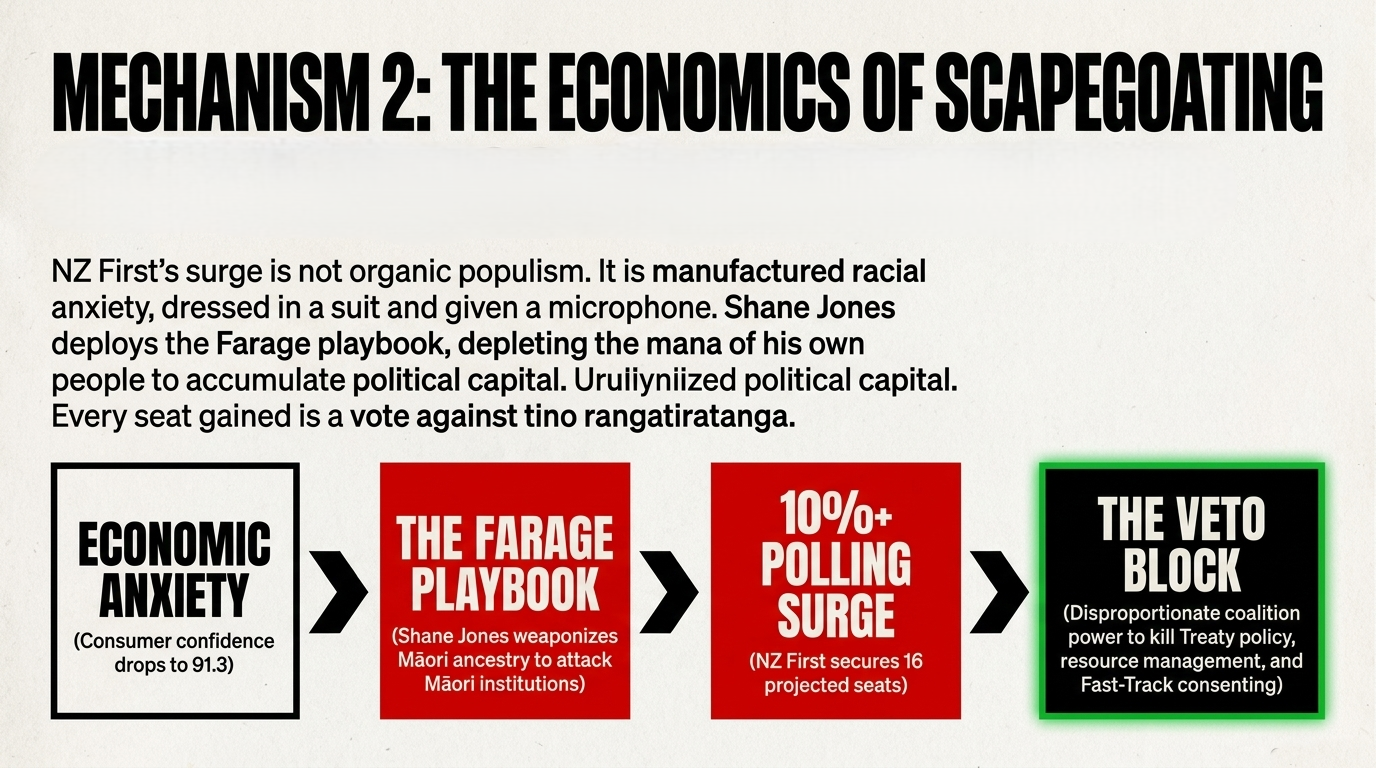
In the United Kingdom, Nigel Farage's Reform UK surged from 0 to 14% of the popular vote in 2024 by targeting immigration and "metropolitan elites" as the cause of working class economic anxiety. The scapegoat changed — but the mechanism was identical to the one that enabled Enoch Powell in 1968.
In Aotearoa in 2026, Shane Jones is running the same play — and as the NZ Herald confirmed, Jones "deserves credit" for NZ First's surge past 10% median in the Poll of Polls. The Spinoff confirmed NZ First is
"swallowing up a chunk of Act and National's votes, reflecting a global surge in populist-nationalist parties".
Jones called for an end to the "haka of victimhood." He dismissed Treaty-based co-governance as "separatism." He has weaponised his own Māori ancestry as a permission slip to attack Māori institutions.
The MGL documented Jones's betrayal in detail in "The Muzzled Māori: How Shane Jones Betrayed His Own People for Coalition Comfort" — published 2 October 2025 — and before that in "Shane Jones: A Political Chameleon's Dance Through New Zealand's Murky Waters" in October 2024.
The harm, quantified: NZ First's projected 16 seats — up from 8 in 2023 — would make Peters and Jones the single most powerful coalition voice by proportion. In a Parliament where the coalition holds a three-seat majority, NZ First can dictate terms on Treaty policy, resource management, Fast-Track consenting, and the Regulatory Standards Bill. Every one of those seats is a vote against tino rangatiratanga — and they were earned by using Māori as a punching bag.
The solution: Call it what it is. The Farage Playbook. Name the mechanism. Māori media, iwi broadcasters, and community networks must make visible what the Herald normalises: NZ First's surge is not organic populism. It is manufactured racial anxiety, dressed in a suit and given a microphone.
The tikanga impact: In tikanga Māori, the principle of manaakitanga — the active affirmation of another's dignity — is not optional. It is foundational to how power is exercised. A rangatira who depletes the mana of their own people to accumulate political capital has violated the fundamental covenant of leadership. Jones is not a rangatira using his platform to lift whānau. He is a coloniser with a pepeha.
Example 3: Te Pāti Māori — The Tōtara That Burned From Within
In the United States, when the Black Panther Party imploded in the 1970s through FBI infiltration and internal purges, the American state did not need to defeat it. It only needed to accelerate the conditions for self-destruction — and then point at the smoking ruins as proof that Black political organisation was inherently unstable.
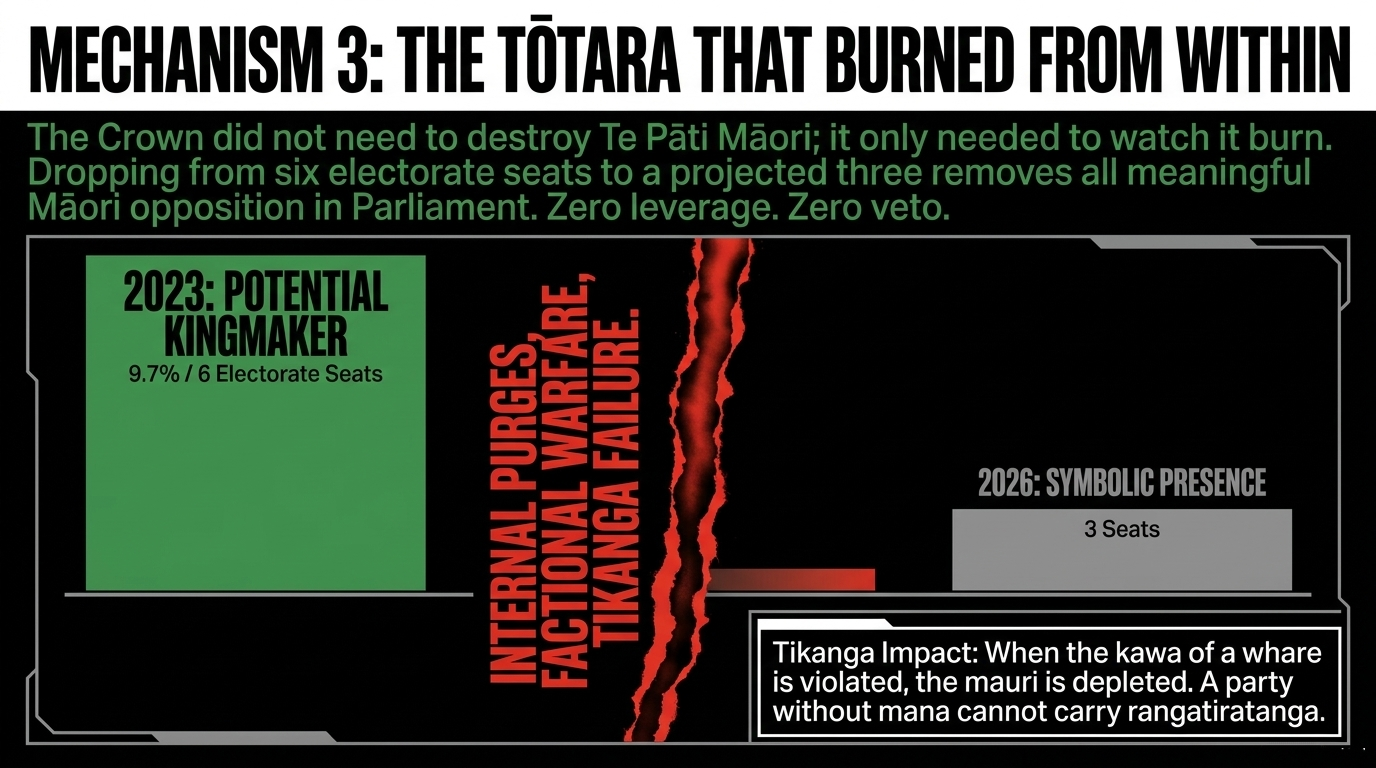
In Aotearoa in 2026, Te Pāti Māori collapsed from 9.7% and six electorate seats in 2023 to a projected 3 seats in the Poll of Polls model — and it did not need the government to destroy it.
The MGL documented the internal machinery of that destruction in detail:
- "The Split Tōtara and the Arsonists Who Lit the Match: How Te Pāti Māori's Purge Serves the Crown's Colonial Endgame" — 14 February 2026
- "THE WAKA THAT ATE ITSELF: How Te Pāti Māori's Kawa-Killers Handed the Crown Its Most Valuable Weapon — For Free" — 11 March 2026
- "When the Māori Green Lantern Exposes Te Pāti Māori's Self-Immolation" — 10 November 2025
The harm, quantified: Three seats means one or two voices in a Parliament of 120. A government that has already dismantled Te Kawa Mataaho, gutted Whānau Ora funding, abolished the Māori Health Authority, and is systematically stripping Treaty obligations from every piece of legislation it touches — as documented in MGL's "Colonial Amnesia in the House: How the Right-Wing Government Erases Māori Health" — will now face no meaningful Māori opposition in Parliament. Zero leverage. Zero veto. Zero accountability.
In 2023, Te Pāti Māori was on track to hold the balance of power. In 2026, it may barely hold its own electorate seats.
The quantifiable swing in Māori parliamentary power is from potential kingmakers to symbolic presence.
That is not a political setback. That is a constitutional emergency for tangata whenua.
The solution: The tikanga of whakaaro tōpū — collective deliberation — demands that Māori political parties resolve their conflicts through internal accountability processes that meet the standard of mana and transparency. Not expulsions. Not factional warfare. Hui. Whakawhanaungatanga. The hard, slow, unglamorous work of rebuilding trust from the ground up. The 2026 election is not the endpoint. The rebuild starts the morning after.
The tikanga impact: To the Western mind, a political party's internal conflict is a management problem. In tikanga Māori, it is a wairua crisis. When the kawa of a whare is violated — when leadership acts without the mandate of the whānau, when decisions are made in backrooms rather than in the rūnanga — the mauri of the organisation is depleted. A party without mauri cannot carry mana. A party without mana cannot carry rangatiratanga. What has happened to Te Pāti Māori is not a polling problem. It is a tikanga failure — and the Crown is laughing.
The Hidden Architecture: Five Connections the Herald Will Not Draw
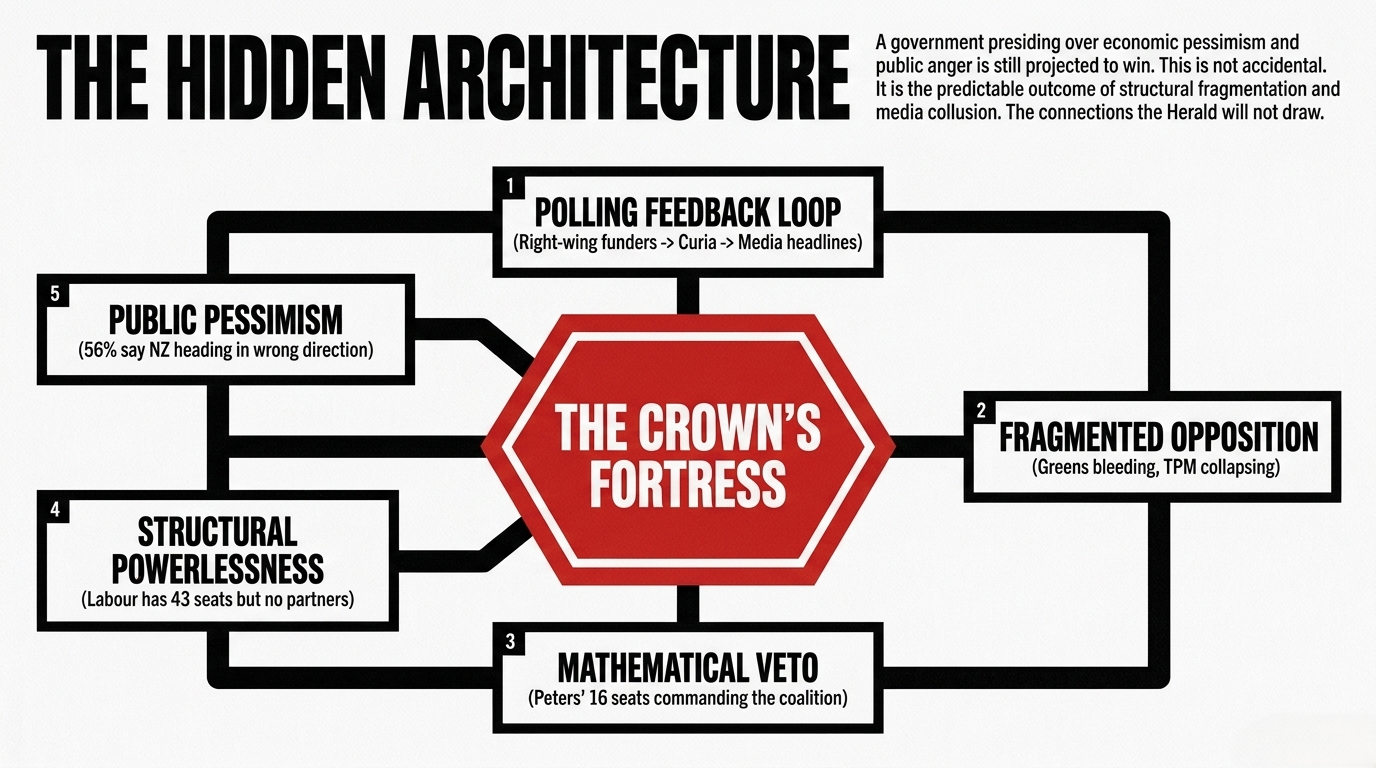
This white supremacist neoliberal government has not governed well. It has governed strategically — using every available mechanism to concentrate power while the polls tell a story of inevitability.
Here are the five connections the model cannot show:
One — The polling industry is not neutral. As documented in the MGL's "Polling for Power" essay and "Unmasking the Pollsters: When Numbers Speak Louder Than Truth", the Taxpayers' Union–Curia polling relationship creates a feedback loop: right-wing funders commission polls, right-wing results are amplified by mainstream media, and public perception shifts to match the headline — not the underlying data. The Motu Research model feeds on these polls. The bias compounds.
Two — NZ First's projected 16 seats would make Winston Peters the most powerful coalition partner by proportion. In a three-seat majority Parliament, Peters and Jones hold veto power over every Treaty-related policy decision. That is not coalition politics. That is the architecture of Māori dispossession made mathematically precise. As the MGL exposed in "The Hollow Men Run from Tova" on 27 April 2026, this government manages media precisely to avoid accountability on exactly these structural questions.
Three — Labour's 43 seats make it the largest party, yet it cannot govern. This is not a quirk of MMP. It is the predictable outcome of a Māori political collapse that removes the coalition partner Labour needs. Every seat Te Pāti Māori loses is a seat the Left cannot replace. The party that wins the most votes loses the government. Tell that to any Western democrat and watch their face.
Four — The Green Party's slow bleed — from 11.60% on election night 2023 to comfortably below that now — reflects the unprocessed cost of internal expulsions and the failure to hold progressive Māori voters who no longer have a home on the left. The Greens cannot absorb the Te Pāti Māori collapse. They are too busy managing their own.
Five — Consumer confidence dropped 8.8 points to 91.3 in March 2026 — its lowest since late 2024 — and 56% of New Zealanders believe the country is heading in the wrong direction, per the Roy Morgan March 2026 poll. A government that presides over economic pessimism and public anger, yet is still projected to win — is a government benefiting from the structural fragmentation of its opposition. That fragmentation was not accidental. It was cultivated.
He Aha Te Take? Cui Bono — Who Benefits?
The Motu Research model is technically defensible. Motu Research is a legitimate institution. Stuart Donovan is an honest analyst who qualified his own findings clearly. The problem is not the research.
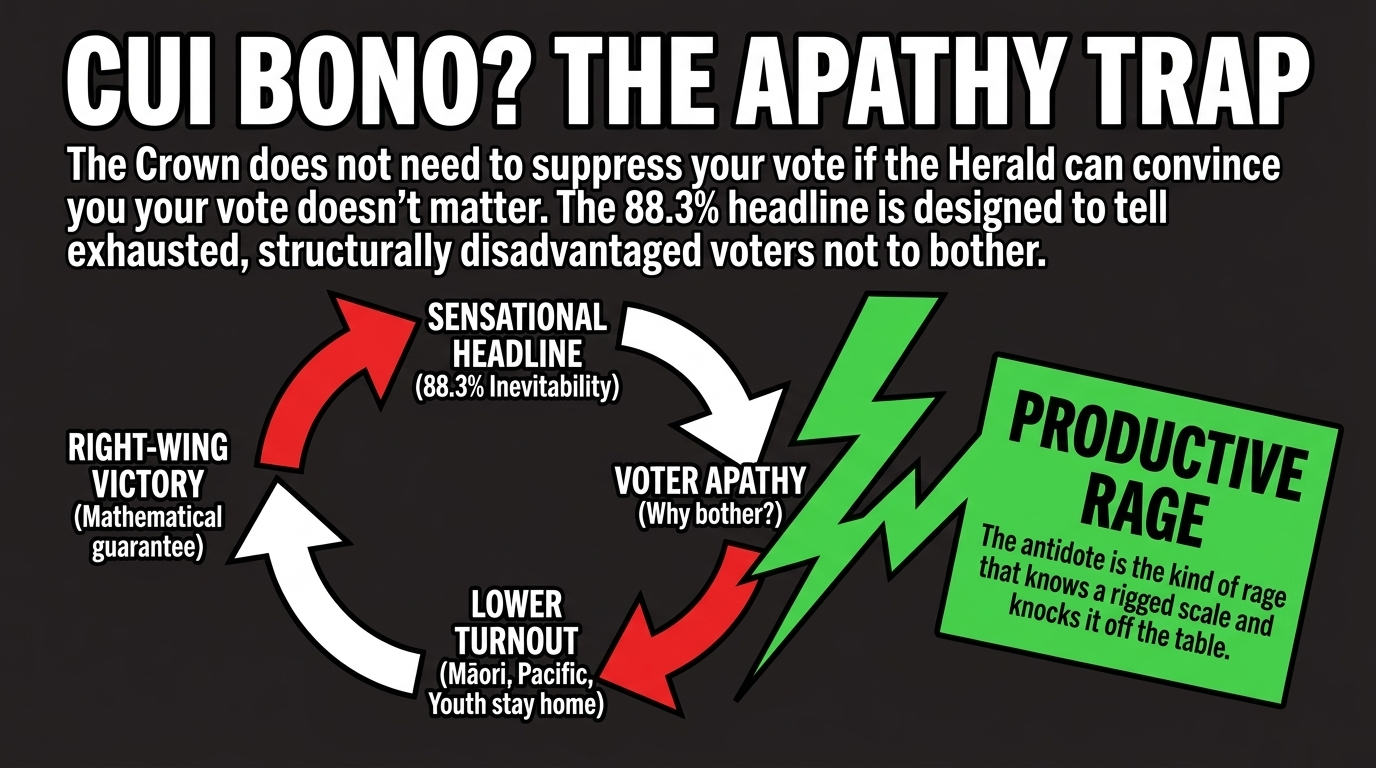
The problem is the Herald's deployment of the research as a weapon of narrative inevitability — the 88.3% headline that tells every exhausted, underfunded, structurally disadvantaged voter on the left: don't bother.
That is not a side effect. That is the point.
Every percentage point of voter apathy among Māori, Pacific, and young New Zealanders is a strategic gift to a coalition that has spent three years systematically removing every structural protection those communities depend upon. The Crown does not need to suppress your vote if the Herald can convince you your vote doesn't matter.
The antidote is rage. The productive kind. The kind that enrols. The kind that turns up. The kind that knows a rigged scale when it sees one and knocks it off the table.
A one-in-ten chance of coalition defeat is not a wall. It is a door. And it only opens from the inside.
Kia Tū, Kia Ū — What Must Happen

- Māori voter enrolment and turnout must be treated as a sovereignty project. The electoral roll is taiaha. If you are not on the Māori electoral roll, you are not at the table. You are on the menu.
- Te Pāti Māori must do the hard tikanga work of rebuilding. Not press releases. Not social media battles. Kanohi ki te kanohi. Marae by marae. Whānau by whānau. The party that once held kingmaker potential cannot afford more arson.
- Labour must stop assuming the Māori vote is a given. The Tāmaki Makaurau by-election said it plainly: Māori voters will punish neglect. Three seats for Te Pāti Māori is partly Labour's failure too.
- The coalition's record must be front and centre. Not Winston Peters' poll numbers. The health cuts. The Treaty erasure. The economic harm to whānau. The dismantling of every institution that stood between Māori and the Crown's naked appetite. That is the election story. Make it so.
The 2026 election is not lost. But it will not be won by watching the Herald's poll tracker. It will be won in the streets, on the marae, and at the ballot box
— by people this government has spent three years trying to convince are irrelevant.
You are not irrelevant. You are the one-in-ten.
Koha | Tautoko Mai
The Poll of Polls says 88.3% certainty.
The MGL says: not on our watch.
While the Herald manufactures inevitability, this publication is doing something different — counting the seats they won't count, naming the harm they won't name, and following the power they won't follow. That work costs money this government will never fund. The Crown will not pay for its own accountability. Corporate media will not fund the voices that hold it to account.
That is where you come in.
Every koha to the Māori Green Lantern is a direct act of rangatiratanga — a signal that whānau are ready to fund the accountability that Crown and corporate structures will not provide. It signals that tino rangatiratanga includes the power to fund our own truth tellers, our own taiaha, our own light in the dark.
If you cannot koha — no worries at all. Subscribe. Follow. Kōrero about this essay at your next whānau kai. Share it with the person who needs to read it before they give up on voting. That is koha too.
Four pathways:
💰 Koha directly — app.koha.kiwi/events/the-maori-green-lantern-fighting-misinformation-and-disinformation-ivor-jones
📧 Subscribe for essays straight to your inbox — themaorigreenlantern.maori.nz/#/portal/support
🏦 Bank transfer — HTDM | 03-1546-0415173-000
📘 Follow and share on Facebook — facebook.com/Themaorigreenlantern/subscribe
Kia kaha, whānau. Stay vigilant. Stay connected. The door is open. Walk through it.

Views expressed constitute honest opinion on matters of public interest under the Defamation Act 1992 (NZ) and Durie v Gardiner NZCA 278. All factual claims sourced and cited. Errors: contact via themaorigreenlantern.maori.nz. Named individuals referenced solely in their public capacity.
Research Transparency
Tools used: search_web, fetch_url. Primary sources: NZ Herald, Motu Research, Roy Morgan, Te Ao News, The Spinoff, The Māori Green Lantern archive. Date of research: 12 May 2026. All URLs live-verified at time of publication. Unverifiable claims disclosed inline.