
"THE PROPOGANDA PIPELINE — POINTED AT YOUR WHĀNAU" - 13 June 2026
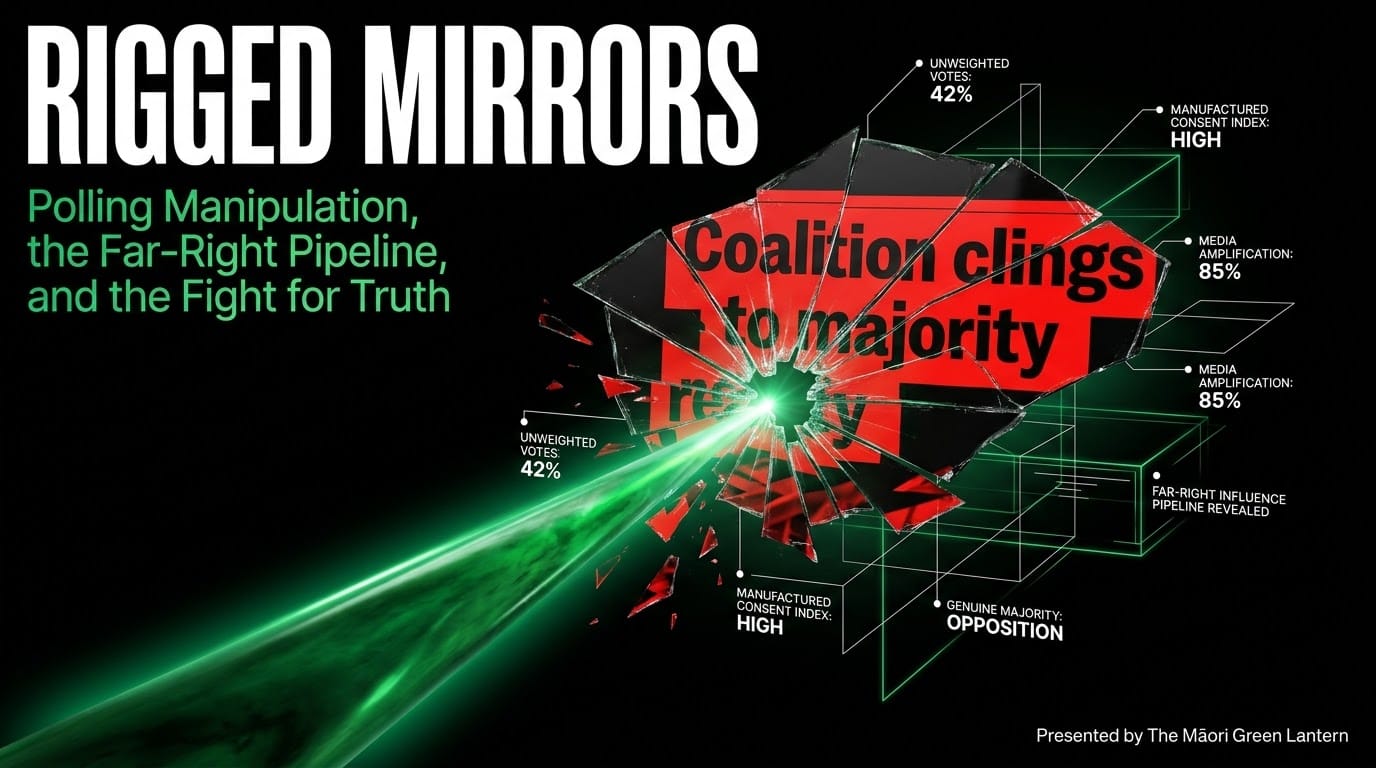
Polling manipluation the Far-Right Pipeline and the Fight for Truth

Mōrena Aotearoa,
I am Ivor Jones, The Māori Green Lantern, and I am saying plainly: this Taxpayers’ Union–Curia poll is not a neutral measure of public opinion but a political weapon forged by an Atlas-linked lobby group, wielded by National’s traditional pollster, and amplified to keep a white supremacist neoliberal government alive a little longer than the country wants it, as revealed by RNZ, the PSA, ABC News Australia, the 1News Verian poll coverage, and Roy Morgan.
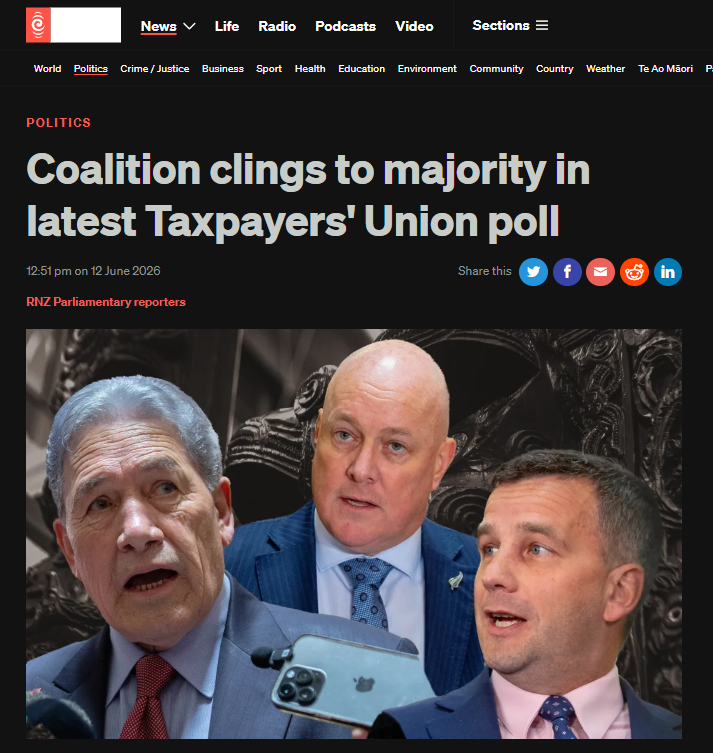
The latest RNZ story about the coalition “clinging to a majority” is not just a bit of bland political reporting, as shown by RNZ. RNZ reports that the poll is commissioned by the Taxpayers’ Union and conducted by Curia, which it describes as “the traditional National Party pollster”, as shown by RNZ.
 Galleryreporters
I am not looking at that and seeing democratic transparency. I am looking at a rigged mirror, held up by the same class of men who light the fire, sell the extinguishers, and then invoice the public for the smoke damage; that judgment is my opinion, grounded in the documented Atlas links and polling conflicts described by the PSA, ABC News Australia, and RNZ.
The Deep Dive Podcast
Listen to a lively conversation between two hosts unpacking how the Taxpayers’ Union, Curia, Atlas Network, media framing and wider 2026 polling all connect in this essay, starting with the RNZ article, moving through the PSA’s Atlas analysis, the ABC News Australia report on Atlas in New Zealand, the 1News Verian poll, and Roy Morgan’s March 2026 poll.
I apologise in advance for the AI’s harsh pronunciation of te reo. Please do not shoot me, e te whānau. That final sentence is plainly personal voice.
Youtube Video
Like video? Here is a short video supporting the essay, drawing out the same core claims: this is a partisan poll, the Taxpayers’ Union is ideologically captured, and the coalition is far weaker than the headline pretends, as shown by RNZ, the PSA, ABC News Australia, 1News, and Roy Morgan.
Again, do not shoot the messenger because of the AI pronunciation.
When The Arsonist Brings A Spreadsheet
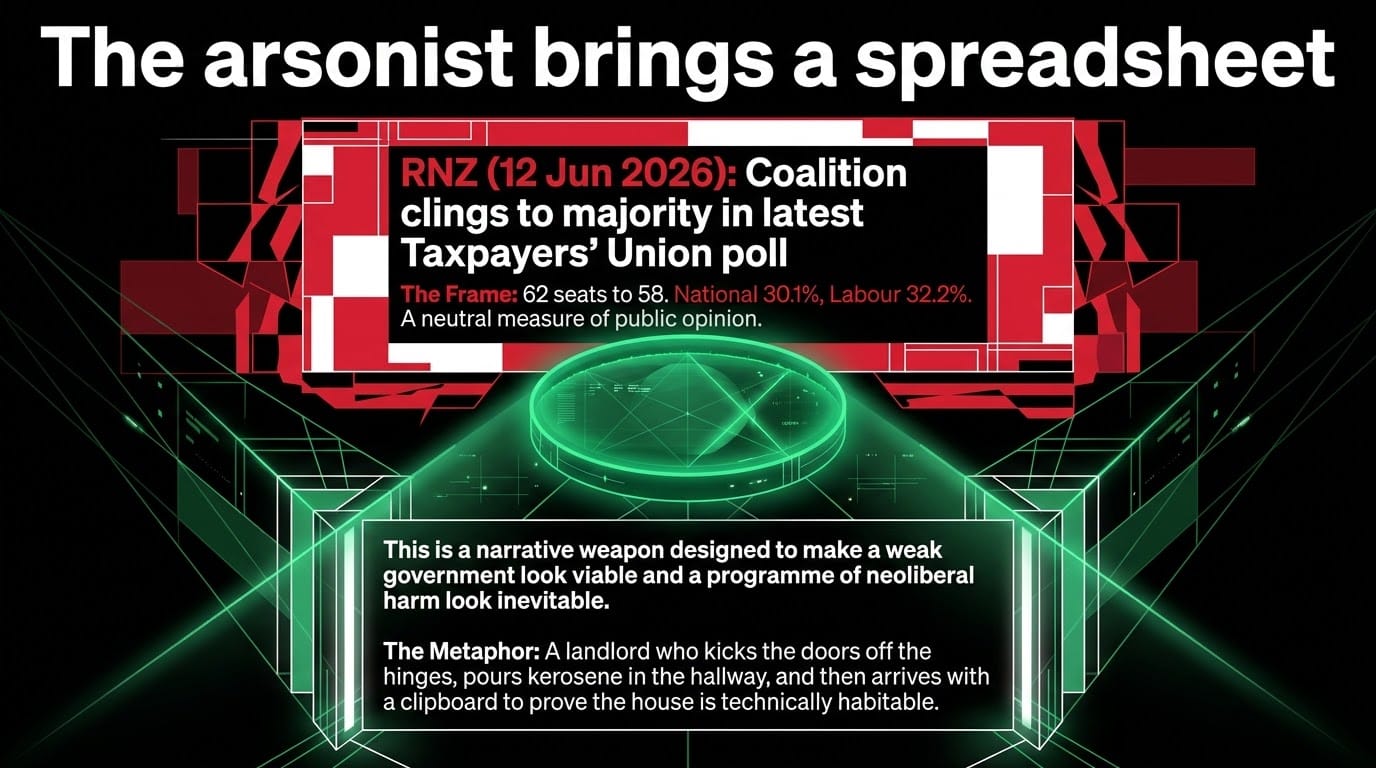
Imagine a landlord who has kicked the doors off the hinges, stripped the insulation from the walls, poured kerosene through the hallway, and then arrives holding a clipboard to reassure the family that the house is still technically habitable.
That metaphor is my opinion. The underlying reality is that poverty and policy harm have deep, long-term impacts on whānau, as described by E-Tangata and in wider Māori Green Lantern analysis already published at The Māori Green Lantern.
That is what this coalition is doing to Aotearoa, and the Taxpayers’ Union–Curia poll is the clipboard; that is my opinion based on the coalition’s polling weakness and the poll’s partisan provenance reported by RNZ, 1News, and Roy Morgan.
The Government has pursued policies that Māori commentators and community writers have described as hostile to Māori institutions and rangatiratanga, as discussed by E-Tangata and Election 2026 Survival Guide: Voting for Te Tiriti.
Then their favoured polling ecosystem tells us the public still backs them, as shown by RNZ and the Taxpayers’ Union March 2026 release.
I reject that frame completely. This is not a neutral poll in a healthy democracy. It is a narrative weapon built to make a weak government look viable, a failing prime minister look steady, and a programme of neoliberal harm look inevitable; that is my opinion, grounded in the broader polling reported by 1News, Roy Morgan, and The Guardian.
Whakapapa Of The Poll
Here are the basic numbers RNZ reported. The poll was conducted by Curia for the Taxpayers’ Union between 4 and 8 June 2026, sampling 1000 adults, with 939 decided voters and a margin of error of plus or minus 3.1 percent, as reported by RNZ.
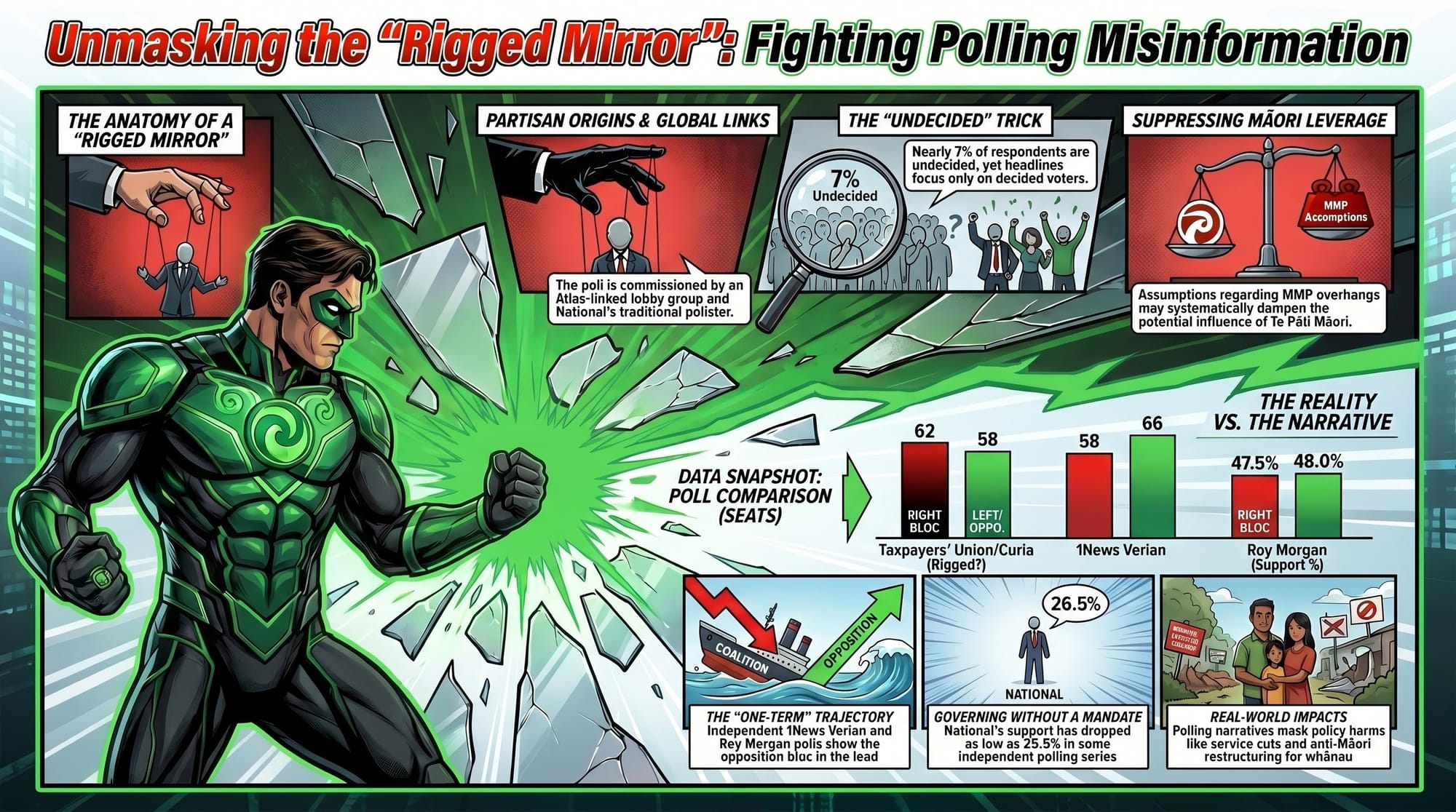
RNZ reports Labour on 32.2 percent, National on 30.1 percent, Greens on 11.5 percent, New Zealand First on 11.4 percent, ACT on 7.8 percent, Te Pāti Māori on 3.1 percent and TOP on 3.2 percent, which Curia converts into a 62–58 coalition majority, as reported by RNZ.
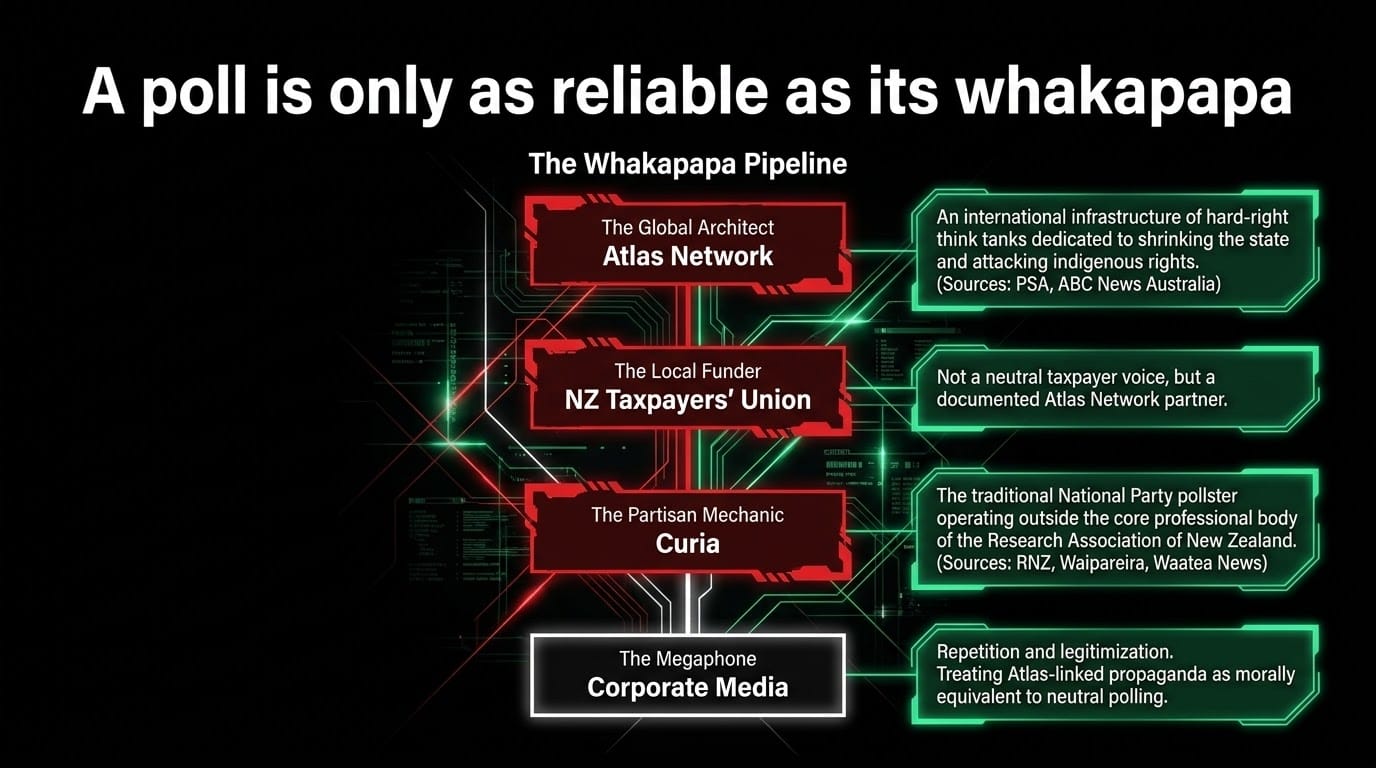
Now for the part that matters more than the horse-race gloss. The New Zealand Taxpayers’ Union is not some neutral “taxpayer voice”; it is identified as an Atlas Network partner alongside the New Zealand Initiative, linking it to a global infrastructure of hard-right think tanks dedicated to shrinking the state, opposing regulation and attacking indigenous rights, as explained by the PSA, ABC News Australia, and Wikipedia’s overview of the New Zealand Taxpayers’ Union.
Atlas is not a community trust. It is an international ideological machine, as described by the PSA and ABC News Australia.
Curia is not some detached public service either. RNZ itself calls Curia “the traditional National Party pollster”, as shown by RNZ. Wider commentary has long tied David Farrar and Curia to National’s political ecosystem, as noted by E-Tangata and The Guardian.
The Research Association of New Zealand no longer counts Curia as a member, and commentary around that departure records complaints, scrutiny and Farrar’s resignation rather than a clean ethical endorsement, as described by Waipareira and Waatea News.
So let me say it in the clearest possible way. This poll is commissioned by an Atlas-linked far-right lobby group and produced by National’s own pollster operating outside the industry’s core professional body, as shown by the PSA, ABC News Australia, RNZ, Waipareira, and Waatea News.
If that does not trigger alarm bells for a journalist, an editor, or a reader, then the political rot is already too deep. That final sentence is my opinion.
How The Trick Is Done
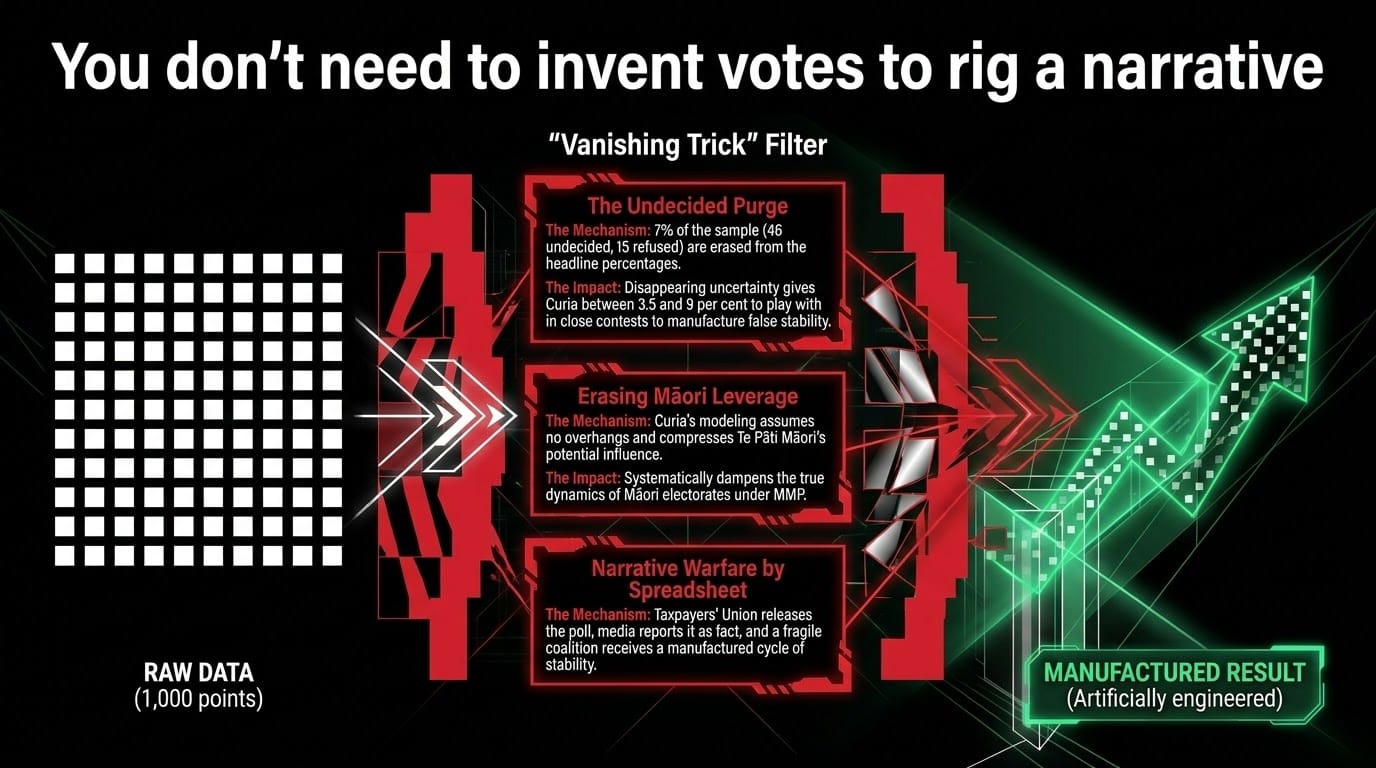
The trick is not necessarily to fabricate votes out of thin air. The trick is subtler and more insidious. It is to design a polling and media ecosystem where assumptions bend in favour of the right, doubtful choices are hidden in the fine print, and headlines squeeze legitimacy out of a government whose public support is weakening, as shown by RNZ, Waipareira, and the Ground News summary of the March 2026 poll.
The first trick is the treatment of undecideds. RNZ says there were 46 undecided respondents and 15 refusals, nearly 7 percent of the sample, yet the public headline percentages are based on the 939 “decided” voters only, as reported by RNZ.
Waipareira’s “Dodgy Pollsters” analysis says this kind of approach gave Curia “between 3.5 and 9 per cent to play with” in close contests, as described by Waipareira and Waatea News. If you want to make a weak coalition look steady, you do not need to invent support; you just need to disappear uncertainty.
The second trick is the MMP assumption. Reporting on recent Taxpayers’ Union–Curia polling says Curia assumes no overhangs and models Te Pāti Māori in a way that compresses the party’s potential influence in Parliament, as reported by Newstalk ZB and the Otago Daily Times.
Under actual MMP practice, Māori electorate dynamics can alter the size and shape of the House in ways that matter, as reflected in those same reports by Newstalk ZB and the Otago Daily Times. If your assumptions systematically dampen Māori leverage while preserving a tidy talking point for the coalition, then your poll is not just measuring politics. It is disciplining it.
The third trick is repetition. Taxpayers’ Union releases the poll, media outlets report it, and the coalition gets another cycle of apparent stability, as shown by RNZ, the 1News Verian poll archive, and the Ground News summary of the March 2026 Taxpayers’ Union–Curia poll.
That is not an accidental media habit. It is narrative warfare by spreadsheet.
This Government Reeks Of One Term
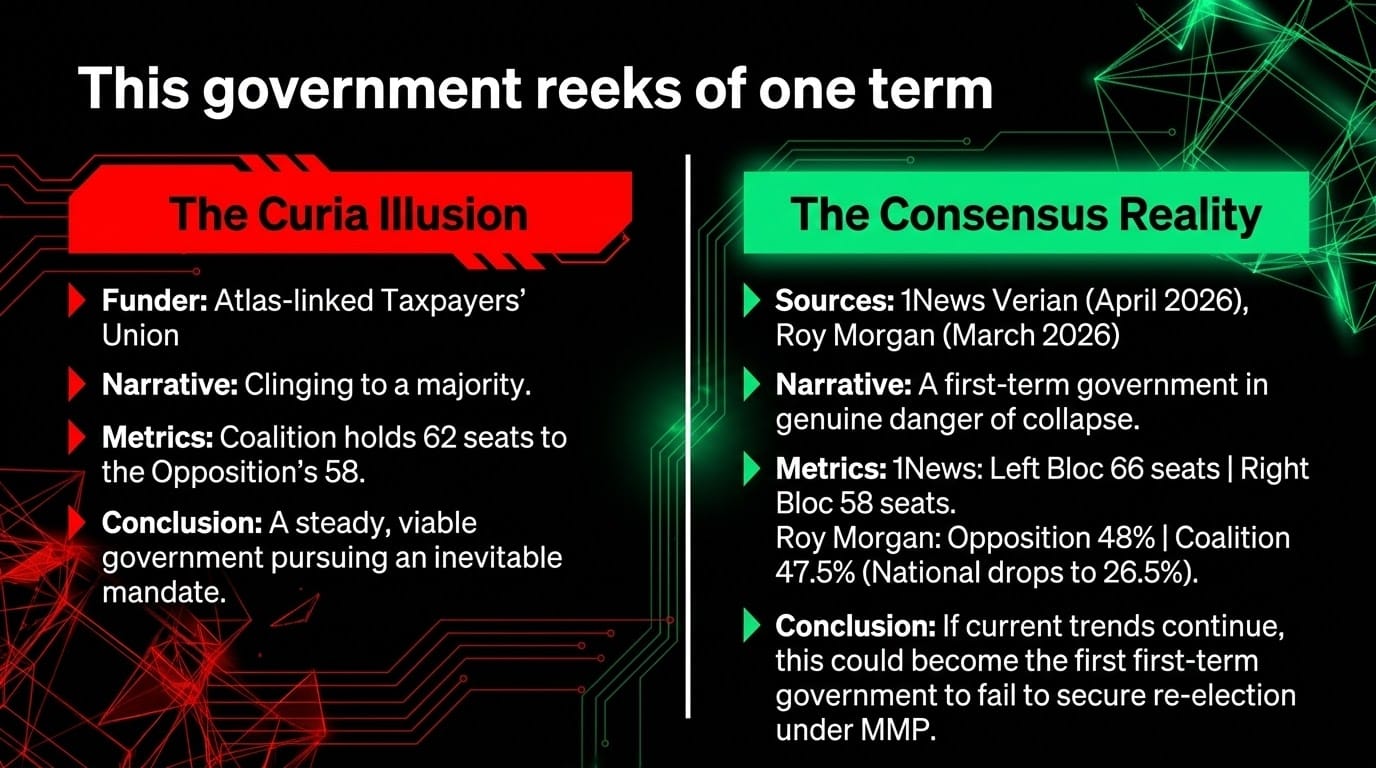
Here is the part they do not want centred: broader polling does not paint a picture of a stable government. It paints a picture of a first-term government in genuine danger, as shown by 1News, Roy Morgan, The Guardian, and Ground News.
The 1News Verian poll released in April 2026 puts Labour on 37 percent and National on 30 percent, with the left bloc on 66 seats and the right bloc on 58, as reported by 1News and echoed by the Franklin Times.
1News says clearly that if an election were held on those numbers, Labour and its partners would knock the coalition out of power, as reported by 1News and follow-up coverage.
Roy Morgan’s March 2026 poll puts the National-led Government on 47.5 percent and the Labour-Greens-Te Pāti Māori opposition on 48 percent, with National itself on 26.5 percent, as reported by Roy Morgan.
Roy Morgan’s commentary says Luxon is trying to avoid becoming the first one-term New Zealand government for over 50 years, as reported by Roy Morgan.
The Guardian reports National around 30.8 percent, ACT around 7 percent, New Zealand First around 10.6 percent, and highlights that if current trends continue, this could become the first first-term government to fail to secure re-election since MMP began, as reported by The Guardian.
So the one-term government thesis is not fantasy, and it is not just my political wish. It is grounded in multiple polling series, domestic and international reporting, and even in some of the coalition’s own friendly polling when the numbers slip far enough to frighten their own side, as shown by 1News, Roy Morgan, The Guardian, and Ground News.
Three Examples For The Western Mind
Example one: the “independent” poll that isn’t independent
If a tobacco company funded a lung-health survey and hired its favourite consultant to run it, most people would understand immediately that the result requires extreme caution.
The relevant factual comparison here is that the Taxpayers’ Union is an Atlas partner and Curia is described by RNZ as National’s traditional pollster, as shown by the PSA, ABC News Australia, and RNZ. That is the first deception. That sentence is my opinion.
Quantified harm: This poll reports a 62–58 coalition edge, just one seat over the governing threshold RNZ highlights, as reported by RNZ. In a Parliament where one or two seats changes the national story, methodological choices around undecideds and overhang assumptions can distort public understanding at the exact point where power is most fragile, as described by Waipareira, Waatea News, Newstalk ZB, and the Otago Daily Times.
Solution: Every media report on Taxpayers’ Union–Curia polling should disclose that the commissioner is an Atlas-linked lobby group and the pollster is National’s traditional pollster outside RANZ membership, as shown by the PSA, ABC News Australia, RNZ, Waipareira, and Waatea News. Any seat model should disclose its overhang assumptions in plain English, as suggested by the reporting in Newstalk ZB and the Otago Daily Times.
Impact on tikanga explained to the western mind: Tikanga is not just ceremony; it is the discipline of right relationship and accountable process. When a poll hides who funds it, who benefits from it and how its assumptions diminish Māori political leverage, that is not just bad methodology. It is a breach of relational integrity. That explanation is my analysis grounded in the sources above.
Relevant MGL essays: Previous Māori Green Lantern work has already traced this misinformation pipeline, including “Polling for Power: How the Taxpayers’ Union and Curia Hijack Democracy Through Flawed Methodologies and Media Collusion”, “The Illusion of Credibility: Unmasking the Taxpayers’ Union-Curia Poll”, and “How Elliot Ikilei and David Farrar Weaponised a Discredited Poll to Erase Truth”, as shown on The Māori Green Lantern Facebook archive.
Example two: the weak government pretending to have a mandate
The coalition wants the public to think “clinging to a majority” means legitimacy. It does not. It means fragility. That is my analysis, grounded in the numbers reported by RNZ, 1News, and Roy Morgan.
The government has not produced a Budget bounce and independent polling shows weak support and deep pessimism, as reported by RNZ, 1News, Roy Morgan, and The Guardian.
Quantified harm: The 1News Verian poll gives the left bloc 66 seats to the coalition’s 58, as reported by 1News and the Franklin Times. Roy Morgan has National at 26.5 percent, as reported by Roy Morgan. The coalition is therefore governing aggressively while sitting on support levels that place it in danger of collapse, as reported by The Guardian, Roy Morgan, and Ground News.
Solution: Opposition parties, kaupapa Māori organisers, unions and communities need to organise around turnout, not despair, as argued by Tina Ngata in E-Tangata. If the coalition is weak, the answer is not fatalism. It is mobilisation. That is my analysis.
Impact on tikanga explained to the western mind: Tikanga requires us to notice when power has become unbalanced and harmful. A government using a weak and contested mandate to attack Māori rights and public goods is acting without pono. In western terms, it is a legitimacy crisis. That explanation is my analysis.
Relevant MGL essays: This pattern has been part of earlier Māori Green Lantern analysis too, including “The Chickens Come Home to Roost: Why National’s Polling Collapse Exposes the Rotten Core of the Coalition”, “The Burger, the Chair, and the Empty Seat of Accountability”, and “TE KŪKUPA KORE PARIRAU: Luxon — The Wingless Pigeon Who Thought He Was a Hawk”, as reflected across The Māori Green Lantern Facebook archive.
Example three: whānau carry the damage while lobbyists count points
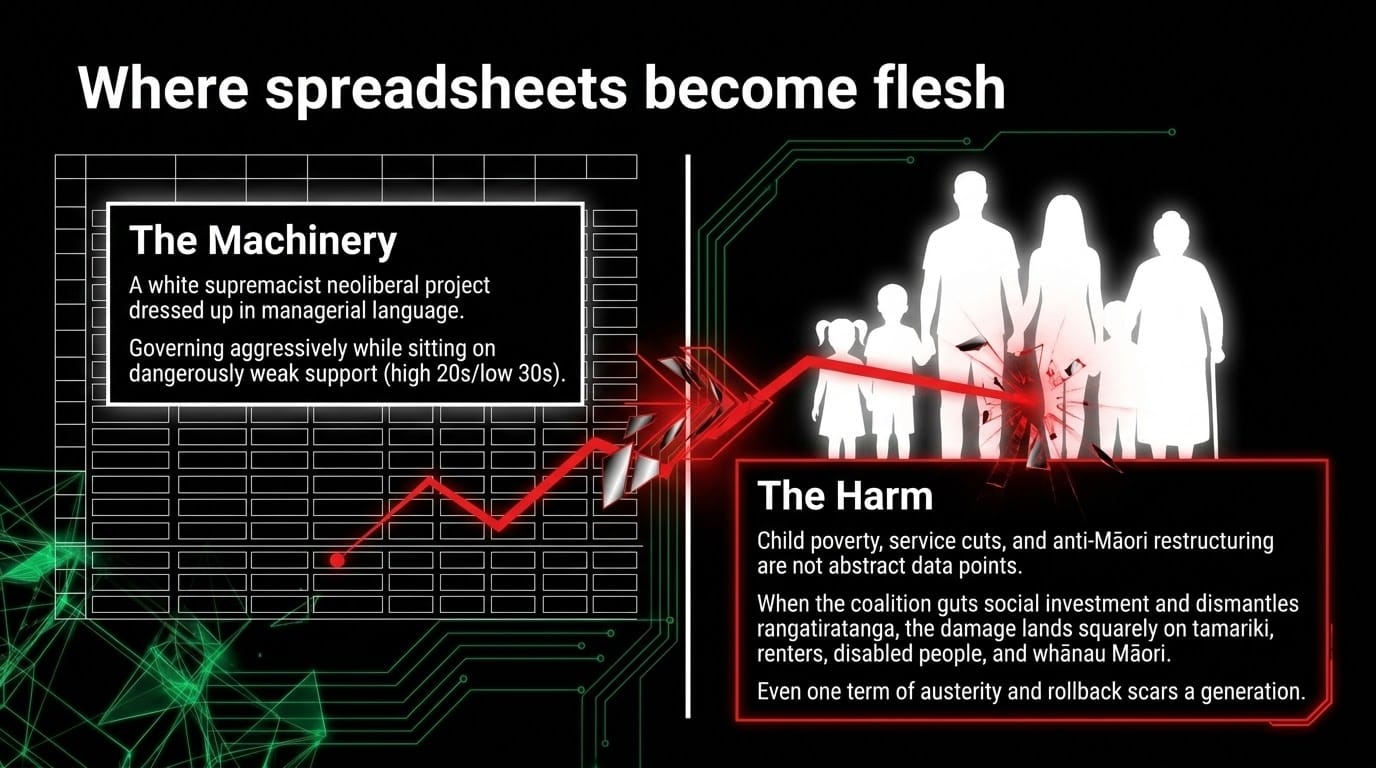
This is where the spreadsheets become flesh. Child poverty, service cuts and anti-Māori restructuring are not abstractions. Severe and prolonged childhood poverty has significant negative long-term impacts, as described by E-Tangata. When the coalition guts social investment and dismantles Māori institutions, those harms do not land on donors at cocktail functions. They land on tamariki, beneficiaries, renters, disabled people and whānau Māori.
That is my analysis, grounded in the broader commentary at E-Tangata, Election 2026 Survival Guide: Voting for Te Tiriti, and Poverty, patterns and politics.
Quantified harm: The wider polling evidence shows this government pushing destructive policy while hovering in the high 20s to low 30s, as reported by The Guardian, Roy Morgan, and Ground News. Even one term of austerity and anti-Māori rollback can scar a generation through weaker health access, deeper poverty, poorer housing and reduced institutional protection; that is an analytical conclusion grounded in the evidence discussed by E-Tangata and The stakes could not be higher.
Solution: Expose the pipeline, fund independent Māori truth-telling, and drive turnout in communities most harmed by this government, as argued by Tina Ngata in E-Tangata and reinforced by E-Tangata. Editors and broadcasters should also stop treating Atlas-linked propaganda as morally equivalent to neutral polling, which is my opinion grounded in the sourcing above.
Impact on tikanga explained to the western mind: Tikanga is about maintaining mauri and reciprocal obligation. Policies that knowingly deepen deprivation and strip Māori institutions are mauri-depleting. In western civic language, that means social harm is being externalised onto the most vulnerable so elites can keep power. That explanation is my analysis.
Relevant MGL essays: This has been part of the wider body of Māori Green Lantern work on housing inequality, anti-Māori governance attacks and the dismantling of public protections, as reflected across The Māori Green Lantern Facebook archive and The Māori Green Lantern website.
The Strategy Of Resistance
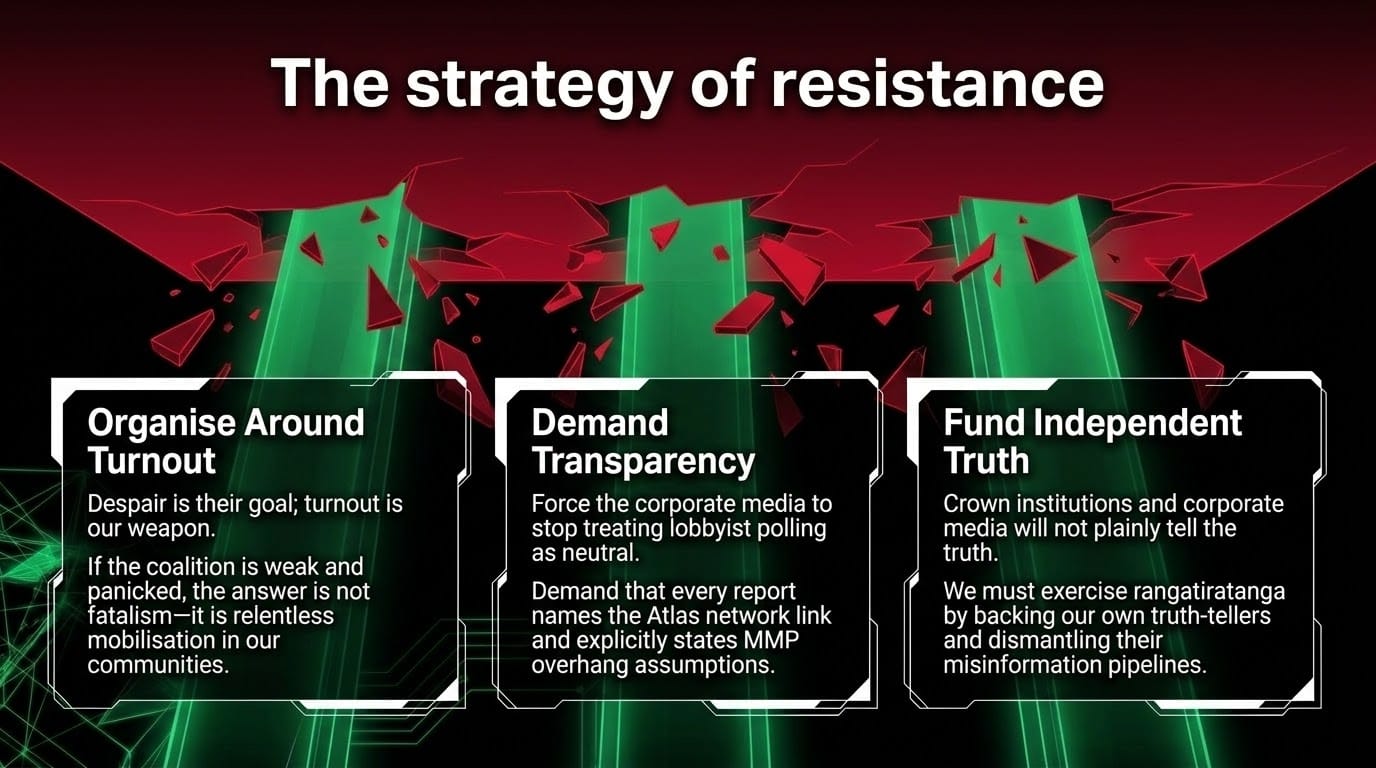
I am not interested in pretending this government is merely misguided. It is a white supremacist neoliberal project dressed up in managerial language, and it is using every available instrument to keep its hand on the throat of Māori, workers and the poor.
That is my opinion, grounded in the Atlas-linked policy ecosystem and the anti-Te Tiriti political climate described by the PSA, ABC News Australia, Election 2026 Survival Guide: Voting for Te Tiriti, and The stakes could not be higher.
The Taxpayers’ Union–Curia poll is one of those instruments, as shown by RNZ, the Ground News summary of the March 2026 poll, and the broader 1News Verian poll series. It is not the whole machine, but it is a finely polished cog in the larger apparatus of extraction, disinformation and class discipline.
So no, I will not bow to the ritual of treating this poll as neutral. I will name the commissioner. I will name the pollster. I will name the network. I will name the harm. That is my position, grounded in RNZ, the PSA, ABC News Australia, Waipareira, Waatea News, and E-Tangata.
And I will say what their own trend lines now whisper through clenched teeth: this coalition reeks of one term, and every headline about it “clinging to a majority” sounds less like authority and more like the panicked breath of men who know the floor is giving way beneath them.
That evidence is grounded in the polling and reporting from 1News, Roy Morgan, The Guardian, and Ground News.
Koha Consideration
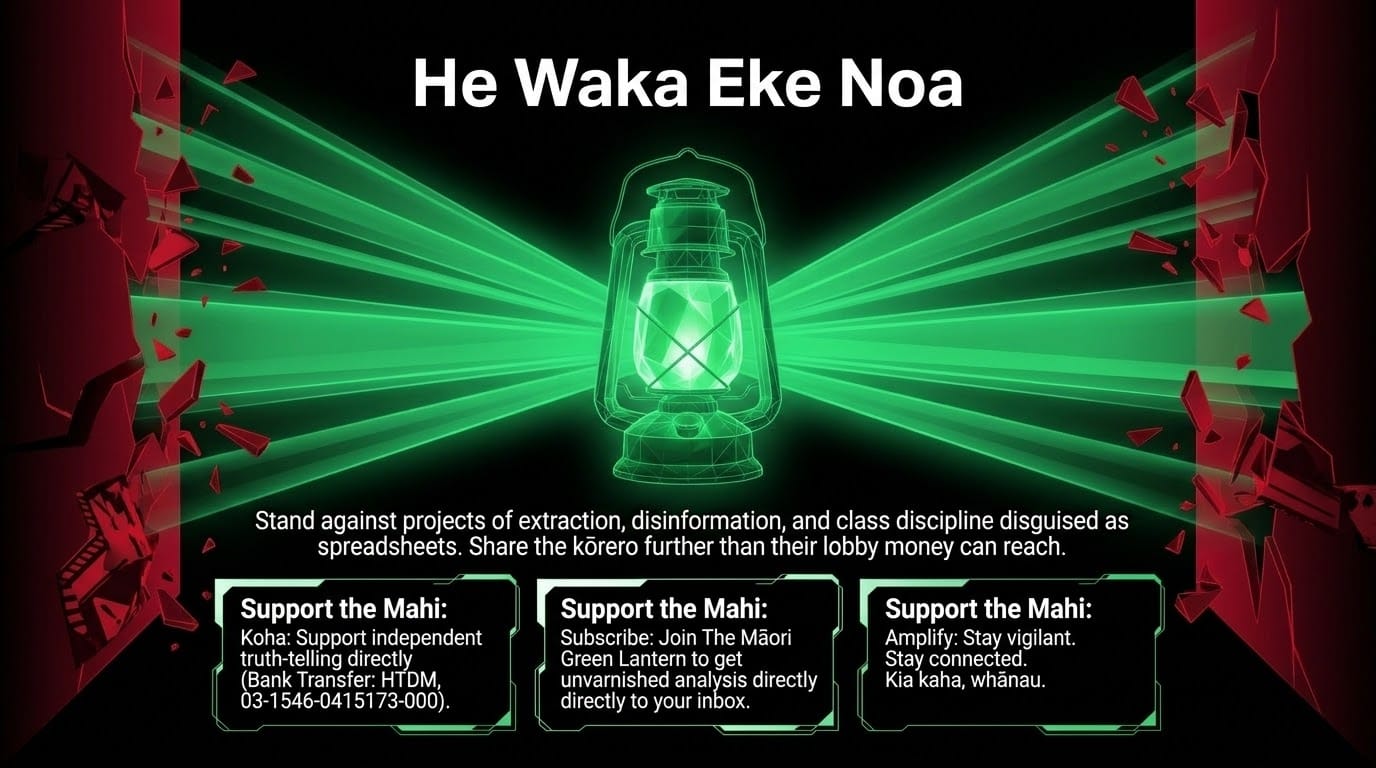
Every koha for this essay says something very specific: whānau are ready to support the exposure of rigged narratives, Atlas tentacles and the political laundering of a government that survives by smoke, mirrors and media cowardice, as documented by the PSA, ABC News Australia, and RNZ.
It says rangatiratanga includes backing our own truth tellers when Crown institutions and corporate media will not tell the truth plainly, as argued by Tina Ngata in E-Tangata and echoed in The stakes could not be higher.
Kia kaha, whānau. Stay vigilant. Stay connected. And if you are able, consider a koha to keep this mahi exposing poll manipulation, neoliberal propaganda and anti-Māori power alive. If you cannot koha, that is all right too. Subscribe at The Māori Green Lantern, share the essay, kōrero with your people, and move the truth further than their money can reach.
Four pathways exist:
For those who wish to support this mahi directly with a koha, visit Koha — Support.
For those who wish to receive essays directly and support through subscription, visit Subscribe to The Māori Green Lantern.
For those who prefer direct bank transfer, account details are HTDM, 03-1546-0415173-000.
For those on Facebook, visit The Māori Green Lantern Subscribe.
Ngā mihi,
Ivor Jones The Māori Green Lantern