"The Official Information Act Is Not Failing. It Is Being Strangled." - 14 June 2026
Fonterra got hand-delivered lobbying documents and a law to kill their lawsuit. Whānau Māori got 20 working days, a redaction, and an Ombudsman with no power to do a damn thing about it.

Mōrena Whānau,
I am going to tell you exactly what is happening to the law that is supposed to let you see your own government. I am going to name every beneficiary. I am going to name every person being harmed. And I am going to prove every word.
 RNZ News
The Official Information Act was built on a single principle: the Crown's business belongs to the public, not to the Crown.
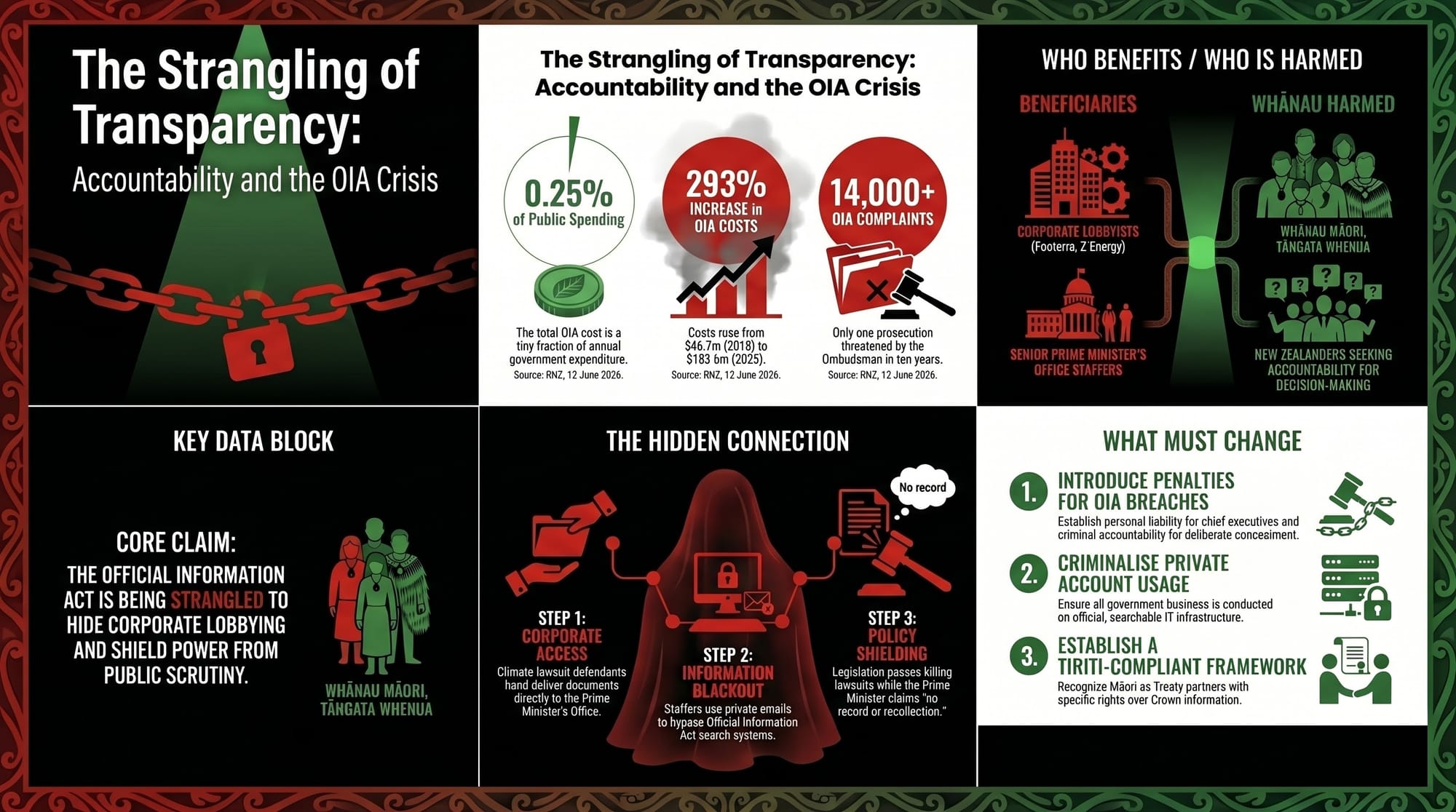
In June 2026, the Luxon government is systematically dismantling that principle — routing corporate lobbying documents through private email accounts, failing to record meetings with major emitters fighting a climate lawsuit, and quietly commissioning a secret review of the transparency law itself. All while the former chief ombudsman confirms on record that the law has no teeth, no penalties, and no consequences for those who breach it.
Ko au tēnei, Ivor Jones. Te Arawa. Ngāti Pikiao. Welsh whakapapa. I live in Ōpōtiki, a whēnua that was taken illegally.
I operate The Māori Green Lantern because this work does not get done anywhere else — not from inside a kaupapa Māori framework, not with this commitment to naming the connections the powerful prefer to keep unnamed.
The Deep Dive Podcast
Listen to a lively conversation between two hosts, unpacking and connecting topics in the sources of this essay. I apologise in advance for the AI's very harsh pronounciation of reo. Please dont shoot me, :).
Youtube Video
Like video? Here is a short video suppporting the essay. Again, don't shoot the messenger please because of AI's pronounciation. :)
The PMO Scandal: "No Record or Recollection"
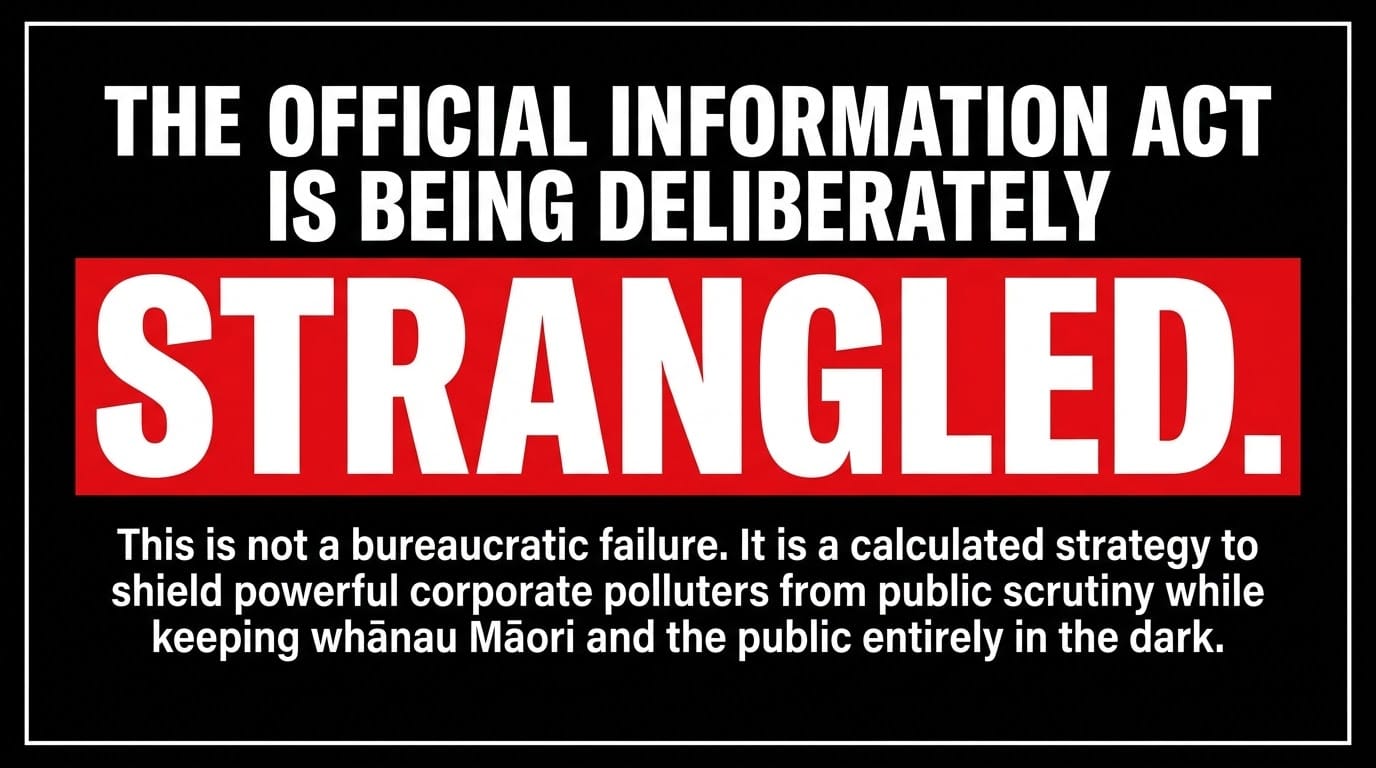
As RNZ's Lillian Hanly reported on 12 June 2026, the Chief Ombudsman has confirmed an active investigation into the "apparent withholding" of official information following a complaint about the way the Prime Minister's Office handled an OIA request.
 Lillian Hanly
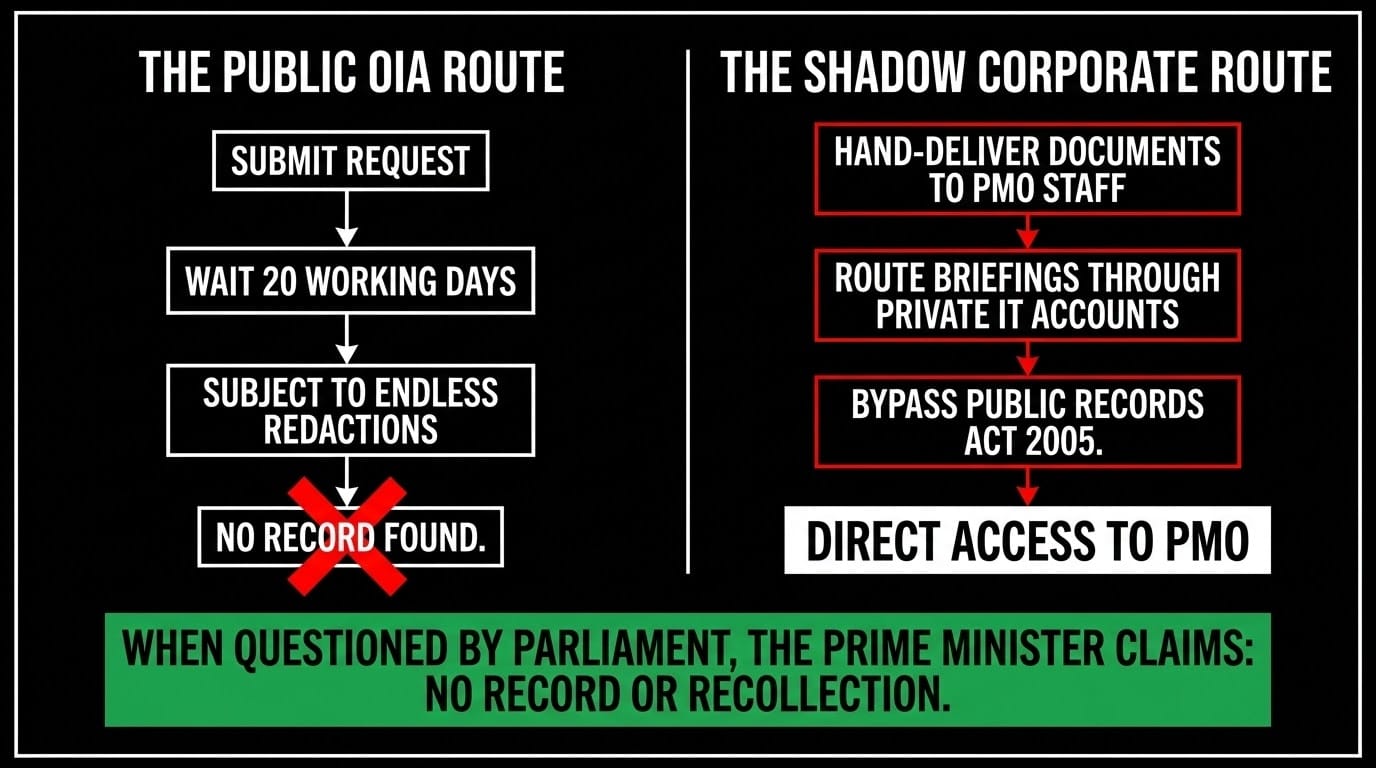
The specific facts: a previously undisclosed document was sent to a senior PMO staffer's private email account — outside official IT infrastructure, where it would never surface in an OIA search.
Lobbying documents from two companies involved in the Smith v Fonterra climate case were hand-delivered to the PMO, never recorded in official systems, and never disclosed when an OIA request was made, as reported by RNZ.
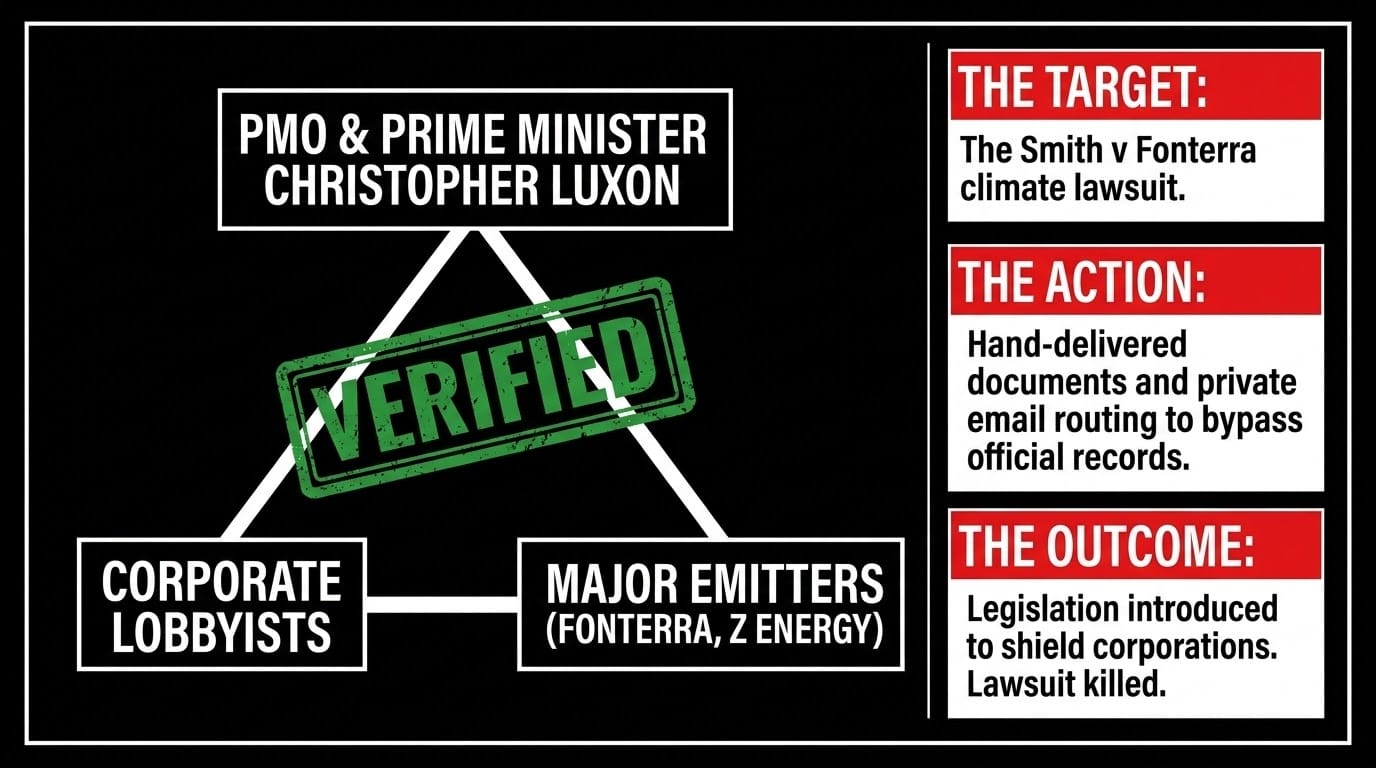
When Parliament asked Christopher Luxon about those meetings, he said there was "no record or recollection" of them.
That phrase does not mean it did not happen. It means the information management systems of the most powerful office in this country were operated in a way that ensured it would never have to be proven. No record. No recollection. No accountability.
"Trust in government depends on New Zealanders being able to see how decisions are made and who is influencing them. When records of meetings with corporate lobbyists don't exist, that trust is undermined," Labour justice spokesperson Camilla Belich said, as quoted by RNZ.
Belich has formally written to the Auditor-General requesting a full performance audit of the PMO, asking whether it has adequate systems for recording meetings with external parties, whether hand-delivered briefings and private-account communications have gone unrecorded, whether the Public Records Act 2005 is being met, and whether OIA searches are designed so that information actually held is reliably surfaced and disclosed, as detailed by RNZ.
I want to say what she could not say in that press release: Fonterra and Z Energy were defendants in an active climate lawsuit. The government introduced legislation to shield them. Before it passed, their representatives hand-delivered documents to the PMO. Those documents were never recorded. The legislation passed. The lawsuit was killed. The Prime Minister says he has no memory of any of it.
Cui bono? Verified.
The Law Has No Teeth — The Former Chief Ombudsman Says So
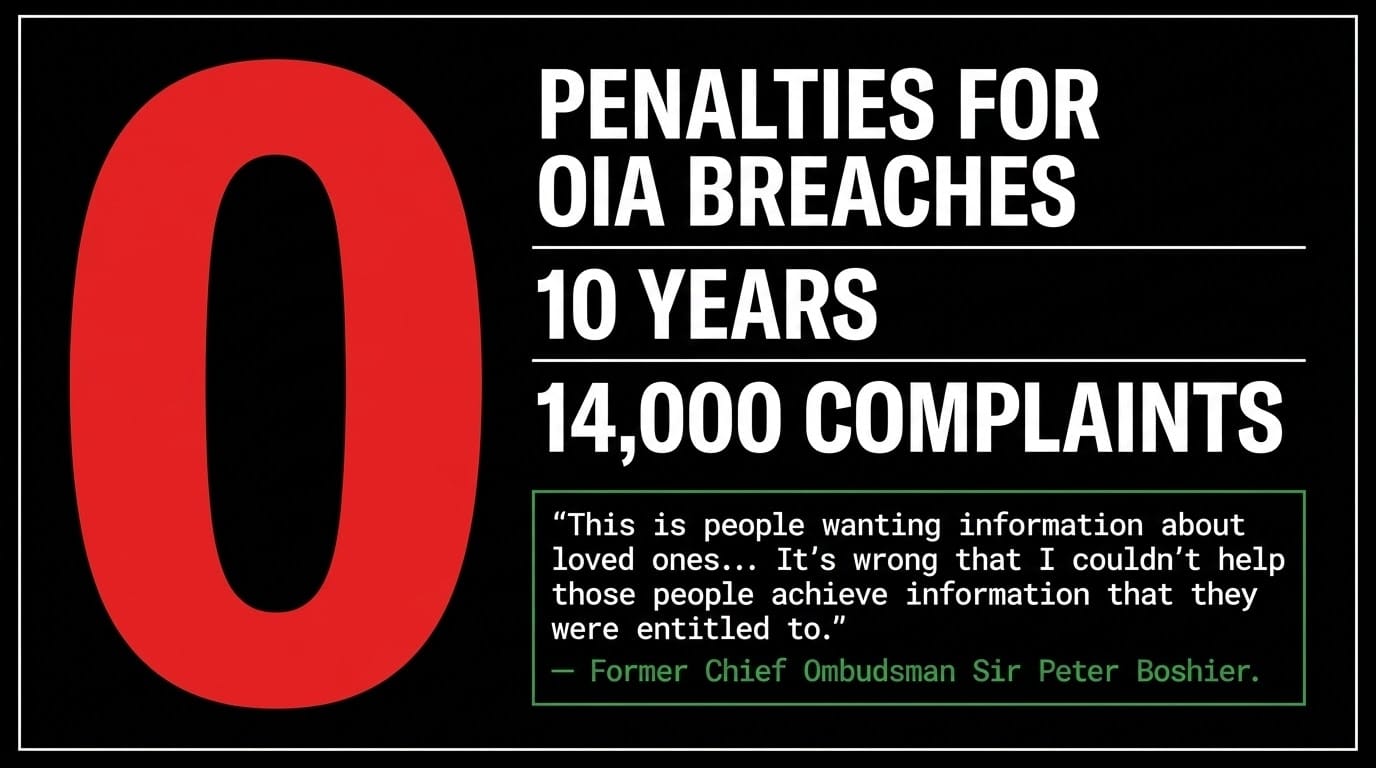
Here is what makes this scandal structurally sustainable: the OIA cannot stop it, because the OIA has no enforcement mechanism.
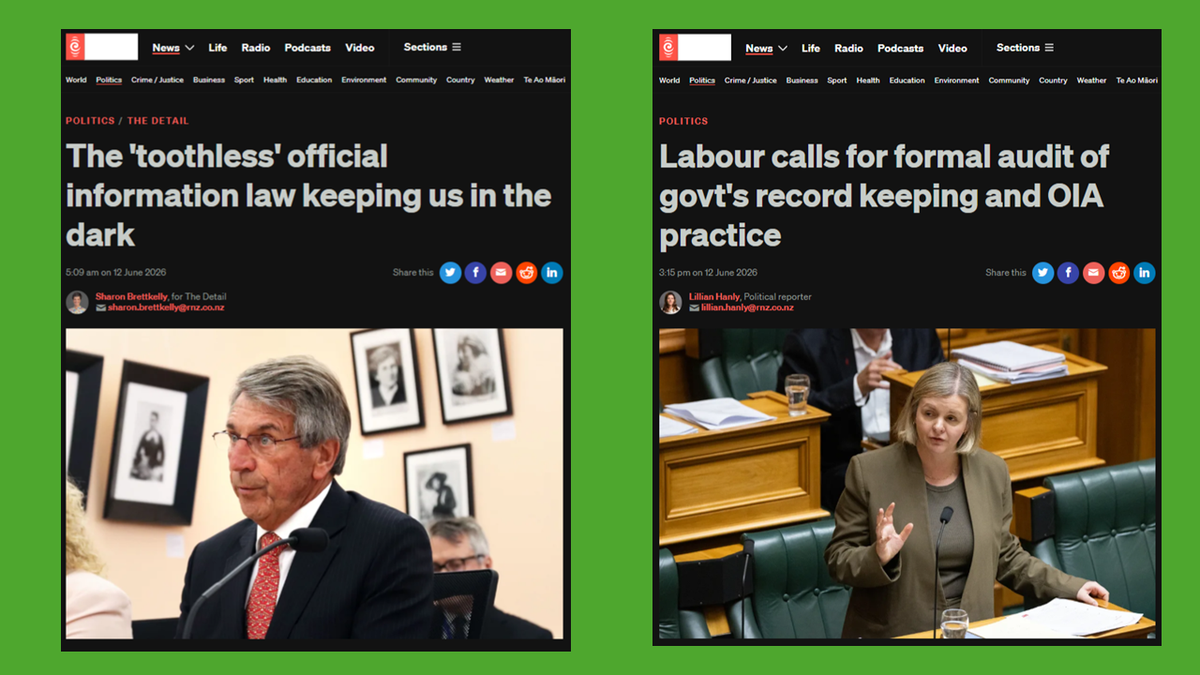
As RNZ's Sharon Brettkelly reported for The Detail on 12 June 2026, former chief ombudsman Sir Peter Boshier — who held the role from December 2015 to March 2025, handling more than 14,000 OIA complaints — has confirmed the Act carries no consequences for non-compliance.
Boshier revealed that in nearly ten years in the role, there was only one occasion he came close to prosecution: when Te Whatu Ora repeatedly failed to respond to OIA requests, delayed, then failed to provide material even after promising to, as reported by RNZ.
The only lever he had was threatening to ask the Solicitor-General to prosecute. He never had to use it before. In ten years. With 14,000 complaints.
"This is, at the end of the day, people wanting information about loved ones, either deceased or alive, and this is the accountability and the ability to participate in decision-making that the Act's all about. It's wrong that I couldn't help those people achieve information that they were entitled to," Boshier said, as quoted by RNZ.
The man responsible for enforcing the OIA for a decade is saying: I could not help people get what the law entitled them to. Because the law carries no penalties.
Stuff investigative journalist Andrea Vance named the stakes directly, as quoted by RNZ: "There are no consequences for breaching the OIA, for not releasing information, for holding back information until it's politically convenient to release it. The OIA is so important — at a time when trust in democracy is being eroded, it's really, really important that we have transparency in our government, our politics and our public service."
Every other law has penalties for breach. The OIA does not. That is not an oversight. It is a design choice — and the people who benefit from that choice are the ones currently in government.
The $180 Million Story Is a Lie Wrapped in a Spreadsheet
While the PMO is under investigation, Justice Minister Paul Goldsmith has been quietly commissioning consultancy firm TBL to review the OIA across 40 public service agencies, with no press release, no public consultation, and no announcement of any kind, as reported by RNZ.
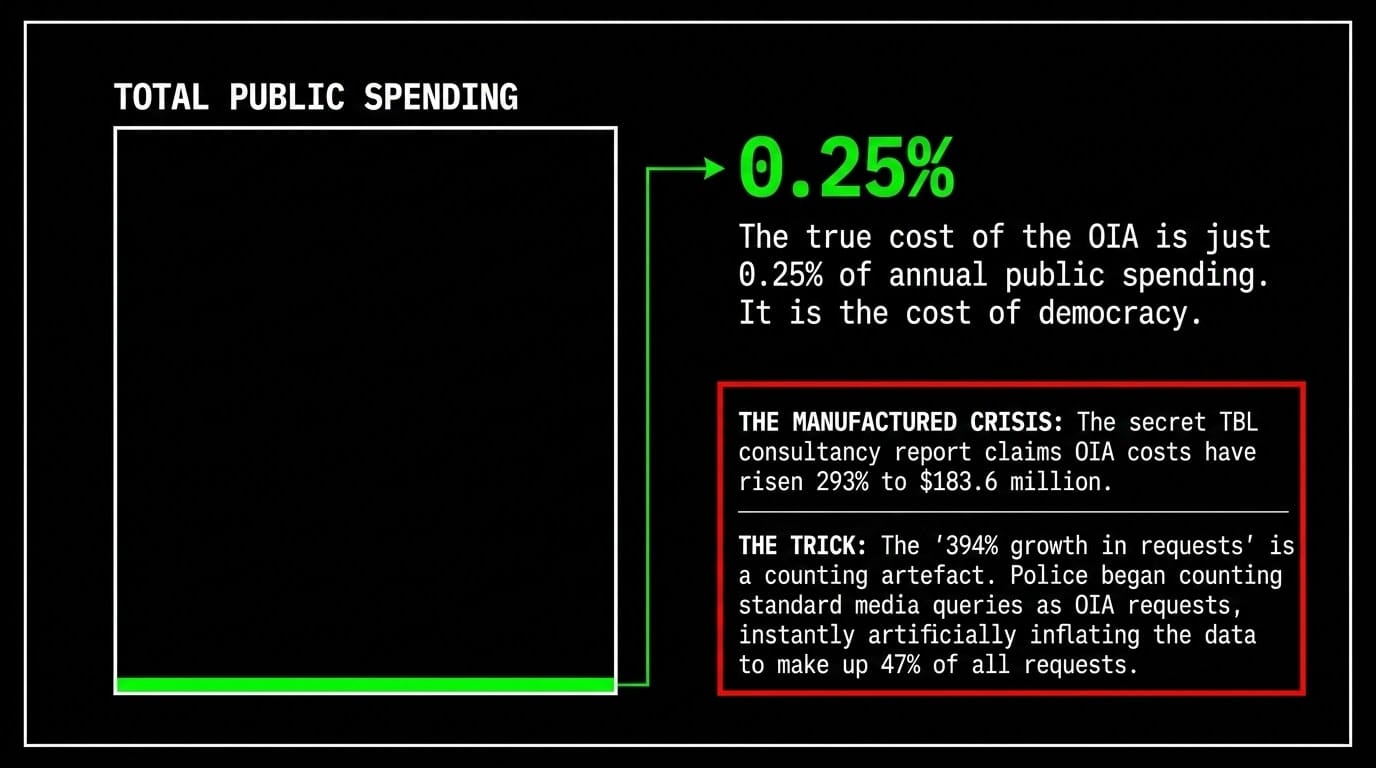
The TBL report estimates the annual cost of OIA compliance grew 293 percent over the past decade — from $46.7 million in 2015/16 to $183.6 million in 2024/25 — with forecasts projecting $342 million by 2030/31, as reported by RNZ.
The government wants you to be alarmed by $180 million.
Here is the number they do not want you to focus on: as critics quoted by RNZ point out, $180 million is just 0.25 percent of annual public spending.
That is the cost of a functioning democracy. And the government thinks it is too much.
The claimed 394 percent growth in requests — Goldsmith's primary justification — is also misleading.
As RNZ reports, both the TBL report and the Ombudsman's office noted the spike came in significant part from a 2018/19 change in police reporting processes that started counting media enquiries as OIA requests — with police now accounting for up to 47 percent of all requests received. Much of the "surge" is a counting artefact.
The government manufactured a crisis narrative from flawed statistics, commissioned a secret review to validate that narrative, and is now using it to justify narrowing what the public can see.
That is not fiscal responsibility. That is strategic opacity dressed as cost management.
Ko te Tikanga: The Obligation They Are Violating
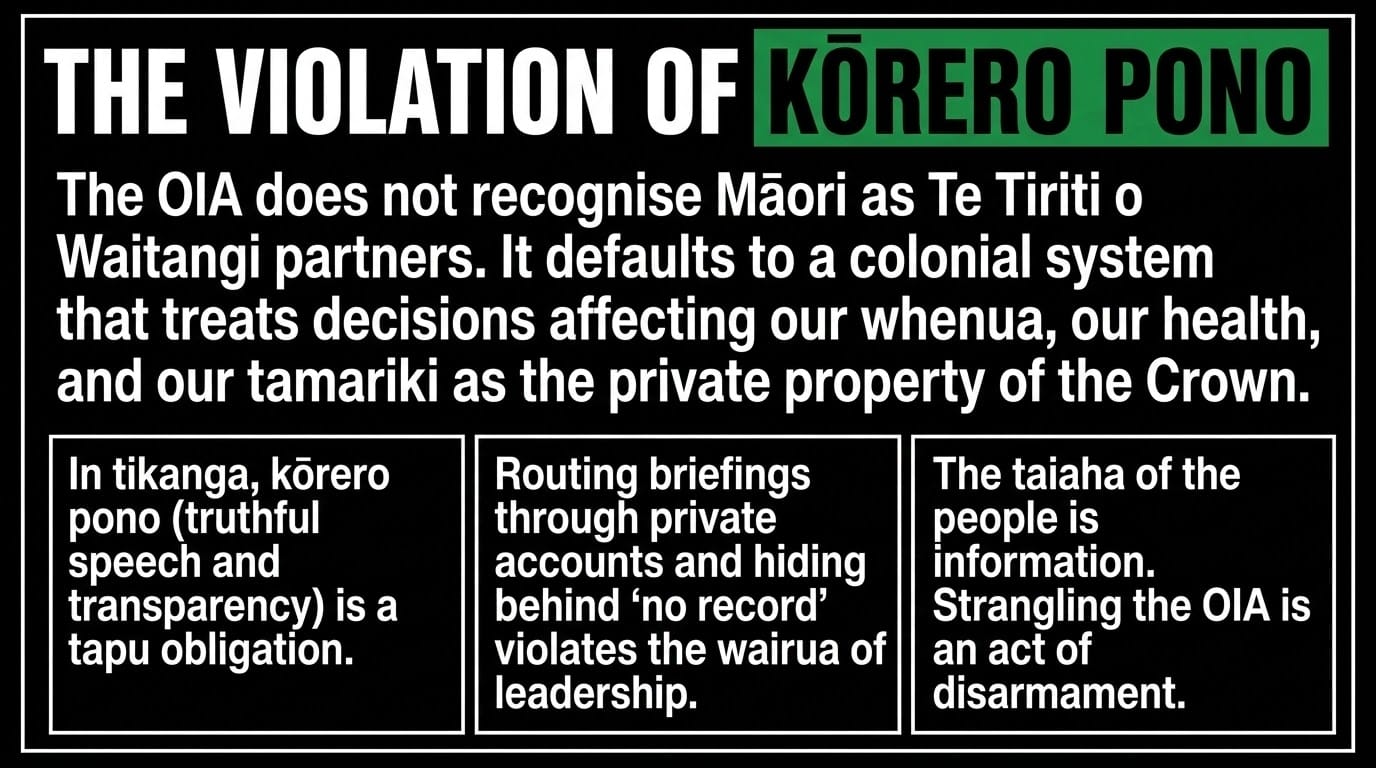
In tikanga Māori, kōrero pono is a tapu obligation. Leaders who speak from behind masks — who route briefings through private accounts, hand-deliver documents that are never logged, say "no record or recollection" when Parliament asks — are not just breaking the law.
They are violating the wairua of leadership itself.
Our tūpuna understood this pattern from the beginning. The Treaty was signed in good faith on one side and immediately subverted on the other. What is new is the sophistication of the concealment — private email accounts instead of secret deeds, consultancy reports instead of musket ultimatums.
But the structure is identical: power operating in darkness, telling the people the darkness is for their own good.
Manaaki demands transparency.
When Sir Peter Boshier — who spent a decade trying to enforce the OIA — stands up and says the law has no teeth and he could not help people get what they were entitled to, as reported by RNZ, that is not a bureaucratic observation.
That is a reckoning.
What Must Change: No More Asking Nicely
Sir Peter Boshier called for OIA reform to address non-compliance and the proliferation of requests, as reported by RNZ.
Andrea Vance called for independent resourcing and penalties for breaches, as reported by RNZ.
Belich has called for a full Auditor-General audit of the PMO, as reported by RNZ.
These are the minimum.
Here is what I am calling for:
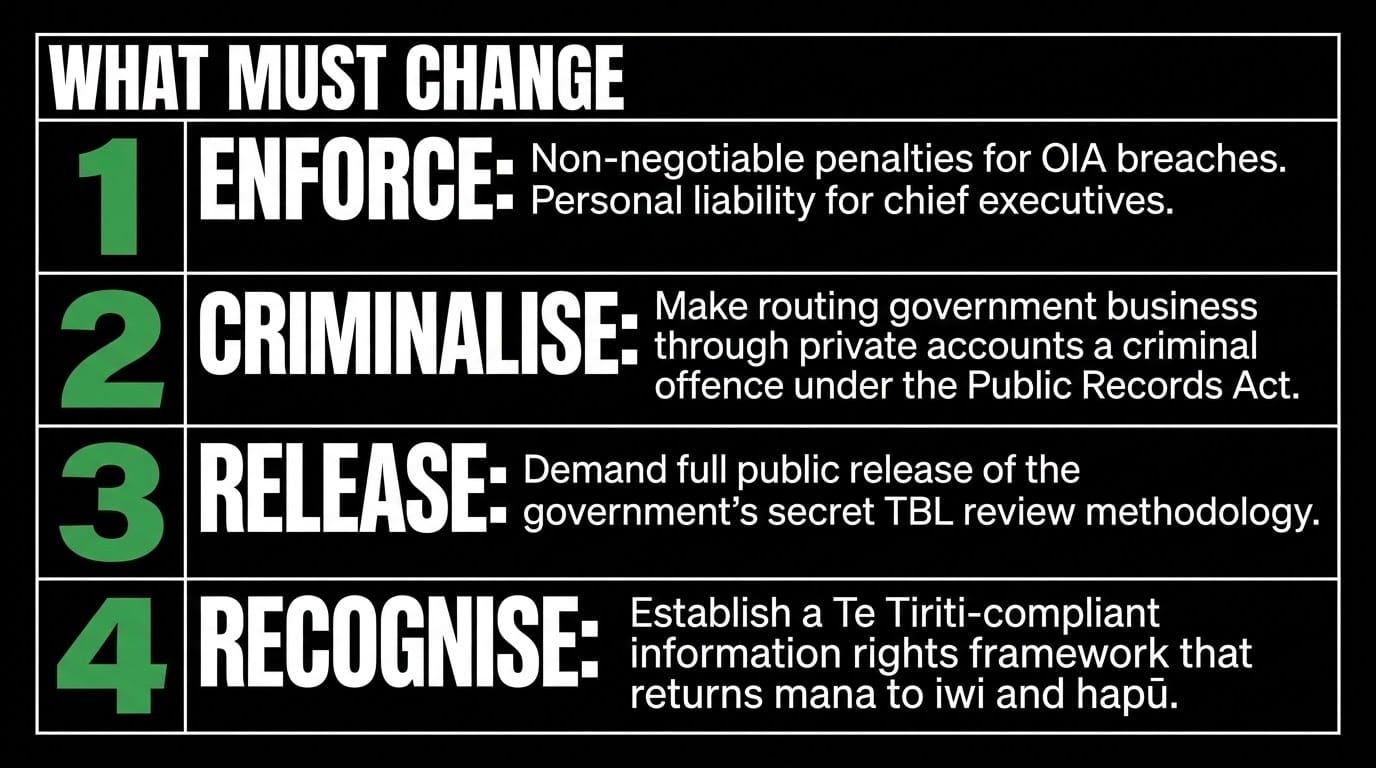
Penalties for OIA breach — non-negotiable. Every other law in this country carries consequences for violation. The OIA must too. Personal liability for chief executives. Criminal accountability for deliberate concealment under the Public Records Act 2005.
Criminalise routing government business through private accounts. What happened in the PMO must be a criminal offence, not a political inconvenience that fades in a news cycle.
Full public release of the TBL review methodology. The government commissioned a report with public money to justify restricting public access to public information. That report belongs to the public.
A Tiriti-compliant information rights framework. The OIA does not recognise Māori as Treaty partners. It does not grant us rights over Crown decisions that directly affect our lands, our health, our tamariki. This is now a matter for the Waitangi Tribunal.
Whakakapi: Ko Wai Mātou?
The OIA was never given to us. It was extracted — from a state that defaulted to secrecy, that treated Crown decisions as Crown property.
Every generation has had to extract it again, because every generation of power tests how much it can take back.
In June 2026, the Luxon government is running that test.
Fonterra got hand-delivered documents and a law to kill their lawsuit. Whānau Māori — asking why their hospitals are understaffed, their tamariki in motels, their whenua being fast-tracked away — get 20 working days, a redaction, and a former chief ombudsman confirming on RNZ that the law carries no consequences for those who deny them.
The taiaha of the people has always been information. When they blunt it, they are not reducing paperwork. They are disarming you.
Ko te mana o te iwi, ko te mana o te kōrero pono.
Kia kaha, whānau. Stay vigilant. Stay connected.
Koha Consideration
This mahi costs time, research, and the refusal to be silent when power operates in darkness.
It is supported entirely by the whānau it serves.
If this essay helped you see something clearly, please consider a koha — not to support a platform, but to keep an independent Māori voice alive.
💚 Koha: Support The Māori Green Lantern
🔔 Subscribe: themaorigreenlantern.maori.nz
💳 Bank: HTDM 03-1546-0415173-000
📘 Facebook: The Māori Green Lantern
⚖️ Legal Notice — NZ Defamation Act 1992: All factual claims sourced directly to the RNZ articles provided and linked inline. Named individuals referenced in their public capacity only. Opinions are flagged as such and grounded in cited facts. Published in the public interest under Lange v Atkinson 3 NZLR 385. Retraction protocol: themaorigreenlantern.maori.nz.