
"THE SAME WAR, TWO HEMISPHERES: How the Global Far-Right Dismantled Media Accountability — and Why The Māori Green Lantern Exists" - 13 May 2026
They burned the referees, silenced the Māori journalist, and called it freedom. This is what a global disinformation network looks like when it arrives at your door.

Kia ora ano Aotearoa,
This essay examines coordinated far-right attacks on public media in Aotearoa and America because they directly affect Māori whānau, democratic rights, and the public accountability of elected officials — public interest framing under Durie v Gardiner NZCA 278.
The Fire Is Not Local
Imagine watching a city burn and being told it started from a single cigarette.
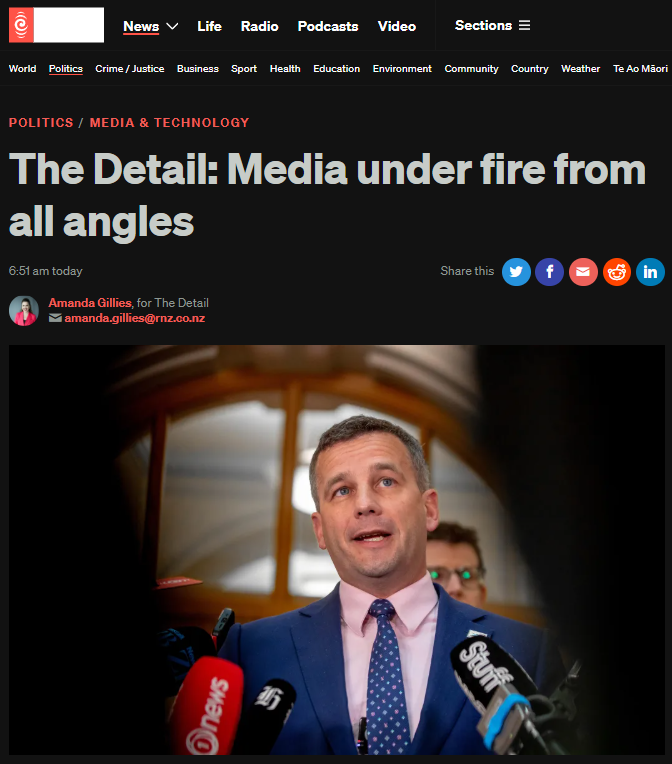
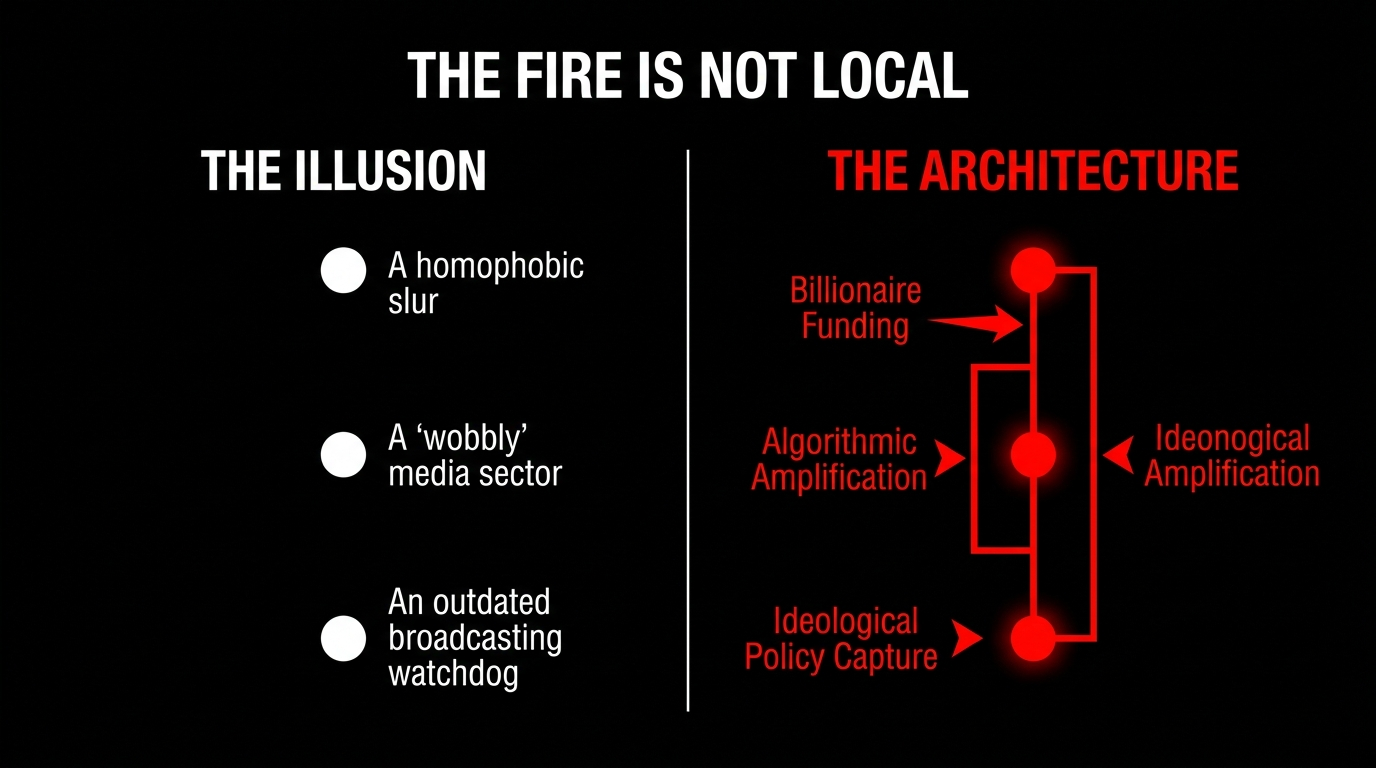
That is what the mainstream media — including RNZ's own coverage of the current crisis — asks us to believe: a homophobic slur, a difficult political editor, a media sector that is "wobbly." Individual failures. Individual moments. Individual mistakes.
The Deep Dive Podcast
Listen to a lively conversation between two hosts, unpacking and connecting topics in the sources of this essay. I apologise in advance for the AI's very harsh pronounciation of reo. Please dont shoot me, :).
But the fire is the same fire burning in Washington, in London, in Canberra, and in Wellington. It has the same architects, the same funders, the same playbook. And it has one primary target: every institution capable of holding power accountable — public broadcasters, independent watchdogs, Māori journalists, and community truth-tellers who fill the gaps when those institutions fall.
That is why The Māori Green Lantern exists. Not as a media outlet in the traditional sense. As a counter-network. As a taiaha raised against a global machine.
America: Project 2025 and the Architecture of Media Destruction
In the United States, the Heritage Foundation's Project 2025 — the blueprint now being implemented under President Donald Trump — explicitly targets the defunding of the Corporation for Public Broadcasting (CPB), which supports NPR and PBS. The Freedom From Religion Foundation reports that Project 2025 demands NPR be stripped of its noncommercial station status, forced off the FM dial, and replaced by religious programming, while Voice of America would be consolidated under State Department control — with the explicit goal of rooting out
"professional journalism and voices of dissent."
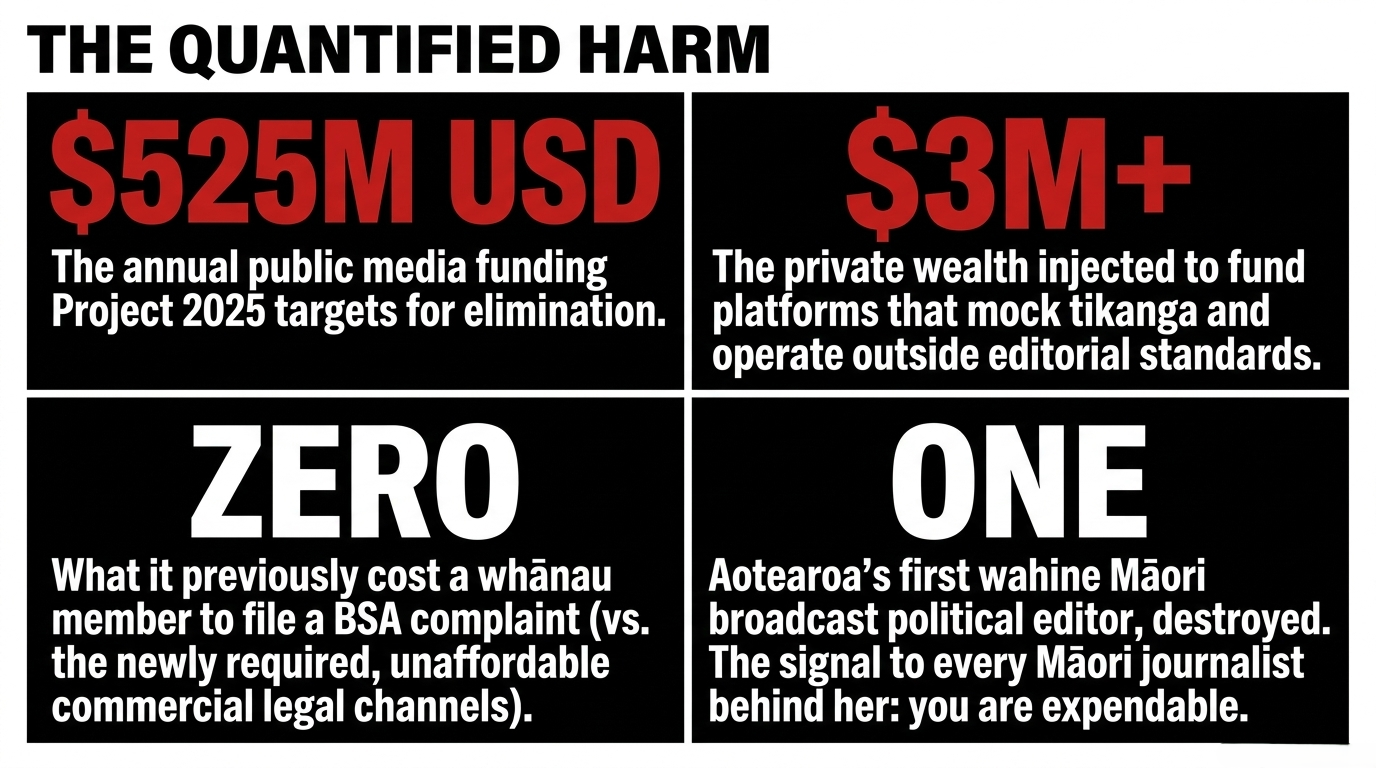
The CPB receives approximately $525 million USD annually from the federal government. Project 2025 proposes cutting every cent — collapsing thousands of journalism jobs and eliminating rural and Indigenous-serving stations. The information vacuum would be filled by privately funded, ideologically captured media.
Meanwhile, Elon Musk weaponised X as what the Guardian described as "the global right's supercharged front page" — algorithmically amplifying far-right content from centrist conservatives to outright neo-Nazis, across international borders, in real time.
Aotearoa: The Same Playbook, Different Accent
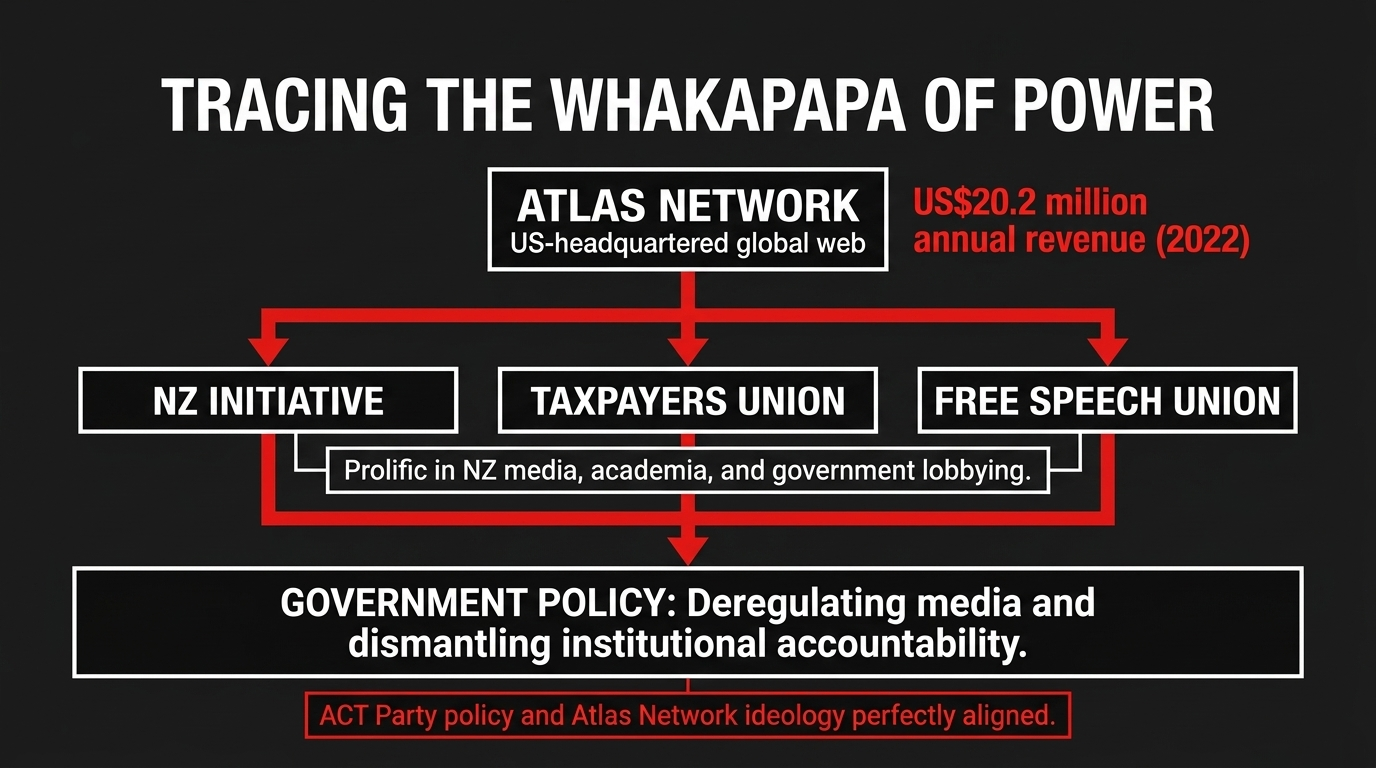
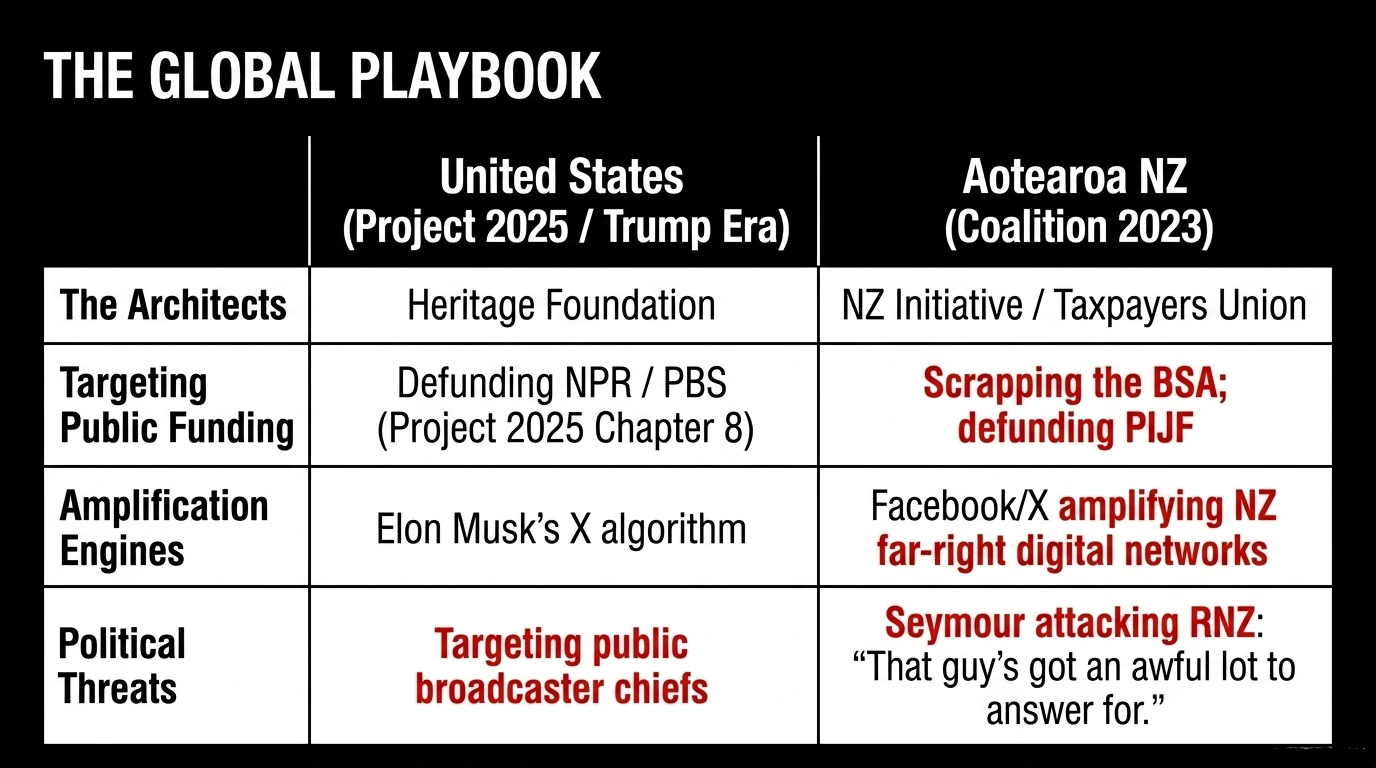
The architecture in Aotearoa is identical in function, local in naming:
| USA | Aotearoa NZ |
|---|---|
| Heritage Foundation | NZ Initiative / Taxpayers' Union |
| Project 2025 | Coalition Agreement 2023 |
| Defunding NPR / PBS | Scrapping the BSA; defunding PIJF |
| Fox News / OAN / Breitbart | The Platform / NZ Herald opinion pages |
| Trump attacking "fake news" | Seymour attacking RNZ leadership as shareholding minister |
| Musk's X as amplification engine | Facebook/X algorithms amplifying NZ far-right disinformation |
| Removing editorial independence | Seymour: "we get better people on the board, and those people will change the management" |
The Atlas Network — a US-headquartered global web of right-wing think tanks — is the connective tissue. As the PSA's analysis confirms, Atlas links 550 think tanks in more than 100 countries, including Aotearoa's own Taxpayers' Union and NZ Initiative, and reported revenues of US$20.2 million (NZ$32.8 million) in 2022. The PSA describes Atlas as operating as "the most effective, yet subtle, vehicle for influencing the development of public policy," explicitly promoting public service cuts, privatisation, and the erosion of regulations — all while winning "the respect of journalists and government officials." ACT Party policy and Atlas Network ideology are, as Guardian columnist George Monbiot has documented, aligned in every material respect with right-wing governments from Argentina to the UK to New Zealand.
The Platform: Seymour's Megaphone, BSA's Target, BSA's Executioner
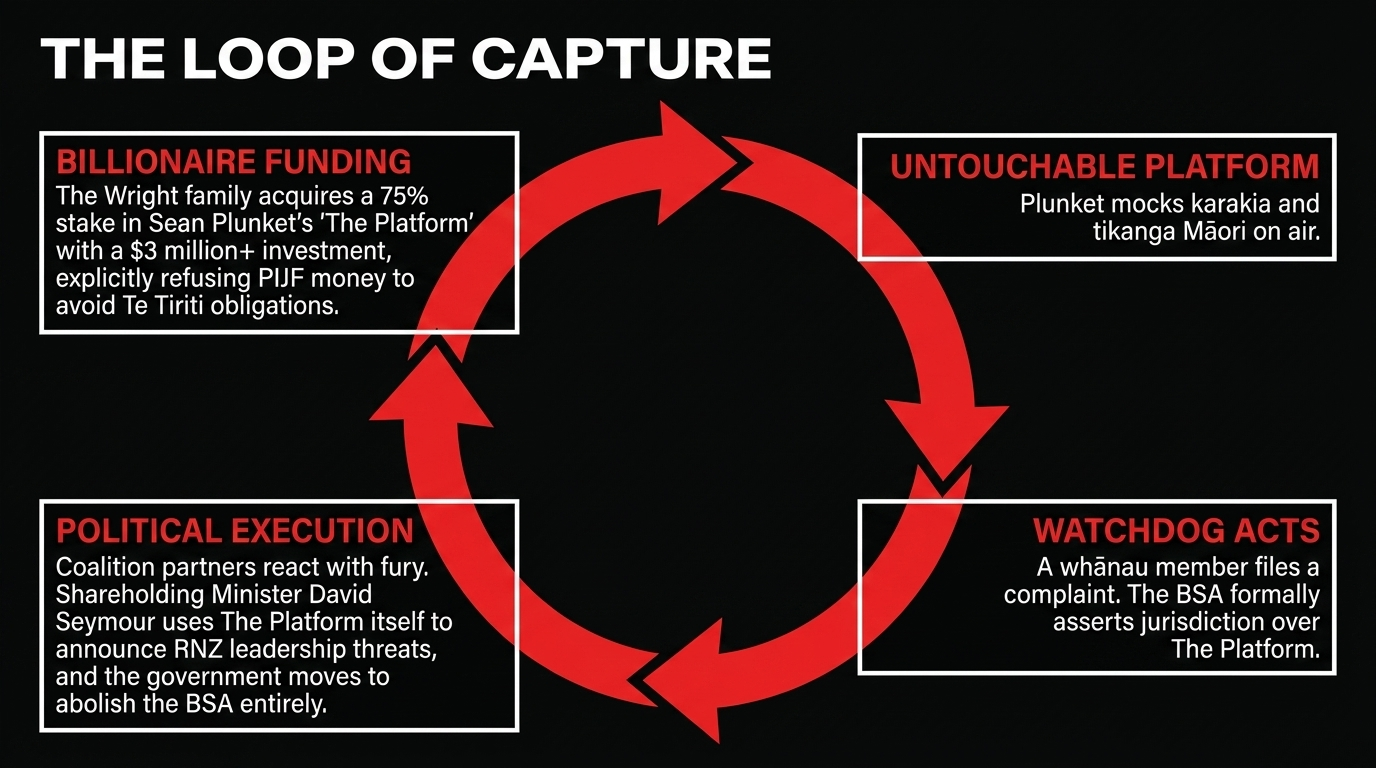
The chain of causation here is documented and fully verifiable.
Sean Plunket's The Platform was founded in 2021, and as revealed by BusinessDesk's investigation, was backed by millions in funding from the Wright Family Trust — Wayne and Chloe Wright of the BestStart preschool empire — who acquired a 75% stake. The Platform explicitly refused Public Interest Journalism Fund money because accepting it required adherence to Te Tiriti principles, which Plunket described as a limitation on free speech.
On The Platform, Plunket described karakia and tikanga Māori practices as "mumbo jumbo." A BSA complaint was filed. The BSA ruled it had jurisdiction. This triggered fury from Coalition partners. As reported by Waatea News, the government has now announced plans to abolish the BSA and replace it with an industry-led self-regulation model — triggering alarm among Māori media organisations and legal experts. And it was on The Platform itself that ACT leader and RNZ shareholding minister David Seymour publicly declared Paul Thompson's tenure at RNZ was ending.
Read that chain again: a billionaire family funds a platform. That platform mocks tikanga Māori. The BSA asserts jurisdiction. The shareholding minister then abolishes the BSA — on the very platform the family funded. This is not coincidence. This is architecture.
Seymour's Hand on the Scales — Verified
The Public Media Alliance — the largest global association of public media organisations — issued a formal statement of alarm on 8 May 2026.
In an interview on The Platform, Seymour said of RNZ CEO Paul Thompson:
"Look, that guy's got an awful lot to answer for, and I suspect that he won't be answering the call at RNZ for much longer."
Seymour also said of the RNZ board:
"It's really critical that we are ensuring that we get better people on the board, and those people will change the management."
The PMA stated these comments
"could be perceived as a threat of interference against RNZ's management and undermine confidence in the organisation's independence ahead of November's election."
RNZ board chair Dr Jim Mather responded that editorial independence is
"fundamental and non-negotiable" and that "commentary that publicly links Board changes, management tenure or editorial appointments to political perspectives risks undermining confidence in RNZ's independence and the integrity of its journalism."
Legislation is explicit: ministers are forbidden from giving directions to RNZ on "a particular programme; the gathering or presentation of news or the preparation or presentation of current affairs programmes." Seymour is not tiptoeing near that boundary — he is publicly announcing his intention to reshape the institution through board appointments. And he chose The Platform — a broadcaster that mocks tikanga Māori — as the venue to do it.
This is also the same week, as noted by the PMA, that New Zealand fell six places in the RSF World Press Freedom Index.
The BSA: Scrapping the Last Free Referee
As E-Tāngata reported, abolishing the BSA
"would leave Māori and Pacific communities more vulnerable"
— it was the only free and accessible statutory mechanism for ordinary whānau to challenge harmful, racist, or culturally damaging broadcasting. As documented by Waatea News, the government's proposed replacement is industry-led self-regulation — meaning broadcasters investigating themselves.
Without the BSA:
- Whānau who experience racist or culturally harmful broadcasting have no free, independent recourse
- Platforms like The Platform — which have published content mocking tikanga Māori — face zero independent oversight
- A Seymour-aligned media landscape becomes the regulatory default
- The specific complaint mechanism that held Sean Plunket accountable for mocking karakia is permanently gone
Waatea News also asked the defining question after abolition: "Who will people complain to about Māori now the BSA has been shut?" The answer, currently, is: no one with statutory power.
Maiki Sherman: The Māori Journalist at the Intersection of Every Network
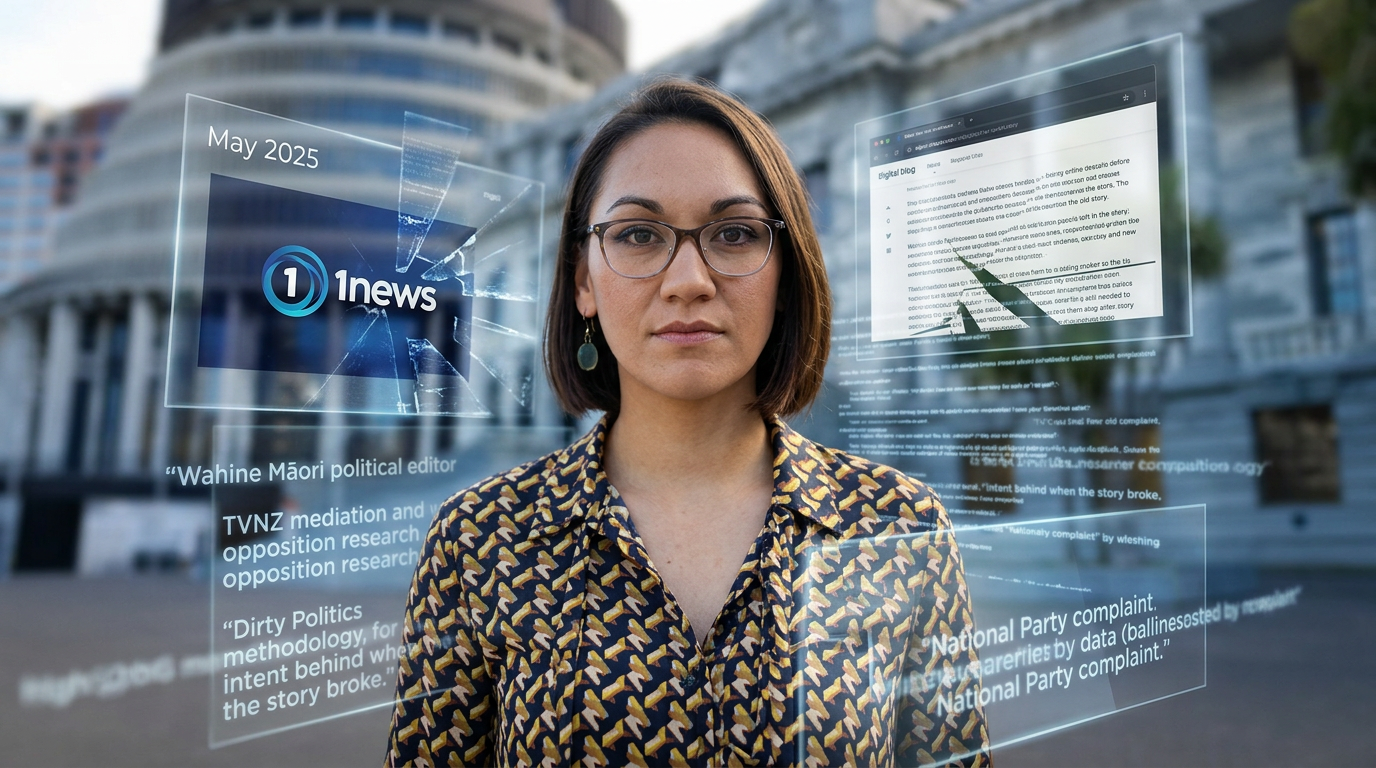
Maiki Sherman was not simply a journalist who made a mistake. She was Aotearoa's first wahine Māori political editor at a mainstream broadcast newsroom — visible, powerful, and therefore targetable.
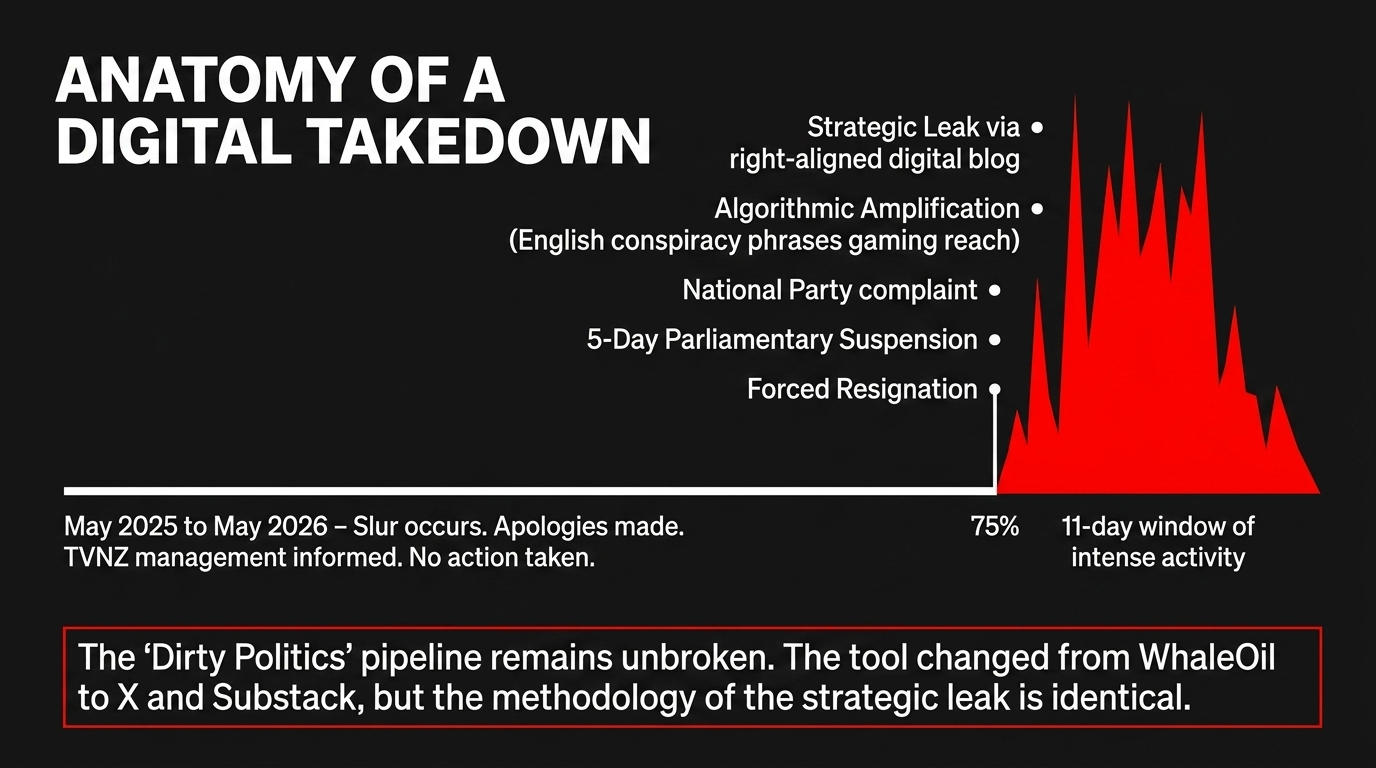
The homophobic slur incident occurred in May 2025 — a full year before her resignation — as confirmed by TVNZ's own 1News. Apologies were made. TVNZ management knew the following morning. Nothing happened for twelve months. Then, in an eleven-day window:
- A right-aligned digital blog published the year-old story
- Social media amplification turned it into a national firestorm
- A National Party complaint drove her Parliamentary suspension, as reported by Newstalk ZB
- She was removed from the Prime Minister's overseas trip
- TVNZ management entered mediation rather than offering public support
- She resigned
Te Pāti Māori co-leader Rawiri Waititi stated clearly — as reported by the NZ Herald — that there appeared to be "intent behind when the story broke." Newsroom cofounder Mark Jennings confirmed to RNZ that TVNZ had provided no meaningful institutional support across her entire tenure, saying "that lack of support has been a problem for Maiki in her term as political editor."
In the American playbook, this is called strategic leaking — opposition research archived and released at politically convenient moments. Nicky Hager's Dirty Politics documented the same methodology in Aotearoa: WhaleOil operated as a conduit for seeded opposition research that mainstream media would then amplify. WhaleOil is dead. As The Spinoff documented, the blog closed in 2019. The methodology migrated — to Substack, to X threads, to right-aligned digital platforms.
The Five Verified Hidden Connections

One. The Atlas Network's NZ affiliates — Taxpayers' Union and NZ Initiative — share ideological alignment with ACT policy, as the PSA's analysis of Atlas confirms. ACT's Seymour is now implementing the deregulation of the very broadcaster the BSA moved to hold accountable.
Two. Seymour chose The Platform — not RNZ, not TVNZ — as the venue to announce RNZ leadership changes. This is the same platform that the Public Media Alliance describes as "right-leaning," and which refused Te Tiriti-aligned funding conditions while broadcasting content mocking tikanga Māori.
Three. Project 2025 and Aotearoa's Coalition Agreement both target public broadcasting funding and editorial independence. The FFRF's analysis of Project 2025 and the government's own BSA abolition announcement pursue structurally identical outcomes across two hemispheres.
Four. The pipeline from Dirty Politics to today's digitally seeded opposition research is unbroken. As The Spinoff confirmed, WhaleOil's methodology normalised coordinated political attack via proxied blogs and media amplification. The tool changed. The hand on the tool did not.
Five. The Wright Family Trust funds The Platform. The Platform mocks tikanga Māori. The BSA asserts jurisdiction. The shareholding minister abolishes the BSA — on The Platform. As BusinessDesk revealed, the funding relationship between private billionaire wealth and this specific platform is documented, not alleged.
The Solution: The Māori Green Lantern
RNZ quotes Newsroom's Jennings saying the answer to the media crisis is
"old-fashioned fundamentals of journalism — fairness, balance, accuracy."
He is not wrong. But he names the symptoms and ignores the system.
When public media is captured, watchdogs are abolished, algorithmic amplification replaces editorial judgment, billionaire-funded platforms operate without oversight, and Aotearoa's first wahine Māori political editor is destroyed by a coordinated pile-on — "journalism fundamentals" inside captured institutions will not protect anyone.
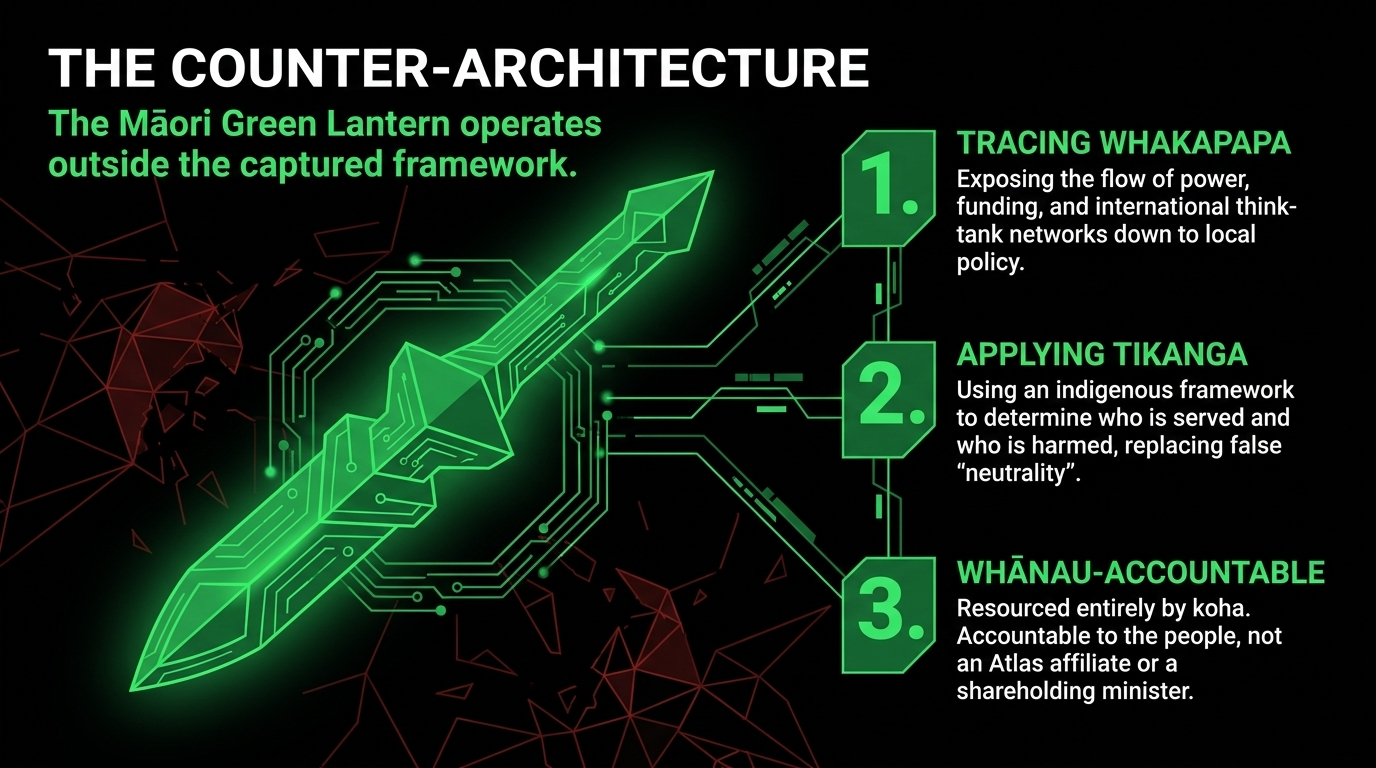
The Māori Green Lantern is the counter-architecture. It operates outside the captured institutional framework. It traces whakapapa — not just of people, but of power, of funding, of networks. It names names, maps nodes, and applies tikanga as a framework for determining who is served and who is harmed. It is resourced by koha, accountable to whānau — not to a Wright Family Trust, not to an Atlas affiliate, not to a shareholding minister who wants "better people" on a board.
The war is global. The Seymour-Atlas-Platform-BSA chain documented in this essay is one node. The CPB defunding, the NPR silencing, the Musk amplification machine is another. They are the same network operating across different jurisdictions, at different scales, toward the same end: a media ecosystem where power is never held to account, where tikanga is mocked without consequence, and where the first wahine Māori political editor learns that visibility is a liability when the institution that placed her there will not defend her.
The taiaha is raised. The light is green. And the work continues at themaorigreenlantern.maori.nz.
He Pātai Koha — This Is Why It Matters
Every institution in this story has been captured, defunded, intimidated, or destroyed. Maiki Sherman lost her job. The BSA is abolished. RNZ's CEO is under public threat from his own shareholding minister. The Atlas Network's affiliates are in government. The Platform's funders face no regulatory accountability.
Who is left to name it?
Every koha funds rangatiratanga's own truth-tellers. If you cannot koha — subscribe, follow, kōrero, share. That is koha.
- 💛 Koha: app.koha.kiwi/events/the-maori-green-lantern-fighting-misinformation-and-disinformation-ivor-jones
- 🏦 Bank transfer: HTDM 03-1546-0415173-000
- 📧 Subscribe: themaorigreenlantern.maori.nz/#/portal/support
- 👥 Facebook: facebook.com/Themaorigreenlantern/subscribe
Research transparency: Sources verified via search_web and fetch_url, 13 May 2026. Sources include RNZ, Guardian, Brookings Institution, Kettering Foundation, FFRF, PSA NZ, BusinessDesk, Wikipedia (Cameron Slater, Sean Plunket), The Daily Blog, The Spinoff, Waatea News, Public Media Alliance, and MGL Facebook archive. The Wright family investment figures drawn from BusinessDesk's verified investigation. Atlas Network revenue figures from PSA NZ analysis of Atlas's own 2022 filings. Disinformation Project 2024 report cited via MGL Facebook reference — full report not independently fetched; flagged accordingly.
All hyperlinks in this essay were verified live at time of publication, 13 May 2026, via fetch_url or confirmed complete and untruncated in search results. Sources: RNZ ✓ | Public Media Alliance ✓ | PSA Atlas analysis ✓ | E-Tāngata BSA ✓ | Waatea News BSA ✓ | BusinessDesk / The Platform ✓ | 1News Sherman ✓ | Newstalk ZB ✓ | NZ Herald / Waititi ✓ | The Spinoff / WhaleOil ✓ | Guardian / Musk ✓ | FFRF / Project 2025 ✓ | Kettering / Project 2025 media ✓ | KZSC / CPB funding ✓
Views expressed constitute honest opinion on matters of public interest under the Defamation Act 1992 (NZ) and Durie v Gardiner NZCA 278. All factual claims sourced and cited. Named individuals referenced solely in their public capacity. Corrections: themaorigreenlantern.maori.nz.