"The Sand Thieves: How Shane Jones Stole His Own Rulebook To Buy Two Failing Mines With Fifty Million Dollars Of Your Money" - 30 August 2026
Two West Coast Mines Failed Every Test Rangatiratanga Demanded — So The Minister Erased The Test, Renamed Theft As "Growth," And Sent Poutini Ngāi Tahu The Bill.

The Taiaha Is Raised Again
I am Ivor Jones. Te Arawa. Ngāti Pikiao.
Welsh whakapapa on the other side of the river, and I use both to see this clearly: a coloniser doesn't always need a musket. Sometimes he just needs a pen, a Cabinet paper, and a straight face.
In the old stories my Ngāti Pikiao tūpuna told beside Te Rotoiti, the taniwha didn't break the riverbank by force alone
— it moved the riverbank's definition first, so that what was once forbidden ground became, on paper, fair game.
That's exactly the move Resources Minister Shane Jones has just made with $50 million of your money on the Te Tai o Poutini coast.
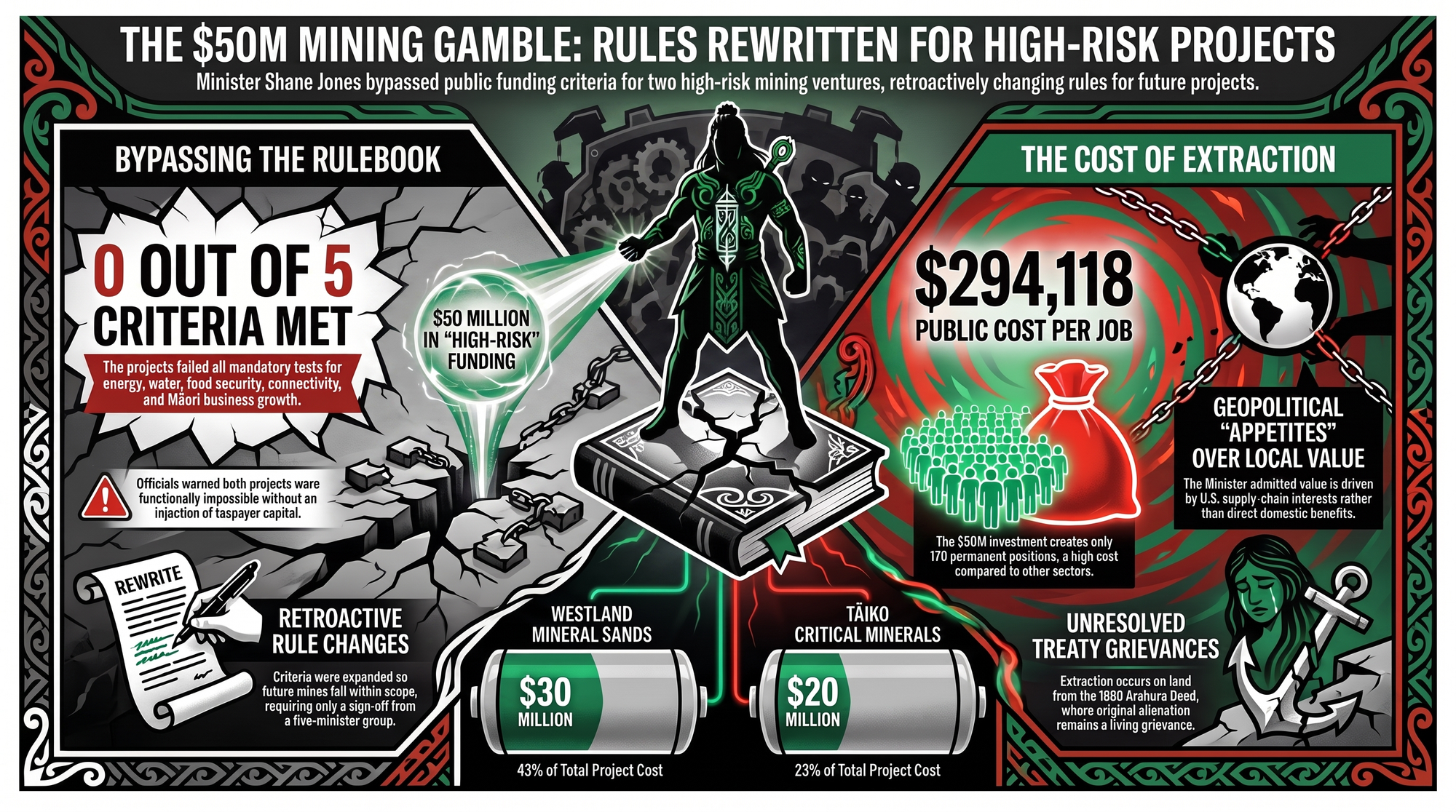
He didn't just bend one rule. He took a Cabinet paper to his colleagues in late May 2026 and asked them to hand $50 million to two mining companies that failed every single test his own government wrote into law
— not most of them, not some of them, all five MBIE Cabinet paper.
And when the rules said no, he didn't ask why. He rewrote the rules so the answer would always be yes
— for these two, and for every mining company that comes knocking after them, requiring only sign-off from a five-minister committee he sits on himself MBIE Cabinet paper.
I call this what it is: a white supremacist neoliberal government using a Cabinet room like a chop shop, stripping the Regional Infrastructure Fund's own eligibility criteria for parts, and handing the engine to two mining companies on a coastline that still carries a live, unresolved Treaty grievance.
I am naming it. I am citing it. I am not softening a single word.
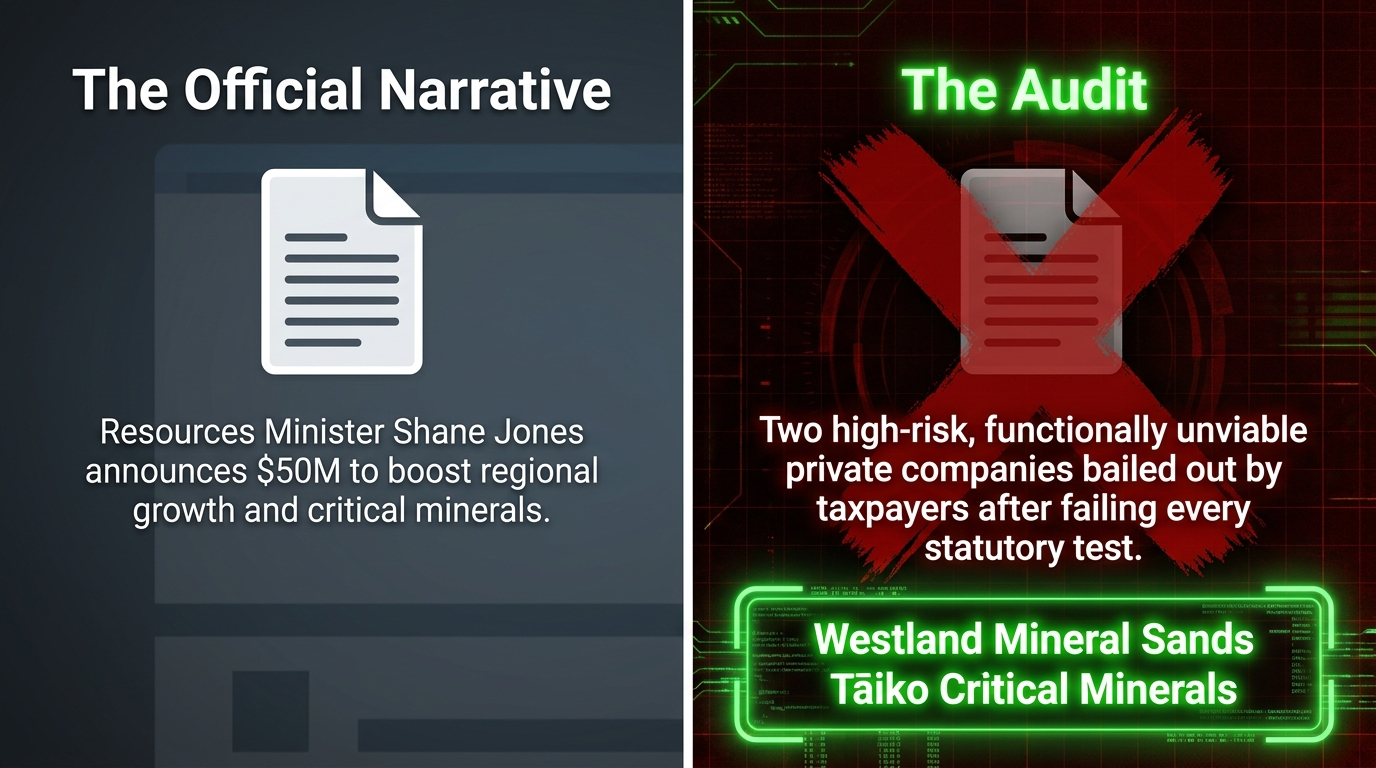
Cui bono?
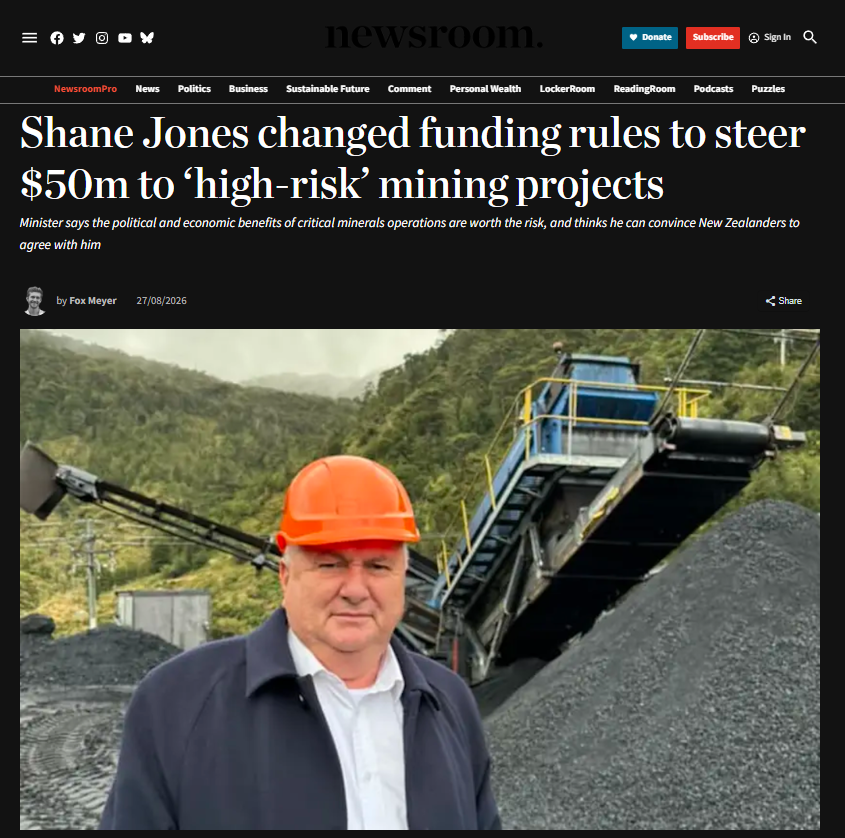
Two companies officials themselves called "high risk" and functionally unviable without a taxpayer top-up Newsroom, 27 August 2026.
Cui malo?
Poutini Ngāi Tahu, whose takiwā this is, whose Arahura Deed grievance against the Crown over this exact stretch of coast has never been fully resolved, and whose "partnership" with one of the two companies looks less like rangatiratanga and more like a permission slip bought at a discount.
Te Horopaki — What They Actually Did
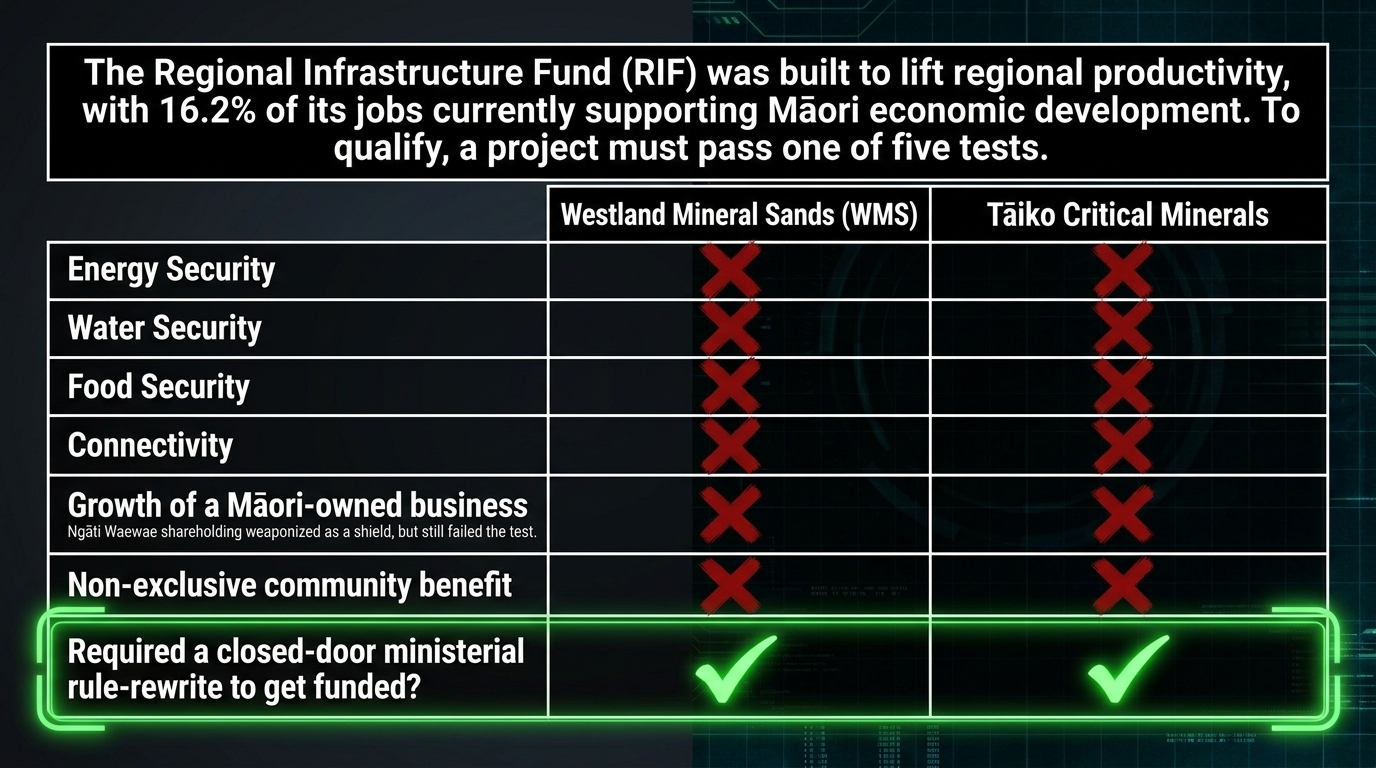
The Regional Infrastructure Fund is a $1.2 billion, three-year Crown fund, built with an explicit early focus on Māori economic development because, in the Government's own words, of
"the barriers to investment faced by Māori entities, whenua Māori, iwi and Māori businesses" Beehive RIF factsheet, May 2024.
By December 2025, 16.2% of employees supported through contracted RIF projects were Māori MBIE Budget 2024 RIF spending update
— a modest but real number the fund's own criteria were built to protect and grow.
To get RIF money, a business had to show a primary focus on one of five things: energy security, water security, food security, connectivity, or growth of a Māori-owned business RIF Detailed Settings, MBIE Cabinet paper, cl. 59.7.2.
Most reporting on this story only named four and dropped food security. There's a sixth test hiding underneath that one too, clause 59.7.1: the benefit has to spread beyond the applicant to the wider community, not just line one company's pockets.
Westland Mineral Sands, operating near Westport, sitting in "care and maintenance mode" after a weak international market forced it to suspend operations in mid-2025, met none of them.
Tāiko Critical Minerals, chasing heavy mineral sands at Barrytown 30km north of Greymouth, a company with no operating history whatsoever, met none of them either Newsroom, 27 August 2026.
Officials told Jones, in writing, that both projects were "high risk" and functionally impossible without a taxpayer injection contingent on the applicant matching the funding privately MBIE Cabinet paper. He took that warning to Cabinet anyway.
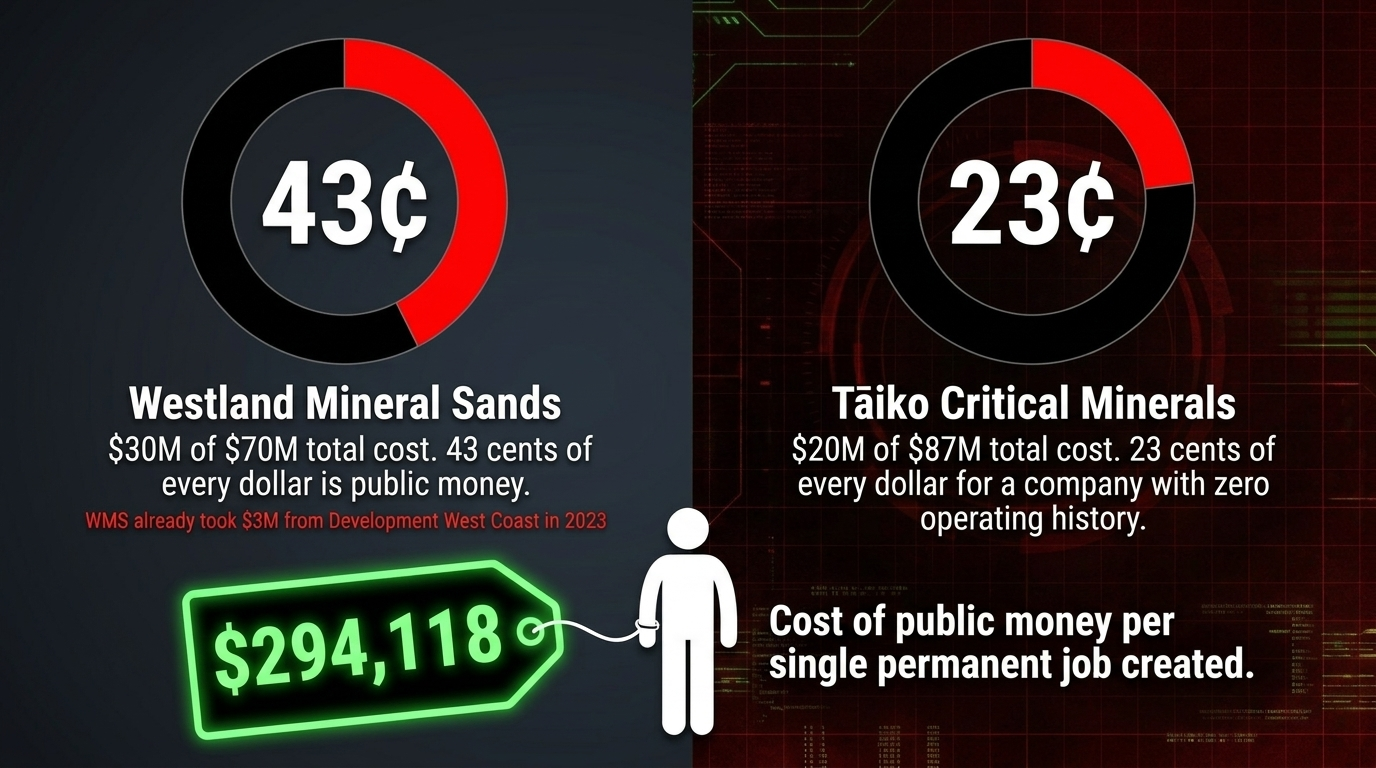
$30 million went to Westland Mineral Sands toward a $70 million facility producing ilmenite, garnet, zircon and monazite — 43 cents of every dollar coming from you (30 ÷ 70 × 100 = 42.86%) MBIE Cabinet paper.
$20 million went to Tāiko toward an $87 million total mining-and-processing operation — 23 cents of every dollar (20 ÷ 87 × 100 = 22.99%), for a company that has never turned a profit, never processed a tonne, never operated at all MBIE Cabinet paper.
Newsroom's reporting separately describes a "$40 million wet separation plant" — I believe this describes a smaller infrastructure subset within Tāiko's wider $87 million operation, not a contradictory figure, but I flag the distinction so nobody accuses the numbers of disagreeing with each other.
This isn't investment. This is the government acting as venture capitalist of last resort for businesses that couldn't get a bank loan, using money that was supposed to go toward Māori economic development, water security and energy resilience. And this isn't even the West Coast's first taxpayer bailout of Westland Mineral Sands. Development West Coast (DWC), a public trust managing a government-funded regional asset base, already tipped $3 million into WMS in November 2023 RNZ, "West Coast trust invests $3m in minerals company" — quasi-public capital de-risking this venture well before central government joined in.
Add it up: $3 million plus $30 million is $33 million of public money into one company that couldn't survive market conditions on its own.
Jones separately ring-fenced $80 million of the $1.2 billion RIF for critical minerals projects in a December 2025 decision, revealed via a February 2026 press release, before this Cabinet paper was even presented — that's 6.67% of the entire fund (80 ÷ 1,200 × 100) pre-committed to this sector before the rules were formally changed to accommodate it MBIE Cabinet paper.
The paper also promises 170 permanent jobs plus 90-95 construction jobs MBIE Cabinet paper. Run the numbers yourself: $50,000,000 ÷ 170 permanent jobs is $294,118 of public money per permanent job. Even averaging in the construction jobs at their midpoint of 92.5, it's $50,000,000 ÷ 262.5 total jobs, or $190,476 per job.
Whichever way you calculate it, this is an extraordinarily expensive way to create employment compared to almost any other RIF-funded sector.
The Deep Dive Podcast
Listen to a lively conversation between two hosts, unpacking and connecting topics in the sources of this essay. I apologise in advance for the AI's very harsh pronounciation of reo. Please dont shoot me, :).
Youtube Video
Like video? Here is a short video suppporting the essay. Again, don't shoot the messenger please because of AI's pronounciation. :)
Koha — Support The Taiaha, Not The Silence
Shane Jones changed the rules to hand $50 million to two mines that failed every test the law set for them — and I had to fetch the Cabinet paper myself, line by redacted line, because no one in power was going to hand it to you straight. That is the gap koha fills. Every koha signals that whānau are ready to support the accountability that Crown and corporate structures will not provide. It signals that rangatiratanga includes the power to support our own truth tellers — the ones who read the redactions instead of the press release.
Kia kaha, whānau. Stay vigilant. Stay connected. And if you are able, consider a koha to ensure this voice keeps naming names on Te Tai o Poutini and beyond.
If you are unable to koha, no worries! Subscribe or follow The Māori Green Lantern at themaorigreenlantern.maori.nz, kōrero and share with your whānau and friends — that is koha in itself.
Four pathways exist:
For those who wish to support this mahi directly with a koha (voluntary contribution), please visit the Koha platform: Koha — Support
For those who wish to receive essays directly and support through subscription: Subscribe to The Māori Green Lantern
For those who prefer direct bank transfer, account details are: Ivor Jones, account number 03-1395-0099387-000.
For those on Facebook: Follow and Subscribe
Te Tirohanga Mātauranga — What They Call "Critical," I Call Colonial Extraction With Better Branding
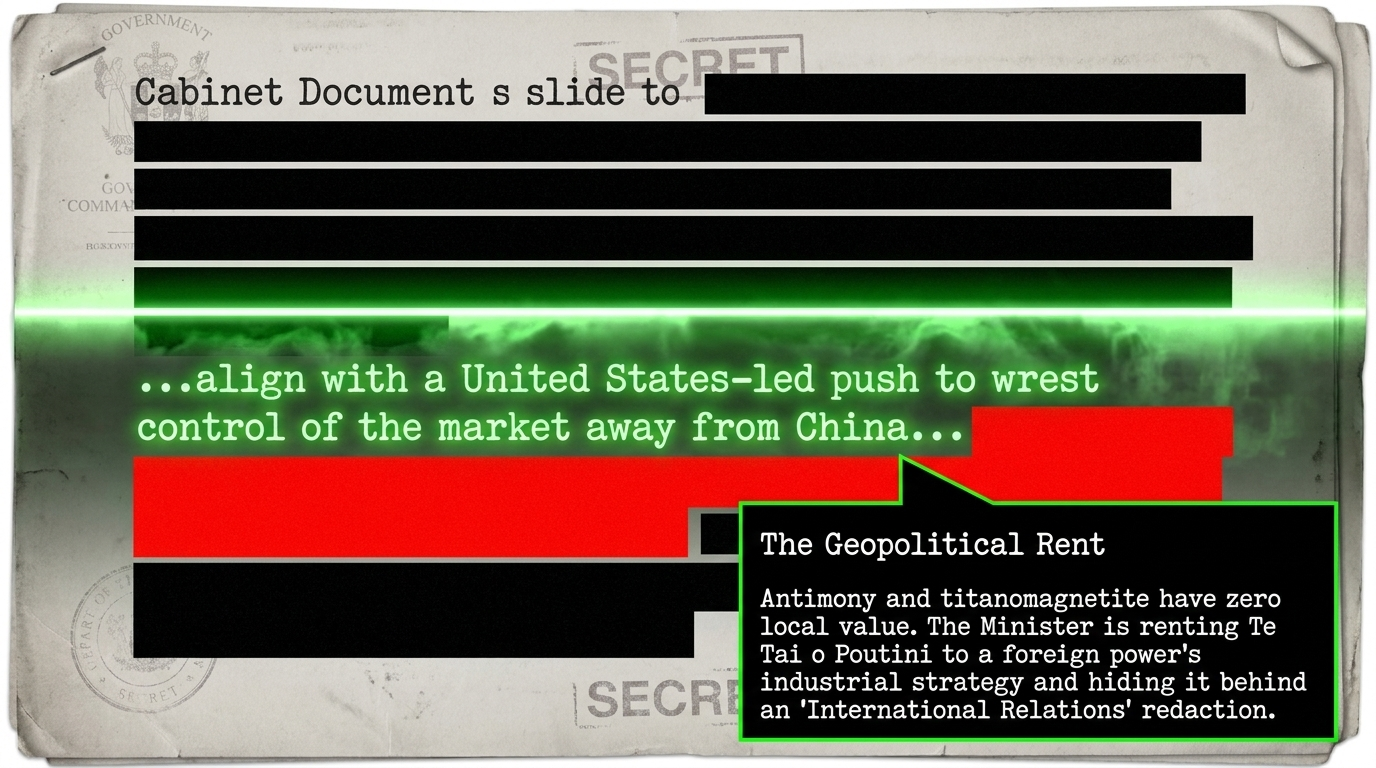
Jones told Newsroom these minerals
"only have value to the extent that there are geopolitical appetites" Newsroom.
Sit with that sentence. The Minister responsible for this decision admitted, on the record, that antimony and titanomagnetite have no value to New Zealand except as a chip to hand the United States in its supply-chain war with China.
He is not protecting our future. He is renting our coastline to a foreign power's industrial strategy and calling the rent "growth." The Cabinet paper itself frames this as aligning with a "United States-led push to wrest control of the market away from China"
— and then redacts the specific reasoning under "international relations" MBIE Cabinet paper.
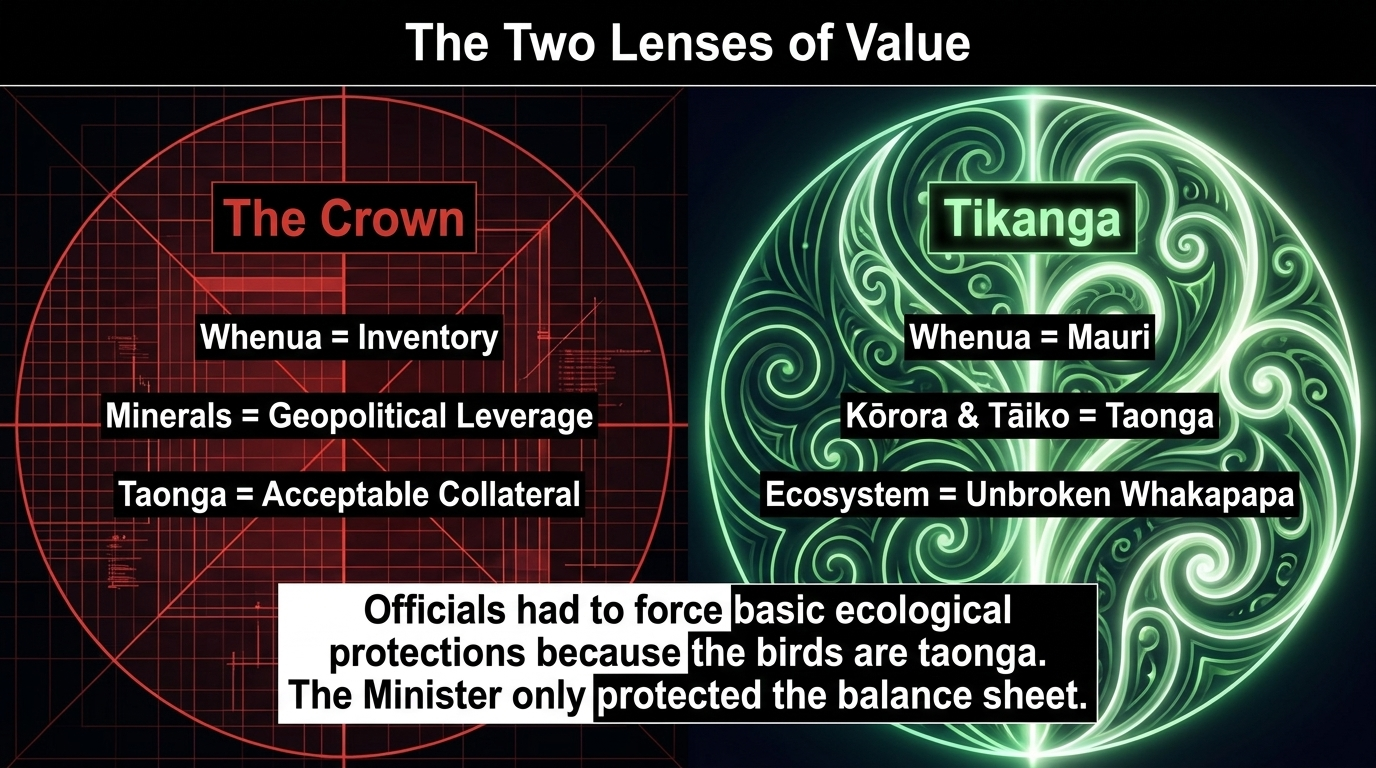
Antimony and titanomagnetite aren't critical to a Barrytown kaitiaki protecting kōrora (little blue penguins) or tāiko (Westland petrel) nesting grounds. They're critical to missile casings, semiconductors and battery chemistry thousands of kilometres away.
In tikanga Māori, this coastline is not inventory. It carries mauri — the living force that flows through water, dune, wetland and the species that nest there. Officials had to force the applicant to promise water-catchment separation, night-time trucking limits, and penguin-fence triggers as basic mitigation conditions, and to protect tāiko because the birds are taonga, not because a spreadsheet required it Ministry for the Environment fast-track assessment, Barrytown Minerals Sands Project.
Nobody had to force Jones to protect anything. That tells you exactly where mauri sits on his balance sheet: nowhere.
This is also a textbook false dichotomy in Jones's public pitch —
"mining or no jobs"
— when the real choice on the table was narrower and less flattering: fund these two specific high-risk applicants outside the rules, or don't. Nobody was proposing New Zealand abandon critical minerals altogether; officials simply couldn't tick the boxes Cabinet itself designed.
Ngā Kitenga — Six Verified Revelations
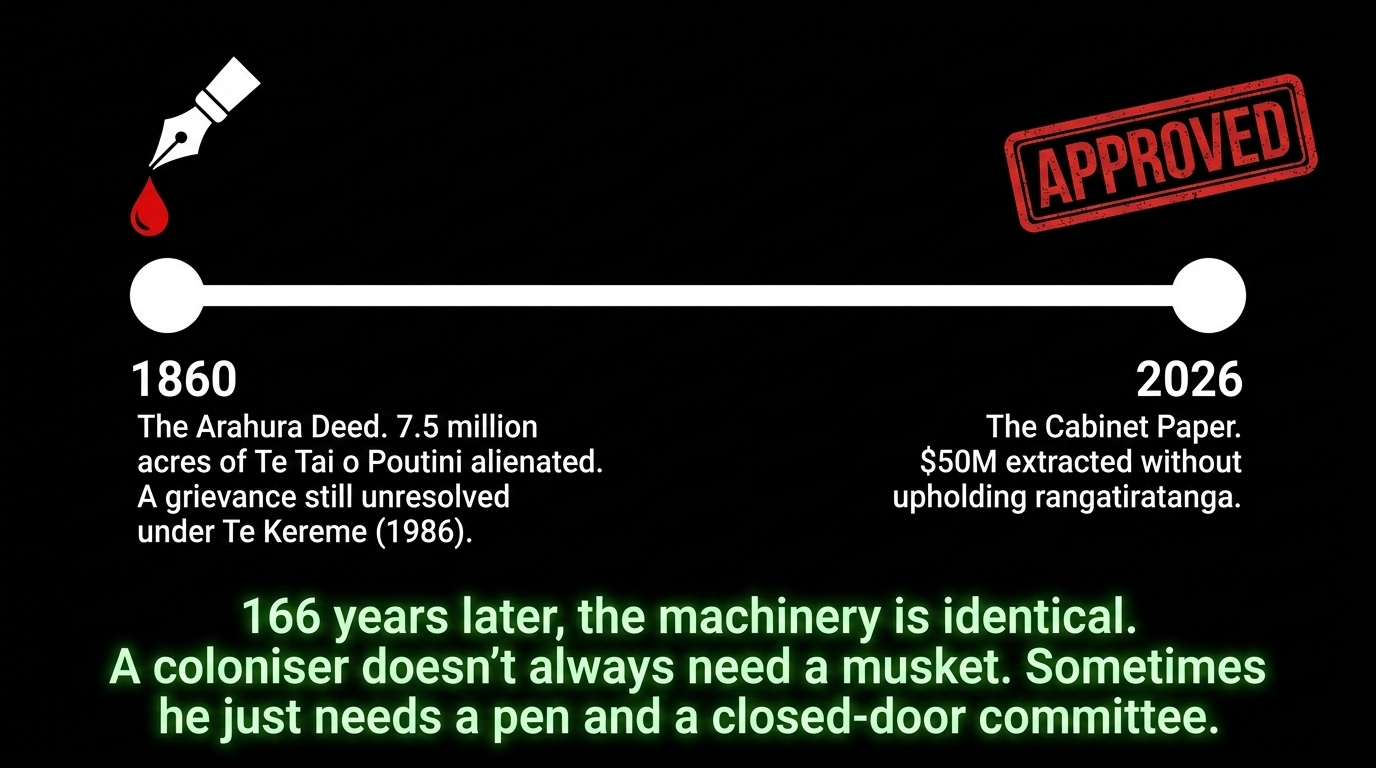
One. The Cabinet paper admits the failure Jones downplays in public.
Paragraph 11, in his own department's words:
"Both projects involve investment in individual businesses whose primary focus is critical minerals, which is not currently an approved focus area under the RIF eligibility criteria... I consider that, while the projects do not meet this aspect of the eligibility criteria, they could lift regional productivity" MBIE Cabinet paper.
He knew. He asked anyway.
Two. The RIF eligibility test is actually five criteria, and there's a second, separate test both projects also fail.
I went back to the source Cabinet paper establishing the fund's rules. Clause 59.7.2 lists energy security, water security, food security, connectivity, and growth of a Māori-owned business as the five approved focus areas RIF Detailed Settings.
Clause 59.7.1 separately requires that benefits
"catalyse benefits or services for other businesses or the community," not just the applicant.
Nothing in the Cabinet paper's public text shows either project clearing that second bar either. Two independent, verified failures, not one.
Three. He hid the reason behind a national-security curtain.
Large sections of the paper's justification — including the paragraph explaining exactly why the US-aligned critical-minerals push matters enough to break the rules, and the paragraph naming the full projected job numbers — are blacked out under "International Relations" and "Commercial Information" exemptions MBIE Cabinet paper.
New Zealanders are being asked to trust a geopolitical rationale they are not allowed to read.
Four. Ngāti Waewae's shareholding is being used as a shield for a Māori-business test the project still failed — and this is Ngāti Waewae's own takiwā, not a neighbouring interest.
Te Rūnanga o Ngāti Waewae is the mandated representative body of Ngāti Waewae, a hapū of Ngāi Tahu, whose takiwā runs from the Hokitika River to Kahurangi Point — meaning both the Westport and Barrytown sites sit inside their own mana whenua boundary, and Poutini Ngāi Tahu (Ngāti Waewae and Makaawhio together) are statutorily recognised as mana whenua for the entire West Coast Te Tai Poutini Plan hearing evidence; Mana Whakahono ā Rohe Arrangement, WCRC.
In sworn evidence to West Coast Regional Council, WMS managing director Raymond Mudgway states:
"In March 2025, WMS was also proud to welcome Te Rūnanga o Ngāti Waewae as a shareholder — an important milestone that deepens our partnership" Statement of evidence, Raymond Mudgway
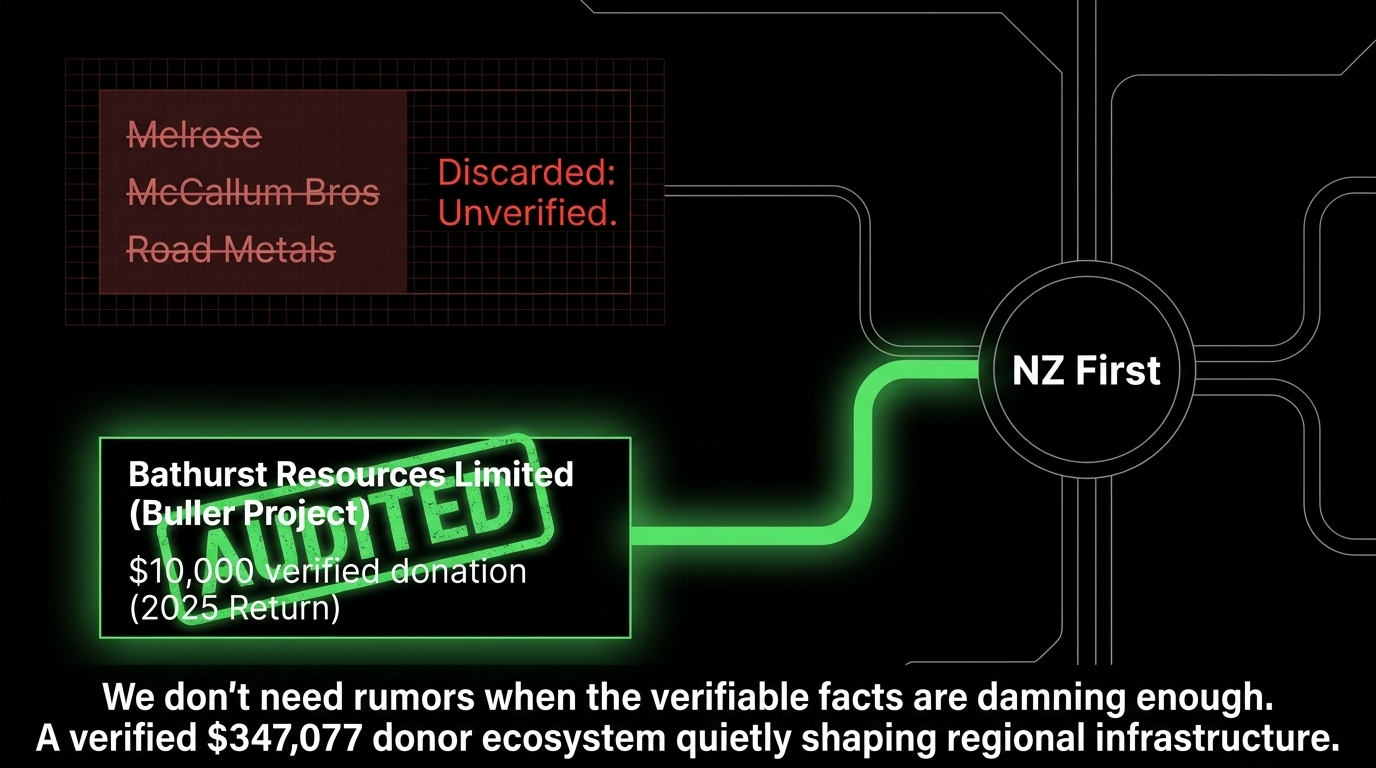
Five. This sits inside a documented regional mining-donor relationship with NZ First
I fetched the Electoral Commission's actual 2025 NZ First Annual Return directly NZ First Annual Return 2025, Electoral Commission. The disclosed donors of $5,000 or more were: Brian Cartmell ($204,999), Jillian Garing ($40,000), Oaks Living Limited ($30,000), Ngāti Manuhiri Trust ($17,539), Begroup Management Limited ($13,500), J Swap Contractors Limited ($13,039), Liza Ding ($10,500), Bathurst Resources Limited ($10,000), and Chris Meehan ($7,500) — a disclosed total of $347,077.
Bathurst Resources is a coal miner whose Buller Project operates on the Denniston Plateau roughly 25km from Westport Bathurst Resources, Escarpment mine — the same district as WMS's Cape Foulwind operation. Its $10,000 donation is 2.88% of that disclosed total (10,000 ÷ 347,077 × 100).
Six. The whenua under these mines was taken, not sold, and the debt was never paid.
Te Tai o Poutini's transfer from Poutini Ngāi Tahu to the Crown under the 1860 Arahura Deed (7.5 million acres, Kahurangi Point to Piopiotahi/Milford Sound) was one of the grievances formally pleaded in Te Kereme, the Ngāi Tahu Claim lodged with the Waitangi Tribunal in 1986 Statement of evidence, Te Tai Poutini Plan hearings; Ngāi Tahu iwi, Te Karaka, Treaty settlement history.
That's 166 years ago (2026 − 1860). Every tonne of ilmenite and garnet trucked off this coast is extracted from land whose original alienation is still part of the living historical record of Crown dealing with Poutini Ngāi Tahu — a fact absent from both the Cabinet paper and Jones's public remarks.
Three Examples For The Western Mind
Example One: The Math Of A Rigged Fund.
Jones didn't just bend one rule — he engineered $30 million of public money to cover 43% of Westland Mineral Sands' facility cost, and $20 million to cover 23% of Tāiko's, for two companies that met zero of five statutory tests MBIE Cabinet paper.
Quantified harm: $50 million diverted from a fund whose founding purpose was lifting Māori economic participation
— sitting at just 16.2% of RIF-supported jobs MBIE — into two ventures that do the opposite, at a public cost of $294,118 per permanent job created.
Solution: strip ministers of unilateral waiver power and require an independent panel, not a five-minister club Jones sits on, to certify any exception to statutory criteria.
Tikanga impact for the Western mind: imagine a building consent officer who fails your renovation on every safety code, then quietly rewrites the code that same week so your renovation passes retroactively. You'd call that fraud with paperwork. In tikanga, when the rules protecting whenua and Māori economic development are the exact rules erased to fund an extractive industry, that isn't administrative flexibility — it's a breach of the duty of care the Crown owes as a Treaty partner.
I documented this exact rule-bending playbook, applicant by applicant, in The Toll Gate on Stolen Ground.
Example Two: The Redaction As A Weapon.
Officials warned both projects were "high risk." Jones's justification for overriding that warning is blacked out under "International Relations" MBIE Cabinet paper.
Quantified harm: New Zealanders cannot audit the actual reasoning behind a $50 million spend, because the one minister who chose secrecy is the same minister who benefits politically from the mining sector's gratitude.
Solution: an Ombudsman-reviewed release of the redacted sections, with genuine harm-to-relations tests applied line by line, not blanket redaction as a courtesy to the applicant.
Tikanga impact for the Western mind: picture a council hiding the engineering report behind "commercial sensitivity" right before approving a dam next to your house. You'd demand it be unsealed before a single truck moved. In tikanga, transparency isn't a nicety — whakapapa demands that decisions affecting whenua for generations be made in the light, not behind a stamp.
I traced this exact redaction-as-shield tactic across multiple fast-track files in Drill Baby, Drill — Into Your Own Fraud.
Example Three: The Shareholding That Wasn't Enough, And Still Got Waved Through Anyway.
Ngāti Waewae holds shares in WMS, on their own takiwā, and the Cabinet paper still recorded the company as failing the "Māori-owned business" test MBIE Cabinet paper; Statement of evidence, Raymond Mudgway
Ngā Hua — The Bill, Itemised
Quantified harm: $50 million in public capital committed to two ventures officials rated high-risk, failing both the five-criteria test and the separate community-benefit test, plus a permanent rule change removing full-Cabinet scrutiny from every future critical-minerals application. $33 million total public money — RIF plus the earlier Development West Coast investment — poured into a single company that couldn't survive market conditions on its own RNZ; MBIE Cabinet paper.
Set against a fund whose own stated purpose includes growing Māori economic participation — currently 16.2% of RIF-supported employment MBIE — this waiver spends outside the very lane built to lift that number, on a coastline still carrying an unresolved 166-year-old land-alienation grievance and inside Ngāti Waewae's own takiwā.
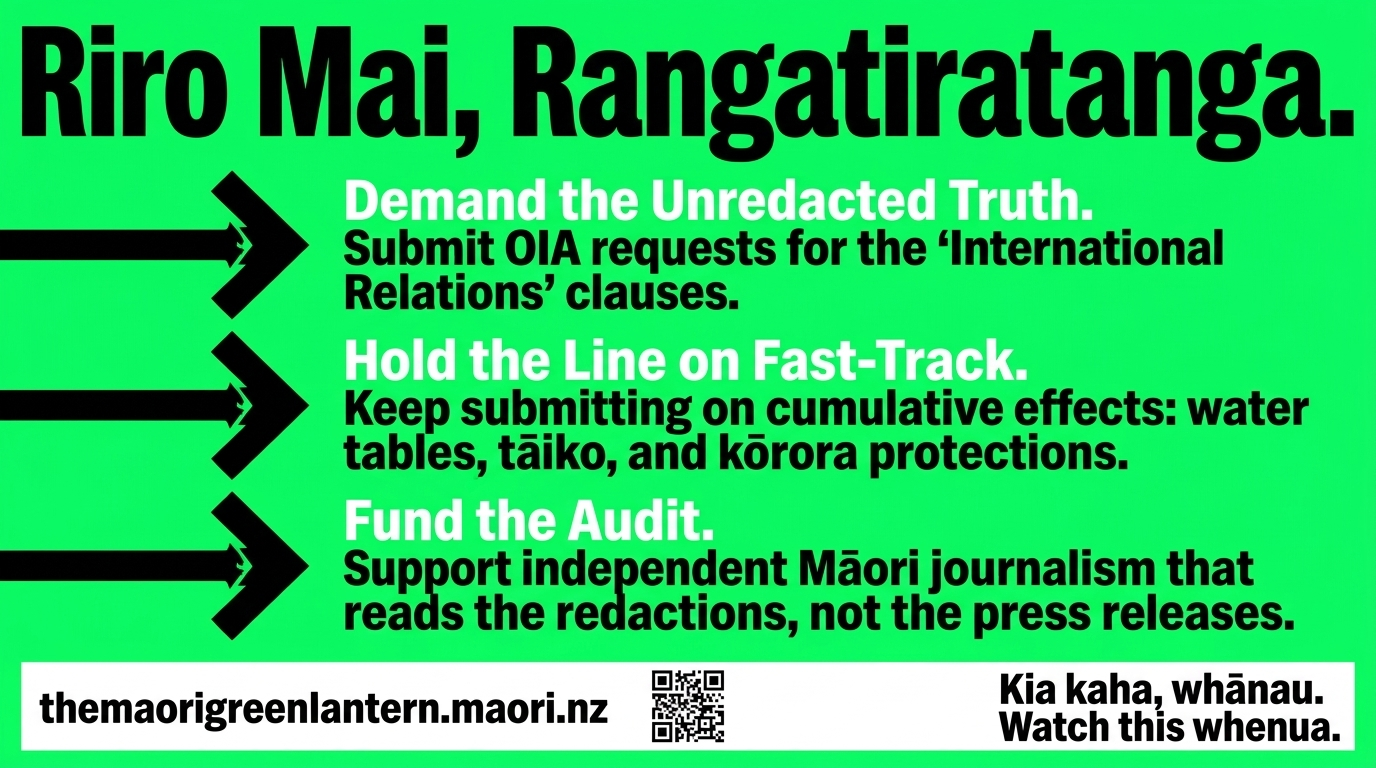
Action: whānau and hapū with a stake in Te Tai o Poutini should request the unredacted sections of the Cabinet paper under the Official Information Act now, while it is fresh, given the "international relations" exemption is doing heavy lifting over what is, on its face, a domestic funding decision.
Submitters to the Barrytown fast-track process should keep pressing on cumulative effects — water table changes, tāiko and kōrora protections, and Coast Road safety — because the fast-track's compressed timelines are precisely where community leverage is weakest.
Kupu Whakamutunga — I Will Not Stop Naming This

Shane Jones says he believes he's "up to the task of convincing Kiwis" that antimony and titanomagnetite are worth $50 million of public risk Newsroom.
He may well convince some. But convincing is not the same as meeting your own rules — two rules, in fact, both verified and both unmet — and a minister who has to change the rulebook before he can hit the target has already told you the honest answer would have been no.
This is what a white supremacist neoliberal government looks like when it doesn't even bother to hide the mechanism — it just changes the definition of eligible, mid-flight, and dares you to keep up.
I keep up. I name it. Ko wai te hua? Ko wai te utu? The mining companies benefit. Poutini Ngāi Tahu, and every taxpayer whose money was meant for Māori economic development, pays. Rangatiratanga means whānau and hapū get to ask that question before the trucks start rolling down the Coast Road, not after.
Kia kaha, whānau. Watch this whenua.
Disclaimer: This essay reflects analysis current as at 30 August 2026, based on the sources cited above, and has been through two rounds of primary-source verification. It is published in the public interest as commentary on the use of public funds and regulatory processes. Facts are sourced and cited; opinions are the author's own and are clearly flagged. Corrections are welcomed and will be published transparently.