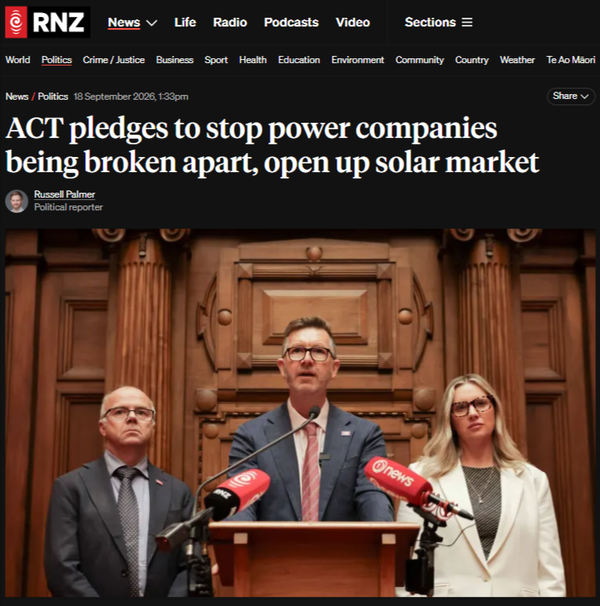
"THE TOLL GATE ON STOLEN GROUND: How National and NZ First Sold the Fast-Track Queue to the Highest Bidder While Māori Paid in Land, Water, and Whakapapa" - 27 May 2026
They called it infrastructure. We call it what it is: a bribe machine disguised as law, operated by a white supremacist neoliberal government that sold the keys to Aotearoa to the donor class — and charged whānau the entry fee in land, water, and dignity.

Kia ora Aotearoa,
This essay examines the direct financial relationships between fast-track project applicants and the National–NZ First coalition because they directly and materially affect Māori whenua, wai, conservation taonga, democratic integrity, and the rights of all whānau under Te Tiriti o Waitangi. Published in the public interest under the responsible communication defence (Durie v Gardiner NZCA 278).
The Toll Gate on Our Whenua
I want you to picture a toll gate. Not a motorway toll — something older, more brutal. A colonial toll gate, planted directly on land that was never lawfully sold, never gifted, never ceded. The Crown built it. The Crown staffed it. And now the Crown is charging entry fees — payable not in cash at the booth, but in donations to the National Party and NZ First before you even arrive.
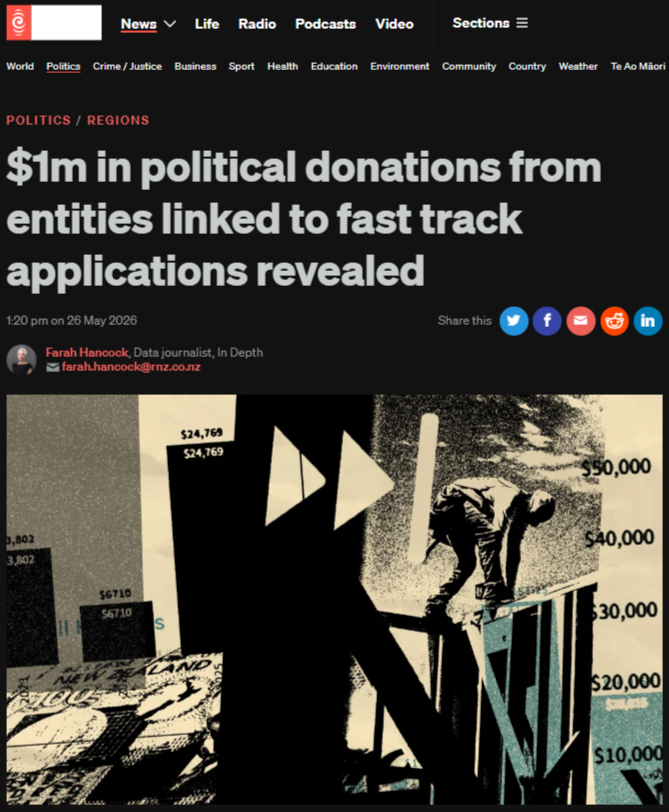
 Farah Hancock
Behind that gate: our rivers. Our conservation land. Our Kaimai Ranges. Our coastal seabed. Our tāonga species. Our unsettled Māori land — land still subject to Treaty claims, land whose tikanga has never been extinguished, land that belongs to the uri of those who were here before any "fast track" was a gleam in a lobbyist's eye.
The Deep Dive Podcast
Listen to a lively conversation between two hosts, unpacking and connecting topics in the sources of this essay. I apologise in advance for the AI's very harsh pronounciation of reo. Please dont shoot me, :).
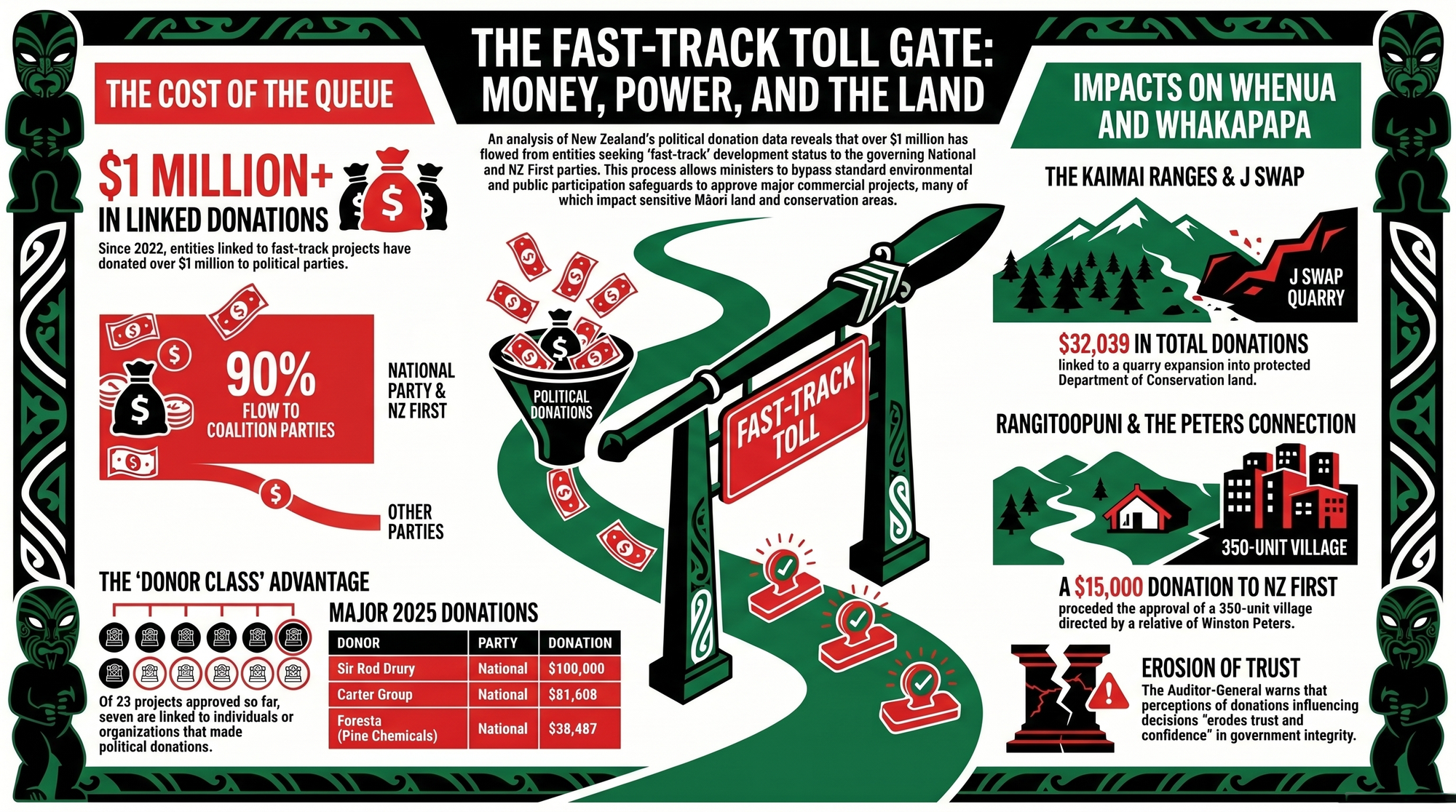
In front of that gate: a queue of developers, miners, resort-builders, and sand-dredgers with cheque-books open and phones buzzing to ministers' offices. They didn't apply on merit. They applied with money. As revealed by RNZ's Farah Hancock, more than $1 million in political donations flows from entities linked to fast-track projects directly to the two governing parties — National and NZ First — who wrote the law, control the gate, and pocket the toll.
I am Ivor Jones, The Māori Green Lantern. I wield the taiaha. Today I am naming the toll collectors, tracing their whakapapa to the donor class, and telling you exactly what they took from us to get here.
What They Built: A Corruption Machine in Legislative Clothing
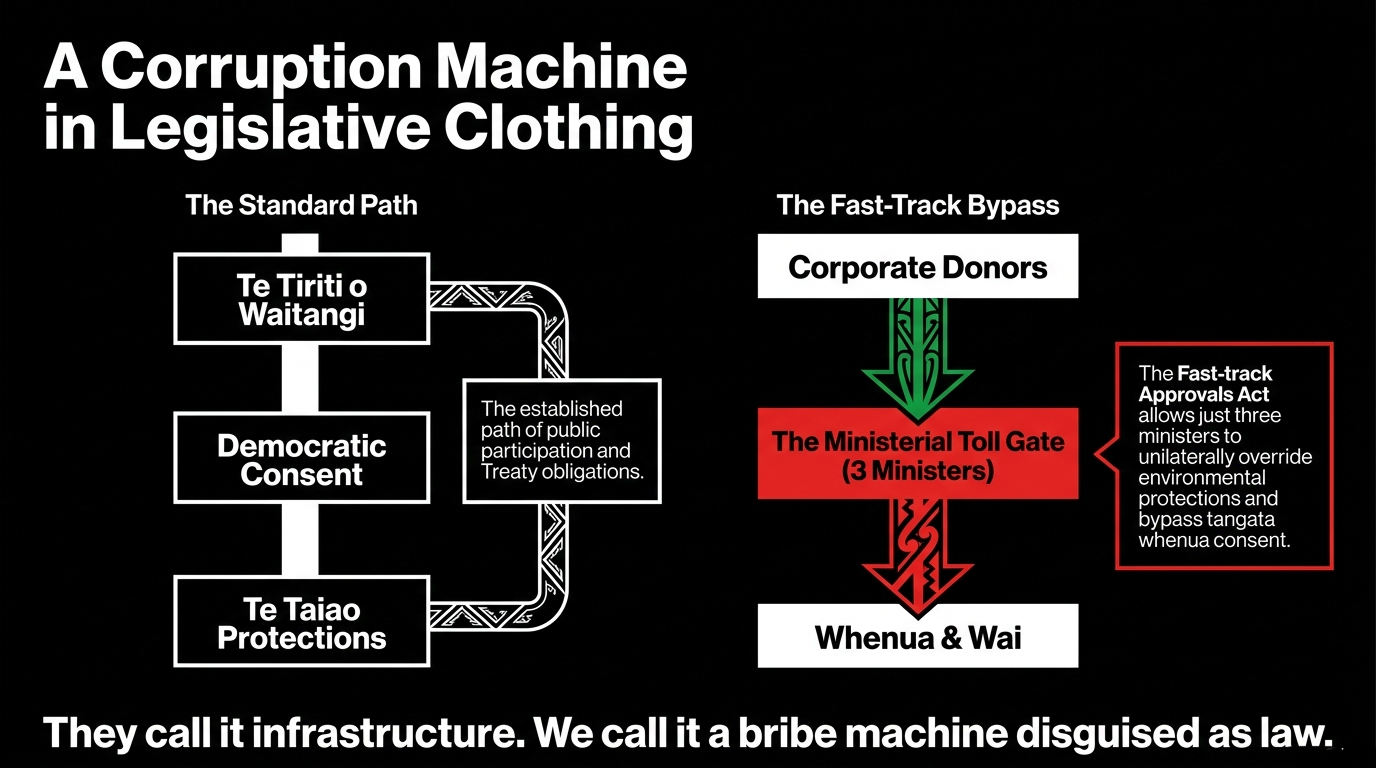
The Fast-track Approvals Act 2024 is not an infrastructure law. It is a corporate access law, disguised as urgency, dressed in the language of economic growth, and armed with the power to override environmental protections, Treaty obligations, and public participation rights with a ministerial signature.
Three ministers — drawn from the same parties that received the donations — can wave through a coal mine expansion, a sand-dredging operation into Māori coastal waters, or a resort development on land adjacent to unsettled Treaty claims.
The introduction of this fast-track process was part of NZ First's coalition bottom line, as confirmed by RNZ.
Let that sit.
A minor party with 8.6 percent of the vote demanded — and received — a permanent legislative regime allowing extractive industry to bypass democracy as their price for sitting at the coalition table.
And then the extractive industries that benefited donated back. Almost 90 percent of the $1 million-plus in donations from fast-track-linked entities since 2022 went directly to National and NZ First, as documented by RNZ.
This is not coincidence. This is whakapapa — the traceable genealogy of power, money, and access. As I have previously tracked at The Māori Green Lantern and in my essay Corporate Greed and Environmental Betrayal: J Swap, Shane Jones and the Fast-Track, this government does not serve New Zealanders. It serves the class with the private jets.
The Verified Whakapapa of $1 Million
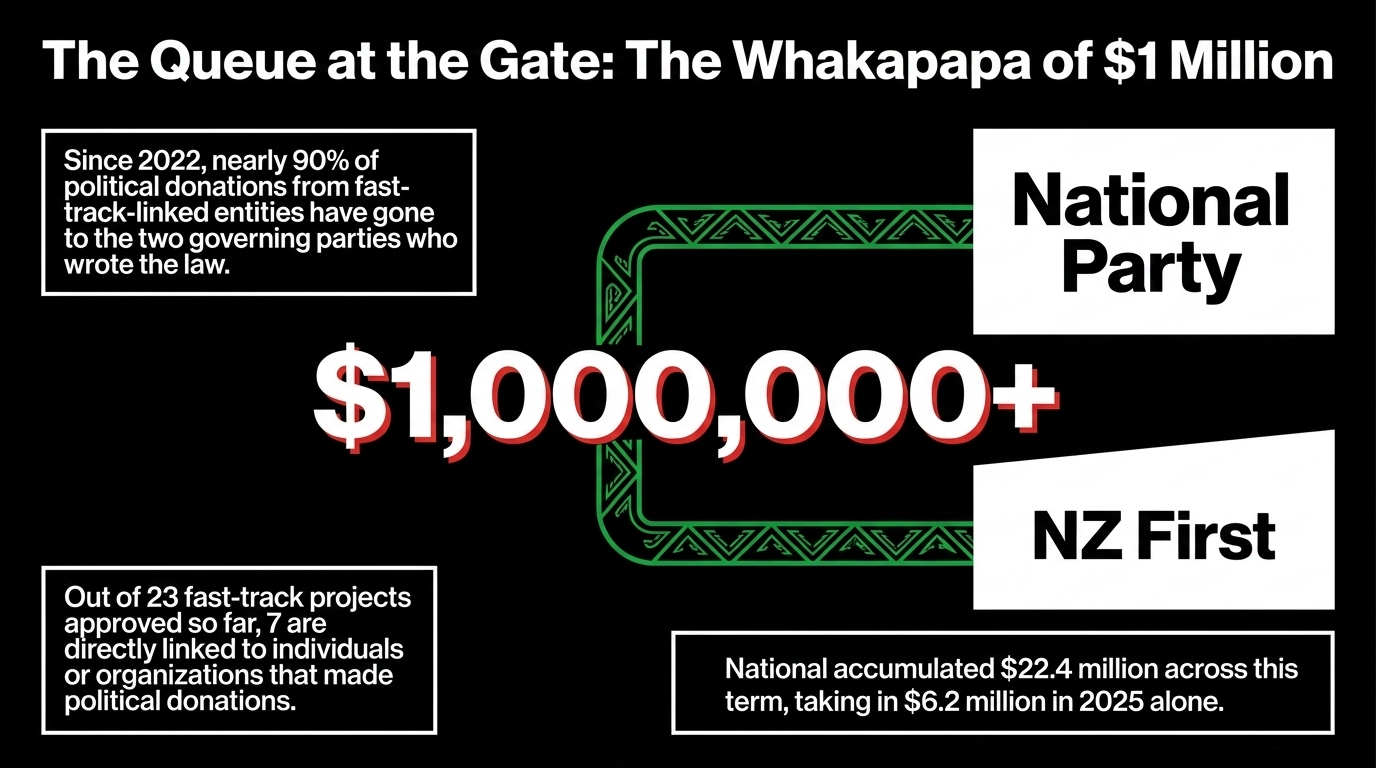
As exposed by RNZ, here is what the donor class bought — and what they are still trying to buy:
| Donor / Entity | 2025 Donation | Party | Fast-Track Project | Outcome |
|---|---|---|---|---|
| Sir Rod Drury | $100,000 | National | Coronet Village: gondola, ski area, 780 units | No substantive application yet |
| Carter Group | $81,608 | National | Ryans Road Industrial; Rolleston & Ōhoka residential | One APPROVED; two pending |
| Foresta (Pine Chemicals) | $38,487 | National | Wood pellet plant, Kawerau (Putauaki Trust land) | Pending |
| AJ Russell / Brett Russell | $26,015 | National | Beachlands South: 2,700 dwellings, Auckland | No substantive application |
| Gibbston Valley Wines | $24,769 | National | Gibbston Village: 900 units | No substantive application |
| Ngāti Manuhiri Settlement Trust | $17,539 | NZ First | Te Ārai South: sand-mining + aquaculture | Under consideration |
| Avant Group (rel. W. Peters) | $15,000 | NZ First | Rangitoopuni: 350-unit retirement village | APPROVED Nov 2025 |
| Gibbons/Gibbonsco | $20,000 | NZ First | Ridgeburn: 1,250 dwellings, Queenstown | Accepted Oct 2025 |
| McCallum Bros | $10,000 | NZ First | Bream Bay offshore sand dredging | Pending |
| Bathurst Resources | $10,000 | NZ First | Buller coal mine: 20 million tonne expansion | No substantive application |
| J Swap Contracting | $13,039 | NZ First | Katikati Quarry into DOC/Kaimai land | No substantive application |
| AJR Group (Kings Quarry) | $10,000 | NZ First | Kings Quarry: 60ha expansion | Pending |
| Beca Group | $8,528 + $8,620 | National + Labour | Lake Pukaki Hydro (Meridian Energy) | Under expert panel |
| DNA Management (Knight Investments) | $5,283 | National | Three business/residential parks | No substantive applications |
National raked in more than $6.2 million in total donations in 2025 alone, as documented by The Spinoff — streets ahead of every other party, having accumulated $22.4 million across the current parliamentary term. The fast-track money is not an anomaly. It is the business model.
Three Examples for the Western Mind
Example One: J Swap, the Kaimai Ranges, and the Price of a Forest
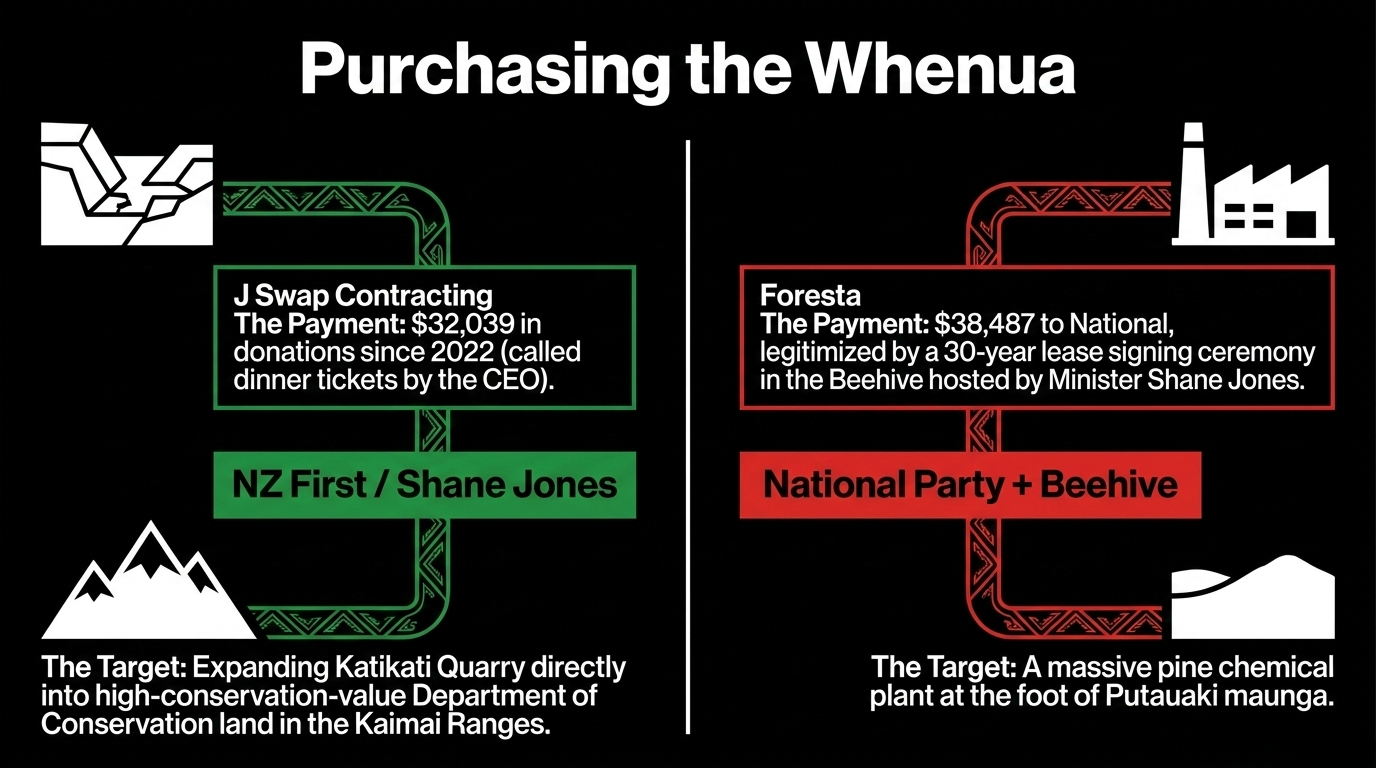
The Claim: J Swap Contracting donated $13,039 to NZ First in 2025. Its CEO personally donated $5,000 to Shane Jones in 2023 — the very minister who championed the fast-track process, declared conflicts of interest on eight projects, and hosted a Beehive signing ceremony for another fast-track applicant. J Swap's application seeks to expand its Katikati Quarry into Department of Conservation land in the Kaimai Ranges. As revealed by RNZ, J Swap has given $32,039 in total political donations since 2022, with $24,039 going to NZ First alone.
The Harm Quantified: The Kaimai Ranges form a critical ecological corridor connecting Coromandel to Bay of Plenty forests — habitat that cannot regenerate in a human lifetime, and certainly not in the lifetime of the whakapapa connecting hapū to that land. As Greenpeace Aotearoa has documented, the fast-track process is "incredibly vulnerable to corporate lobbying — whoever lobbies hardest wins." J Swap's CEO told RNZ the donations were for "dinner tickets." Thirty-two thousand dollars in dinner tickets to the parties controlling the gate to their quarry expansion. Name it.
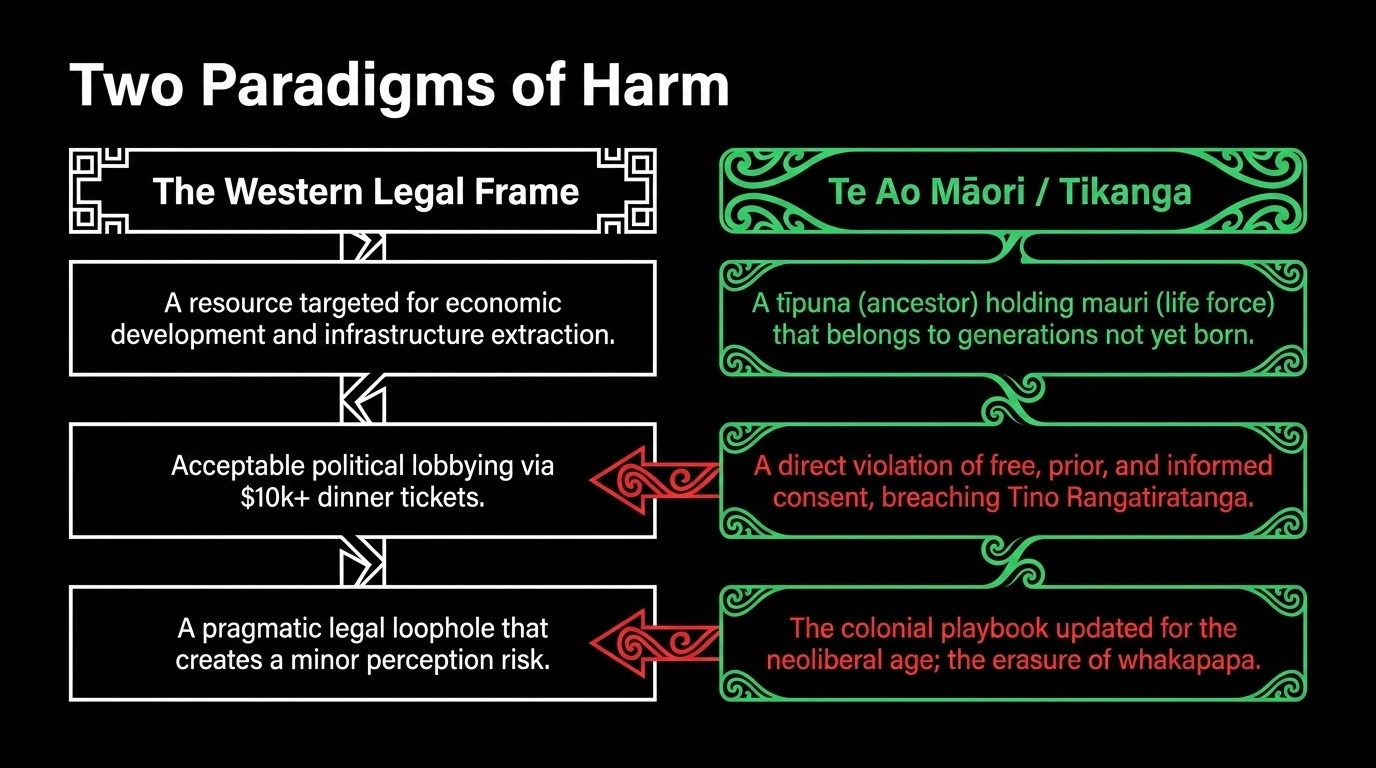
The Tikanga Impact — for the Western Mind: Imagine a corporation donating to the planning committee that approves their building consent, then claiming it was just "keeping in the loop." You would call that corruption. In tikanga, the land of the Kaimai Ranges is not a resource. It is a tīpuna — an ancestor. To quarry it without the free, prior, and informed consent of the tangata whenua of Tauranga Moana is not environmental harm alone. It is an act of violence against whakapapa. It destroys the mauri — the life force — of a living entity that belongs to generations not yet born. As Professor Elizabeth Macpherson confirmed for E-Tāngata, the Fast-track Act facilitates development on high conservation-value lands by avoiding the need for project owners to obtain concessions under the Conservation and Reserves Acts — a direct route to Māori exclusion.
The Solution: Immediate exclusion of DOC conservation land and land adjacent to unsettled Treaty claims from fast-track eligibility. Mandatory iwi and hapū consent — not consultation, consent — before any extractive application proceeds.
Example Two: The Peters Blood Network and the Rangitoopuni Approval
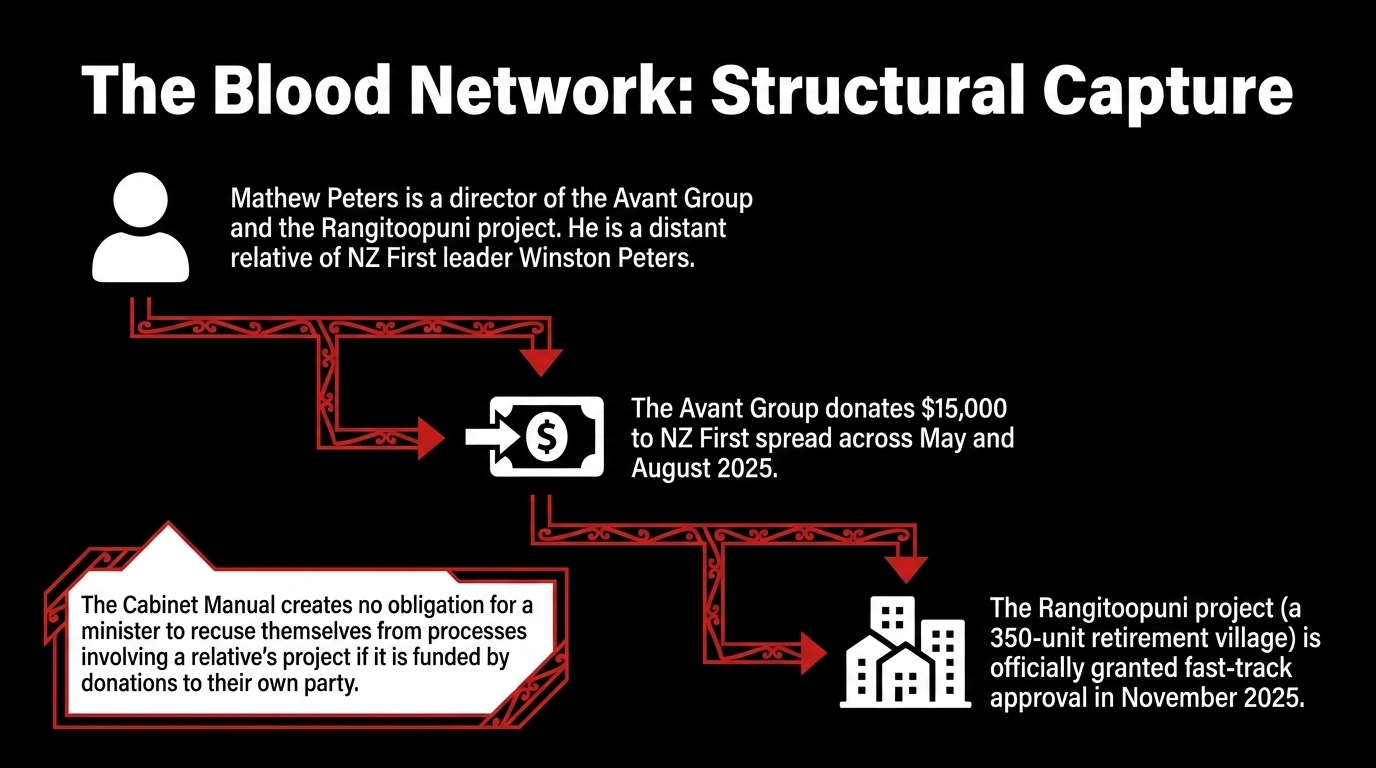
The Claim: Mathew Peters is a director of the company responsible for the Rangitoopuni project — a 350-unit retirement village in Auckland's Riverhead, approved November 2025. Mathew Peters is a distant relative of NZ First leader Winston Peters. The Avant Group — which Mathew Peters also directs — donated $15,000 to NZ First spread across May and August 2025. As revealed by RNZ, the Cabinet Manual does not class party donations as a conflict of interest for ministers — meaning Winston Peters faced no formal obligation to recuse himself from any process involving a relative's project funded by donations to his own party.
The Harm Quantified: As the Office of the Auditor-General confirmed, the perception that donations influence decisions "erodes trust and confidence" in government integrity — regardless of whether actual influence occurred. A project linked to the party leader's relative, funded by donations to that leader's party, is approved. The Cabinet Manual says: no problem. The Auditor-General says: the perception is damaging. I say: the structural corruption is designed into the system.
The Tikanga Impact — for the Western Mind: In tikanga Māori, whakapapa creates obligation. When you trace the connections — Peters to Peters, donation to NZ First, approval granted — you are reading a whakapapa of power that the Western legal framework deliberately refuses to name. The Māori concept of kaitiakitanga demands that those who hold power must hold it for the collective good, not for their uri. This government weaponises tikanga when it suits them — invoking "partnership" language — and discards it the moment accountability is required.
The Solution: A mandatory five-year stand-down between political donations and any government decision that tangibly benefits the donor, as Victoria University's Max Rashbrooke has recommended and as reported by RNZ. And a real-time public register of all fast-track applicants and their political donation histories — searchable and open-access.
Example Three: Foresta, the Beehive Ceremony, and the Putauaki Trust Land
The Claim: The company Foresta, proposing a pine chemical and wood pellet plant on a 9.5-hectare site in Kawerau, leased land from the Putauaki Trust for 30 years with an option to extend. That agreement was formalised in a signing ceremony hosted in the Beehive by regional development minister Shane Jones. Foresta then donated $38,487 to National across three donations between July and October 2025. As revealed by RNZ, this project is still pending fast-track approval — and the company is already donating to the party that controls the approvals process.
The Harm Quantified: The Buller coal mine expansion — also fast-track linked, also backed by a $10,000 NZ First donation from Bathurst Resources — seeks to extract an additional 20 million tonnes of coal over 25 years from the Stockton and Denniston Plateau, as documented by RNZ. These are not clean energy projects. They are fossil fuel and biomass extraction projects wrapped in "economic development" language, being waved through a captured approvals process. The climate harm is irreversible. The land harm is irreversible.
The Tikanga Impact — for the Western Mind: Imagine your local council hosting a ribbon-cutting ceremony for a factory being built on land your grandfather's family never agreed to sell, using permits approved by officials who had received money from the factory owner. You would call that a racket. In tikanga, Putauaki maunga is a tīpuna — an ancestor sacred to Ngāti Awa. The use of a ministerial ceremony in the Beehive to legitimise a 50-year commercial extraction lease on the whenua below that ancestor, followed by $38,487 to the minister's coalition partner, is not economic development. It is the colonial playbook updated for the neoliberal age: colonise the ceremony, then take the land. As Professor Macpherson confirms for E-Tāngata, the legislation enables "a new wave of excluding Māori from the protection and use of the lands they are related to."
The Solution: Mandatory separation of ministerial ceremonial functions from commercial approvals processes. No minister should host or attend a commercial signing ceremony for any project that may subsequently come before a fast-track panel — full stop.
Five Hidden Connections — Verified
Connection One: The NZ First Coalition Dividend. The fast-track process was a NZ First coalition bottom line — and NZ First received donations from at least seven entities with fast-track projects. J Swap's CEO personally donated to Shane Jones. Jones hosted the Foresta Beehive ceremony. Jones declared conflicts of interest on eight fast-track projects, as previously exposed in my essay Corporate Greed and Environmental Betrayal: J Swap, Shane Jones and the Fast-Track. As Greenpeace Aotearoa has confirmed, the process is structurally captured by corporate lobbying. Jones controls both the mining lever and the regional development lever simultaneously. That is not a conflict of interest. That is a conflict of interests — plural.
Connection Two: The Peters Blood Network. Mathew Peters, relative of Winston Peters, directs the Avant Group which donated $15,000 to NZ First, and the Rangitoopuni project which was approved in November 2025, as confirmed by RNZ. The Cabinet Manual creates no obligation for Winston Peters to recuse himself. The Auditor-General says the perception is damaging. The project is approved and building. You connect the whakapapa.
Connection Three: The Carter National Dynasty. Philip Carter, director of the Carter Group ($81,608 to National in 2025; $59,500 in 2023), is the brother of former National MP David Carter, as reported by RNZ. Three projects submitted. The Ryans Road Industrial development: approved. Whakapapa of money — family, party, approved project. As I exposed in Corruption in a Suit: How Corporate Cash Strangles Democracy and Betrays Māori Values, this is the structure of a captured state, not the exception to it.
Connection Four: The Nakhle National Network. Daniel Nakhle's sister-in-law is National MP Rima Nakhle. DNA Management donated $5,283 to National. Knight Investments — also Nakhle's — has three fast-track projects accepted. Nakhle gave $20,000 to Auckland Mayor Wayne Brown's 2025 campaign, as documented by RNZ. As The Spinoff has documented, the broader donor ecosystem shows the same individuals spreading money across coalition partners and local politics simultaneously. Networks within networks. Whakapapa of influence.
Connection Five: The Conservation Land Loophole. As Professor Elizabeth Macpherson confirmed for E-Tāngata, the Fast-track Act does not exclude unsettled Māori land, high-conservation-value land, or QEII-protected land from the approvals process. J Swap wants DOC land in the Kaimai Ranges. Bathurst Resources wants 20 million more tonnes of coal from the West Coast plateau. McCallum Bros want to dredge sand from Bream Bay coastal waters. Every one of these applications was preceded by a donation to the parties running the approvals process. Every gate has a toll. Corporations donate to the party that wrote the law that hands them the land.
The Auditor-General's Polite Warning — And What It Actually Means
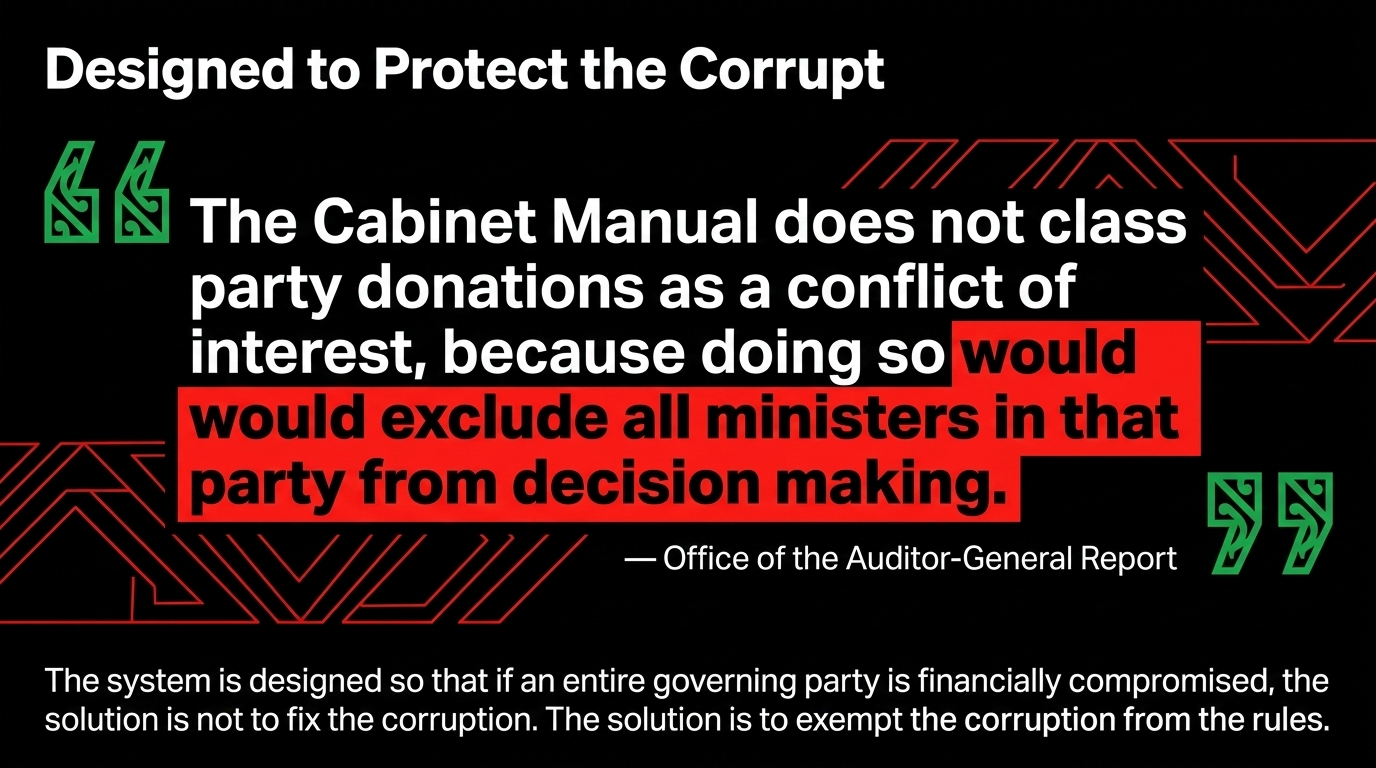
The Auditor-General's investigation found conflicts were "largely well-managed" — a sentence so timid it should have come with a trigger warning. Buried in the same report: the Cabinet Manual does not class donations to a party as a conflict of interest for ministers, because — and I want you to read this slowly — treating party donations as a conflict "would exclude all ministers in that party from decision making."
Read that again. The system is designed so that if the entire governing party's decision-making apparatus is financially compromised by donor relationships, the solution is not to fix the corruption. It is to exempt the corruption from the rules.
The Auditor-General called this "pragmatic." I call it what it is: the structural architecture of a captured state.
Victoria University's Max Rashbrooke told RNZ these donations are "corrosive to trust in politics" and called for a mandatory five-year stand-down. The Government has ignored him. Because the Government is the beneficiary. You do not reform a machine you are profiting from.
As I documented in Parliament's 2025 Year of the Industrial Grinder: they call it efficiency. We call it a loot.
Ngāti Manuhiri — A Word of Care and a Structural Critique
I want to be precise here, because tikanga demands precision. The Ngāti Manuhiri Settlement Trust donated $17,539 to NZ First for event tickets. Their CEO Nicola Rata-MacDonald has stated clearly: the Te Ārai South project will bring more than $2 billion to the local economy, and "we believe this project stands on its merits," as reported by RNZ. Iwi and hapū have every right to engage politically and to pursue economic development on their own whenua. Tino rangatiratanga includes the right to develop on your own land.
My critique is not directed at Ngāti Manuhiri's mana. It is directed at the system that forces iwi to play by the same corporate donation rules as Queenstown resort developers and West Coast coal miners — a system built by the same government that dismantled the Māori Health Authority, cut Māori housing programmes, and gutted te reo funding. As I have tracked in $12.8 Billion Stolen: How the Coalition Gutted Pay Equity, this government gives with one hand and extracts with both.
What This Government Actually Is
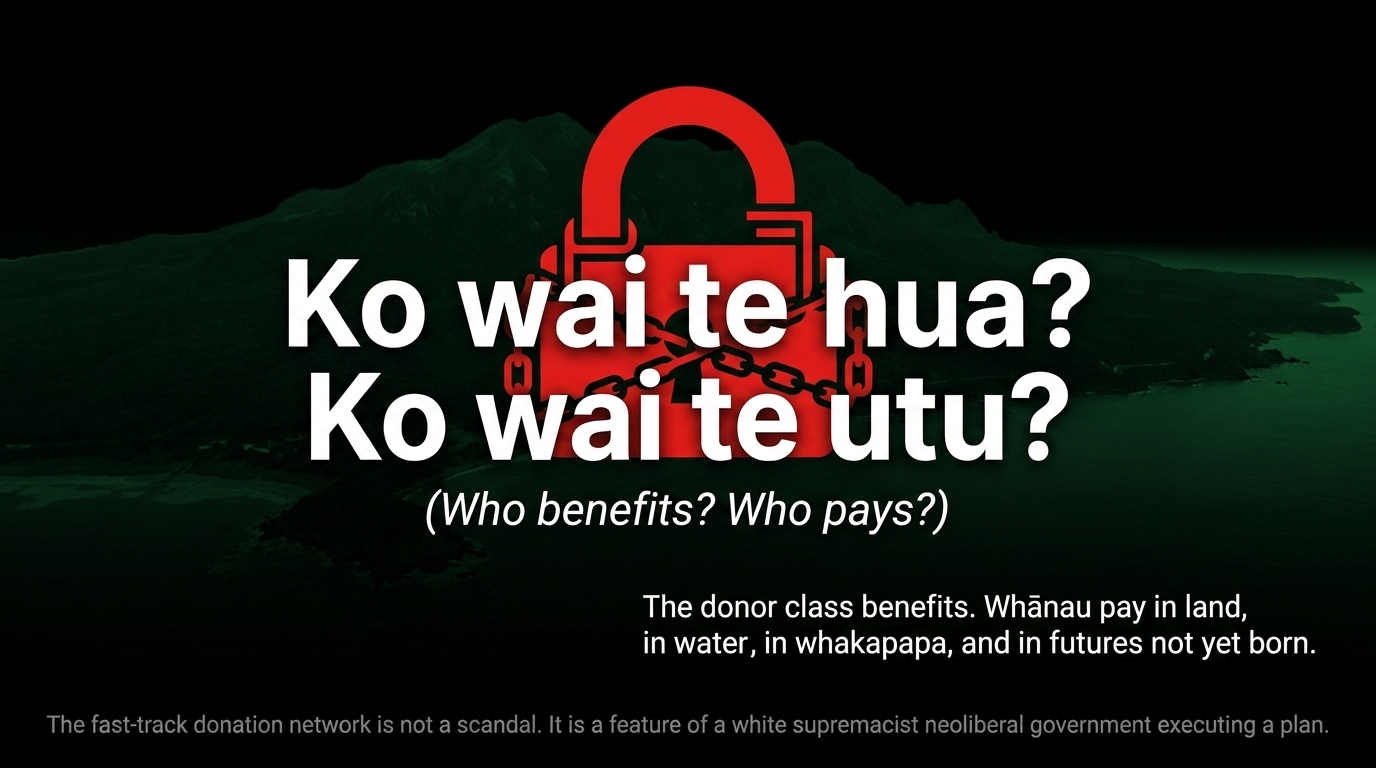
Let me be plain. This is a white supremacist neoliberal government — and I do not use those words to be inflammatory. I use them because they are forensically accurate, and because evidence demands them.
White supremacist: This is a government that dismantled the Māori Health Authority, repealed smokeless tobacco legislation that disproportionately protected Māori lives, attacked co-governance at every turn, and stripped Treaty clauses from legislation through a deliberate review process. It is now fast-tracking development onto whenua Māori using a process that — as confirmed by Professor Macpherson for E-Tāngata — excludes the tikanga-based environmental protections Māori fought for decades to embed in law. The bill enables "a new wave of excluding Māori from the protection and use of the lands they are related to." Those are not my words. Those are the words of an academic who studied the legislation.
Neoliberal: This is a government that concentrates economic decision-making in three ministers, removes public participation, eliminates environmental safeguards, and then takes donations from the corporations that benefit. As The Spinoff has revealed, National received $22.4 million in donations across this parliamentary term. The policy follows the money. The money follows the policy.
As I have argued in my essay Shane Jones: Corporate Puppet Betraying Te Taiao and Tangata Whenua, this is not a government that made mistakes. It is a government executing a plan. The fast-track donation network is not a scandal. It is a feature.
What Must Happen — Non-Negotiably
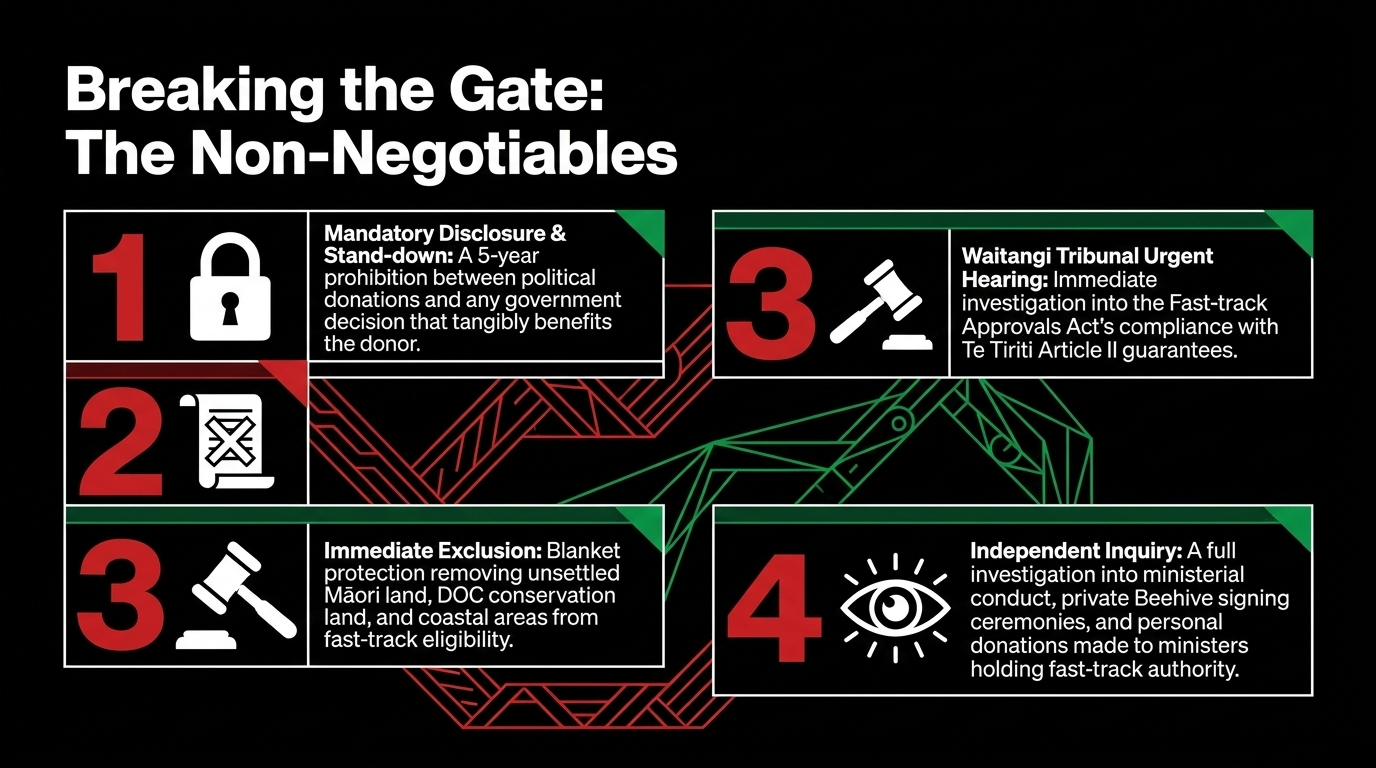
- Mandatory disclosure — all political donations from fast-track applicants classified as a conflict of interest requiring ministerial recusal, consistent with the findings at oag.parliament.nz.
- Five-year stand-down between donations and any government decision that benefits the donor, as Rashbrooke demands and as RNZ has reported.
- Immediate exclusion of all unsettled Māori land, DOC conservation land, and coastal/marine areas from fast-track eligibility, as demanded by the analysis at E-Tāngata.
- A Waitangi Tribunal urgent hearing into the Fast-track Approvals Act's compliance with Te Tiriti Article II guarantees of tino rangatiratanga over taonga, land, and wai.
- A real-time public register of all fast-track applicants and their political donation histories — searchable, open-access, updated quarterly.
- An independent inquiry into Shane Jones' ministerial conduct, the Beehive signing ceremony, and all personal donations made to Jones by entities with fast-track interests.
Kia Mau — The Whenua Does Not Forget
They built a toll gate on our whenua. They staffed it with ministers whose parties received the tolls. They wrote a law that said: this is not corruption. And then they called it "infrastructure."
The Māori Green Lantern is the taiaha at that gate. The evidence is the taiaha. The verified whakapapa of money, ministers, and approved projects is the blow. I have named the names. I have traced the connections. I have cited the sources.
Ko te pātai nui: Ko wai te hua? Ko wai te utu?
Who benefits? Who pays?
The donor class benefits. Whānau pay. In land. In water. In whakapapa. In futures not yet born.
The whenua does not forget. Neither do I.
Koha — Fund the Taiaha at the Gate
While developers donate $100,000 to National to fast-track 780 units onto the slopes below Coronet Peak, and sand miners buy NZ First dinner tickets to dredge Māori coastal waters, this essay exists because ordinary whānau made it possible. Every koha you give is rangatiratanga in action. It funds the accountability that Crown and corporate structures will never provide for themselves. It signals that we know the difference between a donation that buys a toll gate and a koha that funds truth.
Every koha funds rangatiratanga's own truth tellers.
If you are unable to koha — no worries at all. Subscribe, follow, kōrero, share with your whānau and friends. That is koha in itself.
Kia kaha, whānau. Stay vigilant. Stay connected.
- 💚 Koha directly: Support the Māori Green Lantern
- 📧 Subscribe for essays: themaorigreenlantern.maori.nz
- 🏦 Bank direct: HTDM — 03-1546-0415173-000
- 👍 Follow on Facebook: The Māori Green Lantern

Views expressed constitute honest opinion on matters of public interest under the Defamation Act 1992 (NZ) and Durie v Gardiner NZCA 278. All factual claims sourced and cited from verified primary sources, including RNZ, the Office of the Auditor-General, E-Tāngata, The Spinoff, Greenpeace Aotearoa, and the Ministry for the Environment. Named individuals are referenced solely in their public capacity as political donors, ministers, directors, or public figures. Errors or concerns: contact via themaorigreenlantern.maori.nz. Named individuals in their public capacity are welcome to respond — this essay will be updated with any verified corrections.