
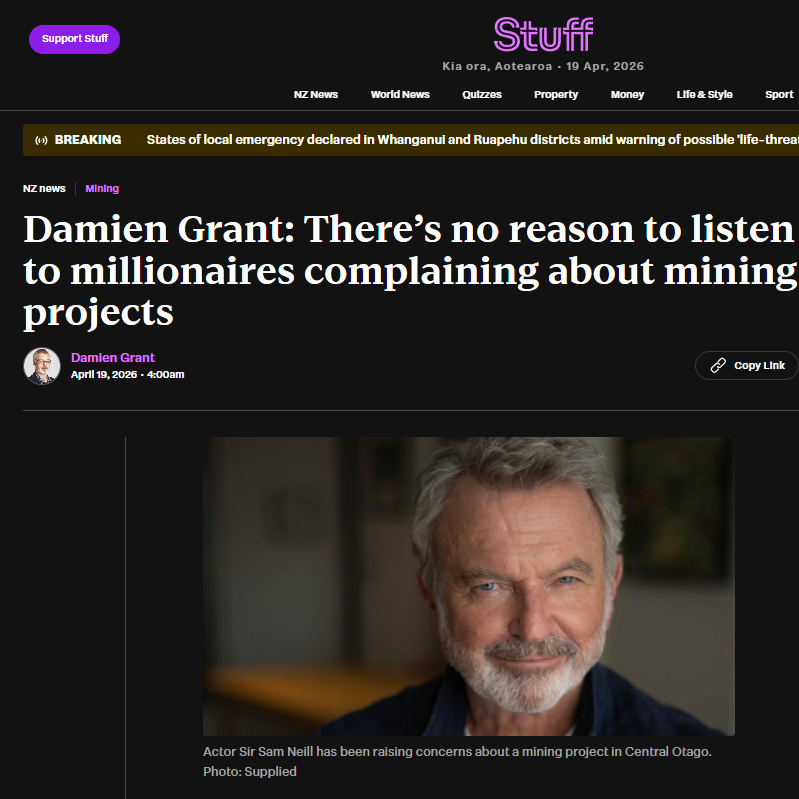
"DRILL BABY, DRILL — INTO YOUR OWN FRAUD" - 19 April 2026
How a Convicted Liquidator, an Australian Gold Miner and a White-Supremacist Neoliberal Government Are Strip-Mining Te Tiriti, Tikanga and the Truth

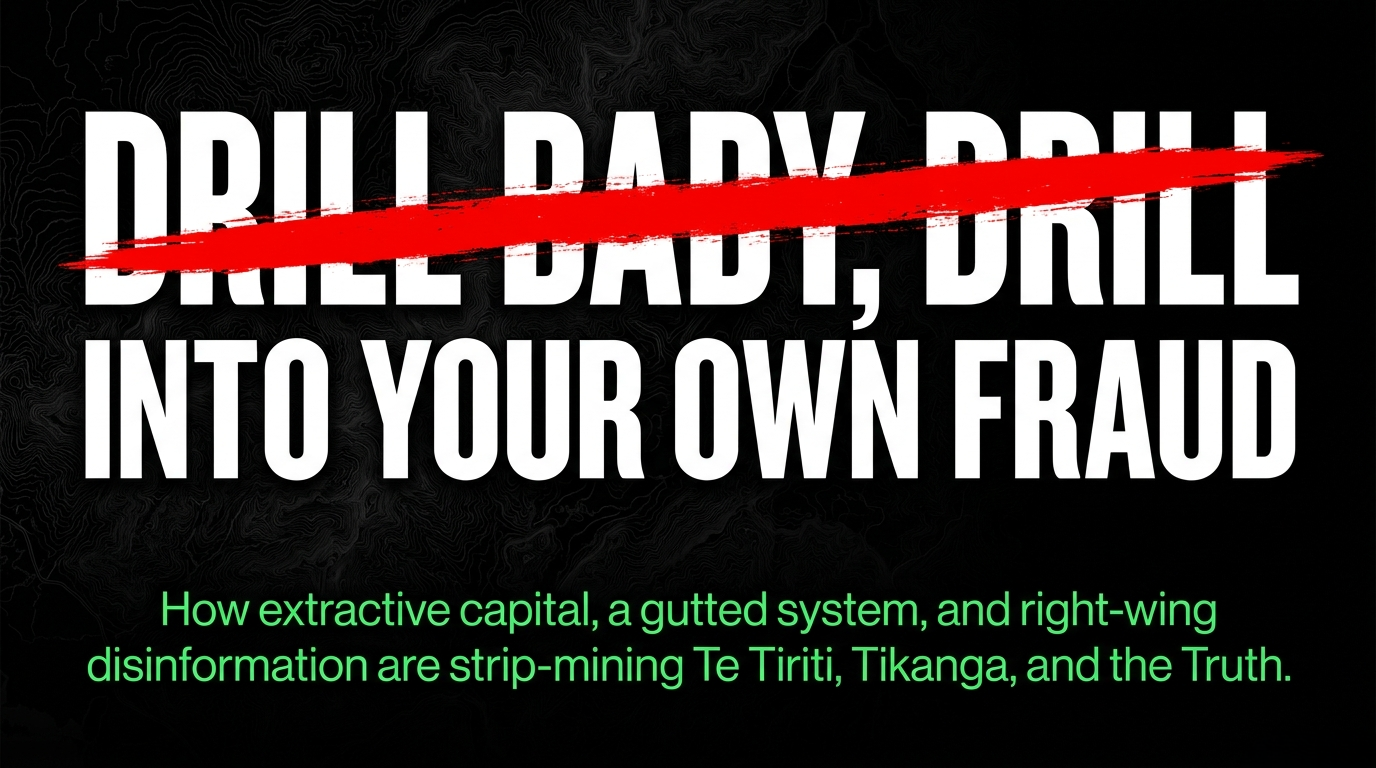
“Thanks Sir, for your contribution, but I am with Shane Jones on this one. Drill Baby, Drill.”
— Damien Grant, convicted fraudster turned Stuff columnist, 19 April 2026.
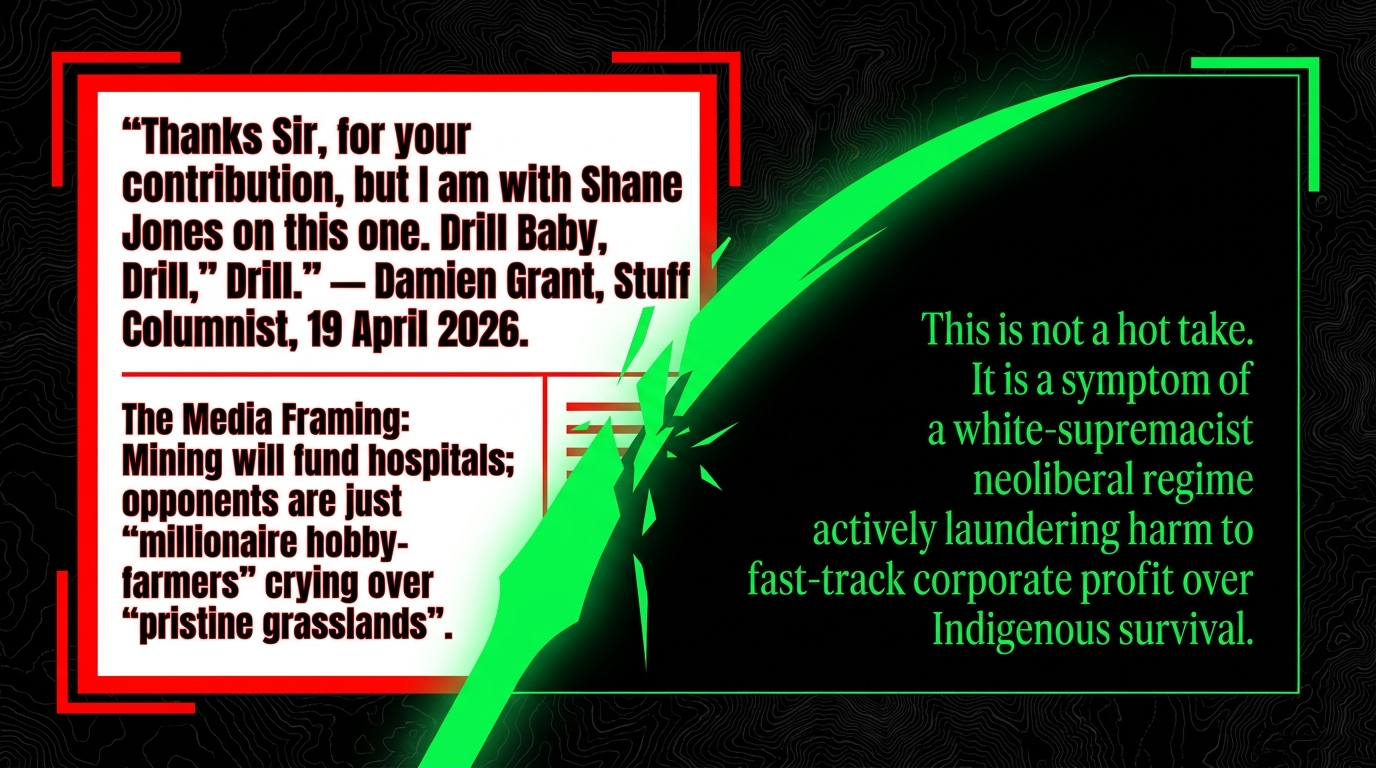
This is not just a bad opinion piece. It is a symptom. Damien Grant is the perfect mascot for this Government: a convicted fraudster wrapped in a suit, fronting for extractive capital, sneering at Māori and at anyone who still believes that whenua has a mauri that can’t be measured in an Australian feasibility spreadsheet.
His latest column on the Central Otago gold mine does not just miss the point — it actively launders harm for a white-supremacist neoliberal regime that is dismantling protections, gutting regulators, and fast-tracking corporate profit over Indigenous survival.
The Deep Dive Podcast
Listen to a lively conversation between two hosts, unpacking and connecting topics in the sources of this essay.
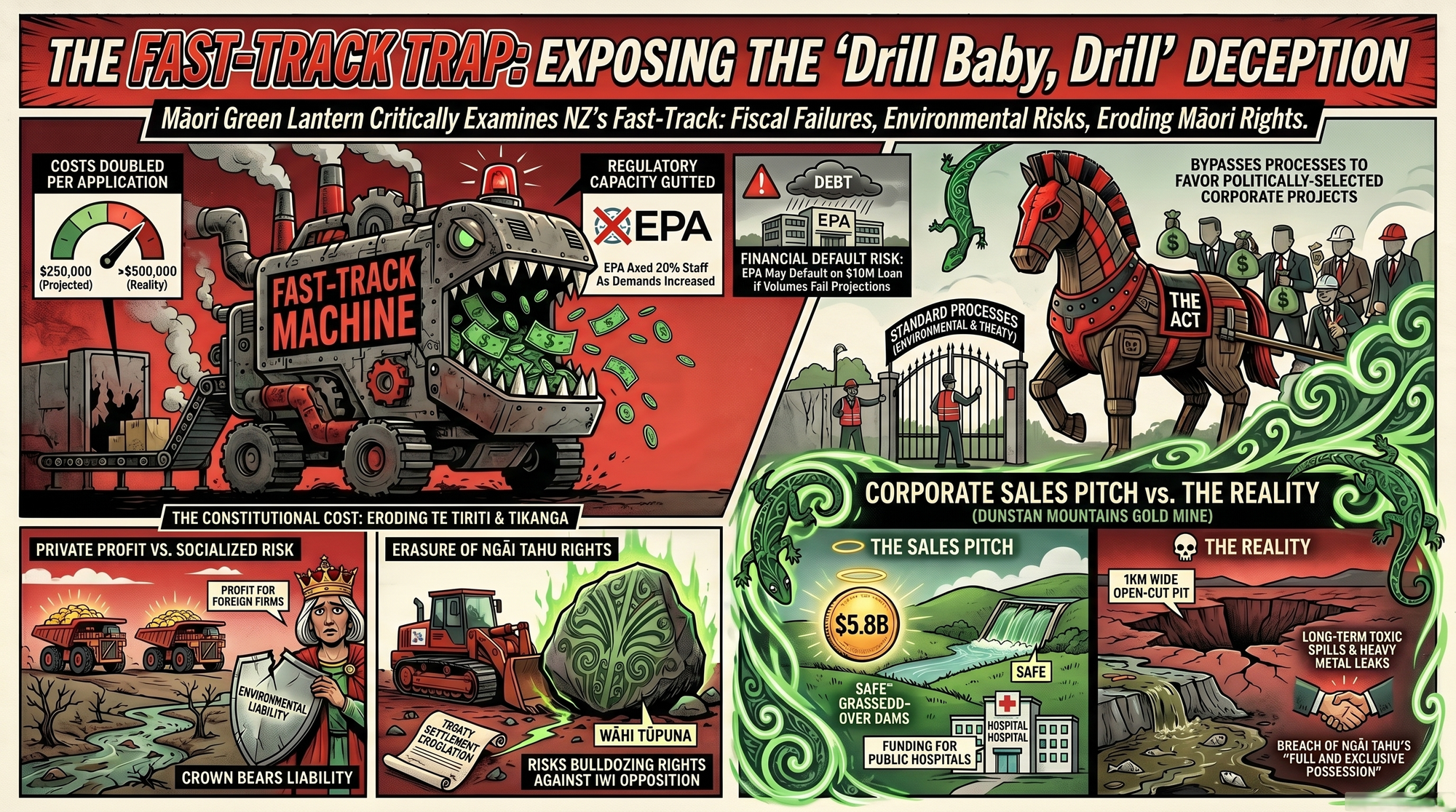
On the very day his piece runs, the Environmental Protection Authority admits the cost of running the Government’s fast-track process is already in excess of what was projected, as revealed by RNZ. The machine he is cheerleading is blowing out, financially and constitutionally, before a single shovel hits the Dunstan Mountains.
This essay keeps all the bones of the earlier takedown and sharpens every edge. The taiaha is out.
Who Is Damien Grant to Tell Anyone to Shut Up?

Before we let this man decide whose voice counts, we need his rap sheet up front.
- Damien Grant is a convicted fraudster. In the 1990s he was sentenced to 30 months’ imprisonment over a credit card and share-trading scam, as reported by the NZ Herald and detailed by the New Zealand Initiative.
- Decades later, his own professional body, RITANZ, decided he was not a “fit and proper person” to hold an insolvency licence, and he had to go to court to claw back his career, as covered by the NZ Herald and revisited when he partially won in the High Court, again reported by the NZ Herald.
- In 2021, the High Court found Grant and another liquidator had charged $56,000 in fees “not reasonably incurred” and ordered them to repay creditors, as reported by the NZ Herald.
This is the guy Stuff repeatedly puts on a pedestal to sneer at “millionaire hobby-farmers” and “academic environmentalists” and to tell Māori and locals their views are irrelevant.
Grant is also part of a media ecology that thrives on agitation and right-wing framing. He appears as a regular commentator on shows with Sean Plunket and Martin Bradbury, including a Magic Talk appearance promoted by his own firm Waterstone Insolvency on Facebook.
He’s not neutral. He’s not balanced. He is a paid mouthpiece for a class that treats whenua as collateral and community as a rounding error.
The Column: A Bad-Faith Script for White-Supremacist Neoliberalism
Grant’s Stuff column on the Dunstan Mountains gold mine is a textbook in extraction apologetics, as published by Stuff. He admits he has never been to Central Otago and doesn’t care if he dies without ever going there. He calls the landscape “uninspiring vistas” and dismisses local concern as “wailings of millionaire hobby-farmers” and “academic environmentalists” concerned about “pristine grasslands”, as shown in the column text.
From there, he runs the classic script:
- Reduce opposition to rich individuals
He centres actor Sam Neill and portrays the controversy as one vain millionaire protecting his view, citing Neill’s comments in the Otago Daily Times and The Guardian only to mock them, as recounted in the Stuff column. All other voices — especially Māori — are erased. - Treat industry-commissioned projections as fact
He touts a report “commissioned by the proposed miner” Santana Minerals that projects 351 direct jobs, 250 indirect jobs, $5.8 billion in economic benefit and $1.8 billion in Crown revenue, as he quotes directly in the column. These numbers originate from company-commissioned analysis, echoed by Santana’s own media statements and summarised in coverage like RNZ on Santana Minerals and BusinessDesk for similar projects. They are not neutral facts; they are sales pitches. - Minimise permanent environmental risks
Grant frames the four open-cut pits — each up to 1km wide over 550 hectares — as barely visible scars you might only notice “if you stop your car and squint”, as he writes in his own piece. He acknowledges the existence of a large tailings dam that will “remain for decades” and that there have been overseas failures causing environmental havoc, then immediately assures readers that “over 98% of tailings dams dry out, are grassed over, and turn into paddocks”, again according to his column. He offers no source, no failure statistics, and no local risk analysis, even though global reviews of tailings disasters paint a very different picture, as summarised in research collated by the NZ Treasury’s fast-track risk assessment. - Openly socialise risk, privatise profit
The most damning line in his column is this: he concedes that “the environmental risk of the tailings dam falls on the state; so precautions are warranted and need to be weighted against the benefits”, as directly quoted from the Stuff article. In other words: if the dam fails, you and I — and whānau downstream — pay, not Santana Minerals’ Australian shareholders. - Erasing Ngāi Tahu and Te Tiriti entirely
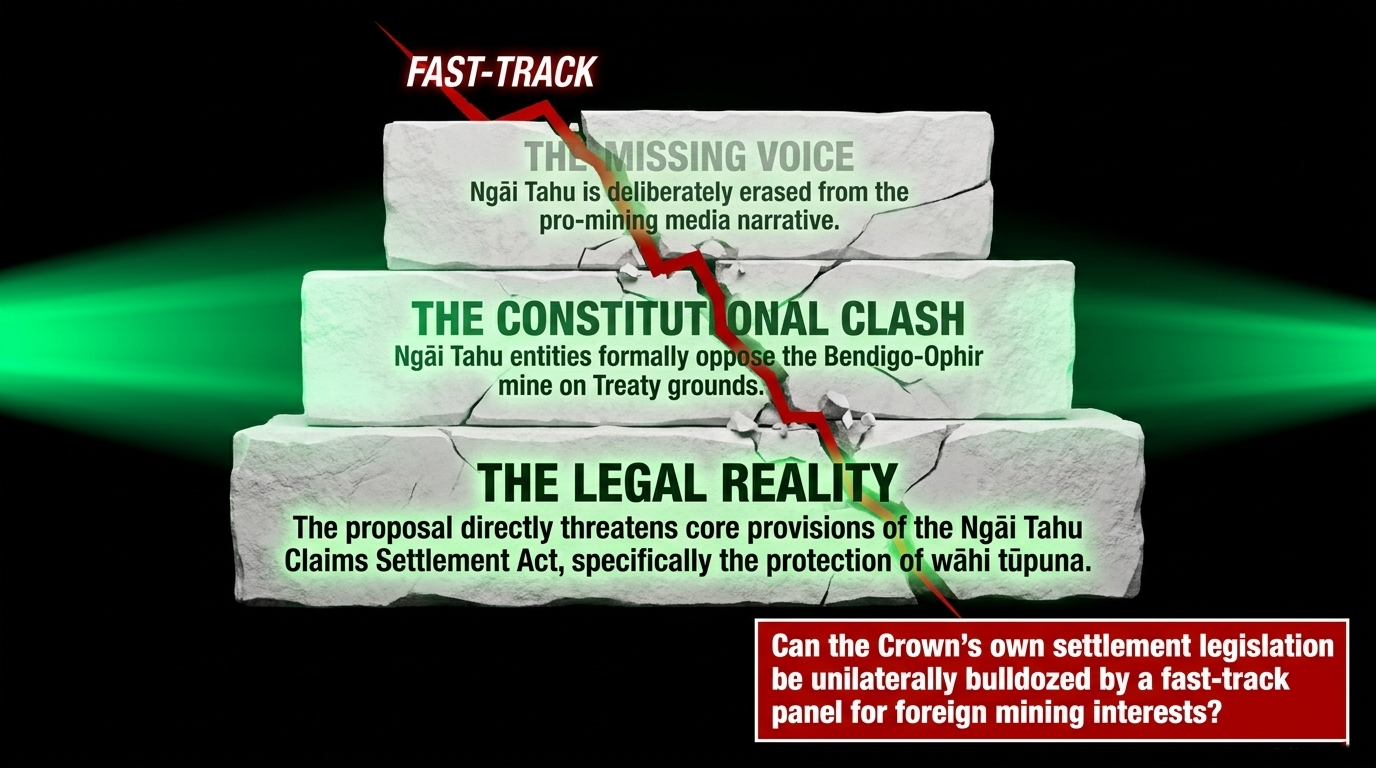
Not once in the entire column does Grant mention Ngāi Tahu, despite the fact that the project sits within their rohe and that Ngāi Tahu entities have already formally opposed the fast-track bid on Treaty grounds, as reported by the Otago Daily Times and further detailed in iwi arguments that the proposal fails settlement Act provisions, also covered by the Otago Daily Times. This is not accidental. It is ideological.
At the end, he lands on
“Thanks Sir, for your contribution, but I am with Shane Jones on this one. Drill Baby, Drill”
— aligning himself with a Minister who has publicly vowed to strip power from regional councils and reduce environmental oversight while taunting Māori opponents of mining, as captured in Shane Jones’ own celebratory posts and statements about dismantling regional councils and anti-mining regimes, linked through Facebook.
This is not just a hot take; it’s a manifesto for a Government project: white wealth, white control, Māori silence.
The Fast-Track Machine: Bleeding Money, Bleeding Tikanga
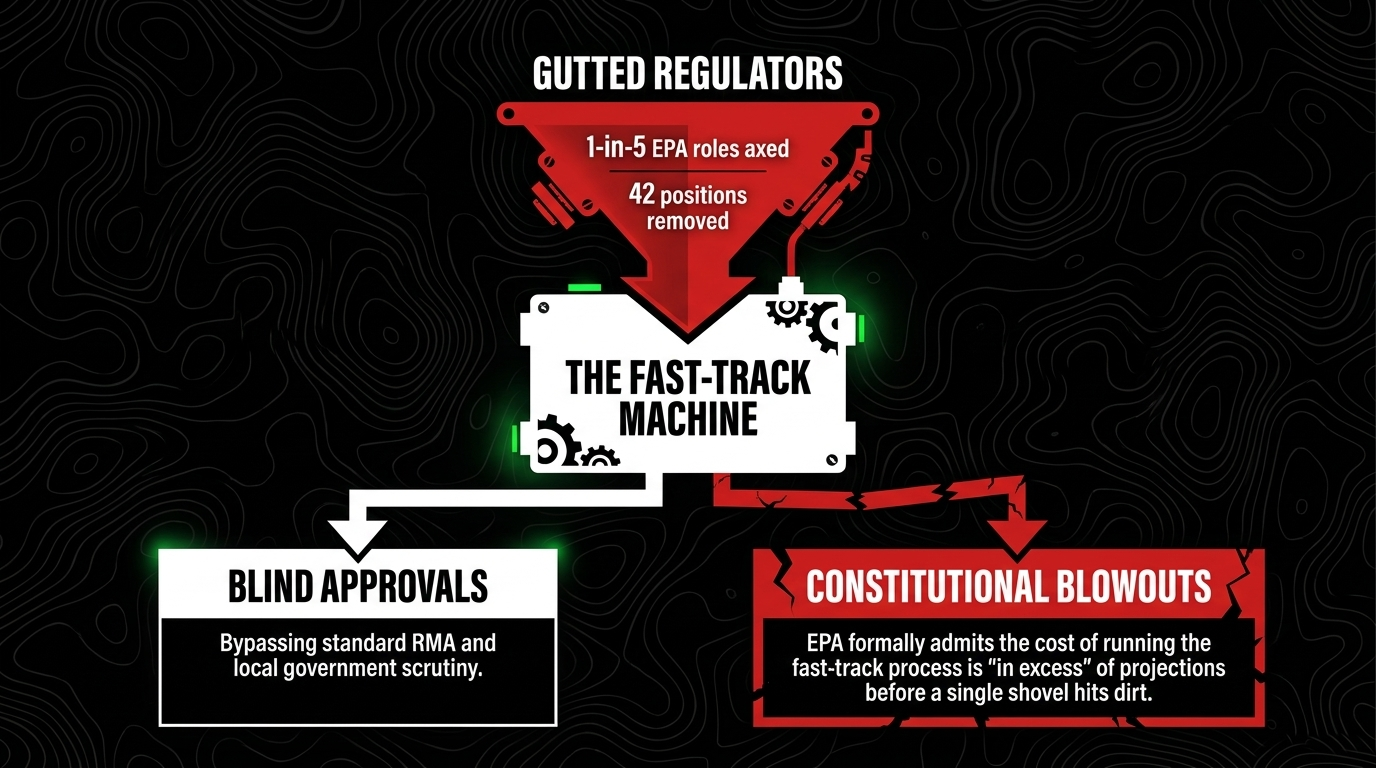
Grant’s entire argument rests on the claim that we need mines like this to pay for Pharmac and cancer care. He even quotes Sam Neill’s advocacy for better leukemia funding to demand that Neill now accept the mine, a manoeuvre that borders on emotional blackmail, as seen in Stuff where he says
“where does the state get the money… when millionaire environmentalists use their fame to prevent the very economic activity that Aotearoa needs to pay for cancer treatment?”.
Here’s the problem: the fast-track approvals regime he champions is already showing the same structural fraudulence as his personal history.
The EPA Is Already Overloaded and Underfunded
The Environmental Protection Authority has admitted that the cost of running the fast-track approval process is “in excess” of initial estimates, as revealed by RNZ. The whole scheme is supposed to be cost recovered from applicants, as set out explicitly in the Government’s own fast-track cost recovery policy.
At the same time, the EPA has already endured brutal staffing cuts. In 2024, the Public Service Association reported that one in five EPA roles (about 42 positions) were axed as part of a Government cost-cutting drive, as detailed by the PSA. An independent funding review for the Ministry for the Environment and EPA found a yawning gap between the scale of regulatory tasks and the funding provided, summarised in Treasury’s rapid review of resource management reforms and environmental agencies, available via the Treasury report.
In plain English: this Government fired the rangers, torched the watchtower budget, then opened the gates for a flood of projects and told us everything will be “streamlined”.
Grant’s cheerleading for this system is not just naïve; it is complicit.
A Trojan Horse for Settler Extraction
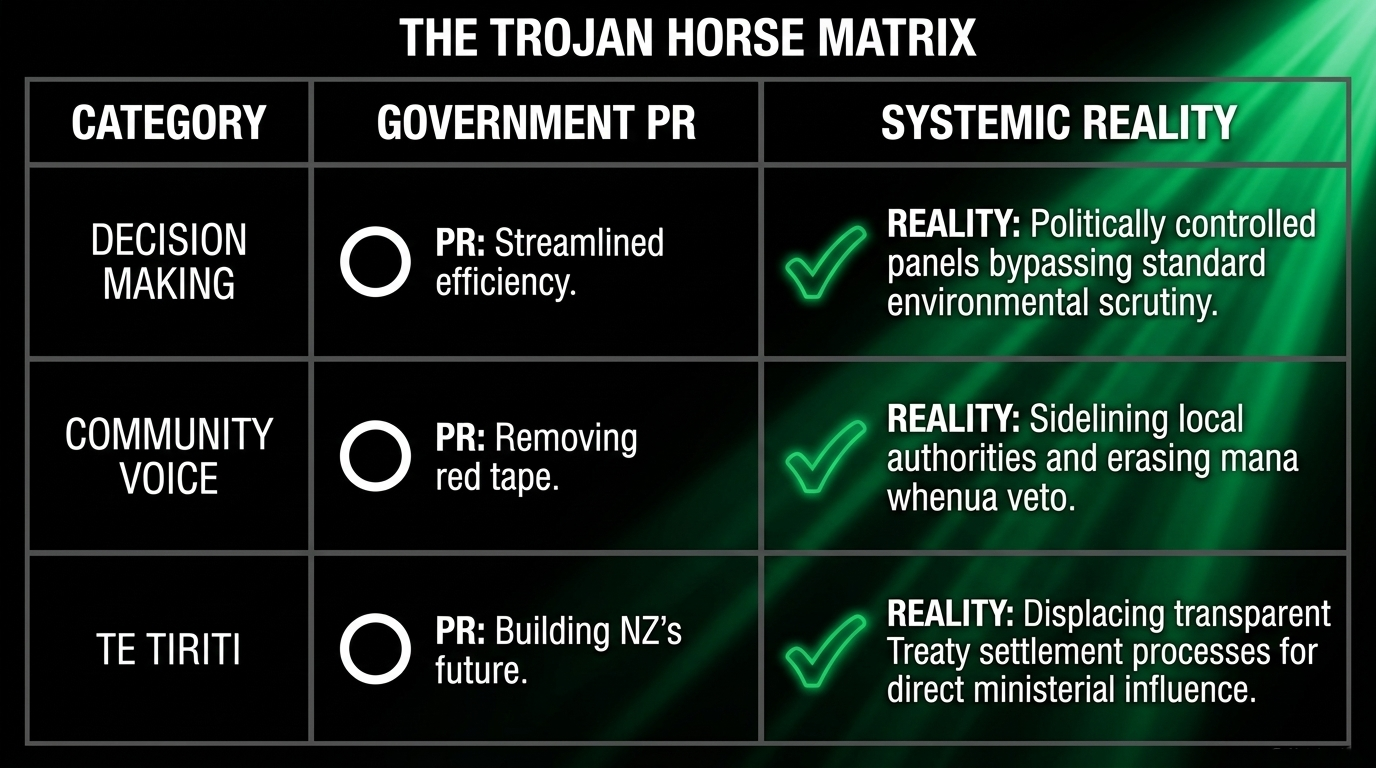
Lawyers, environmental groups and mana whenua have all warned that the Fast-track Approvals Act is a Trojan horse, displacing transparent environmental and Treaty processes with politically controlled panels and ministerial influence, as articulated in critiques like LawNews’ analysis and the detailed submission of the Environmental Defence Society, available through the EDS fast-track submission.
While the Beehive and its loyal commentators boast that “Fast-track is building NZ’s future”, as in the Government’s own self-congratulatory media release on Beehive.govt.nz, the reality on the ground is a steady dismantling of safeguards for water, climate and Te Tiriti. Local authorities are being side-lined; mana whenua are being reduced to tick-box consultation.
Grant’s piece acts as ideological cover for this project: if opponents are just rich hobbyists, and if the only moral argument is “we need money for hospitals”, then anyone questioning the scheme can be smeared as selfish.
This is how white supremacist neoliberalism talks: it steals the language of public good while feeding corporate shareholders.
Ngāi Tahu, Te Tiriti and the Whenua: The Part Grant Deletes
Central Otago is not just “pristine grasslands” and “postcard vistas”, as Grant sneers. It is the rohe of Ngāi Tahu, with whakapapa going back centuries, anchored in tīpuna who navigated the Clutha, harvested mahika kai, and signed Te Tiriti under the promise of tino rangatiratanga and “full exclusive and undisturbed possession” of their lands and taonga.
Ngāi Tahu’s Formal Opposition
Ngāi Tahu hasn’t just “raised concerns”. They have explicitly argued that Santana Minerals’ fast-track bid must be rejected.
- In April 2026, representatives for Ngāi Tahu told the fast-track panel that the mine would breach their Treaty settlement, and that the proposal was inconsistent with the Ngāi Tahu Claims Settlement Act, as reported by the Otago Daily Times.
- Additional coverage outlines iwi legal arguments that the proposal fails core provisions of the settlement legislation, particularly around protection of wāhi tūpuna and cultural landscape values, as explained by the Otago Daily Times.
Fast-track panel chair Matthew Muir KC himself signalled discomfort, noting that he was “anxious” about whether the application met Treaty-related legal requirements before the panel spent more time on it, as reported by B2B News.
This is not some airy cultural objection. It is a hard constitutional question: Can the Crown’s own settlement legislation be bulldozed by a new fast-track regime for foreign mining companies? Grant doesn’t touch it. This Government would dearly love you not to ask.
Tikanga vs Spreadsheet Logic: Explaining the Impact to the Western Mind
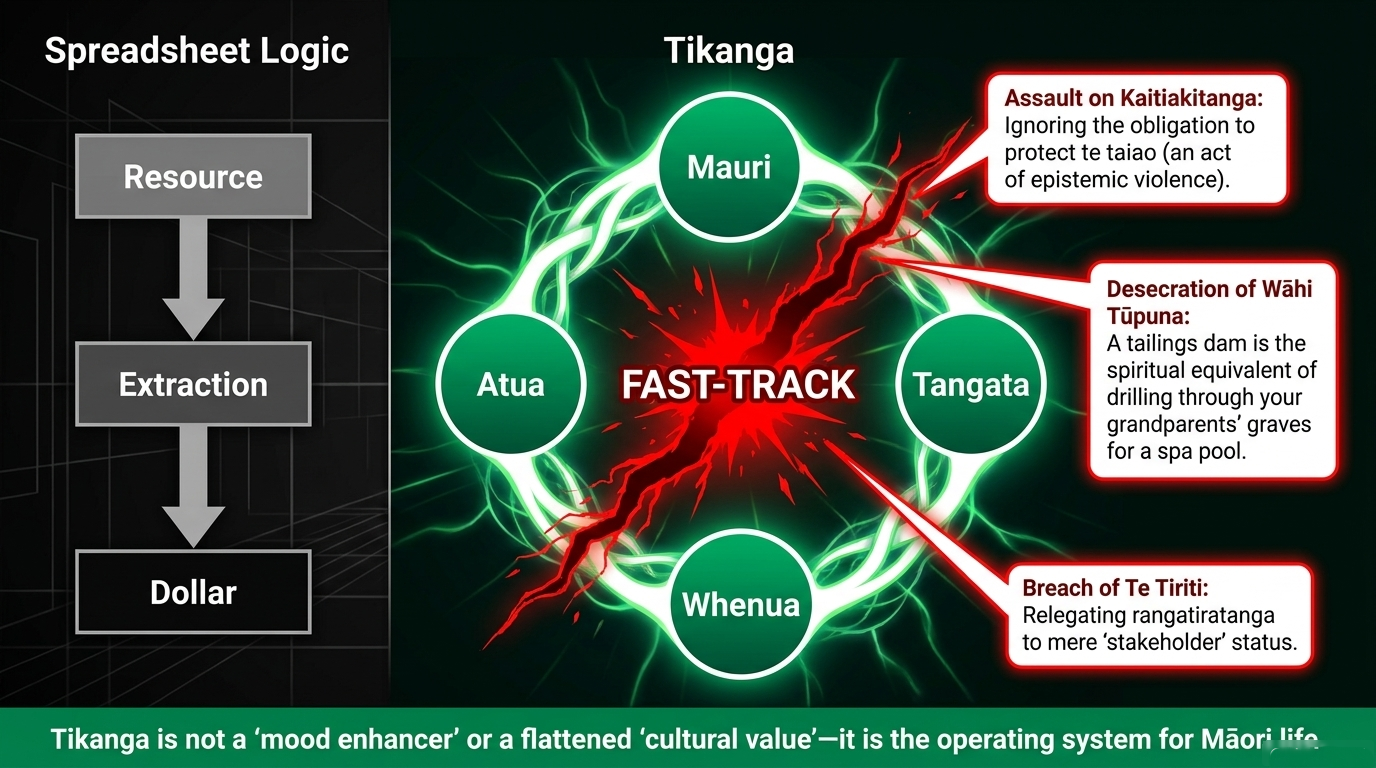
To the Western mind, “tikanga” gets flattened into “cultural values”. That’s like calling oxygen a “mood enhancer”. Tikanga is the operating system for Māori life — it governs relationships to people, place and atua. When a Government tries to fast-track a mine over Ngāi Tahu opposition, it’s not just a “resource decision”; it is:
- An assault on kaitiakitanga — the obligation to protect te taiao for future generations. Ignoring Ngāi Tahu’s kaitiaki role in their own rohe is a direct act of epistemic violence.
- A desecration of wāhi tūpuna — ancestral landscapes carry memory. Turning them into open pits and tailings dams is the spiritual equivalent of drilling through your grandparents’ graves for a spa pool.
- A breach of Te Tiriti — which promised rangatiratanga, not perpetual relegation to “stakeholder” status in a system designed by and for settler capital, as the Waitangi Tribunal has repeatedly found in resource-related inquiries, summarised in its reports on freshwater and resource management available through the Waitangi Tribunal.
From a Western legal perspective, you can translate it this way: Imagine the Government signed a binding settlement to protect a World Heritage site, then quietly passed a new law allowing ministers to approve open-cast mining there, over the objections of the very community that treaty was meant to repair harm to. Now imagine commentators lining up to ridicule anyone who objected.
That is the scale of what’s happening.
Three Examples for the Western Mind: Harm, Quantified and Embodied
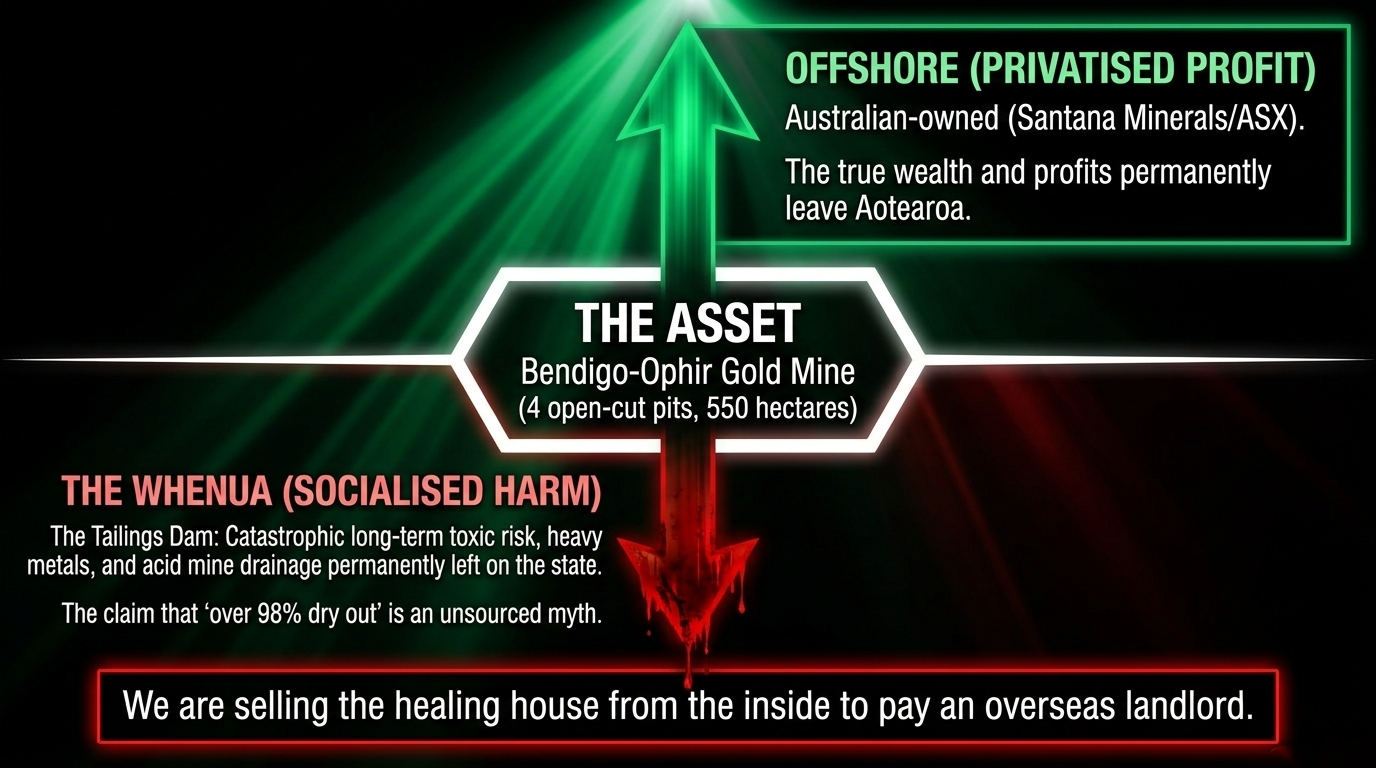
Here are three examples that quantify harm, explain impact on tikanga, and point to solutions.
Example 1: The Fast-Track Trojan Horse vs Te Tiriti
The Harm
The Fast-track Approvals Act lets a small group of ministers and panels bypass normal RMA and local government processes for “priority projects”. Critics — including senior environmental lawyers — have called it a “Trojan horse”, enabling politically favoured projects to leapfrog scrutiny, as analysed by LawNews. Environmental and legal groups warn it will lead to cumulative degradation of ecosystems and sidelining of communities, especially Māori, as detailed in the Environmental Defence Society’s submission.
The Government spins this as “building New Zealand’s future”, celebrating dozens of fast-tracked projects in a year, as bragged by the Beehive. But every shortcut slices away at Te Tiriti-based participation and environmental due diligence.
Tikanga Impact, in Western Terms
Te Tiriti promised partnership. Tikanga demands kanohi ki te kanohi, iterative kōrero, and decisions that reflect mauri, not just dollars. Fast-track flips this: ministers in Wellington, panels with limited Māori representation, and truncated submission windows. To the Western mind: it’s like rewriting the constitution to let Cabinet quietly override the Supreme Court whenever it’s “urgent”.
Solution Pathway
- Repeal or radically overhaul the Fast-track Approvals Act to embed Te Tiriti obligations upfront, not as an afterthought.
- Require mana whenua veto or co-decision on projects in their rohe, especially where settlement legislation is engaged — an approach aligned with rights of Indigenous peoples under the UN Declaration, echoed in discussions on co-governance in reports by the Waitangi Tribunal.
- Redirect funding from corporate subsidies to restore and strengthen EPA and local authority capacity, as Treasury’s review indicates is necessary in its independent rapid review.
The Māori Green Lantern has already mapped similar structural fraud in health, where institutions took Crown money while still delivering early deaths for Māori, in the essay “KO TE WHARE HAUORA KUA HEREA: The Man Who Sold the Healing House From the Inside and Called It Rural Medicine”, introduced on themaorigreenlantern.maori.nz. The pattern is the same: systems redesigned to look “efficient” while quietly entrenching inequity.
Example 2: The Tailings Dam Time Bomb vs Kaitiakitanga
The Harm
Grant’s column brushes off a massive tailings dam by saying 98% become grassed-over paddocks. He offers no data, but global analyses of tailings storage failures show dozens of catastrophic collapses over the last few decades, causing deaths, toxic spills and long-term contamination, as captured in international reviews cited in New Zealand’s infrastructure risk assessments and referenced in the Treasury’s resource management review.
Under the fast-track model, the risk profile is intensified: projects are accelerated, regulators are understaffed, and political pressure is high. The environmental risk is long-term and structural: heavy metals, acid mine drainage, and the permanent loss of safe wetlands and soils, as outlined in technical guidance for fast-track cost-recovery and risk in the fast-track policy document.
Tikanga Impact, in Western Terms
For kaitiaki, a tailings dam is not a neutral engineering problem. It is a wound in Papatūānuku. The mauri of the place is altered; the whakapapa of water is disrupted. To explain this to a Western audience: imagine if your city’s cathedral, cemetery and main water reservoir were all buried under a toxic mound that might hold, but might rupture across your grandchildren’s lifetimes. Even if it never fails, your relationship to that place is permanently haunted.
Solution Pathway
- Ban large-scale open-cast mining and associated tailings dams in culturally and ecologically sensitive areas, especially where iwi have declared wāhi tūpuna and Treaty relationships, aligning with the precautionary principles favoured in conservation advice like that provided by the New Zealand Conservation Authority.
- Where tailings projects exist, require full life-cycle bonding at a level set by independent experts, not company consultants — enough to fully remediate site failure with no public cost, a shift consistent with cost-recovery principles in the fast-track cost recovery framework.
- Uphold kaitiaki veto rights where mauri and wāhi tapu are at stake.
The Māori Green Lantern has already described similar “slow violence” in health — where policy choices lock in decades of Māori morbidity — in recent writing on institutional design and death, previewed on themaorigreenlantern.maori.nz.
Mining adds a physical, toxic mirror of that spiritual damage.
Example 3: Australian Profits vs Māori Rangatiratanga
The Harm
Santana Minerals is an Australian company. Their own announcements and media coverage make clear that the intent is to develop a multi-billion dollar gold resource at Bendigo-Ophir, with shares listed on the ASX, as reported by RNZ and detailed in market coverage such as the NZ Herald’s report.
Negotiated royalty structures — such as a choice between 10% of profits or 2% of gold sales — are touted as delivering an average of around $32 million per year to the Crown, as outlined in RNZ’s reporting and reflected in the company’s own media releases. But profits go offshore. When prices fall, profits shrink and so does the royalty. The environmental liability — from tailings dams to landscape scarring — remains here, as acknowledged even in Grant’s own admission that risk “falls on the state” in the Stuff column.
Tikanga Impact, in Western Terms
Te Tiriti did not promise that foreign companies could arrive centuries later, strip-mine ancestral lands and leave Māori with the bill. Tikanga recognises mana whenua as guardians and owners in a relational sense — their identity is literally bound to this whenua. From a Western perspective: imagine signing a peace treaty where your people’s ancestral estate is guaranteed, then watching a later Government sign it away to an offshore corporation based solely on a Cabinet paper and a panel recommendation. Legally cynical. Morally obscene.
Solution Pathway
- Shift from extractive foreign-owned mining toward regenerative local economies that enhance mana whenua control over resources — including Māori-owned renewables, tourism aligned with tikanga, and land-use that restores biodiversity, in line with aspirations articulated in Māori economic strategies such as those profiled on MyFuture Māori.
- Where mining is considered, require mana whenua equity ownership and control, not just “consultation”, with veto over the most destructive methods, reflecting international Indigenous rights practice.
- End the fast-track pathway for foreign-owned extractive projects. If a project cannot survive full RMA and Treaty scrutiny, it has no moral licence.
The Māori Green Lantern has repeatedly exposed the pattern of Crown institutions taking Māori resources — money, data, trust — to entrench Pākehā control, as seen in pieces like “KO TE WHARE HAUORA KUA HEREA” highlighted on themaorigreenlantern.maori.nz.
The Bendigo-Ophir mine is that pattern in gold.
The Government Project: White-Supremacist Neoliberalism in High-Vis
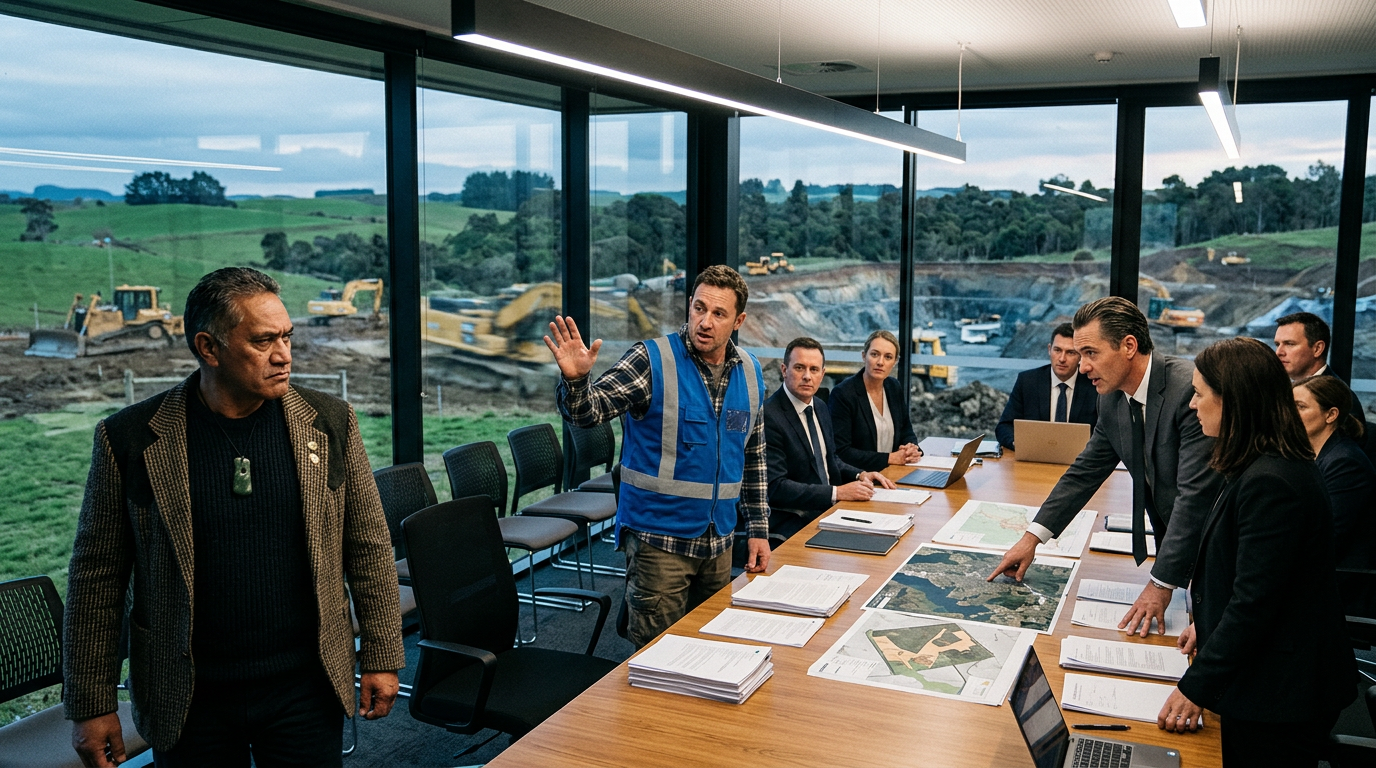
Grant is not an outlier; he’s a functionary. This Government’s project is brutally clear:
- Strip Māori of effective veto by locking decision-making into fast-track panels and ministerial discretion.
- Gut regulators like the EPA while pretending everything can be fixed with “cost recovery” and streamlined processes, as the EPA’s own admission of fast-track cost overruns shows via RNZ.
- Cheerlead extractive projects as the only way to fund health and education, ignoring the billions lost annually in tax avoidance, fossil fuel subsidies, and corporate welfare, issues flagged repeatedly in commentary such as fast-track critiques by Infrastructure New Zealand.
- Deploy white commentators like Grant to ridicule opponents as selfish elites, while smothering the actual voices of mana whenua and environmental defenders.
This is white supremacy in practice: the structures ensure Pākehā ministers, Pākehā corporate boards and Pākehā commentators decide what happens to Māori land — and Māori are expected to be grateful for the trickle of royalties and jobs left over, while bearing the spiritual, cultural and ecological costs forever.
Verdict: Drill Baby, Drill — Into the Lies
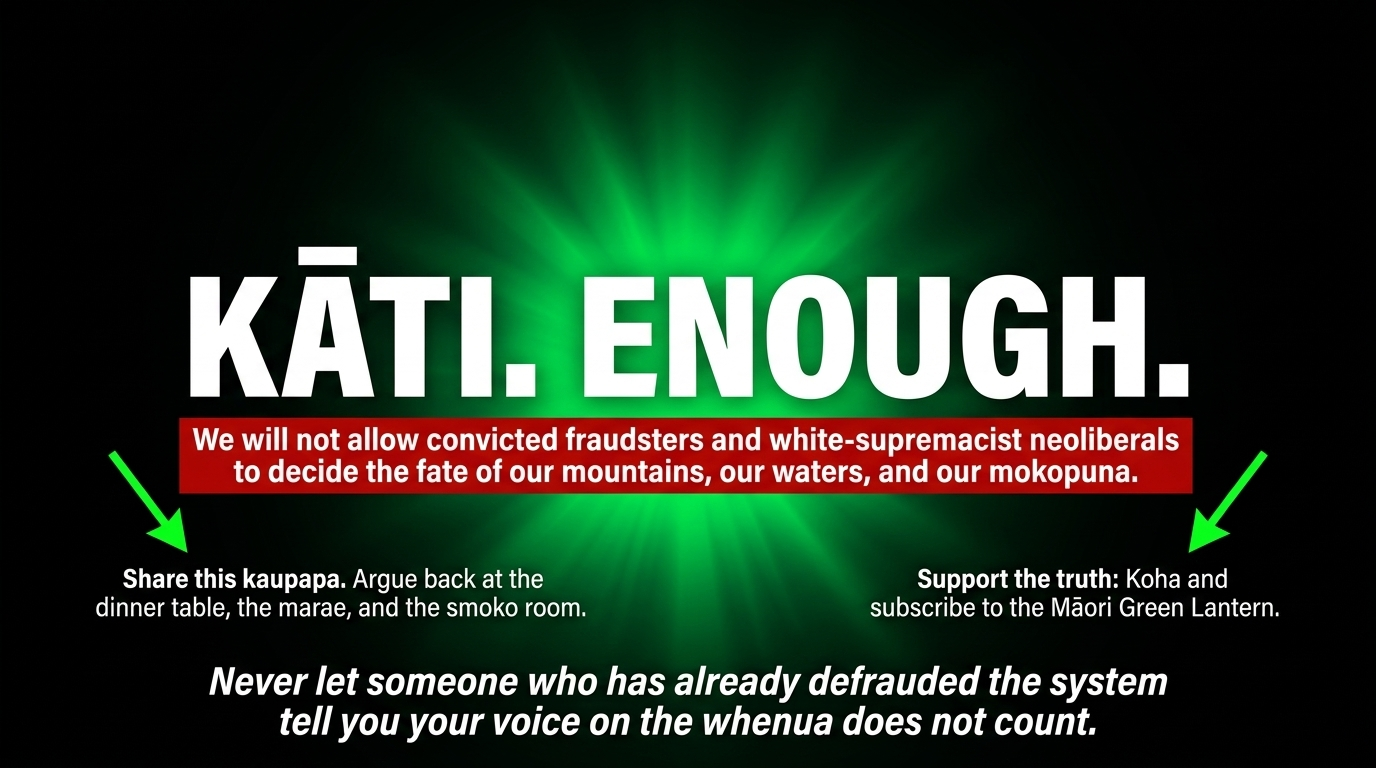
Let’s line up the facts:
- Damien Grant: convicted fraudster; professional body found him not fit and proper; High Court forced him to repay unreasonable fees. All documented in the NZ Herald and analysed in the NZ Initiative’s profile.
- Fast-track system: already breaching cost assumptions according to the EPA itself, as exposed by RNZ, after Government cuts one in five EPA roles, as reported by the PSA.
- Ngāi Tahu: formally opposing the mine on Treaty settlement grounds; fast-track panel acknowledging serious issues; iwi arguing the proposal fails settlement Act provisions, all confirmed by the Otago Daily Times and ODT follow-up coverage.
- Santana Minerals: Australian-owned, with profits heading offshore; royalties and tax slices left here, but environmental risk permanently socialised, as summarised in RNZ’s reporting and market coverage by the NZ Herald.
Grant’s column is not just wrong; it is structurally dishonest. It pretends to care about hospital funding while supporting a policy machine that bleeds regulatory capacity, erodes Te Tiriti, and hands over the whenua to an overseas company over the explicit opposition of mana whenua.
The correct response to “Drill Baby, Drill” is simple:
Kāti. Enough.
We will not allow convicted fraudsters and white-supremacist neoliberals to decide the fate of our mountains, our waters, and our mokopuna.
Koha Consideration — Fuel for the Taiaha
Every koha for this kaupapa is a refusal to let convicted fraudsters, foreign mining companies and a white-supremacist neoliberal Government write the only story about our whenua. It is an act of rangatiratanga — choosing to fund Māori truth-telling that exposes the lies behind “Drill Baby, Drill” and defends kaitiakitanga in places like the Dunstan Mountains.
If you are able, consider a koha to keep this taiaha sharp:
Direct support for this mahi: Koha — Support the Māori Green Lantern
Ongoing backing via subscription: Subscribe to the Māori Green Lantern
Direct bank transfer: HTDM, 03-1546-0415173-000
Follow and share the kaupapa on Facebook: The Māori Green Lantern on Facebook
If you cannot koha financially, your awhi still matters. Subscribe at themaorigreenlantern.maori.nz, share this essay with your whānau, argue back at the dinner table, the marae, the smoko room. That is koha too.
Kia kaha, whānau. Stay vigilant. Stay connected. And never let someone who has already defrauded the system tell you your voice on the whenua does not count.