"National/Labour - Two Faces, One Fist: How A White Supremacist Neoliberal Government And Its Labour Understudy Are Robbing Whānau Blind" - 27 August 2026
While Billionaires Bank $500,000 A Month And Whānau Bury Their Kids' Futures In Debt, Willis And Edmonds Call Their Fixed Fight "Democracy"


Let Me Tell You What I Actually Saw

Kia ora Whānau,
I watched the clips of Nicola Willis and Barbara Edmonds trading blows at the Politik Election Summit in Wellington, and I'm going to be blunt with you: I have seen better acting at a primary school nativity play. Willis stood up and warned you'll pay $100 extra a week in tax under Labour.
 Thomas Coughlan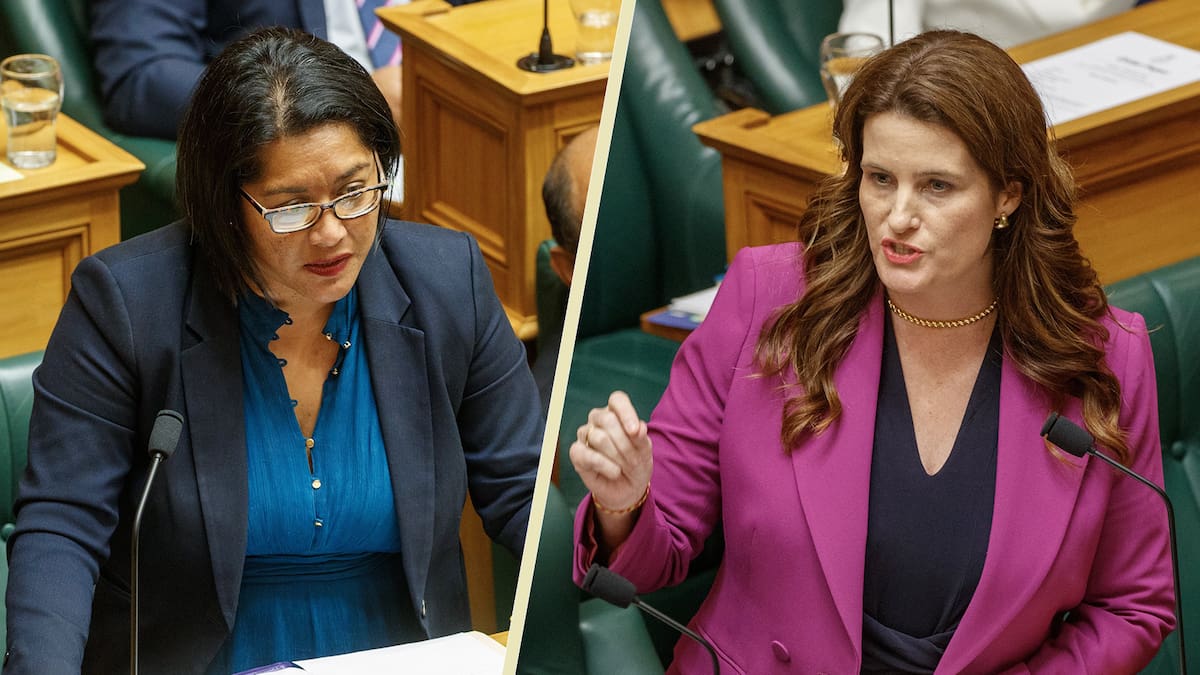
Edmonds stood up and promised Labour's only new tax is a targeted capital gains tax excluding your home, your farm, your KiwiSaver, your shares and your inheritance.
Both of them sold it like it mattered.
It doesn't matter. Not in the way they want you to think it does.
Because while these two performed outrage for the cameras, the Electoral Commission's own public register shows packaging billionaire Graeme Hart's company handing National half a million dollars in a single month, and toy magnate Nicholas Mowbray spreading $450,000 across National and ACT.
This is not a fight between two visions for Aotearoa.
This is a managed consensus — a white supremacist neoliberal architecture built in 1984 that both major parties still serve, dressed up every three years as a genuine choice so you keep showing up to vote for whichever face is currently holding the knife.
I am not being hyperbolic when I call this government white supremacist and neoliberal.
It privatises risk and socialises punishment.
It uses "fiscal responsibility" and "investor confidence" as cover to override tikanga, override Te Tiriti, and override the basic dignity of whānau who are drowning while billionaires throw garden parties.
And Labour — the party that invented this system in 1984 under Roger Douglas — is not the alternative. It is the understudy, waiting in the wings, ready to keep the same architecture running in a slightly softer voice.
The Deep Dive Podcast
Listen to a lively conversation between two hosts, unpacking and connecting topics in the sources of this essay. I apologise in advance for the AI's very harsh pronounciation of reo. Please dont shoot me, :).
Youtube Video
Like video? Here is a short video suppporting the essay. Again, don't shoot the messenger please because of AI's pronounciation. :)
Koha — Support The Truth-Telling This Election Won't Fund Itself

I just handed you a $500,000-a-month billionaire donation, an $8.9 billion tax hole, and a $2.9 billion landlord subsidy — none of it paid for by a party, a corporate, or a Crown press office.
It's paid for by whānau who believe accountability shouldn't have a price tag set by whoever's richest.
If this essay helped you see the fixed fight for what it is, consider a koha to support that same accountability continuing after election day, when the cameras move on and the donor register keeps filling up regardless of who wins.
If you can't koha, no worries — subscribing, following, and sharing this with your whānau is support in itself.
Four pathways:
- 💛 Koha directly: Support via the Koha platform
- 📬 Subscribe: Receive essays directly
- 🏦 Direct bank transfer: Ivor Jones, account number 03-1395-0099387-000
- 📘 Facebook: Follow The Māori Green Lantern
Three Examples For The Western Mind
Example One: The Donor Ledger — Capital Owns Both Corners Of The Ring

The core claim. Both major parties are financed by concentrated wealth.
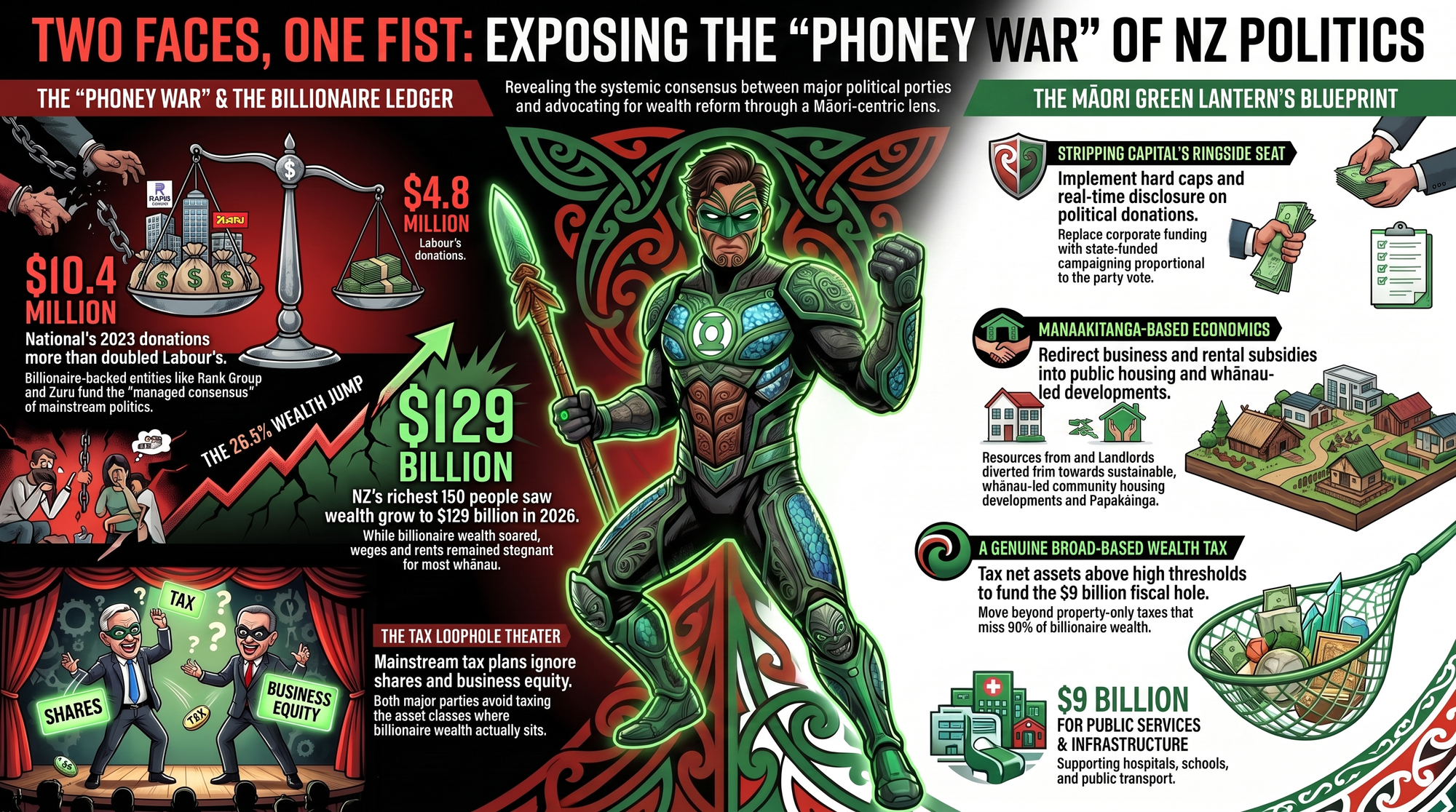
National received $10.4 million in 2023 donations to Labour's $4.8 million — more than double.
By 2024, National's $4.9 million dwarfed Labour's $1.6 million — more than triple.
In this election cycle, the Electoral Commission's live donations register shows Rank Group Limited — packaging billionaire Graeme Hart's investment vehicle — donating $250,000 to National on top of another $250,000 in the same month, plus $100,000 to ACT. Zuru's Nicholas Mowbray, whose family tops the 2026 NBR Rich List at a combined $20 billion, put $250,000 into National and $200,000 into ACT across two separate donations. Labour's own donors — gym-chain magnate Phillip Mills, former Auckland mayor Dick Hubbard, the Dairy Workers Union — are smaller in scale but the same in kind: concentrated money, not mass membership, funds both corners.
Quantified harm. New Zealand's richest 150 people held $129 billion in 2026, up from $102 billion the year before — a 26.5% jump in a single year while your wages and your rent did not move anywhere close to that. Graeme Hart alone is worth an estimated $14.1 billion. That is the money bankrolling the "phoney war" you're being sold as democracy.
The solution. A hard cap on political donations, real-time disclosure instead of the current weeks-long lag, and state-funded campaigning proportional to party vote — strip capital's ringside seat out of the system entirely.
Tikanga impact, explained for the Western mind. In te ao Māori, resources are supposed to flow according to manaakitanga — obligation to need, not to wealth.
A political funding system where one billionaire's company can outspend a union's entire annual contribution in a single afternoon inverts that completely. It replaces whakapapa-based responsibility with a cheque-book queue, and Māori — statistically holding far less concentrated capital than the donors named above — are shoved to the back of that queue every single election.
I've traced this exact pattern before, in far greater depth, in "The NZ Neoliberal Pantomime: Why Every Major NZ Party Serves the Same Masters — and the Wealth Tax That Would End the Charade", where I documented that 311 of New Zealand's wealthiest families pay a median effective tax rate of just 9.4%, against 20.2% for ordinary middle-income earners — figures I sourced from IRD's own investigation.
Example Two: The Capital Gains Tax Theatre — Forty Years Of Stalling, Then A Loophole Dressed As Reform

The core claim. Jacinda Ardern killed her own Tax Working Group's capital gains tax recommendation outright in 2019.
Chris Hipkins went further in July 2023: "under a Government I lead there will be no wealth or capital gains tax after the election. End of story." National has never proposed one and now campaigns on "no new taxes" at all. Labour's 2026 comeback is a narrow 28% tax on investment property only — nothing on shares, nothing on business equity, nothing on inheritance. Willis attacked this directly, saying Labour would need an additional $10.3 billion in revenue by 2031 while its capital gains tax raises only $1.35 billion — leaving, in her own words, "an $8.9 billion shortfall." Labour's rebuttal is that its 33%-of-GDP target is a long-run goal from a current base of 30.4%, not an immediate hike — a fair clarification I record here because accuracy matters even when I'm swinging the taiaha.
Quantified harm. Whatever the honest number, neither party's tax plan touches the asset classes where billionaire wealth like Hart's and the Mowbrays' actually sits — shares and business equity. That means the $9 billion-ish hole in the country's finances gets filled, if it's filled at all, by everyone except the people it should come from.
The solution. A genuine broad-based wealth tax on net assets above a high threshold — the model both parties' own commissioned Tax Working Group already recommended in 2019 and both buried. Not a property-only carve-out that leaves 90% of billionaire wealth untouched.
Tikanga impact, explained for the Western mind. Whānau Māori are disproportionately renters, not landlords, and hold a smaller share of shares and inherited business equity than Pākehā households. A tax that only touches rental property is a tax that misses the exact wealth pattern skewed against the whānau it's marketed as helping. That is not an accident of policy design. That is forty years of design choices, repeated by every Labour leader since 2011, protecting the same asset classes every time.
I documented the full forty-year sequence of this betrayal — Ardern's veto, David Parker's resignation, and the Treasury-costed $3.8 billion wealth tax Hipkins killed outright — in "The NZ Neoliberal Pantomime". Read it and see the receipts.
Example Three: Landlord Welfare And The Business Subsidy Shuffle — Whenua As A Speculative Asset

The core claim. Labour removed landlord interest deductibility in 2021. The National–ACT–NZ First coalition fully restored it, 80% from April 2024 and 100% from April 2025, with Christopher Luxon claiming it would somehow help renters. Going into 2026, Labour has only said it will "potentially" reverse this — a hedge dressed up as a promise. Meanwhile National's Budget 2025 Investment Boost hands businesses an immediate 20% deduction on new asset purchases, at a cost of $1.67 billion a year.
Labour's answer is not to end business subsidy — it's to repeal it and redirect the money into $1.56 billion of small-business relief. Different beneficiary. Same principle: the tax system exists to subsidise capital.
Quantified harm. $1.67 billion a year subsidising business asset purchases and a fully restored landlord tax break run in parallel with a country where Māori home-ownership rates sit well below the national average. Neither party's 2026 tax package touches that gap, because neither treats property or business capital as the problem.
The solution. Redirect landlord and business tax subsidies into direct capital grants for papakāinga and public housing builds — where the return is homes for whānau, not yield for portfolios.
Tikanga impact, explained for the Western mind. Whenua is a taonga held in trust for descendants, not a speculative asset class to be leveraged for interest deductions. Every dollar of subsidy that flows to rental property ownership instead of papakāinga development is a dollar that treats land as capital instead of kin. That is not a technical tax setting. That is the same colonial logic that confiscated the land in the first place, now laundered through IRD paperwork.
I put the landlord number in stark terms in "Labour Is Not the Antidote. Labour Is the Maintenance Crew": a $2.9 billion landlord tax break against a $1,000 one-off toolkit grant for an apprentice is a ratio of 2,900,000 to 1. Labour is not promising to reverse that break. I also laid out the Green Party's costed alternative — a capital gains tax with Māori land protections, paired with the Green wealth tax and direct public housing investment — in "THE LADDER THIEVES: How Nicola Willis and Winston Peters Burned the Bridge to Tomorrow". Confidence: Verified for the deductibility and Investment Boost policy history, cited directly above; Corroborated for the $2.9 billion landlord figure and prior MGL analysis, not independently re-fetched in this essay.
Ngā Pānga — Name The Crime, Name Who Pays

This is not incompetence. It is a system working exactly as designed.
Forty-two years of manufactured consensus made taxing concentrated wealth politically unthinkable, while renters, low-income whānau and the next generation absorb the widening gap.
The beneficiaries are named above: Graeme Hart, the Mowbray family, and every asset-holder whose fortune sits untouched in shares, business equity or inheritance behind both parties' 2026 tax plans.
The whānau paying for it are Māori renters locked out of home ownership and the "family home" exemption, Māori workers whose wages haven't tracked a 26.5% one-year jump in billionaire wealth, and every household told a three-percentage-point argument about GDP shares is the full extent of political imagination on offer.
He Kupu Whakakapi — I Am Not Laying Down The Taiaha

Willis and Edmonds performed conflict in Wellington.
The conflict is real at the margins — three points of GDP, a property-only tax, a repealed subsidy redirected to smaller firms.
But on the two questions that matter most for whānau — should concentrated, growing wealth in shares, businesses and inheritance be taxed, and should the tax system keep subsidising capital investment at all — National and Labour agree.
Forty-two years after Rogernomics, both parties still govern for capital first, and one of them still calls itself the party of the worker while doing it.
Rangatiratanga means refusing to mistake a scripted fight between two managers of the same system for a genuine choice about that system itself. Watch the donor register, not the debate stage.
Mauria Ora.
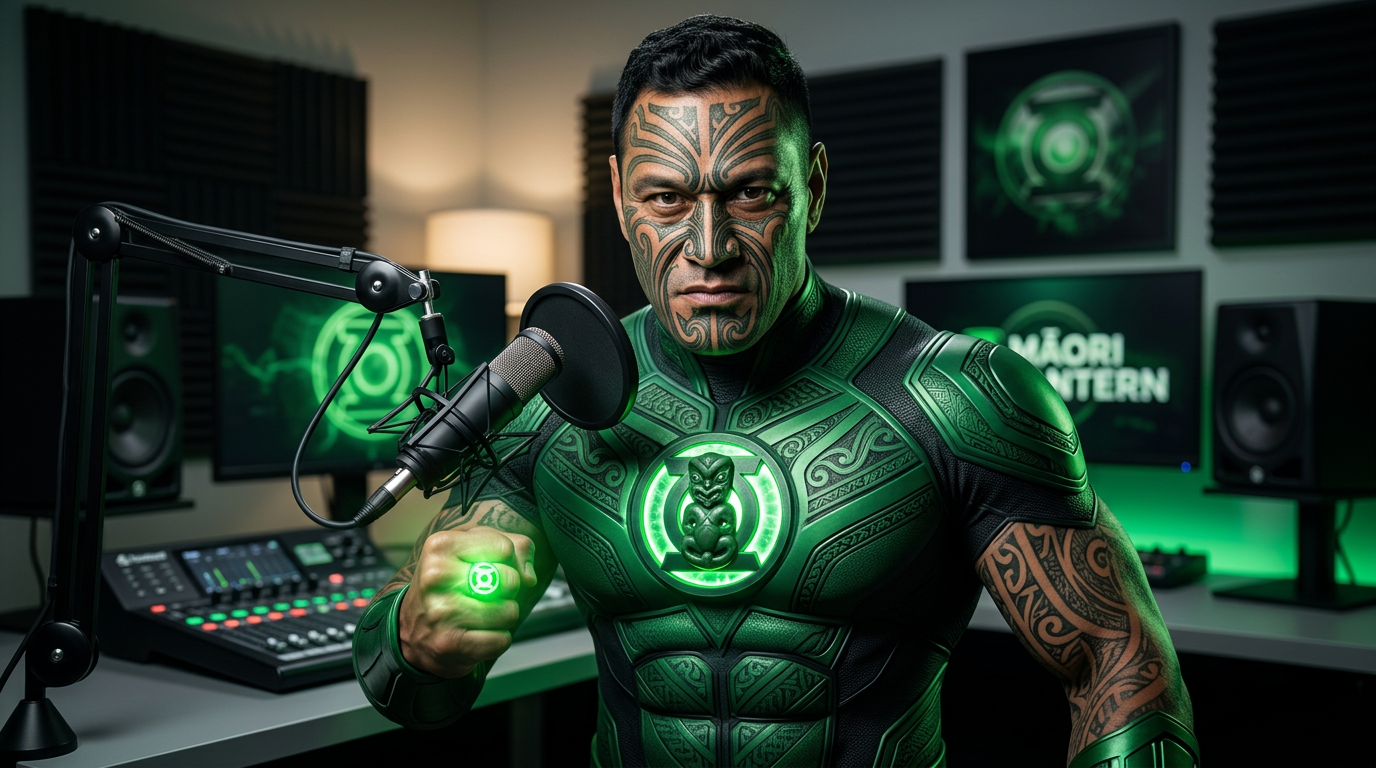
Ivor Jones The Māori Green Lantern Fighting Misinformation And Disinformation From The Far Right
Disclaimer
This essay is opinion and analysis grounded in verified public data, published under The Māori Green Lantern's editorial framework. It alleges no illegality by any named individual or entity, each described only in public professional or political capacity. Views are the author's own, offered in the public interest of democratic transparency, under fair comment protections in the NZ Defamation Act 1992.