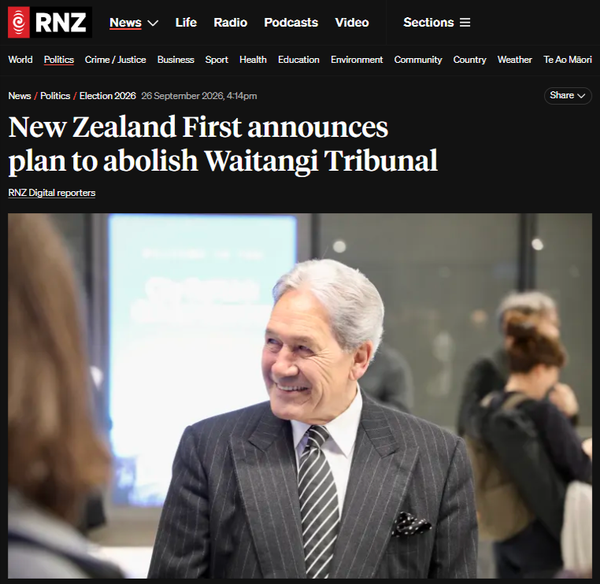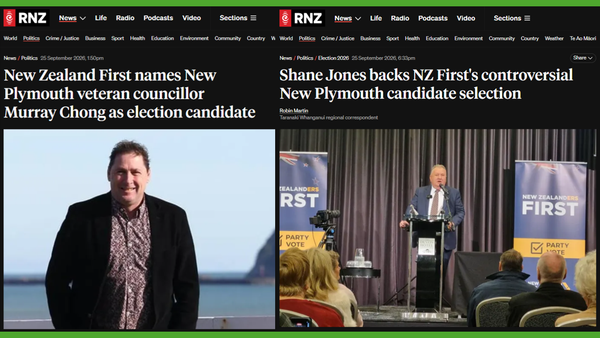
"The Stage They Refuse To Leave" - 24 September 2026
National And ACT Keep Standing Beneath The Taxpayers’ Union Banner While Māori Rights Are Turned Into Campaign Ammunition

The Taxpayers’ Union is not a neutral public service. It is part of a right-wing political network—and National and ACT keep helping it look respectable.
I am Ivor Jones, The Māori Green Lantern. I descend from Te Arawa, Ngāti Pikiao and Welsh whakapapa. I write with Tika—the truth backed by evidence—and Pono—the duty to act properly once the truth is clear.
This essay explains why National and ACT still appear on Taxpayers’ Union debate stages after serious allegations were made in Nicky Hager’s Dirty Work.
It explains why the Taxpayers’ Union is not a neutral group, how it connects to National and ACT through people, polling and shared political goals, and why this matters for Māori, Te Tiriti, our water, and our mokopuna.
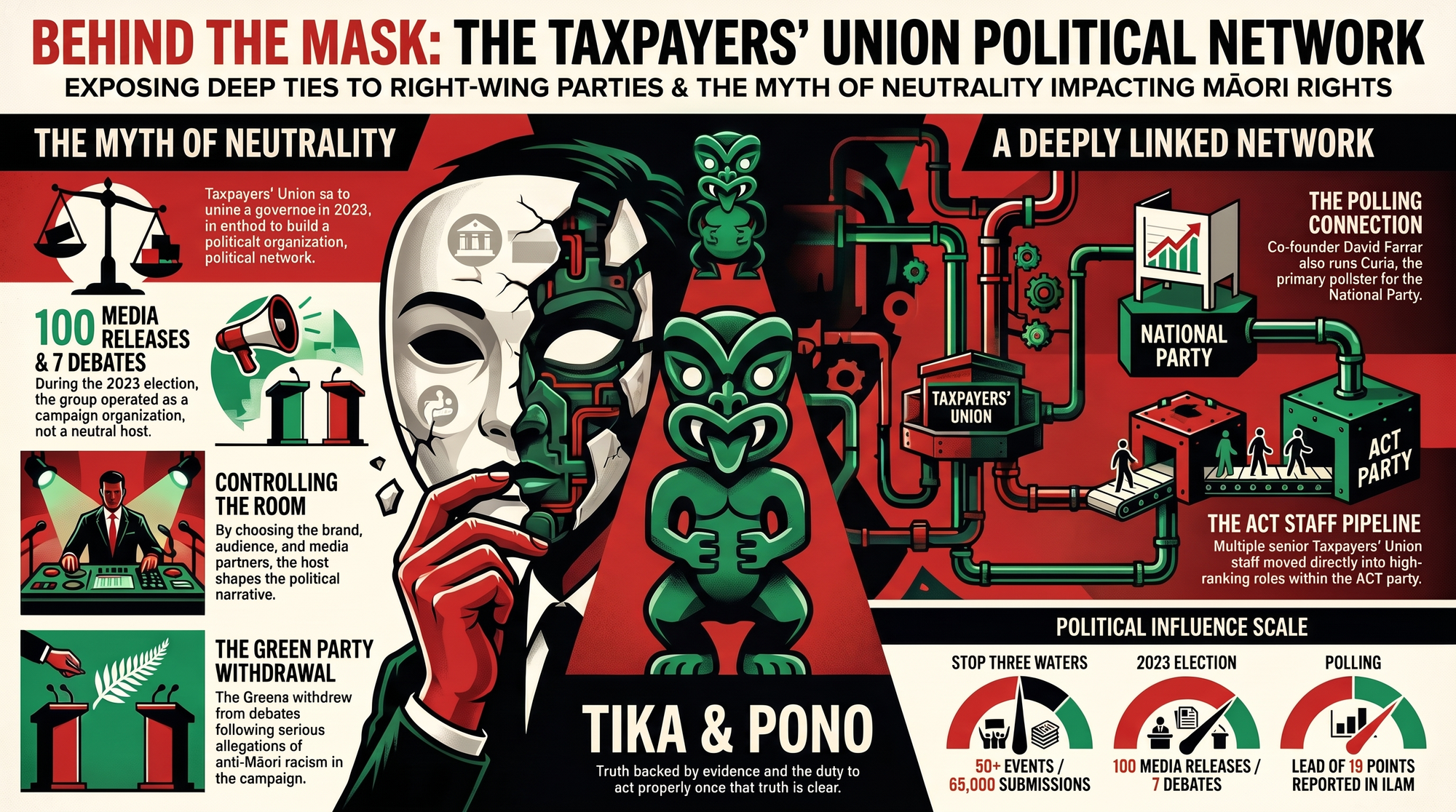
National and ACT do not see the Taxpayers’ Union as an outsider. They see a familiar ally. It gives them polling, platforms, media attention, a ready-made audience, and political messages they often agree with.
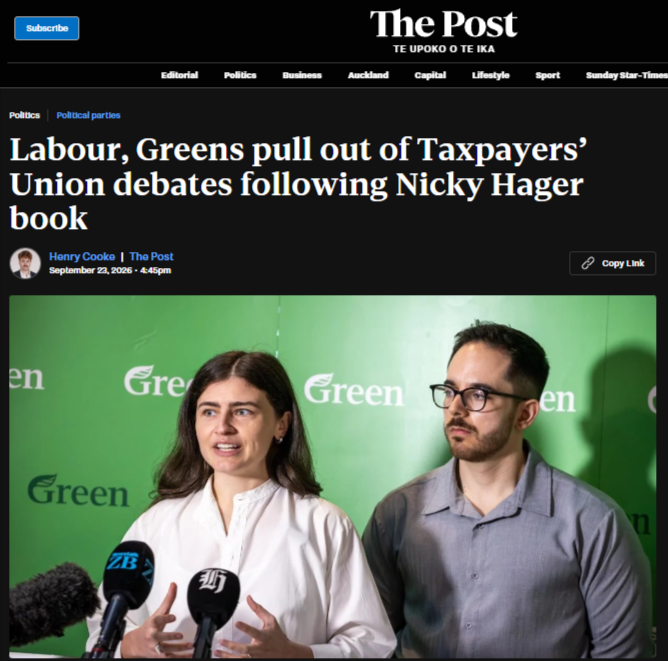
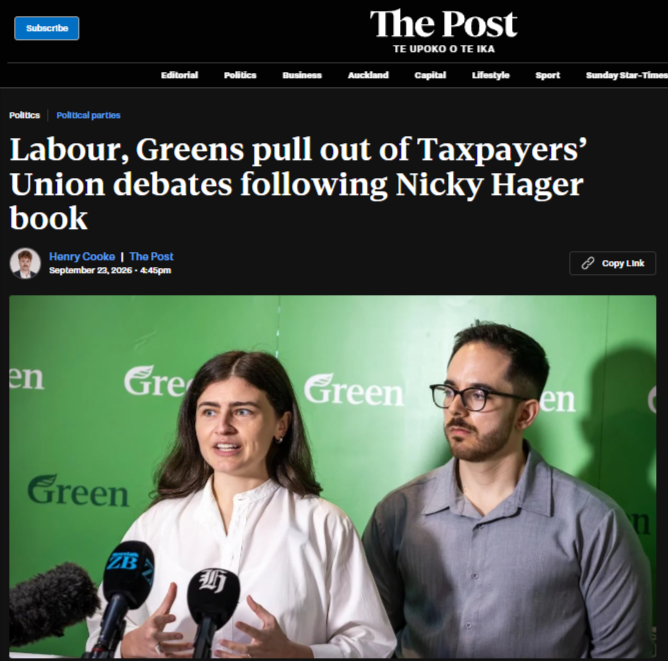
Nicky Hager alleges that the Taxpayers’ Union used anti-Māori racism to build support during the Stop Three Waters campaign. The Taxpayers’ Union denies this. The Green Party pulled out of the group’s debates after the book was released. National and ACT did not. RNZ reported Hager’s allegation, the Taxpayers’ Union’s denial, the Green Party withdrawal, and the responses from Christopher Luxon and David Seymour
I am not saying every allegation in Hager’s book is already proven. It is not. But National and ACT did not need a court case to make a basic political decision: stop giving their time, their faces and their credibility to a lobby group facing serious public questions.
They chose not to.
The Record I Am Building
I have already written about these problems because this is not a one-day story.
On 23 September 2026, I published “The Taxpayer Mask: How Hager’s Dirty Work Rips The Smile Off Neoliberalism’s Favourite Front Group”. On 21 September 2026, I published “The Vitamin Sermon: How A White Supremacist Neoliberal Government Built The Cliff, Then Sold You The View”. Both titles appear on The Māori Green Lantern homepage
I am building a record for our mokopuna.
One day they should be able to look back and say: some people saw what was happening. Some people named the people, the networks, the lies and the harm. Some people warned us.
That is what The Māori Green Lantern is for.
Read, Listen, Watch, Remember
Please click into this mahi because it contains information you can use in daily life.
I have created an audio podcast that explains this kaupapa in detail. I have created a short video for whānau who want the main points quickly. And if you like reading deeply, there is a fully cited 3,000-word essay waiting for you.
This is not just content. It is a record. It is a repository for our mokopuna.
Find the work at The Māori Green Lantern.
What Tika And Pono Mean Here
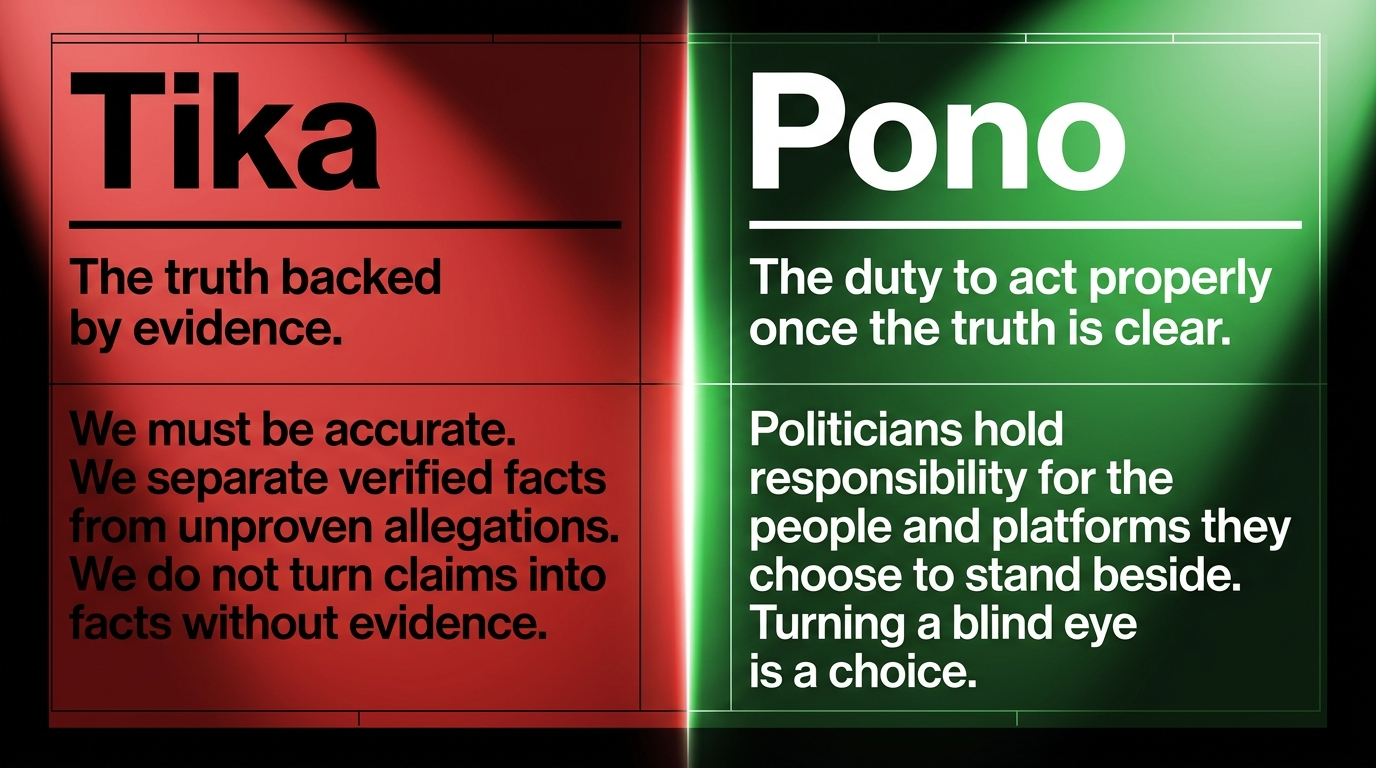
Tika means I must be accurate.
Hager’s claims are allegations. The Taxpayers’ Union denies them. I will not turn allegations into facts without evidence.
Pono means politicians should take responsibility for the people and groups they choose to stand beside.
National and ACT can say they do not agree with every word the Taxpayers’ Union says. That does not remove their responsibility for helping the group look like a normal and trusted part of democracy.
A debate stage is not just a room with chairs. The host gets power from it.
The Numbers Checked First
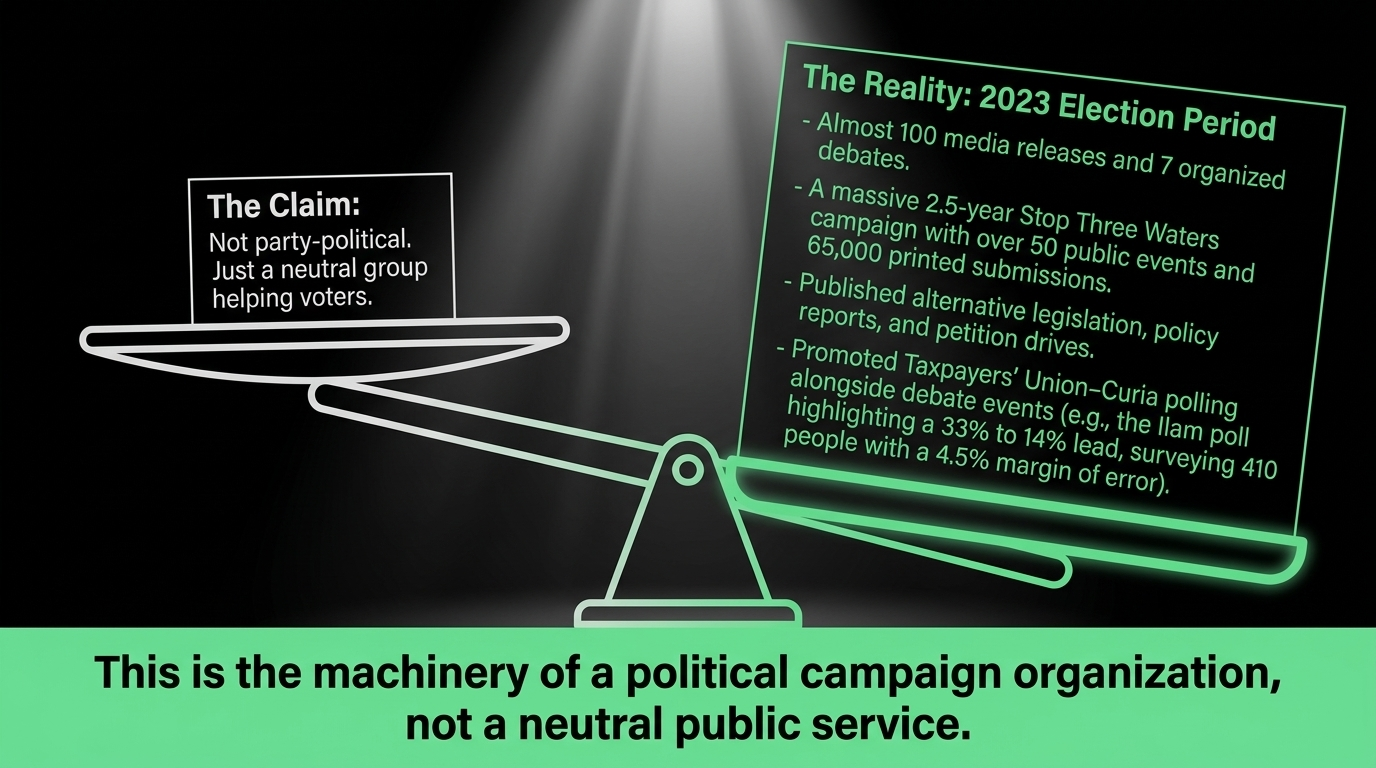
Newsroom reported that the Taxpayers’ Union, between 1 August 2023 and election day, paid for polling, issued almost 100 media releases, hosted seven debates, published policy reports, started a petition, and drafted alternative legislation. Newsroom documented the Taxpayers’ Union’s election-period activity
That is not what a neutral debate host does. That is what a political campaign organisation does.
The Taxpayers’ Union Is Political
The Taxpayers’ Union has the right to campaign. It can hold debates. It can run polls. It can support certain policies. It can criticise parties.
But it cannot honestly claim to be just a neutral group helping voters.
The group’s own debate advertising said candidates would get a chance to put their views to voters. It also said the events would sit alongside Taxpayers’ Union–Curia polling. The Taxpayers’ Union promoted its debates together with its polling work
That matters because the host gets something out of the debate:
- It gets an audience.
- It gets publicity.
- It gets candidates standing under its logo.
- It gets more media reach.
- It gets to look important.
- It gets to make its political views look normal.
The Taxpayers’ Union says it does not set candidate questions and says its events are not party-political. The Post reported the group’s public defence of its debates
That is not enough.
A person can avoid writing the questions and still control the room. They can choose the brand, the audience, the livestream, the media partners, the timing, the promotion and the story told about the event.
The Deep Dive Podcast
Listen to a lively conversation between two hosts, unpacking and connecting topics in the sources of this essay. I apologise in advance for the AI's very harsh pronounciation of reo. Please dont shoot me, :).
Youtube Video
Like video? Here is a short video suppporting the essay. Again, don't shoot the messenger please because of AI's pronounciation. :)
Koha Consideration
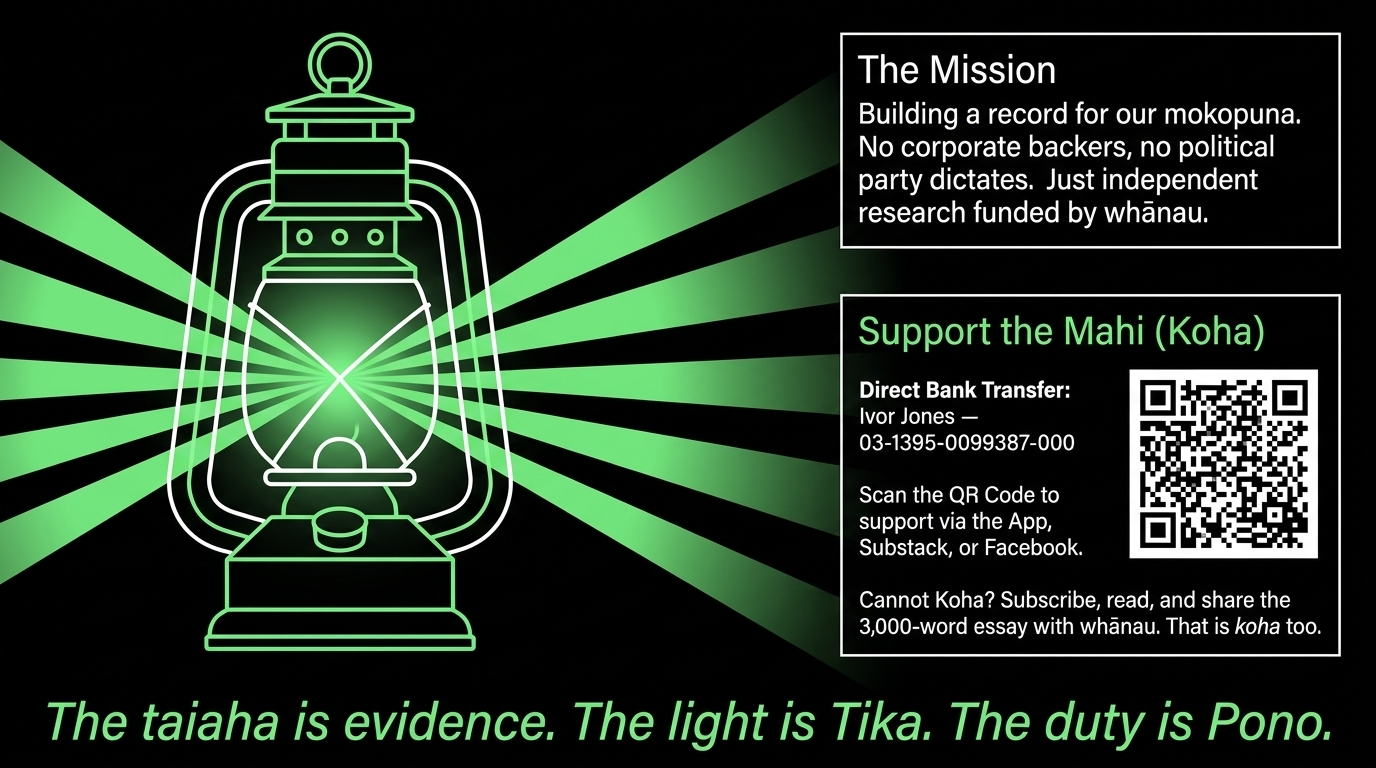
You may ask who supports The Māori Green Lantern to write research like this.
The answer is whānau like you.
There are no big companies paying me to write these essays. No political party tells me what to say. Your koha supports independent research and accountability when the Crown, big business and powerful political networks fail to provide it.
Every koha says we can support our own truth tellers. That is rangatiratanga too.
If this essay helped you understand why the Taxpayers’ Union debate stage matters, why political networks matter, or why Māori rights must not be used as campaign targets, please consider supporting this mahi:
- Koha — Support The Māori Green Lantern
- Subscribe To The Māori Green Lantern
- Direct bank transfer: Ivor Jones — 03-1395-0099387-000
- Subscribe On Facebook
If you cannot koha, no worries. Subscribe, follow, read, talk about the work, and share it with whānau and friends. That is koha too.
Kia kaha, whānau. Stay alert. Stay connected. The taiaha is evidence. The light is Tika. The duty is Pono.
The Network Is Real
I am not saying every National or ACT MP takes orders from the Taxpayers’ Union. The evidence reviewed does not prove that.
But the public record shows a clear political network. National, ACT, the Taxpayers’ Union and Curia are connected through people, polling, events and shared political goals.
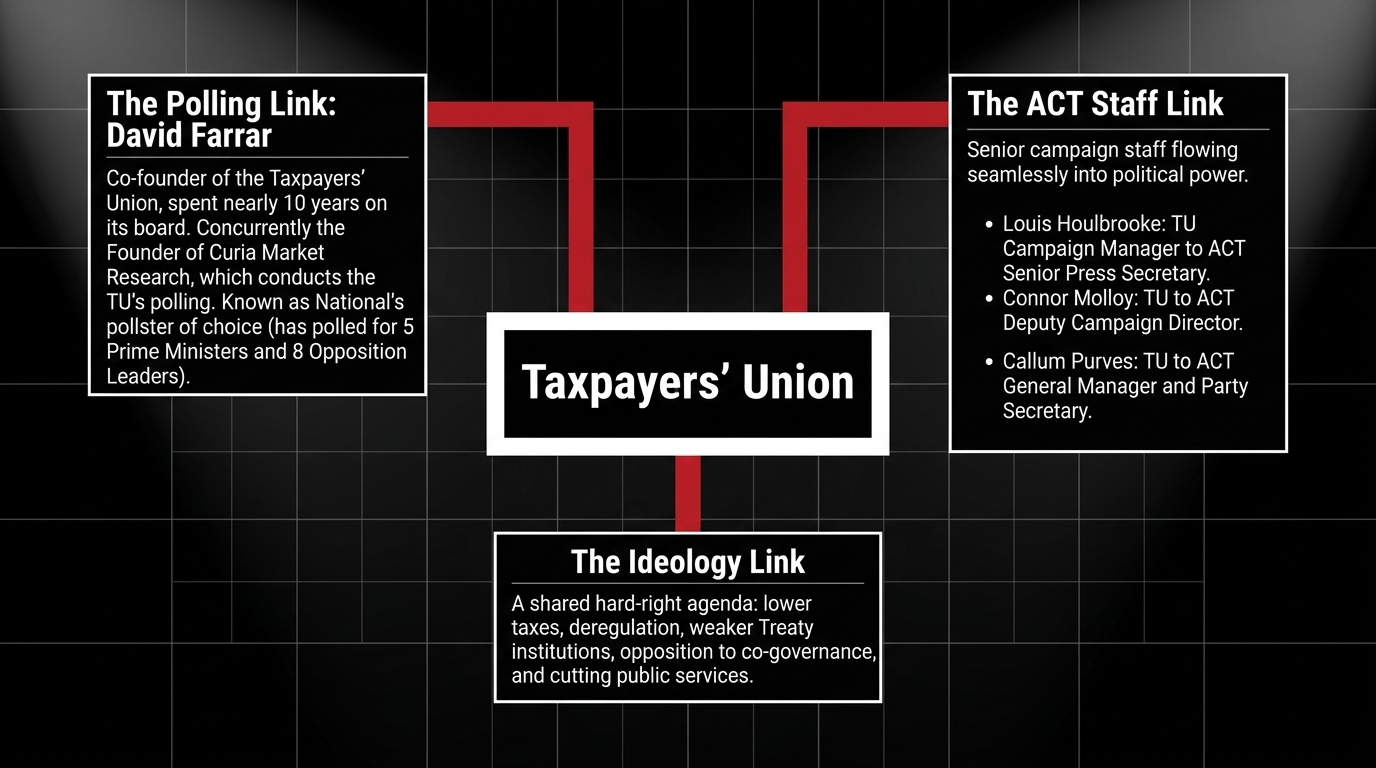
The Polling Link
David Farrar is a co-founder of the Taxpayers’ Union. The group says he founded Curia Market Research and was on the Taxpayers’ Union board for nearly ten years. The Taxpayers’ Union described Farrar’s roles in an interview published on its own site
The Taxpayers’ Union also says Curia conducts its polling. Its September 2026 poll page says Farrar co-founded the union, used to sit on its board, and is a director of Curia. The Taxpayers’ Union disclosed the relationship between its polling, Curia and Farrar
The Taxpayers’ Union itself called Farrar National’s “pollster of choice.” The Taxpayers’ Union described Farrar’s work with National Party leaders Curia says he has worked on polling for five Prime Ministers and eight Opposition Leaders, although it does not name every client or party. Curia described Farrar’s polling work
1News reported that Hager says Curia produces both Taxpayers’ Union–Curia polls and National’s internal polling. Farrar rejected major parts of Hager’s book, calling some claims “1000 percent wrong.” 1News reported Hager’s claim and Farrar’s denial
The plain point is this: the man who helped start the Taxpayers’ Union also sits at the centre of its polling system, and he has a well-known polling relationship with National. That does not prove secret coordination. It does prove the groups are not strangers.
The ACT Staff Link
The ACT link is not only about shared ideas. It is also about people moving from the Taxpayers’ Union into senior ACT roles.
The New Zealand Herald reported that Hager’s book says former Taxpayers’ Union campaign manager Louis Houlbrooke became an ACT senior press secretary; Connor Molloy became ACT deputy campaign director; and Callum Purves became ACT general manager and party secretary. The Herald reported the staff moves described in Hager’s book
People are allowed to change jobs. That alone does not show wrongdoing.
But when experienced campaign staff move from a lobby group into senior party roles, they take skills, political contacts, knowledge of audiences, campaign methods and ideology with them.
That is why this matters. It is not a conspiracy theory. It is how political networks work.
The Shared Politics Link
The Taxpayers’ Union regularly supports a hard-right political agenda: lower taxes, less public spending, deregulation, weaker Treaty institutions, opposition to co-governance, and cutting or reducing public services.
The group has publicly supported ACT positions on issues including climate policy, property rights, infrastructure, Treaty institutions and Māori representation. The Taxpayers’ Union’s own news archive shows its policy campaigning and endorsements
That does not prove ACT runs the Taxpayers’ Union, or that the Taxpayers’ Union runs ACT.
It does show they share a lot of the same political ground.
National is a little different. The Taxpayers’ Union sometimes attacks National. But that does not make the group neutral. It means the group wants National to go further right.
It is like a business lobby attacking the Government because it wants more tax cuts, fewer rules, fewer worker protections and less public spending. The attack is not proof of independence. It is pressure from the same political direction.
The Greens Left. National And ACT Stayed.
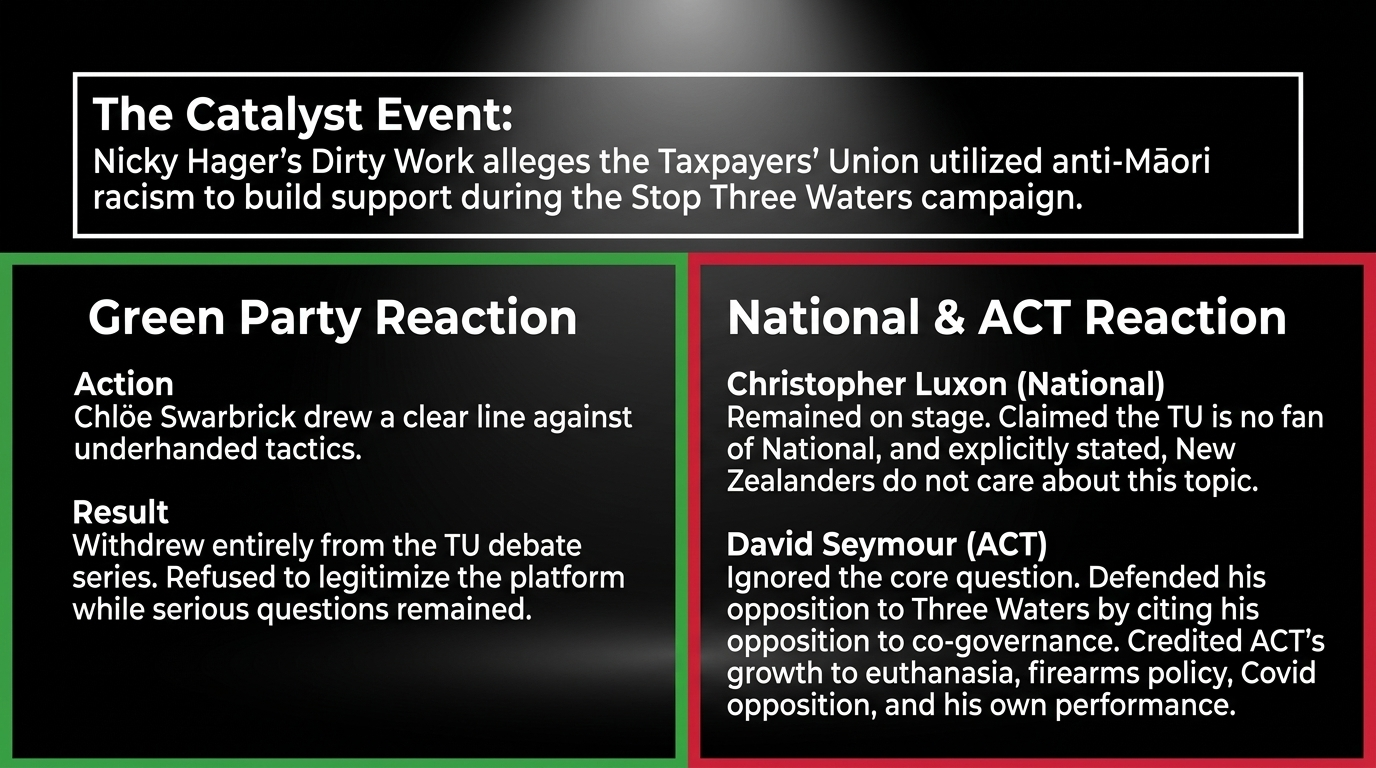
The Green Party withdrew from the Taxpayers’ Union debate series after Hager’s book was released. Chlöe Swarbrick said leaders needed to draw a line against underhanded tactics and called on National and ACT to withdraw too. The Post reported the Green Party’s withdrawal and Swarbrick’s comments
The Taxpayers’ Union said the debates were for voters and that it did not set the questions. The Post reported the Taxpayers’ Union’s response
The Greens made a political decision: while serious questions are being raised, we will not help this group look more legitimate.
National and ACT chose the opposite.
Christopher Luxon said the Taxpayers’ Union was “no fan of the National Party.” The Post reported Luxon’s response RNZ reported that Luxon said he did not care about Hager, did not care about the Taxpayers’ Union, and did not think New Zealanders cared about the issue. RNZ reported Luxon’s comments
That is not a serious answer.
A group can push National from the right and still be useful to National. It can pull National’s policies rightward, make extreme ideas sound normal, and keep its voters angry at the same targets.
David Seymour said ACT’s growth came from other things, including euthanasia, firearms policy, Covid opposition, party organisation and his own performance. The Post reported Seymour’s response
Maybe those things helped. Political support usually has more than one cause.
But Seymour did not answer the main question: why does ACT still want the approval and platform of a group facing serious public allegations about anti-Māori political campaigning?
Three Simple Examples
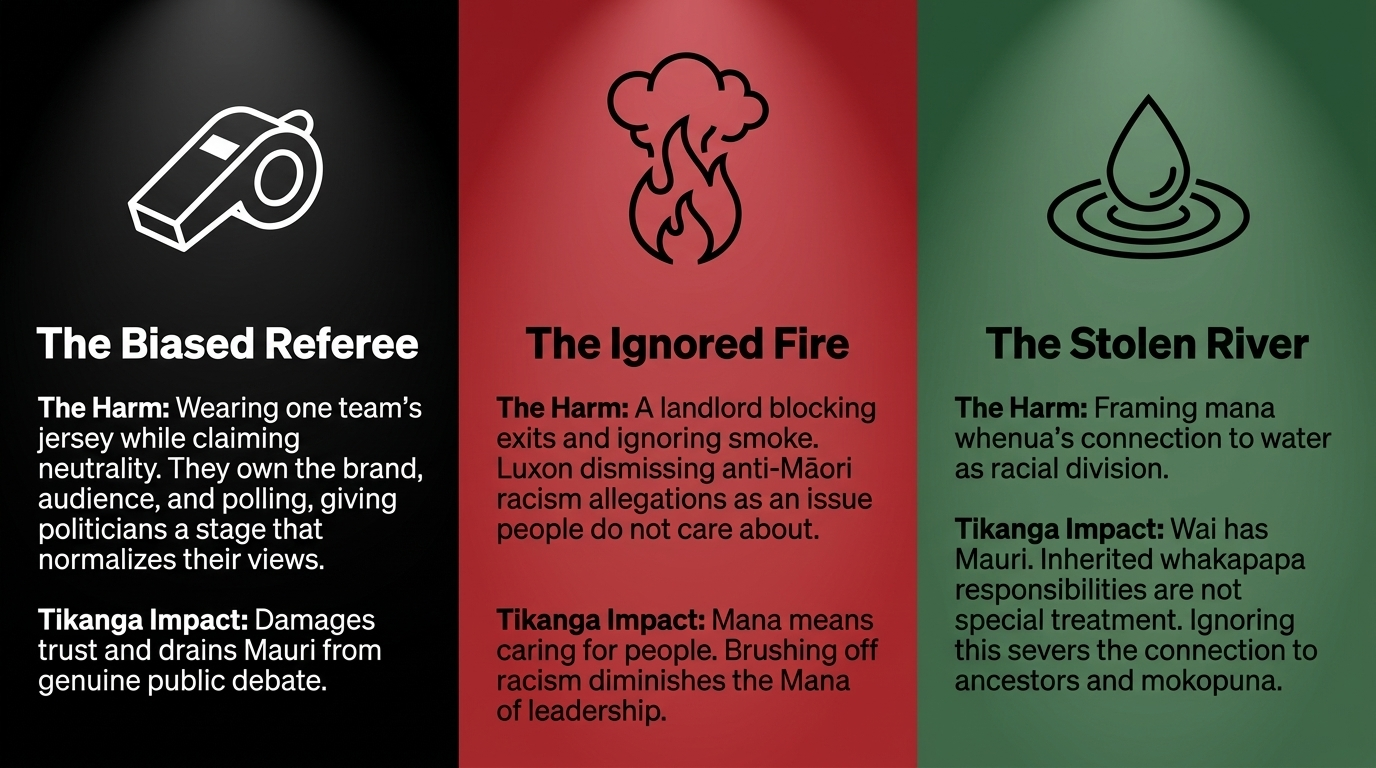
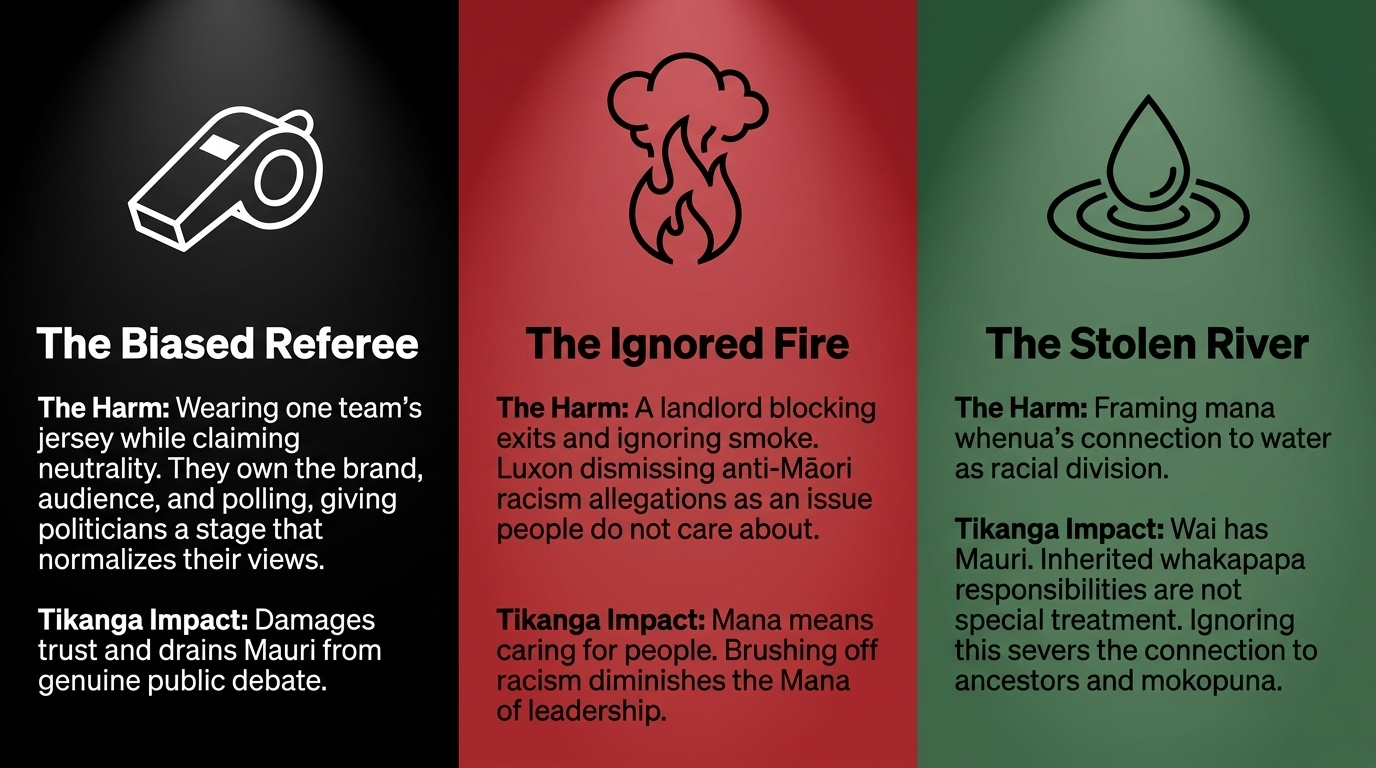
Example One: The Biased Referee
Imagine a rugby referee who wears one team’s jersey.
They sell tickets to that team’s supporters. They run polls saying the other team will lose. They write rule changes that help their favourite team. They put the match on their own channel.
Then they say, “I did not tell the players what to say, so I am neutral.”
Nobody would believe them.
That is the Taxpayers’ Union debate problem. The group does not need to write a question to shape the event. It owns the brand, the audience, the polling, the promotion and the political benefit. Newsroom documented the Taxpayers’ Union’s election activity The group’s own debate page linked its events to its polling work
The Harm: Every politician who attends helps the group look more trusted and more important.
The Solution: Every party should check who is hosting a debate before attending. They should look at funding, political links, polling, question rules, audience access, livestream partners and whether the host respects Te Tiriti and opposes racism.
The Tikanga Impact: Tikanga means proper relationships and proper behaviour. A political lobby group should not wear the mask of a neutral public forum. That damages trust and drains mauri from public debate.
Example Two: The House Fire
Imagine a landlord who blocks the fire exit to save money.
Then the tenants smell smoke. They ask questions. The landlord says, “People do not care about smoke. They care about rent.”
That is what Luxon’s reported response sounds like.
RNZ reported that he said he did not care about Hager, did not care about the Taxpayers’ Union, and said New Zealanders did not care. RNZ reported Luxon’s response
The Harm: Māori are told that allegations about anti-Māori political tactics are not important enough to take seriously.
The Solution: National and ACT should pause their involvement in Taxpayers’ Union events while the issues are examined. They should publish what checks they made before choosing to attend.
The Tikanga Impact: Leaders carry responsibility. Mana is not just status. It means taking care of people. Brushing off concerns about racism does the opposite.
Example Three: The River Board
Imagine a town that depends on a river for drinking water.
The people whose ancestors have cared for that river for generations are told they should not have a real role in decisions about it. When they ask for a place in governance, they are accused of creating racial division.
That is the simple version of the Three Waters and co-governance fight.
Hager alleges the Taxpayers’ Union used anti-Māori racism as a tool during the Stop Three Waters campaign. The group denies it. The Post reported the allegation and denial Seymour has said he opposed Three Waters because he opposed co-governance and people being put in charge based on race. RNZ reported Seymour’s position
The Harm: Māori relationships with wai are treated as a political problem instead of a responsibility under whakapapa and Te Tiriti.
The Solution: Water decisions must include Te Tiriti, mana whenua, clear public rules, good infrastructure planning and honest public information.
The Tikanga Impact: Wai has mauri. Mana whenua responsibilities are inherited responsibilities, not special treatment. Ignoring this is not neutral. It weakens the relationship between people, land, water, ancestors and mokopuna.
What Is Proven And What Is Not
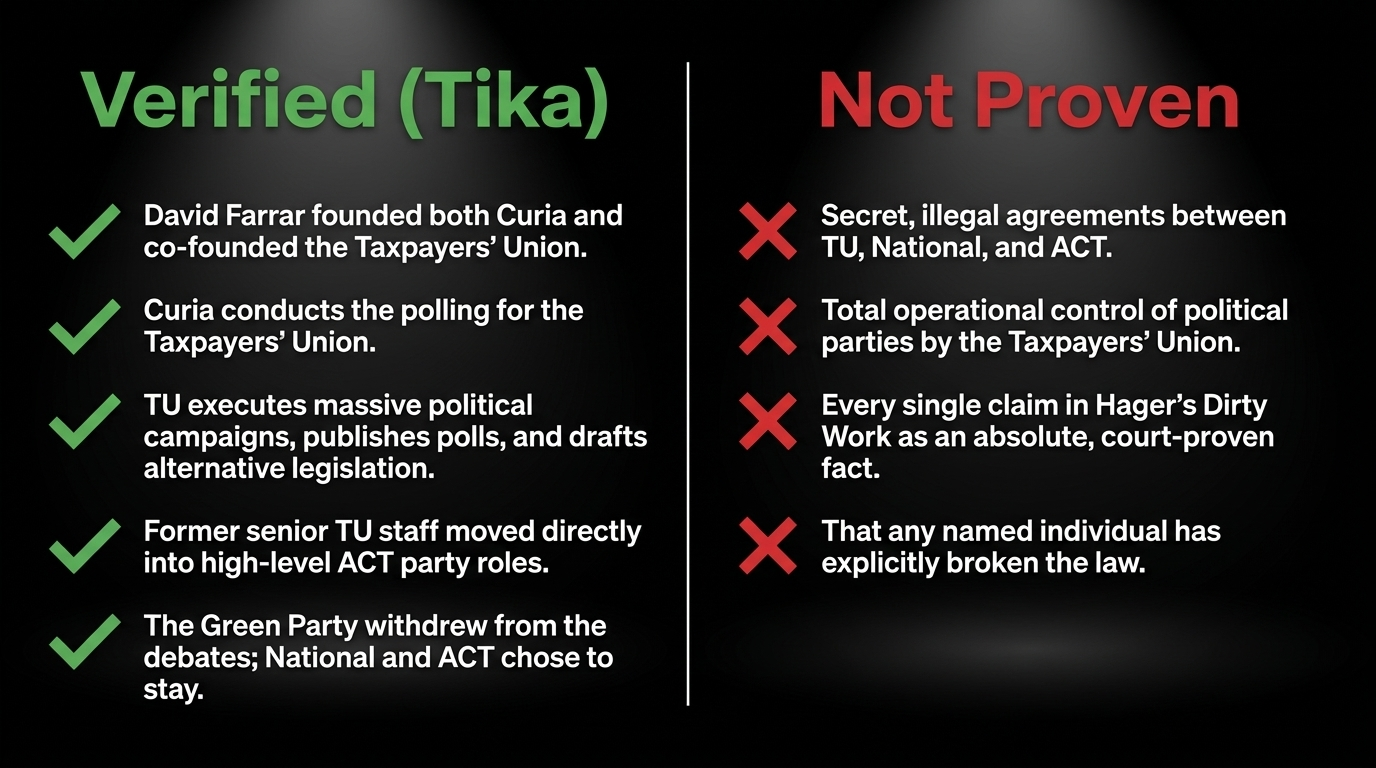
This is where Tika matters most.
Verified:
- David Farrar co-founded the Taxpayers’ Union and founded Curia Market Research. The Taxpayers’ Union described those roles
- Curia conducts Taxpayers’ Union polling. The Taxpayers’ Union disclosed this
- The Taxpayers’ Union runs political campaigns, publishes polling, hosts debates and pushes policy positions. Newsroom documented this election activity
- Hager’s book alleges former Taxpayers’ Union staff moved into senior ACT roles. The Herald reported the staff movements described in the book
- The Greens withdrew from Taxpayers’ Union debates, while National and ACT leaders rejected the concerns. The Post reported the withdrawal and responses
Not Proven In This Essay:
- That National, ACT or the Taxpayers’ Union have a secret agreement.
- That the Taxpayers’ Union controls National or ACT.
- That Hager’s allegations are already proven facts.
- That all people connected to these groups share the same beliefs or take part in the same activities.
- That any named person has broken the law.
The network is real. The legal and factual limits of what can be claimed are also real.
Why This Coalition Must Not Return
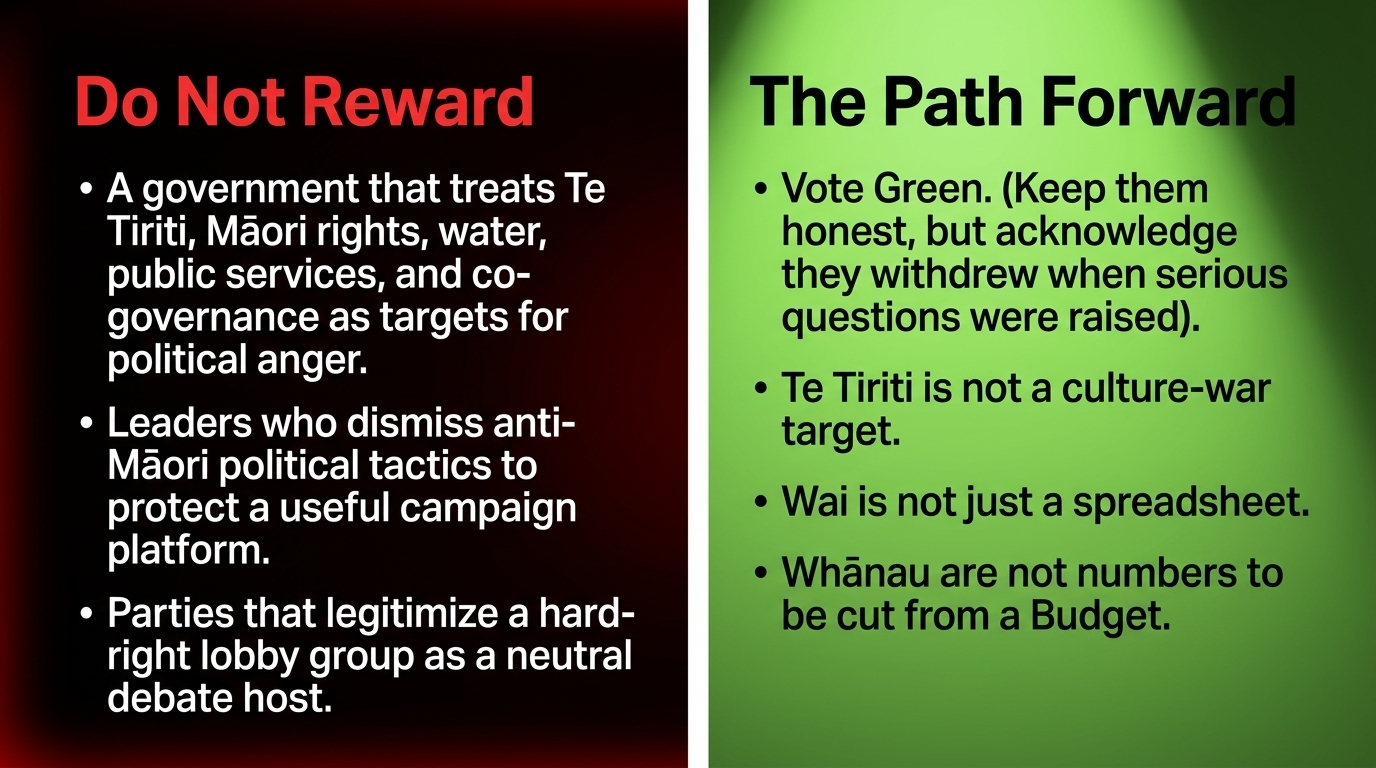
Do not vote this coalition government back into power in November.
Do not reward a government that treats Te Tiriti, Māori rights, water, public services and co-governance as targets for political anger.
Do not reward leaders who dismiss concerns about anti-Māori political tactics because they would rather keep a useful political platform.
Do not reward parties that claim a right-wing lobby group is just a neutral debate host when the public record shows that it is a campaign organisation with strong links to their own political world.
I recommend voting Green.
The Green Party is not perfect. No party is perfect. The Greens also need to explain why they first agreed to take part in Taxpayers’ Union debates.
But they withdrew once serious public questions were raised. The Post reported the Green Party’s withdrawal and call for National and ACT to do the same
That matters.
Vote Green because Māori rights are not a political game. Te Tiriti is not a culture-war target. Wai is not just a spreadsheet. Whānau are not numbers to be cut from a Budget.
Vote Green—but keep every party honest. That is Tika. That is Pono. That is rangatiratanga.

Disclaimer
This is political commentary in the public interest. It is not a legal finding and does not claim that any named person or organisation has committed a crime or broken the law. If documentary evidence shows a factual error, I will assess it and correct the record where needed.