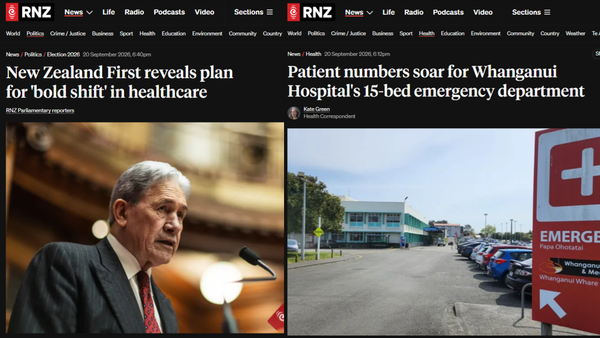
"The Taxpayer Mask: How Hager's Dirty Work Rips The Smile Off Neoliberalism's Favourite Front Group" - 23 September 2026
They Called It Accountability While A Pollster Ran Their Politics, A Pig Costume Hid Their Cuts, And Anti-Māori Rhetoric Did The Dirty Work Their Manifesto Won't Admit To

Tika: I will state only what the evidence supports, attributed precisely to whoever said it. Pono: I will not pretend that an organisation whose own co-founder ran the National Party's pollster while running the "independent" watchdog's poll is a neutral civic institution. That is not balance. That is the mask.
What This Essay Covers
 RNZ | Te Reo Irirangi o Aotearoa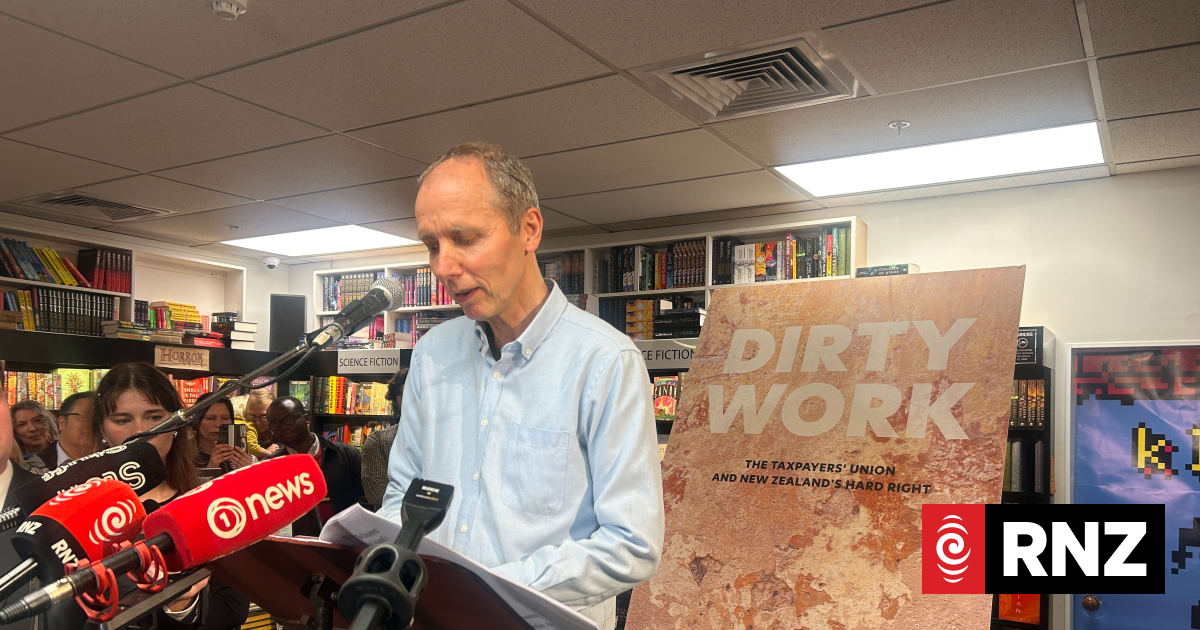
This essay examines Nicky Hager's newly launched book,
Dirty Work: The Taxpayers' Union and New Zealand's Hard Right; the specific allegations he makes and the specific denials David Farrar has given in response;
the Taxpayers' Union's own 2026 political manifesto and what it demands of the next government;
the disclosed polling relationship connecting the Taxpayers' Union, Curia, and the National Party;
the Stop Three Waters campaign and the claim that anti-Māori rhetoric was used as a political weapon; and
what all of this means for tikanga, for whānau, and for how you should vote on 7 November 2026. Newsroom RNZ
I am Ivor Jones. This is The Māori Green Lantern.
I trace whakapapa because policy has whakapapa. Every mascot hides a cut. Every poll hides a pollster's client list. Every "accountability" rebrand hides a fight somebody lost. I am going to show you the fight.
The Shopping List Arrives With A Pig Costume Attached
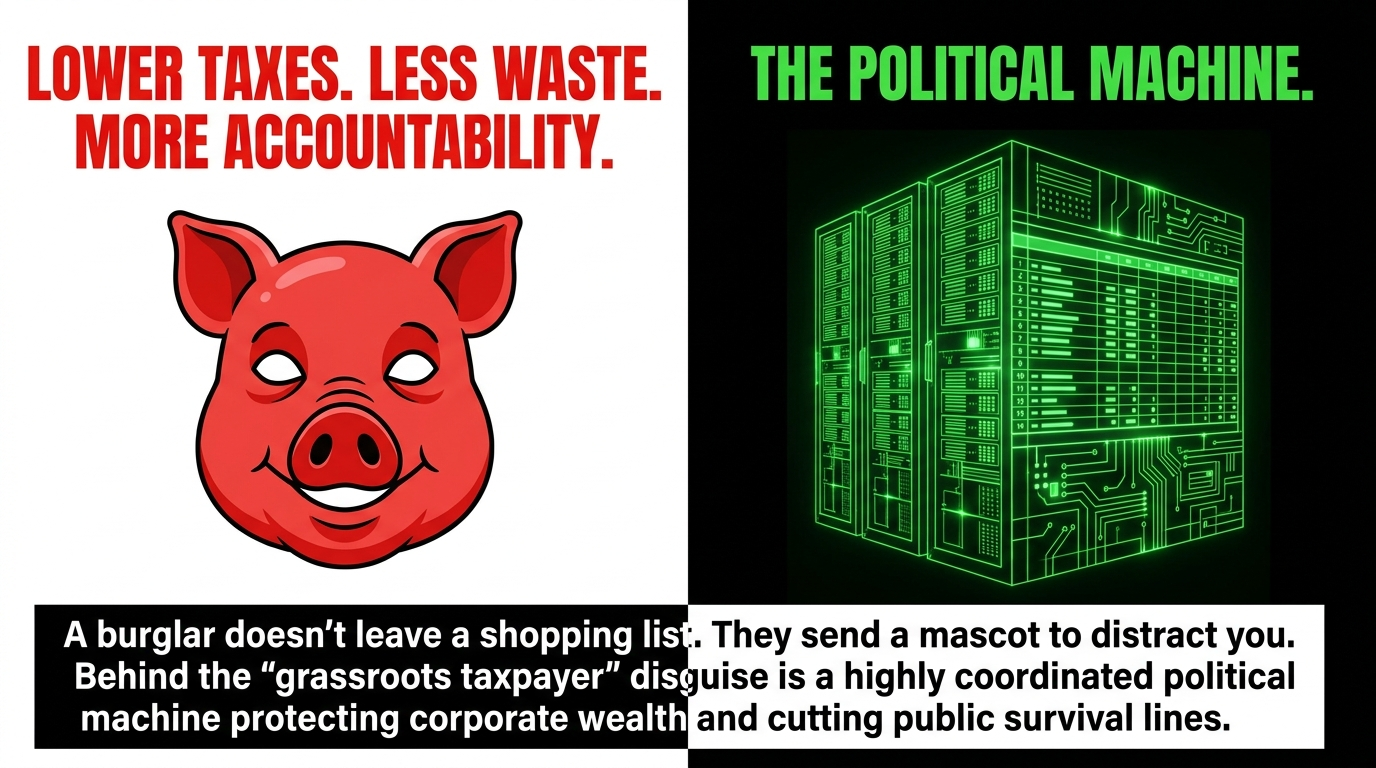
A burglar does not normally leave a shopping list on the kitchen bench. The hard right did something more efficient. It published one, then sent a pig mascot out to distract you while it read the list aloud.
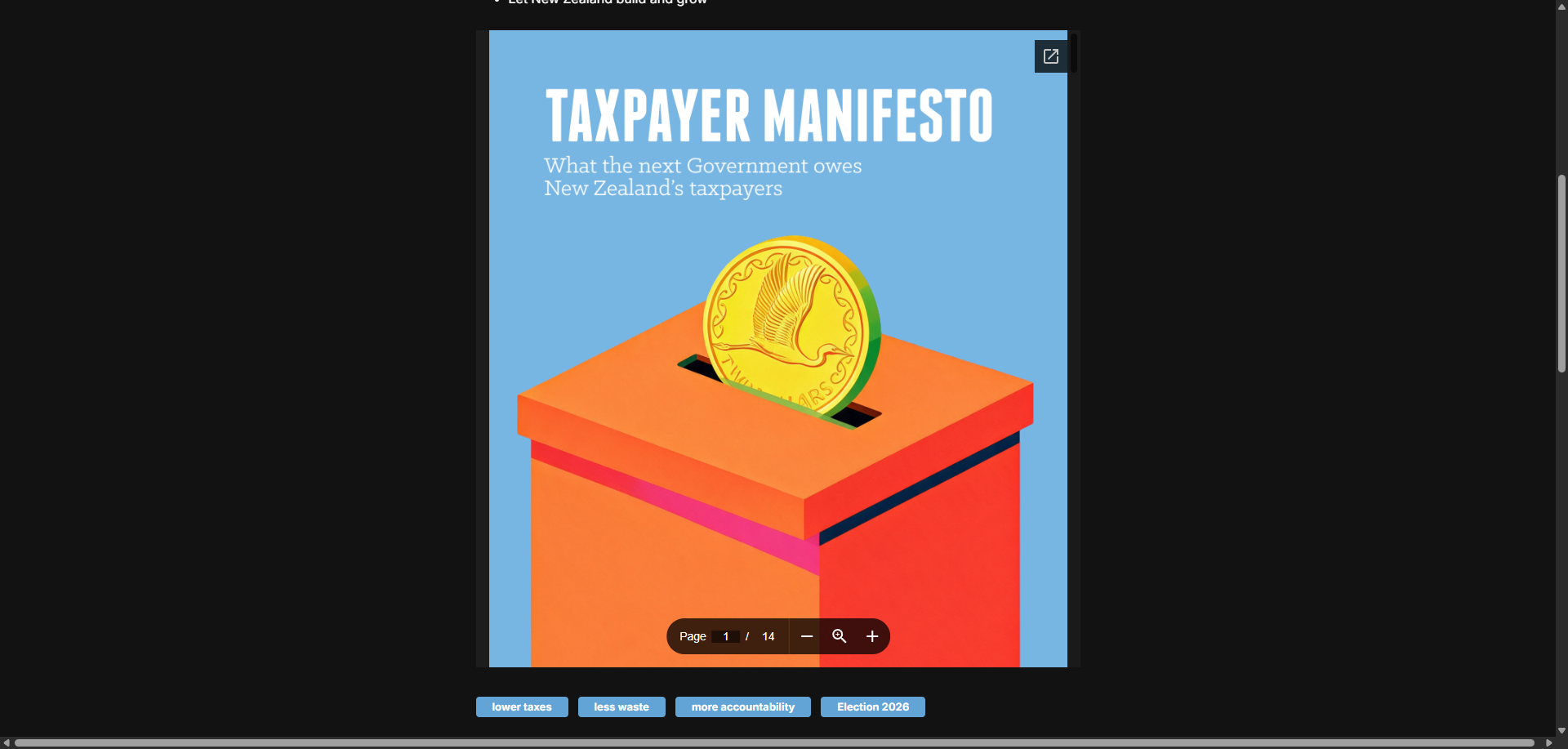
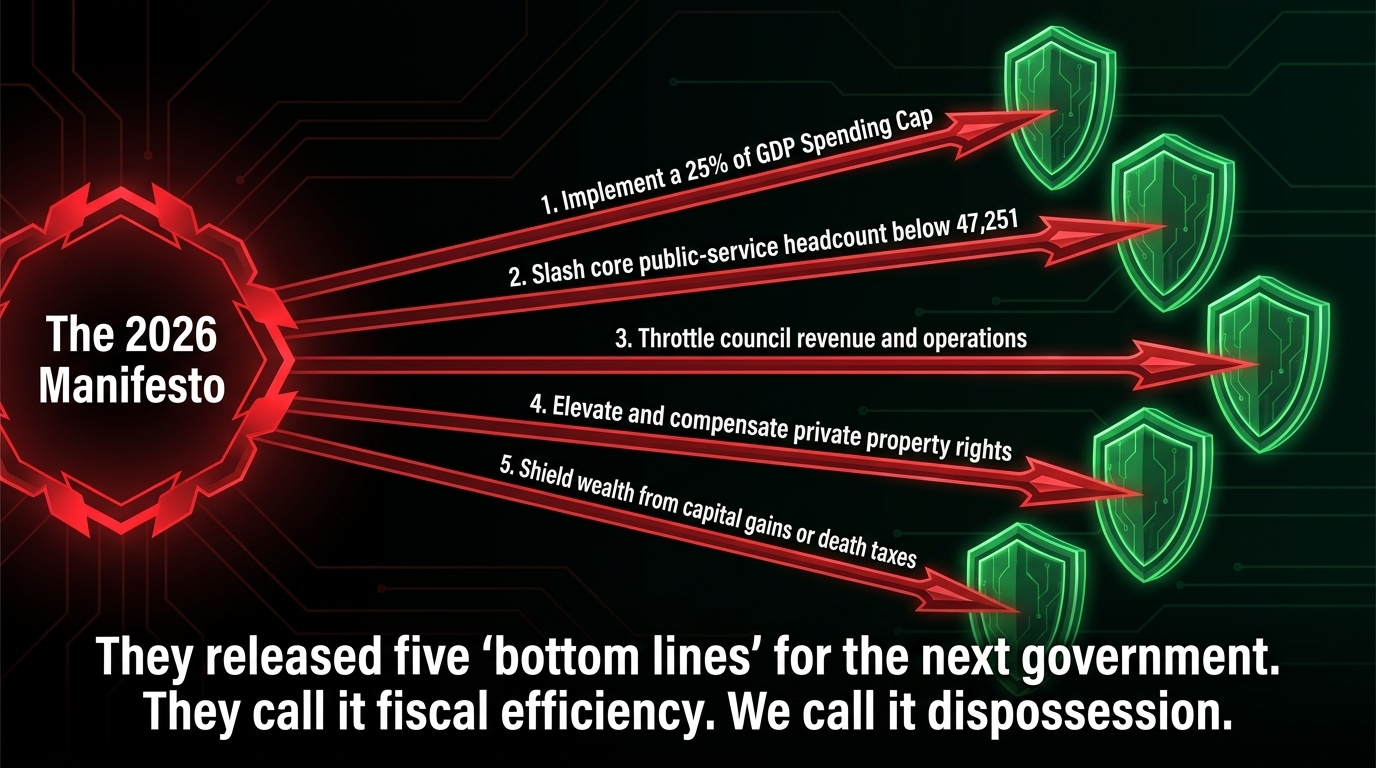
On 17 September 2026, the Taxpayers' Union released its Taxpayer Manifesto 2026, demanding that every party be judged against five "bottom lines" before the election, and that any incoming government adopt them as coalition conditions:
stop new taxes, cut "waste," balance the books, make government answer to taxpayers, and restrict councils to their "proper lane." Taxpayers' Union Scoop
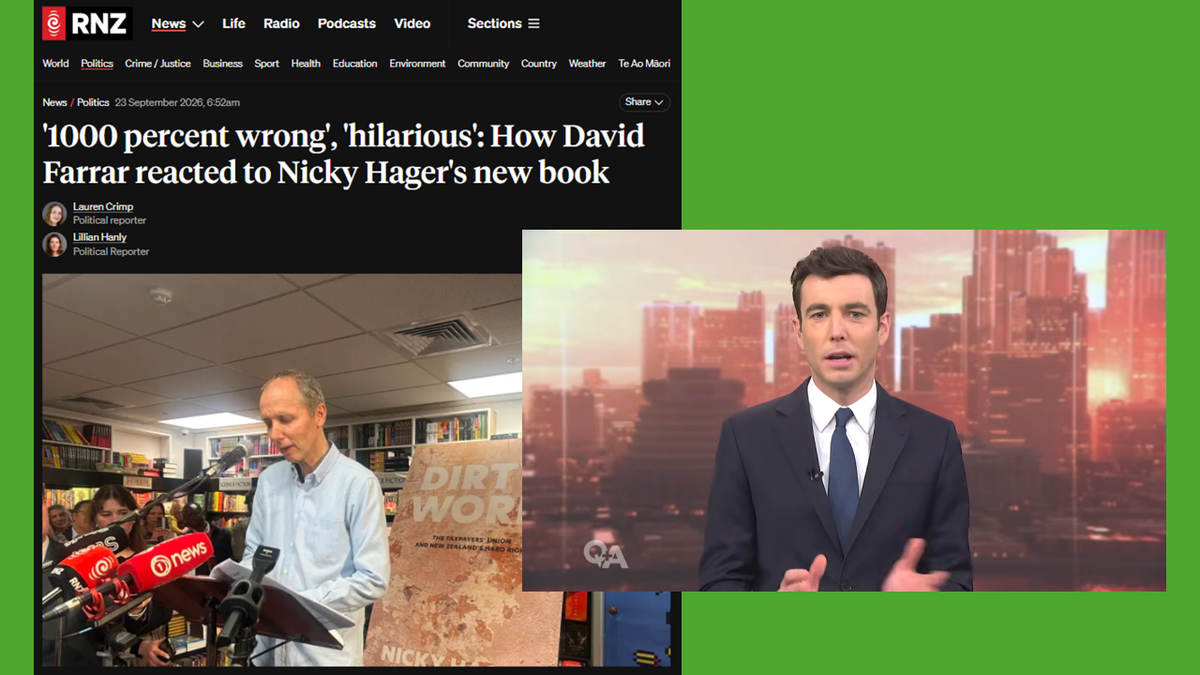
Five days later — Nicky Hager launched Dirty Work: The Taxpayers' Union and New Zealand's Hard Right at Unity Books in Wellington. Newsroom
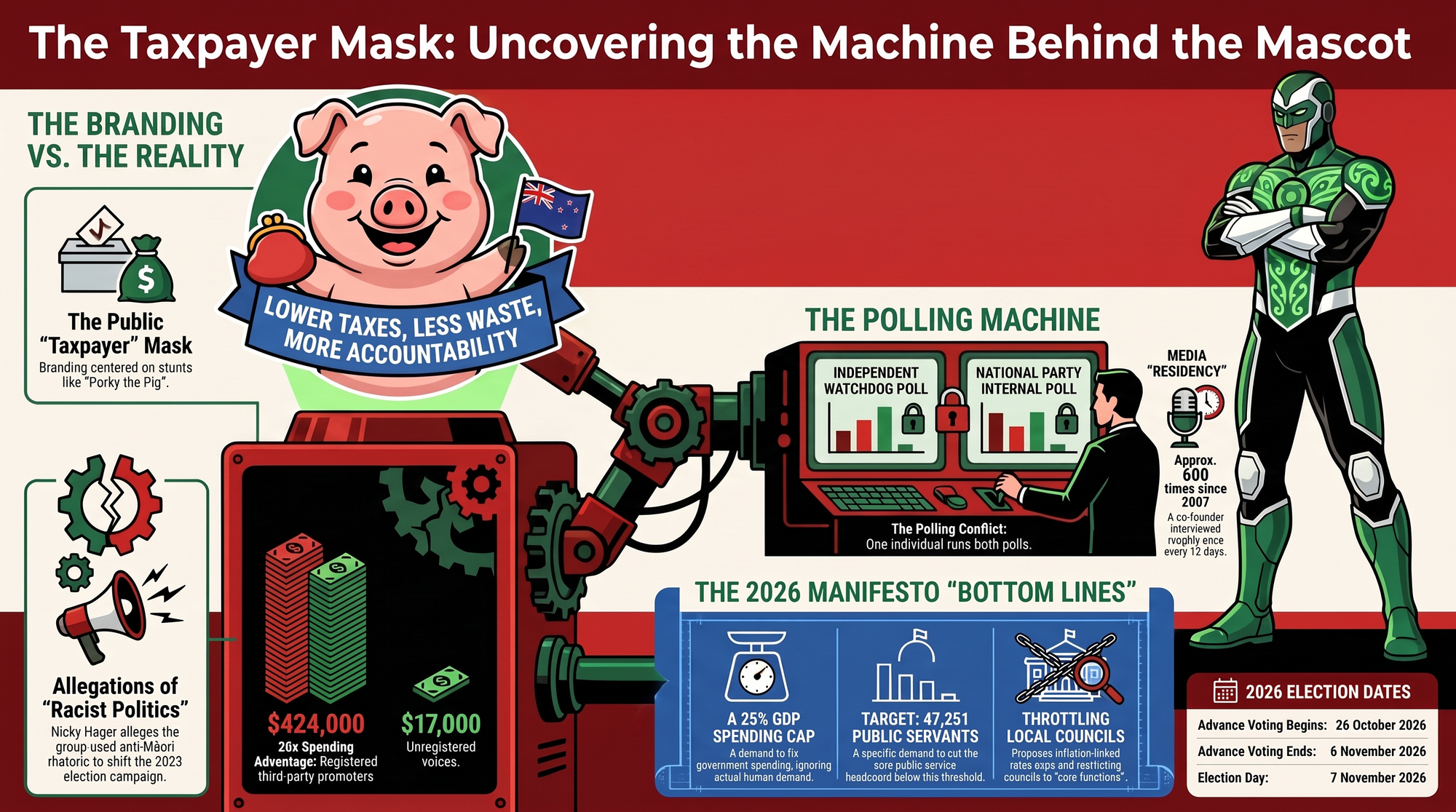
RNZ reports Hager described the book as the story of how "a campaign of racist politics unfolded," built around the Taxpayers' Union's use of anti-Māori rhetoric during its Stop Three Waters campaign, which began in 2021, and which Hager says helped shift the entire 2023 election campaign to the right. RNZ
Those are Hager's reported claims. I record them precisely because Tika demands precision. What I will not do is pretend the wider pattern isn't already sitting in plain sight, published on the organisation's own website, dressed up as a Bribe-O-Meter and a waste-hating pig.
Tika And Pono
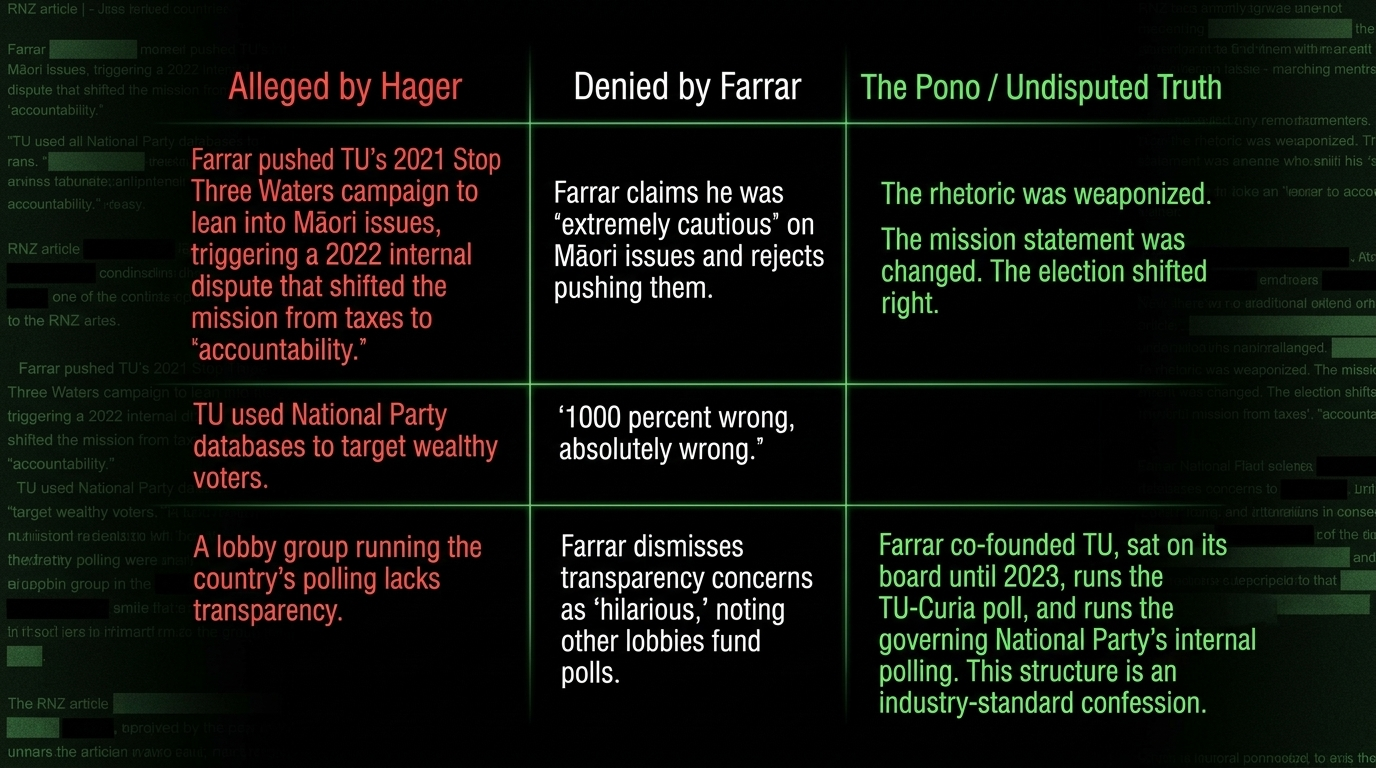
Tika requires me to name exactly what has been verified, exactly what has been alleged, and exactly what has been denied — and to keep those three categories separate.
David Farrar co-founded the Taxpayers' Union and sat on its board until 2023. He runs Curia Market Research. Curia produces both the Taxpayers' Union–Curia political poll and the National Party's internal polling. Farrar does not deny any of this. He cannot. RNZ
Alleged by Hager, denied by Farrar: That Farrar used privileged access to a National Party election database to target Taxpayers' Union mailouts. Farrar called this "totally, 1000 percent wrong, absolutely wrong." RNZ
Alleged by Hager, denied by Farrar: That Farrar pushed the Taxpayers' Union's Stop Three Waters campaign to lean harder into Māori issues, triggering a 2022 internal fight the board resolved in his favour by shifting the mission statement from "taxes and transparency" to "accountability" — a change Hager says legitimised a "move towards race."
Farrar said: "I absolutely reject the characterisation that I was pushing for us to be more involved in Māori issues... I would be quite on the opposite side, extremely cautious on that." RNZ
Alleged by Hager, dismissed by Farrar as "hilarious": That the polling relationship between the Taxpayers' Union, Curia, and the National Party lacks transparency about who funds it. Farrar said, "there's no secret funders for it," and noted that Infrastructure New Zealand, also a lobby group, funds The Post's political polls. RNZ
Pono requires me to say what remains once every denial is heard in full: the structure itself — one man running the "independent" watchdog's poll and the governing party's internal polling — is not in dispute.
Farrar's defence is not "this isn't true." His defence is "everyone does it." That is not innocence. That is an industry-standard confession.
This Is A Warning For Mokopuna
I would love you to click into this essay because it carries a wealth of information you can use in your daily life: how to spot the mascot hiding the policy, how to read a poll's fine print before its headline, and how to ask who benefits when a lobby group's mission statement quietly grows teeth.
I have created an audio podcast that outlays this kaupapa in full detail. I have created a short video that explains the kaupapa plainly. And for the long-form readers, there is a 3,000-word cited essay waiting for you right here.
This is a repository for our mokopuna in the future to look back upon and say: at least we knew that The Māori Green Lantern, amongst a few others, was warning us — naming the pig costume, naming the pollster, naming the mission-statement rebrand, while the country's biggest political machine wore a smile and called its demolition "accountability."
The Deep Dive Podcast
Listen to a lively conversation between two hosts, unpacking and connecting topics in the sources of this essay. I apologise in advance for the AI's very harsh pronounciation of reo. Please dont shoot me, :).
Youtube Video
Like video? Here is a short video suppporting the essay. Again, don't shoot the messenger please because of AI's pronounciation. :)
Support The Truth-Telling
You might ask who supports The Māori Green Lantern to sit through 260-page manifestos, RNZ investigations, and pig-costume press releases so whānau don't have to untangle the spin alone.
The answer is you. This mahi is supported through koha and subscriptions — not corporates, not lobby groups, not a pollster with a National Party contract on the side.
Every koha signals that whānau are ready to support the accountability that Crown, corporate, and broadcast structures will not provide. It signals that rangatiratanga includes the power to support our own truth-tellers.
Kia kaha, whānau. Stay vigilant. Stay connected. And if you are able, consider a koha to ensure this voice continues.
If you are unable to koha, no worries. Subscribe or follow The Māori Green Lantern, kōrero and share with your whānau and friends — that is koha in itself.
- Koha — Support
- Subscribe To The Māori Green Lantern
- Direct bank transfer: Ivor Jones — 03-1395-0099387-000
- Follow On Facebook
Ko Te Whānau Te Kaupeka Kaha O Te Rākau.
The whānau is the strongest branch of the tree.
There Is No Single Taxpayer — There Is A Machine Wearing A Pig Costume
The Taxpayers' Union brands itself as fighting for "the common interests of all taxpayers," under the banner "Lower Taxes. Less Waste. More Accountability." Taxpayers' Union
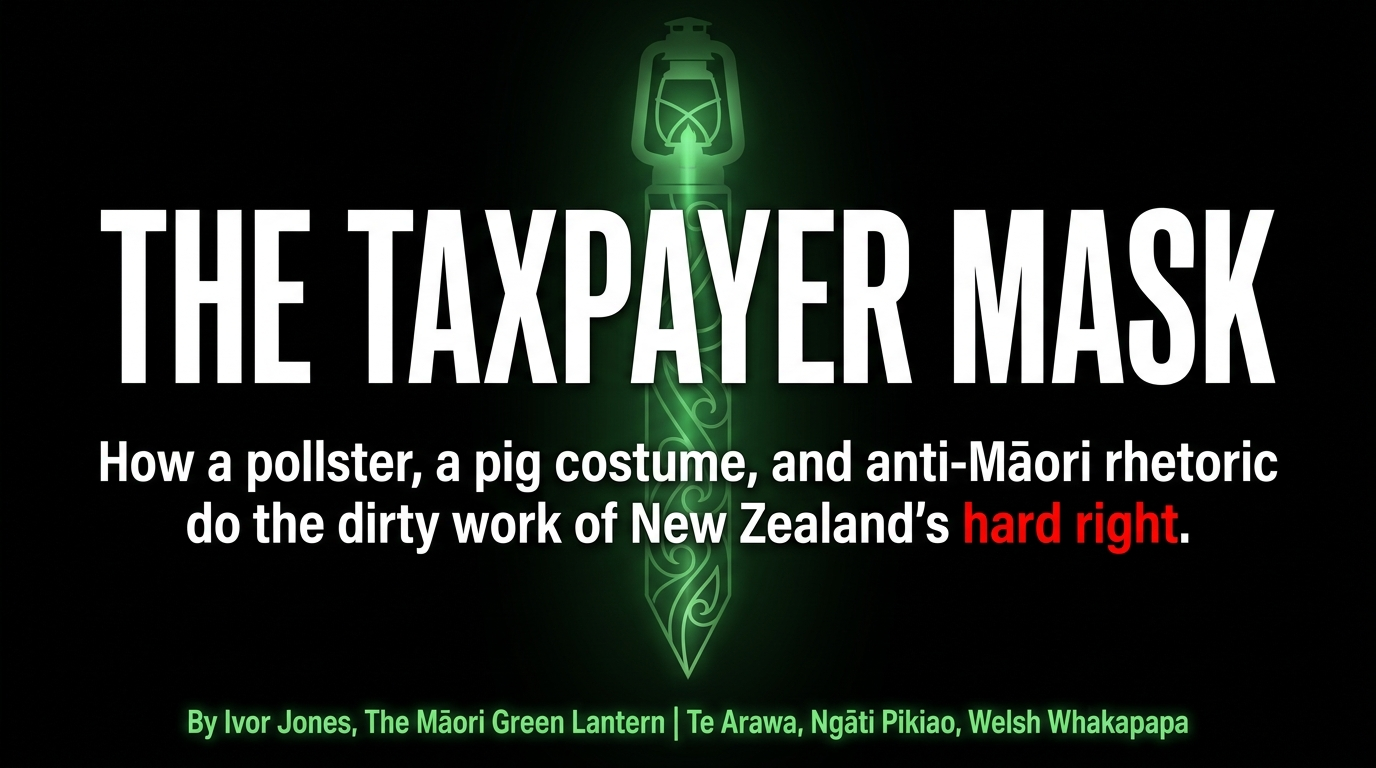
Jack, you should never have given this clown airtime without a fight in the questions.
Shame on you, boy. You had a lobby group sitting in your studio explaining why they want government spending slashed, and you let them run their pig-costume routine unchallenged — no mention of Stop Three Waters, no mention of the polling arm that also does National's internal numbers, no mention that Nicky Hager's new book calls this outfit "the latest front for New Zealand's hard right."
You know exactly what they are. A far-right think tank dressed up as a taxpayer advocate, with sway over this government that goes well beyond a fudge prop and a Bribe-O-Meter.
Giving that DH a soft platform wasn't neutral journalism — it was a missed chance to ask the questions that actually matter to the people paying for the consequences of their manifesto. Do better next time.
Its own public-facing description of its work boasts of "high-profile stunts" — Porky the Waste-Hating Pig in 2017, Nicola's Fudge in 2025, and a 2026 "Bribe-O-Meter" tracking party campaign promises. Q+A with Jack Tame, YouTube
Read that list again. A pig costume, a fudge prop, and a gimmick tracker are the public face of an organisation Hager alleges ran "a campaign of racist politics." RNZ
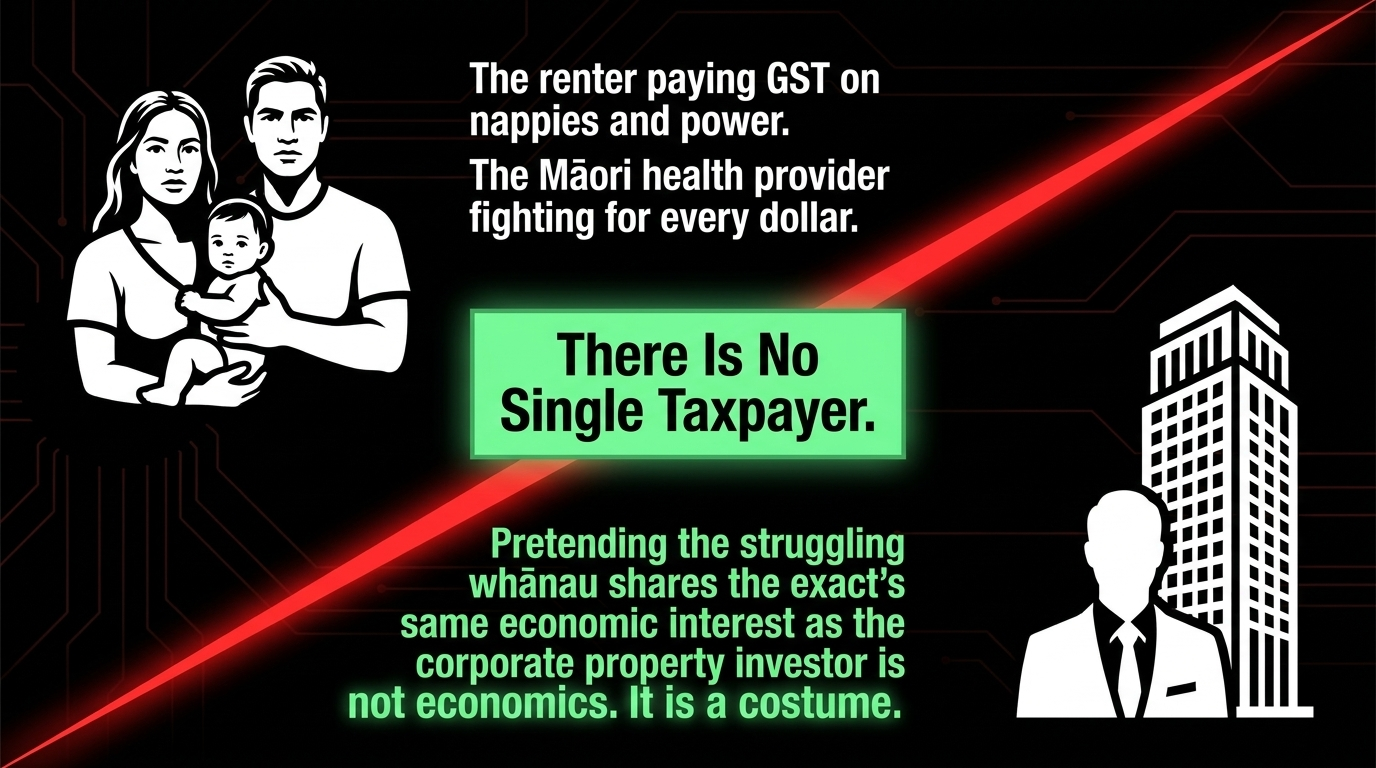
There is no single taxpayer behind that mascot. There is the corporate taxpayer with lawyers and property portfolios. There is the wage worker whose PAYE disappears before it reaches their account. There is the Māori health provider proving every dollar of culturally safe care while the government burns money on restructures. There is the kaumātua in a hospital queue. There is the renter paying GST on nappies and power. There is the person with substantial wealth calling a tax on that wealth an act of theft.
Pretending they share one interest is not economics. It is a costume.
The First Blade: A Cap Is A Cut Wearing A Tie
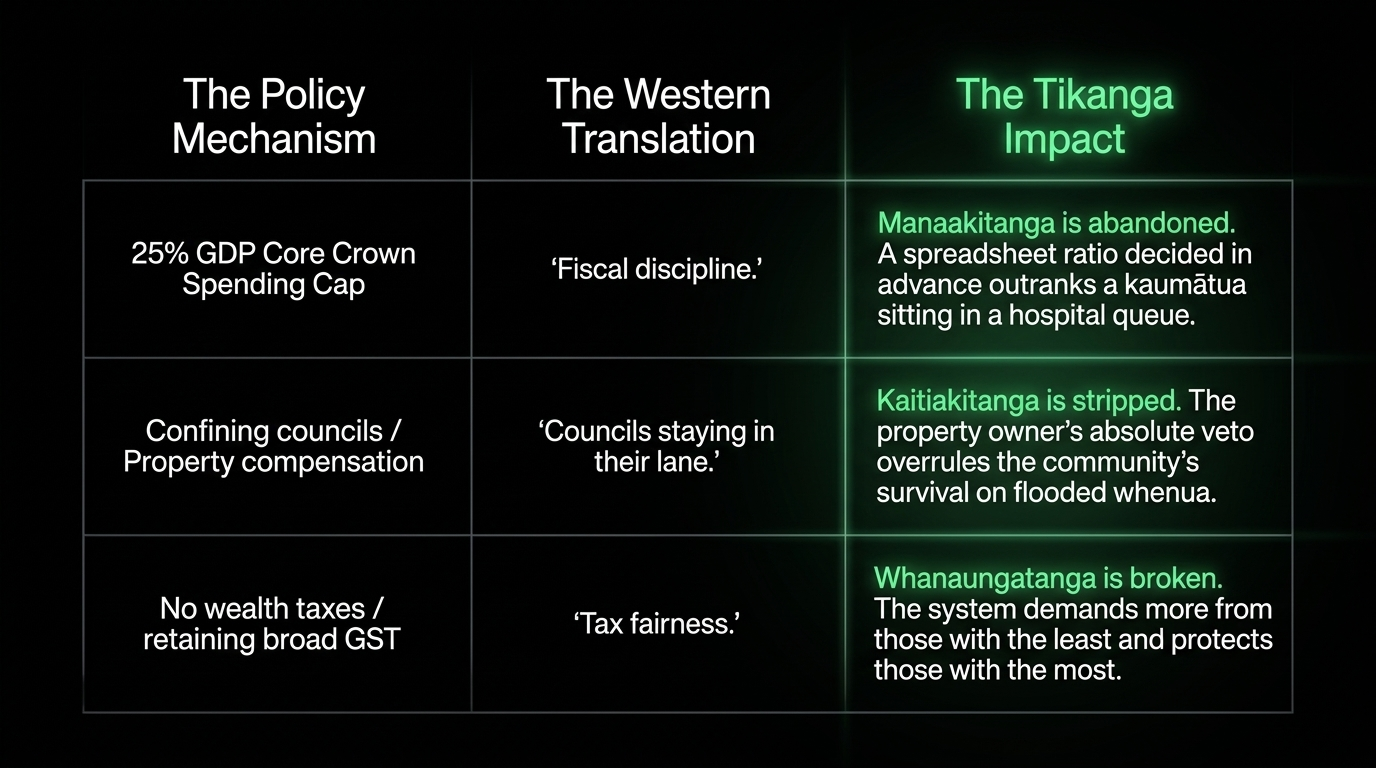
The manifesto demands core Crown spending capped at 25% of GDP and the core public-service headcount cut below 47,251. Scoop
Example One: The Hospital Queue
Western-mind translation: Imagine a hospital manager told the number of sick people no longer matters, because the whole system must fit inside a fixed ratio decided in advance by people who will never sit in that waiting room.
Tikanga impact: Manaakitanga — the obligation to care for and uphold the mana of others — is depleted the moment a spreadsheet ratio outranks a patient's need. A cap that ignores demand is not discipline. It is abandonment with a calculator.
Solution: No spending cap should be adopted without a published health, disability, Te Tiriti, and equity impact statement showing exactly which services survive and which whānau carry the shortfall.
Related MGL coverage: The Māori Green Lantern's prior analysis of the "expanded pharmacist role" traced the same mechanism — manufacture a funding crisis in Māori and public health provision, then sell the resulting collapse as reform. The Māori Green Lantern, health privatisation analysis
The Second Blade: "Waste" Is What They Call Your Job Right Before They Cut It
The manifesto seeks fewer public servants and pay "brought back into line" with private-sector comparators. Scoop
Public servants are the people who process housing support, protect children, inspect workplaces, and keep the state functioning after the minister has finished the press conference. Calling them "waste" is not fiscal analysis. It is dehumanisation with a spreadsheet attached.
The accountability the Taxpayers' Union demands only ever runs one way: down, onto the people with the least power to resist it.
The Third Blade: "Back In Their Lane" Means Sit Down And Let Property Rule
Example Two: The Flooded Street
Policy mechanism: The manifesto proposes an inflation-linked rates cap, restrictions confining councils to "core functions," and compensation where regulation "materially restricts" property. Scoop
Western-mind translation: Imagine a council told to fix the stormwater, protect drinking water, and prepare for worsening floods — while being financially throttled and threatened with compensation claims every time it tries to regulate the property causing the risk.
Tikanga impact: Kaitiakitanga is an intergenerational duty to protect whenua and wai. A policy that elevates the property titleholder's veto above the community's survival treats guardianship as an inconvenience to be litigated away.
Solution: Protect local democratic revenue and decision-making capacity; embed Te Tiriti-based, mana whenua-led resource management rather than a property-owner compensation scheme.
Related MGL coverage: MGL's analysis of coalition environmental rollbacks previously traced how "efficiency" language was used to strip protective regulation ahead of commercial and extractive interests — the same rhetorical move visible again in this manifesto.
The Fourth Blade: Property Rights Have A Whakapapa Of Dispossession
The manifesto seeks stronger property rights in resource-management law and compensation for regulatory "restriction." Scoop
Property in Aotearoa has a whakapapa of raupatu, confiscation, and legislative dispossession. Treating today's distribution of land and wealth as a neutral starting point is not economics. It is amnesia, weaponised.
The Fifth Blade: They Protect Wealth And Call It Fairness
Example Three: The Tax Bill
Policy mechanism: The manifesto rules out wealth, death, and new capital-gains taxes while retaining broad GST and pursuing lower, flatter income tax. Scoop
Western-mind translation: One person pays tax the moment they buy groceries. Another person, with substantial accumulated wealth, is shielded from ever being asked to contribute more from that wealth. Calling both people "the taxpayer" erases the difference between them.
Tikanga impact: Whanaungatanga — reciprocal obligation between people — is broken when the system asks more from those with the least and protects those with the most.
Solution: Test every tax proposal by distributional impact before adoption. Publish who gains and who loses at every income and wealth level.
The Polling Machine, Named In Full
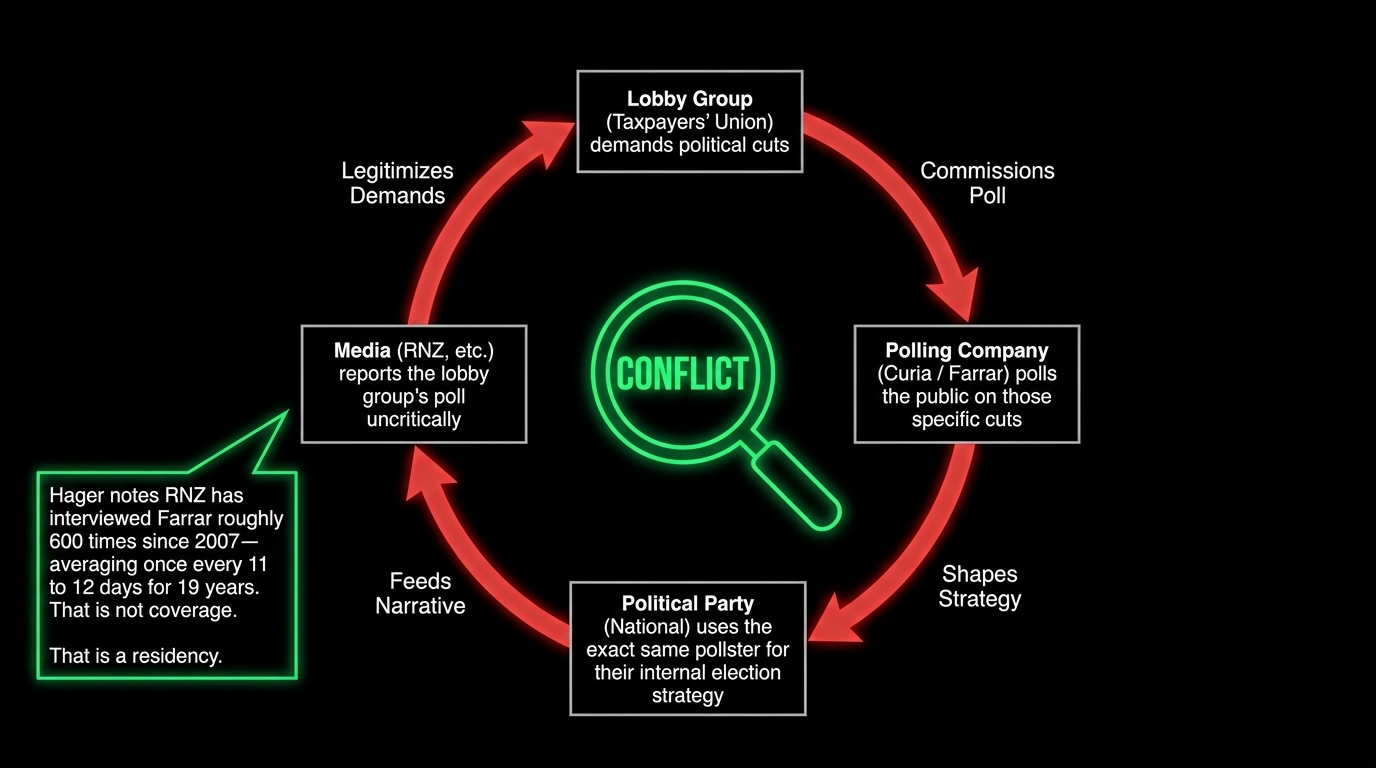
Hager alleges the most successful Farrar–Williams collaboration was teaming the Taxpayers' Union with Farrar's Curia Market Research to produce political polls, warning that "the most worrying aspect of having a lobby group in charge of the country's political polling is that there is no transparency about who is paying for the polls and the fact that the National Party has links to everyone concerned." RNZ
Farrar called that "hilarious." RNZ
I will let readers decide what is funny about one man's company polling for both an "independent" tax lobby and the governing party simultaneously
— while that lobby's poll results shape national news coverage of the very election that party is contesting. That structure is not disputed. Only its innocence is.
Hager also alleges that RNZ alone had interviewed Farrar roughly 600 times since 2007 — a figure attributed to Hager, not independently verified here. Applying simple arithmetic to that reported figure: 2026−2007=192026 - 2007 = 192026−2007=19 years, and 600÷19=31.6600 \div 19 = 31.6600÷19=31.6, meaning — if accurate — Farrar would have appeared on RNZ roughly once every eleven to twelve days for nineteen straight years, introduced, Hager says, as a "polling company maestro" rather than what he also is: a co-founder of the very lobby group being covered. RNZ
That is not coverage. That is a residency.
The Election Money Machine
Elections NZ confirms that a registered third-party promoter may spend up to $424,000 including GST during the 2026 regulated period (7 August–6 November), against just $17,000 for an unregistered promoter — a difference of $407,000, or roughly 25 times the unregistered limit Elections NZ
That is the legal scale at which an organisation like the Taxpayers' Union can operate in this election, entirely lawfully, while presenting itself as a grassroots taxpayer voice rather than a heavily resourced political operation.
Why Not To Vote For This Coalition Again

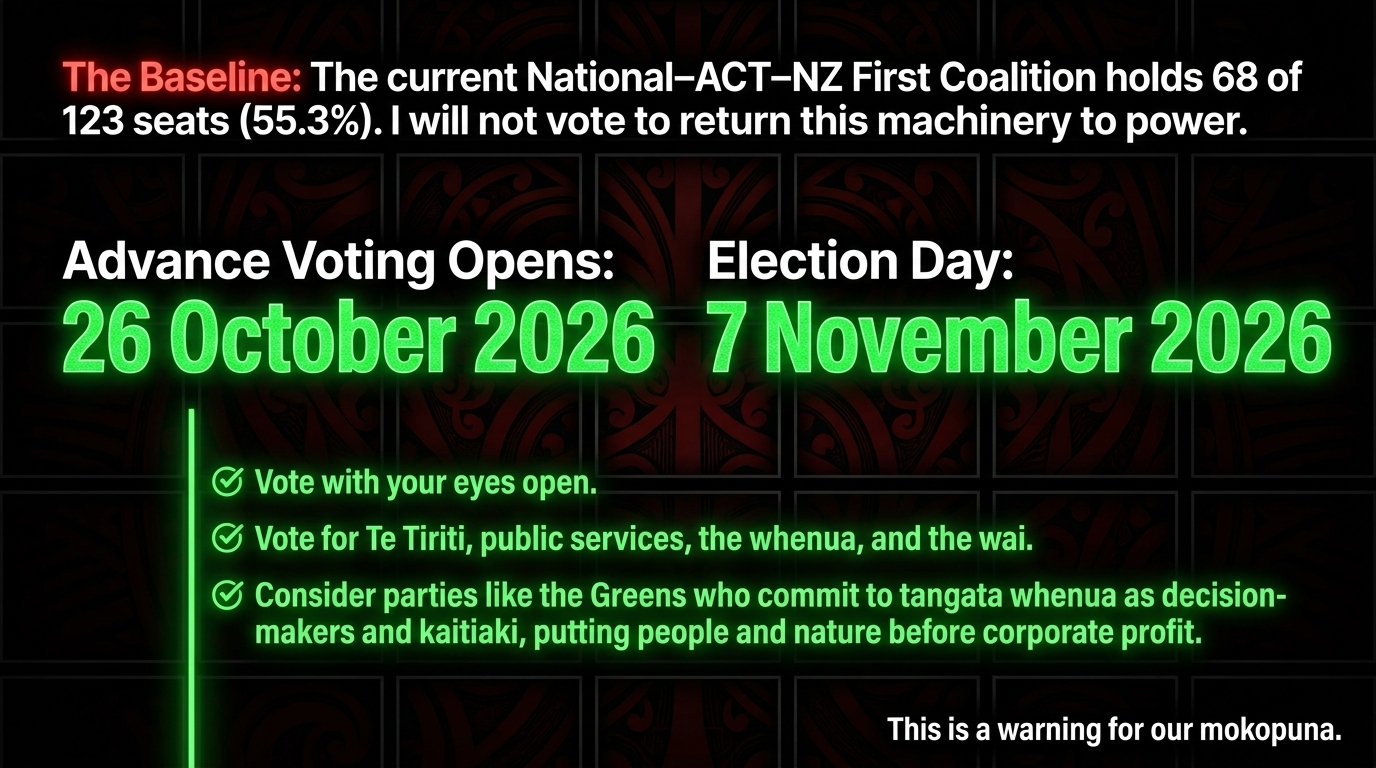
Election day is Saturday, 7 November 2026. Advance voting runs from 26 October to 6 November 2026. Politika
The current National–ACT–New Zealand First Coalition holds 68 of Parliament's 123 seats. Politika
I will not vote to return this coalition government to power.
This is my political opinion, grounded in the policy record traced above: a government that has governed alongside, listened to, and in significant part shared the ideological project of an organisation now credibly accused
— on evidence I have set out with full attribution
— of running anti-Māori campaign rhetoric, obscuring its polling conflicts of interest, and demanding a fiscal straitjacket that treats whānau need as an inconvenience to a spreadsheet ratio. RNZ Scoop
No party is perfect. Every party deserves scrutiny.
But I recommend readers seriously consider the Green Party, which has publicly committed to putting people and nature before corporate profit, affirming Te Tiriti, recognising tangata whenua as decision-makers and kaitiaki, and repealing the coalition's conservation-law changes that force the Department of Conservation to chase "economic opportunities" from protected land. Green Party
Vote with your eyes open. Vote for Te Tiriti. Vote for public services. Vote for the whenua and the wai. Vote for the mokopuna who will inherit the wreckage long after the pig costume is packed away.
No malice: This essay criticises public conduct, public statements, and public policy in the public interest. Opinions are clearly flagged as opinion; factual assertions are attributed to their source.