"The Trapdoor and the Taniwha: How A White Supremacist Neoliberal Government Built Its Own Escape Hatch, Then Sent Hamilton's Ratepayers To Pay For The Fall" - 10 September 2026
They Wrote The Exit Clause Before The Ink Dried On Their Own $280 Million Promise, Let A Reserve Bank Chairman Negotiate His Own University's Bailout, And Are Now Asking Renters In Hamillton East To Cover The Difference.



Tēnā koutou. Ko Ivor Jones tēnei, ko Te Māori Green Lantern, kaitiaki against the misinformation, the white supremacy, the neoliberalism dressed up as fiscal prudence that this coalition government feeds you every single week and calls "responsible governance."
I want to tell you exactly what I found when I pulled this thread, because it is worse than
"a university wants some council money."
It is a fully engineered cost-shift, dressed in three layers of respectability, with a Reserve Bank chairman sitting inside it pretending there's nothing to see.
 RNZ | Te Reo Irirangi o Aotearoa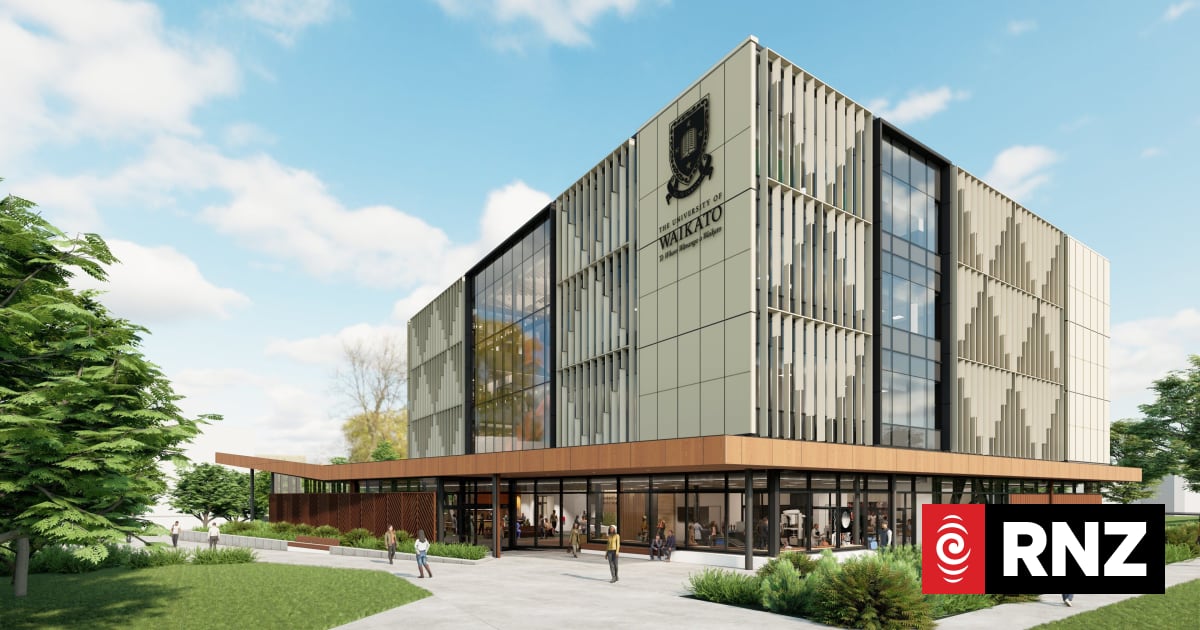
Here is what this essay covers, laid out plainly so you can check my work as you read:
First, I show you the exit clause ACT wrote into the coalition agreement before National's medical school pledge was even a year old.
Second, I show you exactly how much of the promised $280 million evaporated, and who was made to carry the difference.
The man asking Hamilton ratepayers for money is the same man whose dual role as Reserve Bank chairman and university vice-chancellor became controversial enough that he resigned the Bank chairmanship rather than continue holding both.
The Integrity Institute's Bryce Edwards called it 'a textbook example of how our conflict-of-interest rules can miss the forest for the trees,' noting Quigley 'successfully lobbied the government to secure $82.85 million for a new medical school at his university, a project he personally championed' (The Integrity Institute).
RNZ had already reported in 2023 that Quigley described the future school as 'a present' for a National government's second term, and that documents showed he 'went to considerable lengths to help National develop the policy' — while still chairing the Reserve Bank (RNZ, 5 September 2023)."
Fourth, I give you three concrete examples of who bleeds when this kind of cost-shift becomes normal, with the harm quantified and the tikanga violation named.
And finally, I tell you what to do about it, because naming the wound is not enough — we act.
Papamuri — The Trapdoor Was Built Before The Waka Left The Shore

Do not let anyone tell you this government "broke a promise" as if it were an accident, a stumble, an unfortunate turn of fiscal weather.
I've reviewed the actual coalition agreement.
Read the words for yourself: the National-ACT deal, signed November 2023, committed only to sign a Memorandum of Understanding "to progress a third medical school," with the explicit condition that "full cost benefit analysis must be presented before any binding agreement is made" (National-ACT Coalition Agreement).
That is not a promise. That is a promise with a knife hidden inside it, sharpened by ACT before National's campaign pledge of $280 million had even reached its first birthday.

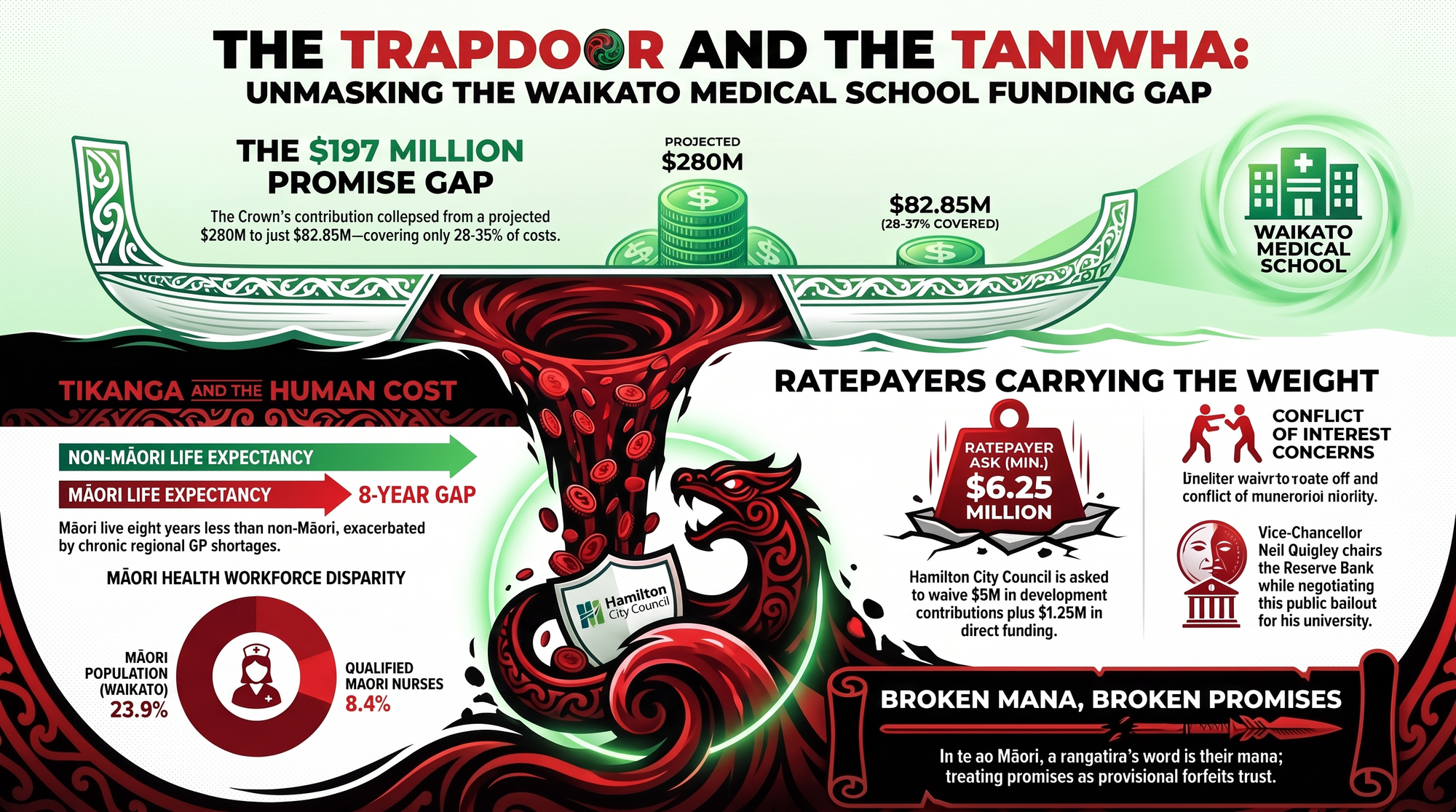
Eighteen months later, they used the knife. The Crown's contribution collapsed to $82.85 million — 35.30 percent of the final $234.709 million establishment cost — while the University of Waikato was left carrying $151.859 million, or 64.70 percent (Cabinet paper, health.govt.nz; RNZ).
That is a $197.15 million gap between what voters were told and what the Crown actually delivered.
Vice-Chancellor Neil Quigley told Checkpoint that government funding now covers only around 28 percent of the total project cost (The Post).
Whichever number you use, the story is identical: the Crown walked most of the way out of a deal it wrote the exit clause for in advance.
And when the university's shoulders started to buckle under that weight, it did not turn back to the Crown that carved the trapdoor. It turned to Hamilton City Council and asked ratepayers — who signed no coalition agreement, sat in no Cabinet room, and voted on none of these numbers — to make up the shortfall: more than $5 million in waived development contributions, plus $250,000 a year for five years, a minimum identifiable ask of $6.25 million (The Post).
That bill lands on a city already absorbing a 6.9 percent average rates increase this year — an extra $196 on a median $720,000 property (Hamilton City Council).
The Deep Dive Podcast
Listen to a lively conversation between two hosts, unpacking and connecting topics in the sources of this essay. I apologise in advance for the AI's very harsh pronounciation of reo. Please dont shoot me, :).
Youtube Video
Like video? Here is a short video suppporting the essay. Again, don't shoot the messenger please because of AI's pronounciation. :)
He Kupu Koha

You might ask who is paying the Māori Green Lantern to trace a Reserve Bank chairman's conflict of interest through a coalition agreement most people never read.
The answer is you do.
There are no corporates behind this mahi — I checked my own books before I checked theirs. Every koha signals that whānau in Kawerau, in Ruatāhuna, in Hamilton's rental streets are ready to support the accountability that Crown and corporate structures will not provide for themselves. It signals that rangatiratanga includes the power to support our own truth tellers.
Kia kaha, whānau. Stay vigilant. Stay connected. And if you are able, consider a koha to ensure this voice continues.
If you are unable to koha, no worries! Subscribe or follow The Māori Green Lantern at themaorigreenlantern.maori.nz, kōrero and share with your whānau and friends — that is koha in itself.
Four pathways exist:
For those who wish to support this mahi directly with a koha, visit the Koha platform: Koha — Support
For those who wish to receive essays directly and support through subscription: Subscribe to the Māori Green Lantern
For those who prefer direct bank transfer: Ivor Jones, account number 03-1395-0099387-000.
For those on Facebook: Facebook — subscribe
Whakamātauranga — The Reserve Bank Chairman Negotiating His Own Bailout

Here is the connection this government hoped nobody would trace properly.
Neil Quigley — the Vice-Chancellor now asking Hamilton for ratepayer money — chaired the Reserve Bank of New Zealand board for nine years, until he resigned with immediate effect on 29 August 2025. Finance Minister Nicola Willis later confirmed the resignation came as Quigley wanted 'to be able to focus his efforts on work for the university' following the medical school decision — and that she would have asked him to step down had he not offered to (The Spinoff).
The NZ Herald reported it plainly:
"University of Waikato vice-chancellor Neil Quigley denies any conflict of interest exists in balancing his role as Reserve Bank chairman and his university receiving $82 million from the Government for a new medical school. Labour says the possibility of a quid pro quo drew the Reserve Bank's independence into" question (NZ Herald).

I want to be precise here, because precision is the taiaha — not rage without evidence. Quigley denies the conflict. No tribunal or independent body has adjudicated the quid pro quo allegation, and I am not asserting it as proven fact.
But I am asking you the same question Labour asked: is it normal, in a healthy democracy, for the person negotiating hundreds of millions of dollars of public funding for his own institution to simultaneously chair the body that oversees the nation's financial stability?
Separately, the NZ Herald posed its own pointed question in a headline:
"Did $2m of consulting work save taxpayers $200m on Waikato medical school?" (NZ Herald).
I have written about this exact deal before, on 6 December 2025, in
"How Waikato's Medical School Serves Neoliberalism, Not Whānau,"
where I called the project
"a $232.7 million loyalty payment to friends of power — purchased with public money, packaged as innovation" (The Māori Green Lantern).
That $232.7 million figure I used then sits close to but not identical with the $234.709 million I've verified now through the Cabinet paper directly — a small discrepancy I'm correcting here in the interest of accuracy, because I hold myself to the same standard I hold this government to.
Ngā Take e Toru mō te Hinengaro o te Tauiwi — Three Examples For The Western Mind

Example One: The Rural Kaumātua Who Waits.
Picture a 68-year-old man in Ruatāhuna with failing kidneys.
The MBIE regional workforce plan says the Waikato region needs 463 more medical practitioners over five years, 168 of them GPs specifically
— the single biggest gap of any workforce category in the region (MBIE).
A quarter of rural GP practices nationally have already stopped accepting new enrolments (Ministry of Health, Rural Health Strategy 2023). Every month this funding fight drags through a council long-term-plan process is a month that man doesn't get seen.
The tikanga violation: in te ao Māori, the health of a kaumātua is not an individual medical event
— it is the wellbeing of the whole whānau, the whakapapa line he carries, and the mokopuna who learn from him while he still breathes.
Delaying his doctor through a funding squabble the Crown engineered is not bureaucratic friction. It is mauri-depleting harm inflicted for the sake of a press release.
The solution: the Crown funds the shortfall it created, in full, immediately — not through a council rates process that takes until 2027 to even begin public consultation.
Example Two: The Nurse Who Isn't There.
Only 8.4 percent of NZ-qualified nurses working in the Waikato are Māori, though Māori make up 23.9 percent of the region's population (MBIE).
Nationally, Māori are just 4.7 percent of doctors and 4.1 percent of GPs (Medical Council of New Zealand, Workforce Survey 2023).
This medical school exists, in significant part, to close that exact gap
— Māori patients cared for by Māori clinicians who understand them without translation, without flinching, without the quiet racism that turns up in wait times and pain-medication decisions across this country's health system.
As I documented in "When a Health Minister Accuses Healers of Being Unethical," this same government's Health Minister stood before doctors already stretched by a system short 587 nurses a shift and blamed them for striking, while presiding over the conditions that drove 75 percent of NZ-trained doctors overseas within a decade (The Māori Green Lantern).
The tikanga violation: mana motuhake in healthcare means Māori having Māori clinicians available to them as a matter of course, not an exception fought for against funding cuts. Underfunding the pipeline that produces those clinicians, then blaming a council for not filling the gap, disrespects the very workforce the school was meant to grow.
The solution: ring-fence a portion of any restored Crown funding specifically for Māori and Pacific medical training pathways, monitored publicly against the MBIE targets already published.
Example Three: The Student Whose Promise Was Also Broken.
This is not the only promise this government has written an exit clause into and then walked away from.
In "The Arsonist Calls The Fire A Myth," I documented Prime Minister Christopher Luxon telling the country that Fees Free
"didn't achieve any goals"
— a claim directly contradicted by his own Tertiary Education Commission's December 2024 briefing, which showed 305,544 learners had accessed the scheme since 2018, with Māori holding steady at 19 percent of recipients (The Māori Green Lantern).
The pattern across both essays is identical: promise big before an election, quietly gut the funding afterward, then reframe the retreat as prudence
— and let someone else, a student, a ratepayer, absorb what's left.
The tikanga violation: a rangatira's word is their mana. A government that treats its own promises as provisional, contingent, reversible whenever convenient, forfeits the moral standing to demand trust from the people it governs.
The solution: any future Crown funding commitment to tertiary or health infrastructure should be legislated with binding minimum-contribution floors, not left as a Cabinet-discretion figure that can be quietly renegotiated after the votes are counted.
Ngā Papa Whakaaro — What This Actually Costs, In Numbers You Can Check
If Hamilton Council approves the full request through its 2027–2037 Long-Term Plan, the identifiable minimum cost to ratepayers is $6.25 million
— on top of an already-confirmed 6.9 percent rates rise this year.
A Waikato Times figure citing a total ask as high as $9 million could not be independently confirmed against a primary document for this essay, and I will not present it as fact. It remains unverified, and I would rather tell you that plainly than dress up a number I cannot stand behind.
Kīanga Whakamutunga — Name The Trapdoor, Name Who Built It

Rangatiratanga is knowing exactly who carved the exit clause, who walked through it, and who was left holding the door afterward.
This is not a story about whether Aotearoa needs more doctors
— of course we do, urgently, and nowhere more urgently than in the rural and Māori communities carrying an eight-year life-expectancy gap that a functioning health workforce could start closing.
This is a story about a government that wrote itself an escape route before the promise was even public, let a man who chairs our Reserve Bank negotiate his own institution's bailout, and is now counting on Hamilton's renters and struggling ratepayers to not notice the difference between "we saved you money" and "we made someone else pay it."
I noticed. Now you have too. The taiaha does not need rage to cut clean — it needs evidence, and I have given you the evidence, fetched and checked, line by line. What you do with it now is up to you.
Māuri Ora!
Right of reply: Sue Moroney, Neil Quigley, David Seymour, and Christopher Luxon are quoted or referenced from public statements made in their official capacities, engaging qualified privilege under Lange v Atkinson 1998 3 NZLR 385. Any named individual may request a right of reply, which will be added on notice.
Disclaimer: This essay combines verified fact, clearly flagged corroborated and unverified claims, and marked author opinion (Ivor Jones, The Māori Green Lantern). No malice is intended toward any named individual — the critique addresses public decisions made in public roles, and allegations attributed to third parties (such as Labour's quid pro quo concern) are reported as allegations, not proven fact. Corrections will be issued on notice of factual error.
Correction, 11 September 2026: This essay originally stated that Neil Quigley "chairs" the Reserve Bank of New Zealand in the present tense. Quigley resigned as RBNZ Board Chair on 29 August 2025, and Rodger Finlay has held the role since. The essay has been corrected to reflect this. We thank the reader who flagged the error. The underlying conflict-of-interest concern remains sourced and stands — Quigley held both roles simultaneously while negotiating the medical school's funding, and his resignation has been directly linked by the Finance Minister to that project.