"HE HINAKI MĀORI: THE TRAP WOVEN IN SILK FEATHERS" - 18 April 2026
They Don't Want to Free You. They Want to Cage You in a Whare That Looks Like Home — And Your Own Party Is Building the Cage From the Inside.

He Kupu Tūāpō — The Midnight Word
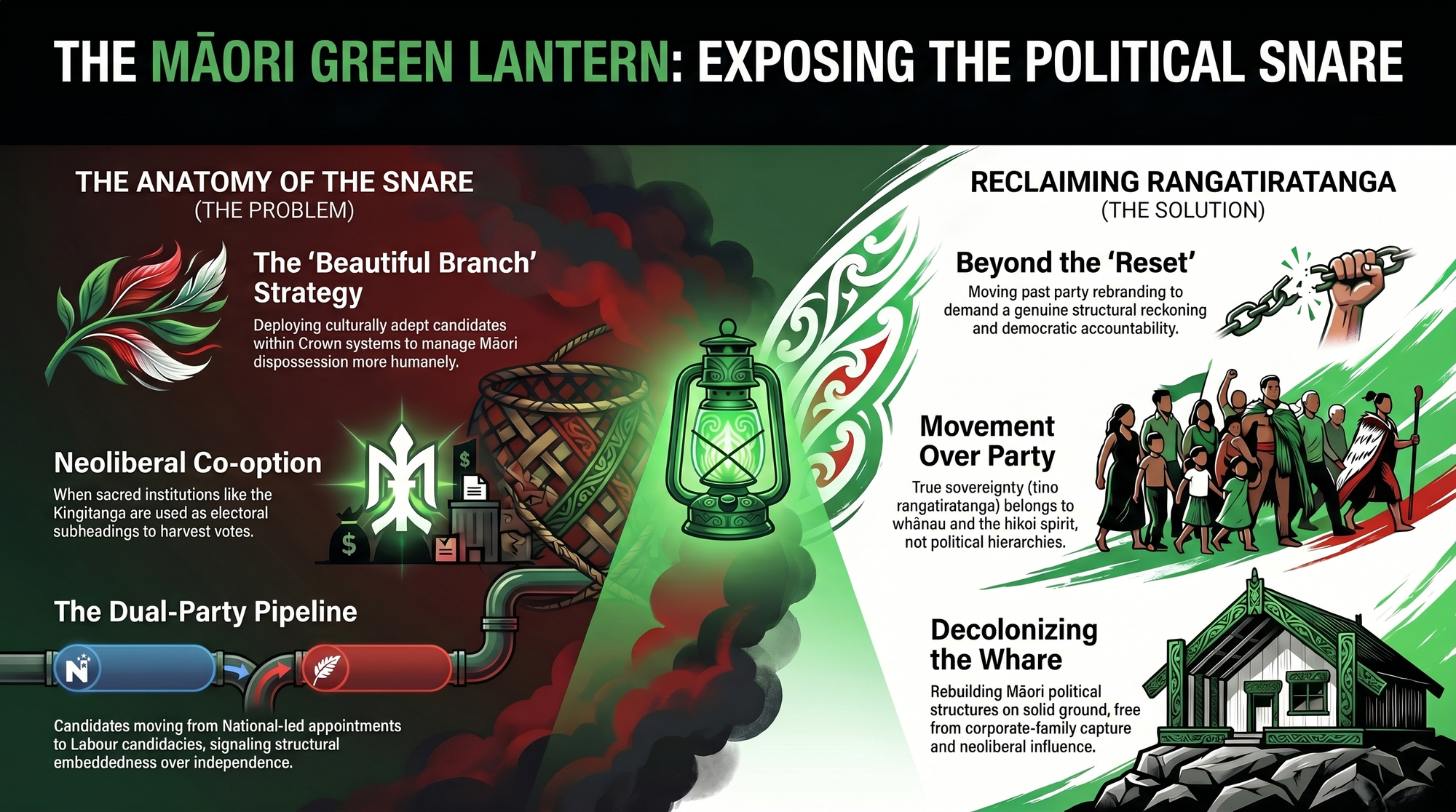
In the deep forest, the kererū does not fear the branch that looks like every other branch. It fears the one that holds a snare.
Labour has carved a beautiful branch and set it in the canopy of Hauraki-Waikato. It is polished with te reo. It is adorned with the blessing of the Māori Queen. It holds the mana of a man who has composed nearly 100 waiata, served Māori health, and walked the marae.
And at its centre — invisible, lethal — is the noose of the neoliberal state.
 Joseph Los’e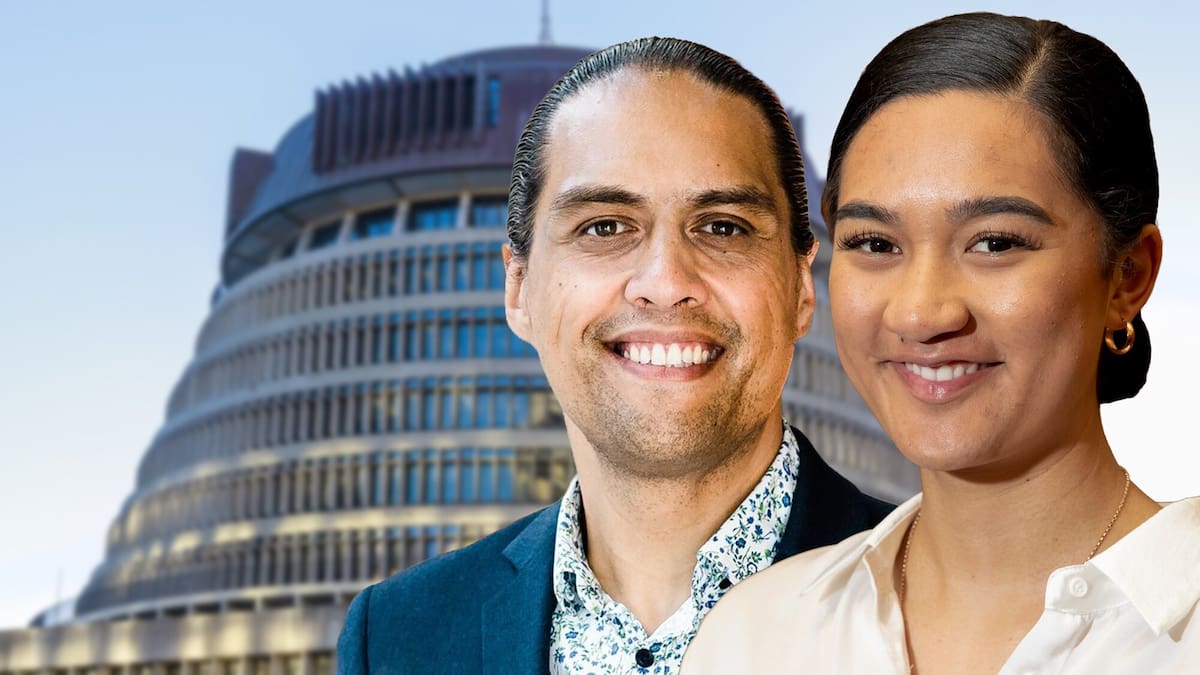
But here is the harder truth — the one that cuts deeper than any Labour strategy: even if Hana-Rāwhiti holds the seat, Te Pāti Māori's own wharenui is on fire from within. And the arsonists are wearing the party's own korowai.
Pokere Paewai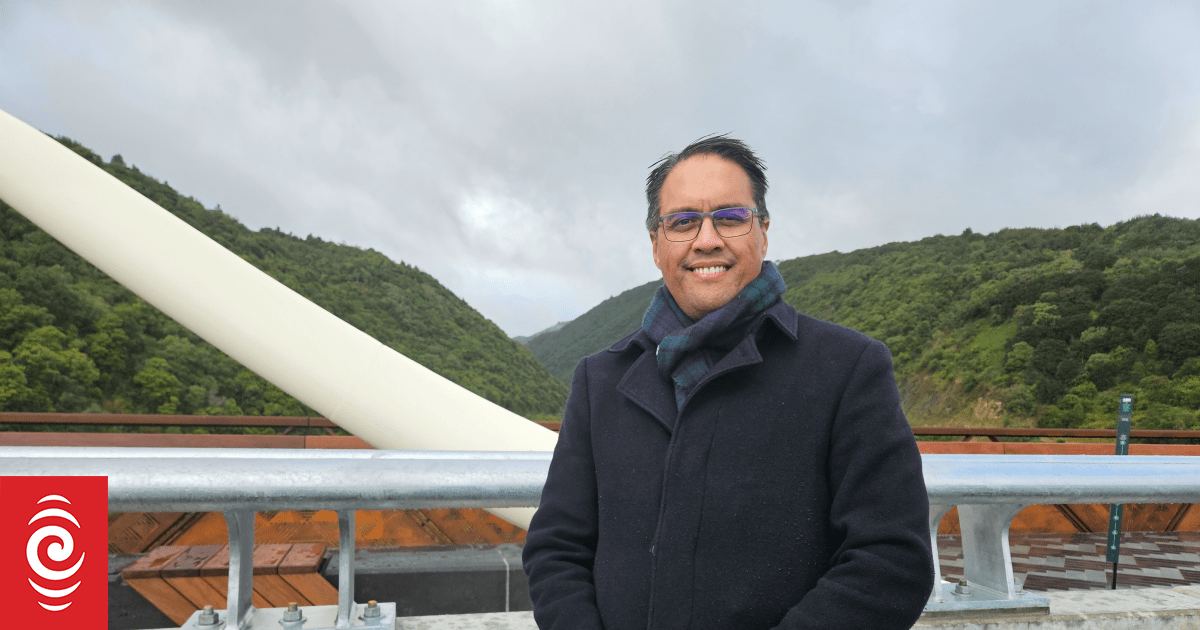
The Deep Dive Podcast
Listen to a lively conversation between two hosts, unpacking and connecting topics in the sources of this essay.
Both houses are broken. Labour is the coloniser's left hand. Te Pāti Māori — in its current form — is the coloniser's mirror, reflecting back our own dysfunction and calling it leadership.
This is not politics. This is a reckoning. And whānau are the ones bleeding.
Ko Wai a Kingi Kiriona? — The Whakapapa of the Candidate
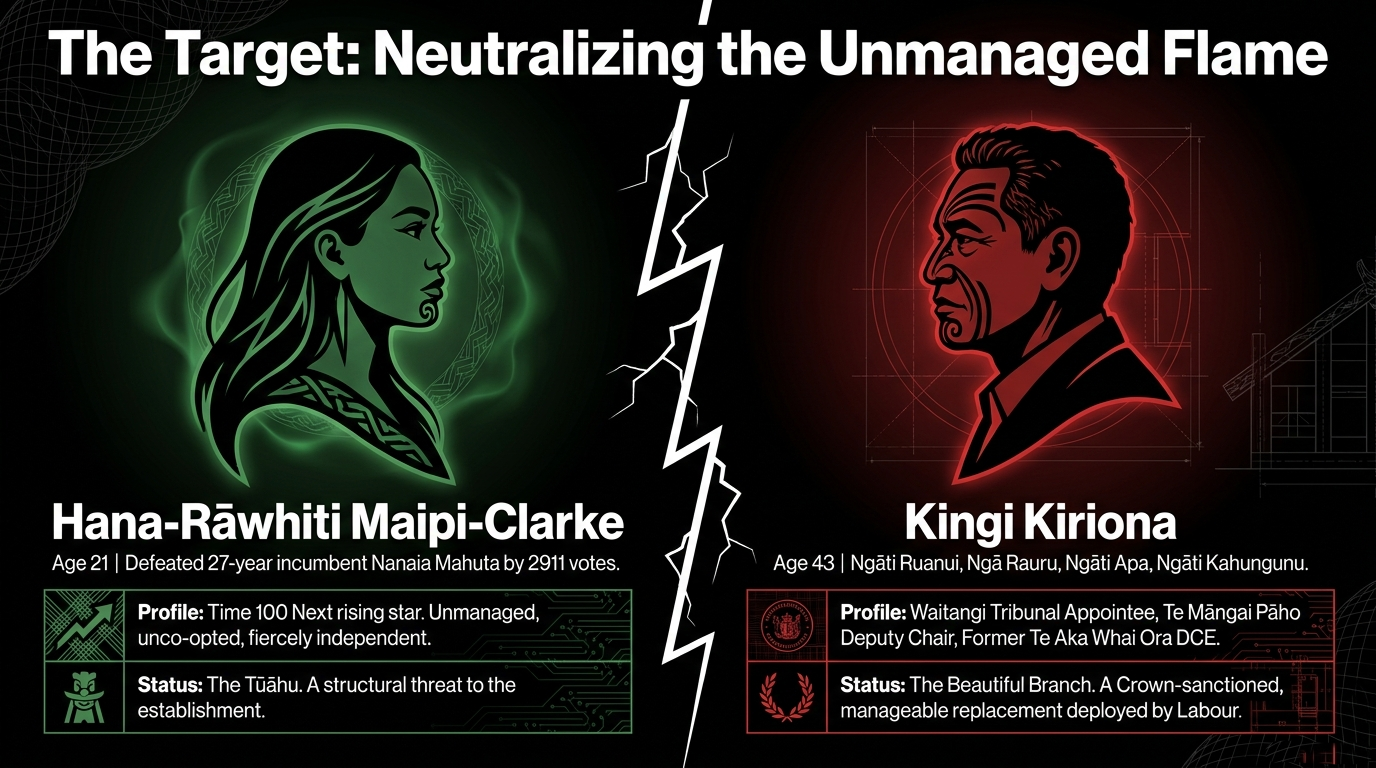
Kingi Kiriona — Ngāti Ruanui, Ngā Rauru, Ngāti Apa, Ngāti Kahungunu — is by any personal measure a talented, accomplished tāne. He is Managing Director of TupuOra Education and Development, a Waitangi Tribunal member as confirmed by the Tribunal's own profile of Kiriona, and as confirmed by the Tribunal's own membership changes notice, that appointment came directly from National's Minister for Māori Development, Tama Potaka.
But his personal mana is not on trial here. The system that deploys him is.
As the 100 Māori Leaders database confirms, Kiriona's entire career has been built within the Crown-sanctioned Māori professional ecosystem — not in opposition to the structures that produce Māori poverty, but in service of their administrative management. There is a profound difference between those who build Māori capacity inside the system and those who challenge the system itself. The state loves the former. It fears the latter.
He Tāhūhū Kōrero — What Kiriona's Own Words Reveal
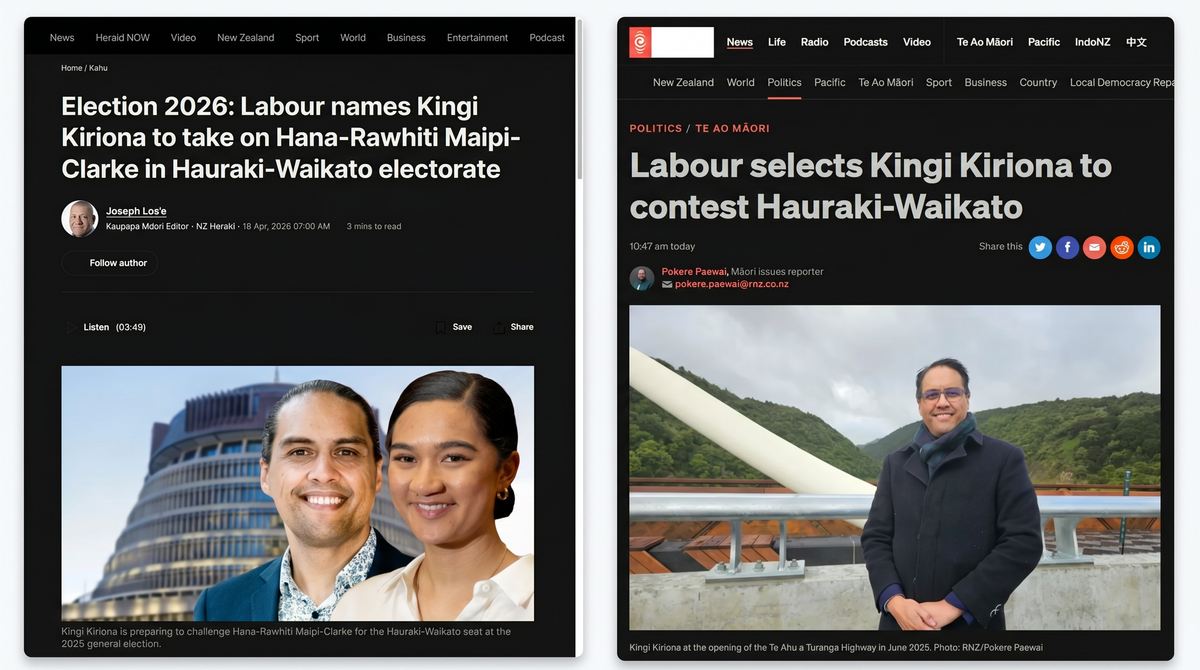
On 18 April 2026, as reported by RNZ's Māori issues reporter Pokere Paewai, Kingi Kiriona gave his first public interview as Labour's candidate for Hauraki-Waikato. He spoke with passion, with cultural fluency, and with what sounded like genuine grievance against the current government.
And in doing so, he handed the ring of analysis everything it needed to expose the architecture beneath the rhetoric.
"Friends" — The Word That Condemned the Pitch
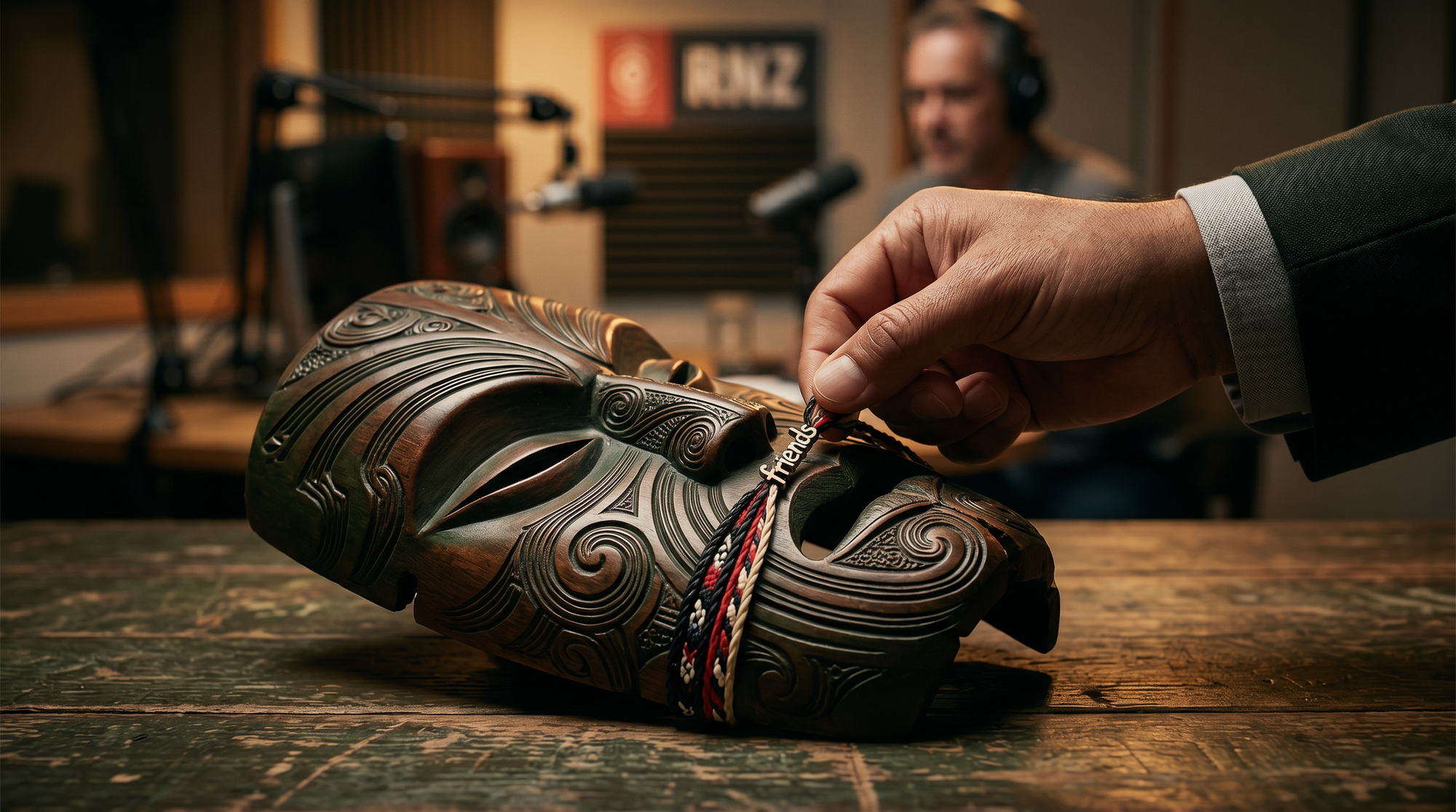
The most devastating moment in the RNZ interview is not a criticism from an opponent. It is Kiriona's own explanation of why he chose Labour.
Asked directly, he said it comes down to one word:
"friends."
"We all know in this game that we call politics, you need friends, you need friends to advance, to make policy gains, funding shifts and so I see an opportunity here with the Labour Party."
Read that again. Slowly.
Not:
"Labour has the best policy for Māori." Not: "Labour has a structural plan to address the health gap, housing crisis, and mass incarceration." Not: "Labour's constitutional commitment to Te Tiriti is demonstrably superior."
Friends. Opportunity. The Labour Party.
This is the language of patronage politics — the same language that has delivered Māori broken institution after broken institution for six decades. The word "friends" in the mouth of a Māori candidate choosing a Pākehā-dominant party is not unity. It is clientelism. It is the managed Māori professional class describing, with accidental honesty, exactly how the neoliberal network maintains itself: you do not challenge the system. You cultivate proximity to it. You become useful to it. And then — when the Crown decides it needs a Māori face for a Māori seat — the network activates.
As The Māori Green Lantern's "Clockwise Betrayal" essay documented:
"the same neoliberal machinery grinds Māori futures either way — just faster when the mask comes off."
Kiriona did not remove the mask. He described it as a friendship bracelet.
TupuOra — The Grievance That Validates the Trap
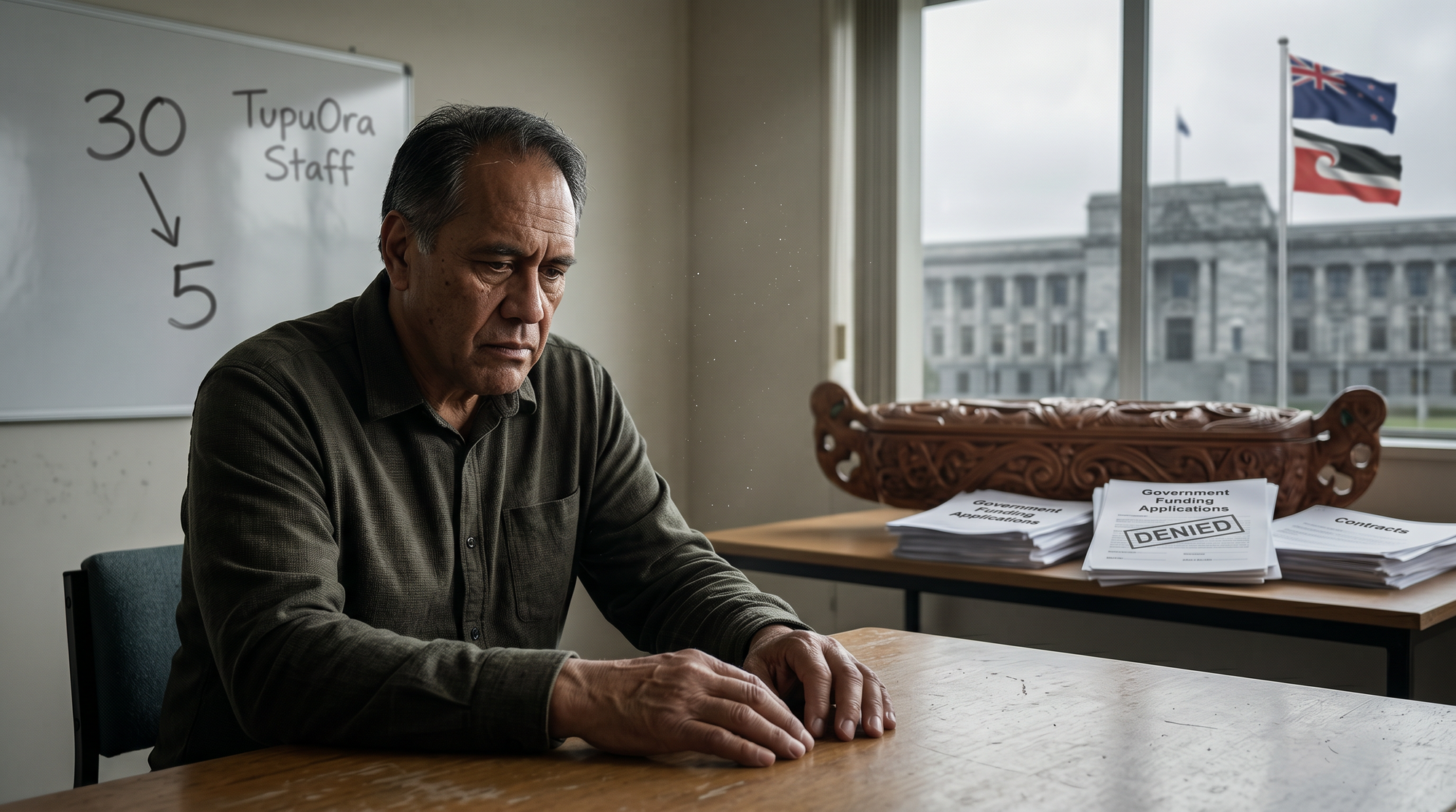
Kiriona told RNZ that his Māori education business TupuOra has shrunk from 30 staff to 5 since the current National government took power — direct damage from the "divestment away from kaupapa Māori." This is real harm. This is documented damage. And it is being used as the emotional and political fuel for his Labour candidacy.
But here is the structural irony that demands naming: TupuOra's funding dependency on government contracts is itself a product of the neoliberal model.
The neoliberal state does not fund Māori community institutions directly. It creates contestable funding rounds that Māori businesses compete for — making them perpetually dependent on whoever holds the government purse. Under Labour, the purse opens slightly wider. Under National, it closes. The whānau who worked at TupuOra lost their jobs either way — because the model was never theirs to control in the first place.
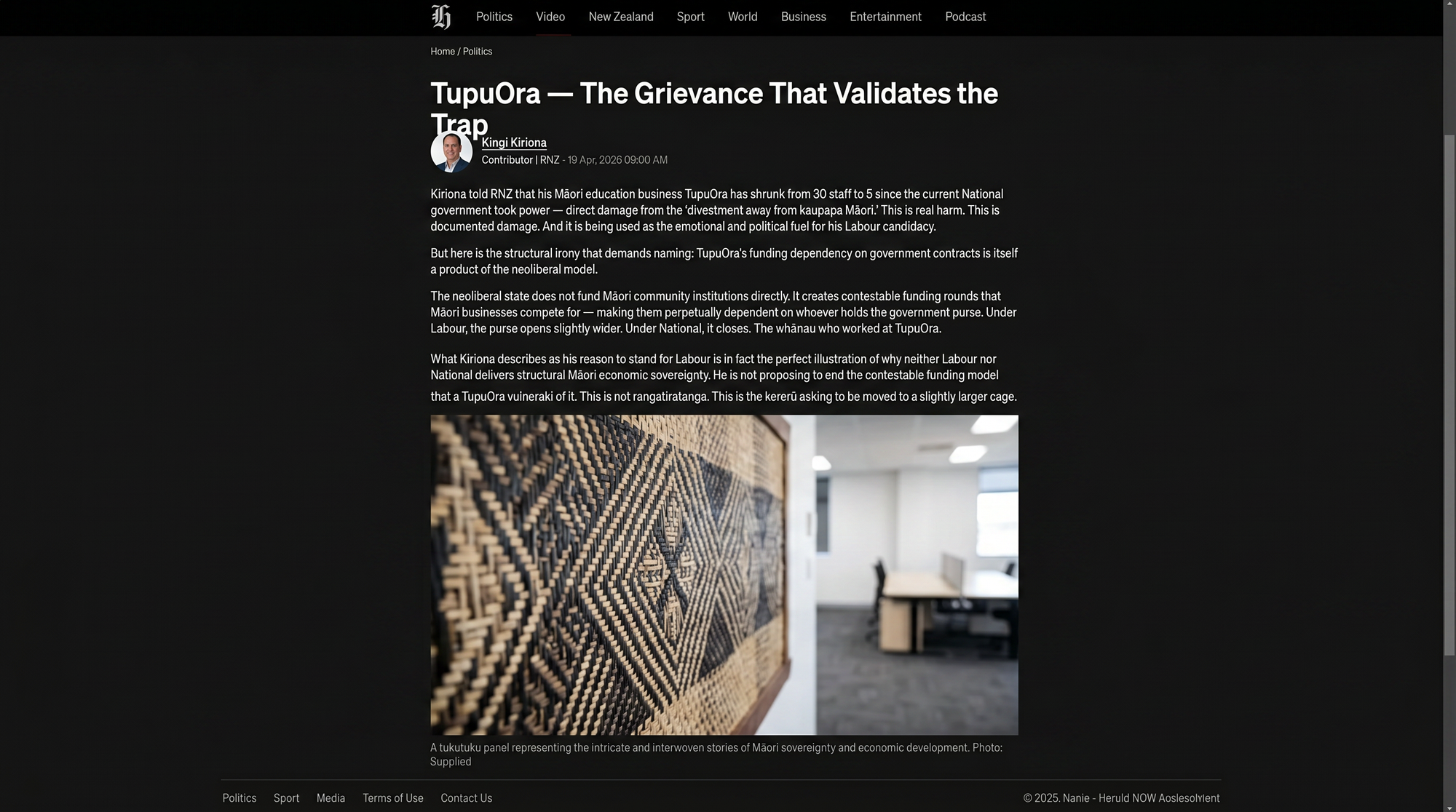
What Kiriona describes as his reason to stand for Labour is in fact the perfect illustration of why neither Labour nor National delivers structural Māori economic sovereignty. He is not proposing to end the contestable funding model that made TupuOra vulnerable. He is proposing to return to the slightly more generous version of it. This is not rangatiratanga.
This is the kererū asking to be moved to a slightly larger cage.
The Conditional Candidacy — The Queen's Blessing as Leverage
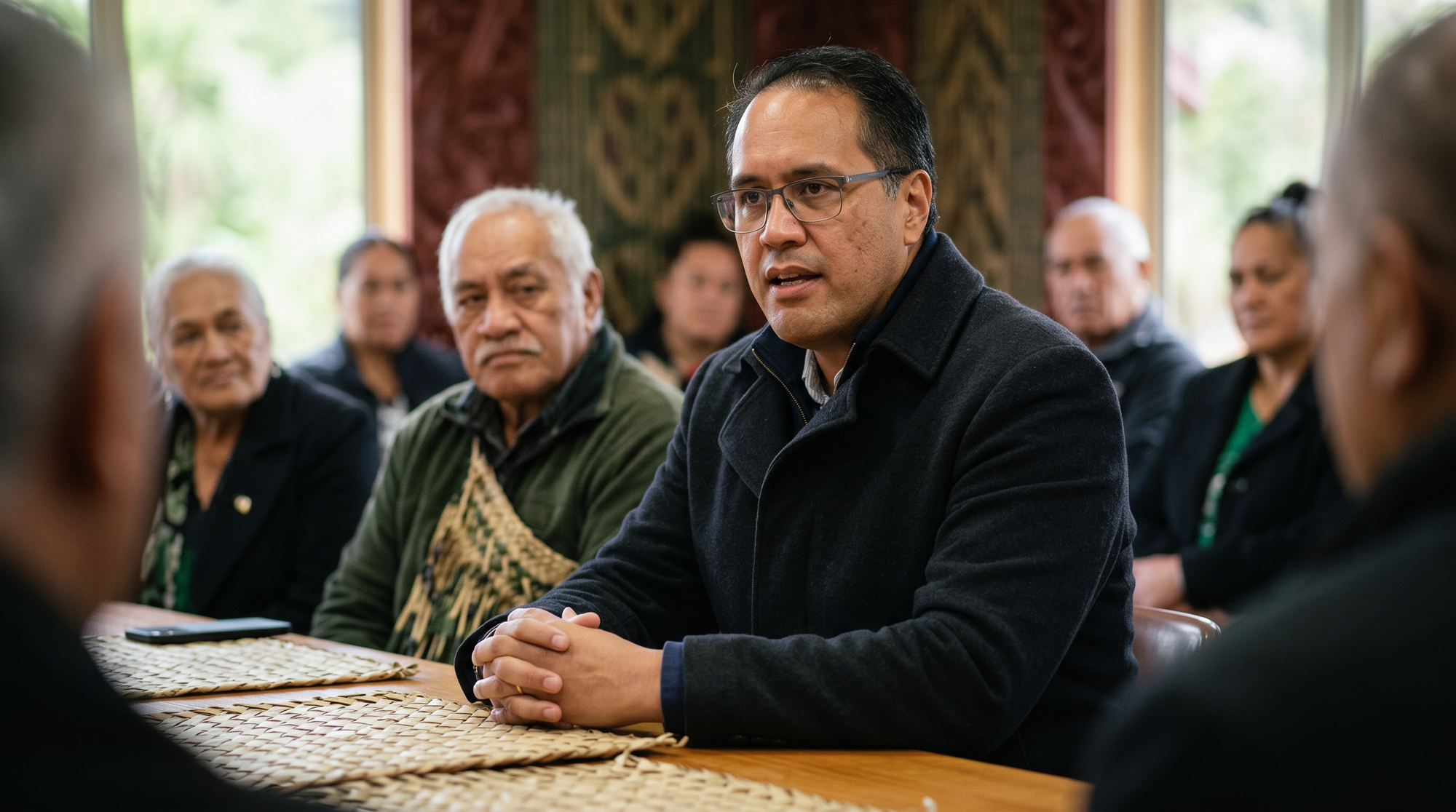
Kiriona told RNZ that he
"made it clear his candidacy would always be contingent on receiving the blessing of Te Arikinui Kuini Ngā Wai hono i te pō."
He received that blessing earlier this year.
The Queen's words, as he quotes them:
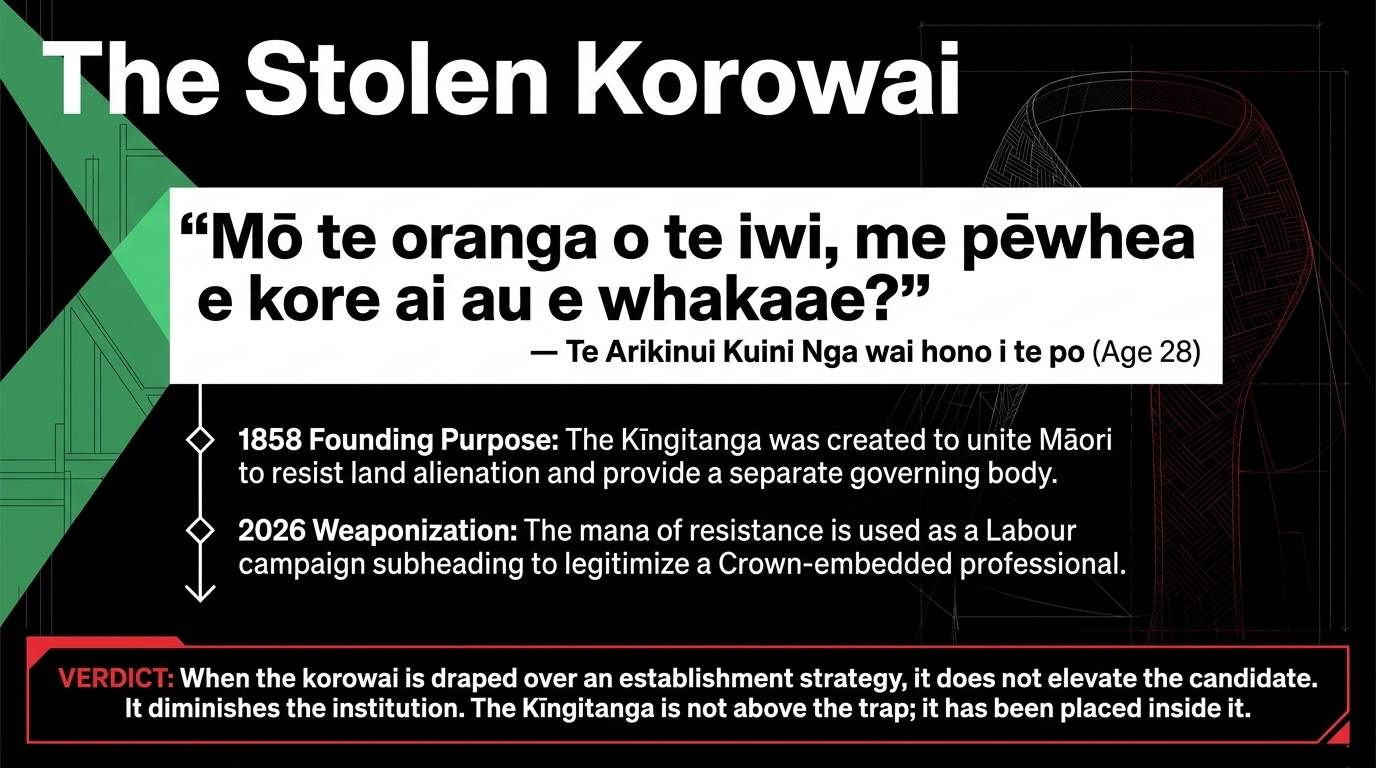
"Mō te oranga o te iwi me pēwhea e kore ai au e whakaae" — for the betterment of the people, how can I not agree?
This appears, on the surface, as humility. But look at the structure beneath it. Kiriona instrumentalised the Queen's blessing as a pre-condition. He made the Kīngitanga's mana a legitimising device for his candidacy before the candidacy was even public. The blessing was not spontaneous royal endorsement. It was a calculated acquisition of cultural capital, secured privately, then deployed publicly as the campaign's single most powerful credential.
And critically — as RNZ's own reporting confirms
— "Te Arikinui was clear she didn't want to see an adversarial election campaign against incumbent MP Hana-Rāwhiti Maipi-Clarke."
The Queen blessed the candidacy but explicitly did not endorse an adversarial campaign. Yet the entire strategic purpose of fielding Kiriona is adversarial —
Labour wants the seat, Labour needs Hana-Rāwhiti gone. The Queen's nuance — her explicit qualification — has been stripped from the campaign headline and replaced with the simple, weaponised words:
"Māori Queen's blessing."
This is how sacred mana is consumed in electoral politics. The condition is swallowed. The blessing is kept. The institution is diminished.
The Whakapapa Relationship — The Disarming Device
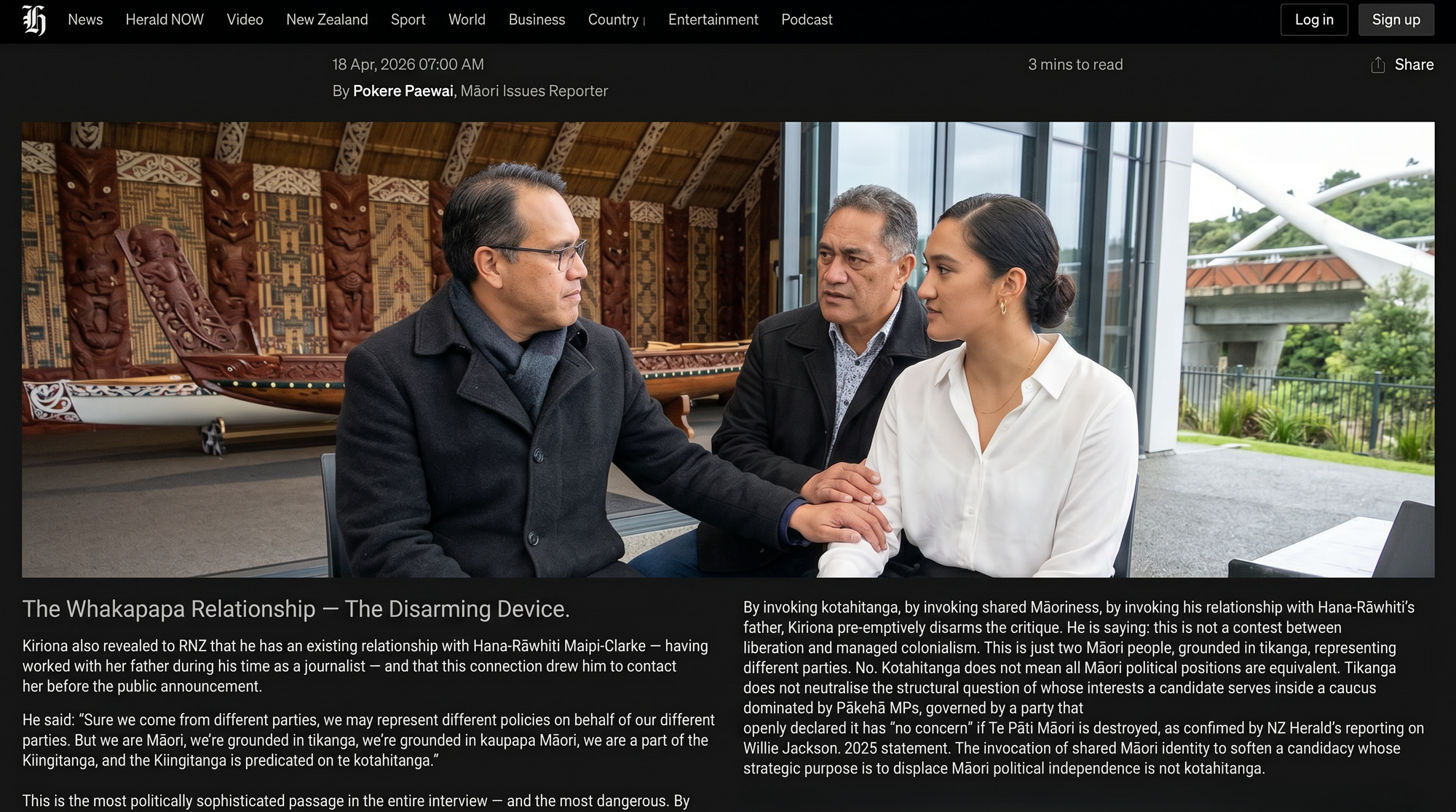
Kiriona also revealed to RNZ that he has an existing relationship with Hana-Rāwhiti Maipi-Clarke — having worked with her father during his time as a journalist — and that this connection drew him to contact her before the public announcement.
He said:
"Sure we come from different parties, we may represent different policies on behalf of our different parties. But we are Māori, we're grounded in tikanga, we're grounded in kaupapa Māori, we are a part of the Kiingitanga, and the Kiingitanga is predicated on te kotahitanga."
This is the most politically sophisticated passage in the entire interview — and the most dangerous.
By invoking kotahitanga, by invoking shared Māoriness, by invoking his relationship with Hana-Rāwhiti's father, Kiriona pre-emptively disarms the critique.
He is saying:
this is not a contest between liberation and managed colonialism. This is just two Māori people, grounded in tikanga, representing different parties.
No. Kotahitanga does not mean all Māori political positions are equivalent.
Tikanga does not neutralise the structural question of whose interests a candidate serves inside a caucus dominated by Pākehā MPs, governed by a party that openly declared it has "no concern" if Te Pāti Māori is destroyed, as confirmed by NZ Herald's reporting on Willie Jackson's November 2025 statement.
The invocation of shared Māori identity to soften a candidacy whose strategic purpose is to displace Māori political independence is not kotahitanga. It is camouflage.
Labour's Full Māori Seats Campaign — The Scale of the Takeover
RNZ confirms that Labour has fielded candidates across all seven Māori electorates: Kingi Kiriona in Hauraki-Waikato; former chair of Te Rūnanga o Koukourarata, Mananui Ramsden, in Te Tai Tonga; former Auckland Councillor Kerrin Leoni in Tāmaki Makaurau; current List MP Willow-Jean Prime in Te Tai Tokerau; and incumbent Cushla Tangaere-Manuel defending Ikaroa-Rāwhiti.
Every single one of these candidates sits within the Māori professional-governance class.
Not one represents the kind of structural, Treaty-based challenge to colonial governance that produced the hīkoi and the haka in Parliament.
This is not a slate of liberation candidates. This is a managed, coordinated takeover of the seven Māori electorates by a Pākehā-dominant party dressed in Māori cultural credentials — executed simultaneously, across the entire electoral map.
Ko Wai a Te Kuīni? — The Queen's Blessing Under the Microscope
The Queen's Whakapapa and the Kīngitanga's Sacred Function
As revealed by Te Ara — the Encyclopedia of New Zealand, the Kīngitanga was founded in 1858 with the express purpose of uniting Māori to resist land alienation and colonial destruction — specifically to
"cease the sale of land to Pākehā, stop inter-tribal warfare, and provide a separate governing body for Māori."
Not to endorse Labour candidates. Not to legitimise Crown-embedded professionals. Not to neutralise the youngest and most radical Māori MP in parliamentary history.
As confirmed by NZ Herald's profile of the new Māori Queen, Ngā Wai hono i te pō Paki became Māori Queen in September 2024 following the death of her father Kīngi Tūheitia — making her the second woman ever to lead the Kīngitanga, barely 28 at the time of this endorsement. As The Spinoff warned immediately after her coronation, she was "immediately thrust into a fractured political environment" where every royal move carries electoral weight.
As the Waikato-Tainui website itself states, the Kīngitanga's founding goals were land protection, cultural preservation, and unified Māori sovereignty. The institution has never existed to be borrowed by parties who will discard it after polling day.
The Kotahitanga Fund — The Neoliberal Signal
In January 2026 at Rātana, as reported by NZ Herald, National's Finance Minister Nicola Willis publicly praised the Māori Queen's economic vision following the Kotahitanga Fund launch. The Finance Minister of the government that abolished Te Aka Whai Ora, gutted Māori health funding, stripped Treaty protections from legislation — standing at Rātana, the most sacred political marae in Māori life, praising the Queen's framework.
As 1News reported from Waitangi 2026, the Māori asset base now stands at an estimated $126 billion. This is the framework within which the Māori Queen operates — Māori economic development within the capitalist system, not in opposition to it.
When Nicola Willis and Chris Hipkins both find comfort in the same Queen's economic vision — one from the right, one from the left — that is not coincidence. That is the architecture of a managed political space.
The Historical Pattern — Kīngitanga as Electoral Football
The Kīngitanga has been weaponised electorally before. In 2021, as reported by NZ Herald, when Kīngi Tūheitia endorsed Māori Party candidate Rahui Papa over Labour's Nanaia Mahuta in this exact seat, Mahuta warned it would put the Kīngitanga
"at risk" — as if royal neutrality only matters when royalty endorses the other party.
Now the endorsement runs Labour's way and silence reigns. And now, as RNZ confirms, the Queen's own qualification — no adversarial campaign — has been stripped from the public narrative, leaving only the headline-ready
"blessing."
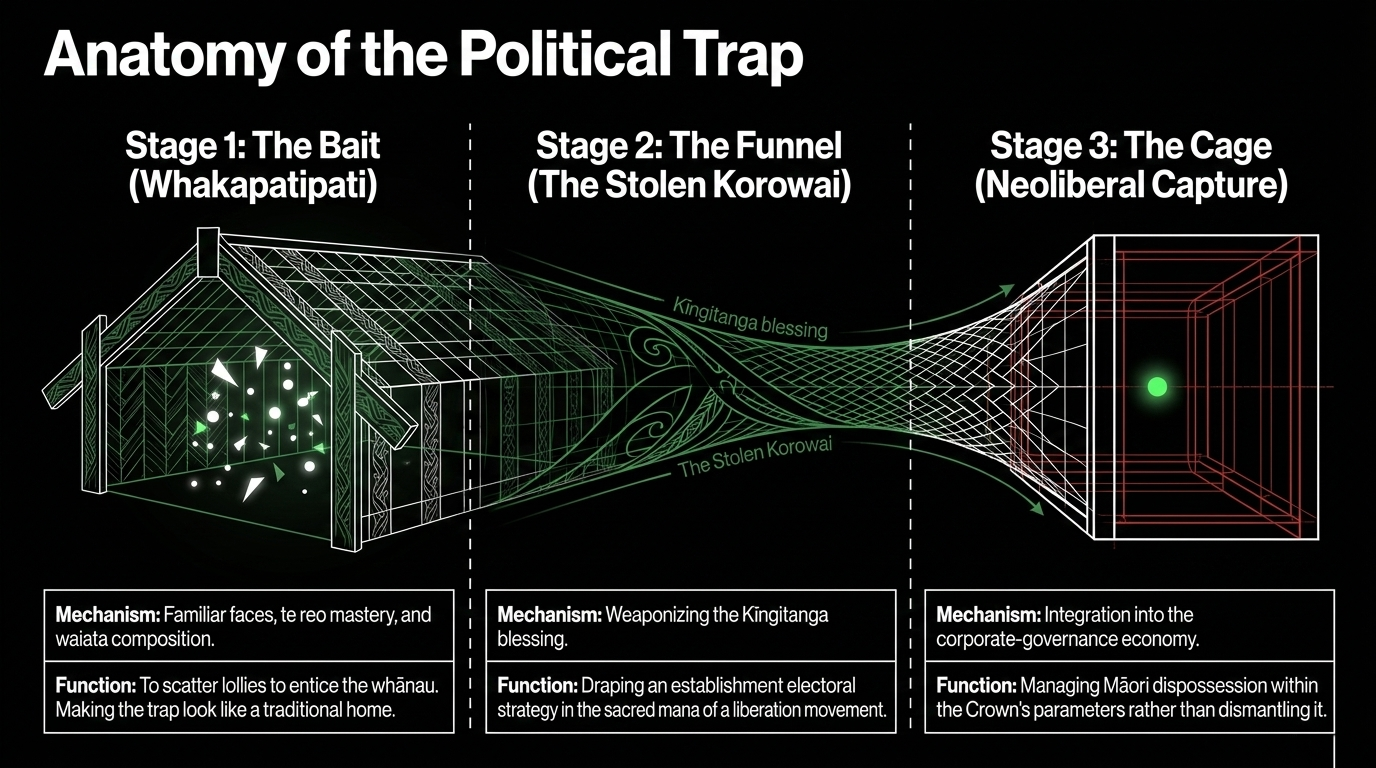
As Te Ao Māori News reported from Rātana 2026, Kīngitanga spokesperson Tukoroirangi Morgan himself warned: Ko te mahi a te Karauna, he ruirui i ngā rare, te whakapatipati i a tātou — it is the work of the Crown to scatter lollies to entice us.
The Kīngitanga's own spokesperson condemns the very environment his institution's endorsement now decorates.
What the Blessing Actually Reveals
The blessing is the intersection of three structural forces.
First: The Kīngitanga's institutional comfort with the Māori corporate-governance economy — investment funds, iwi boards, asset management — which Labour's managed politics protects far better than Te Pāti Māori's radical, Treaty-centric redistribution demands.
Second: A 28-year-old queen navigating her first election year, surrounded by advisors with deep Labour networks.
Third: As NZ Herald's 17 April 2026 article makes explicit in its headline
— "Māori Queen's blessing sets stage for showdown"
— the mana of a movement founded to resist colonialism is now a Labour campaign subheading.
The tikanga violation: When the korowai of the Kīngitanga is draped over a Labour electoral strategy designed to neutralise Māori political independence, it does not elevate the candidate. It diminishes the institution. And a 28-year-old queen deserves our aroha and our honesty simultaneously.
Ko Te Pāti Māori — The Burning Whare
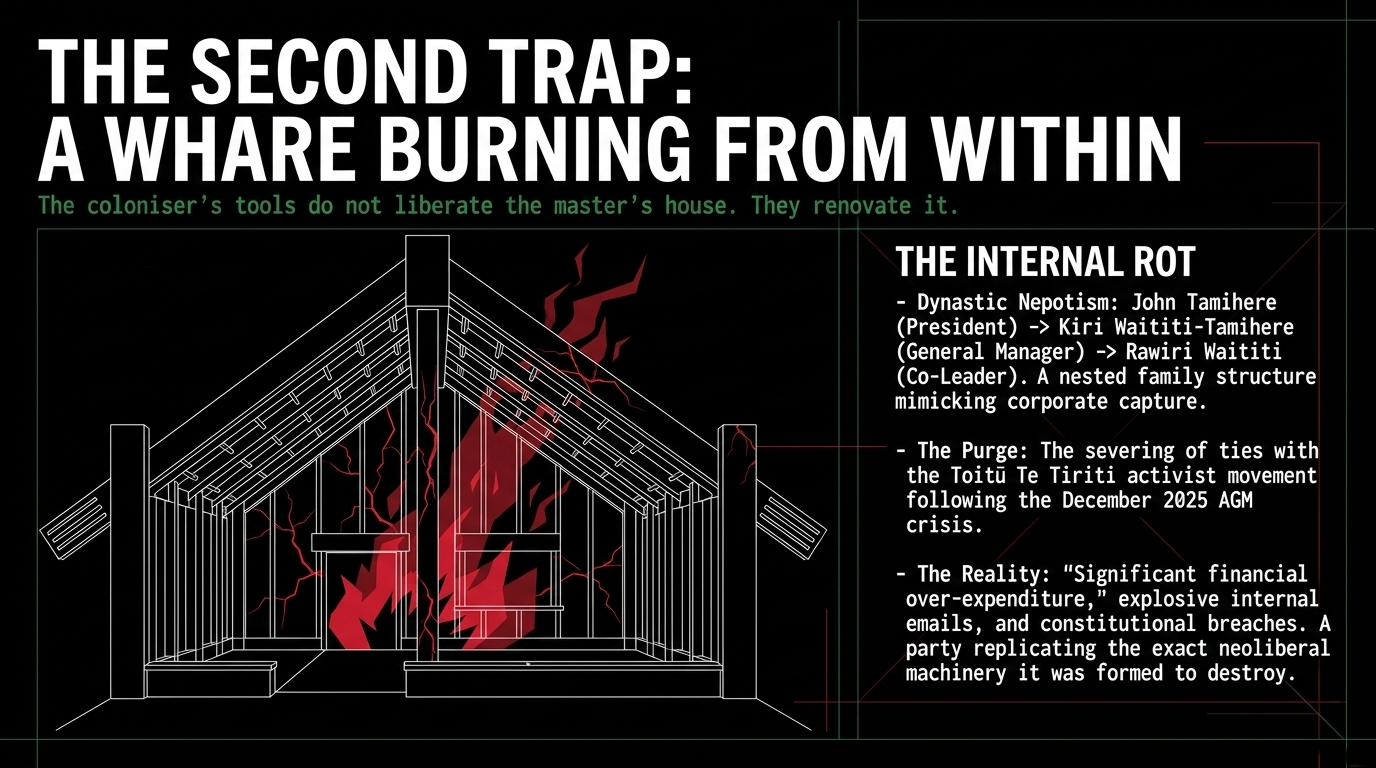
Now we turn to the harder reckoning. Because this essay would be dishonest if it only exposed Labour's predation without naming Te Pāti Māori's own betrayal of its kaupapa.
Ko te whare e tū ana, he whare kōhuru. A house that stands through deception is not a house. It is a ruin waiting to fall.
The Dynastic Implosion
As The Māori Green Lantern's Substack essay "Te Pāti Māori's Dynastic Implosion" documented in October 2025, the heart of the crisis is precisely the neoliberal power structure the party was formed to oppose — concentrated in the hands of connected families while marginalising grassroots voices. John Tamihere serves as party president and leads the Whānau Ora Commissioning Agency, distributing hundreds of millions in government funding to Māori social services. His daughter Kiri Waititi-Tamihere serves as General Manager of Te Pāti Māori. Her partner is co-leader Rawiri Waititi. This is not a political party governed by tikanga.
This is a whakapapa corporation dressed in a tino rangatiratanga korowai.
When Toitū Te Tiriti — the activist movement that brought over 42,000 people to Parliament — severed ties with Te Pāti Māori citing "leadership failures and constitutional breaches," as documented by NZ Herald's October 2025 investigation into the party's internal chaos, it was not a personality conflict.
It was the grassroots rejecting the elite. It was the river rejecting the dam that had claimed to speak for it.
The Constitutional Coup and the Ferris-Kapa-Kingi Catastrophe
As The Māori Green Lantern's December 2025 essay "Te Pāti Māori in Crisis: Leadership Collapse and Kaupapa Betrayal" documented with forensic precision, a devastating Mata-Horizon Research poll revealed that
47% of Māori voters said Te Pāti Māori was heading in the wrong direction, with only 18% expressing trust in the current leadership.
The same poll found that Hana-Rāwhiti Maipi-Clarke — named one of Time's 100 most influential rising leaders in 2025 — commanded 19% support to replace the embattled leaders, far exceeding Rawiri Waititi at 12%.
The crisis timeline is brutal. As NZ Herald reported in October 2025, MP Tākuta Ferris posted social media content targeting non-Māori volunteers. MP Mariameno Kapa-Kingi was demoted. Explosive allegations circulated. Her son Eru — organiser of the historic hīkoi — alleged a "dictatorship leadership" style and his movement severed ties with the party. Kapa-Kingi sought a High Court ruling for reinstatement. Tamihere called for two of his own MPs to resign. As Stuff.co.nz reported in November 2025, with one-third of caucus wanting the co-leaders gone, Waititi and Ngarewa-Packer "defiantly stood their ground" while the party publicly imploded. By the December 2025 AGM at Waiatuhi Marae, former Kīngitanga spokesperson Ngira Simmonds stood on the pae and questioned all three leaders' suitability.
As Te Ao Māori News' analysis in October 2025 stated:
"For a political movement that has prided itself on accountability and kaupapa Māori principles, this is an existential crisis."
Even the National Iwi Chairs Forum was forced to request an emergency meeting to address challenges "distracting" the party. And as 1News confirmed from the December AGM, even former leaders said the party had
"self-destructed" in public view, leaving "a war of words that has hurt us as te ao Māori; damaged our credibility and tarnished our integrity."
The Neoliberal Infection from Within
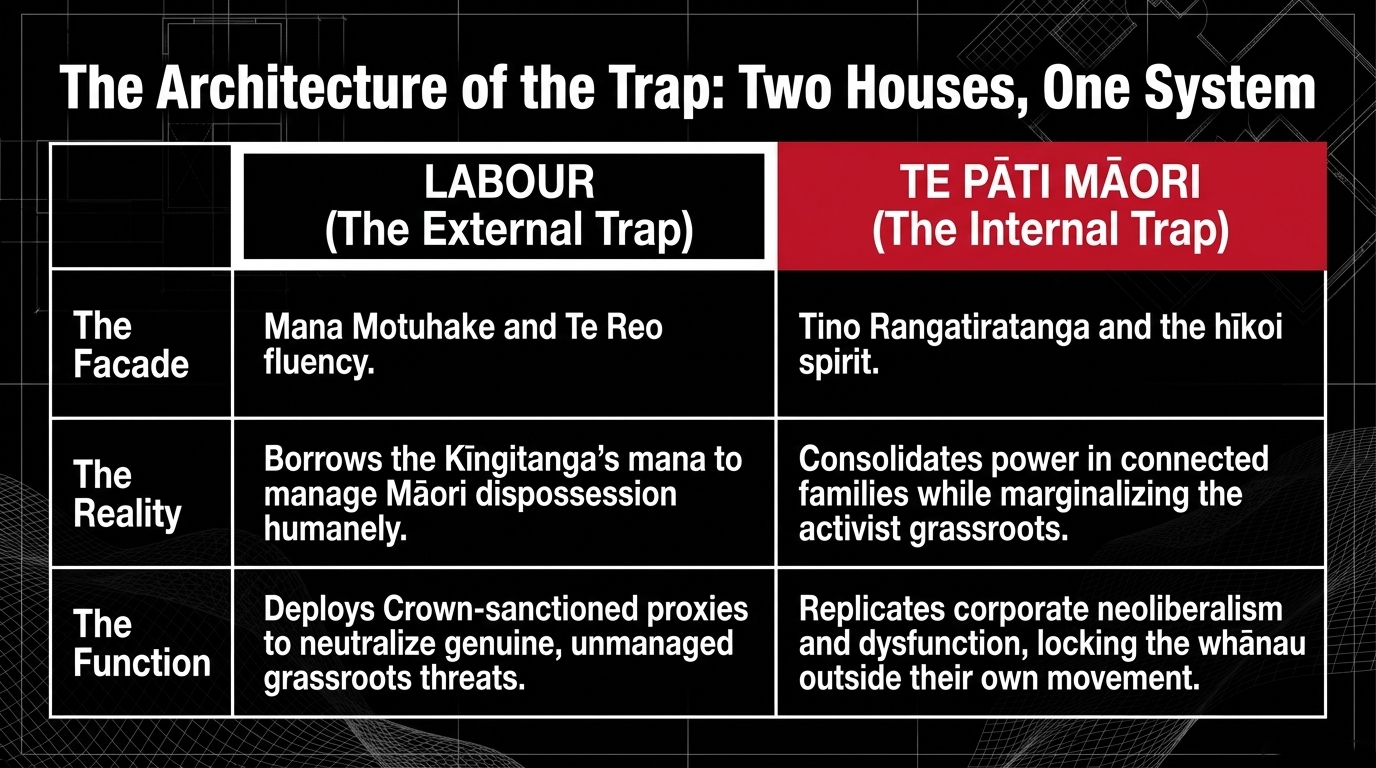
As The Māori Green Lantern's "The Whare Is Rotten" diagnosed in December 2025: Te Pāti Māori did not escape the neoliberal architecture. It absorbed it.
The concentration of power in a nested family structure is not tikanga — it is the corporate-family capture that neoliberalism normalises.
As The Māori Green Lantern's companion essay "The Rot Within" documented:
"The party that claims to represent Māori liberation has descended into what its own former leaders call a 'dictatorship model' where power is concentrated among four people while grassroots voices are silenced."
Now observe the bitter symmetry.
Kiriona's TupuOra lost 25 of 30 staff under National's funding divestment — real, documented harm confirmed by his own RNZ interview. And Te Pāti Māori's leadership burned through money, expelled its MPs, severed its activist base, and went to its AGM unable to elect a Vice President.
Two competing structures, both capturing Māori energy, both failing Māori whānau, both operating within the logic of managed institutional politics. The suffering whānau is the collateral damage of both.
He Mate Whakaahua — A Death the Movement Needs
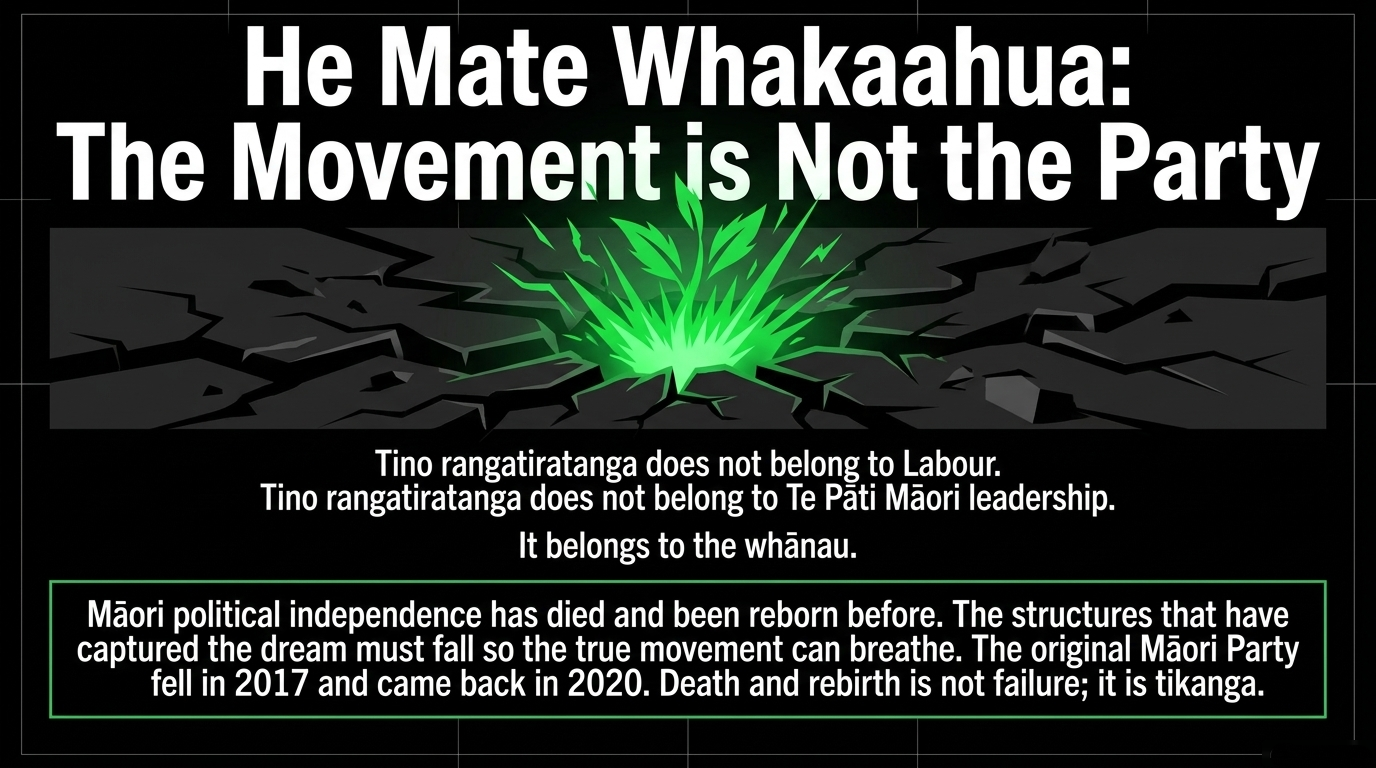
Te Pāti Māori, in its current form, must die.
Not Māori political representation. Not tino rangatiratanga. Not the hīkoi spirit. Not the haka in Parliament. Those are eternal — they belong to whānau, not to any party structure.
But this particular configuration — its dynasties, financial over-expenditure, constitutional breaches, expelled MPs, severed activist movements — must end.
This is not the first time.
As Wikipedia's history of Te Pāti Māori records, the party fell out of Parliament entirely in 2017 before being reborn through Rawiri Waititi's Waiariki victory in 2020 — leaner, sharper, more dangerous. Death and rebirth is not failure in te ao Māori. The pūrākau is full of transformations that required destruction first. The huhu grub must dissolve entirely before it becomes the huhu beetle. The seed must crack before the root finds soil.
What is needed now is not another "reset." It is a genuine structural reckoning — a return to democratic whakapapa, collective accountability, and the kaupapa that made Māori weep with pride when Hana-Rāwhiti danced in Parliament.
As The Māori Green Lantern's "Dynastic Implosion" essay states:
"Our ancestors didn't fight for tino rangatiratanga so the Tamihere whānau could run Māori politics like a family business."
The movement is not the party. The mana is not the leadership. The tino rangatiratanga belongs to whānau — and whānau must reclaim it from every structure, left or right, Crown-appointed or self-appointed, that claims to hold it on their behalf.
He Kūiti Ahumahi — Three Examples for the Western Mind
Example One: The Recycled Rubber Stamp
Imagine the NHS shuts down your local community clinic. Then the same government appoints the clinic's former Deputy Director to a national advisory board — where his job is to advise on the very health gap his defunded clinic used to close. He produces reports. He attends meetings. The gap keeps growing.
This is not fictional. As confirmed by the Beehive's October 2025 leadership appointments announcement, National's Māori Development Minister Tama Potaka appointed Kiriona as Deputy Chair of Te Māngai Pāho — the same government that abolished Te Aka Whai Ora, where Kiriona served as DCE, as confirmed by Te Whatu Ora's own appointment records. The revolving door does not turn on principle. It turns on utility.
The tikanga violation: A rangatira's mana comes from protecting their people, not from holding Crown appointments while their people bleed. When the tohunga serves the pā-burners, he becomes the most effective weapon the enemy has.
Example Two: The Beautiful Birdcage
In the American civil rights tradition, this is the problem Malcolm X named with devastating clarity. The plantation did not abolish slavery. It promoted a figure into the house — better clothes, better role, closer proximity to the master — and used that proximity to manage those still in the field. The improved conditions were not liberation. They were leverage.
As documented by interest.co.nz, Labour's declared mission is to knock Te Pāti Māori out of the Māori seats — not because Labour delivers better outcomes, but because Te Pāti Māori's independence threatens Labour's ability to govern without Māori conditions. As The Spinoff confirmed in February 2026, Labour won all seven Māori seats in 2017 — and then delivered a structurally unchanged unemployment gap, a Māori housing crisis, and ultimately the conditions that made Te Aka Whai Ora necessary in the first place.
The tikanga violation: As the Waitangi Tribunal confirms in its own foundational documents, Te Tiriti guaranteed tino rangatiratanga as a birthright — not a Labour platform. When Labour's Cushla Tangaere-Manuel claimed in November 2025 that Labour could deliver "mana motuhake Māori — with a Labour Government," she revealed the depth of colonial conditioning. Sovereignty cannot be granted by the coloniser's left hand.
Example Three: The Controlled Opposition Formula
In intelligence tradecraft, the most effective way to neutralise a movement is not to destroy it — it is to capture it. You do not assassinate the leader. You field a replacement who looks like the leader, carries the same cultural credentials — but reports to different masters.
As confirmed by NZ Herald's reporting on Kiriona's candidacy, Hana-Rāwhiti Maipi-Clarke became the youngest MP in New Zealand's 170-year parliamentary history at just 21. She performed the haka in Parliament and the world watched. She is unmanaged and unco-opted. And now, as RNZ confirms from Kiriona's own mouth, his replacement candidacy was chosen not by principle
— but by friends.
Labour's answer to radical Māori independence is a te reo-speaking, waiata-composing, Māori-Queen-blessed candidate who will govern from within the neoliberal architecture that produced Māori dispossession.
Ngā Hononga Huna — The Hidden Connections Exposed
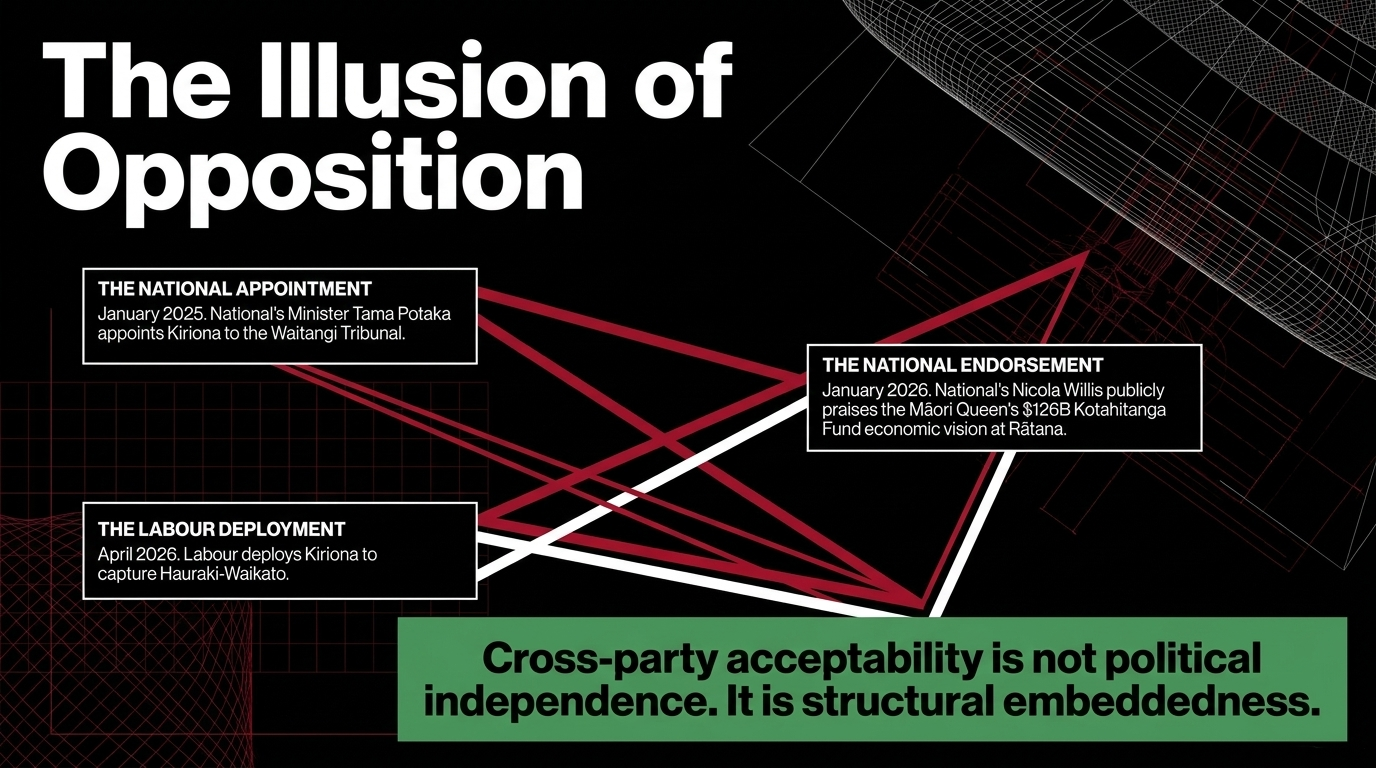
1. The Dual-Party Appointment Pipeline: Appointed to the Waitangi Tribunal by National's Tama Potaka per the Tribunal's own membership notice — part of what The Spinoff described as a "controversial clean-out" replacing esteemed Māori academics — Kiriona pivots to Labour candidate by April 2026. Cross-party acceptability is embeddedness, not independence.
2. The Kīngitanga's Stolen Qualification: As NZ Herald's headline announces "Māori Queen's blessing sets stage for showdown" — while RNZ confirms the Queen explicitly said she did not want an adversarial campaign. The nuance was consumed. The blessing was kept. The institution was weaponised.
3. The Te Aka Whai Ora Wound: As confirmed by Te Whatu Ora's own appointment records, Kiriona served as DCE at the Māori Health Authority National abolished and Labour failed to adequately defend. His candidacy asks the whānau who lost that institution to now vote for the party whose structural weakness enabled its destruction. This is not accountability. This is audacity.
4. Labour's Explicit Anti-TPM Agenda: As reported by NZ Herald in November 2025, Willie Jackson stated Labour has "no concern" if Te Pāti Māori is destroyed. And as NZ Herald separately reported in October 2025, Jackson was publicly declaring the split "inevitable" before the AGM had even convened — Labour was circling the wreckage before the smoke had cleared.
5. The "Friends" Confession: As RNZ confirms from Kiriona's own mouth, the reason he chose Labour comes down to "friends" and "opportunity." This is the language of the patronage network that has managed Māori political aspiration for sixty years. It is not the language of tino rangatiratanga.
6. The Queen's Economic Framework as Political Cover: Praised by Nicola Willis at Rātana per NZ Herald, the Kotahitanga Fund operates within neoliberal capitalism. The trap has two jaws: National controls the funding. Labour harvests the votes. Whānau get managed.
7. Te Pāti Māori's Dynastic Neoliberalism: As The Māori Green Lantern's "Dynastic Implosion" documented, the nested power structure — Tamihere, his daughter, her partner Waititi — replicates corporate-family capture inside the liberation movement. The coloniser's tools are renovating the master's house from within.
8. The Constitutional Coup of 2023: As The Māori Green Lantern's "Te Pāti Māori in Crisis" documented, 2023 constitutional changes shifted authority from the membership to an executive hand-picked by John Tamihere — concentrating power in a tiny circle while stripping genuine democratic participation from whānau. The party that was born from democratic Māori aspiration abolished democracy internally.
Ngā Tuhinga o MGL — Related Essays You Must Read
- He Waka Kotahi, He Hinaki Hou: Labour's Neoliberal Mask and the Māori Votes They Harvest — Documents how Labour's neoliberal reforms produced 25% Māori unemployment and why the structural gap was never closed
- Clockwise Betrayal: How Labour Set the Trap That National-ACT Now Closes — Proves both Labour and National-ACT operate within the same neoliberal framework, delivering indistinguishable structural outcomes for Māori whānau
- Labour's Mana Motuhake Mirage — Dissects Labour's 2025 sovereignty pitch as sophisticated electoral theatre with no structural delivery mechanism
- Te Pāti Māori's Dynastic Implosion: When Whakapapa Politics Becomes Family Business — The definitive analysis of how neoliberal power structures infected Māori political representation from within
- Te Pāti Māori in Crisis: Leadership Collapse and Kaupapa Betrayal — The December 2025 forensic reckoning with the structural conflicts of interest at the party's core, including the devastating 47% wrong-direction poll
- The Whare Is Rotten: Why Te Pāti Māori Must Decolonise Itself — The call for genuine structural rebirth, not rebranding — and the diagnosis of neoliberal capture wearing a korowai
- The Rot Within: How Te Pāti Māori's Power-Hungry Elite Are Destroying the Movement — Documents the concentration of power among four people and the silencing of grassroots voices
- Tribunal Tinkering: Crown's Calculated Colonialism Continues — Exposes National's reshaping of the Waitangi Tribunal, into which Kiriona was inserted
- Two Kings and a Broken Child: The Whakapapa of Power — Maps the whakapapa of Crown institutional capture and how it produces intergenerational harm
- The Nursery of Cages: How a White Supremacist State Built a Factory That Turns Brown Children Into Prisoners — The structural context within which any political party that does not challenge mass Māori incarceration is complicit
He Kupu Whakakapi — The Closing Strike
In te ao Māori, a kaitiaki does not negotiate with the entity that is eating the mauri of the land. They name it. They confront it. They drive it out.
Labour is not your kaitiaki. Labour is the entity that smiles at the pōwhiri, recites the karakia, and then votes to manage your dispossession more humanely than the other party.
They have borrowed the mana of the Kīngitanga — founded by Te Ara's own account to resist exactly this kind of managed colonialism
— to make the trap look like a throne.
And as RNZ confirms from Kiriona's own mouth, the choice was made not by principle, not by policy, not by structural vision
— but by friends.
And Te Pāti Māori? Not your kaitiaki either. Not in this form.
As The Māori Green Lantern warned in "The Whare Is Rotten", the ghost of tino rangatiratanga haunts a whare that has been structurally compromised by the very neoliberal logic it was formed to oppose.
What must die is not the dream.
What must die is the structure that captured the dream and called it leadership.
The Māori Queen deserves our aroha and our honesty simultaneously. But as RNZ confirms, her own qualification — no adversarial campaign — was stripped from the narrative while her blessing was weaponised. When the Kīngitanga's blessing serves Labour's vote-harvesting strategy, the Kīngitanga is not above the trap.
It is inside it.
Kingi Kiriona may be a good man. The ring does not measure goodness. It measures structural function. Cross-appointed by National per the Tribunal's own records, deployed by Labour because of friends, blessed by the Kīngitanga with conditions quietly dropped — his structural function is to replace a woman who cannot be co-opted with someone who already has been.
Hauraki-Waikato: the taonga is the seat. The tūāhu is Hana-Rāwhiti. The snare is the beautiful branch. Do not land on it.
Ka tangi te tītī. Ka tangi te kākā. Ka tangi hoki ahau. Tūia i runga, tūia i raro — the weaving is a trap or a cloak. You decide which. But first — the rotten posts must be replaced. The whare must be rebuilt from the pou to the tāhuhu. On our terms. In our time. Under our mana.
🔥 He Koha Mō Tēnei Mahi
They sent a Māori Queen's blessing, a cross-party CV, 25 lost staff members as emotional fuel, and the word "friends" as their entire political strategy — all to take out the youngest and most dangerous Māori MP in Parliament. And they are counting on Te Pāti Māori's own dynastic implosion to finish the job.
Two traps, one people. Zero accountability — unless whānau fund it.
This essay cost them nothing to ignore. It cost this desk everything to write. No Crown body funded it. No party whip approved it. No corporate sponsor shaped it.
Every koha signals that whānau are ready to fund the accountability that Crown and corporate structures — and captured Māori party structures — will not provide. That when Labour deploys the Kīngitanga's mana as electoral cover, when Te Pāti Māori's leaders run the party like a family business, and when a candidate's reason to stand is "friends" — we have the resources and the resolve to name every single one of those things clearly, publicly, and with evidence.
Rangatiratanga includes the power to fund our own truth tellers. Every subscription, every share, every koha is a declaration:
the beautiful branch will be named. The rotten post will be named. And we will rebuild on solid ground.
🪶 Koha direct — Support via Koha platform
📩 Subscribe for direct delivery — Join the Māori Green Lantern community
🏦 Direct bank transfer — HTDM | 03-1546-0415173-000
📘 Facebook — Follow and subscribe
If you cannot koha right now — no worries at all. Subscribe, follow, share, and kōrero with your whānau. Find all essays at themaorigreenlantern.maori.nz. That is koha in itself.
Kia kaha, Hauraki-Waikato. Kia kaha, te ao Māori. The Kīngitanga was built to protect you. The movement was built to free you. Neither exists to be borrowed by parties — or networks of friends — who will drop them after the election. Remember why they exist. Rebuild them in your own image.
Research conducted 18 April 2026. Sources verified via RNZ, NZ Herald Kahu, Waitangi Tribunal, Beehive.govt.nz, Te Ao Māori News, Te Whatu Ora, 100 Māori Leaders, The Spinoff, interest.co.nz, Te Ara, Waikato-Tainui, 1News, Stuff.co.nz, Courts of NZ, Wikipedia, and The Māori Green Lantern archive. All URLs verified live at time of publication.