"Two Wings Of The Same Captured Bird: Schumer, Jeffries, And The New Zealand Left" - 6 November 2026
Schumer and Jeffries show what captured, donor-funded leadership looks like. New Zealand's left bloc must not repeat that mistake — the Greens and te Pāti Māori should lead a fighting government.

Mōrena ano Aotearoa,
The Democratic Party stands at the edge of a cliff and its two top leaders are holding the door open for Donald Trump to push the country over.
Chuck Schumer and Hakeem Jeffries are not the opposition. They are the accommodation. Schumer is too old, too slow, and too beholden to Wall Street to lead any fight. Jeffries is a corporate Democrat who met privately with Jared Kushner — Trump's son-in-law and adviser — and came away with nothing but a handshake and a photo opportunity. Neither man has the record, the energy, or the independence to hold Trump and the GOP in check. The party needs new leadership, not supplicants to Israel and corporate money.
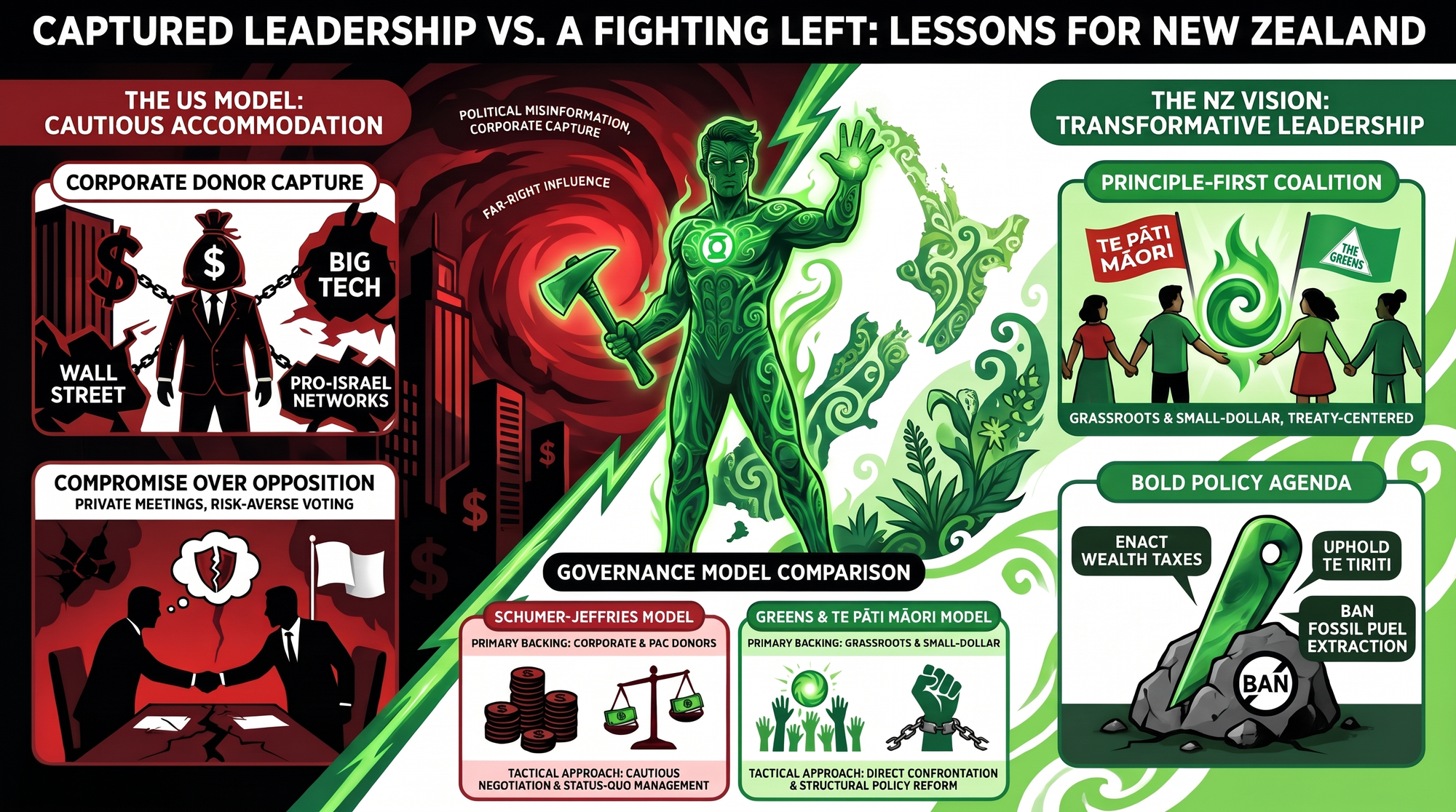
This is not just an American problem. New Zealand faces the same choice on 7 November 2026.
If the left bloc wins — Labour, the Greens, and te Pāti Māori — the country cannot afford another Schumer-and-Jeffries-style leadership: cautious, donor-funded, accommodationist, and afraid of its own shadow.
New Zealand needs leaders who will fight, not manage decline. The same disease runs through both parties: leadership that talks about serving the people but serves itself and industry.
Two Men Who Bow To Israel And Money

Schumer and Jeffries are not leaders who answer to working people. They answer to donors.
OpenSecrets data shows Schumer has taken more than $1.7 million from pro-Israel sources over his career, and Jeffries has taken $1.7 million from the same network Pro-Israel Recipients — OpenSecrets. Jeffries has visited Israel five times, told an AIPAC conference that Jerusalem is "the sixth borough" of New York, and voted to keep billions in US military aid flowing to Israel even as a growing share of his own caucus demanded an end to it Hakeem Jeffries — Wikipedia. Schumer has spent decades shielding Israeli government policy from meaningful congressional pressure, even as that government's actions in Gaza have drawn global condemnation.
This is not a side issue. It goes to the heart of who these men serve. A party that claims to stand for justice cannot be led by men whose first instinct is to protect a foreign government's military aid package while American families cannot afford rent or groceries. Their loyalty to Israel and to the lobby network that funds them is not a detail. It is the core of their political identity.
The Kushner Meeting: A Leader Who Negotiates With The Enemy
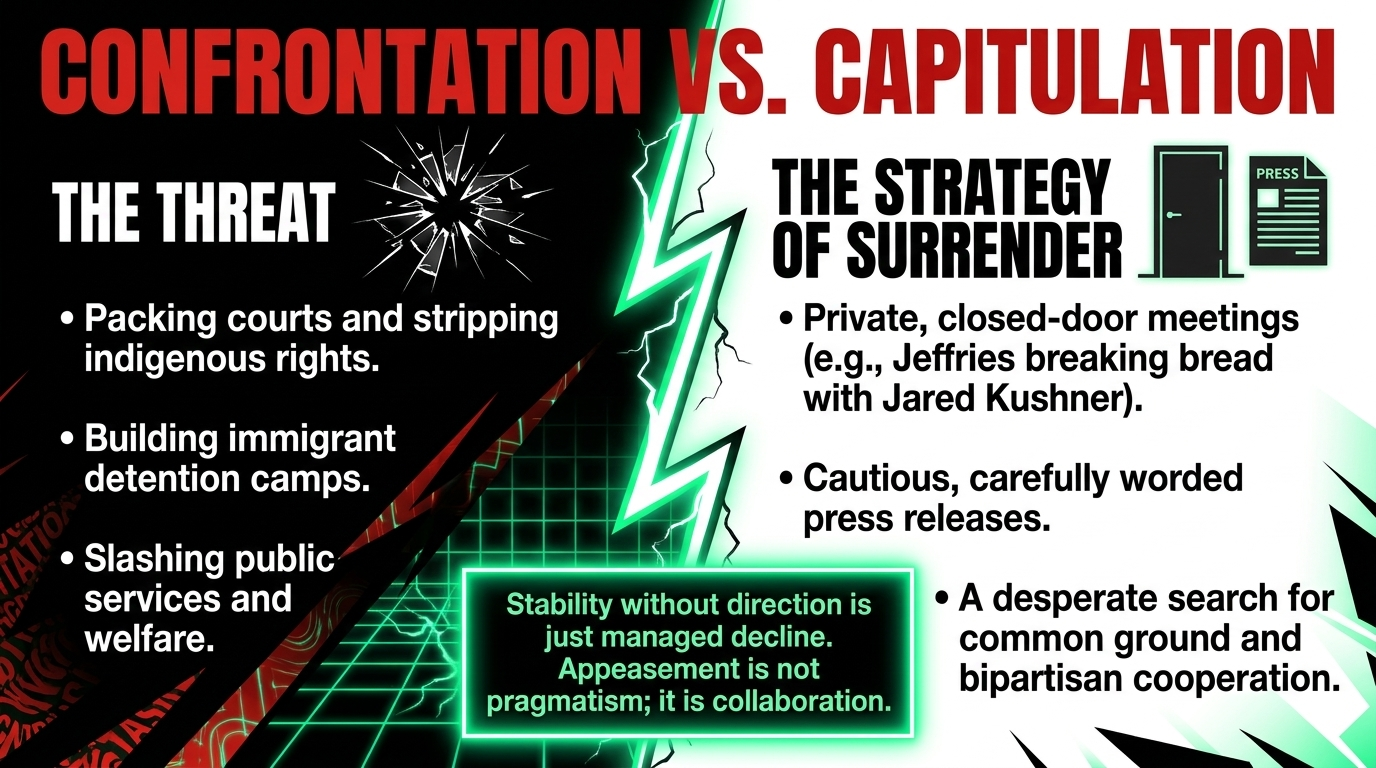
In August 2026, Hakeem Jeffries met privately with Jared Kushner in Manhattan.
Kushner is Donald Trump's son-in-law, a top outside adviser, and a man with deep personal business interests that overlap with the administration's foreign policy Jeffries and Kushner Meet Privately as Midterm Attacks Fly — The New York Times.
The meeting was not a hearing. It was not a public confrontation. It was a private get-together in a space offered by a mutual friend, about which neither man would comment publicly Jeffries and Kushner Meet Privately as Midterm Attacks Fly — The New York Times.
Jeffries later said he took the meeting at Kushner's request to discuss affordability, and insisted Democrats would "hold every single member of the Trump cartel accountable" Jeffries defends himself following criticism for meeting with Kushner — CNN.
But the fact of the meeting is the indictment.
A serious opposition leader does not sit down privately with the president's son-in-law to chat about "common ground" while that same president is packing the courts, attacking immigrants, and threatening the rule of law. Jeffries should have been preparing to confront Kushner. Instead he broke bread with him.
This is the behaviour of a supplicant, not a fighter.
When a leader of the opposition meets in secret with the inner circle of an authoritarian president, he is not building leverage. He is signalling that he can be bought, or at least that he is willing to be seen in the same room. That is weakness. That is collaboration.
The Deep Dive Podcast
Listen to a lively conversation between two hosts, unpacking and connecting topics in the sources of this essay. I apologise in advance for the AI's very harsh pronounciation of reo. Please dont shoot me, :).
Youtube Video
Like video? Here is a short video suppporting the essay. Again, don't shoot the messenger please because of AI's pronounciation. :)
Schumer Is Too Old, Too Slow, And Too Captured

Chuck Schumer is not the problem because of his age alone. He is the problem because his age reflects a leadership that has been in place too long, that has cut too many deals, and that has too little urgency for the moment we are in.
Schumer has been in the Senate since 1999 and in Democratic leadership for decades. His record on Israel is one of consistent deference. His record on Wall Street is one of consistent protection. In March 2025, he facilitated passage of a Republican government-funding measure, showing precisely the risk-aversion that critics fear in an era of constitutional hardball ChatGPT-6: Both Schumer and Jeffries have substantial ties to wealthy donors, corporate interests and AIPAC.
An opposition party facing an authoritarian president cannot be led by a man whose defining trait is caution. Schumer does not need to be more energetic. He needs to be replaced.
The Democratic Party cannot fight Trump with a Senate Minority Leader who thinks the right response to creeping fascism is a carefully worded press release and a closed-door negotiation.
Jeffries Copies Obama, And It Rings False

Hakeem Jeffries is a poor public speaker. He tries to copy Barack Obama's hand gestures and body language, and it comes across as inauthentic. Watch him at a podium and you see a man performing a role he does not inhabit. The pauses are borrowed. The cadence is borrowed. The conviction is missing.
This matters because the fight against Trump is a fight for the public imagination.
It requires a leader who can speak with moral clarity and force, not a man who mimics a previous president's mannerisms while taking money from the same donor class and meeting privately with the president's family. Authenticity cannot be rehearsed. Jeffries lacks it, and the country can see it.
Wall Street And Corporate Money Are Their Base

Chuck Schumer has spent decades as one of the Senate's top recipients of securities and investment industry money.
Over his career, three of his five largest campaign donors have been Wall Street megabanks — Goldman Sachs, Citigroup, and JPMorgan Chase — and his second-largest career donor is Paul Weiss, the Big Law firm where his brother works on mergers for major publicly traded corporations Four Megabanks on Wall Street Hold $3.2 Trillion in Uninsured Deposits — Wall Street on Parade.
Schumer received nearly $9 million from the securities and investment industry from 1989 through 2010 alone, making him the top Senate beneficiary of hedge fund money by a large margin Chuck Schumer — Follow Their Money.
He voted against the Brown-Kaufman amendment imposing leverage and liability limits on large financial companies in 2010, and he shaped Dodd-Frank provisions in ways the industry found acceptable Chuck Schumer — Follow Their Money.
Hakeem Jeffries is no different in kind, only in generation.
He has raised $18.3 million over his congressional career, with top industry donors from finance, real estate, and law Hakeem Jeffries — U.S. Congress — Summary — OpenSecrets. This cycle alone, he raised $17.9 million, 71 percent from individual donors and 15 percent from PACs Where do Hakeem Jeffries's campaign contributions come from? — CivDotiq.
His donor list includes controversial tech and weapons figures: Anduril CEO Brian Schimpf and COO Matthew Grimm spent nearly $150,000 boosting his fundraising committees; Palantir's head of government affairs gave $44,300; and he has backing from executives at Bain Capital, DE Shaw, and Renaissance Technologies Hakeem Jeffries Is Bankrolled by the Most Controversial Tech — Futurism. Jeffries sits on a Democratic artificial intelligence commission stacked with members who have received outsized funding from Big Tech super PACs, executives, and investors, including OpenAI President Greg Brockman, Palantir co-founder Joe Lonsdale, and Andreessen Horowitz's Marc Andreessen and Ben Horowitz Democrats Backed by Industry Super PACs Are Writing the Party's AI Plan — Truthout.
These are not small-dollar people's champions. They are funded by the same class that profits from deregulation, surveillance, privatisation, and endless war.
A Record Of Retreat On Judicial And Legislative Fights
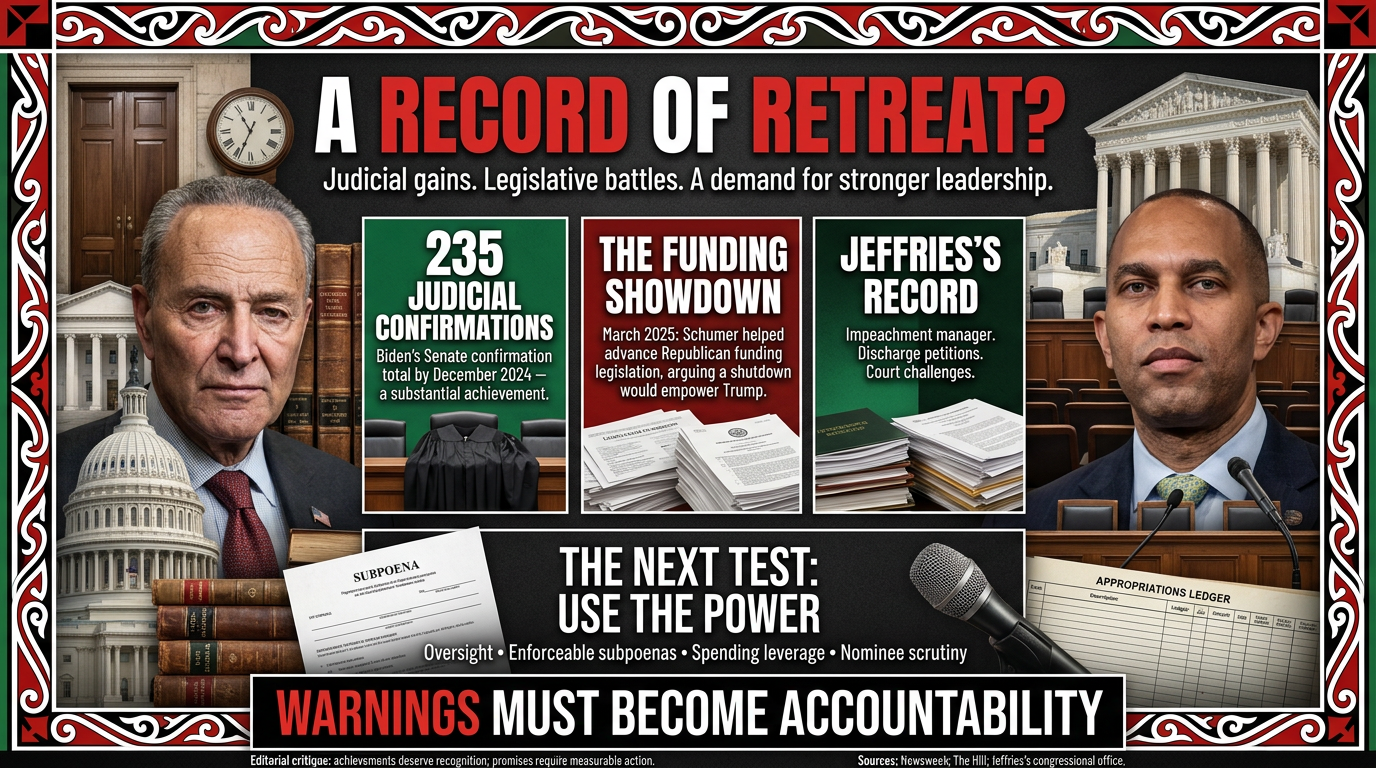
Schumer's record on judicial confirmations is a record of managed surrender.
In December 2024, his Senate confirmed President Biden's 235th lifetime judge, completing a four-year run that left roughly a quarter of all active federal judges carrying the Biden imprint Uncommon Knowledge: Judge not Chuck Schumer on this shutdown — Newsweek.
That was a Democratic achievement — but it is also the limit of Schumer's strategy: confirm judges, then go home. When Trump returns to office and sends up MAGA nominees, Schumer's answer is a warning that they will face "a very tough road" How Democrats plan to use their majorities to constrain Trump — The Hill. Warnings are not a strategy. They are a press release.
In March 2025, Schumer facilitated passage of a Republican government-funding measure, showing precisely the risk-aversion that critics fear in an era of constitutional hardball ChatGPT-6: Both Schumer and Jeffries have substantial ties to wealthy donors, corporate interests and AIPAC. He has not used the Senate's tools — the filibuster, the holds, the floor — to make Trump's agenda painful. He has used them to manage the calendar.
Jeffries's legislative record is similarly defined by caution dressed as accomplishment.
His own office lists discharge petitions, a clean ACA tax credit extension, and amicus briefs as evidence of fighting back Congressman Hakeem Jeffries — About. These are real efforts, but they are defensive tactics inside a Republican-controlled chamber. They do not constitute an offensive strategy. Jeffries was one of seven House impeachment managers in Trump's first trial Congressman Hakeem Jeffries — About, and he has delivered floor speeches against Republican bills Congressman Hakeem Jeffries — Homepage. But speeches and petitions are not power. When Trump sent troops into American cities, built detention camps for immigrants, and launched a war on Iran, the Democratic response under Jeffries and Schumer was bipartisanship, "common ground," and a readiness to "work with" the president After the US midterms: What next? — WSWS.
The party's left flank is in open revolt. Jeffries faces mounting frustration from progressives over Medicare for All, which he co-sponsored before becoming leader in 2022 but now declines to support as a matter of "neutrality" Inside Hakeem Jeffries' coming fight with his left flank — Axios. This is not neutrality. It is the language of a leader who will not take a side when the side-taking matters.
Now Is Not The Time To Placate Trump

The argument from Schumer and Jeffries, and from the establishment wing they represent, is that Democrats must be careful. They must not overreach. They must leave room for bipartisan cooperation. They must not alienate moderates. This is the language of surrender disguised as strategy.
Now is not the time to placate Trump. Now is the time to hold him and the GOP in check. Every day that Democratic leadership chooses caution over confrontation is a day Trump consolidates power, packs the courts, and tests the limits of what he can get away with. Schumer and Jeffries do not offer a strategy of resistance. They offer a strategy of management — managing the decline of democratic norms, managing the outrage of the base, managing the interests of their donors.
The country does not need managed decline. It needs opposition. It needs leaders who will say no, who will filibuster, who will shut things down, who will take the heat and not flinch. Schumer and Jeffries will not do that. They are too compromised, too cautious, and too tied to the same corporate and pro-Israel money that has hollowed out the Democratic Party for a generation.
The Lesson From Schumer And Jeffries For New Zealand

The Democratic Party's problem is not a lack of votes. It is a lack of fighters. Schumer and Jeffries have led through defeat after defeat because they are funded by, and accountable to, the same corporate and pro-Israel interests that hollow out working-class power. They do not fight Trump. They manage him. They meet with Kushner privately, take Wall Street money, and treat caution as strategy.
Labour risks repeating that exact pattern. Labour is the party of the partnership model, of social partnership with business, of the well-worn path of incrementalism. It has governed with the Greens before and treated them as junior partners. It has funded the same consultants, the same donor networks, the same cautious centrism. If Labour leads the next government, New Zealand gets Schumer-and-Jeffries politics by another name: a leadership that talks about serving the people but serves itself and industry.
Who Should Lead New Zealand
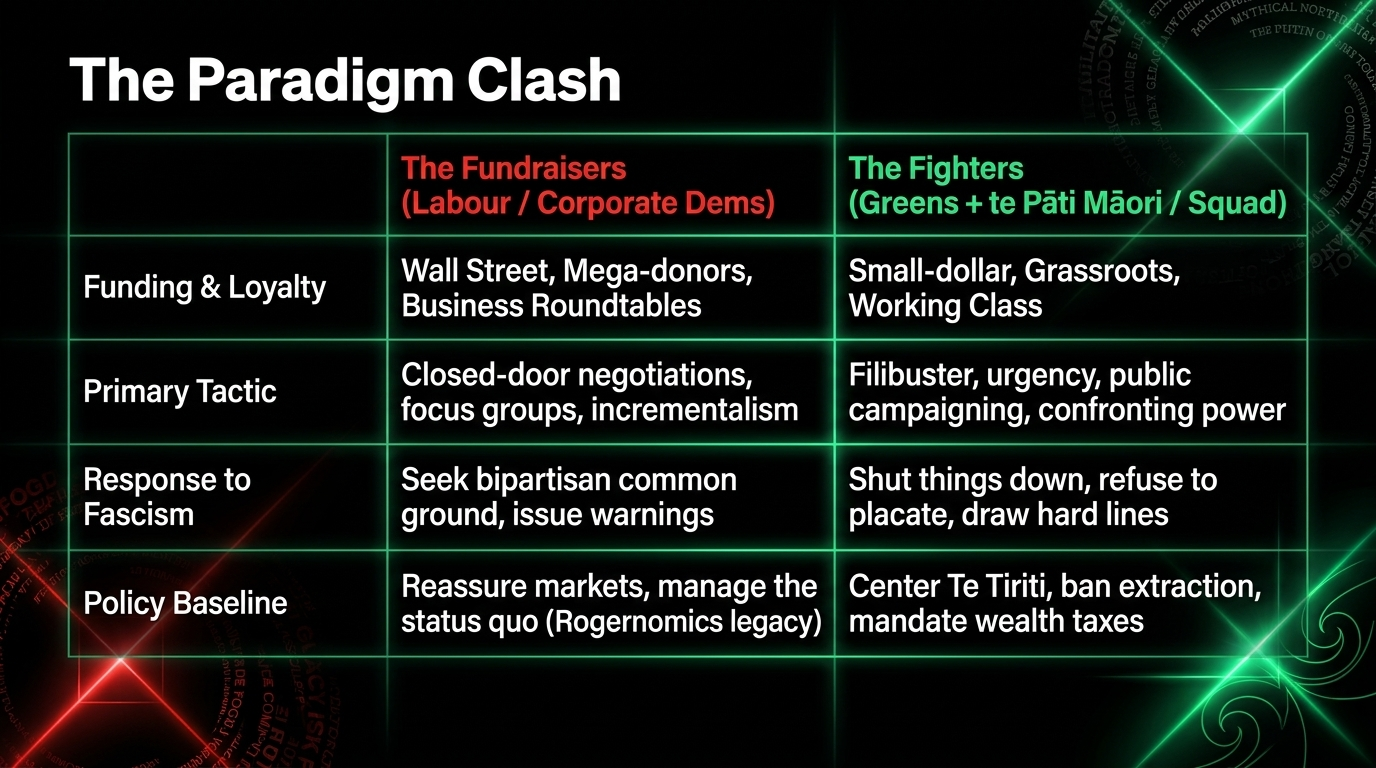
If the left bloc wins, the Greens should lead the government, with te Pāti Māori as an equal coalition partner, and Labour on the outside or in a distinctly subordinate role.
The Greens have consistently refused to treat neoliberal orthodoxy as immutable. They campaign on wealth taxes, on ending fossil fuel extraction, on rebuilding housing as a public good, and on a genuine Te Tiriti partnership. They do not take their cues from Business New Zealand or the OECD. They are closer to the Sanders and Ocasio-Cortez model: small-dollar funded, principle-first, unafraid to name the enemy.
te Pāti Māori brings the kaupapa that Labour has diluted. It centres rangatiratanga, Te Tiriti, and Māori self-determination not as a footnote to policy but as the foundation of it. It has fought the coalition government's attacks on Māori health, language, and land with force and clarity. A government led by the Greens and te Pāti Māori would be a government that understands colonization, racism, and neoliberal wealth transfer as connected systems — not separate issues to be managed.
What A Fighting Government Looks Like
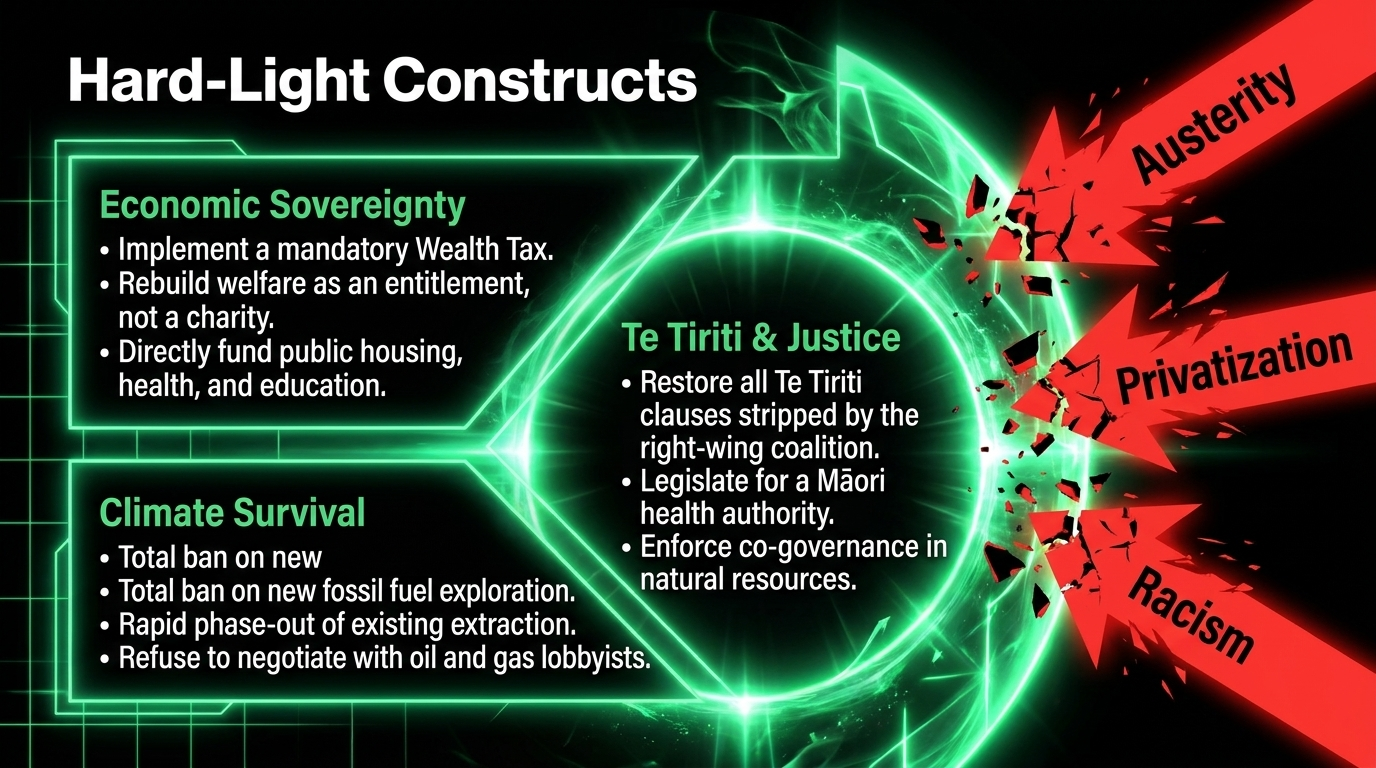
A left bloc government led by the Greens and te Pāti Māori would not meet privately with the powerful to "find common ground." It would:
Introduce a wealth tax and fund public housing, health, and education from it, daring the Opposition to vote against it.
Restore Te Tiriti clauses in legislation stripped out by the National-ACT-NZ First coalition, and legislate for Māori health authority and co-governance in natural resources.
Ban new fossil fuel exploration and phase out existing extraction, refusing to negotiate with oil and gas lobbyists.
Reverse the coalition's public service cuts and rebuild the welfare system as an entitlement, not a charity.
Use every parliamentary tool — urgency, select committee power, filibuster, public campaigning — to make the right wing's agenda painful, not easy.
This is the opposite of the Schumer-Jeffries model. It is confrontation, not management.
Why Labour Should Not Lead

Labour has been the senior partner in neoliberal governments before. It implemented Rogernomics. It has governed with the Greens and then sidelined them.
Its leadership is shaped by focus groups, by business roundtables, by the same caution that makes Schumer and Jeffries meet with Kushner instead of confronting him. Labour's instinct is to reassure the markets, not to challenge them.
If Labour leads the next government, the Greens and te Pāti Māori will be pressured to soften their demands, to drop the wealth tax, to delay Te Tiriti legislation, to "be reasonable."
That is how a left victory turns into a centrist government. That is how the moment is wasted.
The Counterargument: Stability And Governability

The strongest case for Labour leading is that it is the largest party, that it has governed before, and that markets prefer predictability. Stability matters.
But stability without direction is just managed decline. A Labour-led government would negotiate with National behind closed doors, soften its climate targets, and leave Te Tiriti obligations unmet. New Zealand does not need stability at the cost of surrender. It needs a government that will fight.
The same counterargument applies in the United States.
The strongest case for Schumer and Jeffries is that they know the institution. They have relationships. They can count votes. They understand procedure. In normal times, these might be virtues. But these are not normal times.
Trump is not a normal opponent. He is testing the Constitution, attacking the press, demonising immigrants, and using the machinery of government to settle personal scores. Experience with a broken system is not a qualification for fixing it. Pragmatism that produces concessions to authoritarianism is not pragmatism. It is collaboration.

Schumer and Jeffries are corporate Democrats who serve Wall Street, Big Tech, and the pro-Israel lobby network.
Their judicial record is one of managed confirmations followed by retreat. Their legislative strategy is defensive, cautious, and repeatedly outflanked by Trump and the GOP. They are not the leaders to hold Trump in check.
The Democratic Party has alternatives — Ocasio-Cortez, Crockett, Sanders, and the broader left flank — who reject corporate money, who will not meet privately with Trump's inner circle, and who understand that this moment demands a fight, not a negotiation.
New Zealand's election on 7 November is a chance to avoid the Schumer-Jeffries trap.
If the left bloc wins, it should not hand the reins to Labour and repeat the politics of cautious accommodation. The Greens and te Pāti Māori should lead. They are the parties that will tax the rich, defend Te Tiriti, confront the fossil fuel industry, and refuse to meet privately with power.
The lesson is the same in Washington and in Wellington: captured leaders cannot fight captured systems. Both countries need fighters, not fundraisers. Both need leaders who will hold power in check, not negotiate with it behind closed doors.
Koha Consideration

You might ask who is paying the Māori Green Lantern to produce over 1000 high quality, high volume, cited, factually based, educational essays fighting misinformation and disinformation from the far right in today's New Zealand Society?
The answer is you do.
The Māori Green Lantern is supported through koha and that is it. You might think that there is a line of corporate entities lavishly funding Ivor to do this.
That would be incorrect.
There are no corporates supporting this mahi.
Every koha signals that whānau are ready to support and protect the accountability that Crown and corporate structures will not provide. It signals that rangatiratanga includes the power to support and protect our own truth tellers.
This essay — "Two Wings Of The Same Captured Bird" — names Chuck Schumer and Hakeem Jeffries as captured leaders who serve Wall Street and the pro-Israel lobby, not the people. It argues that New Zealand's left bloc must not repeat that mistake, and that the Greens and te Pāti Māori should lead a fighting government after the 7 November election. This is the kind of truth telling that costs. It is not sponsored. It is not commissioned. It exists because whānau choose to support and protect it.
Kia kaha, whānau. Stay vigilant. Stay connected. And if you are able, consider a koha to ensure this voice continues.
If you are unable to koha, no worries! Subscribe or Follow the Māori Green Lantern at themaorigreenlantern.maori.nz, kōrero and share with your whānau and friends — that is koha in itself.
Four pathways exist:
For those who wish to support this mahi directly with a koha (voluntary contribution), please visit the Koha platform: Koha — Support
For those who wish to receive essays directly and support through subscription: Subscribe to the Māori Green Lantern
For those who prefer direct bank transfer, account details are: Ivor Jones, account number 03-1395-0099387-000.
For those on Facebook: https://www.facebook.com/Themaorigreenlantern/subscribe/
Disclaimer
This essay presents political opinion and analysis. Criticism of leaders, donors and institutions does not establish corruption or unlawful conduct. Coalition scenarios are possibilities, not predictions. Images are illustrative composites, not documentary evidence.