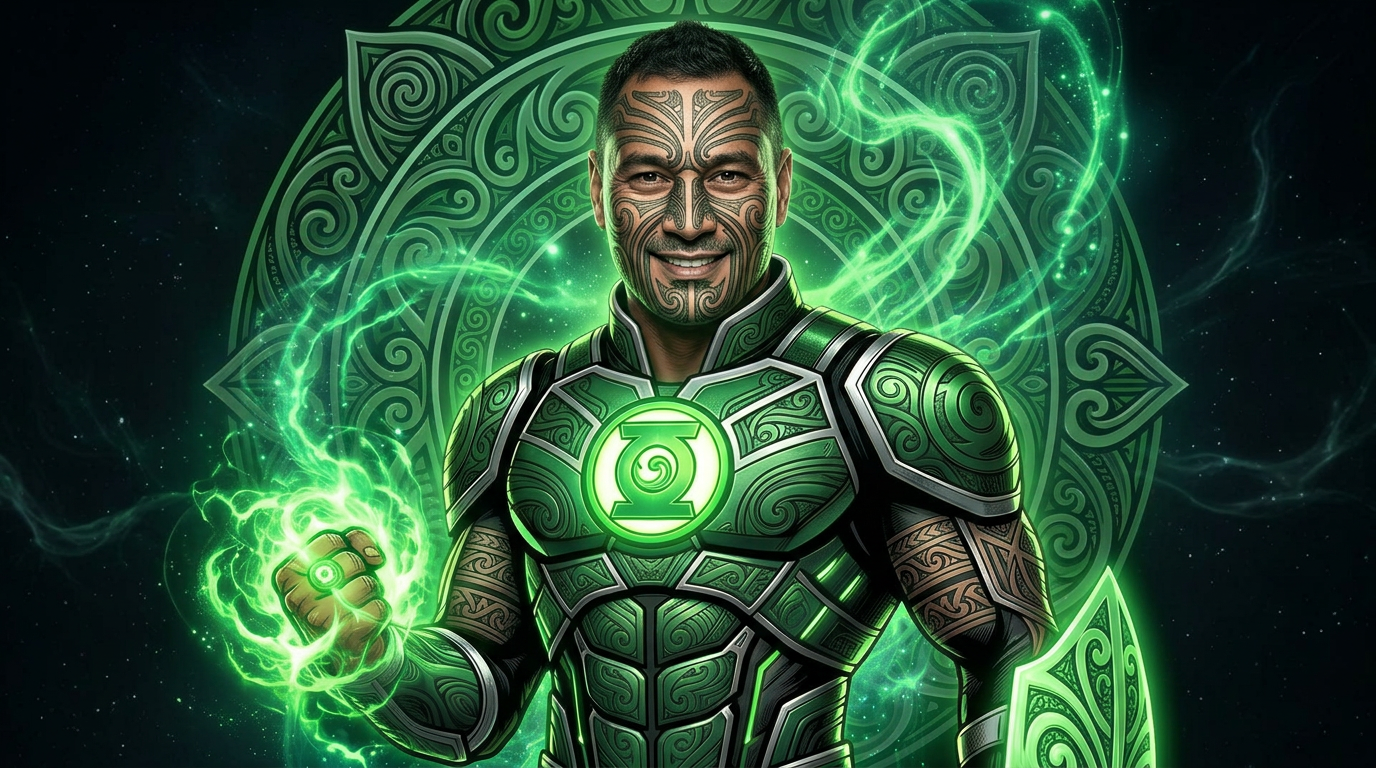
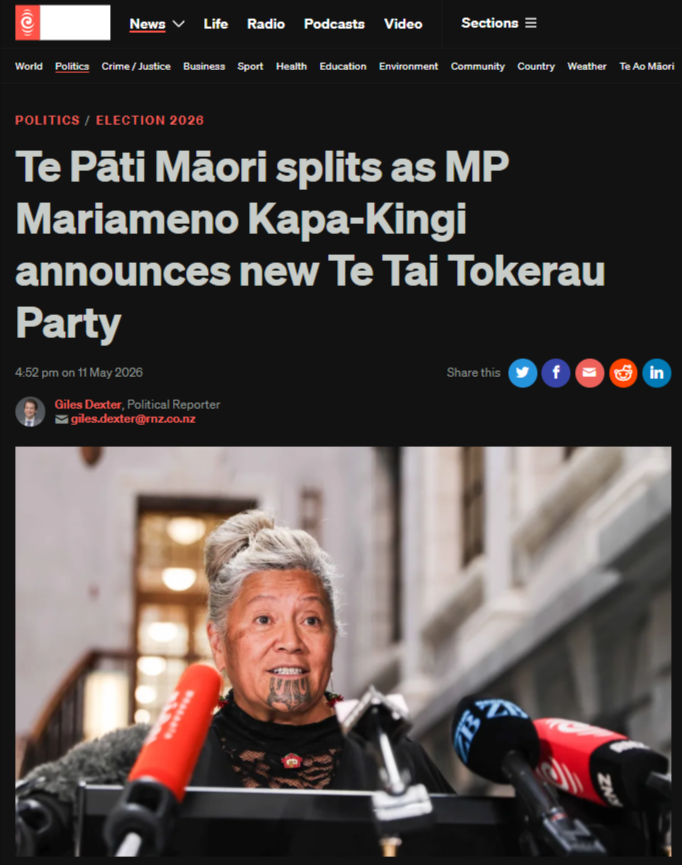
""WE ARE THE ONES WE'VE BEEN WAITING FOR": Mariameno Kapa-Kingi's Full Declaration, the Implosion of Te Pāti Māori, and Why the North Is Rewriting Māori Politics From the Ground Up" - 12 May 2026
One man's ego fractured a movement. One woman's courage is rebuilding it. And this white supremacist government is praying you don't notice.

Kia ora ano Aotearoa,
This essay examines Mariameno Kapa-Kingi's full declaration — on camera, in her own words, unmediated — because it directly affects the democratic rights of every Māori whānau in Aotearoa, and because it documents, in a sitting MP's own voice, the institutional misogyny, governance failure, and political cowardice that a male president and two silent co-leaders allowed to flourish inside what was supposed to be the people's party.
The Metaphor: The Burning Wharenui and the Woman Who Walked Out With the Carvings
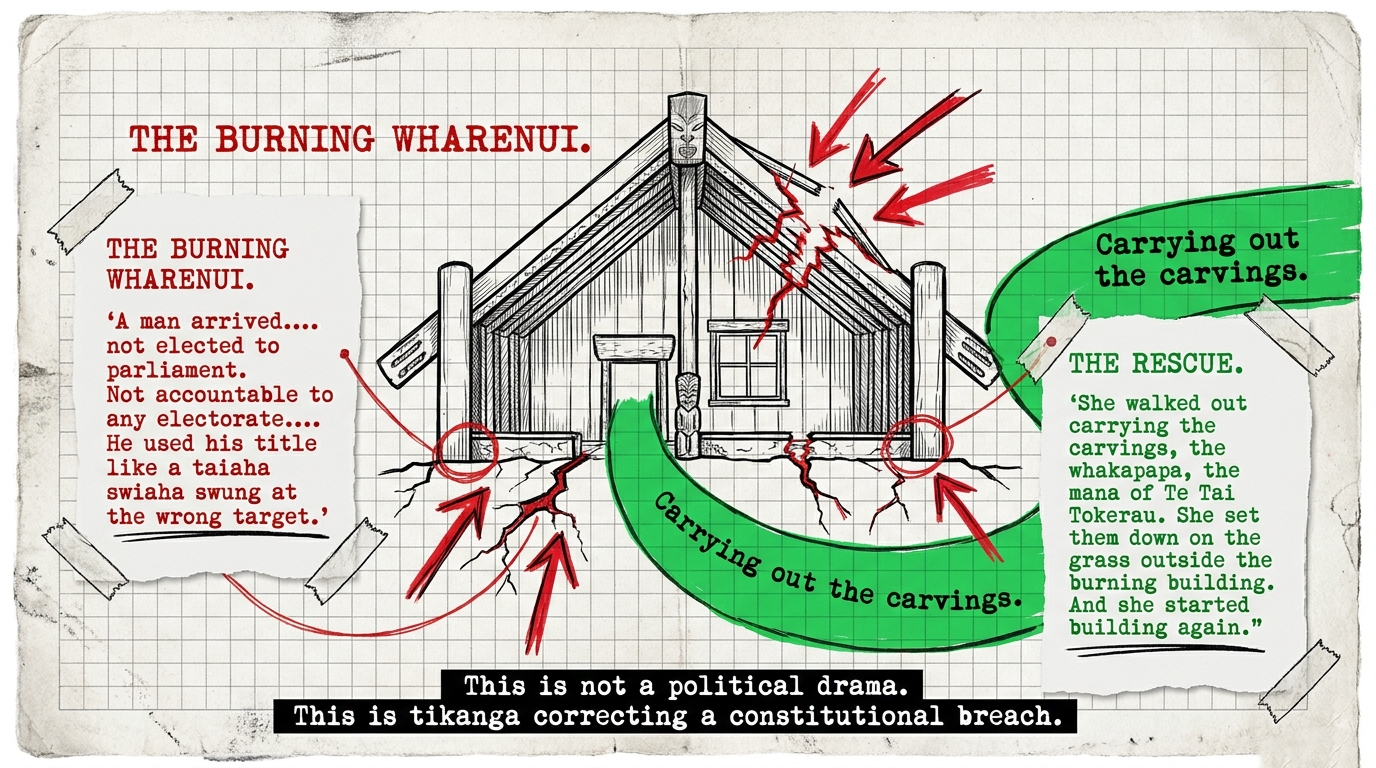
There is a wharenui in the north. It was built over generations. Every pou carved from sacrifice. Every rafter woven from the dreams of whānau who had been told, for 185 years, that their politics — their very existence as a people — was an inconvenience to be managed.
Then a man arrived. Not elected to parliament. Not accountable to any electorate. Not subject to any rohe's judgment. But he had a title — president — and he used it like a taiaha swung at the wrong target. He pointed it at a queer Māori woman who had been unanimously chosen by her own people. He pointed it at the kaitiaki of the north. He swung.
 Giles Dexter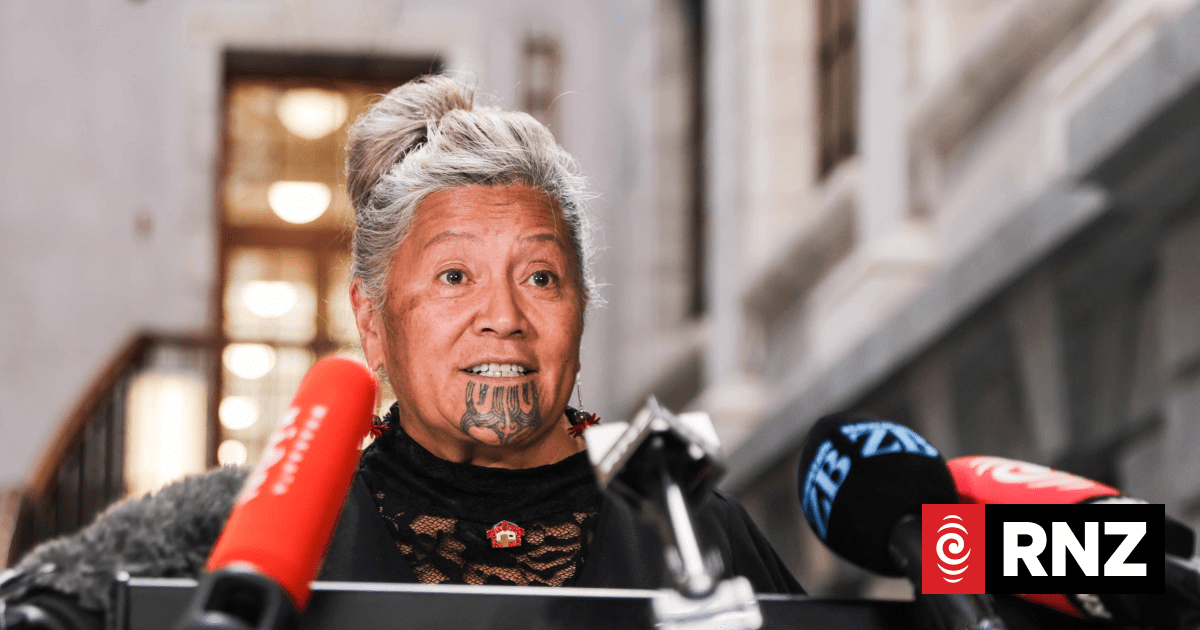
The Deep Dive Podcast
Listen to a lively conversation between two hosts, unpacking and connecting topics in the sources of this essay.
The High Court said it was unlawful. Fifty-five pages. As confirmed by Te Ao Māori News. The co-leaders said nothing. The caucus went quiet. The rohe waited. And she waited.
Then she stopped waiting.
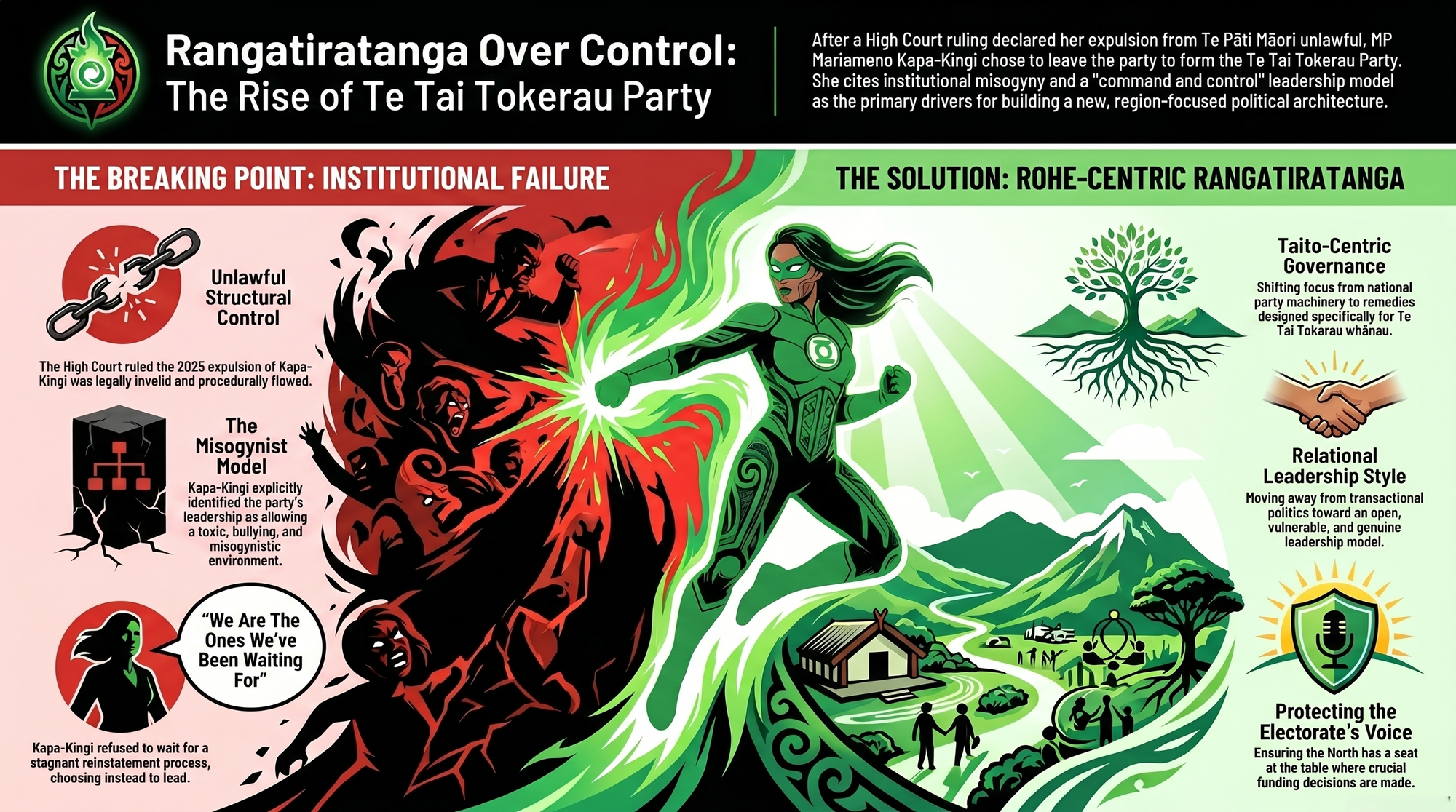
She quoted Alice Walker
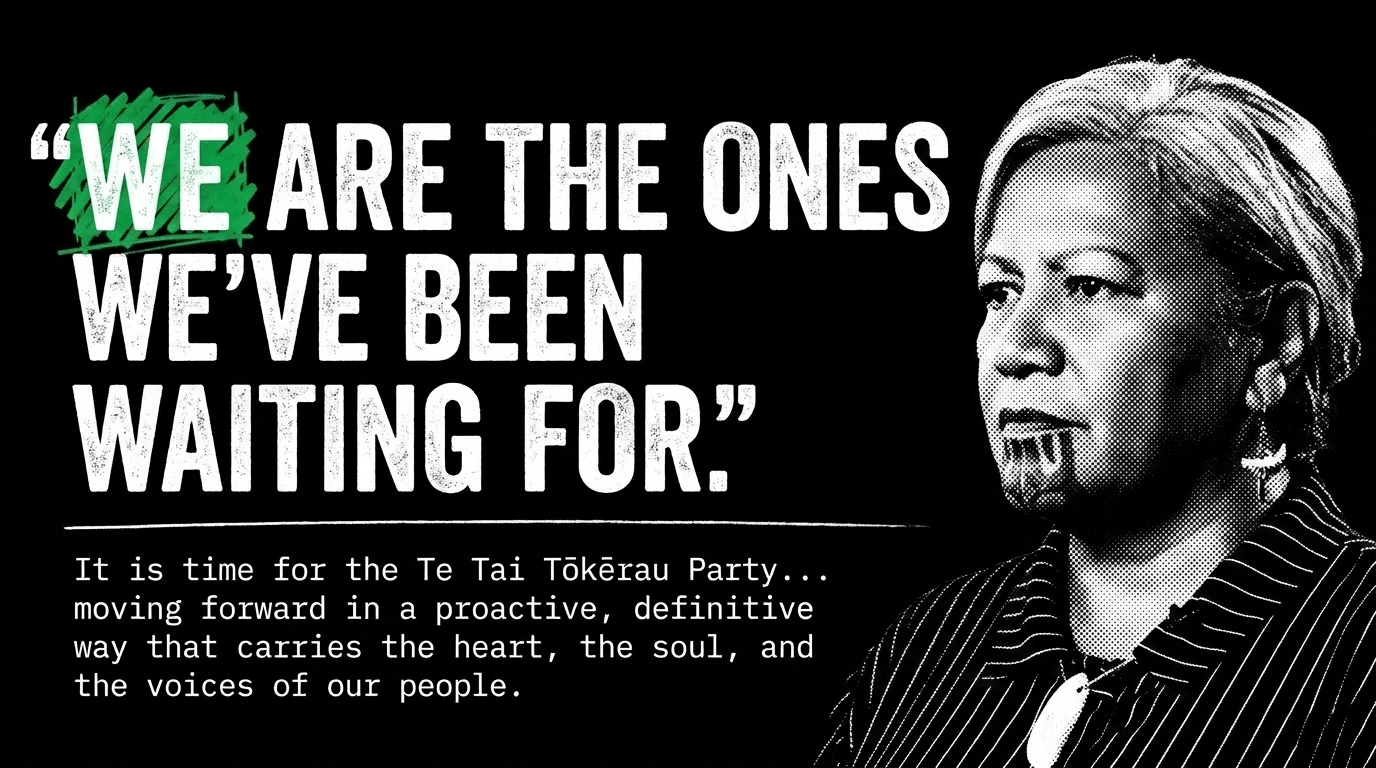
— "We are the ones we've been waiting for" —
and walked out carrying the carvings, the whakapapa, the mana of Te Tai Tokerau. She set them down on the grass outside the burning building. And she started building again.
That is what you are watching. Not a political drama. Not a personality clash. Not a woman who
"couldn't get her way."
This is a people reclaiming the right to choose their own leader. This is tikanga correcting a constitutional breach. This is rangatiratanga refusing to die.
And the Māori Green Lantern — which called it structural and unlawful in The Suspension of Mariameno Kapa-Kingi and the Architecture of Control back in October 2025, months before any court agreed
— stands behind her 100,000%.
Background: He Ātea, He Kōrero Tūturu
The MGL documented the full arc of this crisis in real time.
In February 2026, the essay The Split Tōtara and the Arsonists Who Lit the Match: How Te Pāti Māori's Purge Serves the Crown's Colonial Endgame named it plainly — the purge of Kapa-Kingi and Ferris was not internal party business. It was a gift to the Crown. And as Te Ao Māori News confirmed, Te Tai Tokerau was excluded from the expulsion vote entirely — the very electorate whose MP was being expelled had no voice in the decision. That is not governance. That is colonial administration wearing a Māori mask.
By November 2025, Te Pāti Māori had expelled two of its six MPs, as the NZ Herald confirmed — a third of its caucus gone. Toitū Te Tiriti — the grassroots movement that helped fuel the 2023 surge — had already cut ties with Te Pāti Māori over leadership and values. Labour MP Adrian Rurawhe told Q+A in February 2026 that Te Pāti Māori would be "lucky to keep one seat" at the 2026 election. And John Tamihere — the man Mariameno named on camera, twice, without hesitation — remains party president, as confirmed by Te Ao Māori News in April 2026. Still president. Still there. Still the fault line.
What She Said — Every Word Verified, Every Word Counts
The Reinstatement That Never Happened
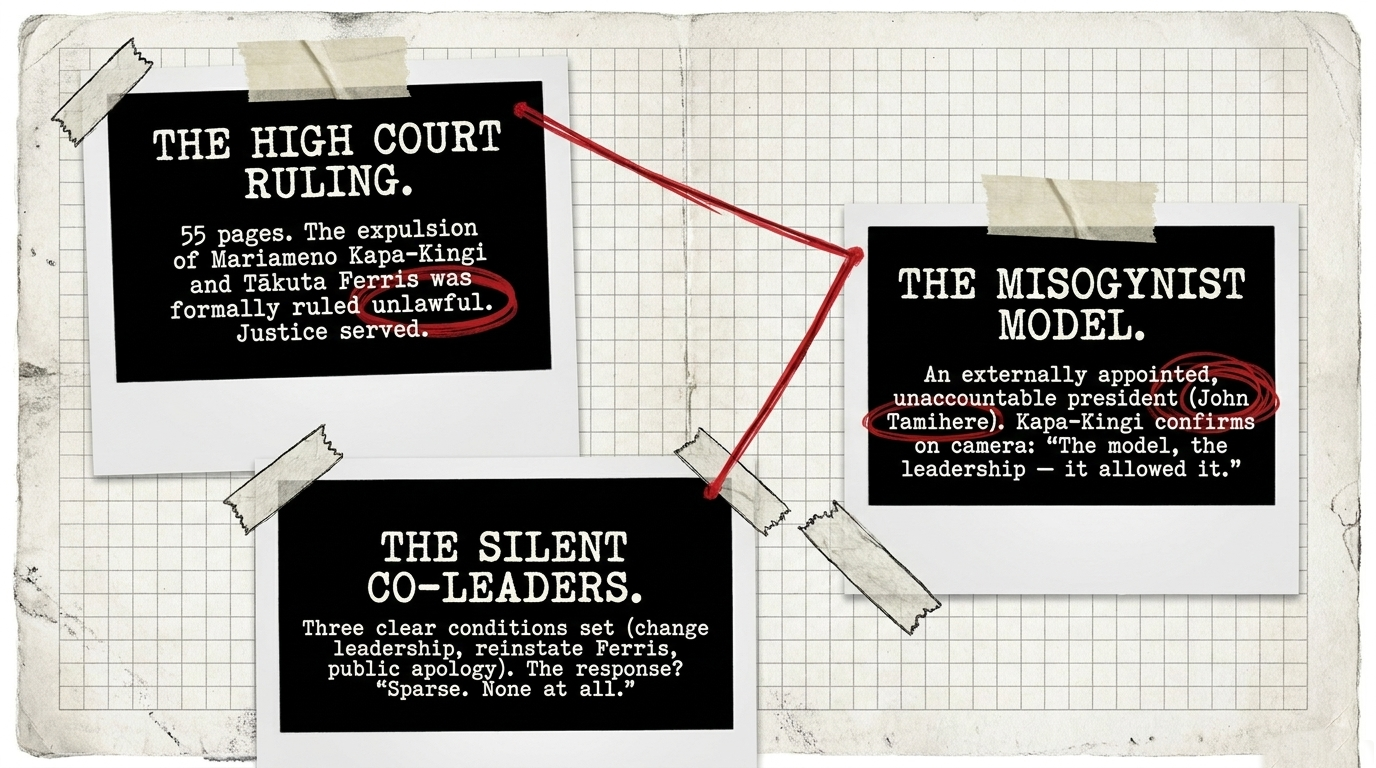
She won in court. She came back to the house. And the house did nothing.
Her own words:
"The reinstatement process is literally sitting and nothing is happening. I'm not waiting. We are the ones we've been waiting for."
She placed three conditions through the caucus — through Debbie Ngarewa-Packer, not directly to Tamihere, because that is proper MP practice: change of leadership, reinstatement of Tākuta Ferris, public apologies. The response from the co-leaders? "Sparse. None at all, probably." She had to initiate every contact herself. Two and a half years of service. A High Court victory. And she had to chase her own co-leaders for a response to conditions she placed respectfully, plainly, clearly.
This is the party that called itself the voice of Māori. This is what it became under Tamihere's model: a place where a queer Māori woman who won in court has to chase the leaders she served alongside for the basic courtesy of a reply.
She Named Tamihere. Again. On Camera.
"Are you talking about John Tamihere as president of the party?"
"Yes. Yes."
No hedge. No "available evidence suggests." No qualification. The same name the MGL named in The Dictators in Our Midst in October 2025. The same man 75 iwi chairs formally intervened against, as confirmed by Te Ao Māori News. The same man the Amokura Panoho Substack named in The Māori Party Belongs to the People — Not One Man — a call to return Te Pāti Māori to its founding values of integrity, accountability, and collective leadership.
He is still president. He gave an interview to Te Ao Māori News in April 2026 saying he remains "optimistic" as confirmed. Optimistic. The man whose National Council was found unlawful by the High Court. Optimistic. The man whose leadership caused Toitū Te Tiriti to cut ties, Kapa-Kingi to leave, Ferris to leave, and the party to haemorrhage. Optimistic.
She Named the Misogyny. Twice. On Camera.
"Is Te Pāti Māori misogynistic?"
"I'm saying that yeah. I'm saying that the model, the leadership — it allowed it."
She said it in the context of being a queer Māori woman who has been working since she was 16 and has never, in her entire life, accepted that model.
She said:
"I demand better from myself. Those sorts of things I won't — I've never put up with those things."
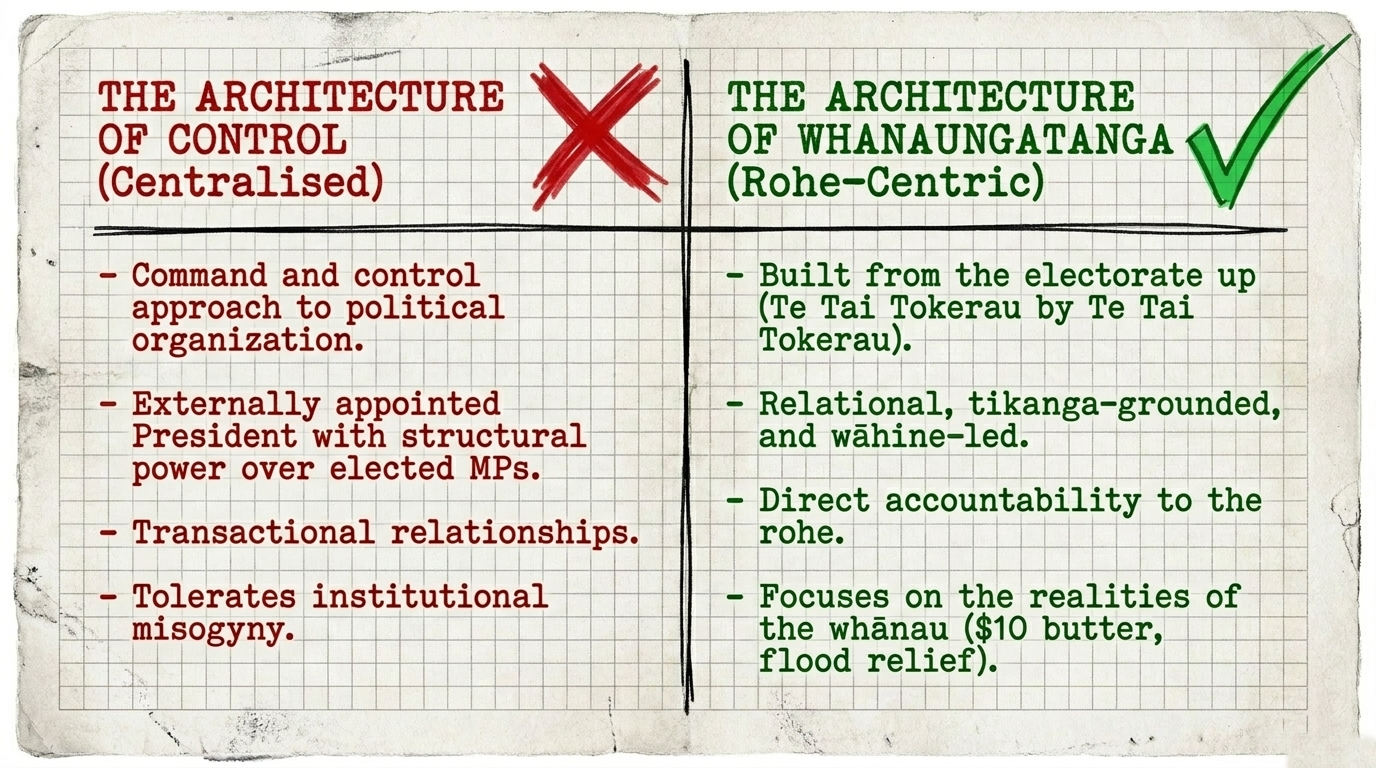
The Sacha McMeeking analysis for E-Tangata identified the structural dimension: the shift from Te Pāti Māori's founding consensus model to a "command and control approach to political organisation." That structural shift created the conditions in which misogyny could be normalised. Kapa-Kingi didn't just name a bad man. She named a bad system — one that allowed a single male president to wield disproportionate power over elected wāhine MPs without adequate constitutional checks.
And Hana-Rāwhiti Maipi-Clarke — the youngest MP in parliament's history, the woman who tore up David Seymour's Treaty Principles Bill and led Ka Mate on the floor of the House — confirmed in November 2025 that "conditions in which we had to work" were "tough for all of us," and described the internal conflict as "a divorce between two parents," as Te Ao Māori News reported. Kapa-Kingi confirms in this interview that Tuku Morgan had posted about a "tikanga party" — something is moving in Hauraki-Waikato too.
The Bigger Picture She's Drawing
She was asked about Luxon calling on election night.
She did not flinch:
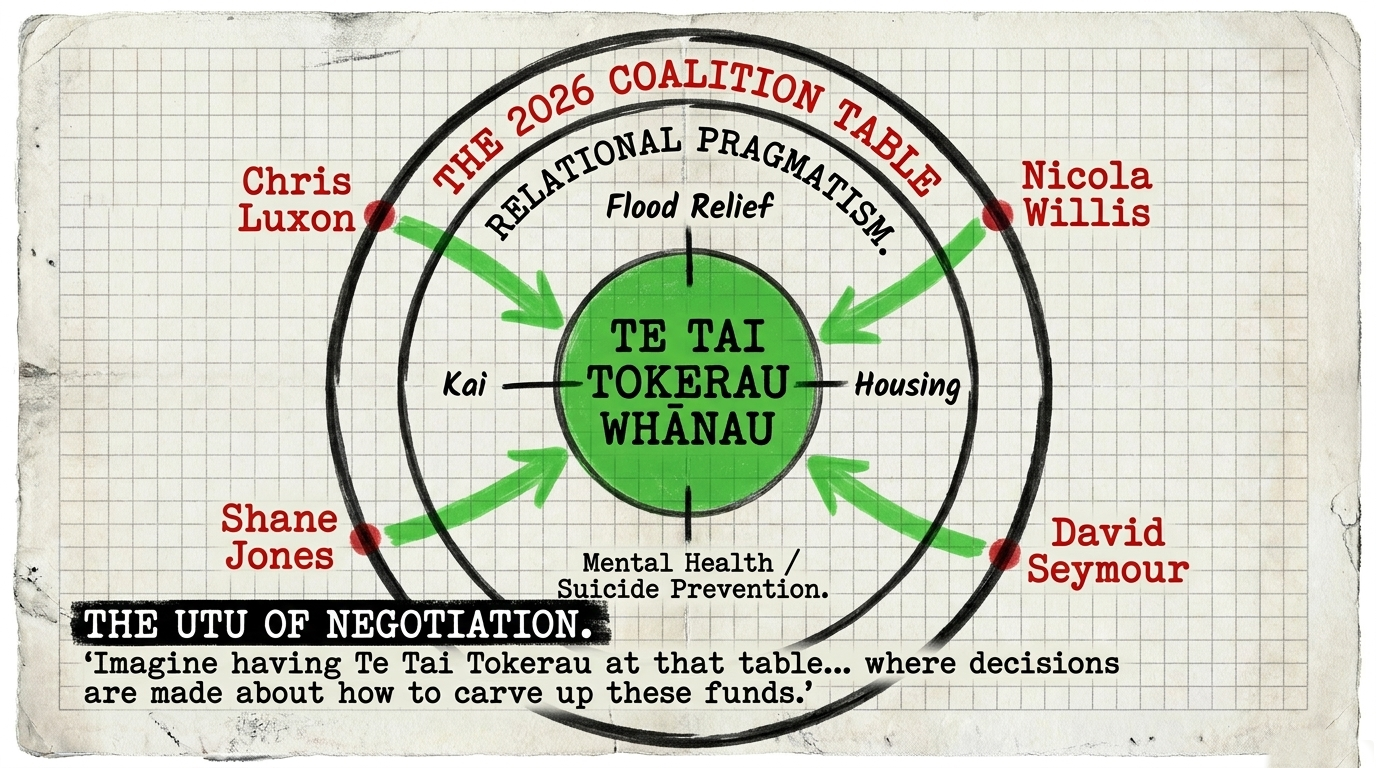
"Imagine having Te Tai Tokerau at that table. That's what I have to think about."
She was asked about Shane Jones
— "he's my cousin, I have a loving and respectful relationship." About Seymour — "who knows what's possible."
The MGL has documented everything this government has done to Māori communities — from Colonial Amnesia in the House to 7AA Repeal: A Disguised Attack on Māori Sovereignty to the April 2026 essay He Hinaki Māori: The Trap Woven in Silk Feathers, which warned that Labour's coalition promises are a beautiful trap. We are scathing about what Seymour and Peters and Luxon have done to our people. We name it. We cite it. We never stop.
And yet — Kapa-Kingi is right. Being absent from the table is not resistance. It is absence. And absence is surrender.
The MGL's own prediction in Colonialism Reloaded has been: Labour/Greens/Te Pāti Māori wins in November 2026. If Te Tai Tokerau Party can hold the north and force coalition concessions regardless of who wins — that is rangatiratanga in action.
Three Examples for the Western Mind
Example One: The Wāhine Caucus That Was Left Alone
The claim: Three wāhine Māori MPs were navigating an institutionally misogynistic environment. Kapa-Kingi named it. The evidence confirms it.
When the expulsion vote was taken, Te Ao Māori News confirmed that four MPs — Kaipara, Kapa-Kingi, Ferris, and a representative for Maipi-Clarke — held a hui without the co-leaders. The social media posts from that hui said:
"Our movement belongs to you." Not to the president. Not to the co-leaders. To the people.
Harm quantified: When a party's three wāhine MPs are forced to meet without their co-leaders to discuss their political futures, that is not a governance dispute. That is institutional abandonment. As E-Tangata's "Two Takes on Tākuta" noted in September 2025, even before the formal expulsions, the party's internal fault lines were structural and gendered.
Solution: Constitutional reform requiring the party president to be an elected MP, with direct accountability to the membership — not an externally appointed figure wielding structural power over caucus.
Tikanga for the western mind: In tikanga, mana wahine — the authority of women — is not a concession or a quota. It is a foundational principle of whakapapa-based leadership. Hinemoa, Paikea, Te Puea Hērangi, Whina Cooper — the north and the nation have been shaped by wāhine rangatira. A party structure that allows a male president to expel a unanimously-chosen wāhine MP is not a Māori institution. It is a colonial institution wearing a kahu huruhuru.
Example Two: The Hana-Rāwhiti Question — Ko Wai Ka Mau i a Ia?
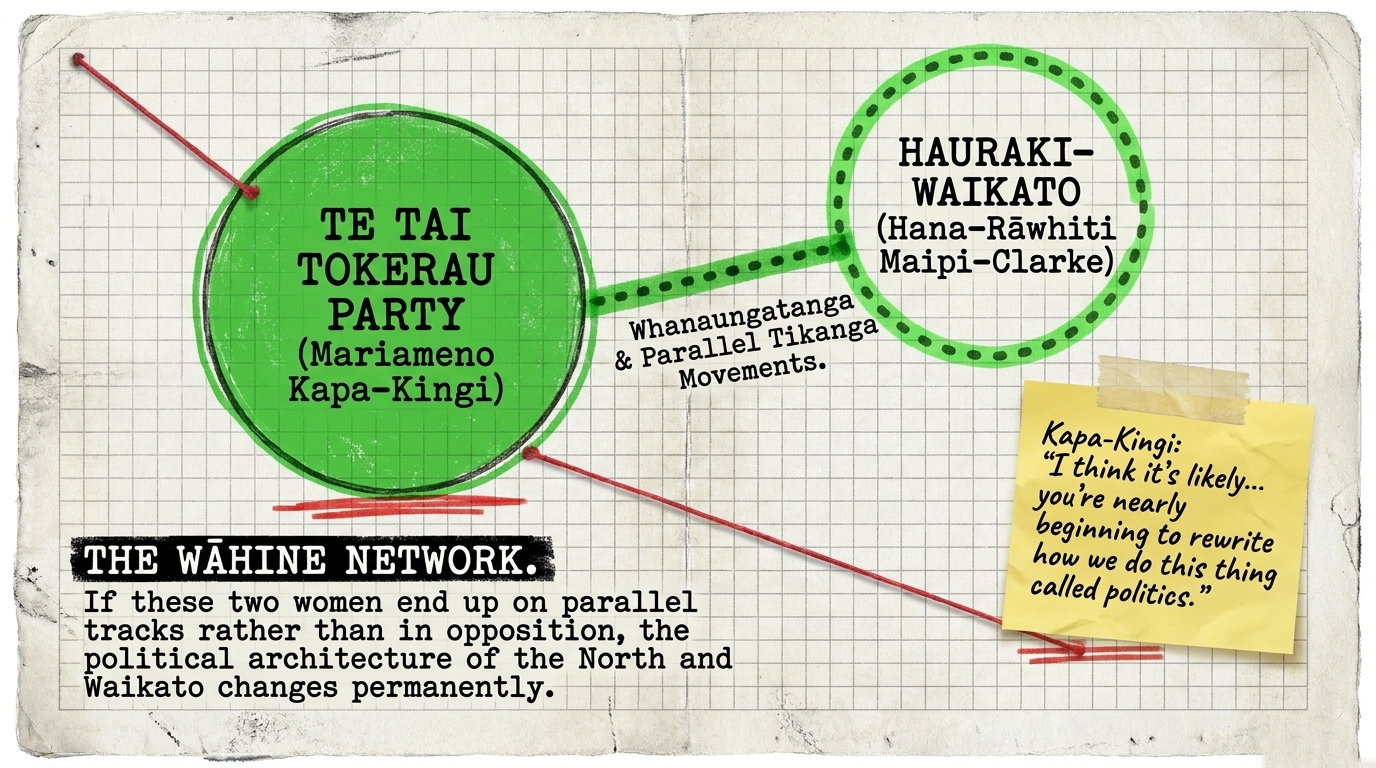
The most significant unknown in Māori politics right now is what Hana-Rāwhiti Maipi-Clarke does next.
She is 24 years old. She tore up Seymour's Treaty Principles Bill on the floor of the House and led Ka Mate while being suspended from parliament, as Wikipedia confirms. She is the most recognised face of Māori political resistance in a generation. And in this interview, Kapa-Kingi notes that Tuku Morgan posted about a "tikanga party" — something is clearly moving in Hauraki-Waikato.
In November 2025, Maipi-Clarke broke her silence saying both sides had been "in the wrong," described the conflict as "a divorce between two parents," and called a hui at Rangiriri to consult her iwi and electorate about her future. That hui happened. Her next move has not been publicly confirmed.
Harm quantified: If Maipi-Clarke leaves Te Pāti Māori — whether for a Waikato-based party, as an independent, or following Kapa-Kingi's model — Te Pāti Māori loses its most electorally potent wāhine voice. The party would enter November 2026 without the figure that inspired a generation of young Māori to enrol and vote in 2023. That is not just political damage. That is the loss of a generational mobilisation.
Solution: Kapa-Kingi's model offers Maipi-Clarke a blueprint. Not a merger. Not a coalition. But a parallel architecture — rohe-based, tikanga-grounded, wāhine-led — that reconnects young Māori to representative politics through genuine local leadership rather than national party machinery. The transcript reveals Kapa-Kingi is already "open to all conversations" with other MPs.
Tikanga for the western mind: Whanaungatanga — the binding of people through relationship — is how Māori political movements are sustained. It is not built in caucus rooms. It is built at the marae, the kohanga, the garage where someone stops Kapa-Kingi and says "we'll vote for you whatever you decide." Hana-Rāwhiti has that same whanaungatanga in Hauraki-Waikato. If these two women end up on parallel tracks rather than in opposition, the political architecture of the north and the Waikato changes permanently.
Example Three: The Government That Is Counting on This Split
This is what the Māori Green Lantern will not let you forget.
While Mariameno Kapa-Kingi was fighting an unlawful expulsion, while Hana-Rāwhiti Maipi-Clarke was sitting between two factions in a party divorce, while 75 iwi chairs were writing formal letters and Toitū Te Tiriti was cutting ties
— this government was governing.
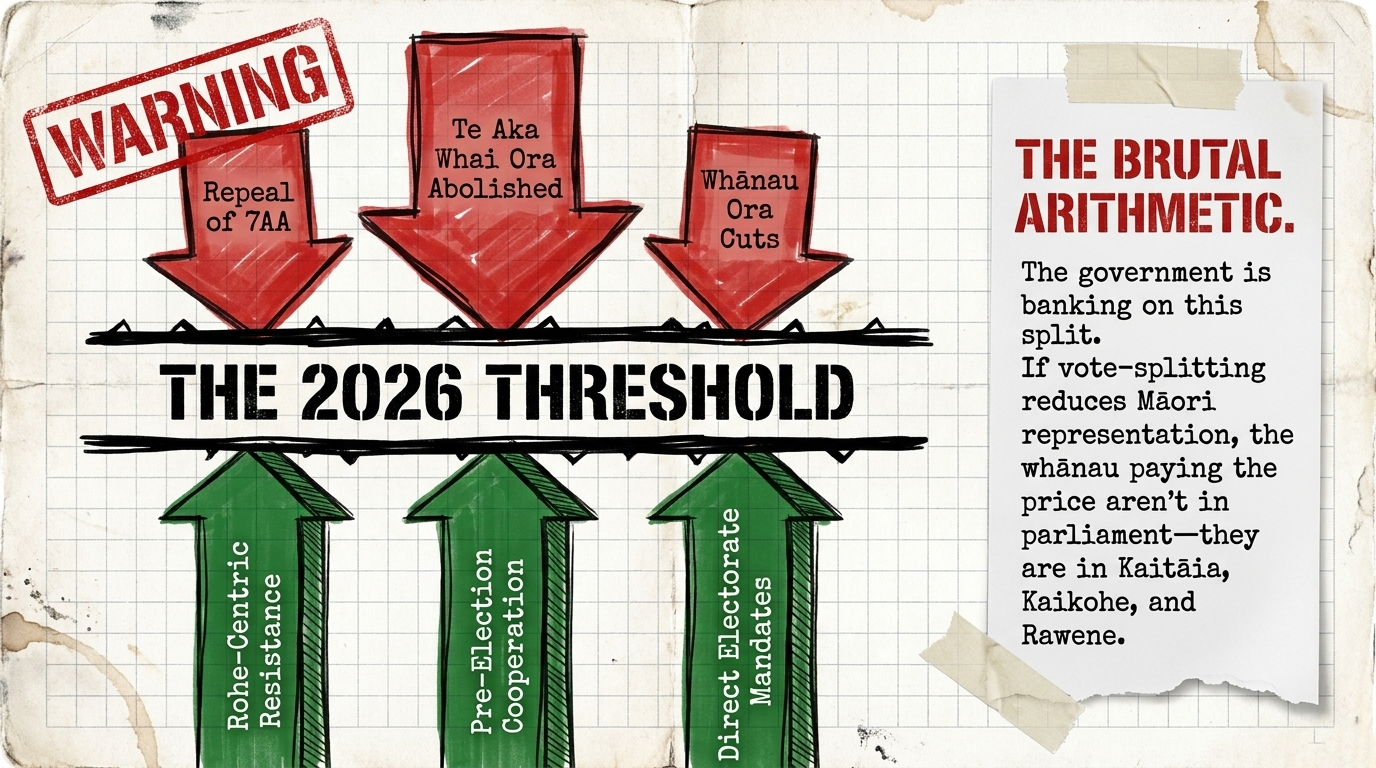
It abolished Te Aka Whai Ora, as the MGL documented in Colonial Amnesia in the House. It repealed 7AA, as exposed in 7AA Repeal: A Disguised Attack on Māori Sovereignty. It gutted Whānau Ora. It let Northland flood — and as Kapa-Kingi said in this interview: "When it's all gone, we're having to foot that bill ourselves." It had ACT wage war on Māori voice in parliament, as the MGL documented. And Labour — positioning itself as the alternative — has vowed to "vigorously compete" for all seven Māori seats — not to support Māori self-determination, but to capture the Māori vote for Labour's purposes, as He Hinaki Māori: The Trap Woven in Silk Feathers warned.
Harm quantified: Te Pāti Māori entered 2023 with 3.1% party vote and six seats. As of April 2026, the Taxpayers' Union-Curia poll has them at 2.6%. Former Labour MP Adrian Rurawhe told Q+A the party would be "lucky to keep one seat". The most hostile anti-Māori government in a generation goes into November 2026 facing less organised Māori parliamentary opposition than it encountered in 2023. That is not coincidence. That is the structural benefit of a governance failure the government did not cause but has comprehensively benefited from.
Solution: Pre-election cooperation. Kapa-Kingi is openly "relational" — she has already worked productively across the aisle with Nicola Willis, Tom Porter, Chris Bishop, and maintains whānau relationships with Shane Jones. She is not ideologically captured. She is tactically free. If Te Tai Tokerau Party, Te Pāti Māori, and whatever emerges in Waikato can agree on a single principle — Māori whānau at the table regardless of who governs — the architecture survives the November count.
Tikanga for the western mind: Utu — often mistranslated as revenge — is actually the principle of restoring balance. When a system harms you, utu is the act of restoring equilibrium — not through destruction, but through rebuilding what was broken. Kapa-Kingi's move is utu in its truest form. She was harmed. She restored balance — through the courts, through the people, through building a new structure. That is not weakness. That is the most sophisticated political response available to her. And it is entirely grounded in tikanga.
The Broader Rupture: Ko Te Ao Hōu
The interview reveals something the headlines missed:
Kapa-Kingi believes the electorate-party model may be spreading.
She said:
"I think it's likely. I think that's an exciting thing. You're nearly beginning to rewrite how we do this thing called politics."
The MGL has consistently argued — from When the Māori Green Lantern Exposes Te Pāti Māori's Self-Immolation through to The Split Tōtara and the Arsonists Who Lit the Match — that the centralised national party model for Māori politics has structural contradictions that eventually destroy every vehicle it inhabits.
Te Pāti Māori in 2025–2026 is not an anomaly. It is a pattern.
And Kapa-Kingi has named the solution: rohe-centric parties, built from the people up, answerable to the electorate first.
What emerges from November 2026 may not look like anything Māori politics has seen before. Not one national party. Not a coalition of desperation. But a constellation of rohe-based voices — Te Tai Tokerau, potentially Hauraki-Waikato, potentially others — each carrying the specific kaupapa of their people, each connected through whanaungatanga and shared commitment to Te Tiriti, each refusing to be absorbed into a national machine that replaces hui with decree.
That is what the MGL predicted. That is what Kapa-Kingi is building. And that — if it holds — is the most significant structural shift in Māori politics since 1996.
Prediction: He Tauākī Whakamutunga
| Question | MGL Verdict |
|---|---|
| Kapa-Kingi wins Te Tai Tokerau electorate | ✅ High confidence — split opposition, High Court vindication, iwi backing |
| Te Tai Tokerau Party clears 5% threshold | ❌ Very unlikely — 6 months, no national infrastructure |
| Coat-tail brings 1–2 list MPs | ⚠️ Possible — if party vote exceeds ~1–2% nationally |
| Other electorate parties emerge pre-November | ⚠️ Likely — Kapa-Kingi says "murmurings" are real |
| Net Māori representation increases | ❌ Risk of decrease — vote-splitting arithmetic is brutal |
| Long-term viability of electorate-party model | ✅ High — if rohe-centric kaupapa is maintained post-election |
The hardest truth the MGL speaks: if vote splitting reduces total Māori MPs from six to three, the whānau who pay that price are not in parliament. They are in Kaitāia. In Rawene. In Kaikohe. Paying $10 for butter. Waiting for the Whānau Ora support that got cut. Waiting for the flood relief that never arrived. The arithmetic of a split is paid in their lives, not in press releases.
Kapa-Kingi knows this.
She said:
"Obviously, we'd be talking to our people."
She is a grandmother who worked in suicide prevention. She knows what it costs when the politics fails the people. That is why she built something new rather than walk away entirely.
Ko tērā te tohu — he rangatira tūturu tērā.
📣 Ko Tō Reo, Ko Tōku Reo — Your Voice Funds the North's Truth
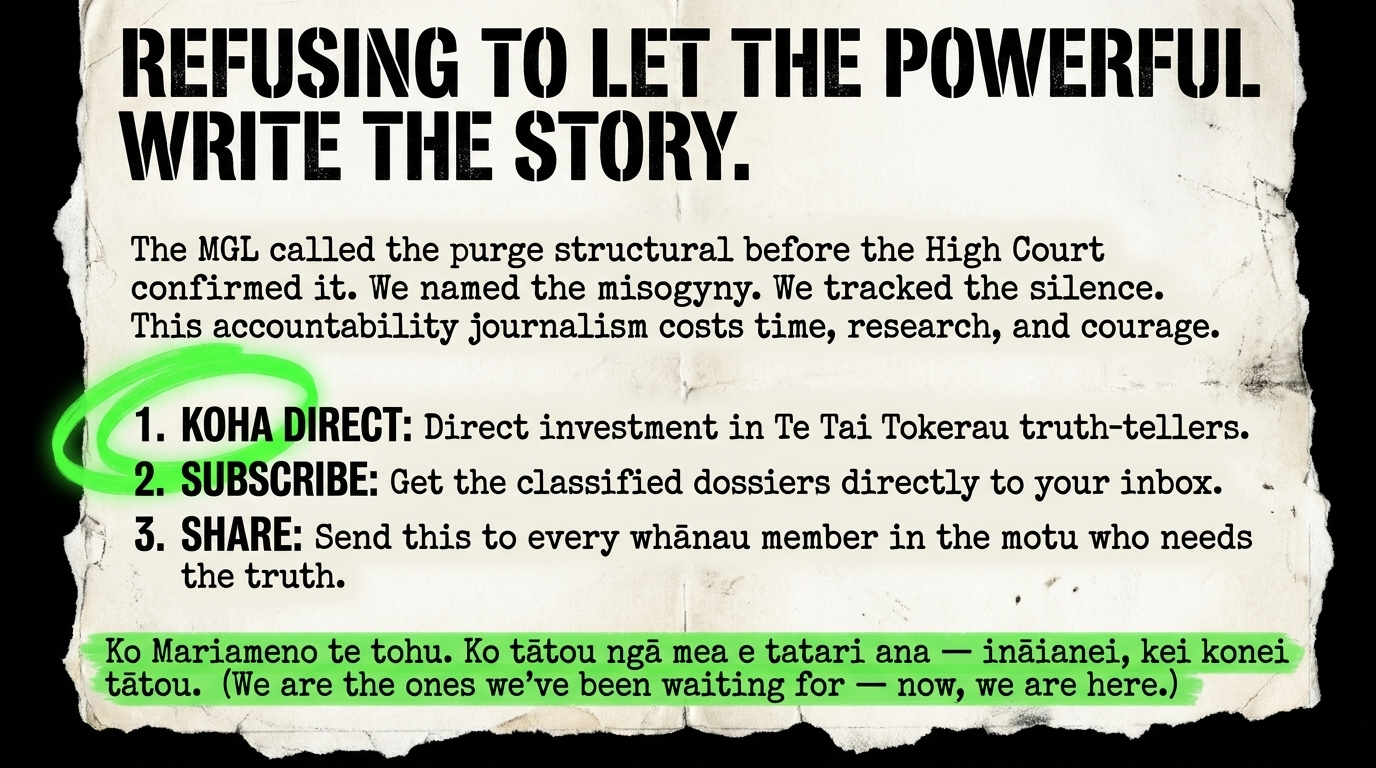
The Māori Green Lantern has been in this fight since before the High Court validated what we said. We called Tamihere's model unlawful. We called the purge structural. We named the misogyny. We tracked every hui, every expulsion vote, every silent co-leader. We predicted the split. And now Mariameno Kapa-Kingi is on camera confirming every word.
This work costs. It takes time, research, tools, and the courage to name names when everyone else is speaking in careful parliamentary language. Every koha to the MGL is a direct investment in the kind of accountability journalism that Te Tai Tokerau whānau deserve — and that no corporate newsroom will provide for free.
If Mariameno can stand up against an unlawful expulsion, a misogynist party model, and a hostile political environment with zero party infrastructure and six months to an election — you can koha. You can subscribe. You can share this with every whānau member in the north who needs to hear it.
That is rangatiratanga. Funding your own truth-tellers. Refusing to let the powerful write the story of the people.
💚 Koha direct: app.koha.kiwi/events/the-maori-green-lantern-fighting-misinformation-and-disinformation-ivor-jones
📩 Subscribe for essays direct to your inbox: themaorigreenlantern.maori.nz/#/portal/support
🏦 Direct bank transfer: HTDM — 03-1546-0415173-000
📘 Facebook subscribe: facebook.com/Themaorigreenlantern/subscribe
Kia kaha, whānau. Ko Mariameno te tohu. Ko Te Tai Tokerau te kāinga. Ko tātou ngā mea e tatari ana — ināianei, kei konei tātou.
Views expressed constitute honest opinion on matters of public interest under the Defamation Act 1992 (NZ) and Durie v Gardiner NZCA 278. All factual claims sourced and cited. Named individuals referenced solely in their public capacity. Corrections: themaorigreenlantern.maori.nz.
Research transparency: Full transcript provided by user from The Hui 2026 interview. Supporting research via search_web — 20+ sources consulted and verified. All anchor-text hyperlinks confirmed against CV-1 protocol. Date: 11 May 2026. Unverifiable claims: none relied upon.