"$20,000 TO OWN A RAILROAD: HOW WINSTON PETERS AUCTIONED NEW ZEALAND'S RAIL NETWORK TO A DONOR AND CALLED IT GOVERNANCE" - 20 April 2026
When the Crown's Rail Infrastructure Becomes a Party Fundraising Perk — and the Board Chair Has to Draw the Corruption by Hand


E hoa mā,
— let's start with a story your grandmother would understand.
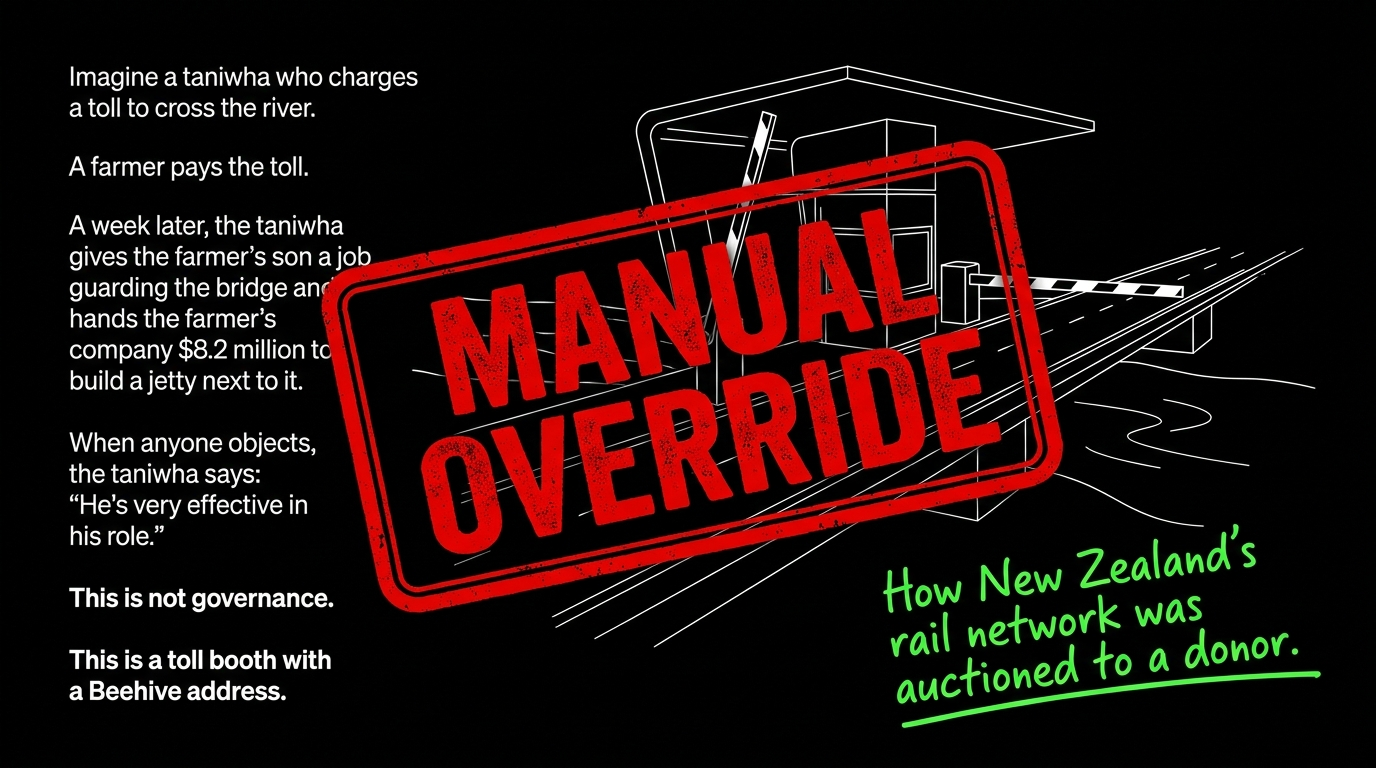
Imagine a taniwha who charges a toll to cross the river. A farmer pays the toll.
A week later, the taniwha gives the farmer's son a job guarding the bridge, hands the farmer's company $8.2 million to build a jetty next to it, and then, when anyone objects, says:
"He's very effective in his role."
 Farah Hancock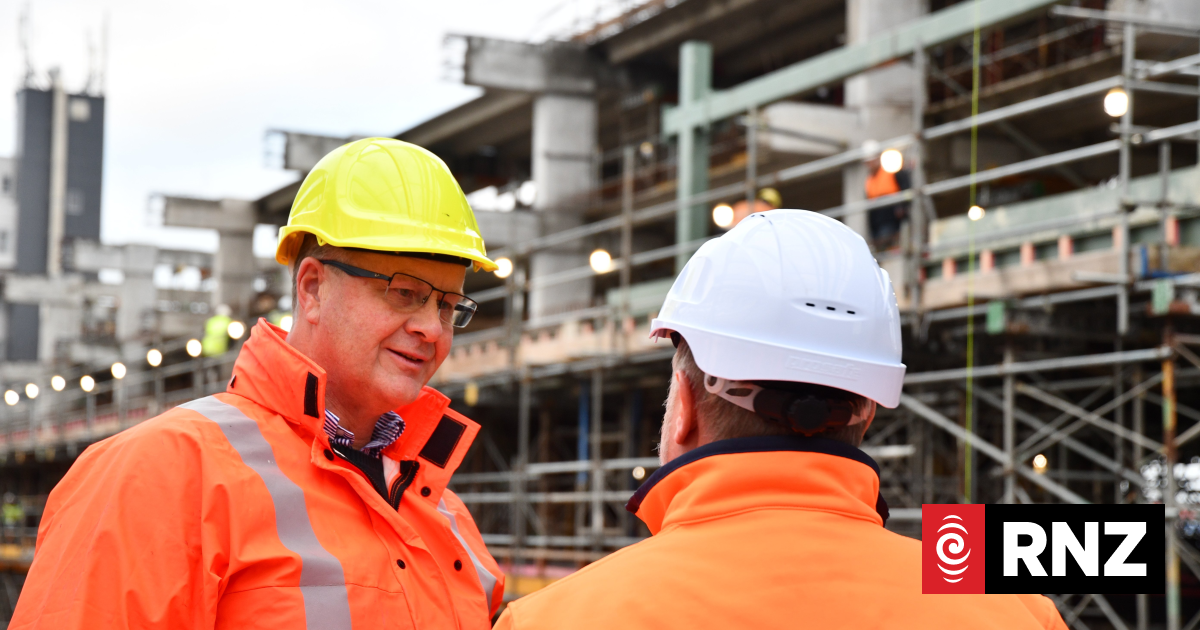
The Deep Dive Podcast
Listen to a lively conversation between two hosts, unpacking and connecting topics in the sources of this essay.
That is what Winston Peters did with New Zealand's national rail network.
That is what Scott O'Donnell's KiwiRail board appointment was.
And that is what this government
— a white-supremacist neoliberal project dressed in coalition clothing
— does every single week while the rest of us argue about the cost of groceries.
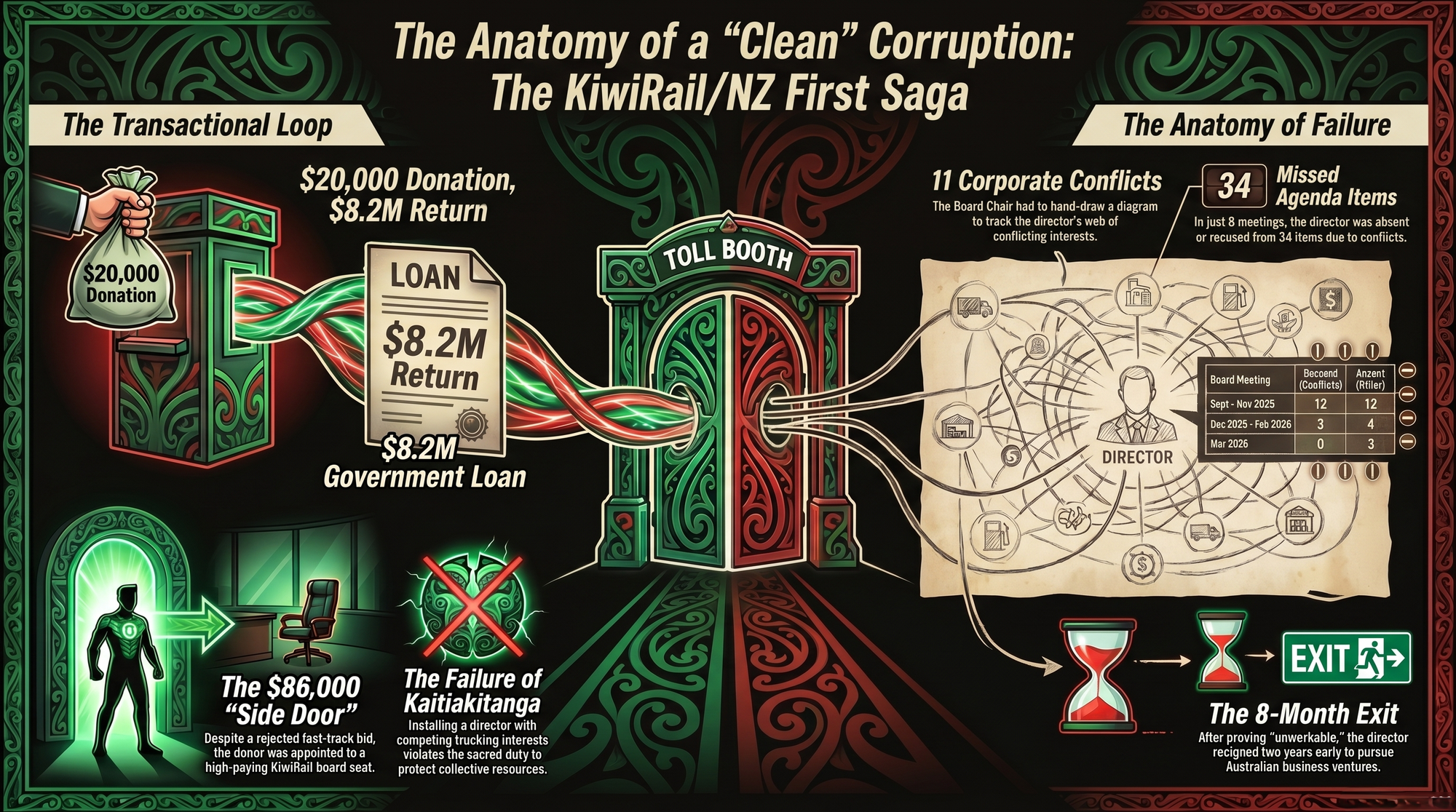
This is not governance. This is a toll booth with a Beehive address.
The Price Tag: $20,000 for a Nation's Infrastructure
Let's be brutally precise about the transaction.
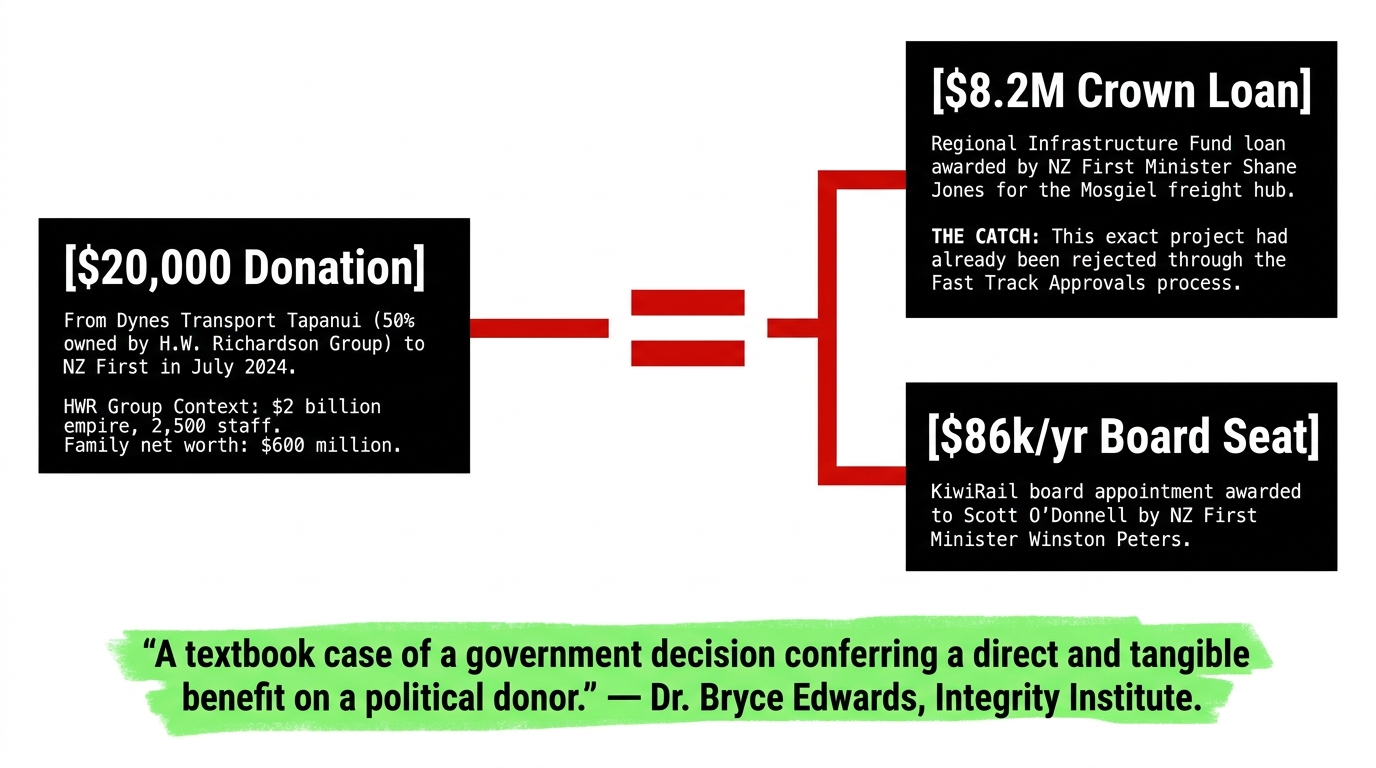
Dynes Transport Tapanui — 50% owned by the H.W. Richardson (HWR) Group, of which Scott O'Donnell and his family own 75% — donated $20,000 to NZ First in July 2024.
The Richardson family, whom O'Donnell married into, are listed in the NBR Rich List as worth $600 million
— up $100 million in a single year
— employing 2,500 staff with a $2 billion annual turnover.
These are not struggling small-business owners. These are people for whom $20,000 is a rounding error on a single fuel invoice.
And yet, the return was extraordinary:
- Shane Jones — NZ First MP, Regional Development Minister — awarded an $8.2 million Regional Infrastructure Fund loan to Dynes' joint venture with Port Otago for the Mosgiel freight hub
— a project that had already been rejected through the Fast Track Approvals process.
- Winston Peters — NZ First leader, Deputy Prime Minister, Rail Minister — appointed O'Donnell to the KiwiRail board in July 2025, a seat worth up to $86,000 per year.
The same party. The same donor. Two ministers. Two payouts.
The Integrity Institute's Dr Bryce Edwards called it a textbook case of a government decision conferring a direct and "tangible benefit" on a political donor
— precisely the scenario the Auditor-General warned creates "significant risks to public integrity."
One door closed through Fast Track. A political donation quietly opened another. That is not coincidence. That is architecture.
Three Examples the Western Mind Will Understand
Example 1: The Revolving Door (The American Way)
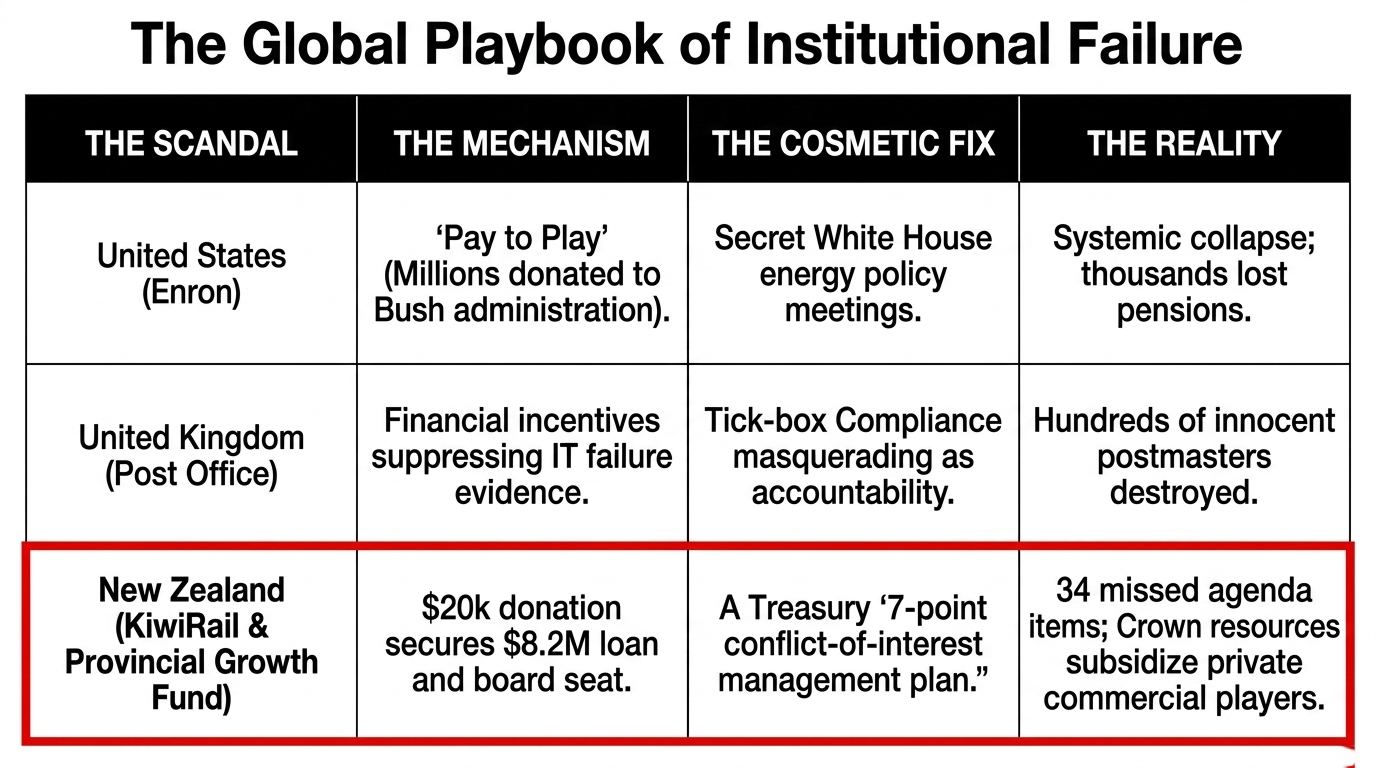
In the United States, this is called "pay to play." When Enron donated millions to the Bush administration and its energy executives literally co-wrote U.S. energy policy in secret White House meetings, the world called it corruption. When it collapsed, thousands lost their pensions. The mechanism here is identical — only the dollar amounts are smaller, and the New Zealand media is polite enough to call it a "conflict of interest management plan" rather than what it is. As the Integrity Institute documents, a private freight company that donated $20k to a governing party received $8.2 million in Crown funding through a discretionary fund controlled by a single minister from that same party — after being rejected through the multi-minister oversight process. The lesson: when the front door has scrutiny, a donation buys a side door.
Example 2: The Seven-Mitigation Farce (The British Boardroom Way)
In the United Kingdom, when the Post Office Horizon scandal broke — where executives with deep conflicts of interest and financial incentives actively suppressed evidence of IT failures that destroyed hundreds of innocent postmasters — the public inquiry found that governance had been reduced to performance. Tick-box compliance masquerading as accountability. Here, Treasury produced a seven-point conflict-of-interest mitigation plan for O'Donnell before he sat in a single meeting. As the Integrity Institute found, the Cabinet Manual is explicit: where a conflict is "significant and pervasive," the only appropriate remedies are divestment or resignation — not a seven-point plan. The Government chose the cosmetic solution. Board chair Suzanne Tindal had to personally go to the Companies Office, draw her own diagram of the corporate web, and essentially beg MPs to understand that she hadn't appointed this man. That is not governance. That is one woman trying to hold up a rotting ceiling with her bare hands.
Example 3: The Provincial Growth Fund — A Slush Fund With New Clothes
Shane Jones' Regional Infrastructure Fund is the direct successor to the Provincial Growth Fund — widely criticised during the 2017–2020 Labour-NZ First government as a political slush fund used to reward supporters. Same minister. Same fund. Same playbook. Different logo. A rival privately-funded inland port proposal — Calder Stewart's $3 billion Milburn project — was already in the pipeline, meaning there was no market failure requiring government intervention. As the Integrity Institute concluded, Minister Jones' decision was "not one of necessity, but of choice: a decision to use public money to subsidise one commercial player over another" — the one that had funded his party. The Clutha District Mayor expressed public frustration that the Mosgiel announcement came "out of the blue." The market didn't need fixing. The donor needed rewarding.
What This Does to Tikanga — For Those Who Need It Explained
For pākehā readers who wonder why Māori are so angry about a board appointment: let me be plain.
Tikanga is not a cultural add-on. It is the living architecture of ethical obligation — to people, to place, to future generations. At its core is the concept of kaitiakitanga: the duty to protect and steward resources not for personal gain, but for the collective wellbeing of all who depend on them. A board director of a state-owned enterprise holds kaitiakitanga over infrastructure that moves the nation's freight — over whenua, across awa, through rohe. That is a sacred trust, not a commercial sinecure.
What O'Donnell's appointment did was install someone whose financial obligations ran directly counter to the infrastructure he was meant to protect. His companies supply services to KiwiRail. His joint venture depends on KiwiRail's strategic decisions for its profitability. His trucking interests compete with rail freight. He had fiduciary duties to two masters — and they were not aligned. As the Integrity Institute put it:
"These interests are not aligned; they are in direct and perpetual conflict."
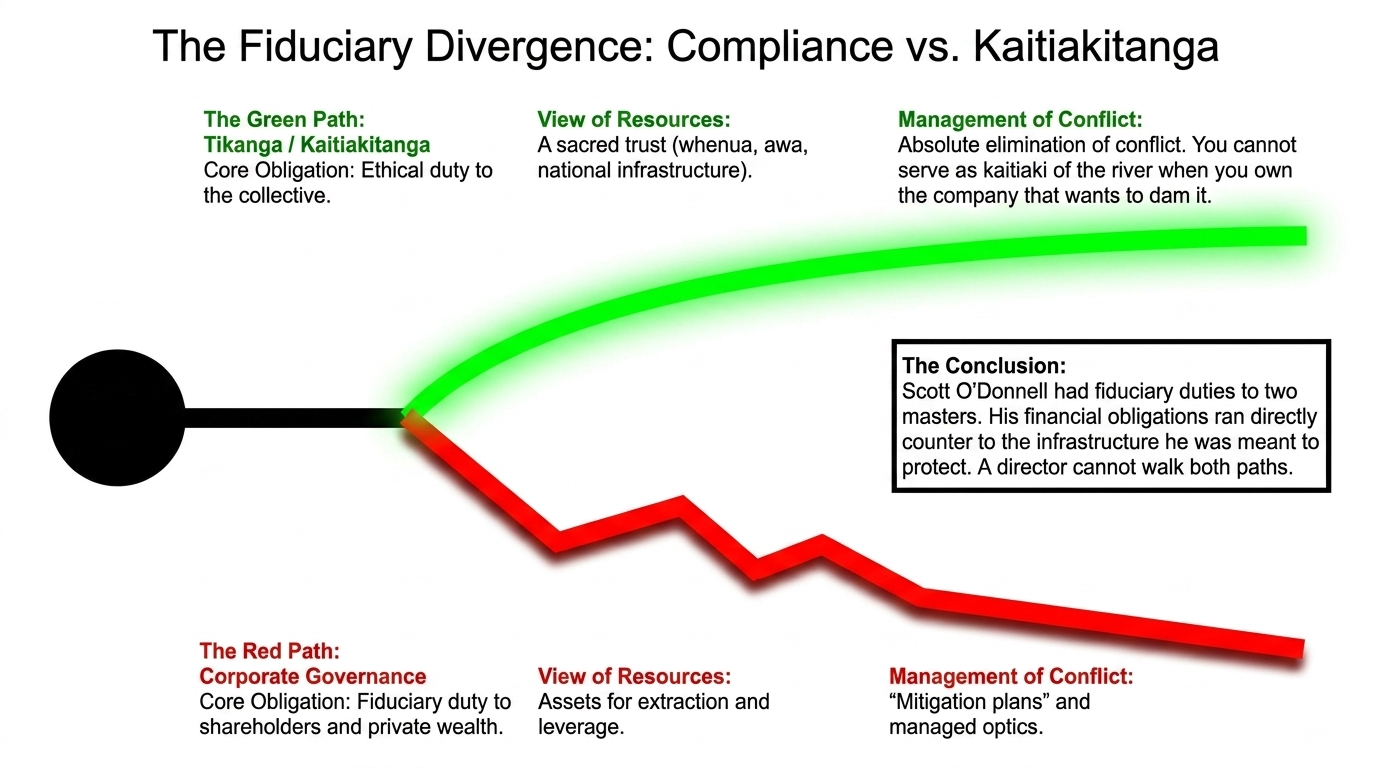
In tikanga terms: you cannot serve as kaitiaki of the river when you own the company that wants to dam it.
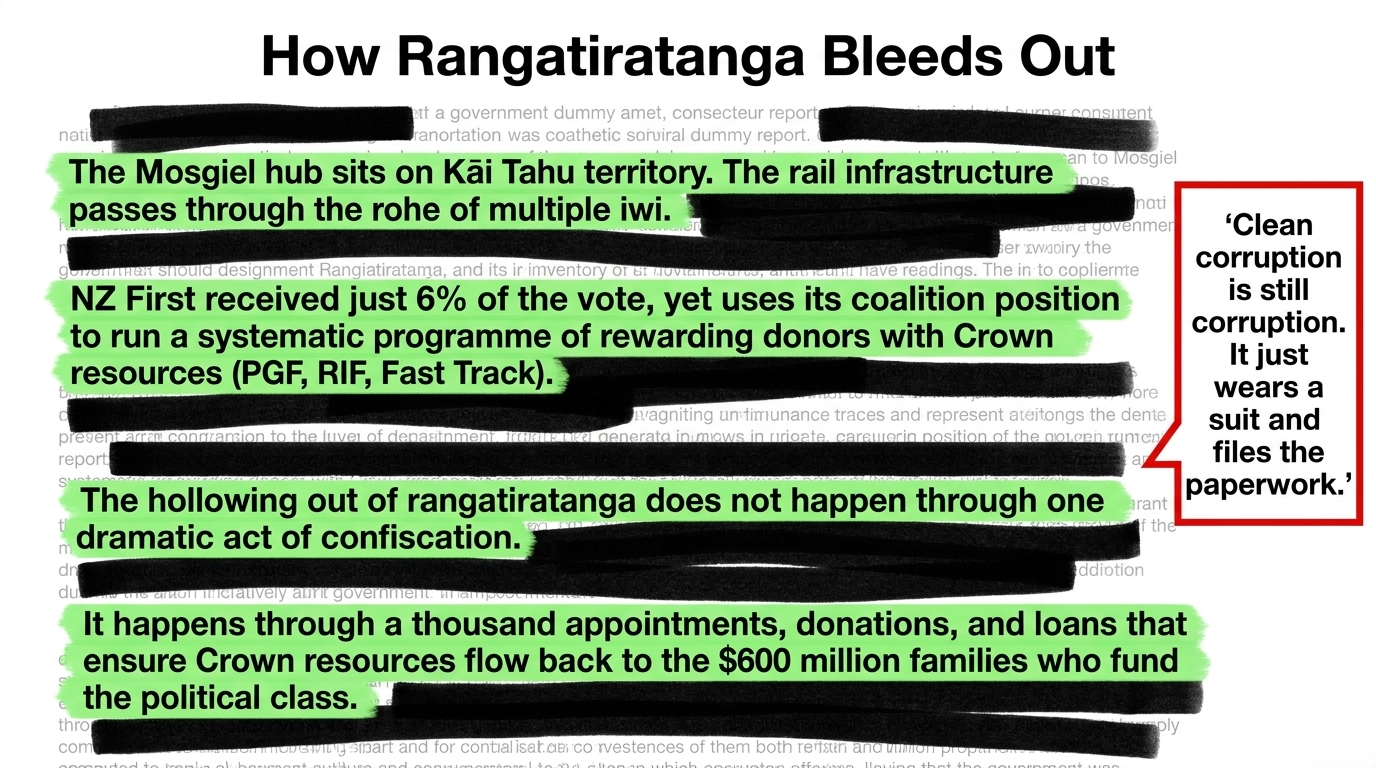
The Mosgiel hub sits on Kāi Tahu territory. The rail infrastructure passes through the rohe of multiple iwi. When Crown infrastructure loans flow to projects that have been rejected on their merits, when board seats are purchased through party donations, when conflicts are "managed" rather than eliminated
— Māori communities are, as always, the last to benefit and the first to bear the cost. The erosion of institutional integrity is not abstract.
It is the specific, measurable mechanism by which rangatiratanga is hollowed out — not by one dramatic act of confiscation, but by a thousand appointments, donations, and loans that ensure the Crown's resources flow back to those who fund the political class.
For more on how this government is systematically dismantling the institutions that protect Māori, see previous essays from The Māori Green Lantern: "Drill Baby, Drill — Into Your Own Fraud", which maps how the same coalition is strip-mining Te Tiriti alongside its resource extraction agenda; and the essay on "He Promised to Fix the Economy. He Broke the People.", which traces the human cost of these same neoliberal choices on whānau who cannot donate $20,000 to anyone.
The Anatomy of a Corrupt Appointment
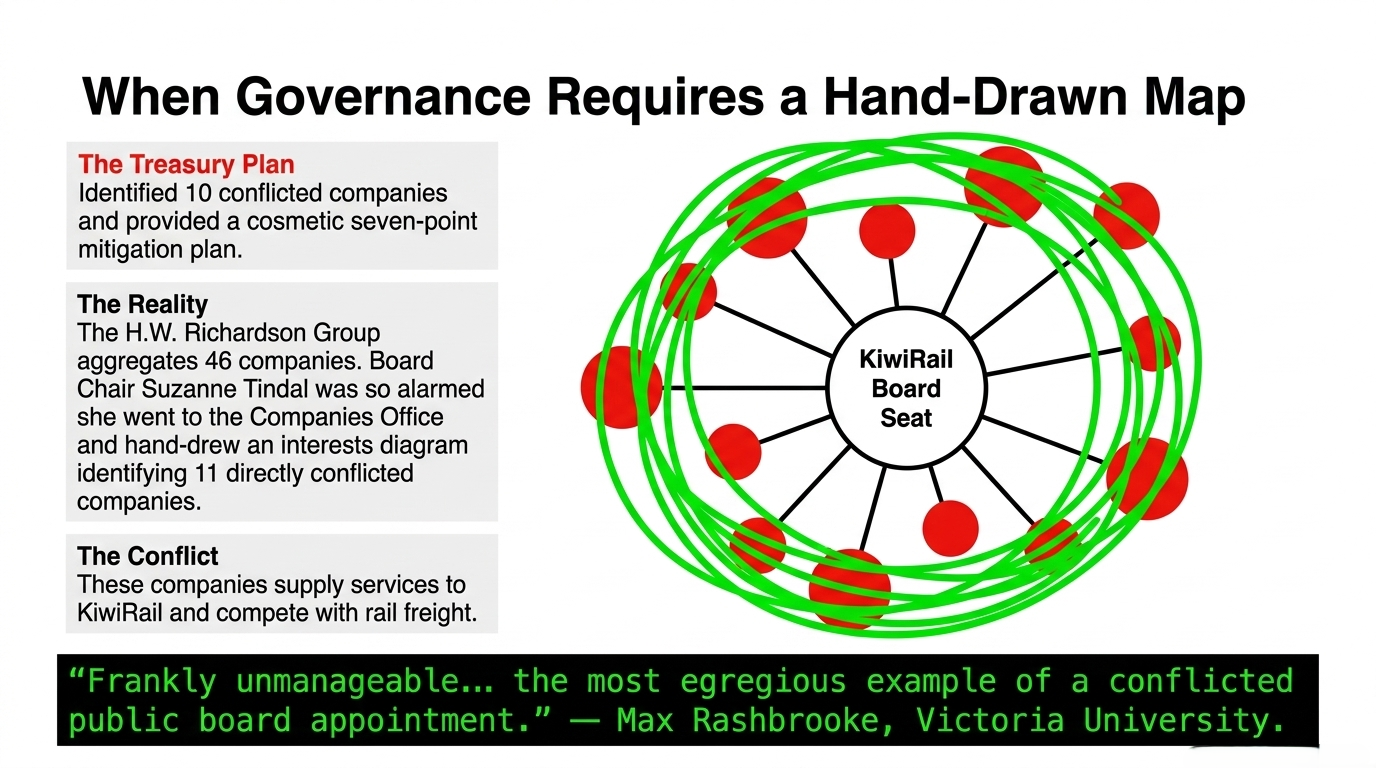
The H.W. Richardson Group aggregates 46 companies, employs approximately 2,500 people, and has an annual turnover of approximately $2 billion. The conflicts identified in O'Donnell's Treasury-managed plan included ten companies — let that settle for a moment. Ten companies. And they still proceeded. Board chair Tindal didn't wait for Treasury. She went to the Companies Office herself and hand-drew an interests diagram identifying 11 companies with conflicts. OIA documents reveal she was so alarmed she personally mapped the corporate web before formally raising her concerns. The minister ignored her.
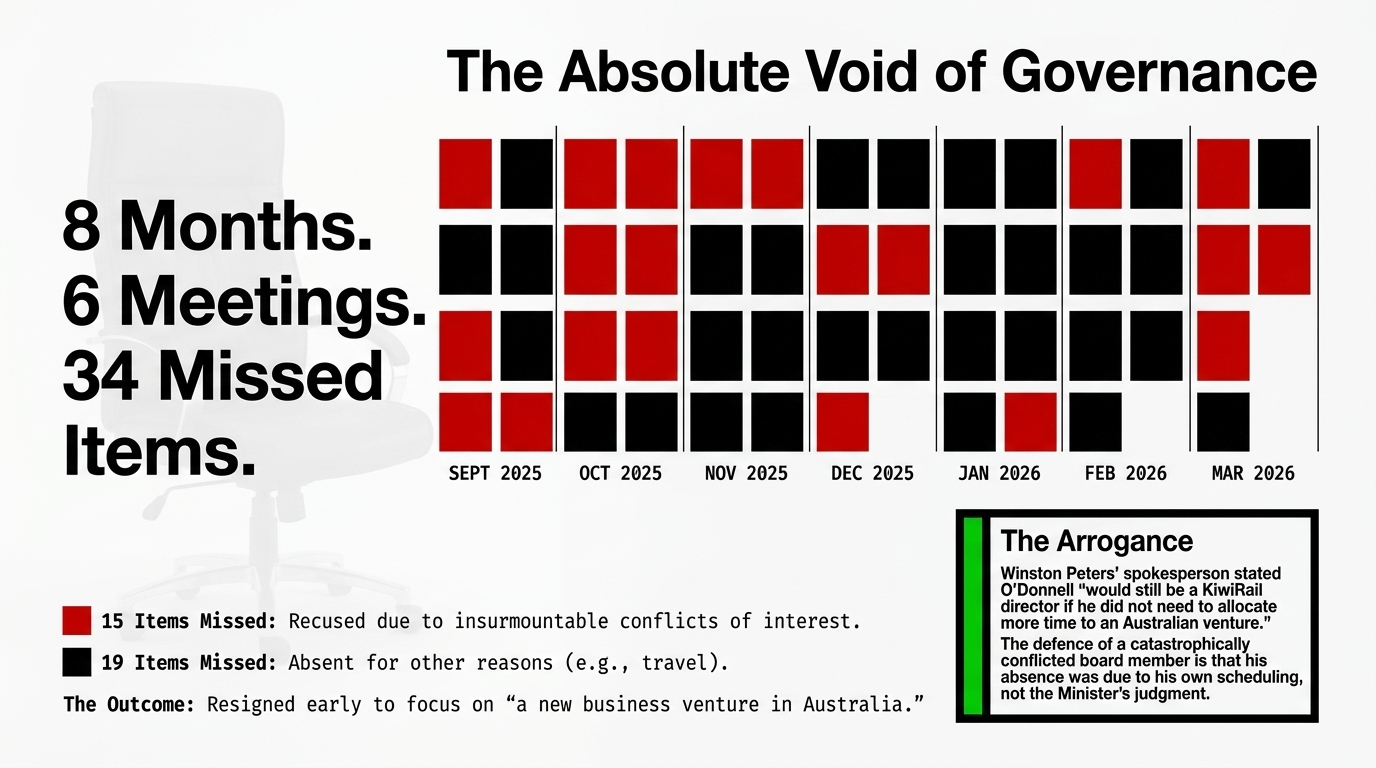
The results were as predictable as they were catastrophic:
| Board Meeting | Recused (Conflicts) | Absent (Other) |
|---|---|---|
| Sep 2025 | 1 | 12 |
| Oct 2025 | 5 | 0 |
| Nov 2025 | 6 | 0 |
| Dec 2025 | 2 | 0 |
| Feb 2026 | 1 | 4 |
| Mar 2026 | 0 | 3 |
| TOTAL | 15 | 19 |
Thirty-four agenda items. Six meetings. Eight months. Then gone — to "a new business venture in Australia." The board chair told Parliament during scrutiny week in December 2025 that O'Donnell's conflicts of interest were affecting the board's capability and efficiency — and reminded the MPs present, with notable precision, that she did not appoint directors. Victoria University's Max Rashbrooke called it the most egregious example of a conflicted public board appointment he had ever seen, describing the conflicts as "frankly unmanageable." ACT MP Simon Court — hardly a radical — acknowledged the appointment had proven "unworkable," and that the board had made every effort to work around conflicts that were fundamentally too extensive to manage.
The Arrogance: A Government Without Shame
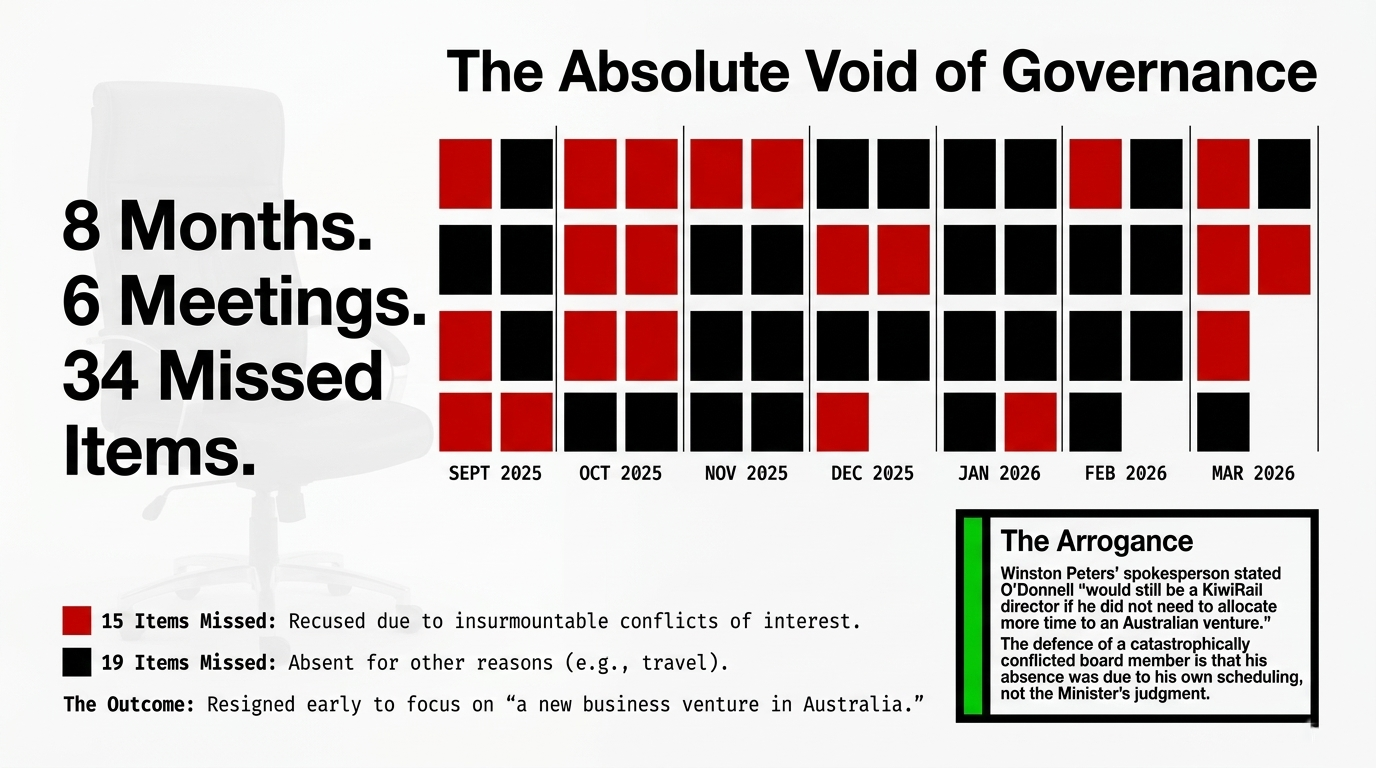
When confronted with 34 missed agenda items, Peters' spokesperson did not apologise. They said: "We remind you that Mr O'Donnell would still be a KiwiRail director if he did not need to allocate more time to an Australian venture."
Read that again. The defence of a catastrophically conflicted, absent board member — who collected tens of thousands of Crown dollars for eight months of compromised presence — is that he would still be there if he hadn't chosen to leave. The implication being: the failure is his scheduling, not the minister's judgment. Peters thanked O'Donnell for his "service to our country." As Bryce Edwards wrote: the farce is over, but the embarrassment should last.
It won't. Because this is a government that does not experience embarrassment. It experiences elections every three years, and in the meantime, it governs for its donors.
In O'Donnell's own words to the 2025 NBR Rich List interview — this is a man who complained about government "red tape" and the standard government answer being "no, not how can we get it done?" A man with a $2 billion family business empire, who paid $20,000 to the party that controls the ministry that oversees the infrastructure that intersects with his businesses at every level — and then sat on the board of that infrastructure body while his companies continued to supply it. His complaint about red tape is the complaint of a man who bought himself a pair of scissors.
What Must Happen: Structural Reform, Not Managed Corruption
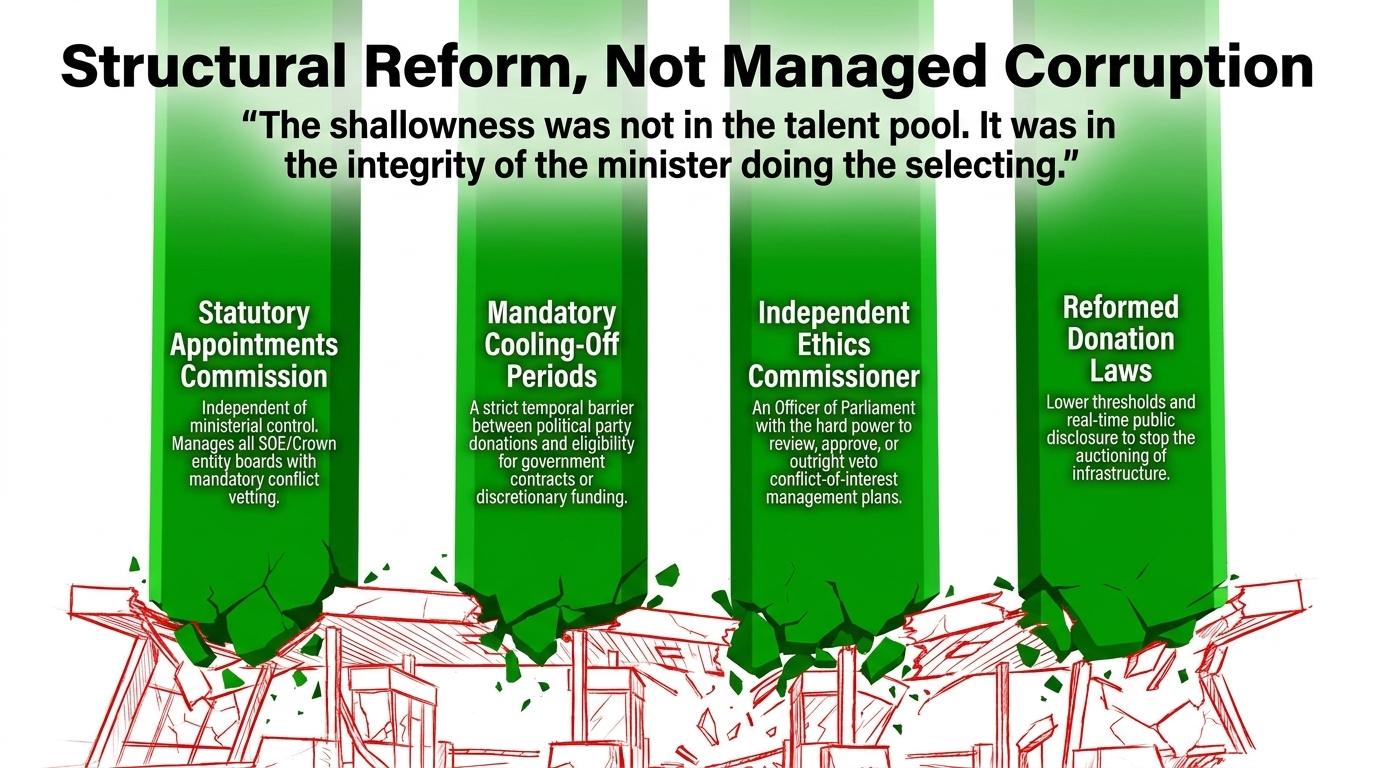
Max Rashbrooke is right that an overhaul is needed — but the prescription must be radical, not cosmetic.
As the Integrity Institute demands:
- A Statutory Appointments Commission — independent of ministerial control — to manage all SOE and Crown entity board appointments through open recruitment, with mandatory conflict vetting and pre-approved shortlists
- Mandatory cooling-off periods between political party donations and eligibility for government contracts, discretionary funding, or Crown appointments
- An Independent Ethics Commissioner — an Officer of Parliament — with the power to review, approve, or veto conflict-of-interest management plans
- Reformed political donation laws with lower thresholds and real-time public disclosure
As the Integrity Institute concluded, the Dynes Transport case
"illustrates the thin line between legitimate political patronage and problematic conflicts of interest."
But let's be honest: that line was not approached carefully here. It was bulldozed — by a $2 billion freight empire, with a $20,000 donation, through a side door opened by a minister who controls a discretionary fund answerable to no one but himself.
New Zealand is not so small that it contains only one qualified transport director. As Rashbrooke told RNZ:
"Sometimes the talent pools will be shallow, that is absolutely true, but they're not so shallow that they contain only one person."
The shallowness was not in the talent pool. It was in the integrity of the minister doing the selecting.
This Is What Corruption Looks Like in a Country That Refuses to Name It
New Zealand prides itself on its low Transparency International corruption score. It prides itself on being "clean." But clean corruption is still corruption. It is just corruption that wears a suit, files the paperwork, draws up the management plan, thanks you for your service, and moves on.
The O'Donnell-KiwiRail saga is not an aberration. It is the operating system. NZ First — a party that received 6% of the vote — has used its coalition position to run a systematic programme of rewarding donors with Crown resources. The Provincial Growth Fund. The Regional Infrastructure Fund. The Fast Track Approvals process. The SOE boardrooms. All of it flowing, with careful documentation and a compliant Cabinet, toward those who fund the party.
This is what rangatiratanga bleeds out to. Not one dramatic confiscation. A thousand appointments. A thousand donations. A thousand "conflict management plans" that manage nothing except the optics, while the resources flow where they always flow — away from whānau, toward the $600 million families who are already comfortable enough to complain about red tape.
$20,000 donation.
$8.2 million Crown loan.
$86,000-per-year board seat.
34 missed agenda items.
Eight months.
Gone to Australia.
"Very effective in his role."
Tēnā koutou. Name it. Every time.
💚 Koha — Fund the Accountability This Government Won't Provide
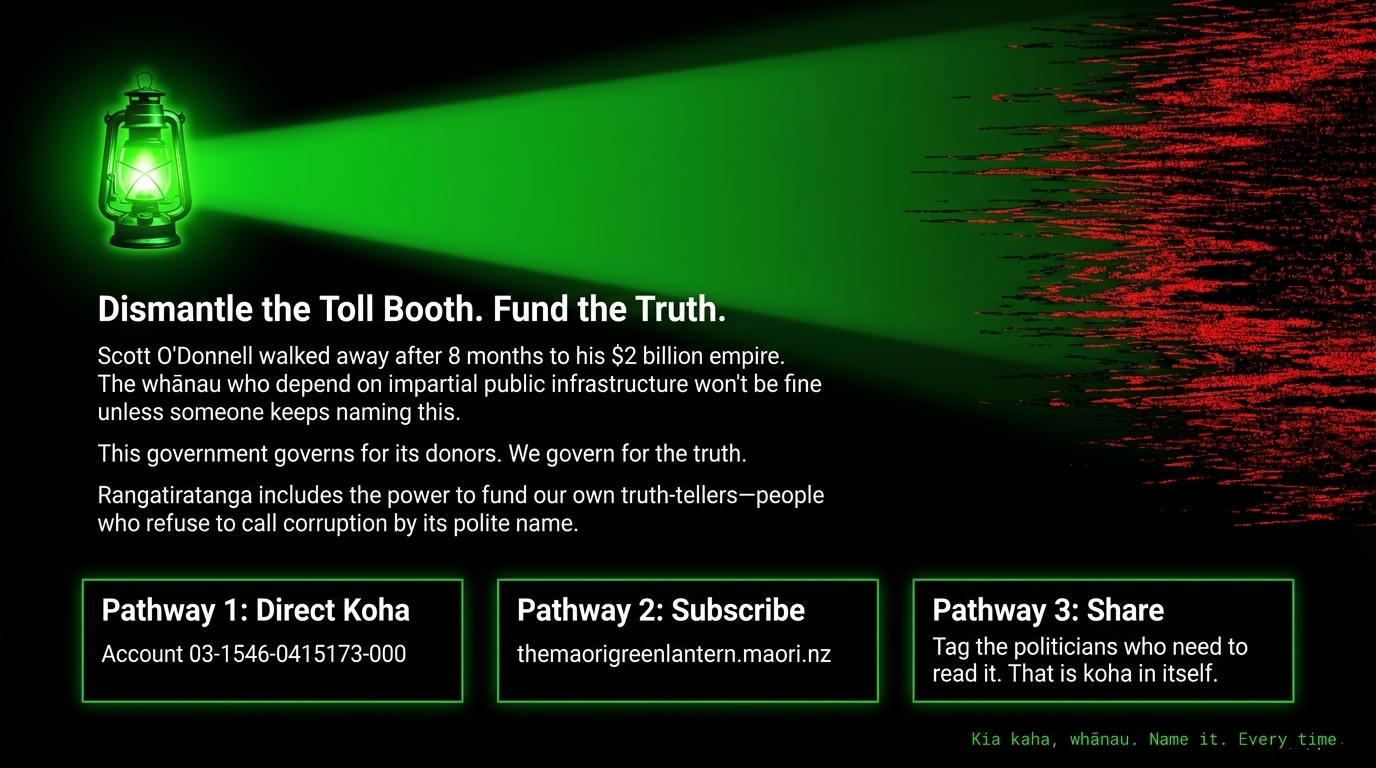
Scott O'Donnell walked away from KiwiRail after eight months, 34 missed agenda items, and tens of thousands of Crown dollars.
He'll be fine — he's got a $2 billion family empire and a new Australian venture to attend to.
The whānau who depend on functioning, impartial public infrastructure — on rail that isn't governed by its own freight customers — won't be fine unless someone keeps naming this. This essay exists because you fund it. Not the Crown. Not a party donor. You.
Every koha signals that whānau are ready to fund the accountability that Crown and corporate structures will never provide. Every share signals that rangatiratanga includes the power to fund our own truth-tellers — people who will trace these networks, name these names, and refuse to call corruption by its polite name.
If this essay landed — if you felt the weight of a $20,000 donation purchasing $8.2 million in Crown money and a seat at the infrastructure table — then this mahi matters and deserves to continue.
Three pathways to support:
💚 Direct koha — Support The Māori Green Lantern here
📬 Subscribe for every essay direct to your inbox — themaorigreenlantern.maori.nz
🏦 Direct bank transfer — HTDM, account 03-1546-0415173-000
📘 Facebook community — Follow and subscribe here
If you cannot koha right now — no worries. Share this essay. Send it to your whānau and friends. Post it in your community groups. Tag the politicians who need to read it. That is koha in itself.
Kia kaha, whānau. The toll booth has been exposed. Now let's dismantle it.
Research tools used: RNZ OIA documents (Farah Hancock), Beehive press releases, Integrity Institute (Dr Bryce Edwards), ODT, 1News, The Māori Green Lantern archives. Research conducted 20 April 2026. All URLs verified at time of publication.