"THE PLAYSTATION POGROM: How a Suit-Wearing Sociopath Built Aotearoa's Most Sophisticated Poverty Machine — While Pocketing Every Subsidy He Could Find" - 19 April 2026
He tells the poorest people in Aotearoa to get off the couch. He claims the couch on expenses.

Tēnā koutou, whānau.
On April 19, 2026, New Zealand's Prime Minister,
— a man who earned a total remuneration of $4.7 million in a single year at Air New Zealand,
who owns multiple investment properties,
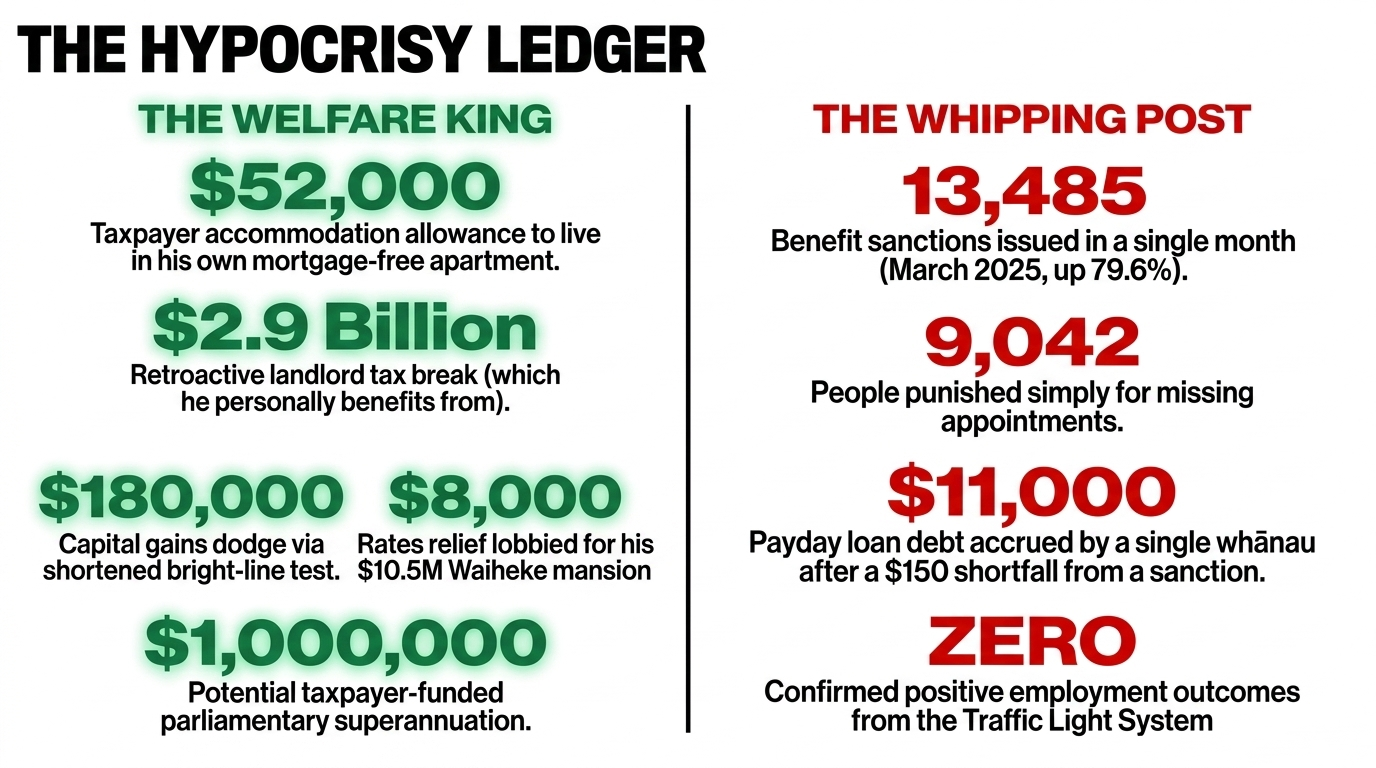
who quietly claimed a $52,000 taxpayer accommodation allowance to live in his own mortgage-free Wellington apartment,
who successfully lobbied Auckland Council to slash $8,000 off his annual rates bill on his $10.5 million Waiheke Island holiday mansion, and
who avoided up to $70,000 in capital gains tax on the sale of his Wellington apartment
— stood before cameras at the Ministry of Social Development and sneered at the poorest people in this country for playing PlayStation.
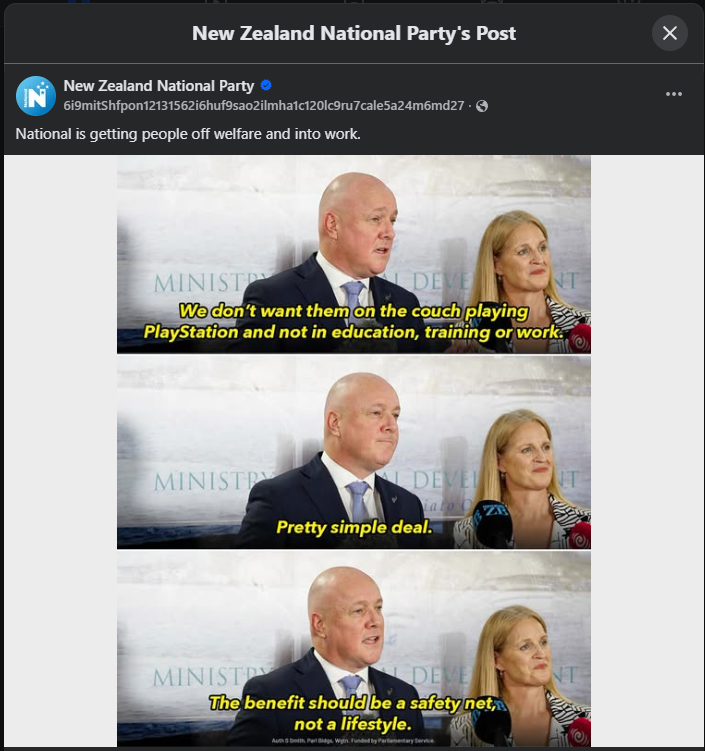
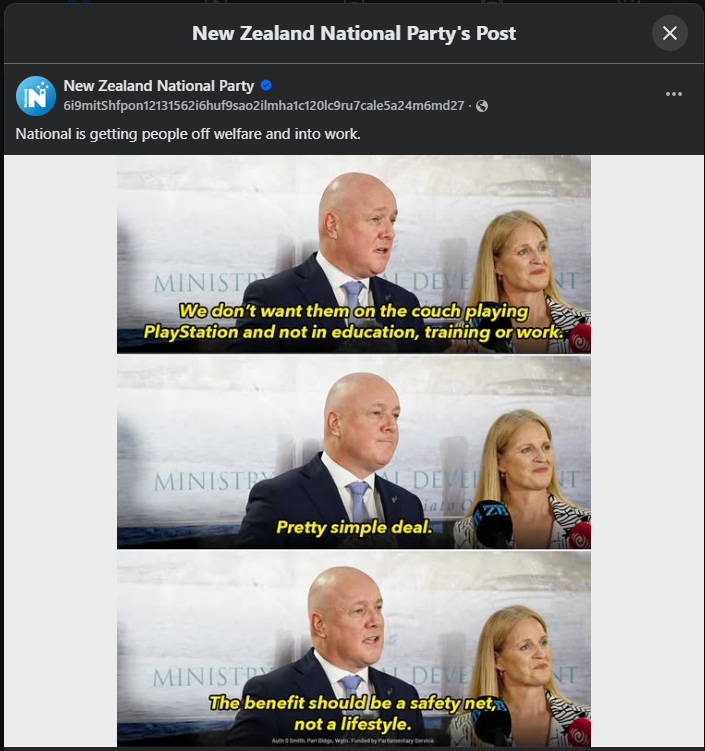
That man is Christopher Luxon. That man is your Prime Minister. And he posted it on Facebook.
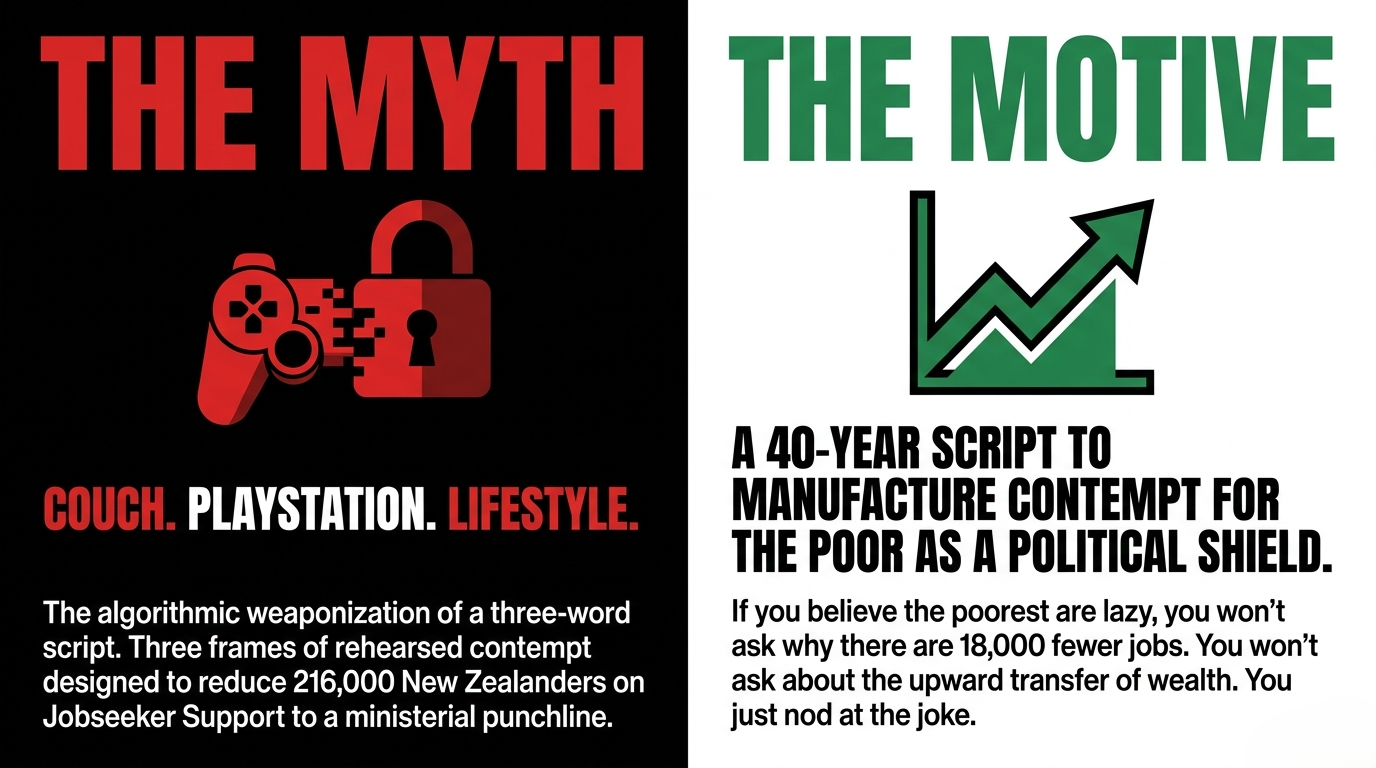
Three frames of rehearsed contempt: couch. PlayStation. lifestyle.
The social media team hit publish. The algorithm rewarded it. And 216,000 New Zealanders on Jobseeker Support — 39% of them Māori, receiving 55% of all sanctions
— were reduced to a punchline in a ministerial press release, paid for by your taxes.
Ko wai ka hua i tēnei? Who benefits from the PlayStation myth?
Not the parents going without food so their children can eat. Not the whānau rationing electricity. Not the rangatahi in Rotorua — where unemployment hits 11.3%, the highest in the nation.
The beneficiary of the PlayStation myth is a man who has been personally subsidised by the Crown from the moment he took office.
He is the welfare king. He just wears it in a better suit.
The Deep Dive Podcast
Listen to a lively conversation between two hosts, unpacking and connecting topics in the sources of this essay.
The Metaphor: A Pā Under Siege by Spreadsheet
Picture a pā. Not under musket fire — those at least announced themselves honestly.
This siege arrives in press releases. The attackers carry traffic lights. Their taiaha is a sanctions database. Their pā wall is a five-day compliance window. And when your benefit goes red
— when they cut your food, your power, your medicine — they call it personal responsibility.
The man issuing the order sits in a million-dollar apartment, claiming $1,000 a week from the state to pay for it, while simultaneously legislating a $2.9 billion tax break for landlords
— the very people who own the houses the poor cannot afford to rent. And he owns some of those houses.
As documented in the Māori Green Lantern's The Traffic Light Taiaha: How a White Supremacist Government Built a Punishment Machine, this government did not build a welfare system.
It built a whipping post — painted green, orange and red so it looks like traffic management, when it is actually the systematic punishment of poverty, the structural targeting of Māori, and the deliberate demolition of the social contract by people who have never needed it.
The mauri of the welfare system — its capacity to hold, protect and restore — has been surgically extracted. What remains is a machine.
And the machine is working exactly as designed.
The Man Who Claims Everything He Denies You
Before we go one sentence further, let us place the man himself on trial. Because the moral centre of this essay lives in the following irrefutable, documented, verified facts.
Christopher Luxon has personally benefited from more government subsidies than any single beneficiary he has sanctioned.
Let us count them.
Betrayal 1 — The $52,000 Accommodation Allowance.
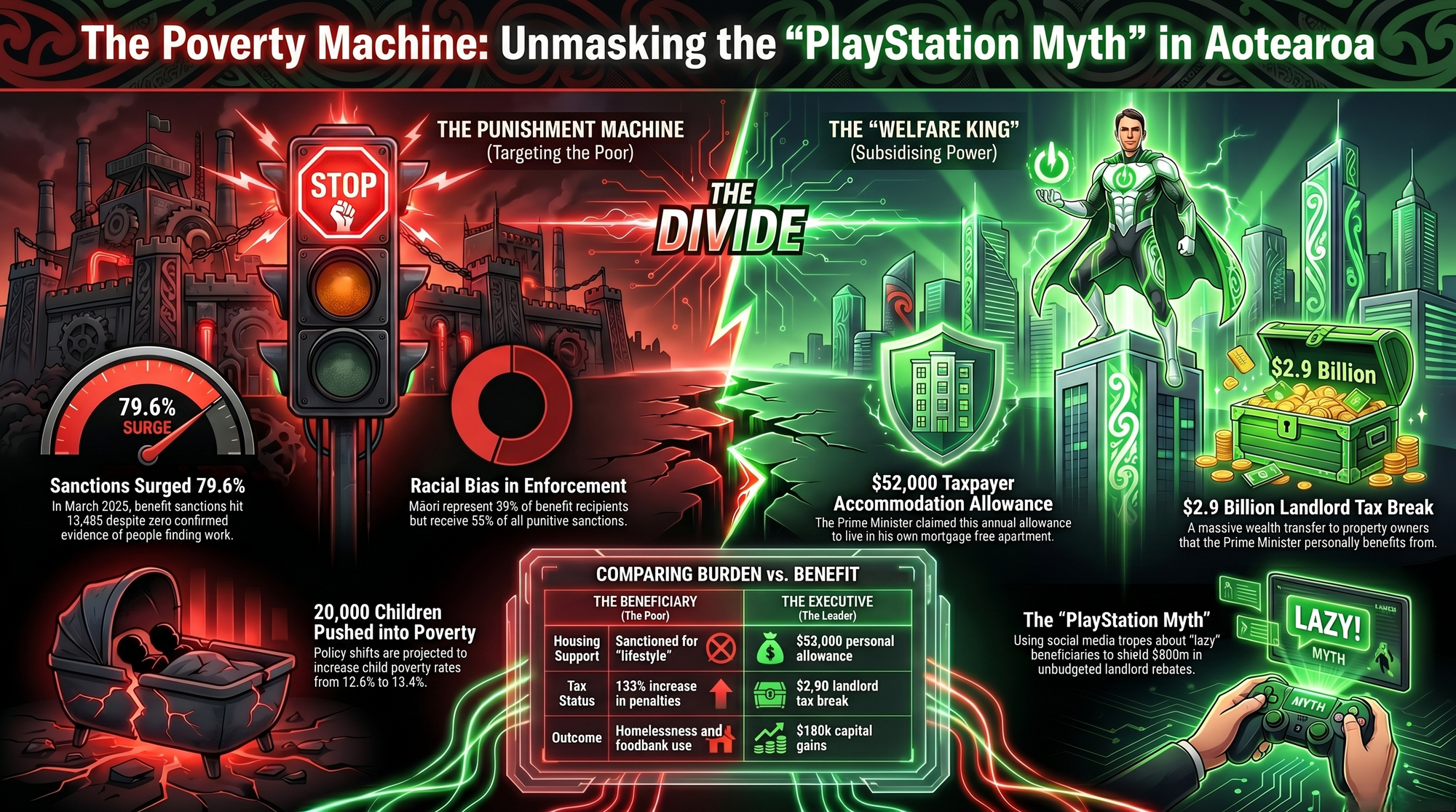
As revealed by Newsroom, Luxon claimed a $52,000 annual taxpayer accommodation allowance to live in his own mortgage-free Wellington apartment, valued at over $1 million.
He defended it first.
The NZ Herald confirmed he had already collected at least $13,000 before reversing course
— not because it was wrong, but because it was a "distraction."
That is not contrition. That is crisis management from a man on $471,000 a year with a mortgage-free portfolio.
This is the same man who tells the sanctioned that the benefit should be a safety net, not a lifestyle.
One thousand dollars a week, taxpayer funded, for the Prime Minister. A missed MSD appointment for you, and your children go hungry.
Betrayal 2 — The $2.9 Billion Landlord Tax Break He Personally Benefits From.
As confirmed by 1News, the Government reinstated full mortgage interest deductibility for residential landlords — a cost confirmed by the NZ Herald at $2.9 billion over four years,
$800 million more than originally budgeted.
As detailed by the NZ Council of Trade Unions, the change was retroactive — landlords received rebates on interest already paid, while tenants received nothing.
Luxon is a landlord. He personally benefits from this law his own government passed. When pressed, he told reporters renters were "very grateful" for the break. He said that. With his face. Out loud.
While those $2.9 billion flowed upward to property owners, as Labour documented:
"children in New Zealand are going hungry."
Simultaneously, public services were cut to fund those tax breaks. The money flows upward. The punishment flows downward. That is the entire policy.
Betrayal 3 — The Apartment Tax Dodge: $180,000 Capital Gain, Near-Zero Tax.
As revealed by the NZ Herald, Luxon sold his Wellington apartment — reportedly pocketing around $180,000 in capital gain — and narrowly avoided a significant tax bill because his own government had shortened the bright-line test from ten years to two, and his sale landed just in time to benefit.
A Prime Minister who changes the tax law, sells his property, avoids the tax bill his own law created, and calls beneficiaries dependent. That is not governance. That is insider trading on public policy.
Betrayal 4 — The $8,000 Rates Relief on His $10.5 Million Waiheke Mansion.
As confirmed by the NZ Herald and Duncan Garner's podcast, Luxon challenged Auckland Council's valuation of his Waiheke Island holiday property and obtained a revaluation that cut his rates by $8,000 a year.
This is the same Prime Minister who tells councils to be "fiscally disciplined" and refuses to cap rates increases for ordinary New Zealanders.
As the Māori Green Lantern documented in Power Plays in Paradise: How the Prime Minister Secured His Holiday Home While Whānau Suffered, this is not exception. This is the pattern.
Betrayal 5 — The Parliamentary Superannuation Entitlement.
As circulated in February 2026, ministers qualify for taxpayer-funded superannuation contributions worth up to $1 million over a career in Parliament
- a gold-plated retirement scheme for people who simultaneously tell beneficiaries that dependence on the state is a moral failing. Luxon qualifies. He is accruing it right now.
The Pattern in Plain English: The accommodation allowance. The landlord tax break. The capital gains dodge. The rates relief. The parliamentary super.
Luxon is the most heavily subsidised individual his own government has produced — and he posts PlayStation videos at you. This is not hypocrisy in the ordinary political sense.
This is class war conducted in plain sight, with a Facebook account and parliamentary funding.
The Whakapapa of Cruelty: 1991–2026
They have done this before. They did it deliberately. They were rewarded for it.
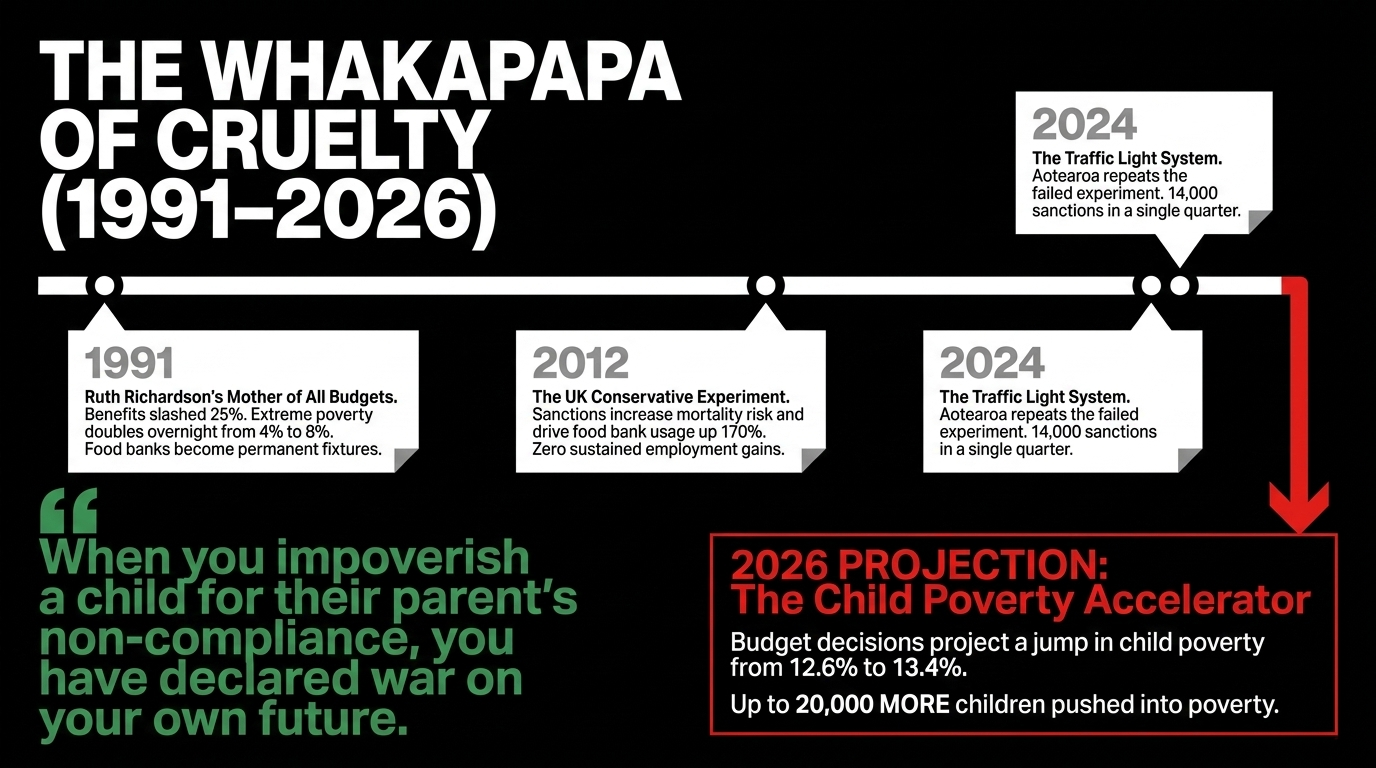
In 1991, Finance Minister Ruth Richardson detonated the "Mother of All Budgets" on the poorest families in Aotearoa. Unemployment benefits were cut 25% for young people, 20% for sickness beneficiaries, 17% for solo parents. Benefits for 16 and 17-year-olds were eliminated entirely. State house rents were effectively tripled. The number of people in extreme poverty doubled from 4% to 8% overnight. Food banks appeared in Aotearoa for the first time since the Great Depression. Those benefit cuts were not restored for 25 years. A generation of Māori children grew up in the hunger that policy manufactured.
What did this government do in June 2025? It gave Ruth Richardson a state honour. A Companion of the New Zealand Order of Merit. For the architecture of mass poverty.
As noted by The Spinoff, this was a slap in the face for the poor.
The Māori Green Lantern tracked the direct ideological lineage in Ruth Richardson's Neoliberal Delusions Exposed: the ideology is the same, the targets are the same, the victims are the same.
Luxon is Richardson in a nicer suit, with a better social media team. The couch. The PlayStation. The lifestyle. It is 1991. They just gave it a Facebook account.
The Traffic Light Punishment Machine: Numbers That Should End Careers
In August 2024, Social Development Minister Louise Upston launched the Benefit Traffic Light System: Green = compliant. Orange = breach. Red = benefit cut or suspended. A government so confident in its cruelty it colour-coded it.
The numbers are a verdict:
- Sanctions hit 13,485 in March 2025 — up 79.6% on the prior year. MSD cannot confirm a single sanction led to a single person finding work. Not one. Not one confirmed outcome.
- Missed-appointment sanctions alone surged to 9,042 — more than double the prior year's same quarter, confirmed by the Child Poverty Action Group.
- Te Pāti Māori's MSD OIA data revealed a 133% increase in sanctions in one year — over 14,000 in a single quarter — as jobs simultaneously vanished.
- The Salvation Army's State of the Nation 2025 found more than 400,000 people needing welfare support in December 2024 — the highest since the 1990s.
- As confirmed by 427,236 people on a main benefit as of December 2025 — an 18% increase since National took office.
- There are approximately 18,000 fewer jobs than when National became government. You cannot sanction people into jobs that do not exist.
The Spinoff confirmed that the government's own welfare reduction target is marked "at risk" of not being achieved. More people on welfare. More people sanctioned. Zero net jobs created. This is not social policy. This is a performance of contempt funded by the Parliamentary Service.
From October 2025, the government added mandatory job-search reporting, compulsory unpaid community labour, and obligation failures that stain a beneficiary's record for two full years. More obligations. More sanctions. Zero jobs. As the Māori Green Lantern documented in The Neoliberal Cruelty of Louise Upston: How MSD's "Hardship Prevention" Doubles Down on Punishment, MSD's own officials warned against these measures. They were ignored.
The Racial Architecture: It Was Built This Way
Stop calling it a side effect. This is the design.
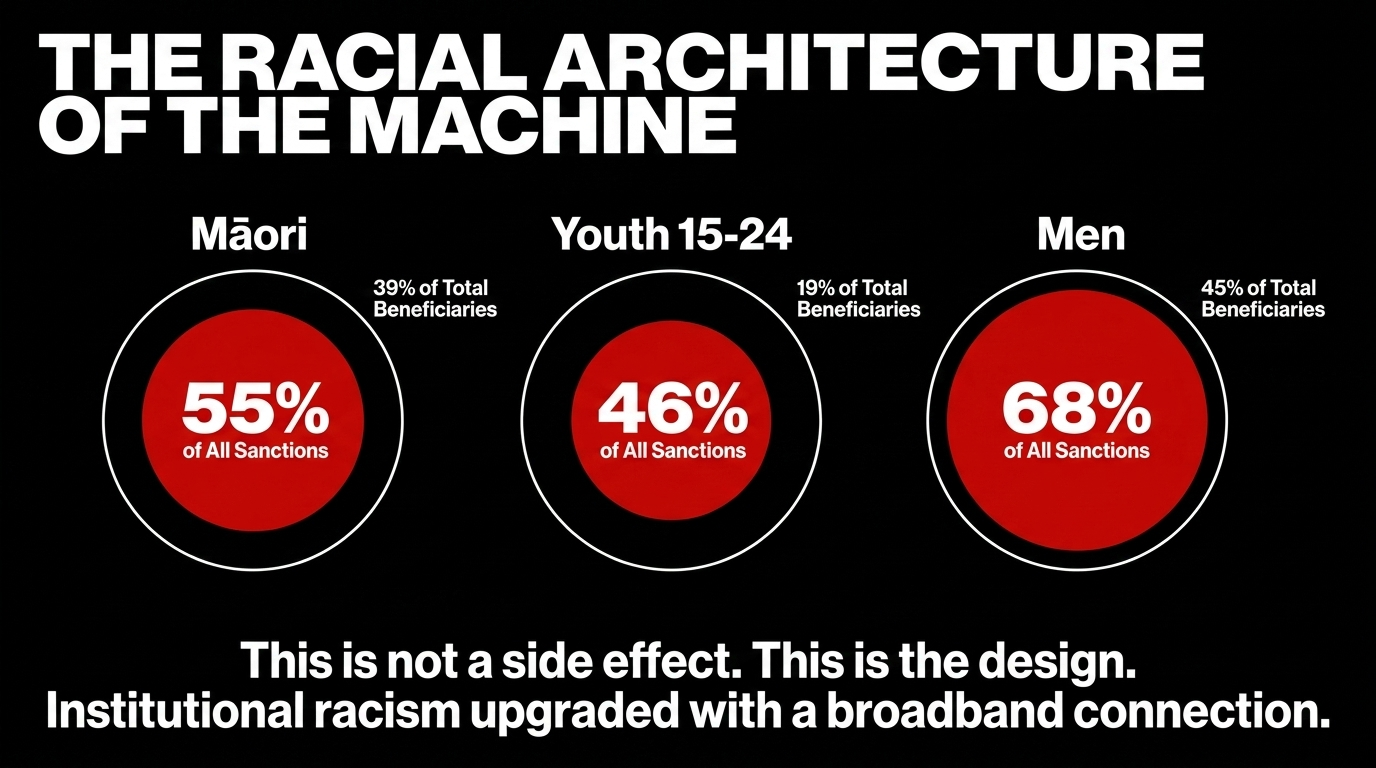
As documented exhaustively in the Māori Green Lantern's The Traffic Light Taiaha, Māori comprise 39% of beneficiary recipients but receive 55% of all benefit sanctions. The CERD shadow report submitted to the United Nations in 2025 names this explicitly as evidence of systemic discrimination. The Green Party confirmed: "More than half of people having their benefits sanctioned are Māori and Pasifika. This shows our welfare system is failing already disadvantaged communities." Young people aged 15–24 make up 19% of beneficiaries but receive 46% of all sanctions. Men are 45% of beneficiaries but receive 68% of sanctions.
Māori unemployment hit 11.2% in December 2025 — more than twice the national average. The Salvation Army confirmed Māori wellbeing data is worsening across every single tracked indicator: welfare dependency, youth unemployment, imprisonment.
The 1986 Pūao-te-Ata-tū report named institutional racism inside the Department of Social Welfare and demanded structural reform. Nearly 40 years later, the disproportionate punishment of Māori has not decreased. It has been formalised into a government algorithm. The institution did not reform. It upgraded its racism and gave it a broadband connection. As the University of Canterbury documented, the "colonising environment" describes structural decisions made without Māori consent inside settler institutions, producing intergenerational harm. The Traffic Light System is that colonising environment — with government branding and a ministry logo.
Three Examples for the Western Mind
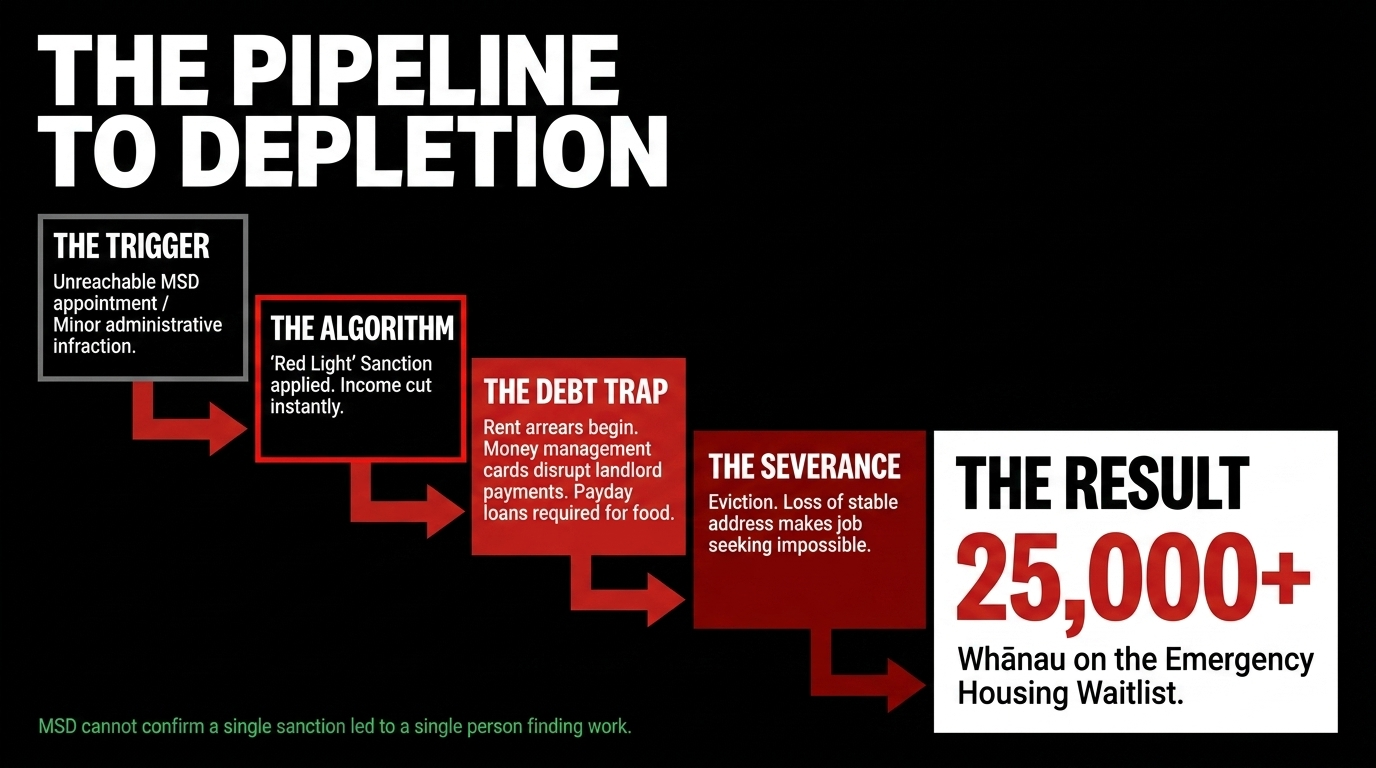
Example 1 — The Sanction-to-Foodbank Pipeline: Quantified Harm
Imagine you are a factory manager. You implement a policy with no evidence of effectiveness, rejected by your own experts, targeting your most vulnerable employees at twice the rate of everyone else, producing zero confirmed positive outcomes, and increasing demand on your crisis services by 133%. You would be dismissed before lunch.
That is what Louise Upston has built. MSD's own 2018 data showed 97.6% of disputed obligation failures were overturned on review. Yet 83% of people never challenge their sanction — because 52% don't know they can. The system is designed to punish the people least likely to know their rights. Beneficiary Advisory Service research documents people going without food, electricity and medication — one participant accrued $11,000 in debt from a $150 payday loan after a sanction cut their income. The Salvation Army's 2025 State of the Nation documents food parcel demand tracking directly to sanctions data.
Now hold that image. Now hold this one: Luxon collecting $1,000 a week from the state to live in his own mortgage-free apartment. Hold both simultaneously. That is the class structure of this government.
What this means for tikanga: This violates manaakitanga — the sacred obligation to uphold the dignity of every person who comes to you in need. You do not demand compliance before feeding them. You feed them. The state has inverted that obligation into a debt trap, while its leader feeds at the public trough.
The solution: Immediate freeze on all sanctions pending an independent inquiry. Full legal aid for sanction reviews. Mandatory written notification to every sanctioned person that 83% of reviews succeed.
Example 2 — The UK Ran This Experiment. People Died.
The Western world has a controlled experiment on record. The United Kingdom implemented a near-identical punitive sanctions system from 2012 under the Conservatives. Their own Department for Work and Pensions reports showed sanctions increased mortality risk, drove food bank usage up 170%, increased homelessness, and produced no sustained improvement in employment outcomes — as the Māori Green Lantern documented in The Traffic Light Taiaha.
The UK National Audit Office found the system cost more to administer than it saved in benefits. The ideology exported from Thatcher to Richardson to Upston has a 40-year failure record. Every Western government that ran this experiment produced the same result: more poverty, more illness, more death, no net employment gain.
Aotearoa is not learning from that experiment. It is repeating it deliberately.
As the Māori Green Lantern exposed in The NZ Neoliberal Pantomime, every major party answers to the same economic masters. And as SAANZ sociology research confirms, neoliberalism in Aotearoa was never a neutral economic experiment — it was a deliberate transfer of wealth upward, with Māori and the working poor bearing the full structural cost.
What this means for tikanga: This violates kaitiakitanga — the obligation to guard and sustain, not extract and deplete. A rangatira who depletes the mauri of their people for personal political gain is not a rangatira. They are a predator. And this one owns investment properties.
The solution: Implement the full recommendations of the 2019 Welfare Expert Advisory Group. Restore Mana in Mahi, He Poutama Rangatahi, and Flexi-Wage — programmes that collectively supported 100,233 people into work in 2022 alone. Repeal the Traffic Light System entirely.
Example 3 — The Child Poverty Accelerator: 20,000 More Children Punished for Being Born Poor
Think of this as compound interest on cruelty.
Labour's data projects that National's Budget decisions will push child poverty from 12.6% to 13.4% — potentially adding 20,000 more children into poverty. As confirmed by Statistics New Zealand data cited in the Māori Green Lantern's The Pātaka is Ash, nearly 150,000 tamariki already remain in poverty in Aotearoa with no annual improvement recorded.
These are not children of PlayStation parents.
These are children whose parents were sanctioned for missing an MSD appointment they couldn't reach, couldn't afford transport to, couldn't arrange childcare for — and 52% of those parents didn't know they could challenge the sanction that stripped their income.
While those 20,000 additional children edge toward poverty, Luxon gave $2.9 billion to landlords — including himself — and told renters they were "very grateful."
As the Māori Green Lantern exposed in The Charity of Conquerors: How the Crown Turned Its Sacred Obligation to Warrior Families Into a Photo Opportunity, this government consistently outsources its obligations to charity, celebrates the charity's compliance, and calls it care.
What this means for tikanga: This violates whanaungatanga — the most fundamental obligation of all. The wellbeing of the child is the responsibility of the collective. When you impoverish a child for their parent's "non-compliance," you have not enforced responsibility. You have declared war on your own future.
The solution: Reinstate Best Start payments immediately. Raise benefit rates to the 2019 Welfare Expert Advisory Group recommended levels. Remove children from all sanction calculations — permanently and unconditionally.
Five Verified Hidden Connections
Connection 1 — The Sanctions-to-Homelessness Conveyor. The social housing waiting list exceeds 25,000. Money management cards — introduced May 2025 — prevent beneficiaries from paying rent in the timing landlords require. Beneficiary Advisory Service research traces the direct pipeline: sanction → arrears → eviction → emergency housing → waiting list. As the Māori Green Lantern documented in The Human Cost of Deception: Exposing Luxon's Homelessness Crisis Denial, Luxon has publicly denied that stricter emergency housing rules caused increased homelessness — while his own data contradicts him directly. National sanctions people into homelessness, then refuses to house them. This is the neoliberal model in perfect operation: manufacture the crisis, defund the response, outsource the charity, and call the suffering a lifestyle.
Connection 2 — The Fiscal Fraud. The government calls sanctions fiscal responsibility. As exposed in Ka Noho i Roto i te Ahi: The Government's Toll Booth to Hell, this government budgets $2.9 billion for landlords while implementing a sanctions system that cannot demonstrate a single employment outcome. The Welfare Expert Advisory Group found zero evidence that punitive welfare policies reduce benefit duration. MSD's own modelling showed the system disproportionately impacts Māori and women and increases inequity. There is no fiscal case. There is only ideology — and the political reward of punishing the visible poor while invisibly enriching the wealthy.
Connection 3 — The 1991–2026 Lineage. Richardson's cuts doubled poverty overnight. Labour's programmes helped 100,233 New Zealanders into work in 2022 alone. National dismantled those programmes on Day 1 and replaced them with a traffic light and a PlayStation joke. As exposed in Rogernomics Resurrected: The Neoliberal Zombie Rises to Devour Aotearoa's Soul, this zombie never died — it waited in the Treasury corridors for a government without shame. In June 2025, the government gave that zombie a state medal.
Connection 4 — The Pūao-te-Ata-tū Betrayal. Pūao-te-Ata-tū named institutional racism inside the Department of Social Welfare in 1986 and demanded structural reform. Forty years later, Māori receive 55% of sanctions while constituting 39% of the welfare population. The state had four decades to fix the racist architecture. It chose instead to formalise racism into an algorithm and give it government branding. The Traffic Light System is Pūao-te-Ata-tū's worst nightmare wearing a ministry colour scheme.
Connection 5 — The Personal Profit Loop. This is the most damning. Luxon's government legislated full interest deductibility for landlords from April 2025. As documented by the NZ CTU, landlords received retroactive rebates — money for nothing, for payments already made. Luxon is a landlord. Luxon personally benefits from that law. Luxon simultaneously imposed a sanctions system that cannot demonstrate a single employment outcome. The money flows upward to people who own the housing stock. The punishment flows downward to people who cannot afford to rent it. As the Māori Green Lantern documented in When the Wolf Claims to Guard the Flock: count your sheep. The wolf is running the yard.
The Language of Contempt — Decoded
Luxon's "couch, PlayStation, lifestyle" trilogy is not a spontaneous opinion. It is the latest iteration of a 40-year neoliberal script — the same script that told Aotearoa in 1984 that the market would set us free, in 1991 that the poor were dependent, and in 2013 in Britain that the unemployed were scroungers. The script does one thing: it manufactures contempt for the poor as a political shield.
If you believe the person on the benefit is lazy, you will not ask why there are 18,000 fewer jobs. You will not ask why Rotorua's unemployment hits 11.3%. You will not ask why the government's own welfare target is marked "at risk." You will just nod at the PlayStation. And the landlord tax break will keep growing. And Luxon will keep lobbying Auckland Council about his Waiheke rates bill. And the Aotearoa Centre for Indigenous Peoples and the Law will keep warning that this government is
"actively and profoundly aggravating New Zealand's constitutionally racist foundation in a way we have not seen for at least half a century."
As the Māori Green Lantern called out in The NZ Neoliberal Pantomime: the pantomime has a villain, a victim, and a standing ovation from the business community. The villain always plays the poor. The cast never changes. And the Bootcamp Betrayal exposes how Māori rangatahi are used as neoliberal test subjects for every punitive experiment this government runs.
Rangatiratanga Response: The Taiaha in Your Hand
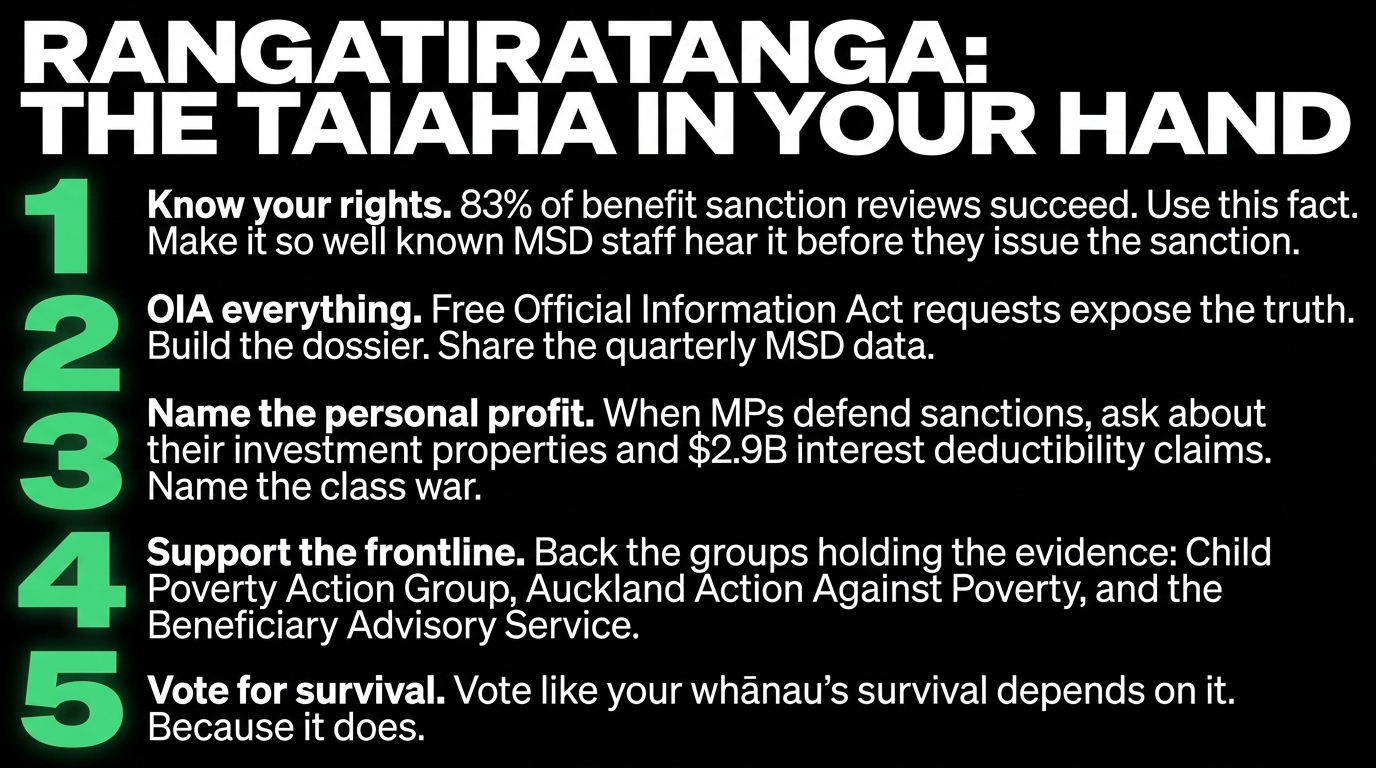
The whipping post is exposed. Now the mahi.
- Know your rights. If you are sanctioned, you can request a review. 83% of reviews succeed. That single fact is a weapon. Use it. Share it. Make it so well known that MSD staff hear it before they issue the sanction.
- OIA everything. Te Pāti Māori used free OIA requests to expose a 133% sanctions increase. MSD quarterly data is public. File requests. Build the dossier. Share the results.
- Name the personal profit. Every time a National MP defends sanctions, ask: how many properties do they own? What is their interest deductibility claim? What rates relief have they sought? The class war only works if we don't name the class.
- Support Child Poverty Action Group, Auckland Action Against Poverty, and the Beneficiary Advisory Service. They hold the evidence. They are doing the mahi.
- Vote like your whānau's survival depends on it. Because it does. And it always has.
Koha Consideration — Funded by Whānau, for Whānau
Every sanction this government imposes depletes the mauri of someone's whānau. Every essay published here names the architects, documents the harm with verified data, and hands the receipts to the people who need them most.
This essay — tracking Luxon's personal subsidies against the sanctions he imposes on the poorest people in Aotearoa, tracing the 35-year whakapapa of cruelty from Ruth Richardson to Louise Upston, verifying every number, testing every link — took hours of sustained research to produce. That mahi requires fuel.
If you have ever seen the traffic light turn red on someone you love
— if you watched a whānau member go without food because of a missed appointment
— if you are enraged that a man on $471,000 a year claimed $1,000 a week in accommodation subsidies and $8,000 in rates relief while sanctioning beneficiaries for living a lifestyle
— then this koha is yours to give, on behalf of those who cannot.
Not as charity. As rangatiratanga. As proof that whānau can fund our own truth-tellers — because the Crown and corporate media will never do it for us.
Three pathways:
Direct koha — Support the Māori Green Lantern on the Koha platform
Subscribe for essays direct — themaorigreenlantern.maori.nz
Direct bank transfer — HTDM: 03-1546-0415173-000
Facebook community — Follow and subscribe here
If you cannot koha — no worries at all, whānau. Share this essay. Send it to your MSD caseworker. Send it to your MP. Send it to every person who nodded at the PlayStation joke without asking how many houses Luxon owns.
The koha of circulation is what keeps the light burning when they try to cut the cord.
He aha te mea nui o te ao? He tāngata, he tāngata, he tāngata.
Kia kaha. Kia māia. Kia manawanui.
Ivor Jones is the Māori Green Lantern — tohunga mau rākau wairua, kaitiaki of Māori, fighting misinformation, white supremacy, racism, and neoliberalism. Read more at themaorigreenlantern.maori.nz | Subscribe at Substack
Research Transparency: Research conducted 19 April 2026. Sources include: NZ Herald, Newsroom, 1News, The Spinoff, Child Poverty Action Group, Salvation Army State of the Nation 2025, Te Pāti Māori parliamentary releases, MSD quarterly sanctions data, Green Party parliamentary releases, Wikipedia (verified), The Māori Green Lantern archives, University of Canterbury, Sagepub academic journals, SAANZ sociology journal, Interest.co.nz, NZ CTU, Rova/Duncan Garner podcast, and Treasury OIA releases. All URLs tested and verified at time of writing. Statistics cross-referenced against MSD primary data where available.