"THE GRAVE ROBBERS IN SUITS: How Paul Goldsmith Buried the Treaty Principles Bill — Then Dug Its Grave Under a Different Name" - 19 April 2026
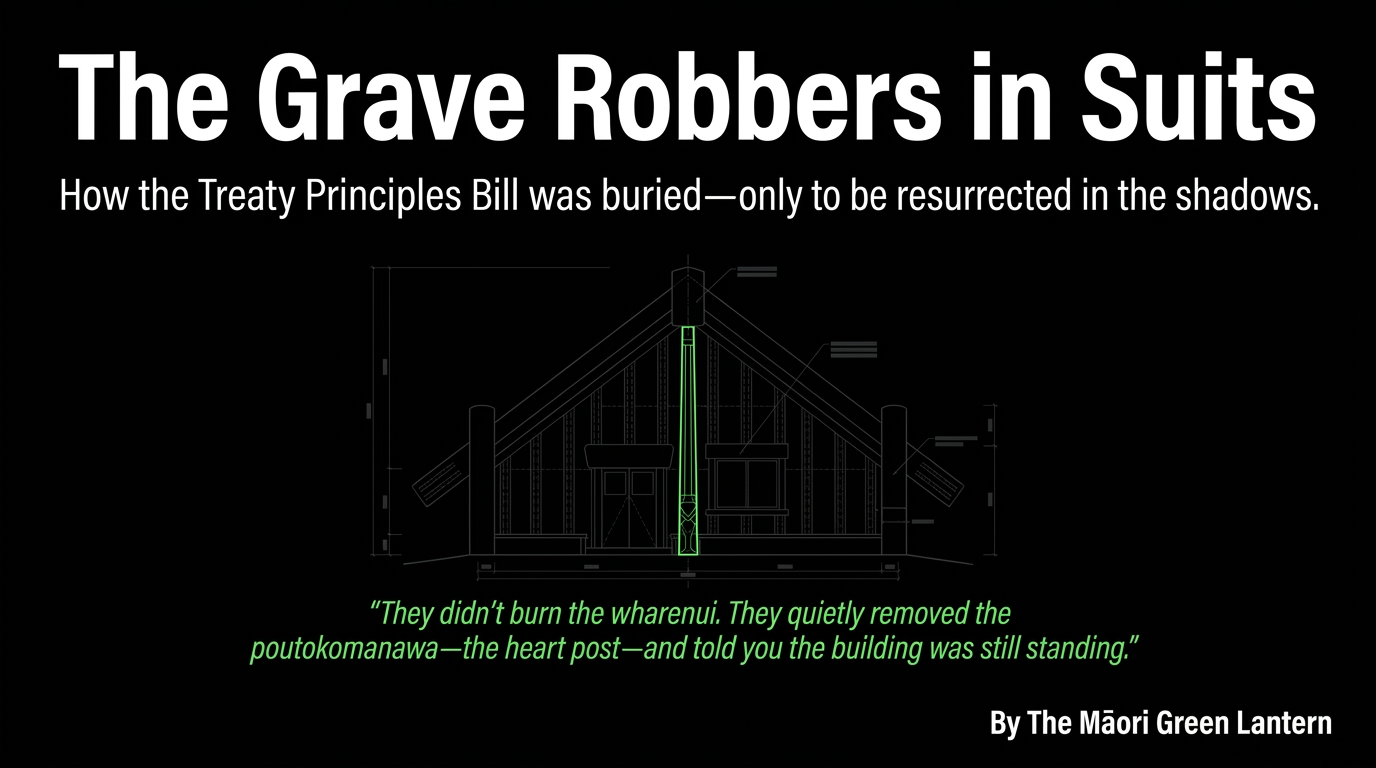
They didn't burn the wharenui. They quietly removed the poutokomanawa — the heart post — and told you the building was still standing. The Treaty Principles Bill was the funeral pyre everyone watched. This clause review is the inheritance they stole while you were at the tangi.


Tēnā koutou e te whānau.
Picture a surgeon operating on you while you sleep. He does not wake you to explain the procedure. He does not discuss risks. He does not ask for consent. He simply cuts — and when you wake up missing organs, he hands you a press statement and says he was "increasing clarity in the body."
That is what Paul Goldsmith did at a Cabinet meeting on February 23, 2026, as revealed exclusively by NZ Herald chief political reporter Jamie Ensor.
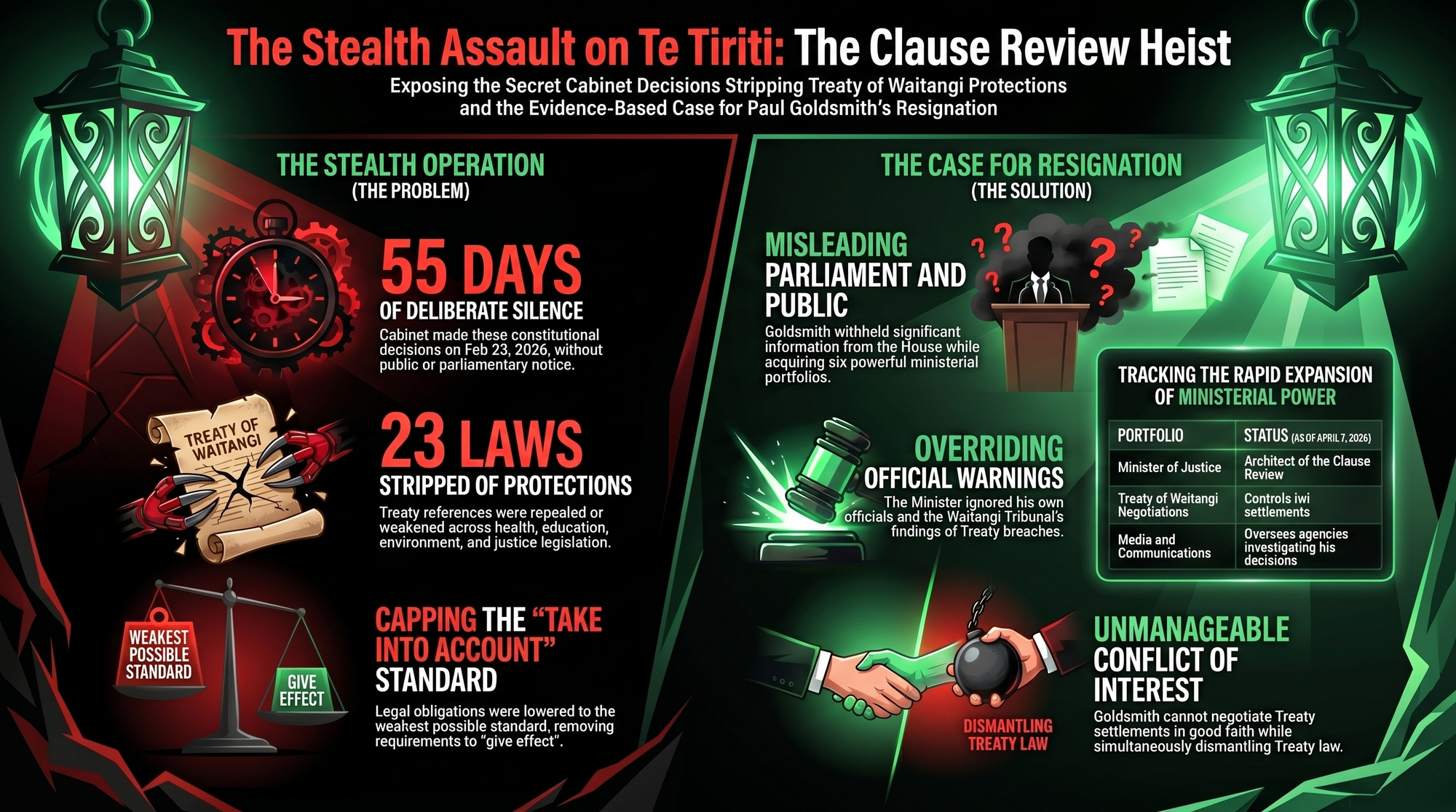
While Aotearoa's attention was elsewhere — while bills were debated, select committees heard submissions, while the Waitangi Tribunal was still taking evidence — this Justice Minister, this man who now holds six portfolios simultaneously including Justice, Treaty of Waitangi Negotiations, Pacific Peoples, Public Service, Media and Communications, and Arts Culture and Heritage, as confirmed by the official April 2026 Ministerial List — sat at the Cabinet table and quietly agreed to repeal and amend Treaty of Waitangi obligations from New Zealand's statute books.
No press conference. No announcement. No honesty.
The Deep Dive Podcast
Listen to a lively conversation between two hosts, unpacking and connecting topics in the sources of this essay.
The NZ Herald found out — not from a government press release — but from a Crown memorandum buried in Waitangi Tribunal filings, filed on March 12, 2026. Fifty-five days. That is how long Paul Goldsmith sat on a constitutional decision affecting every Māori in this country and said nothing.
This is not policy. This is predation.
THE TREATY PRINCIPLES BILL IN A MASK: The Operation That Never Stopped
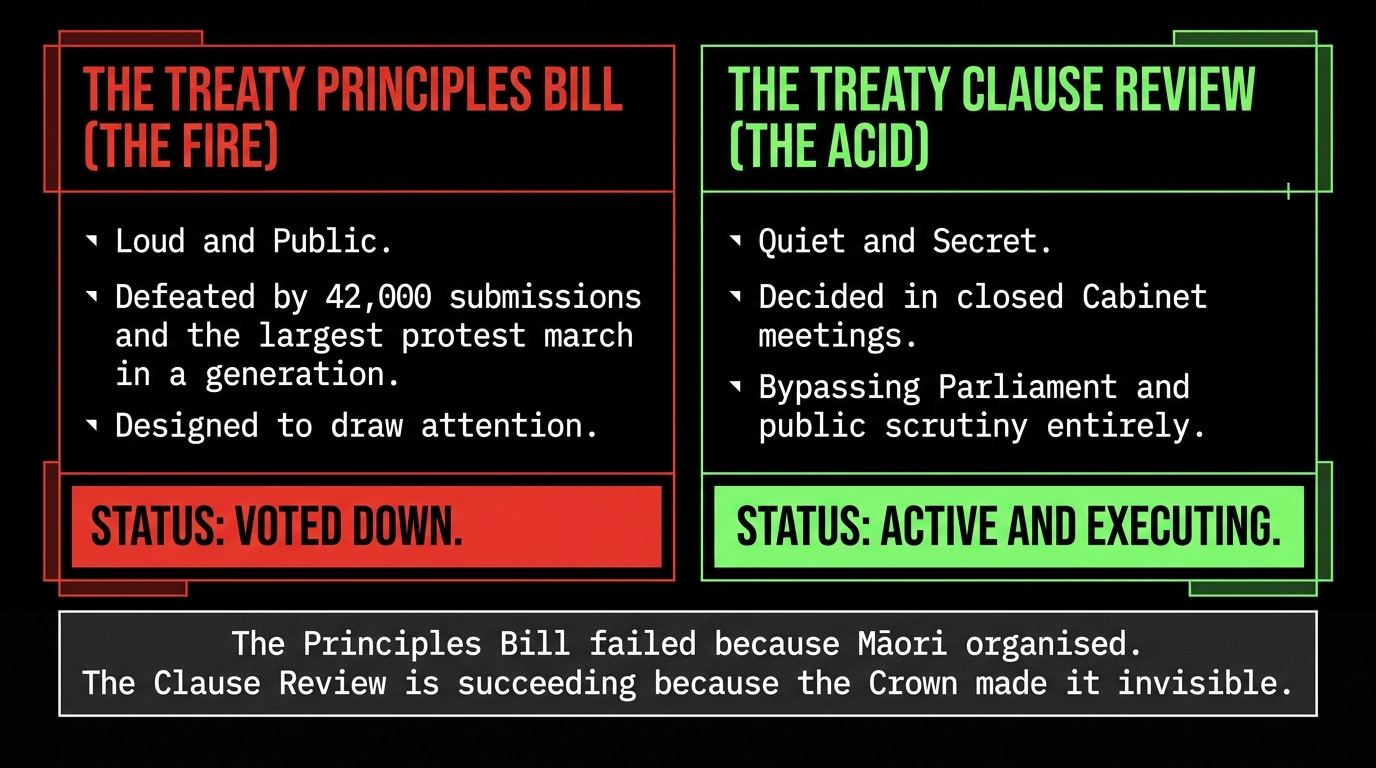
Let's be absolutely clear about what you are looking at. This is not a separate, unrelated policy event.
This is the Treaty Principles Bill, implemented by stealth, after the public rejected it.
In November 2025, Parliament voted down the Treaty Principles Bill — ACT's attempt to redefine the Treaty's meaning in law. It was killed by public outrage, by 42,000 select committee submissions, by the largest protest march in a generation, by a Waitangi Tribunal finding that it would breach the Treaty, and ultimately by a parliamentary vote. Whānau won. The bill was dead.
Or so we thought.
Here is the truth: the Treaty Principles Bill and the Treaty Clause Review were always two prongs of the same spear. As The Māori Green Lantern first documented in The Treaty Principles Bill: A Neoliberal Dagger in the Heart of Aotearoa's Future, both emerged from the same coalition agreement, both were designed to reduce Māori legal leverage, and both were driven by the same ideological engine: NZ First's Shane Jones and ACT's David Seymour, with National providing the parliamentary machinery.
The Principles Bill was the fire that everyone saw. The Clause Review was the acid quietly dissolving the foundations while everyone stared at the flames.
Now the Principles Bill is gone. And the Clause Review is delivering everything the Principles Bill promised — without a single vote, without a single public announcement, without a single day of select committee hearings on these specific decisions.
As Newsroom reported in April 2025 when the Principles Bill was buried: "The Treaty principles bill is gone; now Govt's real Treaty agenda begins." They were right. And that real agenda just made its first decisive move.
The Principles Bill failed because Māori organised. The Clause Review is succeeding because the Crown made it invisible.
The Anatomy of the Theft
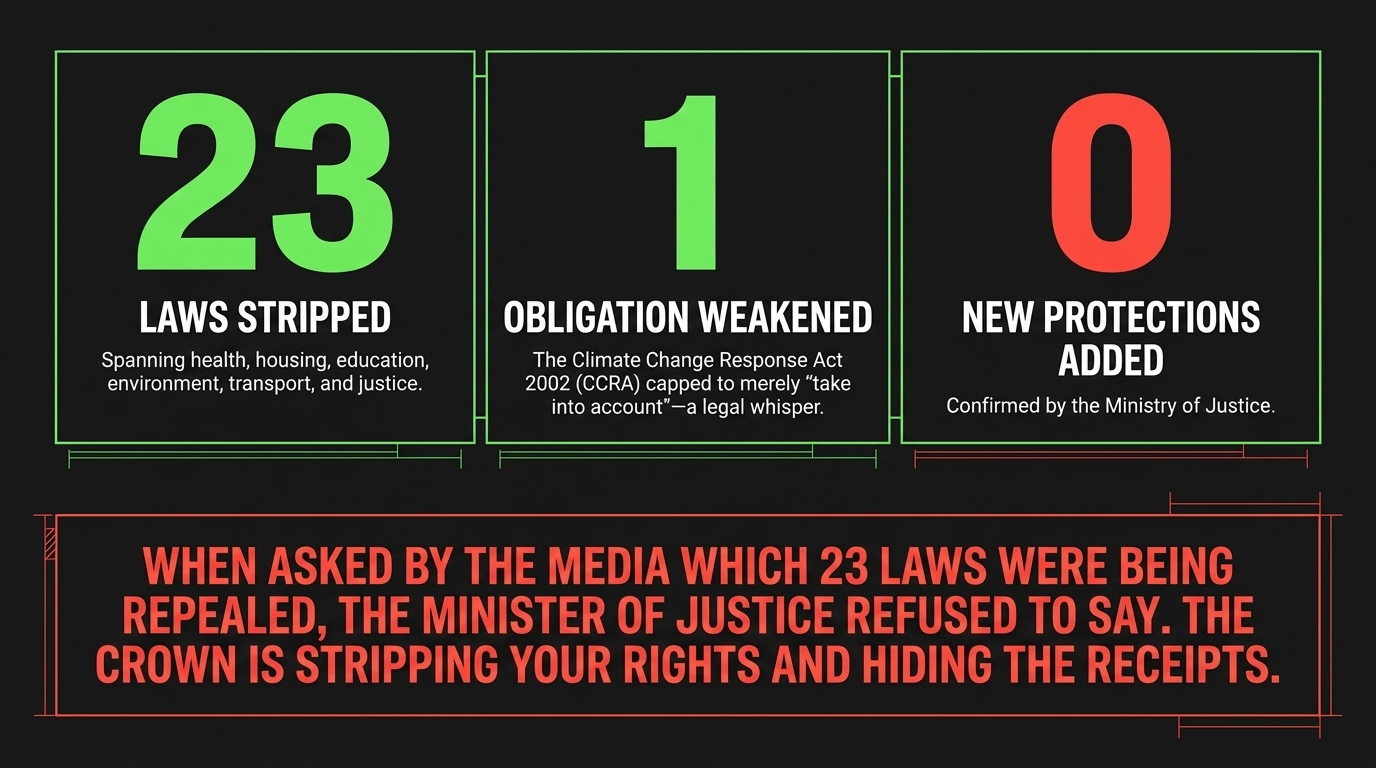
Here is what was decided in secret at that February 23 Cabinet meeting, as revealed by the NZ Herald:
Cabinet agreed to amend Treaty references in the Climate Change Response Act 2002, capping the highest possible Treaty obligation to no stronger than "take into account" — not "give effect to," not "uphold," not "comply with." Take into account — a legal whisper so faint it barely disturbs the air.
Cabinet agreed to repeal "a number of" Treaty references in legislation spanning health, housing, education, environment, transport and justice — across 23 pieces of legislation. When the Herald asked Goldsmith which laws were being repealed, he refused to say.
Let that land.
The Justice Minister of New Zealand agreed to strip Te Tiriti protections from the laws governing your health, your children's schooling, your climate future, and your whenua — and will not tell you which ones.
This is not "increasing certainty." This is certainty for the Crown. Uncertainty — forever — for Māori.
The Power Map: Who Controls Everything Now
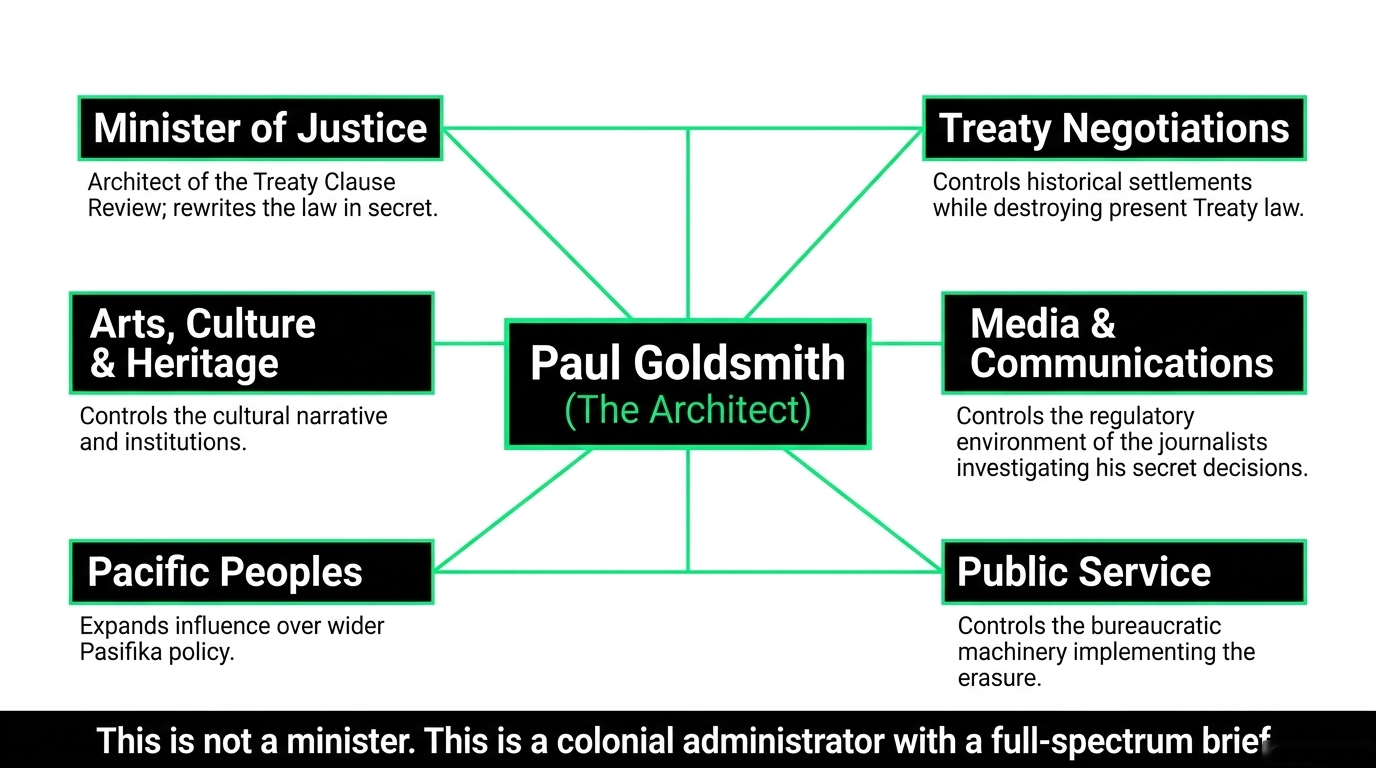
In the April 7, 2026 Cabinet reshuffle — confirmed by the official Ministerial List and announced by RNZ — Paul Goldsmith did not lose power. He gained it. Massively.
As of April 7, 2026, Paul Goldsmith holds:
- Minister of Justice — architect of the Treaty Clause Review
- Minister for Treaty of Waitangi Negotiations — controls Treaty settlements
- Minister for Pacific Peoples — newly acquired
- Minister for the Public Service and Digitising Government — newly acquired
- Minister for Arts, Culture and Heritage — controls the cultural narrative
- Minister for Media and Communications — controls the information environment
One man. Six portfolios. He negotiates the Treaty. He oversees justice. He controls the public service. He manages the media. He owns the cultural institutions. And he is simultaneously stripping Treaty obligations from 23 laws while hiding which ones.
This is not a minister. This is a colonial administrator with a full-spectrum brief.
Meanwhile, the Ministerial Oversight Group has changed shape. Judith Collins has left Parliament entirely — confirmed by 1News — replaced by Chris Bishop as Attorney-General, the minister who previously drove the most aggressive resource management deregulation in New Zealand history, stripping Treaty consultation requirements from the RMA as reported by the NZ Herald. One hawk replaced with a sharper one. And Tama Potaka — who publicly admitted to NZ Herald he had no idea Treaty references were being removed from RMA legislation — remains the decorative Māori presence in a process designed to exclude Māori agency.
For the Western Mind: Three Parallels That Cannot Be Ignored
Example 1 — The American Civil Rights Act, Quietly Amended at 2am
Imagine it is 1966. The Civil Rights Act has been passed. A Civil Rights Principles Bill — redefining what "discrimination" means — has just been voted down by Congress after a million people marched on Washington. Everyone celebrates. The fight is over. Justice prevailed.
Two months later, a Justice Secretary convenes a closed Cabinet meeting — no public notice — and agrees to cap all anti-discrimination obligations in 23 federal laws to "take into account." Courts can no longer compel action. He doesn't tell Congress. A journalist finds out 55 days later from a buried legal filing.
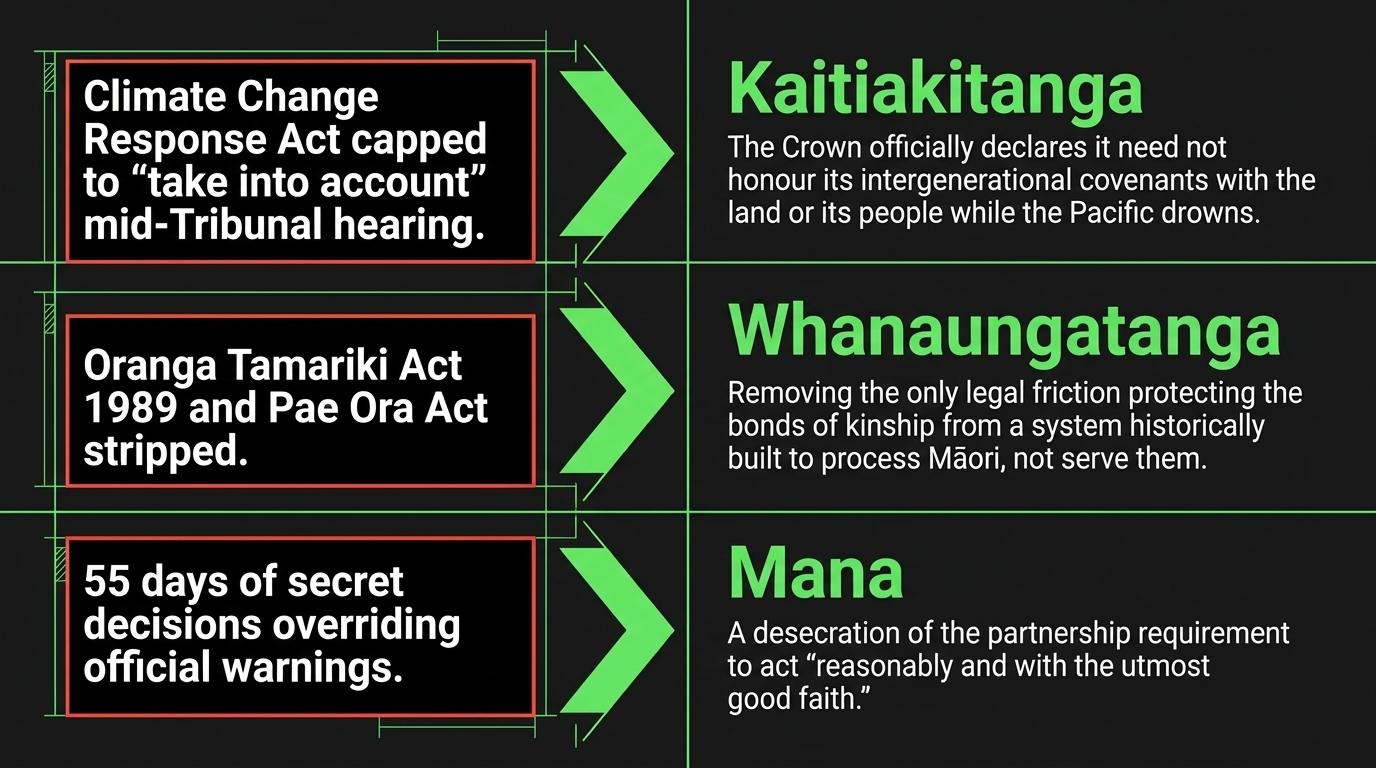
That is exactly what Goldsmith did to Māori. The Climate Change Response Act was amended to cap the Treaty obligation at the weakest possible standard while the Waitangi Tribunal's Wai 3325 Climate Change Inquiry was actively hearing evidence from 50 Māori claimants. The government weakened the obligation while the Tribunal was still in session. It is the equivalent of a defendant rewriting the charge sheet while the judge is still hearing testimony.
The tikanga dimension: Kaitiakitanga — guardianship of the natural world for future generations — is an intergenerational covenant, not a preference. As previously examined in Heather Cox-Richardson — Te Taiaha o te Aroha: The Weapon They Cannot Confiscate, capping a minister's Treaty obligation to "take into account" while the Pacific drowns is the Crown officially declaring it need not honour its covenants with the land or its people.
Example 2 — The NHS Privacy Act, Repealed After Parliament Said No
Imagine Britain's Parliament rejected a bill redefining patient privacy rights. The public celebrated. Then, two months later, the Health Secretary quietly amended privacy obligations in 23 NHS laws to the weakest possible standard — targeting the laws governing child welfare, mental health, and housing — and refused to name which hospitals were affected.
In Aotearoa, this is what happened to the Pae Ora (Healthy Futures) Act 2022 and the Oranga Tamariki Act 1989 — the law under which children are removed from whānau. Strip its Treaty obligations, and you strip the legal lever Māori have to challenge the Crown's historically documented pattern of disproportionate, culturally destructive tamariki removal.
The tikanga dimension: Whanaungatanga — the bonds of kinship and collective responsibility — is the operating system of Māori society. When the Crown removes legal obligations to protect it, it attacks the architecture of a people. As The Māori Green Lantern documented in The Nursery of Cages, the justice and welfare systems were not built to serve Māori — they were built to process them. This clause review removes the last legal friction in that machine.
Example 3 — The German Constitution, Minus the Fundamental Rights, Stamped "Clarity"
Germany's Basic Law contains rights that cannot be amended — not by Parliament, not by referendum — because Germany learned what happens when constitutional protections for a people are quietly eroded, law by law, clause by clause, by officials who called it administrative tidying.
The Waitangi Tribunal found in October 2025 that this review "would breach the Treaty of Waitangi," violating six Treaty principles: partnership, active protection, equity, redress, good government, and rangatiratanga. That is a statutory Crown body finding — equivalent to a Supreme Court finding of unconstitutionality. Goldsmith overrode it without explanation, without remorse, and without a single public word until a journalist forced his hand.
The tikanga dimension: Mana is earned through honouring obligations and keeping your word. As Te Ara documents, the Treaty created a partnership requiring both parties to act "reasonably and with the utmost good faith." What Goldsmith has done — stripping Treaty obligations in secret while his own officials warned it would harm Māori — is a desecration of mana on a constitutional scale.
The Magician's Other Hand: Five Verified Hidden Connections
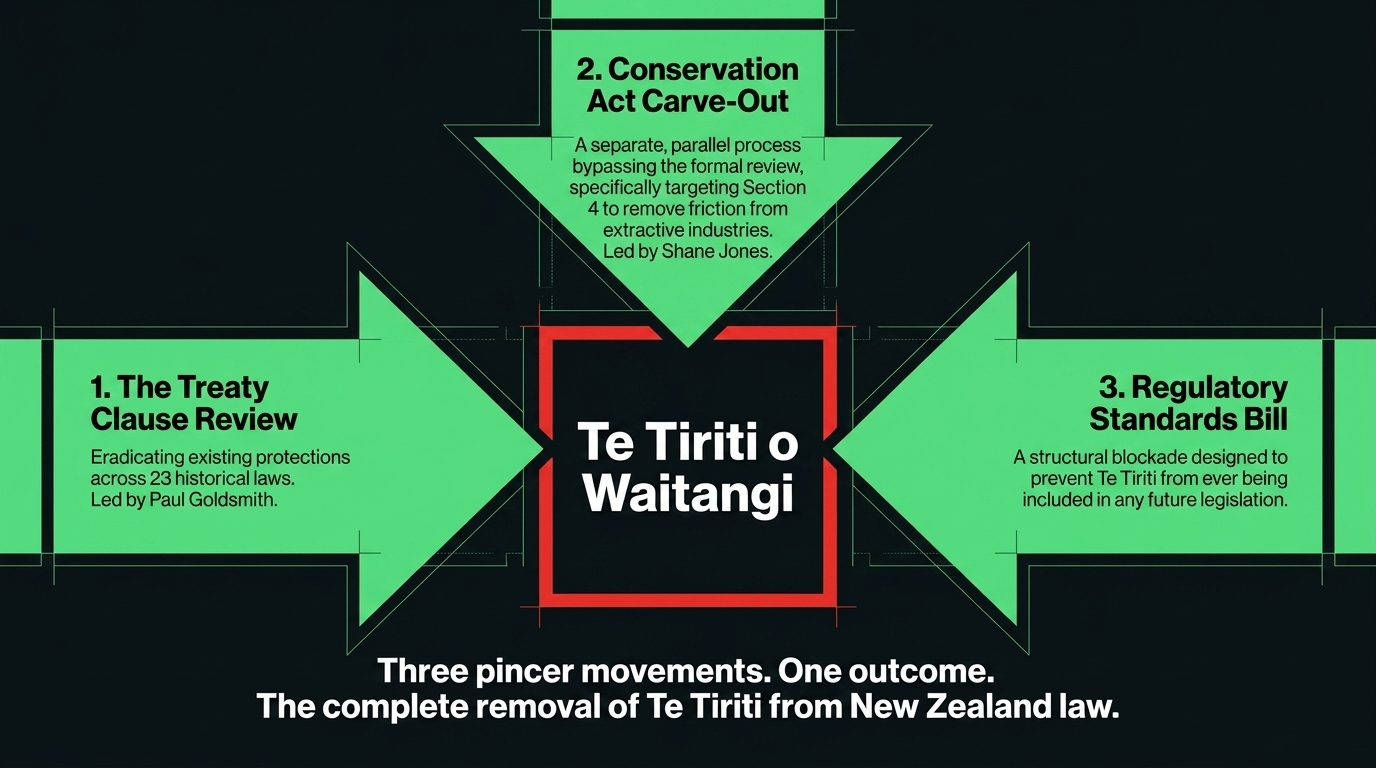
Connection 1: The Principles Bill Was the Decoy. As The Spinoff's October 2024 investigation documented, the review was "under the radar" by design — running parallel to the Principles Bill specifically to avoid the scrutiny the bill attracted. The bill was always expendable. The clause review was always the point. Māori protest energy was directed at the decoy while the actual heist proceeded.
Connection 2: The February 23 Decision Was Hidden for 55 Days While Goldsmith Expanded His Power. Cabinet decided February 23. The memorandum was filed March 12. The NZ Herald published April 19. During those 55 days, Goldsmith was simultaneously securing six ministerial portfolios in the April reshuffle confirmed by the DPMC. He became more powerful in the same fortnight this story broke.
Connection 3: The Climate Inquiry Was Undermined Mid-Hearing. Wai 3325 — the Waitangi Tribunal's climate inquiry — was hearing evidence from 50 Māori claimants when Goldsmith filed a memorandum at that same Tribunal confirming Cabinet had already capped the Treaty obligation in the very legislation under scrutiny. The Crown was simultaneously defendant and rewriting the statute governing its own liability.
Connection 4: The Conservation Act Is Being Handled Separately — Out of Sight. Section 4 of the Conservation Act — the strongest Treaty standard in New Zealand law — was excluded from the formal 23-law review, placed in a separate parallel process targeted personally by Shane Jones. As The Māori Green Lantern documented in Te Ara Utu: The Toll Road to Nowhere, Jones's regional development agenda requires removing Treaty friction from extractive industry. That friction is being removed privately and deliberately. The Crown Minerals Act faces the same fate through the same parallel process, as confirmed by the Ministry of Justice.
Connection 5: The Regulatory Standards Bill Runs the Third Prong. While this review strips existing Treaty clauses, the Regulatory Standards Bill — as documented by The Spinoff — removes Te Tiriti from the framework governing all future legislation. Past protections stripped through the clause review. Future protections blocked through the Regulatory Standards Bill. Present protections weakened through the Conservation Act parallel process. Three pincer movements. One outcome. The complete removal of Te Tiriti from New Zealand law.
THE CASE FOR RESIGNATION: Paul Goldsmith Must Go
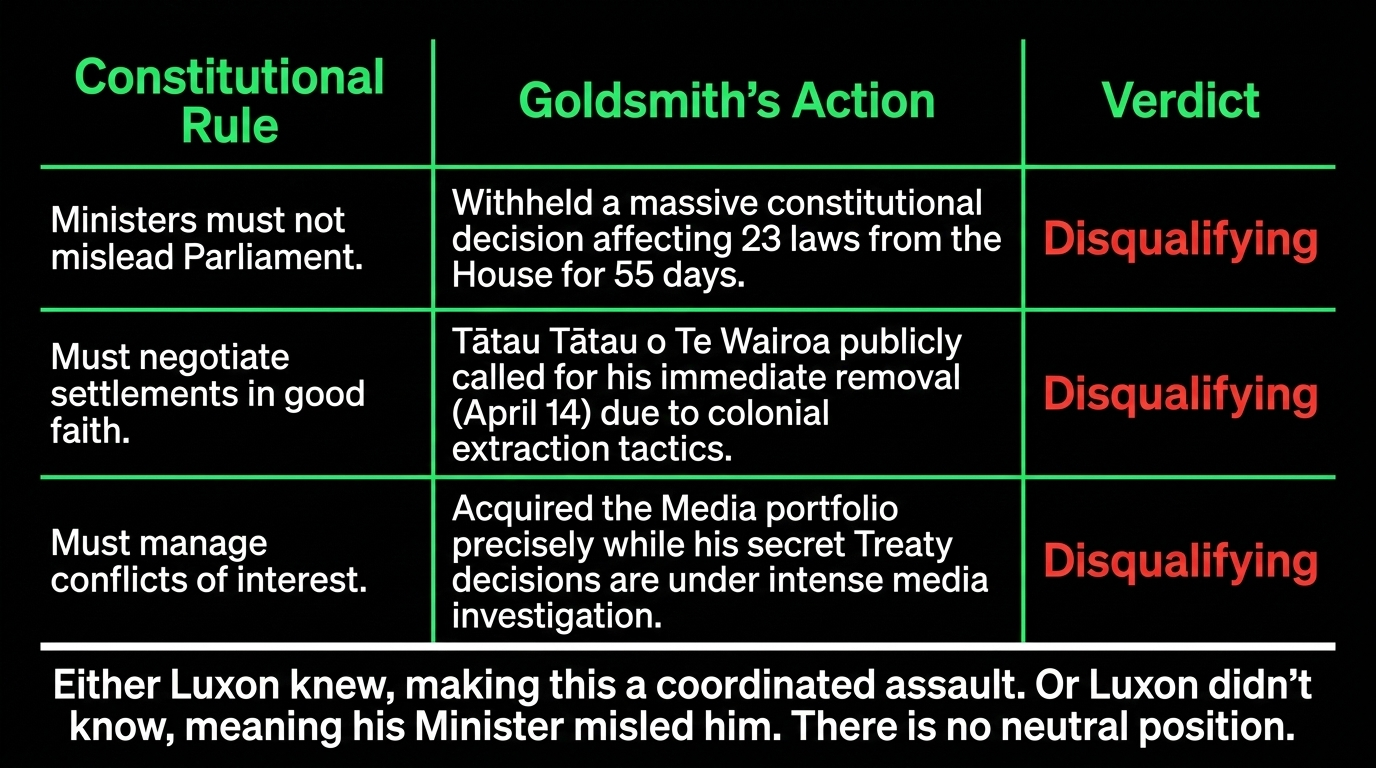
This is not a call for theatre. This is a documented, evidence-based, constitutionally grounded demand. Paul Goldsmith must resign from every portfolio he holds, effective immediately. Here is the case — ground by ground.
Ground 1: He Misled Parliament Through Deliberate Silence
New Zealand's constitutional conventions are unambiguous. As Te Ara's Cabinet Government documentation confirms, grounds for ministerial resignation include "misleading the prime minister, one's cabinet or parliamentary colleagues, or Parliament itself." Goldsmith made a Cabinet decision on February 23 that stripped Treaty obligations from 23 laws. Parliament sat for 55 days. Question Time ran. Māori MPs asked questions about Treaty policy. Not once did Goldsmith inform the House.
That is not an oversight. That is a deliberate decision to withhold constitutionally significant information from Parliament. As Hāpai Public's analysis of ministerial responsibility conventions makes clear, the convention requires a minister to "front up to Parliament, undertake to rectify a situation, and report back." Goldsmith did none of these things. He was forced into disclosure by a journalist. That is the precise antithesis of ministerial responsibility.
Notably, the UK Ministerial Code — a close analogue to our own Cabinet Manual — is even more explicit: as quoted by Yorkshire Post, "Ministers who knowingly mislead Parliament will be expected to offer their resignation to the Prime Minister." The principle is the same in Westminster systems everywhere. Goldsmith knowingly sat on this for 55 days. That is the definition of knowingly.
Ground 2: He Overrode His Own Officials' Treaty Breach Warning — Twice
Goldsmith's own Cabinet committee paper, filed in his name, recorded that officials warned from the earliest stage that the review was "likely to negatively impact on existing relationships between agencies and Māori and potentially be seen as a breach of the Treaty," as confirmed by the NZ Herald's reporting.
Then the Waitangi Tribunal — a statutory Crown body — formally found in October 2025 that the process "would breach the Treaty of Waitangi," violating six Treaty principles, as Newsroom reported. Goldsmith received the Tribunal's report. He received his own officials' advice. He overrode both and proceeded to a Cabinet decision that was hidden for 55 days.
A minister who is warned twice — by his own officials and by a statutory Tribunal — that his actions breach the Treaty, and proceeds anyway while hiding the decisions from the public, has not made a mistake. He has made a choice. That choice is disqualifying.
Ground 3: He Cannot Negotiate Treaty Settlements in Good Faith While Destroying Treaty Law
Paul Goldsmith is simultaneously the Minister for Treaty of Waitangi Negotiations — tasked with settling historical Treaty grievances — and the architect of a review stripping Treaty obligations from the statute books. He is paying with one hand and stealing with the other.
The consequences are already playing out. As NZ Herald reported in June 2025, Ngāti Hine leader Pita Tipene ruled out settling under this Government following Goldsmith's demand that iwi accept Crown sovereignty as a precondition of settlement — itself a position the NZ Herald confirmed Goldsmith stated publicly at the Māori Affairs select committee in June 2025.
And last week — just days before this article broke — Tātau Tātau o Te Wairoa publicly called for Goldsmith's immediate removal as Treaty Negotiations Minister, following the allocation of six DOC reserves exclusively to a neighbouring iwi without adequate recognition of TToTW's overlapping interests and centuries of connection to that land. TToTW chairman Pieri Munro said, as reported directly by TToTW's own website: "What we're calling for is for the Prime Minister to remove Minister Goldsmith from the position he holds in terms of Minister for Treaty Negotiations. The reason for that is we don't believe that this Minister is able to see and appreciate, and feel our connection, our rights and interests for whenua tāpui."
This was confirmed further by Te Karere on April 17 and by 1News' coverage of the overlapping iwi dispute. This is not a fringe protest. This is an active Treaty settlement trust — an institutional representative of an iwi in live negotiations with the Crown — declaring that the minister is unfit to negotiate. That is a complete collapse of the Crown-Māori relationship at the operational level.
As previously documented in Colonial Sovereignty Supremacy: How Goldsmith's Treaty Settlement Demands Expose This Government's Agenda, this pattern — demanding Crown sovereignty acceptance as a settlement precondition while stripping Treaty obligations from the law — is not negotiation. It is colonial extraction wearing a ministerial warrant.
Ground 4: He Declared Colonisation Was Good For Māori — Then Was Handed Power Over Treaty Law
This is not ancient history. In 2019, Goldsmith wrote that on balance colonisation was good for Māori because it brought literacy, freedom and democracy. As Waatea News confirmed when he was appointed Treaty Negotiations Minister in 2023, he doubled down in a 2021 interview stating: "I think on balance it has been — yes." As Te Ao News documented, almost every other National MP distanced themselves from those comments because they recognised them as disqualifying for any serious Treaty role.
Luxon appointed him anyway. Then kept him on. Then gave him six portfolios including Treaty Negotiations, Justice, and Media in the same fortnight his secret Treaty decisions were exposed.
A man who believes colonisation was a net positive for Māori must never hold power over Treaty obligations. That he now holds six portfolios is not a governance failure. It is a governance intention.
Ground 5: He Tried to Remove Tikanga From the Courts — While Overseeing Justice
As RNZ reported via the NZ Herald in September 2025, Goldsmith warned lawyers at a Law Association event that "unique" court rulings recognising tikanga Māori could cost New Zealand investment, expressing concern the country was developing a "bespoke" legal system. He signalled the government was prepared to legislate against those rulings.
A Justice Minister who publicly threatens to remove tikanga from judicial decisions — while simultaneously stripping Treaty obligations from legislation — while also overseeing the judicial processes that interpret that legislation — has demonstrated a comprehensive contempt for judicial independence, Treaty obligations, and the constitutional settlement in a single portfolio term.
As former Prime Minister Sir Geoffrey Palmer warned in Newsroom, this government is "lurching towards constitutional impropriety" through processes that "lack transparency" and give "unprecedented power to ministers to overrule the enacted law." Goldsmith is that warning made flesh.
And as The Māori Green Lantern documented in The Taiaha Strikes: How New Zealand's Far Right Weaponised a Bathroom Break to Wage War on the Judiciary, Goldsmith served as Acting Attorney-General overseeing the unprecedented judicial conduct panel convened against Judge Ema Aitken — a Māori judge targeted after overhearing Winston Peters making demonstrably false claims about tikanga law. A minister who weaponises judicial removal proceedings against a Māori judge for reacting to political disinformation — while simultaneously stripping the Treaty obligations that same judge and her colleagues interpret — has demonstrated the full spectrum of this government's intent.
Ground 6: He Now Controls the Media That Reports on Him
With the April 7 reshuffle confirmed by the DPMC Ministerial List, Goldsmith added Minister for Media and Communications to his portfolio. He is now the minister responsible for the regulatory environment governing the NZ Herald and RNZ — the outlets that are investigating and reporting on his secret Treaty clause decisions.
A Justice Minister who makes secret constitutional decisions affecting Māori, refuses to name the laws he is repealing, and then acquires oversight of the media investigating him — has created a structural conflict of interest that is, in any functional democracy, immediately disqualifying.
The Resignation Demand — In Full
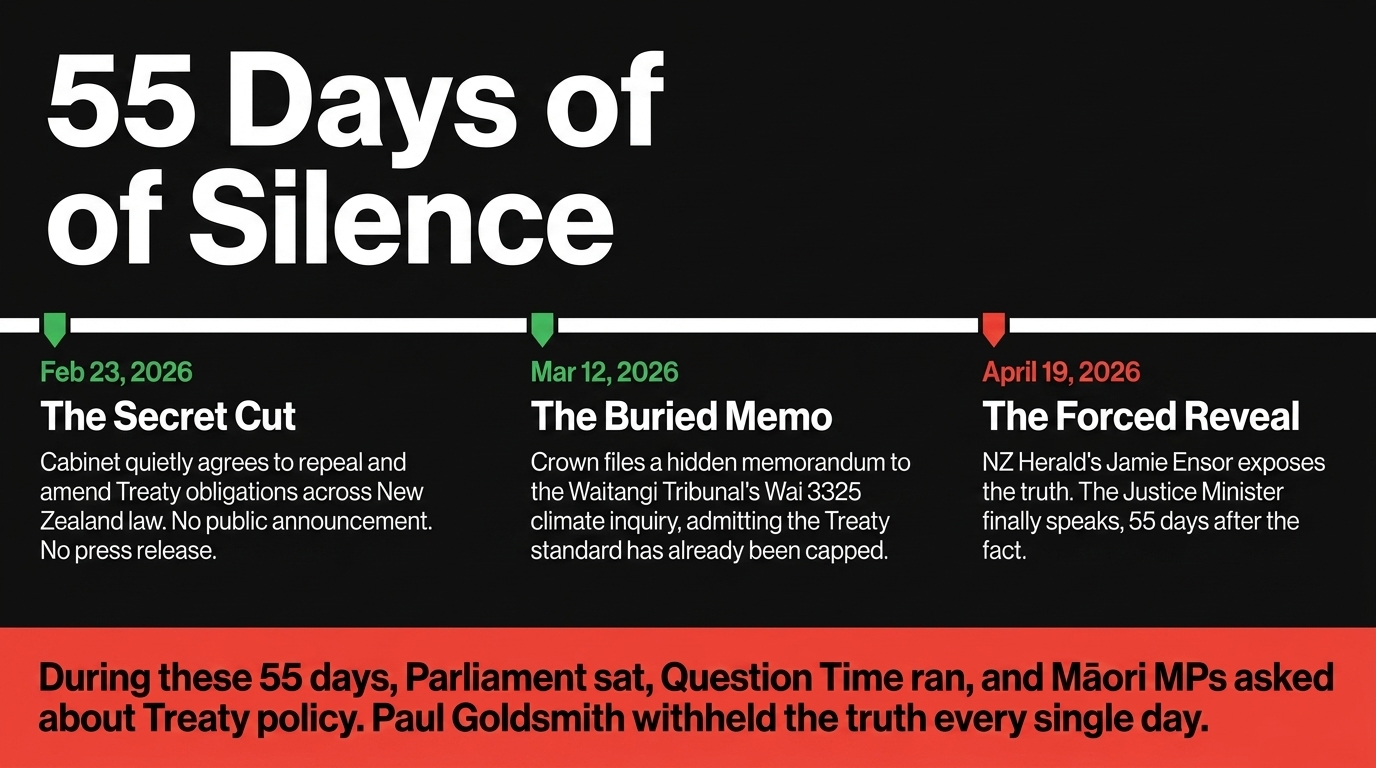
The constitutional conventions are clear. As Te Ara states: grounds for resignation include "misleading the prime minister, one's cabinet or parliamentary colleagues, or Parliament itself." And as Hāpai Public's constitutional analysis confirms, where a minister's breach is severe enough, resignation — not just explanation — is the appropriate outcome.
Goldsmith meets every threshold:
- Made a constitutional decision affecting Māori in 23 laws and withheld it from Parliament for 55 days, as confirmed by the NZ Herald
- Overrode his own officials' written warning that the review would breach the Treaty, as documented in his own Cabinet paper
- Overrode the Waitangi Tribunal's statutory finding that the process breached six Treaty principles, as reported by Newsroom
- Refused to name the laws being repealed when asked by a journalist
- Has been publicly called to resign by an iwi trust in active negotiations with him, as reported by Te Ao News and confirmed by TToTW's own statement
- Holds the documented view that colonisation was good for Māori, as confirmed by Waatea News, while overseeing the dismantling of Treaty protections
- Threatened to remove tikanga from court decisions, as confirmed by RNZ via NZ Herald
- Now controls Media and Communications while his Treaty decisions are under media scrutiny, per the DPMC Ministerial List
Christopher Luxon gave this man six portfolios two weeks after these decisions were made in secret. Either Luxon knew — in which case this is a coordinated constitutional assault — or Luxon did not know — in which case his own Justice Minister misled him.
Either way, the answer is the same: Goldsmith must resign.
If he will not, Luxon must remove him. And if Luxon will not remove him, then Luxon owns every single breach, every single secret decision, every single warning overridden, every single Māori right stripped from every single one of those 23 laws.
There is no neutral position here. Silence is complicity. And this government has been silent for 55 days already.
The Whakapapa of This Government's War on Te Tiriti
This is not a standalone event. It is a chapter in a book The Māori Green Lantern has been building since this coalition formed:
Colonial Sovereignty Supremacy: How Goldsmith's Treaty Settlement Demands Expose This Government's Agenda — this is the same man who manages Treaty settlements while dismantling Treaty obligations.
The Treaty Principles Bill: A Neoliberal Dagger in the Heart of Aotearoa's Future — named the coordinated nature of the assault and identified the clause review as the second prong.
The Starving of the Seedlings — documented how the same government strips Māori health, education, kai — and now the laws that protect all of it.
Winston Peters Is a Temu Trump — named Goldsmith as the man who said colonisation was good for Māori, now the architect of Treaty dismantling.
The Taiaha Strikes: How New Zealand's Far Right Weaponised a Bathroom Break to Wage War on the Judiciary — documented Goldsmith using judicial processes to target a Māori judge.
The Colosseum of Kingsland — the government's use of spectacle to absorb protest while real damage runs offstage.
Two Kings and a Broken Child — the whakapapa of severance at the heart of this government's Māori policy.
The Iron Throne of Fools: How Luxon's April 1st Purge Exposed a Rotting Crown — named Goldsmith's blocking of a near-completed Treaty settlement with Te Whānau-ā-Apanui.
The pattern is not subtle. It is a programme. And Goldsmith is not a cog. He is the architect — and as of April 7, he runs six portfolios giving him control of law, settlements, public service, media, culture, and Pacific communities.
The Ministerial Accountability Record
| Minister | Current Role (from 7 April 2026) | Documented Actions |
|---|---|---|
| Paul Goldsmith | Justice, Treaty Negotiations, Pacific Peoples, Public Service, Media, Arts | Secret Cabinet decision Feb 23; refused to name repealed laws; overrode official and Tribunal warnings; believes colonisation was good for Māori; threatened to remove tikanga from courts; now controls media oversight — NZ Herald, DPMC |
| Shane Jones | Regional Development | Drove coalition commitment; personally targeting Conservation Act section 4 — NZ First |
| Chris Bishop | Attorney-General (from 7 April) | Drove RMA deregulation stripping Treaty consultation; now Crown's chief law officer — NZ Herald |
| Judith Collins | Retired from Parliament — Law Commission | Sat on oversight group; has exited — 1News |
| Tama Potaka | Māori-Crown Relations (outside Cabinet) | Admitted not knowing Treaty references removed from RMA — NZ Herald |
| Christopher Luxon | Prime Minister | Signed coalition agreement; gave Goldsmith six portfolios; has been publicly silent on every breach |
| David Seymour | ACT Leader, Cabinet | Admitted the review failed to resolve the underlying problem — then called it "useful" — NZ Herald |
The Quantified Harm
- 23 laws stripped of Treaty obligations — NZ Herald
- Climate Change Response Act Treaty obligation capped at "take into account" while 50 Māori climate claimants wait — Lawyers for Climate Action
- Six Treaty principles formally found breached — Newsroom
- 55 days of deliberate Crown silence following the Cabinet decision
- Zero new Treaty protections added — Ministry of Justice
- Conservation Act and Crown Minerals Act targeted in separate less-visible parallel reviews — Ministry of Justice
- Tātau Tātau o Te Wairoa publicly calling for Goldsmith's removal as of April 14, 2026 — Te Ao News
- Ngāti Hine ruling out settling under this government — NZ Herald
The Crown's Confession
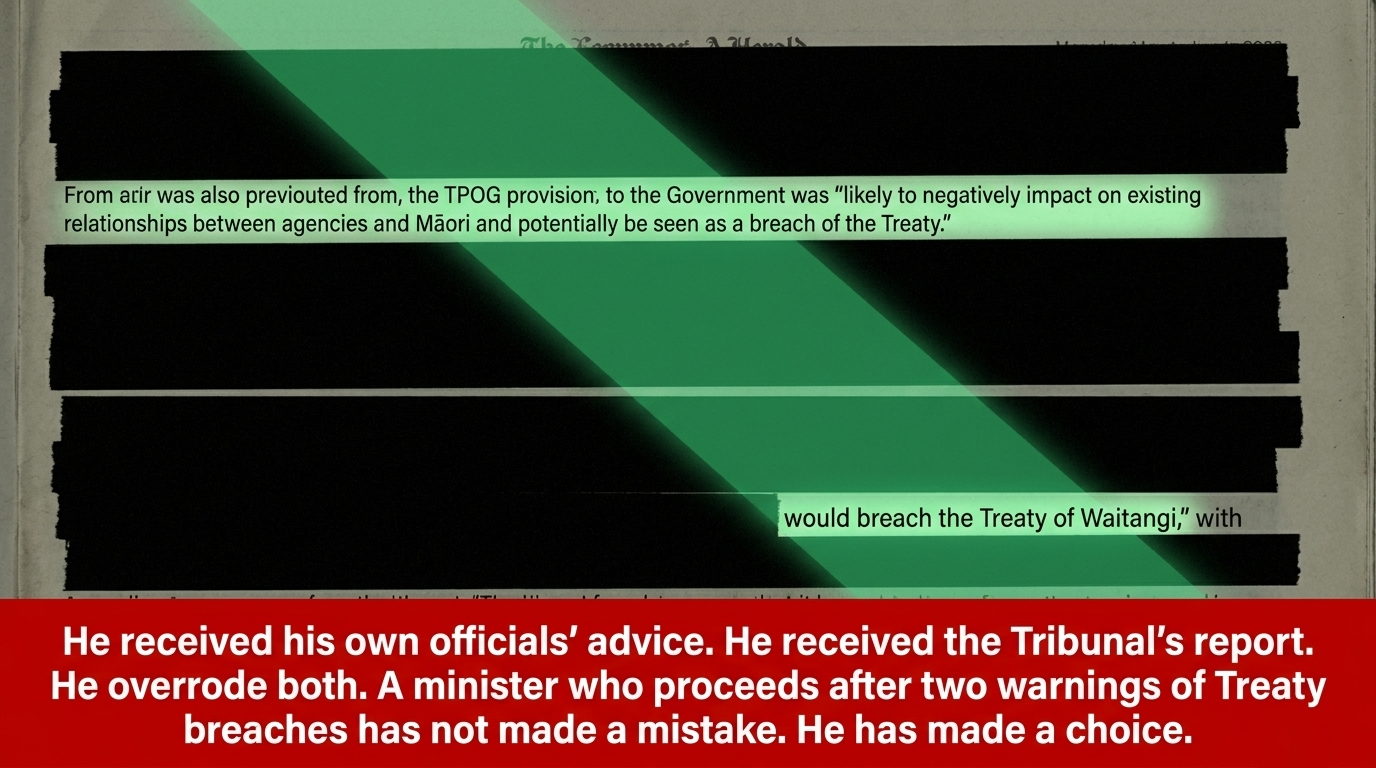
Goldsmith's own Cabinet paper admitted officials warned the review was "likely to negatively impact on existing relationships between agencies and Māori and potentially be seen as a breach of the Treaty," as confirmed by the NZ Herald.
His own paper. His own admission. He proceeded anyway.
When finally cornered, he offered:
We are now consulting with Iwi leaders before introducing legislation."
Now consulting. After Cabinet decided. That is not consultation. That is notification with a friendly font. It is the Crown inviting you to the table to admire the meal it has already eaten.
And even David Seymour admitted the exercise was pointless:
"The 'Treaty principle' is still a legal term in New Zealand's law books and what that means is no clearer than before."
The man who designed the original weapon says this new weapon doesn't work either. The government is still using it. You are not watching policy failure. You are watching ideological vandalism without conscience or exit strategy.
Rangatiratanga Action — Do This Now, Whānau
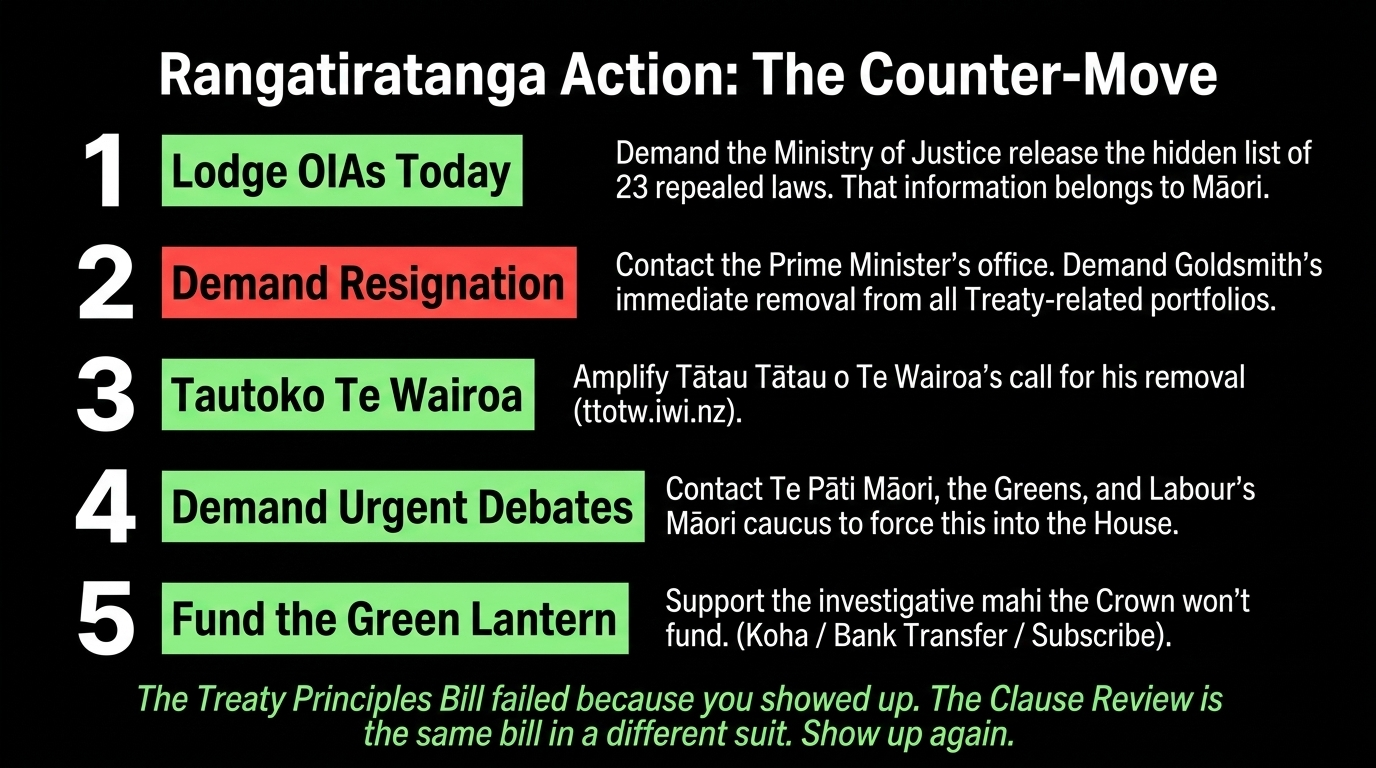
- Lodge OIA requests today to the Ministry of Justice for all advice relating to the February 23 Cabinet decisions, including the full list of laws subject to repeal. File at the Office of the Ombudsman.
- Demand the full list of repealed laws. Goldsmith refused to name them to the NZ Herald. That information belongs to Māori.
- Call for Goldsmith's resignation. Contact Christopher Luxon's office at beehive.govt.nz/contact-us. Demand he remove Goldsmith from all Treaty-related portfolios immediately.
- Stand with Tātau Tātau o Te Wairoa. They have already called for Goldsmith's removal — amplify their voice at ttotw.iwi.nz.
- Contact Te Pāti Māori, the Greens, and Labour's Māori caucus — demand Urgent Debates in Parliament this week on every resignation ground documented above.
- Get this to the Wai 3325 lawyers. Contact Lawyers for Climate Action — the Crown capped its Treaty obligations in the CCRA while their clients' inquiry was live.
- Watch the Conservation Act. Ask Shane Jones directly and publicly: when does the separate Conservation Act review conclude, and why was it excluded from the formal process?
Tautoko This Mahi — Fund the Accountability the Crown Will Not
They removed the poutokomanawa and told you the building was still standing. They killed the Treaty Principles Bill in Parliament and then implemented it through Cabinet, without a vote, without a hearing, without telling you which laws they destroyed.
The Treaty Principles Bill failed because you organised. The Clause Review is the same bill in a different suit. Show up again.
Goldsmith must resign. If he will not, Luxon must remove him. If Luxon will not, then in November 2026 — you remove them both.
Paul Goldsmith hid this decision for 55 days. He now holds six portfolios — including oversight of the media investigating him. He has been publicly called to resign by an iwi trust in active negotiations with him. He believes colonisation was good for Māori and has been handed the keys to Treaty law.
Every koha to this mahi is a direct counter-move. When Goldsmith strips 23 laws of Treaty obligations in secret and the news cycle moves on — this space stays on it, names names, and builds the evidence that sticks.
Three pathways to tautoko:
🔴 Koha directly — fund this accountability work: Koha — Support the Māori Green Lantern
📩 Subscribe — receive every essay directly: Subscribe at themaorigreenlantern.maori.nz
🏦 Bank transfer — HTDM, account number 03-1546-0415173-000
📘 Facebook — follow and subscribe: facebook.com/Themaorigreenlantern
If you cannot koha right now — no worries, no pressure, no shame. Share this essay. Send it to your MP. Send it to Luxon's office. Read it with your whānau. That is koha in itself. The Treaty Principles Bill failed because you showed up. The Clause Review is the same bill in a different suit. Show up again.
Kia kaha, whānau. Stay vigilant. Stay connected.
Ko Ivor Jones tēnei. Ko te Māori Green Lantern. Ka whawhai tonu mātou — ake, ake, ake.