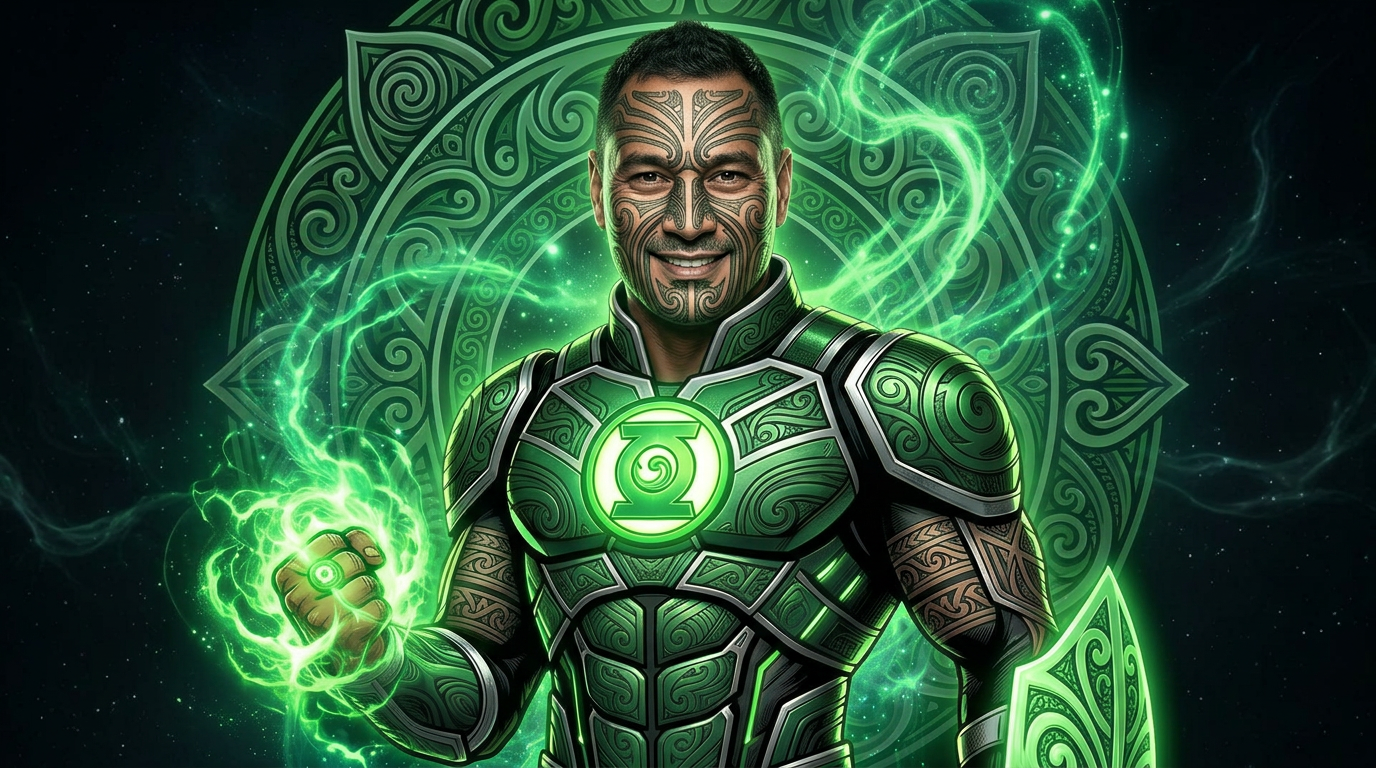
"🔆 SOLAR THEATRE IN A DYING EMPIRE: AOTEAROA'S LAST POLITICAL HOPE VERSUS THE LORDS OF THE LONG DARK" - 19 April 2026
Every other party has either sold the future, stolen it, or cosplayed sovereignty while the hui was cancelled and the constitution was being rewritten. The Greens are flawed. They are also the only ones left standing.

Kia ora ano Aotearoa,
Imagine a whare on fire. National built it from rotting timber and called it economic growth. ACT is charging admission to the fire. NZ First is selling LNG to the flames. Labour is drafting a working group. And Te Pāti Māori — the party that was supposed to be your waka — is locked in a boardroom, expelling its own MPs, while John Tamihere checks his constitutional amendments and Rawiri Waititi posts on Instagram.
Then the Green Party walks up, solar panel in hand, and says:
"Actually — what if we stopped burning things?"
That is New Zealand in April 2026. That is the "State of the Planet."
And before this essay is done, you will understand why — for all their imperfections, all the structural gaps, all the policy work still left to do
— the Green Party is the only political vehicle in this country still pointed at a future worth living in.
The Deep Dive Podcast
Listen to a lively conversation between two hosts, unpacking and connecting topics in the sources of this essay.
The World the Corrupt Built — And Left Burning
Let's start with the fire, because too many people are still being polite about it.
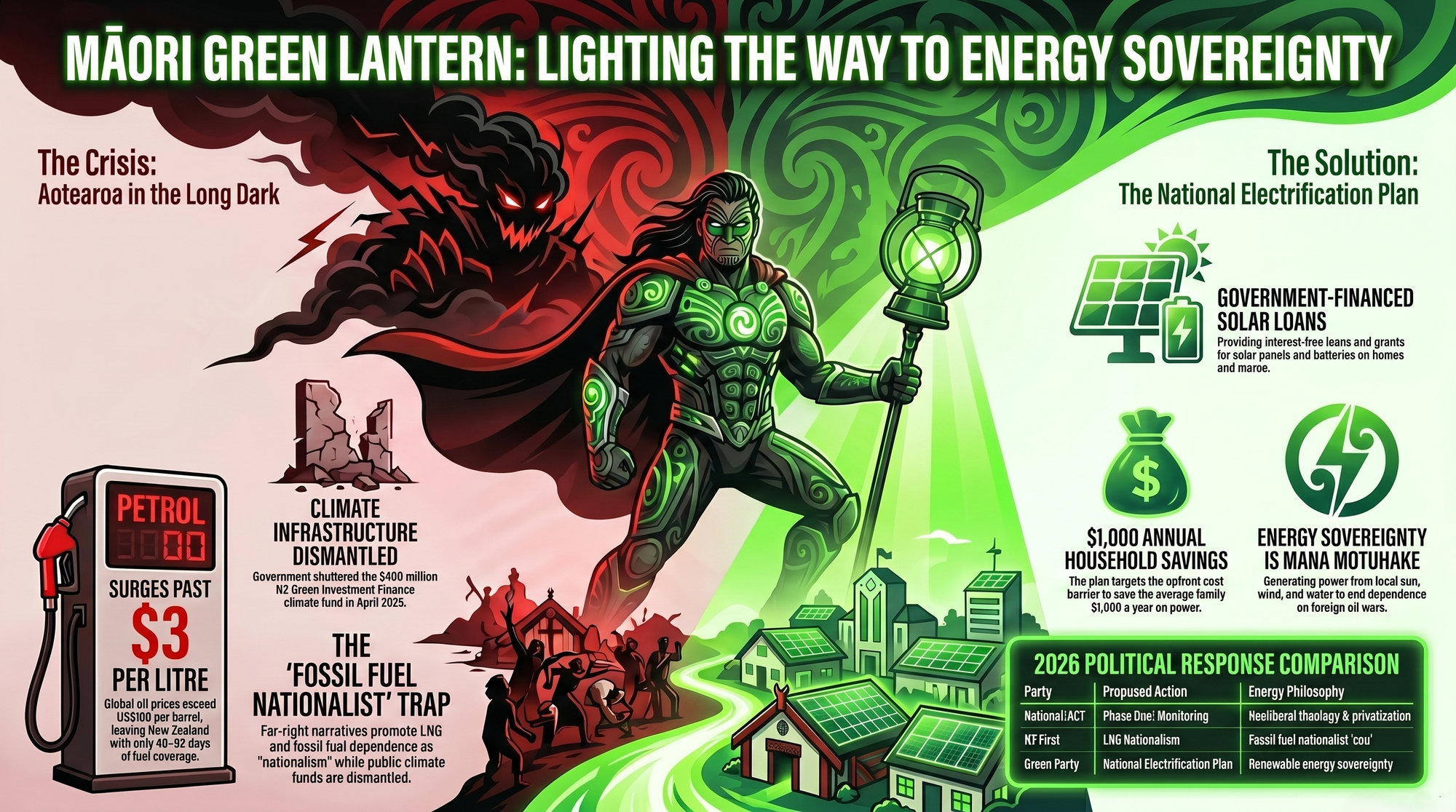
The 2026 Iran war fuel crisis has effectively closed the Strait of Hormuz, disrupting 20% of global oil supply and sending petrol past NZ$3 a litre at New Zealand pumps. New Zealand — which imports every drop of its petrol — has approximately 46–53 days of fuel coverage, as confirmed by investinglive.com reporting on the government's contingency plan. Oil has surged past US$100 a barrel, with analysts warning it could reach US$150 if the strait stays closed, as 1News confirmed in March.
The Luxon Government's response?
Phase One: Monitoring. Watching. Waiting. Hoping the market fixes itself. While whānau queue for petrol and choose between filling the tank and filling the fridge.
This is not mismanagement. This is the logical endpoint of neoliberal theology: privatise the resilience, socialise the collapse, and make sure the donors are comfortable.
The Rogues' Gallery — Name Them All
National: The Arsonists in Suits
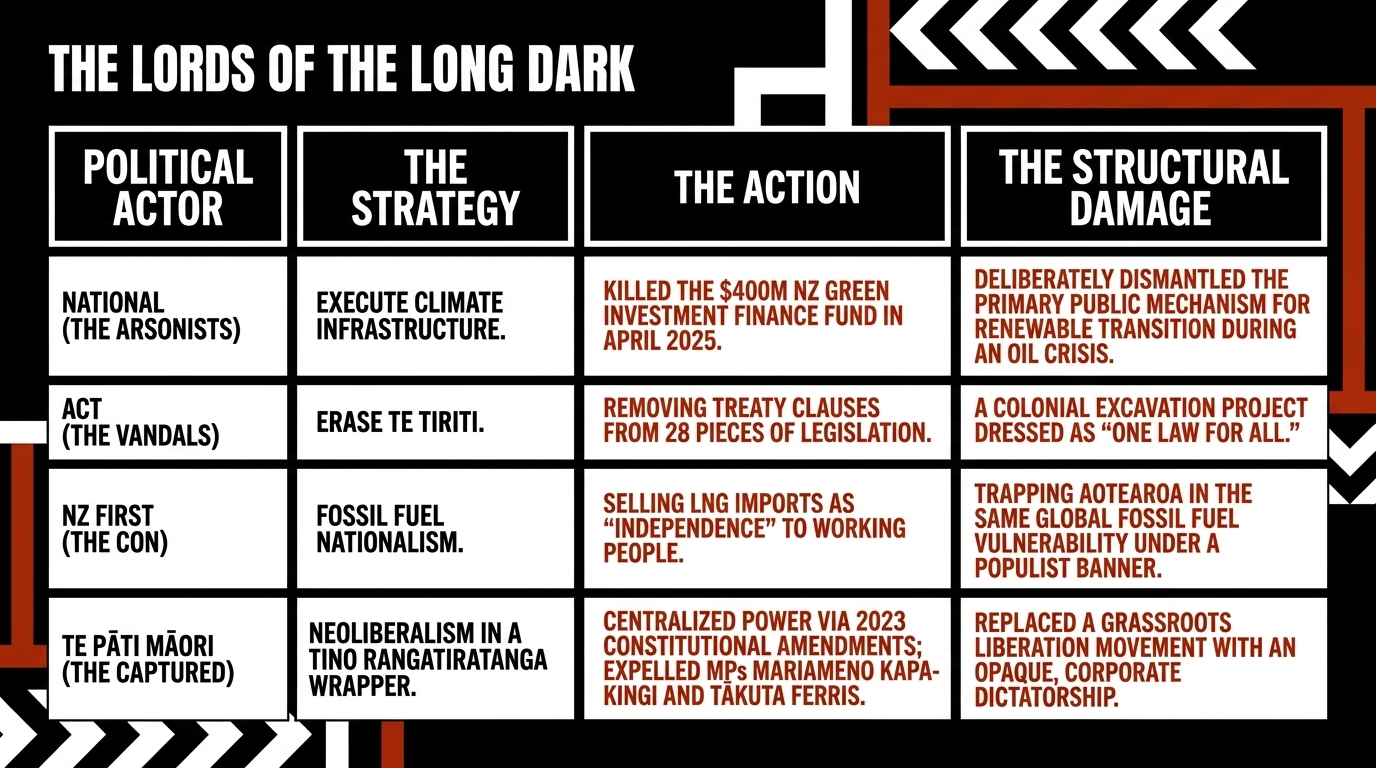
Christopher Luxon and his Cabinet did not stumble into this crisis. They accelerated toward it with both hands on the wheel and their donors in the back seat.
This is the government that, as confirmed by NZ Herald, shut down the $400 million NZ Green Investment Finance climate fund — the primary public mechanism for renewable energy transition — in April 2025. They used the collapse of SolarZero, a private company, as political cover. No replacement. No transition. No acknowledgment of the Māori and community energy projects left without funding. Just the quiet execution of the infrastructure that might have saved us.
They dismantled Te Aka Whai Ora — the Māori Health Authority — ripping out the only health structure built from kaupapa Māori principles, as documented in MGL's essay Exposing Simeon Brown's Dangerous Health Agenda. They are removing Te Tiriti from 28 pieces of legislation. They are pursuing an LNG import strategy during a global oil war, as condemned by the Green Building Council. They have deliberately weakened the Emissions Trading Scheme — reducing the carbon price floor and industrial allocations — degrading the very revenue base that could fund a renewable transition.
And Luxon — as Marama Davidson correctly indicted on Sunday — cannot say plainly whether a war is legal or
"have the courage to condemn the killing of children."
This is white-supremacist neoliberalism at full throttle. Not metaphorically.
Structurally.
A government whose every policy decision since 2023 has redistributed resources upward, away from Māori, away from the poor, away from the planet — toward the 2% who, as Te Pāti Māori's own press release once noted, hold 50% of the wealth.
ACT: The Philosophical Vandals
David Seymour and ACT are what happens when you hand the keys of the state to a libertarian pamphlet. The removal of Treaty clauses from legislation is not a policy disagreement. It is a colonial project — the systematic erasure of the founding document of this nation, dressed in the language of "one law for all." As the MGL documented in The Colonial Mindset on Display: David Seymour's Oxford Hypocrisy, Seymour's condemnation of Māori MPs for expressing themselves in Parliament reveals a commitment to limiting Māori political expression to forms acceptable to the coloniser.
ACT is not governing. ACT is excavating. Removing every structural protection for Māori, workers, and the environment — and handing the rubble to its donors.
NZ First: The Fossil Fuel Nationalist Trap
Winston Peters is running the oldest con in the populist playbook. While the Greens offer renewable energy sovereignty, NZ First is offering LNG nationalism — the idea that energy independence means importing more fossil fuels, just from different suppliers. This is the Rust Belt Trump play, imported wholesale to Aotearoa: tell working people their abandonment was caused by environmentalists and Māori, not by the economic system that actually gutted their communities.
NZ First is now polling at 13–15%, as tracked on the Wikipedia 2026 election polling tracker. In a year defined by climate crisis, oil war, and energy poverty, the anti-environment, pro-fossil fuel party is eating the Greens' lunch.
That is not a political accident. That is a manufactured narrative, and Peters has been building it for three years.
Labour: The Managed Decline Department
Labour is not the enemy. Labour is something almost worse: the reasonable face of the same structural failure.
Under Labour, the ETS was implemented but underfunded. The clean energy transition was started but not resourced. Māori housing, health, and energy poverty were acknowledged but not solved. And when the Luxon Government began dismantling everything, Labour's opposition has been measured, procedural, and — on energy — largely silent.
Labour MP Willie Jackson believes a split in Te Pāti Māori is "inevitable" and is already positioning for post-split alignment. That tells you everything about Labour's relationship with Māori politics: it is a management strategy, not a liberation strategy.
Te Pāti Māori: Neoliberal Māori — The Hardest Truth
Let's say it plainly, because the MGL has been saying it since 2024, and the events of 2025 proved it: Te Pāti Māori has been captured by the same logic it claims to oppose.
This publication's essay Te Pāti Māori in Crisis: Leadership Collapse and Kaupapa Betrayal documented it with precision. And the follow-up The Whare Is Rotten: Why Te Pāti Māori Must Decolonise Itself named the structural source.
In 2023, constitutional amendments shifted authority from the membership — from the hapū, the electorate branches, the rangatahi who built this movement — to an executive hand-picked by party president John Tamihere, as revealed by The Spinoff's investigation into the party's unravelling. This is not a stylistic choice. This is the neoliberal governance model — centralised control, managed dissent, opaque decision-making — wearing a tino rangatiratanga flag as a costume.
The consequences were predictable and damning. Two MPs — Mariameno Kapa-Kingi and Tākuta Ferris — were expelled in November 2025, as confirmed by Te Ao Māori News. Kapa-Kingi described the expulsion as "unethical and unconstitutional." Her son, former party vice-president Eru Kapa-Kingi, had accused the leadership of "operating like a dictatorship" — making decisions without consultation, silencing those who challenged. As Newsroom confirmed, Te Pāti Māori had "collapsed in on itself."
Meanwhile, as the MGL noted from Facebook in 2024, while Māori trades training was cut by $20 million, Te Pāti Māori was managing its own PR instead of fighting for whānau.
And the migration tells its own story. Former Te Pāti Māori lawyer and Treaty activist Tania Waikato announced she would stand for the Green Party in 2026, as confirmed by Te Ao Māori News. A former Te Pāti Māori candidate, Te Au-Skipworth, made the same move — citing the Greens'
"stance on Te Tiriti o Waitangi, environmental protection and social equity" and "the sense of representation she sees for her whānau within the party structure", as reported by Waatea News.
When Treaty lawyers and rangatahi candidates leave your waka for the Greens, the waka has a problem. And the problem has a name: neoliberal capture in a tino rangatiratanga wrapper.
The Green Party: Flawed, Embattled, and Worth Fighting For
Now let us be honest — the way a tohunga is honest, not the way a press secretary is honest.
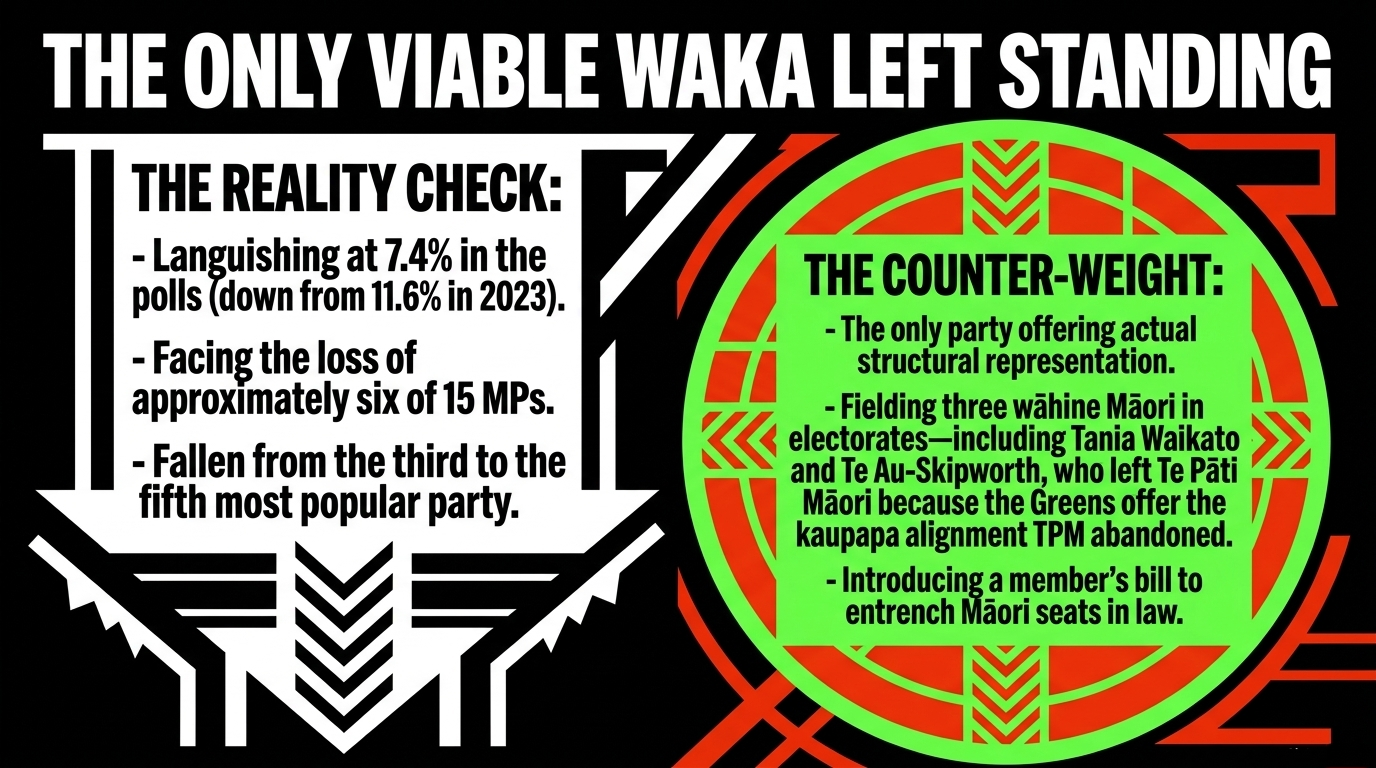
The Greens have problems. They are at 7.4% in the April 2026 average of Talbot Mills and Curia polls — down from 11.6% at the 2023 election, according to the Wikipedia polling tracker. They have had a difficult term on the Opposition benches. The March Talbot Mills poll had them at 11%, then the April figures dropped to 7.4% — a collapse of four points in weeks, tracked by The Spinoff's election analysis. On current numbers, they lose approximately six of their 15 MPs. They have fallen from third to fifth most popular party.
The MGL names this honestly. But the MGL also names what the Greens have done, and are doing, that no other party is doing.
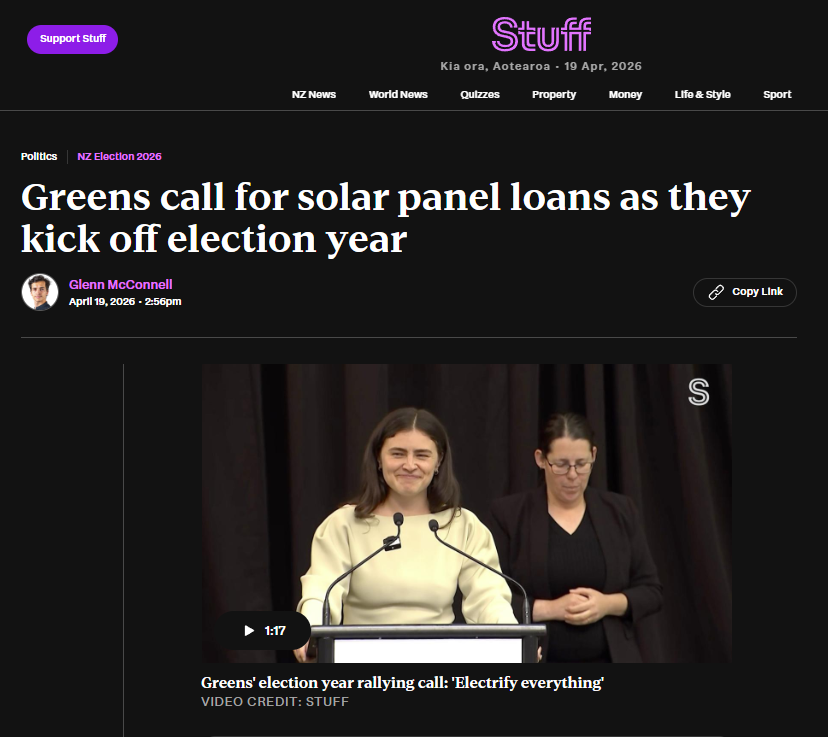
On Sunday in Wellington, Chlöe Swarbrick stood up and said:
"No one is hoarding, attacking, or starting wars over sun, wind, water and geothermal energy. They don't come through the Strait of Hormuz."
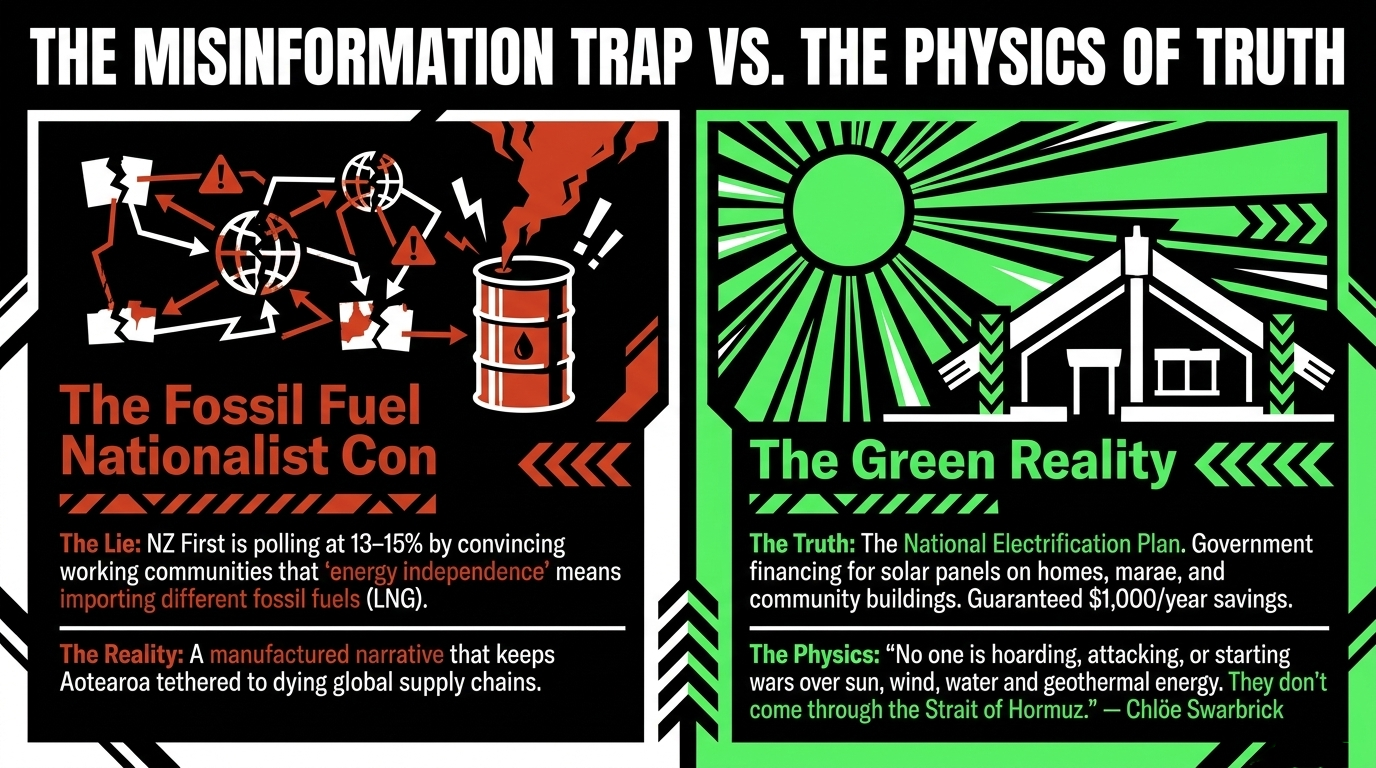
That is physics. That is geopolitics. That is the most honest sentence delivered in New Zealand politics this year.
Swarbrick's National Electrification Plan — anchored by government-financed solar loans for homes, marae, and community buildings — builds on the Clean Power Payment policy: grants of up to $6,000 and interest-free loans of up to $30,000, with an explicit promise of $1,000 a year savings on household power bills, as confirmed in the attached Stuff article.
When first announced, Greenpeace Aotearoa welcomed it as the first genuine household solar pledge and the Sustainable Energy Association of NZ endorsed it as substantive. The NZ Herald reported that energy experts backed the plan as well-designed and costed.
Marama Davidson named the war crimes. She named Luxon's silence. She said what no other mainstream party leader said:
"Our prime minister cannot even say plainly whether a war is legal or have the courage to condemn the killing of children."
And the Green Party is actively recruiting Māori leadership — fielding three wāhine Māori candidates in Māori electorates, including former Te Pāti Māori figures who left because the Greens offer what Te Pāti Māori has stopped offering: actual structural representation, as reported by Waatea News.
The party has also introduced a member's bill to entrench Māori seats in law — a Treaty-protective move that Te Pāti Māori has failed to deliver from the inside, as confirmed in the same reporting.
This is a party that is moving toward Māori, not away. It needs to move further, faster, and with greater structural commitment. But the direction is correct.
Three Examples for the Western Mind
Example 1: The Homeownership Wall — Whose Energy Transition Is This?
The Western parallel: After Hurricane Katrina, FEMA's rebuilding grants were primarily accessible to homeowners with clear title — excluding the majority of Black New Orleans residents, whose land ownership was complicated by generations of discriminatory lending, succession disputes, and informal tenure. The rebuilding programme was structurally sound for those who already had equity. For everyone else, it was a wall.
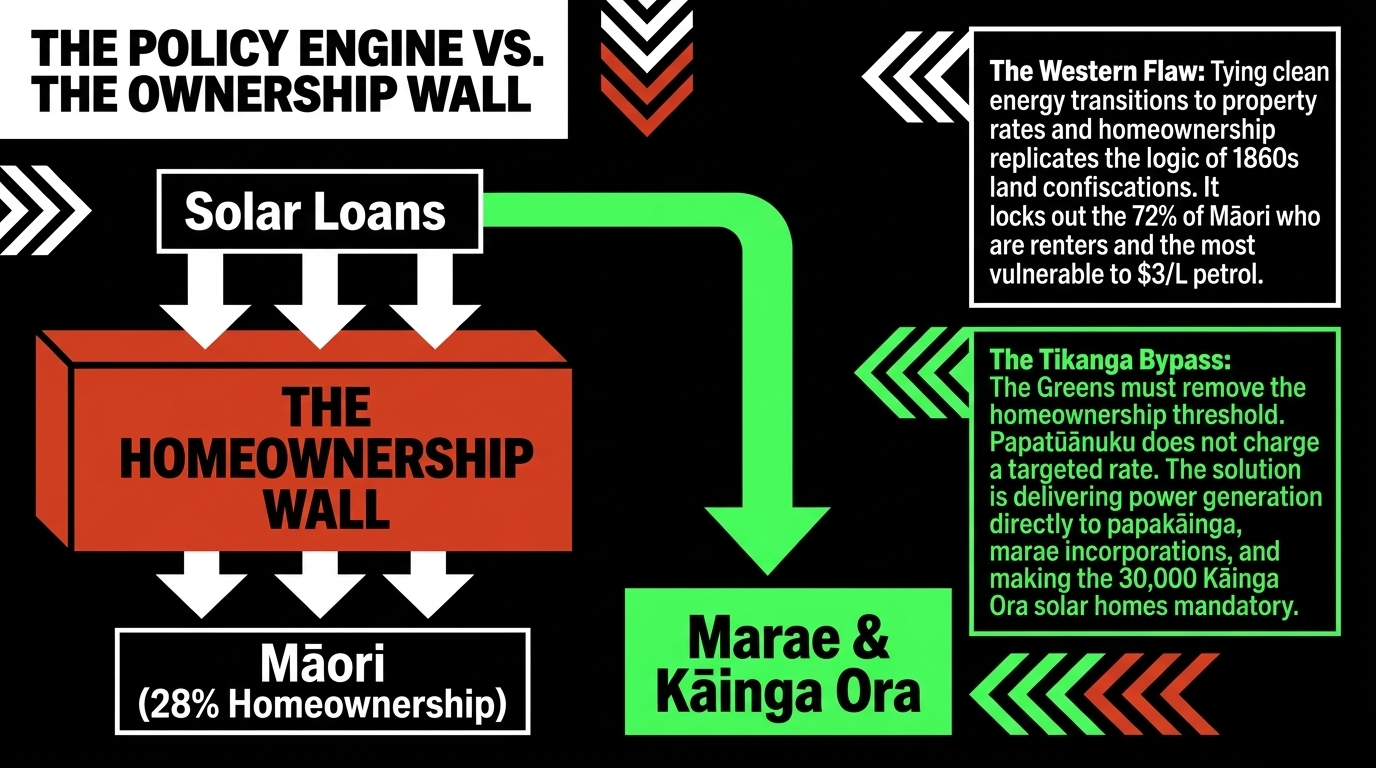
The Green Party's solar loan scheme, administered through targeted rates, carries the same structural risk. It requires ratepayer status — you must own the property. Māori homeownership sits at approximately 28%, compared to over 60% for Pākehā, according to Stats NZ. The majority of Māori whānau are renters. They are the most energy-poor. They pay the most of their income on power. They are paying NZ$3 a litre right now.
The tikanga impact: In te ao Māori, the relationship between people and whenua is not a financial transaction. It is whakapapa — identity, obligation, continuity. A policy that makes energy access contingent on property ownership replicates the logic of the 1860s land confiscations: those without deeded title are outside the circle of civic benefit. Papatūānuku does not charge a targeted rate. The Crown does.
The solution the Greens should adopt: Deliver solar directly to papakāinga trusts, marae incorporations, and Kāinga Ora stock without the homeownership threshold. The Greens' proposal to solar-panel 30,000 Kāinga Ora homes is the most transformative element of the policy
— it is the one component that reaches renters directly, and disproportionately Māori and Pasifika whānau. Make that the centrepiece, not the footnote.
Example 2: The Deleted Funding Mechanism — Infrastructure Murder by Policy
The Western parallel: In 2017, the Trump administration dismantled the Clean Power Plan, removed funding for community solar programmes, and then used the resulting market failures to argue that renewables were unviable. The destruction of the mechanism was presented as evidence of the mechanism's failure. It was deliberate. In Aotearoa, the Luxon Government ran the identical play.
The NZ Green Investment Finance climate fund — $400 million in public financing for renewable energy — was closed in April 2025. The ETS revenue base the Greens' policy depends on has been deliberately degraded, as detailed in interest.co.nz's policy analysis. Meanwhile New Zealand now has 46–53 days of fuel coverage during a global oil crisis, revealed by this fuel contingency report.
The tikanga impact: Kaitiakitanga — active guardianship — is an obligation to protect resources for future generations. A government that destroys public financing for renewable energy during a global oil war is not neutral. It is kaitiakitanga in reverse: actively depleting the mauri of the resource base that mokopuna will need. This is not a policy failure. It is a values failure. It is the choice of a government that has decided its donors matter more than the atmosphere.
The solution the Greens should adopt: Reconstitute the NZ Green Investment Finance fund under a Treaty-compliant governance structure. Mandate a Māori Energy Sovereignty stream — minimum 40% capitalisation directed to hapū and iwi-led renewable projects, governed under Article 2 of Te Tiriti.
Example 3: NZ First and the Fossil Fuel Nationalist Con
The Western parallel: In 2016, Donald Trump won the American Rust Belt not because coal was economically viable, but because his message acknowledged the communities that the green transition had skipped past. The people most hurt by deindustrialisation were offered a story — false, but emotionally coherent — that their suffering was caused by environmentalists, not by the capital class. Winston Peters is running the same con, with LNG instead of coal, and Māori communities instead of Appalachian white workers.
NZ First is polling at 13–15% on the 2026 election tracking data. In a year defined by a global oil war and a domestic energy crisis, the fossil fuel nationalist party is outpolling the Green Party. This is not a failure of the Greens' policy. It is a failure of reach — of the Greens not yet making the energy sovereignty argument in the language that working-class and Māori communities recognise as their own.
The tikanga impact: Mana motuhake — self-determining authority — is the deepest political concept in te ao Māori. Energy sovereignty is mana motuhake. The capacity to generate your own power, on your own whenua, from your own resources, for your own whānau, without dependence on the Strait of Hormuz or a Wellington power company — this is tino rangatiratanga made material. Peters is offering a fossil fuel version of the same story. The Greens must offer the real one, loudly, in the rohe of the people who need it most.
The solution the Greens should adopt: Make Māori energy sovereignty the campaign centrepiece. Not "we'll fund marae solar too." Rather:
"Hapū and iwi will be energy generators, energy exporters, energy sovereigns. We will capitalise them. This is what tino rangatiratanga looks like in 2026."
What the Greens Must Now Do — Seven Months, No Excuses
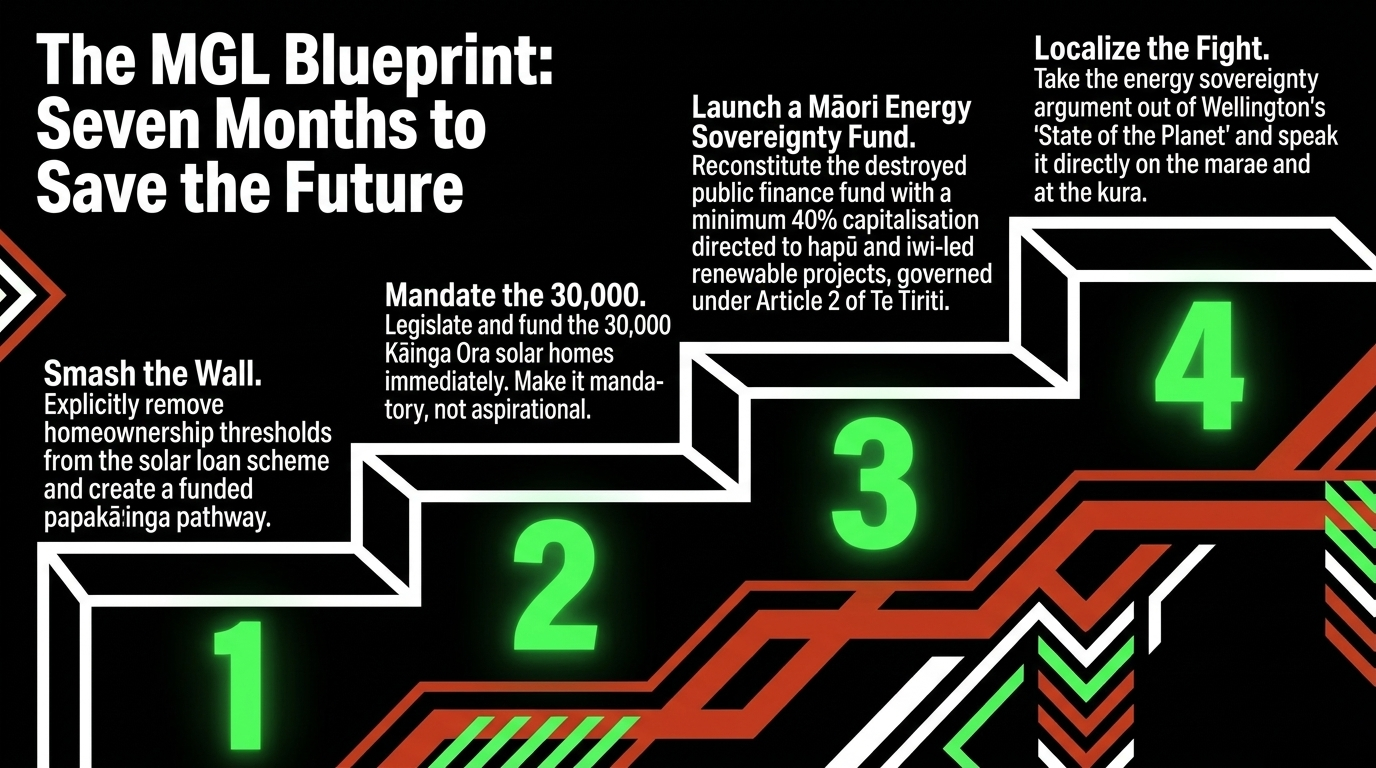
The Greens' co-leaders delivered what may be the most honest "State of the Planet" address in this election cycle.
They have the right physics, the right geopolitics, and — in their growing wāhine Māori candidate pipeline — the beginning of the right kaupapa structure. Now they must match the vision with the architecture.
Specifically, in the seven months remaining:
- Remove the homeownership threshold from the solar loan scheme — explicitly, publicly, with a funded papakāinga and rental pathway
- Make the 30,000 Kāinga Ora solar homes mandatory, not aspirational — legislate it, fund it, announce the timeline
- Launch a Māori Energy Sovereignty Fund — Treaty-governed, hapū-capitalised, marae-anchored
- Build coalition clarity with Māori communities — not Labour party management, but actual kaupapa alignment with the wāhine Māori entering the Greens from Te Pāti Māori's wreckage
- Speak the energy sovereignty argument in te reo and in the rohe — not just at Wellington's "State of the Planet", but on the marae, at the kura, at the petrol station where parents are choosing between school lunches and a full tank
Te Kōrero Whakamutunga — The Last Party Standing
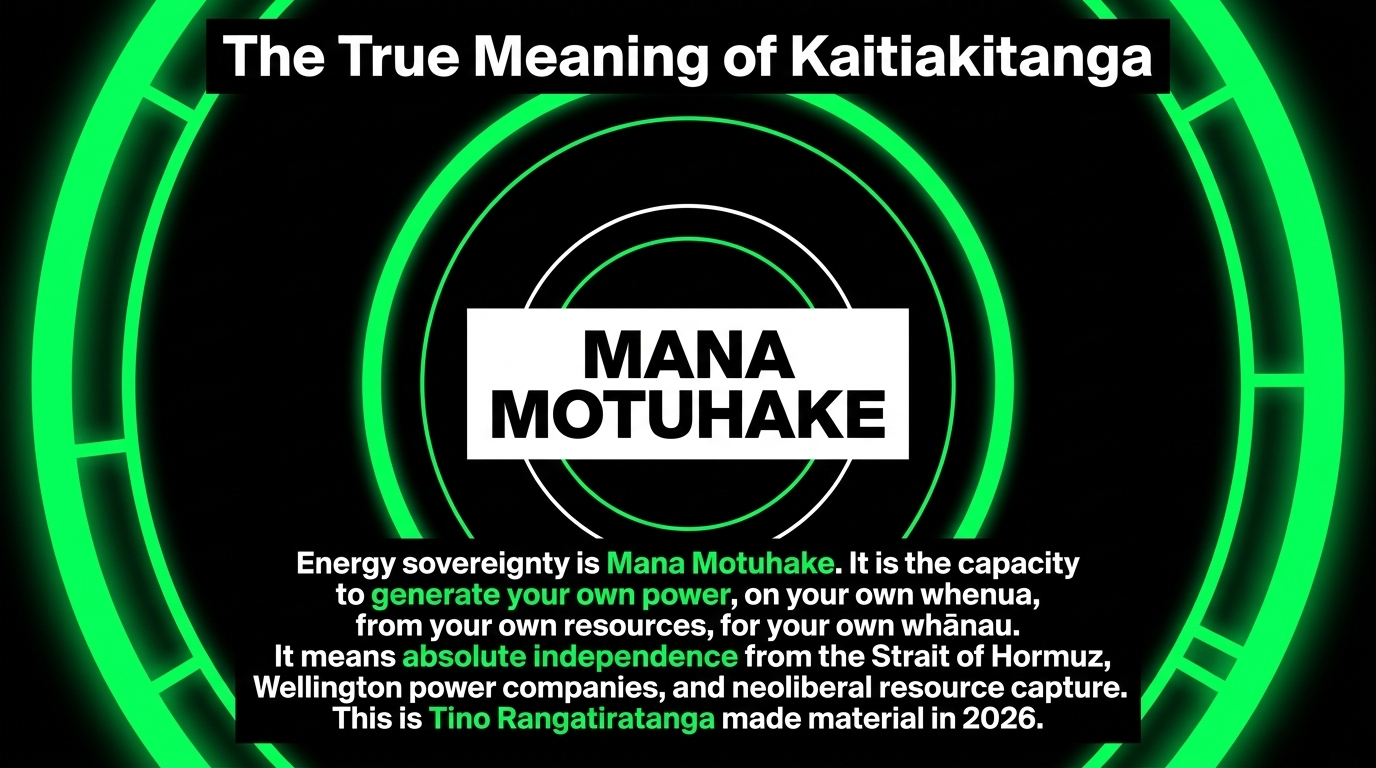
The whare is on fire. National built it from rotting timber and called it economic growth. ACT is excavating the foundations. NZ First is selling LNG to the flames. Labour is writing a report about the report. Te Pāti Māori's leadership is in a boardroom, amending its constitution to protect itself from its own members.
The Green Party is standing outside with solar panels, a Treaty commitment, and the most honest analysis of the global fuel crisis in New Zealand politics. They are flawed. They are embattled. They are down six MPs on current polling. And they are the only political vehicle in this country still pointed toward a future worth living in.
This election is do or die. Not just for the Greens. For the communities who cannot afford another three years of fossil fuel theology, constitutional erasure, and "Phase One: Monitoring."
The taiaha is raised. The ring is charged. Vote with your eyes open, your whakapapa intact, and your mana motuhake non-negotiable.
Kia kaha, whānau. The Greens are not perfect. Neither is the dawn. But it is still coming. Be there when it arrives.
☀️ Koha — Fund the Voice That Names the Darkness
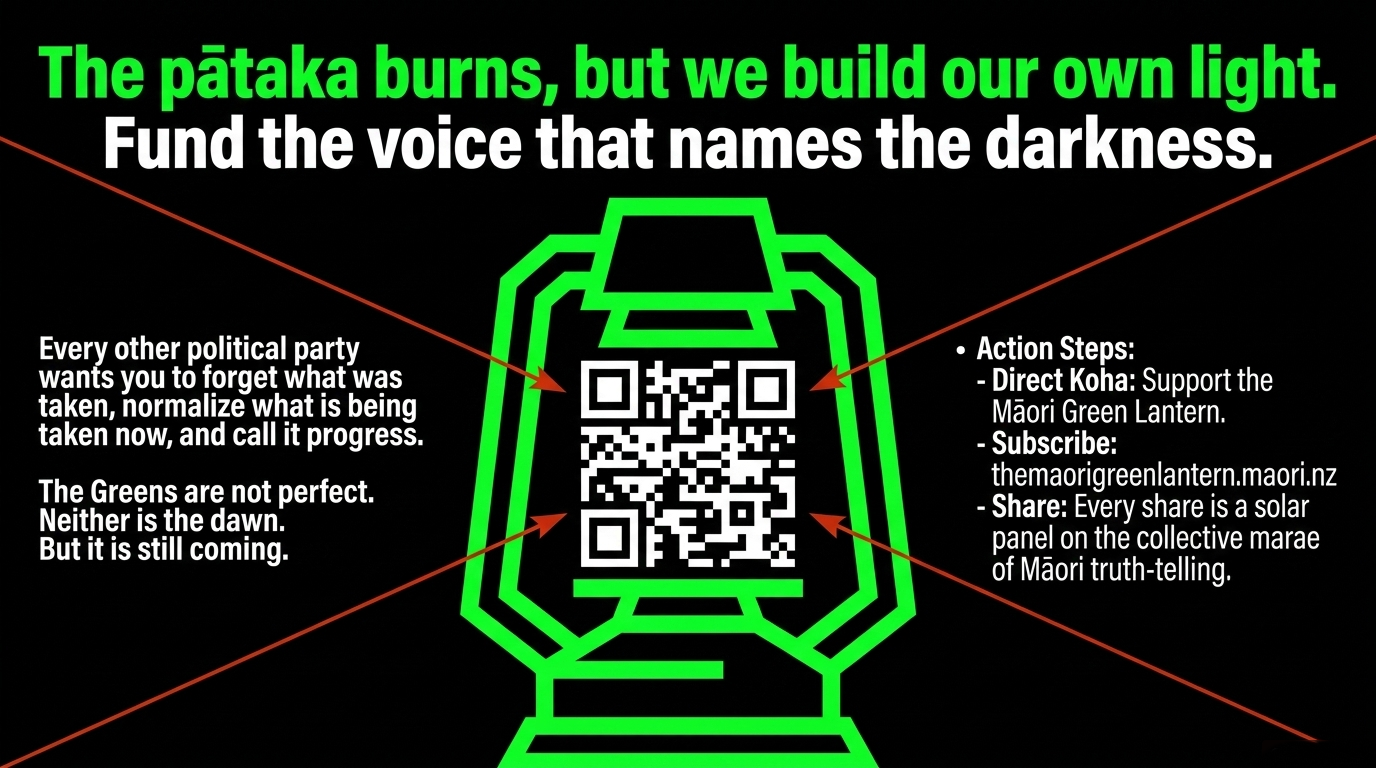
This essay exists because every other political party wants you to forget what was taken, normalise what is being taken now, and call it progress.
Someone has to stand in the gap — naming the constitutional coups, the deleted funding mechanisms, the fossil fuel nationalists stealing the sovereignty argument, and the one party still building toward a liveable future.
When whānau in Tairāwhiti are paying NZ$3 a litre to drive to the doctor, when the marae can't afford its power bill, when the ETS that was supposed to fund our clean future has been gutted by the Beehive
— that is when this mahi matters most.
If this essay helped you see more clearly, share it. That is koha. That is rangatiratanga. That is the peer-to-peer accountability structure that no government can defund.
If you can go further:
- Direct koha: Support the Māori Green Lantern here — every amount signals that whānau are ready to fund their own truth tellers
- Subscribe for direct delivery: themaorigreenlantern.maori.nz — essays straight to you before the algorithm buries them
- Bank transfer: HTDM — 03-1546-0415173-000
- Facebook whānau: Follow and subscribe here
Unable to koha? No worries — follow, subscribe, kōrero, and share with your whānau and friends. That is koha in itself. Every share is a solar panel on the collective marae of Māori truth-telling.
While Luxon monitors the crisis, Peters sells the LNG con, Te Pāti Māori rewrites its constitution, and the pātaka burns — we build our own light.
Nō reira — tukuna, kōrerotia, tautokona. Kia kaha.
Research conducted 19 April 2026. Sources verified via web search, fetch, and attached Stuff article. MGL essays cited: Te Pāti Māori in Crisis: Leadership Collapse and Kaupapa Betrayal (20 December 2025); The Whare Is Rotten: Why Te Pāti Māori Must Decolonise Itself (23 December 2025); Exposing Simeon Brown's Dangerous Health Agenda (June 2025); The Colonial Mindset on Display: David Seymour's Oxford Hypocrisy. All URLs live at time of publication. Unverifiable claims withheld per MGL Rule 2.