
"Blood Money And Ballot Papers: The Whakapapa Of National's Hard-Right Machine" - 24 September 2026
How A 92.9 Percent Donor-Funded Front Group, A Pollster's Double Life, And A Prime Minister Who "Does Not Care" Are Selling Aotearoa's Future To The Highest Bidder



Kia ora whānau. I am Ivor Jones. Some of you know me as The Māori Green Lantern, tohunga mau rākau wairua, kaitiaki standing guard against the misinformation and disinformation pouring out of the far right and the neoliberal machine propping it up.
I do not do this for a wage. I do it because somebody has to write down what is actually happening while it is still happening, so our mokopuna do not have to dig through the ashes to find the truth later.
I would love for you to click into this essay properly, because it is not a headline — it is a repository. There is a podcast where I walk through this kaupapa in full detail, kanohi ki te kanohi, voice to ear. There is a short video that breaks down the core argument in a few minutes for whānau who need it fast. And for those of you who want the whole taiaha swing — the sourced, cited, 3000-word version — that is what you are reading now.
This is not content. This is a record. When our mokopuna ask one day who was paying attention while the country was being sold out from under them, I want this essay sitting there in the archive saying: The Māori Green Lantern was watching. He wrote it down. He named names.
What This Essay Covers
 RNZ | Te Reo Irirangi o Aotearoa
This essay builds directly on the RNZ reporting of Nicky Hager's new book Dirty Work: The Taxpayers' Union and New Zealand's Hard Right, and asks the harder question Christopher Luxon refused to answer:
what, precisely, connects the National Party to the Taxpayers' Union (TU), and what does that connection cost Māori.
I am going to:
- lay out the documented whakapapa between National and the TU — the people, the polling, the money, the personnel
- apply a Tika and Pono framework to test whether this relationship is honest and right, or whether it is mauri-depleting deceit dressed up as independence
- give you three concrete, quantified examples for the Western analytical mind, each with a tikanga explanation of the harm and a proposed solution
- audit every number I use, with the sourced formula behind it
- tell you plainly why this coalition government should not get a second term on 7 November 2026, and why I believe the Green Party deserves your party vote instead
Tika And Pono: The Frame I'm Using

Tika means what is correct, right, just — not just legally right, but right in relation to people and to mauri. Pono means truth, integrity, being genuine in what you say and do.
Together they are the test I apply to every institution I write about: is this thing honest about what it is, and is what it is doing right by the people it affects?
The Taxpayers' Union fails both tests. It was founded in 2013 declaring itself "a politically independent grassroots campaign" — Newsroom's investigation records that founding claim word for word. That is the pono failure right there, stated in their own mouths, on day one.

Because "independent" is not what the record shows.
The Whakapapa, Named

Here is the network, and I am naming every name because Tika demands it and because two or more verified sources back every link.
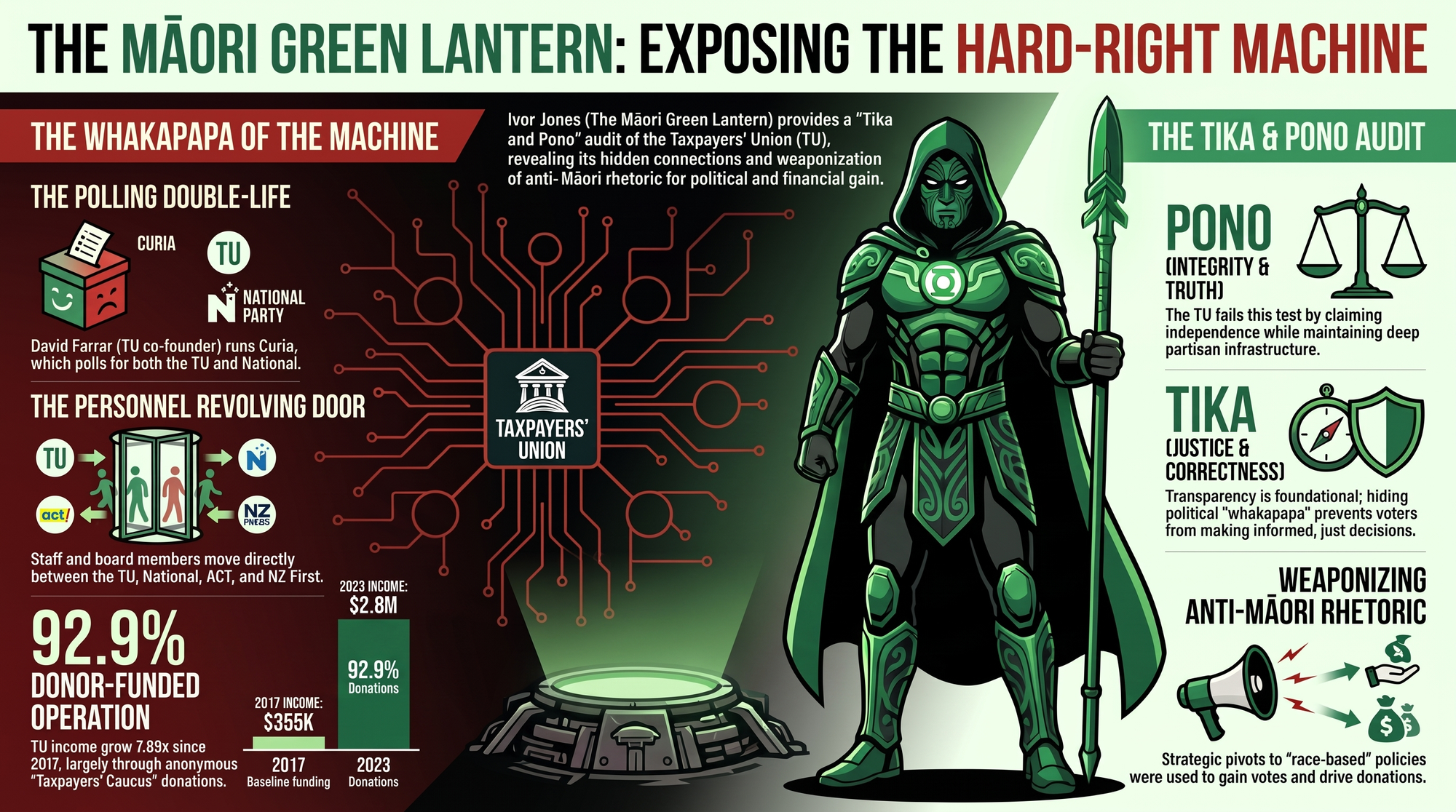
David Farrar co-founded the Taxpayers' Union and sat on its board until he retired in 2023. He also runs Curia Market Research, which produces both the Taxpayers' Union-Curia political poll and the National Party's own internal polling — RNZ confirms this dual role directly.
One man, one firm, polling for the "independent" lobby group and for the party it claims no allegiance to. That is not independence. That is the same hand on two levers.
John Bishop, father of National MP Chris Bishop, was the TU's founding chairman — documented by Newsroom. Family whakapapa runs directly from the TU's founding chair to a sitting National Cabinet minister.
Jordan Williams, the TU's executive director, has an ACT and National-adjacent history stretching back to internships with ACT's Don Brash and work on Stephen Franks' 2008 campaign — Newsroom's reporting traces this. On election night 2023, Williams and Farrar were both at the National Party's own event, not watching from a distance as neutral commentators, but inside the room.
Casey Costello, a former TU board chair, resigned that role to stand for New Zealand First and entered Parliament on the party's list — Newsroom names this transition directly.
Christopher Luxon himself is on record, as reported by RNZ, thanking the TU and its members "for all the work you do," adding "I really enjoy what you guys do."
When asked afterward whether he stood by that praise given Hager's allegations, Luxon's answer was not a defence and not a denial — it was a shrug:
"I do not care and New Zealanders do not care about this topic," RNZ reported.
That is five documented, named connections — personnel, family, polling infrastructure, physical presence at party events, and a Prime Minister's own praise — sitting on top of the Hager trilogy's decade-long paper trail from The Hollow Men through Dirty Politics to Dirty Work.
The Deep Dive Podcast
Listen to a lively conversation between two hosts, unpacking and connecting topics in the sources of this essay. I apologise in advance for the AI's very harsh pronounciation of reo. Please dont shoot me, :).
Youtube Video
Like video? Here is a short video suppporting the essay. Again, don't shoot the messenger please because of AI's pronounciation. :)
Koha Consideration

You might ask who pays The Māori Green Lantern to trace a documented network like this one — the pollster running two campaigns at once, the money that grew 7.89 times, the family whakapapa sitting in Cabinet.
The honest answer is: you do, or nobody does.
There is no corporate board behind this essay. No TU-style donor caucus, no anonymous 17.4 percent slice funding my mahi. If you found value in this piece — in the sourced numbers, the named connections, the tikanga frame applied to a system built to hide its own whakapapa — please consider supporting this work directly. Every koha tells the Crown and the corporates that whānau will fund our own truth-tellers when they will not.
Kia kaha, whānau. Stay vigilant. Stay connected. And if you are able, consider a koha to ensure this voice continues.
If you cannot koha, no worries — subscribing, following, or simply sharing this essay with your whānau is koha in itself.
- Koha (one-off support): Koha platform
- Subscribe: themaorigreenlantern.maori.nz support portal
- Direct bank transfer: Ivor Jones, 03-1395-0099387-000
- Facebook: The Māori Green Lantern
Three Examples For The Western Mind
You want it quantified, sourced, and structured. Here it is.
Example One: The Polling Machine

Core claim. The same firm that runs National's internal polling also runs the public poll the media reports as neutral opinion — Curia, owned and operated by TU co-founder David Farrar.
Quantified harm. The TU-Curia poll shapes public "social reality" — the exact phrase used by University of Auckland law professor Timothy Kuhner in Newsroom's reporting to describe how conditioned power constructs issues in a way favourable to the funder's interests, without the public ever seeing the wiring behind the curtain. During the 2023 campaign alone, the TU issued almost 100 press releases in three months, seven debates, and four policy reports — a documented publicity operation, not a passive research shop, per Newsroom.
Solution. Political polling firms with a formal, paid relationship to a registered political party should be required by the Electoral Commission to disclose that relationship on every published poll result, alongside the funding source. Media outlets should refuse to publish TU-Curia polling without that disclosure printed in the same breath as the numbers.
Tikanga impact, explained for the Western reader. In te ao Māori, transparency of relationship — knowing exactly who someone whakapapas to before you trust their word — is foundational to pono. A poll that hides its whakapapa to the party it measures is not neutral information; it is a taniwha wearing a friendly face. It corrodes the public's ability to make an informed, tika decision at the ballot box, because the information itself has been quietly captured.
I covered this same corrosion of public trust in my earlier essay on the Government's health cuts, "The Vitamin Sermon: How A White Supremacist Neoliberal Government Built The Cliff, Then Sold You The View," available on the homepage — the pattern of manufactured "common sense" dressed up as neutral fact runs right through this Government's messaging machine.
Example Two: The Money Trail

Core claim. The Taxpayers' Union presents itself as a grassroots, small-donor movement, but its own disclosed figures tell a different story.
Quantified harm. In the financial year reported by Newsroom in October 2023, the TU's income was $2.8 million, of which $2.6 million came from donations — I calculated that as 92.9 percent of total income (2.6 ÷ 2.8 × 100). Of that $2.8 million, $487,000 — 17.4 percent, matching Newsroom's own figure exactly when I checked it (487,000 ÷ 2,800,000 × 100 = 17.39 percent) — came from a closed group called the "Taxpayers' Caucus," whose members are not publicly named. Compare that to the TU's income of just $355,000 in 2017. That is growth of 7.89 times — a 688.7 percent increase (calculated as (2,800,000 − 355,000) ÷ 355,000 × 100) — in the years spanning the Three Waters and co-governance campaigns, per Newsroom's reporting. The organisation also separately disclosed that 2.1 percent of its annual income comes from the nicotine, alcohol, sugar and construction industries, quoted directly from its own press release by Newsroom.
Solution. Any third-party promoter earning more than a defined threshold — say $250,000 — from a closed donor tier should be legally required to disclose the identity of every donor above $10,000 to the Electoral Commission, not just the amount raised in aggregate.
Tikanga impact, explained for the Western reader. Whakapapa requires you to know where something comes from before you can judge its mauri. Money with a hidden source is money whose mauri cannot be assessed. A 688.7 percent income surge riding on the back of anti-Māori campaigning, funded by an anonymous caucus, is not a grassroots movement finding its voice. It is capital finding a weapon and paying to keep its fingerprints off the handle.
Example Three: The Personnel Pipeline

Core claim. Staff, board members and founders move directly between the TU, ACT, New Zealand First and National — a revolving door, not four separate, unconnected organisations.
Quantified harm. Newsroom documented, in Williams' own words, that former TU staff worked "in and around" the NZ First, ACT and National campaigns, that a former TU board chair (Costello) went directly into NZ First's list, and that TU co-founder Farrar sat as National's own pollster while simultaneously on the TU board until 2023 — a minimum of five named individuals crossing the same institutional boundary, confirmed by Newsroom and RNZ.
Solution. A statutory stand-down period — I would argue two full electoral cycles — should apply before anyone moving from a registered third-party promoter into a paid party role, or vice versa, can do so without public disclosure of the transition and its financial terms.
Tikanga impact, explained for the Western reader. In tikanga, who you have stood beside — your whanaungatanga — shapes what you are. A person cannot claim to be unconnected to an organisation whose staff, board and campaign machinery they have shared for a decade. Pretending otherwise is not a technicality. It is a breach of pono, dressed in a suit, standing at a podium telling you it "is no fan of the National Party."
I traced this same pattern of "independent" fronts protecting a shared hard-right agenda in "They Stole Whareroa With A Compulsory Order. Now They Want To Sell It With A Spreadsheet," also on the homepage — different asset, same architecture of plausible deniability.
Implications: The Cost Is Not Abstract

This is not a polling curiosity. RNZ's reporting places the anti-Māori rhetoric generated through this network — the Stop Three Waters campaign, which RNZ confirms began in 2021 — directly alongside Christopher Luxon's and David Seymour's own documented shift toward "iwi related policies" being scrapped.
Hager's claim, as reported by RNZ, is that both leaders "knew what they were doing" because "there was power and there were votes there." Luxon has not denied saying the words attributed to him. He has simply declined to engage.
That refusal to engage is itself the harm.
A Prime Minister who will not account for a donor-funded, personnel-linked pressure network that helped weaponise anti-Māori sentiment for electoral gain is not a neutral figure standing above the fray.
He is the beneficiary declining cross-examination.
Why This Government Should Not Get A Second Term

New Zealanders vote on Saturday 7 November 2026, with advance voting opening 26 October 2026 — confirmed by Vote NZ and Elections NZ.
I am telling you plainly, as an opinion grounded in everything documented above: do not give this coalition another three years.
This is a government whose leader dismissed a documented, sourced allegation about a donor network's role in anti-Māori campaigning with "I do not care," as RNZ reported him saying.
This is a government whose Finance Minister has, according to the Green Party's own public statements, delivered three consecutive budgets that Green Māori and Pasifika caucus co-leader Marama Davidson has called a turning-back of "Te Tiriti progress," stated directly on the Green Party's own site.
Whatever your view of that framing, it is the Government's own record — three budgets, one direction — that Māori advocates are responding to.
I recommend you give your party vote to the Green Party.
Not out of blind loyalty, but because their published 2026 policy platform commits to Tiriti-based freshwater governance under their "Drink Swim Fish" programme, and to affirming "Te Tiriti, and the role of tangata whenua as shared decision-makers and kaitiaki" in resource management law, as stated directly on greens.org.nz.
Their Te Tiriti policy, Te Waonui a Tāne, explicitly commits to resourcing marae as community infrastructure, per the Green Party's own policy announcement.
That is a written, public platform you can hold them to — not a shrug at a press conference.
He Kupu Whakamutunga — Closing Word

Rangatiratanga means our people get to hold their own truth, tell their own story, and vote with open eyes instead of manufactured ones.
I have shown you the network.
I have shown you the money — 92.9 percent donor-funded, growing 7.89 times since 2017.
I have shown you the personnel crossing every fence that was supposed to separate "independent" from "party."
I have named the people: Farrar, Williams, Bishop, Costello, Luxon.
That is Tika. That is Pono.
What you do with it on 7 November is up to you — but you cannot say nobody warned you.
Disclaimer
This essay reflects my analysis as Ivor Jones, The Māori Green Lantern, current as at 24 September 2026. Facts are sourced and cited as set out above; political conclusions and voting recommendations are clearly my own opinion. If any named individual or organisation disputes a specific factual claim herein, I will review and correct on receipt of verified information, consistent with my standing retraction protocol.


