
"How The $39.9 Million Science Kit Deal Looks - A Fair Game? Or A Mate Writing The Rules?" - 4 October 2026
When The Person Who Helped Shape The Curriculum Also Wins The Contract, Whānau Are Right To Ask Questions.


Kia ora ano Aotearoa,
A box turns up at a primary school. Inside are magnets, soil samples and worksheets. A term later, another box swaps in for it.
 Benedict Collins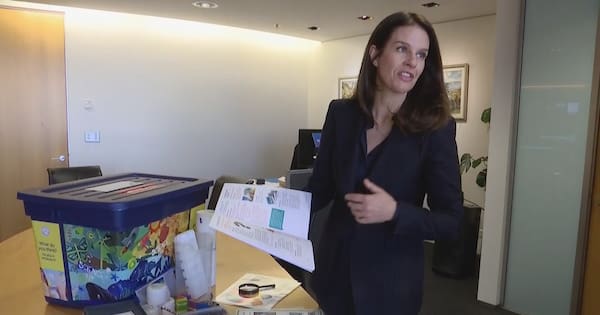
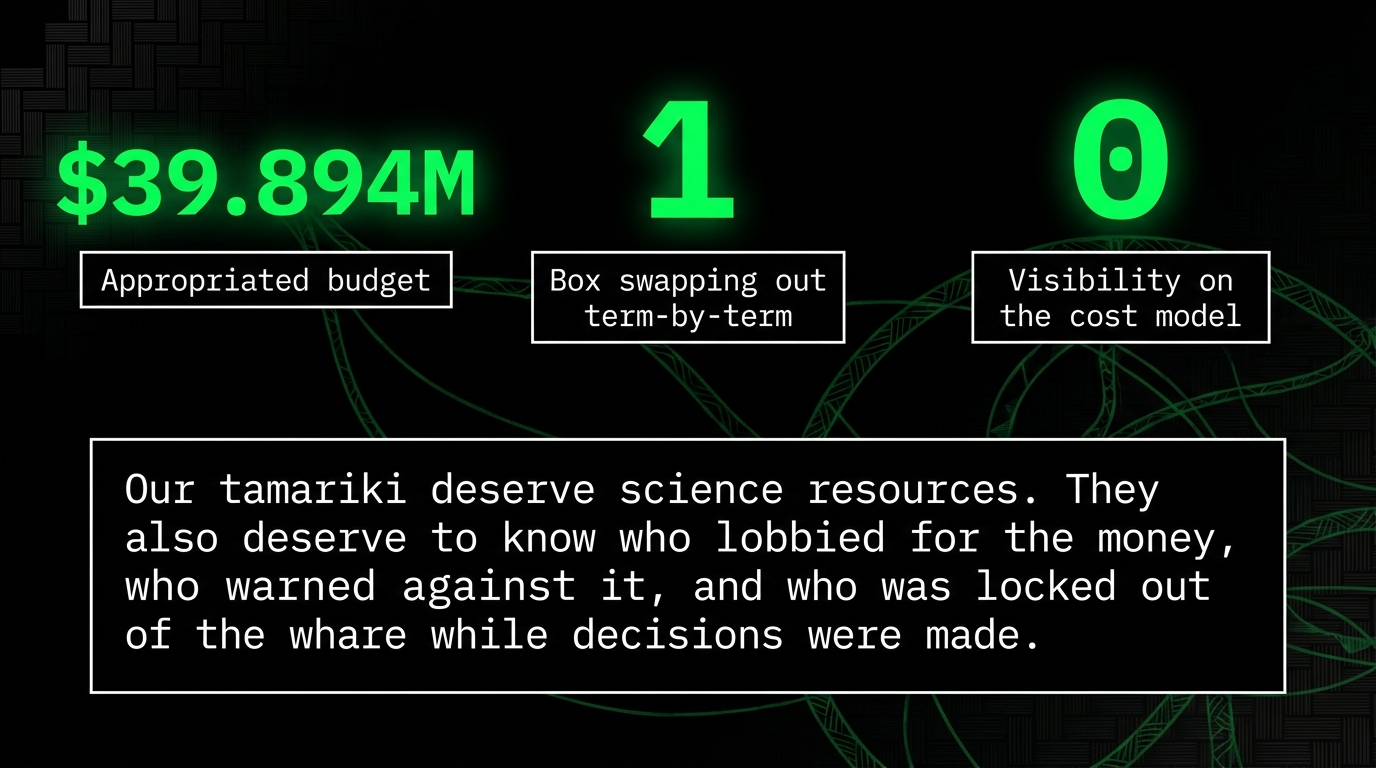
That box is a slice of $39.894 million (Cabinet's Vote Education decision). Our tamariki deserve science resources. They also deserve to know who lobbied for the money, who warned against it, and who was locked out of the whare while the decisions were made.
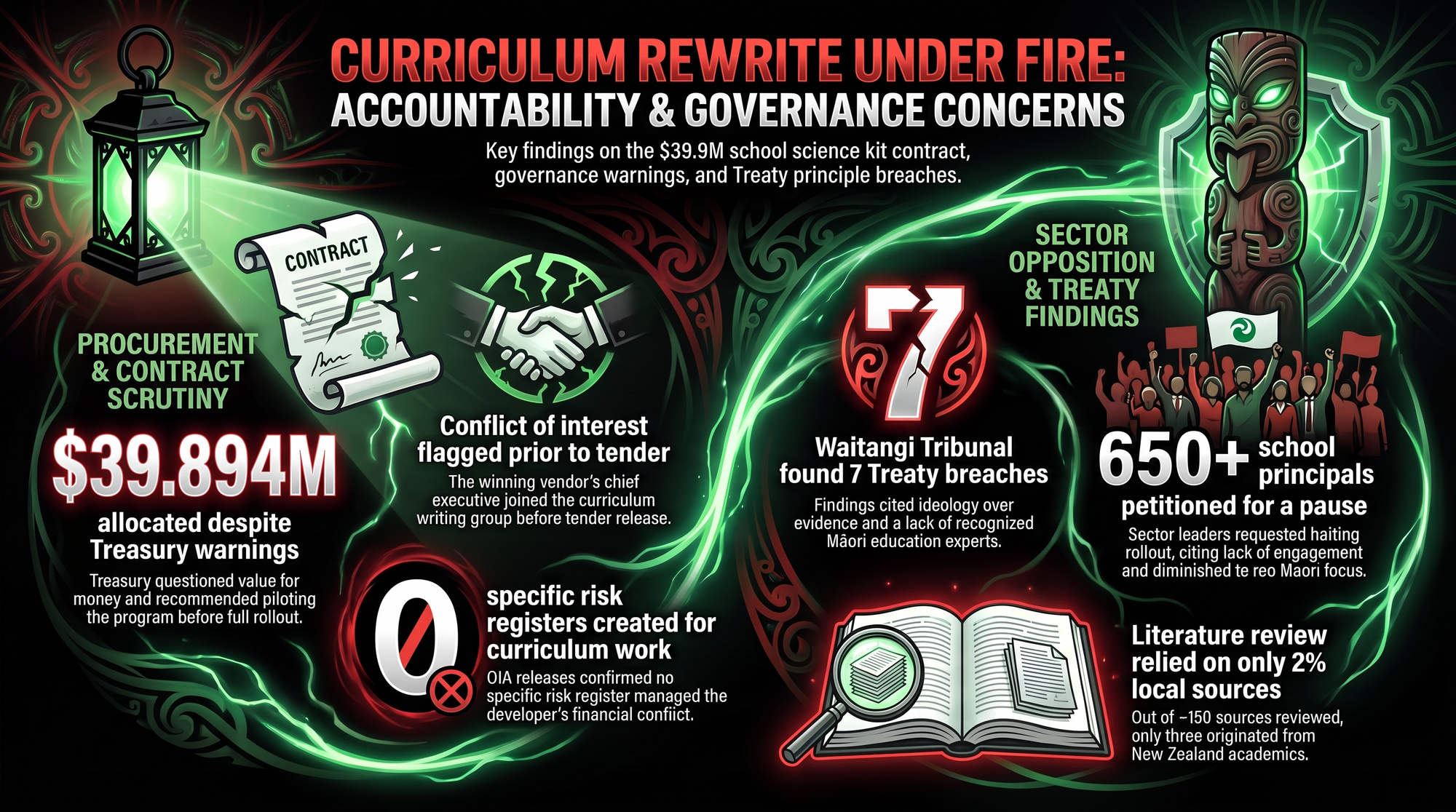
In this essay I cover the contract, the conflict of interest, Treasury's warning and the pattern behind Stanford's decisions. I then give three examples for the Western mind, the Tika, Pono and Tikanga test, and why you should not vote this coalition back in on 7 November.
I would love you to click on and share this essay. It holds information you can use in daily life. There is an audio podcast that lays out the kaupapa in detail, and a short video that explains it. For long-form readers, a 3,000-word cited essay is waiting. This is a record for our mokopuna. They can look back and say that at least the Māori Green Lantern, among a few others, warned us.
The Contract: A Lobbyist In The Curriculum Room
House of Science kept asking Stanford for funding. Documents released under the Official Information Act show it pushed for updates while the tender ran. Its chief executive, Chris Duggan, also presented to the minister in March 2024 (1News).
Before the tender began, Duggan was added to the group writing the science curriculum, on Stanford's recommendation. A Ministry official wrote that she "could directly benefit financially from being involved" (1News). Verified. Then the money arrived in Budget 2025, and House of Science was confirmed as supplier in February 2026 (Ministry of Education).
The person helping to write the map then won the contract to supply the vehicles. That is the sequence on the record. I can see it from here.
The Other Side, Fairly Stated
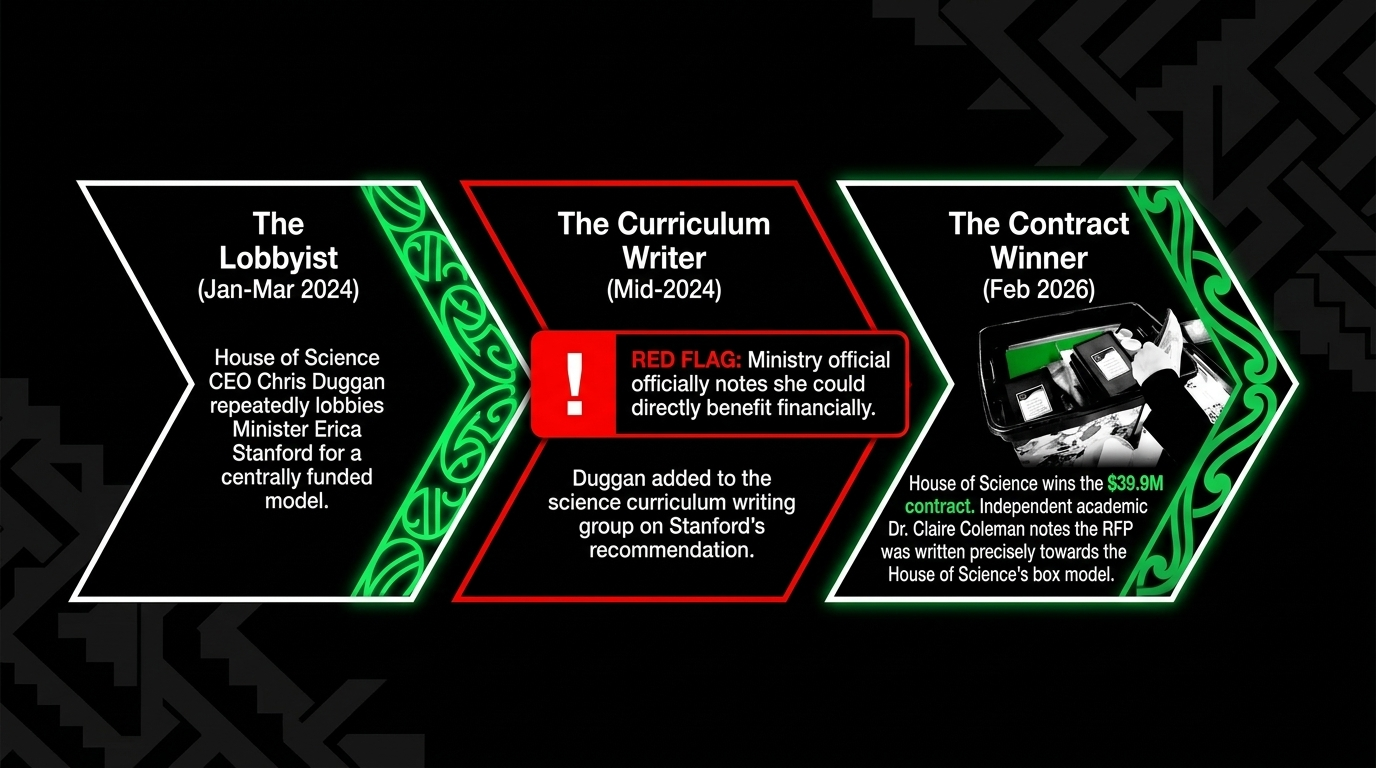
The Ministry says Duggan declared the conflict and that it "managed" it through a "robust and thorough process".
Duggan says House of Science is a charitable trust and that she stands to make no personal financial gain. Stanford says she never responded to the lobbying and never discussed contracts or funding with Duggan (1News).
Now look at what the Ministry could actually produce. Its own release says there was "no specific risk register for the science curriculum development work" (Ministry OIA response).
A flagged conflict, "managed" by processes nobody can show us, is a promise. It is not evidence. No source I found shows corruption, rigging or personal enrichment. Labour wants the Auditor-General to look, and the Auditor-General is the right body to settle it (1News).
Treasury Said Slow Down, And Stanford Floored It
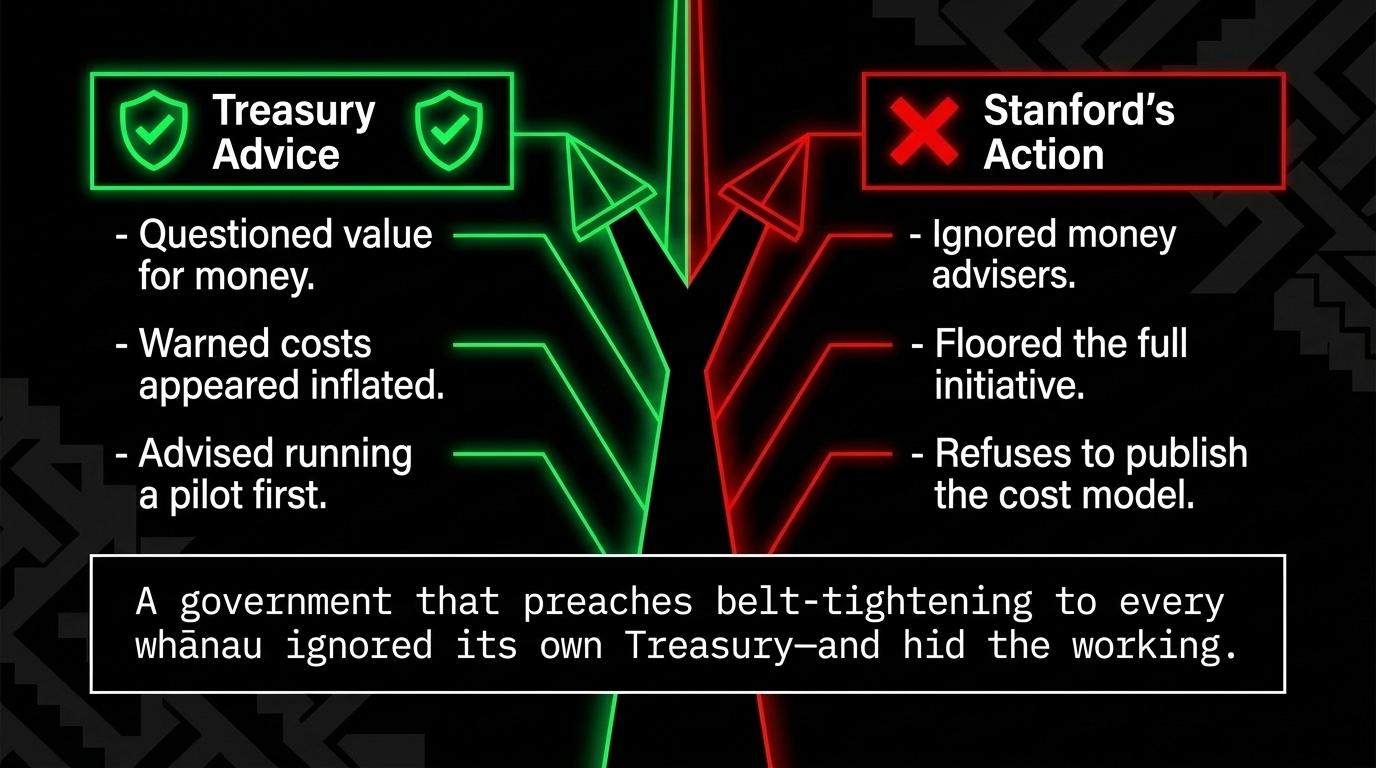
Treasury advised against the full initiative.
It questioned the value for money, considered the costings apparently inflated, and favoured a pilot first (Treasury advice; Cabinet decision).
This is a government that preaches belt-tightening to every whānau in the country.
It ignored its own money advisers, and it has not published the cost model that justified doing so.
Ministers can overrule Treasury, but they owe the public their working. Here the working is missing.
This Is Not One Box: Stanford's Pattern Of Power
Learning First: The Echo Chamber With An Invoice
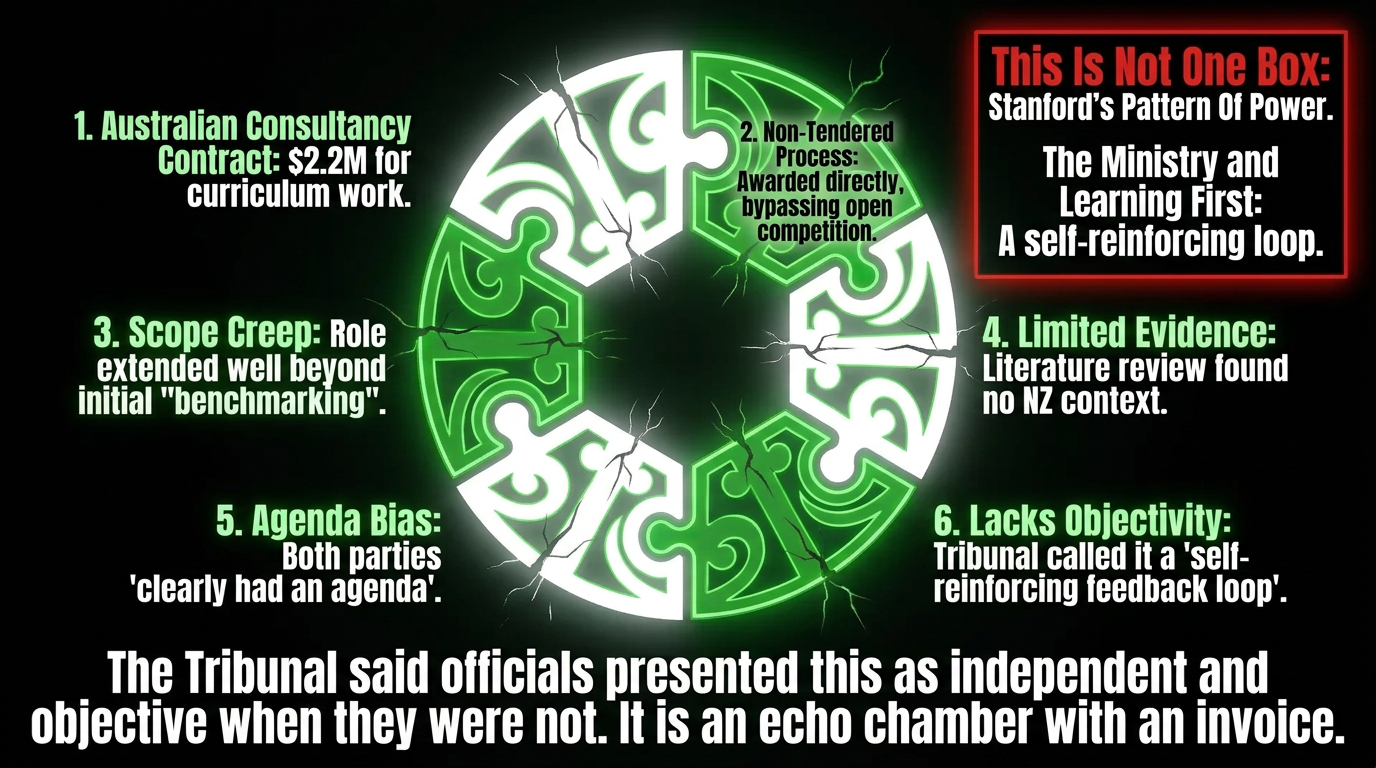
The Ministry paid an Australian consultancy about $2.2 million for curriculum work that was not openly tendered. The released documents showed a role well beyond the "benchmarking" described publicly (Newsroom; RNZ).
The Tribunal then looked at Learning First's literature review. It found no criticism of the knowledge-rich approach. Of nearly 150 sources, only three were from New Zealand (about 2%), and two of those were Rata's own work.
The Tribunal said officials presented this as independent and objective when "both organisations clearly had an agenda to promote knowledge-rich".
It called it "a self-reinforcing feedback loop" (Newsroom).
The Advisory Group: A Chorus Picked Before The Song
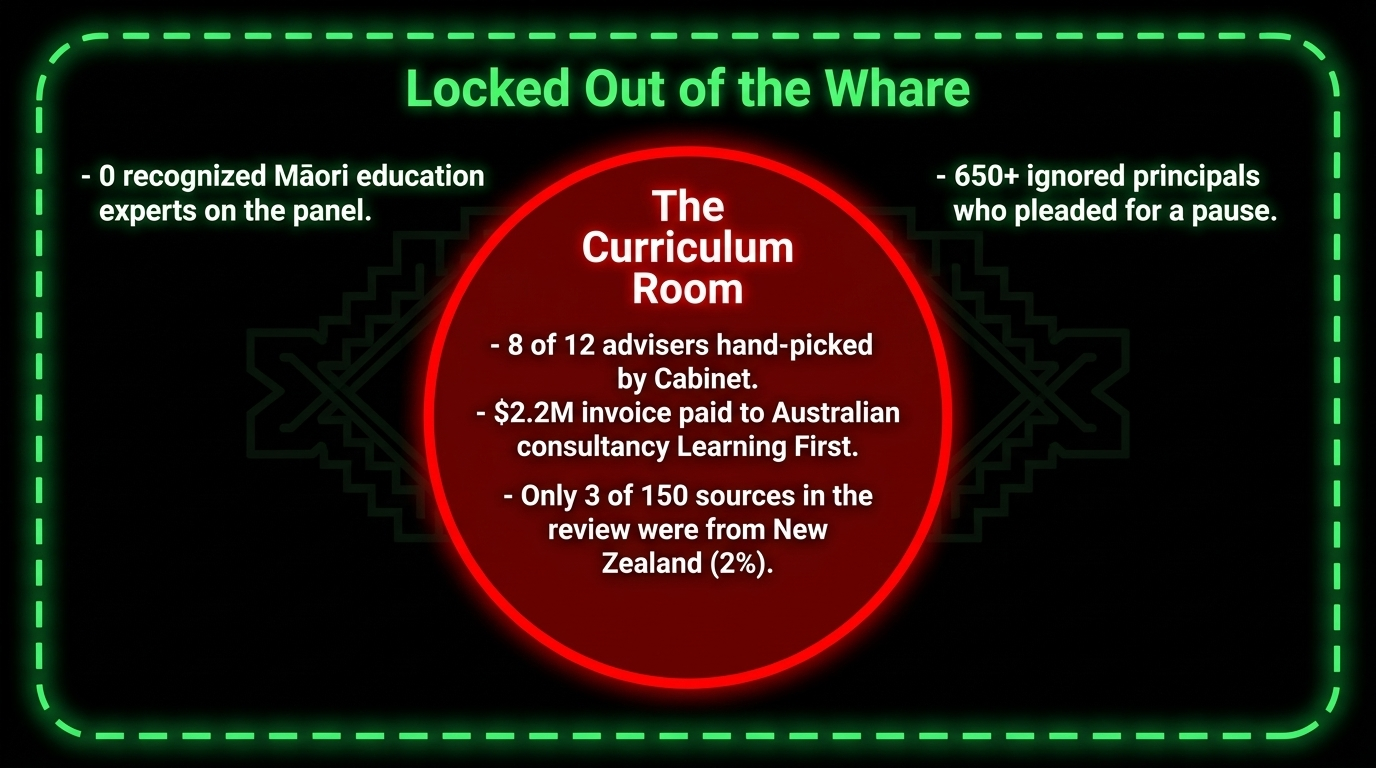
Of its 12 members, 8 were selected by Cabinet on Stanford's recommendation.
The Tribunal said the group had no recognised expert in Māori education and included other known supporters of the knowledge-rich approach. It said key advice was "out-sourced" to people who backed one teaching approach, with "no Māori education voice" (Newsroom).
The Tribunal: Seven Breaches
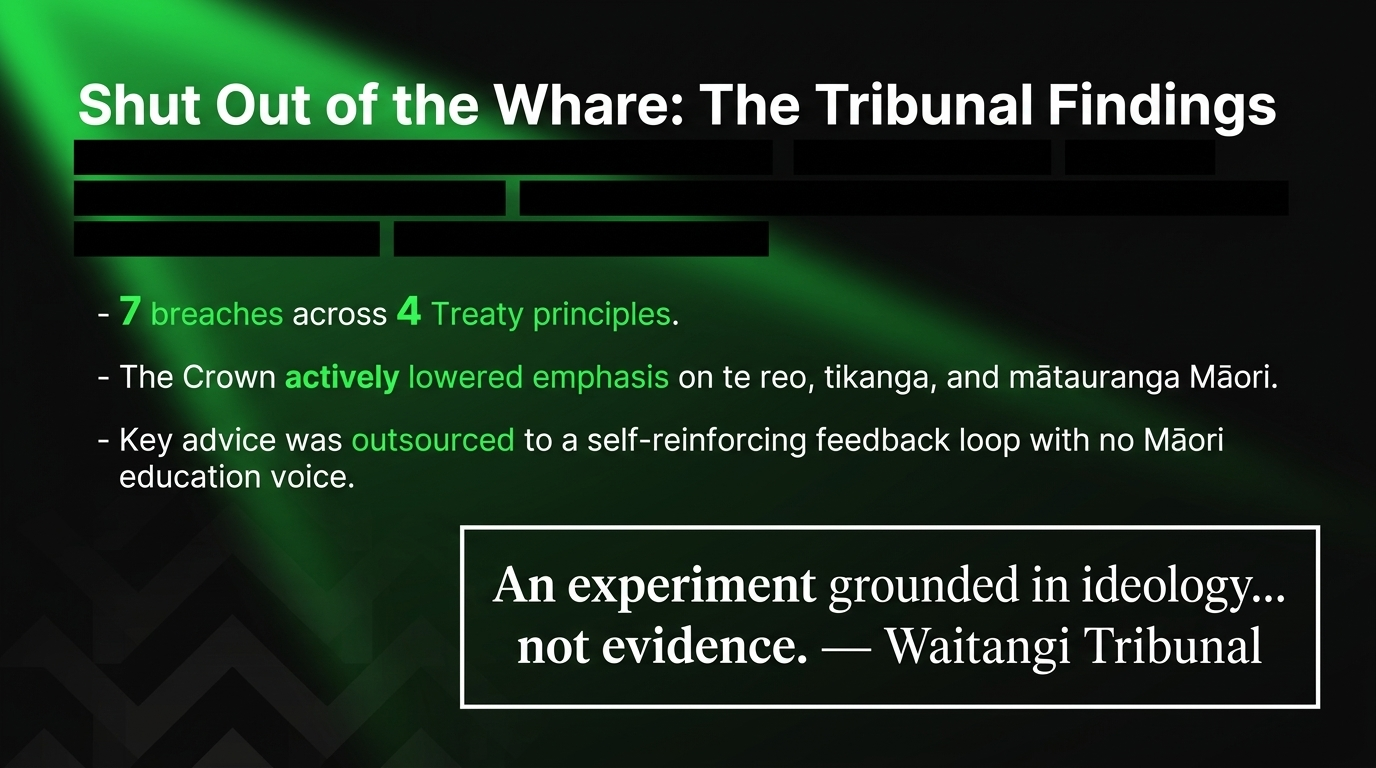
Its 239-page report says the knowledge-rich approach looks "more like an experiment grounded in ideology than one based on evidence".
It found the Crown breached multiple Treaty principles, including through a lack of meaningful engagement and by lowering emphasis on te reo, tikanga and mātauranga Māori (Newsroom; Te Ao Māori News).
Stanford disagrees with some findings and says she consulted almost 100 Māori experts and academics. Consulting 100 people means little when nobody has the power to change the outcome.
The Pause She Refused
More than 650 principals asked her to pause the rollout, and she pressed on (NZEI Te Riu Roa).
The Paper Trail That "Does Not Exist"
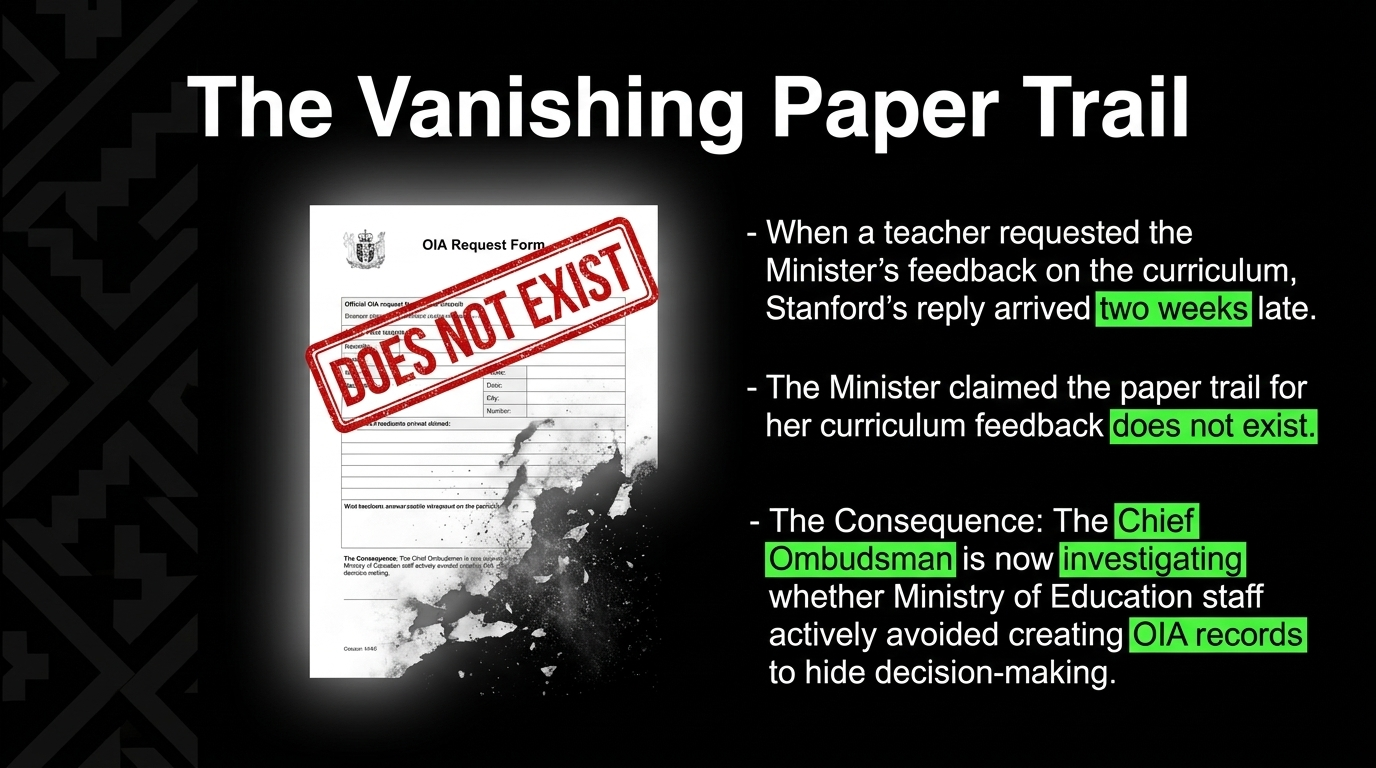
A teacher, Bevan Holloway, asked what changes the minister requested to the draft English curriculum.
Stanford's reply came two weeks late.
She wrote that her office "does not hold any documentation" about those changes, while confirming she gave feedback to officials in meetings. The Ombudsman's guidance says the Official Information Act covers information held in someone's memory, even if "not yet recorded in writing" (RNZ).
Holloway says he asked because he found two versions of the curriculum in March 2025. One required Māori and Pasifika authors in teaching programmes, and the version sent to the sector did not (RNZ). The Ombudsman is also investigating whether Ministry staff tried to avoid OIA records (Office of the Ombudsman). An investigation is not a finding, and nothing I found shows Stanford knew.
The Te Reo Cut
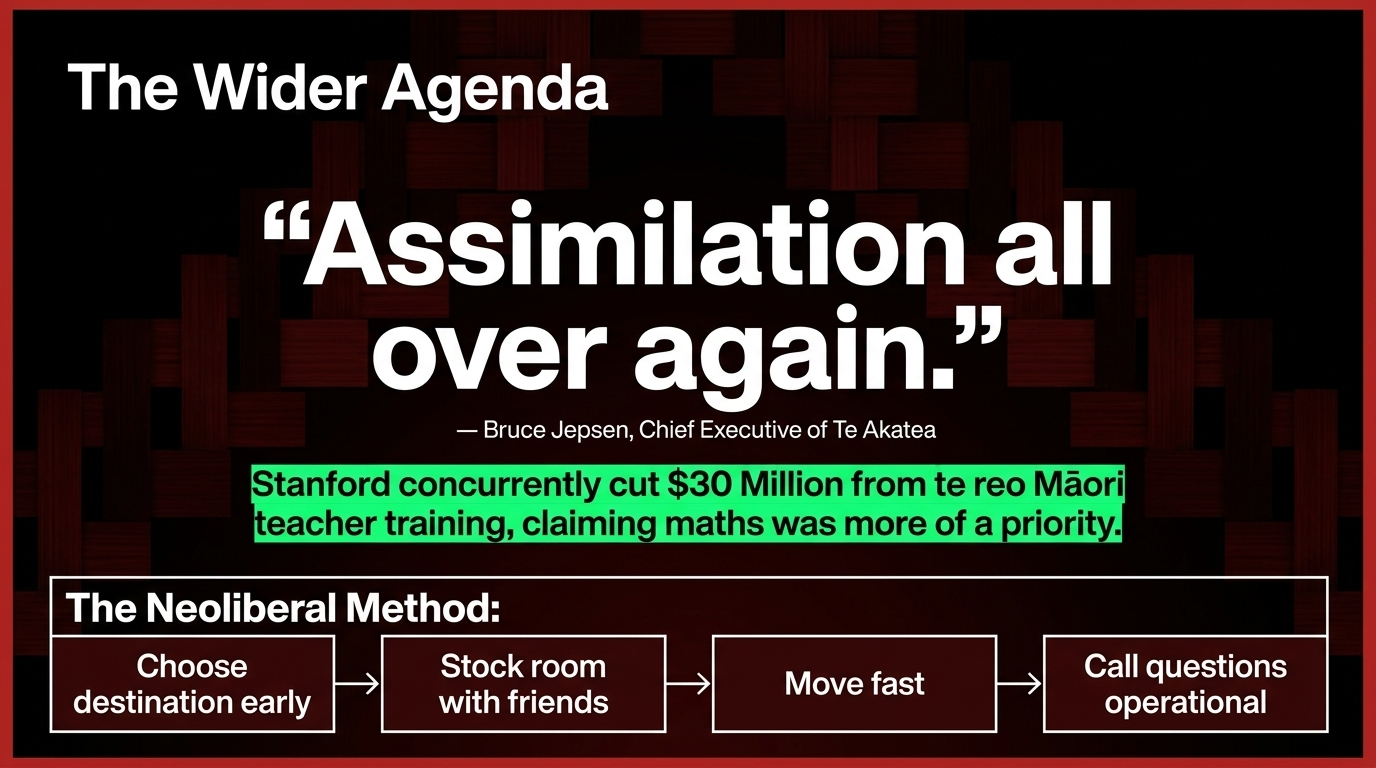
My earlier essay reported that in September 2024 Stanford cut $30 million from te reo Māori teacher training, telling the NZ Herald that maths was "more of a priority" (The Curriculum Coup).
Bruce Jepsen, chief executive of Te Akatea, described the reforms as "assimilation all over again" (Newsroom).
In my opinion, this is a white-supremacist-shaped, neoliberal way of governing.
The factual basis is the Tribunal's finding that the Crown imposed "an overseas approach that Māori educators (and the wider sector) strongly oppose", sidelined Māori expertise, and ran a process officials fed with advice that suited the minister.
I do not claim to know any minister's private beliefs. I judge the conduct and its effect on whānau.
No single decision proves misconduct.
Taken together, they form a method: choose the destination early, stock the room with friends, move fast, and call every question "operational".
Three Examples For The Western Mind
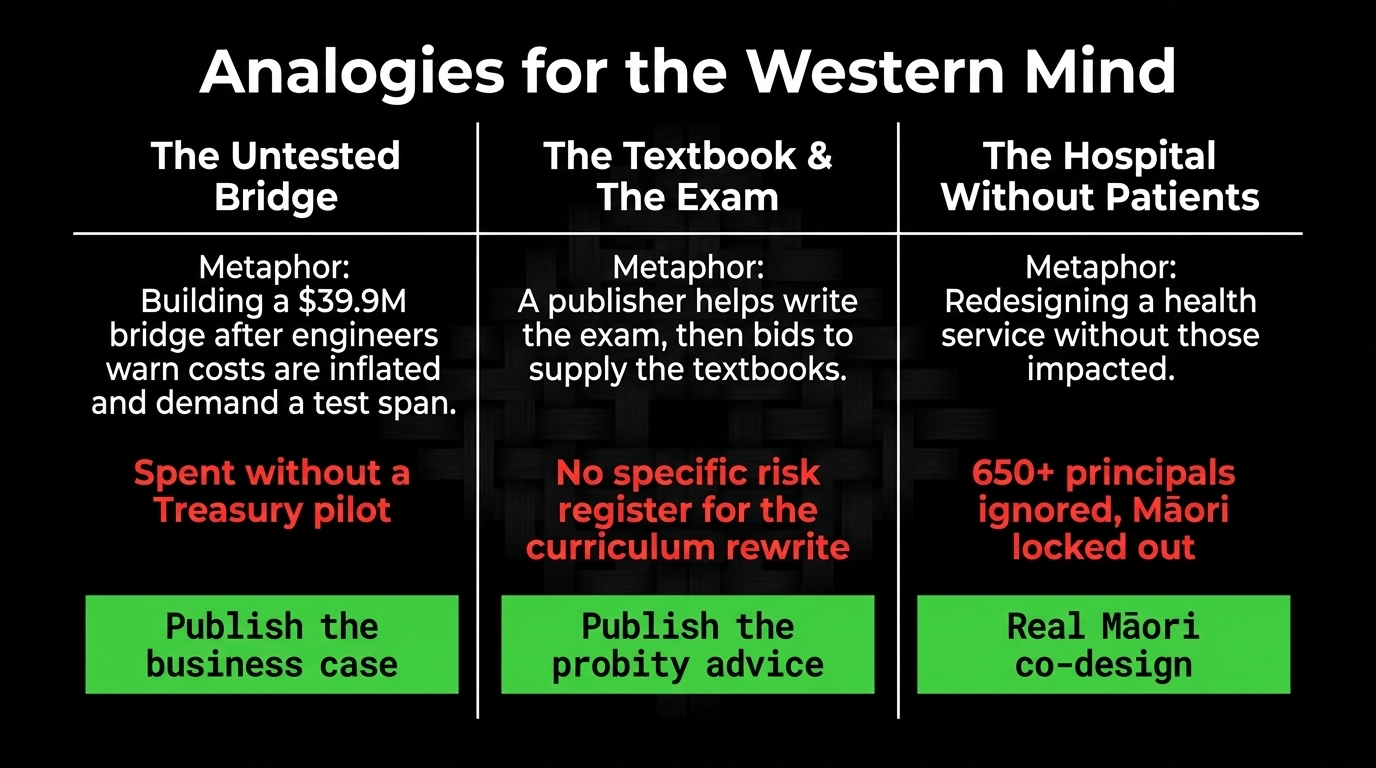
Example One, The Untested Bridge
A council approves a $39.894 million bridge after its engineers warn the costs look inflated and one span should be tested first.
It builds the lot, and then refuses to publish the engineers' reports.
The harm is the money spent without evidence. The fix is to publish the business case and run a pilot.
The tikanga impact is that tika means doing the right thing before the money goes out. It does not mean building a defence afterwards.
Example Two, The Textbook And The Exam
A publisher helps write an exam and then bids to supply the textbooks.
It may be honest. A decent institution still builds a visible firewall and shows its working. Here the exposure is $39.894 million, and the official admission is that there was no specific risk register.
The fix is to publish the conflict plan, the evaluation scores and the probity advice.
The tikanga impact is that pono means the whole truth, not the narrowest true thing.
Example Three, The Hospital Without Patients
A health service for a community with poor outcomes is redesigned by hand-picked advisers, with a consultancy's one-sided review driving the model.
Hundreds of practitioners ask for a pause, a tribunal finds Treaty breaches, and the government carries on. The numbers are 8 of 12 advisers chosen by Cabinet, 3 of about 150 sources from New Zealand, and 650+ principals asking for a pause.
The fix is real co-design, with Māori holding decision rights.
The tikanga impact is that consultation is not authority, and a bilingual label is not rangatiratanga.
I have traced this same pattern before. See The Butcher's Thumb, The Curriculum Con and The Education Factory Fire. I also wrote "The Machine That Ate Our Children" (24 May 2026), but its link was truncated in my search results, so I cannot link it here.
Tika, Pono And Tikanga: Does This Build Mauri?
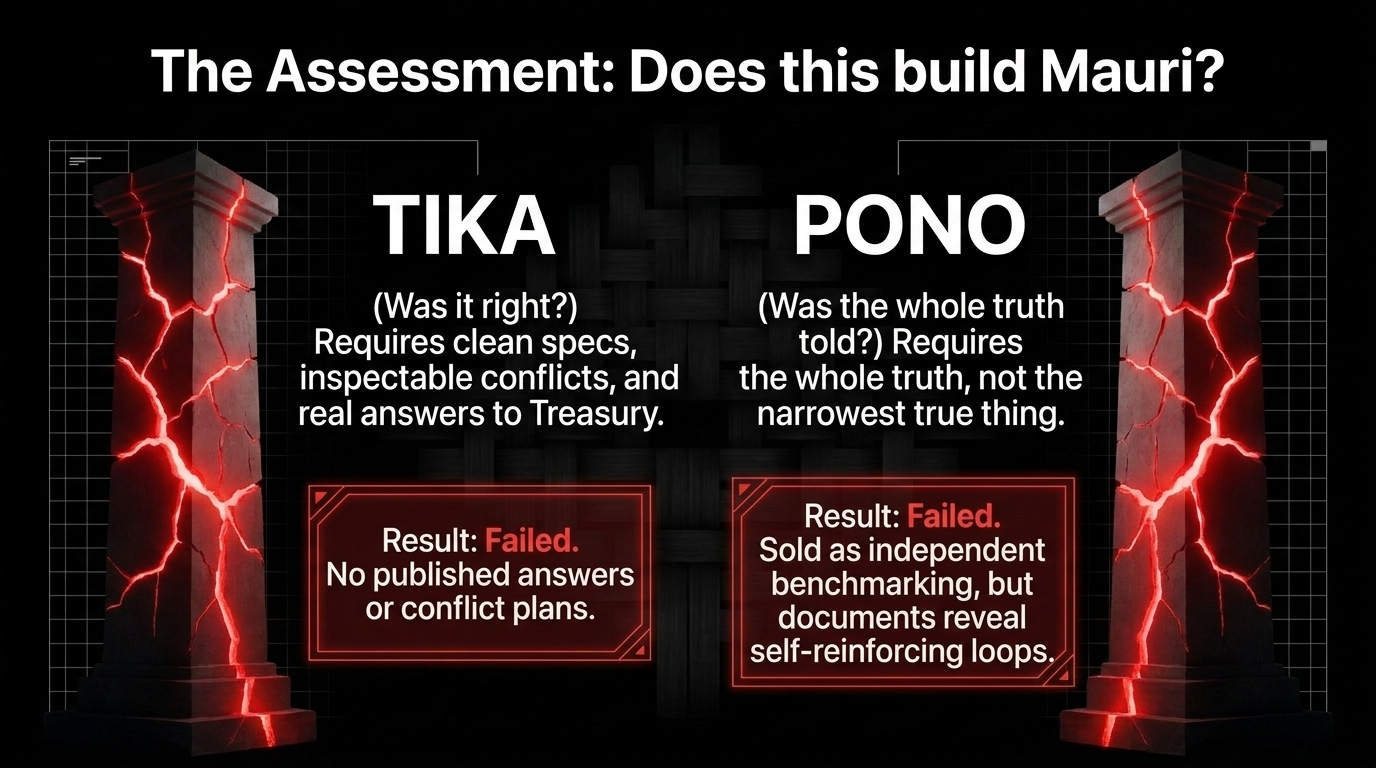
Tika asks: was it right?
An open tender is a start. A right process also needs clean specifications, a conflict you can inspect, and a real answer to Treasury. I have seen none of these published.
Pono asks: was the whole truth told?
Learning First was sold as benchmarking, the review was presented as independent, and the documents showed neither was the full story. That does not prove a lie.
It does show the public account was incomplete.
Tikanga asks five questions.
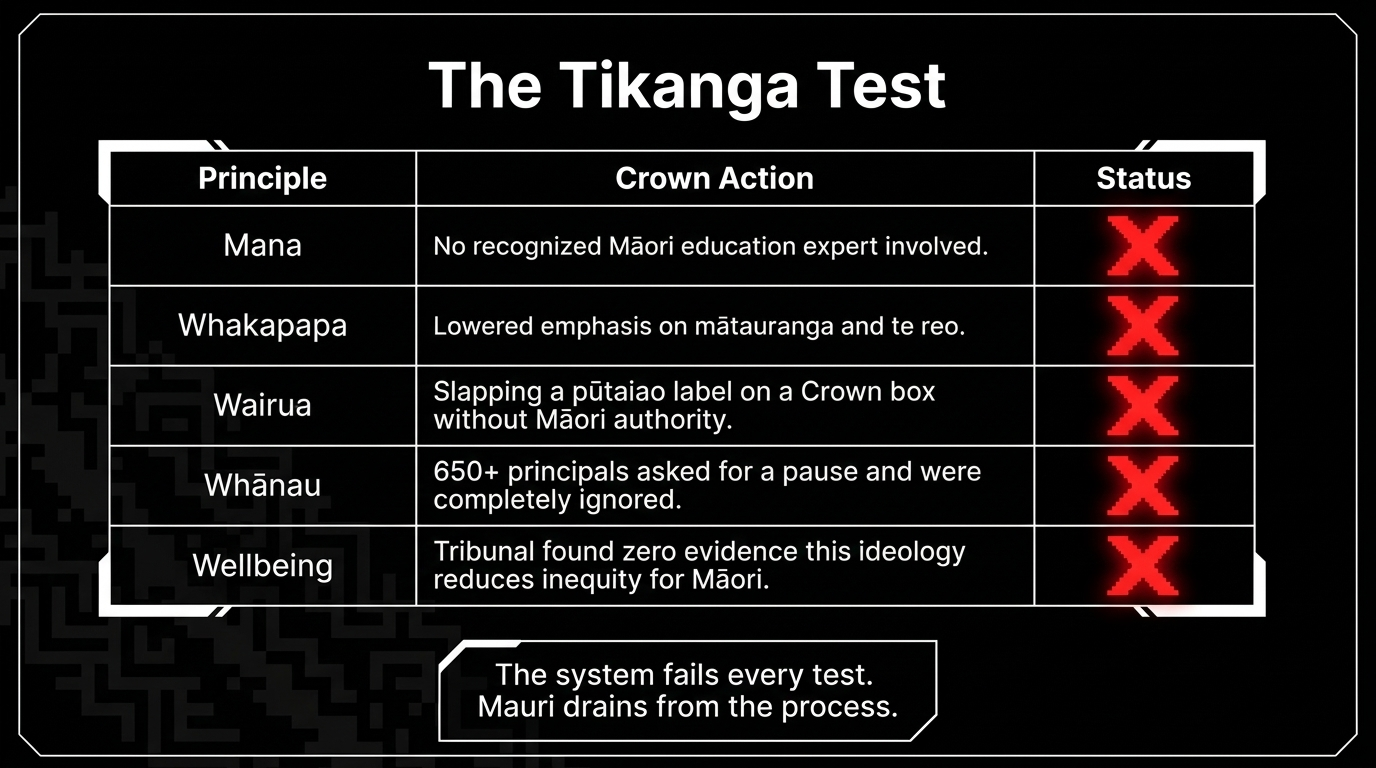
Did the system preserve their mana, recognise their whakapapa, respect their wairua, involve their whānau and return them to wellbeing?
- Mana: The Tribunal found no recognised Māori education expert on the advisory group.
- Whakapapa: It found the Crown lowered the emphasis on te reo, tikanga and mātauranga Māori.
- Wairua: Pūtaiao on a Crown box is not Māori authority over the knowledge inside it.
- Whānau: 650+ principals asked for a pause and were ignored.
- Wellbeing: The Tribunal found no solid evidence the approach would reduce inequity for Māori.
The system fails every test, and mauri drains from the whole process.
What Must Happen
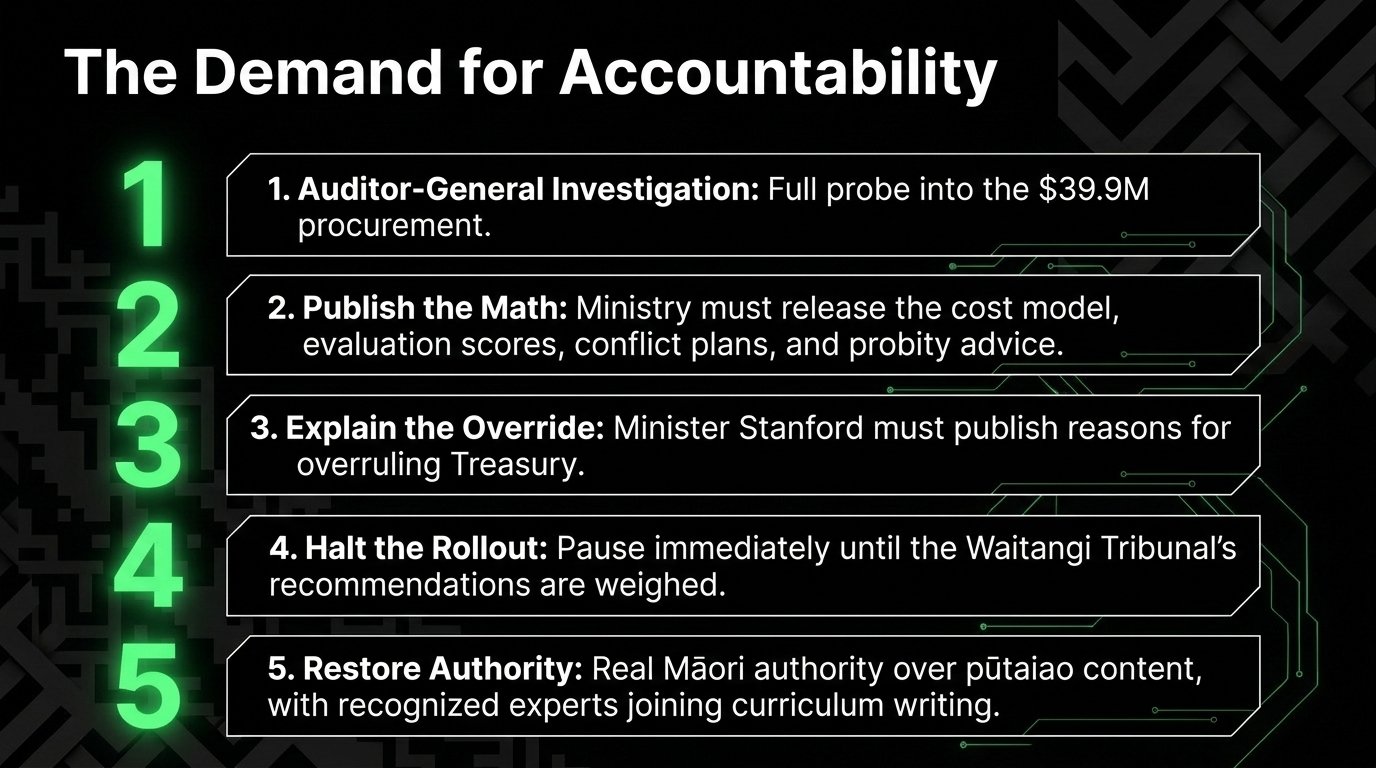
- The Auditor-General investigates the procurement.
- The Ministry publishes the cost model, evaluation scores, conflict plan and probity advice.
- Stanford publishes her reasons for overruling Treasury.
- Māori hold real authority over pūtaiao content, and recognised Māori experts join curriculum writing, as the Tribunal recommends.
- The rollout pauses until the Tribunal's recommendations are weighed.
Why You Should Not Vote This Coalition Back In
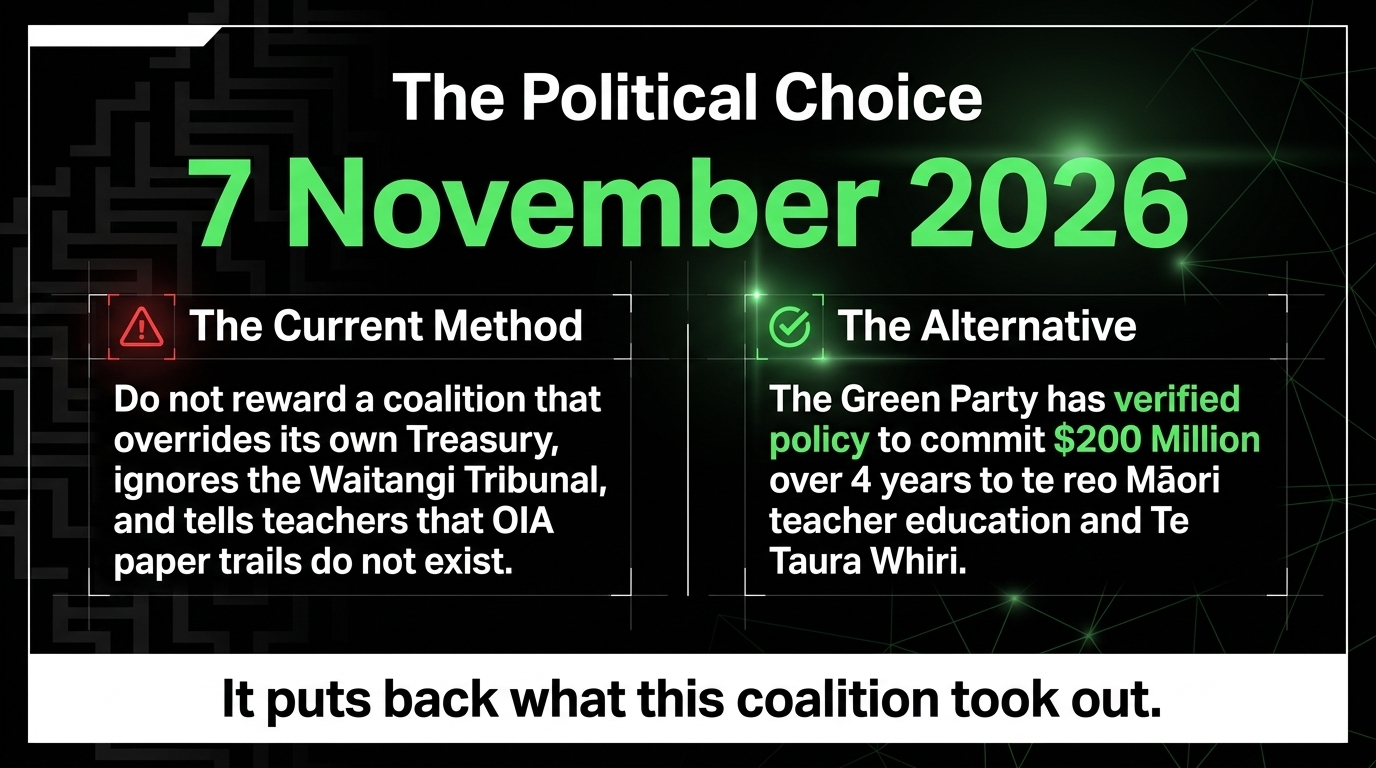
The election is on 7 November 2026 (Vote NZ). This is my opinion, built on the cited facts above.
Do not reward a government that overrode its own Treasury. Do not reward one whose advisory group had no Māori education expert, whose consultancy review leaned on three New Zealand sources out of about 150, and whose minister pressed on past a Tribunal report and 650 principals. Do not reward one that tells a teacher the record of her feedback "does not exist" while the Ombudsman investigates its Ministry.
I recommend the Green Party.
Its published policy commits $30 million a year to te reo Māori teacher education and $20 million a year to Te Taura Whiri and Te Mātāwai. That is 30 + 20 = 50 million a year, and 50 × 4 = 200 million over four years (Green Party). Verified as party policy.
It puts back what this coalition took out. Read every party's policy and decide for yourself, but do not vote for more of this.
The Deep Dive Podcast
Listen to a lively conversation between two hosts, unpacking and connecting topics in the sources of this essay. I apologise in advance for the AI's very harsh pronounciation of reo. Please dont shoot me, :).
Youtube Video
Like video? Here is a short video suppporting the essay. Again, don't shoot the messenger please because of AI's pronounciation. :)
Koha Consideration
Who pays the Māori Green Lantern to follow a $39.9 million box and its vanishing paper trail? You do. This mahi is supported through koha and nothing else. No corporates support it. Every koha says whānau will support the accountability that Crown and corporate structures will not give, and that rangatiratanga includes supporting our own truth tellers.
Kia kaha, whānau. Stay vigilant. Stay connected. If you can, consider a koha so this voice continues. If you can't, subscribe, follow, kōrero and share with your whānau and friends. That is koha too.
- Koha: Support The Māori Green Lantern
- Subscribe To The Māori Green Lantern
- Bank Transfer: Ivor Jones, 03-1395-0099387-000
- Support On Facebook
Disclaimer: This essay is public-interest commentary based on the sources linked above. It separates documented fact, attributed claims and my opinion. The opinions are my genuine views, and I have explained their factual basis. This essay does not allege corruption, unlawful conduct or personal enrichment by any person or organisation unless a cited source says so. The people and organisations named are welcome to reply, and I will fairly publish any reply that corrects a factual error. This is not legal advice. If a material error is shown, I will correct or retract it promptly.