
"The Butcher's Thumb: Foodstuffs Paid A Sydney Consultancy To Weigh Itself While Whānau Went Hungry" - 4 October 2026
Three Years Of Coalition Government, An 82 Percent Duopoly, And One Māori Child In Three Living With Food That Runs Out. Vote Them Out On 7 November.


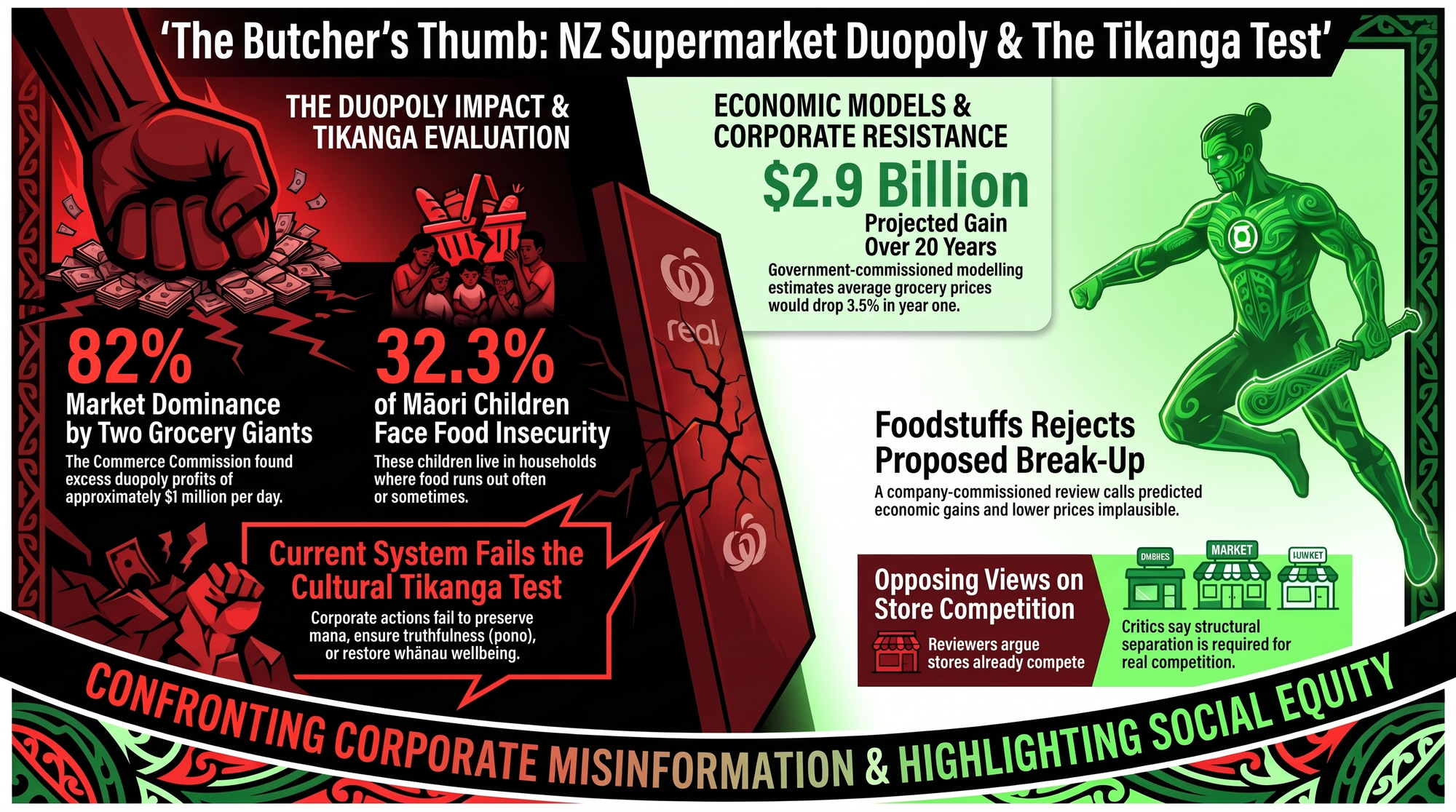
Kia ora, whānau.
In this essay I argue that change in the grocery sector is not optional.

I start with what Foodstuffs did this week, then give the background, run the Tika, Pono and Tikanga test, and set out six findings.
After that come three examples for the Western mind, and last the case for change and the vote.
I would love for you to click on this essay. It holds information you can use in your kōrero at work, at the marae and around the dinner table. There is an audio podcast that lays out this kaupapa in detail, a short video that explains it, and for the long-form readers a 3000-word cited essay is waiting.
This is a repository for our mokopuna. When they look back, they can say that at least they knew the Māori Green Lantern, among a few, was warning us.
The Butcher Weighs His Own Thumb

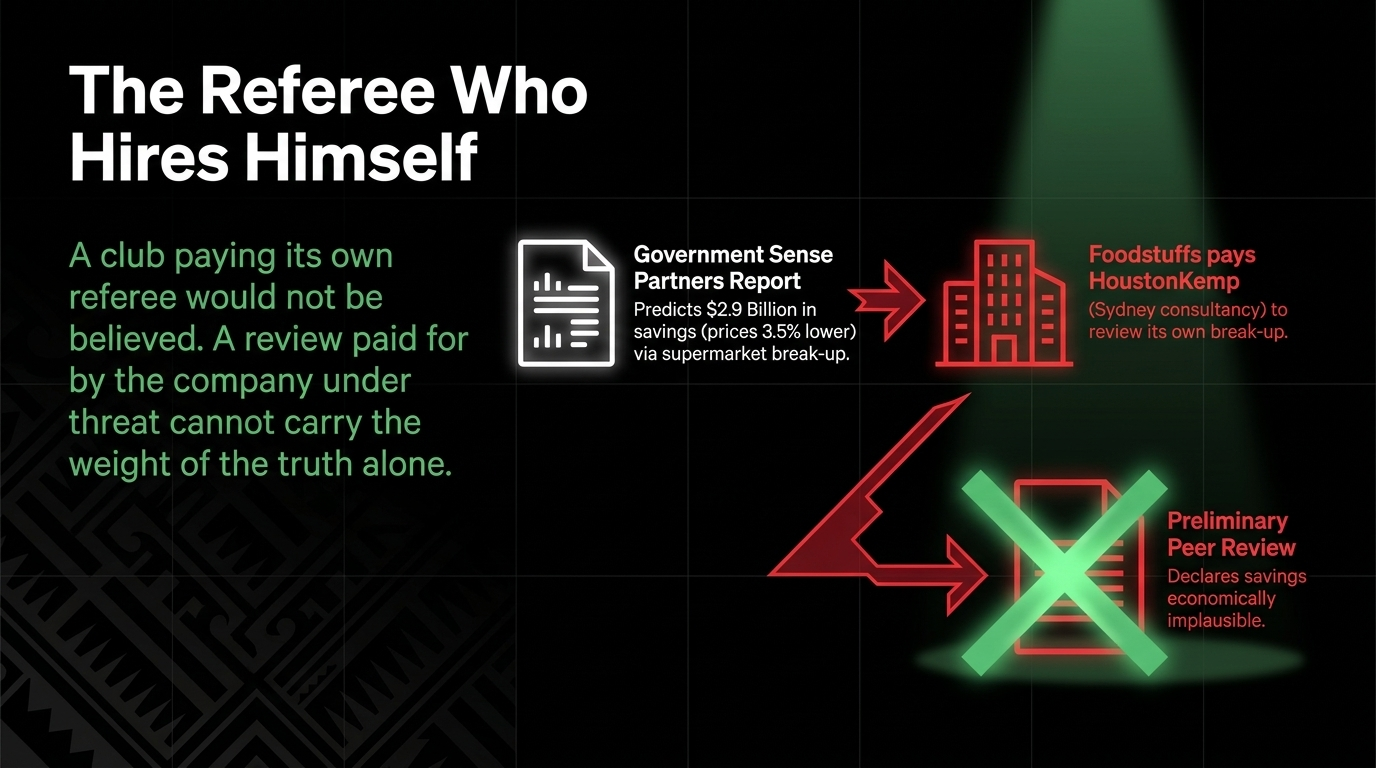
Picture a butcher told his scales are rigged. He doesn't invite the inspector in. He hires a consultant from Sydney, who weighs the meat on the same scales and finds them fair. Then he hands the certificate to the press.
Foodstuffs commissioned a preliminary peer review of the Government's modelling and released it to the media.
RNZ reported that Foodstuffs "has come out swinging against proposals to split it up."
The Post's headline called the review "economic mirage" and said Foodstuffs attacked the plan. HoustonKemp's only listed office is in Sydney.
My opinion, based on that public conduct, is that Foodstuffs wants no change. I can't see inside the boardroom. What I can see is a company spending money to defeat a reform rather than to improve on it.
Tika, Pono And Tikanga: The Test I Use
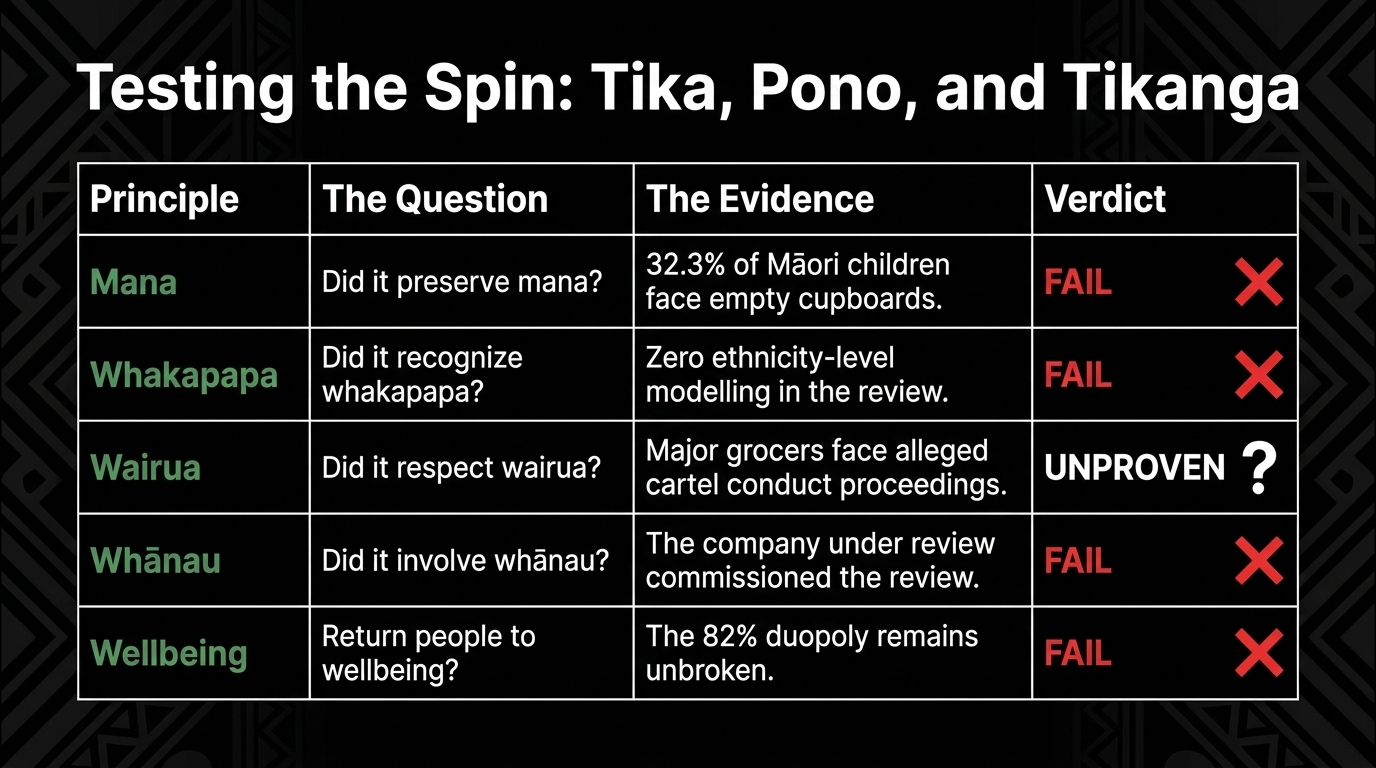
Tika asks whether the action was right. Pono asks whether the word was true. Tikanga asks whether the system preserved mana, recognised whakapapa, respected wairua, involved whānau and returned people to wellbeing.
| Tikanga Question | What The Evidence Shows | My Verdict (Opinion) |
|---|---|---|
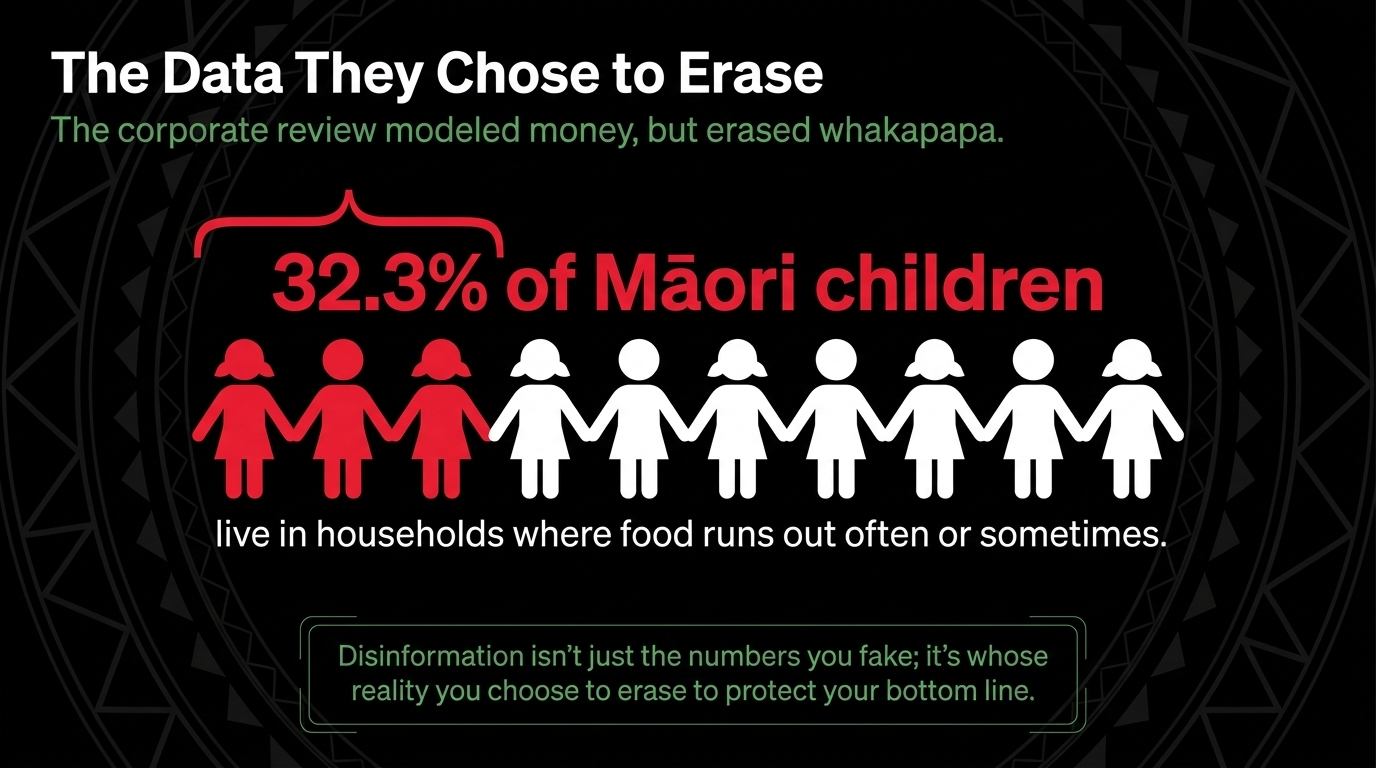
| Preserved Mana? | 32.3% of Māori children live in households where food runs out often or sometimes | Failed |
| Recognised Whakapapa? | In the documents I could read, I found no ethnicity-level modelling, though I could not read every page | Failed (provisional) |
| Respected Wairua? | Foodstuffs North Island and Gilmours face alleged market allocation proceedings, which they are defending | Unproven |
| Involved Whānau? | The company under review commissioned the review | Failed |
| Returned People To Wellbeing? | The duopoly still holds about 82% | Failed |
Background: A Market The Regulator Called Muted
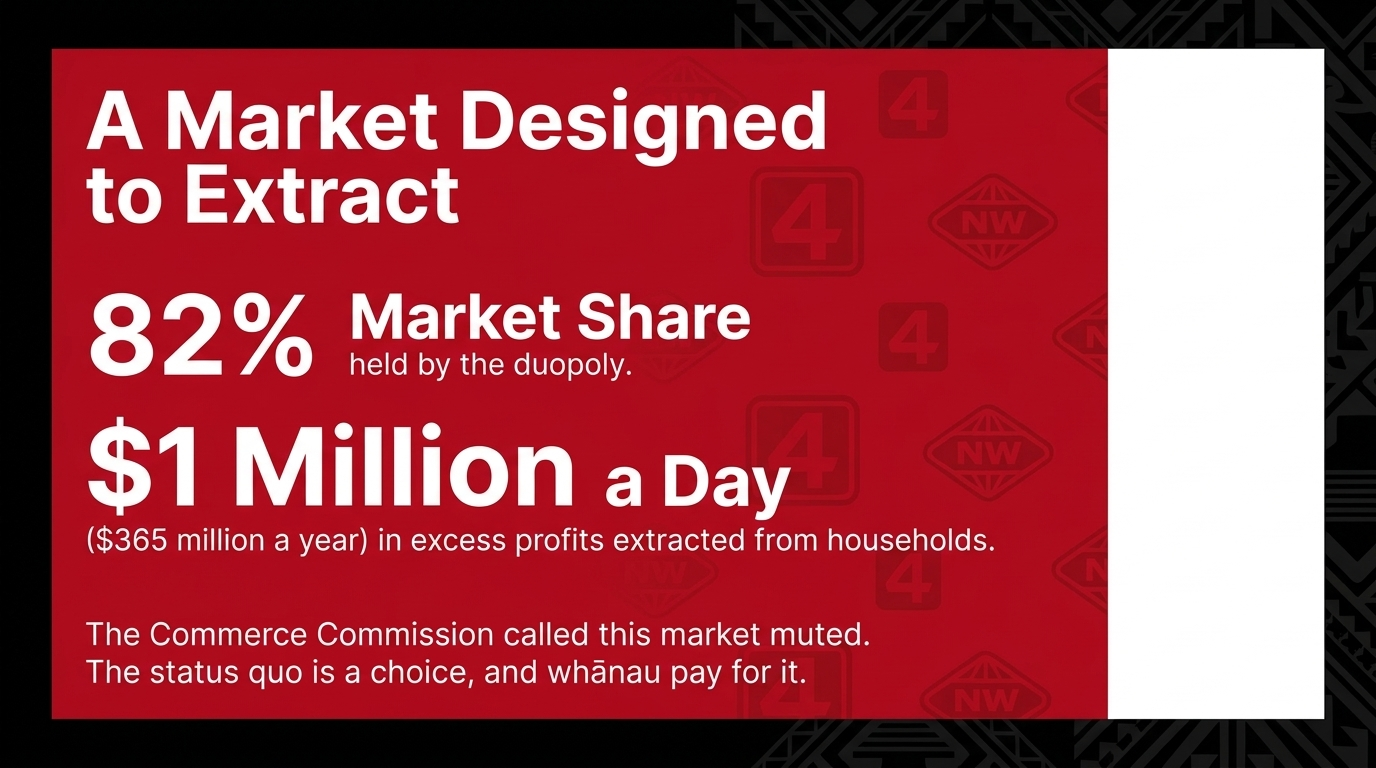
The Commerce Commission's 2022 market study found excess profits of around $1 million a day. That is about $365 million a year by my calculation ($1m × 365).
The proceedings against Foodstuffs North Island and Gilmours were announced in 2025. Newsroom separately reported that Gilmours was given a deadline over Grocery Act breaches. Allegations are not findings.
Six Findings
1. The Duopoly Survived The Reforms
RNZ reports that more than four years after the Commission's damning stocktake, Foodstuffs and Woolworths still dominate about 82 percent of the market.
The existing reforms did not break it.
2. The Review Is Preliminary
RNZ reports that the review was a "preliminary" peer review.
HoustonKemp's own page says there was insufficient detail to replicate the modelling.
3. Its Arithmetic Reproduces, And I Say So
I rebuilt the 3.5% and 4.9% from the published tables and got 3.47% and 4.94%. On those figures profit goes negative. That is a reason for the Commerce Commission to test the numbers, not a reason for doing nothing.
4. Foodstuffs' Own Margin Is Healthier Than The Sector Average
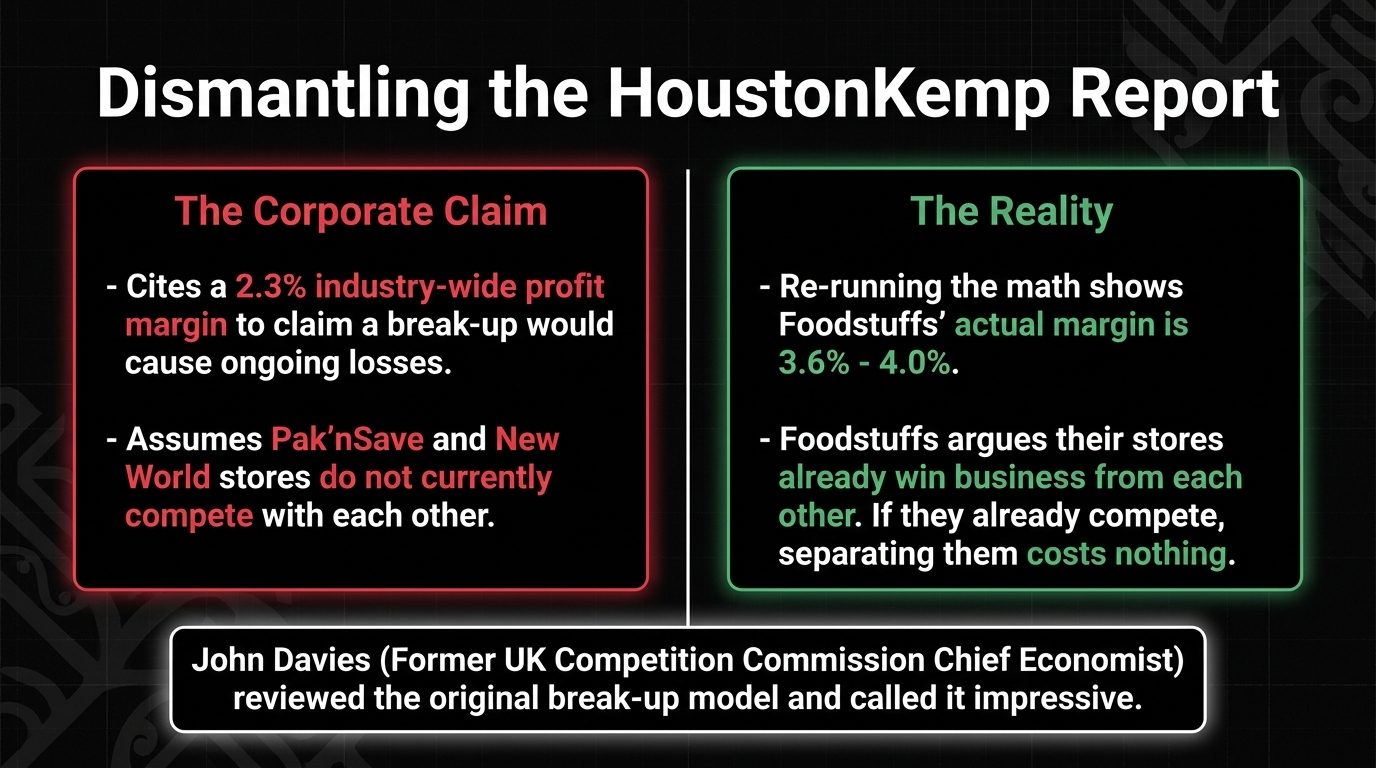
HoustonKemp's 2.3% is a sector average. From its inputs, I calculate that Foodstuffs alone earned about 3.6% in FY25 ((3.9% × 37 + 2.9% × 14) ÷ 51) and about 4.0% on a four-year simple average.
5. The Dilemma Foodstuffs Has Created For Itself
My argument, and opinion is that HoustonKemp says Pak'nSave stores can and do win business from New World.
If the brands already compete hard, separating them should cost little.
If they don't, the Sense Partners assumption it attacks looks right.
Foodstuffs cannot lean on both.
6. The Independent Reviewer Backed The Method
RNZ reports that John Davies, former chief economist at the UK Competition Commission, called the Sense Partners work "impressive." The analysis puts the net gain to the economy at $2.9 billion over 20 years.
The Deep Dive Podcast
Listen to a lively conversation between two hosts, unpacking and connecting topics in the sources of this essay. I apologise in advance for the AI's very harsh pronounciation of reo. Please dont shoot me, :).
Youtube Video
Like video? Here is a short video suppporting the essay. Again, don't shoot the messenger please because of AI's pronounciation. :)
Koha: Support This Mahi
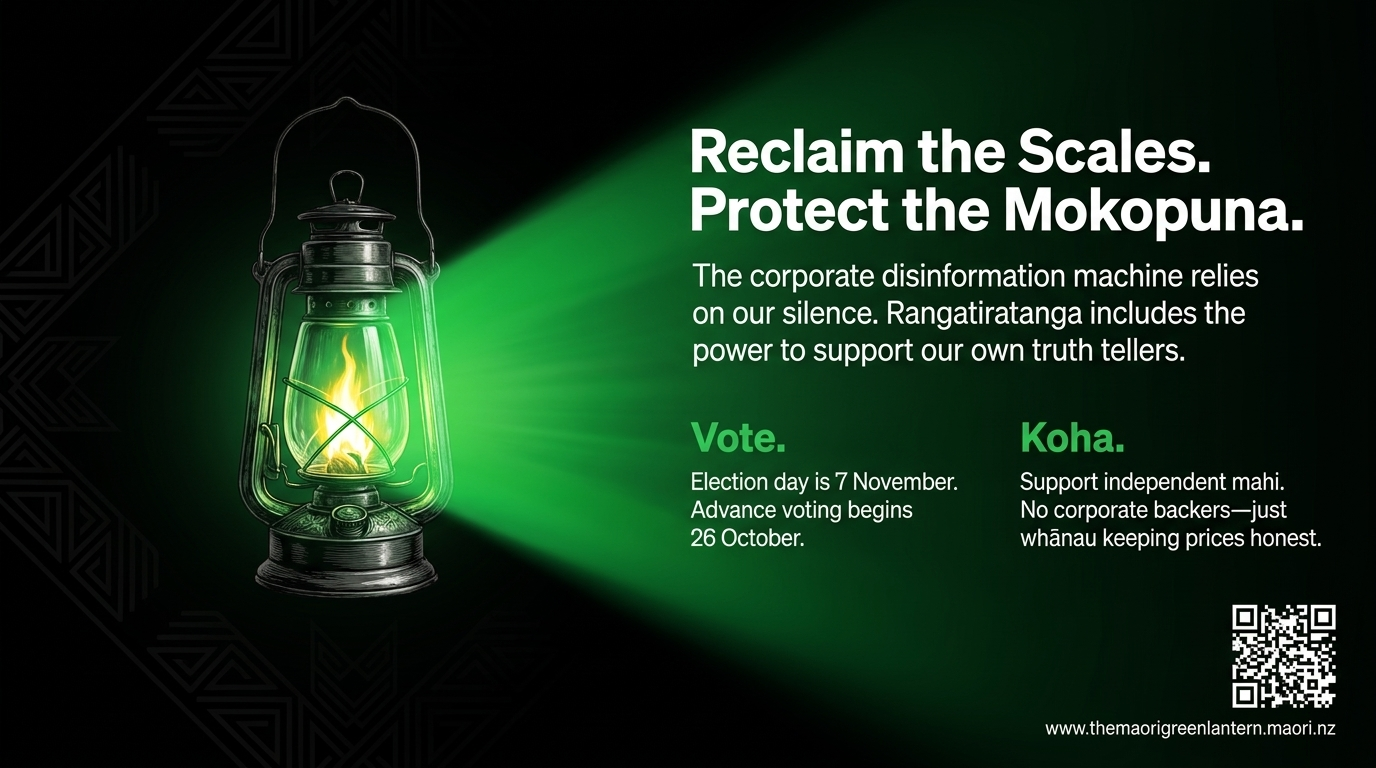
You might ask who is paying the Māori Green Lantern to read a Foodstuffs-commissioned review line by line.
The answer is you do.
No corporate supports this mahi, and no supermarket is backing Ivor to keep the prices honest. Every koha tells us whānau are ready to support the accountability that Crown and corporate structures won't provide. It says rangatiratanga includes the power to support our own truth tellers.
Kia kaha, whānau. Stay vigilant. Stay connected. If you are able, consider a koha to ensure this voice continues.
If you are unable to koha, no worries. Subscribe or follow at themaorigreenlantern.maori.nz, kōrero and share with your whānau and friends. That is koha in itself.
Four pathways exist:
- Koha: Support the mahi directly
- Subscribe: Receive the essays and support through subscription
- Bank transfer: Ivor Jones, account number 03-1395-0099387-000
- Facebook: Subscribe on Facebook
Three Examples For The Western Mind
Example 1: The Referee Who Hires Himself
A club paying its own referee would not be believed.
Harm: households could miss $3.85 to $25.38 a week by 2035 ($200 ÷ 52 and $1,320 ÷ 52).
Solution: the Commerce Commission tests it with full data, and the data is published.
Tikanga impact: pono. A review paid for by one side cannot carry the weight of the truth alone.
Example 2: The Owner Who Loses 3 Cents
A Kawerau New World owner says just over 3 cents of every customer dollar comes back to her. She warns a split would affect her business. It is a real concern that a reform must answer.
Solution: design a split that protects the small owner.
Tikanga impact: manaakitanga. Look after the local owner and the whānau who shop there.
Example 3: The Missing Whānau
The documents I read give no ethnicity-level modelling.
Harm: 32.3% of Māori children live with food that runs out, against 27.0% for all children in 2023/24, which is 1.27 times (34.3 ÷ 27.0).
Solution: require ethnicity-level reporting.
Tikanga impact: whakapapa and mana tangata.
For the wider pattern, read my essays Five Kingmakers, No Conscience and Seven Parties Walked Into The Light.
Why Change Must Come
My opinion, with the facts above as its basis, is that change is not optional.
- Concentration has not shifted. About 82 percent is held by two companies.
- The regulator found excess profit. The Commission put it at about $1 million a day.
- The economic case exists. An independent reviewer called it impressive, and the claimed gain is $2.9 billion.
- Foodstuffs' best argument is a reason to test, not to wait. If its maths is right, the Commission will find it.
The parties differ on how.
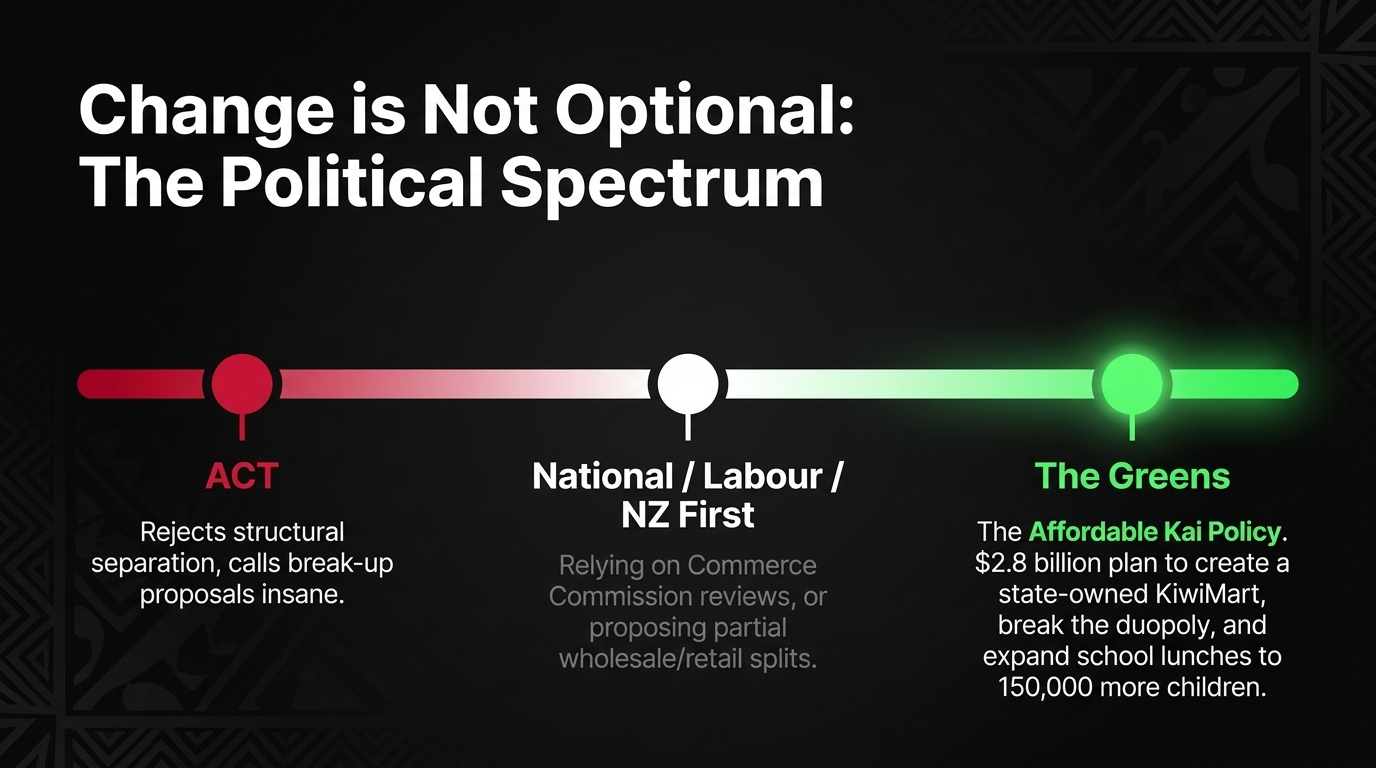
National would have the Commerce Commission assess a split, and NZ First wants separation without waiting.
Labour wants wholesale and retail arms run independently, and the Greens want store sell-offs to create a state-owned KiwiMart.
ACT rejects structural separation. David Seymour says ACT will put its foot down over his coalition partners' pledges to split Foodstuffs.
Why I Say Vote Green
This is my opinion.
The Greens' Affordable Kai policy says it would create KiwiMart, ban excessive supermarket prices and require supermarkets to be transparent about their price margins.
The party's costing is $2.8 billion. The Greens would also restore school lunches and expand them, feeding 150,000 more children.
I found no independent modelling of KiwiMart, and it is a promise, not a delivered policy. They are polling at their best-ever 1News Verian result, which would give them 19 MPs.
Election day is 7 November. Enrol by midnight on 25 October, and advance voting begins on 26 October.

Disclaimer: This essay is opinion and commentary based on published sources. The claim that Foodstuffs "wants no change" is my opinion, based on its public conduct. Court allegations are unproven. I will correct any error shown.