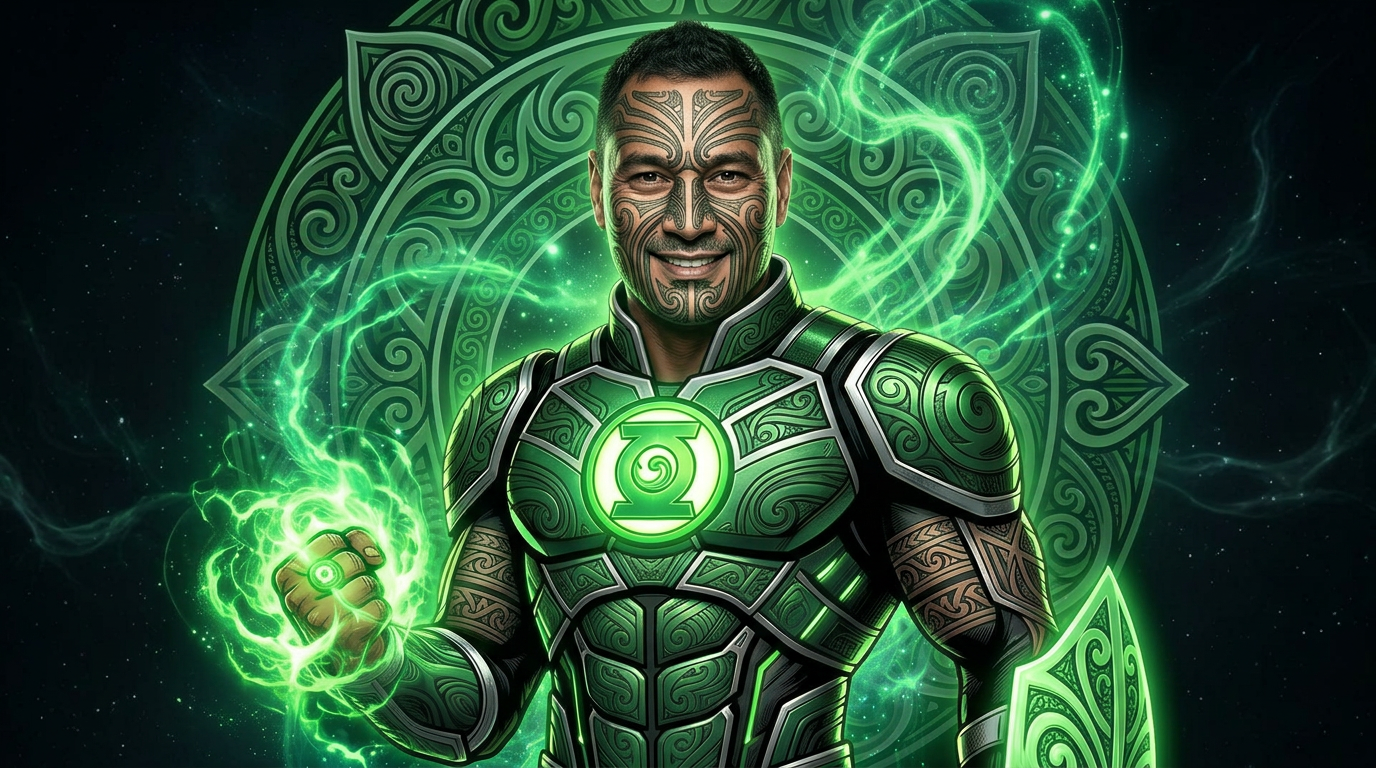
"Brendon Asked Where Power Lives — The Crown Answered By Taking It Back" - 4 October 2026
A Māori Green Lantern Answer To The Questions Raised By Brendon McIntosh In Kei A Koe Te Mana, Kei Te Pūnaha Hoki Te Mana — And A Scathing Account Of The Government System That Restricts Whānau Mana, Then Blames Whānau For The Restriction


E hoa Brendon, tēnā koe.
You are an ally in this fight, and your essay Kei A Koe Te Mana. Kei Te Pūnaha Hoki Te Mana deserves to be met with the seriousness it earned.
 Brendon McIntosh
You wrote as a pharmacist, a Māori health researcher and a person who sits kanohi ki te kanohi with whānau every day.
You did not write to score points.
You wrote to work through a genuine tension — one that Te Arikinui Kuini Ngā wai hono i te pō, Annette Sykes and Shubz each named from different angles — about where Māori agency ends and where systemic power begins.
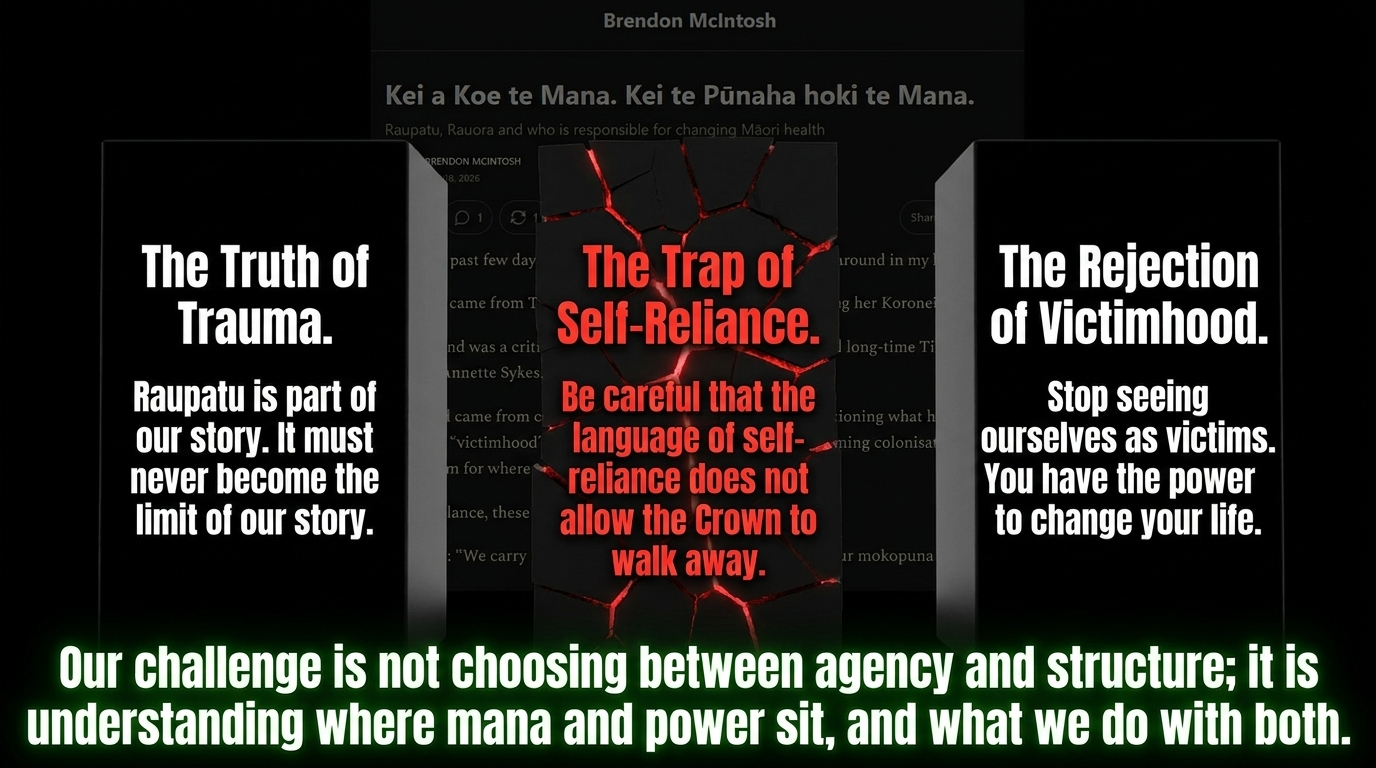
This essay answers the questions your work raised, directly:
- Can we hold Māori agency and structural accountability together, without one cancelling the other?
- Where does decision-making power actually sit, and who controls it?
- What does it mean when a health service calls someone "hard to reach" or "disengaged"?
- Who gets to decide what "better" health looks like?
- Does building Māori institutions let the Crown off the hook?
- What are we building, beyond simply asking the Crown to behave?
- Does power reaching a Māori institution automatically mean it reaches whānau — and what does genuine whānau control actually look like in practice?
I answer each through Tika — whether an action is right, just and fit for whānau — and Pono — whether a claim is honest, complete and evidenced. I then give three examples for the Western mind, quantify the harm, name the tikanga impact, and set out solutions. Where the tone turns scathing, it is aimed at the Crown's conduct and at a white-supremacist neoliberal pattern of governing, not at you or your kaupapa.
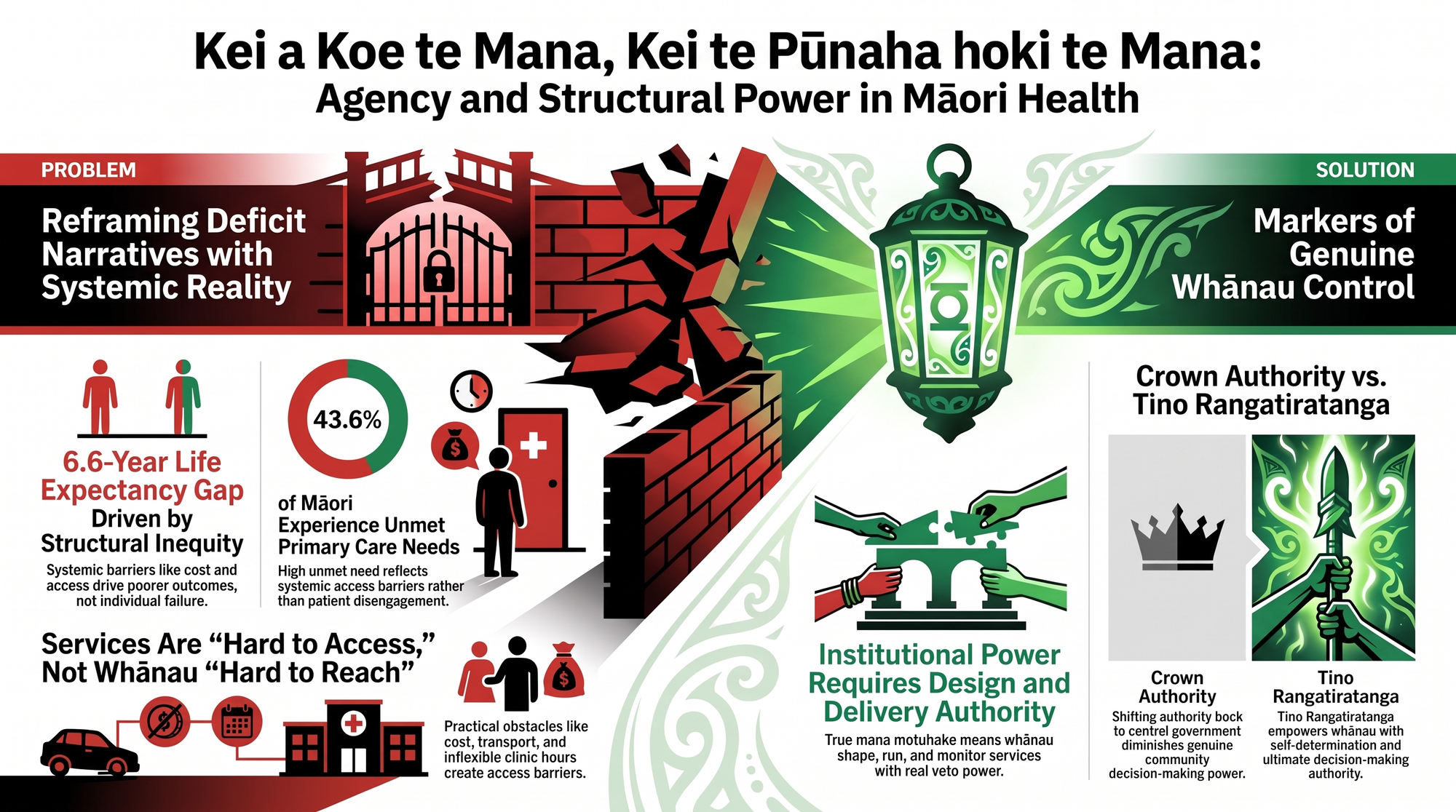
I would love readers to click into this essay because it carries a wealth of information usable in daily life — at the pharmacy counter, in the clinic, around the whānau table, and whenever a politician disguises blame as reform. I have made an audio podcast that lays out this kaupapa in detail, and a short video explaining it plainly. For long-form readers, this fully cited essay is here for you.
This is also a repository for our mokopuna. If these warnings go unheeded, I want them to be able to say: at least The Māori Green Lantern named it, and Brendon McIntosh asked the questions that made the naming possible.
Question One: Can Agency And Structure Both Be True?
Brendon's essay refuses a false choice between "Māori have agency" and "the system produced this."
He is right to refuse it, and I answer with the same refusal.
Māori are not powerless. Our whakapapa did not begin with raupatu, and our future does not belong to an epidemiological graph. Tamariki Māori should grow up believing they can become pharmacists, scientists, doctors, artists, farmers or anything else their gifts allow.
At the same time, explaining a cause is not surrendering agency.
A pharmacist who sees an adverse medicine reaction does not tell the patient to stop dwelling on the past — the cause is identified precisely so the harm can be reduced. Te Ara records that Māori health has remained poorer than Pākehā health even after accounting for income, occupation, education, neighbourhood and behaviour. The College of GPs identifies colonisation, racism and power imbalance as interconnected drivers of continuing inequity.
Tika: encourage agency — give people clear information, real options, and respect for the decisions whānau make.
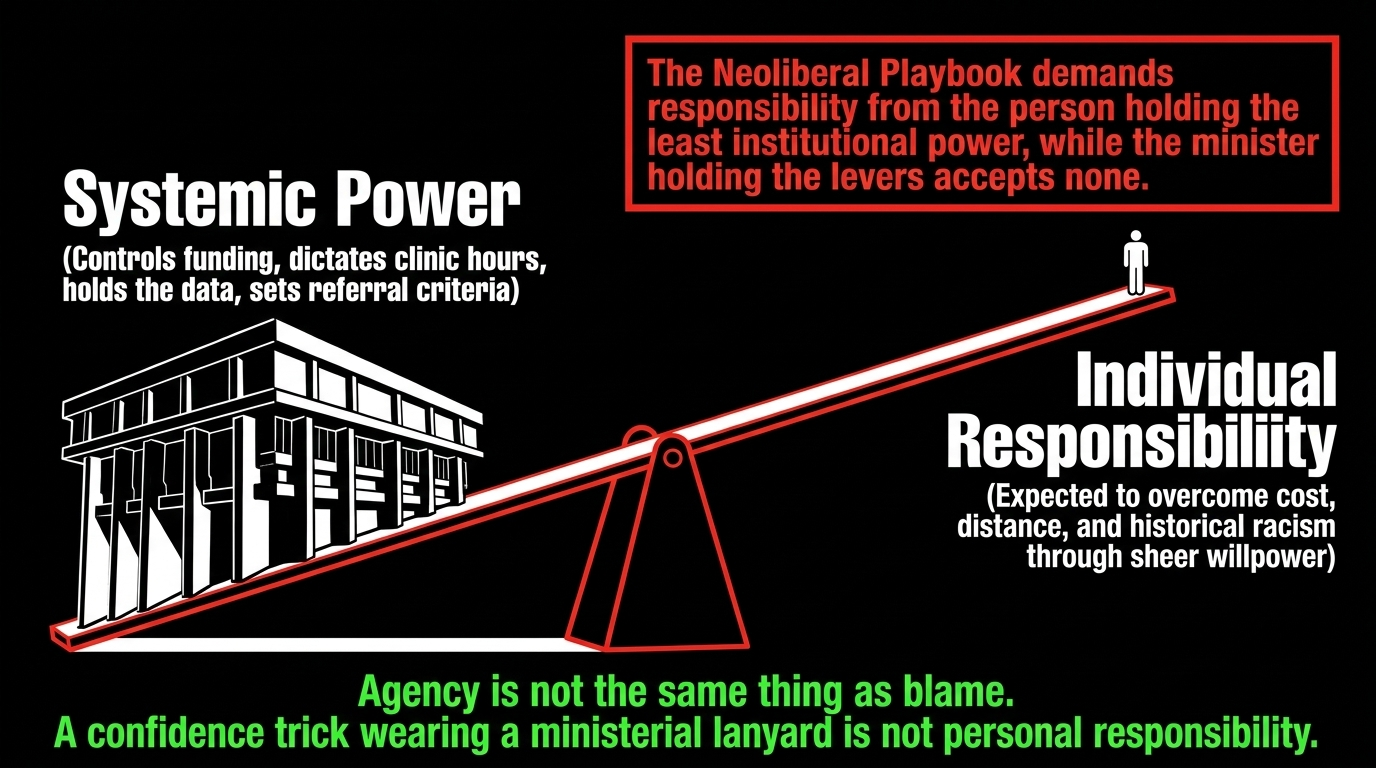
Pono: do not call a decision "free" once cost, distance, discrimination or an inflexible service have already narrowed the options to almost nothing.
The neoliberal state loves the first half of that sentence and buries the second. It demands responsibility from the person holding the least institutional power, while the minister holding the levers accepts none. That is not personal responsibility.
It is a confidence trick wearing a ministerial lanyard.
Question Two: Where Does Decision-Making Power Actually Sit?
This is the sharpest question in Brendon's essay: Kei hea te mana whakatau?
A person can carry enormous mana while holding almost no institutional power. Mana is not a coupon a government department hands out. Institutional power is different — it decides which medicine is funded, where a clinic sits, how long an appointment runs, who sees the record, and who signs the cheque.
A service can open with a mihi, hang tukutuku on the wall, employ a cultural adviser — and still reserve every real decision for itself. That is not power-sharing. That is Crown control wearing a korowai it did not weave.
The practical test for whether power has genuinely moved is simple: Can whānau influence when and how care is delivered? Can they question a plan without being labelled non-compliant? Can they define what success means alongside clinical measures? Can Māori communities govern the money and the data, not merely advise on them? If the answer is no, the system has moved responsibility downward while keeping authority at the top.
Nowhere is that clearer than the death of Te Aka Whai Ora.
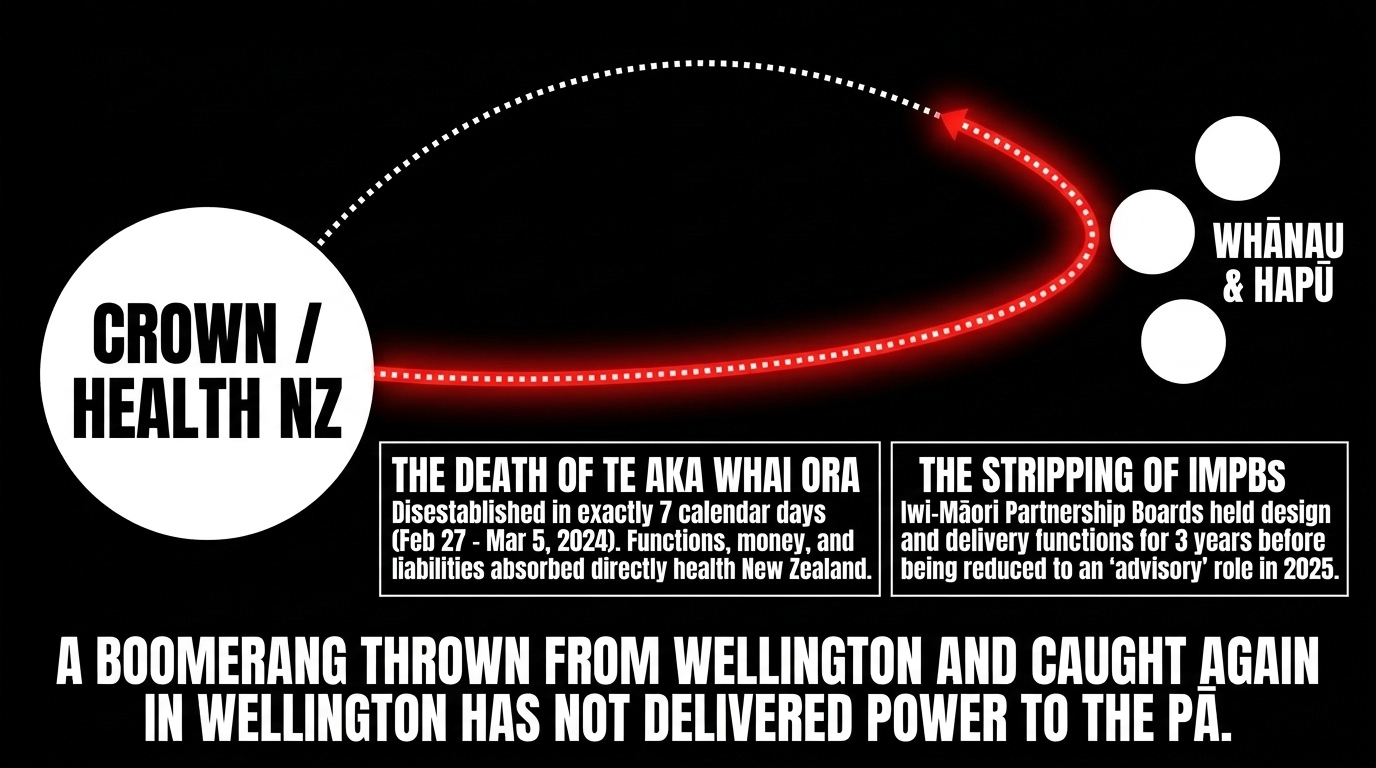
The Bill disestablishing the Māori Health Authority was introduced on 27 February 2024 and enacted seven calendar days later, on 5 March. The Waitangi Tribunal found the Crown failed to consult Māori meaningfully, lacked substantive policy advice and proper impact analysis, acted from ideology rather than evidence, and breached Treaty principles including partnership, active protection and tino rangatiratanga.
The Government's stated justification was that decisions should sit closer to communities and hapū. That explanation deserves to be read in full. But Pono asks: if power was moving closer to whānau, where did the equivalent independent authority go? The legislation transferred the Authority's functions, money and liabilities back into Health New Zealand — not into hapū hands. A boomerang thrown from Wellington and caught again in Wellington has not delivered power to the pā.
I traced this in The Government That Burned Our Healing House Is Now Selling You A Box Of Band-Aids and in Luxon's War On Truth, Tikanga And Māori.
Question Three: What Does "Hard To Reach" Actually Mean?
Brendon asks what changes when we stop calling people "disengaged" and start asking what is happening around them. Everything changes.
"Disengaged," "non-adherent" and "low health literacy" place the problem inside a person and let the institution avoid examining its own hours, fees, distance and history of racism. That does not mean every choice is healthy — all humans forget medicines, miss appointments and make imperfect decisions. The racist move is turning ordinary human behaviour into an ethnic diagnosis: Pākehā imperfection becomes human complexity; Māori imperfection becomes a cultural problem to be managed.
Tika changes the opening question from "What is wrong with this whānau?" to "What is happening around this whānau?" In 2020, 43.6% of Māori — about 44 in every 100 — reported at least one unmet primary-care need.
When unmet need exists at that scale, searching 44 personalities for a shared moral flaw is intellectually bankrupt. Examining the system they encountered is not.
The Deep Dive Podcast
Listen to a lively conversation between two hosts, unpacking and connecting topics in the sources of this essay. I apologise in advance for the AI's very harsh pronounciation of reo. Please dont shoot me, :).
Youtube Video
Like video? Here is a short video suppporting the essay. Again, don't shoot the messenger please because of AI's pronounciation. :)
Koha Consideration
You might ask who supports The Māori Green Lantern to produce this volume of plain-language, cited work about Māori health and Crown power. The answer is you. This mahi is supported through koha. There is no line of corporate entities paying me to soften the evidence or turn structural harm into a cheerful infographic.
Every koha supports a repository our mokopuna can return to — one that honours honest kōrero between Māori thinkers like Brendon and me, while keeping the sharpest scrutiny fixed on the Crown and corporate systems that hold institutional power, and the same honest scrutiny turned on our own institutions when it is warranted. It signals that rangatiratanga includes the power to support our own truth-tellers.
Kia kaha, whānau. Stay vigilant. Stay connected. If you are able, consider a koha to ensure this voice continues.
If you are unable to koha, no worries. Subscribe to or follow The Māori Green Lantern, kōrero about this kaupapa, and share it with your whānau and friends. That is koha in itself.
Four Pathways Exist:
- Koha — Support The Māori Green Lantern
- Subscribe To The Māori Green Lantern
- Direct Bank Transfer — Ivor Jones, Account Number 03-1395-0099387-000
- Subscribe On Facebook
Question Four: Who Decides What "Better" Looks Like?
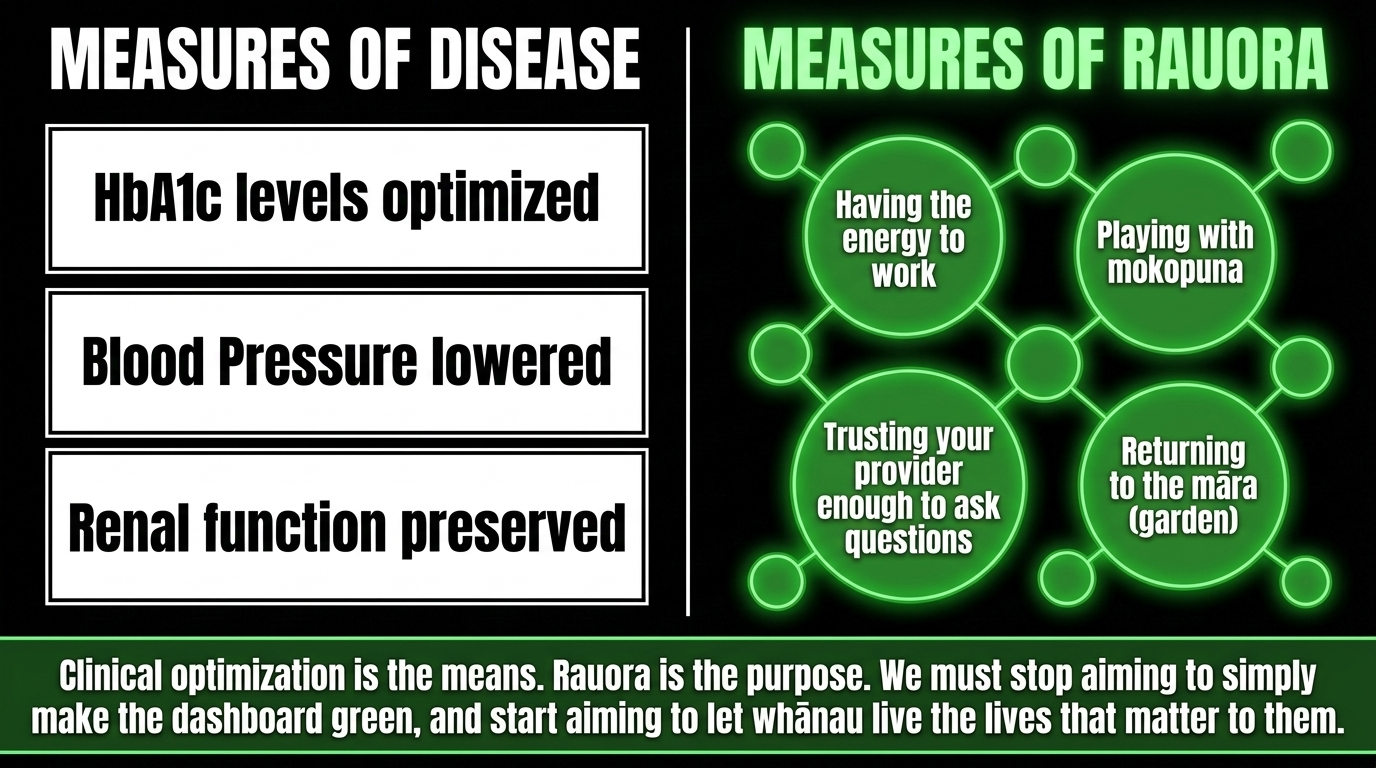
Brendon's essay makes an important distinction: HbA1c, blood pressure and kidney function are measures of disease, not measures of Rauora.
A system can hit every clinical target while leaving a person confused, unheard and afraid to ask questions.
Tika requires sound clinical care. Pono requires the system to admit clinical optimisation is a means, not the whole purpose of a life. Whānau must help define success: Do I understand what is happening? Do I trust the people involved? Does the plan fit my life? Can I return to what gives my life meaning? These are not "soft" additions to real medicine — trust determines whether people return, and understanding affects whether treatment works at all.
Question Five: Does Building Māori Institutions Let The Crown Off The Hook?
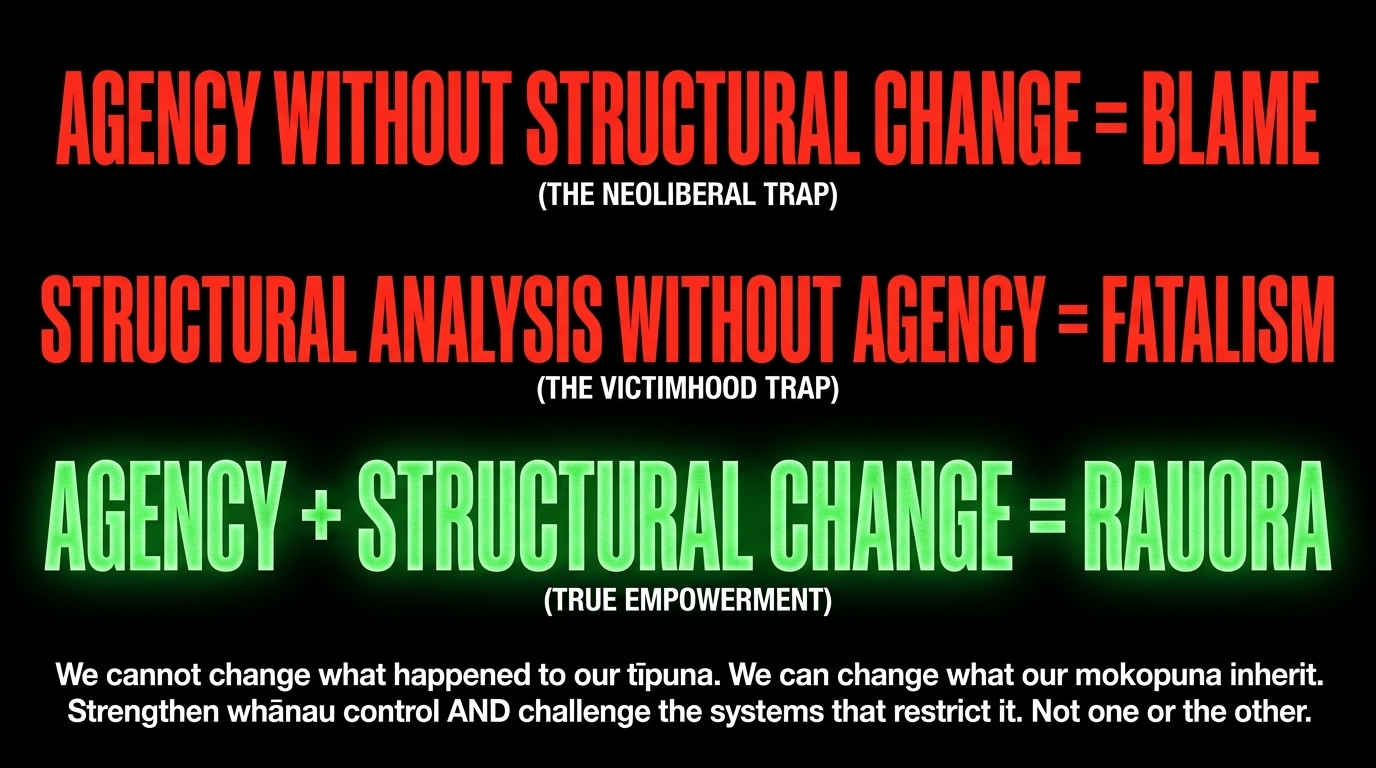
No — and Brendon is right to insist on this. Mana motuhake cannot become an excuse for kāwanatanga failure.
The Ministry of Health's own Te Tiriti framework says active protection requires the Crown to act, to the fullest practicable extent, to achieve equitable Māori health outcomes. The Waitangi Tribunal has found the Crown responsible for equitable policy outcomes and active protection of Māori health and wellbeing.
A Māori provider receiving public money is not proof of Māori dependency — by that standard, every hospital and government contractor would be "dependent." Public funding exists to meet public need. The real questions are who controls it, whether it follows need, and whether the service works.
Question Six: What Are We Building?
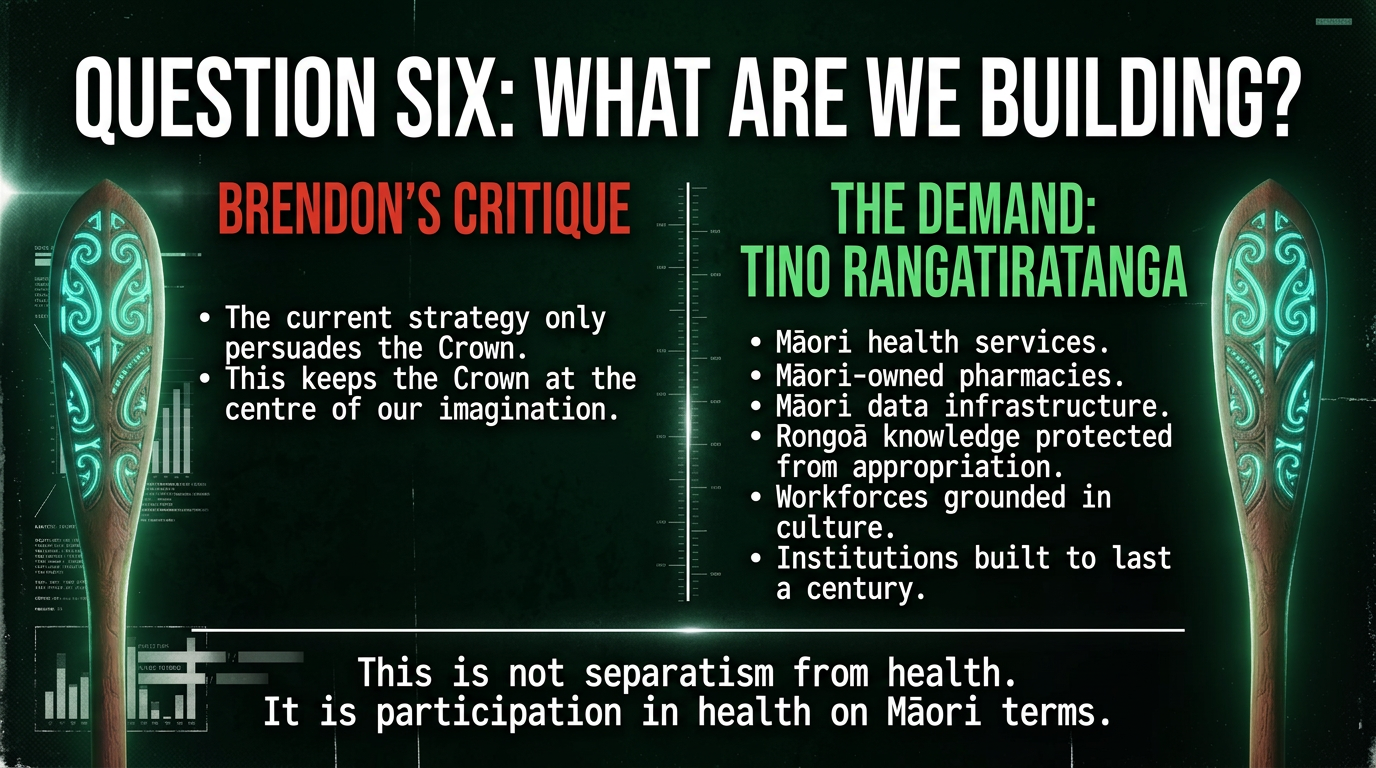
Brendon asks what happens if our only strategy is persuading the Crown to behave better — then the Crown remains the centre of our imagination.
Tino rangatiratanga demands more: Māori health services, Māori-owned pharmacies, Māori data infrastructure, rongoā knowledge protected from appropriation, workforces grounded in culture, institutions built to last a century. This is not separatism from health. It is participation in health on Māori terms.
Question Seven: Does Power Reaching A Māori Institution Mean It Reaches Whānau?
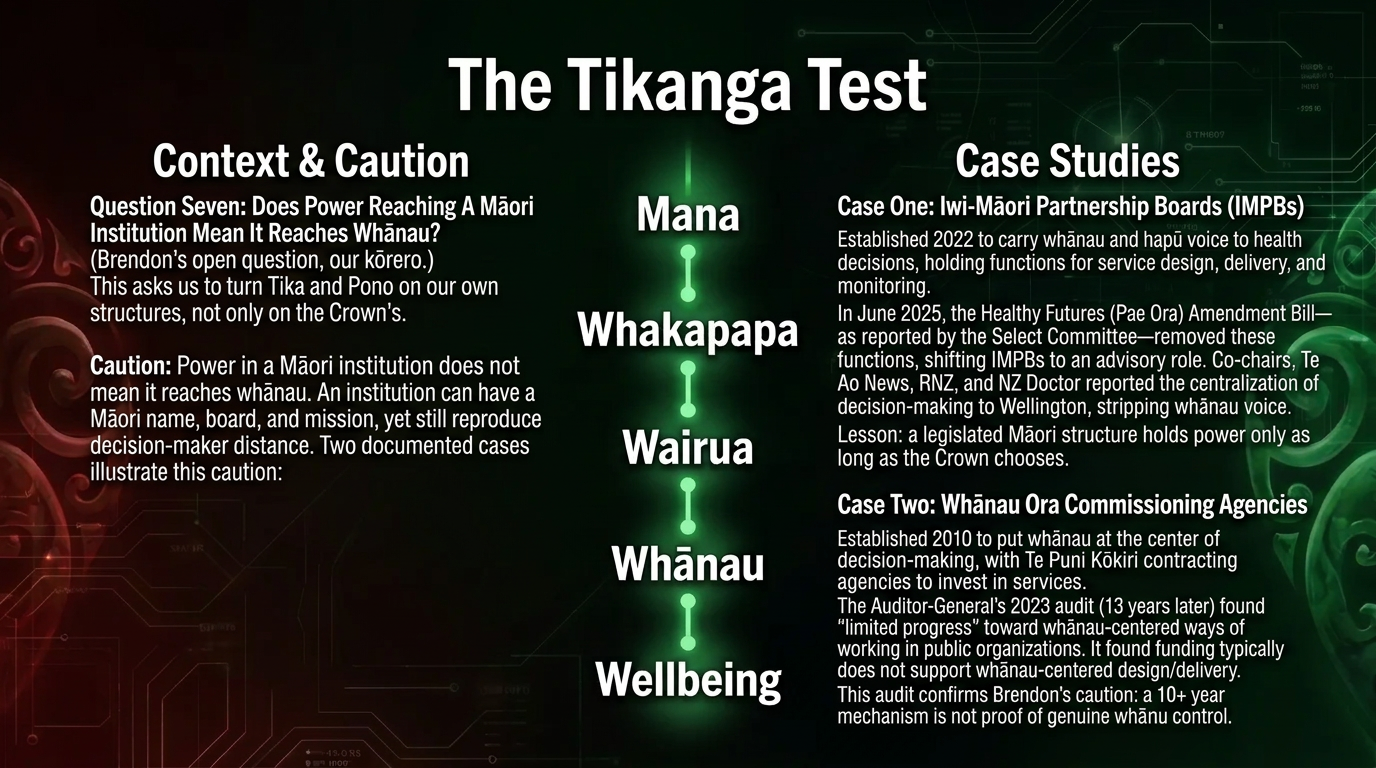
This is the question Brendon left open at the end of our kōrero, and it is the hardest one, because it asks us to turn Tika and Pono on our own structures, not only on the Crown's.
The caution is this: putting power into a Māori institution does not automatically mean that power reaches whānau. An institution can carry a Māori name, a Māori board and a Māori mission statement, and still reproduce the same distance between decision-makers and the people the decisions affect.
Two documented cases show why this caution is necessary — one where the Crown clawed power back from a Māori structure, and one where an independent audit found that a whānau-centred structure had not yet delivered the power transfer it promised.
Iwi-Māori Partnership Boards
The fifteen IMPBs were established in 2022 specifically to carry whānau and hapū voice into local health decisions, holding functions over service design, delivery and monitoring.
In June 2025, the Government introduced the Healthy Futures (Pae Ora) Amendment Bill, which — according to the Select Committee's own report — removed those substantive functions and shifted IMPBs to an advisory role feeding into the Hauora Māori Advisory Committee, which in turn advises the Minister and the Health New Zealand board. RNZ reported IMPB co-chairs warning the change would centralise decision-making back in Wellington and strip an authentic whānau voice from the system. Te Ao News reported the same loss of business planning, service design and monitoring functions, as did NZ Doctor.
The lesson is not that IMPBs were ever a flawless vehicle for whānau power — some researchers were already warning before the cuts that IMPBs lacked the dedicated funding and infrastructure to function effectively.
The lesson is that a Māori institutional structure, even one legislated into existence, holds power only for as long as the Crown chooses not to take it back.
Whānau Ora commissioning agencies
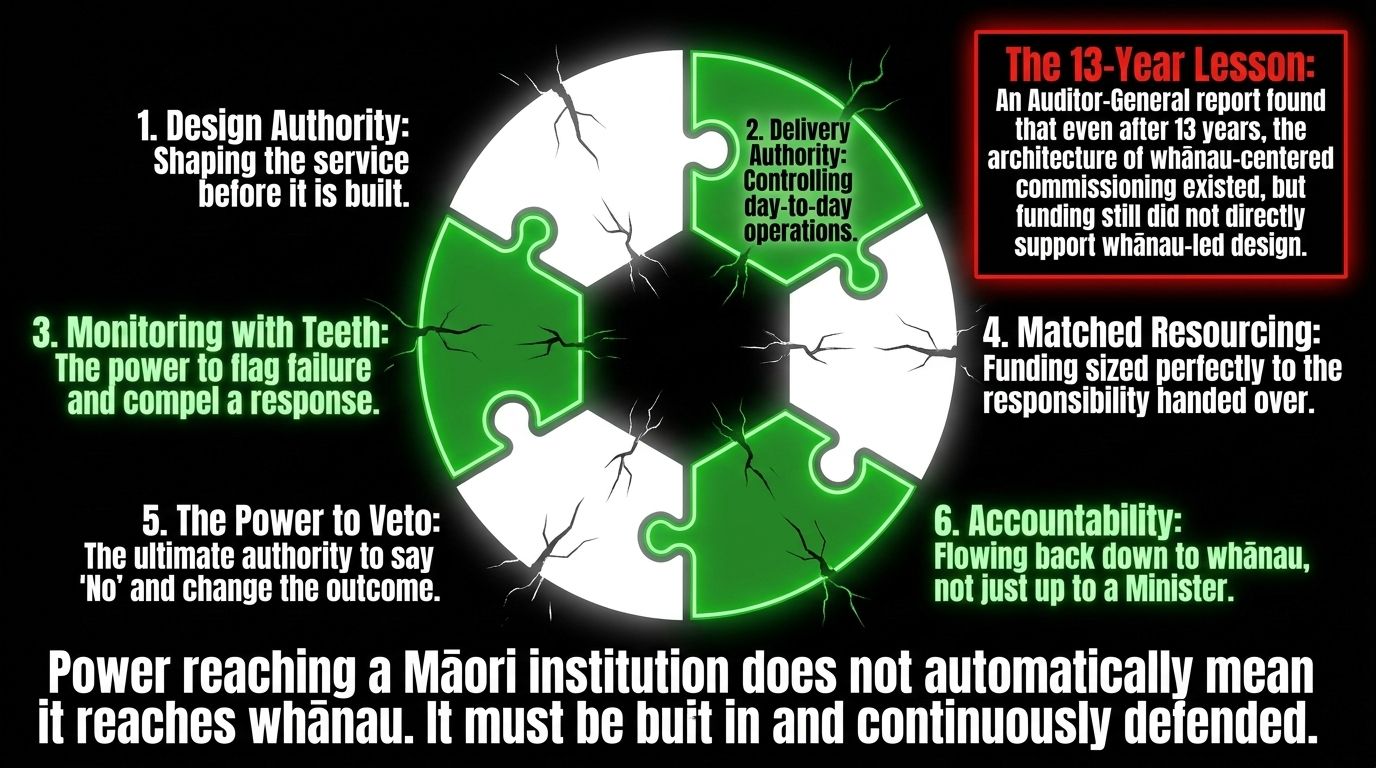
These were established in 2010 specifically to put whānau at the centre of decision-making, with Te Puni Kōkiri contracting commissioning agencies to invest directly in whānau-centred services. The Auditor-General's 2023 audit — thirteen years after Whānau Ora began — found that public organisations had made only "limited progress," that "we did not see a significant shift" toward whānau-centred ways of working, and that funding to commissioning agencies "typically does not directly support the design and delivery of whānau-centred approaches."
This finding does not accuse any commissioning agency or provider of wrongdoing — the audit examined the performance of public organisations around Whānau Ora, not the agencies themselves.
But it confirms Brendon's caution precisely: the existence of a kaupapa Māori mechanism, even one running for over a decade, is not proof that whānau gained genuine control over the decisions affecting them.
What Genuine Whānau Control Actually Looks Like
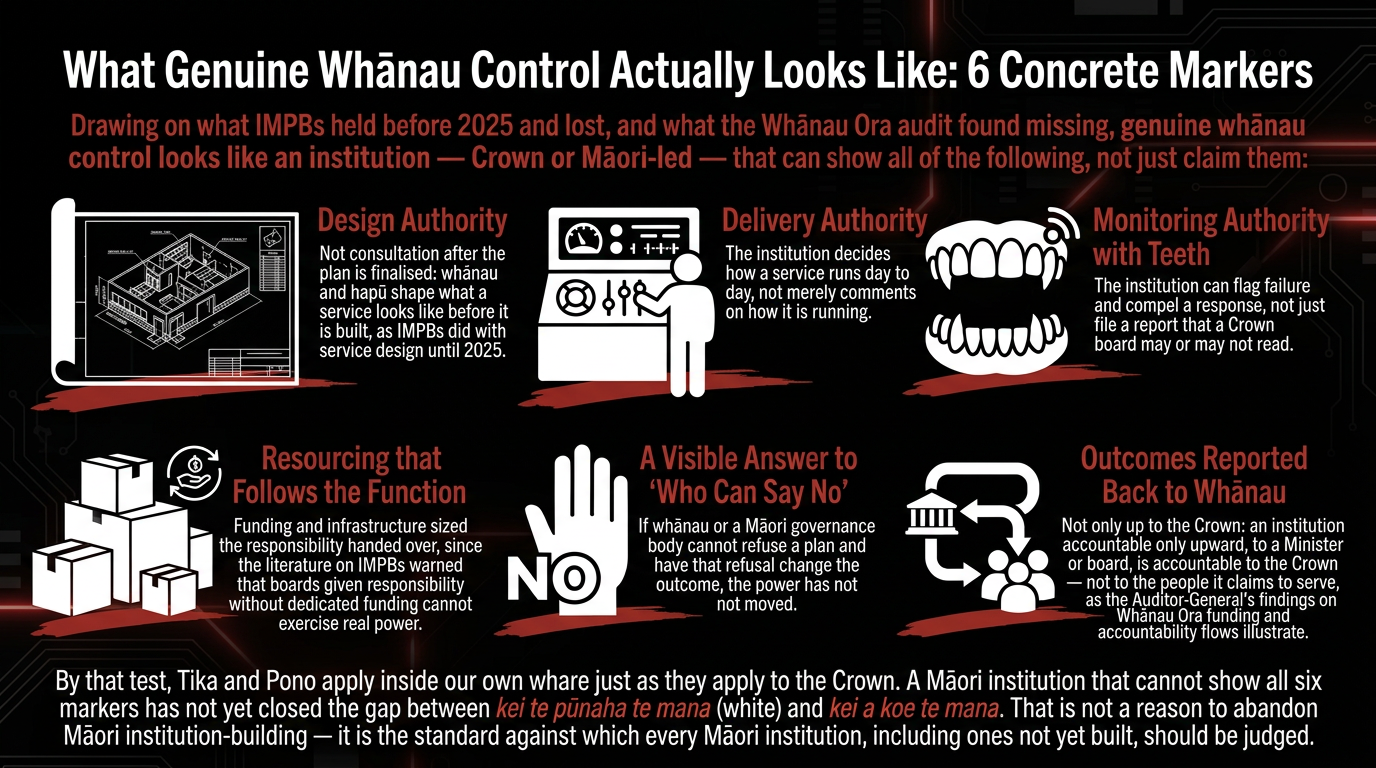
Brendon's question deserves more than a warning — it deserves concrete markers. Drawing on what IMPBs held before 2025 and lost, and what the Whānau Ora audit found missing, genuine whānau control looks like an institution — Crown or Māori-led — that can show all of the following, not just claim them:
- Design authority, not consultation after the plan is finalised: whānau and hapū shape what a service looks like before it is built, as IMPBs did with service design until 2025.
- Delivery authority: the institution decides how a service runs day to day, not merely comments on how it is running.
- Monitoring authority with teeth: the institution can flag failure and compel a response, not just file a report that a Crown board may or may not read.
- Resourcing that follows the function: funding and infrastructure sized to the responsibility handed over, since the literature on IMPBs warned that boards given responsibility without dedicated funding cannot exercise real power.
- A visible answer to "who can say no": if whānau or a Māori governance body cannot refuse a plan and have that refusal change the outcome, the power has not moved.
- Outcomes reported back to whānau, not only up to the Crown: an institution accountable only upward, to a Minister or board, is accountable to the Crown — not to the people it claims to serve, as the Auditor-General's findings on Whānau Ora funding and accountability flows illustrate.
By that test, Tika and Pono apply inside our own whare just as they apply to the Crown.
A Māori institution that cannot show design authority, delivery authority, monitoring authority with teeth, matched resourcing, a real power to say no, and accountability flowing back to whānau has not yet closed the gap between kei te pūnaha te mana and kei a koe te mana.
That is not a reason to abandon Māori institution-building — it is the standard against which every Māori institution, including ones not yet built, should be judged.
The Direct Answer To The Gap Brendon Left Open
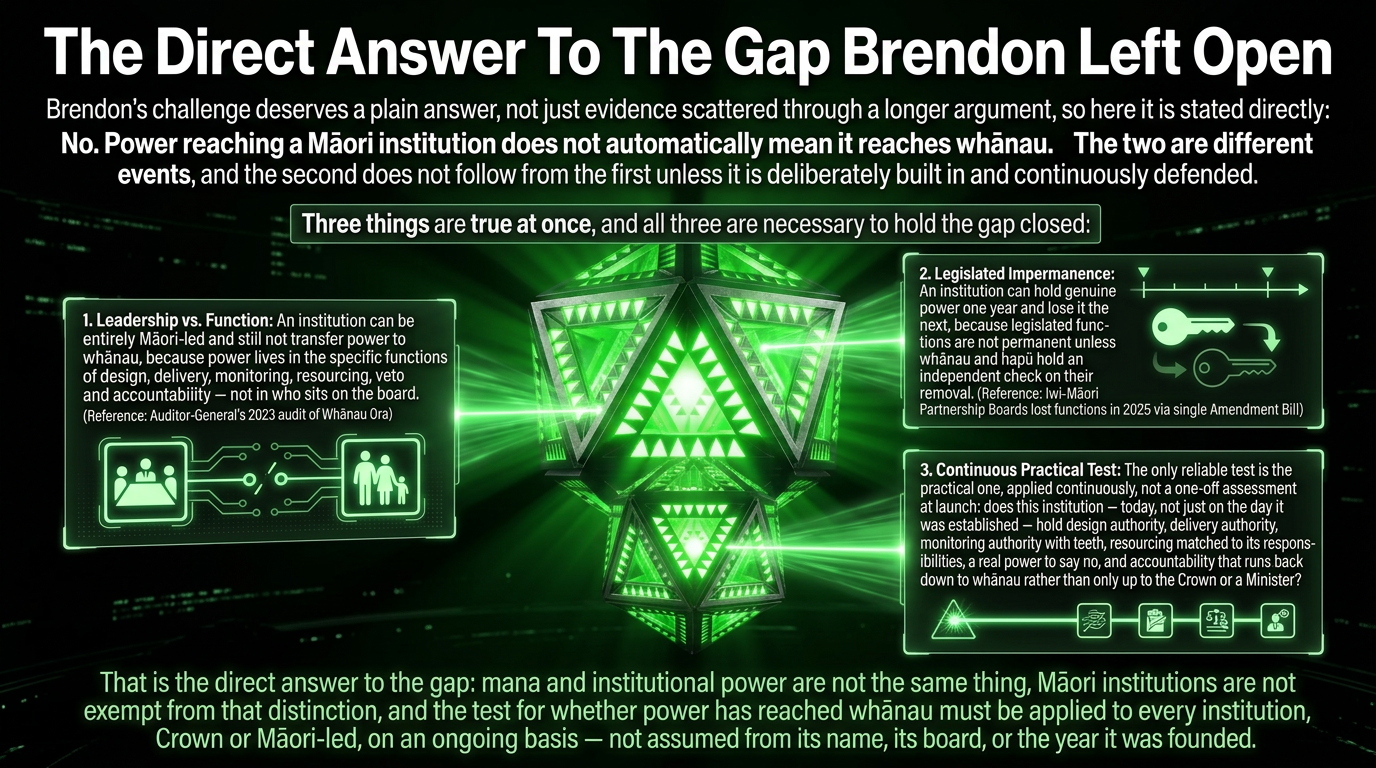
Brendon's challenge deserves a plain answer, not just evidence scattered through a longer argument, so here it is stated directly:
No. Power reaching a Māori institution does not automatically mean it reaches whānau. The two are different events, and the second does not follow from the first unless it is deliberately built in and continuously defended.
Three things are true at once, and all three are necessary to hold the gap closed:
- An institution can be entirely Māori-led and still not transfer power to whānau, because power lives in the specific functions of design, delivery, monitoring, resourcing, veto and accountability — not in who sits on the board. The Auditor-General's 2023 audit of Whānau Ora found exactly this after thirteen years of operation: the architecture of whānau-centred commissioning existed, but "we did not see a significant shift" and funding "typically does not directly support the design and delivery of whānau-centred approaches."
- An institution can hold genuine power one year and lose it the next, because legislated functions are not permanent unless whānau and hapū hold an independent check on their removal. Iwi-Māori Partnership Boards held real service design, delivery and monitoring functions from 2022, and lost them to an advisory-only role in 2025 by a single Amendment Bill — a three-year lifespan for functions that whānau were told would be theirs.
- The only reliable test is the practical one, applied continuously, not a one-off assessment at launch: does this institution — today, not just on the day it was established — hold design authority, delivery authority, monitoring authority with teeth, resourcing matched to its responsibilities, a real power to say no, and accountability that runs back down to whānau rather than only up to the Crown or a Minister? Where that test has been applied by independent auditors and select committees, the honest answer has twice been "not yet" or "not any more" — even inside structures built by and for Māori.
That is the direct answer to the gap:
Mana and institutional power are not the same thing, Māori institutions are not exempt from that distinction, and the test for whether power has reached whānau must be applied to every institution, Crown or Māori-led, on an ongoing basis — not assumed from its name, its board, or the year it was founded.
Three Examples For The Western Mind
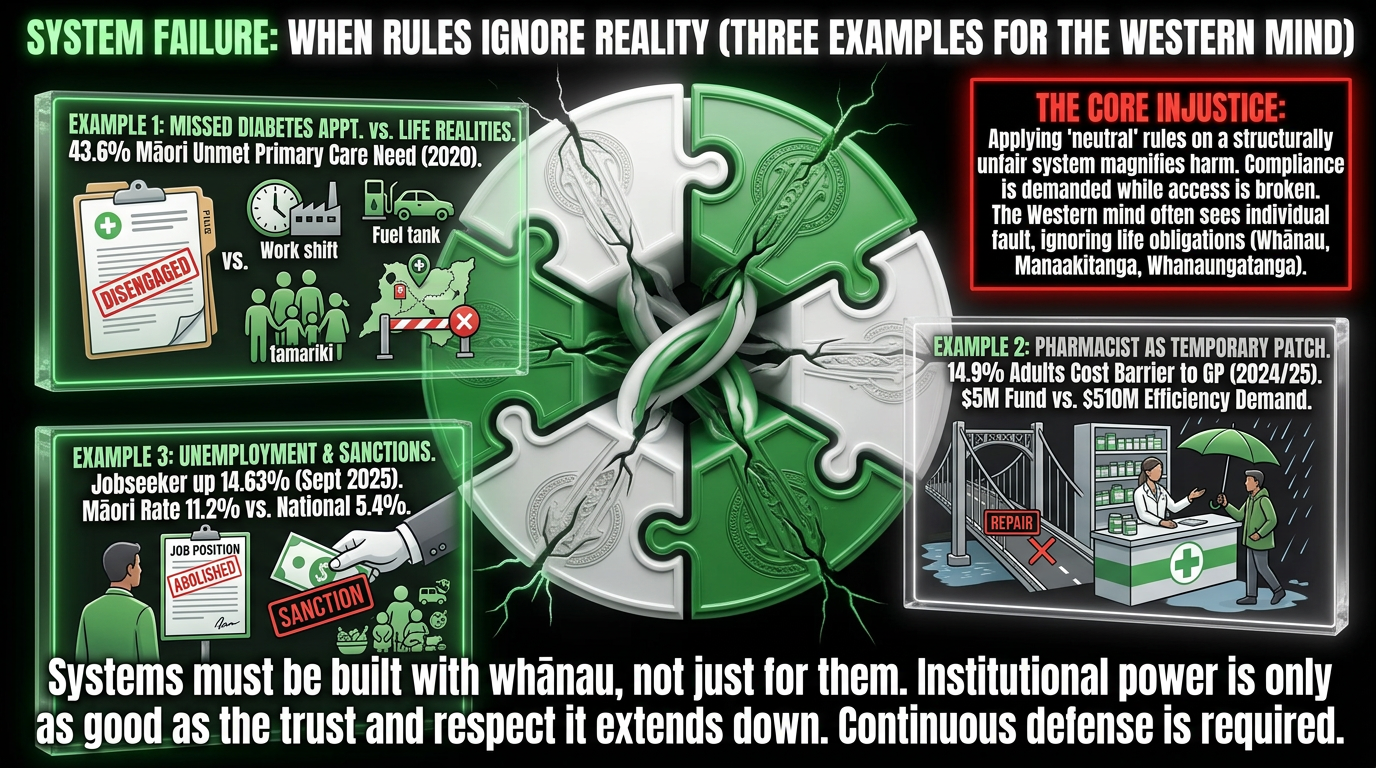
Example One: The Missed Diabetes Appointment
A Māori worker misses three diabetes appointments. The file says "disengaged." Look instead at the life around the file: the appointment clashed with paid work, petrol was unaffordable, tamariki needed care, the clinic was distant, an earlier visit involved racism.
Quantified harm: 43.6% of Māori — about 44 in every 100 — reported unmet primary-care need in 2020.
Tikanga impact: the service breaches manaakitanga when it demands compliance while refusing humane access, and weakens whanaungatanga by treating the person as an isolated unit rather than someone embedded in whānau obligations.
For the Western mind: imagine a fire service placing the station two towns away, opening it only during your shift, charging at the door — then blaming your attitude when your house burns.
Solution: mobile and after-hours clinics, transport support, outreach pharmacists, and asking whānau what time and place would actually work.
Example Two: The Pharmacist Filling A Hole The Crown Dug
The Government announced expanded pharmacist-funded treatment for common conditions, backed by a $5 million annual fund. The proposal presents pharmacies as a convenient additional option. Pharmacists — Brendon's own profession — hold real trust and community knowledge that the wider system underuses.
But Tika and Pono require asking whether this expands a healthy system or patches a hole created by political choices. 14.9% of adults — about one in seven — did not see a GP because of cost in 2024/25, while Health New Zealand's regions were told to find roughly $510 million in efficiencies.
Quantified harm: roughly 15 in every 100 adults face a cost barrier to primary care, inside a system under a far larger efficiency demand than the new pharmacy fund provides.
Tikanga impact: pharmacy care enhances manaakitanga when relational and connected; it becomes mauri-depleting when it fragments care and substitutes one transaction for ongoing whānau relationships.
For the Western mind: imagine a council closing lanes on a damaged bridge, then handing pedestrians better umbrellas. The umbrella may help. It does not repair the bridge.
Solution: support expanded pharmacist care and properly resource primary care, with consent-based record access, funded follow-up and support for Māori-owned pharmacies.
Example Three: The Unemployed Person Blamed For A Labour Market They Did Not Design
Jobseeker Support rose from 190,000 people in December 2023 to 217,800 in September 2025 — an increase of 27,800, or 14.63%, with the target marked "At Risk." Māori unemployment was 11.2% in the December 2025 quarter versus 5.4% nationally — just over twice the national rate.
Quantified harm: 27,800 more people on Jobseeker Support than the baseline, and a Māori unemployment rate 5.8 percentage points above the national rate.
Tikanga impact: punishment without realistic opportunity turns utu from restoration into one-way extraction, and harms whānau collectively when sanctions on one adult reduce food, transport and stability for everyone in the home.
For the Western mind: imagine your employer abolishing your job, then being fined for not being employed.
Solution: measure sustainable employment rather than sanction activity; invest in Māori-led pathways, transport, training and regional job creation.
The Answer, Held Together

Brendon's essay refused two false endings, and this essay refuses them too.
Whānau already have mana — the system does not manufacture or distribute it, and its first duty is to stop diminishing it. Systems also hold enormous power over resources, access and the range of choices realistically available. A mana-enhancing approach must strengthen the first while moving the second — and must check, honestly, whether the second has actually moved.
Moving power closer to whānau is not achieved by shuffling a box between Crown agencies, appointing Māori advisers while executives keep the veto, consulting after the decision is made, or standing up a Māori-named institution and assuming the job is done.
It becomes real when whānau can make decisions, control resources, govern data and define success on their own terms — and when that institution can pass the test set out above: design authority, delivery authority, monitoring authority with teeth, matched resourcing, a real power to say no, and accountability flowing back to whānau rather than only up to the Crown.
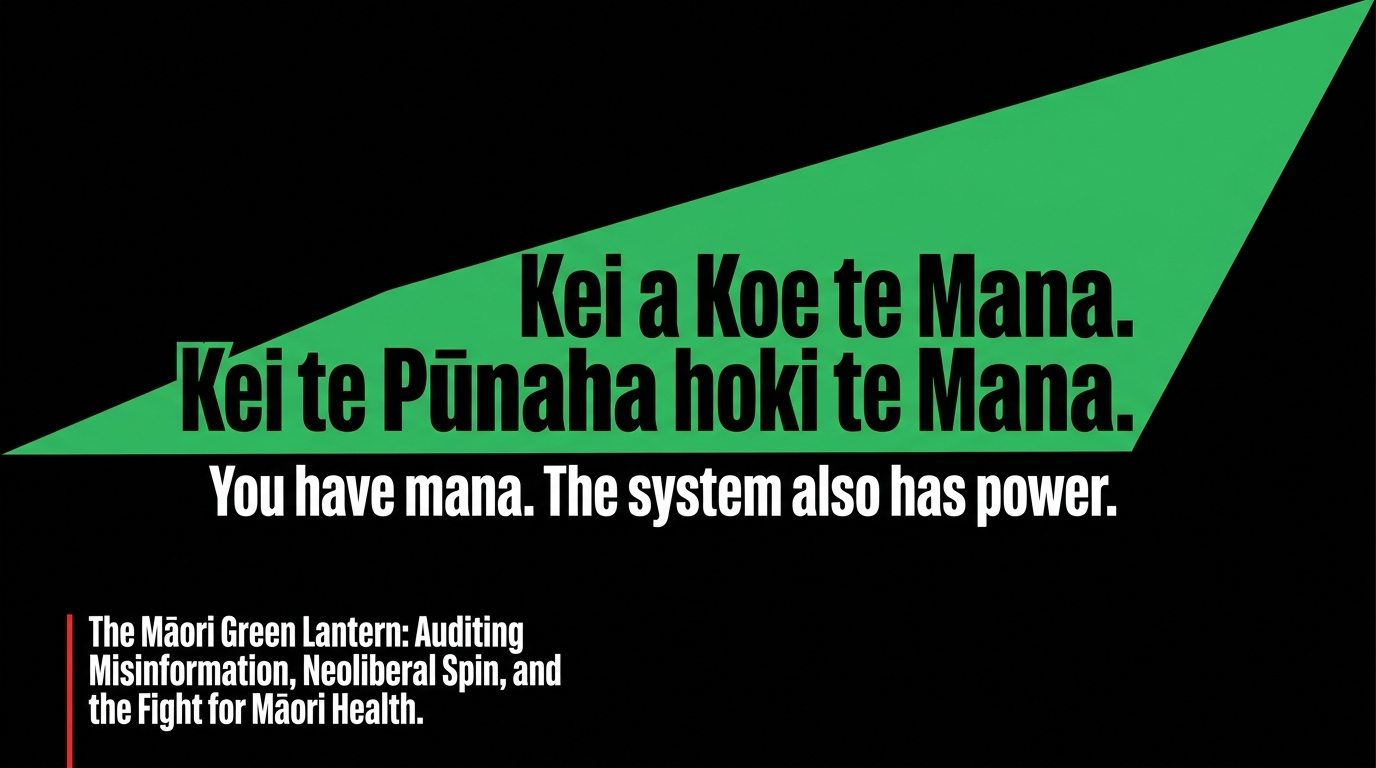
Kei A Koe Te Mana. Kei Te Pūnaha Hoki Te Mana.
You have mana. The system also has power. Strengthen the first. Move the second — and keep checking that it has actually moved, whoever holds it next.
Raupatu explains how we arrived here. Rauora asks what we build from here. And if the system blocks the mana of whānau — whether that system wears a Crown crest or a Māori name — I will not tell whānau to become more resilient beneath its boot.
I will name the boot, trace who controls it, and work alongside allies like Brendon to remove it.
Disclaimer
This essay addresses Māori health, Te Tiriti obligations, public expenditure and government policy. Criticism concerns people and institutions acting in public capacities and serves the public interest by comparing official claims with legislation, data, Waitangi Tribunal findings, Select Committee reporting and Auditor-General findings.
Terms such as "white-supremacist," "neoliberal" and "bureaucratic sadism" express political opinion based on the facts linked in the same passages. They do not allege criminal offending or claim knowledge of any person's private state of mind. No malice is intended. The discussion of IMPBs and Whānau Ora commissioning agencies is a structural analysis of institutional design and audited performance, not an allegation against any named individual or provider.
A standing right of reply applies to ministers, agencies and organisations discussed. Corrections supported by primary evidence will be considered promptly and material errors corrected transparently through The Māori Green Lantern.