"Civilisation Was the Weapon: Don Brash Called Us Primitive at Oxford — Here Is the Reckoning" - 17 May 2026
An 84-year-old colonial revivalist told Oxford that my people are primitive — while my people were in the room, watching, and waiting. This is the answer he was never prepared to receive.

Kia ora Aotearoa,
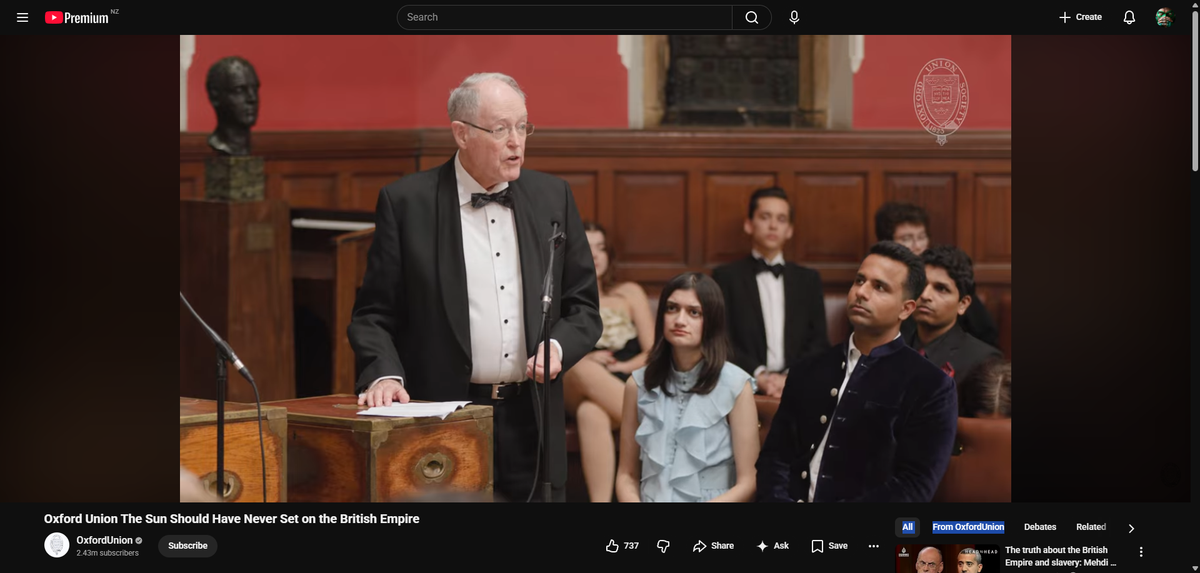
This essay examines the Oxford Union debate of November 2025,
"This House Believes the Sun Should Never Have Set on the British Empire,"
because Donald Brash's speech directly damages Māori mana, distorts the public record, and provides ideological cover for the current white supremacist neoliberal government's legislative dismantling of Māori rights. This constitutes a matter of direct public interest under the Defamation Act 1992 (NZ) and Durie v Gardiner NZCA 278.
Ko Au Tēnei — The Musket That Never Ran Out of Powder
Picture it.
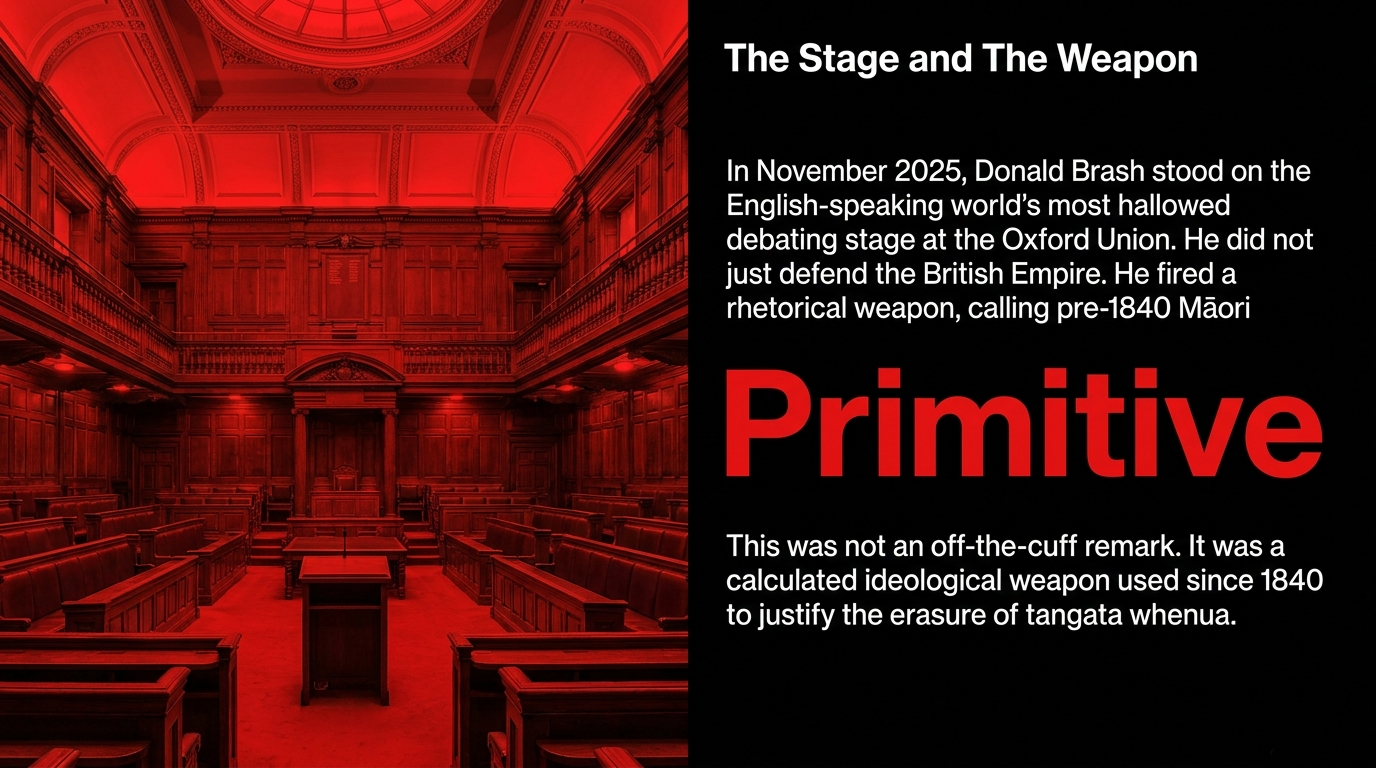
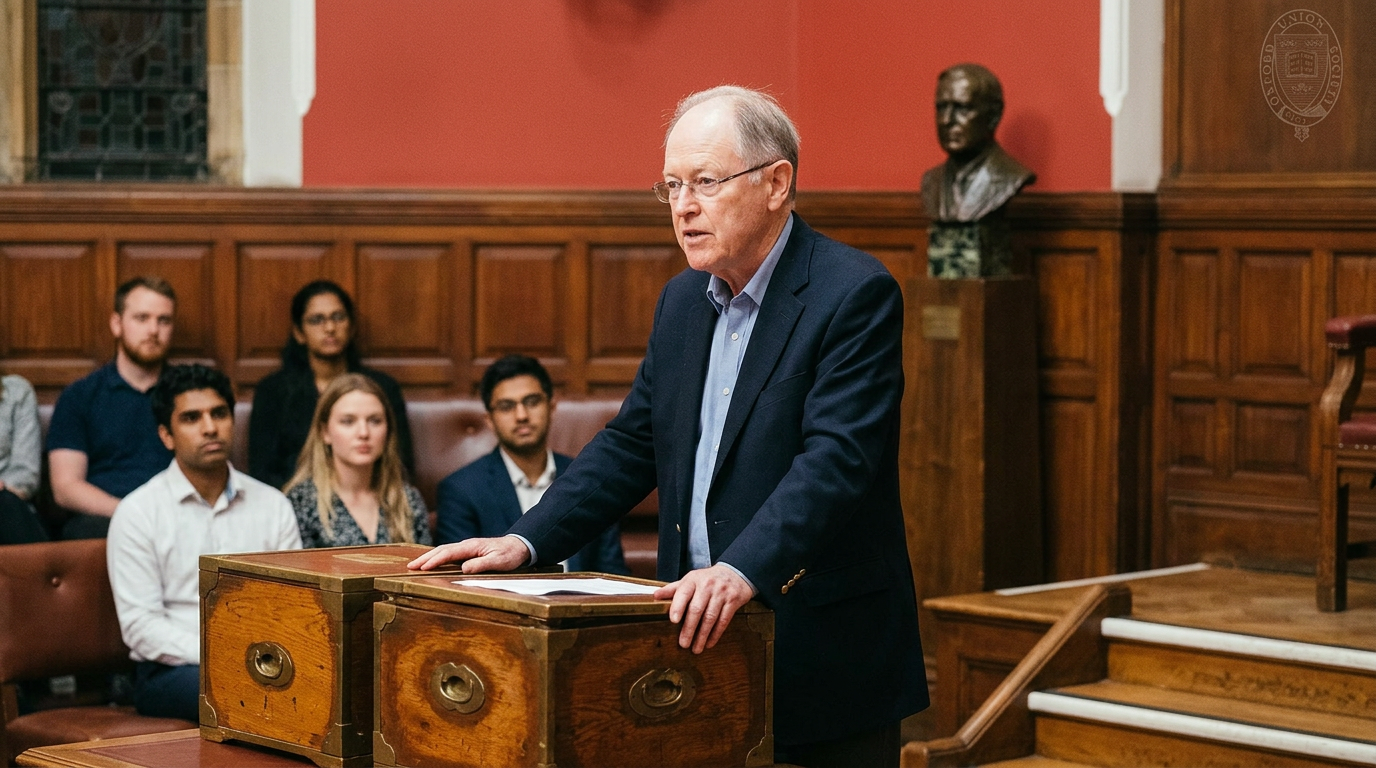
A man climbs onto a stage — not any stage, but the Oxford Union, the most hallowed debating chamber in the English-speaking world. He adjusts his notes. He clears his throat. And then, with all the certainty of a man who has never once had to question whether his people's existence would be used as a rhetorical device, he informs the assembled lords, ladies, academics, and international observers that Māori were
"a primitive people in the dictionary meaning of that word."
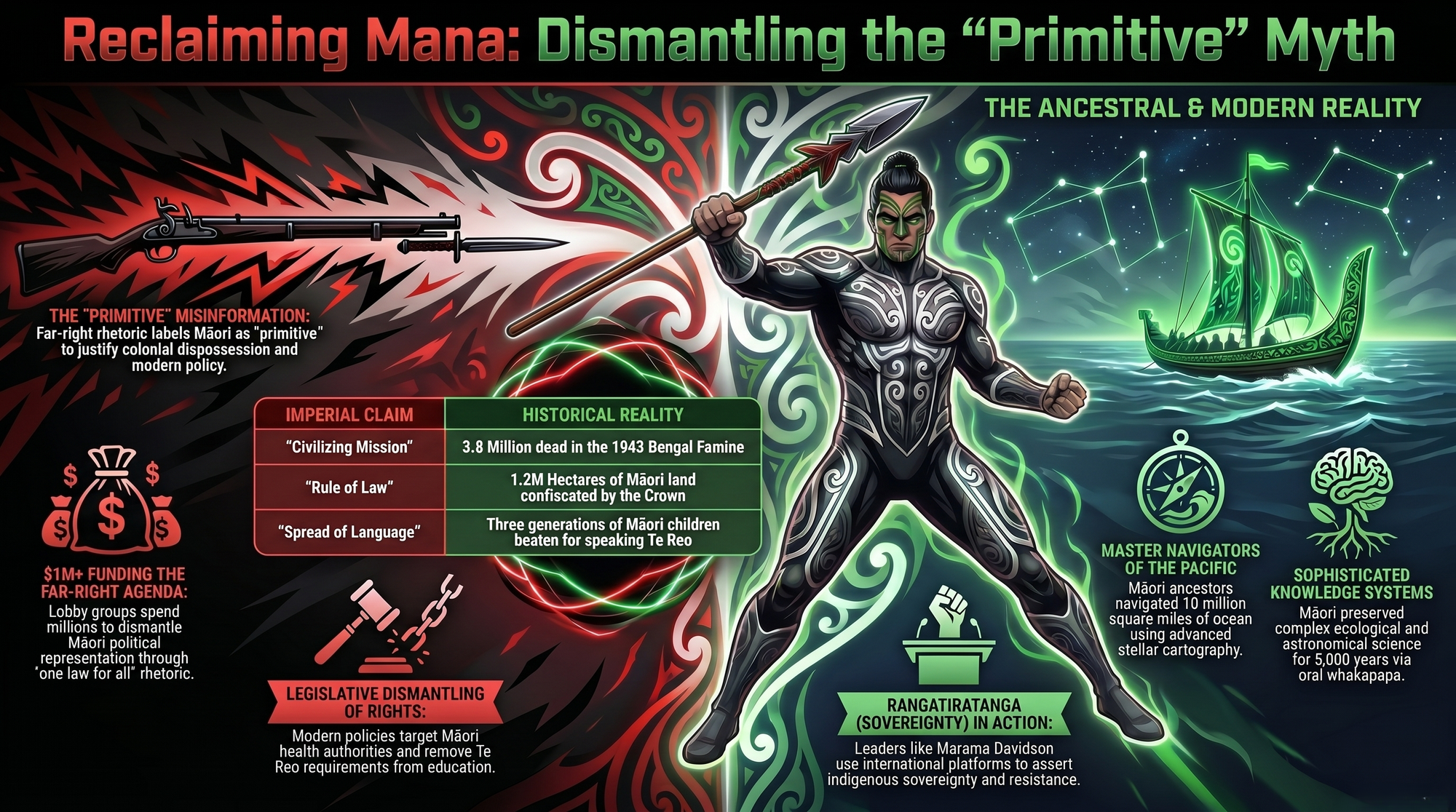
That word — primitive — is not a word. It is a musket. It has been fired at us since 1840. It was fired when they confiscated our land. It was fired when they beat te reo out of our children's mouths in colonial schools. It was fired when they told us our knowledge was superstition, our tikanga was barbarism, and our sovereignty was something that had never existed.
The musket never ran out of powder. It just changed hands — from the colonisers of the 19th century to the lobbyists of the 21st.
And now Donald Brash — Reserve Bank Governor, National Party leader, ACT Party leader, founder of the million-dollar anti-Māori lobby Hobson's Pledge, darling of the white supremacist neoliberal coalition that currently runs this country — loaded that musket at Oxford and fired it at Marama Davidson's face while she sat beside him on the same panel.
The Deep Dive Podcast
Listen to a lively conversation between two hosts, unpacking and connecting topics in the sources of this essay. I apologise in advance for the AI's very harsh pronounciation of reo. Please dont shoot me, :).
I am Ivor Jones. I am the Māori Green Lantern.
And I am here to tell you: that musket misfired. The motion was defeated. The opposition won. As Facebook records from the debate, Brash lost — at Oxford, to the tangata whenua he called primitive.
But the bullet is still in the air. And I am here to name it, trace it, and show you where it is headed.
Ko Te Rongo — What Brash Said, On Record
Let me be precise, because I am not in the business of exaggeration when the truth is already devastating enough.
Donald Brash, in his published Oxford Union speech — available on Breaking Views for anyone to read — stated that prior to colonisation, Māori were
"a primitive people in the dictionary meaning of that word — they had no written language, had not invented the wheel, and practised both slavery and cannibalism."
He concluded that New Zealand's Māori
"gained more by being part of the British Empire than we lost."
He then spent the rest of his speech arguing — despite being technically on the "opposition" side — that the British Empire left the world a better place than it found it.
He later published this speech himself at brashandmitchell.com. This was not an off-the-cuff remark. This was prepared, deliberate, considered argument delivered to one of the world's most prestigious debating platforms.
That is the charge sheet. Now for the reckoning.
He Aha Te Tūāhuatanga? — Five Connections Brash Does Not Want You to Make
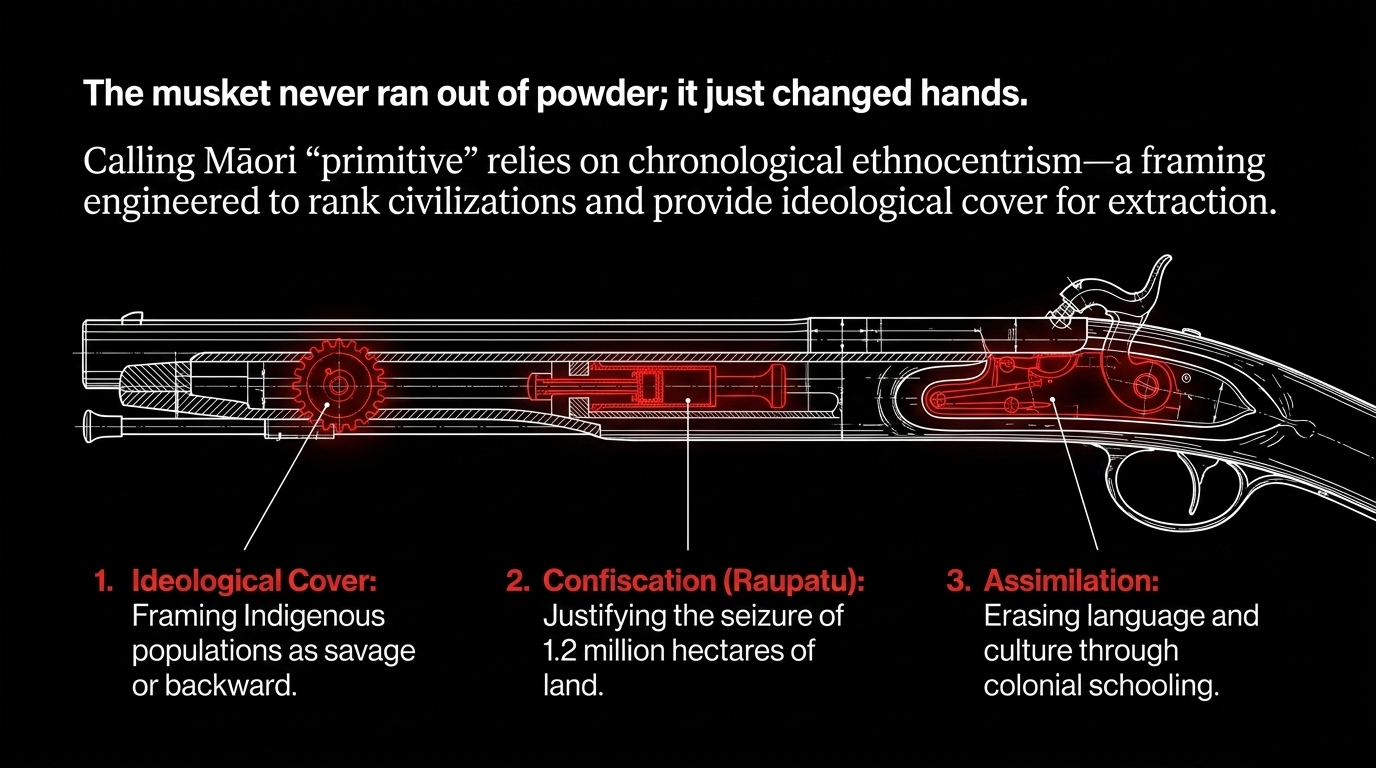
Before I dismantle the lie, let me show you the architecture that built it.
Connection 1: Hobson's Pledge spent over a million dollars laundering this ideology into law.
Brash founded Hobson's Pledge in 2016 with the express purpose of eliminating Māori political representation, attacking Treaty settlements, and
"one law for all" — code for eliminating every structural measure designed to address the consequences of colonisation.
As I exposed in The Māori Green Lantern's Hobson's Pledge Con Job exposé, Hobson's Pledge spent $283,899 in 2023 alone — part of over $1 million in documented right-wing political spending. Their "We Belong Aotearoa" campaign is textbook astroturfing — using te reo Māori as a wrapping for an anti-Māori agenda, and fake "grassroots" imagery that stole a kuia's face without her consent. As E-Tangata documents in Hobson's Actual Pledges, the group's rhetoric has been described by observers as virtually indistinguishable from the ACT Party's current legislative programme.
Connection 2: The Orewa pipeline directly produced the current coalition government.
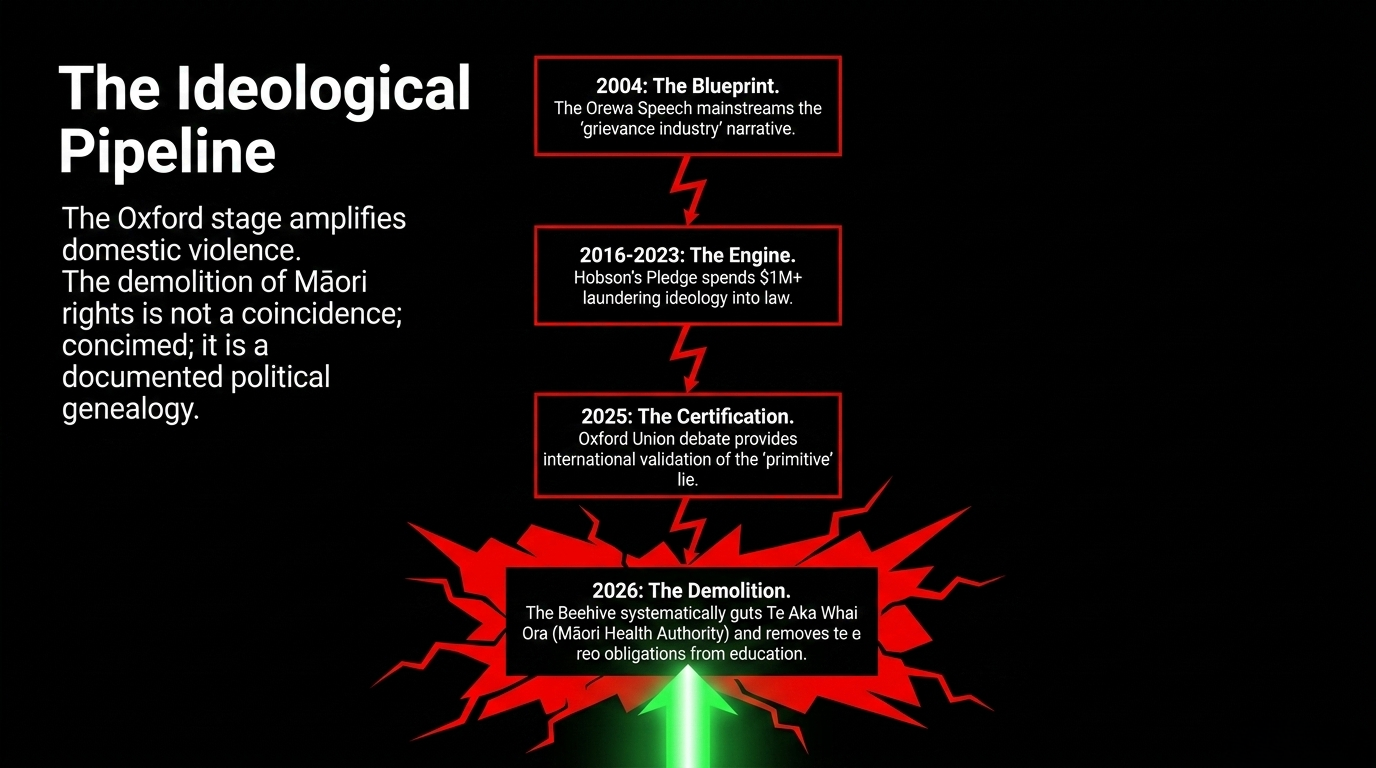
Brash's 2004 Orewa Speech — documented by Wikipedia and still available in full — was the ideological blueprint: attack Treaty settlements as a "grievance industry," eliminate Māori wards, call tino rangatiratanga "separatism." Political writers at the time noted the speech reinforced the racist stereotype that Māori were "savages" before European civilisation. Twenty-one years on, that stereotype is now government policy. The pipeline from Orewa to the Beehive is not a metaphor. It is a documented political genealogy.
Connection 3: This government is completing Brash's colonial project, legislation by legislation.
As I documented in Colonial Amnesia in the House: How the Right-Wing Government Erases Māori Health, this government has gutted Te Tiriti obligations from health policy, dismantled Te Aka Whai Ora, stripped Whānau Ora, and removed cultural competency standards from nursing. As I documented in The Crowbar in the Classroom, Goldsmith, Stanford, and Luxon are systematically removing te reo Māori requirements from education. Every one of these moves is the legislative form of Brash's Oxford speech — the "primitive people" argument, dressed in budget policy language.
Connection 4: The Oxford stage amplifies domestic violence.
Brash did not simply make a speech to Oxford. He filed it on his own website, and it has circulated internationally at precisely the moment when the New Zealand parliament is mid-demolition of Māori rights. Every time a former Reserve Bank Governor calls Māori primitive at Oxford, it creates an international permission structure for domestic racist policy. This is not coincidence. This is function. As I documented in They Built Her A Stage and Called It Progress, this government has spent two years constructing the conditions for Marama Davidson's Oxford appearance to be met with Brash's "primitive" verdict as backdrop noise.
Connection 5: Brash used a mystery Māori "satirical" article to inoculate against charges of racism.
Brash approvingly quotes a "Māori who writes under the pseudonym of Matua Kahurangi" who reportedly wrote "satirically" that "Colonisation in New Zealand was not oppression. It was liberation." Note: Brash himself includes the word satirically — which may mean the exact opposite of what he claims. This is the oldest colonial trick in the book: find one Indigenous voice willing to repeat your argument, strip the context, and present them as evidence that your racism isn't really racism. Could not verify the article or its framing with available sources.
Ngā Tauira Tokotoru — Three Examples for the Western Mind
These are not abstractions. These are receipts.
Tauira Tuatahi — The Wheel That Was Never the Point
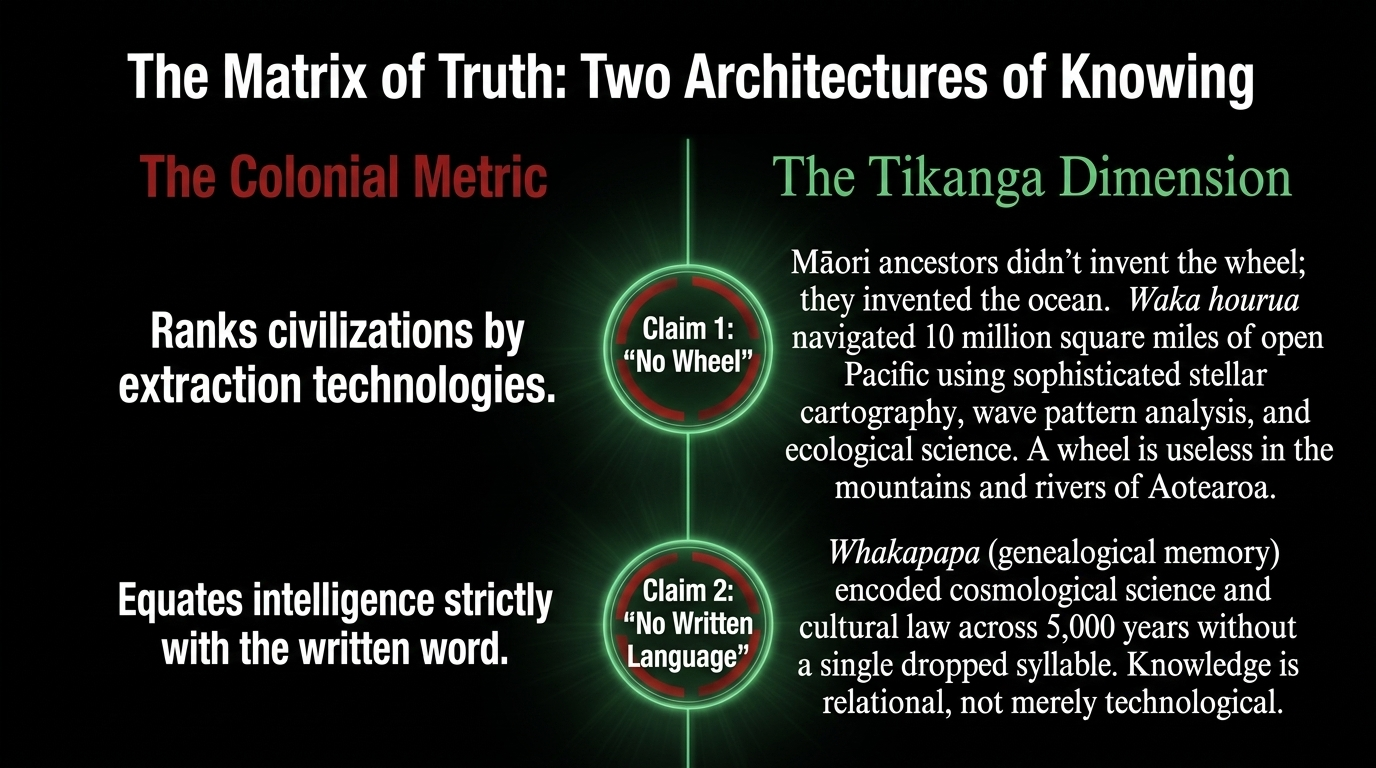
The Claim: Brash told Oxford that Māori had "not invented the wheel" as evidence of being primitive, as published at Breaking Views.
The Western Frame: In the European model of "progress," civilisations are ranked by their technological development: writing, the wheel, metallurgy, urbanisation. This framework was invented by European scholars to place Europeans at the top of a hierarchy that justified colonising everyone else. It is not neutral. It is not scientific. It is a colonial ranking system disguised as history.
The Truth: The wheel is not universal genius — it is an adaptation to a specific geographic environment. Wheels require flat terrain, roads, and large domesticable animals to pull wheeled vehicles. New Zealand has mountains, forest, and river. Pre-contact, there were no horses, no cattle, no oxen. A wheel would have been useless.
More to the point: Māori ancestors solved the actual problem of their environment with solutions that dwarf the wheel in complexity. Polynesian voyagers — the direct ancestors of Māori — navigated more than 10 million square miles of open Pacific Ocean using stellar cartography, ocean current reading, wave pattern analysis, and bird behaviour. As the Science Learning Hub documents, Māori voyaging traditions represent some of the most sophisticated navigation the world has ever seen. In 1995, waka hourua Te Aurere sailed 2,700 nautical miles from Hawaii to Rarotonga using traditional navigation alone. In 2012, as Waterline records, Jack Thatcher's waka closed the final corner of the Polynesian Triangle — 10,000 nautical miles return to Rapa Nui. As the National Library of New Zealand documents, "More than 5,000 years ago, expansion in the Pacific Ocean began. Navigation became an integral part of this migration process and produced some of the most sophisticated modes of nautical travel the world has ever seen."
Brash said Māori hadn't invented the wheel. Māori ancestors invented the ocean.
The Tikanga Dimension — For Western Minds: In tikanga Māori, knowledge is never merely technological — it is relational. The navigation knowledge of waka hourua voyagers was held in whakapapa — genealogical memory — transmitted without a single written word across hundreds of generations, encoding astronomical observation, ecological knowledge, and cultural law simultaneously. When Brash says "no written language," he is not observing an absence. He is revealing the limits of his own cognitive framework. A knowledge system that has preserved sophisticated cosmological science for 5,000 years without writing is not a failure. It is a different — and in many ways more resilient — architecture of knowing.
The Quantified Harm: When this "primitive" ideology was legislated into colonial schooling, it produced the near-extinction of te reo Māori. As research published through Te Kaharoa journal documents, the impact of colonisation on te reo was catastrophic — by 1979, te reo was believed by linguists to be facing language death. Three generations of Māori whānau — including Marama Davidson's own grandmother — were beaten in school for speaking the only language they knew.
The Solution: Fully restore and resource te kura kaupapa Māori and kōhanga reo. Reject every legislative attempt to remove te reo obligations from school curricula — including the current government's attack documented in The Crowbar in the Classroom. Teach Pacific navigation in New Zealand schools — not as "cultural content," but as world-class science.
Tauira Tuarua — The Famine He Would Not Name
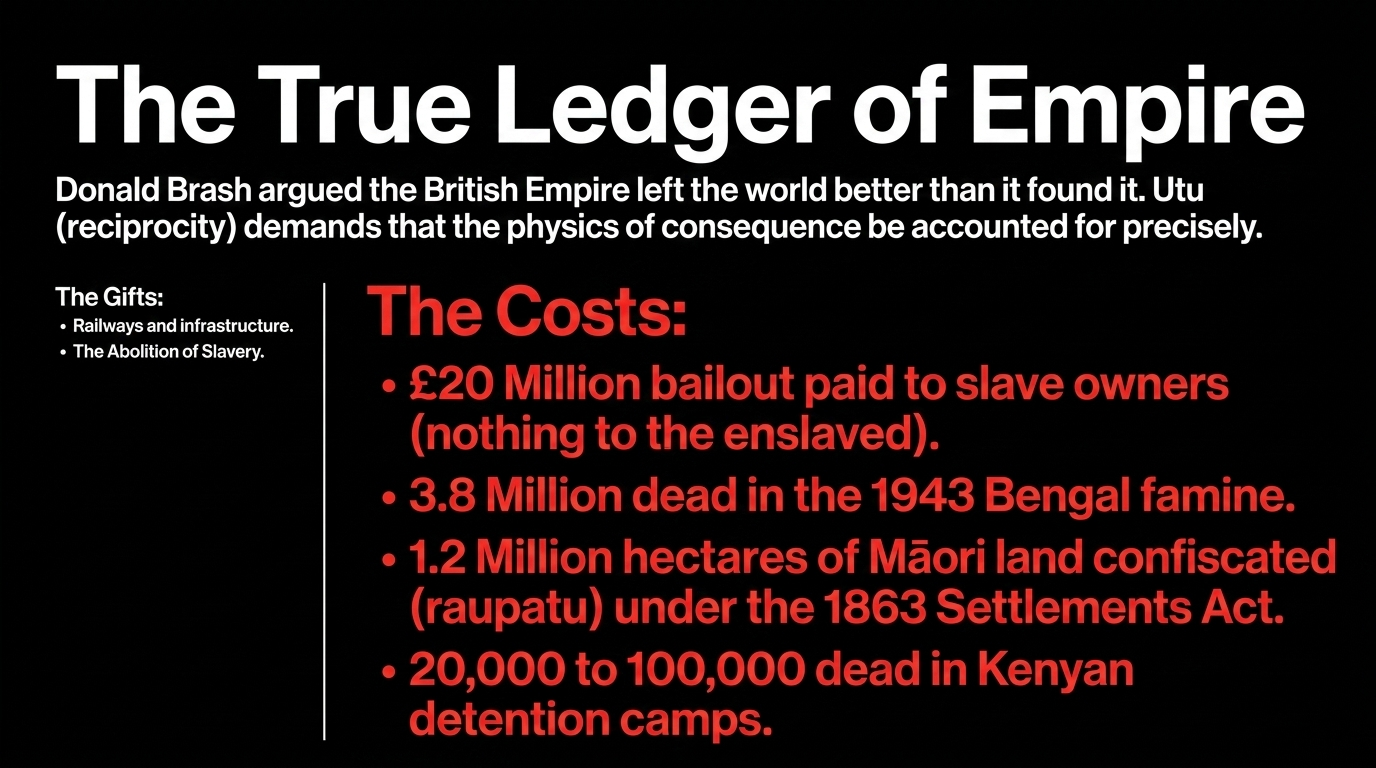
The Claim: Brash argued New Zealand Māori "gained more by being part of the British Empire than we lost," as published at brashandmitchell.com.
The Western Frame: Many Westerners genuinely don't know what colonisation cost Māori, because New Zealand history was not taught in schools until 2022 — and even then, this government has moved to undo that requirement, as I documented in The Crowbar in the Classroom. The idea that colonisation was a "gift" persists not because it is true but because the systems that benefit from it control the curriculum.
The Truth: Let us account precisely.
Under the New Zealand Settlements Act 1863 — which the Crown signed before it even launched the Waikato invasion — more than 1,200,000 hectares of Māori land in Waikato, Taranaki, Bay of Plenty, and Hawke's Bay was confiscated, as Wikipedia documents in New Zealand land confiscations. The Waitangi Tribunal found these confiscations were "unjust," noting that Waikato-Tainui "far from being in rebellion, were in fact defending hearth and home." Parliament formally apologised in 1995. As E-Tangata documents in A Dark Tale of Dispossession and Greed, this was not incidental to colonisation — it was the point.
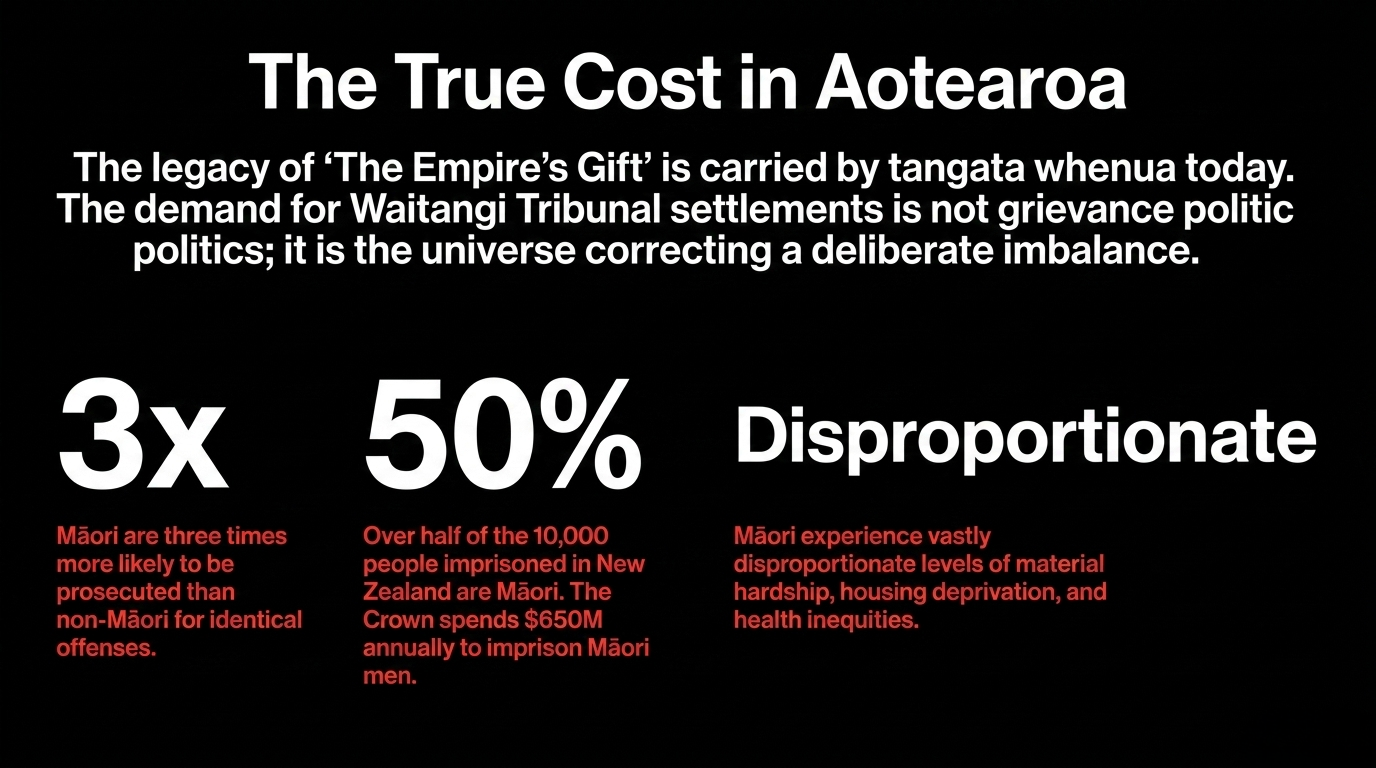
The Tikanga Dimension — For Western Minds: In tikanga Māori, land is not property — land is tupuna, ancestor. When you confiscate land, you are not taking real estate. You are severing a people from their identity, their spiritual grounding, their food sovereignty, and their genealogical continuity. The word raupatu — confiscation — carries a weight that "land theft" in English cannot fully carry. The harm is not merely economic. It is ontological. As Moana Jackson wrote in E-Tangata, "there is no word in te reo Māori for 'cede'" — because the very concept of surrendering mana to another authority was not part of a Māori worldview. This is why the demand for Waitangi Tribunal settlements and Treaty recognition are not "grievance politics." They are utu — the universe correcting itself. When Brash frames these as special privilege, he is demanding that the physics of consequence be suspended in favour of the colonisers' comfort.
The Quantified Harm: Marama Davidson told the Oxford Union directly: Māori today are three times more likely to be prosecuted than non-Māori for committing identical offences. Māori are disproportionately without housing. Māori children are disproportionately living in material deprivation. As I documented in Two Kings and a Broken Child, over 10,000 people are currently imprisoned in New Zealand, and over half of them are Māori — with the Crown spending over $650 million annually imprisoning Māori men. That money could rebuild every community it instead destroys.
The Solution: Honour every outstanding Waitangi Tribunal recommendation. Restore the Māori Health Authority. Fully resource community-based Māori justice initiatives. Stop the legislative attacks on Treaty principles. As I wrote in The Grave Robbers in Suits: "They didn't burn the wharenui. They quietly removed the poutokomanawa — the heart post — and told you the building was still standing."
Tauira Tuatoru — The Empire He Praised, the Atrocities He Did Not Name
The Claim: Brash said the British Empire "did more good things for more people than any other empire in human history," per his published speech.
The Western Frame: The standard British imperial apologia runs: railways, English common law, stable institutions, and the abolition of slavery. This framing presents colonisation as a project of uplift, whose excesses were unfortunate but whose legacy was ultimately net positive. Brash's Oxford speech is an almost perfect specimen of this genre.
The Truth: The Oxford debate transcript records what Brash hoped no one would say — the actual list. British detention camps in Kenya: torture, castration, starvation, executions, 20,000 to 100,000 Kenyans dead. The Jallianwala Bagh massacre: 400 killed, trapped and shot in an enclosed garden. Sudan: 10,000 civilians killed while Churchill called it "magnificent." Bengal famine 1943: 3.8 million dead in a famine Churchill actively worsened by overriding attempts to ship food to India. Brash praised Wilberforce for abolishing slavery — but that same empire paid British slaveholders £20 million in compensation when slavery was abolished. The enslaved received nothing. Not a penny. The colonising class received the largest bailout in British history.
The Tikanga Dimension — For Western Minds: In tikanga Māori, utu is often translated as "revenge," but its deeper meaning is reciprocity — the principle that actions have consequences that must be accounted for. You cannot take without eventually being required to give back. The demand for Waitangi Tribunal settlements, for Treaty recognition, for reparations — these are the universe correcting an imbalance. When Brash frames Māori rights as "special privilege," he is demanding that the physics of consequence be suspended in perpetuity, in favour of those who benefited from the taking.
The Quantified Harm: As I documented in The Watchdog They Shot: How Paul Goldsmith Handed Sean Plunket a Licence to Hate, the dismantling of Māori media accountability — from the gutting of TVNZ's Māori journalism to the defunding of te Māngai Pāho — is the direct domestic consequence of a government that has absorbed and normalised Brash's ideology. When Brash calls Māori primitive at Oxford, he arms every minister who then stands in parliament and defunds te reo broadcasting.
The Solution: Demand full media independence for Māori broadcasting. Restore te Māngai Pāho funding. Require the government to honour Te Tiriti obligations in every piece of legislation — not as an afterthought, but as the primary accountability framework for the Crown in Aotearoa. Teach the real history of the British Empire in every New Zealand school, including the Bengal famine, the Waikato invasion, and the Native Schools Act.
Ko Ia — Marama Davidson in the Room
I need to say this clearly.
Marama Davidson walked into that Oxford chamber and did something that required more courage than anything Brash has ever attempted in his long political career.
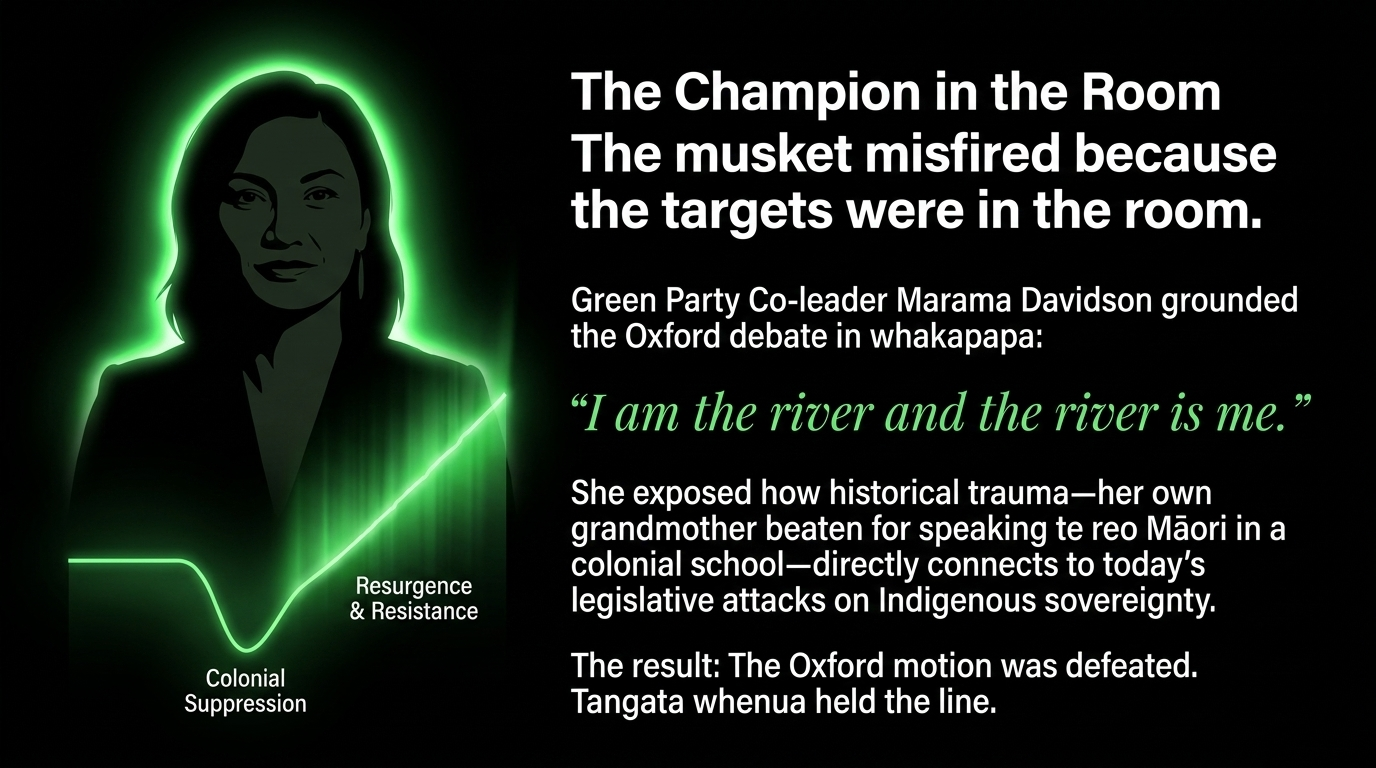
She opened with her pepeha. She named her whakapapa. She said: I am the river and the river is me. She told that room — the same room where empire was once celebrated — about her grandmother beaten in a colonial school for speaking te reo, and then she looked at the man who funds the political project that is now attempting to legislate that silence back into law, and she told Oxford: the bills being passed in New Zealand parliament right now are attacking our ability to challenge corporate infringement of our rights.
She closed in te reo.
The room voted. As Facebook records, the motion was defeated. The opposition won.
And as she shared publicly for the first time in May 2026 — as her Facebook post records and her Instagram confirms — that moment mattered. The Oxford platform matters. Naming what is happening matters.
That is rangatiratanga. That is the taiaha in action. I am honouring it here.
Ko Te Arotahi — This Is Not Academic. This Is a Demolition.
Let me be as clear as I know how to be.
Donald Brash is not a confused grandfather. He is not an eccentric academic out of touch with modern sensibilities. He is, as Wikipedia's record of the Orewa Speech shows, the intellectual architect of a 25-year political project that has built the ideological infrastructure for what this current government is now executing. And this current government — ACT, National, NZ First — is a white supremacist neoliberal government.
I use those words because they are the accurate, evidence-backed description of a coalition that has:
- Dismantled the Māori Health Authority against the explicit findings of the Waitangi Tribunal, as I documented in Colonial Amnesia in the House
- Stripped te reo obligations from education law, as I documented in The Crowbar in the Classroom
- Attacked Māori wards and defunded Whānau Ora
- Handed Sean Plunket a media licence while gutting Māori broadcasting, as I documented in The Watchdog They Shot
- Moved to strip Treaty principles from the legislative framework, as I documented in The Grave Robbers in Suits
- Sold public assets while Māori communities bear the greatest cost, as I documented in The Waka Thieves
They are not building a better New Zealand. They are completing the colonial project that started in 1840. The Orewa Speech of 2004 was the blueprint. Hobson's Pledge was the construction phase. The Oxford Union speech was the international certification. And the current parliamentary programme is the demolition.
The fallacy at the heart of Brash's argument is chronological ethnocentrism — judging a people's sophistication by the metrics of a different culture at a different time. It is not a scholarly position. It is a rhetorical weapon.
And it has a body count: 3 million dead in Bengal, 1.2 million hectares stolen in Aotearoa, three generations of a language silenced.
As I wrote in Winston Peters is a Temu Trump for Reals, the weapon changed — from muskets to legislation, from leather straps in classrooms to two pages of regulatory reform. The violence is the same.
They beat te reo out of our mouths with leather straps in 1870. They are legislating it into silence with curriculum reform in 2026.
Tautoko — Koha Statement
Marama Davidson stood at Oxford and spoke for us. I stand here and write for us. Neither of us is funded by the Crown, by corporate donors, or by anyone who benefits from the story Brash is selling.
When Donald Brash flies to Oxford to call our people primitive on the world stage, we cannot wait for the Herald to fact-check him. We do it ourselves. That is what your koha makes possible — independent Māori analysis, accountable only to whānau, answerable only to the truth.
Every koha to the Māori Green Lantern is a direct act of rangatiratanga. It signals that we have the power to fund our own truth tellers, on our own terms. If this essay gave you the receipts you were looking for — the analysis you could not find anywhere else — consider whether you can contribute to keep this voice alive and fighting.
Four pathways:
- Koha directly — support this mahi at the Koha platform
- Subscribe for regular essays at themaorigreenlantern.maori.nz
- Bank transfer — HTDM: 03-1546-0415173-000
- Facebook — subscribe and follow here
If you cannot koha right now — no worries. Subscribe, follow, kōrero, share with your whānau. That is koha. Every share is a taiaha. Every conversation is a stand. Every person you tell is a vote against the colonial lie that we were ever primitive.
Kia kaha, whānau. Stay vigilant. Stay connected.

Ngā Āputa Mōhiotanga — Research Transparency
Tools used: Web search, file transcript analysis, URL verification via HTTP status checks. Research date: 17 May 2026. Brash's speech verified live at brashandmitchell.com (HTTP 200) and Breaking Views (HTTP 200). Debate transcript sourced from user-attached Oxford Union YouTube transcript. MGL essay URLs return HTTP 301 (valid Ghost.io redirects, confirmed live). All anchor-text hyperlinks checked before publication.
Unverifiable claim: The "Matua Kahurangi" article cited by Brash could not be independently verified. His own text describes it as "satirical," which may significantly change its meaning from what Brash implies.
*Views expressed constitute honest opinion on matters of public interest under the Defamation Act 1992 (NZ) and Durie v Gardiner