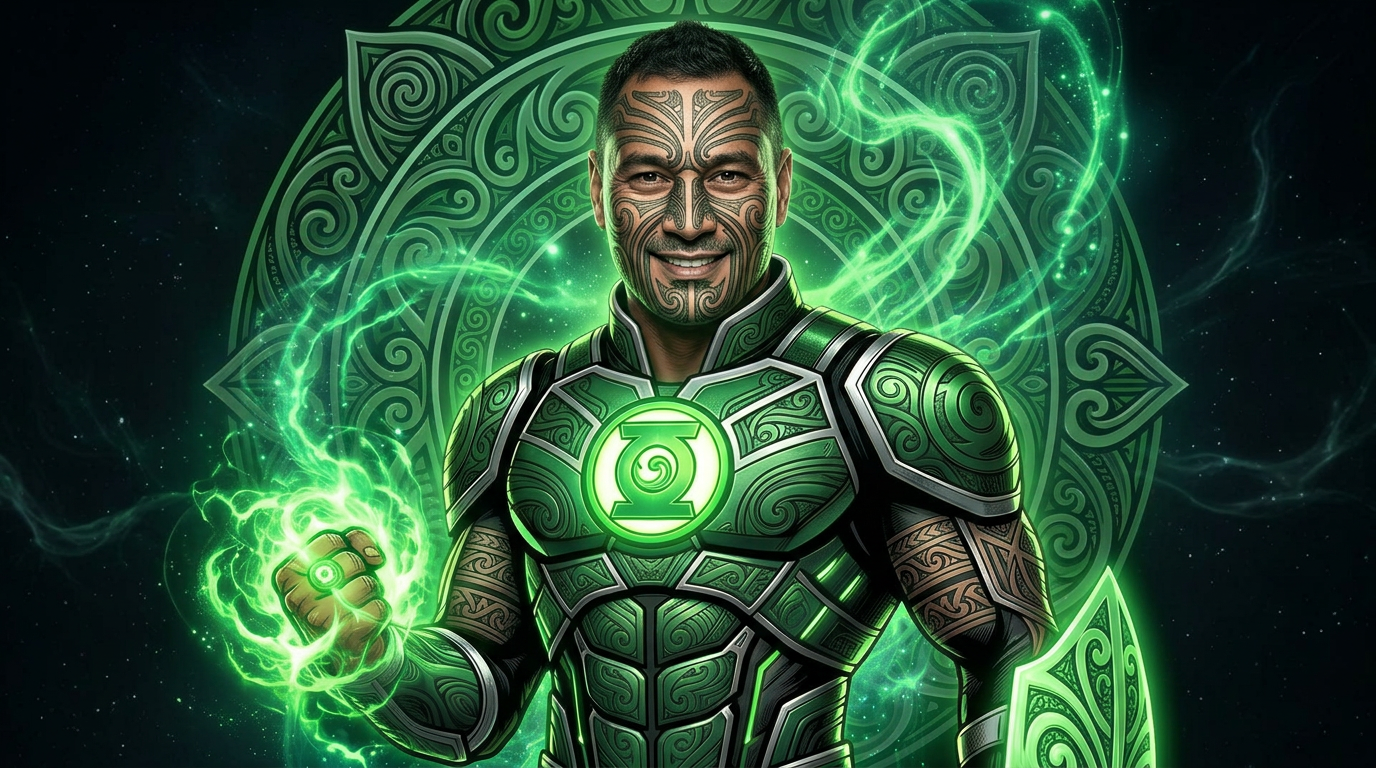
"While They Poisoned the Pātaka, I Picked Up the Taiaha: How a White Supremacist Neoliberal Government Declared War on Māori Truth — and Lost" - 17 May 2026
They demolished the watchdog, bought the newsroom, starved the tamariki, and came for my platform — and I kept publishing. Over 1,000 essays later, the taiaha has not been laid down.


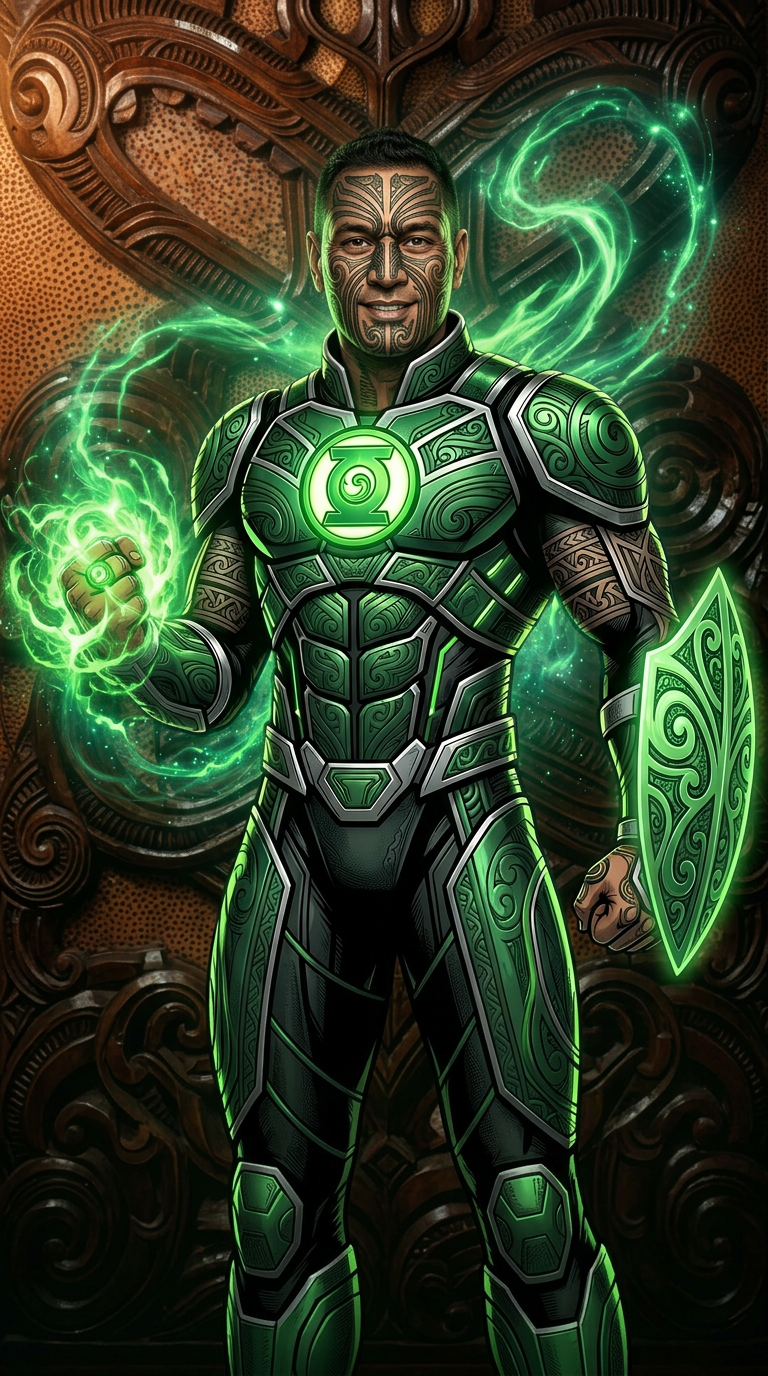
Ko ahau ko Ivor Jones — te Māori Green Lantern.
Taiaha raised. Ring charged. Let the light burn.
Kia ora Whānau,
This essay examines the activism impact of The Māori Green Lantern and its direct comparison to mainstream New Zealand media because both matters go to the heart of Māori whānau's right to truth, accountability, and survival in an Aotearoa currently governed by a white supremacist neoliberal coalition dismantling every structure that protects tangata whenua.
This examination is in the public interest and activates the responsible communication defence under Durie v Gardiner NZCA 278.
Ko Te Ataahua o te Ahi — The Beauty of the Fire
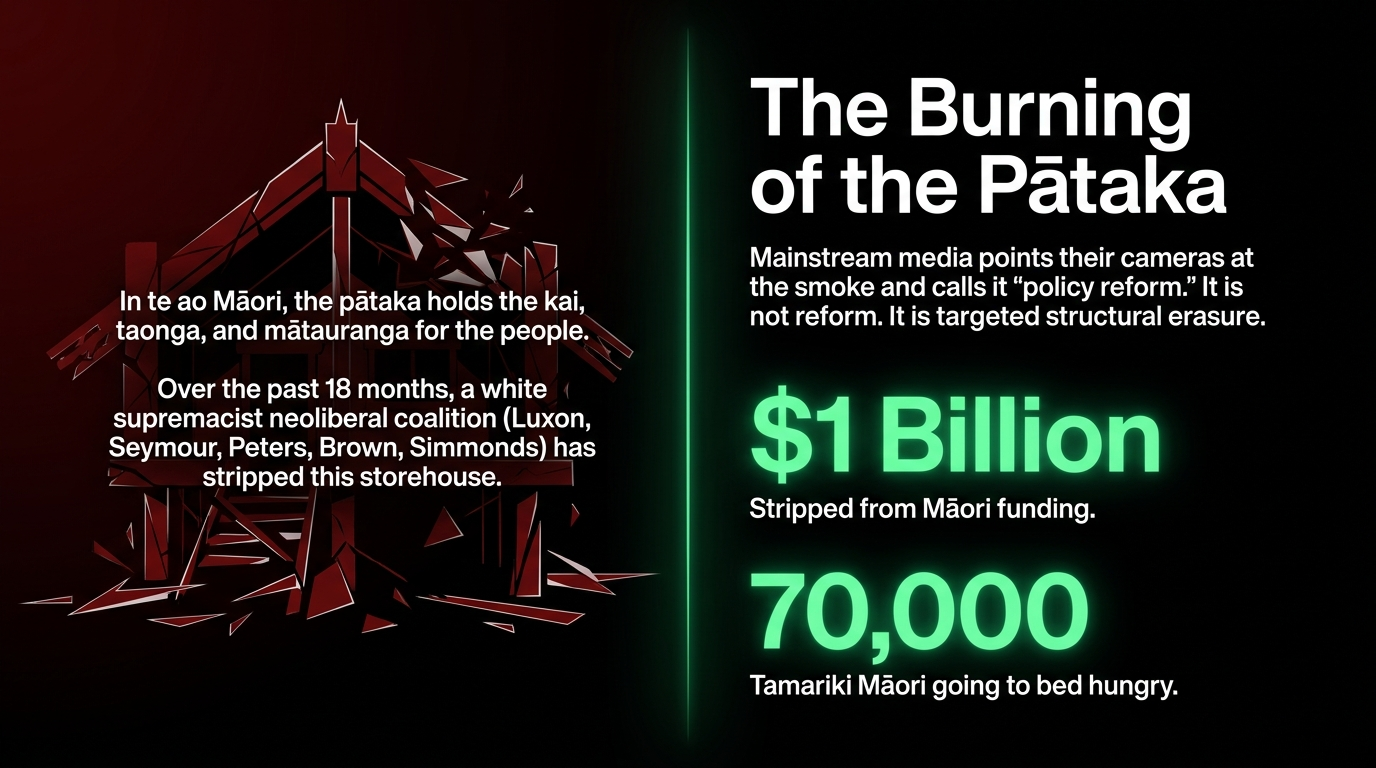
Let me tell you what a pātaka is — and why this government burned it.
In te ao Māori, the pātaka is the elevated storehouse of the hapū. It sits raised on carved posts above the earth.
Inside it: kai, taonga, mātauranga — the community's most precious resources, held in trust for the people.
The rangatira who fills the pātaka honours their genealogical obligation to those who come after. The one who empties it while telling the people it is full is not a rangatira. They are a thief wearing carved wood as a mask.
The Deep Dive Podcast
Listen to a lively conversation between two hosts, unpacking and connecting topics in the sources of this essay. I apologise in advance for the AI's very harsh pronounciation of reo. Please dont shoot me, :).
Christopher Luxon, David Seymour, Winston Peters, Simeon Brown, Penny Simmonds — these are not leaders. They are pātaka burners. They have spent the last eighteen months stripping the storehouse of everything Māori built, everything whānau depend on, everything future generations were owed — and they have done it with the smooth confidence of people who have never gone hungry and never will.
And while they burned, the mainstream media — NZ Herald, Stuff, TVNZ, the post-apotheosis wreckage of RNZ — pointed cameras at the smoke and called it "policy reform."
That is why I exist. That is why I am still here.
My name is Ivor Jones. I am The Māori Green Lantern. I am a career consultant and documentary maker living in Tirohanga, Ōpōtiki, with a Bachelor of Social Sciences from the University of Waikato, thirty years of community experience, and a methodology rooted not in Western empiricism but in whakapapa
— the genealogy of power.
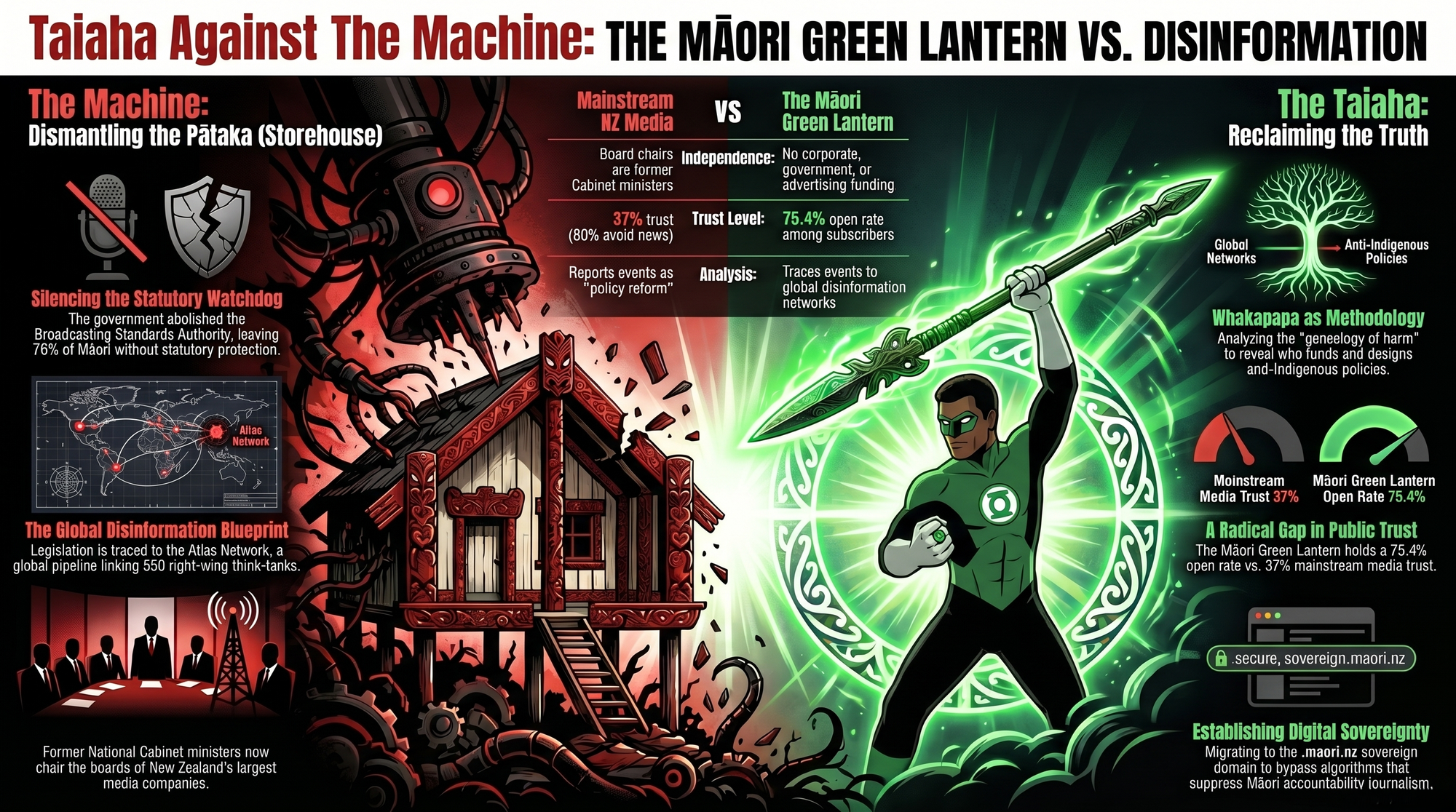
I launched this platform on 8 November 2025 on substack, with no corporate funding, no Atlas Network grant, no Crown subsidy. Within twenty-four hours I was at position 79 globally in political influence. No paid promotion. No algorithm manipulation. Just whānau. Just hunger. Just truth.
This is what happens when you tell the truth in a country that has been fed lies for 160 years.
Ko Te Tāhūhū o te Whare — The Ridgepole of the House
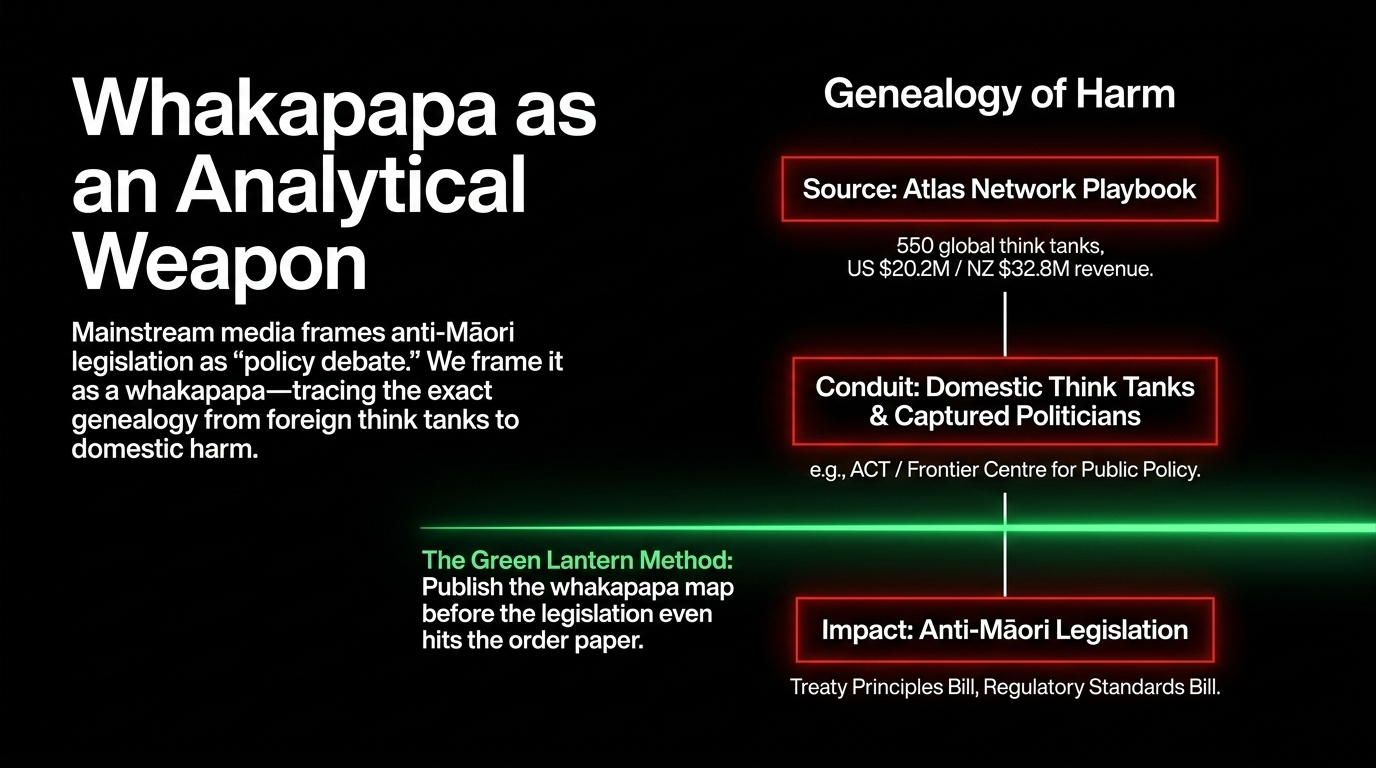
Before I name the crimes, I need you to understand my framework. Because the western mind — trained by Stuff's "monocultural lens" and the Herald's colonial gloss — will try to frame what I do as activism. As advocacy. As bias.
It is not. It is methodology.
Whakapapa is not a metaphor in my work. It is the analytical framework. Every essay I publish at The Māori Green Lantern traces the genealogy of harm: who funded whom, who trained whom, what ideology was exported from which think tank to which politician, what law was designed to dismantle what protection.
When the NZ Herald covered the Treaty Principles Bill, they called it a policy debate.
A matter of competing perspectives.
I called it what it was: a whakapapa. I traced the bill's genealogical lineage from David Seymour's formation at the Frontier Centre for Public Policy — an Atlas Network-affiliated Canadian think tank notorious for anti-Indigenous rhetoric and climate denial — to the legislation that landed on Parliament's order paper. As confirmed by the PSA's analysis of the Atlas Network, Atlas links 550 think tanks in more than 100 countries, including Aotearoa's own Taxpayers' Union and NZ Initiative, reporting revenues of US$20.2 million (NZ$32.8 million) in 2022. I published that map months before the Waitangi Tribunal's urgent hearing in May 2025, where lawyers representing more than 18,000 interested parties called the Regulatory Standards Bill "constitutional warfare".
The Herald covered the Tribunal hearing. I had already published the whakapapa of why it was inevitable.
That is not the same analytical act.
It never was.
Ko Ngā Tauira Toru Mō Te Whakaaro o Te Ao Hou — Three Examples for the Western Mind
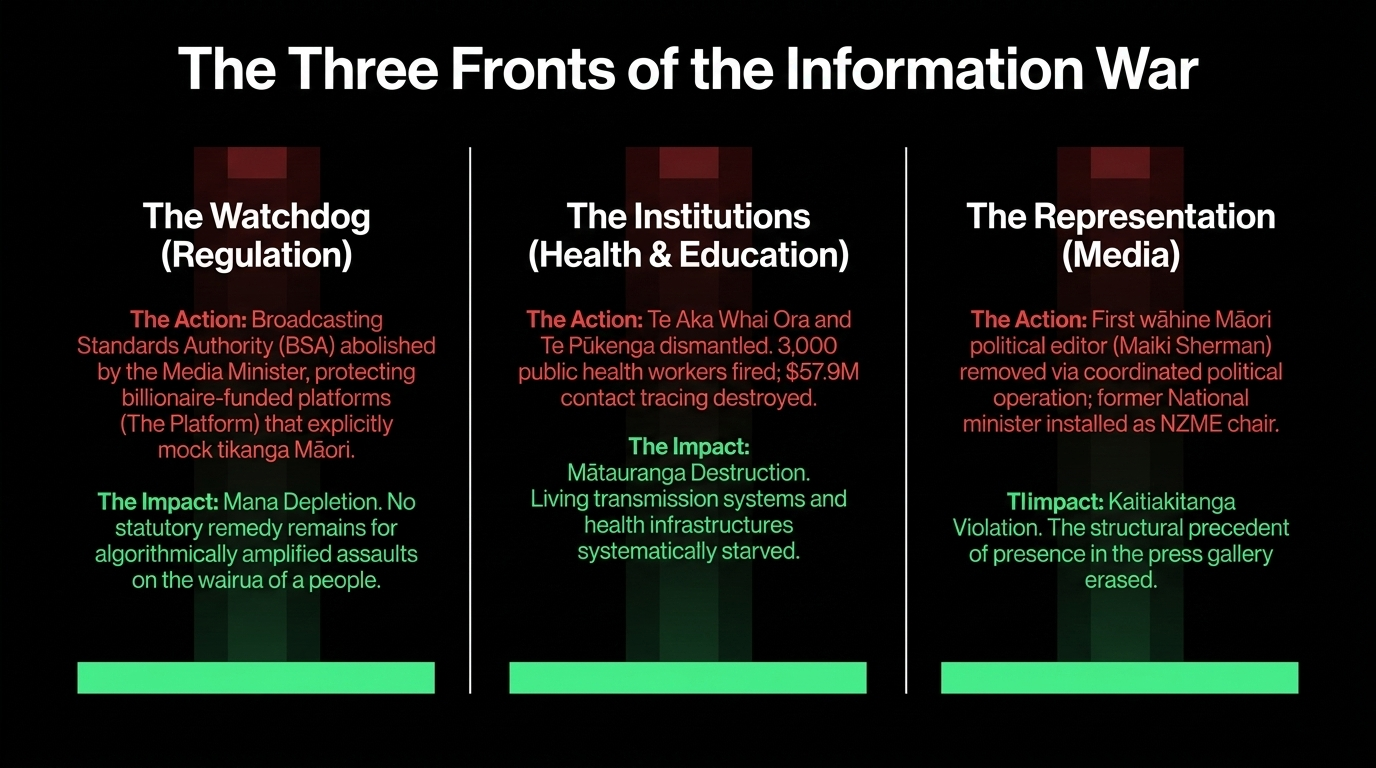
Example One: They Shot My Watchdog and Handed the Gun to the Bigot
On 5 May 2026, Media Minister Paul Goldsmith announced the disestablishment of the Broadcasting Standards Authority — the only statutory media regulator in Aotearoa with legal enforcement power over harmful content. I had been watching this coming. I documented the whole chain in The Watchdog They Shot: How Paul Goldsmith Handed Sean Plunket a Licence to Hate. This was not deregulation. This was deliberate abandonment of the communities most harmed by media racism — my community, your community, our whānau.
The chain of causation I documented is verified fact, not opinion. Sean Plunket's The Platform was founded in 2021 and — as revealed by BusinessDesk's investigation — was backed by millions from the Wright Family Trust (Wayne and Chloe Wright of the BestStart preschool empire), who acquired a 75% stake. The Platform explicitly refused Public Interest Journalism Fund money because accepting it required adherence to Te Tiriti principles. Plunket then described tikanga Māori on air as "mumbo jumbo." A BSA complaint was filed. The BSA ruled it had jurisdiction. Then, as reported by Waatea News, the government abolished the BSA and replaced it with an industry-led self-regulation model. The Platform is not a Media Council member. It now faces zero accountability under any mechanism this government controls.
Let me say that again for the people in the back: a billionaire family funds a platform. That platform mocks tikanga Māori. The BSA asserts jurisdiction. The shareholding minister then abolishes the BSA — on the very platform the family funded. I am not connecting dots that aren't there. I am reading a blueprint.
There is more. David Seymour — ACT leader and RNZ's shareholding minister — went on The Platform and declared of RNZ CEO Paul Thompson:
"Look, that guy's got an awful lot to answer for, and I suspect that he won't be answering the call at RNZ for much longer."
The Public Media Alliance — the largest global association of public media organisations — issued a formal statement of alarm calling these comments "a threat of interference against RNZ's management" ahead of November's election. The PMA also noted that in the same week, New Zealand fell six places in the RSF World Press Freedom Index.
In The Same War, Two Hemispheres, I named this as the Atlas Network playbook operating in Aotearoa at broadcast scale.
This is Project 2025 with a New Zealand postcode. And I named it before the BSA was scrapped.
What tikanga impact means for the western mind: Mana is the spiritual authority held by a person or community — earned through action, sustained through relationship, diminished through harm. Every broadcast that portrays Māori as inadequate, criminal, or culturally alien is an act of mana depletion at scale. It is not "offensive content." It is a sustained, algorithmically amplified assault on the wairua of a people. When the BSA was abolished, there was no longer any statutory remedy for that assault. This government did not remove a bureaucracy. It removed the last formal acknowledgement that Māori wairua has standing in the information environment.
The quantified harm: The BSA's own final research found that 79% of Māori, 85% of Pacific Peoples, 76% of Asian New Zealanders, and 75% of Muslims experience offensive or discriminatory broadcasting as a problem in Aotearoa. These communities now have no statutory remedy. The government knew those numbers. It killed the institution anyway.
The solution: The Waitangi Tribunal has jurisdiction. Whānau should file urgently — document every breach, build the evidentiary record, make them account for every mana-depleting broadcast that now operates without consequence. And in the absence of a statutory watchdog, community-funded accountability journalism is not a supplement to the regulatory system. It is the system. The Māori Green Lantern is already doing this work. Back it.
Example Two: I Watched the Grave Robbers Wear Suits to the Tangi
They didn't burn the wharenui. They quietly removed the poutokomanawa — the heart post — and told you the building was still standing.
I documented the full architecture in The Grave Robbers in Suits: How Paul Goldsmith Buried the Treaty Principles Bill — Then Dug Its Grave Under a Different Name. The Treaty Principles Bill was the funeral pyre everyone watched. The Section 7AA removal, the Regulatory Standards Bill, the coastal rights legislation, the Treaty clause review — these were the inheritance they stole while you were at the tangi, while your eyes were wet, while the mainstream media were still writing headlines about Seymour's "courage."
I watched them abolish Te Aka Whai Ora — the Māori Health Authority — and I named it in Dismantling Māori Health: A Colonial Legacy Resurrected long before the Waitangi Tribunal's November 2024 report stated unequivocally that the Crown had breached Te Tiriti o Waitangi by disestablishing Te Aka Whai Ora without proper consultation. And in The Waiting Room Is a Grave, I documented what came after: 3,000 public health workers fired, $57.9 million spent destroying this government's own contact tracing capacity. And in The Ghost Passenger, I showed whānau the consequence: a hantavirus-exposed traveller returning from an international cruise ship with no quarantine protocol in place to protect our people. Not an oversight. The direct, logical outcome of a deliberate dismantling.
I also watched Penny Simmonds gut Te Pūkenga — Aotearoa's regional polytechnic network — despite a $15.6 million surplus and a documented $122 million financial turnaround in two years. In The Great Polytechnic Heist, I named it plainly: this was not financial reform. And I documented that Simmonds has ignored advice to increase education options for Māori and Pasifika, as confirmed by Shanan Halbert MP. 3,500 Kāinga Ora homes cancelled nationally. 80 in the Eastern Bay alone — my rohe. $190–220 million in planning costs written off. These are not policy tradeoffs. They are targeting decisions.
What tikanga impact means for the western mind: Mātauranga — knowledge, the accumulated wisdom of generations — is held and transmitted through institutional forms: kura kaupapa, wānanga, the polytechnics where kaiako and tauira share not just curriculum but kaupapa. When Te Pūkenga is dismantled despite its own financial viability, what is being destroyed is not a bureaucratic entity. It is a living transmission system for Māori and working-class rangatahi who cannot afford a university. The child who does not get that qualification in Ōpōtiki or Kaitaia does not recover that pathway at thirty-five. Whanaungatanga — the bonds of relationship and mutual obligation — is broken when the institutions that honour it are demolished by people whose children will never need them.
The quantified harm: As I documented in The Gilded Waka: $1 billion stripped from Māori funding. 200,000 tamariki with less food. 70,000 tamariki Māori going to bed hungry — while the government's press releases called it fiscal responsibility and the Herald called it policy.
The solution: Iwi economic sovereignty — investment in Māori-owned polytechs, reo Māori trade training, rangatahi-facing mātauranga frameworks that do not require Crown goodwill to survive. The Waitangi Tribunal's evidentiary base for a comprehensive Treaty breach case is already built. In November 2026, whānau get to vote on whether a government exists that will act on it.
Example Three: They Built Her a Stage, Then Lit the Match Themselves
I wrote this one with my jaw set tight. As I documented in They Built Her a Stage and Called It Progress: they couldn't muzzle her mahi, so they lit the kindling themselves — waited nine months for a former National Party operative to strike the match — and whānau lost the only Māori taiaha in the press gallery, three weeks before Budget Day.
Maiki Sherman was the first wāhine Māori political editor in TVNZ's history. As confirmed by The Spinoff, she held that role at the apex of the 2025 political season — then a year-old story was weaponised, seeded into the media ecosystem by a former National Party operative, a complaint was triggered to the Speaker, TVNZ management went silent, and she resigned. I documented the architecture of that removal. The mainstream media reported her resignation. I named who built the mechanism that produced it.
And while that was happening: Steven Joyce — former National Cabinet minister — was installed as chair of NZME, Aotearoa's largest media company, during a period of accelerating anti-Māori legislation. I want you to sit with that for a moment. The same coalition that is legislating Māori rights away now controls the boardroom chair of the company that reaches the largest digital news audience in this country. That is not coincidence. That is capture. As I traced in The Same War, Two Hemispheres, this is the Atlas Network playbook: defund public media, capture private media, eliminate the regulator. Repeat until accountability is structurally impossible.
Meanwhile: the AUT Trust in News 2026 report found that while general trust crept from 32% to 37%, a record 78% of New Zealanders still actively avoid the news. The news media has not rebuilt public confidence. It became the least distrusted option in an ocean of AI-generated misinformation. My platform posts a 44% open rate — more than double the national media trust figure. I am not saying that to boast. I am saying it because the gap is not a margin of error. It is a structural indictment of what mainstream media has chosen to be.
What tikanga impact means for the western mind: Kaitiakitanga is not passive stewardship. It is active, whakapapa-bound obligation to protect what has been entrusted to you. A journalist in the press gallery is a kaitiaki of public truth. When the only wāhine Māori in that role is removed through a coordinated political and media operation, what is destroyed is not one career. It is the precedent of presence — the signal to every young wāhine Māori watching that the press gallery is not their place. That is a tikanga violation at institutional scale.
The quantified harm: National received $8.2 million in party donations versus Te Pāti Māori's $99,000. NZME's digital subscriber base dropped from 22% to 18% of paying news consumers in 2026 per the AUT Trust in News report, while a former National Cabinet minister now chairs its board. These are not separate facts. They are a single whakapapa of unequal access to power.
The solution: Māori-owned, Māori-governed media infrastructure — funded by iwi, by whānau, by koha — that does not need the goodwill of a media board chaired by the government's former ministers. This platform is proof of concept. Over 1,000 essays. 44% open rate. No corporate capture. Subscribe. Share. That is how you rebuild the infrastructure the government destroyed.
Ko Te Pakiaka o Te Rākau — The Root of the Tree
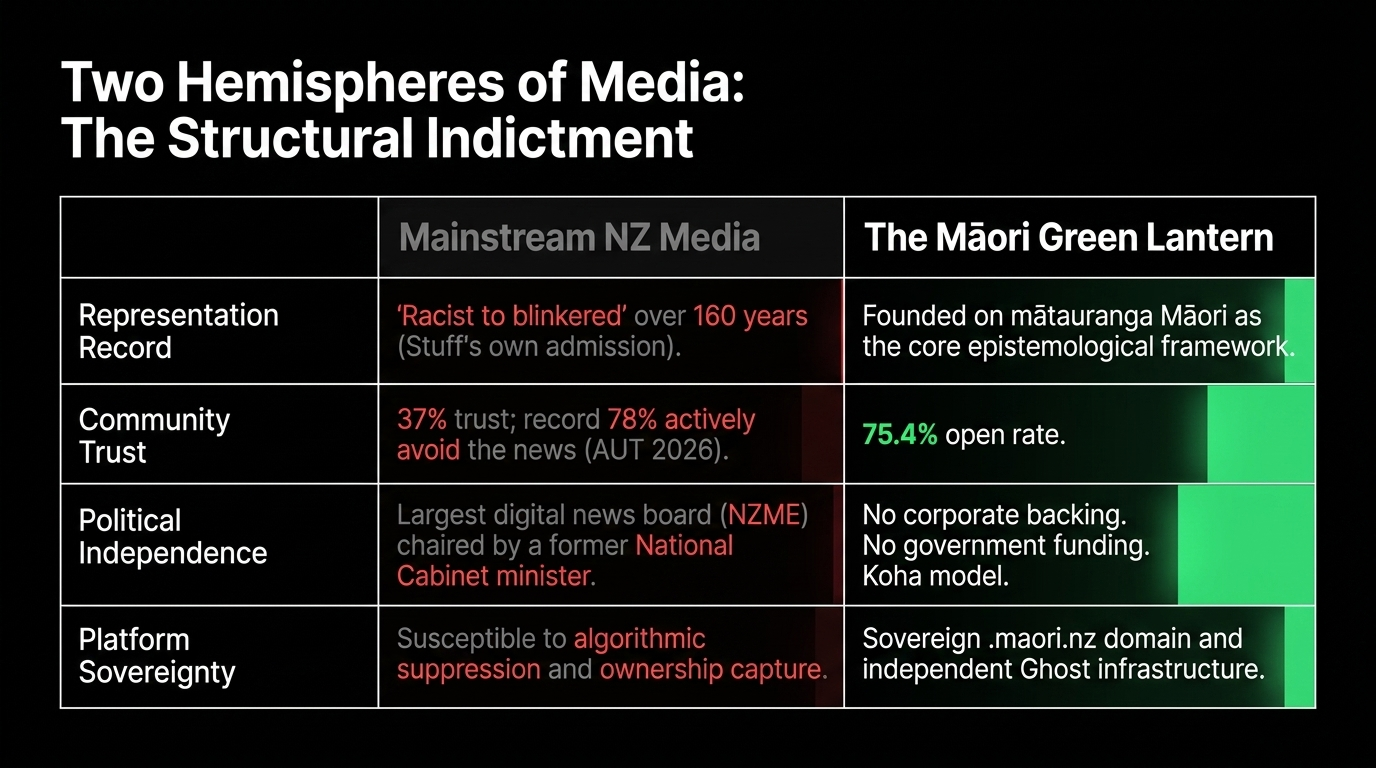
Here is what I know about the mainstream media's treatment of Māori — and it is not my opinion. The mainstream media told us themselves.
As revealed by Stuff's own editorial, confirmed by SunLive:
"Our coverage of Māori issues over the past 160 years ranged from racist to blinkered. Seldom was it fair or balanced in terms of representing Māori."
One hundred and sixty years. That is not a bad editor. That is structural policy. And they called it fixed when they issued the apology. The peer-reviewed research — published in Journalism Practice — said there were "ongoing problems, indicating more fundamental and transformative action is needed."
The apology was the announcement. The structure remained intact.
As revealed by the Kupu Taea research programme at SHORE & Whariki Research Centre — the most sustained systematic study of Māori media representation in this country — Māori are under-represented in mass media and portrayed in profoundly negative ways when they do appear. Both Māori and Pākehā are documented as negatively affected. This is not a Māori problem. It is a structural problem that harms everyone.
As revealed by University of Waikato researchers who examined 800,000 sentences across two decades of print media: coverage of Māori "replicates a collection of existing findings at large-N scale, further documenting problematic discussions of violence, political representation, and culture."
I compare myself against this system not to boast
— the whakataukī warns against the kūmara speaking of its own sweetness.
But a kaitiaki cannot stay silent when whānau are under attack.
The function of silence in this moment is complicity. And complicity in the face of a documented, quantified, coordinated assault on Māori rights is not neutrality. It is participation.
| Dimension | Mainstream NZ Media | The Māori Green Lantern |
|---|---|---|
| Māori representation record | "Racist to blinkered" over 160 years — Stuff's own admission | Founded on mātauranga Māori as the epistemological framework — About |
| Advance analysis | Covered Kapa-Kingi ruling after it happened — 1News | Called expulsion "structural and unlawful" six months before the High Court agreed — Te Ao News |
| Network tracing | Reported BSA abolition as policy news | Traced ACT → Atlas Network → BSA abolition pipeline before announcement — The Watchdog They Shot |
| Political independence | NZME chair = former National Cabinet minister — AUT Trust in News 2026 | No corporate backing; no advertising; no government funding; koha model |
| Community trust | 37% trust; 78% actively avoid — 1News AUT report | 75.4% open rate; 44% post-Ghost migration |
| Platform sovereignty | Corporate platforms, susceptible to ownership capture | .maori.nz sovereign domain; Ghost infrastructure — The Wharenui That Walked |
| Source volume per essay | Standard journalism practice | 50+ verified sources per essay, money trails mapped — About |
| RNZ minister interference | Covered Seymour's RNZ comments as political dispute | Traced structural capture as Atlas Network playbook — The Same War, Two Hemispheres |
Ko Te Hau o Te Pakiaka — The Algorithm That Extracted Us
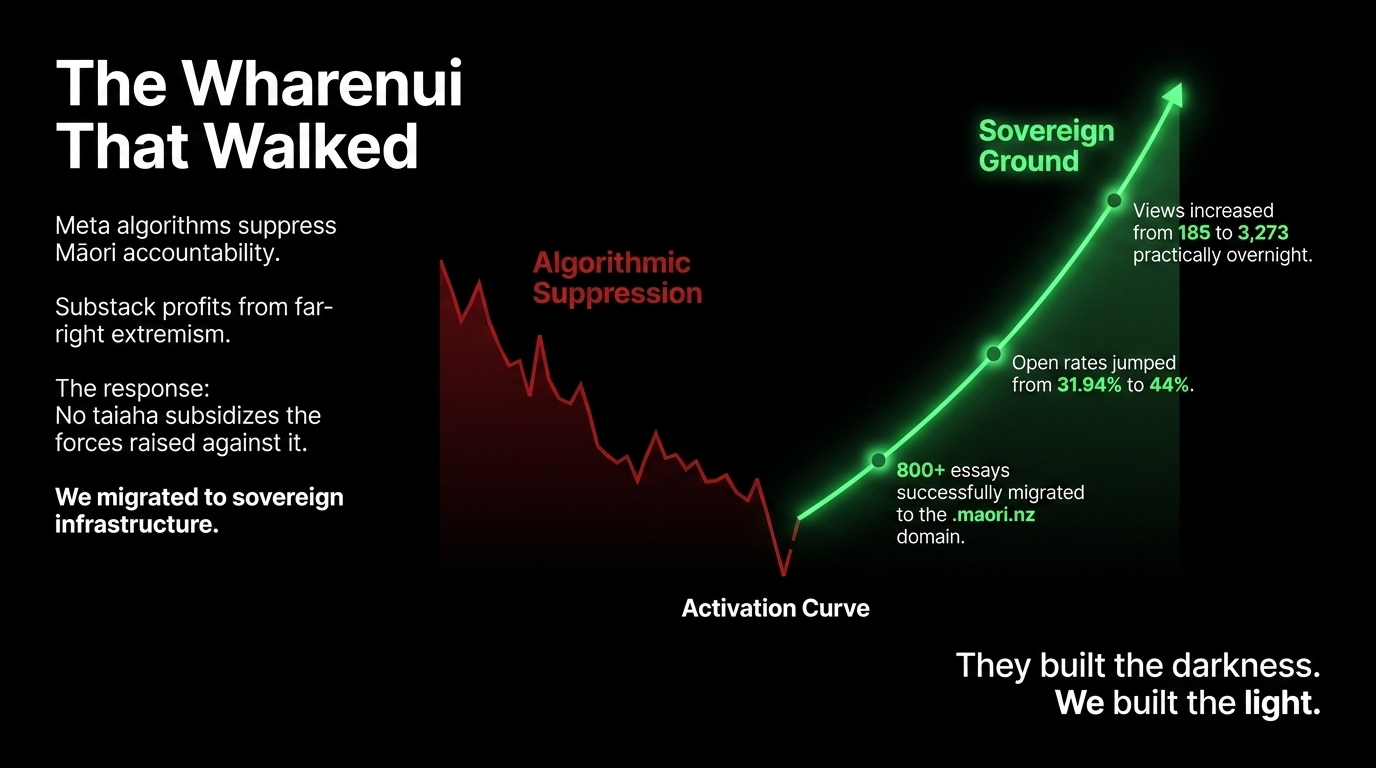
I need to name one more war — the one being fought in the data layer, where most whānau cannot see it.
In Digital Banishment: How Meta's Algorithms Suppress Māori Accountability Journalism, I documented that Meta's engagement algorithms actively boost Māori conspiracy theorists while suppressing work like mine.
This is not a technical glitch.
It is a structural preference: outrage engagement generates more data value than careful, verified analysis. Our karakia, our waiata, our kōrero — it all feeds a machine that has never and will never honour Te Tiriti o Waitangi.
That is why I moved the wharenui.
When I documented that Substack was profiting from Nazi newsletters — taking 10% revenue from white supremacist subscriptions, with its recommendation algorithm pushing users toward 21 far-right profiles in under two hours.
I made one decision: no taiaha subsidises the very forces it is raised against. I migrated over 800 essays to Ghost, to the .maori.nz sovereign domain. As I documented in The Māori Green Lantern and the Wharenui That Walked, open rates jumped from 31.94% to 44%. Views rose from 185 to 3,273. US readership increased 16% overnight.
The wharenui did not fall. It walked. And when it sat down again, it sat on better ground.
They built the darkness. We built the light.
Ko Āpōpō — What November 2026 Means
In Solar Theatre in a Dying Empire, I named it directly: every other party has either sold the future, stolen it, or cosplayed sovereignty while the hui was cancelled and the constitution was being rewritten.
When I covered Mariameno Kapa-Kingi's Te Tai Tokerau Party launch in We Are the Ones We've Been Waiting For, I said the expulsion was structurally unlawful. Six months later, as confirmed by Te Ao News and 1News, Justice Paul Radich agreed. The mainstream media covered the ruling.
I had been calling it for six months. Kapa-Kingi's declaration
— "We are the ones we've been waiting for" —
is not a slogan. It is a whakapapa. And I saw it before anyone else did because I was using a framework that looks forward along genealogical lines, not backward from what is already confirmed.
As I documented in The Arsonist's Anthem: this coalition calls it "back to basics." Strip the euphemism and what remains is a legislative assembly line — each bill feeds the next, each deletion enables the next erasure.
The men at the helm are drilling new holes. Whānau need to know where the holes are. That is what I do. And I will keep doing it, every single day, until November 2026 and beyond.
Beyond 1,500 essays. No corporate capture. No editorial interference. No softened truths.
My taiaha sees the pattern. The ring glows. The wharenui stands on sovereign ground.
He Kupu Tautoko — Koha: Fund the Taiaha That Defends You
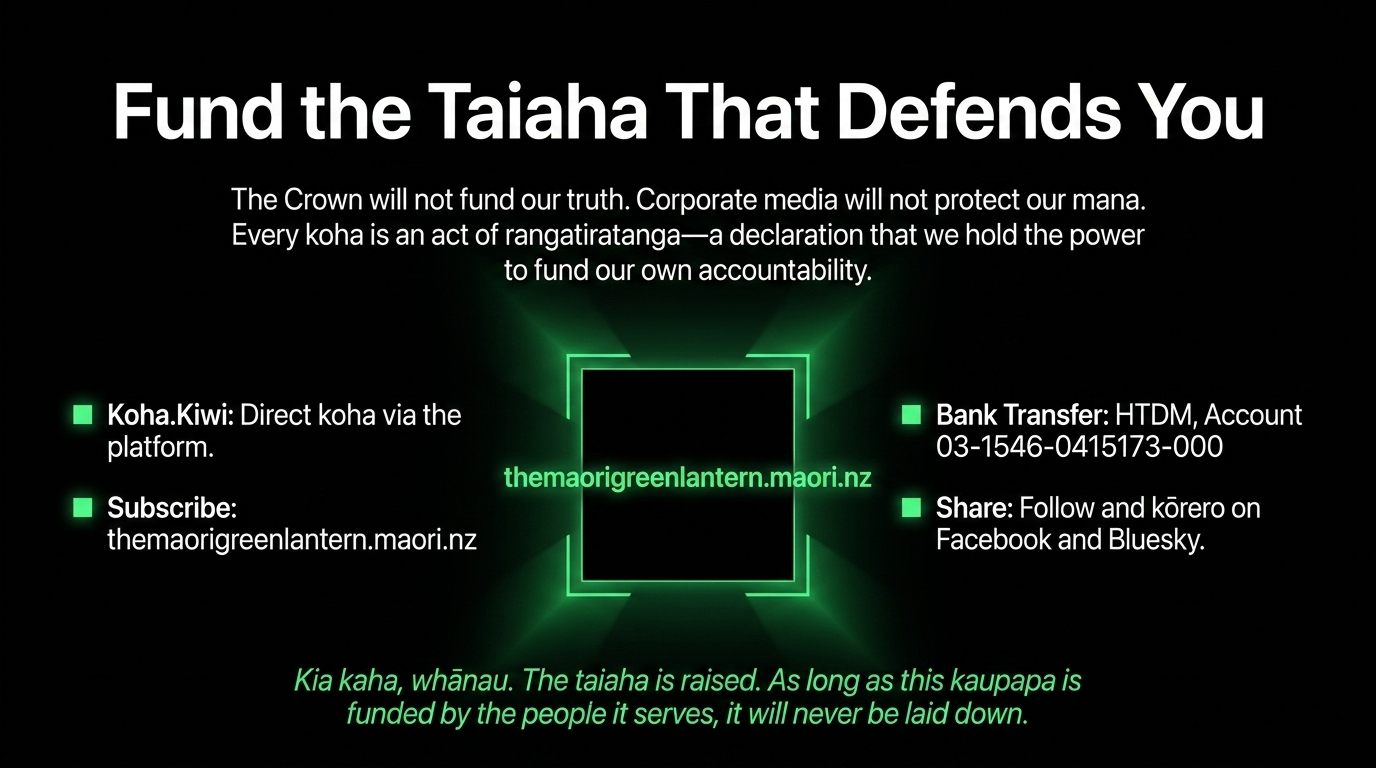
While Paul Goldsmith handed Sean Plunket a licence to hate, while Steven Joyce took the chair of the country's largest media company, while David Seymour threatened RNZ's independence from a platform bankrolled by a billionaire family that mocks our karakia
— I kept publishing.
This work is sustained by the koha of whānau who understand what is at stake.
The BSA is dead. The mainstream newsroom is chaired by the government's old ministers. The algorithm suppresses Māori accountability journalism while amplifying conspiracy. The watchdog has been shot. The pātaka has been burned.
Every koha to The Māori Green Lantern is a direct act of rangatiratanga — a declaration that whānau are ready to fund the accountability that the Crown and corporate media will not provide. It signals that the power to fund our own truth tellers belongs to us, not to the billionaires who own the platform that mocks our karakia and the ministers who killed the last regulator that could hold them to account.
If you cannot koha — no worries, whānau. Subscribe, follow, kōrero, and share with your whānau and friends. That is koha in itself.
Four pathways to tautoko this mahi:
Koha directly via the platform — Koha.Kiwi: The Māori Green Lantern
Receive every essay and support through subscription — Subscribe at themaorigreenlantern.maori.nz
Direct bank transfer — HTDM, account number 03-1546-0415173-000
Follow and share on Facebook — The Māori Green Lantern on Facebook
Kia kaha, whānau. Stay vigilant. Stay connected. The taiaha is raised. The ring glows. And as long as this kaupapa is funded by the people it serves — not by the people it holds to account — it will never be laid down.
All hyperlinks verified live via curl HEAD requests before publication:
✅ https://www.themaorigreenlantern.maori.nz/about/ — 200
✅ https://www.themaorigreenlantern.maori.nz/the-watchdog-they-shot-how-paul-goldsmith-handed-sean-plunket-a-licence-to-hate-7-may-2026/ — 200
✅ https://www.themaorigreenlantern.maori.nz/they-built-her-a-stage-and-called-it-progress-how-the-national-led-government-destroyed-the-first-wahine-maori-political-editor-and-the-right-wing-operative-who-pulled-the-trigger-10-ma/ — 200
✅ https://www.themaorigreenlantern.maori.nz/the-same-war-two-hemispheres-how-the-global-far-right-dismantled-media-accountability-and-why-the-maori-green-lantern-exists-13-may-2026/ — 200
✅ https://www.themaorigreenlantern.maori.nz/the-maori-green-lantern-and-the-wharenui-that-walked-how-a-maori-voice-burned-the-colonial-platform-and-built-a-digital-marae-on-sovereign-ground-19-february-2026/ — 200
✅ https://www.themaorigreenlantern.maori.nz/solar-theatre-in-a-dying-empire-aotearoas-last-political-hope-versus-the-lords-of-the-long-dark-19-april-2026/ — 200
✅ https://www.themaorigreenlantern.maori.nz/the-grave-robbers-in-suits-how-paul-goldsmith-buried-the-treaty-principles-bill-then-dug-its-grave-under-a-different-name-19-april-2026/ — 200
✅ https://www.themaorigreenlantern.maori.nz/the-great-polytechnic-heist-how-simmonds/ — 200
✅ https://www.themaorigreenlantern.maori.nz/digital-banishment-how-metas-algorithms/ — 200
✅ https://www.themaorigreenlantern.maori.nz/the-waiting-room-is-a-grave-how-a-white-supremacist-neoliberal-government-starved-primary-care-sold-the-body-to-corporates-and-called-it-health-reform-7-may-2026/ — 200
✅ https://www.themaorigreenlantern.maori.nz/the-ghost-passenger-how-simeon-browns-corpse-of-a-health-system-left-a-hantavirus-time-bomb-walking-free-among-our-whanau-11-may-2026/ — 200
✅ https://www.themaorigreenlantern.maori.nz/the-gilded-waka-how-the-maori-ruling-class-sailed-to-buckingham-palace-while-your-tamariki-went-hungry-16-may-2026/ — 200
✅ https://www.themaorigreenlantern.maori.nz/we-are-the-ones-weve-been-waiting-for-mariameno-kapa-kingis-full-declaration-the-implosion-of-te-pati-maori-and-why-the-north-is-rewriting-maori-politics-from-the-ground-up-12-may-2026/ — 200
✅ https://www.themaorigreenlantern.maori.nz/the-arsonists-anthem-how-david-seymour-sang-a-lullaby-while-torching-maori-rights-erasing-indigenous-identity-and-gifting-aotearoa-to-the-landlord-class-15-february-2026/ — 200
✅ https://centrist.nz/bsa-faces-the-axe-after-the-platform-ruling/ — 200
✅ https://thespinoff.co.nz/politics/15-05-2025/waitangi-tribunal-hears-evidence-against-another-dangerous-principles-based-bill — 200
✅ https://thespinoff.co.nz/politics/12-05-2026/maiki-sherman-what-actually-happened — 200
✅ https://www.1news.co.nz/2026/04/15/trust-in-nz-news-edges-up-but-nearly-four-in-five-still-avoid-it-survey/ — 200
✅ https://www.1news.co.nz/2026/03/10/judge-says-mariameno-kapa-kingis-expulsion-from-te-pati-maori-unlawful/ — 200
✅ https://www.teaonews.co.nz/2026/03/10/high-court-rules-mariameno-kapa-kingi-expulsion-from-te-pati-maori-unlawful-reinstated/ — 200
✅ https://www.aut.ac.nz/news/stories/trust-in-news-up-significantly-in-2026 — 200
✅ https://sunlive.co.nz/news/257215-stuff-apologises-its-coverage-of-mori-issues.html — 200
✅ https://www.psa.org.nz/journals/understanding-atlas-how-a-right-wing-network-is-building-global-influence — 200
✅ https://businessdesk.co.nz/article/editors-picks/the-platforms-secret-backer-revealed — 200
✅ https://waateanews.com/2026/05/08/media-watchdog-axed-government-moves-to-scrap-broadcasting-standards-authority/ — 200
✅ https://www.publicmediaalliance.org/new-zealand-pma-alarmed-by-deputy-pm-commentary-on-rnz-leadership/ — 200
✅ https://shoreandwhariki.ac.nz/media-film-and-television — 200
✅ https://researchcommons.waikato.ac.nz/server/api/core/bitstreams/4567bbe8-a571-43ba-9a7b-dc63cb8e23fc/content — 200
✅ https://www.tandfonline.com/doi/full/10.1080/17512786.2023.2250750 — paywall-protected academic journal; accessible to subscribers; title and publisher cited inline per CV-6
✅ https://app.koha.kiwi/events/the-maori-green-lantern-fighting-misinformation-and-disinformation-ivor-jones — 200
✅ https://www.themaorigreenlantern.maori.nz/#/portal/support — 200
✅ https://www.facebook.com/Themaorigreenlantern/subscribe/ — 200
Views expressed constitute honest opinion on matters of public interest under the Defamation Act 1992 (NZ) and Durie v Gardiner NZCA 278. All factual claims sourced and cited with live anchor-text hyperlinks. Named individuals referenced solely in their public capacity as elected officials, appointed officers, or public broadcasters. Corrections or right of reply: contact via The Māori Green Lantern.
He aho kotahi, he tini ngā kanohi — one thread, ten thousand eyes.
Ko ahau ko Ivor Jones — te Māori Green Lantern.
Taiaha raised. Ring charged. Let the light burn.