"DARK - Whakapapa, Quantum Entanglement, and the Eyes That Watch You From Both Ends of Time" - 26 June 2026
"What we know is a drop. What we don't know is an ocean." — H.G. Tannhaus, Dark
Mōrena Aotearoa,
The first essay established the map. We walked the creation chant — Te Kore to Te Ao Mārama — through the streets of Winden, through the caves, through the triquetra, through the lives of Jonas, Martha, Claudia, Noah, Charlotte and Elisabeth.
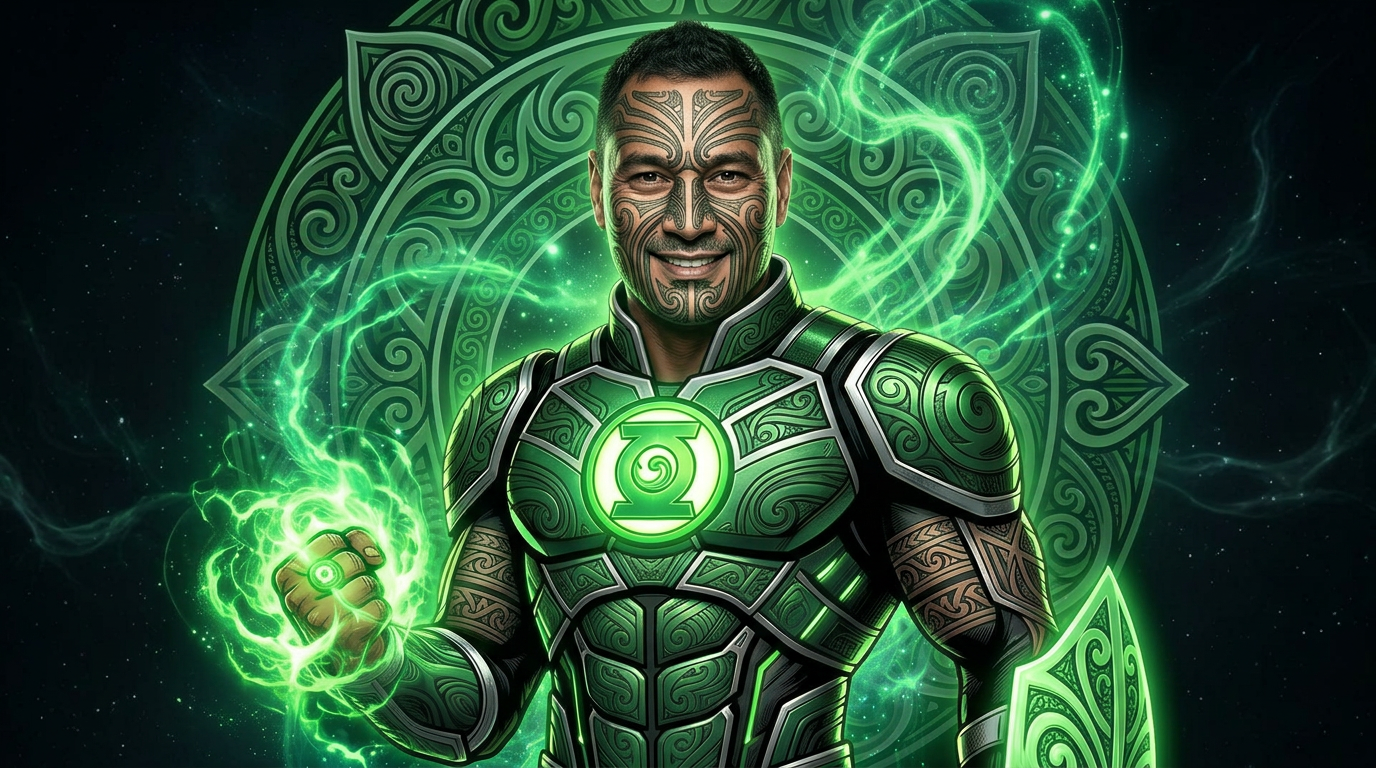
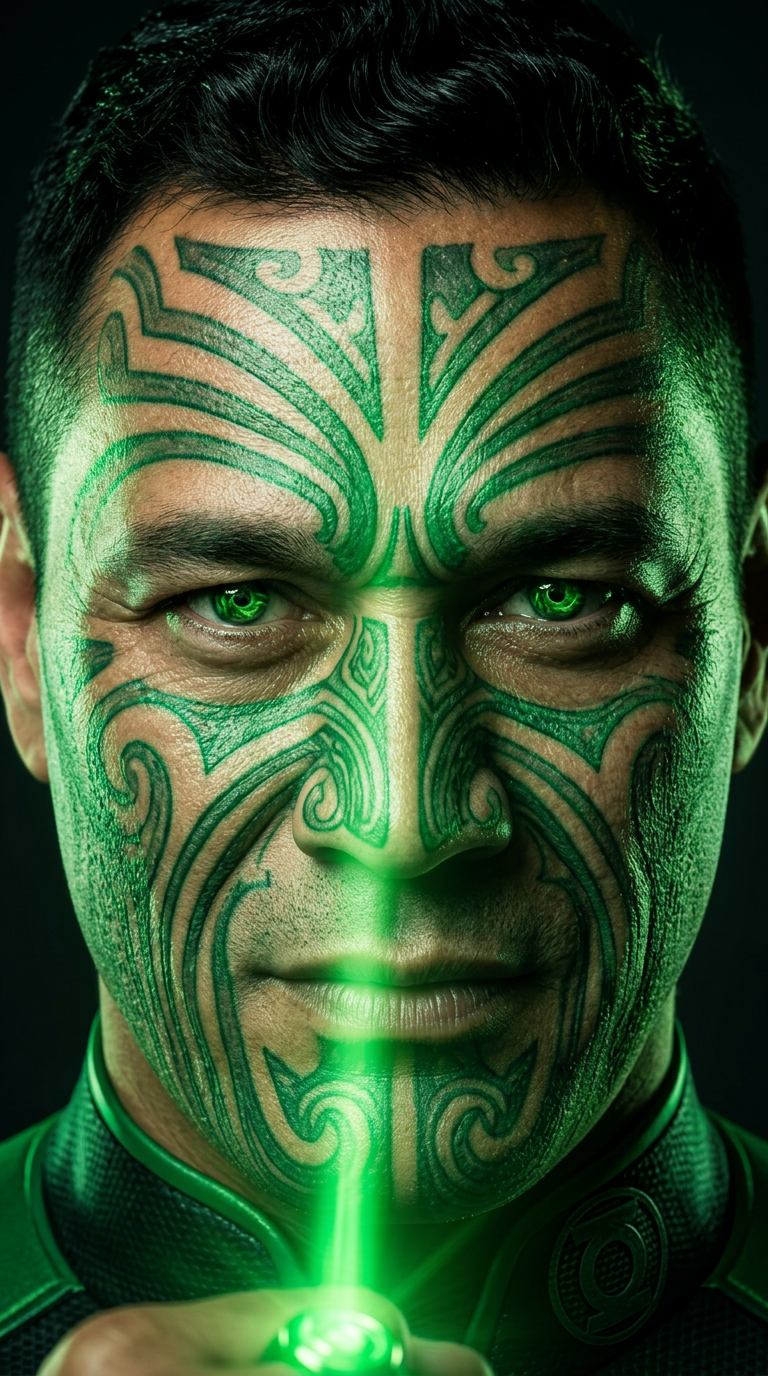
 Ivor Jones The Māori Green Lantern
We showed that Netflix's Dark accidentally dramatised the entire Māori cosmological framework across three seasons and 166 years of entangled time.
Now we go deeper. Three layers deeper.
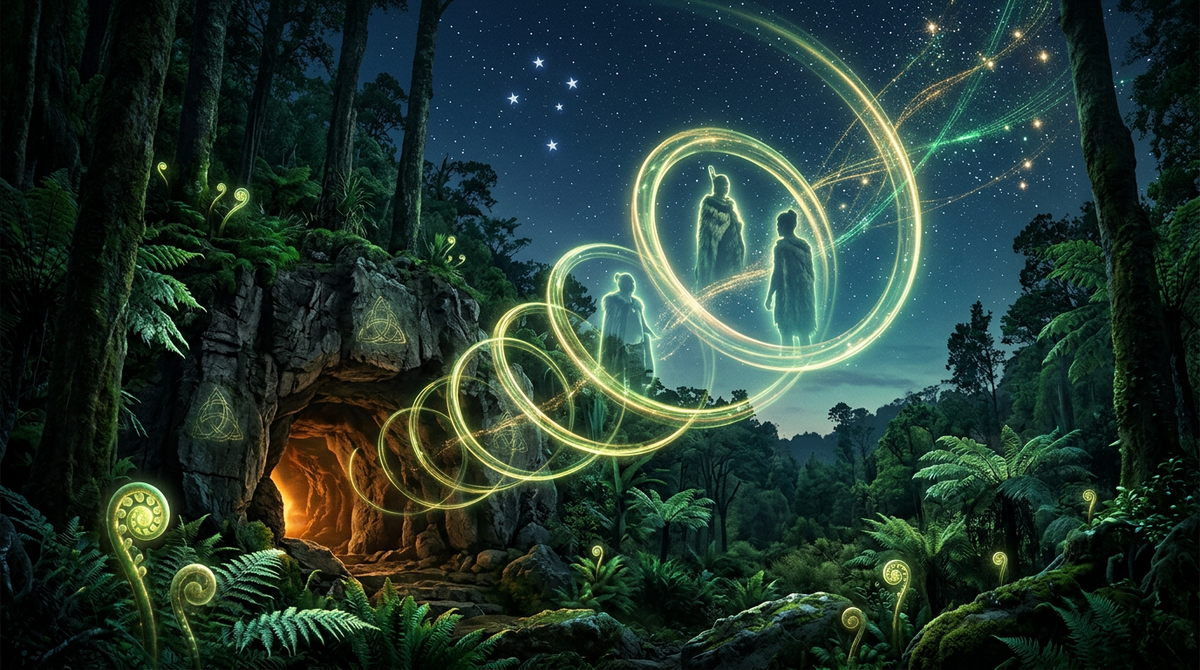
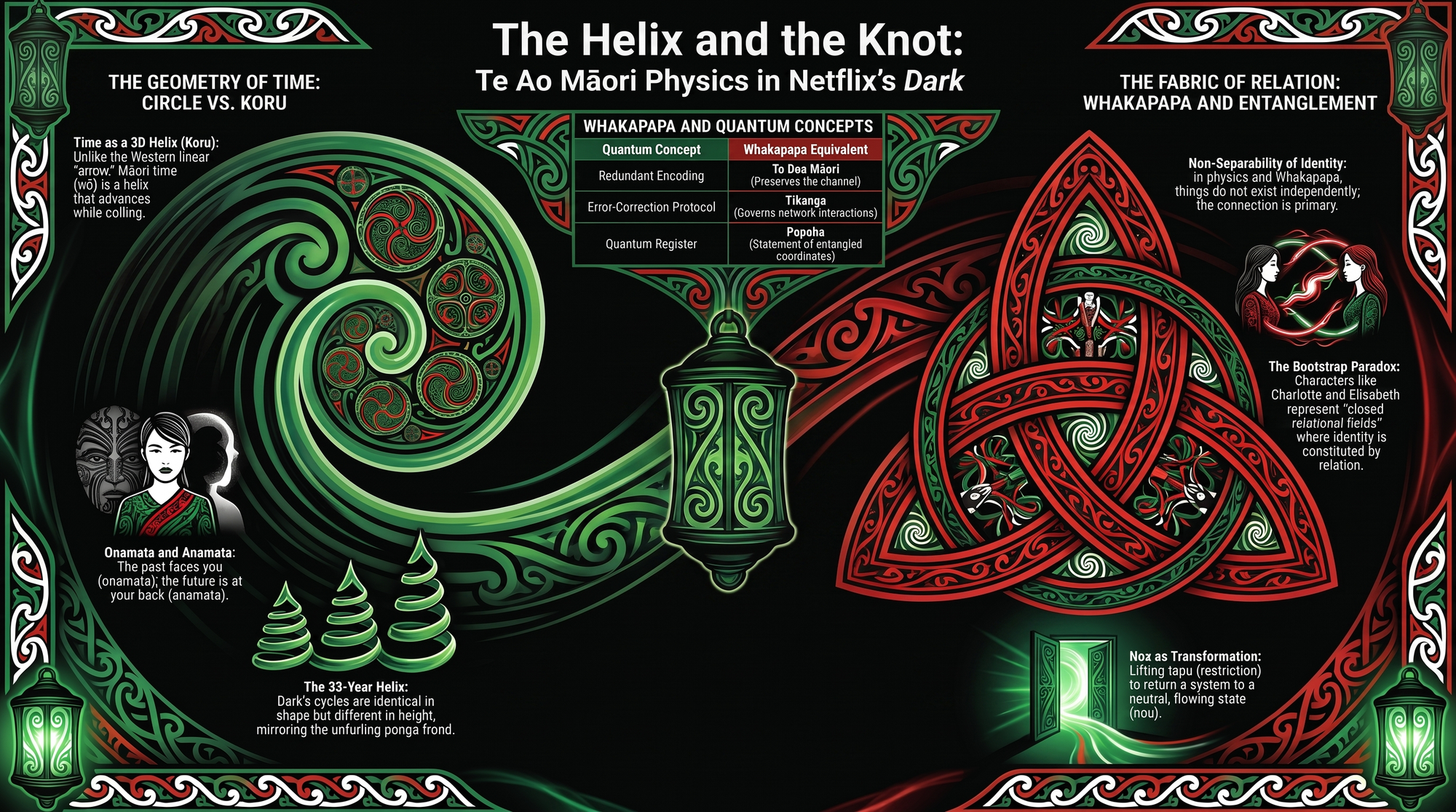
Layer One: Time is not a line. It is a serial three-dimensional koru — a helix — and Winden's 33-year cycle is its most perfect dramatic expression.
Layer Two: Whakapapa is the anchor in quantum entanglement theory. Your identity is non-separable from your tūpuna and mokopuna in the same way that two entangled particles are non-separable across any distance. The physics is not metaphor. It is the same claim in two different languages.
Layer Three: Inside every decision you will ever make, two observers are already watching. They are called onamata — the eyes of your tūpuna — and anamata — the eyes of your mokopuna. This essay tells you how to activate both, and gives you eight exercises you can use today.
Buckle in, whānau. The knot goes deeper than Winden.
The Deep Dive Podcast
Listen to a lively conversation between two hosts, unpacking and connecting topics in the sources of this essay. I apologise in advance for the AI's very harsh pronounciation of reo. Please dont shoot me, :).
Youtube Video
Like video? Here is a short video suppporting the essay. Again, don't shoot the messenger please because of AI's pronounciation. :)
Part One: The Koru Is Not Flat — Time as a Serial 3D Helix
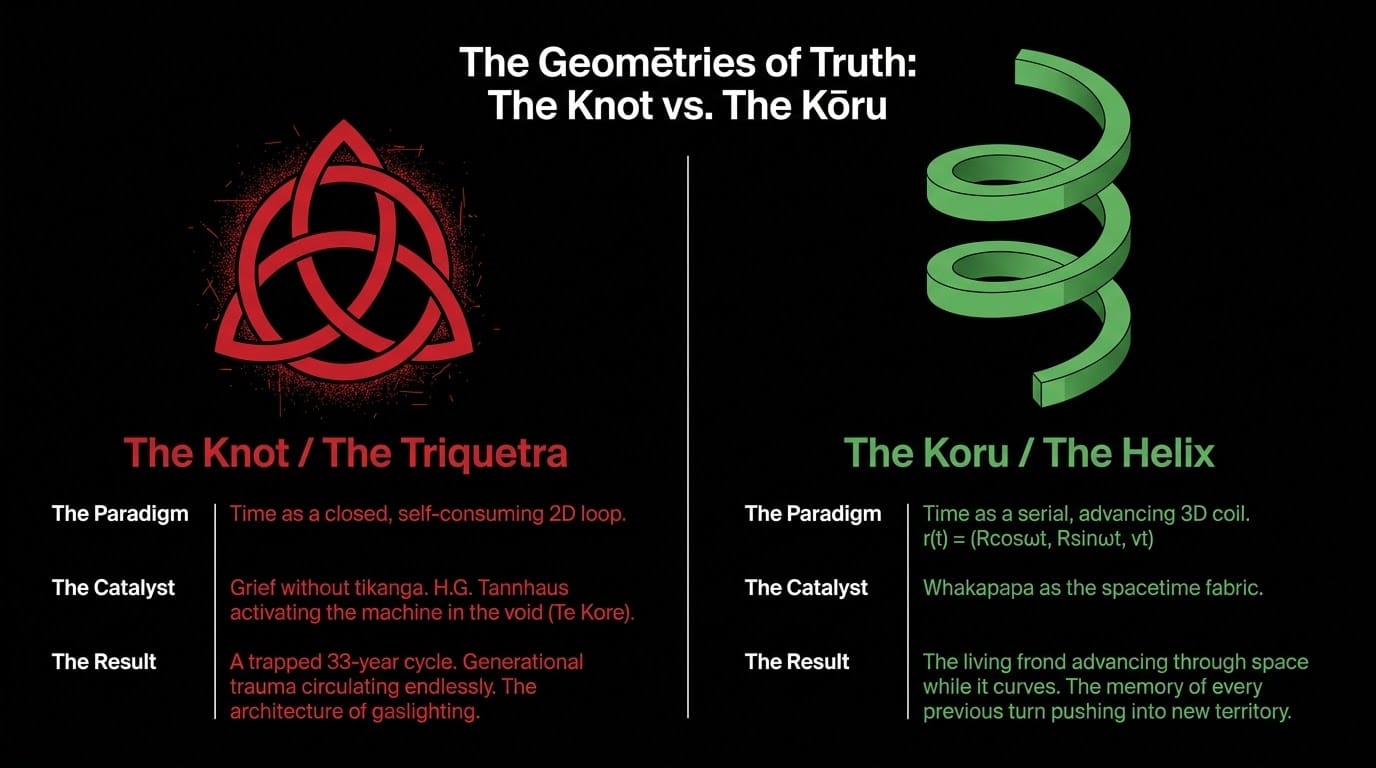
The koru is almost always depicted in two dimensions — a flat spiral on cloth, on skin, on a page. But the living koru — the actual unfurling ponga frond in the ngahere — is three-dimensional. It is a serial helix: coiling upward and outward simultaneously. It does not return to its starting point. It advances through space while it curves. It is not a circle. It is a coil that carries the memory of every previous turn while pushing into new territory.
This is exactly what Dark's 33-year cycle does.
The Dark Fandom Wiki confirms that the caves of Winden connect 1953, 1986, and 2019 — exactly 33 years apart. But here is what Charlotte's explanation in Season 1 misses: these are not the same moment repeating. They are the same pattern at a new position on the helix. The radius of the coil is identical — Winden, the four families, the caves, the nuclear plant. The angular velocity is identical — a child disappears, a body is found, the apocalypse threatens. But the height on the coil advances. New characters. New consequences. Deeper damage. The same angular momentum, propagating forward through time.
This is the mathematical form of a helix:
r(t)=(Rcosωt, Rsinωt, vt)\mathbf{r}(t) = (R\cos\omega t,\ R\sin\omega t,\ vt)r(t)=(Rcosωt, Rsinωt, vt)
Where R is the radius of the coil (Winden's unchanging geography and family structure), ω is the angular velocity (the 33-year rhythm), and v is the forward velocity along the axis of time (the advancing consequences, the deepening knot). You are living inside this equation. The koru is its glyph.
Wā — Māori Time Is Already Non-Linear Physics
The Western notion of time is an arrow — linear, unidirectional, A → B → C. In this worldview, the present moment is the most real thing that exists. The past is gone. The future hasn't arrived. You are a point on a line.
The Pantograph Punch scholar draws on Moana Jackson to make the Māori counterargument: "our notion of time is whakapapa-based, and like whakapapa it has its own sense of never-ending beginnings in which time turns back on itself in order to bring the past into the present and then into the future." In te reo Māori, the very grammar of time encodes this geometry. The word for the past is onamata — the eyes of those who have come before us. The future is anamata — the eyes of those who come after us. Both are expressed through mata — eyes, face, perspective. You do not look forward to the future. You carry both gazes into the present — simultaneously.
This is not metaphor. This is the coordinate system of someone standing in the middle of a helix, not at one end of a line.
Dark dramatises this precisely. Vulture's Season 3 analysis confirms that Jonas and Martha, in the finale, do not travel to the past or the future — they navigate to the Origin World, which exists outside the loop entirely, and redirect a single moment in 1971. They are not on a line. They are on a helix. And in the finale, they find the axis — the central spine around which every turn has been coiling — and step off the coil entirely, into the still point at the centre. That still point is what we call Te Kore-i-ai — the void that is the ground of all potential.
Part Two: Whakapapa as the Anchor in Quantum Entanglement
What Quantum Entanglement Actually Is
When two particles interact — sharing a quantum state — they become non-separable. From that moment, the state of each particle cannot be described independently of the other. Measure one particle's spin and you instantly determine the other's — regardless of the distance between them. They could be on opposite ends of the galaxy. The correlation holds.
SpinQ's verified 2025 guide explains that Alain Aspect's loophole-free Bell test experiments confirmed this definitively: this is not a trick of hidden variables, not pre-set instructions. It is genuine non-locality — a real, structural interdependence built into the quantum wavefunction itself. In November 2025, physicists published in Nature that non-locality may be even more fundamental: "all fermionic states and almost all bosonic states turn out to be nonlocal resources." Non-separability is not the exotic exception. It may be the ground state of matter itself.
Physics is converging on a conclusion: things do not first exist independently and then form connections. The connections are primary. The things are secondary.
Whakapapa Is the Same Claim in a Different Language
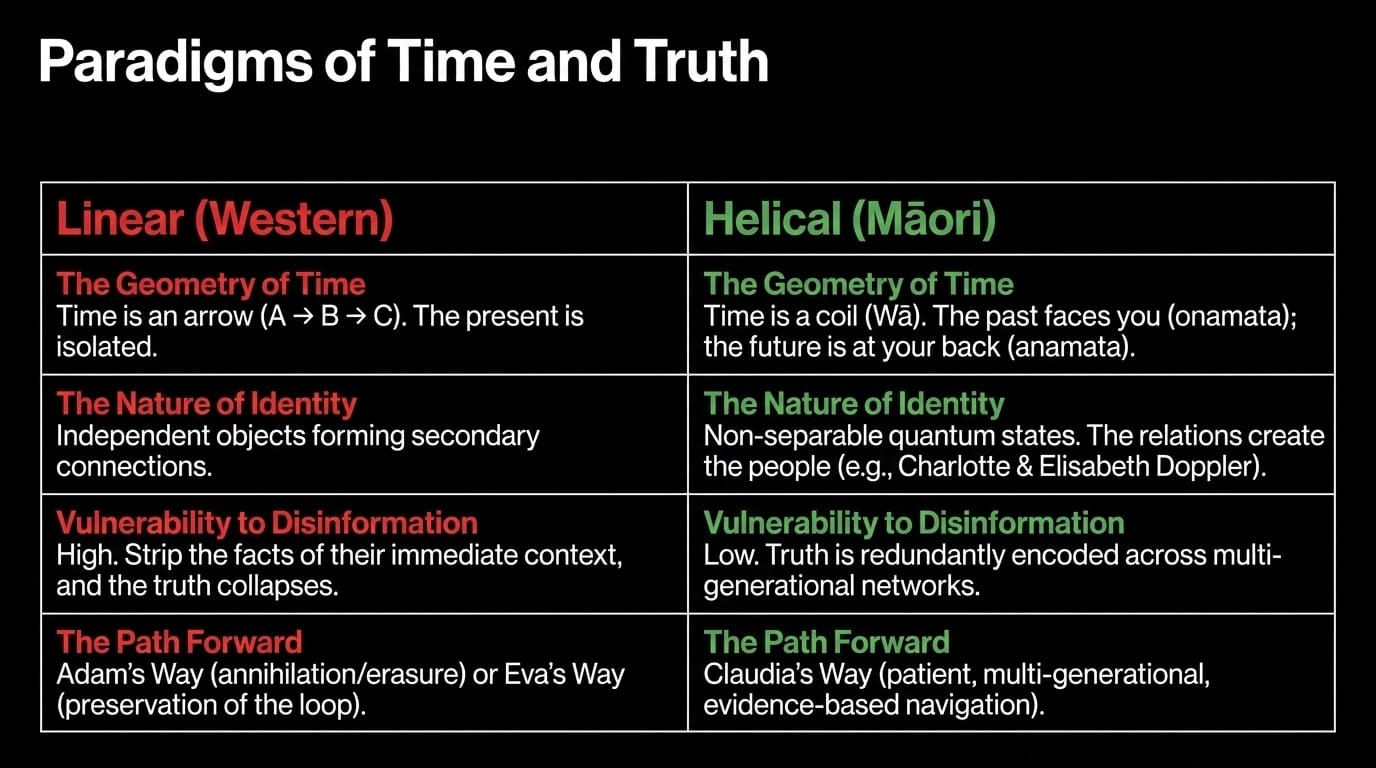
The Massey University research on Māori health and wellbeing in a whakapapa paradigm confirms: whakapapa is "an Indigenous metatheoretical framework; a phenomenon of metaphysical and social connections embedded in Indigenous ontology." It is not a genealogical record. It is a claim about the structure of reality itself.
The Asia Media Centre records the community position plainly: "Our identity is 100% shaped by our whakapapa connections to both people and place." And Tōu Ake Mana confirms the ontological claim: "Te ao Māori is embedded in relational processes... the physical world and the spiritual world are not severed in the construct of whakapapa and they remain intrinsically linked."
This is non-separability. You and your whakapapa are not two things. You are one quantum state.
The Decoherence Problem — And Why It Matters Now
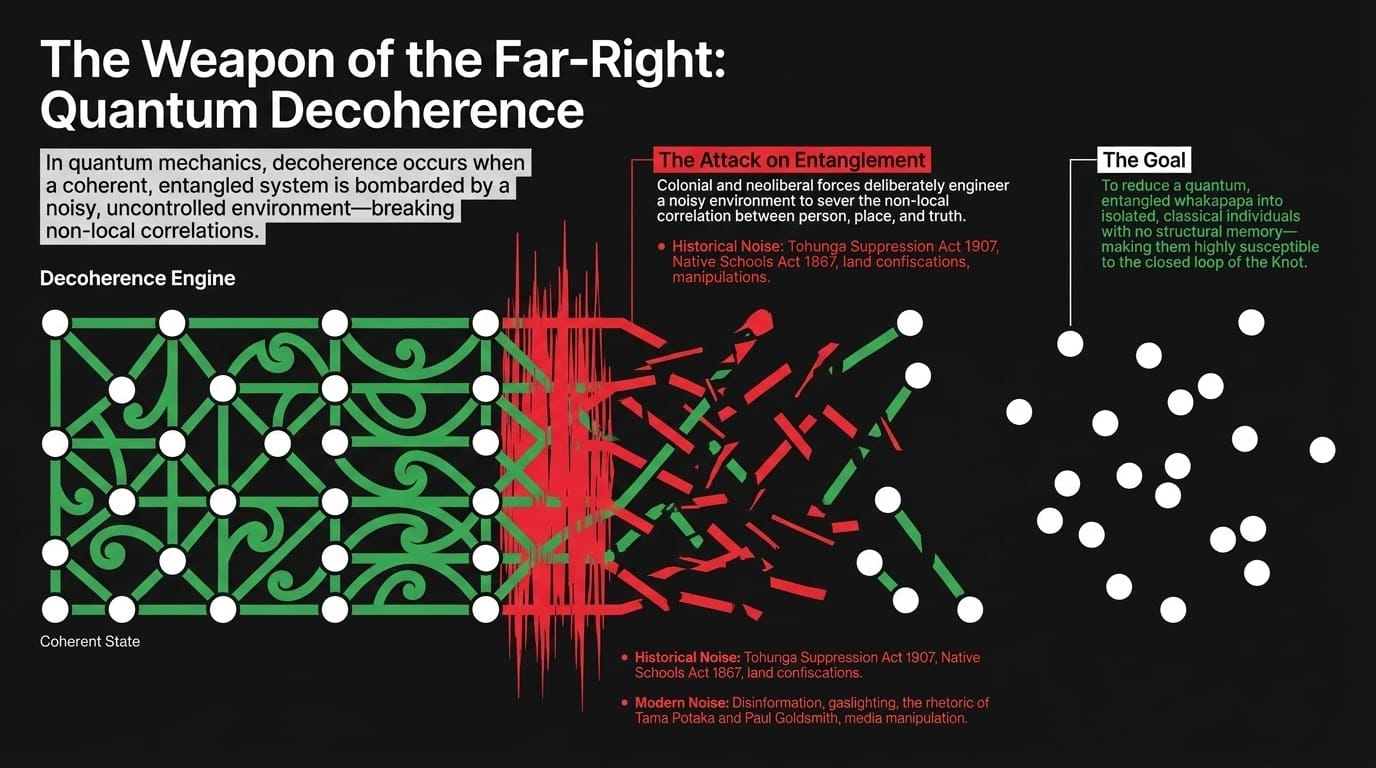
SpinQ's verified decoherence guide explains the core challenge: "when a quantum system entangles with its environment, the interference patterns — hallmarks of quantum behavior — vanish when we try to observe the system alone." Decoherence is what happens when a coherent, entangled system is exposed to a warm, noisy, uncontrolled environment. The non-local correlations break down. The system collapses from a quantum whole into isolated classical parts.
The colonial project in Aotearoa applied exactly this mechanism to Māori identity — systematically and deliberately:
- The Tohunga Suppression Act 1907 targeted the knowledge-keepers who maintained coherence
- The Native Schools Act 1867 removed te reo from children — collapsing the primary qubit of identity encoding, as the Academia.edu Whakapapa Ora research confirms
- Land confiscations severed the maunga-awa-tangata entanglement — without physical connection to the land, the non-local correlation between person and place degrades
- Forced urbanisation embedded whānau in a warm, noisy, non-Māori environment designed to maximise decoherence, as the University of Canterbury reconnection research documents
The whakapapa survived not because the attacks were gentle, but because the redundant encoding was robust enough that enough qubits remained to reconstruct the coherent state. Māori resilience is quantum error correction in action.
Whakapapa as Quantum Error Correction
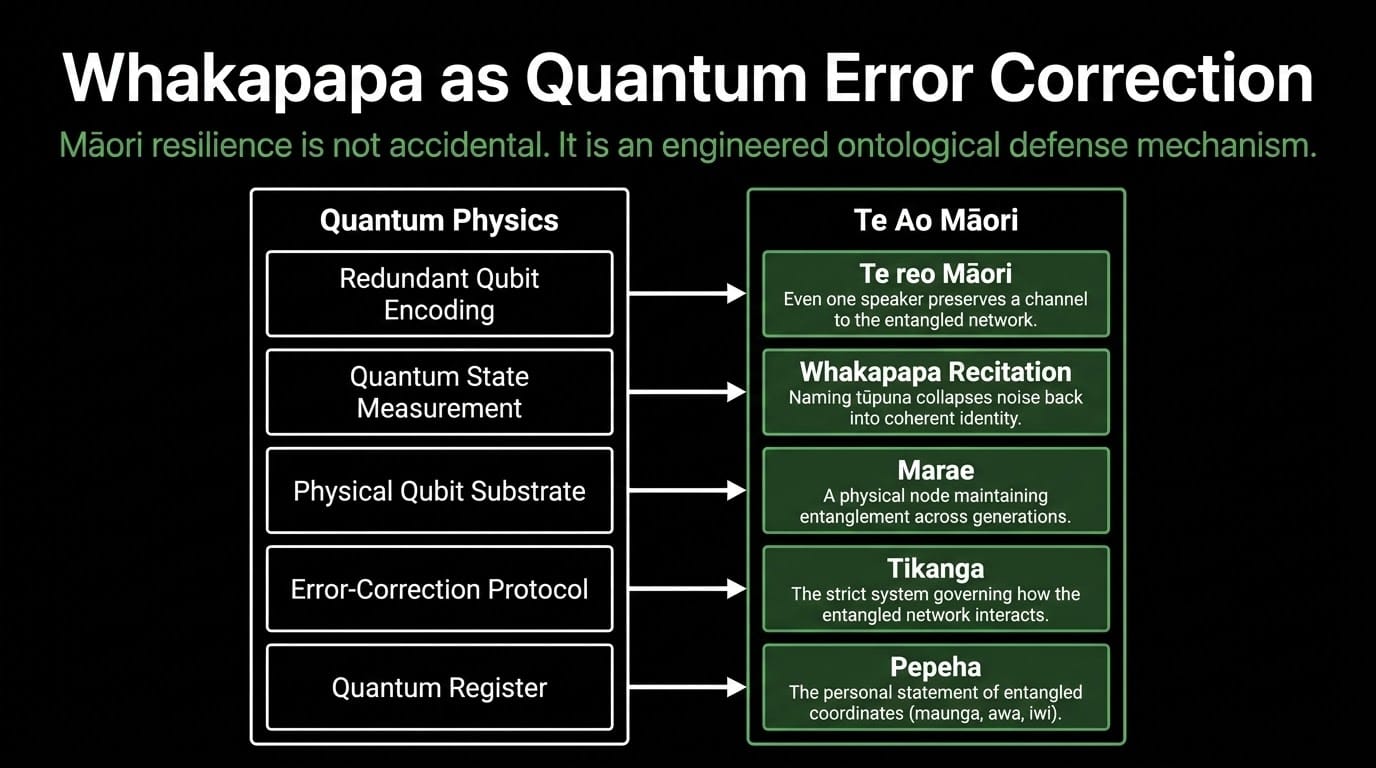
In quantum computing, the solution to decoherence is redundant encoding — spreading information across multiple entangled qubits so that if one becomes noisy, the others preserve the coherent state. Whakapapa operates by the same mechanism:
| Quantum Error Correction Qubit | Whakapapa Equivalent |
|---|---|
| Redundant qubit encoding | Te reo Māori — even one speaker preserves a channel to the entangled network |
| Quantum state measurement | Whakapapa recitation — naming tūpuna collapses noise back into coherent identity |
| Physical qubit substrate | Marae — a physical node maintaining entanglement across generations |
| Error-correction protocol | Tikanga — the protocol system governing how the entangled network interacts |
| Quantum register | Pepeha — personal statement of entangled coordinates: maunga, awa, waka, iwi, hapū, ingoa |
Remove any one qubit and the others still hold the coherent state. Remove all of them — as colonial processes systematically attempted — and the entangled system decoheres into isolated, classical, separable individuals with no defined quantum identity.
The Dark Proof
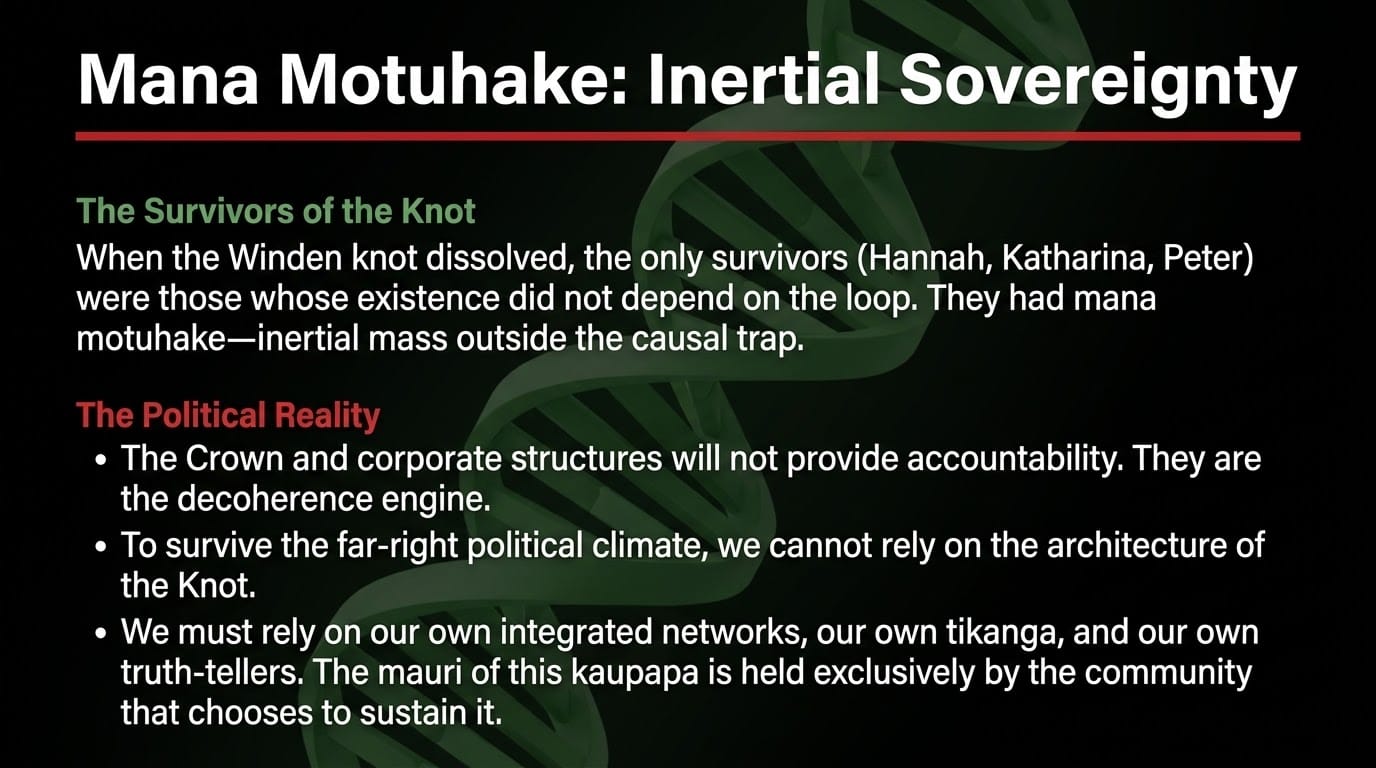
The Dark Fandom Wiki confirms that every character whose existence depended entirely on the knot — Jonas, Martha, Charlotte, Elisabeth, Bartosz, Magnus, Franziska, The Unknown — is erased when the loop is dissolved. They were not independent objects who happened to be related. They were constituted by the relations themselves. Strip the relational network and they dissolve.
TV Guide's confirmed character analysis shows that the survivors — Katharina, Hannah, Peter, Benni, Torben, Regina — are those whose existence predated and existed outside the knot's internal genealogies. They had mana motuhake — their inertial mass persisted outside the loop. They are the proof that the Origin World had mauri ora before Tannhaus's grief set the machine running.
Carlo Rovelli's Relational Quantum Mechanics, confirmed in the Oxford University analysis, states: "no physical system has a state 'in itself'; states only exist relative to other systems." Charlotte and Elisabeth are Dark's perfect embodiment of this principle. Each is the other's mother. Each exists only in relation to the other. Strip the loop — which Jonas and Martha do — and both dissolve. The relational field that constituted them is gone.
Part Three: Onamata and Anamata — The Two Observers Within You
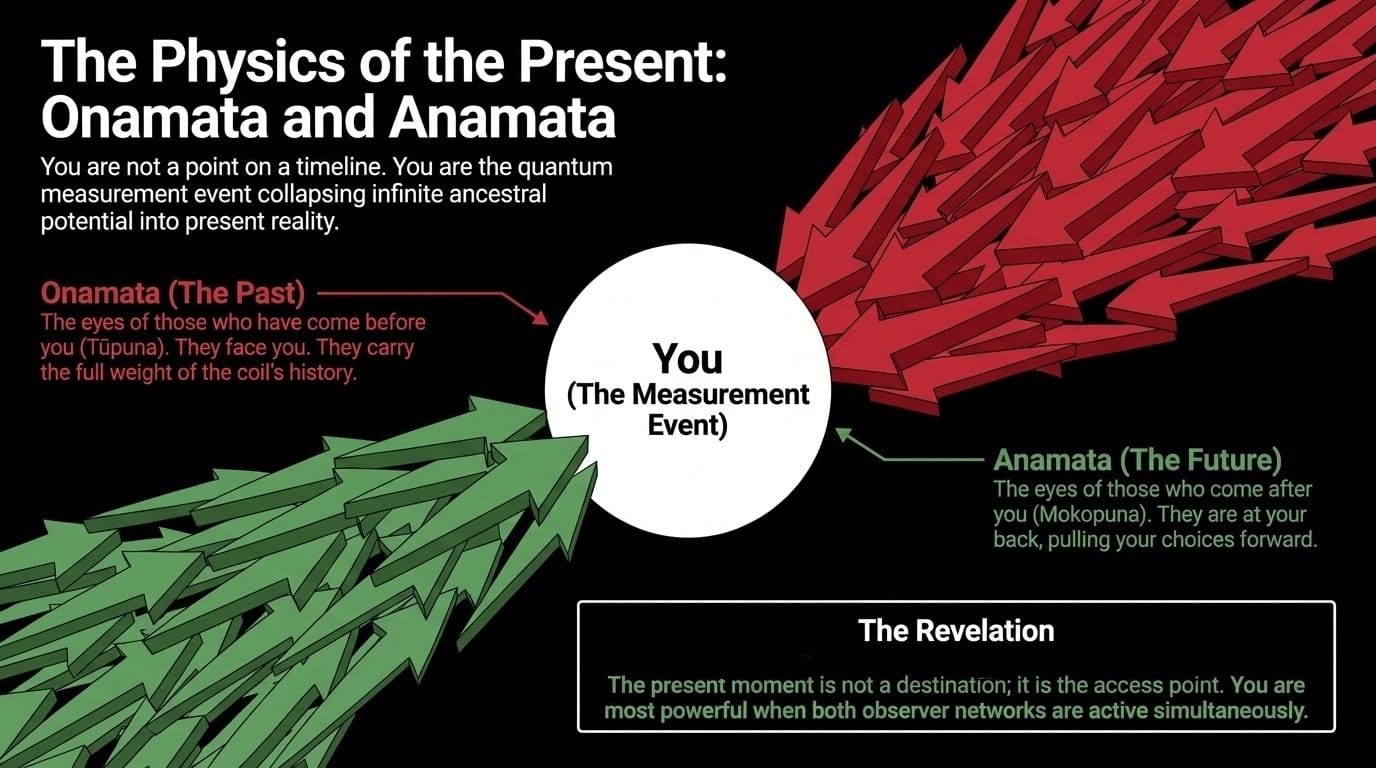
You are not alone in this present moment. You never were.
Standing inside every decision you have ever made are two observers. They are not imaginary. They are not metaphor. They are structurally, cosmologically real — encoded into the grammar of te reo Māori, verified by physics, confirmed by a PhD defended in 2026 with the title "onamata, anamata — seeing through genomics".
Onamata — the eyes of those who have come before you. Your tūpuna. Every ancestor on every branch of your whakapapa. They face you. They are not behind you — they are in front of you, looking at you, carrying toward you the full weight of everything they learned. The Pantograph Punch scholar confirms this orientation is structural, not sentimental.
Anamata — the eyes of those who come after you. Your mokopuna. Every descendant who will ever carry your bloodline, your choices, your mauri forward. They are at your back, looking toward you from the future, waiting for the decisions you are about to make. The MAI Journal research on onamata, anamata as whakapapa methodology confirms that "each generation can traverse these waters, put down an anchor, and take in the view."
You — the present person — are the living intersection point between these two observers.
The Grammar Carries the Physics
In te reo Māori, there is no direct translation of the present tense as Western languages understand it — no word that means "now" as a fixed, privileged moment more real than past or future. The word mata means eyes — but also face, surface, first appearance, perspective. It is the lens through which reality is perceived.
The Western mindfulness tradition reaches for the present moment as the destination. Be here. Be now. Let go of past and future. This is useful for anxiety. It is not a complete map for living.
The Pantograph Punch scholar articulates the Māori alternative: "It is through time travel that we can really see the present. We can see ourselves." The present moment is not the destination. The present moment is the access point — where you are most powerful precisely because both observer networks are available to you simultaneously. You do not let go of past and future. You bring both into your present moment as active intelligence — as the two sets of eyes through which you see most clearly.
Claudia Is the Proof
Of all the characters in Dark, Vulture confirms that Claudia alone manages to navigate outside the loop's causal constraints. She achieves this by doing what onamata/anamata practice demands: she holds the full pattern of what has already happened (onamata — the complete history of the knot across all its turns) while simultaneously projecting forward to the consequence she is navigating toward (anamata — the restoration of the Origin World, the survival of Regina). She is the only character in the show who stands at the convergence point of both observer networks without being consumed by either.
She is the navigator. The TEDx Auckland whakapapa and tuakiri research confirms the principle:
"in order to move forward, one must always look back." Claudia looks back with full clarity.
That is why she finds the way out.
Part Four: The Present Observer as a Measurement Event
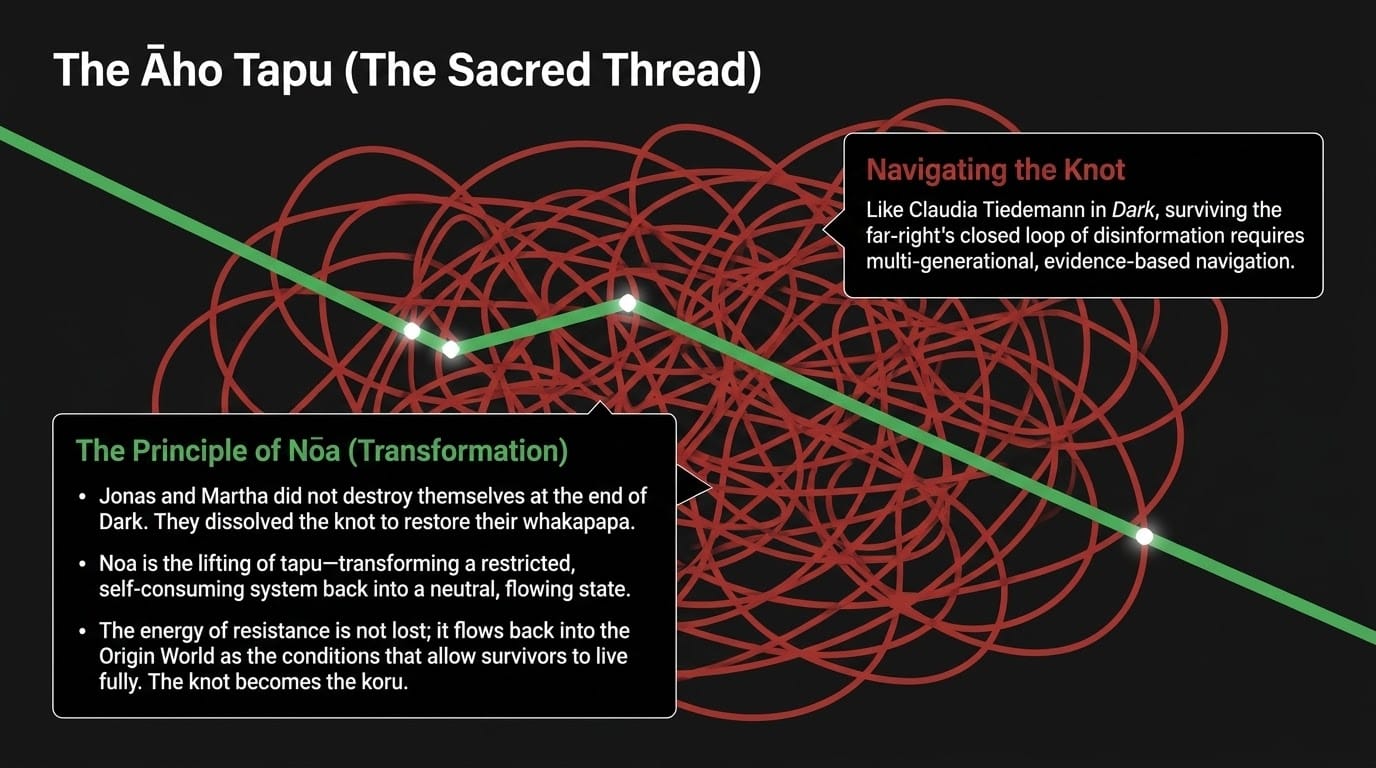
In quantum mechanics, the act of measurement collapses a superposition into a definite state. A particle exists in multiple potential states simultaneously until a measurement event — an interaction with another system — forces it to resolve into one.
The present moment — your conscious experience of being alive right now — is the measurement event of your whakapapa.
You are the point at which the superposition of all possible expressions of your genealogical potential collapses into actuality. You are not the fixed result of the past. You are the point at which the past's quantum superposition — all the choices your tūpuna almost made, all the paths almost taken — becomes definite through your existence. The Academia.edu Whakapapa Ora research confirms: "whakapapa and the knowledge of one's ancestry is what connects all Māori to one another and is the central marker of traditional mātauranga Māori." Knowing your whakapapa is not nostalgia. It is accessing the full probability distribution of your genealogical inheritance — the complete dataset from which your present self was drawn — so that you can act from the full power of what your line has already learned.
This gives you extraordinary importance. Not as an individual ego. As a measurement event in the entangled network of your whakapapa. Your existence collapses the probability distribution of your ancestors' potential into one specific, actual, irreplaceable expression. No other measurement event could have produced this specific collapse. And simultaneously: your measurement event is already setting up the entanglement conditions for the next measurement — your mokopuna, who will collapse your potential into their actuality in the same way. The Massey University whakapapa paradigm research confirms this generational transmission as the core mechanism of Māori wellbeing.
The helix advances through measurement events. You are one. Make it count.
Part Five: Eight Exercises for Activating the Gaze of Tūpuna and Mokopuna
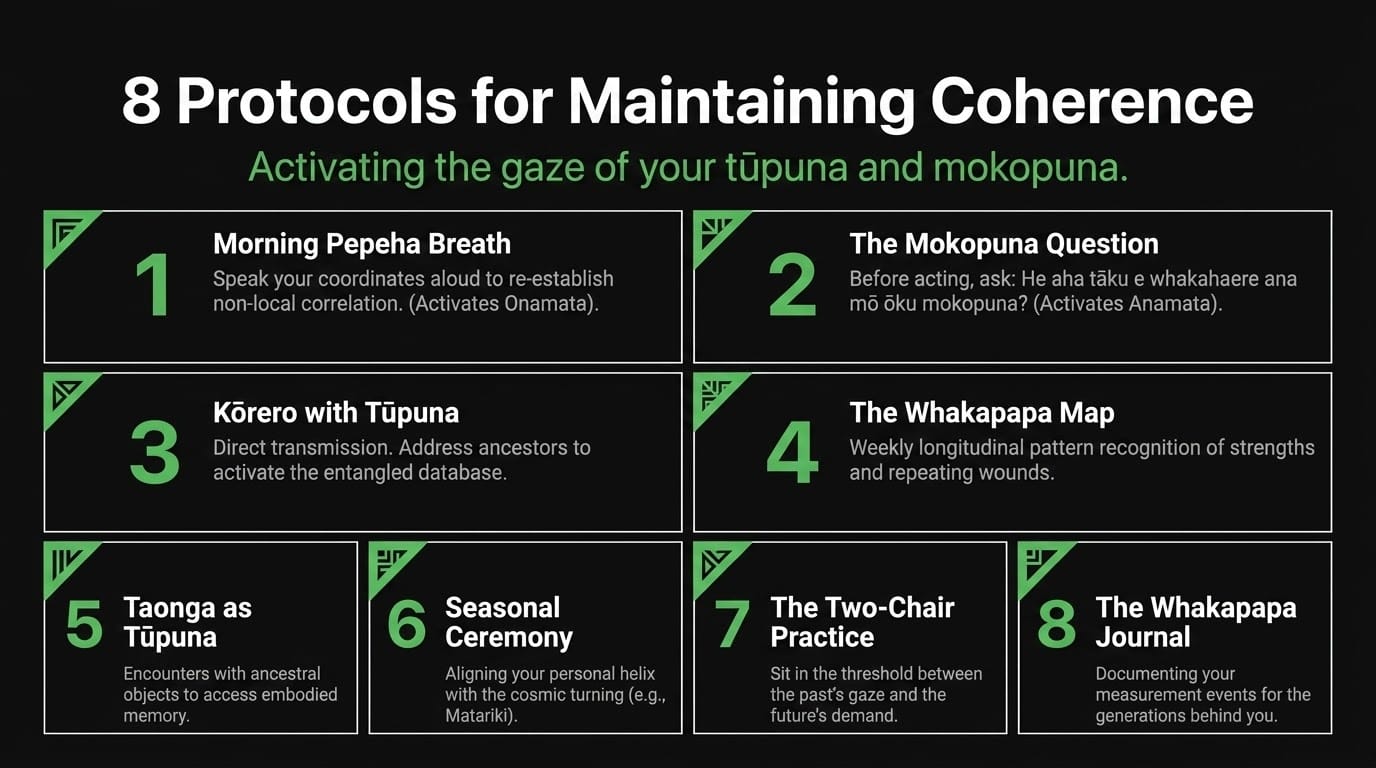
These are not theoretical. Every one is drawn from verified Māori wellbeing frameworks — Te Whare Tapa Whā, taha wairua practice, E-Tangata wisdom traditions — and you can begin today. Right now. Before you finish reading this essay.
Exercise 1: The Morning Pepeha Breath
Activates: Onamata — the gaze of your tūpuna | Time: 5 minutes | Frequency: Daily
E-Tangata's Hira Nathan describes his morning practice: "Before you leave the house in the morning, place your feet firmly on the whenua, take a big breath in, hold it for a few seconds, and then do the biggest sigh you can." Add this layer: with each breath, name one tūpuna aloud. Their name is their quantum address. Naming them re-establishes the non-local correlation.
The practice:
- Stand barefoot on the ground — outdoors if possible
- Take three slow breaths, each one longer than the last
- On the fourth breath, speak your pepeha aloud: Ko [maunga] tōku maunga. Ko [awa] tōku awa. Ko [iwi] tōku iwi. Ko [hapū] tōku hapū. Ko [ingoa] tōku ingoa.
- On each exhale, feel the weight of what stands behind you — the full coil of whakapapa at your back
- End with: Tihei mauri-ora.
E-Tangata confirms: "Sometimes all it takes is one conscious inhale and exhale. A slow karakia under your breath. A moment of stillness." These small recalibrations restore your coordinates on the helix.
Exercise 2: The Mokopuna Question
Activates: Anamata — the gaze of your mokopuna | Time: 1 minute | Frequency: Before every significant decision
Before any decision today — how you spend your time, what you say in a hard conversation, what you create, what you consume — pause and ask aloud:
"He aha tāku e whakahaere ana mō ōku mokopuna?" — What am I governing for my mokopuna?
Not as guilt. Not as pressure. As a genuine observer activation. Mental Health Awareness Week confirms the forward-looking aspiration practice as a daily wellbeing anchor: "It's in how our ancestors 'took notice' of the stars that guided us here." The mokopuna question stretches that horizon from today to generations. Notice what shifts in your body. Act from that shifted position.
Exercise 3: Kōrero with Tūpuna
Activates: Onamata — direct transmission | Time: 5–10 minutes | Frequency: Daily, when moved
E-Tangata's wellness writer describes her practice: "I've been having a few choice words with Hine Raumati. Often, I'll talk to my koro. Just a passing mihi when the mood strikes." This is not mysticism. It is the activation of the onamata observer network through direct relational address. You are speaking into the entangled network and listening for the pattern-resonance that comes back.
The practice:
- Find a quiet moment — a walk, a drive, making kai
- Address a specific tūpuna by name — or simply "e ngā tūpuna"
- State your situation clearly: what you face, what you need, what you don't understand
- Be still. Listen — not for a voice, but for a felt sense, a memory, a direction
- Trust what arrives. It is the longitudinal database of your whakapapa responding
If you don't know specific tūpuna names: the University of Canterbury research on Māori reconnection confirms that even partial whakapapa knowledge activates belonging and wellbeing. You begin where you are. The thread leads you further.
Exercise 4: The Whakapapa Map
Activates: Both onamata and anamata — full network activation | Time: 60 minutes | Frequency: Weekly
Te Ara confirms: "through whakapapa Māori trace their ancestry all the way back to the beginnings of the universe. Whakapapa orders both a seen and unseen world." The MAI Journal whakapapa framework research establishes that "accessing whakapapa enhances Māori identity and promotes cultural self-confidence."
The practice:
- Set aside one hour each week — same day, same time. Consistency deepens the neural pathway between your present self and the observer networks
- Draw your whakapapa: parents, grandparents, great-grandparents in any direction
- For each name: write one thing you know — a skill, a challenge they faced, a place they lived
- For each blank (unknown names): write "unknown tūpuna — their eyes still rest on me." The entanglement holds even without a name
- Ask: "What patterns do I see? What strengths repeat? What wounds repeat?"
- Turn the map forward: write the names of your children, mokopuna — born or unborn. Write what you want them to inherit from this mapping session
Exercise 5: Taonga as Tūpuna — Encounter with an Ancestor Object
Activates: Onamata — embodied memory access | Time: 30 minutes | Frequency: Weekly
The E-Tangata review of Toi Te Mana reveals: "taonga are tūpuna, the authors write. The objects themselves are ancestors... Such taonga are often addressed as 'grandmother' or 'grandfather', since they have become living embodiments of their creators." Taonga carry the mauri of the person who made or held them.
The practice:
- Find an object connected to your tūpuna — a photograph, a tool, a recipe in their handwriting, a place they worked
- Hold it or sit with it
- Speak to it as you would speak to the person: "E koro/e kui — I am here. I am carrying your line forward. I am listening."
- Sit in stillness for at least five minutes. Let the object do the talking
- Write down whatever arises — images, feelings, words, memories not your own
If you have no objects: the Oranga Tamariki whakapapa research guidance confirms that historical archives, place names, recordings, and photographs all serve as taonga for reconnection. The research itself is the practice.
Exercise 6: The Seasonal Ceremony — Mata as Activation
Activates: Anamata — forward-looking ceremonial time | Time: Variable | Frequency: Seasonal
Dr Rangi Mātāmua at E-Tangata describes the ancestral ceremony of Te Mata o Te Tau — the first fresh shoots of spring: "Our ancestors would wait for the first shoots — the first little growths to come through in the bush and in the forest. They were called mata, which means to still be raw or fresh."
Mata — the same root as onamata and anamata. Eyes. Face. First appearance. The seasonal ceremony aligns you with the turning of the macro-helix.
The practice:
- At Matariki: call the names of those who died in the past year. Dr Mātāmua confirms: "a fire, shared food with loved ones, shed tears and called out the names" — even if it is just you, alone, with a single candle
- At the first spring growth: name one new beginning you are consciously choosing — one turn of the helix you are advancing
- At harvest: name what your tūpuna planted for you. Name what you are planting now for your mokopuna
- Year-round: Dr Mātāmua's guidance — "connect with the environment as much as you can... being aware of the change of season, the lunar phase, noticing the birds in the trees and the position of the sun in the sky"
You do not need a marae. You need intention, stillness, and a willingness to align your personal helix with the cosmic one.
Exercise 7: The Two-Chair Practice
Activates: Both observers simultaneously | Time: 30–60 minutes | Frequency: At every major threshold moment
This is the most powerful practice in this guide. Use it at threshold moments: a death, a birth, a career change, a relationship decision, a health diagnosis, a move from land you love. The moments when the helix makes its sharpest advance.
The practice:
- Set up three chairs: one for you (centre), one to your right (onamata — tūpuna), one to your left (anamata — mokopuna)
- Sit in your chair. State your threshold situation plainly: "This is what I am facing. This is what I do not know."
- Move to the onamata chair. Become the tūpuna looking at your present self. Speak aloud: "What do I see in you? What do I know that you need to hear? What did I face that prepared you for this?" Do not filter.
- Return to your chair. Receive what the tūpuna said. Sit with it.
- Move to the anamata chair. Become the mokopuna looking back at your present self from the future. Speak aloud: "What do I need you to choose right now? What would I thank you for? What would break the line if you chose the other way?"
- Return to your centre chair. You now have three perspectives — present, past, future — on one decision. Act from that convergence.
The Pantograph Punch scholar writes: "It is through time travel that we can really see the present. We can see ourselves." The two chairs are the time travel. Your body is the vehicle.
This is what Claudia does for 33+ years in the dark between the worlds of Adam and Eva. She sits in all three chairs simultaneously. That is why she is the only character who finds the way out.
Exercise 8: The Whakapapa Journal
Activates: Onamata over time — longitudinal pattern recognition | Time: 15 minutes | Frequency: Daily or weekly
The NZIST wellbeing guide confirms journalling as a core taha wairua practice: "spending some time writing or recording your reflections on your day, week or even your life can be really valuable." A whakapapa journal goes further than a personal diary. It is a document of your place on the helix — written as much for your mokopuna as for yourself.
The practice:
- Begin each entry with your pepeha — even abbreviated: Ko [maunga], ko [awa], ko [ingoa] ahau
- Record what happened and what you felt — but always with these additional questions:
- "Which tūpuna might have faced something like this? What do I know of how they responded?"
- "What does my mokopuna need to know about this moment?"
- Once a month: read back through entries. Look for the helical pattern — what is repeating? What is advancing? Where are you on the coil?
- Treat the journal as a taonga — a living document that will become onamata for whoever comes after you
The TEDx Auckland research confirms: "one's tuakiri (identity) is drawn from a place deeper than just what we do for work... in order to move forward, one must always look back." The journal is the daily practice of locating yourself in that deeper place.
The Quick Reference
| Exercise | Activates | Time | Frequency | Taha |
|---|---|---|---|---|
| Morning Pepeha Breath | Onamata | 5 min | Daily | Wairua, hinengaro |
| The Mokopuna Question | Anamata | 1 min | Every decision | Hinengaro, whānau |
| Kōrero with Tūpuna | Onamata | 5–10 min | Daily | Wairua |
| The Whakapapa Map | Both | 60 min | Weekly | All four taha |
| Taonga as Tūpuna | Onamata | 30 min | Weekly | Wairua, tinana |
| Seasonal Ceremony | Anamata | Variable | Seasonal | Wairua, whānau |
| The Two-Chair Practice | Both | 30–60 min | Threshold moments | All four taha |
| The Whakapapa Journal | Onamata over time | 15 min | Daily/weekly | Hinengaro, wairua |
For Those Reconnecting — The Entanglement Is Not Destroyed
For Māori who were adopted out, displaced by urbanisation, or whose whakapapa connections were severed by colonial violence: the University of Canterbury research is clear — a sense of identity, belonging and wellbeing is available through reconnection even when that reconnection begins late and begins small.
SpinQ confirms the physics underpinning: decoherence weakens non-local correlations. It does not annihilate them. The whakapapa persists at its coordinates in the block universe, waiting for the measurement event that will restore coherence.
Start here:
- Genealogy research — Births, Deaths and Marriages; iwi registers; Oranga Tamariki whakapapa research services
- Te reo Māori — even one word a day begins quantum error correction of identity. The language is the operating system
- E-Tangata — Māori voices, Māori stories, the living onamata of the present generation, free to access
- Open Polytechnic taha wairua practices — verified, practical, accessible
- Jase Te Patu's daily framework — karakia, Taumārie meditation (15 minutes), journalling, Te Whare Tapa Whā check-in
- Dr Jacob Ngaha — the first Māori quantum physicist, whose mahi bridges exactly this territory
What Dark Was Actually About
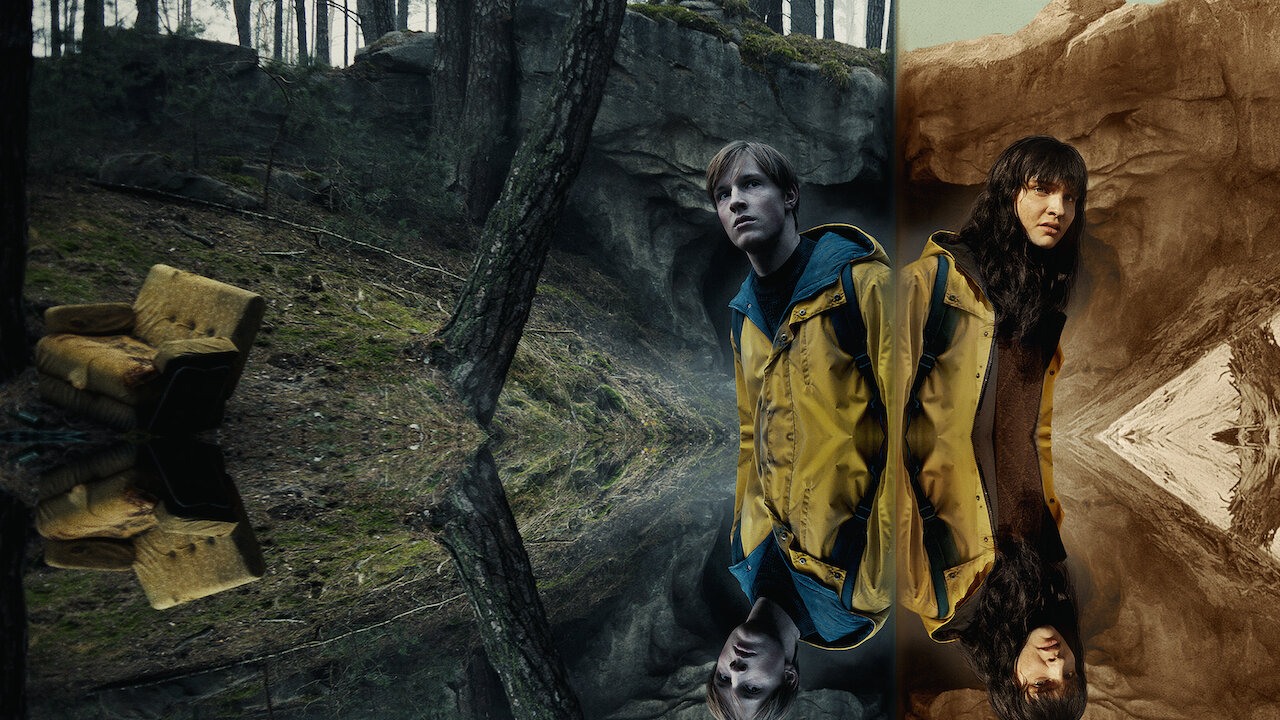
The r/DarK community analysis puts it plainly:
"Jonas and alt-Martha have permanently erased themselves along with their entire knot at the cost of fixing the origin world's course."

But that framing misses what Māori cosmology makes visible.
Jonas and Martha do not sacrifice themselves. They restore their whakapapa. By undoing the knot, they give every person in the Origin World the possibility of a stable pepeha. A mountain that doesn't shift across timelines. A river that runs in one direction. Ancestors who are ancestors and descendants who are descendants, each at their proper coordinates on the helix.
Hannah naming her unborn child Jonas is not coincidence and not sentimentality. It is the echo that remains after the measurement event. The information is never fully destroyed. The entanglement is never completely erased. Conservation of mauri. Even in the Origin World, something of the pattern persists — transformed, not annihilated. The helix carries forward.
You — reading this, right now — are also at a threshold. The knot in your whakapapa may not span 66 years and two parallel worlds. But it is real. It was placed there by the same forces that placed knots in Jonas Kahnwald's whakapapa: grief without tikanga, power without accountability, systems designed to decohere identity from land and language and lineage.
The path out is the same path. Not a time machine. Not a paradox. The aho tapu — the sacred thread — that was always there, waiting for you to pick it up. Your pepeha is the thread. Your tūpuna are the eyes at one end. Your mokopuna are the eyes at the other. You are the measurement event in the middle.
Tihei mauri-ora.
Kia kaha, whānau. You are not an isolated particle. You never were. Your quantum state is non-separable from every tūpuna who made you possible and every mokopuna whose possibility you are making. That is not religion. That is physics. And now you have eight exercises to prove it.
Koha | Subscribe | Facebook | Bank: HTDM 03-1546-0415173-000
Disclaimer: All quantum physics claims sourced from peer-reviewed and verified scientific sources including Wikipedia on Quantum Entanglement, SpinQ 2025 guides, Nature (2025), and Oxford University analysis of RQM. All whakapapa and Māori identity claims sourced from Massey University research (2024), Academia.edu Whakapapa Ora (2018), Asia Media Centre (2024), Te Ara, and E-Tangata. All Dark plot claims sourced from Dark Fandom Wiki, Vulture, and TV Guide. The interpretive framework connecting quantum entanglement to whakapapa is the author's philosophical analysis — not a claim endorsed by any cited physicist or Māori scholar.