"Your Voting Team Reached The Hospital. Did It Reach The Patient?" - 16 November 2026
Nurses say bedridden patients missed their vote. An official process is not enough: democracy must reach the bedside without making whānau supply the missing service.

"Your Voting Team Reached The Hospital. Did It Reach The Patient?" - 16 November 2026
Mōrena ano Aotearoa,
Five patients in North Shore Hospital’s Elective Surgery Centre. Four in Ward 4. Three in Ward 15.
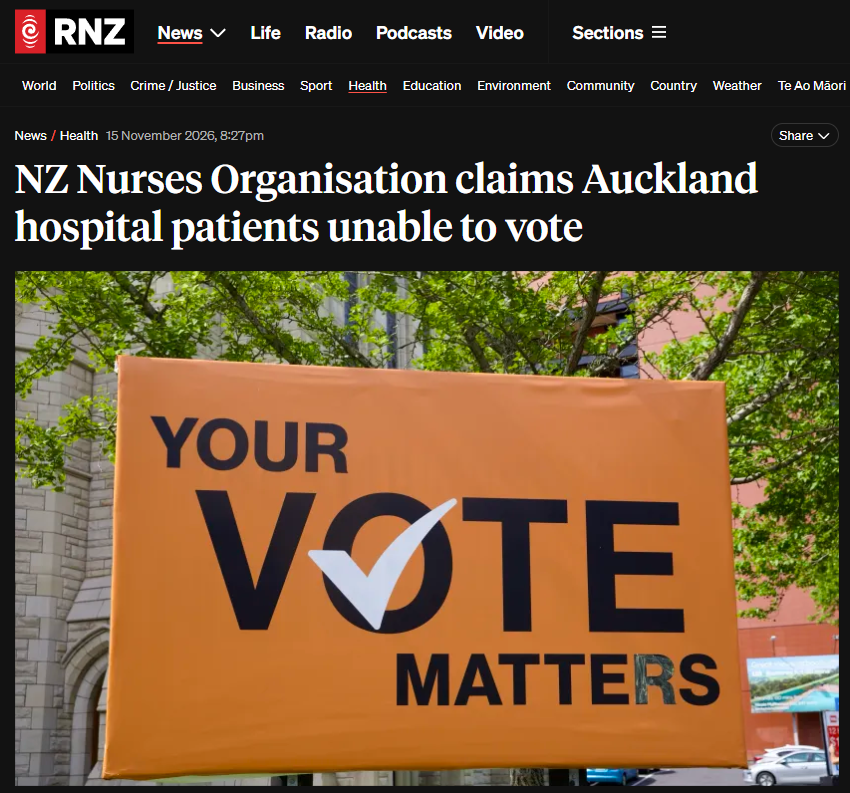
According to New Zealand Nurses Organisation delegate Sophie Tomes, these bedridden patients could not reach the mobile voting team and missed their chance to vote. Those are the cases identified in NZNO’s statement about hospital voting access.
 RNZ | Te Reo Irirangi o Aotearoa
Before the election, the public had been given a different assurance.
Health New Zealand told RNZ that all patients would have voting options, with mobile teams visiting North Shore and Waitākere wards on Friday to assist people unable to reach a polling office. That commitment appears in RNZ’s 5 November report on hospital voting arrangements.
A service promised to reach people who could not get to a polling place. Nurses now reporting people it did not reach.
That contradiction deserves an answer about the patients—not another description of the plan.
NZNO’s account remains an allegation requiring investigation. The union was surveying members at North Shore and Middlemore to establish the extent of the problem when RNZ reported its concerns on 15 November. But uncertainty about the full extent is not a reason to dismiss the specific cases already raised.
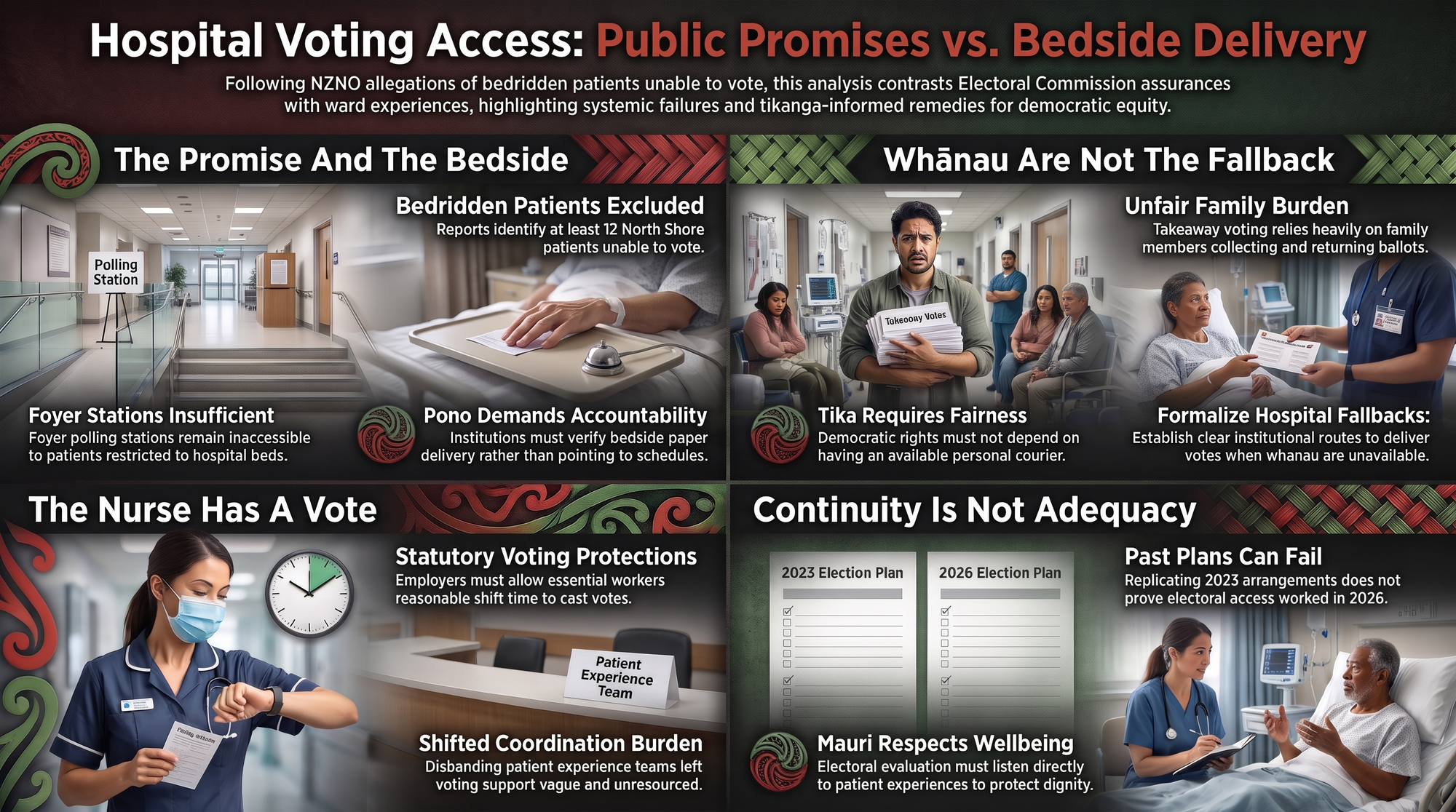
I want the same standard applied to both sides.
Nurses must substantiate what they report. Public institutions must demonstrate what they delivered. Neither a union statement nor an official assurance should be accepted simply because we trust the organisation making it.
A voting team reaching a hospital is not the same thing as a vote reaching a patient.
The Promise And The Bedside
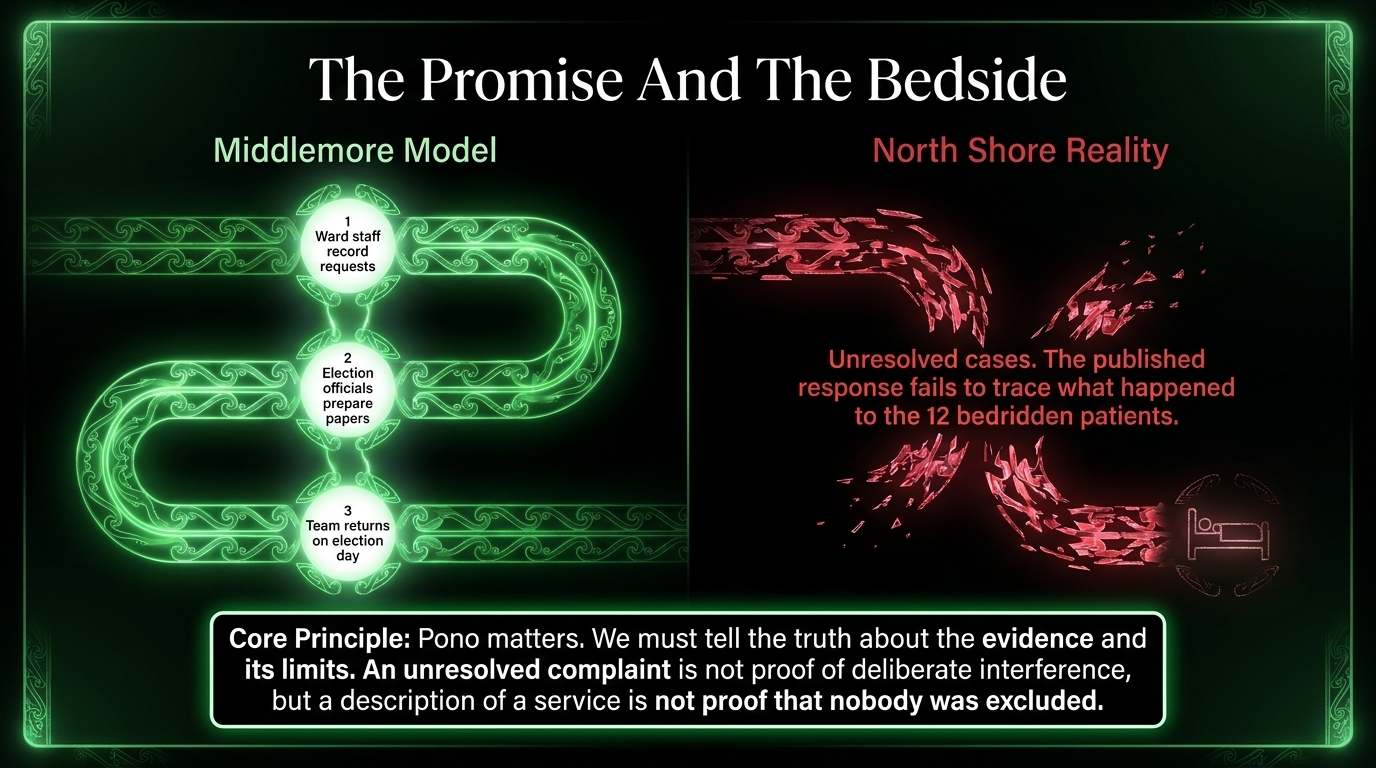
The Electoral Commission’s response described a workable-looking arrangement at Middlemore.
A team attended on Friday 6 November to issue takeaway votes; ward staff recorded patients’ requests and passed their details to election officials, who prepared the papers. The team returned on election day to collect completed votes, according to the Commission’s explanation to RNZ.
That is a substantive response. It establishes that the Commission says a service existed and that its team returned on election day. It also qualifies Tomes’s account that teams were present only on Friday: the published statements differ on that point.
But issuing papers and collecting completed papers are different tasks. A collection visit does not, by itself, establish what help was available to someone still needing papers. Nor does an explanation about Middlemore resolve the cases specifically identified at North Shore. The published response does not trace what happened to those patients.
This is where pono matters: tell the truth about the evidence, including its limits. Do not turn an unresolved complaint into proof of deliberate interference. Do not turn a description of a service into proof that nobody was excluded.
The right at stake is explicit.
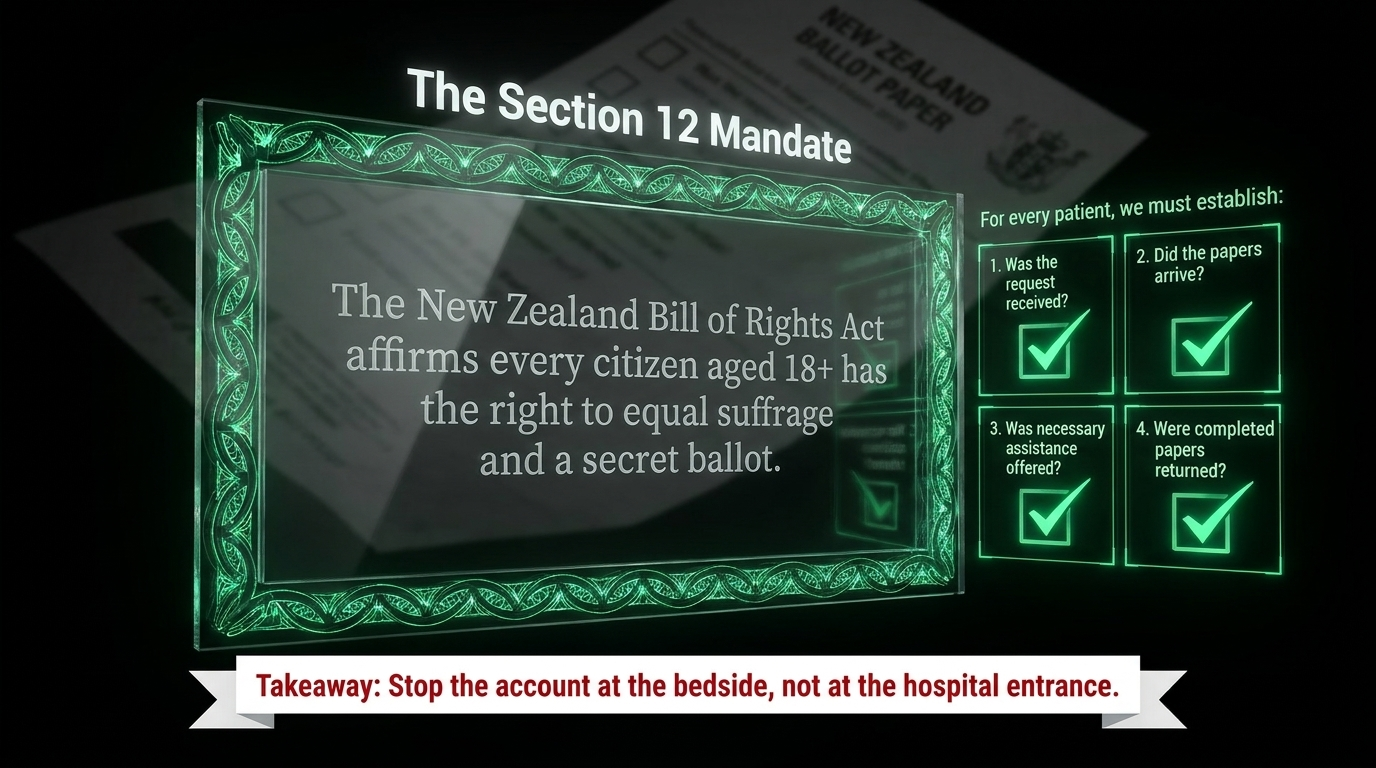
Section 12 of the New Zealand Bill of Rights Act affirms that every New Zealand citizen aged 18 or over has the right to vote in genuine periodic parliamentary elections, with equal suffrage and a secret ballot. The Act protects electoral participation; whether these particular arrangements breached the law would require further evidence and legal assessment.
The practical investigation is more immediate. For each patient who wanted to vote, establish whether their request was received, whether papers reached them, whether necessary assistance was offered and whether completed papers were returned.
That is not an invitation to publish medical histories. It is a demand to follow the service through, with consent where appropriate, instead of stopping the account at the hospital entrance.
There was provision beyond a mobile team. Before the election, Health NZ said North Shore would also have a voting place in its main foyer on Friday, alongside ward visits for patients unable to reach it. Those were the arrangements Health NZ publicly described. The issue is therefore not simply whether a voting place existed. A foyer is still beyond reach for someone who cannot leave their bed.
If NZNO’s account is substantiated, the failure must be located precisely. Was the problem communication, timing, staffing, delivery or an unanswered request? The remedy should follow the evidence.
Another poster announcing that voting is available will not repair a broken handover.
The Deep Dive Podcast
Listen to a lively conversation between two hosts, unpacking and connecting topics in the sources of this essay. I apologise in advance for the AI's very harsh pronounciation of reo. Please dont shoot me, :).
Youtube Video
Like video? Here is a short video suppporting the essay. Again, don't shoot the messenger please because of AI's pronounciation. :)
Whānau Are Not The Fallback Service
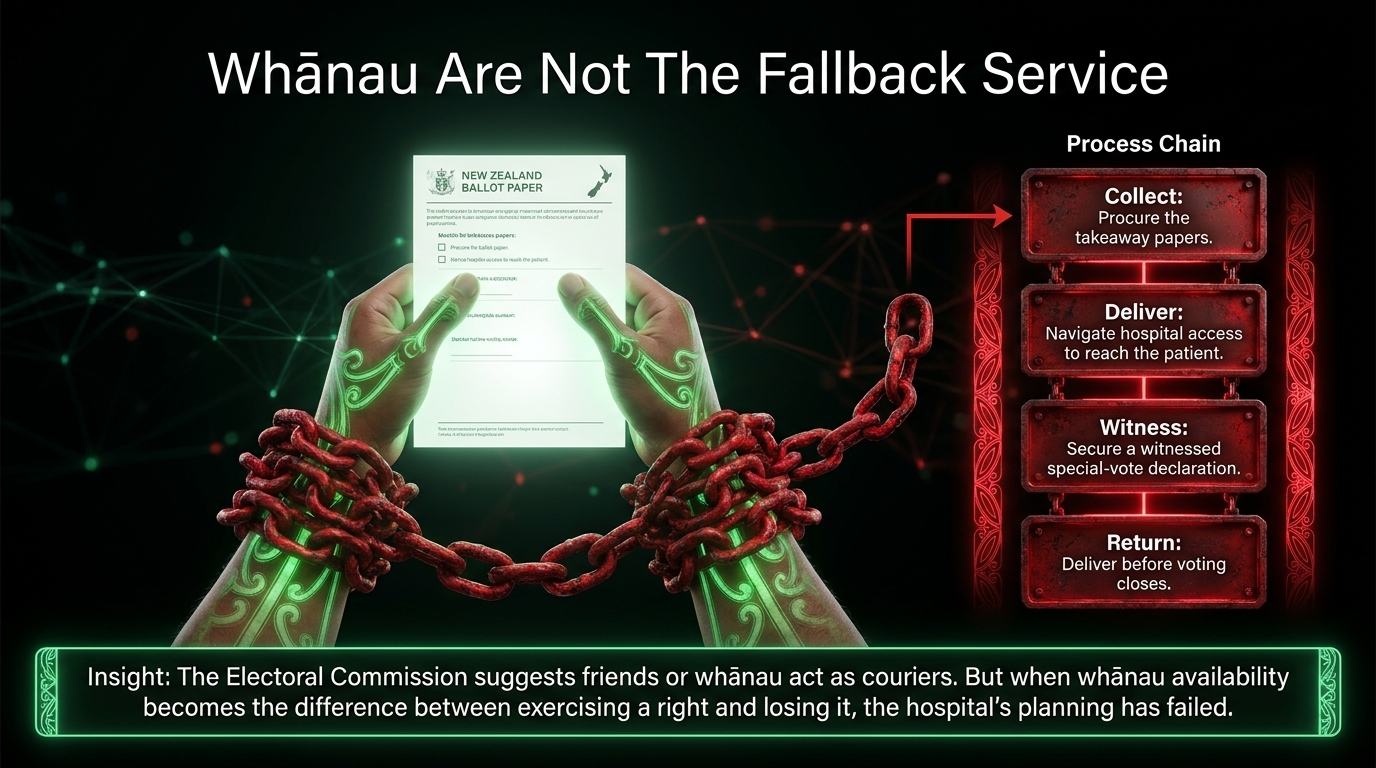
The strongest defence of the arrangements is straightforward: patients do not need a conventional polling booth beside every ward. Other ways of voting exist.
The Commission allows someone unable to reach a voting place to authorise another person to collect their papers. The voter then completes the papers and a witnessed special-vote declaration, and the papers must be returned before voting closes. Its takeaway-voting guidance explains the process.
For hospital patients, the guidance specifically suggests a friend or family member bringing the papers. That is a published option, not something whānau must invent for themselves.
There is nothing wrong with whānau helping. The problem begins if their availability becomes the difference between a right someone can exercise and a right they can only read about.
Look at the work the arrangement requires. Somebody collects the papers, gets them to the patient and ensures they return on time, while the declaration also needs witnessing. Those are practical requirements of the official process. That work does not cease to exist because it happens outside an agency’s staffing arrangements.
The Commission does recognise people without someone available to collect papers. It directs them to their electorate manager, says arrangements will be made, and adds that delivery and collection “may be possible”. That fallback appears in its accessibility guidance.
A route to help is welcome. Uncertainty about whether the papers can actually be delivered is what hospital planning should resolve.
The practical alternative is not mysterious. Build that fallback into the hospital’s arrangements. Give patients and staff a clear way to activate it. Assign responsibility for unresolved requests. Make sure someone checks that assistance arrived.
That is how I apply tika here: not merely whether an option was offered, but whether the arrangement was fair and somebody could be held answerable for its delivery.
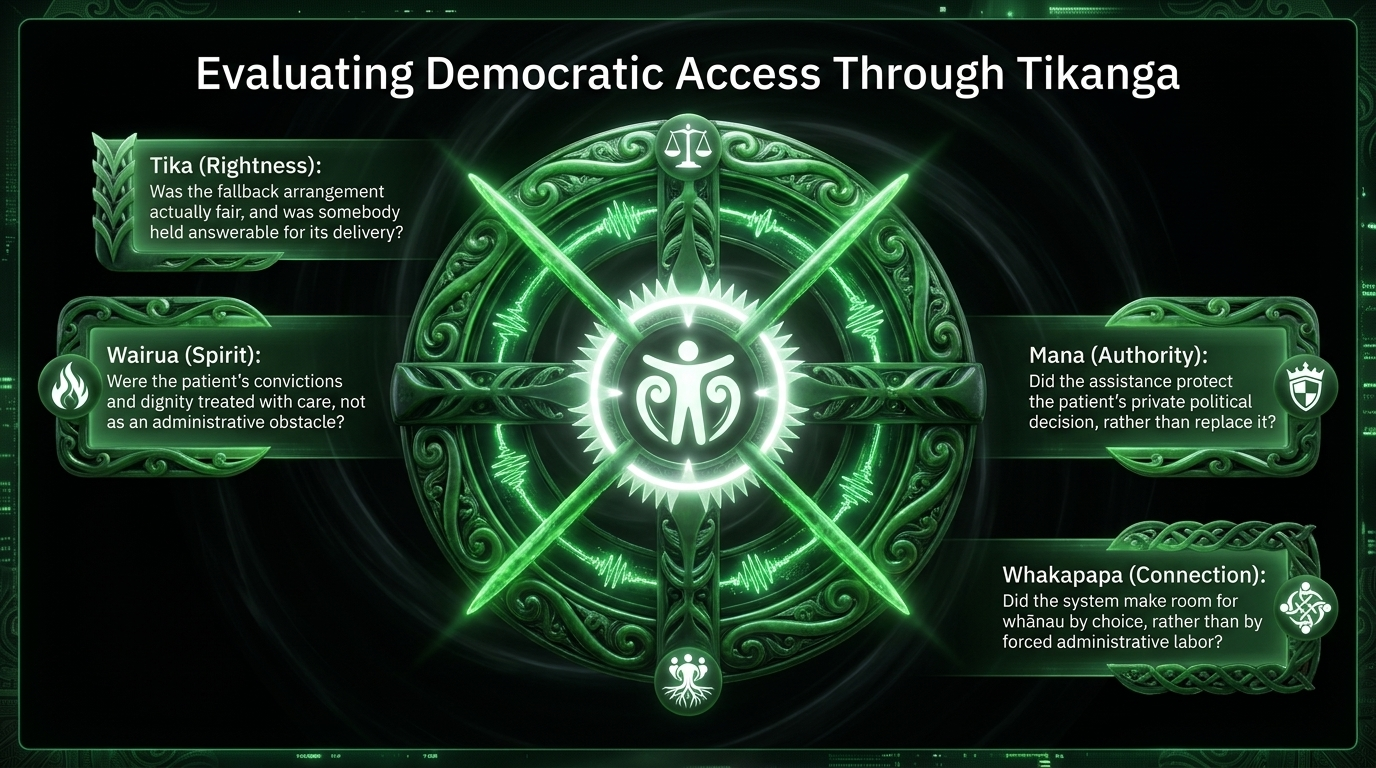
Tikanga demands more than a tidy transaction.
In this argument, it means attending to the person’s mana, relationships and authority over their own decision. Recognising whakapapa means making room for the people a patient wants involved—not assuming every patient has an available courier. Respecting wairua means approaching the person’s convictions and dignity with care, not treating them as an administrative obstacle.
Whānau involvement should be meaningful and chosen. Assistance should protect the patient’s private political decision, not replace it.
I made a related argument in “I Wanted A Māori Movement, Not Another Political Machine”: protecting an organisation is not the same thing as protecting the people it exists to serve. The same discipline belongs here. The institution does not get to mark its own homework by counting a visit while leaving an unanswered request out of the picture.
The Nurse Has A Vote Too
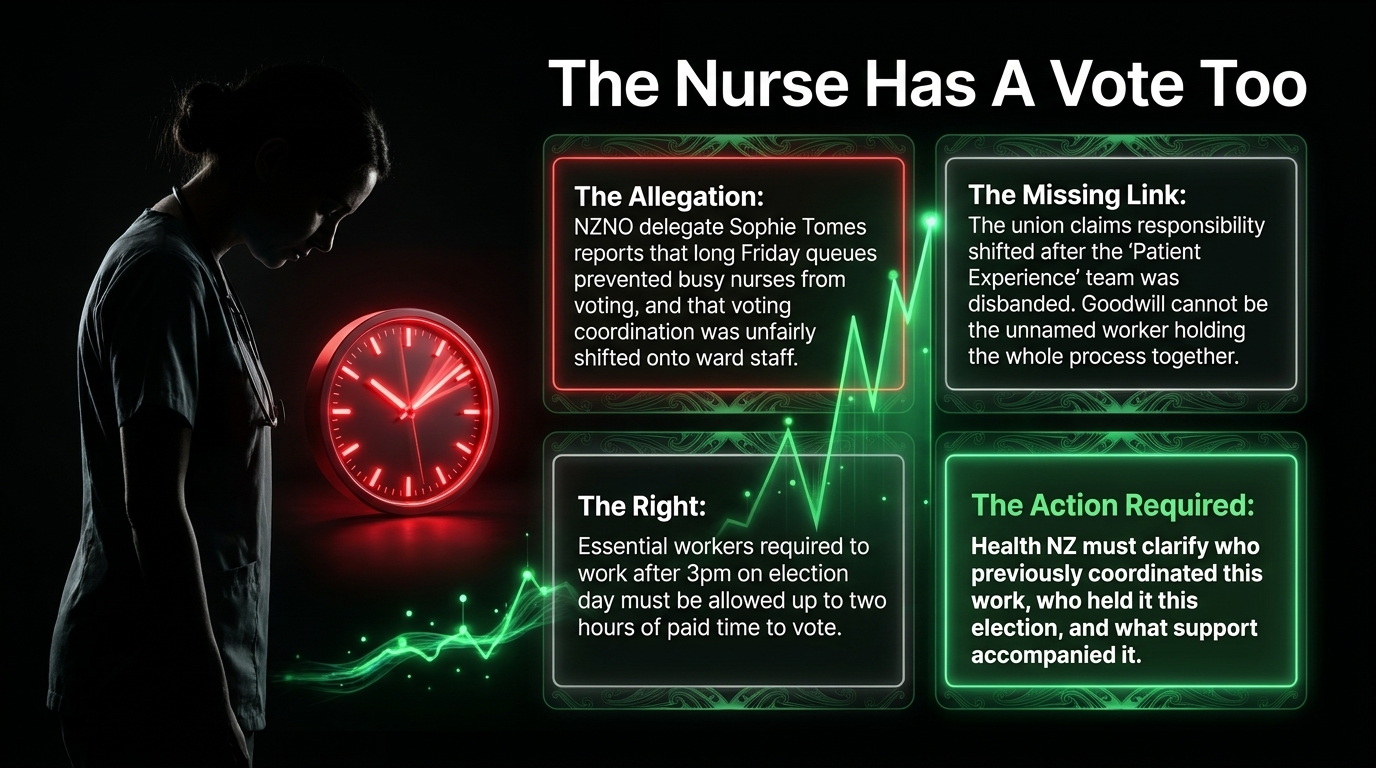
The complaint also reaches the people providing care.
Tomes said long Friday queues prevented busy nurses from voting and that members found participation harder than at previous elections. Those are NZNO’s reported concerns, not an established count of nurses who missed out.
Neither the union statement nor RNZ’s report establishes each nurse’s shifts, earlier opportunities or any particular employer’s compliance with the law. The published account does not resolve those circumstances.
There is, however, an existing protection to investigate.
The Commission says essential workers required to work after 3pm on election day must be allowed reasonable time earlier that day to vote; employers cannot deduct pay for that voting time where it does not exceed two hours. Its workplace guidance sets out those protections.
That gives employers a practical starting point: plan cover, tell staff how voting time will work, and investigate when someone says the opportunity was unusable. Pointing to advance voting should not substitute for checking the election-day protection that applies.
The patients’ complaint and the nurses’ complaint are distinct.
They may have different explanations. But both require an account of access as people experienced it, not as it appeared on a schedule.
NZNO’s original statement raises another consequential allegation: the union understands responsibility for organising patient voting shifted onto nurses after a Patient Experience team was disbanded. It also reports distressed patients and additional work for nurses. Those claims appear in the union’s own release.
That is a lead for investigation, not an established explanation of the missed votes.
Health NZ should clarify what changed, who previously coordinated the work, who held that responsibility this election and what support accompanied it.
If a function was transferred, the transfer needs examining. If the union’s understanding is wrong, correct it with records. What is not acceptable is leaving the responsibility vague while patients and nurses carry the consequences.
At Middlemore, ward staff were expressly part of the process the Commission described: they received requests and passed details to election officials. That handover was built into the arrangement. Their role therefore needed clear instructions, adequate support and an understood point at which election officials took over.
Goodwill cannot be the unnamed worker holding the whole process together.
Continuity Is Not Adequacy
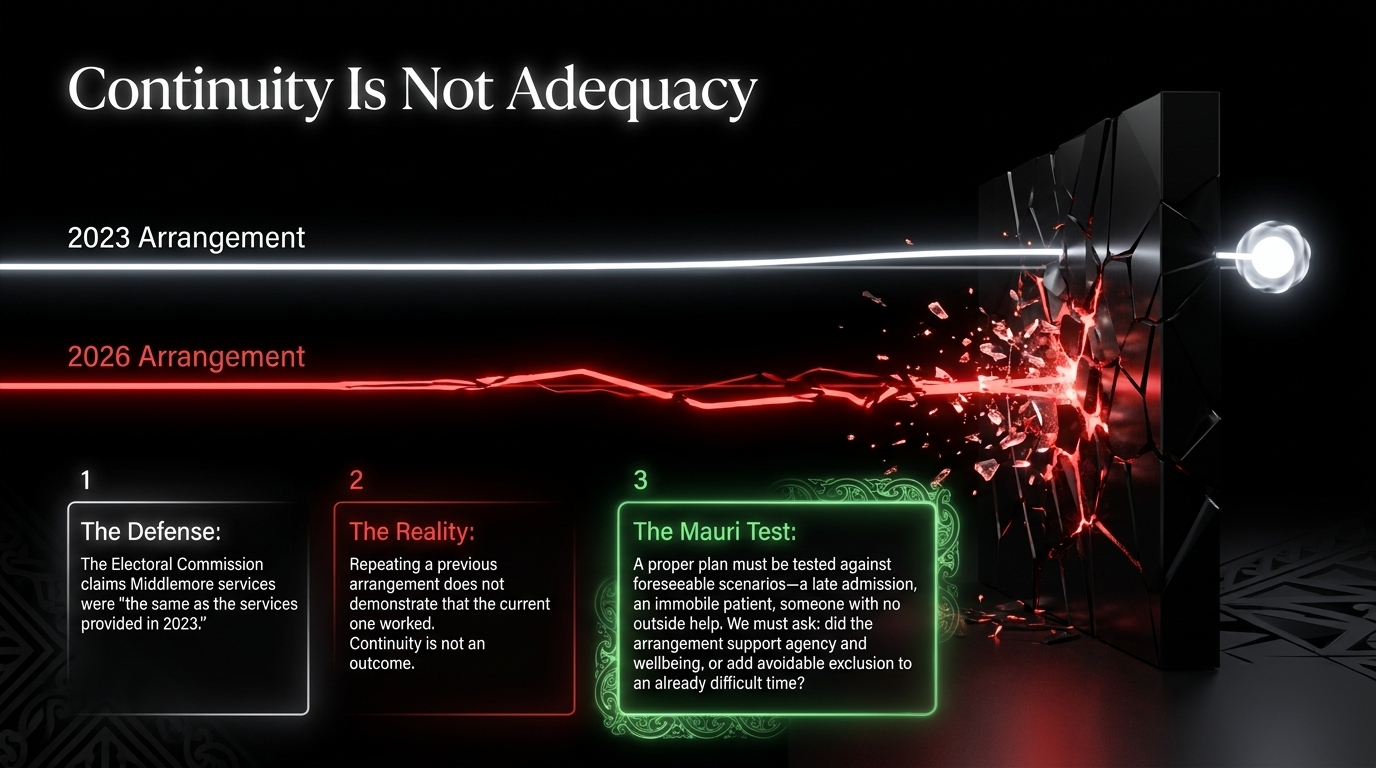
The Commission said Middlemore’s service was the same as in 2023 and that arrangements were worked out with hospitals according to their circumstances and available space. That was its explanation of the service design.
There is a reasonable argument in that.
Different hospitals need different arrangements. A well-run ward service could be more useful to bedridden patients than a polling booth elsewhere in the building. Staff and patient safety belong in the design too; the Commission identified those considerations before the election.
But repeating the previous arrangement does not demonstrate that this one worked. Continuity is not an outcome.
Likewise, the advice to vote before a planned hospital admission is sensible. The Commission recommends advance voting where possible. It cannot answer every access problem arising inside a hospital.
A proper plan should be tested against a late admission, a patient unable to act during the scheduled visit and someone with nobody outside to help. Those are foreseeable planning scenarios, not claims about the individual North Shore cases.
In “Vote For The Future They Keep Calling Impossible”, I argued for judging public provision by what people can actually use. Here, attention to mauri means asking whether the arrangement supported agency, connection and wellbeing—or added avoidable exclusion to an already difficult time.
We cannot assign an emotional or spiritual experience to patients we have not heard from. We can insist that their accounts belong in the assessment. An institution should not decide that a process preserved someone’s dignity without listening to the person.
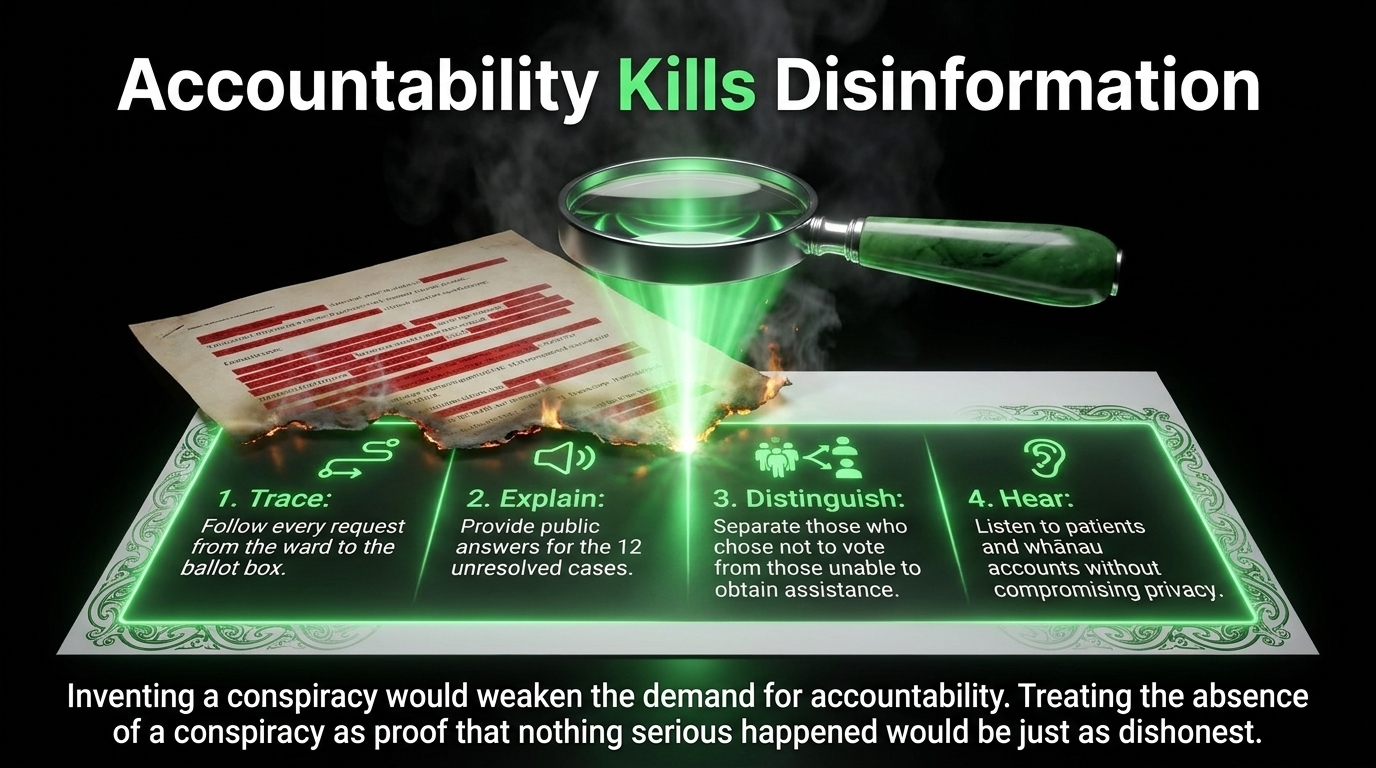
The Electoral Commission and Health NZ should now establish what happened at each hospital. Trace the requests. Explain those left unresolved. Distinguish someone choosing not to vote from someone wanting to vote but unable to obtain assistance. Hear from patients and whānau who wish to contribute, while protecting their privacy.
Then publish the findings, the responsibility and the correction.
The published RNZ report does not establish partisan targeting, deliberate suppression or an attempt to change the result. It records an access complaint and the Commission’s response.
Inventing a conspiracy would weaken the demand for accountability. Treating the absence of a conspiracy as proof that nothing serious happened would be just as dishonest.
If a service failure prevented these patients from voting, it matters whether or not their votes could have changed a seat. Participation is not a privilege reserved for people whose ballots might prove decisive.
I want a system in which a patient can ask for help without having to become their own election organiser. Where whānau can support without becoming the missing public service. Where nurses know their responsibilities and can exercise their own rights too.
The final measure is not whether officials can point to a completed visit.
It is whether the person who wanted to vote was given a usable opportunity to do so. That is where the public promise must be judged: at the bedside, not in the reassurance issued afterwards.
Koha Consideration
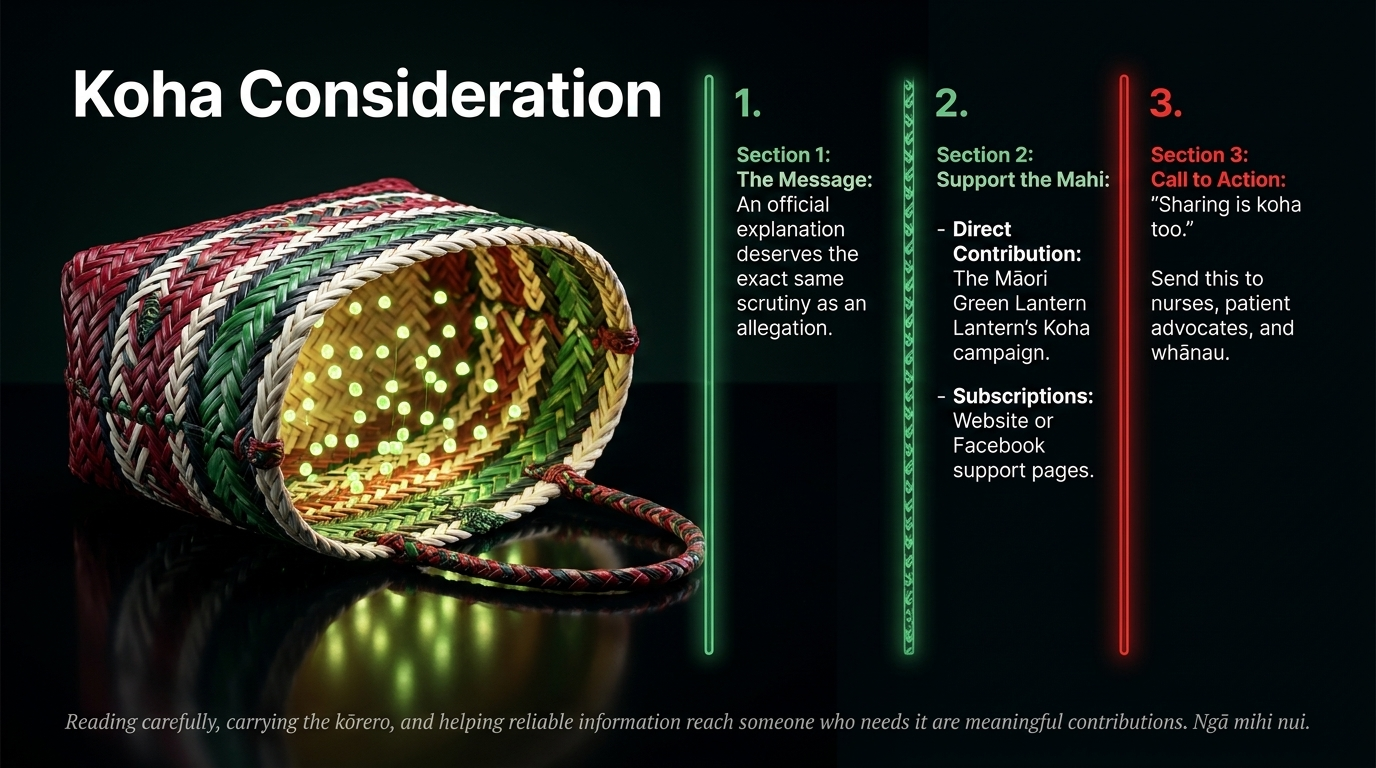
An official explanation deserves the same scrutiny as an allegation. This mahi means reading beyond the headline, checking what was promised and refusing to lose sight of the people carrying the consequences.
If this essay has been useful, please consider supporting The Māori Green Lantern’s research and writing in a way that works for you:
Give a one-off contribution through The Māori Green Lantern’s Koha campaign.
Support through The Māori Green Lantern’s website subscription options.
Make a direct bank transfer using the account details published on the Koha campaign page.
Subscribe through The Māori Green Lantern’s Facebook support page.
Sharing is koha too. Send this essay to a nurse, a patient advocate, someone working in election administration or whānau who want public promises tested against delivery. Share the full link so people can examine the evidence for themselves.
Please do not put a financial contribution ahead of kai, power, rent or your whānau’s needs. Reading carefully, carrying the kōrero and helping reliable information reach someone who can use it are meaningful contributions.
Your support helps keep this work focused on the question that matters: not whether power has an explanation, but whether that explanation stands up.
Ngā mihi nui.
Disclaimer: This essay is public-interest commentary, not a legal finding. Claims that patients were unable to vote are attributed to NZNO and considered alongside the Electoral Commission’s published response. The essay calls for investigation and accountability; it does not establish individual legal liability or allege deliberate electoral interference.