"Words Are Not Enough: A Challenge to Tania Waikato, Kerrin Leoni, and Hāley Maxwell" - 20 April 2026
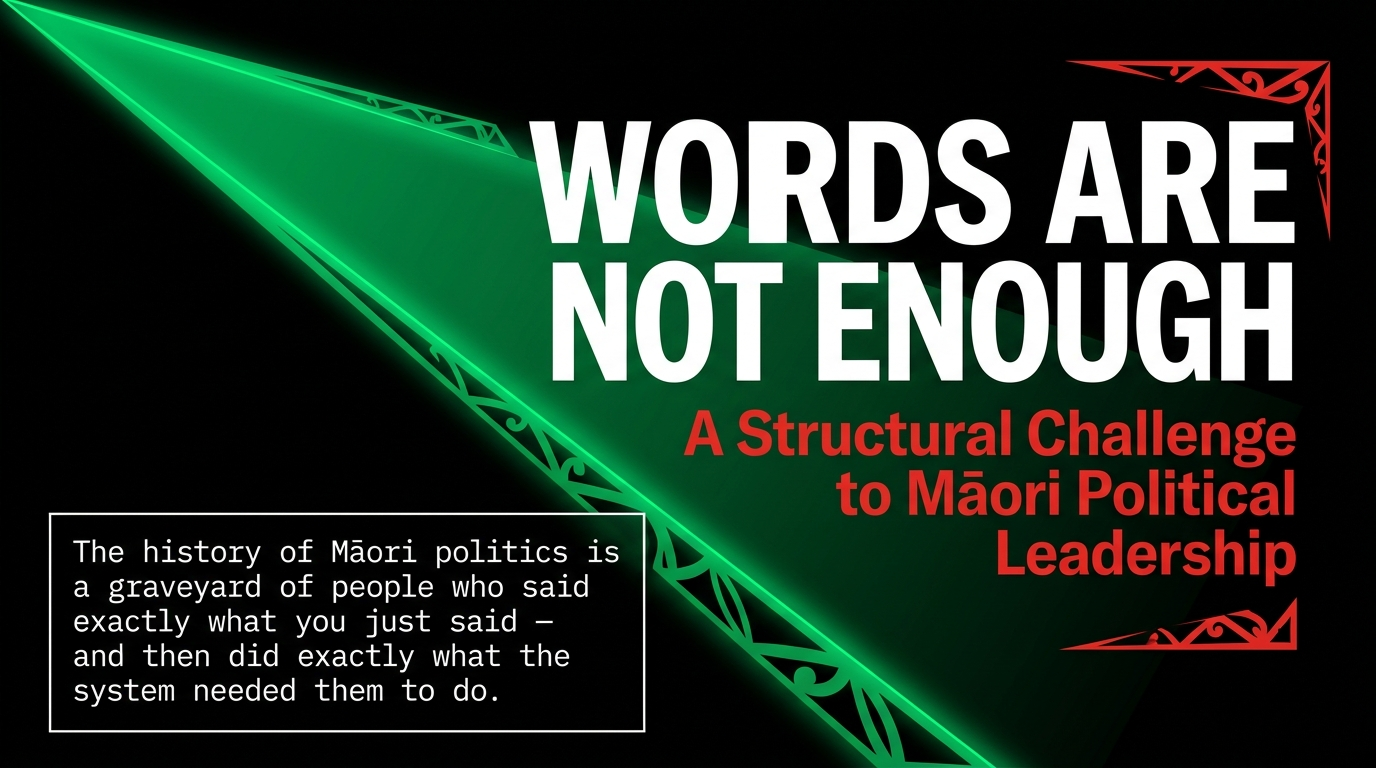
You said the right things. You wore the right korowai. You invoked the right tūpuna. Now prove it. Because the history of Māori politics is a graveyard of people who said exactly what you just said — and then did exactly what the system needed them to do.


Kia ora Aotearoa,
This essay is an act of aroha. It is also an act of challenge.
Because genuine aroha — the kind that comes from your tūpuna, not from a campaign donor — does not flatter you into complacency. It holds you to account before you get the power to betray us, not after.
Tania Waikato. Kerrin Leoni. Hāley Maxwell. You sat across from Moana Maniapoto and you delivered exactly what the audience needed to hear. Eloquent. Grounded. Māori. Righteous.
The Deep Dive Podcast
Listen to a lively conversation between two hosts, unpacking and connecting topics in the sources of this essay.
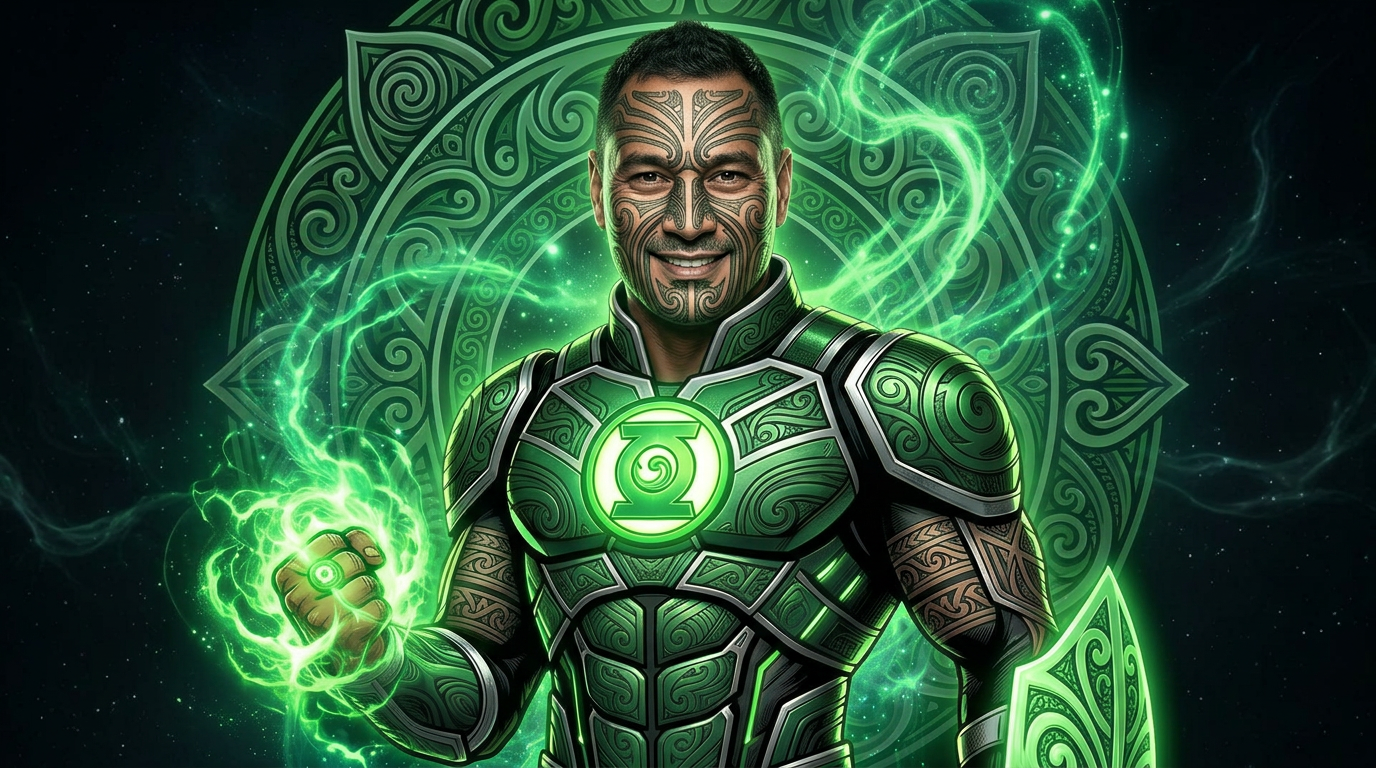
And this ring has watched enough Māori politicians deliver exactly that performance — and then walk into a caucus room and trade their people's bottom lines for a ministerial warrant, a committee chair, or the word
"friends."
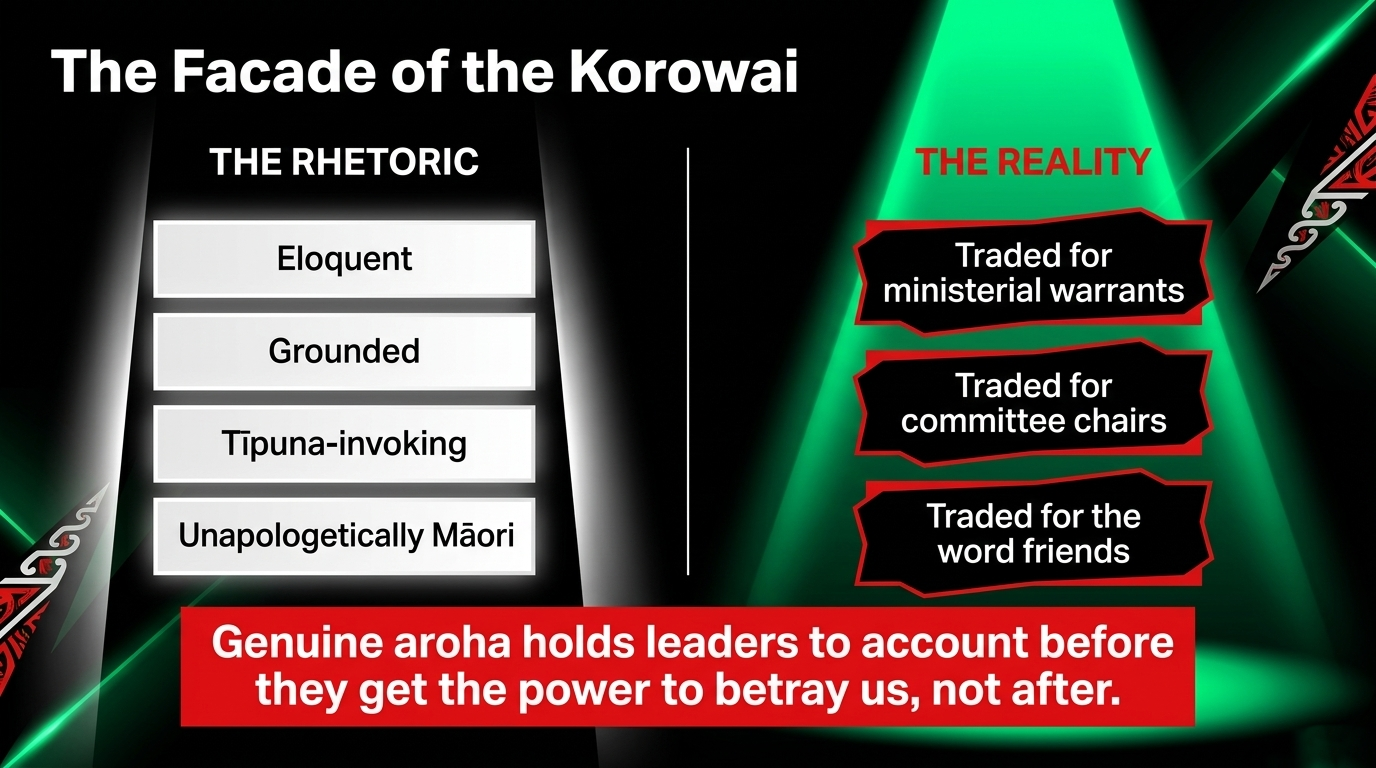
So let's have the harder conversation. The one Moana didn't have time for. The one your campaign managers would prefer not to have. The one your tūpuna — the ones who actually paid the cost — are demanding right now.
The Māori Green Lantern's He Hinaki Māori names the trap precisely:
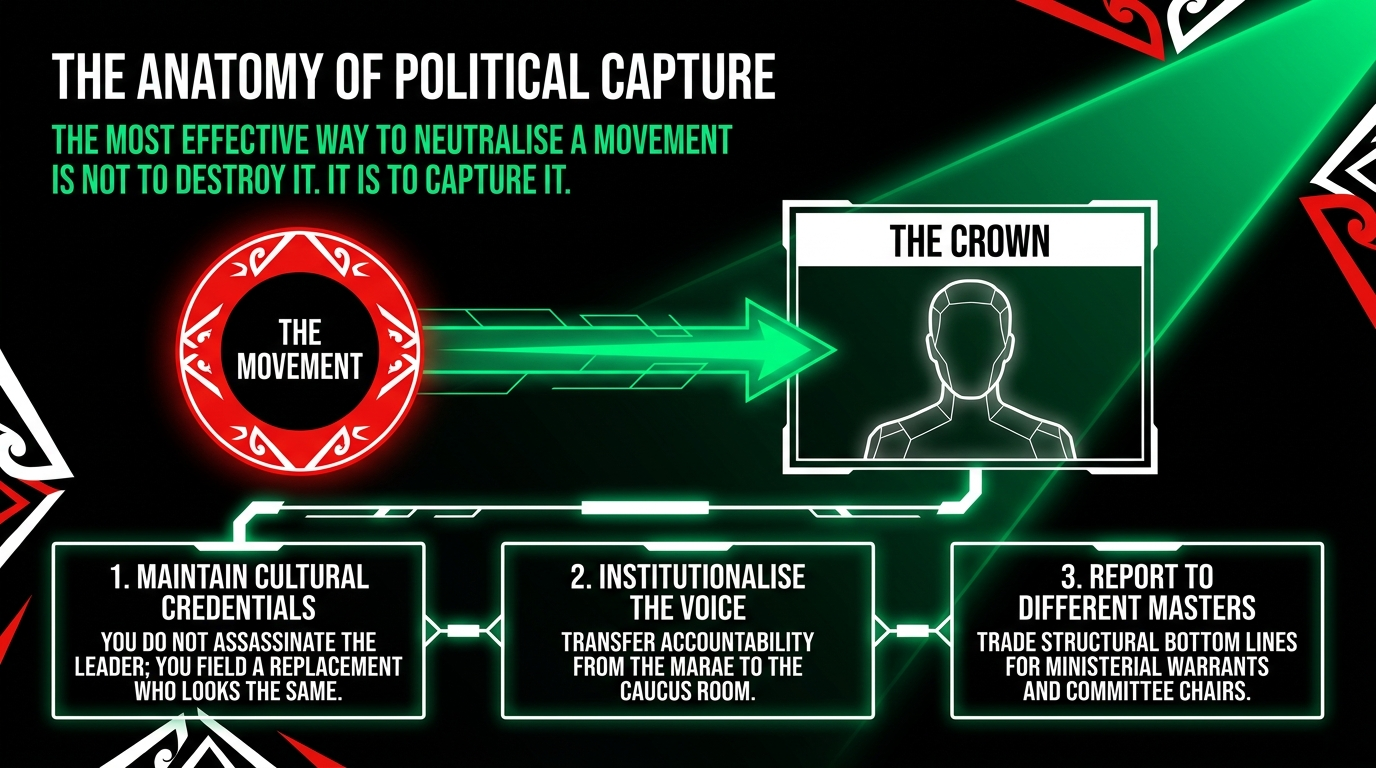
"the most effective way to neutralise a movement is not to destroy it — it is to capture it. You do not assassinate the leader. You field a replacement who looks like the leader, carries the same cultural credentials — but reports to different masters."
That essay was written about someone else. But the question it asks belongs to all three of you.
Hāley Maxwell: Your Tā Moko Is Not a Credential — It Is a Covenant
You said it yourself: your tā moko is political. Twenty years of kāwai and kopapahaerenga. The embodiment of your tūpuna's dreams. We hear you. We see you. And because we see you — we must ask the question your tā moko demands you answer.
Your rhetoric is the most powerful in this room. Your evasion is the most dangerous.
You were asked — directly, clearly, on camera — what happens when your hapū and your party diverge.
Your answer:
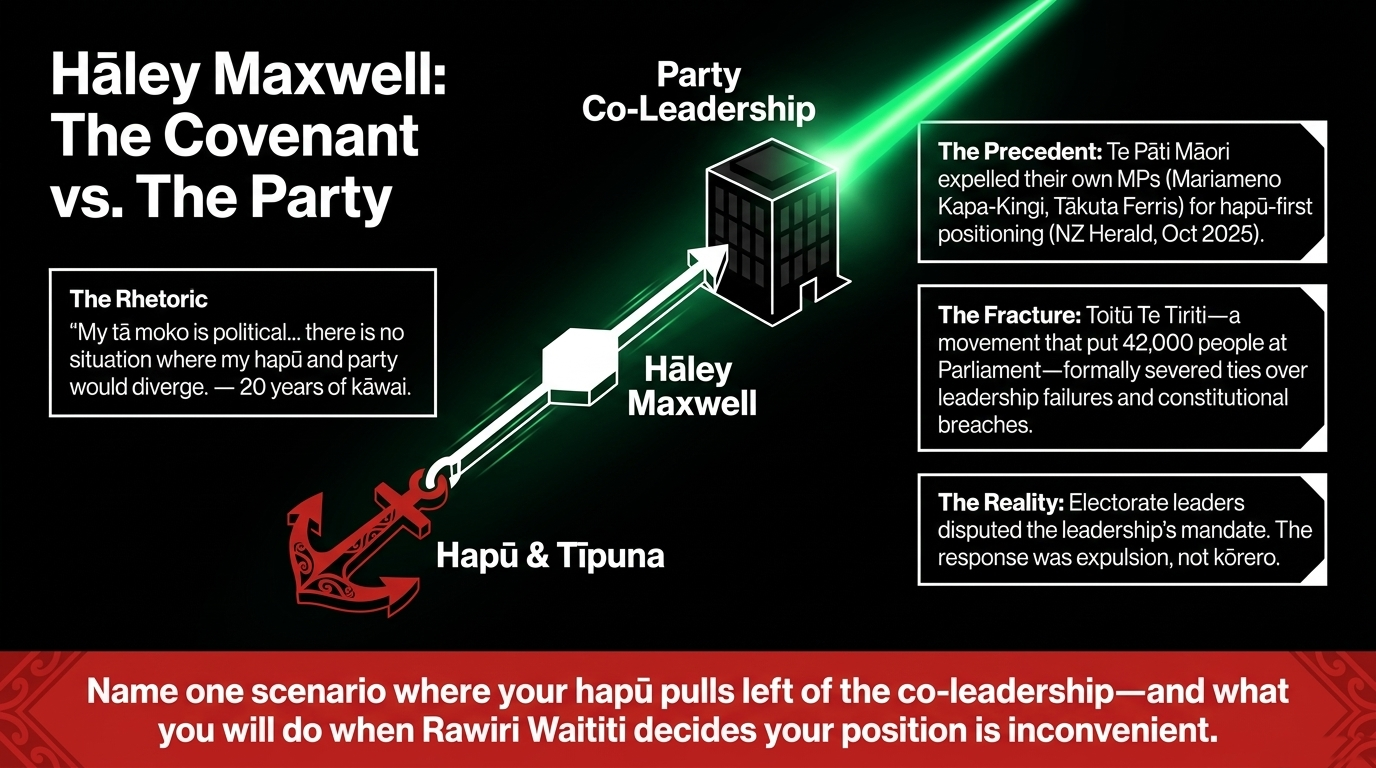
"My answer is always that I really don't think there's a situation where that would happen."
That is not a political answer. That is a pre-election loyalty pledge dressed up as confidence. And Māori voters — who watched Te Pāti Māori's own co-leadership expel Mariameno Kapa-Kingi and Tākuta Ferris for exactly that kind of hapū-first positioning — know precisely what happens when the answer turns out to be wrong, as NZ Herald's October 2025 investigation documented in devastating detail. The party expelled its own MPs — two people who were, by every community measure, closer to the kaupapa than the co-leadership that removed them.
You are entering that institution. You are defending it in this panel. And you are saying, without irony, that you will not face the same choice those women faced.
The challenge: Name one scenario where your hapū would pull you left of Te Pāti Māori's co-leadership — and tell us what you would do. Not hypothetically. With specificity. Because your tā moko is a covenant with your tūpuna — and your tūpuna did not mark you to become the party's cultural credential. They marked you to be accountable to them. Those are not the same thing.
Te Pāti Māori's founding promise was hapū before party. As Te Ao News' November 2025 analysis confirms, electorate leaders were already disputing the leadership's mandate before the AGM. The co-leadership's response was expulsion, not kōrero. If that happens to you — if Rawiri Waititi decides your hapū's position is inconvenient — what will you do? The ring does not ask this to undermine you. It asks because the answer is the most important thing you will ever say publicly before this election.
And on performative politics: you defended Te Pāti Māori's "theatrics" as engagement. The haka at the Treaty Principles Bill reading was historic. It was documented globally. But the Māori Green Lantern's He Hinaki Māori essay documents that Toitū Te Tiriti — the movement that produced 42,000 people at Parliament — formally severed ties with the party, citing "leadership failures and constitutional breaches." The people who organised the hīkoi left the building. Calling that "settled" is not analysis. It is brand management. Your people deserve more than brand management.
Kerrin Leoni: Proximity to Power Is Not the Same as Power — and You Know This
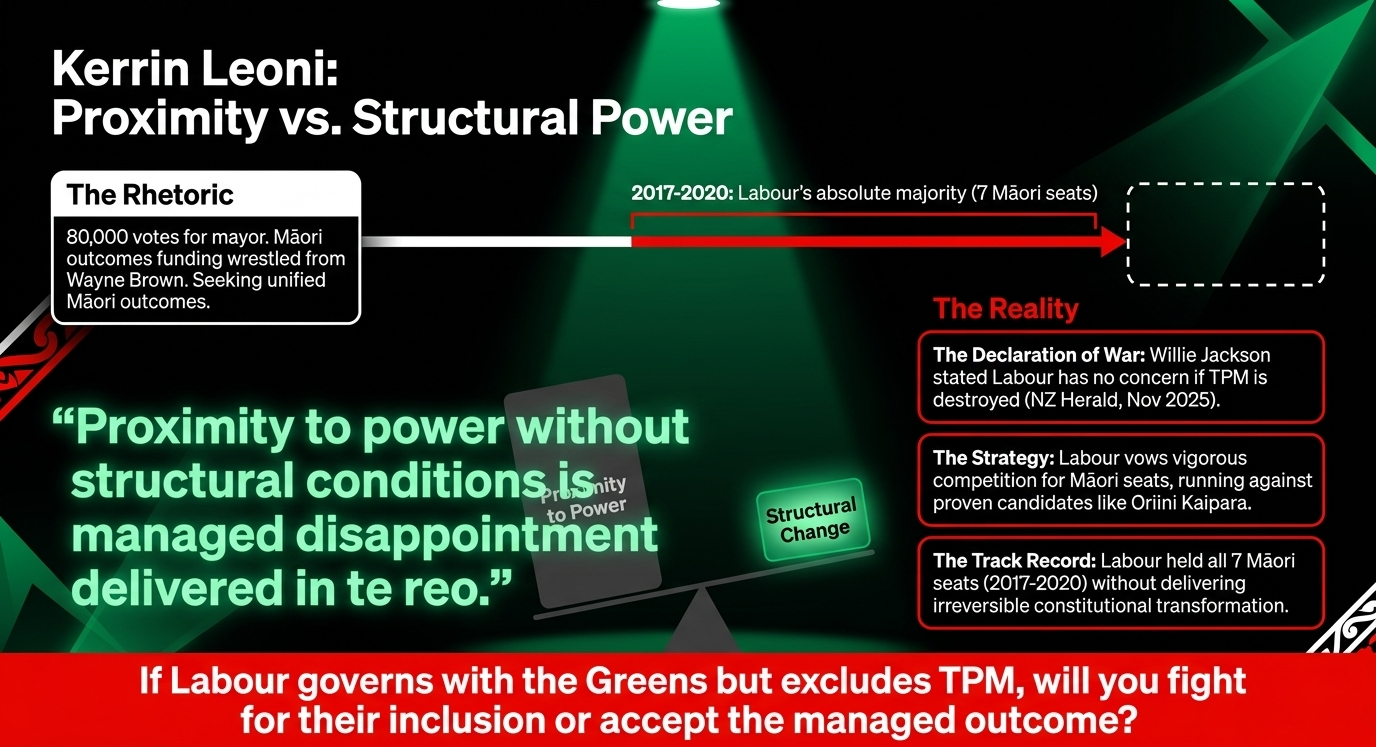
You are the most experienced politician in this room. That is not flattery — it is context for the challenge. Seven years of campaigns. Five races. Eighty thousand votes for mayor. Wayne Brown's Māori outcomes funding wrestled from the tightest fist in Auckland. This is not nothing.
But your party has declared war on the people you say you want to work alongside — and you have not named that contradiction once.
As NZ Herald reported in November 2025, Willie Jackson — your senior colleague, the man who built his career on Māori broadcasting — said Labour has "no concern" if Te Pāti Māori is destroyed at the 2026 election. He said this out loud. On record. With no subsequent correction from your leader. And as Labour's own February 2026 statement via Te Ao News confirms, the party has vowed "vigorous competition" in winning the Māori seats — a euphemism for electoral annihilation of the party most trusted by Māori voters.
You are running against Oriini Kaipara. A woman who won the Tāmaki Makaurau by-election as confirmed by NZ Herald. A woman standing for the same people you say you want to serve. And your party's strategy is not to offer better policy for Māori — it is to destroy the institutional vehicle through which Māori political independence has been most recently expressed. You told Moana that you, Tania, and Hāley have more in common than different. You told her you already worked with Tania to push the Treaty Principles Bill pushback. And then your party's senior MP told the country he doesn't care if Te Pāti Māori — Hāley Maxwell's waka — is obliterated.
Do you see the contradiction? Because Māori voters do.
The challenge: In this panel, you said your bottom line — what would make you walk from Labour — is something you haven't yet identified because "all of the things that I have believed in in terms of the Labour Party we're actually on the same trajectory." That is not a bottom line. That is a blank cheque. Tania Waikato named constitutional transformation as her unambiguous bottom line. What is yours? And specifically: if Labour wins government and refuses to enter coalition with Te Pāti Māori — choosing instead to govern alone or with the Greens while TPM is excluded — will you fight for their inclusion? Or will you accept the managed outcome your party's strategists have been architecting since 2025?
You said the right thing about the cost of living. About Māori in prison. About Treaty settlements. But as the Māori Green Lantern's He Hinaki Māori analysis documents in the context of another Labour Māori seat campaign: "proximity to power without structural conditions is managed disappointment delivered in te reo." Labour had all seven Māori seats from 2017 to 2020. It had the numbers. What constitutional transformation did it deliver? Name one structural change that this government could not reverse. Because The Spinoff's February 2026 analysis notes that a new generation of Māori voters "no longer defaults to loyalty." They are watching. And your party's war on their preferred vehicle is the loudest thing Labour has said to them in years.
Tania Waikato: Your Argument Is Correct. Your Party's Practice Is Not Yet Consistent With It.
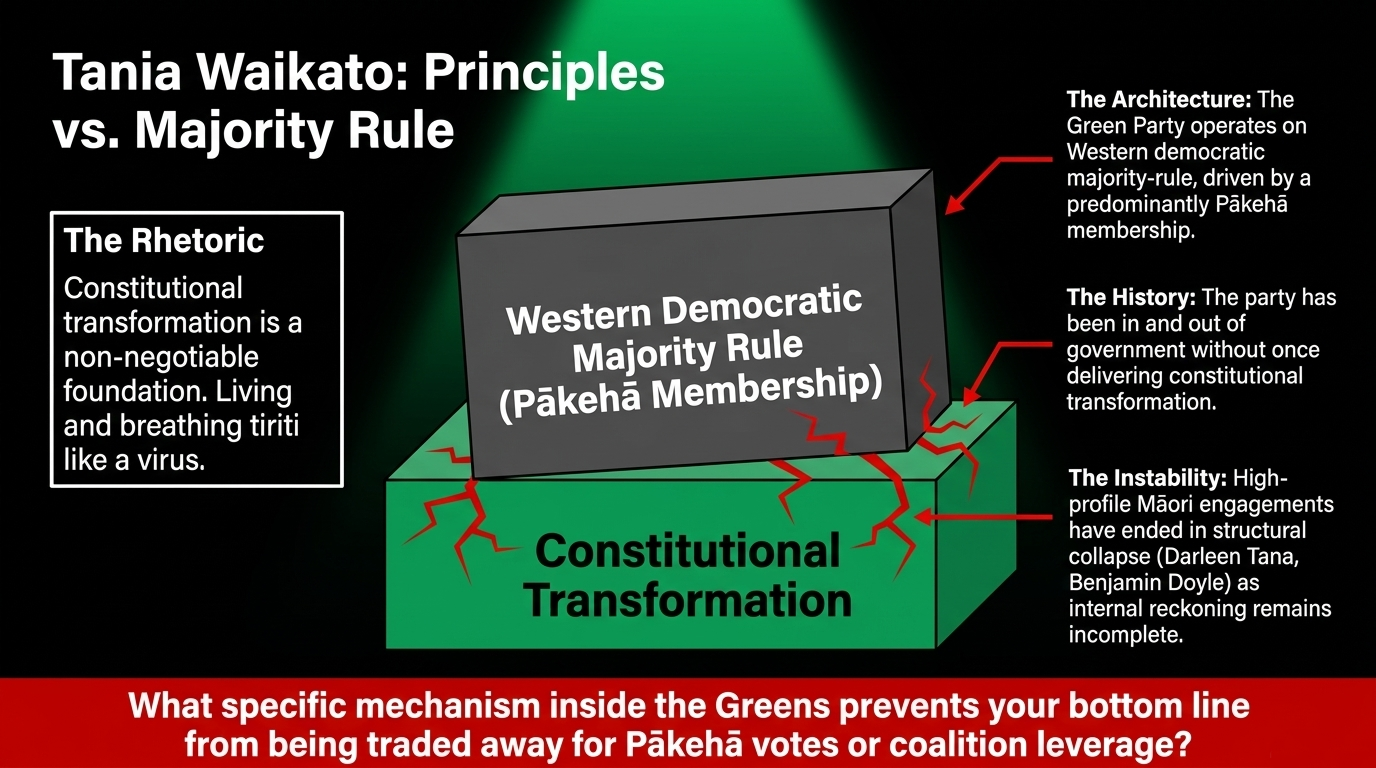
Of the three, your rhetoric is the most structurally honest. Constitutional transformation as non-negotiable foundation. The virus metaphor — living and breathing tiriti, not just performing it in institutional spaces. The direct naming of Winston Peters. The refusal to pretend that numbers of Māori in Parliament substitute for Māori working for their people. This ring endorses every word.
And that is precisely why your Green Party's internal architecture must be named alongside it.
You told Te Ao News that the Greens' foundational placement of tiriti within the entire party framework was "the seller" for you. You said: "I know where my people sit and where particularly my hapū sit — which is always to back me 100%." That confidence is hard-earned. But the Green Party does not operate from tikanga. It operates from Western democratic majority-rule. It has 14 Māori candidates in 2026 as the Greens confirmed in March — a genuine structural commitment. But its membership is predominantly Pākehā, its list process is majority-vote, and its caucus decisions in government will be weighted by that composition.
Constitutional transformation — your explicit bottom line — is a challenge to Pākehā constitutional privilege. When that bottom line costs the Greens Pākehā votes or coalition leverage, will the party hold? The Greens have been in and out of government without once delivering constitutional transformation. As the Māori Green Lantern's Van Velden Vanishing essay documents, the collapse of political personnel signals structural instability across the board — and the Greens are no exception. Darleen Tana. Benjamin Doyle. Several sitting MPs dropped in the draft list as NZ Herald reported in March 2026. The internal reckoning is not complete.
The challenge: You said constitutional transformation must "spread like a virus — starting in the home." Correct. Necessary. Urgent. Now tell us: what specific mechanism inside the Green Party prevents that bottom line from being traded away in coalition negotiations, the way every previous coalition trade has softened the hardest Māori rights commitments? What constitutional commitment from the Greens is non-negotiable — locked in, not subject to caucus compromise? Because your argument is the foundation. But a foundation requires walls. Where are the walls?
And this must also be said: you chose the Greens — at least in part — because Te Pāti Māori's internal collapse made it an unreliable vessel. That was honest and principled. But you are still asking Māori voters in Waiariki — Rawiri Waititi's home ground — to vote for a party whose most recent high-profile Māori engagement ended in scandal. You cannot ask for that trust without acknowledging the weight of it.
The Challenge They All Share: What Happens When the Waka Hits the Toherā?
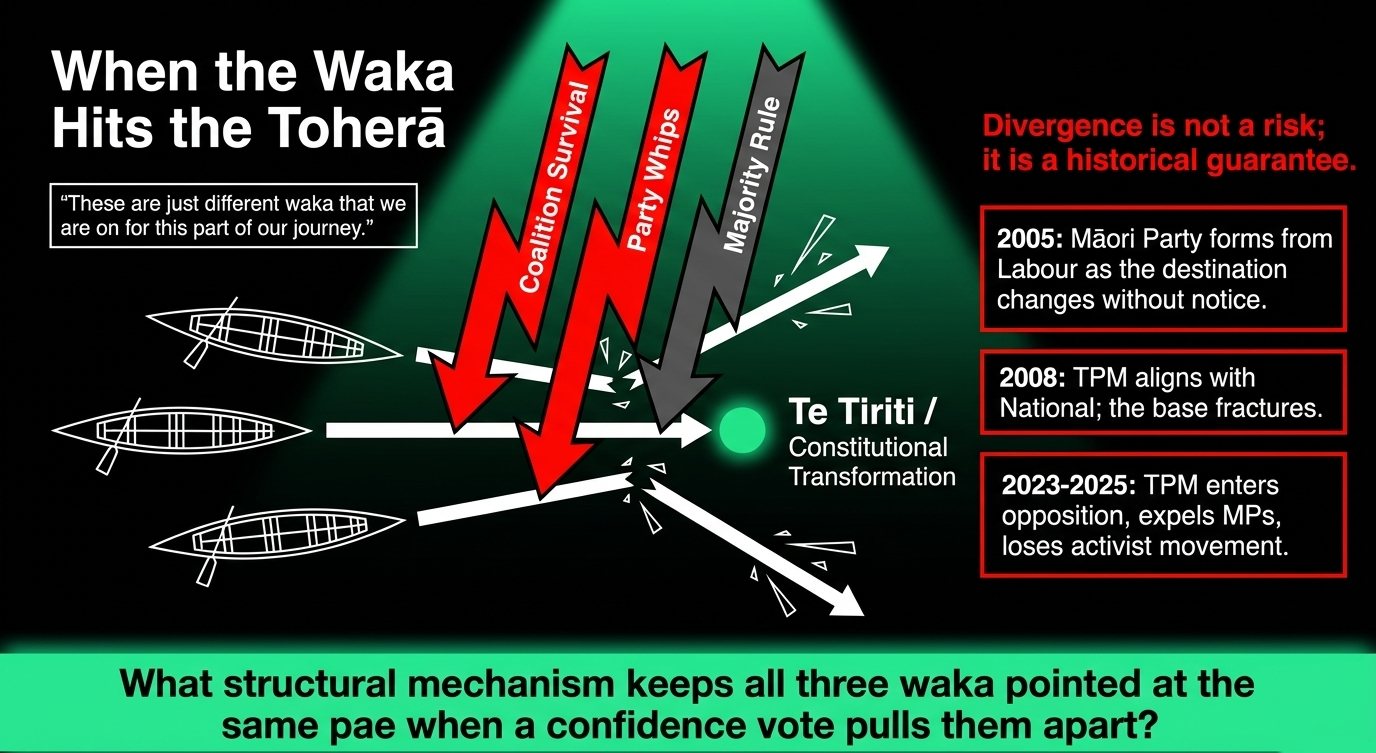
All three deployed the waka metaphor.
Different waka, same destination.
It is a beautiful frame. The ring respects it — and then presses it.
Waka do not always converge. The history of Māori political coalitions is a history of convergence promised and divergence delivered. In 2005, the Māori Party was founded because Māori in Labour's waka realised the destination had changed without notice. In 2008, the Māori Party went into confidence and supply with John Key's National government and watched their base fracture. In 2023, Te Pāti Māori held six seats, entered opposition, and then — within two years — expelled two of its own MPs, lost its activist movement, and went to its AGM unable to elect a Vice President as documented across NZ Herald's October 2025 investigation, Te Ao News' November 2025 analysis, and the Māori Green Lantern's December 2025 reckoning.
The question is not whether you are on different waka.
The question is:
what structural mechanism keeps all three waka pointed at the same pae when a coalition negotiation, a confidence vote, or a party leadership decision pulls them apart?
None of you answered that. Moana didn't push it. But your tūpuna are pushing it. The mokopuna you invoked are pushing it. And this ring is pushing it
— because the answer to that question is the difference between constitutional transformation and another three years of managed disappointment.
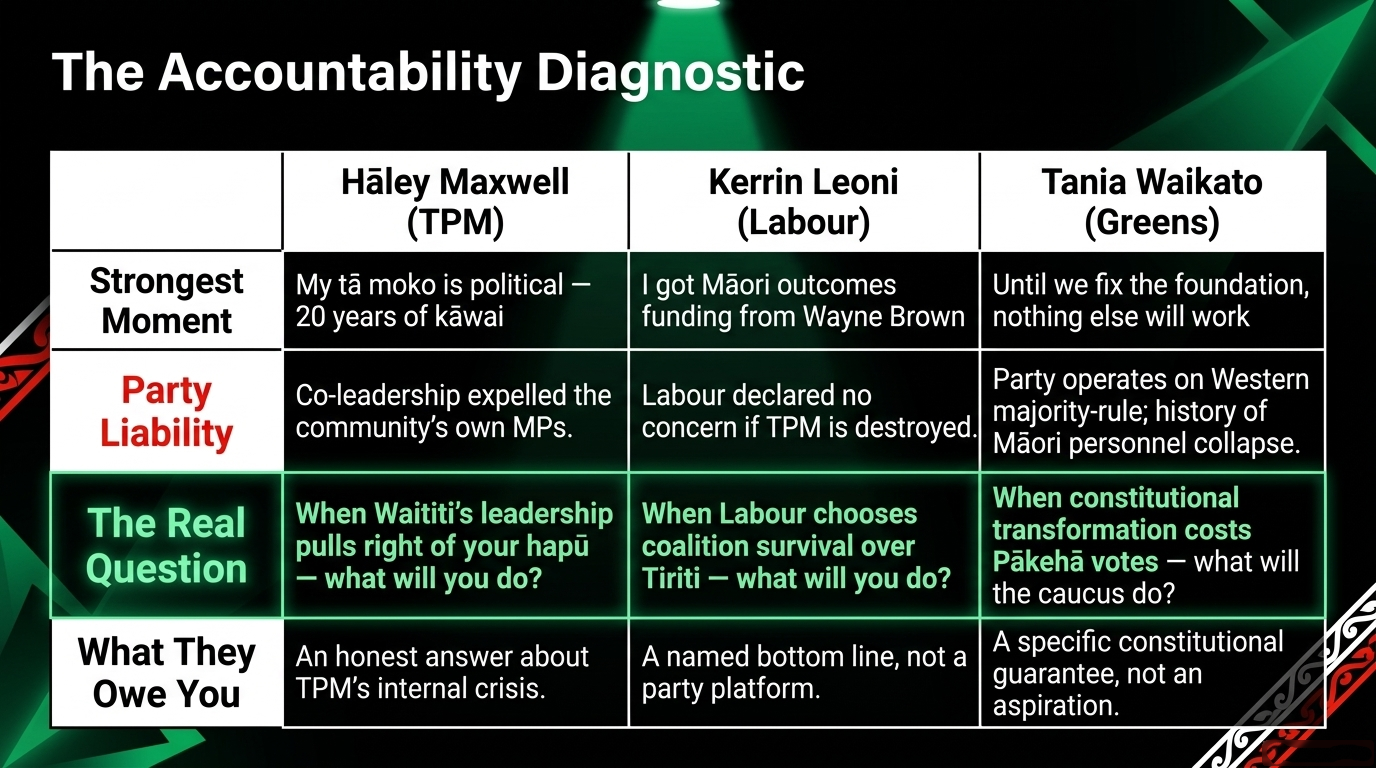
The Comparative Challenge Ledger
| Hāley Maxwell | Kerrin Leoni | Tania Waikato | |
|---|---|---|---|
| Strongest moment | "My tā moko is political — 20 years of kāwai" | "I got Māori outcomes funding from Wayne Brown" | "Until we fix the foundation, nothing else will work" |
| Evasion that must be answered | Hapū/party divergence dismissed as impossible | Bottom line indistinguishable from Labour's platform | Green Party caucus accountability mechanism unnamed |
| Party liability they didn't name | Co-leadership expelled the community's own MPs | Labour declared no concern if TPM is destroyed | Greens have never delivered constitutional Tiriti reform in government |
| The real question | When Waititi's leadership pulls right of your hapū — what will you do? | When Labour chooses coalition survival over Tiriti — what will you do? | When constitutional transformation costs the Greens Pākehā votes — what will the caucus do? |
| What they owe Māori voters | An honest answer about TPM's internal crisis and her role in it | A named bottom line, not a party platform | A specific Green Party constitutional guarantee, not an aspiration |
The Ring's Final Challenge
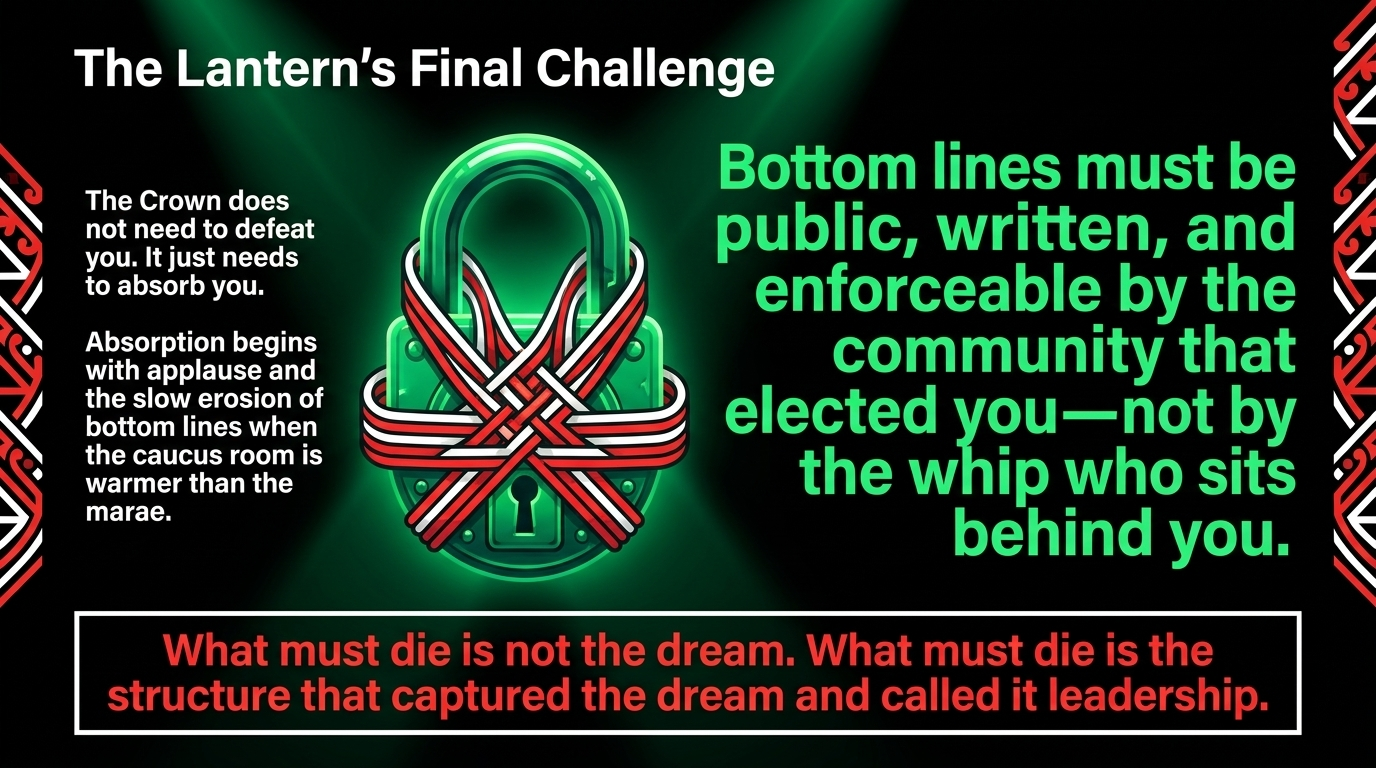
This essay does not oppose these three wāhine. It is written for them — because the most dangerous thing that can happen to a principled Māori candidate is to be celebrated into complacency. The Crown does not need to defeat you. It just needs to absorb you. And the way absorption begins is with applause, invitation, and the slow erosion of bottom lines that happens when the caucus room is warmer than the marae.
You each have what many Māori MPs who came before you did not: a community watching, a movement behind you, and the documented history of every betrayal as a map of what not to do.
Use it. Let it make you harder, not softer. Let it make your bottom lines specific, not rhetorical.
As the Māori Green Lantern's He Hinaki Māori closes:
"What must die is not the dream. What must die is the structure that captured the dream and called it leadership."
Your job — each of you — is to make sure that this time, the dream is held by the people, not the party structure. That your bottom lines are public, written, and enforceable by the community that elected you — not by the whip who sits behind you.
Prove us wrong. The ring is watching. And so are your tūpuna. 🟢
Koha Consideration
This essay asked three wāhine the questions their campaign managers would prefer were never asked. It named the evasions, the party contradictions, the silences inside the oratory
— not to tear them down, but because our people deserve candidates who have been tested before they reach the House, not after.
That kind of accountability journalism does not get funded by the Crown. It does not get funded by party donors. It does not get funded by the corporate media that needs those same politicians onside. It gets funded by whānau who understand that rangatiratanga includes the power to fund our own truth tellers.
Every koha signals that we are done waiting for someone else to ask the hard questions. Every koha says: we will hold our own candidates to account, with aroha and without apology.
Tania, Kerrin, and Hāley are out there funding their campaigns with community support.
Fund the voice that challenges them
— because a candidate who has never been challenged is a candidate who has never been prepared.
Three pathways:
For direct koha to keep this mahi alive: Koha — Support the Māori Green Lantern
For essays delivered straight to your inbox: Subscribe at themaorigreenlantern.maori.nz
For direct bank transfer: HTDM — 03-1546-0415173-000
For whānau on Facebook: Follow and subscribe here
If koha is not possible right now — no worries. Share this essay with your candidate. Read it at your next hui. Send it to your rangatahi. Ask your MP the questions this essay asked. That is koha. That is the accountability the Crown will never fund and the parties will never commission.
Kia kaha, whānau. Stay vigilant. Stay connected. The ring stays lit — as long as you keep it burning. 🟢
Research conducted April 20, 2026. Sources: NZ Herald, Te Ao News, The Spinoff, Te Pāti Māori, Green Party of Aotearoa, Māori Green Lantern archive — He Hinaki Māori (April 18, 2026), The Van Velden Vanishing (March 24, 2026), Wikipedia, interest.co.nz, NBR. All URLs verified live at time of publication.