
"Seven Generations: The Intergenerational Crime Against Ngāti Awa Whānau" - 27 April 2026
Miscarriages, birth defects, learning difficulties, infertility, and the multigenerational reach of dioxin exposure.

They dipped fathers in dioxin, sent them home to their wives, watched a generation miscarry, birth the broken, and bury the young — then asked for more time to study the problem. Seven generations of harm. Seven decades of delay. Not a mistake. A policy.
Essay Four of The Green Chain Series | By Ivor Jones, Te Māori Green Lantern | April 2026
He Kupu Whakataki — The Word That Cannot Be Unsaid
There is a concept in Māori thinking that the actions of this generation ripple for seven generations forward.
The tohunga who articulated it understood biology before the western laboratory caught up. Because that is precisely what dioxin does.
The sawmill at Whakatāne did not just poison workers. It poisoned the intimate architecture of reproduction itself. Workers and their families suffered reproductive illnesses and birth defects, many couples endured numerous miscarriages and ectopic pregnancies, and others had children and grandchildren with learning difficulties, birth defects, and infertility, as recorded by Te Ara. That is not collateral damage from an industrial accident. That is compound interest on a colonial crime — paid across generations in bodies the state chose never to count.
The Deep Dive Podcast
Listen to a lively conversation between two hosts, unpacking and connecting topics in the sources of this essay.
This is the most uncomfortable essay in the series. Not because it is the most complex. Because it is the most simple. This is about babies. This is about women carrying invisible chemical cargo in their blood. This is about children arriving into the world already marked, already burdened, already carrying the decisions of a government that looked at Māori lives and chose profit.
The Miscarriage Number That Should Have Ended the Debate and Didn't
Let us begin with one statistic and let it land without cushion.
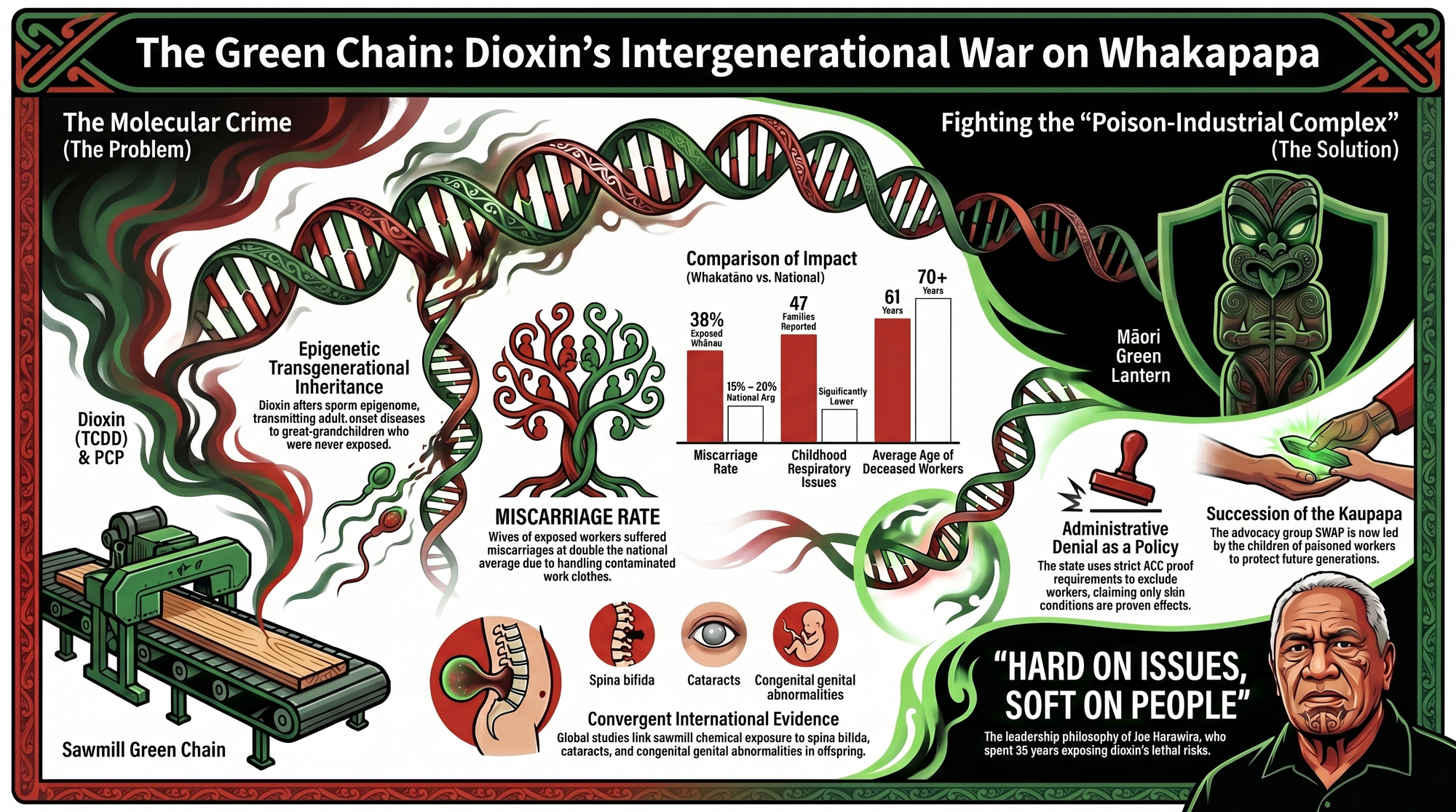
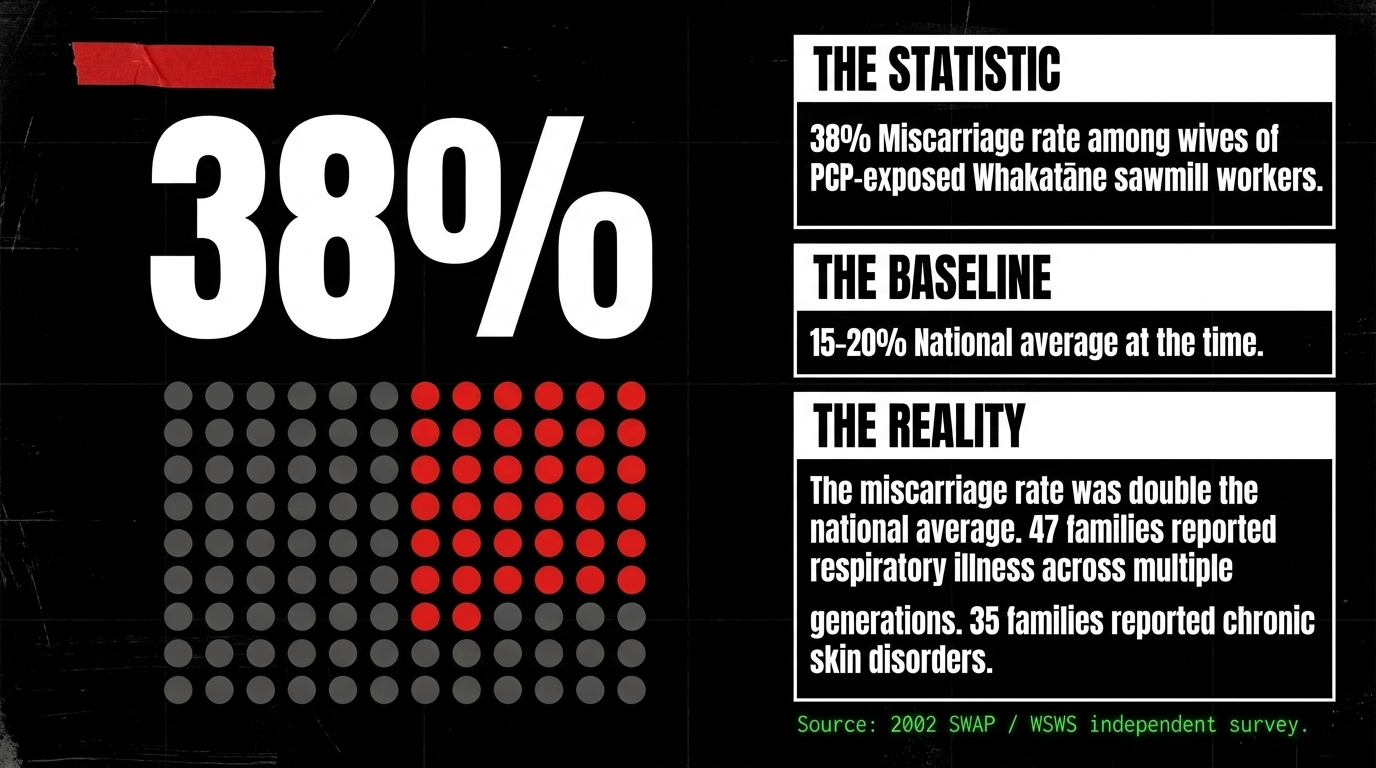
A 2002 survey of former Whakatāne sawmill workers and families of deceased workers found that 38 percent of the wives surveyed had experienced a miscarriage, while the national average at the time was 15 to 20 percent, as reported by WSWS. That means the miscarriage rate among wives of PCP-exposed sawmill workers was roughly double the national rate.
Double. Not slightly elevated. Not statistically marginal. Double.
The reason was not mysterious.
The same survey identified the mechanism: wives were hand-washing and wringer-washing their husbands' work clothes, saturated daily with PCP and dioxin residues, without any knowledge of what they were handling, as reported by WSWS.
Workers' households also burned treated timber in open fireplaces before closed fireplaces became widespread in the early 1980s, according to WSWS. Vegetable gardens were also fertilised with contaminated sawdust, as described by Te Ara.
The most intimate acts of whānau life — washing your husband's clothes, feeding your family from the garden, warming the home — became the routes by which dioxin entered women's bodies and destroyed pregnancies.
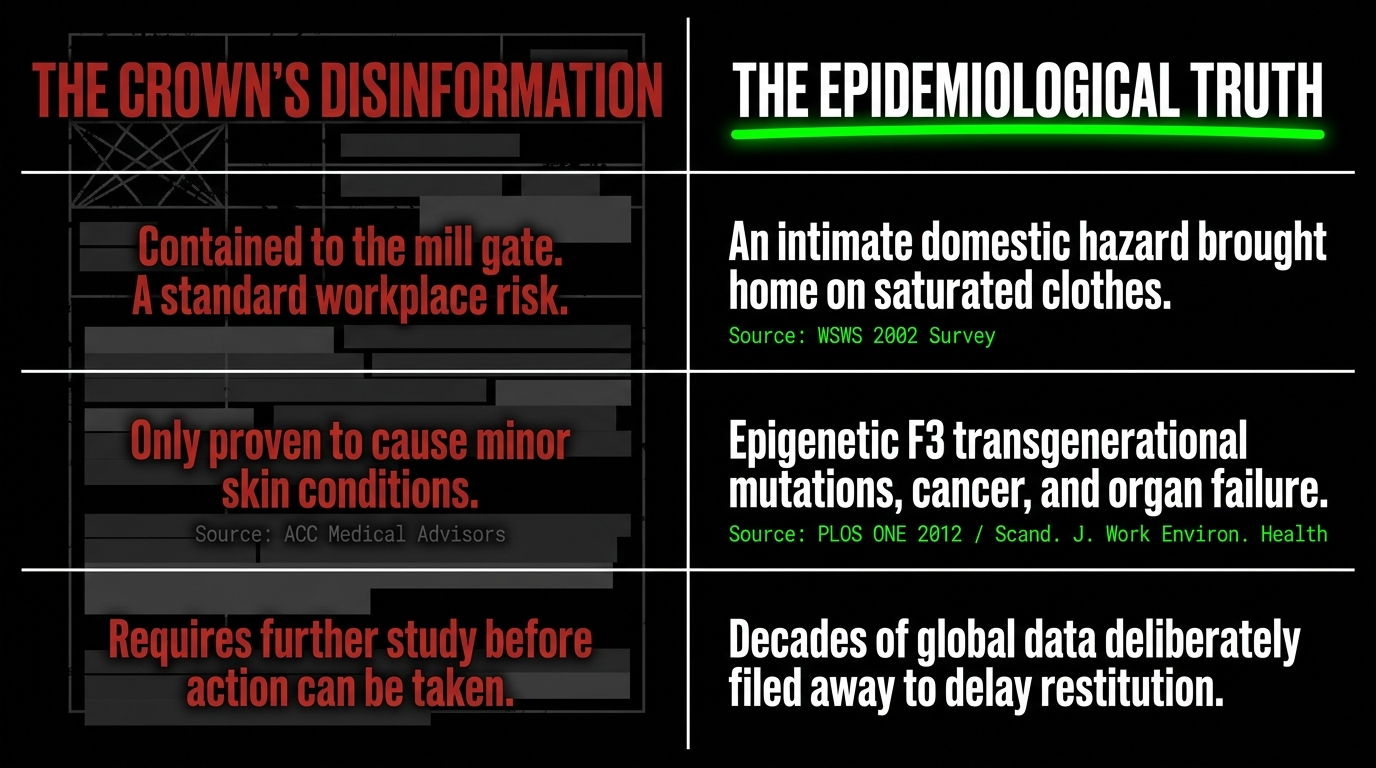
The state knew about domestic transmission pathways. It continued to describe the problem as a workplace issue. That definitional trick — confining the harm to the mill gate — was one of the most cynical pieces of administrative self-protection in this entire history.
For the western mind: if a factory's contaminated uniforms were going home and causing double the national miscarriage rate in workers' partners, that would trigger an immediate public health emergency.
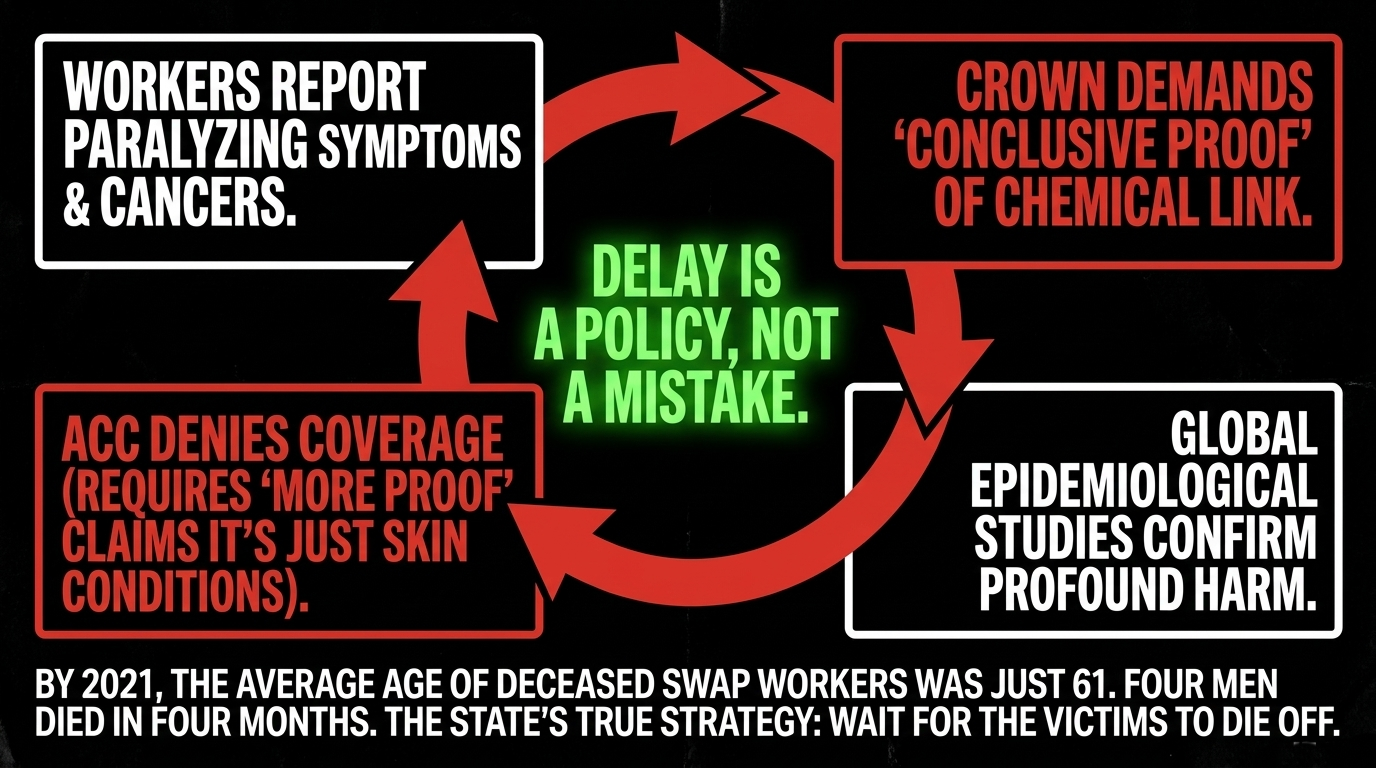
Because the workers were Māori, it triggered a study, then another study, then an ACC dispute, and then further delay.
The Crown's Favourite Sentence Was "Further Study May Be Warranted"
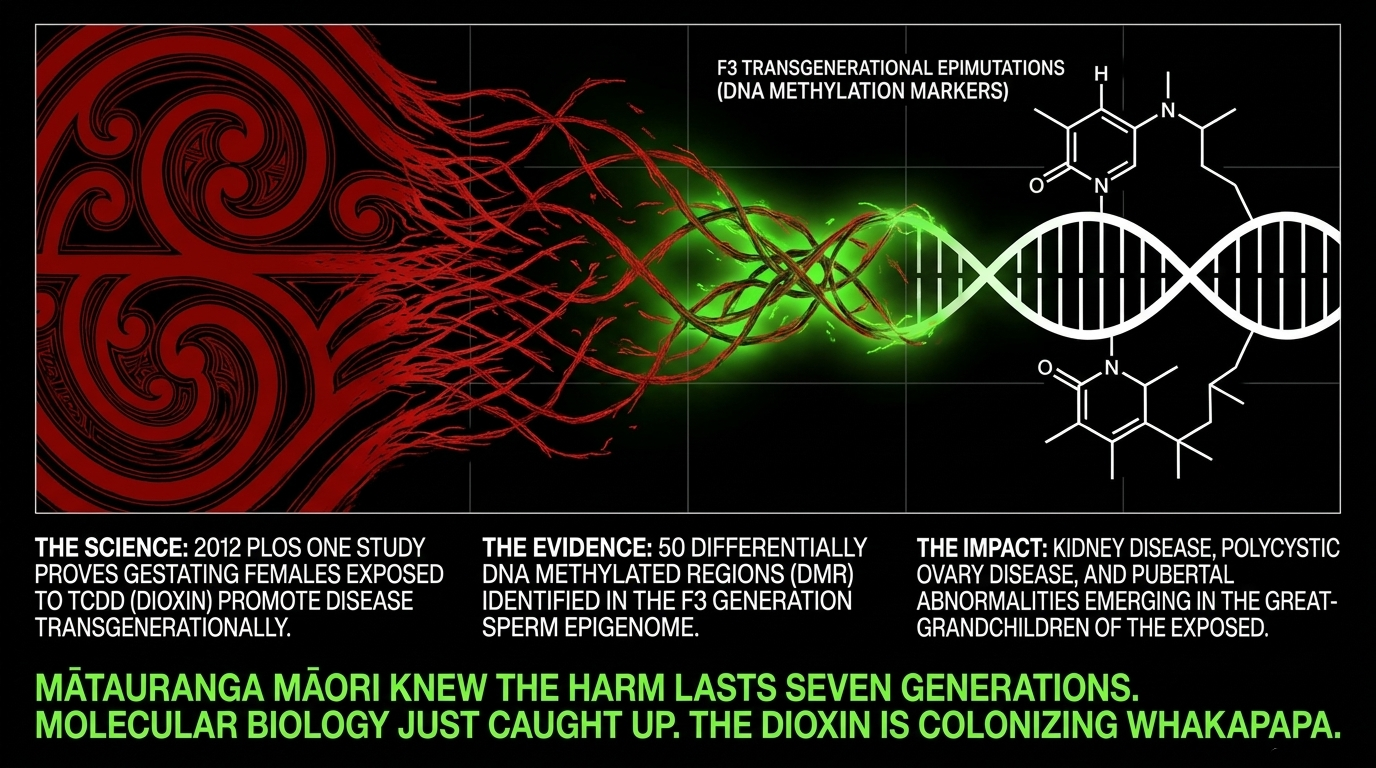
The science was not uncertain. The Crown's willingness to act was uncertain. These are not the same thing, and conflating them was deliberate.
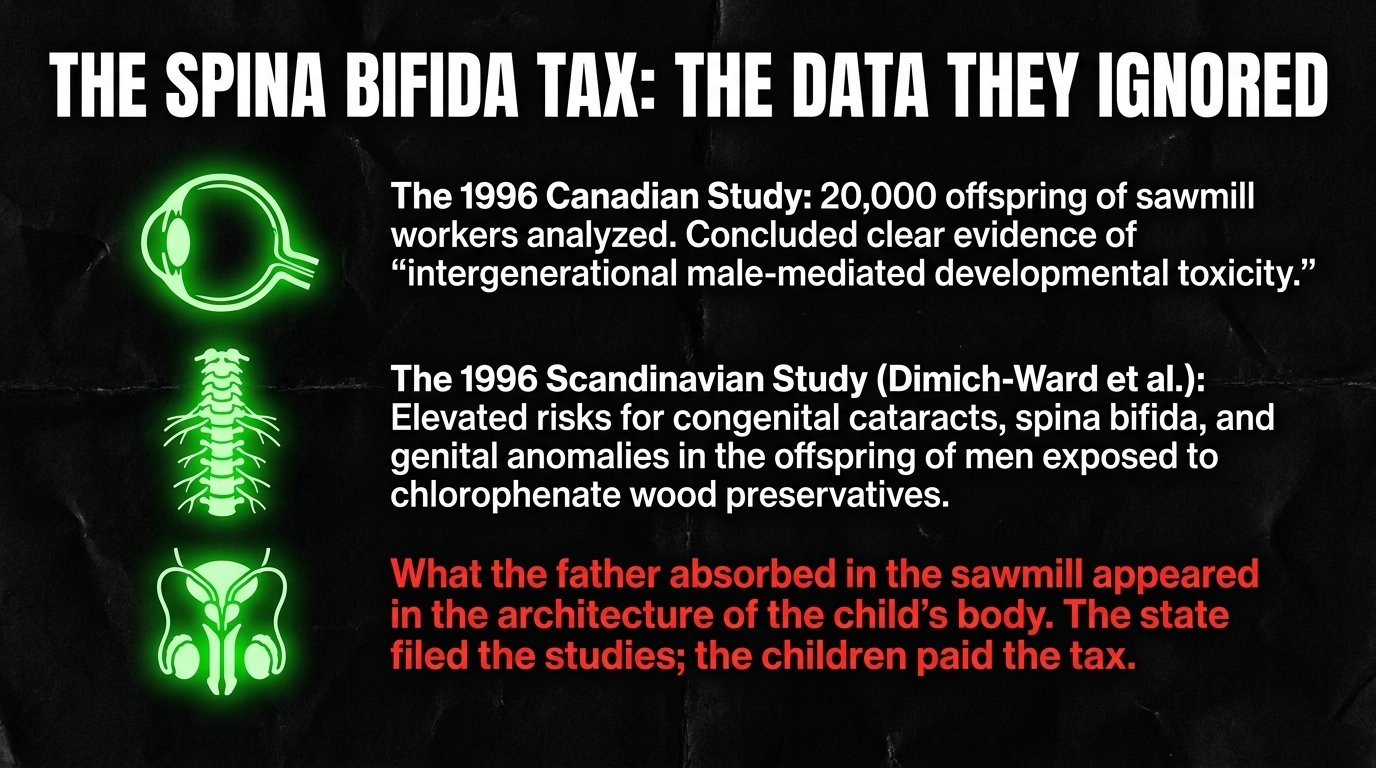
A 1996 Canadian study of 20,000 offspring of sawmill workers found increased risks of congenital abnormalities of the eyes and genital organs, as well as higher incidence of spina bifida, as cited by WSWS and the NZ OSH health outcomes report. The study's conclusion supported intergenerational male-mediated developmental toxicity, as cited by WSWS. In plain language: what the father absorbed in the sawmill appeared in the architecture of the child's body.
A 2012 study published in PLOS ONE demonstrated that gestating females exposed to dioxin TCDD promoted epigenetic transgenerational inheritance of disease and sperm epimutations, with prostate disease, ovarian follicle loss, polycystic ovary disease, kidney disease, and pubertal abnormalities appearing in the F3 generation — the great-grandchildren of those exposed. The same study identified 50 differentially methylated regions in gene promoters in the F3 generation sperm epigenome, as shown by PLOS ONE.
The Seveso dioxin cohort study found that TCDD exposure was associated with decreased fecundability and increased infertility in exposed women and potentially in their daughters. The Yusho incident research linked maternal PCB and dioxin-related compound exposure to increased spontaneous abortion and stillbirth. The Scandinavian reproductive effects study showed offspring of male sawmill workers at elevated risk for cataracts, anencephaly, spina bifida, and congenital genital organ abnormalities.
That is not a thin literature. That is a convergent international body of evidence pointing directly at the harm. The state's posture of scientific caution was a performance. The audience was Māori families. The purpose was delay.
The Women the State Designed Out of the Picture
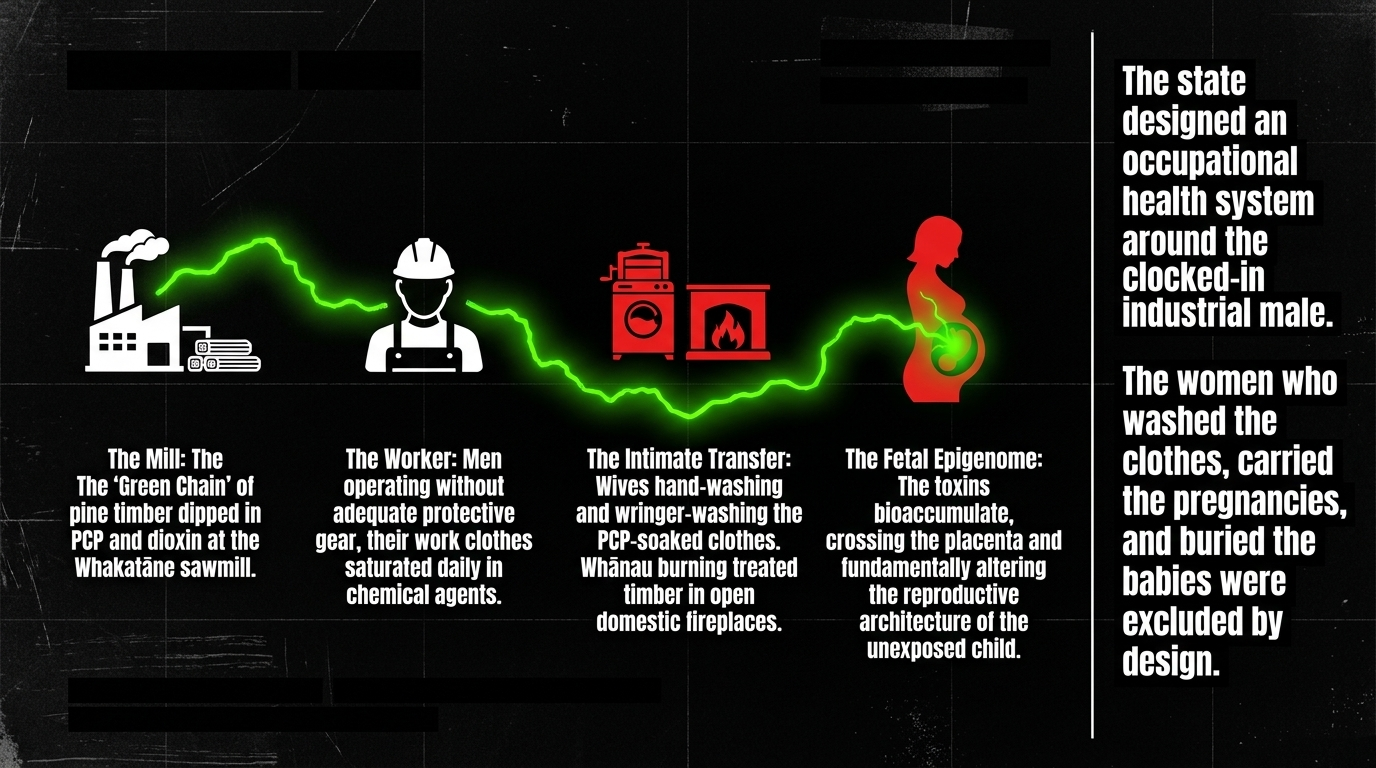
When SWAP members travelled to Wellington to meet government officials, many of the men could barely walk and rolled up their trouser legs to show what dioxin had done to their skin and bones, while the women had more hidden damage and bore the burden of living with poisoned men in silence, as recorded by Te Ara.
More hidden damage. In silence.
That is what the state's architecture produced: a recognition system built around the industrial body — male, clocked-in, visible, measurable — that left the domestic body — female, intimate, invisible, immeasurable — outside the frame.
The women who washed the clothes, cooked the meals, carried the pregnancies, buried the babies, raised damaged children, and grieved without a diagnosis were not overlooked by accident. They were excluded by design.
The WSWS survey found wives had similar patterns of illness to the men, though not as severe, and that the miscarriage rate was a matter of concern. It added that perhaps more detailed investigation was warranted, as reported by WSWS. A 38 percent miscarriage rate receiving the word perhaps is not caution. It is contempt with a vocabulary upgrade.
Epigenetics: When Molecular Biology Validates the Ancestors
Here is where mātauranga Māori and molecular biology stop being separate conversations.
Māori always understood that what you do now shapes what your mokopuna carry. The PLOS ONE study showed that gestating females exposed to dioxin TCDD promoted heritable sperm epigenome alterations across three subsequent generations, with disease appearing in the great-grandchildren. The Seveso cohort called for further research on descendants given the heritable epigenetic signal in the literature.
This is the scientific confirmation of what SWAP had already said publicly: the harms from PCP and dioxin exposure could be felt for seven generations, as reported by SunLive.
When SWAP said that, the health system heard grievance. The epigenetic literature heard a population health projection.
The implication should end the argument about whether this is historical harm. People being born today into Ngāti Awa whānau with this exposure history carry a biochemical legacy from a sawmill that closed in 1988. Their great-grandparents were sent to work without adequate protection. Their great-grandmothers washed the clothes. The dioxin entered the epigenome. The epigenome was inherited.
Marama Cook: The Daughter Who Was Never Supposed to Be Here Still Fighting
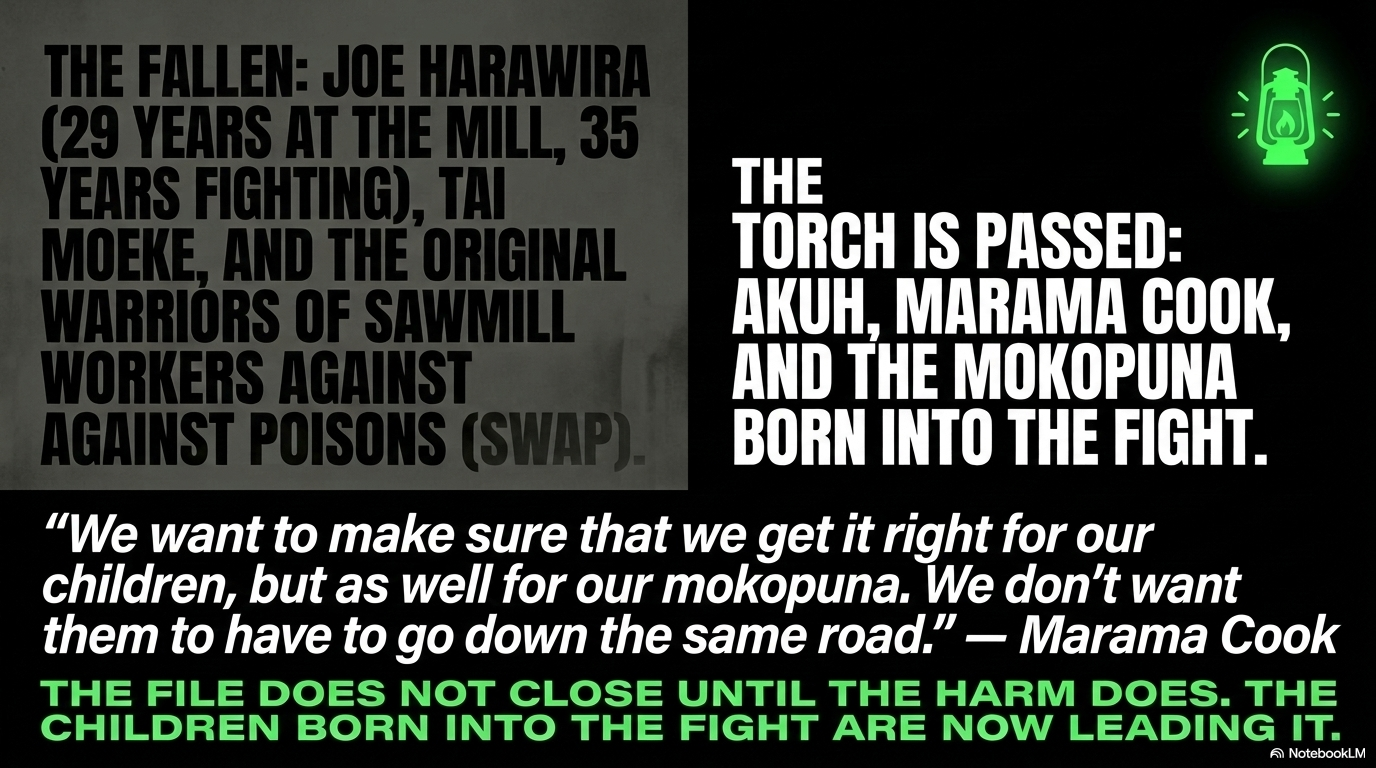
As reported by Te Ao Māori News, Marama Cook — Joe Harawira's daughter and now co-chair of SWAP — says the organisation has even more members than before because the intergenerational process is real. She says children and daughters like herself have come into the fold to continue the kaupapa, and that the goal is to get it right not just for their children but for their mokopuna.
That statement is both a political manifesto and a medical prognosis. Marama Cook is not just continuing her father's advocacy.
She is living the biological reality this essay describes: the harm did not stop with the workers. It came home. It distributed itself through whakapapa.
E-Tangata describes Kereama Akuhata standing where Joe Harawira stood, with no money for specialist medical care and with ACC still failing most of them with their complex health conditions. That is not just a health failure. It is a statement of value.
Three Examples for the Western Mind
1. The Contaminated Lunchbox
Imagine a factory town where children were being born with elevated rates of respiratory conditions, skin disorders, and learning difficulties, and researchers traced the cause not to children's direct exposure but to their grandfathers' poisoned work clothes, laundered by their grandmothers' bare hands, decades before. The WSWS 2002 survey documented exactly this for Whakatāne: 47 families reported respiratory problems in children and grandchildren, 35 families reported chronic skin disorders, and hearing, sight, birth defects, and learning difficulties were prevalent.
The tikanga impact for the western mind: In tikanga, the child is the living expression of all ancestors — the proof that the line continues. When children arrive bearing industrial damage, it is not merely a medical tragedy. It is a rupture in the genealogical record.
Quantified harm: A 38 percent miscarriage rate among exposed workers' wives sat against a national average of 15 to 20 percent, and 47 families reported multigenerational respiratory illness, as documented by WSWS.
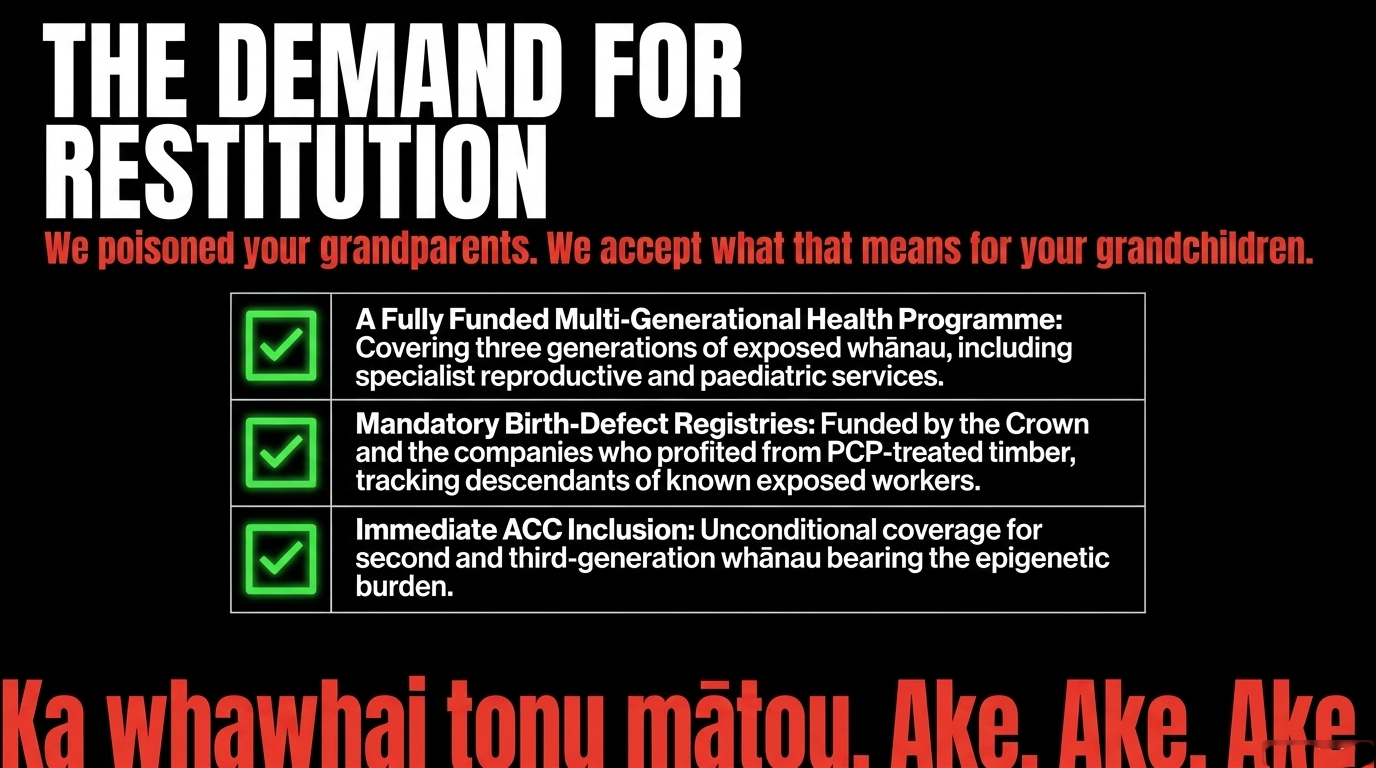
Solution: A fully funded multigenerational health programme covering three generations of exposed whānau, specialist reproductive and paediatric services, and immediate inclusion of second and third-generation whānau in ACC entitlements.
2. The Spina Bifida Tax
Imagine a corporation and a government learning from a study of 20,000 children that paternal occupational chemical exposure was associated with elevated rates of spina bifida, cataracts, and congenital genital organ abnormalities in offspring — and responding by filing the study rather than funding a birth-defect monitoring programme. The 1996 Canadian study of 20,000 sawmill offspring, cited by WSWS and the NZ OSH health outcomes report, is exactly that.
The tikanga impact for the western mind: A father who cannot protect his child from the consequences of his own poisoned work is placed in an impossible position by the state. In tikanga, the obligation to nurture and protect mokopuna is not discretionary.
Quantified harm: Elevated rates of congenital eye abnormalities, spina bifida, and genital organ defects were documented in offspring of male sawmill workers exposed to chlorophenate preservatives, as cited by WSWS and the OSH report.
Solution: Mandatory birth-defect and health-outcome registries for descendants of known PCP-exposed workers, funded by the Crown and the companies who profited from PCP-treated timber, plus free genetic and epigenetic screening.
3. The Great-Grandchild's Inheritance
Imagine discovering that an industrial chemical exposure in your great-grandmother's era had altered DNA expression in a lineage so that you — who were never near a sawmill — still carry the biological echo of that harm. The PLOS ONE 2012 study demonstrated this mechanism by showing that gestational dioxin exposure produced F3 generation descendants with disease transmitted through altered sperm epigenomes. The Seveso cohort study further documented reduced fecundability and infertility in daughters of women exposed to high dioxin levels.
The tikanga impact for the western mind: Whakapapa is not just a list of names going backward. It is a living relational architecture. When dioxin inserts itself into the epigenome and rides that architecture forward, it is not just damaging individuals. It is colonising whakapapa.
Quantified harm: The PLOS ONE study identified 50 differentially methylated gene promoter regions in F3 generation sperm epigenomes following ancestral gestational dioxin exposure, while the Seveso study documented reduced fecundability and increased infertility in daughters of exposed women.
Solution: Epigenetic biomarker screening for descendants of Whakatāne mill workers, funded through a Crown intergenerational remediation fund and delivered in active partnership with Ngāti Awa and SWAP.
The Harms the State Refuses to Tabulate
| Documented Harm | Population | Source |
|---|---|---|
| 38% miscarriage rate vs 15–20% national average | Workers' wives | WSWS 2002 survey |
| 47 families: respiratory illness across children and grandchildren | Second and third generation | WSWS 2002 survey |
| 35 families: eczema, dermatitis, skin disorders | Second and third generation | WSWS 2002 survey |
| Hearing, sight, birth defects, learning difficulties prevalent | Second and third generation | WSWS 2002 survey |
| Miscarriages, ectopic pregnancies, infertility in whānau | Workers' partners and descendants | Te Ara |
| Learning difficulties, birth defects across families | Children and grandchildren | Te Ara |
| 12–18 deaths per year by 2009 | Workers and whānau | MAI Journal |
| Elevated congenital eye defects, spina bifida, genital organ abnormalities in workers' offspring | Children of workers | WSWS citing 1996 Canadian study |
| Epigenetic disease in F3 generation following gestational dioxin exposure | Great-grandchildren (animal model) | PLOS ONE 2012 |
| Reduced fecundability and infertility in daughters of exposed women | Daughters of exposed women | Seveso cohort study |
| SWAP membership growing as next generation joins the fight | Children and mokopuna of workers | Te Ao Māori News |
The Māori Green Lantern Has Already Named This Pattern
The essay Two Kings and a Broken Child shows how Crown rupture of whakapapa is structural rather than accidental. The Playstation Pogrom traces how punitive state systems criminalise Māori children produced by conditions of harm. The Traffic Light Taiaha maps the governance structure that explains why contaminated sediment moved faster through bureaucracy than contaminated Māori bodies.
The Pātaka Is Ash documents how community health, mental health, and Māori-led wellbeing services are being defunded. Winston Peters — A Walking Contradiction names the coalition as dismantling the institutional infrastructure meaningful intergenerational remedy would require. The Trapdoor Prime Minister shows how leadership stripped of moral obligation always chooses the balance sheet over the birth-defect register.
He Whakakapi — The File Does Not Close Until the Harm Does
Seven generations is not a sentimental claim. It is what the epigenetic science says. It is what the Seveso data implies for daughters of exposed mothers. It is what a community in Whakatāne already knew in its body before the laboratory confirmed it.
Joe Harawira spent decades as the keeper of a file this country kept trying to bury, as described by Te Ao Māori News. He died in 2017. His daughter carries it now. Her children may yet carry it next. Not because they chose an inherited struggle. Because the chemistry chose them.
Until this country can say with honesty — and with a funded programme and legal framework to back it — we poisoned your grandparents and we accept what that means for your grandchildren — the file stays open.
Ka whawhai tonu mātou. Ake. Ake. Ake.
Tautoko Mai | Support This Mahi
Every koha for this essay says one specific thing: miscarried pregnancies, structural birth defects, learning difficulties, infertility, and damaged great-grandchildren will not be reduced to a footnote in a Crown report while descendants still fight for recognition.
Rangatiratanga includes funding truth-tellers when the official story prefers amnesia. If koha is not possible right now, subscribe, follow, kōrero, and share this essay with your whānau and friends at The Māori Green Lantern. That is koha too.
Four pathways exist:
- Koha direct: Support the Māori Green Lantern
- Subscribe for essays: Subscribe to the Māori Green Lantern
- Direct bank transfer: HTDM, account number 03-1546-0415173-000
- Facebook: Follow and subscribe on Facebook
Next in the series: Ka Whawhai Tonu traces the organising line from Joe Harawira to Kereama Akuhata, from a Whakatāne garage floor to the halls of Parliament, and from the first SWAP meeting to Marama Cook's co-chairmanship, as recorded by Te Ara, E-Tangata, and SunLive.