
"The Man With the Brown Paper Bag: How Gordon Jackman Went to War Against New Zealand's Invisible Poison — And How This White Supremacist Government Is Trying to Bury Him" - 2 May 2026
They built a clean green lie on a foundation of dioxin, PCP, and Māori bodies. One scientist picked up a brown paper bag full of the truth — and they have spent thirty-five years trying to make him put it down.

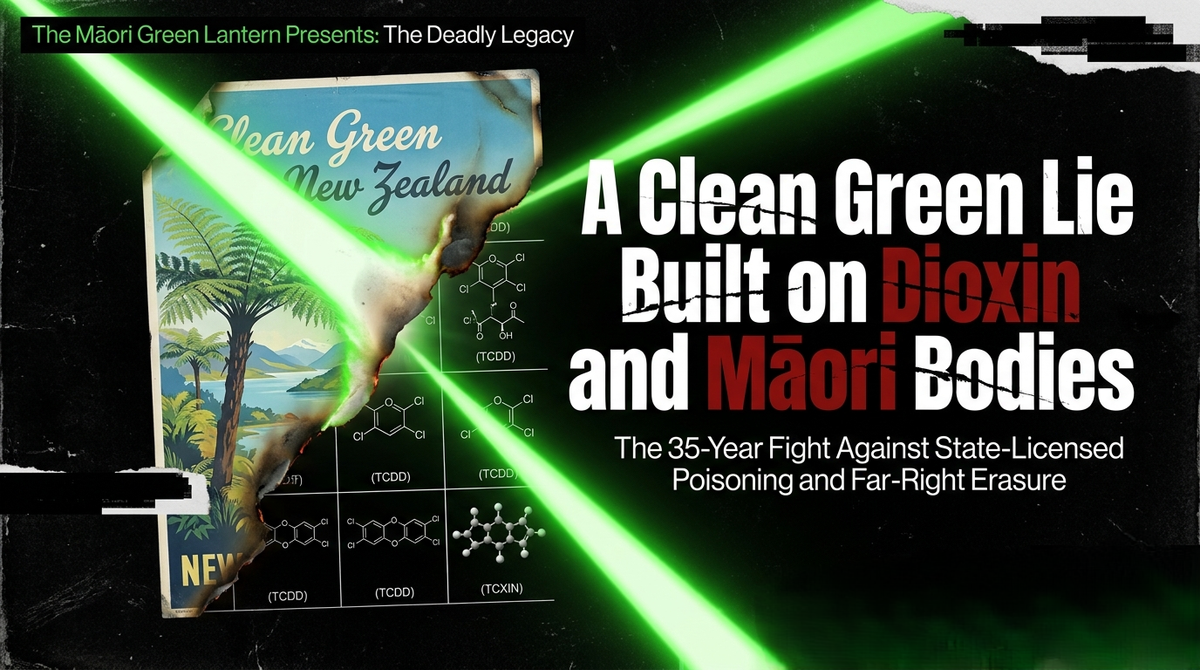
Essay One of The Deadly Legacy Series | By Ivor Jones, Te Māori Green Lantern | 1 May 2026
This essay examines Gordon Jackman's environmental science career and New Zealand's toxic contamination legacy because these matters directly affect Māori whānau health, public accountability for state and corporate decisions, and the ongoing fight for justice by Ngāti Awa and communities across Aotearoa.
Named individuals are referenced solely in their public capacity. Views expressed constitute honest opinion on matters of public interest under the Defamation Act 1992 (NZ) and Durie v Gardiner NZCA 278.
He Kōrero Tūāpō — Before the River Forgets
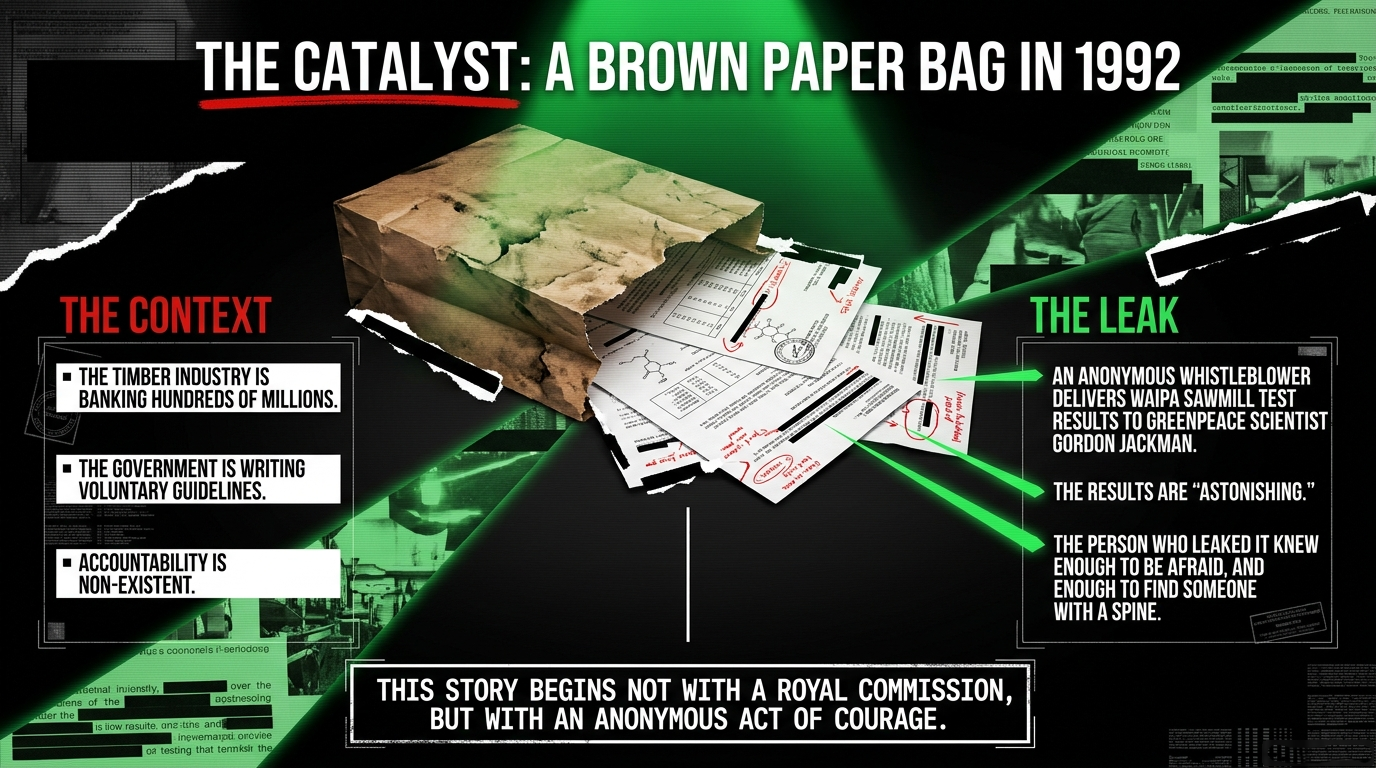
Picture New Zealand in 1992. The tourist posters still show ferns and geysers and the jewelled surface of Lake Rotorua. The forestry industry is banking hundreds of millions of dollars. The government is writing guidelines. Nobody is being held accountable for anything.
And then a brown paper bag arrives on a scientist's desk.
Inside that bag are the dioxin test results from the Waipa sawmill — results that, as Gordon told Ivor directly in correspondence on 30 April 2026, "were astonishing."
The person who put those results in the bag knew enough to be afraid. They also knew enough to make sure someone with a spine received them.
The Deep Dive Podcast
Listen to a lively conversation between two hosts, unpacking and connecting topics in the sources of this essay.
That is how this story begins. Not with a ministerial announcement, not with a Royal Commission, not with a corporate apology. With an anonymous act of courage — and a scientist who understood exactly what he was holding.
This is the story of that scientist. What he found. What he did with it. And why, thirty-five years later, the fight is not over — because a white supremacist neoliberal government has spent the last three years dismantling every regulatory gain he and his allies spent decades winning for the people of this land.
The River That Made Him
Gordon did not become an environmental campaigner from the comfort of a desk. He became one standing at the edge of a polluted river.
His environmental activism began when he played and swam as a young boy in the beautifully clean Hangaroa River, where he fell in love with nature, and that love became the source of his power to wield instruments to fight pollution. The instrument he chose was Greenpeace.
It was his time studying the Tarawera river that he saw the results of industrialisation, the cause being Tasman Pulp and Paper.
The Tarawera river had a second name - the “Black Drain”.
As reported by New Scientist, Gordon went on to serve as Greenpeace New Zealand's Green Forestry Campaigner, and in that role he made the toxic contamination legacy of New Zealand's timber industry impossible for the state to quietly file away.
He was not a bureaucrat calculating risk. He was a witness calculating injustice. And in tikanga terms, that distinction is everything — because a witness who stays silent becomes complicit, while a witness who speaks becomes part of the healing.
Gordon himself described Greenpeace's reach at its peak, in a meeting with Ivor Jones The Māori Green Lantern, as so substantial that people would contact it as if it were a government agency.
That was the infrastructure he wielded. And the Crown was genuinely afraid of it.
The Deadly Legacy: Gordon Names the Crime
In the early 1990s, Gordon authored The Deadly Legacy: a report on the toxic contamination of New Zealand by the indiscriminate use of pentachlorophenol (PCP).
It remains one of the most damning environmental documents ever produced in this country.
The Deadly Legacy states plainly what the Crown was trying to obscure:
"Behind New Zealand's clean, green image of sheep, pine trees and the Rotorua lakes there is a hidden reality the tourist brochures do not show. It is the hundreds of contaminated timber treatment sites found across the country from North to South and the resulting contamination of New Zealand and New Zealanders."
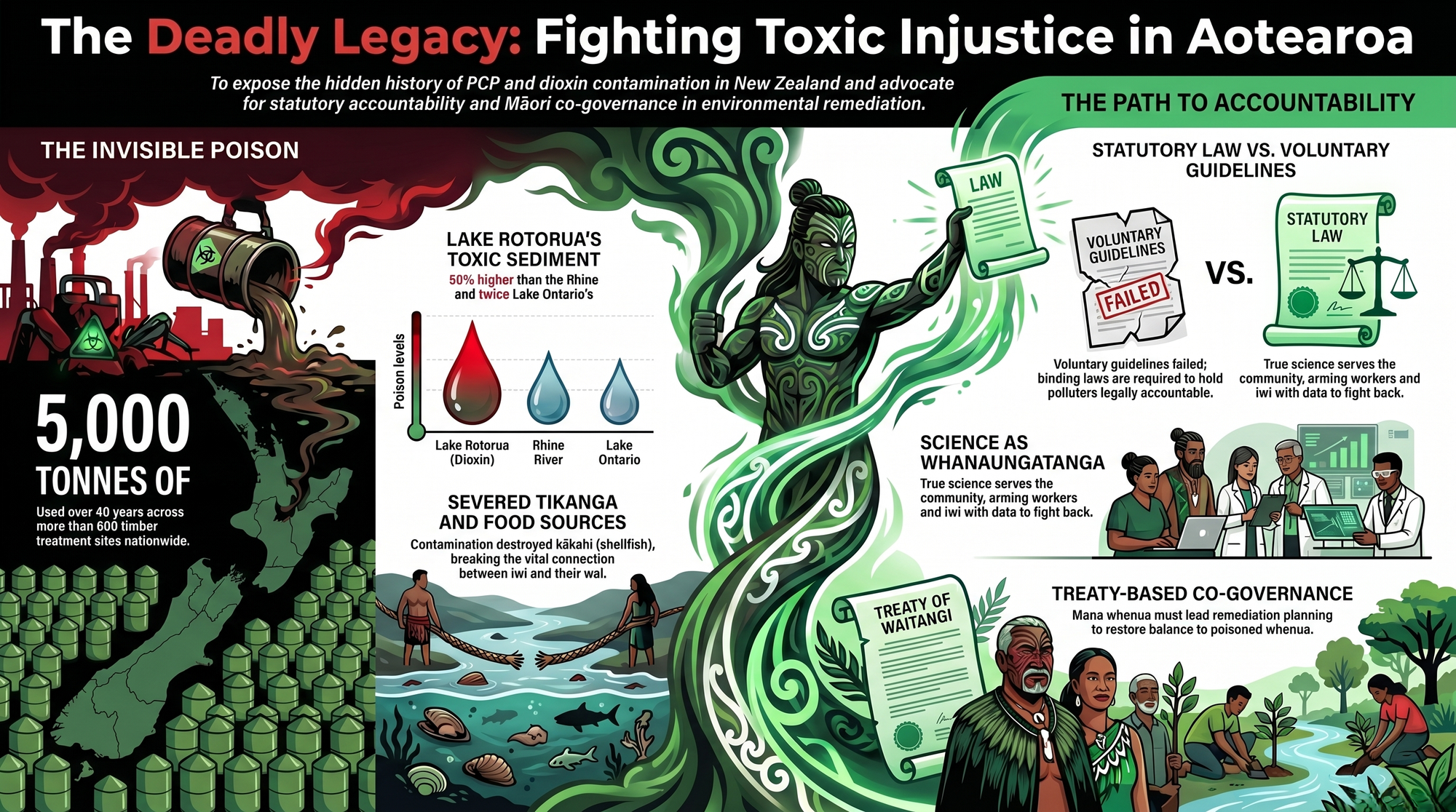
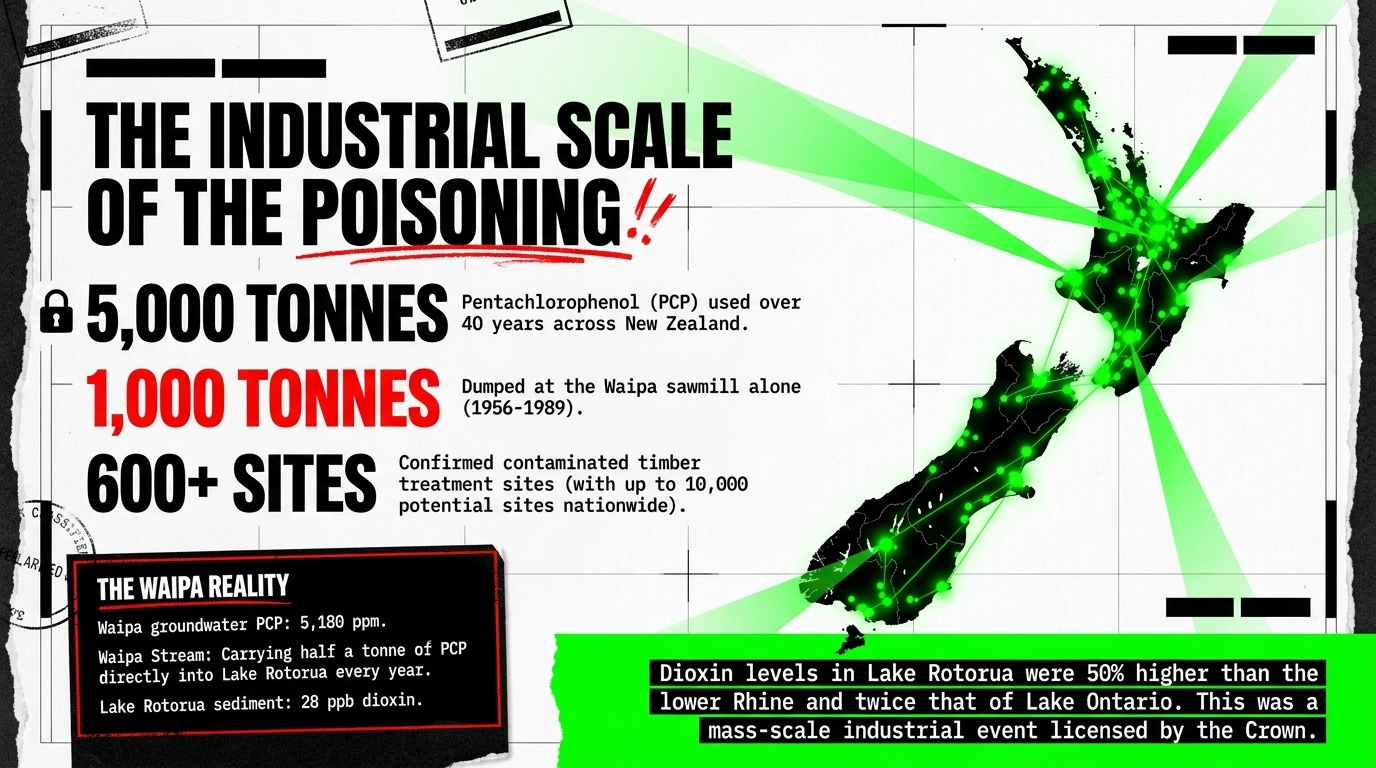
As documented in that same report, up to 5,000 tonnes of PCP were used over approximately 40 years at more than 600 sites nationally. PCP was manufactured with dioxin and furan impurities that the report described as
"some of the most toxic substances known."
And as confirmed by New Scientist's 1993 investigation, the government had possessed evidence of serious health hazards
— including documented fatalities among timber workers in Japan, France, and Australia in 1952 and 1953
— and continued licensing PCP use for nearly four more decades.
That is not negligence. That is a policy choice. And as Gordon wrote to Ivor on 30 April 2026:
"I was involved with all those sites and Tasman Lumber was as bad as Whakatane board mills."
All those sites. Waipa. Tasman Lumber. Kinleith. Across both islands — silent, seeping, killing.
Waipa: The Numbers That Made a Government Squirm
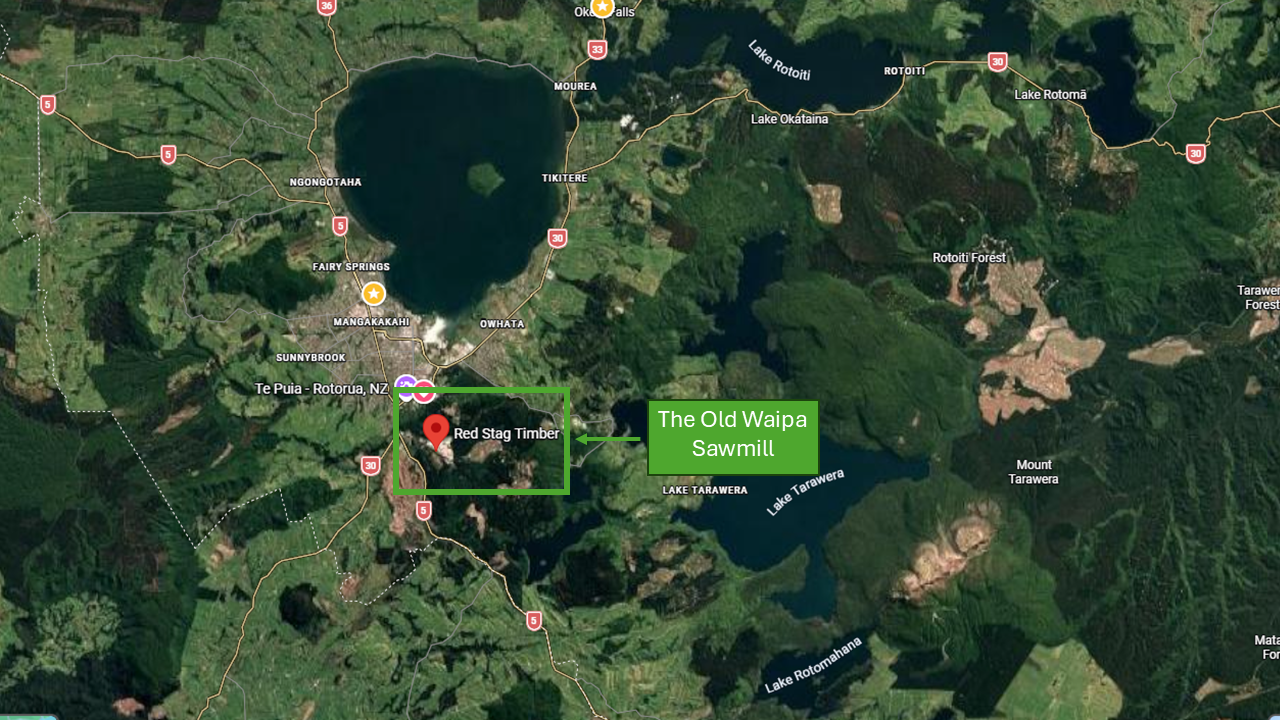
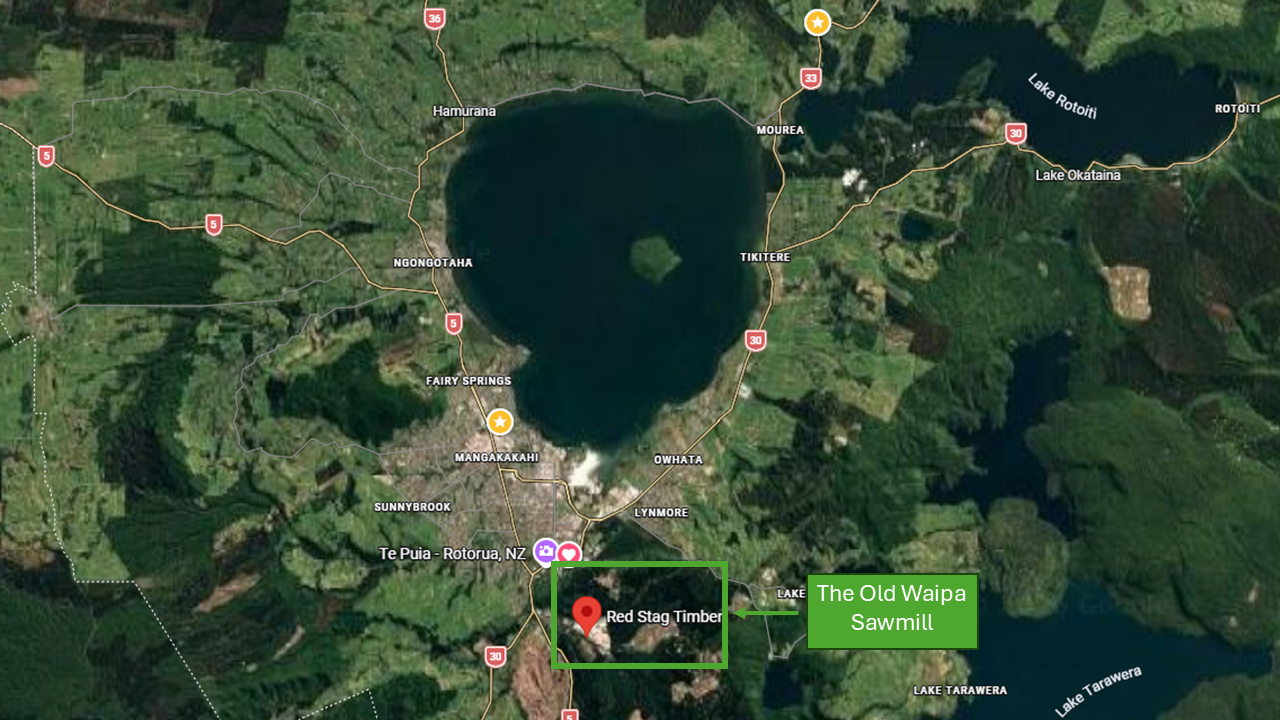
The Waipa sawmill occupied 120 hectares five kilometres south of Lake Rotorua and used up to 1,000 tonnes of PCP between 1956 and 1989.
As New Scientist reported from the National Task Group's findings, residues in the worst-affected areas of the mill reached 6,500 ppb of PCP, 85,400 ppb of dioxin, and 46,900 ppb of furan. PCP in groundwater immediately below parts of the site reached 5,180 ppm. Contaminated groundwater was migrating toward the Waipa Stream, which flows directly into Lake Rotorua.
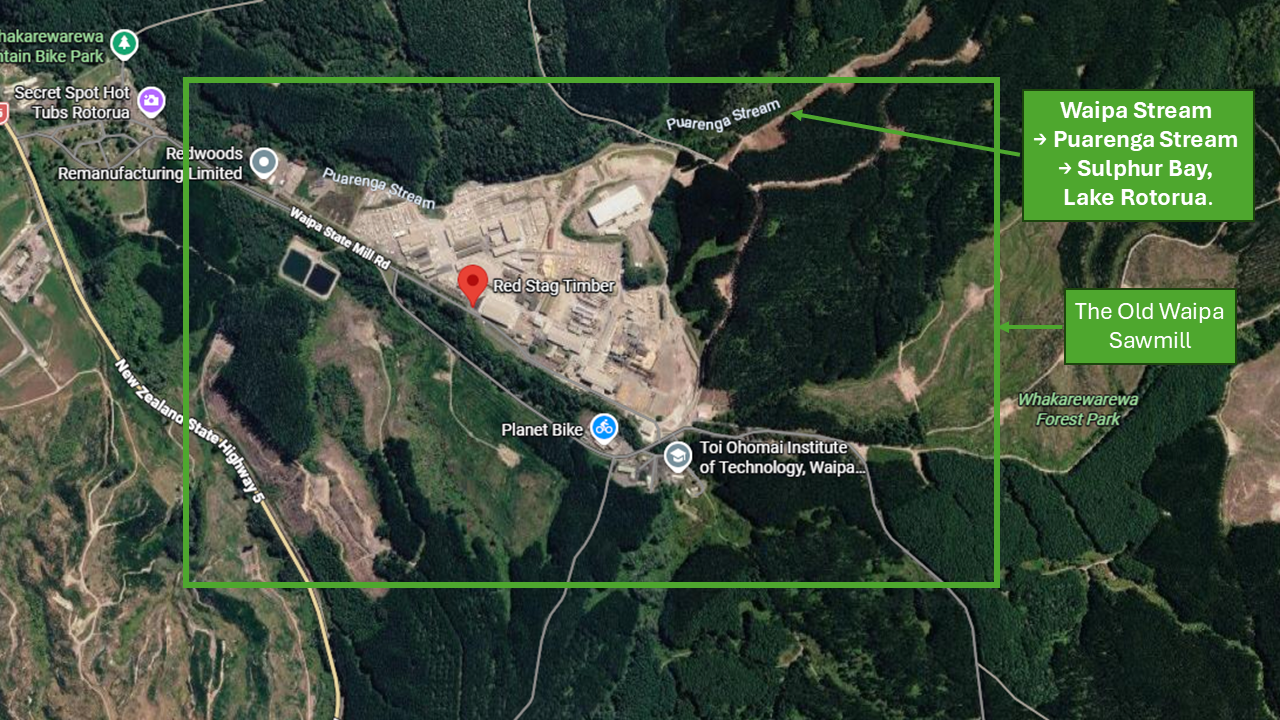
As further confirmed by New Scientist, the lake's sediment contained 28 parts per billion of dioxin — a level Greenpeace documented as 50 percent higher than the lower Rhine and twice as high as Lake Ontario. PCP was accumulating in the food chain, with levels of up to 2,819 ppb recorded in trout and up to 34.5 ppb dioxin toxic equivalents in mussels up to three kilometres from the stream outlet.
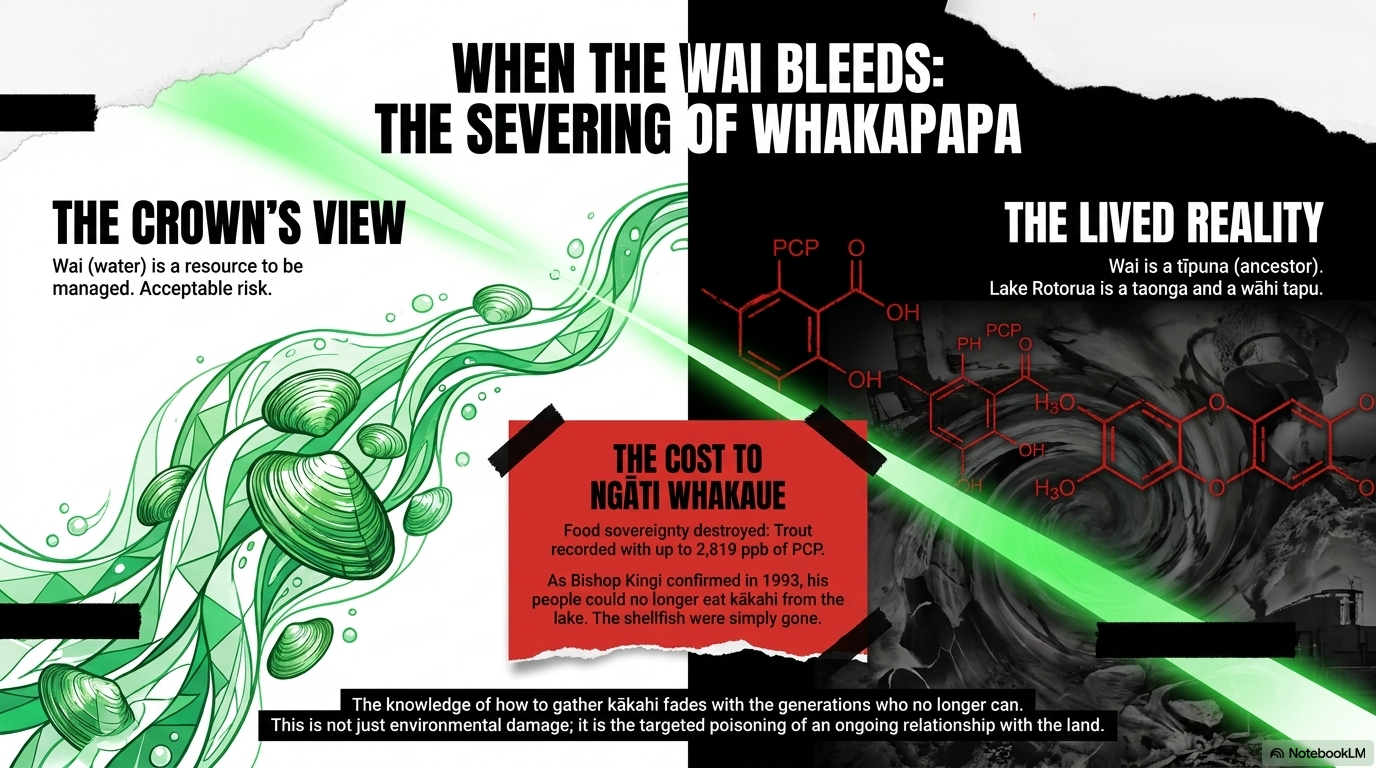
To the Māori of Ngāti Whakaue, Lake Rotorua is a taonga.
As Bishop Kingi told New Scientist:
"The lake has always been the source of food to the Arawa people. Deterioration of the lake has not only killed a number of food sources that used to be here but it has now also become a grave health problem."
He confirmed that no one in his tribe ate kākahi from the lake any longer. The kākahi were simply gone.
That is what dioxin contamination looks like through a tikanga lens. It does not merely damage an ecosystem. It severs the relationship between a people and the place that fed and sustained them across generations.
The knowledge of how to gather kākahi fades with the generations who no longer can. Feeding your whānau from the lake becomes an act of risk rather than an act of love. That is a form of violence. It was entirely preventable. And it was licensed by the Crown.
Gordon stated it without softening to New Scientist in 1993:
"There has been no real acknowledgement of the severe nature and scale of the problem New Zealand faces, let alone a clear strategy to deal with contamination. By not setting basic cleanup levels in law, or adequately funding site investigations, the government is putting public and environmental health in jeopardy."
That quote is from 1993. Read it again with 2026 eyes.
The Crown's Favourite Alibi: Guidelines
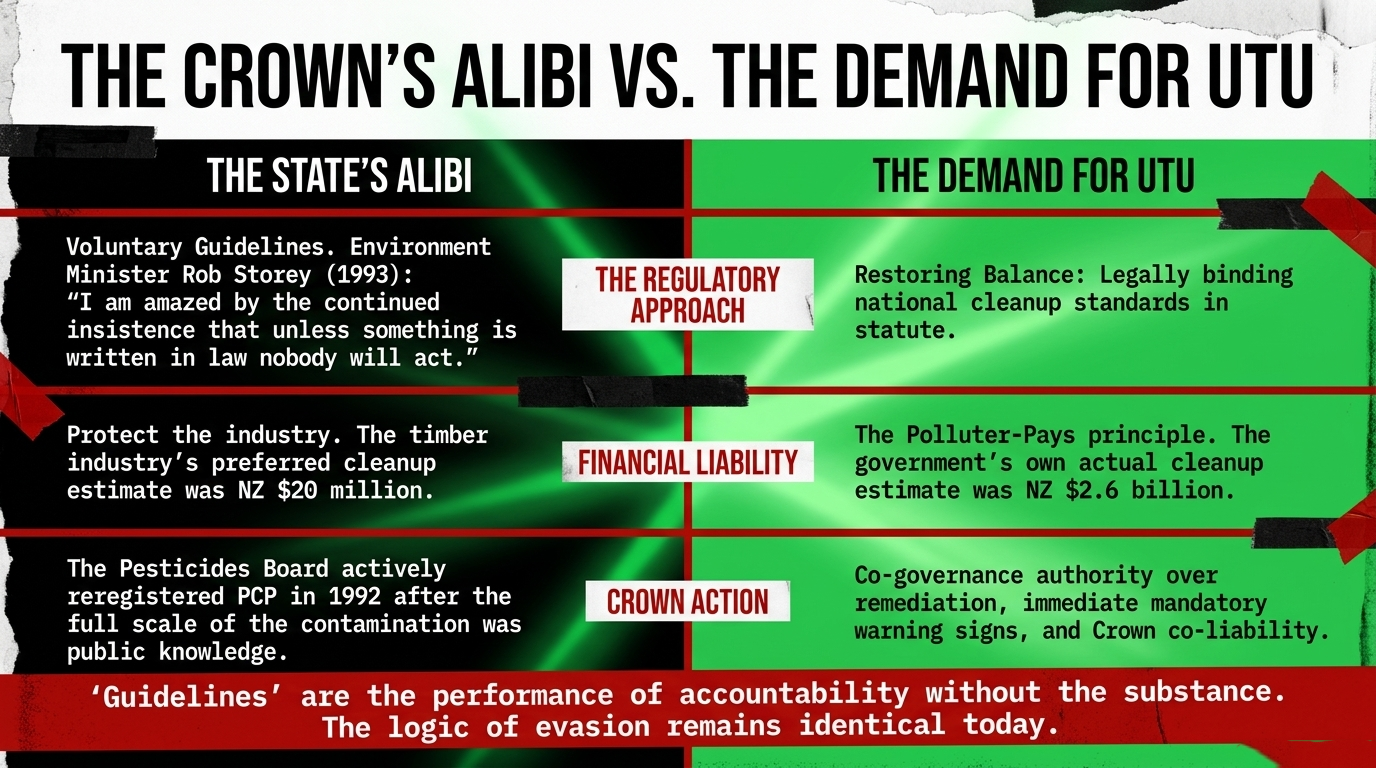
One of the most contemptible chapters in this entire history is how the state chose vagueness when law was needed and performance when action was required.
As New Scientist records, Environment Minister Rob Storey defended the government's reliance on voluntary guidelines over legally binding standards with the words:
"I am amazed by the continued insistence that unless something is written in law nobody will act."
Parliamentary Commissioner for the Environment Helen Hughes demolished that position in her 1992 report, stating as quoted by New Scientist:
"No amount of guidelines will solve the problem, unless new legislation has the legislative teeth to give them effect. New Zealand has to face up to the polluter pays principle. We need an equitable formula to solve the problem, we can't just leave it to vague guidelines."
Gordon said it even more plainly, as recorded in the same New Scientist investigation:
"Guidelines are a meaningless waste of time unless there is some statutory basis to enforce them."
That exchange
— between a government defending soft voluntary guidance and scientists and commissioners demanding binding law
— is the same exchange happening across every policy domain the Luxon-Peters-Seymour government has touched.
The language changes. The logic is identical. Protect industry. Defer accountability. Call it pragmatism. Let communities bear the cost.
As Gordon's own Deadly Legacy report documented, the specific legislative failures were not ambiguous: the government failed to establish the Hazards Control Commission required under the Resource Management Act;
failed to set any numerical standards for PCP and dioxins in the environment;
left the Pesticides Board as a self-regulating body nominated by supplier and user groups;
and — as the same report records — the Pesticides Board reregistered PCP in June 1992, after the full scale of contamination was public knowledge.
They reregistered a known carcinogen after knowing what it had already done. That is not regulatory failure. That is regulatory capture. And it is the same capture this government is engineering right now across the entire public sector.
"My Scientist": The Alliance That Changed Everything
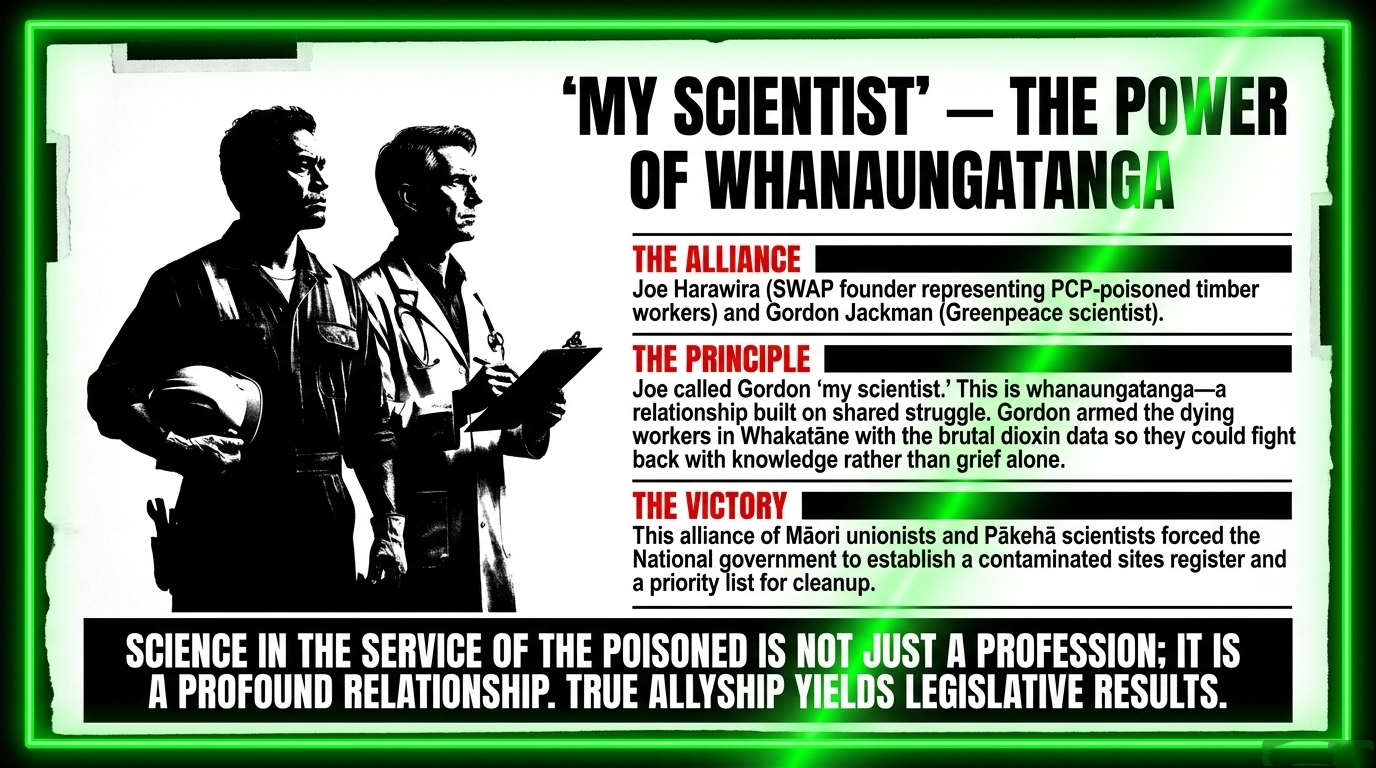
E-Tangata records that Joe Harawira — SWAP founder and the man who led the decades-long fight for recognition of PCP-poisoned timber workers — called Gordon "my scientist."
That phrase is not casual. In te ao Māori, those words carry the weight of whanaungatanga — a relationship built through shared struggle, mutual respect, and genuine care for the same people.
Joe did not say "a scientist."
He said my scientist.
Because Gordon showed up. As E-Tangata describes, Gordon explained the dioxin data at a meeting in Whakatāne, arming workers "with that awful truth" so they could fight back with knowledge rather than grief alone.
E-Tangata also records that Catherine Delahunty and Gordon worked alongside Joe and SWAP for years, eventually negotiating with the National government to establish a contaminated sites register and a priority list for cleanup.
Those hard-won gains
— a register, a priority list, cleanup commitments
— exist because a Māori unionist and a Pākehā scientist refused to accept the Crown's silence as the final word.
That is precisely what this government is now dismantling. Piece by piece. Portfolio by portfolio. Appointee by appointee.
The Poison That Never Left: Triclosan
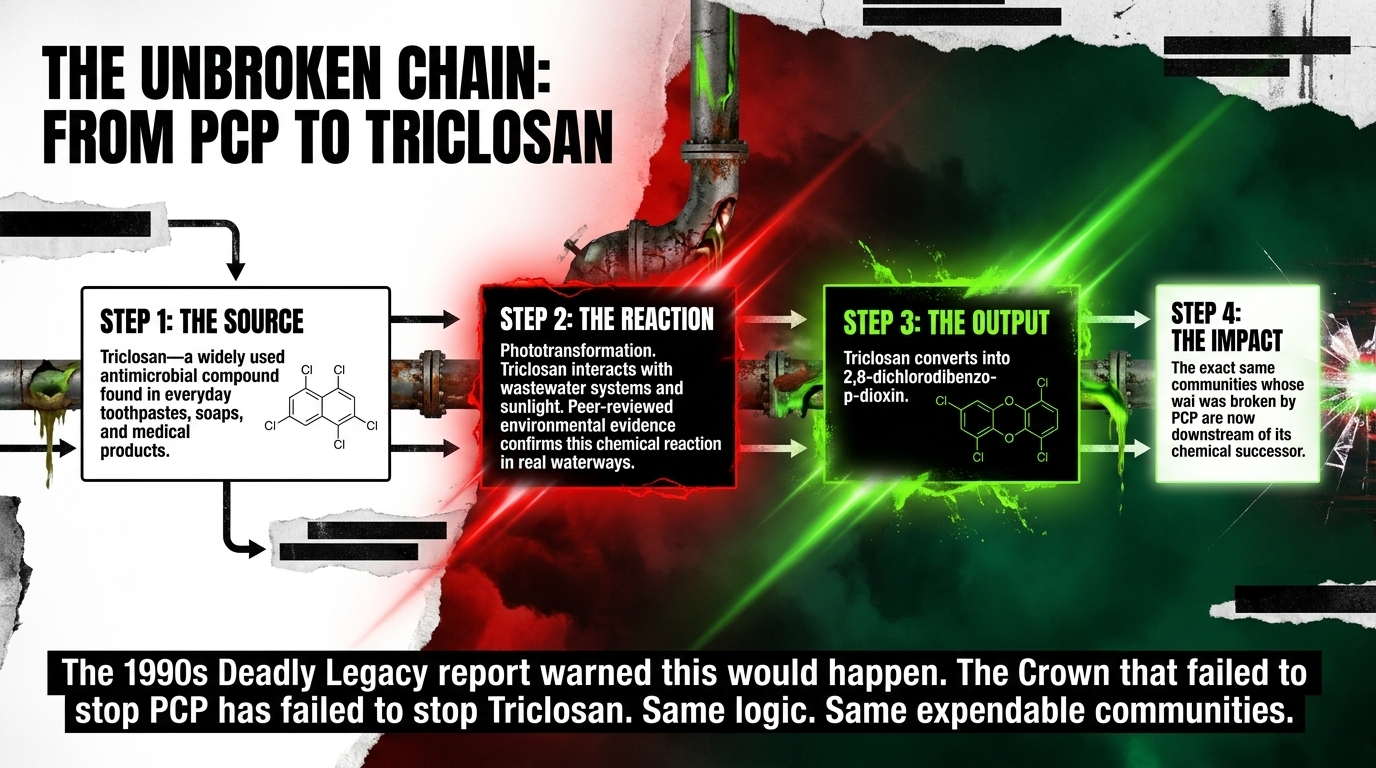
The western mind might assume PCP's deregistration in 1991 closed this chapter. Gordon made clear in his conversation with The Māori Green Lantern that it did not.
A new generation of chemistry is running through the same waterways.
As Gordon described, triclosan — a widely used antimicrobial compound found in everyday toothpastes, soaps, and medical products
— can convert to dioxin in wastewater systems.
That is not opinion. It is peer-reviewed science confirmed by PubMed, which records triclosan undergoing phototransformation to form 2,8-dichlorodibenzo-p-dioxin, with sediment cores providing direct environmental evidence of this reaction occurring in real waterways.
Triclosan is moving through New Zealand's wastewater infrastructure right now.
The communities whose wai was already broken by PCP are now downstream of its chemical successor. And the same Crown that failed to stop PCP has failed to stop triclosan.
The Deadly Legacy warned this would happen.
It stated explicitly:
"Despite the known hazards, other organochlorine chemicals perhaps as toxic as PCP such as carbendazim, oxine-copper and chlorothalonil are still being used in the forestry industry, even though non-toxic alternative treatments such as kiln drying are capable of replacing anti-sapstain chemicals. Up to now there has been little financial incentive to change when cheap, toxic chemicals guaranteed short term profits."
Written in the early 1990s. Structurally true today. Same logic. Same governance. Same expendable communities.
Three Examples for the Western Mind
1. The Whistleblower the Crown Hoped You'd Forget
If a chemical company had poisoned a nation's most famous lake with dioxin levels 50 percent higher than the Rhine, a scientist had documented it in a published report, and the government had responded with guidelines instead of law, every western journalist in every major outlet would call that a national scandal. As confirmed by New Scientist's 1993 investigation and as Gordon's own Deadly Legacy report demonstrates, that is exactly what happened in Aotearoa.
Tikanga impact: Wai is not a resource to be managed. It is a tīpuna — an ancestor — to be cared for and respected. When a lake that is wāhi tapu, a collective food source, and the living whakapapa of a people is contaminated with persistent organochlorine toxins, you do not merely cause "environmental damage." You sever the relationship between a people and the place that sustained them. You poison the act of remembrance itself. The kākahi that Bishop Kingi's people could no longer harvest were not simply shellfish. They were the evidence of an unbroken relationship with that rohe — and that evidence was destroyed by a company and a Crown that weighed it against export earnings and chose the money.
Quantified harm: Dioxin in Lake Rotorua sediment at 28 ppb — 50 percent higher than the lower Rhine and twice that of Lake Ontario, as reported by New Scientist. PCP in the Waipa Stream at 40 ppb — equivalent to half a tonne of PCP flowing into Lake Rotorua every single year. PCP in trout at up to 2,819 ppb. Food sovereignty gone. Trust in wai gone.
Solution: Legally binding national cleanup standards in statute — not guidelines. Mana whenua co-governance authority over remediation planning, monitoring, and outcomes. A public contaminated sites register with mandatory warning signs at every known site. Polluter-pays legislation with Crown co-liability for every site it licensed, permitted, and failed to protect.
Read also: The Māori Green Lantern's When the Whenua Bleeds maps how contaminated land and water function as instruments of colonial dispossession — not merely industrial accidents.
2. The Government That Chose Guidelines Over Lives
If a minister said on the record — with full knowledge of what the chemistry had already done to workers and waterways — that they were amazed anyone would insist on statutory law to compel action, the western world would call that sociopathic indifference dressed up as governance pragmatism.
As New Scientist records, that is exactly what Environment Minister Rob Storey said in 1993 — and it is structurally identical to the language this coalition government uses today when it talks about "cutting red tape" and "trusting business to do the right thing."
As The Māori Green Lantern documented in Dying on the Books, ACC's exclusion of PCP and dioxins from its compensable conditions was not an oversight — it was a legal construction designed to let the state escape the bill for its own licensing decisions. The machine was built to make recognition expensive, delayed, and ultimately fatal for claimants.
Tikanga impact: Mana is held or lost through action, not through declarations of intent. A government that knows what a chemical has done and responds with guidance documents rather than law forfeits its mana entirely. The tikanga principle of utu — not revenge, but the restoration of proper balance — requires the Crown to respond with weight proportionate to the harm it caused. Guidelines written by the same agencies that licensed the poison are not utu. They are the performance of accountability without its substance.
Quantified harm: The Deadly Legacy report documents that the government's own cleanup estimate for 5,530 highly and moderately contaminated sites was NZ $2.6 billion. The timber industry's preferred estimate, as reported by New Scientist, was NZ $20 million. The distance between those two numbers is the exact size of the lie the industry and the Crown were asking communities to swallow.
Solution: Full ACC coverage for all PCP and dioxin-related illness without exception, threshold, or further bureaucratic review. A national cleanup funded proportionately between polluters and the Crown, with polluter liability established in law. All future environmental standards set in statute with mandatory enforcement mechanisms and criminal penalties for breach.
3. The Clean Green Brand Built on Brown Water
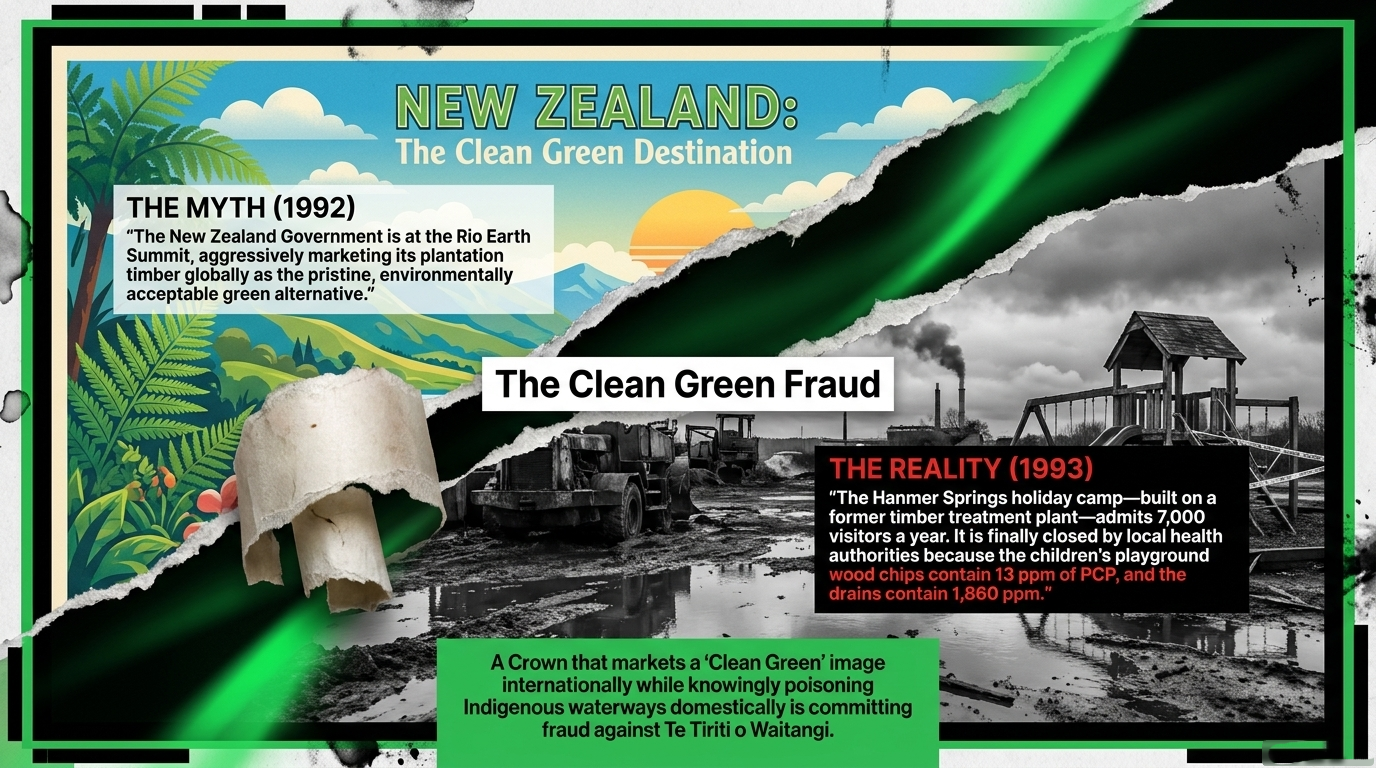
If a tourism board aggressively promoted a nation as the world's pristine environmental alternative while that nation's own government reports identified more than 10,000 potentially contaminated sites — and the most contaminated site in the country was its most famous tourist lake — western media would call it one of the great national frauds of the twentieth century. As New Scientist reported in 1993, in the very same year New Zealand was at the Rio Earth Summit promoting its plantation timber as the world's environmentally acceptable green alternative, the Waipa stream was carrying half a tonne of PCP per year into Lake Rotorua.
Gordon's Deadly Legacy captures the obscenity of the timing:
"At the Rio Earth Summit New Zealand proudly promoted our plantation-grown wood products as the environmentally acceptable alternative to logging old growth forests."
While the contamination Gordon had documented was actively spreading through the nation's most iconic lake. While Māori were being told not to eat the kākahi. While the task group was still finding new sites.
The Hanmer Springs holiday camp — built on the site of a former timber treatment plant — was admitting approximately 7,000 visitors a year when it was finally closed by local health authorities in 1993, as reported by New Scientist. PCP contamination in the children's playground reached 13 ppm in wood chips. PCP in the drains reached 1,860 ppm. New Zealand had no legally binding safety standards for PCP at the time. Children played in a contaminated playground while the government wrote guidelines.
Tikanga impact: Kaitiakitanga is not a marketing word. It is a fundamental obligation that binds every relationship between people and the natural world in te ao Māori, and it binds the Crown as Treaty partner. A Crown that markets its clean green image internationally while knowingly poisoning Indigenous waterways domestically is not merely failing its environmental obligations. It is committing fraud against its Treaty obligations and against every community whose wai, kai, and whenua it was supposed to protect as a co-signatory to Te Tiriti o Waitangi.
Quantified harm: More than 600 contaminated timber treatment sites confirmed by 1992.
Up to 10,000 total sites potentially contaminated, as documented in New Scientist.
Total cleanup cost estimated at up to NZ $2.6 billion. Remediation at the Waipa site alone estimated as comparable to some of the worst contaminated sites in the United States, at a cost equivalent to NZ $50 million.
Solution: End the clean green marketing while contamination remains unresolved. Establish a binding national environmental accountability framework with Treaty-based co-governance of all environmental standards and remediation programmes. Begin — with full funding, full transparency, and full Crown accountability — now. The remediation will take decades. The decision to start cannot wait another three years for this government to finish dismantling whatever remains of the regulatory architecture Gordon spent his life building.
Read also: The Māori Green Lantern's Dying on the Books traces how the state systematically denied compensation to the workers who built this export economy with their contaminated bodies — while the clean green brand they worked to produce kept selling overseas.
What New Zealand Could Have Been — and Who Killed It
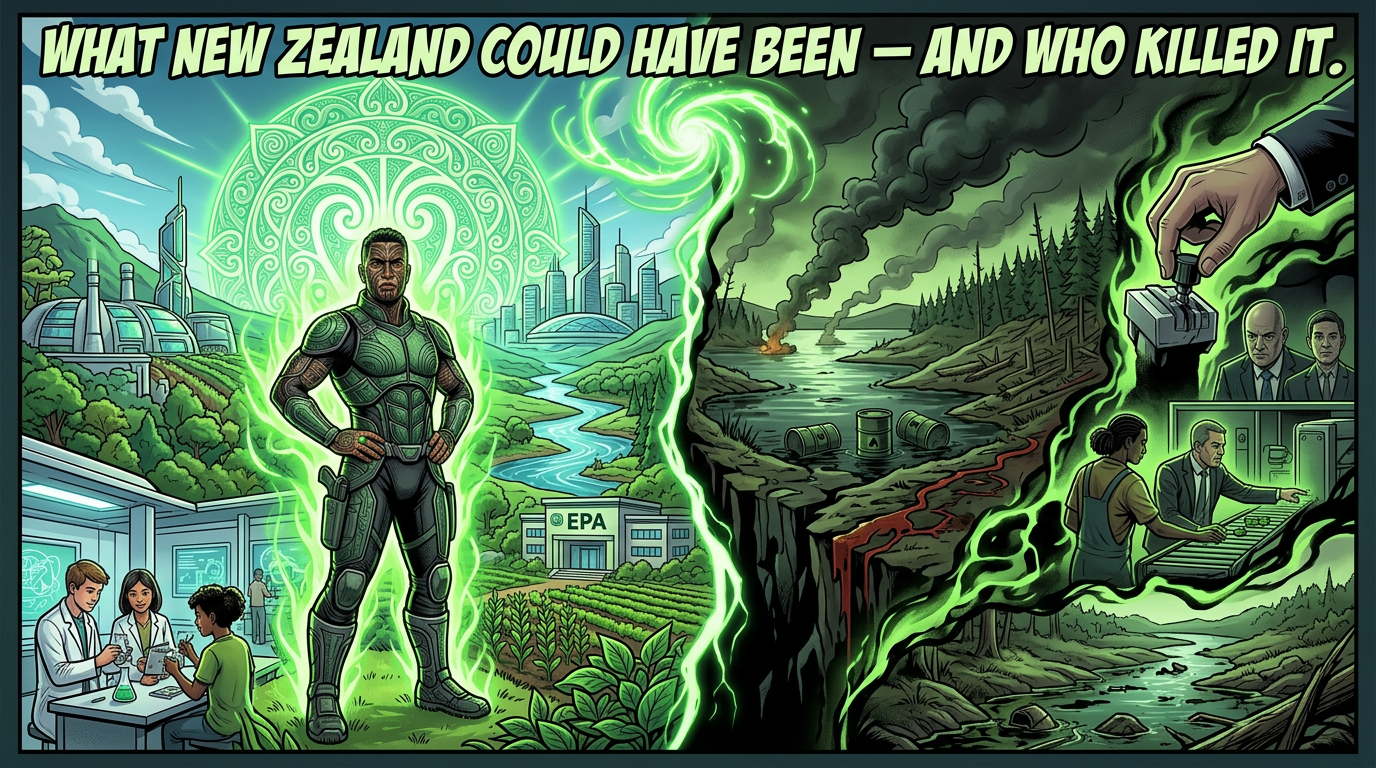
In his conversation with The Māori Green Lantern, Gordon described his vision for what New Zealand could have become had the regulatory reforms he and Greenpeace proposed in the 1990s been implemented in full: a genuine Environmental Protection Agency with statutory enforcement power, hazardous substances legislation with real criminal teeth, a science education system that engaged young people rather than alienated them, and a genuine transformation of industrial forestry and agriculture toward regenerative practice.
The Deadly Legacy proposed exactly this — calling for the establishment of a "New Zealand Environmental Protection Agency" and demanding "a government strategy to deal with contamination that includes legally enforceable cleanup standards, a coordinated national survey of contamination, the setting up of a public database on cleanup technologies, and for public warnings to be posted at all contaminated sites."
None of it was delivered in full. The Hazardous Substances and New Organisms Act 1996 emerged without the enforcement teeth Gordon had demanded. And now, as documented by The Māori Green Lantern in When the Whenua Bleeds, the Luxon government is systematically weakening what remains — stripping regulatory agencies of resources, installing compliant appointees, and opening the whenua to extractive industries while calling it economic growth.
The pattern is unbroken. Every time a generation of campaigners wins a partial gain, a subsequent right-wing government dismantles it in the name of productivity and getting out of the way of business.
The same business that put dioxin in Lake Rotorua.
The same business that directed Māori workers into the green chain without protection.
The same business that Gordon has been fighting since the Hangaroa River first showed him what extraction looks like when it is finished with a place.
The HRC Report: Watch What This Government Does Next
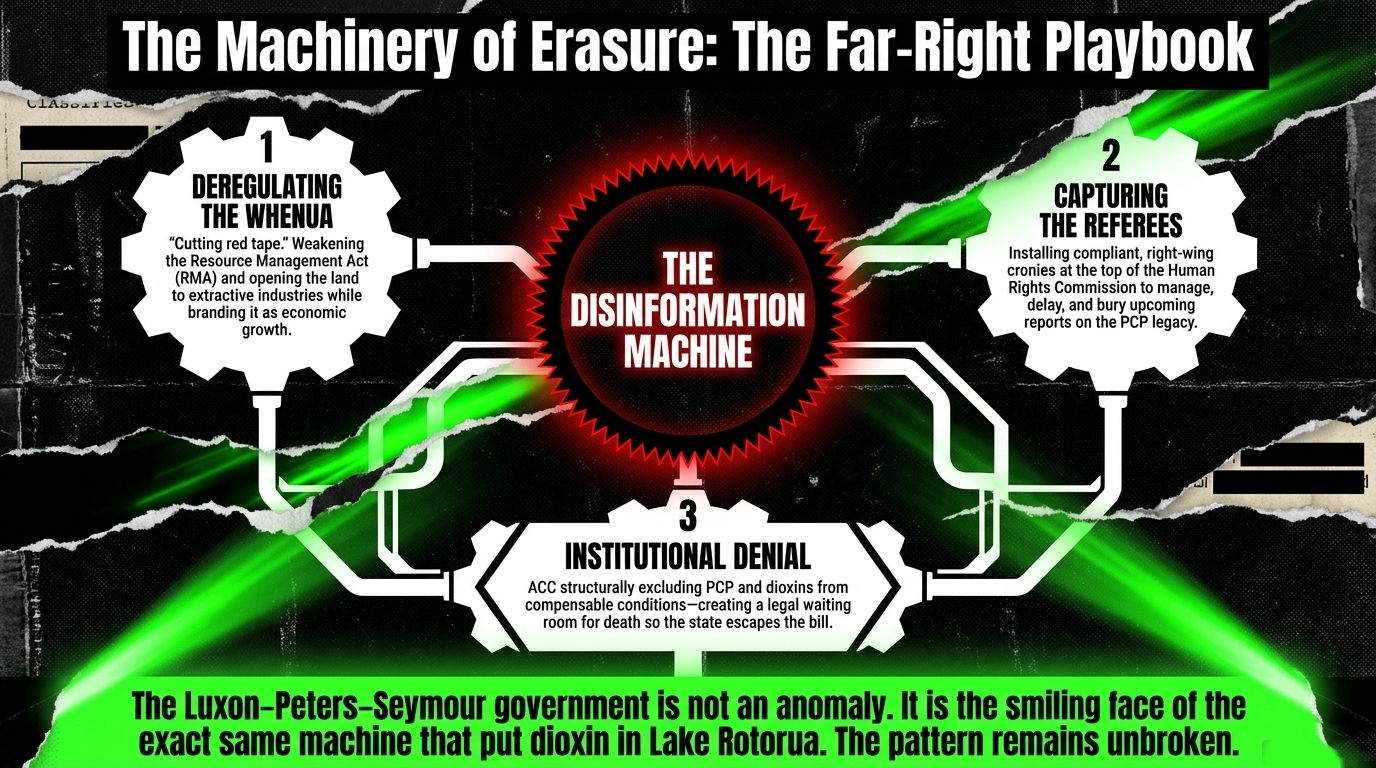
Gordon confirmed that a Human Rights Commission report on the PCP poisoning legacy is due out soon, describing it as coming
"hopefully to contribute for a just outcome, despite all that has not happened."
In the same exchange, Ivor noted that this right-wing government has installed its cronies at the top of the HRC too.
That is the pincer move this government has perfected. Commission the review. Install the people who will manage its reception. Wait for the momentum to drain. Convert evidence into process. Give it a reference number. File it beside every other report that recommended action and received a working group as its answer.
Gordon has watched this happen before. He is not naïve about it. He is writing a crime thriller about it — transforming three decades of campaign history and documentary evidence into a form that will reach people the Crown's commission reports never will. That book is the brown paper bag, delivered at scale.
He Whakakapi — The Taiaha Has Not Been Sheathed
Gordon received an anonymous brown paper bag in 1992 and turned it into a national campaign, a government-challenging published report, thirty-five years of sustained advocacy, a contaminated sites register, and
— as E-Tangata records
— a relationship with Joe Harawira and SWAP that gave dying workers the language and the data to name what was killing them.
He is still in it. Email on a Friday morning. Zoom at midday. A crime thriller in progress. Watching the Human Rights Commission with cautious hope and earned suspicion.
Joe Harawira called him "my scientist" because science in the service of those being poisoned is not a profession. It is a relationship. In tikanga terms, it is a form of utu — not vengeance, but the restoration of balance through truth, through presence, through refusing to soften a fact that the people needed to hear whole.
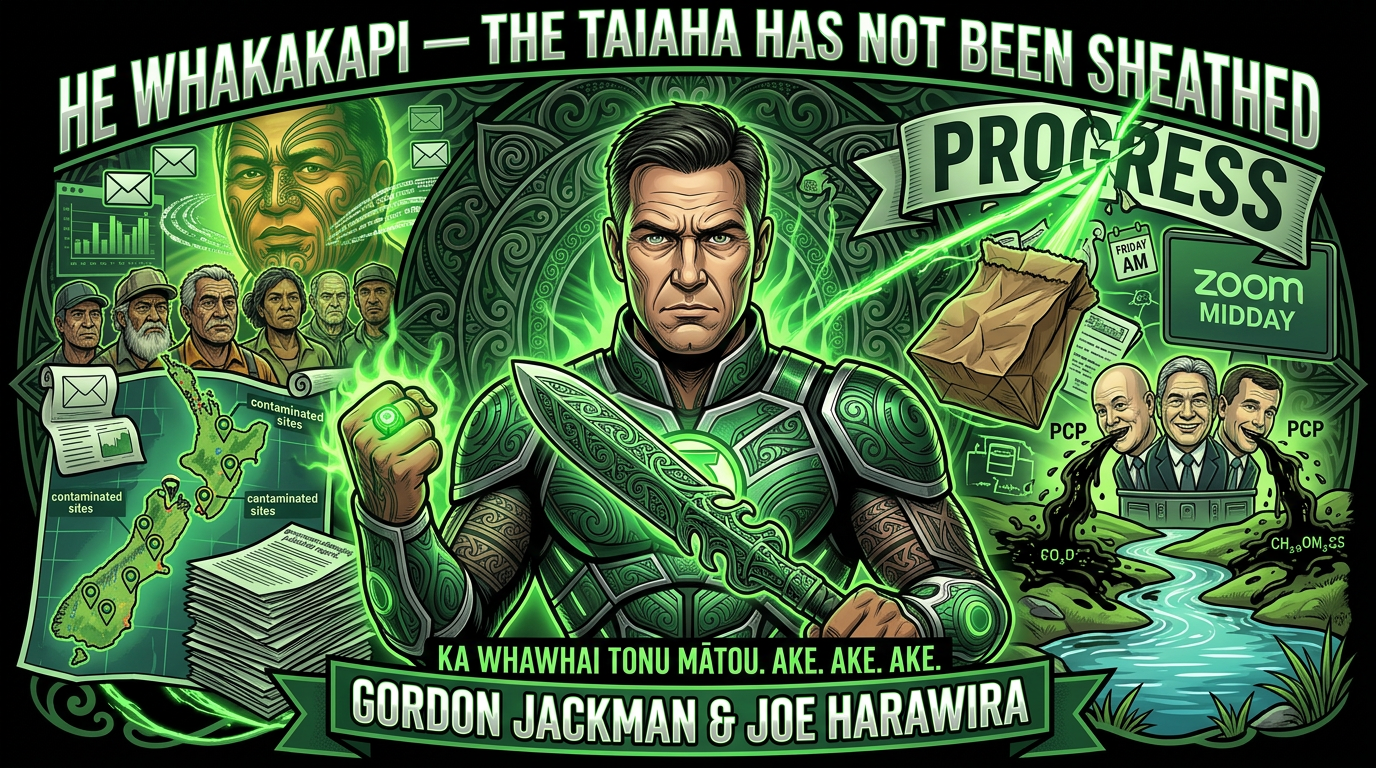
The current government is not a departure from the history this essay documents. It is its most honest expression. Christopher Luxon, Winston Peters, David Seymour. They did not create the logic of expendable communities and privatised profit. They inherited it, celebrated it, and are accelerating it with new urgency. They are the smiling face of the same machine that left the Waipa stream carrying half a tonne of PCP per year into a taonga lake and called it progress.
Gordon looked in that brown paper bag and refused to call it progress.

Thirty-five years later, so does this publication.
Ka whawhai tonu mātou. Ake. Ake. Ake.
Tautoko Mai — Koha
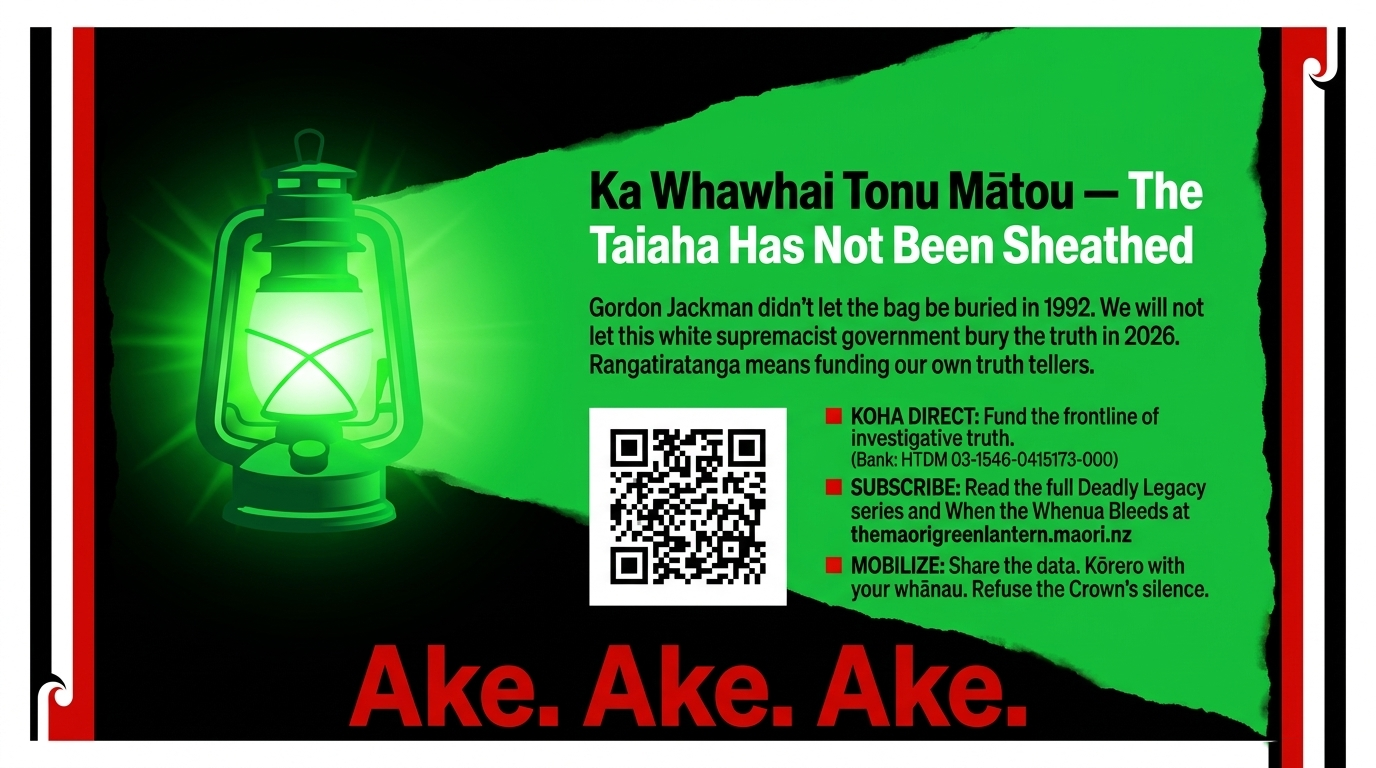
Gordon spent thirty-five years making sure the evidence in that brown paper bag could not be buried.
This essay exists to make sure it cannot be buried again — not by a minister's guidelines, not by a reregistered pesticide board, not by a Human Rights Commission whose leadership was chosen by the very government that needs to be accountable.
Every koha to The Māori Green Lantern says that the science Gordon documented — the dioxin, the PCP, the kākahi gone from Lake Rotorua, the workers still dying — will not be filed away while this white supremacist neoliberal government waits for us to stop asking. It says rangatiratanga includes funding our own truth tellers, because the Crown that licensed the poison will never fully fund the accounting of it.
If koha is not possible right now — subscribe, follow, kōrero, share. That is koha too.
- Koha direct: Koha — Support the Māori Green Lantern
- Subscribe for essays: Subscribe to the Māori Green Lantern
- Bank transfer: HTDM 03-1546-0415173-000
- Facebook: The Māori Green Lantern on Facebook

Views expressed constitute honest opinion on matters of public interest under the Defamation Act 1992 (NZ) and Durie v Gardiner NZCA 278. All factual claims sourced and cited. Named individuals referenced solely in their public capacity.
Correction 2 May 2026: An earlier version of this essay incorrectly stated Gordon Jackman's formative river was the Hangaroa as a site of pollution. Gordon has confirmed the Hangaroa was clean and beloved. It was the Tarawera River — known locally as "the Black Drain" due to Tasman Pulp and Paper's industrial discharge — that showed him what extraction does to a living waterway. This correction has been made and strengthens the record.