
"The Curriculum Coup: Stanford's Three-Act Colonial Performance — and the Lie That Ties Them All Together" - 6 May 2026
A Florida-trained, Atlas Network-funded, NDA-gagged recolonisation programme wearing the costume of "achievement" — and a minister who called every kaiako in Aotearoa a "vocal minority" when they noticed.

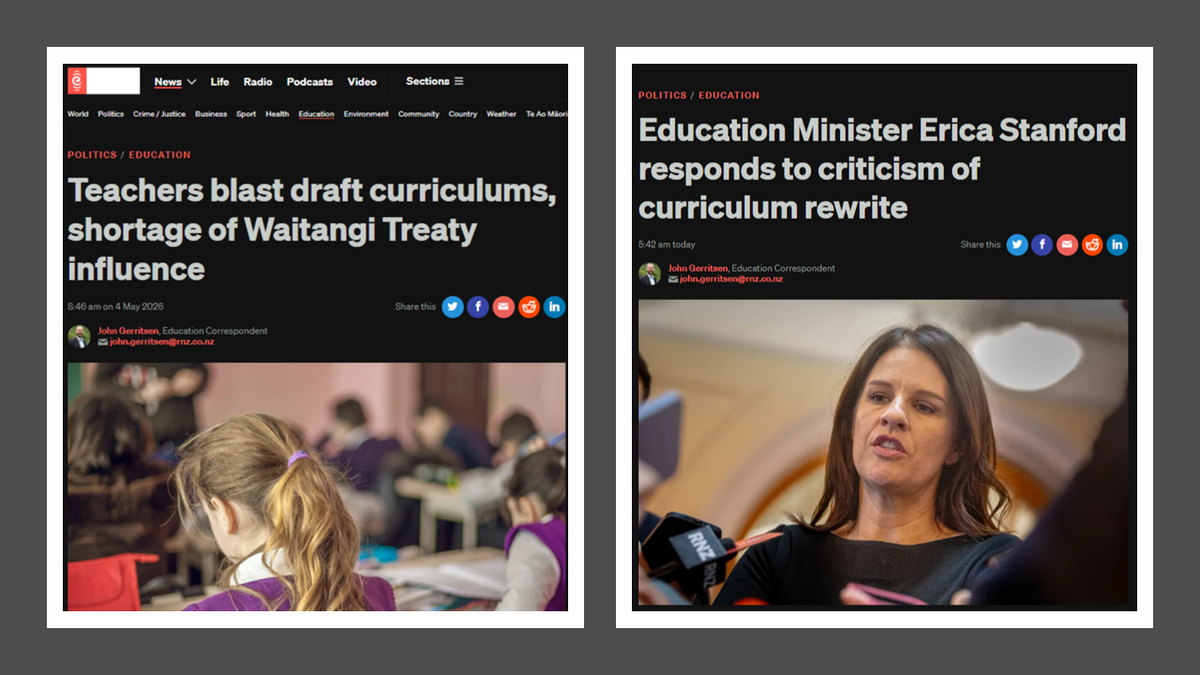
This essay examines Erica Stanford's curriculum rewrite in full because it directly threatens the Treaty-protected educational rights of Māori tamariki, the professional rights of kaiako, and the democratic accountability of a minister who has been caught lying — not once, but systematically, at every stage of a three-act colonial performance.
Kia ora Aotearoa,
The River Poisoned from the Source
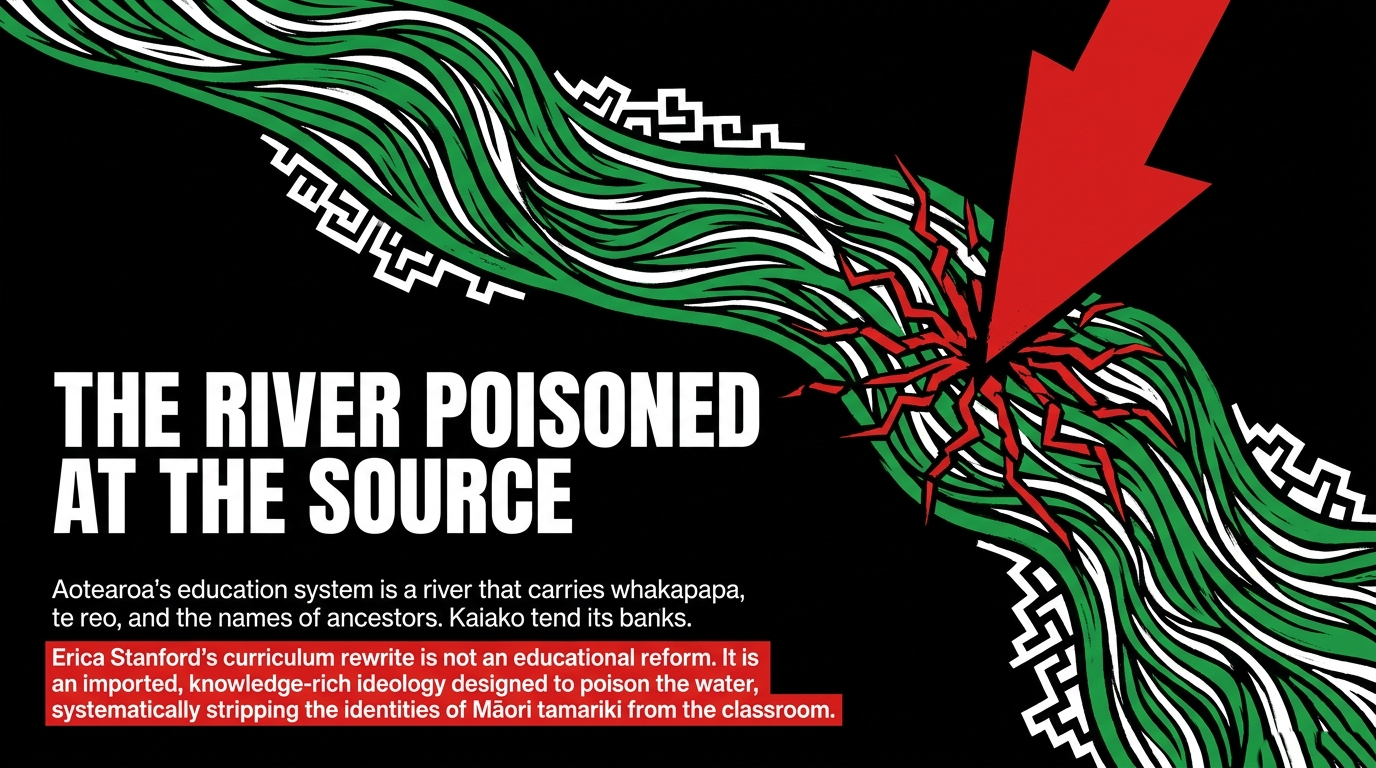
Picture a river. It has flowed through this land for a thousand years. Its banks are lined with kūmara gardens. Kaiako — teachers — tend those banks. They know every current, every bend, every stone. They have given their lives to this water. The children swim here. They learn here. The river carries whakapapa, te reo, the names of ancestors. It carries everything.
 John Gerritsen
Now imagine a government that poisons the river at the source — quietly, in a meeting room in Wellington, using a formula imported from Florida, written by a Pākehā sociologist, recommended by an American think tank, and approved without consulting the people whose children drink from it. Then imagine that minister standing at the river's edge with a camera crew, pointing downstream at the dying fish, and saying: "The children were already getting sick. We had to act."
John Gerritsen
That is Erica Stanford's curriculum rewrite. The river is Aotearoa's public education system. The poison is Atlas Network ideology dressed as "knowledge-rich" reform. The dead fish are Māori tamariki's language, history, and identity — stripped from their classrooms by a policy written in secret, sealed with NDAs, and now defended with the contemptuous dismissal that every teacher, every principal, every professional body, and every Māori community raising the alarm is merely "a quite vocal minority."
The Deep Dive Podcast
Listen to a lively conversation between two hosts, unpacking and connecting topics in the sources of this essay.
The poison is already in the water. This essay names every hand that put it there.
ACT ONE: The Pre-Written Policy — "Knowledge-Rich" Was Never Stanford's Idea
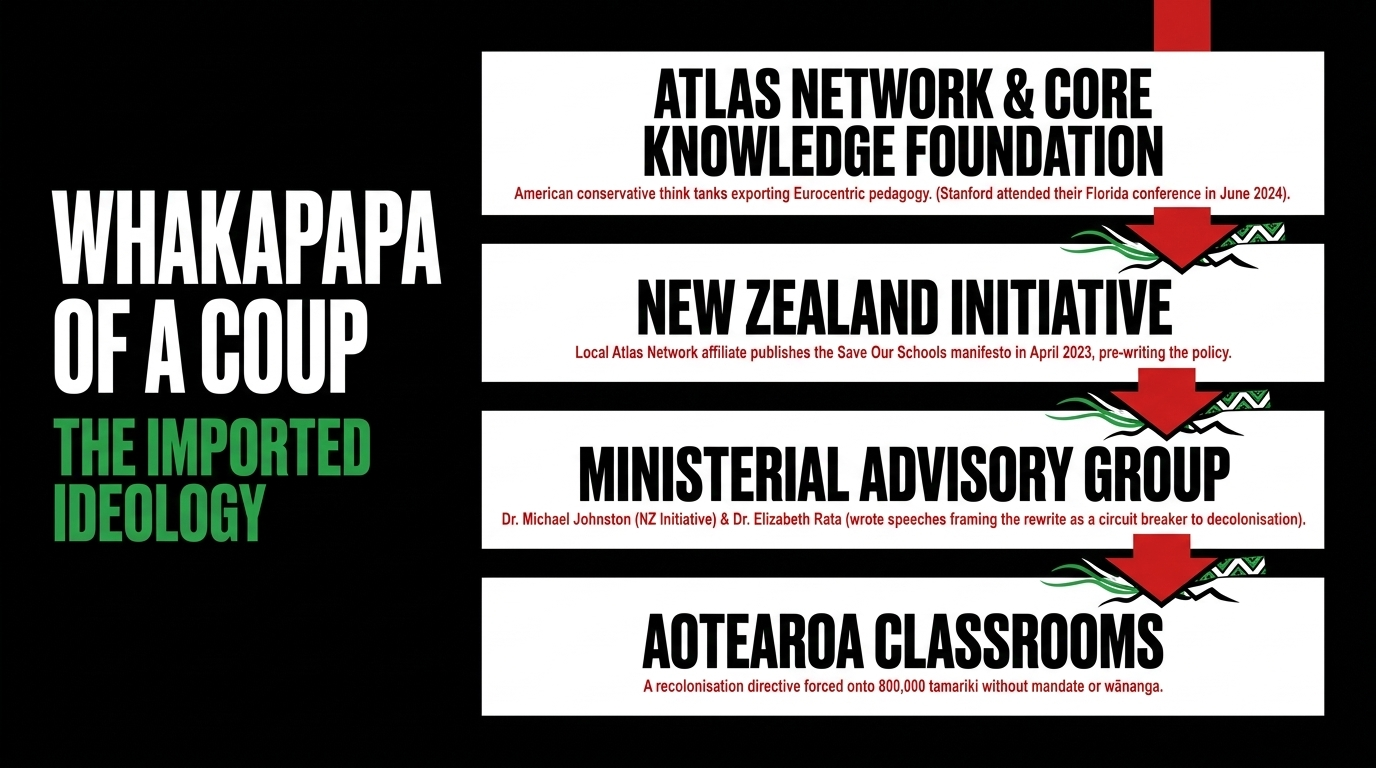
Before Erica Stanford appointed a single advisory group member, before she announced a single curriculum review, the policy was already written.
In April 2023 — months before the National-led coalition even took office — the New Zealand Initiative published its education manifesto
Save Our Schools.
Its number one recommendation:
"introducing a new knowledge-rich curriculum."
As E-Tāngata's Jessie Moss revealed, this Atlas Network member had long lobbied Aotearoa politicians to adopt what US and UK conservatives call
"core knowledge"
— a Eurocentric canon that erases Indigenous epistemologies while presenting itself as universal truth.
That phrase — knowledge-rich — now defines Stanford's entire reform programme. It appears in every press release, every media statement, and, critically, in a speech that was written for Stanford by Dr Elizabeth Rata, a Pākehā sociologist appointed to Stanford's ministerial advisory group, who emailed congratulations when the English draft was released:
"It is the knowledge-rich curriculum you promised."
Stanford did not originate this policy. She received it — packaged, speech-written, and ready for delivery — from ideologues with a pre-existing agenda.
Who are those ideologues?
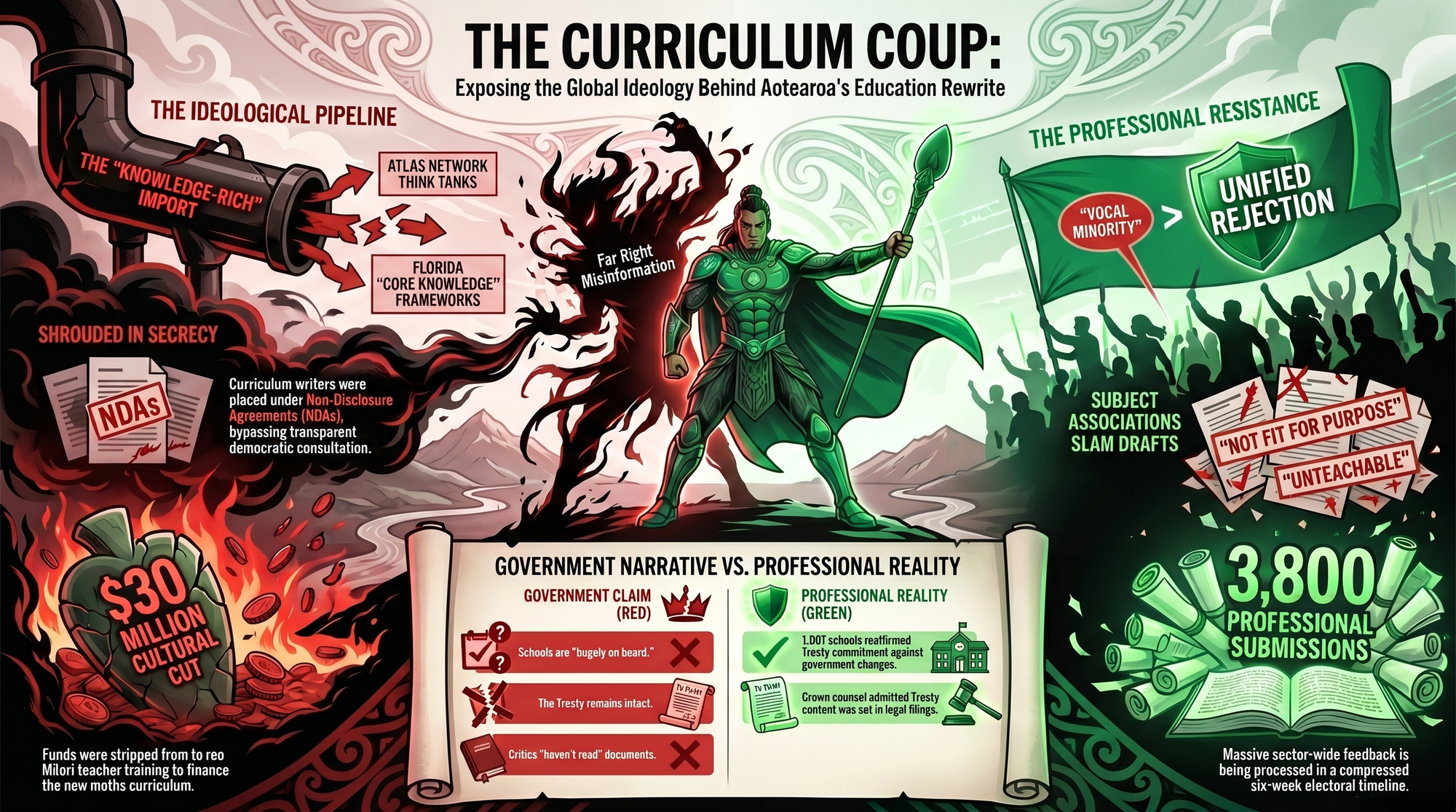
The New Zealand Initiative is a confirmed Atlas Network member. Stanford appointed its senior fellow Dr Michael Johnston to her Curriculum Coherence Group.
Johnston is now her public spokesperson defending the curriculum to media. As The Māori Green Lantern documented in "Copy-Pasted Colonialism" (October 2025),
"The same think tank writing our curriculum" — and the pipeline from Atlas Network → think tank manifesto → ministerial advisory group → national policy is not coincidental.
It is structural. It is whakapapa of a coup.
And Rata's explicit goal?
In her speech for Stanford, Rata hoped the reforms would be the
"circuit breaker" to "ending decolonisation's success." Her advisory group's formal recommendation to Stanford was that "Te Tiriti o Waitangi, our nation's founding document, be removed from the curriculum and replaced with the science of learning." This is not education policy. This is a recolonisation directive, signed, delivered, and acted upon.
ACT TWO: The Florida Curriculum — Imported Ideology, Aotearoa's Tamariki
In June 2024, Stanford flew to the United States and stood on a stage at the Core Knowledge Foundation conference in Florida. There, she told American conservative education reformer E.D. Hirsch — directly, on record, in public — that
"I am now implementing huge reform in New Zealand based on your book."
The plenary was chaired by Robert Pondiscio of the American Enterprise Institute, as E-Tāngata documented
— another Atlas Network affiliate.
Hirsch's framework has been criticised globally by Indigenous education scholars for enshrining a Eurocentric colonial canon as universal, while erasing First Nations knowledge systems.
Stanford flew home and began rewriting the curriculum for 800,000 Aotearoa school children using the ideas of an American conservative ideologue.
As The Māori Green Lantern exposed in "The Atlas Network's Trojan Horse" (2025), this is how Atlas Network ideology travels: from American think tank conference → New Zealand Initiative manifesto → ministerial advisory group → national curriculum.
The Daily Blog confirmed it independently in October 2025:
"Stanford's Drive to Impose an Overseas Developed Curriculum in NZ Schools."
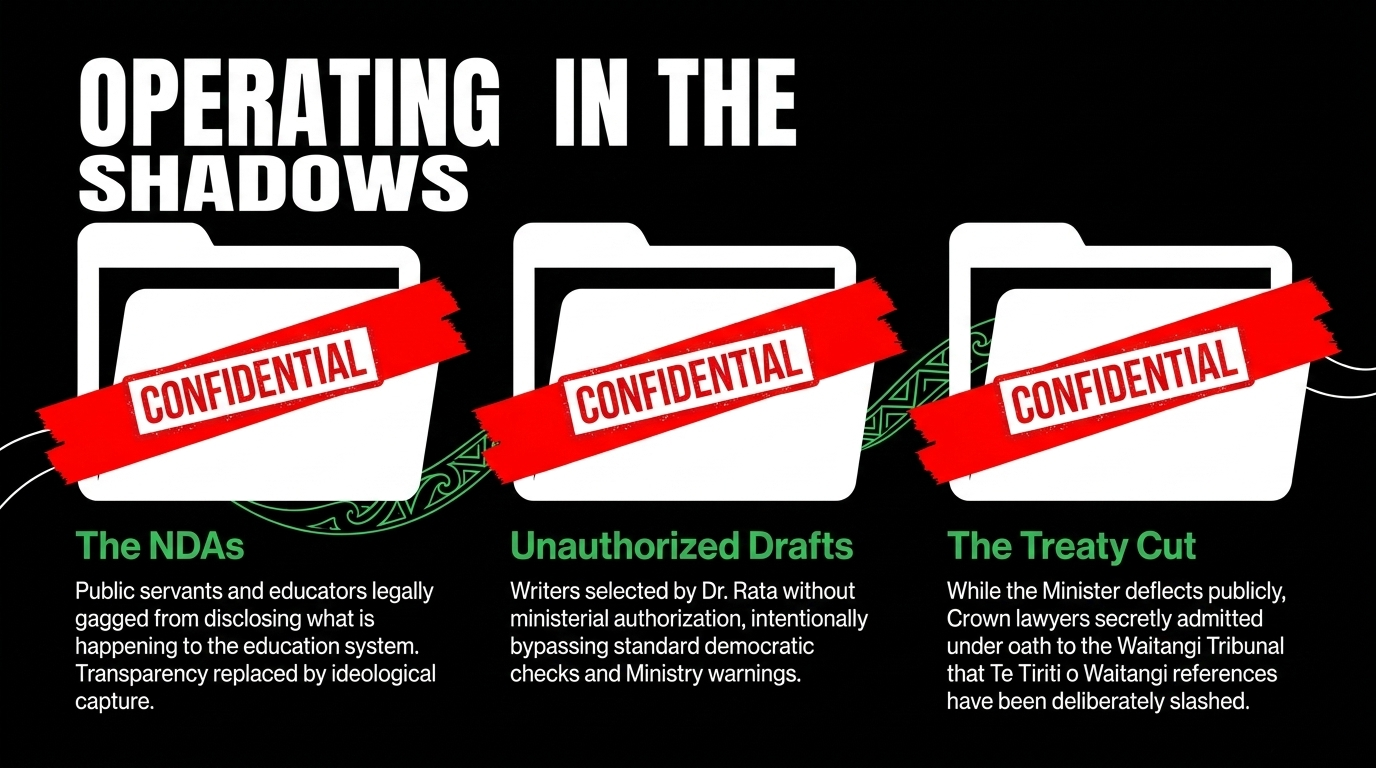
OIA-released emails then revealed what happened next. Rata — operating outside her formal mandate — began selecting curriculum writers by April 2024, without ministerial authorisation. A Ministry of Education staffer warned her in writing:
"Can you please not do anything further until the Minister has formally responded."
Rata's reply:
"Oh dear, I wrote to 3 of the 7 members of the English Writing Team today to invite them to join."
She continued. Stanford let it stand. Participants were placed under non-disclosure agreements. One NDA-bound advisory member rejected Te Tiriti as a basis for including Māori writers in the English curriculum, citing "quality" alone. Stanford has never addressed this. Not once.
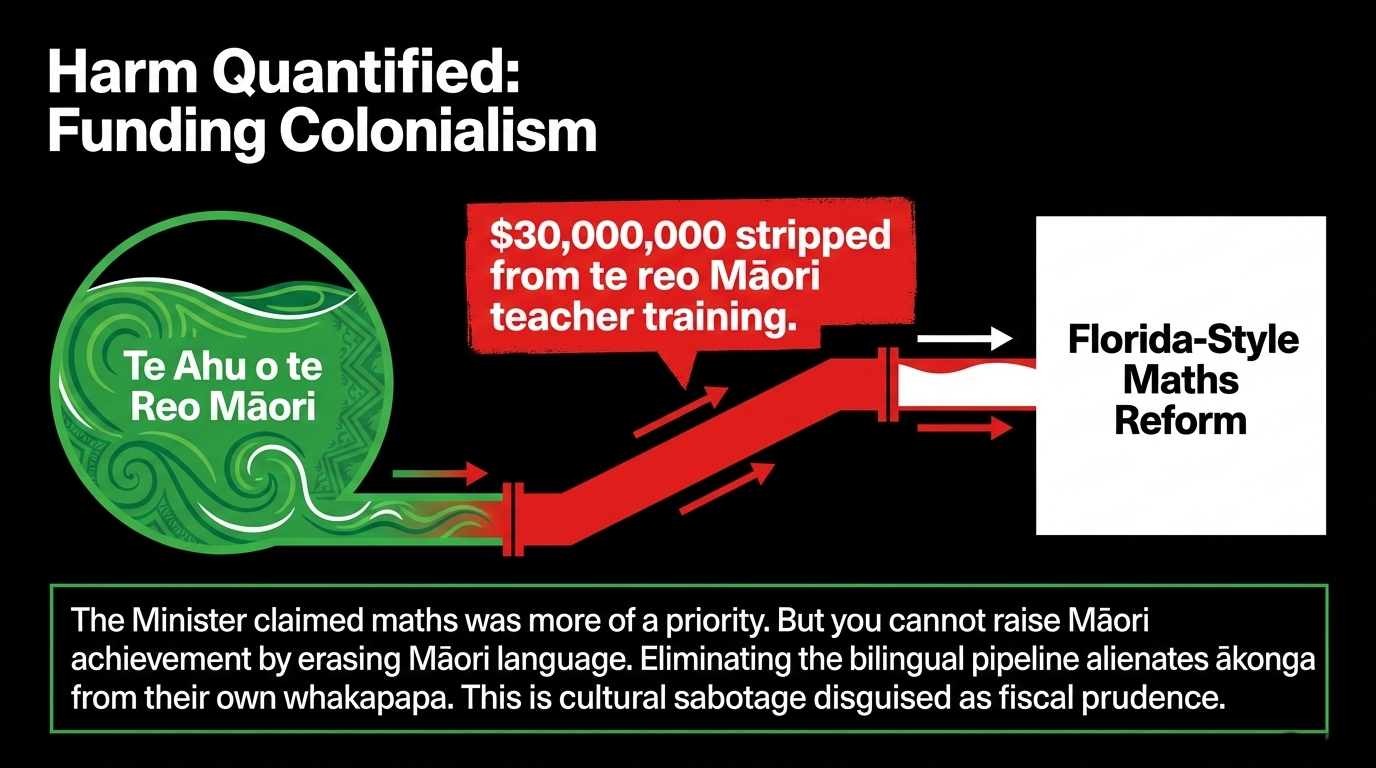
Then came the funding axe. In September 2024, Stanford cut $30 million from te reo Māori teacher training to fund the maths curriculum refresh — telling the NZ Herald that maths was "more of a priority." As The Māori Green Lantern reported at the time, thirty million dollars stripped from the language of tangata whenua, redirected to a maths curriculum built on Florida ideology. Then when Stanford moved to strip school boards of their Treaty obligations under the Education Act, the Ministry of Education advised her to consult with Māori first. She ignored the advice. She did not consult. She told Newstalk ZB she was "not certain what school boards were expected to do" under the requirement she was abolishing — a jaw-dropping admission of either ignorance or deliberate deception.
And here is the Crown's own verdict, delivered not to cameras but to lawyers: in January 2025, Crown counsel formally admitted to the Waitangi Tribunal that "yes, there are fewer direct references to Te Tiriti and associated te reo Māori words and concepts in the curricula for years 0–6 English and years 0–8 Maths," as E-Tāngata documented. The Crown admitted, under oath, in a legal forum, what Stanford still denies in press conferences. That gap between what Crown lawyers admit and what the minister says publicly is the territory where her credibility has gone to die.
ACT THREE: The Dismissal — "A Quite Vocal Minority"
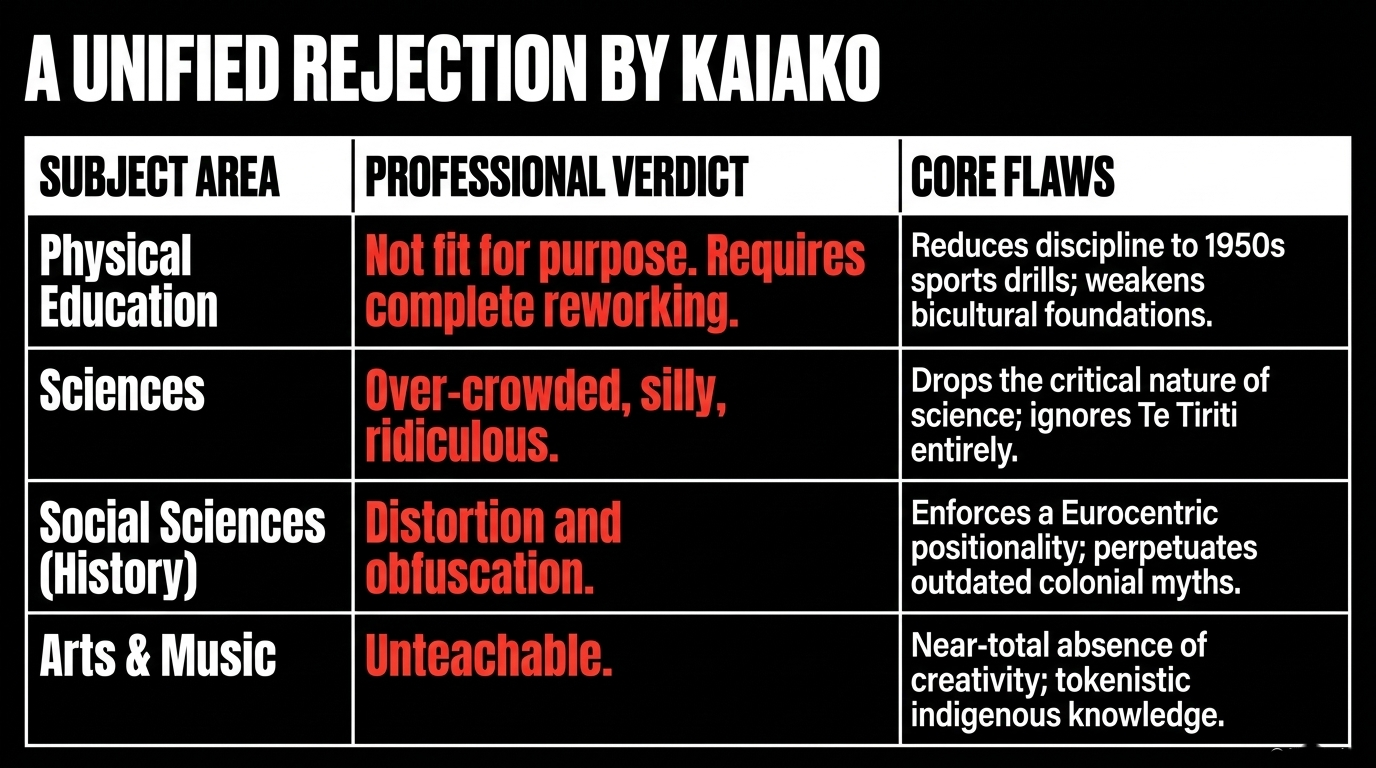
Here is where the mask fully comes off. By May 2026, the professional response to Stanford's six draft curriculums was not ambiguous. It was overwhelming, unified, and formally documented across every subject area, as RNZ reported on 2 May 2026:
- Physical Education New Zealand: demanded a complete rewrite, called the draft "not fit for purpose"
- Social Sciences teachers: warned of "distortion and obfuscation" that will "negatively impact Māori students" — called the drafts Eurocentric, monocultural, "perpetuating outdated myths"
- Music teachers: called the curriculum "unteachable"
- Science teachers: called content "overcrowded," "silly," and "ridiculous"
- NZATE (English teachers): withdrew entirely from Ministry working groups — an unprecedented act
- Dozens of national principals' and teachers' organisations: signed an open letter calling for a complete halt to all curriculum changes
- 1,007 schools: formally reaffirmed their commitment to Te Tiriti o Waitangi after Stanford removed the Treaty obligation from school boards
- Over 200 school boards: wrote to Stanford within two weeks of the law change to oppose it
- 3,800 formal submissions: received by the Ministry on the six drafts
Not one organisation representing teachers or principals has spoken in support of Stanford's changes. Not one.
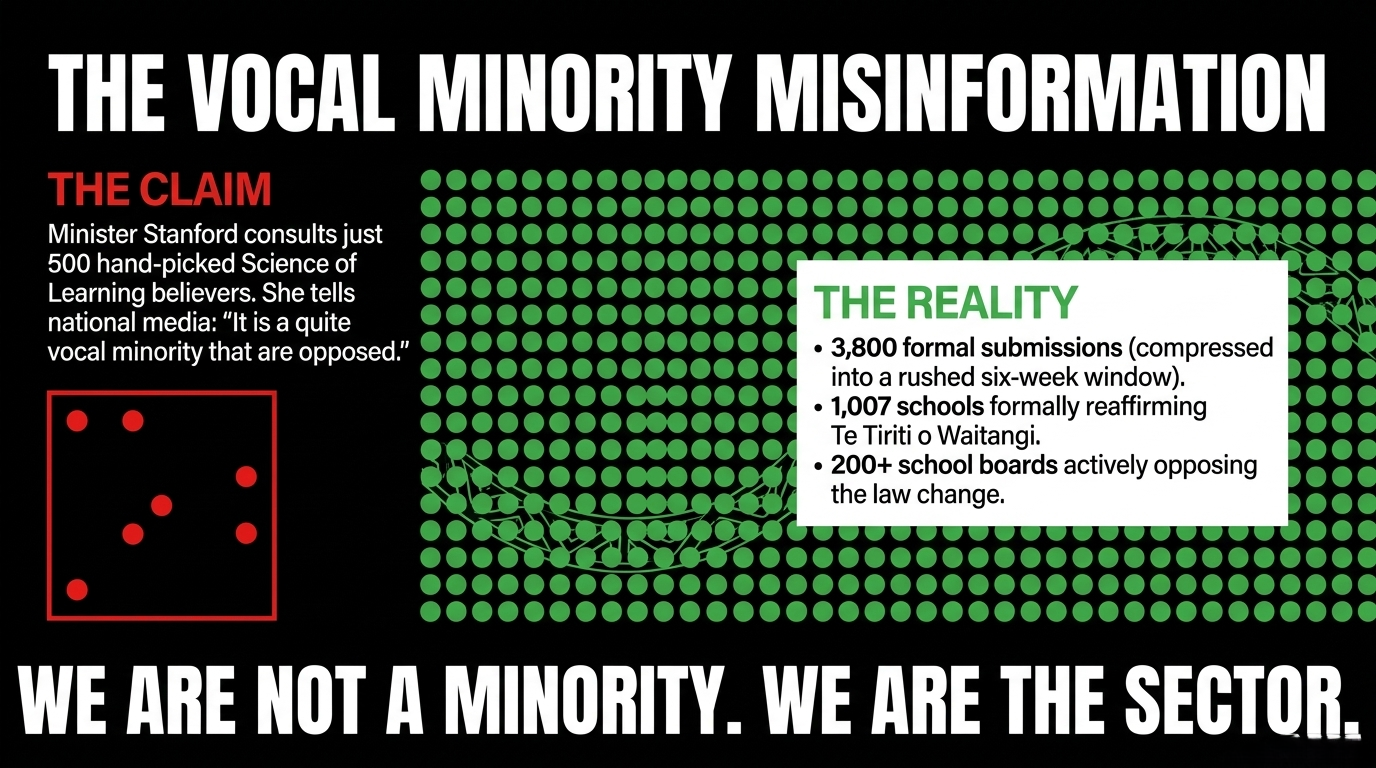
Stanford's response to this historic, cross-sector, profession-wide rejection? She attended a self-selected weekend conference of 500 teachers already committed to "the science of learning" — her own preferred pedagogy — and told RNZ on 6 May 2026:
"Schools I've talked to are hugely on board. My view is that it is a quite vocal minority that are opposed to these changes."
Five hundred self-selected believers. Versus every professional body in the country. Stanford chose the conference. This is not arithmetic. This is a colonial operator managing a narrative she can no longer control.
She then dismissed PE teachers as
"wanting us to push back to a very vague curriculum that's stripped of any sort of knowledge"
— insulting, in a single sentence, an entire national teaching profession that has dedicated careers to the subject she just waved away. She ruled out complete rewrites. She suggested critics
"had not read the documents properly."
Meanwhile, her own appointed insider, Michael Johnston, admitted to RNZ:
"The process has been very rapid, nobody can deny that. When England revised its curriculum it took many years. We have a three-year political cycle and like it or not, that has an influence."
The timeline is electoral, not pedagogical. The urgency is partisan, not educational. Even the government's own insider admits it. Stanford denies it. That is the anatomy of a lie.
THREE EXAMPLES FOR THE WESTERN MIND
Example 1: The $30 Million Theft from Te Reo — Harm Quantified
In September 2024, Stanford cut $30 million from Te Ahu o te Reo Māori — the teacher training programme funding kaiako to learn te reo Māori — and redirected it to fund the maths curriculum refresh. She told media that te reo teacher training
"isn't accredited" and that maths was "more of a priority."
The harm: 12% of Māori students in English-medium settings are at the maths benchmark by Year 8, as Stanford's own Māori Education Action Plan conceded. But stripping $30 million from te reo training does not fix maths. It eliminates the bilingual pipeline that evidence shows improves outcomes for Māori learners. You cannot raise Māori achievement by erasing Māori language. That is not education policy. That is cultural sabotage disguised as fiscal prudence.
The tikanga impact: In tikanga Māori, te reo is not a subject. It is the breath of whakapapa — the living structure through which relationships, history, and identity are transmitted across generations. When you defund te reo teacher training, you do not save money. You sever the cord. You produce generations of Māori children alienated from their own whakapapa, easier to govern, easier to exploit, easier to disappear into the statistics of underachievement that this government then uses to justify the next round of cuts.
The solution: Restore te reo Māori teacher training funding. Expand it. Make it accredited, resourced, and permanent. Treat te reo Māori as the constitutional taonga it is under Te Tiriti — not as a line item to be sacrificed to an Atlas Network maths curriculum imported from Florida.
This has been covered previously by The Māori Green Lantern — see "Stanford's War on Māori Education Rights" (June 2025) and "Stanford's Colonial Classroom" (March 2026).
Example 2: The NDA Silencing — Democracy Killed by Paperwork
Participants in Stanford's curriculum development process were placed under non-disclosure agreements. Teachers and academics — public servants paid by the Crown to serve the public — were legally gagged from disclosing what was happening inside the process that would determine the education of every child in Aotearoa.
The harm: As the University of Auckland's Jude MacArthur documented in November 2025, "The Stanford curriculum process has been shrouded in secrecy. We don't know who rewrote the framework or what the writers' aims were." The original Te Mātaiaho — developed transparently between 2020 and 2023 with named Māori, Pacific, and Tangata Tiriti experts — was "sidelined" by a process whose authors cannot be named and whose deliberations cannot be disclosed. The NZATE — New Zealand's association of English teachers — found the process so irredeemably corrupted that it withdrew entirely from Ministry working groups rather than lend legitimacy to it.
The tikanga impact: In tikanga Māori, transparency and collective accountability — kanohi ki te kanohi, face to face, no hidden hands — are not optional values. They are the foundation of mana. A process conducted in secrecy, sealed with NDAs, with participants forbidden from speaking to their own communities, is not a consultation. It is a violation. It produces a curriculum with no mauri — no life force — because the life force of any genuine educational document comes from the people it is meant to serve contributing openly and freely to its creation.
The solution: Abolish the NDAs immediately. Publish the names of all curriculum writers and their institutional affiliations. Restart the process with transparent, Treaty-mandated Māori co-design — not as a token gesture, but as the governing methodology. As The Māori Green Lantern documented in "The Curriculum Con" (October 2025), "Stanford and her advisory group have hijacked the process, replacing democratic consultation with ideological capture."
Example 3: 3,800 Submissions Compressed into Six Weeks — Consultation as Theatre
The Ministry of Education received approximately 3,800 submissions on the six draft curriculums, as Ministry deputy secretary Pauline Cleaver confirmed to RNZ on 6 May 2026. Cleaver stated the updated curriculum would be published "in the middle of the year." That is approximately six to eight weeks from the close of submissions. Three thousand eight hundred detailed professional critiques — written by teachers who gave up evenings, weekends, and class preparation time — compressed into a government timeline that Johnston himself admitted was driven by the three-year electoral cycle.
The harm quantified: Michael Johnston admitted England's curriculum revision took "many years." Aotearoa's is being done in weeks, between the close of submissions and a mid-year publication deadline. Stanford has already ruled out complete rewrites — before the submissions were processed. The Physical Education draft was called "not fit for purpose." The Social Sciences draft was described as requiring a complete rethink. The outcome of consultation was decided before consultation began. As The Māori Green Lantern exposed in "The Curriculum Weapon" (October 2025), this is a weapon, not a reform — designed to move faster than democratic accountability can respond.
The tikanga impact: In tikanga Māori, wānanga — deep collective deliberation — is not a formality. It is the process through which mana is conferred on a decision. A decision made without genuine wānanga carries no mana. It is a hara — a transgression — because it violates the relational obligations that make collective life possible. Stanford's curriculum will carry no mana in Māori communities because it was built on the systematic exclusion of Māori voices, Māori knowledge, and Māori authority. That is not a metaphor. That is a legal and constitutional reality, confirmed by the Crown's own counsel before the Waitangi Tribunal.
The solution: Pause the curriculum update timeline now. Convene a genuine Waitangi Tribunal-supervised wānanga with Māori educators, iwi representatives, and kaiako from every affected subject area. Require the Ministry to publish a detailed, named response to every submission. Allow the Waitangi Tribunal's education inquiry to report before the curriculum is finalised.
See previously: The Māori Green Lantern, "Recolonisation by Stealth" (November 2025) and "Te Kōrero Tūmatanui: The Neoliberal Hijacking of Our Children's Minds" (October 2025).
THE THROUGH LINE: Whakapapa of a Coup
Draw the lines. The structure is unmistakeable:
Atlas Network → New Zealand Initiative manifesto Save Our Schools (April 2023) → "knowledge-rich curriculum" recommendation → Stanford appointed Johnston (NZ Initiative) to advisory group → Rata wrote Stanford's speeches → Rata selected curriculum writers without authorisation → NDAs silenced participants → $30 million stripped from te reo Māori teacher training → Ministry advice on Māori consultation ignored → Treaty obligations removed from school boards → Crown admitted Treaty content cut before Waitangi Tribunal → Teachers condemned drafts in every subject area → Stanford called them "a vocal minority" → 3,800 submissions to be processed in six weeks → updated curriculum published mid-2026.
This is not a sequence of mistakes. It is a methodology. Each step was engineered to move faster than democratic accountability could respond. As The Māori Green Lantern traced in "The Atlas Network's Trojan Horse", the Atlas Network's model is precisely this: manufacture urgency, install ideologically aligned advisers, bypass consultation, and present the outcome as inevitable. And as The Māori Green Lantern documented in "Privatising Education is Cultural Genocide" (February 2025), the endpoint of this methodology is not achievement. It is the privatisation of a public system stripped of its Treaty obligations and rendered safe for market capture.
This is what a white supremacist neoliberal government looks like when it operates through policy rather than violence. It does not burn the schools. It rewrites the curriculum. It does not ban the language. It defunds the teachers. It does not abolish the Treaty. It removes it quietly, clause by clause, advisory group by advisory group, NDA by NDA — and when 3,800 people notice, it calls them a minority.
THE TIKANGA RECKONING: Kāore te Kūmara e Kōrero Ana
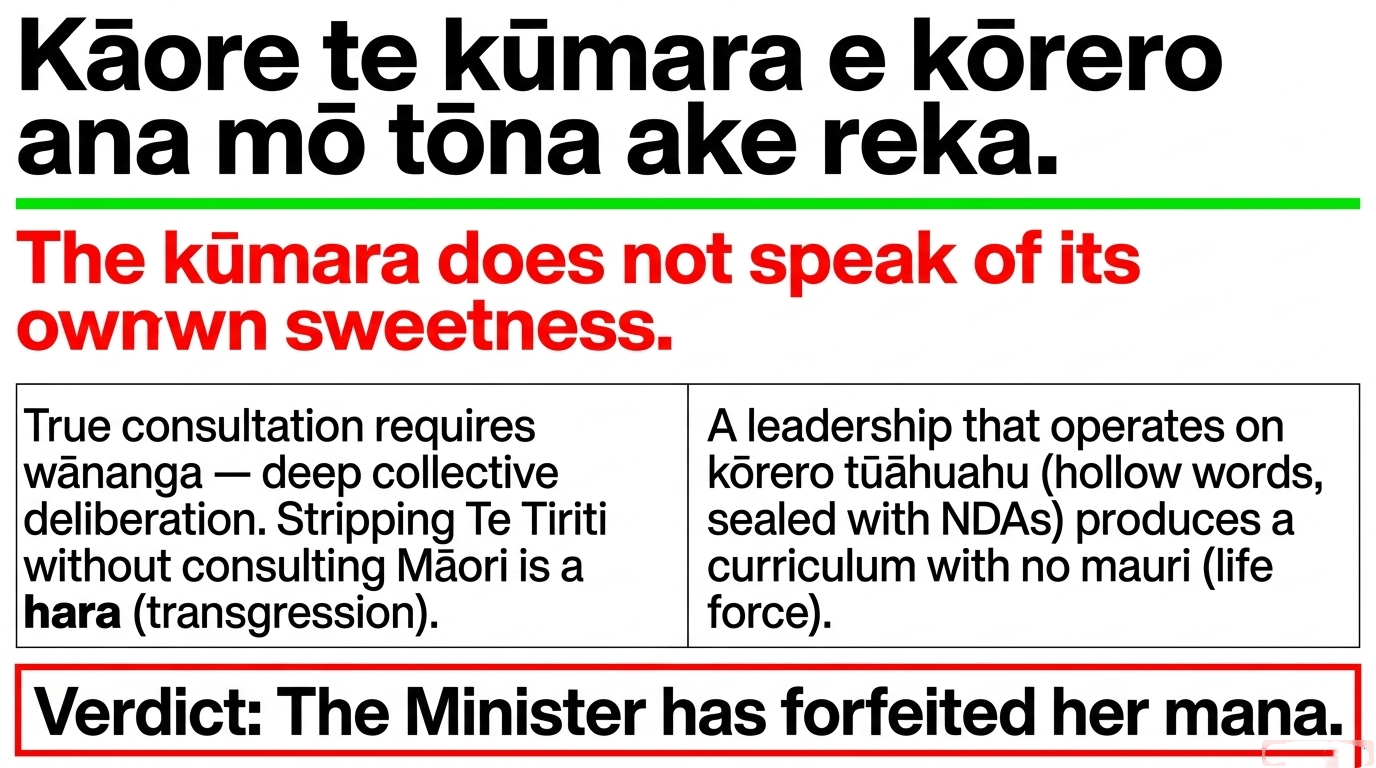
The kūmara does not speak of its own sweetness.
But Stanford speaks of nothing else. She tells every camera that she takes Treaty responsibilities "really seriously." She says consultation is "the point." She says schools are "hugely on board." She says she was already talking to principals about pace before the open letter demanded she slow down.
Every single claim is contradicted by documented, verified, on-the-record evidence. The Treaty was removed without Māori consultation — against Ministry advice. Pace was decided before principals were meaningfully consulted. The consultation outcome was predetermined. No national body supports the changes. And the Crown's own lawyers confirmed before the Waitangi Tribunal that Treaty content has been cut — while Stanford continues to imply to Māori whānau that the Treaty is intact.
That is not a difference of emphasis. That is a lie told to Māori parents about what their children will learn. It is kōrero tūāhuahu — hollow words, detached from integrity, performing substance while carrying none. And in tikanga Māori, a leader whose words carry no weight, whose consultation is theatre, whose Treaty commitments are press-release-deep, has forfeited the authority that makes governance legitimate.
Stanford has forfeited that authority. The profession has said so. The Waitangi Tribunal process confirms it. The evidence is overwhelming. The only remaining question is whether the institutions of this country will act before another generation of Māori tamariki is put through a curriculum designed in Florida to end decolonisation.
WHAT MUST HAPPEN — He Ara Whakamua
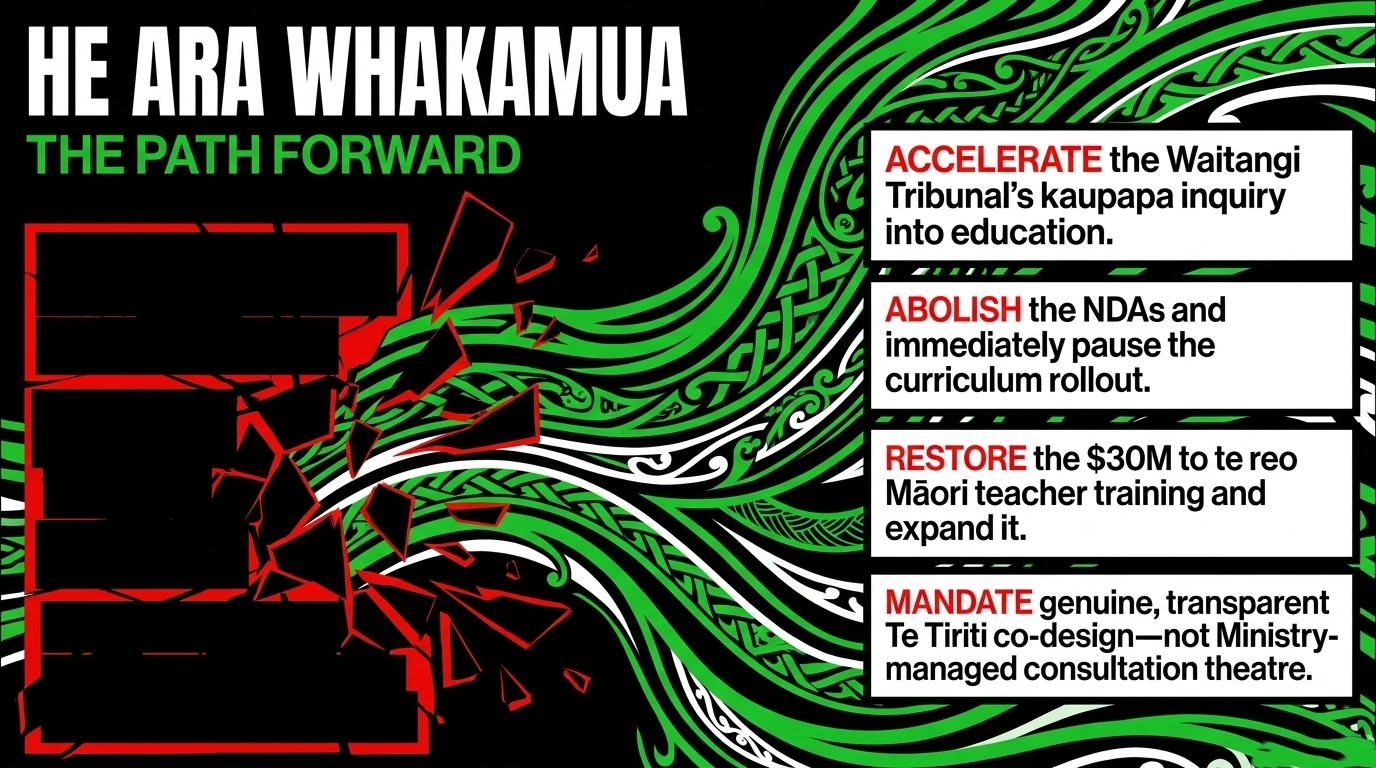
The Waitangi Tribunal's kaupapa inquiry into education must be accelerated.
Its findings must carry binding political consequence.
The NDA gag orders must be rescinded. The curriculum update must be paused until a genuine, Treaty-mandated co-design process — not a Ministry-managed consultation theatre — can be completed.
The $30 million stripped from te reo teacher training must be restored and expanded.
Every kaiako who submitted to this process must know: your words were heard, even if the minister refused to hear them.
Every principal who signed the open letter must know: your professional integrity is the last institutional barrier between this government and our tamariki.
Every Māori whānau must know: the Crown admitted, in its own legal filings, that the Treaty was being erased from your children's education — and the minister kept smiling for the cameras.
Stanford flew to Florida and came home with a colonial curriculum.
She handed it to Atlas Network researchers to write.
She sealed the process with NDAs.
She stripped $30 million from te reo. She had her own lawyers admit the damage before the Tribunal.
And when 3,800 people, 1,007 schools, and every professional body in the country said this is wrong — she pointed to 500 people at a weekend conference and called everyone else a minority.
Ko wai rātou? Ko Stanford. Ko Johnston. Ko Rata. Ko te New Zealand Initiative. Ko Atlas Network.
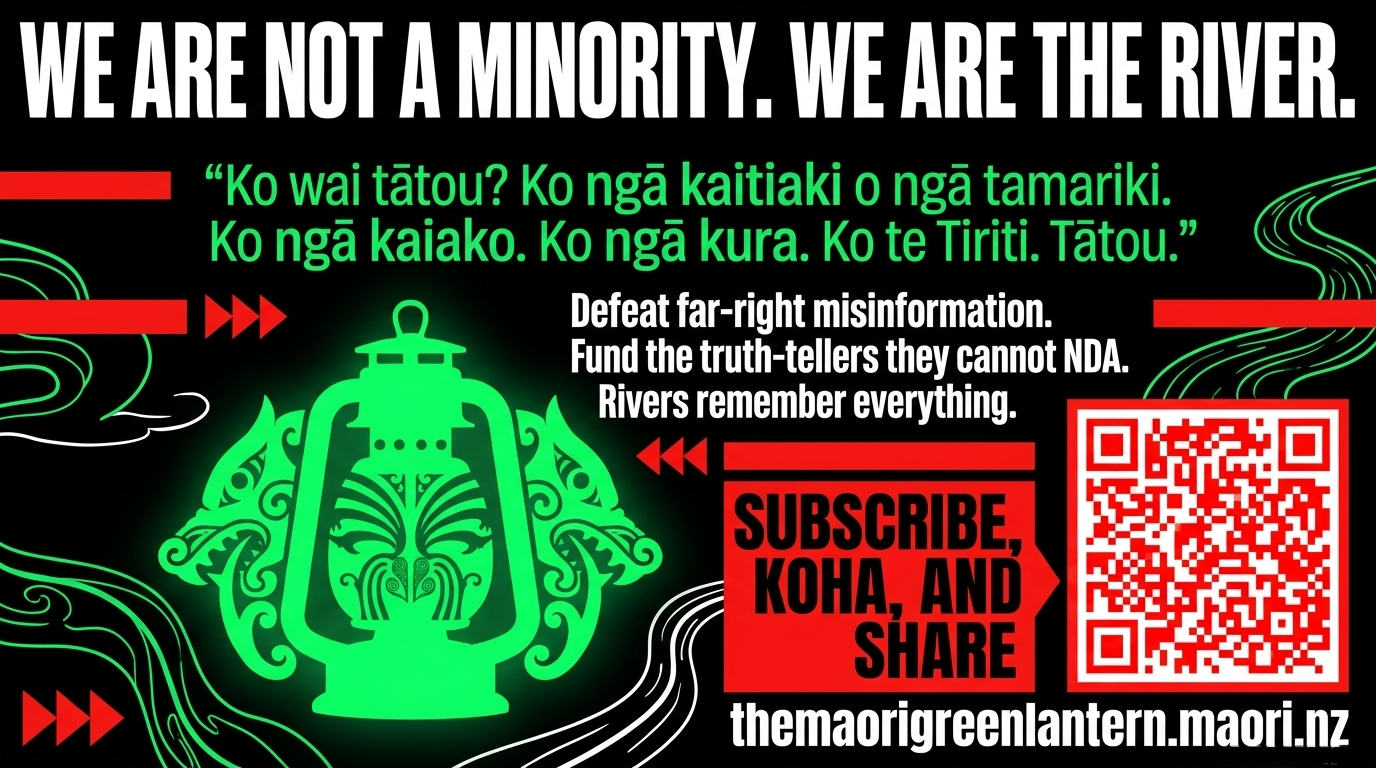
Ko wai tātou? Ko ngā kaitiaki o ngā tamariki. Ko ngā kaiako. Ko ngā kura. Ko te Tiriti.
Tātou. Tātou. Tātou.
We are not a minority. We are the river. And rivers remember everything.
💚 KOHA — Fund the Truth Tellers They Cannot NDA
This essay exists because three thousand eight hundred kaiako gave their evenings to a consultation designed to ignore them.
It exists because Māori tamariki deserve a curriculum that knows their names, speaks their language, and honours their whakapapa.
It exists because no NDA can silence the truth when someone is willing to trace the whakapapa and name every hand that poisoned the river.
Every koha signals that whānau are ready to fund the accountability that Crown and corporate structures — and Stanford's NDAs — will not provide. It signals that rangatiratanga includes the power to fund our own truth tellers, our own curriculum defenders, our own voices.
Kia kaha, whānau. Stay vigilant. Stay connected. And if you are able, consider a koha to ensure this voice continues.
If you cannot koha — no worries. Subscribe, follow, kōrero, share with your whānau and friends. That is koha in itself.
Four pathways to support this mahi:
- Koha direct: Support The Māori Green Lantern on Koha
- Subscribe for essays direct to your inbox: themaorigreenlantern.maori.nz
- Bank transfer: HTDM — 03-1546-0415173-000
- Facebook: Follow & Subscribe on Facebook

Views expressed constitute honest opinion on matters of public interest under the Defamation Act 1992 (NZ) and Durie v Gardiner NZCA 278. All factual claims are sourced and cited. Named individuals are referenced solely in their public capacity as minister, official, or public academic. Errors or corrections: contact via themaorigreenlantern.maori.nz.