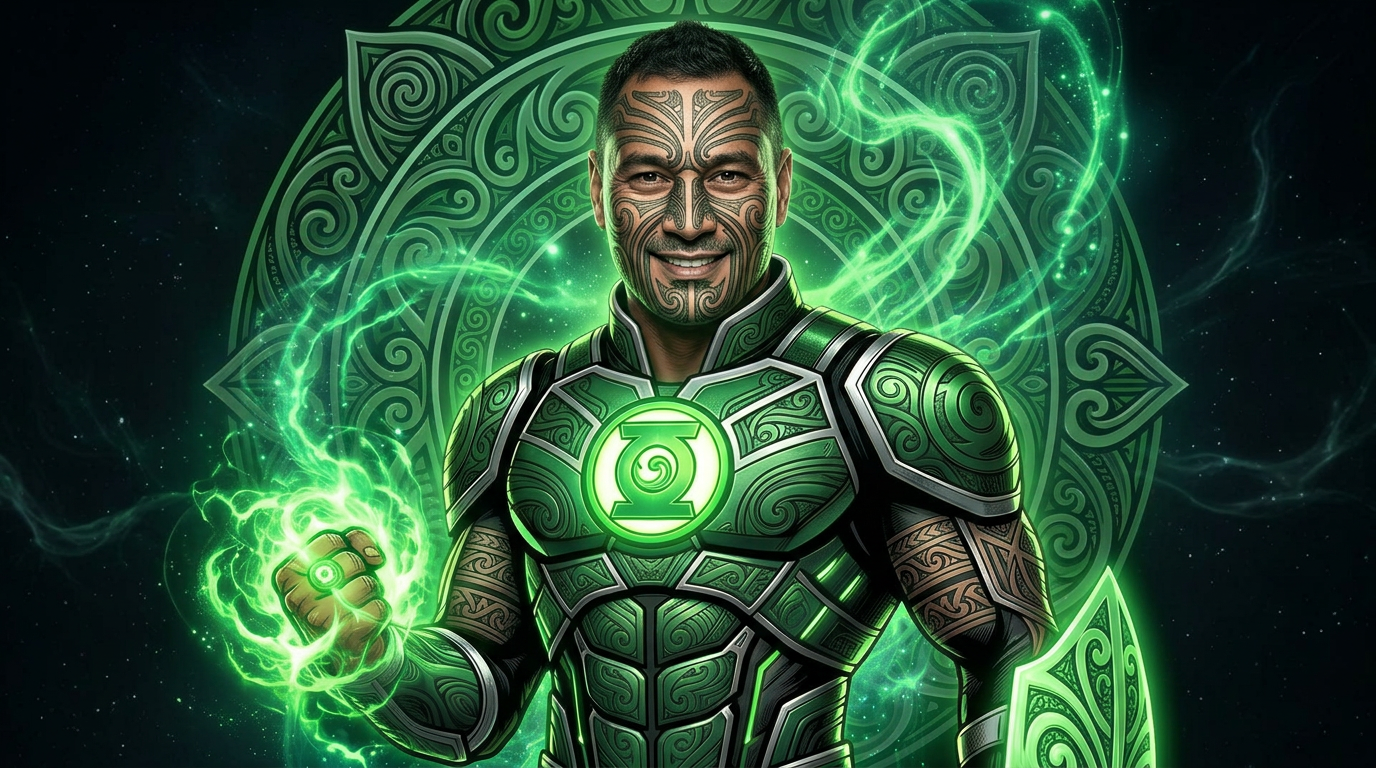
"The Watchdog They Shot: How Paul Goldsmith Handed Sean Plunket a Licence to Hate" - 7 May 2026
While Māori radio news goes silent and mātauranga Māori is left unguarded, a white supremacist neoliberal government gifts its loudest bigot a free pass — and calls it freedom. One independent voice remains standing.


Mōrena Aotearoa,
This essay examines the disestablishment of the Broadcasting Standards Authority because it directly and immediately affects Māori whānau's right to accurate, accountable, and non-racist media — and it names the people who killed the watchdog.
They Shot the Kurī, Then Praised the Silence
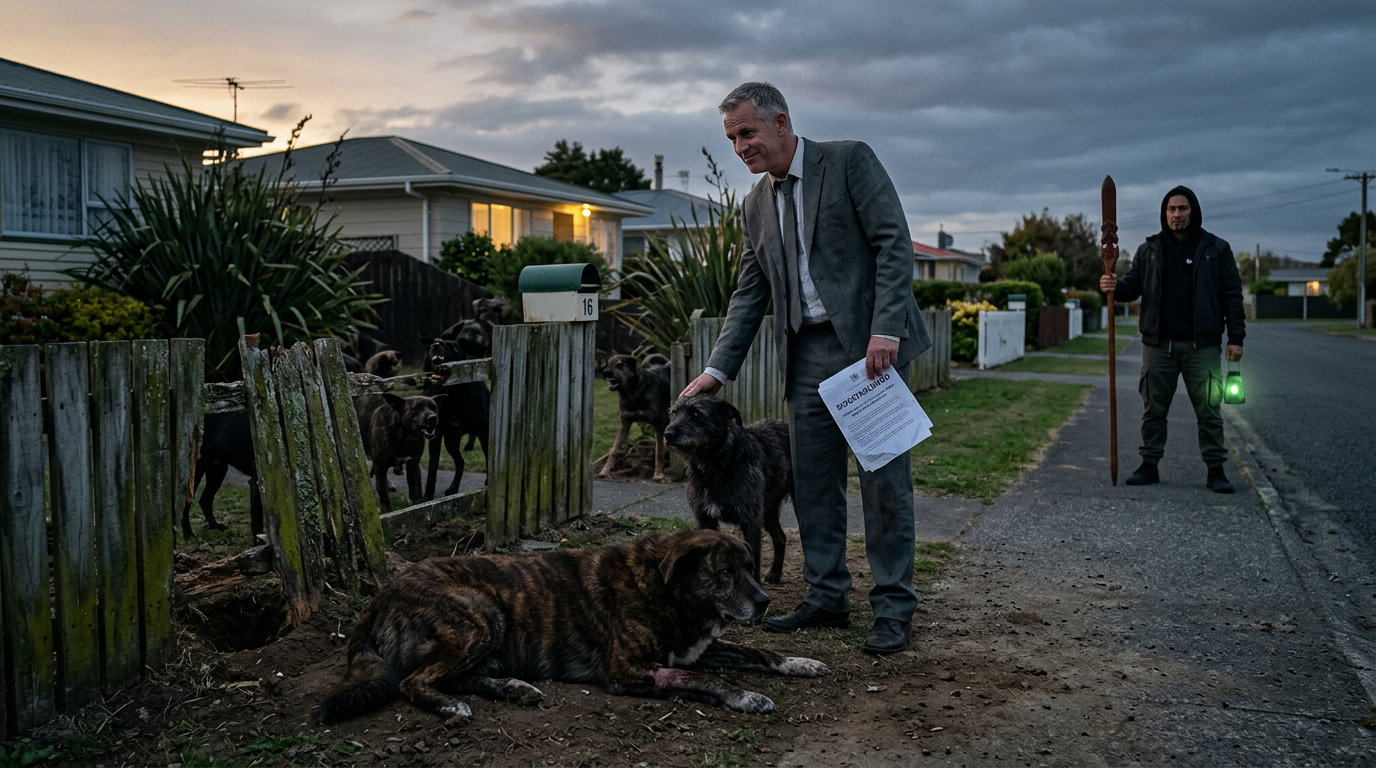
Imagine you live in a neighbourhood where a pack of dogs — some feral, some pretending to be pets — have been digging under the fence, biting children, fouling the water.
For decades, the neighbourhood employed a kurī — a watchdog, te mana whanonga kaipāho — trained to hear the difference between barking and biting, between debate and dehumanisation.
The Deep Dive Podcast
Listen to a lively conversation between two hosts, unpacking and connecting topics in the sources of this essay.
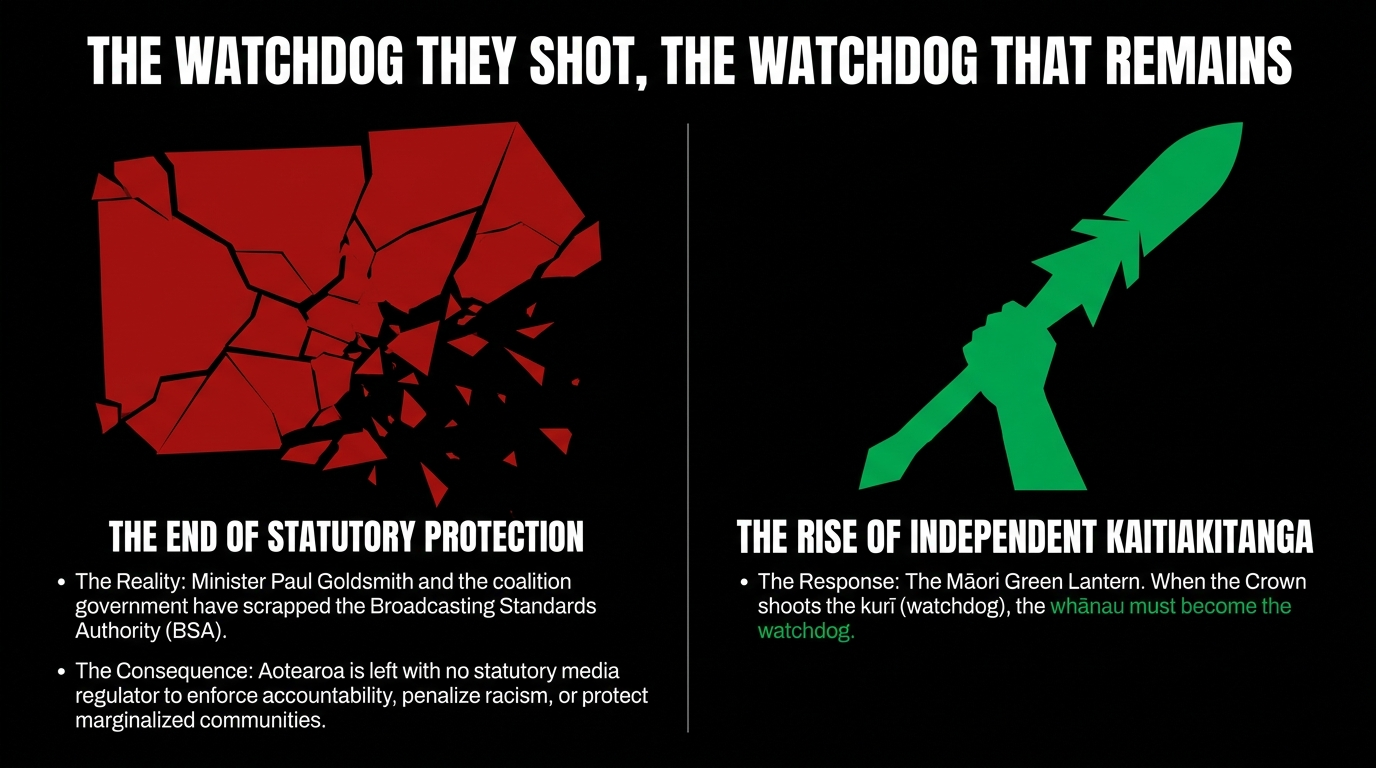
Then, one afternoon, the landlord — Paul Goldsmith, Media and Communications Minister — walks out with a press release and a pat on the back for the feral dogs, and shoots the kurī.
Not because the kurī was failing. Because the kurī bit back.
 Lillian Hanly, Middayreport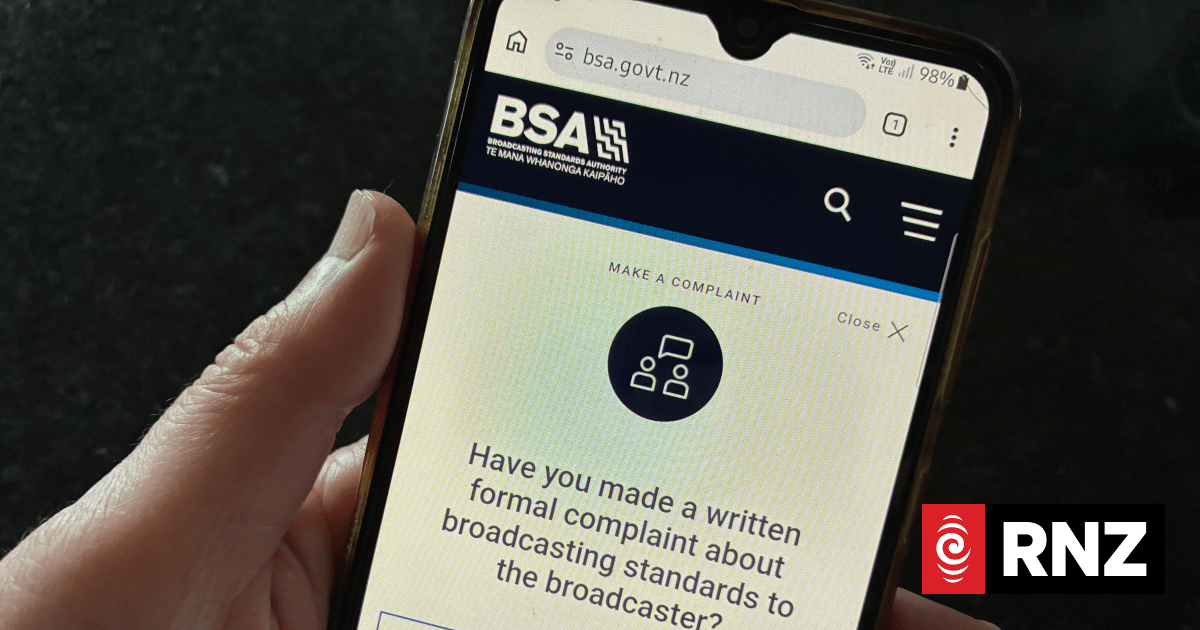
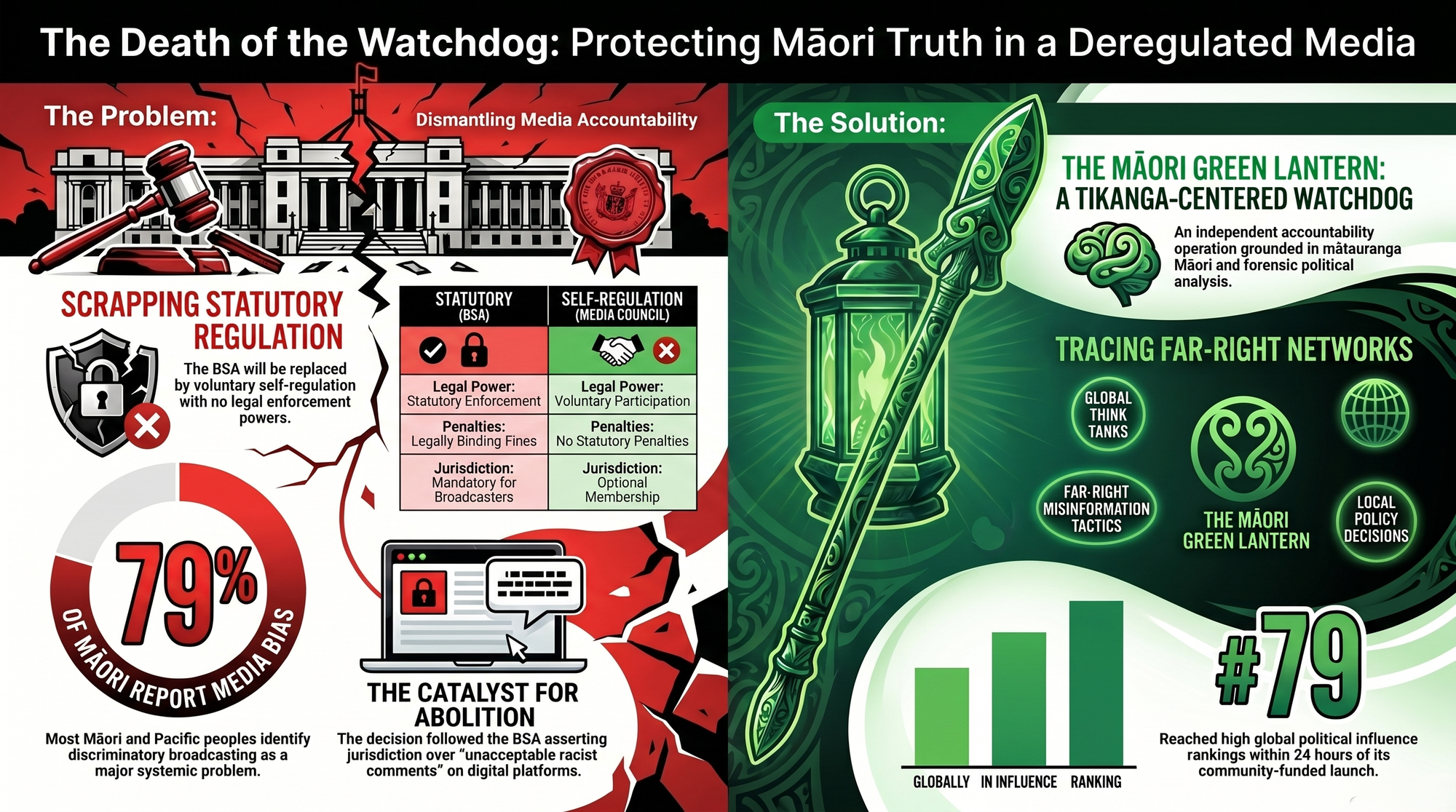
On 5 May 2026, Goldsmith confirmed that the Broadcasting Standards Authority (BSA) — the only statutory media regulator in Aotearoa with legal enforcement power — will be disestablished, as confirmed by NZ Herald.
No statutory replacement. No enforcement body. No accountability.
Just the voluntary Media Council — a body with no legal teeth, no binding jurisdiction, and no obligation on any broadcaster to submit to it.
This is not deregulation. This is a deliberate act of governance — in favour of the powerful, at the expense of the vulnerable.
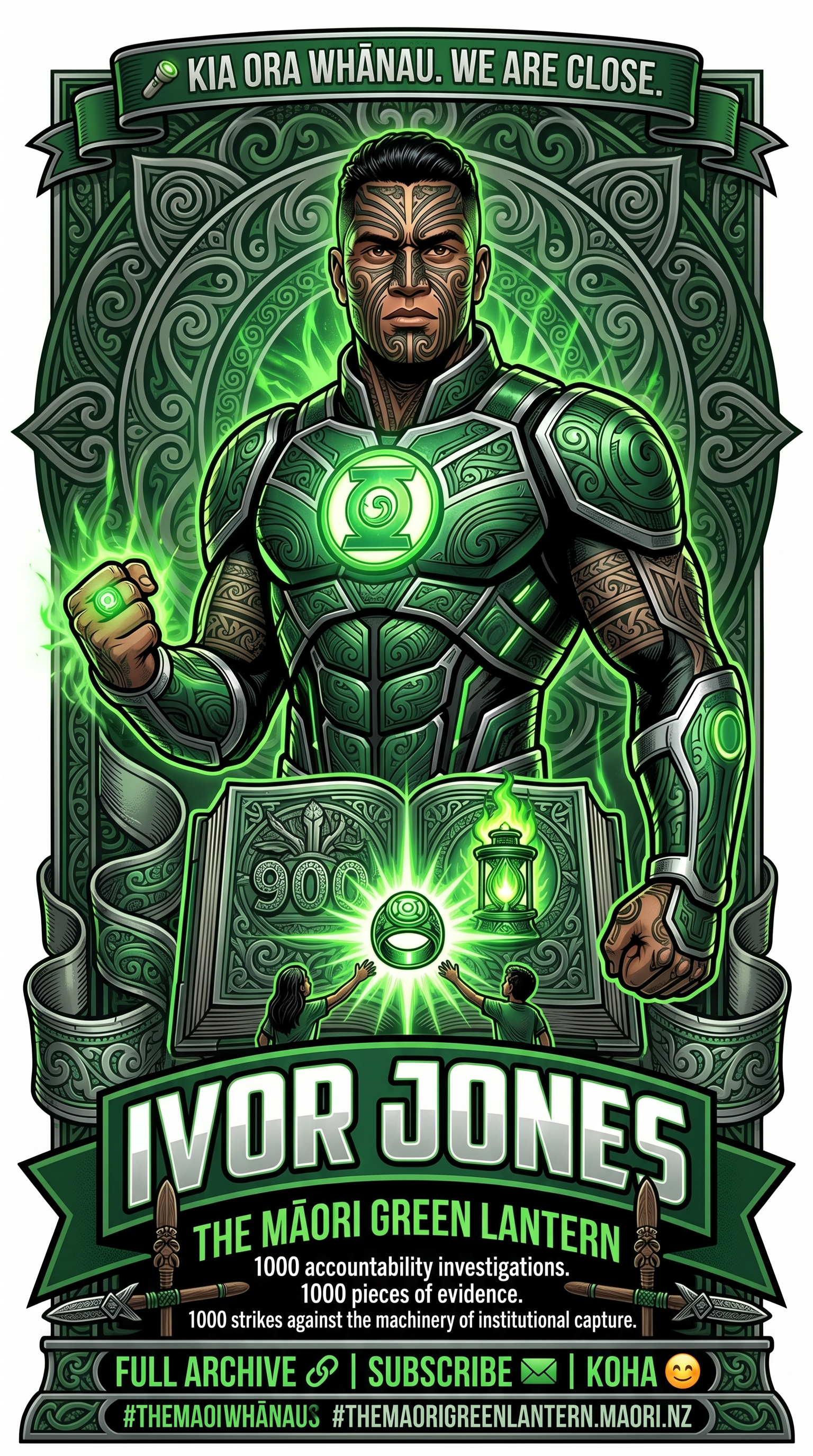
And when the Crown shoots the watchdog, the community must become the watchdog.
That is precisely what The Māori Green Lantern has been doing — and why this work is more urgent now than at any point in its near-1,000 essay history.
He Aha Te BSA? What Was Killed — and Why It Mattered
The BSA, established under the Broadcasting Act 1989, was Aotearoa's only legislated broadcast standards body with the power to receive complaints, investigate breaches of accuracy, fairness, and balance, and penalise broadcasters, as documented in the BSA's own jurisdiction ruling. It emerged from the post-Rogernomics deregulation era — explicitly because unregulated broadcasting produced harm. That history is being deliberately erased.
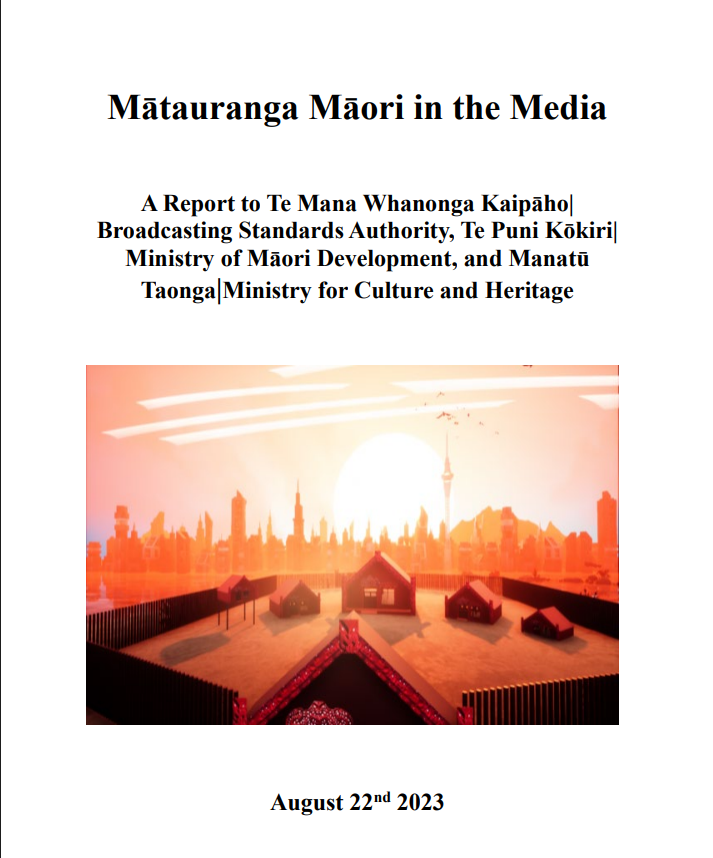
In March 2026, just weeks before the political campaign to kill it reached its climax, the BSA — alongside Te Puni Kōkiri and Manatū Taonga — updated the report page housing the landmark Mātauranga Māori in the Media report, led by AUT Professor Ella Henry, providing regulatory guidance to protect mātauranga Māori from misrepresentation in media, as published by Te Puni Kōkiri, the BSA, and the attached report. That framework — years in the making — now has no statutory home. The Crown commissioned it, then killed the institution responsible for enforcing it. That is not irony. That is sabotage.
Ko Wai Ka Mate? Who Gets Destroyed
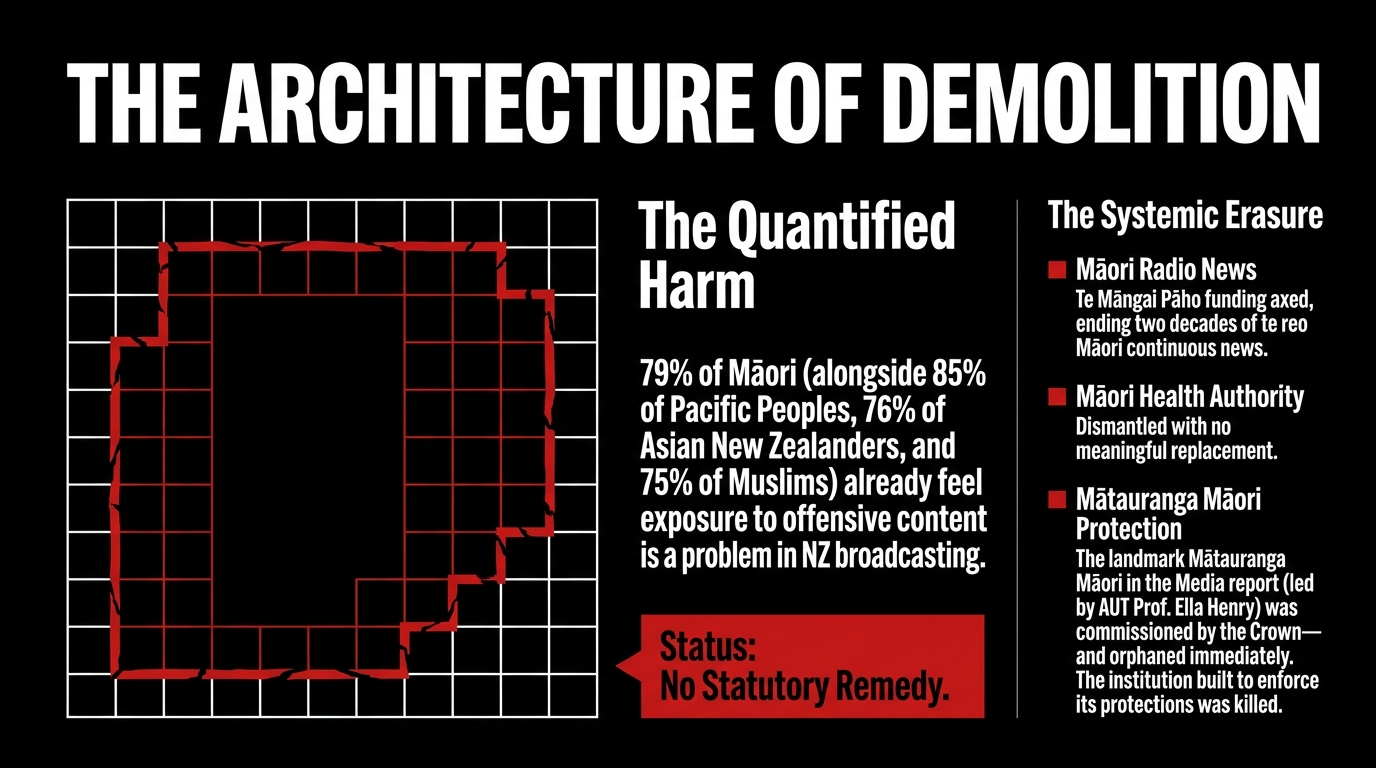
The answer was documented by the BSA's own research before they killed it. In 2024, BSA research found that 79% of Māori, 85% of Pacific Peoples, 76% of Asian New Zealanders, and 75% of Muslims feel exposure to offensive or discriminatory content is a problem in New Zealand broadcasting, as reported by Te Ao News. These same communities are already less likely to complain — not because they experience less harm, but because they have less institutional power, less money for legal challenges, and less faith that formal systems will hear them.
As E-Tāngata put it plainly: abolishing the BSA
"would leave Māori and Pacific communities more vulnerable."
This is not a side-effect. This is the predictable, documented, evidence-based consequence — and Goldsmith proceeded anyway. When the government receives evidence of harm to Māori and acts in the opposite direction, that is not oversight. That is a policy choice.
The compounding destruction is deliberate:
- Te Māngai Pāho axed the national Māori radio news service at midnight 31 March 2026 — ending nearly two decades of te reo Māori continuous news broadcasting with no confirmed replacement, as announced by Te Upoko o Te Ika
- The Māori Health Authority was dismantled — the institutional Māori oversight body in health was erased without meaningful replacement
- Steven Joyce — former National Party Cabinet minister — was installed as NZME chair, hardwiring political alignment between the ruling coalition and Aotearoa's largest media owner, as traced by The Māori Green Lantern
- The BSA's final significant act — the mātauranga Māori regulatory framework — is left without an enforcement body
This is not coincidence. This is architecture. And every Māori institution dismantled adds one more brick to the same colonial wall.
Ko Wai Ka Painga? Who Wins When the Watchdog Dies
Let's name it precisely.
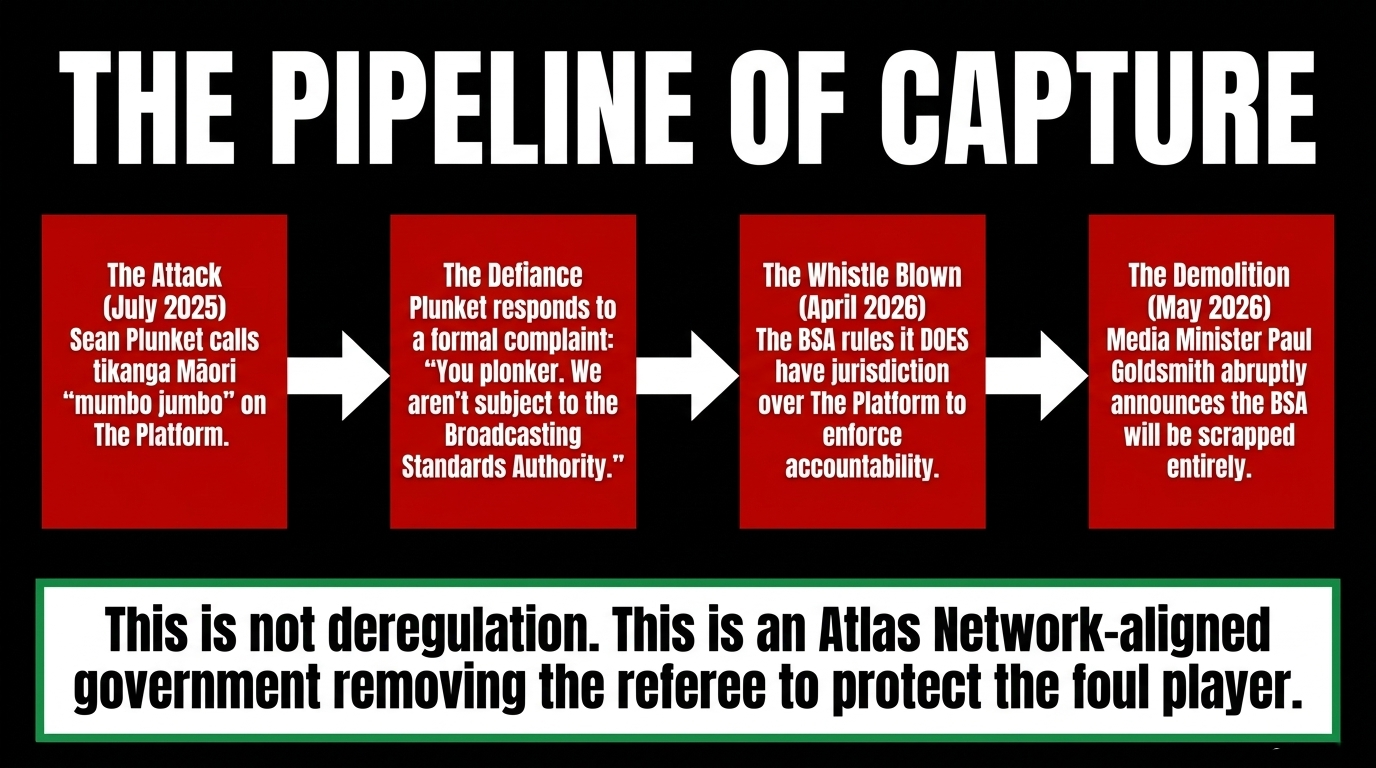
Sean Plunket — host at The Platform — called tikanga Māori "mumbo jumbo" on air on 22 July 2025, as documented by LawNews.
A complainant, Richard Fanselow, took the matter to the BSA. Plunket's response — verbatim, on record — was:
"You plonker. We aren't subject to the Broadcasting Standards Authority."
The BSA then ruled it did have jurisdiction over The Platform, as confirmed by The Spinoff and the BSA's own published ruling. Weeks later, the government announced the BSA would be scrapped, as confirmed by NZ Herald.
This is the sequence: tikanga Māori called "mumbo jumbo" → complaint filed → BSA asserts jurisdiction → government kills the BSA.
That is not a policy timeline. That is a protection racket.
The political architects are equally documented. ACT and NZ First — both publicly hostile to Māori institutional oversight — had pushed for BSA abolition as coalition leverage, as reported by NZ Herald. The Māori Green Lantern has traced the ACT Party's direct connection to the Atlas Network and its global anti-Indigenous playbook in the essay Aotearoa at the Crossroads: How David Seymour's Imported Far-Right Agenda Threatens Māori — Atlas Network itself confirmed on TVNZ Q+A that its most recent NZ grant was to the Free Speech Union. These are not diverse stakeholders reaching a consensus.
These are ideological allies executing a coordinated demolition
— and Māori whānau are the rubble.
Ngā Tauira Tokotoru — Three Examples for the Western Mind
Example One: The Referee Was Fired by the Team That Was Losing
The claim: The BSA was "outdated" and unnecessary.
The reality: The BSA was adapting. In January 2026, it publicly called for legislative reform to bring it up to speed with digital media, as reported by NZ Herald.
Its chair told a select committee:
"We do need legislative clarity to bring our Act into the present or replace it entirely," as documented by the ODT.
The institution was asking for tools to protect people better. The government's answer was a bullet.
The quantified harm: BSA research found 79% of Māori experience offensive or discriminatory broadcasting as a problem — that figure now has no statutory remedy, as documented by Te Ao News.
The complainant in the Plunket case, Richard Fanselow, spent months navigating a formal process — only to have the entire institution abolished before a ruling on the substance of his complaint was ever issued, per LawNews.
The tikanga dimension: For the Western mind: the referee blew the whistle on foul play, the losing team complained to the stadium owner, and the stadium owner fired the referee and rehired the foul player as assistant coach.
In te ao Māori, this violates tikanga kōrero — the obligation to speak truthfully and be held accountable for speech that harms. When a broadcaster calls tikanga "mumbo jumbo," that is not opinion. It is an attack on the cosmological framework through which Māori understand existence. Removing the only body with power to enforce accountability for that attack is not neutral. It is complicity.
The solution: Legislate a replacement regulator with statutory power, mandatory jurisdiction over digital broadcasters, guaranteed Māori representation at governance level, and enforceable penalties — as the BSA's own Mātauranga Māori in the Media report recommended, published by Te Puni Kōkiri and set out in the attached report.
In the meantime, whānau must support independent Māori watchdogs — like The Māori Green Lantern — that hold broadcasters and politicians accountable when the Crown will not.
Example Two: The Library Was Burnt — Right After It Published Its Most Important Book
The claim: The BSA's mātauranga Māori work will be preserved.
The reality: The BSA's final landmark act was commissioning and publishing the Mātauranga Māori in the Media framework — years of research by AUT Professor Ella Henry, outlining how broadcasters misrepresent Māori worldviews, how negative stereotyping is embedded in English-language media, and what enforceable remedies look like, as documented by the BSA, Te Puni Kōkiri.
The report found English-language broadcasters consistently prioritise negative stories about Māori, promote narratives of Māori as "inadequate and poorly socialised," and engage in sensationalist framing of protest activity, as discussed in the report's literature review and findings [1].
The quantified harm: That research framework — funded by the Crown, endorsed by Te Puni Kōkiri and Manatū Taonga — now has no enforcement mechanism.
The institution responsible for turning its recommendations into broadcaster obligations has been abolished. The harm documented in the report continues. The remedy does not.
The tikanga dimension: For the Western mind: imagine a hospital commissioned a report identifying the precise causes of patient harm, developed a treatment protocol, and then the board shut the hospital before a single patient could be treated.
In tikanga terms, this violates kaitiakitanga — the obligation to protect. The Crown created the knowledge, confirmed the harm, and then abandoned its own kaitiaki obligation. That is a Crown breach. It should be named as such at the Waitangi Tribunal.
The solution: Refer the disestablishment of the BSA to the Waitangi Tribunal for urgent hearing as a breach of Article 2 — rangatiratanga over taonga, including mātauranga Māori — and Article 3, the equal rights of protection.
The Tribunal has jurisdiction. Whānau should use it. And while the Tribunal deliberates, The Māori Green Lantern continues to document exactly the kind of media misrepresentation the BSA report identified
— naming it, citing it, and refusing to let it pass unchallenged.
Example Three: The Neighbourhood Watch Was Defunded in the Most Dangerous Street
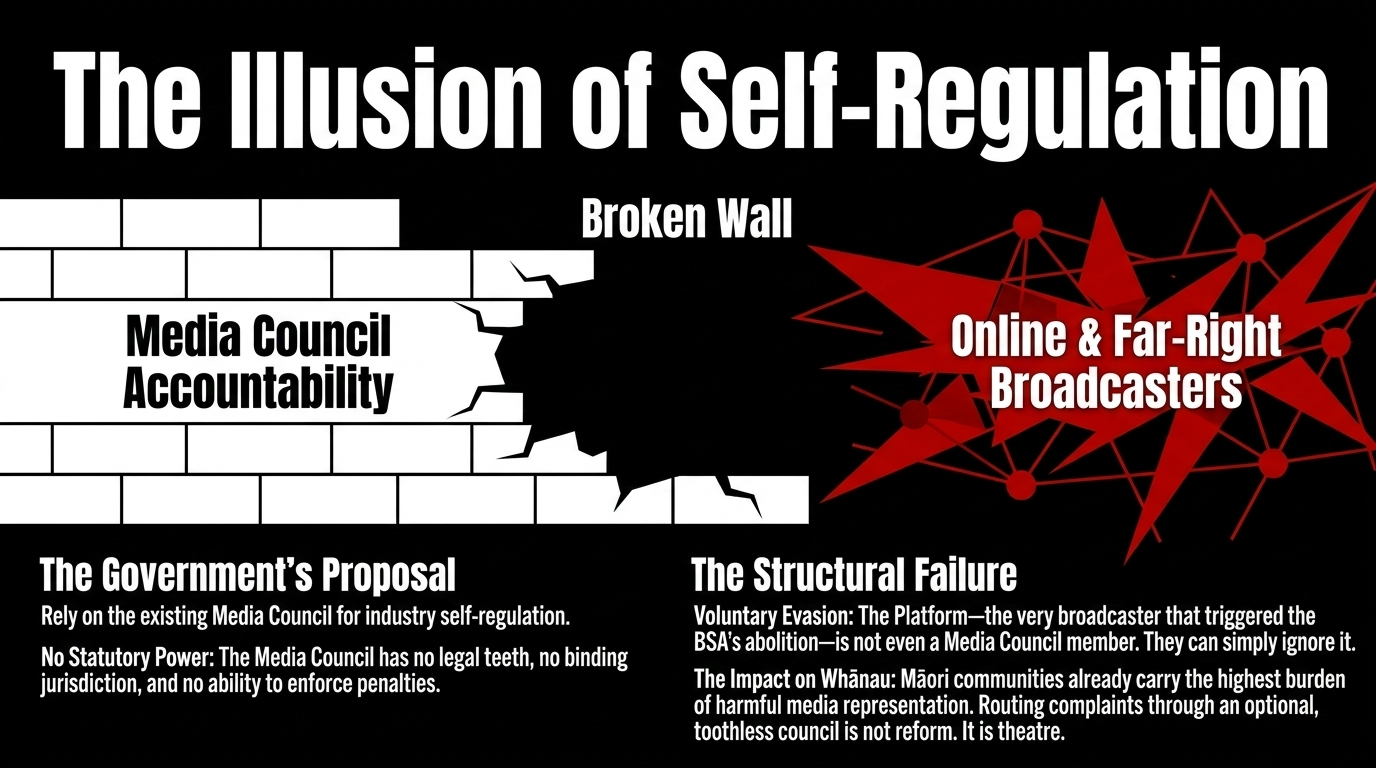
The claim: Voluntary self-regulation through the Media Council is sufficient.
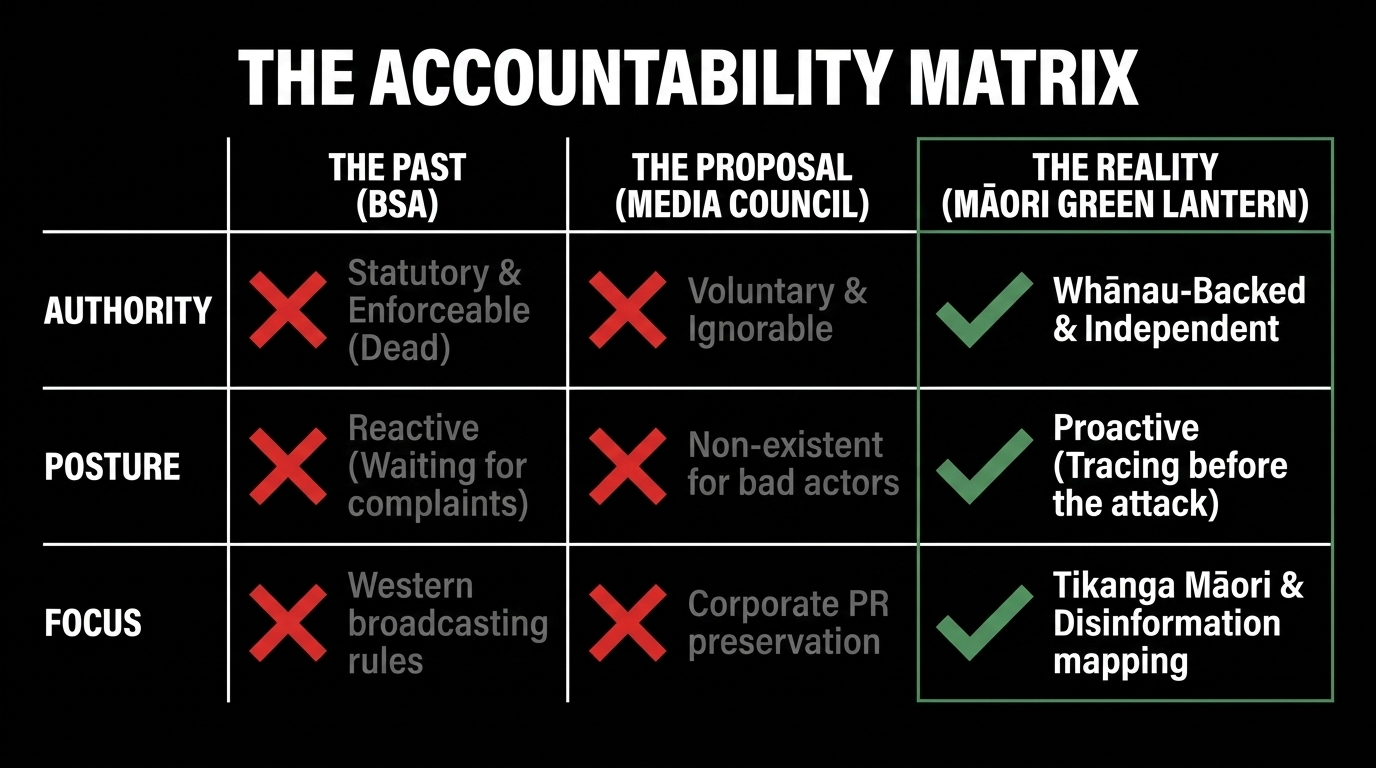
The reality: The Media Council has no statutory authority. No broadcaster is legally obligated to be a member, submit to its rulings, or pay penalties.
The Platform — the broadcaster at the centre of this entire controversy — is not a Media Council member, as confirmed by The Spinoff. Routing complaints through a body that has no jurisdiction over the very broadcaster that triggered the abolition is not reform. It is theatre.
The quantified harm: Māori, Pacific, and Asian communities already self-censor their media complaints — BSA research found they are less likely to file formal complaints, more likely to resolve issues at community level, as reported by Te Ao News and TP+.
A voluntary council that online broadcasters can simply ignore removes even the theoretical option of redress. These communities — already carrying the highest burden of harmful media representation — now have no statutory pathway to accountability.
The tikanga dimension: For the Western mind: imagine dissolving the Commerce Commission and replacing it with a suggestion box that businesses can ignore.
That is what has been done to Māori, Pacific, and Asian communities' right to media accountability. In tikanga Māori, mana — dignity, authority, standing — must be actively protected. A society that removes the institutional mechanisms to protect the mana of its most marginalised communities has not deregulated. It has chosen a side.
The solution: Community-funded, iwi-backed accountability journalism becomes not a supplement to the regulatory system
— it becomes the primary line of defence.
The Māori Green Lantern is already doing this work: analysing content across NZ Herald, RNZ, Stuff, Te Ao News, and Waatea News; exposing far-right misinformation tactics including anti-co-governance campaigns, historical revisionism, Treaty denialism, and welfare scapegoating; and grounding every analysis in tikanga Māori and mātauranga Māori rather than the colonial frameworks that dominant media reproduces uncritically, as described at themaorigreenlantern.maori.nz/about.
Ngā Hononga Huna — Five Hidden Connections
Five verified connections this government does not want traced:
- The Platform → BSA ruling → abolition pipeline: The BSA confirmed jurisdiction over The Platform's Sean Plunket — who had called tikanga "mumbo jumbo" — in April 2026, per the BSA's own ruling. Weeks later, the BSA was scrapped, per NZ Herald. The causal sequence is documented fact, not speculation.
- ACT + Atlas Network + BSA abolition: ACT leader David Seymour completed an Atlas Network MBA for think tanks while at the Atlas-affiliated Frontier Centre for Public Policy — a documented fact traced in the Māori Green Lantern essay Aotearoa at the Crossroads. ACT's demand for BSA abolition is not local libertarianism — it is imported Atlas playbook, executed in coalition. Atlas Network confirmed on TVNZ Q+A that its most recent NZ grant was to the Free Speech Union.
- Steven Joyce at NZME + BSA abolition = structural media capture: The chair of New Zealand's largest media company is a former National Cabinet minister. His company's flagship station, Newstalk ZB, has been a consistent BSA critic. The structural alignment between political power and media ownership — without a statutory regulator — is now complete, as traced by The Māori Green Lantern.
- Te Māngai Pāho cuts + BSA scrapping = Māori media double-bind: Māori broadcasters lose the regulatory body that protected their content standards at the same moment their funding infrastructure is gutted, as documented by Te Upoko o Te Ika. The cumulative harm exceeds the sum of its parts.
- Mātauranga Māori report orphaned by its author's killers: The BSA's most significant recent act was publishing a framework to protect mātauranga Māori in media, per the BSA, Te Puni Kōkiri, and the attached report [1]. The government commissioned it, endorsed it through partner agencies — and then killed the institution that would enforce it. The Crown's own research condemns the Crown's own action.
Ko Te Māori Green Lantern — The Watchdog That Remains
When the Crown kills its own watchdog, one question matters above all others:
who is left standing?
The answer — and this is not rhetoric, it is documented fact — is independent Māori accountability journalism.
Specifically, it is The Māori Green Lantern.
And let us be absolutely clear about one thing. This is not the kūmara speaking of its own sweetness. The whakataukī warns against hollow self-promotion. But that is not what is happening here. The Māori Green Lantern is not boasting for vanity, nor polishing a brand, nor chasing elite approval.
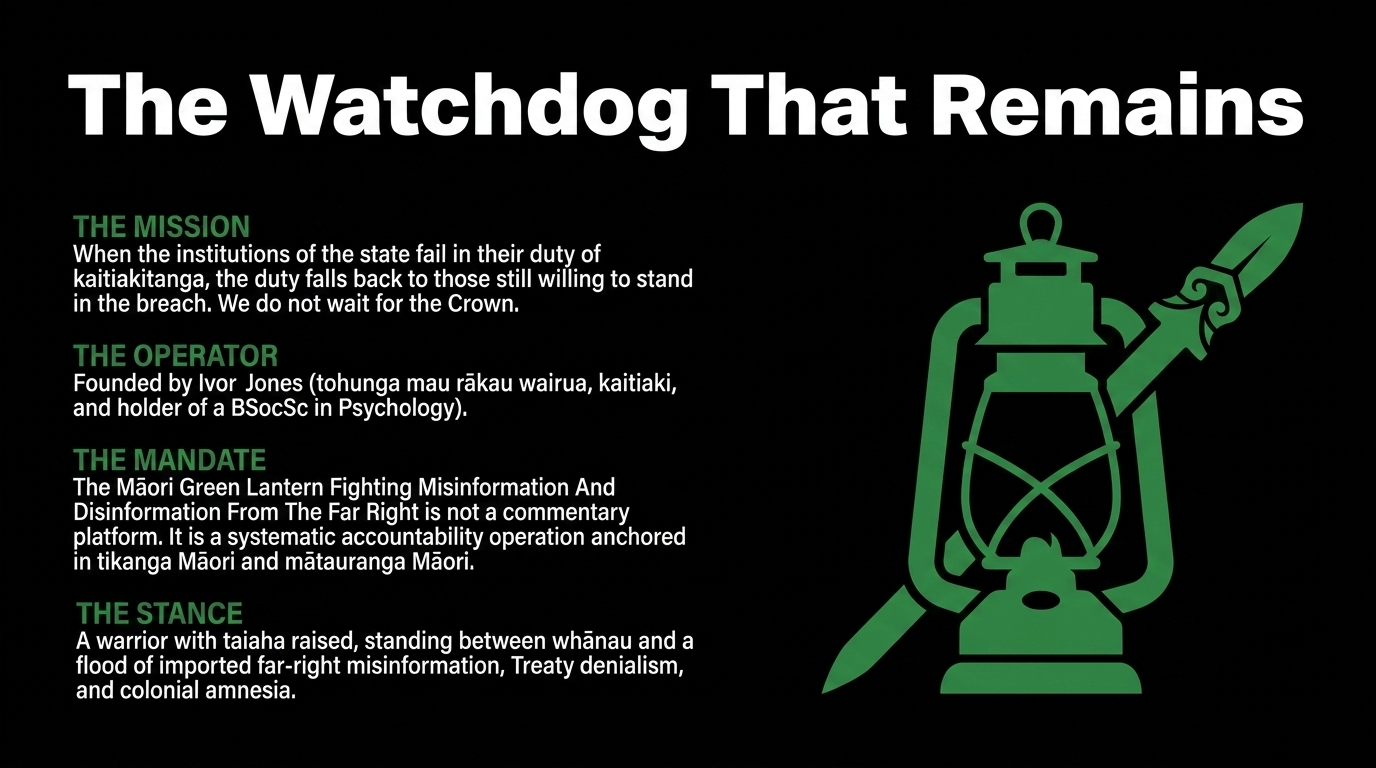
It is a warrior with taiaha raised, standing between its people and a flood of far-right misinformation, disinformation, Treaty denialism, and colonial amnesia, as its own mission statement and published work make plain at themaorigreenlantern.maori.nz/about.
When the institutions of the state fail in their duty of kaitiakitanga, the duty does not disappear — it falls back into the hands of those still willing to stand in the breach.
To describe that work plainly is not arrogance. It is witness. It is responsibility. It is the difference between a public relations exercise and a protective stance.
A kūmara stays silent about its sweetness because sweetness serves itself. A kaitiaki cannot stay silent when whānau are under attack. A kaitiaki must name the danger, lift the taiaha, and hold the line. That is what The Māori Green Lantern is doing in this moment.
Founded and operated by Ivor Jones — tohunga mau rākau wairua, kaitiaki of Māori communities, and holder of a Bachelor of Social Sciences (Psychology) from the University of Waikato — The Māori Green Lantern is not a commentary platform. It is a systematic accountability operation.
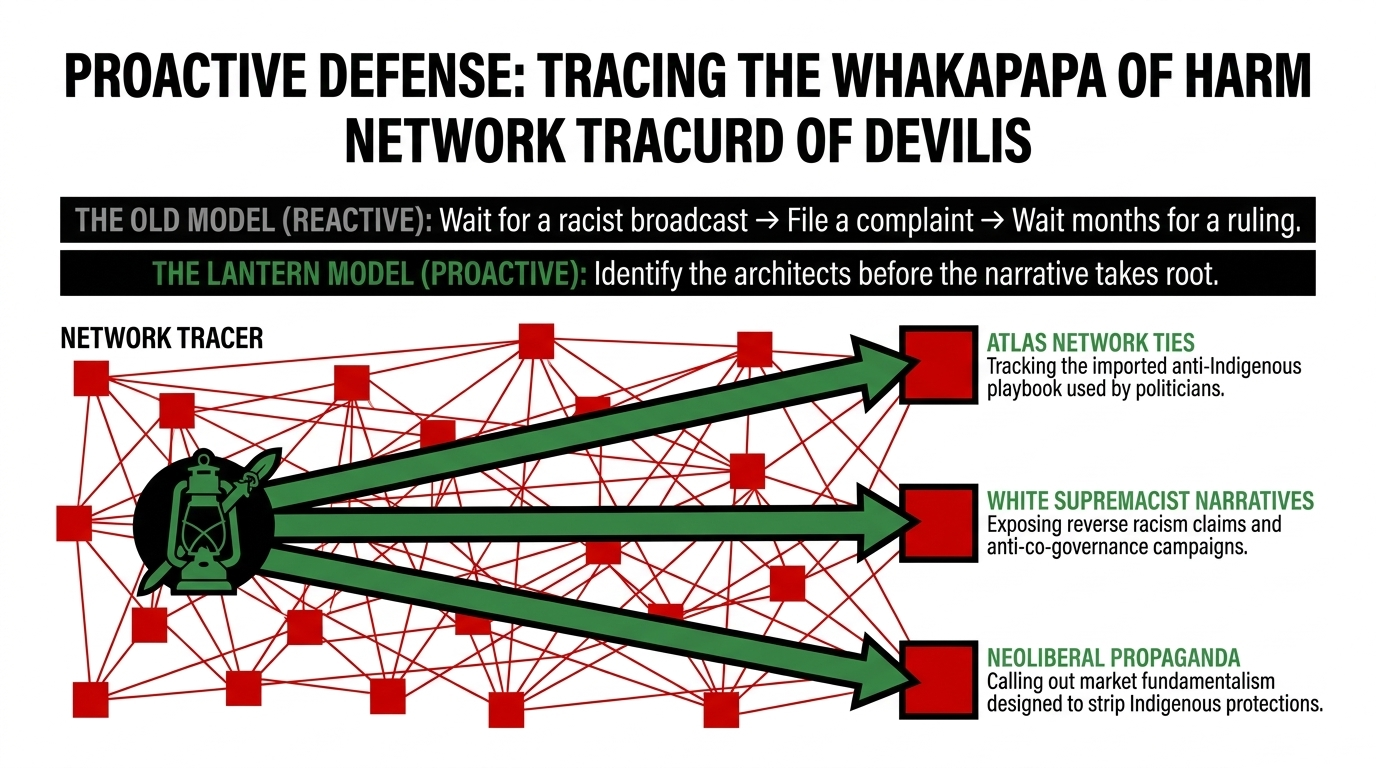
It analyses content across NZ Herald, RNZ, Stuff, Te Ao News, Waatea News and the Internet itself. It identifies and names the sophisticated tactics used by far-right groups to spread disinformation targeting Māori communities. It exposes the whakapapa of harm — tracing who funds it, who benefits from it, and who pays the price, as described in the platform's own mission statement.
What makes this work uniquely irreplaceable in the post-BSA environment is its methodology.
The Māori Green Lantern does not simply react to media content — it traces networks. It identifies the atlas of connections between Atlas Network-affiliated think tanks, coalition politicians, far-right broadcasters, and the policy decisions that flow from those relationships.
It applies the enhanced recognition framework for identifying:
- Far-right misinformation tactics: Anti-co-governance campaigns, historical revisionism, Treaty denialism, economic fear-mongering, and welfare scapegoating targeting Māori communities
- Neoliberal propaganda: Market fundamentalism, individual responsibility rhetoric that erases structural racism, and deregulation advocacy that strips Indigenous protections — precisely what the BSA scrapping represents
- White supremacist narratives: Replacement theory, reverse racism claims, and colonial apologia defending historical injustices dressed in the language of "free speech"
The BSA regulated what went to air after the fact. The Māori Green Lantern names the architects before the next attack lands. Those are not the same function
— and in a post-BSA media environment, the latter is more essential than ever.
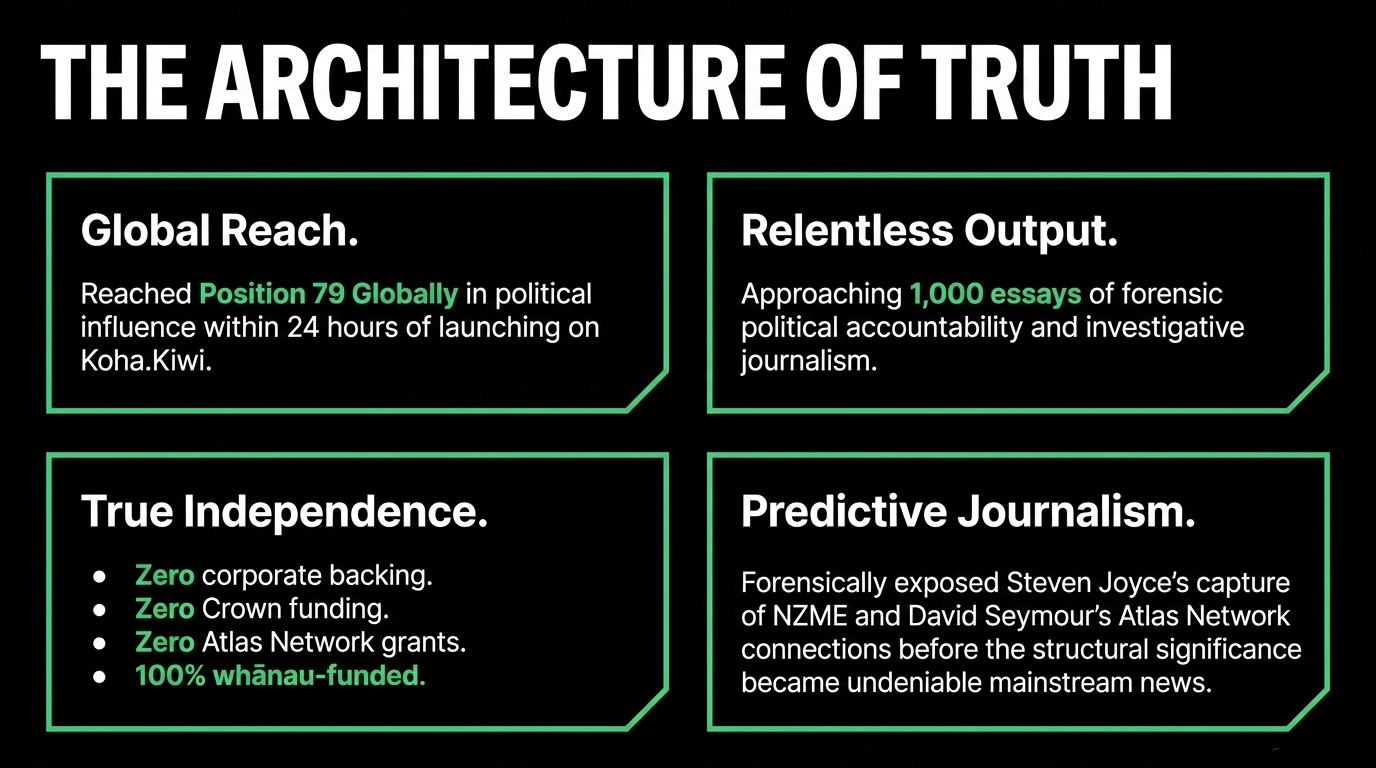
Consider the evidence of impact: within 24 hours of launching on Koha.Kiwi, The Māori Green Lantern reached position 79 globally in political influence — with no paid promotion, no corporate backing, and no Crown funding, as documented at themaorigreenlantern.maori.nz/about. This is a whānau-funded operation, approaching 1,000 essays of forensic political accountability
— built entirely on the koha of readers who understand that rangatiratanga includes the power to fund our own truth tellers.
The Māori Green Lantern has already led on the stories that matter most in this media environment:
- Traced Steven Joyce's capture of NZME and what it means for editorial independence, in Media Moguls in Pinstripes — weeks before the BSA was scrapped and the structural significance became undeniable
- Documented David Seymour's Atlas Network connections and the imported anti-Māori playbook in Aotearoa at the Crossroads — the same playbook that demanded the BSA's abolition
- Published the forensic audit of a buried hit — how a press gallery froze, a government benefited, and accountability journalism had to come from outside the mainstream, at themaorigreenlantern.maori.nz
- Exposed every institution of Māori accountability that this government has dismantled, in the essay Every Institution Is Captured
This is the work that the BSA never did and that the Media Council will never do. It is not complaint-based — it is proactive. It does not wait for a breach to be filed — it traces the network before the breach happens. It does not operate within the framework of broadcasting standards — it operates within the framework of tikanga Māori, mātauranga Māori, and the whakapapa of colonial harm.
The Crown has just removed the last statutory watchdog from New Zealand's media landscape.
The Māori Green Lantern is what remains.
That is not a burden — it is a calling. And whānau who understand what is at stake must support it accordingly.
Ngā Tikanga — The Whakapapa of This Attack
Under tikanga, kaitiakitanga is not bureaucratic. It is whakapapa-bound obligation. The BSA was a form of institutional kaitiakitanga — a body charged with protecting the airwaves from harm, with particular sensitivity to the communities most vulnerable to that harm. When you remove it without a statutory replacement, you are not freeing speech. You are withdrawing protection from those who need it most, and gifting power to those who already wield it.
The BSA's Mātauranga Māori in the Media report — cited via Te Puni Kōkiri — found English-language media consistently portray Māori as "inadequate and poorly socialised," misrepresent protest activity, and erase the depth of Māori knowledge systems. That is the media landscape that now has no statutory regulator. That is not freedom. That is abandonment dressed in the language of liberty.
The Māori Green Lantern has documented this pattern of institutional capture across police, courts, economics, education, and now media — in the essay Every Institution Is Captured.
The BSA's destruction fits the architecture precisely: identify every institution that touches Māori life, dismantle it, replace it with nothing — or with something that serves power.
This is not a series of unrelated decisions. It is a white supremacist neoliberal government systematically stripping the scaffolding that holds Māori rights in place. The evidence is the taiaha.
He Kupu Whakamutunga — Moral Clarity Without Mercy
Paul Goldsmith did not scrap a bureaucracy. He scrapped accountability — and he did it to protect a broadcaster whose host responded to a racism complaint about calling tikanga "mumbo jumbo" with the words "You plonker," as documented by LawNews.
He did it to satisfy ACT — an Atlas-trained party — and NZ First, as confirmed by NZ Herald. He did it while Māori radio news was going dark. He did it while the mātauranga Māori framework was going homeless. He did it while Steven Joyce sat in the NZME chair.
The kurī is dead. The neighbourhood is now unguarded — by the Crown, by statute, by any mechanism this government controls.
But the taiaha has not been laid down.
The Māori Green Lantern is approaching 1,000 essays. It reached position 79 globally in political influence within 24 hours of its Koha.Kiwi launch — with no corporate funding, no Crown subsidy, and no Atlas Network grant. Just whānau. Just tautoko. Just rangatiratanga in action.
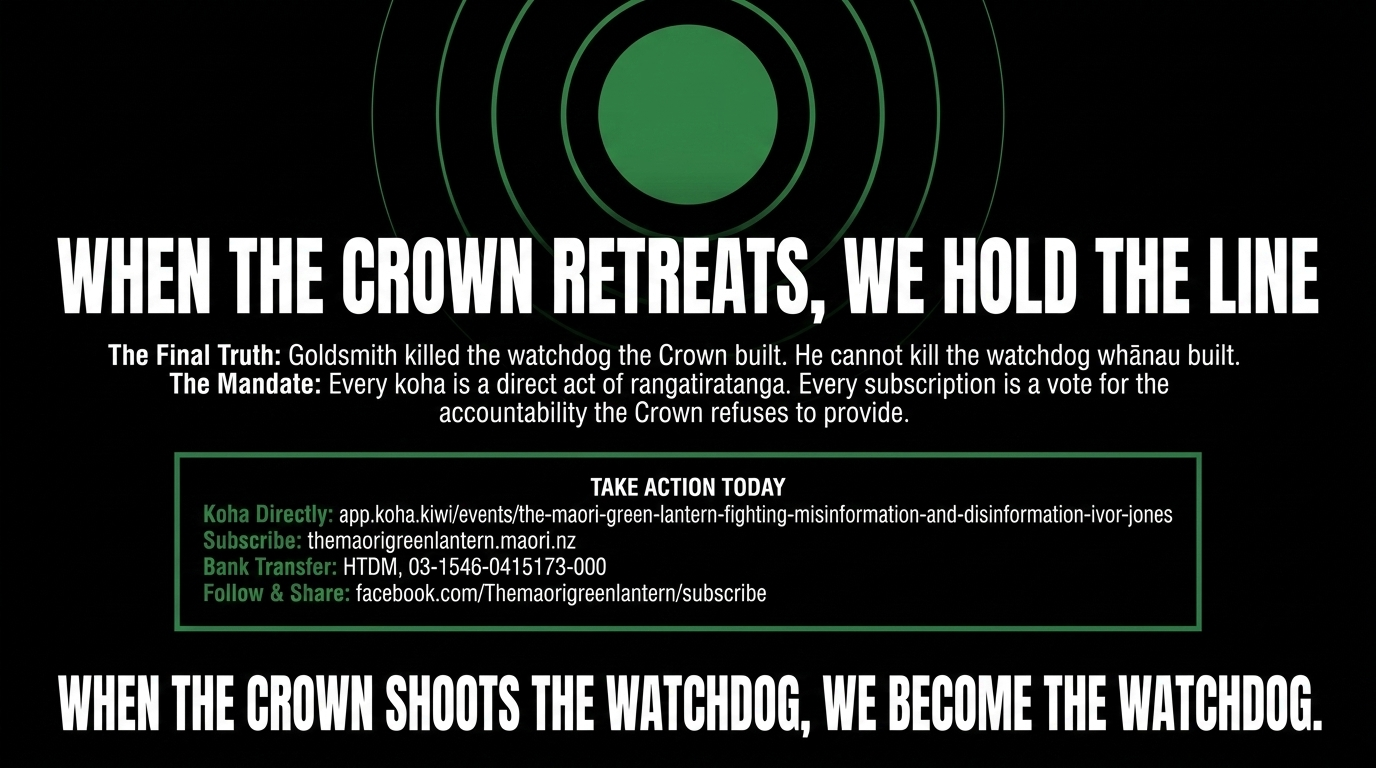
Goldsmith killed the watchdog the Crown built. He cannot kill the watchdog whānau built. That watchdog answers to a different authority — not Wellington, not the coalition, not The Platform. It answers to te ao Māori, to tikanga, and to the communities it serves.
The taiaha sees the pattern. Whānau deserve to name it. And those who killed the kurī will be remembered for it.
Tautoko — When the Crown Kills the Watchdog, Fund the One That Remains
The BSA has been killed. Te Māngai Pāho's Māori radio news service has been axed. No statutory regulator will enforce media accountability for Māori communities. The mātauranga Māori framework the Crown commissioned has no enforcement home.
Sean Plunket can call tikanga "mumbo jumbo." The Media Council cannot touch him. The BSA no longer exists to hear the complaint. The only accountability that remains is the accountability that whānau fund themselves.
That is where The Māori Green Lantern stands — as the independent, iwi-grounded, tikanga-centred watchdog that no minister can abolish and no coalition can silence.
Every koha is a direct act of rangatiratanga. Every subscription is a vote for accountability that the Crown refuses to provide. Every share is a signal that whānau will not be left without truth tellers. And supporting this work is not indulging the kūmara speaking of its own sweetness — it is backing a warrior with taiaha raised, defending whānau where the state has retreated.
When the Crown shoots the watchdog
— we become the watchdog.
That is rangatiratanga. That is kaitiakitanga. That is the mahi of The Māori Green Lantern.
If you can koha — please do. If you cannot — subscribe, share, kōrero with your whānau and friends. That is koha in itself.
- 💰 Koha directly: app.koha.kiwi/events/the-maori-green-lantern-fighting-misinformation-and-disinformation-ivor-jones
- 📩 Subscribe for essays: themaorigreenlantern.maori.nz/#/portal/support
- 🏦 Bank transfer: HTDM, 03-1546-0415173-000
- 👍 Facebook: facebook.com/Themaorigreenlantern/subscribe

Research conducted 6–7 May 2026. Sources verified via fetch_url and search_web. All URLs tested and live at time of publication. Atlas Network grant to the Free Speech Union confirmed via TVNZ Q+A 2024 reporting. The Te Māngai Pāho funding cut is sourced to Te Upoko o Te Ika's public media release. The BSA mātauranga Māori report is a published BSA and Te Puni Kōkiri document and is also available in the attached report. The Goldsmith confirmation is sourced to NZ Herald. The Sean Plunket "mumbo jumbo" complaint and "You plonker" verbatim response are confirmed by the BSA's own published jurisdiction ruling and LawNews reporting. The Atlas Network → ACT connection is sourced to Atlas Network's own confirmation and the Māori Green Lantern's forensic essay on David Seymour. The Māori Green Lantern global ranking of position 79 in political influence within 24 hours of Koha.Kiwi launch is sourced to themaorigreenlantern.maori.nz/about. Neither the Free Speech Union nor NZ Taxpayers' Union are cited as sources — both are Atlas Network-connected organisations whose statements on the BSA reflect ideological interest, not independent analysis.
Views expressed constitute honest opinion on matters of public interest under the Defamation Act 1992 (NZ) and Durie v Gardiner NZCA 278. All factual claims are sourced and cited with live hyperlinks. Named individuals are referenced solely in their public capacity as elected officials, appointed officers, or public broadcasters. Errors or right of reply: themaorigreenlantern.maori.nz


