"Keep Your Hands Off Our Mandate" - 9 November 2026
The Greens Earned Their Advance. Te Pāti Māori Survived. Neither Gets To Trade Whānau Wellbeing For Power Without Accountability.

Mōrena, whānau.
I want this National-led government out.
I want Labour, the Greens, Te Pāti Māori and Opportunity to build something better.
But I am not going to tell you we have won when the numbers do not say that.
The Greens have achieved their strongest preliminary party-vote result. Te Pāti Māori has held a substantial electorate foothold through a damaging internal conflict. Yet National, ACT and New Zealand First still hold a projected parliamentary majority. Those facts sit together, however inconvenient that may be for anyone preparing a victory speech. The Electoral Commission records the preliminary position, and RNZ confirms the Greens’ record support.
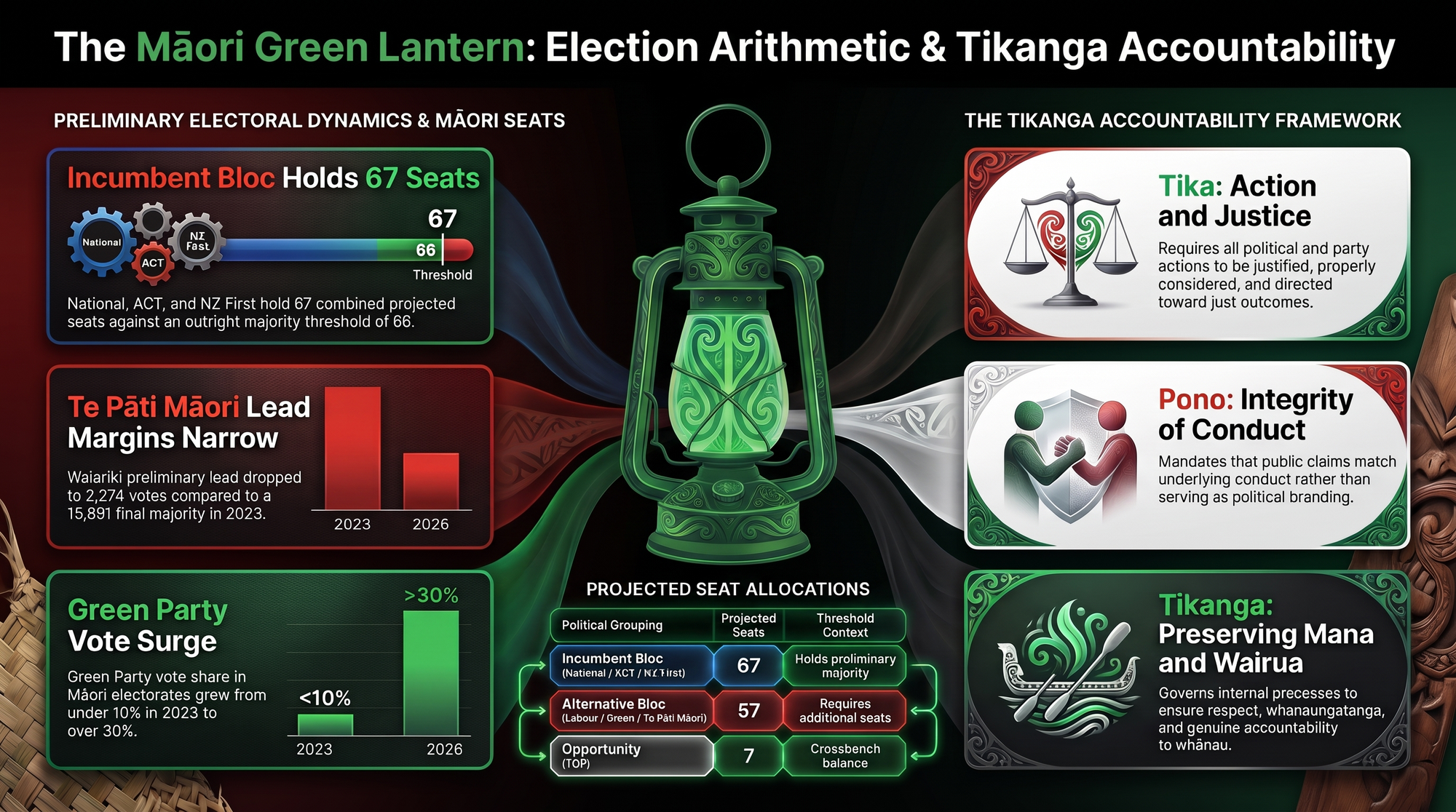
So let us talk about what actually matters: what Māori voters have said, what the Greens can do with their advance, what Te Pāti Māori’s survival does not excuse, and how special votes could change the government-formation options.
I will walk through the possible deals, explain the electoral arithmetic that can turn an apparent victory into no additional parliamentary strength, and bring the whole argument back to Tika, Pono and Tikanga.
Because I am not interested in changing the faces around the Cabinet table just to leave whānau under the same boot.
Māori Voters Are Not Anybody’s Property
Lillian Hanly’s RNZ article describes Te Pāti Māori leading in five Māori electorates while facing much tighter competition.
Rawiri Waititi’s preliminary Waiariki lead is 2,274, against his final 2023 majority of 15,891. Debbie Ngarewa-Packer’s preliminary Te Tai Hauāuru lead is 3,841, compared with 9,162 in 2023.
These are different stages of counting, but the preliminary picture is plainly more competitive. Hanly sets out the figures and their context.
 RNZ | Te Reo Irirangi o Aotearoa
In Te Tai Tokerau, Hūhana Lyndon is just 436 votes behind Aperahama Edwards. In Waiariki, Tania Waikato is Waititi’s nearest challenger. The Greens are not merely collecting sympathetic comments from Māori voters. Their candidates are seriously contesting representation. RNZ identifies both challenges.
Good.
Nobody owns our political choices.
Voting Green does not make a Māori voter less Māori. Challenging Te Pāti Māori does not make somebody an enemy of rangatiratanga. A party has to earn its authority. Putting “Māori” in its name does not issue its leadership a lifetime exemption from scrutiny.
Greaves interprets the narrower margins as voters supporting Te Pāti Māori strategically while also punishing it. Ngarewa-Packer says the exceptional result was 2023, and earlier elections provide a better comparison. Her argument deserves to be heard. Retaining five seats is not a collapse. Both interpretations appear in RNZ’s report.
But survival is not vindication.
It means voters returned candidates. It does not mean every leadership decision has been blessed, every grievance settled or every critic proved wrong.
Tika, Pono And Tikanga Must Reach Inside The Party
Here is the framework I use.
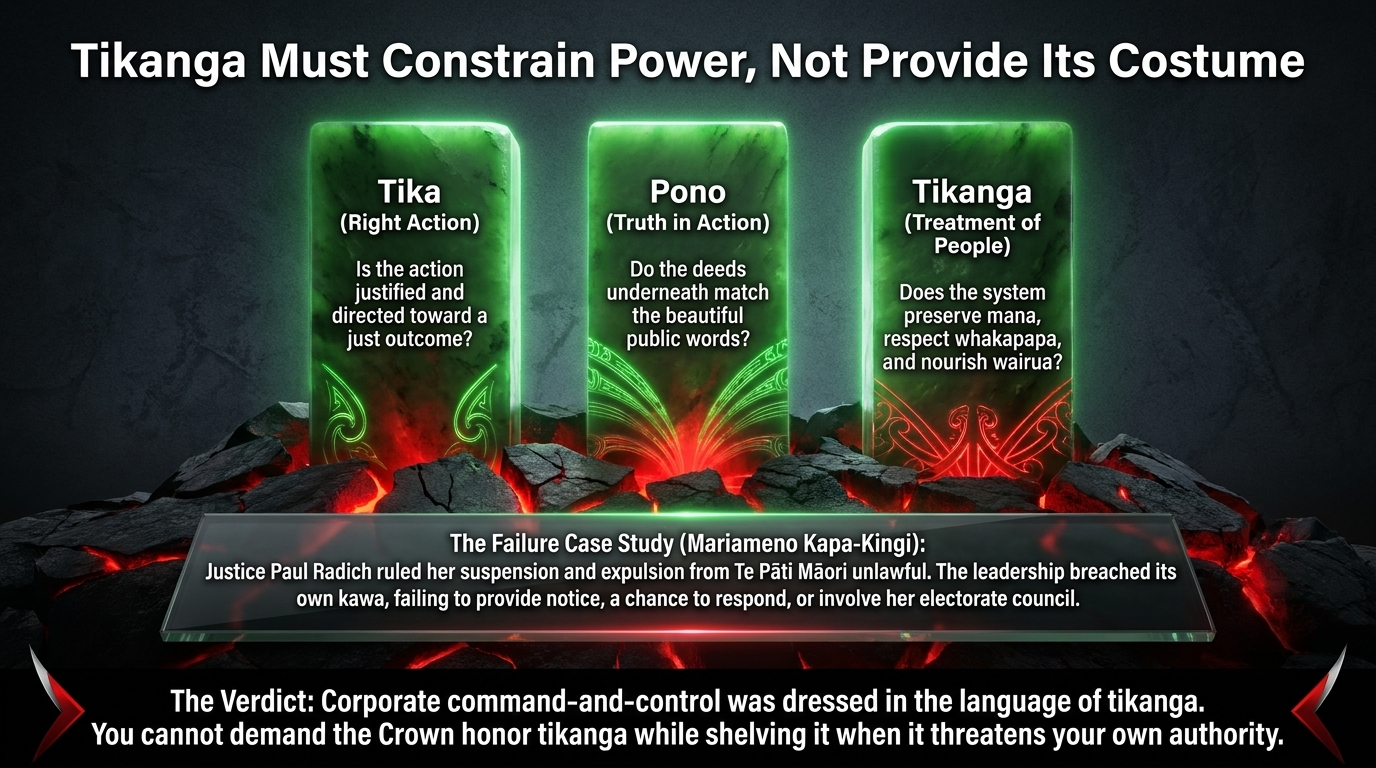
Tika asks whether the action was right: whether it was justified, properly considered and directed towards a just outcome.
Pono asks whether the words match the deeds. Not whether the speech sounded beautiful. Whether the conduct underneath it told the same story.
Tikanga asks how people were treated: did the system preserve their mana, recognise their whakapapa, respect their wairua, involve their whānau appropriately and return them towards wellbeing?
I have used these connected tests before in “Stop Changing The Managers Of The Damage”. They are the framework of this argument, not a claim that I speak for every iwi or hapū.
Mauri runs through all of it. What does the exercise of power leave people able to do? Participate? Belong? Speak without fear of punishment? Shape their future? Or does it grind them down and then congratulate itself on maintaining discipline?
That standard applies to the Crown.
It applies to Tamihere.
And it applies to the Greens and Labour too.
There is no point demanding liberation from one hierarchy while excusing another because we recognise the faces at the top.
The Deep Dive Podcast
Listen to a lively conversation between two hosts, unpacking and connecting topics in the sources of this essay. I apologise in advance for the AI's very harsh pronounciation of reo. Please dont shoot me, :).
Youtube Video
Like video? Here is a short video suppporting the essay. Again, don't shoot the messenger please because of AI's pronounciation. :)
Tamihere’s Leadership Has A Record To Answer For
My objection to Te Pāti Māori’s leadership is not a vague dislike of strong personalities.
Look at what happened to Mariameno Kapa-Kingi.
Justice Paul Radich found her suspension and expulsion unlawful because the party had breached its own kawa. RNZ reports his finding that the tikanga principles infused into that document “were not mentioned or applied” in relation to her suspension. The court findings are reported in detail here.
The meeting affecting her future went ahead without involving her, warning her that suspension was under consideration, giving her a substantive opportunity to respond, or including members of her electorate council. The judge said that could not be reconciled with enhancing relationships, respect, whanaungatanga, unity or nourishing wairua. Those are the failures identified in the reported judgment.
Read that beside the party’s public language about tikanga.
That is the contradiction.
Not tikanga versus accountability. Tikanga requiring accountability—and leadership failing the test.
The party’s lawyer disputed the alleged breaches. After the ruling, the party said it would respect the decision, while its leaders described it as guidance and direction. RNZ includes that defence and response.
But “guidance” is a remarkably comfortable word for a finding that your disciplinary process was unlawful.
My judgement is that the process exposed corporate-style command and control dressed in language that should have constrained it. That is criticism of documented conduct, not proof that every part of the organisation operates identically.
A party cannot demand that the Crown honour tikanga and then shelve tikanga when it becomes inconvenient to its own authority.
The Split Vote Kept The Door Open
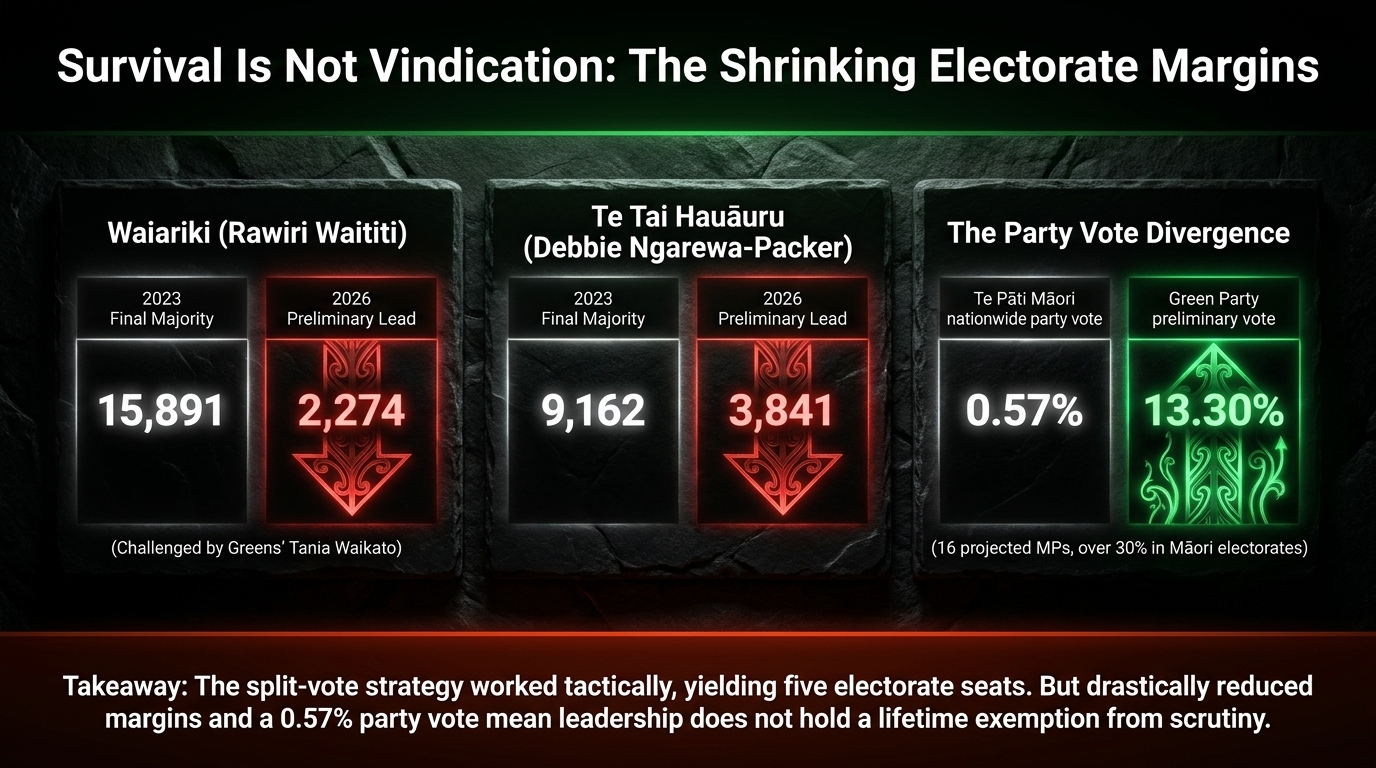
Te Pāti Māori explicitly encouraged electorate votes for its candidates and party votes for Labour or the Greens. It also published a deliberately minimal party list. Claire Timperley and Richard Shaw explained that strategy before the election.
The result is five projected electorate MPs alongside 0.57% of the nationwide party vote. Those are the Commission’s preliminary figures.
That is consistent with the strategy. It does not tell us precisely why each person voted as they did.
Some may have followed the recommendation. Some may have trusted their local candidate and distrusted the leadership. Some may have preferred the Greens regardless of anything Te Pāti Māori said.
The party does not get to claim ownership of all those decisions.
Nor do I get to call its electorate voters foolish because I oppose its leadership. Their votes belong to them.
What I will not accept is a tactical success being waved around as a clean bill of health.
Here Are The Numbers They Have To Govern With
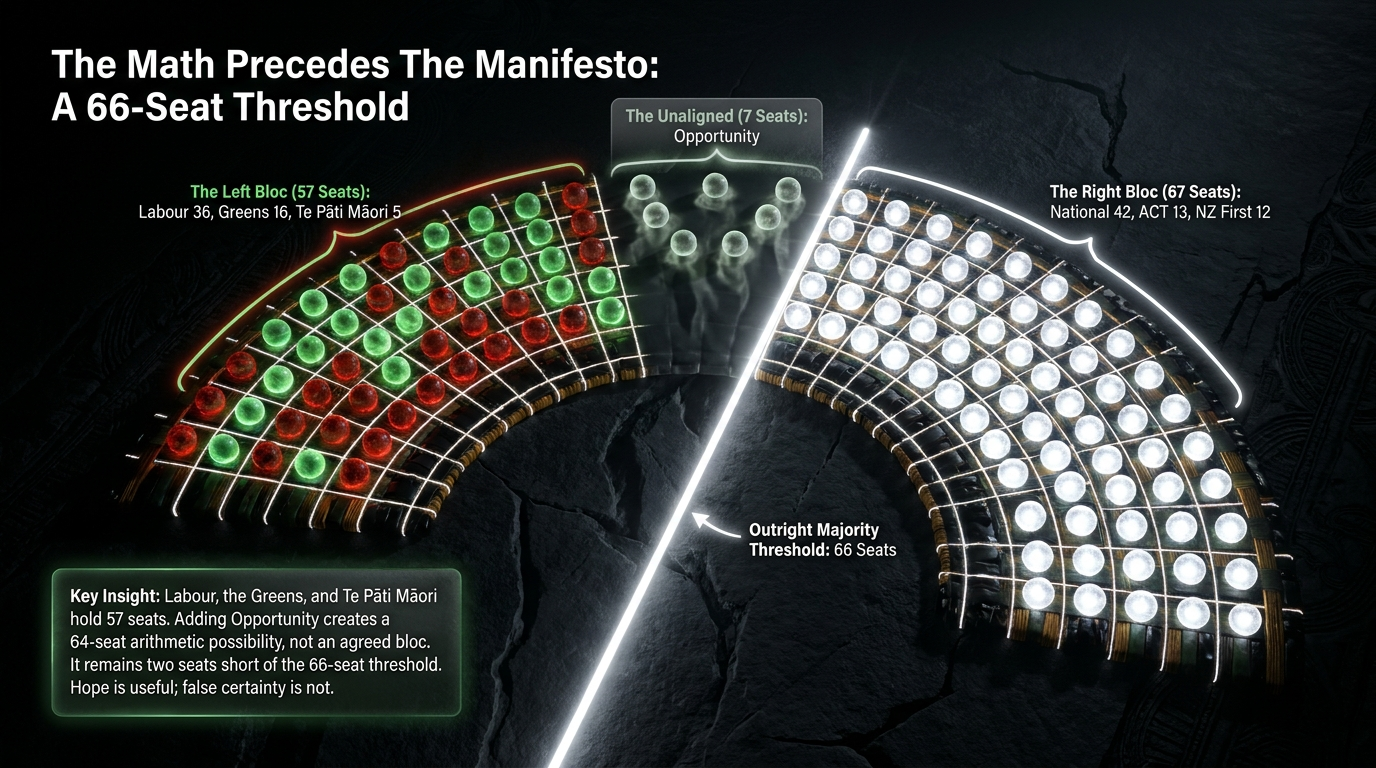
The Greens have 13.30% of the preliminary party vote and 16 projected MPs. National has 42 seats, Labour 36, ACT 13, New Zealand First 12, Opportunity seven and Te Pāti Māori five. Together that makes a projected House of 131. The Commission publishes the complete allocation.
National, ACT and New Zealand First therefore have 67 seats. Labour, the Greens and Te Pāti Māori have 57. Add Opportunity and the total becomes 64. An outright majority in this House is 66. The arithmetic comes directly from the preliminary table.
There is the problem.
Our preferred grouping is not yet an agreed grouping, and it is not yet an outright majority.
Opportunity’s Qiulae Wong says she will speak first to the party with the most seats, presently National. She says that guarantees nothing and has left coalition, confidence and supply, and crossbench arrangements open. Luxon had ruled out governing with Opportunity. RNZ reports both positions.
So stop counting Opportunity’s MPs as though they have already signed a Labour agreement.
The Commission aims to publish official results on 27 November. Talks do not have to wait until then, and that date is not a deadline for forming a government. The Commission gives the timetable, while constitutional lawyer Dean Knight explains the rules.
I explained the importance of facing the count in “The Count Is Not Surrender”.
Hope is useful. False certainty is not.
The Green Victory That Might Not Add A Seat
Here is where the system gets awkward.
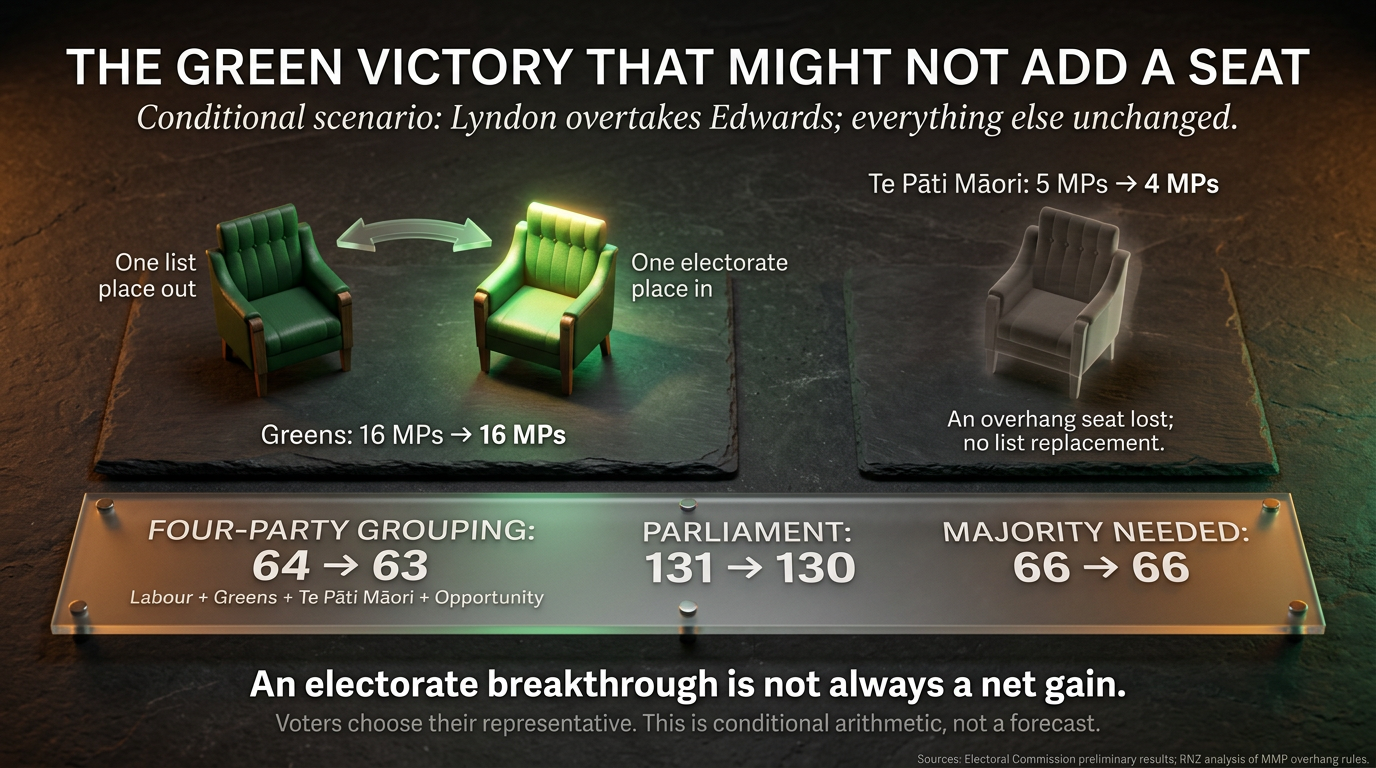
Normally, an electorate win changes how a party fills its proportional entitlement: another electorate MP, one fewer list MP. An overhang happens when a party wins more electorates than its party vote entitles it to. It keeps the additional seats, enlarging Parliament. Timperley and Shaw explain that mechanism.
Suppose Lyndon overtakes Edwards, with everything else unchanged.
The Greens would ordinarily replace a list place with her electorate place. Their total would stay the same. Te Pāti Māori could lose a seat without receiving a list replacement. The proposed four-party grouping would fall from 64 to 63, and Parliament from 131 to 130. The outright-majority threshold would still be 66. That is conditional arithmetic using the preliminary allocation and the overhang rules, not a forecast.
Does that mean Lyndon should not stand?
No. Voters choose their representative. They are not pieces that party managers can move around without consent.
It means an electorate breakthrough and a net gain for the wider grouping are different things.
Apply the same scrutiny to National. All its projected seats are electorates, and its overhang is central to the incumbent bloc’s position. A change in National-held electorates can therefore affect the governing arithmetic even when another party simply swaps a list MP for an electorate MP. RNZ explains National’s unprecedented electorate-only result.
Special votes can change the House itself—not just the names sitting inside it.
Scenario One: We Have The Numbers To Change Government
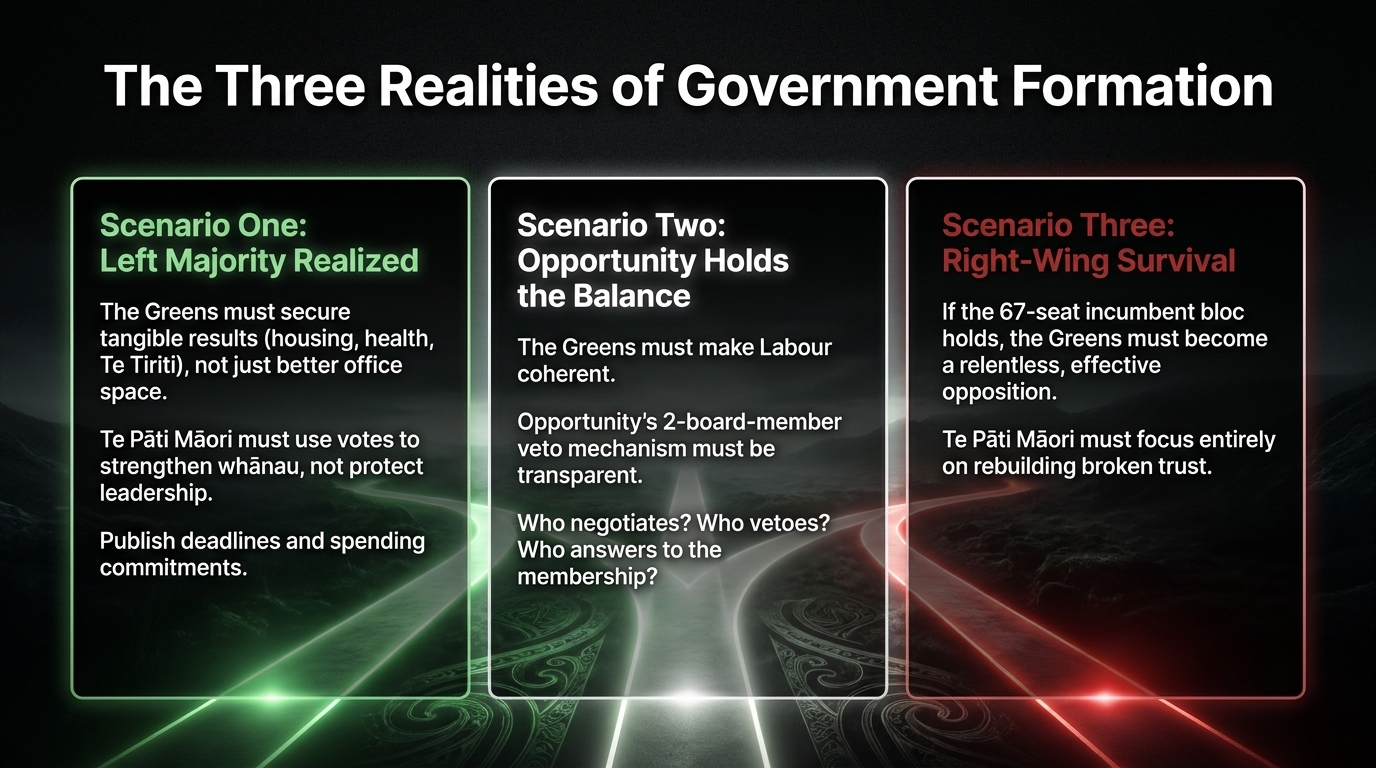
If the final allocation makes a Labour–Green–Te Pāti Māori–Opportunity government viable, the Greens should help put a serious common programme together.
Not a collection of private trophies. Not portfolios handed out while the hard commitments disappear into “further work”.
A coalition brings parties into government together. Confidence and supply can provide the parliamentary support necessary to sustain a government without every supporting party joining Cabinet. Cooperation is looser and does not automatically guarantee survival. These arrangements can be combined. RNZ explains the options.
I want a programme covering housing, household security, public health, climate action, redistribution and Te Tiriti. I want its spending commitments explained and its delivery dates published.
Those are my demands, not an invented agreement between the parties.
The Greens should use their advance to secure results, not merely better office space.
Te Pāti Māori should use necessary votes to strengthen whānau, not protect the leadership from questions.
Who authorised the agreement? Who can challenge it? What happens when a promise is abandoned?
A government changes nothing for a hungry child merely by announcing that its partners enjoyed a constructive meeting.
Scenario Two: Opportunity Holds The Balance
If the incumbent bloc loses its majority and Opportunity becomes decisive between workable alternatives, the Greens have a job to do: make a Labour-led arrangement coherent enough to govern.
That means resolving disagreements, identifying shared commitments and showing that the government would last.
But the Greens cannot command Wong’s votes. And Wong cannot conjure willing partners just because a combination fits on paper. Her stated options and Luxon’s position remain political constraints.
Te Pāti Māori’s leverage would depend on whether its votes were indispensable. Even then, necessary does not mean omnipotent. Everyone required for the arrangement must be able to accept it.
Then look inside Opportunity too. RNZ reports that its rules allow two board members to veto a government arrangement negotiated by its caucus. That approval mechanism appears in the coalition explainer.
I am not going to attack concentrated authority in Te Pāti Māori and politely ignore it elsewhere.
Who negotiates? Who approves? Who vetoes? Who answers to the membership?
Those questions do not become rude because we want the deal to happen.
Scenario Three: This Government Survives
The present preliminary allocation allows National, ACT and New Zealand First to continue together. Their combined projection remains 67 seats.
If that survives the official count, the Greens cannot turn a record result into a Labour government by force of enthusiasm.
Their task becomes effective opposition: scrutinising legislation, exposing failures, proposing alternatives and cooperating where genuine gains are possible.
Te Pāti Māori would retain representation without necessarily holding government-formation leverage. It would still have to rebuild trust. Keeping seats is not a repair programme.
And remember Nicola Willis. National’s lack of list seats leaves its finance minister outside the preliminary parliamentary allocation, while the governing bloc still has the numbers. RNZ explains the connection.
A government can lose familiar faces and keep power.
I want more than the satisfaction of watching a minister disappear. I want the policies that hurt whānau stopped.
Three Examples For The Western Mind
These comparisons are bridges into the argument, not substitutes for tikanga.
Example One: The Board That Locks Out Its Representative
Imagine a board making a decision about a director’s future without telling them what is proposed or giving them a proper chance to respond.
You would recognise a governance failure immediately.
In Kapa-Kingi’s case, the harm was not hypothetical: the court ruled both her suspension and expulsion unlawful and ordered reinstatement. The judge identified exclusion from the decision-making process and failure to apply the party’s tikanga-infused rules. RNZ reports the findings.
I will not invent a dollar value for that harm.
The tikanga question goes further than whether a form was completed. Was her mana preserved? Were her relationships and elected mandate respected? Was there room for her voice?
The remedy is fair notice, meaningful participation, independent dispute resolution and leadership willing to acknowledge an error without hiding it behind “guidance”.
The point of tikanga is to constrain power, not provide its costume.
Example Two: The Clinic That Calls An Unseen Patient A Saving
Imagine a clinic boasting about financial discipline while patients stay away because they cannot afford the appointment.
The accounts might look tidier. The person is still unwell.
In the 2024/25 Health Survey, 18.7% of Māori adults reported not visiting a GP because of cost, compared with 14.5% of European/Other adults—a gap of 4.2 percentage points, or approximately 29% relative to the European/Other rate. The Ministry publishes both figures.
Those figures do not prove that abolishing Te Aka Whai Ora caused the gap.
They show the need against which decisions must be judged.
The Waitangi Tribunal found failures of consultation, tino rangatiratanga, equity and other Treaty principles in the Crown’s alternative arrangements. It recommended revisiting a stand-alone Māori health authority, extensive consultation and evidence-based decisions. The Tribunal sets out its findings and recommendations.
I examined that record in “The Crown Ripped Māori Hands From The Health System”.
My political judgement is blunt: treating Crown control as normal while Māori authority is disposable reproduces a white-supremacist institutional hierarchy. That judgement concerns the documented distribution of power, not an invented claim about every minister’s private beliefs.
The solution must address affordable care and meaningful Māori authority together. Processing people faster is not enough if they cannot afford to enter.
Example Three: The Household Behind The Fiscal Speech
Imagine a finance committee congratulating itself while a child’s household runs out of food.
Would you call that success?
The Health Survey found that 32.3% of Māori children lived in households where food ran out often or sometimes, compared with 18.3% of European/Other children. That is a 14-percentage-point gap. The Ministry records the measure and its timeframe.
I will not pretend one government created the entire disparity. Nor will I accept inherited harm as an excuse for preserving it.
Tikanga asks what that insecurity does to mana, whānau relationships, wairua and the ability to live well.
My proposed response is adequate incomes, affordable housing, accessible services and public reporting that shows whether hardship actually falls.
That is how coalition promises should be judged. Not by how impressive the agreement looks at the signing table.
Read It, Hear It, Keep It For Our Mokopuna
I would love you to click through and spend time with this mahi. I design it to give you information you can use—in a whānau conversation, a submission, a workplace discussion or the next time somebody presents a slogan as established fact.
For those who prefer listening or watching, my earlier Māori-health investigation brings together a long-form audio discussion, a short explanatory video section and a substantial cited essay.
This growing repository is for our mokopuna.
I want them to look back at the record of neoliberalism, misinformation and disinformation in Aotearoa and know that The Māori Green Lantern, alongside other persistent voices, was documenting what happened and trying to protect them.
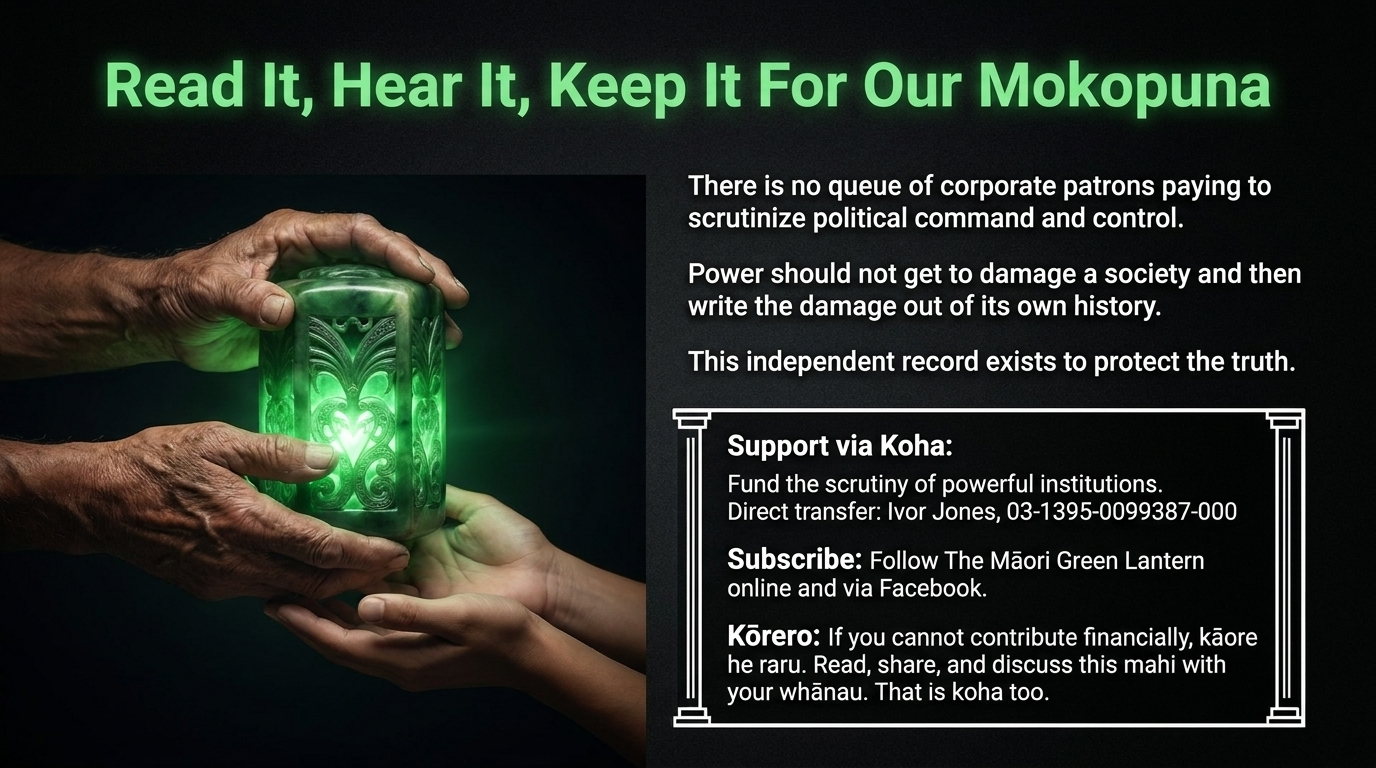
Power should not get to damage a society and then write the damage out of its own history.
Koha Consideration
Who supports this work of reading the results, checking the judgments and refusing to confuse a Māori face with accountable Māori power?
You do.
There is no queue of corporate patrons paying me to scrutinise political command and control. This mahi depends on people choosing to support and protect an independent record for whānau and mokopuna.
Every koha helps support and protect the accountability that powerful institutions would rather avoid. Rangatiratanga includes supporting our own truth-tellers.
If you cannot contribute financially, kāore he raru. Read, subscribe, follow, kōrero and share. That is koha too.
- Support And Protect This Mahi Through Koha.
- Subscribe To The Māori Green Lantern.
- Direct bank transfer: Ivor Jones, 03-1395-0099387-000, also published on the Koha page.
- Visit The Facebook Subscription Page.
Our Mandate Is Not Their Property
I want the Greens to help build a government that redistributes power as well as income.
I want Labour to offer more than gentler management.
I want Te Pāti Māori’s MPs to serve whānau without pretending that scrutiny threatens Māori independence.
And I want Opportunity to explain exactly whose future any agreement would protect.
Publish the commitments. Identify the spending. Set the deadlines. Tell us who approved the bargain. Report what happened when the cameras left.
Apply tikanga when power is exercised—not just when a microphone is switched on.
The Greens’ stronger mandate should raise the standard. Te Pāti Māori’s survival should not lower it.
Our votes are not an inheritance handed to party leaders. Our whakapapa is not campaign packaging. Our whānau are not the human cost politicians get to write off while congratulating themselves on staying in office.
If a government cannot preserve our mana, respect our relationships, recognise our authority and improve our wellbeing, then it has failed the people it exists to serve.
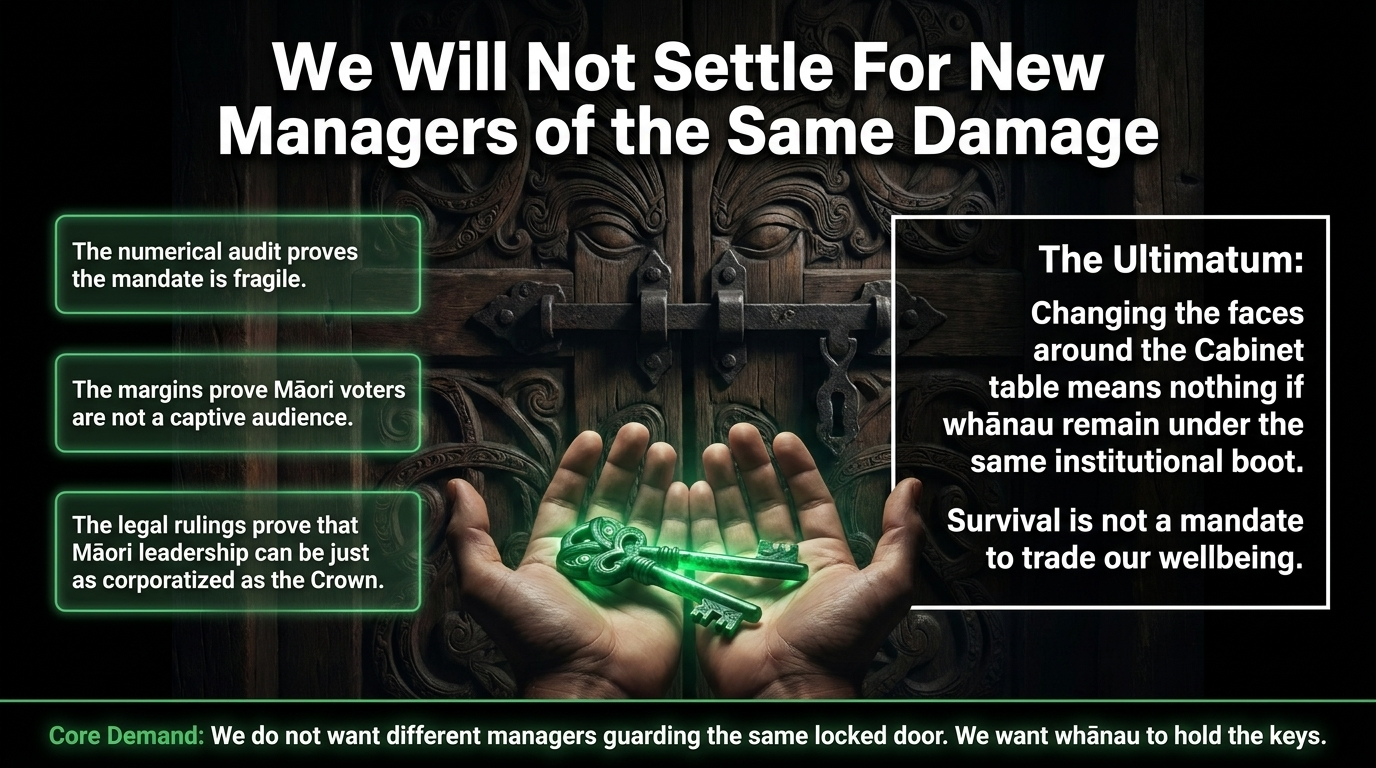
I do not want different managers guarding the same locked door.
I want whānau to hold the keys.
Disclaimer: This essay is political commentary reflecting the author’s views. Election figures are preliminary as at 9 November 2026. Coalition scenarios are conditional analysis, not predictions or evidence of agreed deals. Criticism concerns political conduct and accountability, not Māori identity or Māori aspirations.