"Labour Built It. National Drove It Harder. Now A Billionaire Wants Them Back Together." - 13 November 2026
They Rewrote The Rules For Capital. Do Not Confuse A Call For Political Stability With An Answer To What Those Rules Cost Our People.

Mōrena Aotearoa,
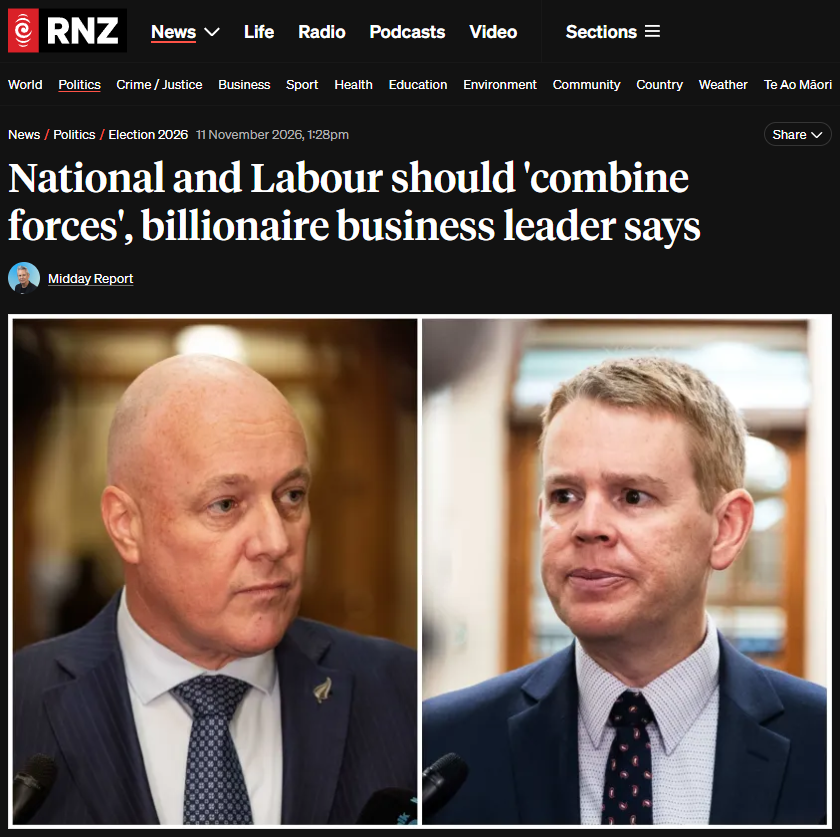
There is something missing from the conversation about a billionaire wanting National and Labour to work together.
Labour helped build the economic order he is speaking from. National carried it on.
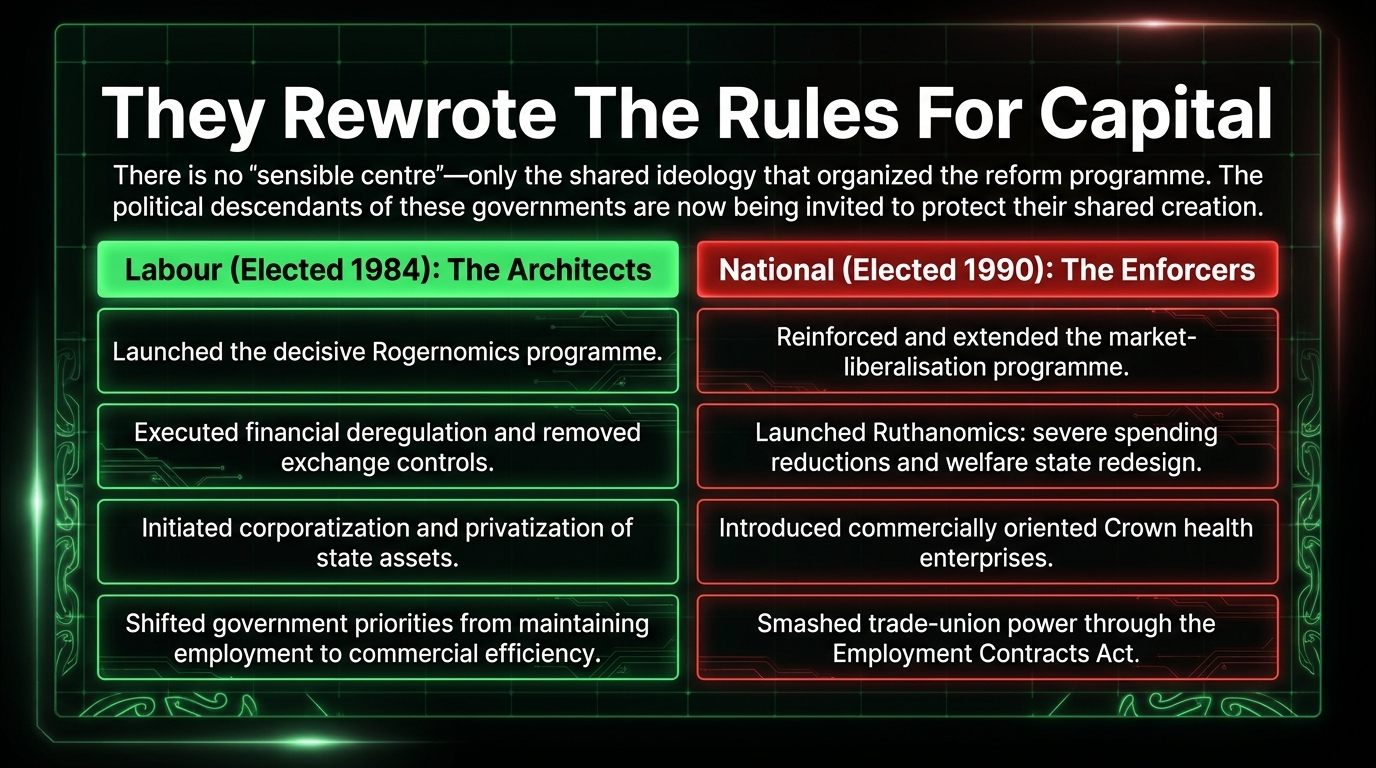
That is not a party-political insult. It is the history. The Labour government elected in 1984 launched Rogernomics, while the National government elected in 1990 reinforced the market-liberalisation programme. teara.govt
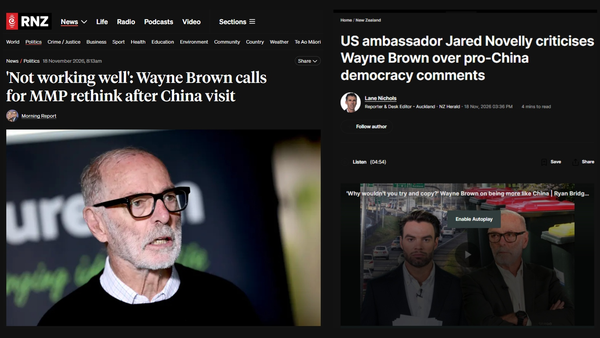
 RNZ | Te Reo Irirangi o Aotearoa

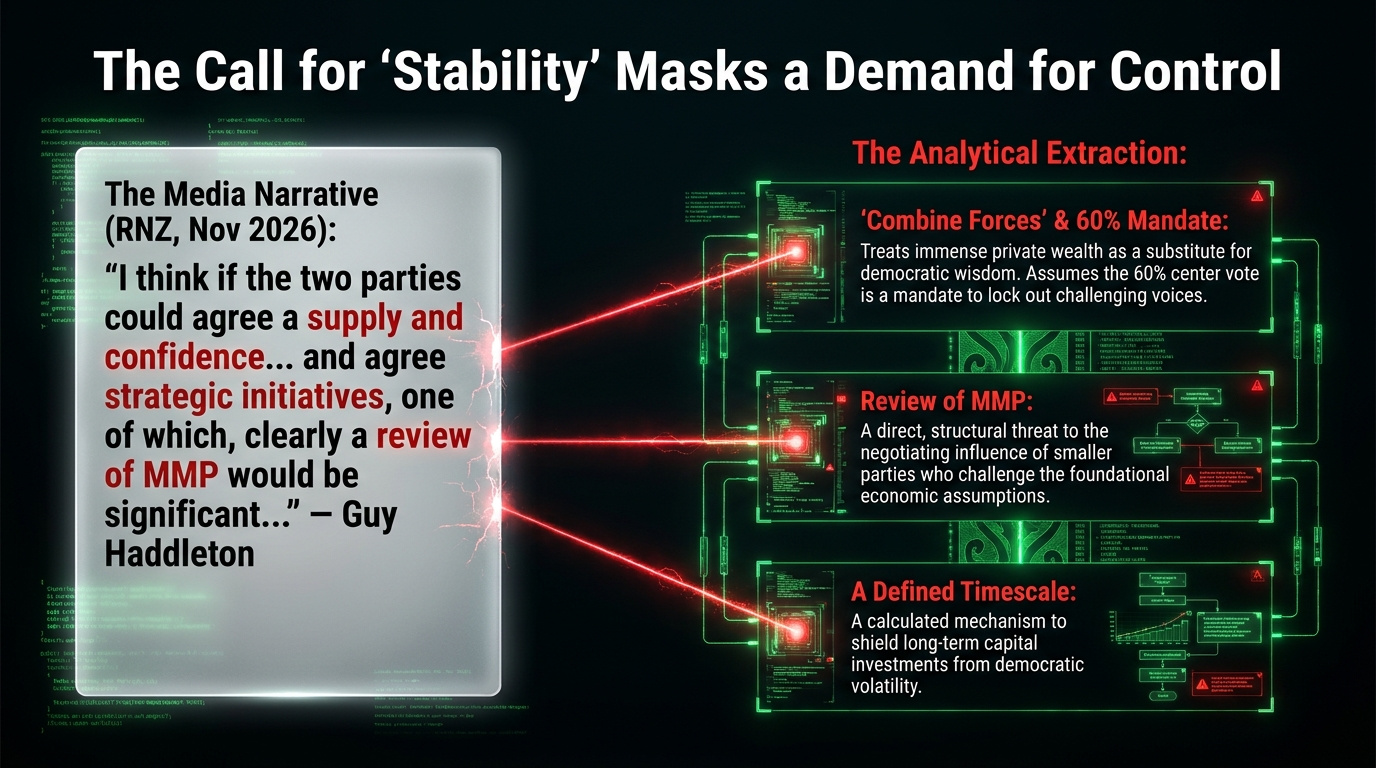
So when billionaire business leader Guy Haddleton proposes an arrangement between National and Labour, with agreed strategic initiatives and a review of MMP, I am not looking at two parties with no shared economic history being asked to discover common ground.
I am looking at the political descendants of the governments that changed the rules around public ownership, investment, employment and the distribution of economic power.
And I want to know what, exactly, they are being invited to stabilise.
The country?
Or an economic settlement whose winners have become accustomed to having their confidence treated as a national priority?
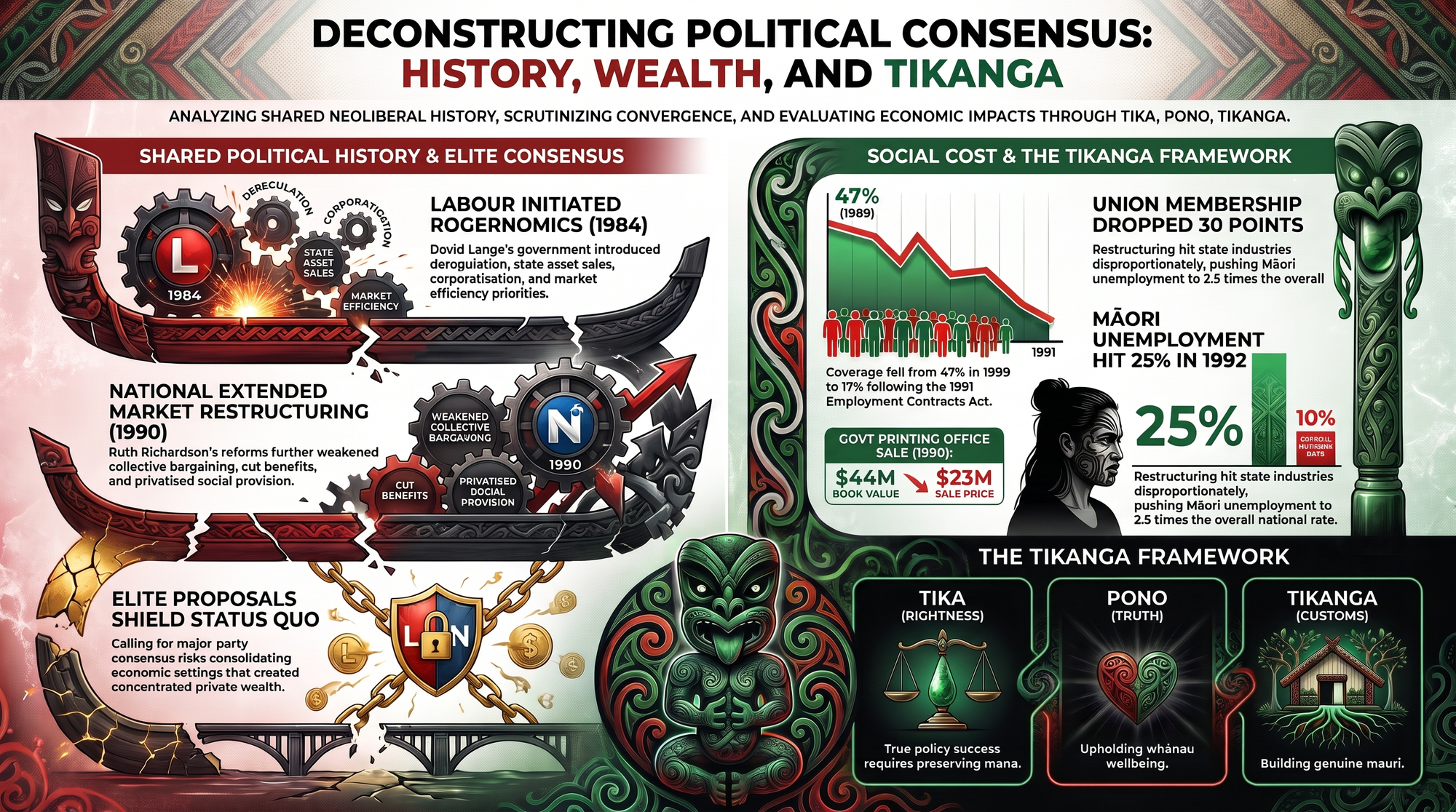
This essay follows that connection: Labour’s introduction of Rogernomics, National’s continuation of the project, the opportunities those changes created for private accumulation, and the significance of a billionaire now suggesting that those parties govern more closely together.
I will test it through Tika, Pono and Tikanga, with concrete examples of what happened to public assets, workers’ bargaining power and Māori employment.
Because I have no interest in another comfortable conversation about political stability that refuses to discuss what people are being asked to remain stable underneath.
Labour Does Not Get A Free Pass
Let us say it plainly.
The decisive Rogernomics programme did not arrive wearing a National Party rosette.
It came from Labour.
Under David Lange’s government, Finance Minister Roger Douglas drove a transformation involving financial deregulation, the removal of exchange controls, corporatisation, privatisation and reduced protection for domestic industries. The Ministry for Culture and Heritage’s history sets out that programme and its consequences.
Government departments were reorganised into commercially oriented businesses. Some were then sold. State-sector employment was no longer treated in the same way as a means of maintaining jobs; commercial efficiency and profitability became central objectives. NZHistory explains how the state-owned enterprise model changed those priorities.
That matters because these were not merely technical adjustments carried out in a back office.
They changed what government considered itself responsible for.
Was its job to maintain collective capacity, employment and public provision? Or to create commercially disciplined organisations, expose activities to market pressure and leave more decisions to private owners?
I am not going to let Labour hide behind its name.
If a party claiming to represent working people changes the rules in ways that injure working communities, its branding does not excuse the consequences.
Tika does not mean protecting the party you feel closest to.
Pono does not mean remembering only the history that makes your side look good.
The Deep Dive Podcast
Listen to a lively conversation between two hosts, unpacking and connecting topics in the sources of this essay. I apologise in advance for the AI's very harsh pronounciation of reo. Please dont shoot me, :).
Youtube Video
Like video? Here is a short video suppporting the essay. Again, don't shoot the messenger please because of AI's pronounciation. :)
National Did Not Undo It. National Extended It.
Then National came in.
Not to restore the old settlement, but to carry the transformation further.
Ruth Richardson’s programme sought both spending reductions and a redesign of the welfare state. National also introduced commercially oriented Crown health enterprises. Te Ara’s Treasury history documents those decisions.
Labour began the decisive restructuring. National extended it into employment relations and social provision.
That is the continuity we need in the room whenever somebody suggests that bringing the parties together would somehow lift government above ideology.
Above which ideology?
The ideology that organised the reform programme does not stop being an ideology because politicians from different parties have administered it.
Sell an asset under Labour, weaken collective bargaining under National, and then call the resulting arrangement the sensible centre.
I do not accept that sleight of hand.
But accuracy matters here too. The parties were not identical then, and they have not been identical since.
Later Labour-led governments established Kiwibank, bought back rail assets and acquired a majority shareholding in Air New Zealand. Labour also replaced Crown health enterprises with district health boards. Those reversals and departures are part of the same historical record.
They matter. Public ownership matters. Employment law matters. Different governments can make materially different decisions.
My argument is not that every government has done exactly the same thing.
It is that neither party gets to discuss today’s economy as though it had no hand in constructing it.
The Billionaires Did Not Fall Out Of The Sky
When I say neoliberalism helped create the billionaire class, I mean something more concrete than “rich people exist and I am angry”.
I mean governments changed the opportunities available to capital.
Public enterprises became purchasable assets. Financial markets were deregulated. Top income-tax rates were reduced. Employment law changed the bargaining position of workers. Those changes are documented in the histories of Rogernomics and its continuation and in Te Ara’s account of employment and incomes.
Those decisions did not mechanically manufacture every fortune. They did not erase entrepreneurship, innovation, management skill, inheritance or international markets.
Nor does the evidence establish that Haddleton personally became wealthy through buying privatised state assets.
But it destroys the fairy tale that enormous private fortunes emerge in a world untouched by political choices.
Governments make the rules within which wealth is accumulated.
They decide what can be sold, what can be owned, how gains are taxed and what rights workers retain.
Then, when someone succeeds spectacularly within those rules, we are supposed to treat the resulting fortune as proof that they understand the national interest better than everyone else.
No.
Success within an economic order does not grant you authority to define its political boundaries.
Especially when the people carrying its costs have something to say.
Example One For The Western Mind: A Public Asset Becomes A Private Stepping Stone
Take Graeme Hart.
Not as a stand-in for Haddleton. They are different people, and I am not suggesting they coordinated anything.
Hart provides a documented example of how privatisation could become a stepping stone in the growth of a major private fortune.
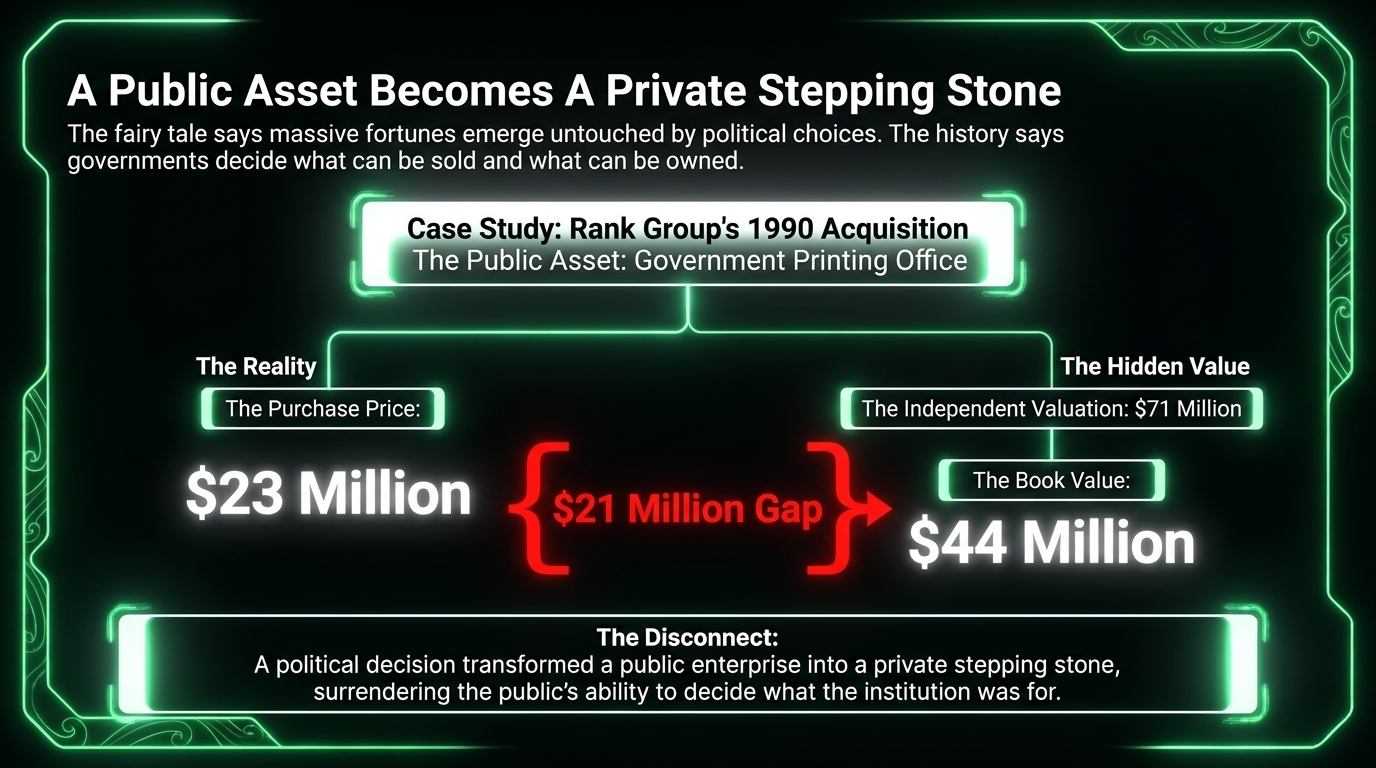
Business commentator Brian Gaynor described Rank Group’s purchase of the Government Printing Office in 1990 as Hart’s big break. Rank paid $23 million; Gaynor reported a book value of $44 million and an independent valuation of $71 million. His account identifies the transaction and the subsequent growth of Hart’s business interests.
The difference between the reported book value and purchase price was $21 million: $44 million minus $23 million. That is a comparison of accounting value and transaction price, not a finding that $21 million was stolen or a complete calculation of public loss. Gaynor supplies the underlying figures.
And Pono requires the rest of the story.
Gaynor also credited Hart’s rigorous analysis, consistent investment approach, management team and ability to work through difficult acquisitions. His assessment was not that Hart’s entire fortune could be reduced to a government asset sale.
The point is more precise.
A political decision made a public enterprise available for private acquisition. That transaction became an important opportunity in a businessman’s rise.
So spare me the suggestion that government and private wealth inhabit separate universes.
For readers used to Western commercial accounting, the tikanga question begins where the sale agreement ends.
What happened to the workers? What capacity did the public retain? Was the price justified? Who gained control over future income? Were the people whose livelihoods depended on the institution treated as more than an operating expense?
My proposed remedy is straightforward: public-interest assessment before asset sales, transparent valuations, enforceable obligations where appropriate, and a real willingness to retain public ownership.
Selling something is not proof that you have improved it.
Sometimes it means you have surrendered the ability to decide what it is for.
Example Two For The Western Mind: Bargaining Power Was Redistributed Too
Public assets were not the only thing at stake.
So was the power of people who worked for wages.
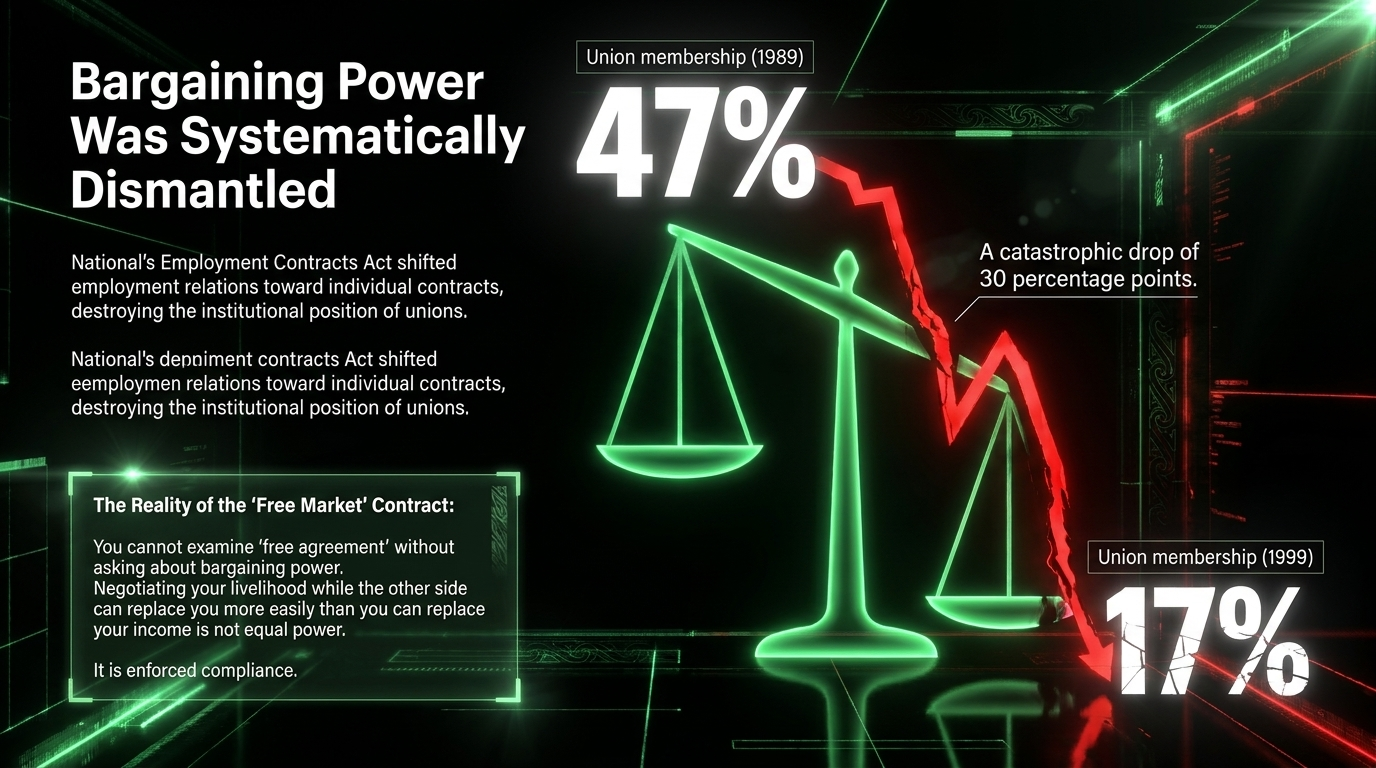
National’s Employment Contracts Act shifted employment relations towards individual contracts and diminished the institutional position of unions. Te Ara explains the legislation and its effects.
It records union membership falling from 47 percent of the employed labour force in 1989 to 17 percent over the following decade, largely as a consequence of the Act. Those historical figures come from its account of trade unions.
That is a fall of 30 percentage points: 47 minus 17.
Do not confuse that with a direct calculation of wage losses. It measures the decline in union membership, not every consequence of the legislation.
But it shows why “free agreement” between an employer and an individual worker cannot be examined without asking about bargaining power.
Imagine negotiating the terms of your livelihood while the other side can replace you more easily than you can replace your income.
Calling that a contract does not make the power equal.
This is the connection to private accumulation: the division of economic returns depends partly on the institutions through which workers can negotiate. It is not determined by business brilliance alone.
For the Western mind, tikanga asks you to stop treating the wage as the whole transaction.
Was the worker’s mana preserved? Could they speak without fear? Could their employment support whānau life? Were they able to participate in decisions that shaped their future?
My proposed response is stronger collective bargaining, effective employment-law enforcement and worker participation—not a return to pretending that dependence on a pay packet makes someone freely interchangeable with the person controlling it.
A government that wants stability should start with stability in people’s lives.
Example Three For The Western Mind: Māori Carried A Disproportionate Cost
The harm was not evenly shared.
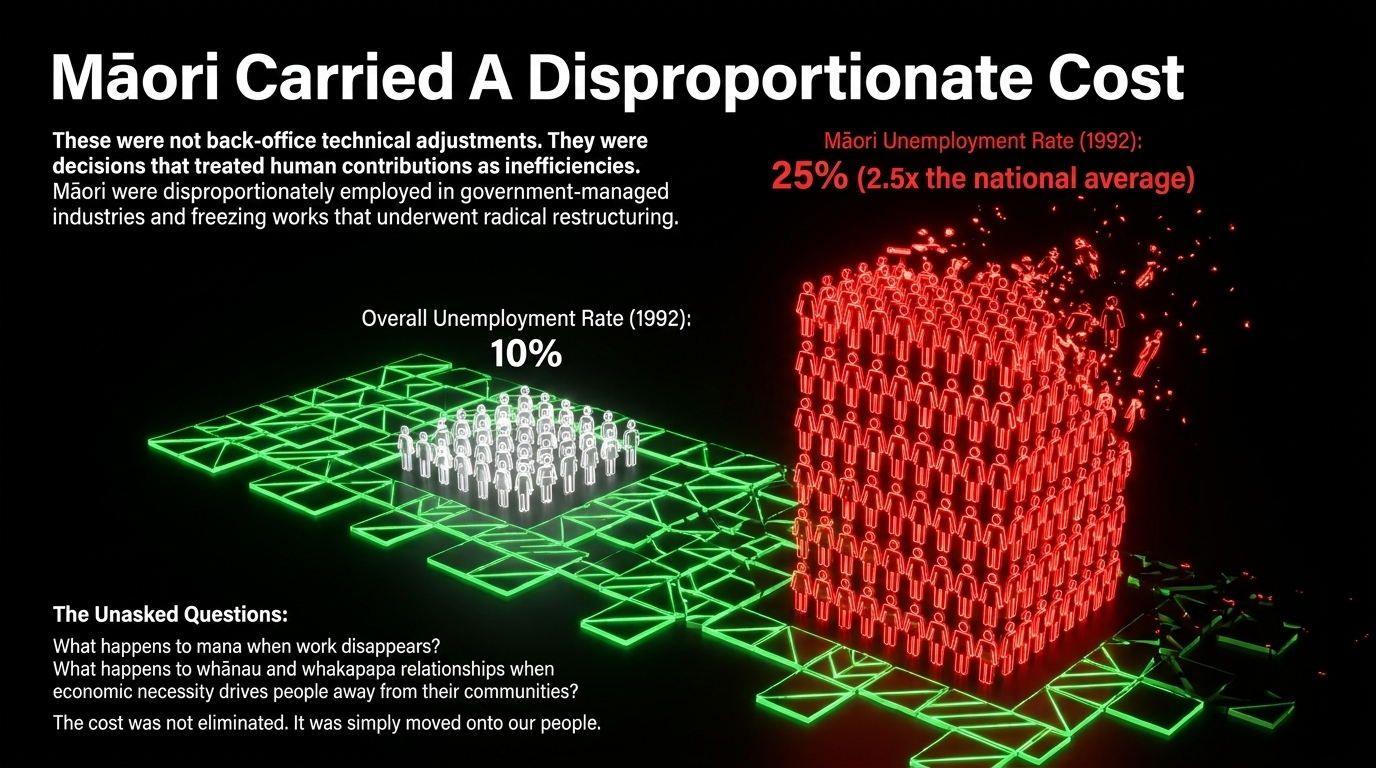
NZHistory records that Māori were disproportionately employed in government-managed industries and other sectors, including freezing works, that underwent restructuring and major job losses. It reports Māori unemployment reaching 25 percent in 1992, compared with an overall rate of 10 percent. That account explicitly connects Māori employment exposure with the impact of Rogernomics.
The comparison is 2.5 times the overall rate: 25 divided by 10.
These are the historical figures reported by that source, not current unemployment rates. And exposure to restructuring is not a claim that every instance of Māori unemployment had one cause.
Still, the disparity is devastating.
In the official account, this is unemployment.
Through the framework I am applying, the questions extend into the home.
What happens to mana when someone’s contribution is dismissed as an inefficiency?
What happens to whānau when work disappears?
What happens to whakapapa relationships when economic necessity drives people away from the communities they belong to?
Those questions are not an invitation to invent somebody’s personal experience. They are the questions a responsible policy process should have asked before deciding that social consequences could be dealt with afterwards.
The solution is not nostalgia for every feature of the old economy.
It is a different standard for change: Māori authority in decisions affecting Māori communities, regional investment, secure employment, properly supported transitions and public provision that does not abandon people once a commercial calculation has been made.
If your reform creates opportunities for investors while leaving communities to absorb the damage, you have not eliminated the cost.
You have moved it.
Now Connect That History To The Proposal
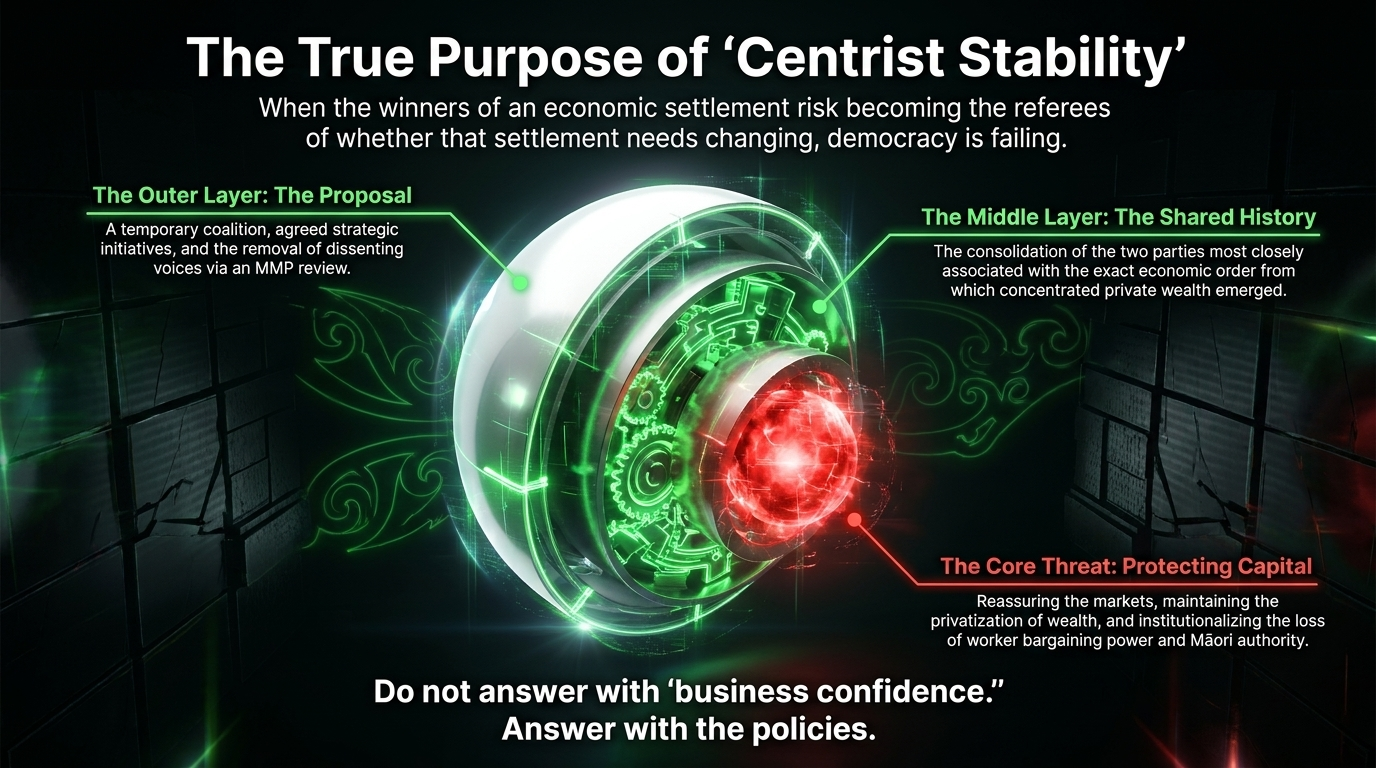
Here is why Haddleton’s suggestion deserves more scrutiny than a pleasant discussion about politicians getting along.
Read that alongside the history.
These are the parties whose governments launched and extended the decisive market-reform programme.
An arrangement between them could pursue public-interest policies. It could also make it easier to maintain areas of economic agreement while reducing the negotiating influence of parties challenging those assumptions.
That second possibility is my political concern—not an established secret intention.
I am not claiming Haddleton has disclosed a plan to enrich himself, abolish MMP or silence Māori. The RNZ article establishes none of those allegations.
What it establishes is that a billionaire favours closer cooperation between the largest parties and considers an MMP review a significant strategic initiative.
That is enough to ask a serious question.
Does this proposed stability create room to confront concentrated economic power?
Or could it consolidate agreement among the parties most closely associated with the economic order from which concentrated private wealth emerged?
Do not answer with “business confidence”.
Answer with the policies.
What Does “More” Mean Here?
When I say the billionaire class wants more, I am not claiming to possess a collective instruction sheet signed by every billionaire.
This report concerns Haddleton’s proposal, not a verified class-wide campaign.
The “more” I am challenging is the expectation that success in business should translate into authority over the shape of government.
A person is entitled to advocate an arrangement. Wealth should not give that advocacy a higher democratic status.
The danger is a loop: politically created opportunities help produce exceptional private wealth; exceptional wealth is treated as exceptional wisdom; that supposed wisdom is then invoked to recommend how political power should be organised.
At that point, the winners of an economic settlement risk becoming the referees of whether the settlement needs changing.
I reject that.
The people who lost secure work, bargaining power or public control are entitled to help define the problem too.
They do not need a billionaire’s permission to call the outcome unacceptable.
The Strongest Counterargument Deserves An Honest Answer
The strongest case for cooperation is not ridiculous.
Long-term infrastructure, investment and public services need continuity. Some reforms addressed genuine problems in the old economy.
Te Ara records that telecommunications users faced delays and unmet demands before restructuring, and that subsequent changes brought new services and lower toll prices. Its history includes those improvements alongside job reductions and later criticism of network control.
So no, I am not arguing that every market reform failed, that nothing improved or that the pre-Rogernomics economy was paradise.
Nor am I arguing that National and Labour must refuse to cooperate.
I am arguing that continuity is not a sufficient political purpose.
Continuity of what?
Public investment—or private advantage?
Fair taxation—or selective protection?
Māori authority—or another arrangement in which it can be overridden?
Show us the substance. Then we can judge it.
“Both major parties agree” is not a substitute for evidence.
Their shared history is precisely why it cannot be.
Tika, Pono And Tikanga Set A Harder Standard
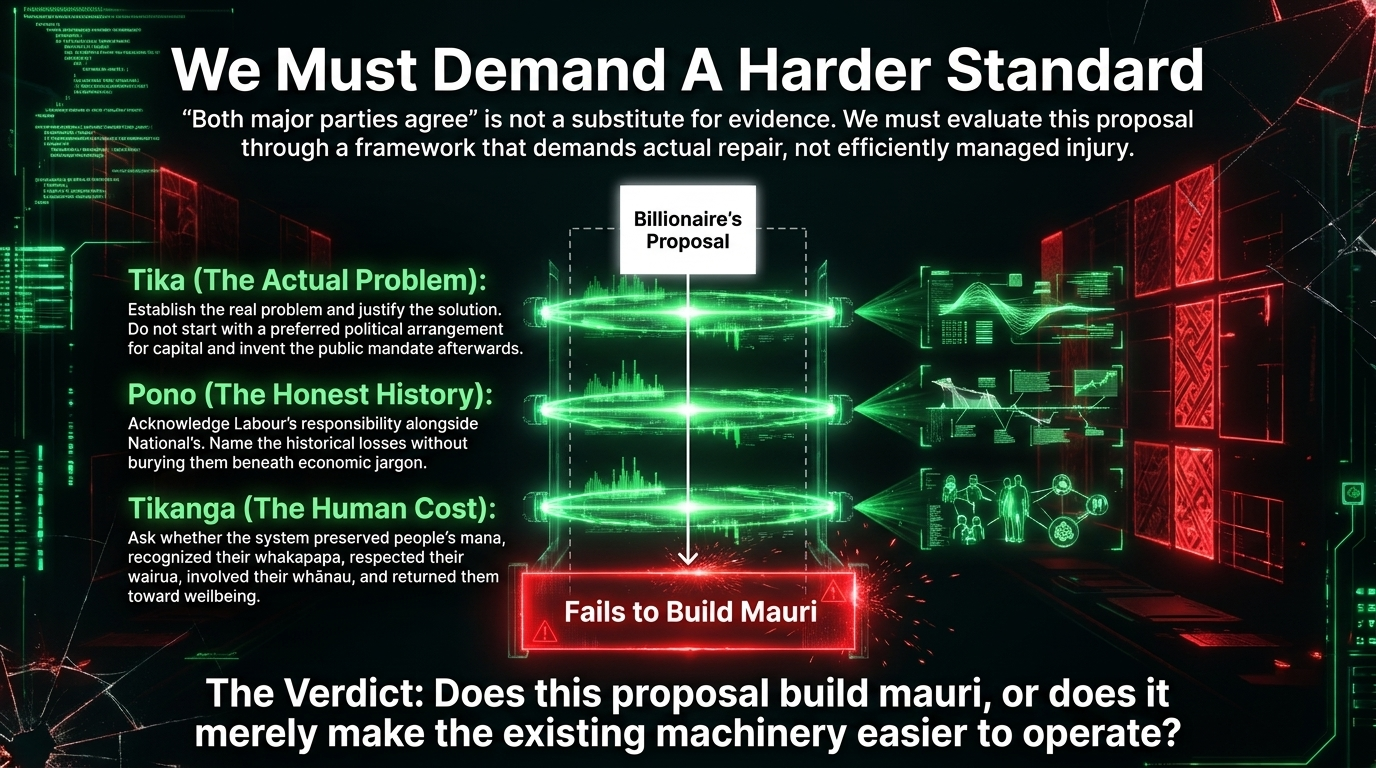
I have used this framework in “Stop Changing The Managers Of The Damage”, and examined commercial power and accountability in “The Owners’ Letter Is A Confession”.
Here is what it demands of this debate.
Tika: establish the actual problem and justify the proposed solution. Do not start with a preferred political arrangement and invent the public mandate afterwards.
Pono: acknowledge Labour’s responsibility alongside National’s. Recognise improvements where they occurred, and name the losses without burying them beneath economic jargon.
Tikanga: ask whether the system preserved people’s mana, recognised their whakapapa, respected their wairua, involved their whānau and helped return them towards wellbeing.
Then ask whether the result builds mauri.
Does it strengthen people’s ability to live securely, participate, belong and shape their future?
Or does it merely make the existing machinery easier to operate?
I do not want a more efficiently managed injury.
I want the injury confronted.
Keep This Record For Our Mokopuna
I would love you to read and share The Māori Green Lantern’s essays, because this mahi is intended to be useful beyond the moment of publication.
Use the evidence in a submission. Bring it into a whānau conversation. Follow the sources when a politician tells you there was no alternative.
For people who prefer listening or watching, earlier work such as “The Owners’ Letter Is A Confession” includes audio, video and the cited written essay.
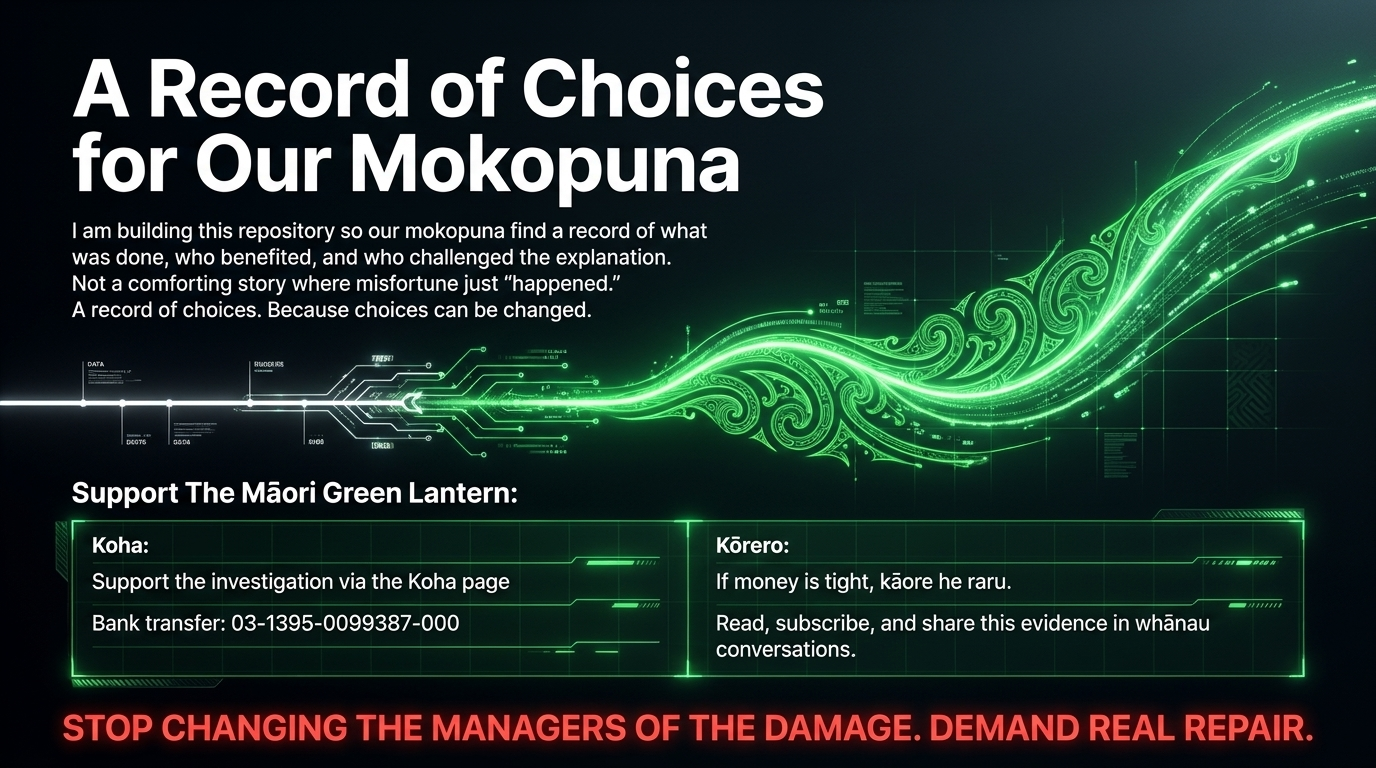
I am building this repository for our mokopuna.
I want them to find a record of what was done, who made the decisions, who benefited and who challenged the explanation.
Not a comforting story in which everything unfortunate simply happened.
A record of choices.
Because choices can be changed.
Koha Consideration

This investigation is about refusing to let wealth become the only voice that carries.
My work relies on people who choose to support and protect an independent voice—the kaupapa set out on my Koha page.
Your koha helps preserve the time and independence needed to follow the record, challenge political amnesia and hold Labour and National to the same standard.
If money is tight, kāore he raru. Read, kōrero, subscribe and share with whānau. That is koha too.
Support And Protect This Mahi Through Koha.
Subscribe To The Māori Green Lantern.
Direct bank transfer: Ivor Jones, 03-1395-0099387-000, as listed on the Koha page.
Facebook Subscription.
Do Not Reunite The Managers And Call It Repair
Labour does not get to forget Rogernomics.
National does not get to pretend it merely inherited the programme.
And private fortunes must not be treated as proof that the people holding them are best qualified to decide how the rest of us should be governed.
If National and Labour want to work together, let them demonstrate that cooperation can do more than preserve the economic assumptions their predecessors helped establish.
Let them strengthen public capacity. Restore bargaining power. Distribute obligations fairly. Respect Māori authority. Put people’s wellbeing and the living world ahead of the demand that every decision reassure capital.
That would be something worth debating.
But do not bring the old managers closer together, reassure the winners and expect the people carrying the costs to call it renewal.
The question is not whether National and Labour can cooperate.
The question is whether they will change what they are cooperating to protect.
Disclaimer
This essay combines sourced reporting with my political analysis and opinion. It challenges policies, systems and the influence of concentrated wealth; it does not allege unlawful conduct, secret coordination or identical motives among billionaires. Historical links do not, by themselves, prove any individual’s intentions.