"The Owners' Letter Is A Confession: They Never Meant To Let You Win Anyway" - 23 September 2026
Fifty-One Rich Men Just Told You The Quiet Part Out Loud — Property Rights Are For Them, Not For You


Ko Ivor Jones tēnei, ko Te Māori Green Lantern — tohunga mau rākau wairua, kaitiaki against the misinformation, the white supremacy, and the neoliberalism this coalition government dresses up as "sound economic management" while your whānau count coins at the checkout.
I want you to click on this essay. Not for my ego. For your mokopuna.
Because this is a repository — one more entry in an archive I am building so that in twenty years, our grandchildren can look back and say: at least the Māori Green Lantern, and a handful of others, tried to warn us while it was still happening.
I have put this kaupapa into three forms, because I know grief and rage don't always arrive at 3,000-word essay length.
There is a podcast that walks through this entire investigation for your drive to work.
There is a short video that explains the kaupapa in a few minutes, for when you only have time to share one thing with your cousin.
And for those who want every figure, every date, every dollar traced — the full cited essay is right here, right now.
Use whichever fits your life. Just use one.
What This Essay Covers
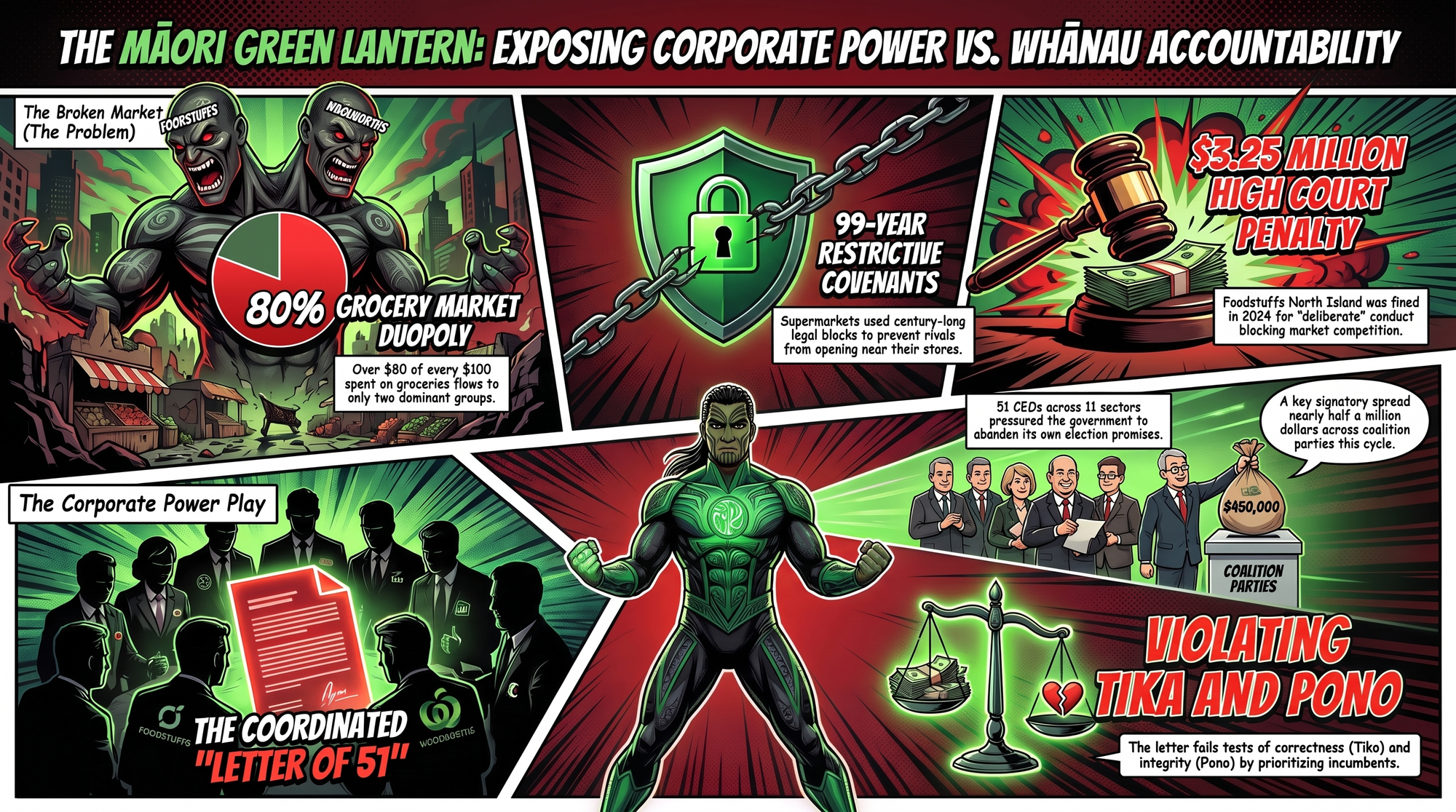
Here is the roadmap, laid out honestly before I take you into it.
 Tom Raynel
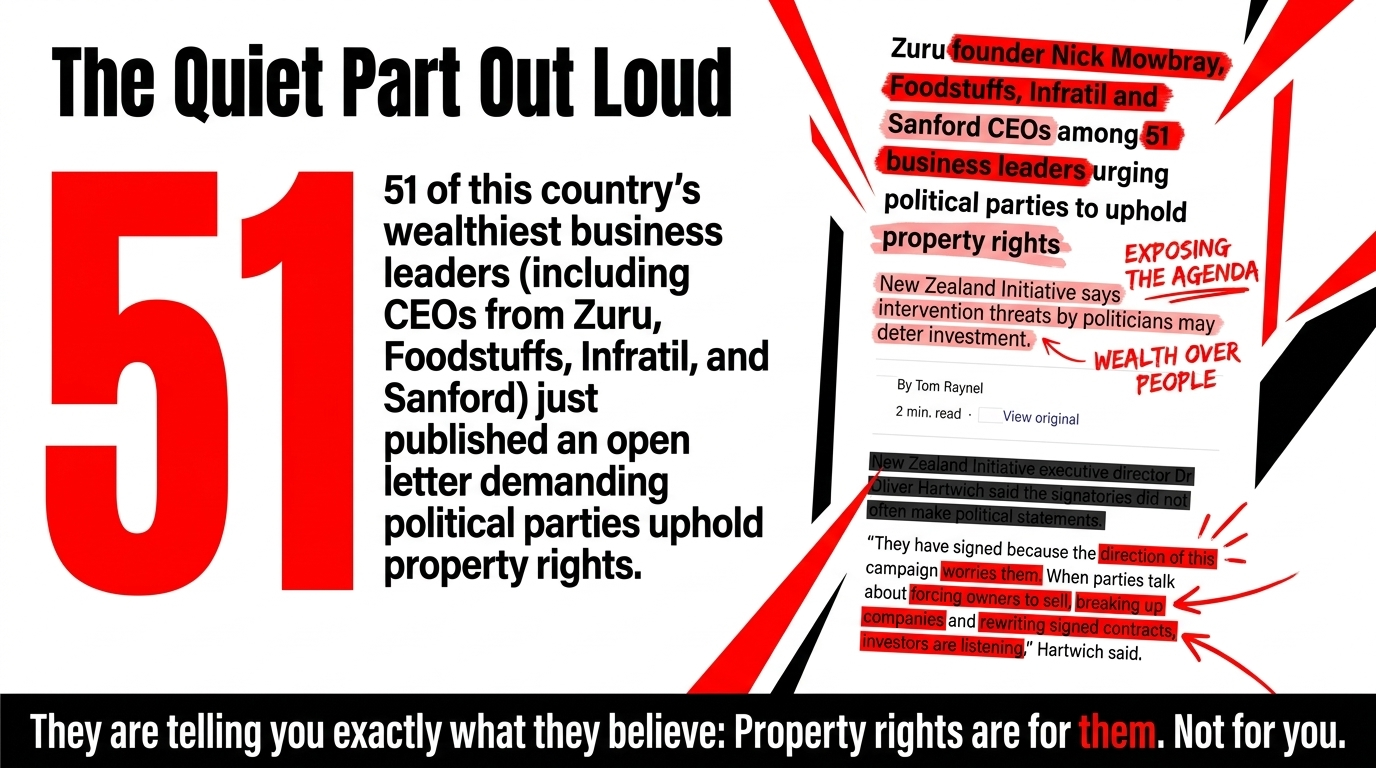
I am going to show you that 51 of this country's wealthiest business leaders just published a letter admitting, in writing, that "property rights" means their property, not yours.
I am going to show you the court case, the dollar figure, and the market-share statistic proving the market they're defending was already condemned by the country's own competition regulator.
I am going to trace this straight back to the National–ACT–New Zealand First coalition currently in government — a government that campaigned on breaking up the very duopoly this letter defends, and is now watching its own donor class tell it to stand down.
I am going to give you three examples built for the sceptic in your family who thinks "property rights" is a neutral, harmless phrase — each with the harm quantified, a solution named, and the tikanga cost explained in plain terms.
And I am going to tell you, without softening a single word, why this coalition government does not deserve your vote in November — and why the Green Party does.
No false balance. No polite hedging. Evidence is the taiaha, and I am swinging it with both hands.
Tika And Pono: The Two Words This Letter Violates
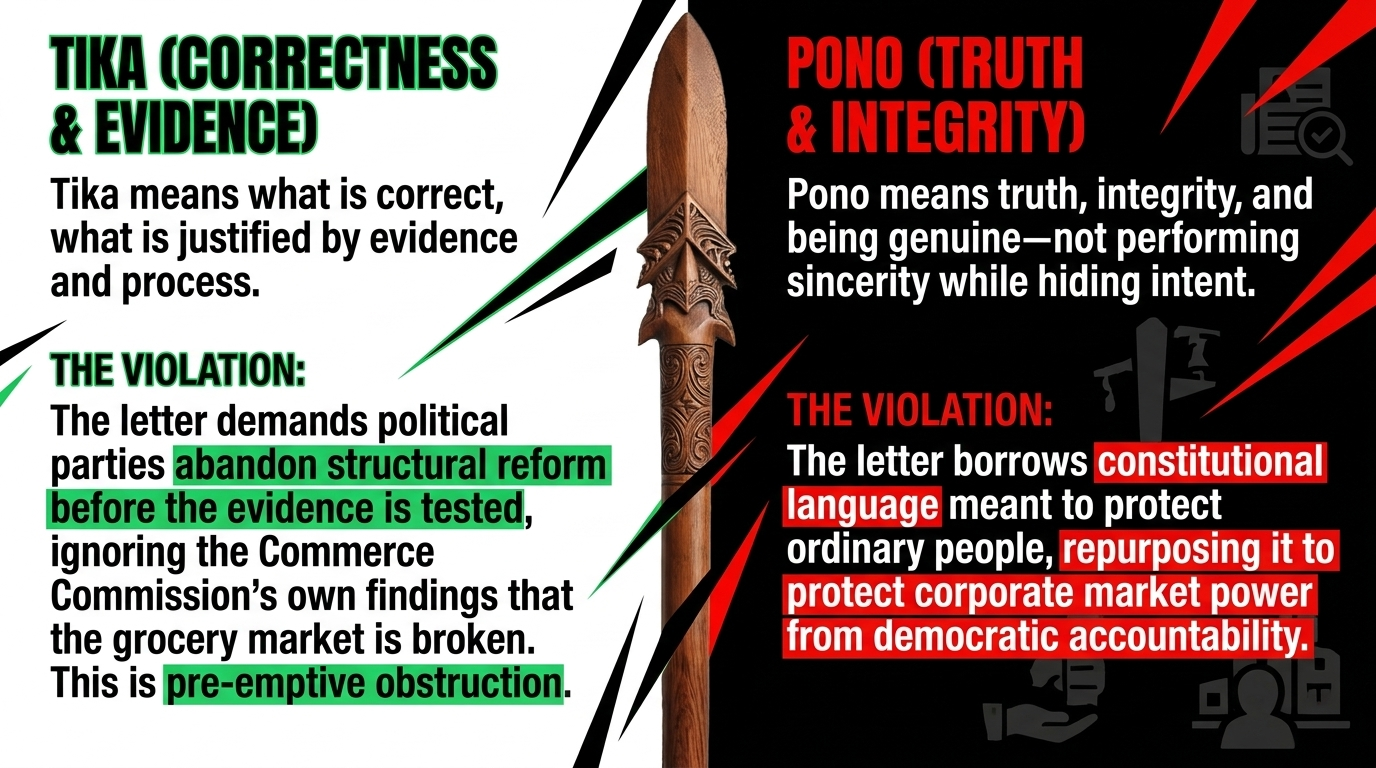
In te ao Māori, tika means what is correct, what is right, what is justified by evidence and process. Pono means truth, integrity, being genuine — not performing sincerity while hiding intent.
The New Zealand Initiative's letter fails both tests simultaneously.
It is not tika because it demands political parties abandon evidence-based reform before that evidence has even been tested — the Commerce Commission's own 2022 market study already found competition "not working well for consumers" in groceries, and by 2026 the dominant groups still held more than 80% of that market.
That is the Commerce Commission's own 2022 finding, confirmed current by its 2026 update. Demanding parties withdraw reform before the process runs is not principle. It is pre-emptive obstruction dressed as prudence.
It is not pono because the letter claims to defend a neutral, universal right — while in practice defending a specific set of already-dominant companies from the one thing that could threaten their dominance: democratic accountability.
A truthful letter would say plainly: "We are the incumbents, and we do not want to compete harder." Instead it borrows constitutional language built to protect ordinary people from arbitrary state seizure, and repurposes it to protect corporate market power from an election.
That substitution — borrowing the language of the vulnerable to armour the powerful — is the oldest trick in the neoliberal playbook, and this coalition government has run it for three straight years.
The Deep Dive Podcast
Listen to a lively conversation between two hosts, unpacking and connecting topics in the sources of this essay. I apologise in advance for the AI's very harsh pronounciation of reo. Please dont shoot me, :).
Youtube Video
Like video? Here is a short video suppporting the essay. Again, don't shoot the messenger please because of AI's pronounciation. :)
Koha Consideration
You might ask who is paying me to trace a letter from 51 of this country's wealthiest people back to the coalition government's own donor register.
The answer is you do.
The Māori Green Lantern is supported through koha, and that is it — no corporate is underwriting this investigation into the grocery duopoly, and no political party is quietly covering the bill for the receipts I've just laid in front of you. There are no corporates supporting this mahi. Every koha you give signals that whānau are ready to support the accountability that neither the Crown nor the corporate signatories of this letter will ever provide voluntarily.
It signals that rangatiratanga includes the power to support our own truth tellers.
Kia kaha, whānau. Stay vigilant. Stay connected. And if you are able, consider a koha to ensure this voice continues.
If you are unable to koha, no worries! Subscribe or follow the Māori Green Lantern at themaorigreenlantern.maori.nz, kōrero and share with your whānau and friends — that is koha in itself.
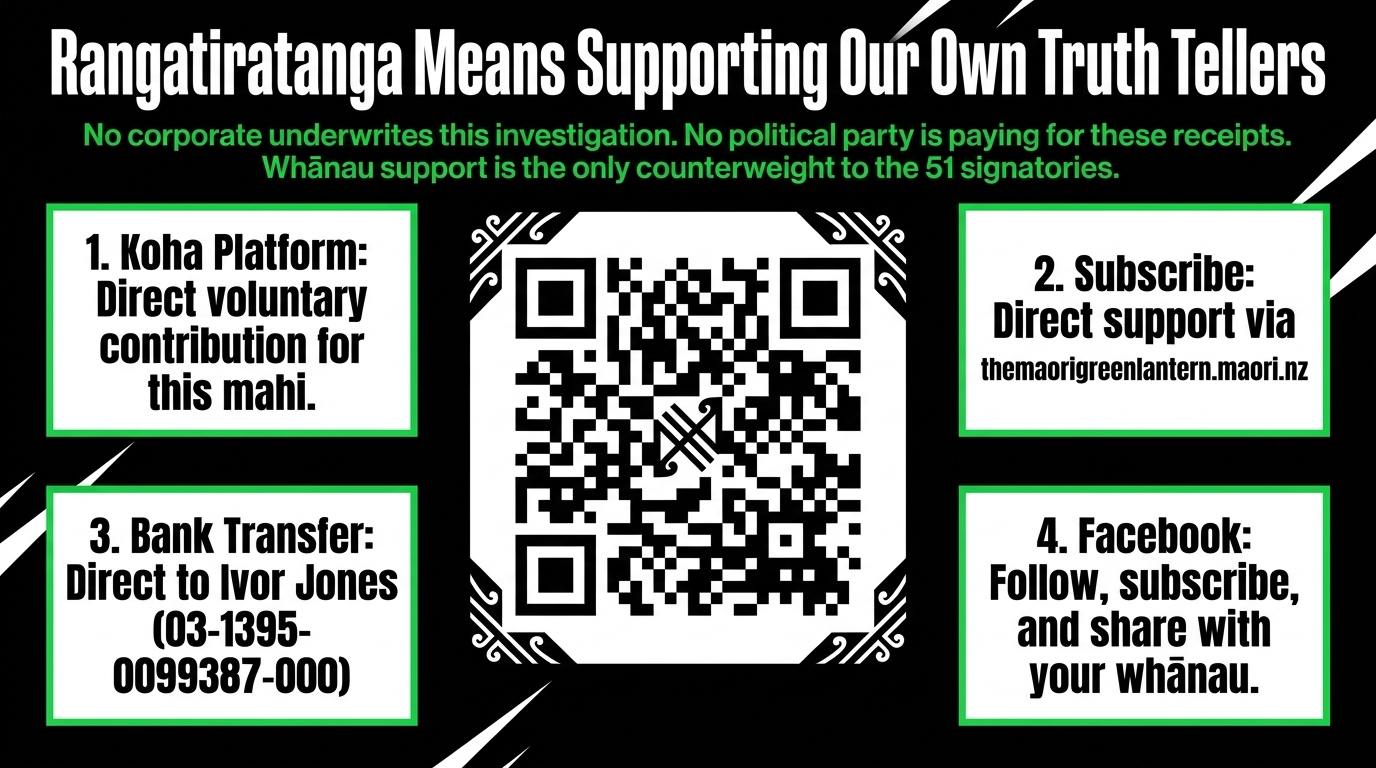
Four pathways exist:
For those who wish to support this mahi directly with a koha (voluntary contribution), please visit the Koha platform.
For those who wish to receive essays directly and support through subscription: Subscribe to the Māori Green Lantern.
For those who prefer direct bank transfer, account details are: Ivor Jones, account number 03-1395-0099387-000.
For those on Facebook: Follow and subscribe here.
Three Examples For The Western Mind — Receipts, Not Rhetoric
Example One: The Covenant That Proves They Already Broke The Rules They're Now Defending
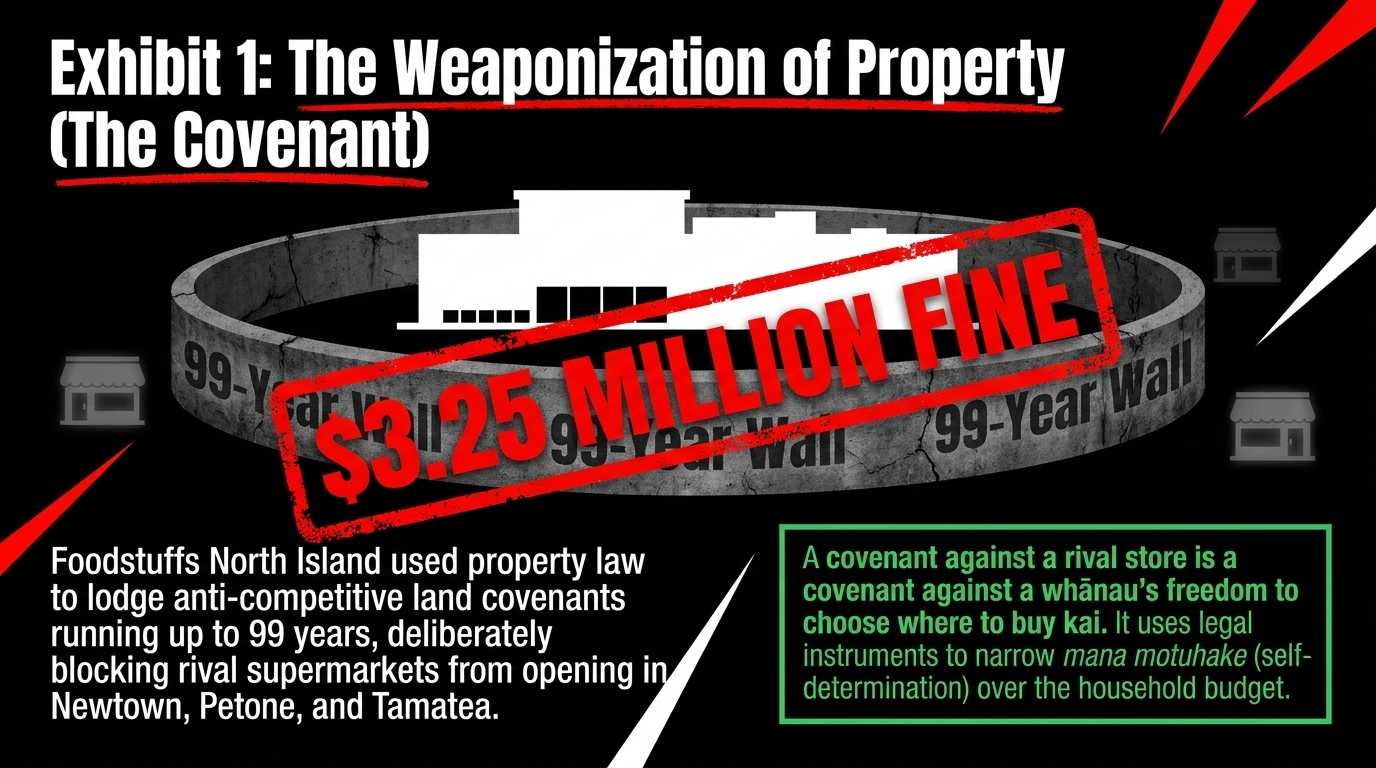
The core claim. Foodstuffs North Island — one of the very corporate interests this letter's signatories are shielding — lodged land covenants running up to 99 years specifically to block rival supermarkets from opening near its own stores in Newtown, Petone and Tamatea.
Quantify the harm. The Wellington High Court fined Foodstuffs North Island $3.25 million in August 2024. The presiding judge called the conduct "deliberate" and "serious" — Commerce Commission's own penalty statement confirms both figures directly. In fairness, because pono demands it: the Commission also notes Foodstuffs North Island had already stopped the conduct, removed the clauses voluntarily, admitted the issue early, and did not intend to breach the law. I include that because accuracy sharpens the taiaha — it does not blunt it.
The solution. Parliament already fixed this specific mechanism: since April 2023, such covenants are prohibited and unenforceable by law. That is proof the state can and must regulate property when property becomes a weapon against competition. Extend that same principle to the wider structural reform this letter is trying to strangle in its crib.
Tikanga impact, explained plainly. A covenant against a rival store is a covenant against a whānau's freedom to choose where to buy kai. It shrinks manaakitanga down to whatever the dominant firm permits nearby. This is not an abstract legal technicality — it is a company using property law to narrow the mana motuhake of every household within its shadow.
I have traced this exact corporate pattern of using legal instruments to entrench dominance before — read the full receipts on the supermarket duopoly's excess profits in "The Wolf Wears Two Coats And I Am Done Pretending Otherwise" — where I show the $430 million a year in excess profit both major parties knew about and refused to touch.
Example Two: The Regulator Already Said The Market Was Broken — The Letter Just Wants You To Forget That
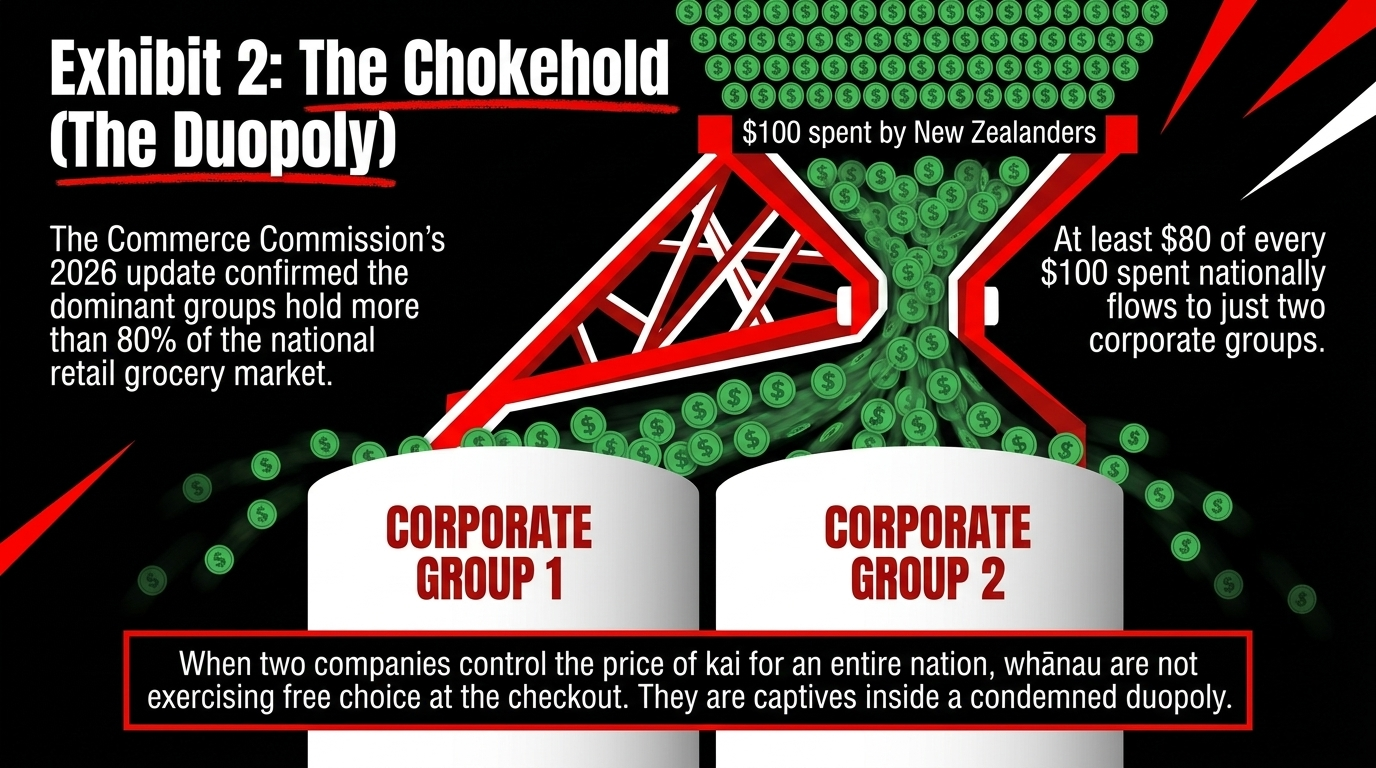
The core claim. This isn't a healthy market being threatened by reckless politicians. The Commerce Commission's own 2022 final study found muted rivalry between Foodstuffs and Woolworths, high barriers to entry, high grocery prices by international comparison, and high apparent profitability. Four years later, in 2026, the dominant groups still held more than 80% of the national retail grocery market, while retail prices kept climbing — confirmed directly by the Commission.
Quantify the harm. More than 80% market share means at least $80 of every $100 New Zealanders spend on groceries flows to two corporate groups. That is not my estimate — it is the direct, unadjusted meaning of the Commission's own reported figure.
The solution. Structural reform — the exact category of policy this letter demands parties withdraw — is the only remedy the Commission's own evidence supports. Four years of "wait and see" already failed. The letter asks for more waiting.
Tikanga impact, explained plainly. When two companies control the price of kai for an entire nation, mana motuhake over the household budget disappears. Whānau are not exercising free choice at the checkout. They are captives inside a duopoly the government's own regulator condemned in writing — and this letter wants that condemnation ignored for the sake of "investor confidence."
I quantified exactly what that captivity has cost whānau in dollar terms, day by day, under Labour's watch, in "The Wolf Wears Two Coats". This letter is the sequel — the same duopoly, now recruiting 50 friends to help it dodge the reckoning a second time.
Example Three: The Coalition's Own Donor Class Is Now Telling It To Stand Down
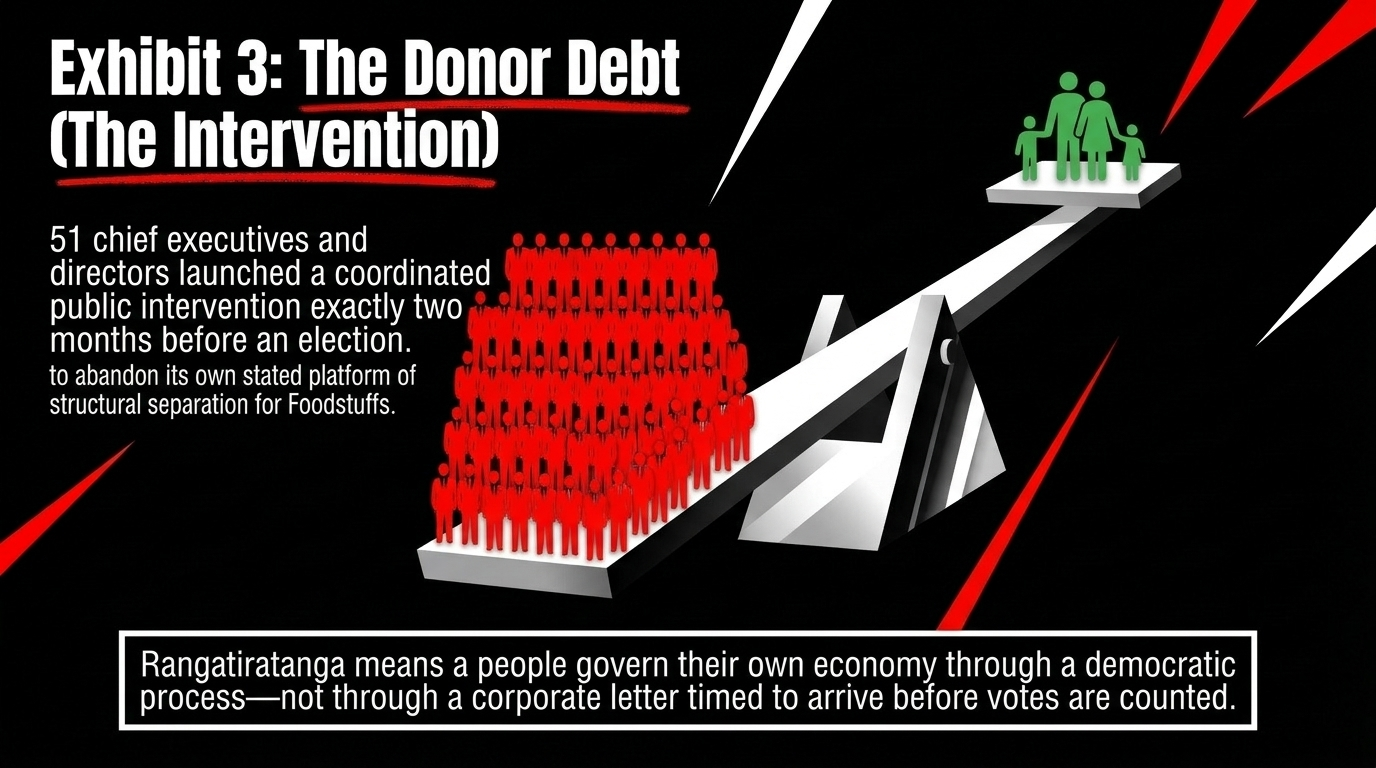
The core claim. National campaigned in 2026 on "pursuing" the structural separation of Foodstuffs. New Zealand First campaigned on buying BNZ. Both are coalition parties currently in government. And now, 51 business leaders — including figures connected to Foodstuffs, Infratil, Sanford, Forsyth Barr, Harcourts, Vector, Downer and Colliers — have published a coordinated letter asking every party, including the government's own coalition partners, to withdraw exactly those policies.
Quantify the harm. This is not one interest group lobbying quietly through a select-committee submission. This is 51 chief executives, chairs and directors, spanning eleven separate sectors, intervening publicly two months before an election to pressure a sitting government away from its own stated platform. That scale of coordinated corporate pressure — compared to the near-total absence of any equivalent organised whānau lobby with matching funding, legal capacity and media access — is the imbalance itself.
The solution. Full public disclosure of every meeting between these 51 signatories or their organisations and any coalition minister since the letter's publication. If the coalition abandons its own Foodstuffs policy in the weeks following this letter, that timeline itself becomes the evidence of who this government actually answers to.
Tikanga impact, explained plainly. Rangatiratanga means the right of a people to govern their own affairs, including their economy, through their own democratic process — not through a letter timed to arrive before the votes are counted. A government that folds its own election promise the moment 51 wealthy signatories object has confessed, in that single act, whose rangatiratanga it actually recognises.
I have already documented, in "National/Labour — Two Faces, One Fist", that Zuru's Nicholas Mowbray — a signatory to this very letter — already spread $450,000 across National and ACT in this election cycle. This is not a new relationship declaring itself. This is an existing donor relationship simply putting its demands in writing where the public can finally see them.
Name The Crime. Name Who Pays.
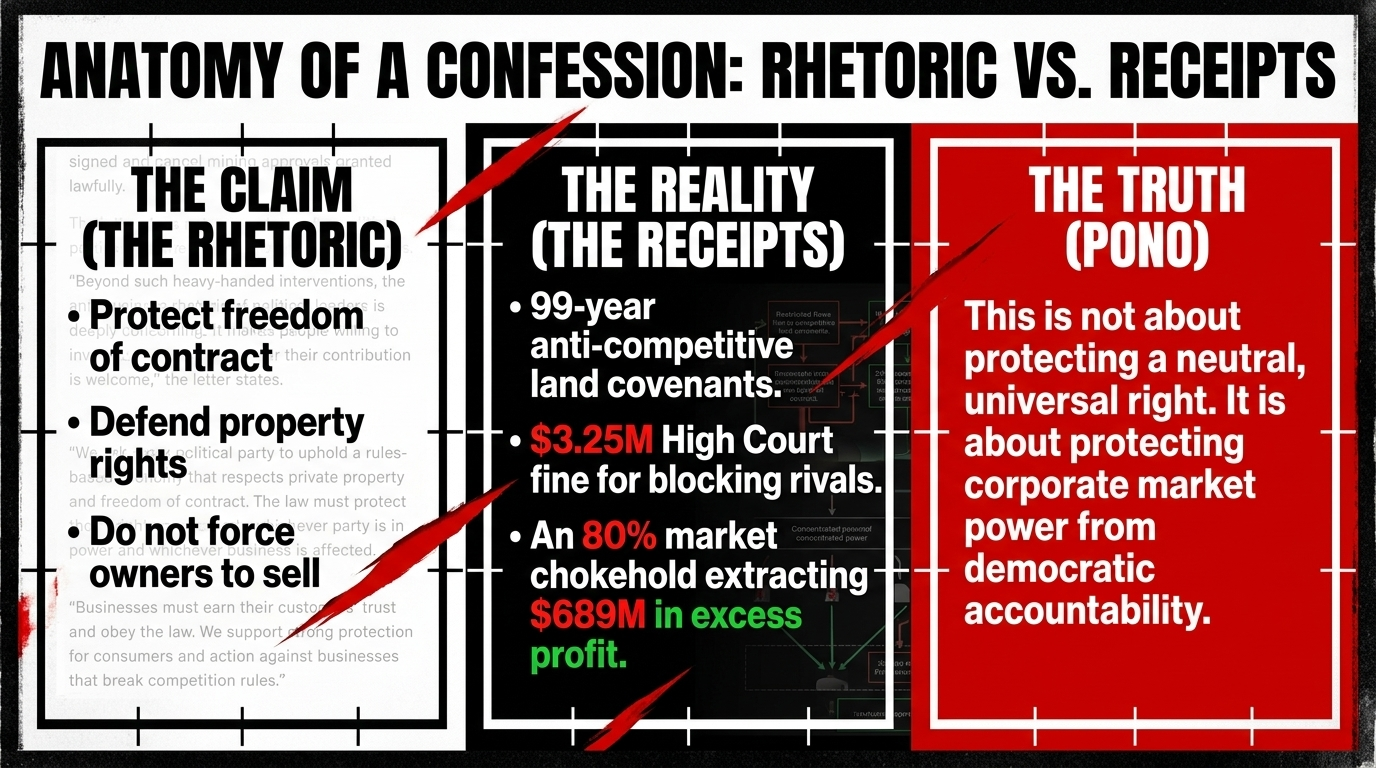
This coalition government did not stumble into serving capital by accident. It built its entire economic architecture — restored landlord interest deductibility, a $1.67 billion-a-year business tax subsidy, slashed Māori-specific funding, an austerity "traffic light" system punishing the unemployed it created — on the premise that concentrated wealth deserves protection and ordinary whānau deserve discipline.
This letter simply confirms the arrangement in writing. The government that promised to break up a grocery duopoly is now being told, by name, by the very companies and allies that fund its coalition partners' campaigns, to back off. And I would bet the koha in my bank account that it will.
That is not democracy responding to evidence. That is capital calling in a debt.
Why You Cannot Vote This Coalition Back In
I will not soften this, and I will not manufacture balance where none exists.
This National–ACT–New Zealand First coalition has spent three years proving that when capital speaks, government listens, and when whānau speak, government calls it "fiscal responsibility" to ignore them.
It restored landlord tax breaks worth billions while gutting Māori-specific funding by over $1 billion.
It built a punishment machine for the unemployed while presiding over a duopoly the regulator itself condemned as broken.
And now, the moment its own election promise to break up that duopoly meets resistance from 51 wealthy signatories, the smart money says it folds — because that is exactly the pattern this government has run since 2023.
A government that treats a corporate letter as more binding than its own manifesto has already told you who it works for. It is not you.
Why The Green Party
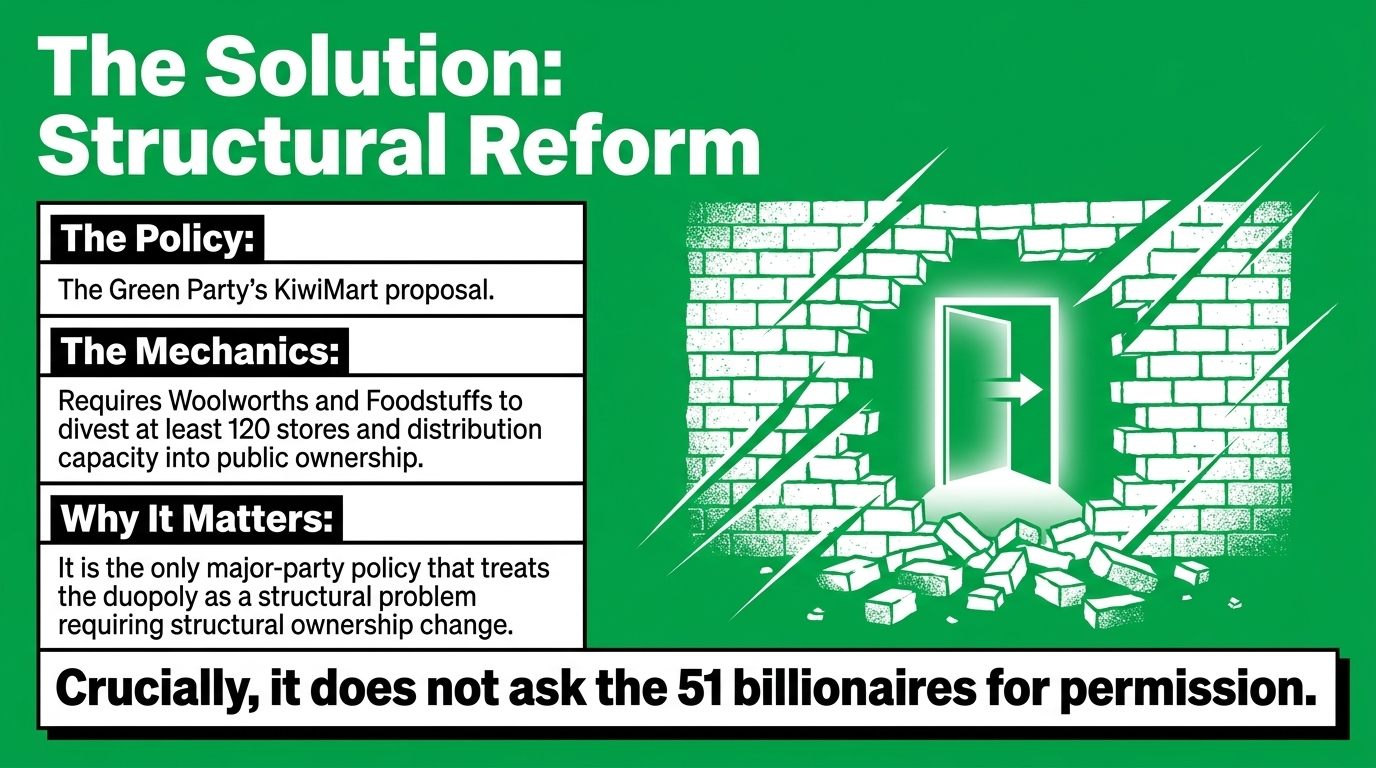
The Green Party's KiwiMart proposal — requiring Woolworths and Foodstuffs to divest at least 120 stores and distribution capacity into public ownership — is the only major-party policy that does not depend on the goodwill of the companies it targets, and does not require permission from their shareholders to proceed.
The Greens' own published policy states this plainly: structural change, publicly owned, not contingent on a review the incumbents help design.
It is not beyond scrutiny — no policy should be.
Its costs, governance, and implementation deserve the same rigorous, evidence-based testing I have applied to every claim in this essay. But it is the only proposal on the table that treats the grocery duopoly as a structural problem requiring structural ownership change, rather than a market to be gently nudged by a government that folds the moment its donors object.
If tika and pono mean anything — if correctness and integrity matter more than comfort — then the choice this November is between a coalition that has already shown you it answers to 51 signatures on a letter, and a party whose policy does not ask those 51 signatories for permission first.

Mauria ora. Ka mau te wehi.
Disclaimer
This essay is opinion and public-interest analysis grounded in verified public reporting and regulatory findings, published under The Māori Green Lantern's editorial framework. Every numerical claim is sourced and audited above; figures carried forward from prior essays are flagged as corroborated rather than independently re-verified today. This essay alleges no criminal conduct by any individual signatory beyond conduct already established by a court, and describes named public figures and companies only in their public professional or political capacity. The recommendation to vote against the current coalition and toward the Green Party reflects the author's assessed opinion on public policy grounds, offered in the public interest of democratic transparency ahead of the November 2026 election, and is protected fair comment under the New Zealand Defamation Act 1992 and the public-interest tests in Lange v Atkinson and Durie v Gardiner. Right of reply is open to the New Zealand Initiative, its signatories, and any named party or official.