"Silver Trays Do Not Settle The Public Account" - 16 November 2026
Luxon’s silver-tray farewell cannot settle the public account. Fiscal forecasts, violence statistics and Treaty findings demand answers beyond praise for departing friends.

"Silver Trays Do Not Settle The Public Account" - 16 November 2026
Mōrena Aotearoa,
 Ethan Manera

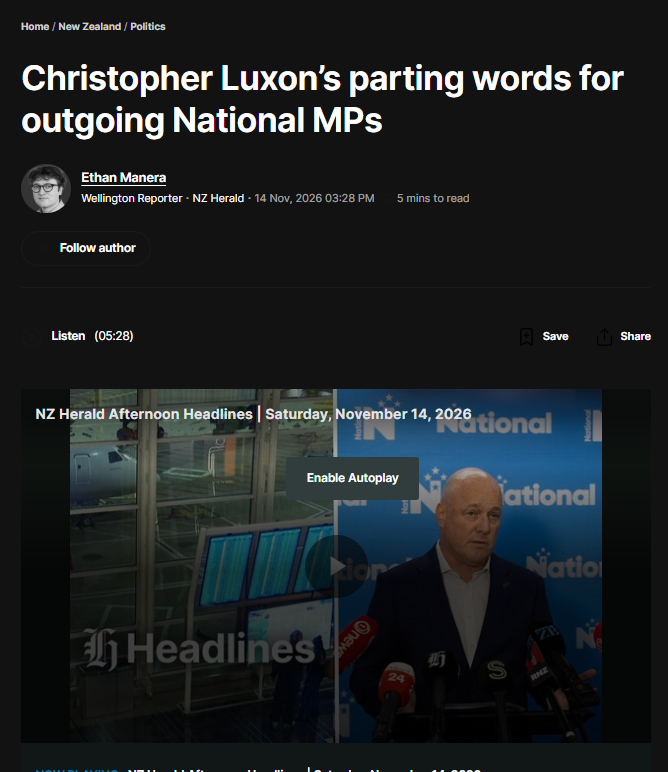
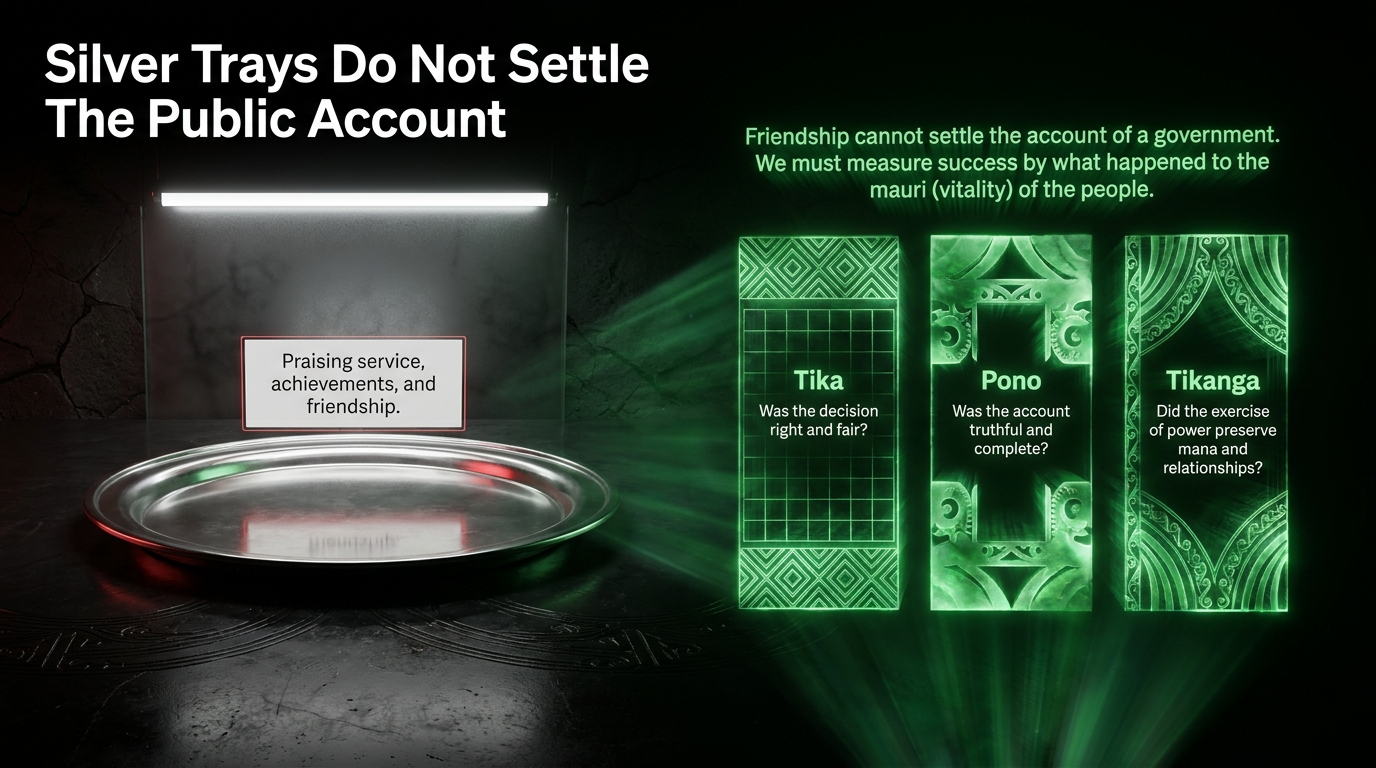
National presented seven departing MPs with engraved silver trays at its farewell caucus meeting. In his tribute, reported by the New Zealand Herald on 14 November, Christopher Luxon praised their service, their achievements and their friendship. It was a generous send-off from a leader to colleagues leaving Parliament. The Herald’s account records the ceremony and his tribute.
Then the personal farewell became something else. Luxon credited Nicola Willis with getting the government books back in order and told New Zealanders that people were safer because of Paul Goldsmith’s work as Justice Minister. Those were claims about the public record, not simply expressions of affection. His reported comments make that distinction unavoidable.
I have no argument with colleagues thanking one another. Losing office does not strip people of their dignity, and public accountability does not require anyone to enjoy their departure.
But friendship cannot settle the account of a government. Once Luxon asks the public to accept his assessment of what these ministers achieved, we are entitled to put the evidence beside it. Especially when the measure of success is not how hard a minister worked, but what happened to the people living with their decisions.
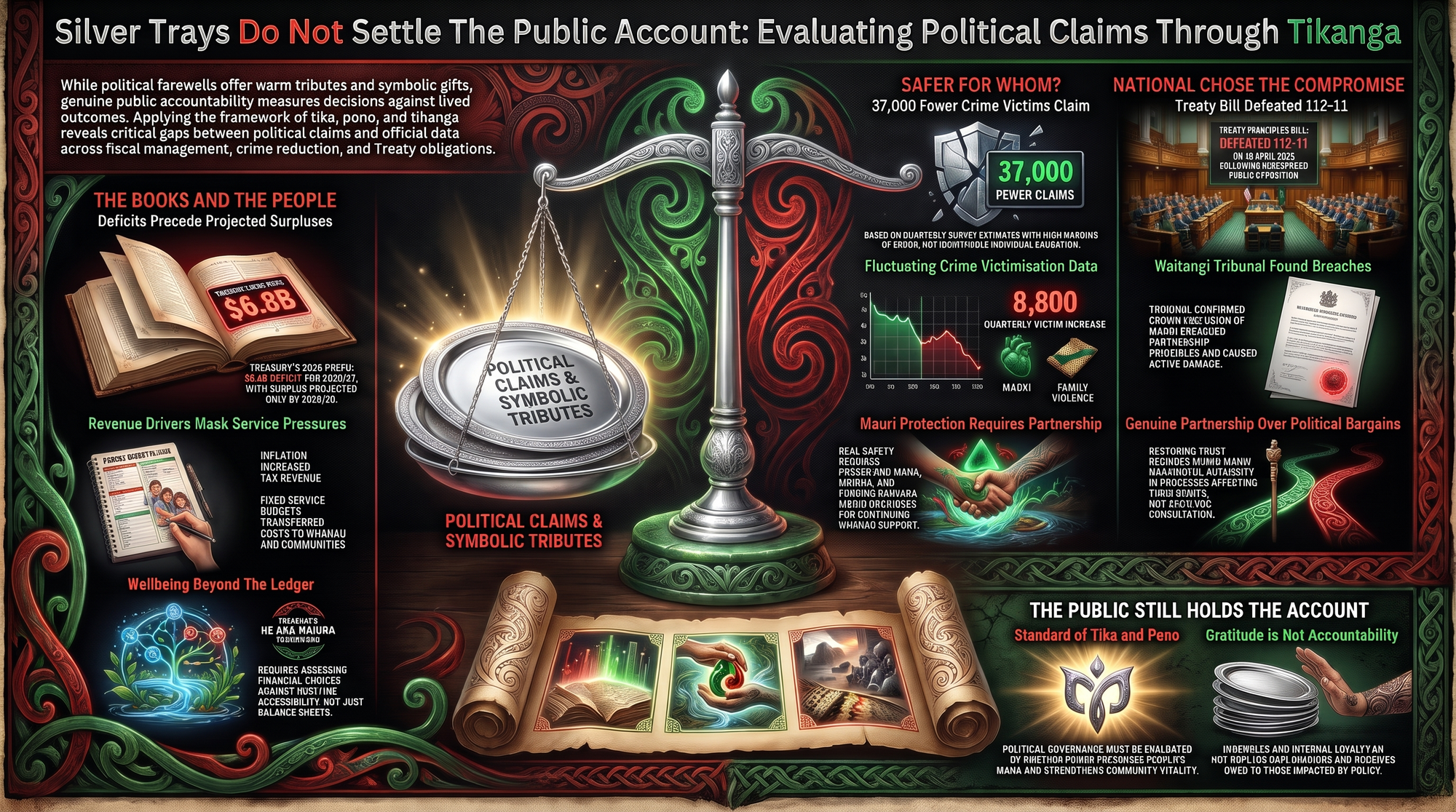
That is where I bring tika, pono and tikanga into this argument.
Not as a universal definition for every iwi or hapū, but as the editorial standard I am applying: was the account truthful, was the decision right and fair, and did the exercise of power preserve people’s mana and honour their relationships? Did it strengthen mauri—the vitality of people and communities—or leave them carrying more harm?
A polished tribute is not an answer to those questions.
The Books And The People
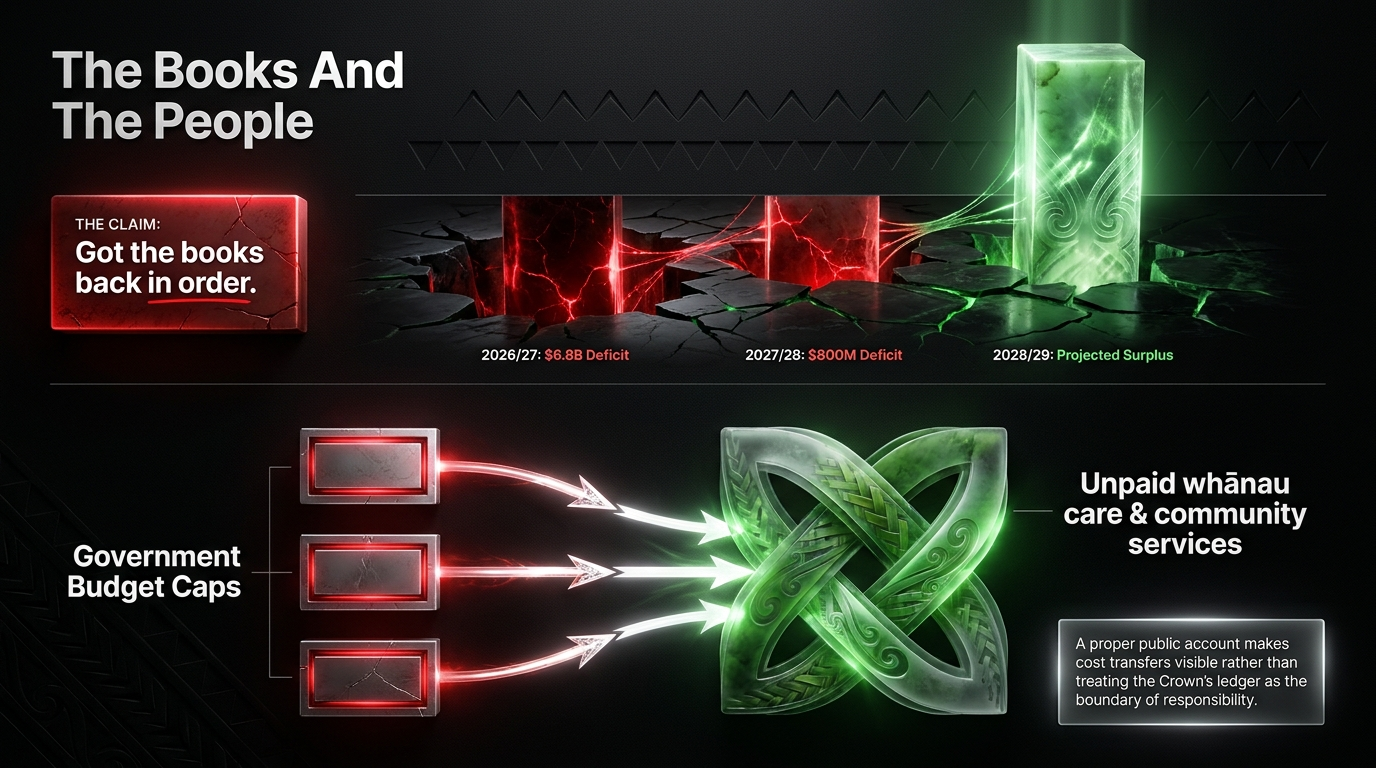
Luxon’s praise of Willis contained an important distinction, whether he intended it or not.
Saying New Zealand was back on a path to surplus acknowledged that the destination had not been reached. Saying she had got the books back in order suggested a job already completed. Both claims appeared in his farewell tribute.
Treasury’s September 2026 pre-election update supports the first proposition much more comfortably than the second. Its operating-balance measure excluding ACC, OBEGALx, showed a forecast deficit of $6.8 billion in 2026/27, followed by an $800 million deficit in 2027/28, before a projected $4 billion surplus in 2028/29. Those were forecasts, not completed results. Treasury sets out that fiscal track in its executive summary.
There was genuine improvement in the account. Treasury estimated that the underlying fiscal position had strengthened between 2023/24 and 2025/26, with weak economic conditions masking much of that improvement. It also warned that these estimates were imprecise. That assessment deserves the same attention as the deficits.
Pono requires us to keep evidence that complicates our criticism. Pretending nothing improved would be no more honest than pretending the recovery was finished.
The more revealing part of Treasury’s explanation concerns how the outlook improved.
Higher tax revenue was the main driver of the stronger forecast since the Budget. Treasury explained that higher inflation could lift nominal incomes, spending and profits, increasing tax revenue while many government spending allowances remained fixed. The same process could make it harder for agencies to operate within their funding. Treasury describes both sides of that mechanism explicitly.
Here is the first concrete test of Luxon’s account.
The Crown’s position can improve partly because prices rise while service budgets do not automatically keep pace.
That does not establish that every agency suffered a particular cut or that every household became worse off. It does establish why an improving fiscal forecast cannot, by itself, prove improving wellbeing. The distinction follows directly from Treasury’s explanation of revenue and expenditure pressures.
For the person needing a public service, the important question is what the available funding actually delivers.
If a saving leaves somebody needing more unpaid help from whānau, the cost has not vanished. It has changed hands. A proper public account should make that transfer visible rather than treating the Crown’s ledger as the boundary of responsibility.
The practical alternative is not to abandon financial discipline. It is to assess financial decisions alongside service access, outcomes and who carries the consequences.
Treasury’s own He Ara Waiora discussion paper recognises wellbeing beyond monetary measures and stresses that incorporating Māori concepts must produce substantive change, not merely different vocabulary. That is a much more demanding approach than celebrating a favourable balance alone.
I want sustainable public finances. I also want an honest answer about what is being sustained.
The Deep Dive Podcast
Listen to a lively conversation between two hosts, unpacking and connecting topics in the sources of this essay. I apologise in advance for the AI's very harsh pronounciation of reo. Please dont shoot me, :).
Youtube Video
Like video? Here is a short video suppporting the essay. Again, don't shoot the messenger please because of AI's pronounciation. :)
Safer For Whom?
Luxon’s tribute to Goldsmith went further.
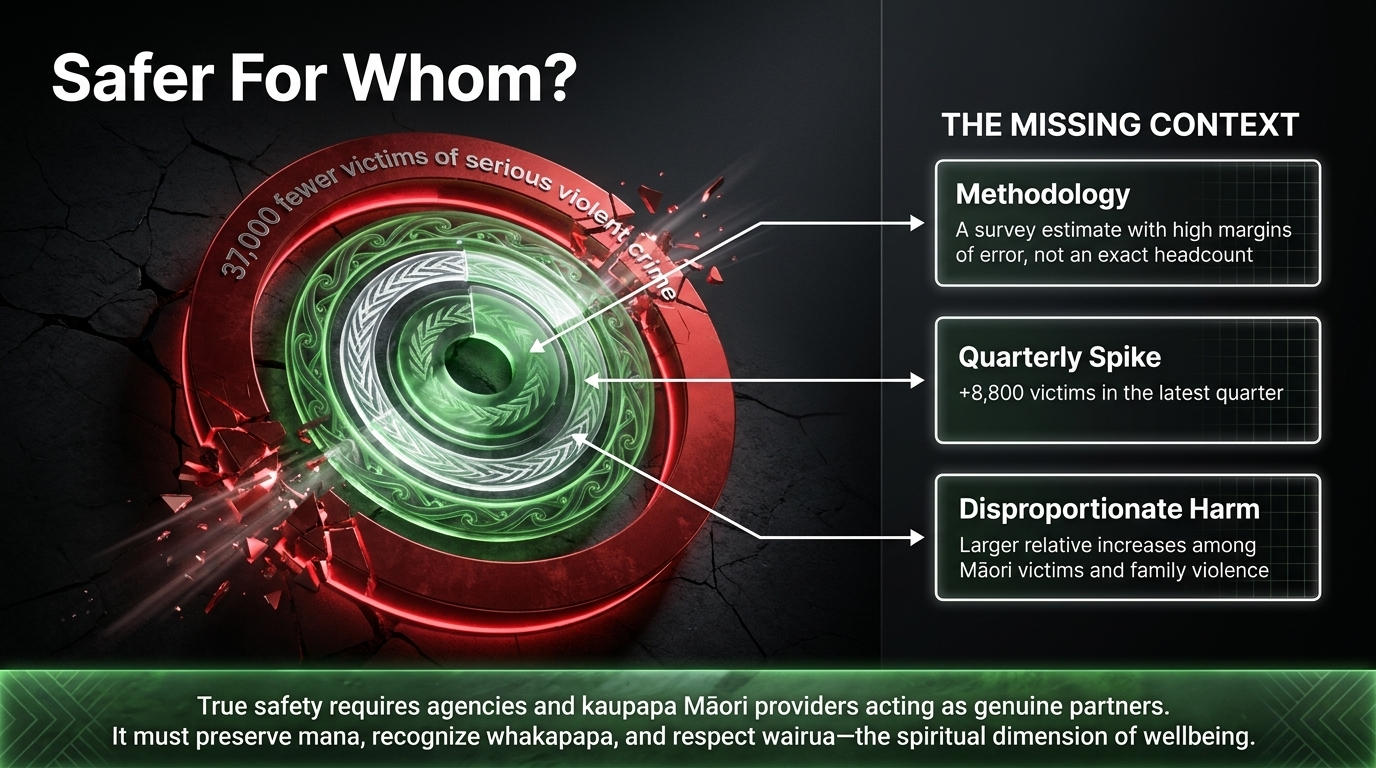
He cited 37,000 fewer victims of serious violent crime and attributed their greater safety to the minister’s work. The Herald records that claim in his farewell message.
There is an official statistical basis for the number.
The Government’s June 2026 target factsheet reported a May estimate of 147,577 adult victims of assault, robbery or sexual assault, against an October 2023 baseline of 185,000. It described the difference as approximately 37,000 fewer adults experiencing violent crime. The target factsheet supplies the figures and defines the offences.
That is welcome evidence. Avoiding violence matters more than which party gets to announce it.
But it was a survey estimate, not a headcount of identifiable people whose safety could be individually credited to Goldsmith.
The Ministry of Justice describes these quarterly monitoring estimates as indicative, and the target factsheet warns that the survey’s margins of error are high. The Ministry explains the estimates’ monitoring purpose, while the factsheet records the uncertainty.
The same factsheet also reported an increase of approximately 8,800 victims compared with the previous quarter, with larger relative increases among Māori victims and victims of violence by family members. It cautioned that quarterly results could fluctuate. Those qualifications sit alongside the favourable comparison with the baseline.
We should not turn that quarterly movement into proof of a sustained deterioration. Neither should Luxon turn the baseline comparison into proof that one minister’s policies caused the reduction. The document reports outcomes and government activity; it does not isolate Goldsmith’s contribution. Nothing in the target factsheet establishes the causal claim made in the tribute.
This is the second concrete test: whether the Government uses evidence to understand safety or uses a favourable number to close the conversation.
For whānau experiencing violence, safety is not simply the absence of another recorded offence. The process must also preserve mana, recognise whakapapa and trusted relationships, and respect wairua—the spiritual dimension of wellbeing.
Meaningful whānau involvement cannot mean forcing a victim into contact with unsafe relatives. It must begin with their safety and their authority to identify who can support them.
There is evidence for working that way. The 2019 evaluation of the Integrated Safety Response pilots found an improved service response, with agencies and specialist community providers working together. Its whānau-centred approach began with people identifying their own whānau, goals and support needs; participating families reported feeling safer and better connected. The evaluation explains both the model and its findings.
That report was not a guarantee of permanent safety. It identified limits in assessing longer-term changes in violence and called for stronger ongoing support beyond the immediate crisis response. Its findings support coordinated, properly resourced assistance—not claims of a finished solution.
That is a practical direction: fund specialist and kaupapa Māori providers as genuine partners, connect crisis intervention with continuing support, and evaluate whether people remain safe. It is a harder undertaking than claiming ownership of a survey result. It is also closer to what protecting mauri requires.
National Chose The Compromise
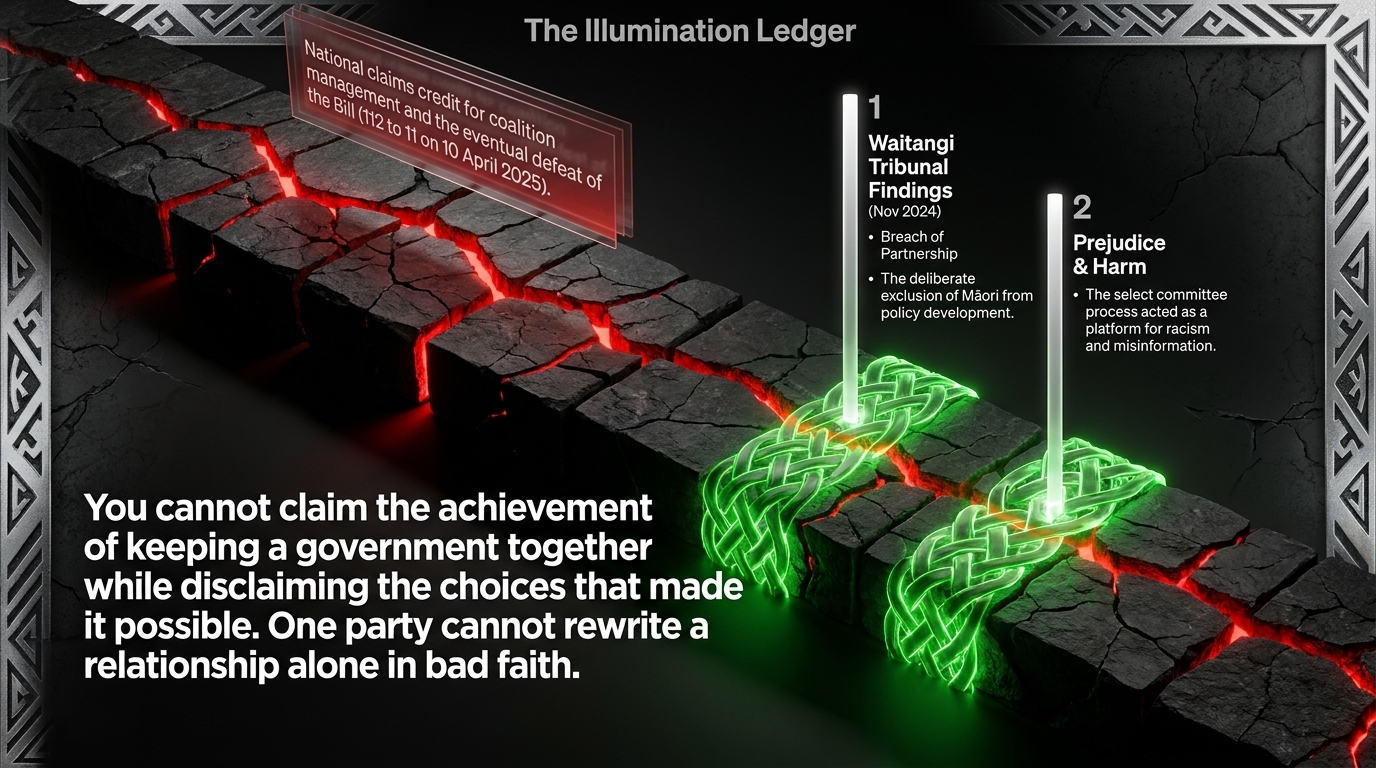
The sharpest contradiction in the farewell story came from one of the people leaving.
Vanessa Weenink told RNZ that Luxon’s Treaty Principles Bill compromise had cost National and hurt the country. She also defended the difficulty of his leadership decisions and credited him with holding the coalition together. Her interview contains both the criticism and the defence.
Her assessment does not explain every voter’s decision. It does, however, expose the weakness in asking the public to praise coalition management while treating its concessions as somebody else’s responsibility.
I made that argument in National, Stop Insulting Our Intelligence: a party cannot claim the achievement of keeping a government together and disclaim the choices that made the arrangement possible.
The strongest defence deserves a straight hearing. Coalition government requires compromise. Letting legislation reach a select committee is not the same as agreeing to enact it. National ultimately voted against the bill, which Parliament defeated by 112 votes to 11 on 10 April 2025. Hansard records National’s position and the final division.
That defeat mattered. It stopped the proposed legal changes. An honest criticism must preserve that fact.
But it does not answer whether advancing the bill was justified in the first place.
In her published account of the Waitangi Tribunal’s November 2024 findings, Tribunal chair Caren Fox explained that the Crown had deliberately excluded Māori consultation from developing the policy. The Tribunal found breaches of partnership, good faith and active protection, and criticised the policy’s evidential and regulatory foundations. Her account sets out the findings against the process.
The Tribunal also found that the Māori–Crown relationship had already been damaged and warned of further prejudice from introducing the bill, even if it never became law. Its concern included the potential for the select committee process to become a platform for racism and misinformation. Those findings directly challenge the argument that eventual defeat made the exercise harmless.
This is the third concrete test, and it reaches beyond ordinary policy disagreement.
Māori were excluded from developing a proposal concerning the meaning and protection of their own rights. The subsequent opportunity to object was not an adequate substitute for participation before the Government committed itself. That exclusion is central to the Tribunal’s findings.
For a reader accustomed to contracts and public administration, the good-faith problem should be recognisable: one party cannot rewrite the basis of a relationship alone and call the other party’s later objections meaningful partnership.
But tikanga demands more than that contractual comparison captures. Whakapapa, mana, wairua and relationships are not administrative complications to be processed after Cabinet has settled its position.
The question is whether those exercising power recognise the standing of the people whose future they are deciding.
There was an alternative.
The Tribunal recommended abandoning the bill. If the Crown would not do that, it recommended referral to the Tribunal under the Treaty of Waitangi Act and identified value in pausing further policy to await the wider constitutional inquiry. Those were practical recommendations, not merely expressions of disapproval.
Repair now requires more than National deciding how to recover electoral support.
My judgement is that it must acknowledge its own decision, give Māori meaningful authority in processes affecting Māori rights, and demonstrate that the same bargain will not simply be offered again.
An apology that preserves the method of harm is not much of a remedy.
The Public Still Holds The Account
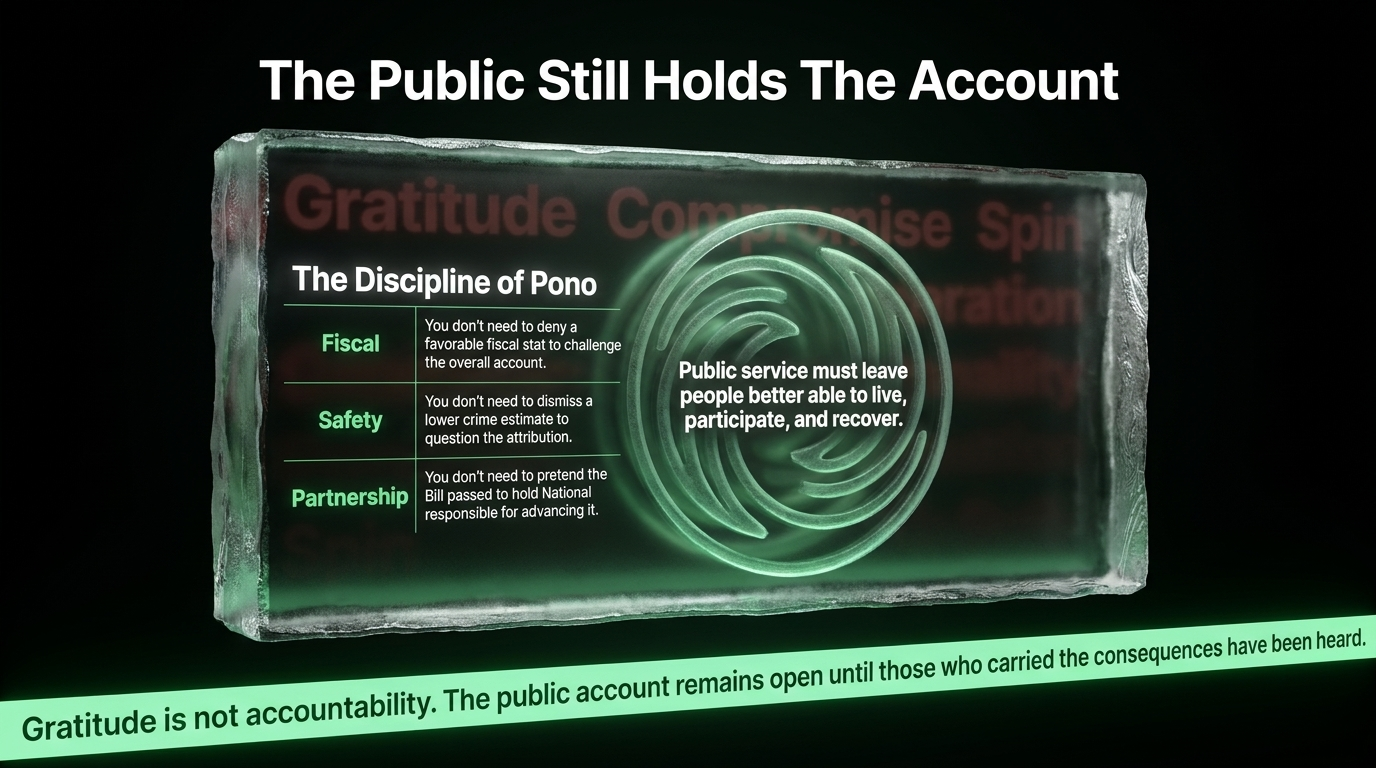
There is a fair place for gratitude in political life. People can work hard, serve their communities and form genuine friendships while also making decisions that deserve sustained criticism.
I do not need to deny the favourable fiscal evidence to challenge Luxon’s account. I do not need to dismiss a lower victimisation estimate to question his attribution. And I do not need to pretend the Treaty Principles Bill became law to hold National responsible for helping advance it.
That is the discipline pono demands of the critic as well as the politician.
The deeper issue is the standard by which government asks to be remembered. Loyalty to a leader is not the same as service to the public. Surviving a coalition is not proof that its compromises were right. A decision does not become tika because the person making it found it difficult.
Public service should leave people better able to live, participate, recover and shape what happens to them. Where it does not, leaders owe the people affected an explanation and a remedy—not just a warm account of how much their colleagues cared.
Luxon can give his friends silver trays. He cannot decide that gratitude is the final form of accountability.
The public account remains open until those who carried the consequences have been heard.
Koha Consideration
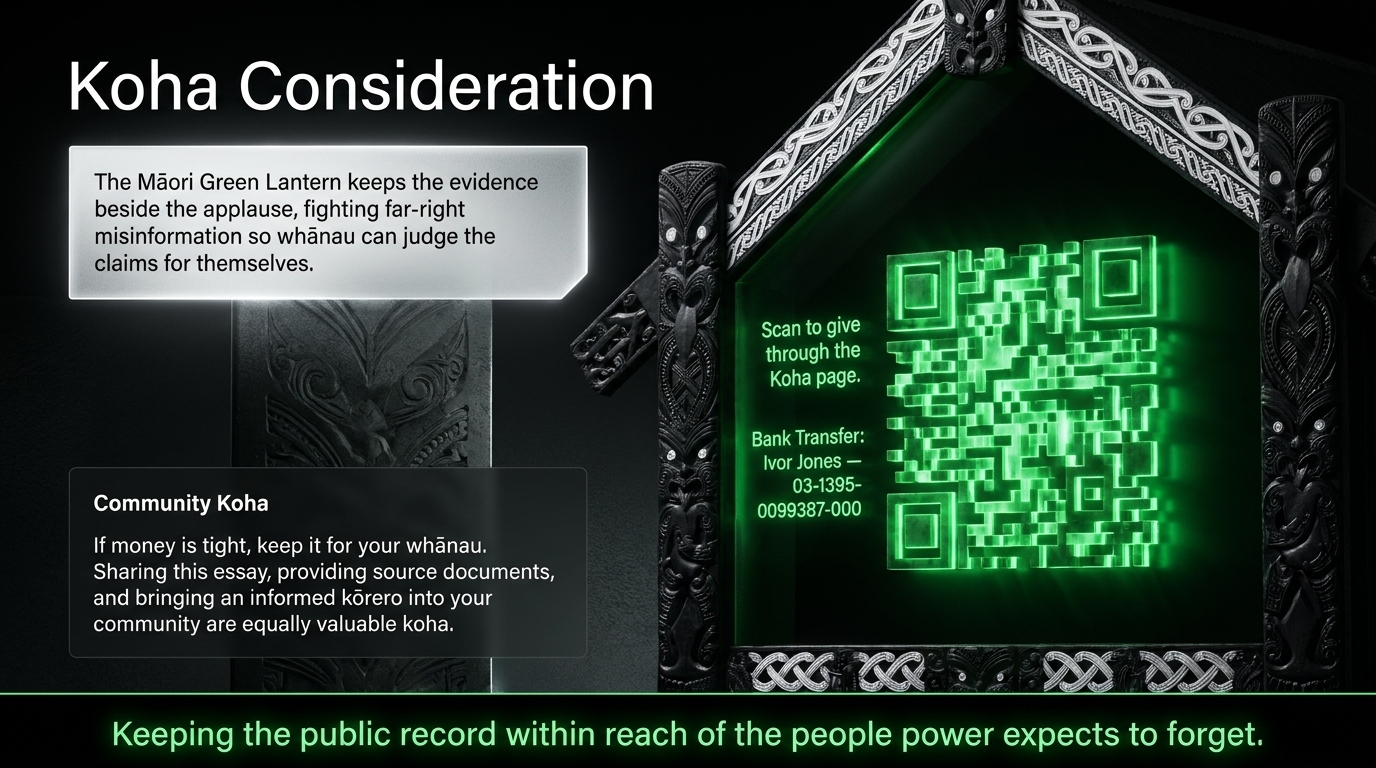
A farewell tribute can make a government’s record sound settled. This mahi keeps the evidence beside the applause, so whānau can judge the claims for themselves.
If you value that work and can afford to support it, you can give through The Māori Green Lantern’s Koha page or subscribe through The Māori Green Lantern website.
For direct bank transfer, the published details are Ivor Jones — 03-1395-0099387-000. You can verify them on the Koha organiser page.
If money is tight, keep it for your whānau. Sharing this essay, passing the source documents to someone who needs them, and carrying an informed kōrero into your community are koha too.
The point is not simply to keep a voice speaking. It is to keep the public record within reach of the people power expects to forget.
Disclaimer: This essay is public-interest political commentary. Its judgements concern public claims, decisions and accountability—not private motives or character. Forecasts are not completed outcomes, and statistical changes do not by themselves establish political causation. The tikanga framework reflects this essay’s approach, not a claim to speak for all Māori. Evidence-based corrections are welcome.