"Paul Henry Is Not Fit For Parliament" - 16 November 2026
Paul Henry’s record deserves scrutiny, not celebrity indulgence. His conduct, explanations and political choices make the case against entrusting him with parliamentary power.

"Paul Henry Is Not Fit For Parliament" - 16 November 2026
Kia ora Aotearoa,
Paul Henry’s colleagues told him how to pronounce Sheila Dikshit’s name.
He kept turning it into a vulgar joke, then linked the insult to her being Indian. The Broadcasting Standards Authority found that the performance was a deliberate personal attack that extended to Indian people generally. You can read the exchange and the findings in the original decision.
That distinction matters. A pronunciation mistake ends when someone corrects it.
Henry was corrected and continued.
This was not ignorance that nobody gave him an opportunity to remedy. His co-hosts repeatedly supplied the correction.
Now the preliminary election result has put him on course to enter Parliament as an ACT list MP, according to the account of incoming MPs published by 1News. The result remains provisional: the Electoral Commission’s timetable schedules official results for 27 November.
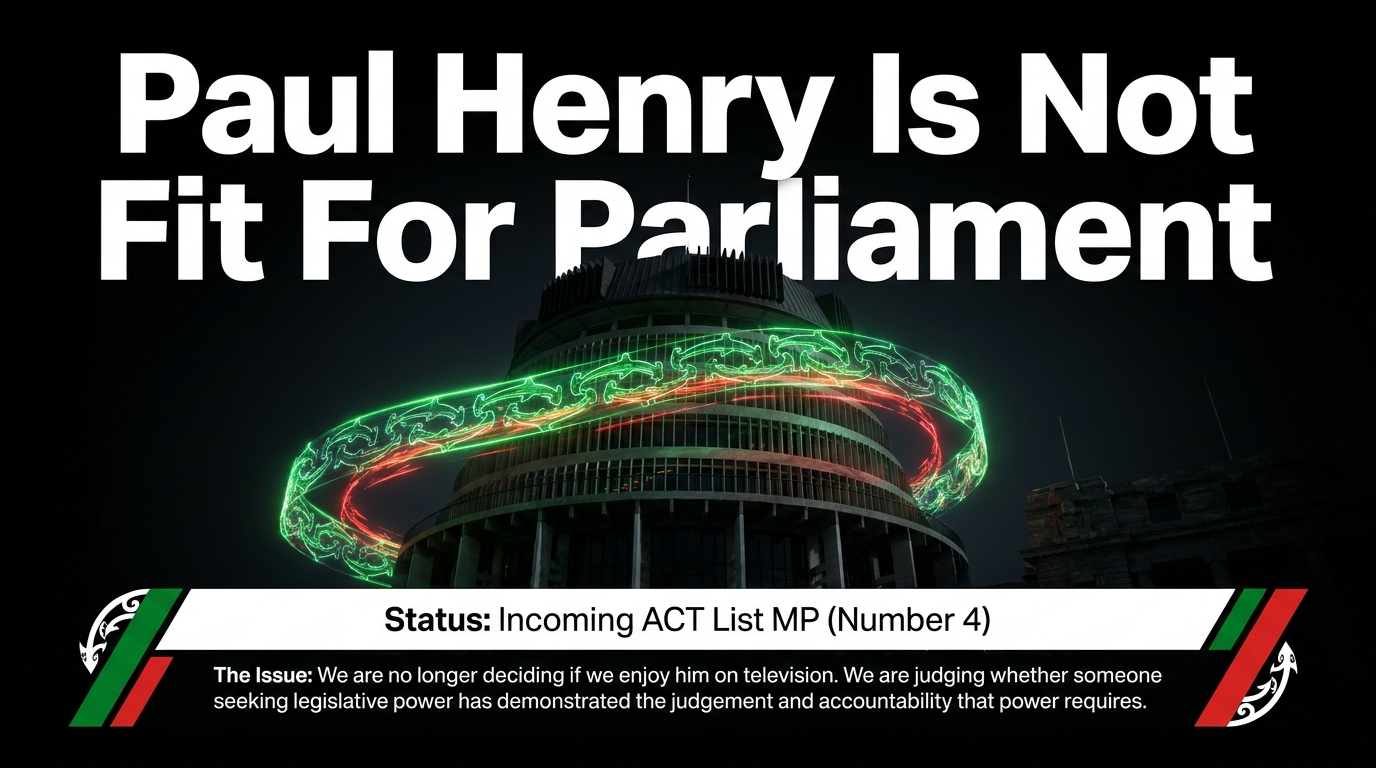
We are no longer deciding whether we enjoy Paul Henry on television.
We are judging whether someone seeking legislative power has demonstrated the judgement and accountability that power requires.
My answer is no.
Parliament does not need saints, and an offensive broadcast should not automatically disqualify someone for life. But neither celebrity nor the passage of time answers a documented record. The person seeking our trust must do that.
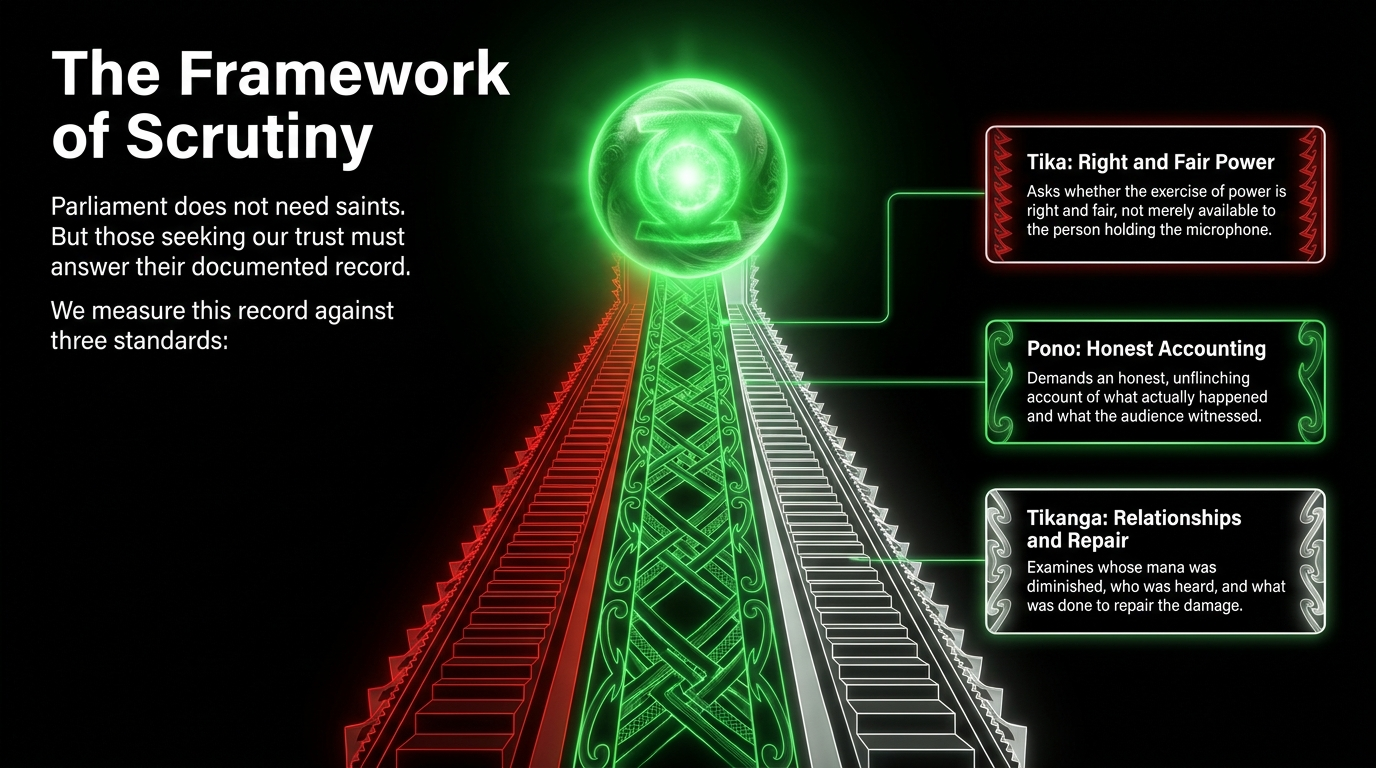
For me, tika asks whether the exercise of power is right and fair, not merely available.
Pono demands an honest account of what happened.
Tikanga brings the relationships and responsibilities into view: whose mana was diminished, who was heard, and what was done to repair the damage. These are the standards I bring to this argument, not a claim to define these concepts for every iwi or hapū.
Henry’s record should be measured against them.
The People Beneath The Punchline
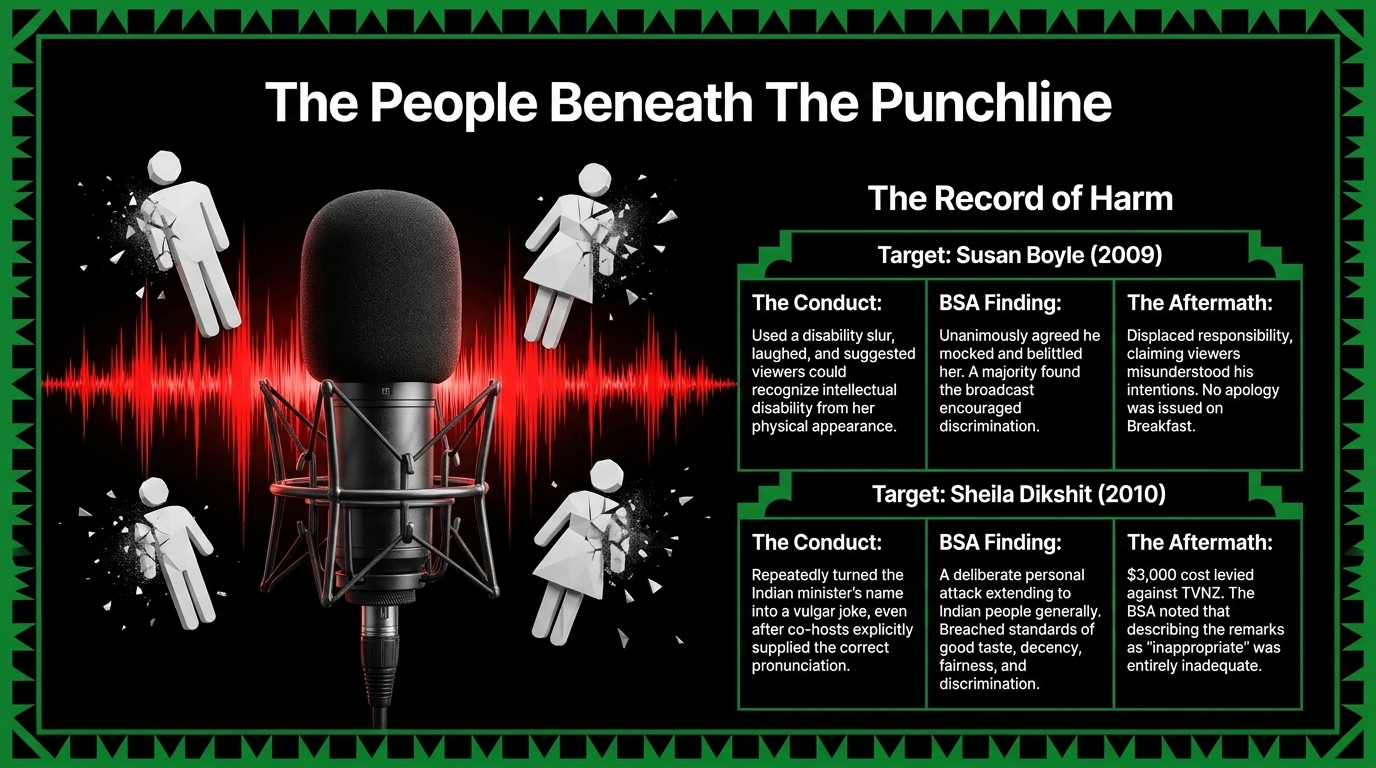
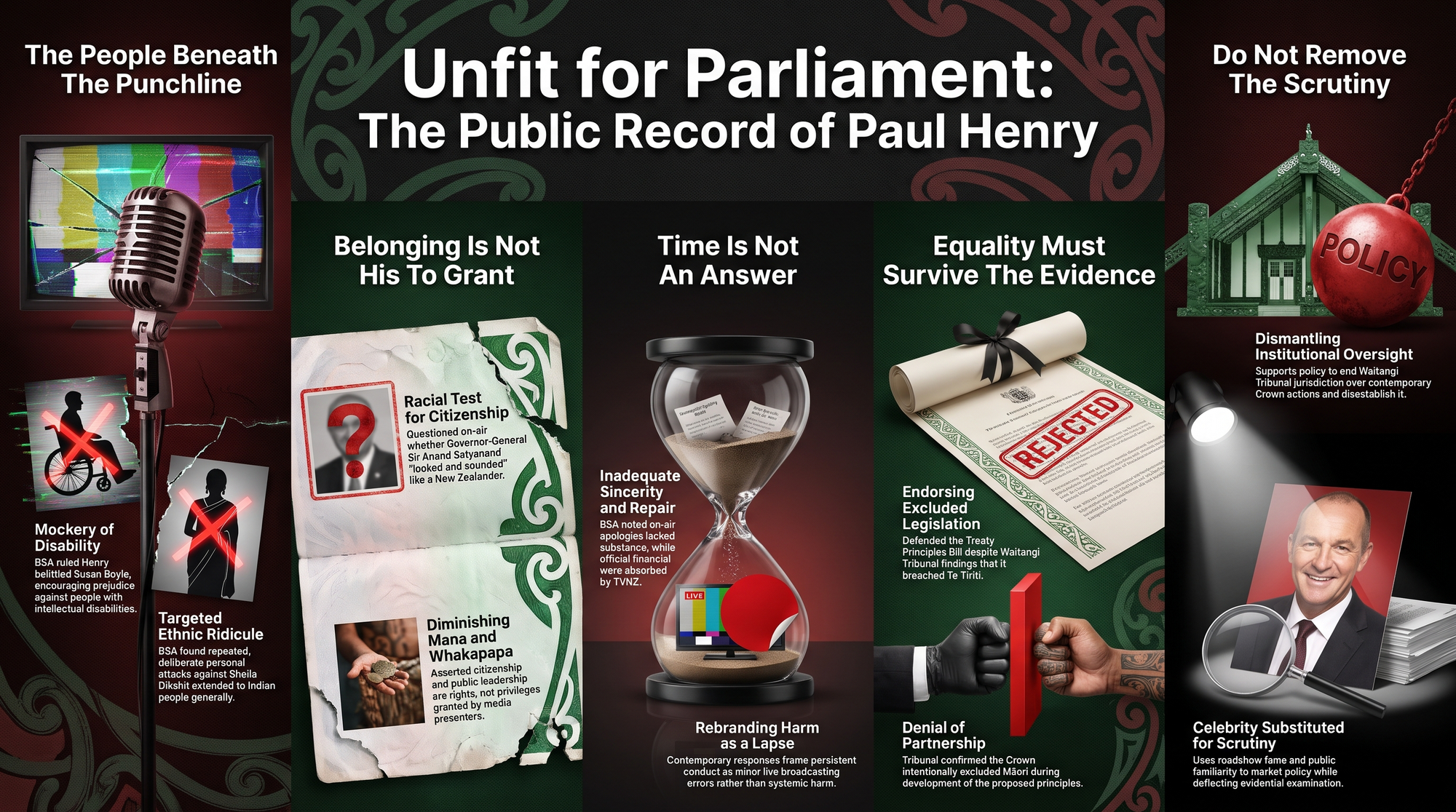
Before the Dikshit broadcast, there was Susan Boyle.
In November 2009, Henry discussed a magazine account of what it described as Boyle’s intellectual disability.
He used a disability slur, laughed, held up her photograph and suggested viewers could recognise the disability from her appearance. The Broadcasting Standards Authority’s decision records the conduct.
The Authority unanimously agreed that he had mocked and belittled Boyle on the basis of intellectual disability. A majority also found that the broadcast encouraged discrimination against people with intellectual disabilities more broadly. The dissent concerned whether that additional threshold had been crossed; it did not excuse the treatment of Boyle. Both the majority reasoning and the dissent are available in the ruling.
This was not simply a disagreement about which words polite people should use. The mechanism was the invitation to look at someone, identify a supposedly inferior kind of person, and join the laughter.
The majority found that Henry’s conduct reinforced prejudice against people with intellectual disabilities. People First New Zealand was among those who challenged the broadcast. The decision records both the finding and the organisation’s complaint.
That is where the consequences reach beyond a distant celebrity. A person does not owe us exceptional talent before deserving dignity. Their whānau should not have to explain why turning disability into entertainment makes the world less welcoming for someone they love.
Henry’s written response emphasised his intentions and expressed regret that people had understood him differently. The Authority rejected his attempt to position himself as the victim of a misunderstanding. It also noted that no apology or statement had appeared on Breakfast, where the original comments were made. Those failures formed part of its finding that TVNZ’s response was insufficient.
Pono requires more than a declaration that you meant well. It requires acknowledging the conduct the audience actually witnessed.
There was a practical remedy. The Authority ordered TVNZ to broadcast a statement immediately before or after the same magazine segment. It confined that statement to the unanimously upheld finding about the inadequate response; it did not order the public apology some complainants wanted. The order specifies the scope and placement.
The principle is sound: accountability should reach the people who received the original message. Listening directly to disabled people and their chosen supporters would also be a better starting point for repair than telling them they misunderstood.
Then, on 1 October 2010, came the Dikshit broadcast. The decision establishes the date and the repeated ridicule after correction.
TVNZ offered the context of complaints about Commonwealth Games accommodation.
The Authority found that Henry had gone well beyond that subject, attacking the Chief Minister personally and Indian people generally. It agreed that the broadcast breached standards covering good taste and decency, fairness, and discrimination and denigration. The ruling addresses the explanation and rejects its limits.
The Authority ordered a broadcast statement and $3,000 in costs to the Crown.
That order was against TVNZ. It was not a personal fine imposed on Henry. The orders identify the responsible party explicitly.
Nor was that sum a valuation of the harm to Indian New Zealanders. The decision supplies no defensible dollar figure for what it means to hear your ancestry made into a public insult. There is no need to manufacture one.
What it does establish is that describing the remarks as merely inappropriate was inadequate. The Authority said the breaches required clear acceptance that the conduct was unacceptable and a prompt response on the programme itself. That is its assessment of what meaningful accountability required.
Names carry family, history and relationships. Treating them with respect is not a concession to oversensitivity. Through tikanga, I ask whether the response restored people’s standing or merely managed the broadcaster’s embarrassment.
A complaints process can close a file without repairing a relationship.
The Deep Dive Podcast
Listen to a lively conversation between two hosts, unpacking and connecting topics in the sources of this essay. I apologise in advance for the AI's very harsh pronounciation of reo. Please dont shoot me, :).
Youtube Video
Like video? Here is a short video suppporting the essay. Again, don't shoot the messenger please because of AI's pronounciation. :)
Belonging Is Not His To Grant
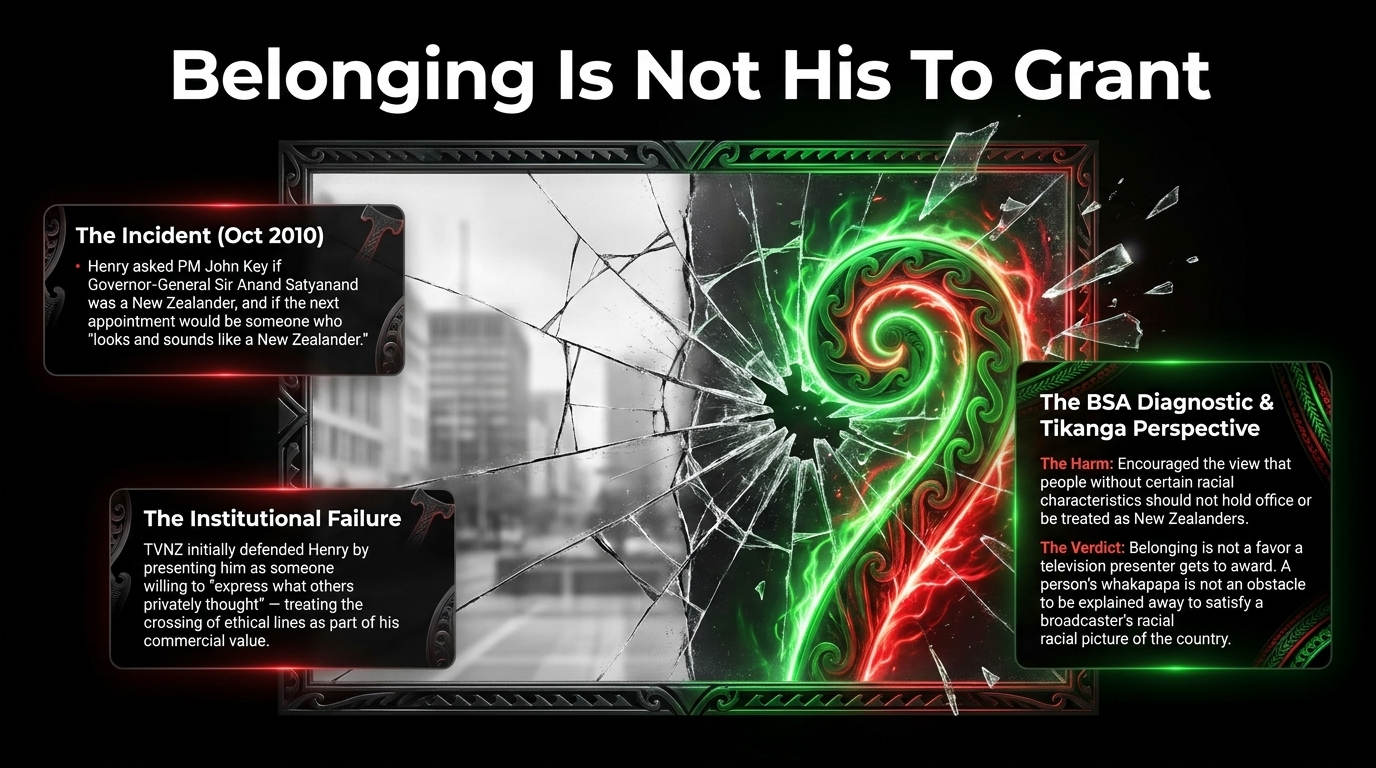
On 4 October 2010, Henry asked John Key whether Governor-General Sir Anand Satyanand was even a New Zealander.
Key said he was. Henry then pursued whether the next appointment would be someone who looked and sounded like a New Zealander. The subsequent Authority decision records the exchange.
Satyanand was born and raised here. RNZ’s contemporary reporting established that straightforward fact.
But the deeper problem was not a missing biographical detail.
The Authority found that Henry’s remarks encouraged the view that people without certain racial characteristics should not be treated as New Zealanders or hold office representing the country. That was the finding about the message conveyed.
Belonging is not a favour a television presenter gets to award.
For whānau, the question is whether your children can grow into public life without first satisfying somebody else’s racial picture of the country. A person’s mana does not depend on looking familiar to the person holding the microphone. Their whakapapa is not an obstacle to be explained away.
The practical answer is to scrutinise public appointments for competence, conduct and the requirements of the role. Reject the racial test rather than making its target prove they deserve an exception.
Henry did apologise. That fact belongs in an honest account. RNZ reported his statement on the day of the broadcast, and the Authority recorded his subsequent on-air apology.
But the Authority found that the on-air apology lacked substance and sincerity. It nevertheless accepted TVNZ’s eventual response—including suspension without pay, public denunciation of the remarks, and review of its editorial policies—as sufficient, and declined to uphold the complaints that further action was required. Both parts of that decision matter.
That is not an exoneration of the conduct. Nor is it permission to pretend the broadcaster did nothing. Precision makes the criticism stronger.
There was an institutional failure here as well. TVNZ initially defended Henry by presenting him as someone willing to express what others privately thought. The Authority found that this compounded the broadcaster’s failure to act promptly. Its decision expressly criticises that response.
The problem was not only a presenter crossing a line. It was an institution briefly treating the crossing as part of his value.
Time Is Not An Answer
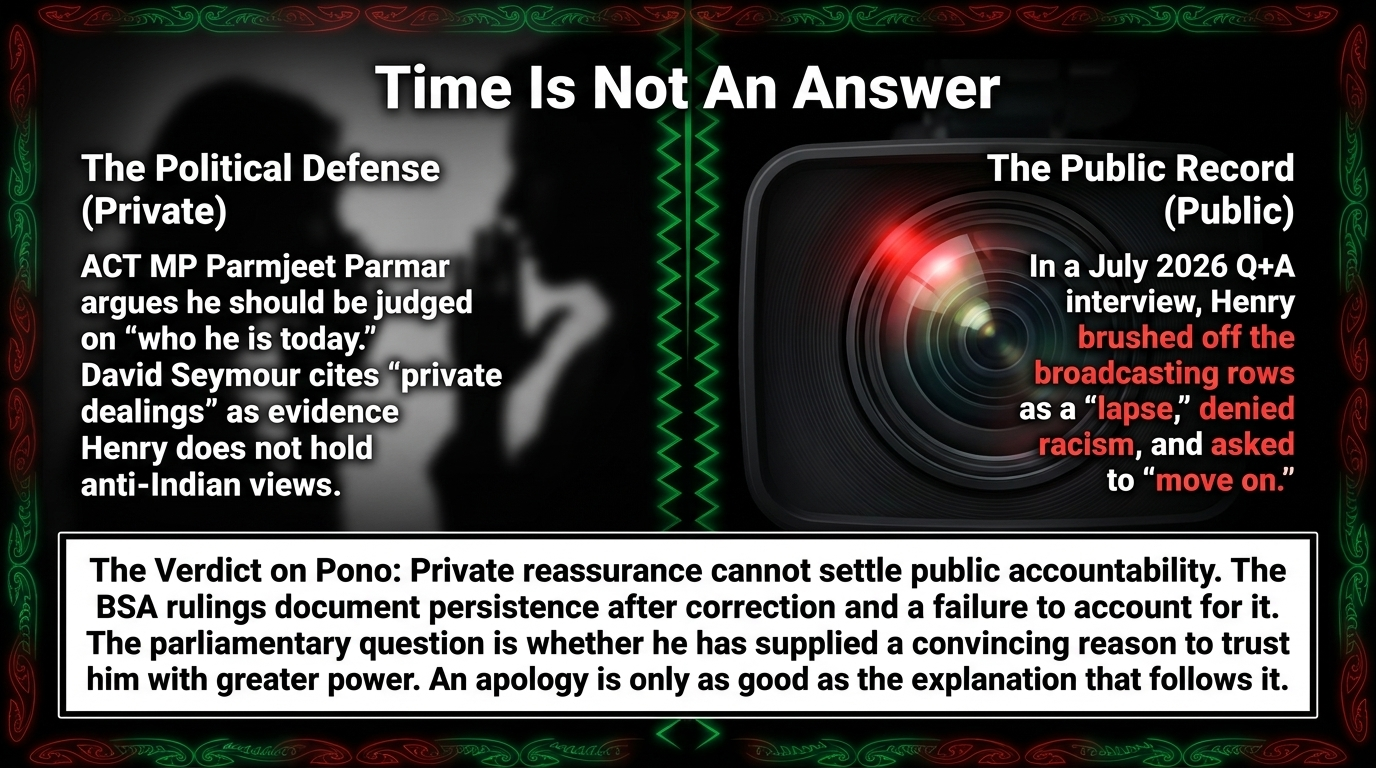
The strongest defence of Henry deserves a fair hearing.
ACT MP Parmjeet Parmar condemned his old comments as unacceptable while arguing that he should be judged on who he is today. She also pointed to his acknowledgement that he had gone too far. Awaaz reported her statement and the follow-up questions her office declined to answer.
David Seymour has offered his own experience of Henry as careful and thoughtful, saying their private dealings had given him no reason to believe Henry held anti-Indian views. He argued that selected moments from a long broadcasting career were an unfair basis for judging the whole person. Awaaz’s account sets out that defence.
People can change. Someone can also behave differently in private from how they behave before an audience. Neither possibility should be dismissed.
But private reassurance cannot settle public accountability. Seymour’s experience is evidence of his experience, not an answer to the findings.
The relevant question is what Henry now understands about the conduct and why it matters for the office he seeks. In its written account of his July 2026 Q+A interview, 1News reported that he pointed to his earlier apology, denied racism and sought to move on. He explained the incident as a lapse during years of live broadcasting. That is the contemporary explanation the article records.
I do not find it adequate.
The Dikshit ruling documents persistence after correction. The Boyle ruling documents both the original ridicule and a response that displaced responsibility onto misunderstanding. One establishes the repeated conduct; the other examines the failure to account for it.
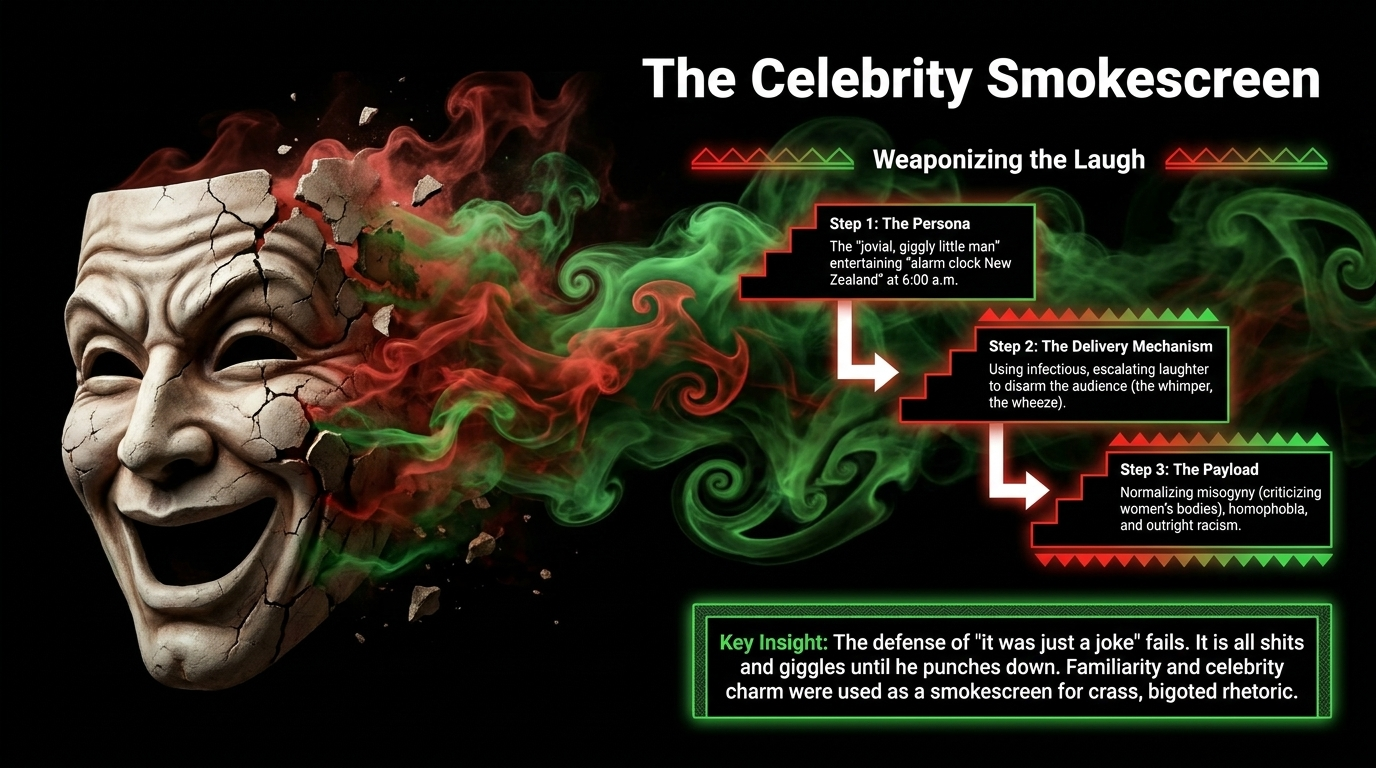
That was fuckhead behaviour: using a powerful platform to make other people’s dignity the entertainment.
The judgement concerns the conduct. The parliamentary question is whether Henry has supplied a convincing reason to trust him with greater power. An apology is relevant. So is the quality of the explanation that follows it.
Equality Must Survive The Evidence
An argument confined to old television would be incomplete.
Henry’s present political choices matter.
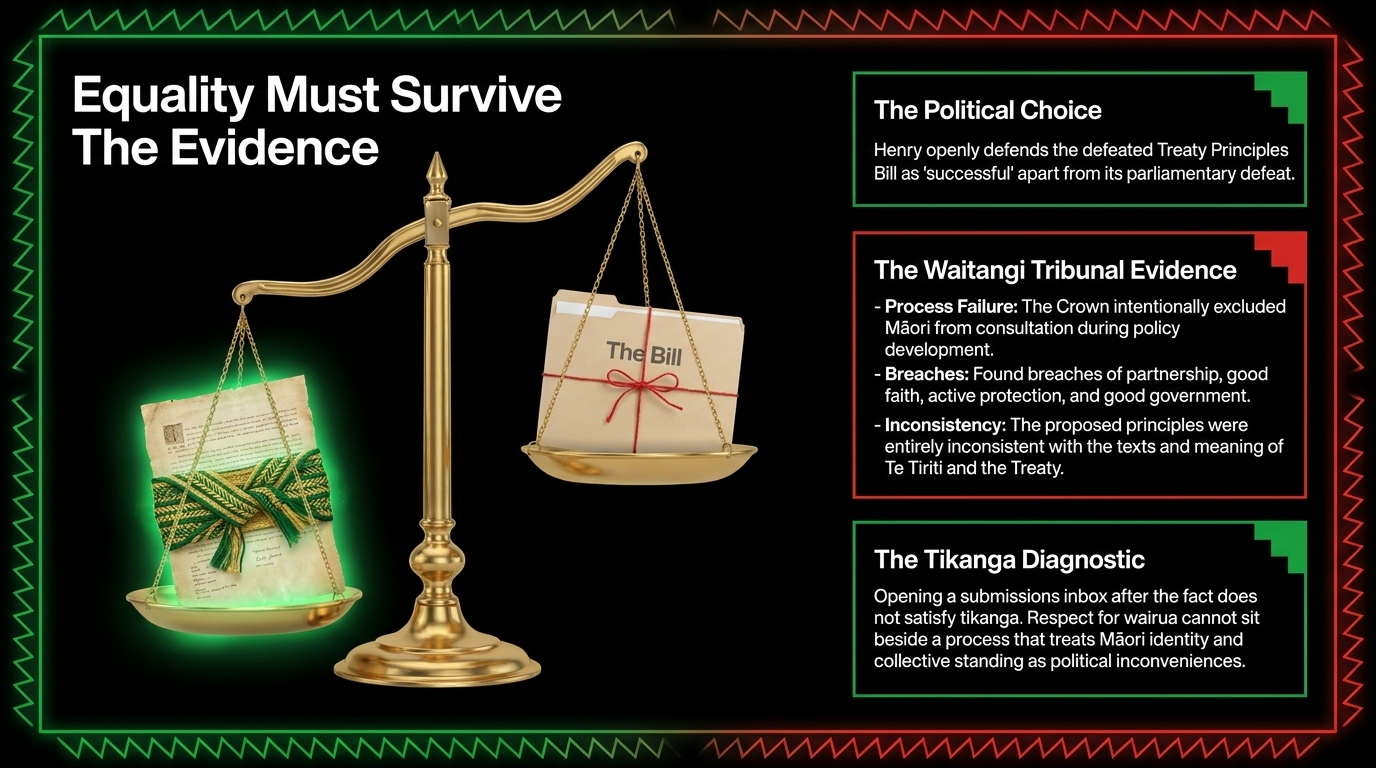
The same 1News account reported that he defended the defeated Treaty Principles Bill as successful apart from its parliamentary defeat. It also reported that he accepted there could be an argument that its proposed principles differed from the Treaty’s actual text. Those positions appear together in the article.
Put that beside the evidence.
The Waitangi Tribunal found that the Crown intentionally excluded Māori from consultation during development of the bill policy. It found breaches of partnership, good faith, active protection and good government. The full report explains those findings and the underlying process.
It also found that the proposed principles were inconsistent with the texts and meaning of Te Tiriti and the Treaty. The report distinguished the consequences of enactment from the damage already being done through exclusion and the introduction of the proposal. It recommended abandoning the bill. Those are the Tribunal’s findings, not an allegation about Henry’s private motives.
Seymour’s case was that Parliament should define Treaty principles, provide clarity and protect equal rights. He also said the bill would not amend the Treaty itself. His ministerial statement sets out that justification.
Equal rights and clear law matter. But those words do not relieve a proposal of the obligation to represent its subject honestly. Leaving the physical text untouched does not answer criticism of how legislation would interpret the rights it guarantees.
Nor does inviting submissions on a developed bill replace involving the Treaty partner in its development. The Tribunal explicitly rejected that substitution. Its report explains why the select committee opportunity was not adequate consultation or collaboration.
Here the relationship between institutional process and whānau becomes unavoidable. Who gets authority to shape the decision, and who is left responding after the fundamental choices have been made?
Tikanga is not satisfied because an institution opens a submissions inbox. The question is whether it recognises the people, their authority and their relationships. Respect for wairua—the spiritual dimension of people’s lives—cannot sit comfortably beside a process that treats their identity and collective standing as political inconveniences.
The alternative was available: abandon the proposal, as the Tribunal recommended, and engage Māori meaningfully rather than substituting a completed policy for a relationship. The report identifies both the exclusion and the remedy.
Henry is entitled to disagree with those findings. Praising the political exercise does not answer them.
Do Not Remove The Scrutiny
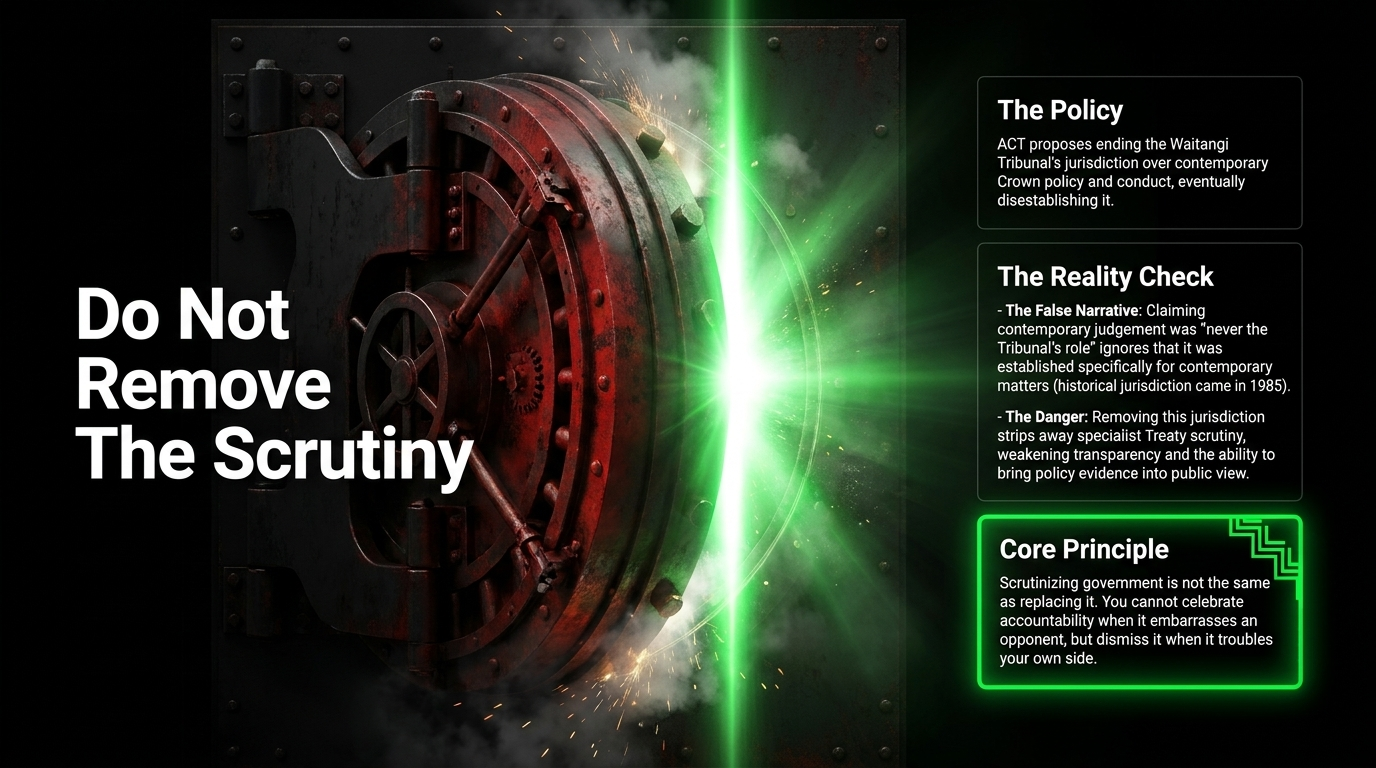
ACT subsequently announced a policy to end the Tribunal’s jurisdiction over contemporary Crown policy and conduct, then disestablish it after eligible historical work was completed. That is the party’s published proposal, not something to describe as enacted law.
Its strongest argument is that elected governments should determine policy, historical settlements should be completed, and everyone should have rights protected through ordinary courts. ACT also says it would not impose an arbitrary deadline that rushed the remaining eligible historical claims. Those qualifications belong in the account.
But scrutinising government is not the same as replacing it.
ACT’s statement says that passing judgement on contemporary policy was never the Tribunal’s role. Yet the Tribunal was established to examine contemporary matters; jurisdiction reaching back to 1840 came later, in 1985. Carwyn Jones explains that history and its significance.
You cannot honestly present the removal of an original function as merely correcting a departure from the institution’s purpose.
Jones has also explained that removing contemporary inquiries would weaken transparency and accountability, including the Tribunal’s ability to bring policy evidence into public view. RNZ reported that response alongside Seymour’s justification.
The consequence is not speculative: contemporary Crown conduct would lose this form of specialist Treaty scrutiny. That is what ACT proposes.
A government can dispute findings, answer criticism and improve decisions without abolishing the forum asking the questions. Retaining contemporary scrutiny while completing historical work is an alternative to pretending that finishing one task ends the need for the other.
Henry’s role in selling the party’s programme is public.
At his New Plymouth roadshow, he presented ACT policies to supporters who later queued for photographs. One attendee told RNZ she intended to share her photograph to encourage voting. The reporting documents the connection between celebrity and campaigning.
There is nothing inherently wrong with a popular person campaigning.
There is plenty wrong with allowing familiarity to substitute for scrutiny.
The distinction is one I have made elsewhere: a person’s right to participate does not exempt their power from examination. That principle runs through “Your Fortune Is Not A Second Vote”. It applies to celebrity as surely as wealth.
For me, attention to mauri means looking beyond the performance to whether people and relationships can flourish.
Does public power strengthen whānau wellbeing and their ability to stand securely in their identity, or leave them diminished and less able to challenge decisions affecting them?
An official finding, a complaint and a Treaty inquiry are different things. But each can force an uncomfortable record into view. The answer cannot be to celebrate accountability when it embarrasses an opponent and dismiss it when it troubles your own side.
My judgement is that Henry has not demonstrated the standard Parliament requires. His documented conduct matters. The inadequacy of his contemporary explanation matters. His defence of a Treaty project condemned for excluding Māori and misrepresenting their rights matters too.
He should not be a fucking MP.
That is a judgement about fitness, not a claim that his supporters have no democratic rights. If the final count confirms his election, he will have the same responsibilities as every other MP—and no celebrity exemption from them.
The people an MP governs are not an audience assembled for his amusement. They are people with mana, whānau and rights. They do not have to laugh, resemble his preferred image of the country, or agree with his party before he owes them respect.
Koha Consideration
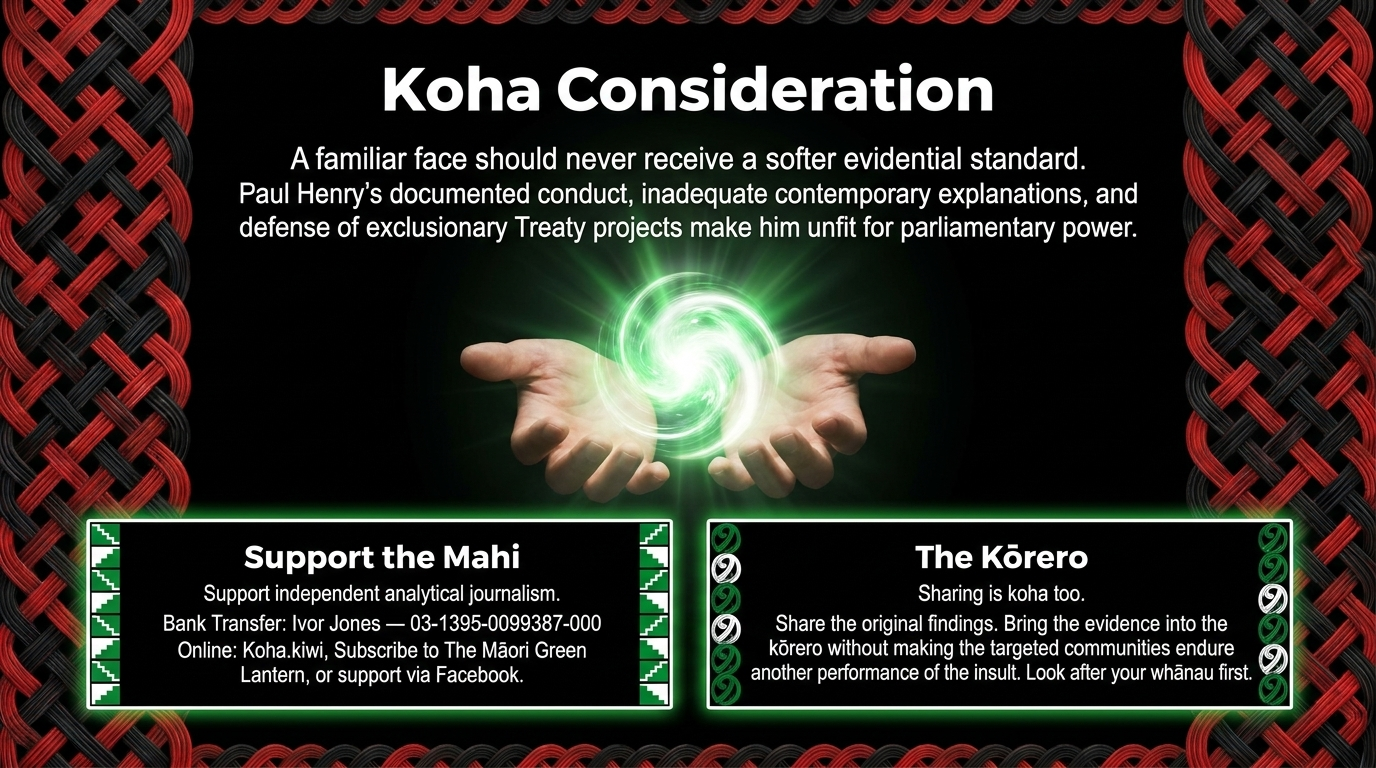
A familiar face should never receive a softer evidential standard than anyone else. If this essay has helped you look past the performance and inspect the record, consider supporting the mahi that keeps doing that work.
You can offer a voluntary koha through Koha.kiwi, subscribe to The Māori Green Lantern, or support through Facebook.
For direct bank transfer: Ivor Jones — 03-1395-0099387-000, as recorded on the published Koha page.
Sharing is koha too. Send the essay to someone who remembers the television personality but has never read the decisions. Share the original findings. Bring the evidence into the kōrero without making the people targeted endure another performance of the insult.
Look after your whānau first. Financial support is welcome, never an obligation. Helping reliable information reach someone who needs it is a contribution that matters.
Disclaimer
This essay is political commentary. The judgement that Paul Henry is unfit for Parliament is my opinion, grounded in the linked evidence. Criticism targets his public conduct, explanations and political choices; it does not allege criminal conduct. Tika, pono and tikanga guide my analysis; I do not speak for all Māori, iwi or hapū. Factual errors will be corrected when supported by evidence.