"Your Fortune Is Not A Second Vote" - 15 November 2026
Some Give Their Evenings. Others Give Fortunes. Stop Pretending The Power Is Equal.

"Your Fortune Is Not A Second Vote" - 15 November 2026
Mōrena Aotearoa,
I am sick of being told that a wealthy person’s right to donate settles the argument about wealthy people’s power.
Of course they have political rights. So does the person stacking supermarket shelves, caring for a parent, driving the bus or trying to keep the power connected. The question is why the size of someone’s fortune should determine how much political machinery they can keep running.
 Jonathan Milne

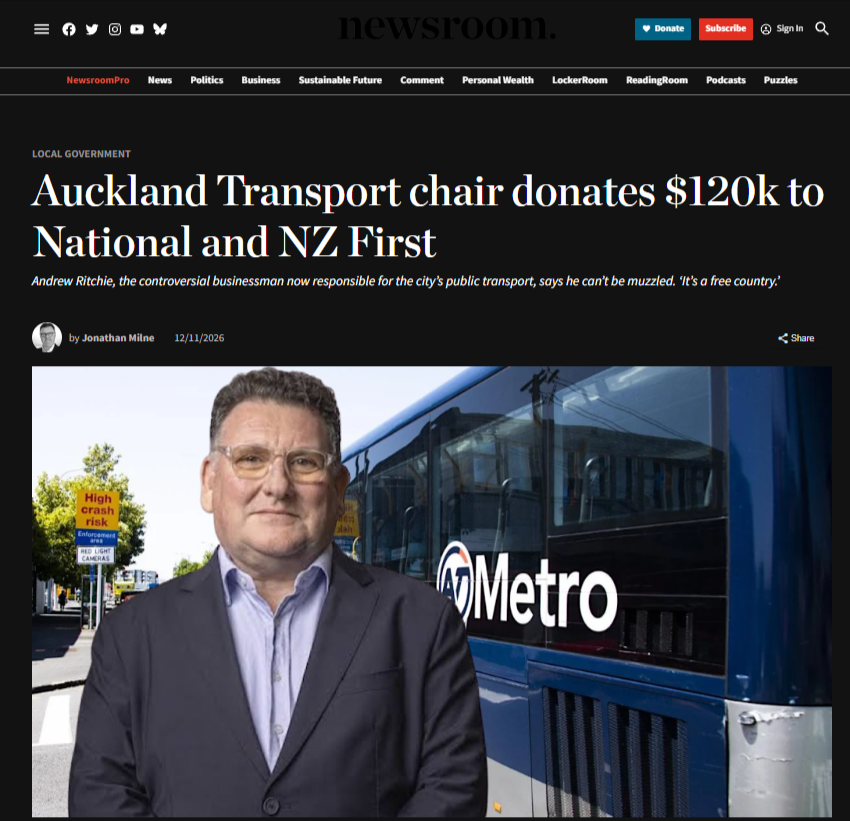
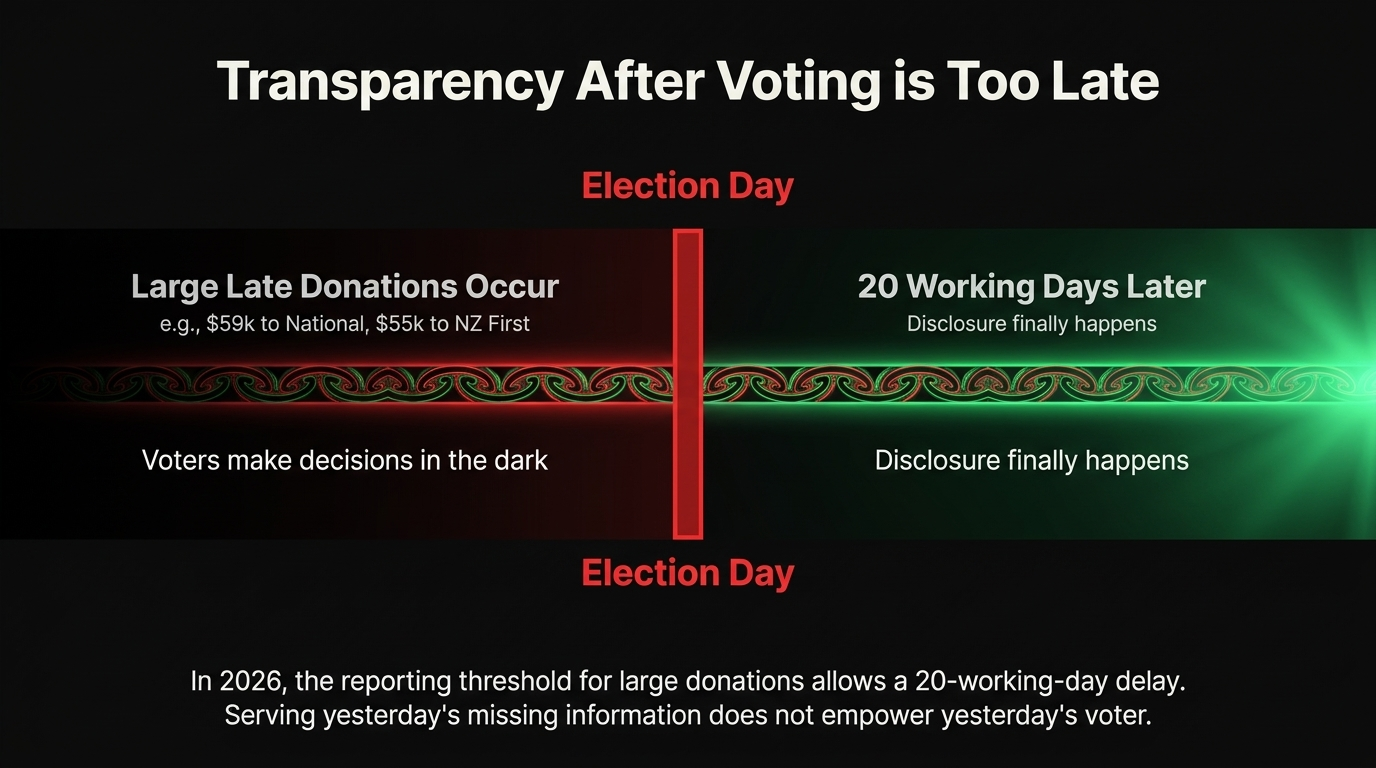
Andrew Ritchie has handed us another reason to ask. Jonathan Milne reports that the Auckland Transport chair gave $59,425 through his company to National, a similar amount to NZ First that Ritchie said had not yet been reported, and $5,000 to Labour candidate Phil Twyford. The large party donations arrived too late to require disclosure before election day, according to Newsroom’s report.
Ritchie’s answer was: “I’m a citizen. I’m allowed to. It’s democracy.” He invoked free speech and pointed to union donations to Labour in the same interview.
Well, Andrew, citizenship is not the issue. Political inequality is.
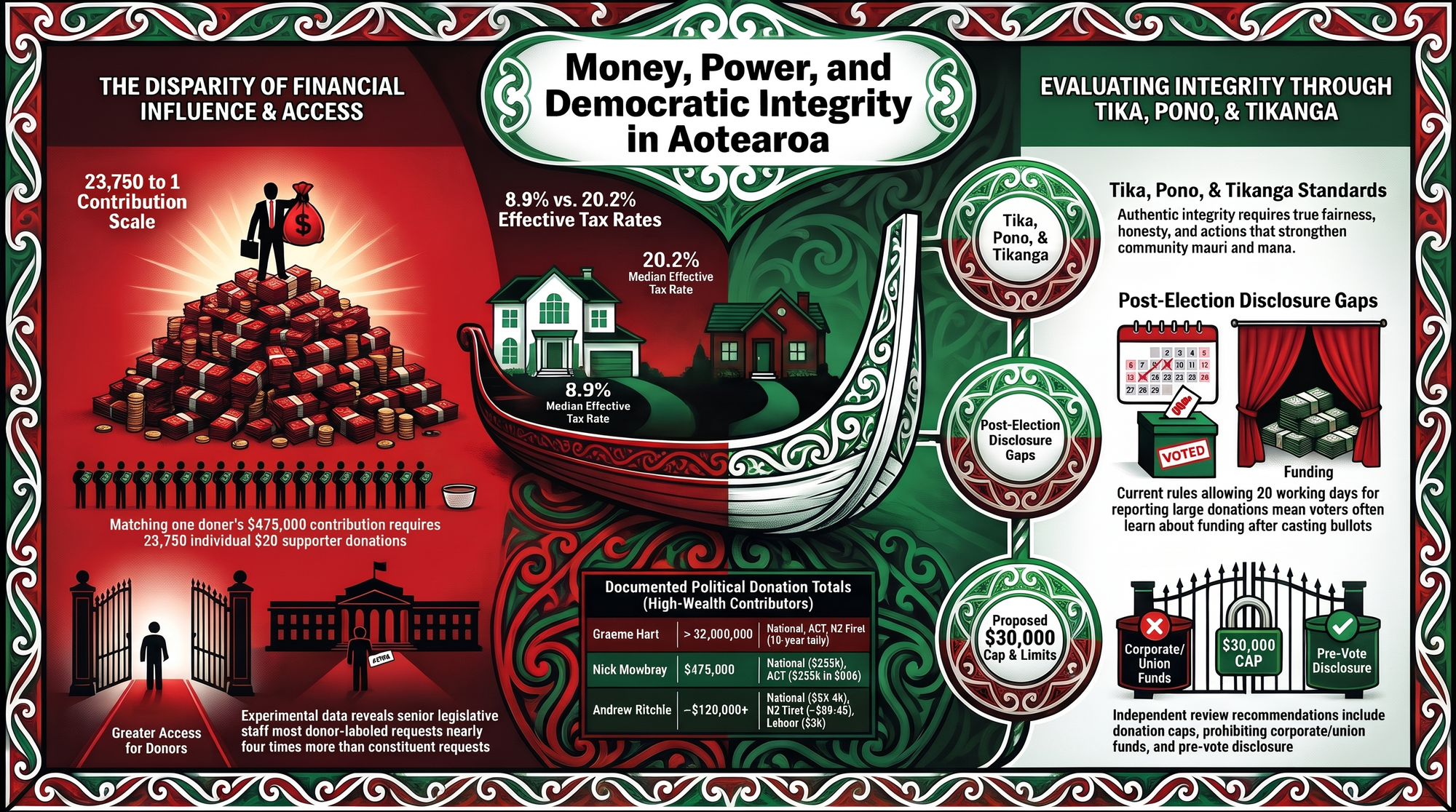
I want to follow the donations, explain the tax rules surrounding concentrated wealth, examine what money can obtain without buying a parliamentary vote, and confront disclosure that arrives after voters have made their decision. Then I want to put the whole arrangement through Tika, Pono and Tikanga: does it strengthen the mauri of our people, or protect the comfort of those already holding the advantage?
Because “I’m allowed to” is a miserable answer to “Is this right?”
The Cheque Is Not The Citizen
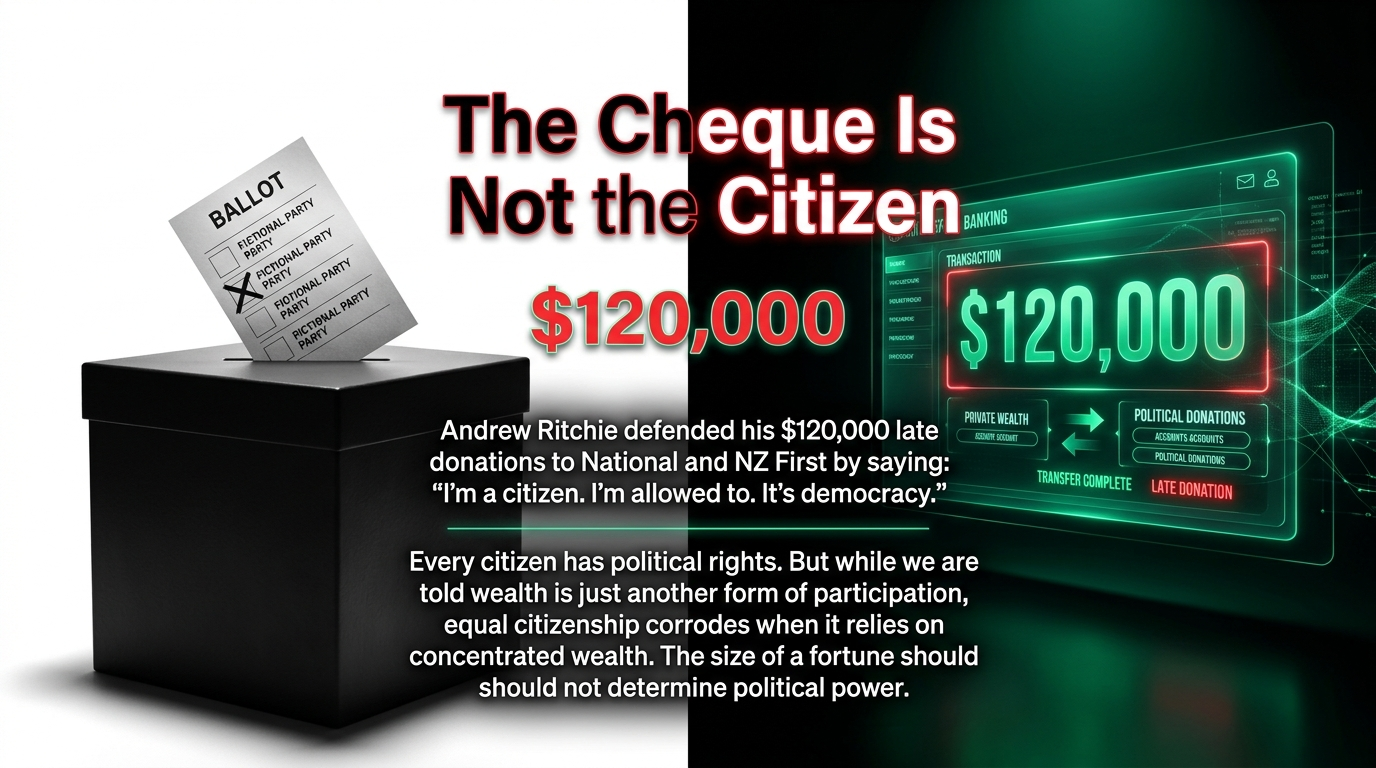
Nobody needs to muzzle Ritchie. He can speak, organise, argue and support a party. What I reject is the sleight of hand that turns scrutiny of enormous donations into an attack on the donor’s citizenship.
The citizen has rights. The size of the cheque deserves scrutiny.
Ritchie’s situation also involves public responsibility. Newsroom reports that he was confirmed as Auckland Transport chair in September after councillors blocked an earlier appointment in 2023 over concerns about his connections to Mayor Wayne Brown. It records his contributions to Brown’s campaigns as well: the appointment and donation history.
Those facts do not establish that he purchased his appointment. They establish why questions about interests, independence and public confidence belong in the conversation.
That distinction matters. I am not going to invent bribery to make a structural problem sound serious. Dependence on concentrated private wealth is serious enough.
A criminal transaction can be investigated and prosecuted. An unequal system can keep operating while its beneficiaries assure us that every form was completed correctly.
Tika Is More Demanding Than Legal
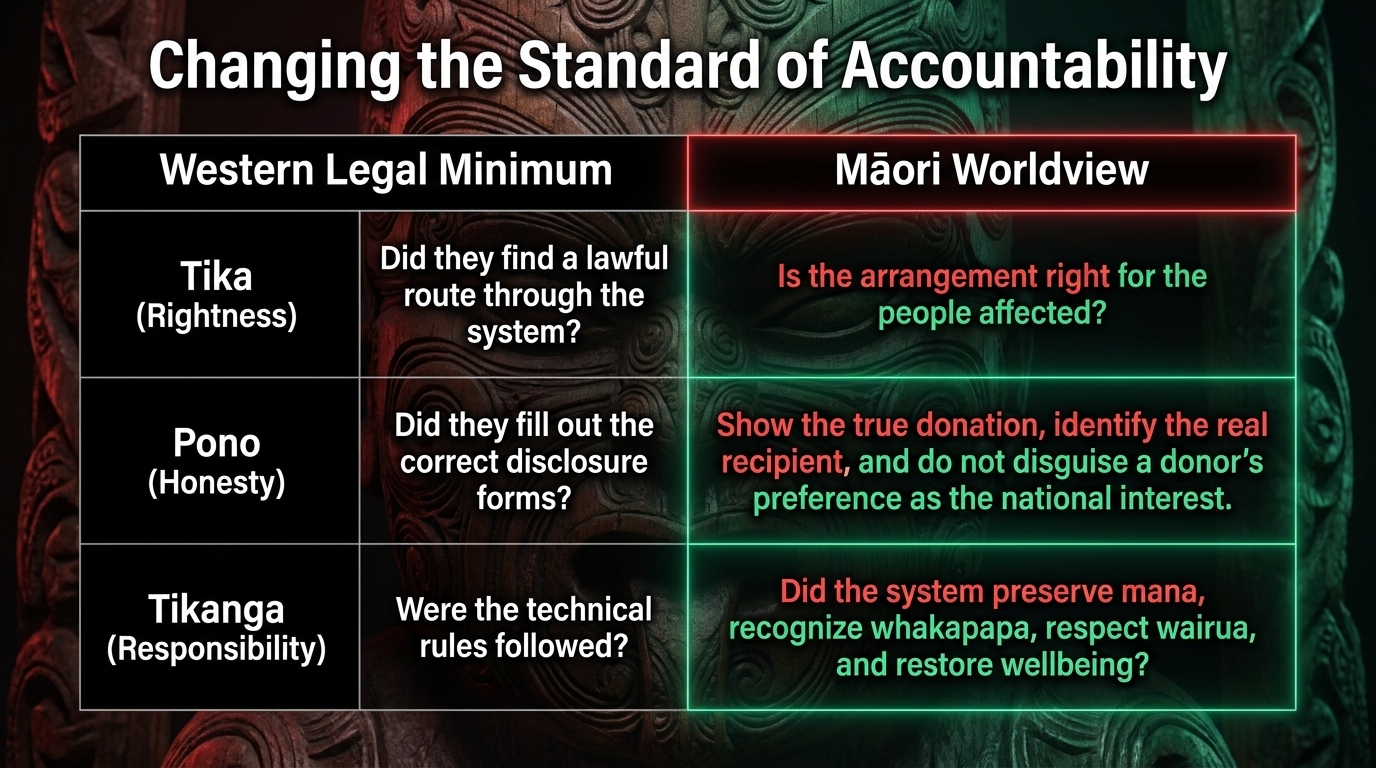
Here is the standard I use.
Tika asks whether the arrangement is right for the people affected—not merely whether somebody found a lawful route through it.
Pono demands honesty. Show the donation. Identify the recipient. Distinguish a documented relationship from an imagined conspiracy. Do not sell a donor’s preference as the national interest, and do not let my anger turn suspicion into fact.
Tikanga asks about relationships and responsibilities. Did the system preserve their mana, recognise their whakapapa, respect their wairua, involve their whānau in ways they wanted, and help return them to wellbeing?
I have set out this approach in “Your Bottom Line Is Not Our Reason For Living”. These are the questions guiding my argument, not a claim to speak for every iwi and hapū.
For readers trained in Western policy language, dignity, meaningful participation, cultural and spiritual safety, relationships and actual outcomes provide useful points of connection. They are not complete translations.
Building mauri means strengthening the conditions in which people and communities flourish. A system does not pass because the paperwork is immaculate while the people leave diminished.
The Deep Dive Podcast
Listen to a lively conversation between two hosts, unpacking and connecting topics in the sources of this essay. I apologise in advance for the AI's very harsh pronounciation of reo. Please dont shoot me, :).
Youtube Video
Like video? Here is a short video suppporting the essay. Again, don't shoot the messenger please because of AI's pronounciation. :)
Example One: The Volunteer And The Fortune
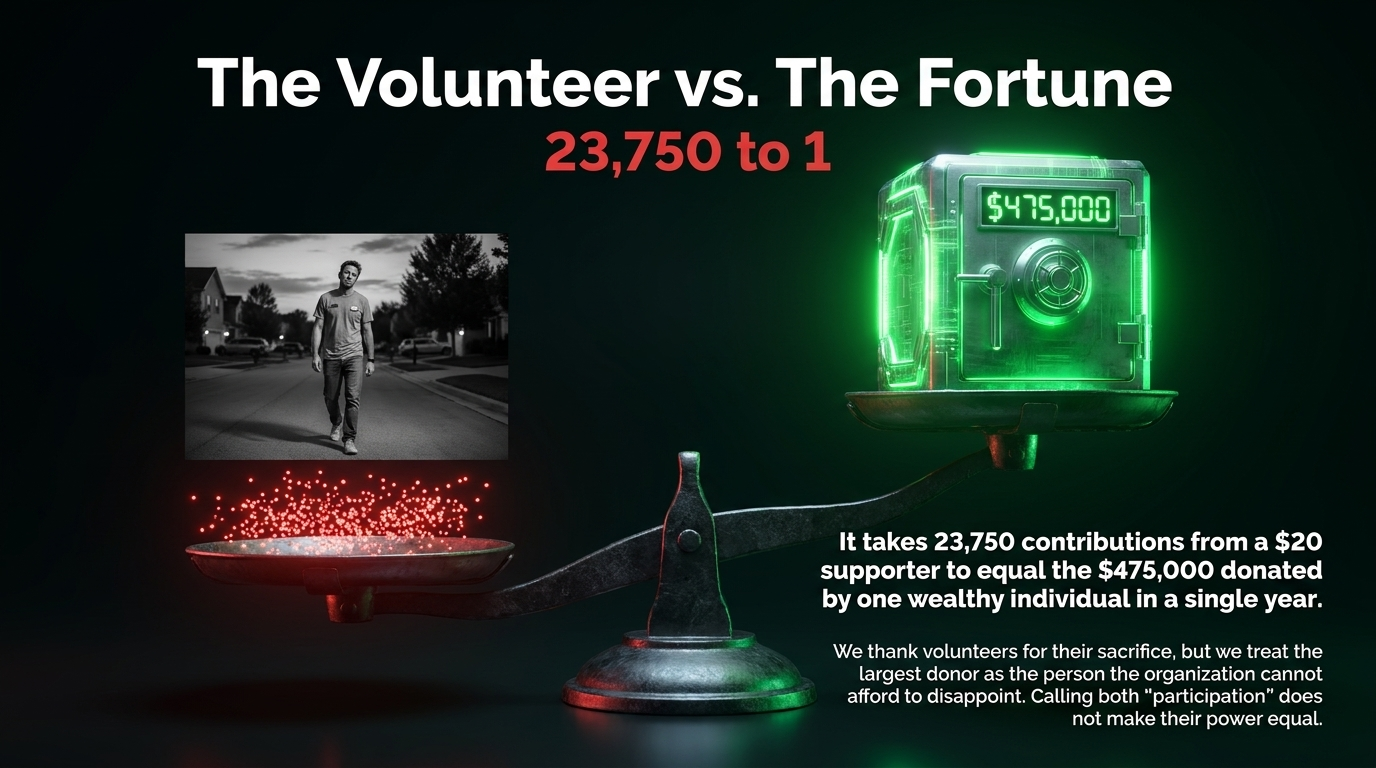
Picture a campaign volunteer getting home from work, sorting dinner and heading out again to knock on doors. The petrol comes from the household budget. So does the childcare. So does the exhaustion.
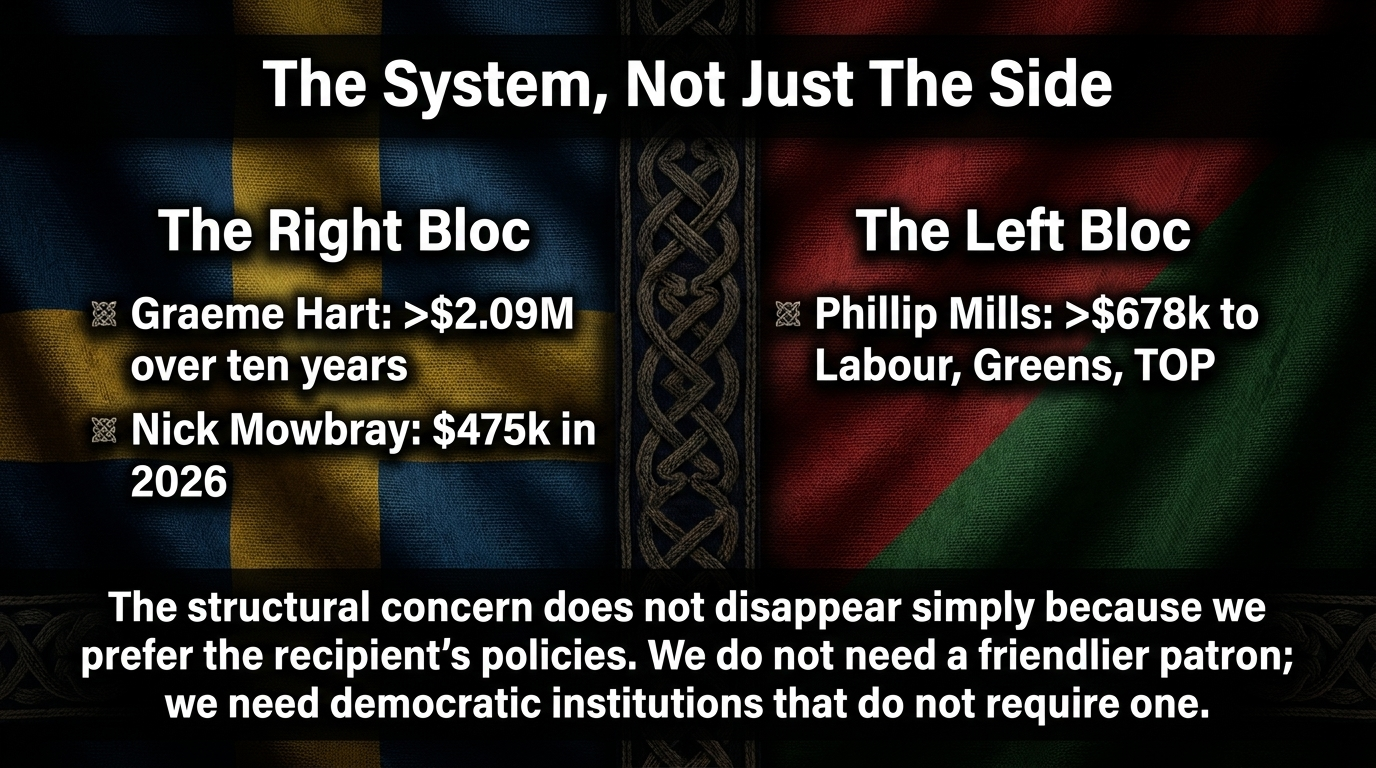
Now put beside it Nick Mowbray’s recorded donations during 2026: $250,000 to National and contributions to ACT of $100,000, $100,000 and $25,000. That is $475,000 across the parties, documented in the Electoral Commission’s register.
If another supporter can spare $20, it takes 23,750 contributions of that size to equal $475,000. That arithmetic compares money—not dedication, volunteer hours or votes delivered.
Hart illustrates sustained financial support. Newsroom’s tally puts his contributions to National, ACT and NZ First above $2.009 million over ten years, pending further disclosures: the reported decade-long total.
Ritchie illustrates political giving alongside public governance. Nick Mowbray illustrates the scale available to an individual donor. Hart illustrates support sustained across a political bloc. They are distinct people and activities, not evidence of a single coordinated operation.
For the Western mind, the issue is unequal capacity to finance political organisations. Calling the volunteer’s evening and the enormous bank transfer “participation” does not make their power equal.
Through tikanga, I ask whether we honour the person whose contribution is care, time and commitment—or quietly rank their political importance below someone who can move money without leaving the house.
The practical response is meaningful donation limits, broader public support for democratic participation and arrangements that make involvement easier for people with caring responsibilities and insecure incomes.
Do not thank the volunteer for their sacrifice while treating the largest donor as the person the organisation cannot afford to disappoint.
The Tax Rules Are Part Of This
Politics determines the rules surrounding wealth. Inland Revenue has already shown us why those rules deserve scrutiny.
IRD researched 311 wealthy families, generally worth more than $50 million. Their median effective tax rate on economic income over 2015–2021 was 8.9%, according to its published factsheet.
Economic income includes increases in the value of businesses, property and investments. It is not simply the amount appearing as personal taxable income, as IRD explains.
The group’s median rate on personal taxable income was around 30%. Much of its wider economic income came from capital gains mostly outside personal income taxation; the research also accounted for tax paid by businesses: IRD’s explanation of the different measures.
That is not evidence of tax evasion. It is evidence about tax design.
Nor is the confidential research population a donor list. It supplies no basis for identifying Ritchie, Hart or the Mowbrays as participants in the study.
Keep the argument accurate. Then confront what it establishes.
Example Two: Put The Difference In Dollars
IRD’s adjusted comparison, adding GST and subtracting government-paid benefits, gives a median effective rate of 9.4% for its wealthy research group against Treasury’s 20.2% estimate for a middle-wealth New Zealander. IRD identifies differences between the underlying studies, including company and trust treatment, beside that comparison.
Apply those rates to an explicitly hypothetical common amount of $100,000 in economic income.
At 9.4%, the amount is $9,400. At 20.2%, it is $20,200. The difference is $10,800.
Those are not actual household assessments. They show the scale of the rate difference, not revenue waiting to be collected from a named person.
For the Western mind, distinguish economic capacity from taxable income. The way a person becomes better off helps determine how much of that gain enters the tax system.
Through tikanga, I ask whose contribution is recognised and whose security is protected. A system that makes ownership comparatively comfortable while demanding sacrifice elsewhere deserves more than another speech about everyone doing their bit.
The response is to examine capital gains, accumulated wealth and the interaction between tax bases, then publish properly costed options. I argued for confronting that concentration of power in “Keep Your Kindly Billionaire. Give Us Our Democracy Back”.
No fairy-tale revenue forecasts. No hiding behind complexity either.
Watch How Wealth Defends Wealth
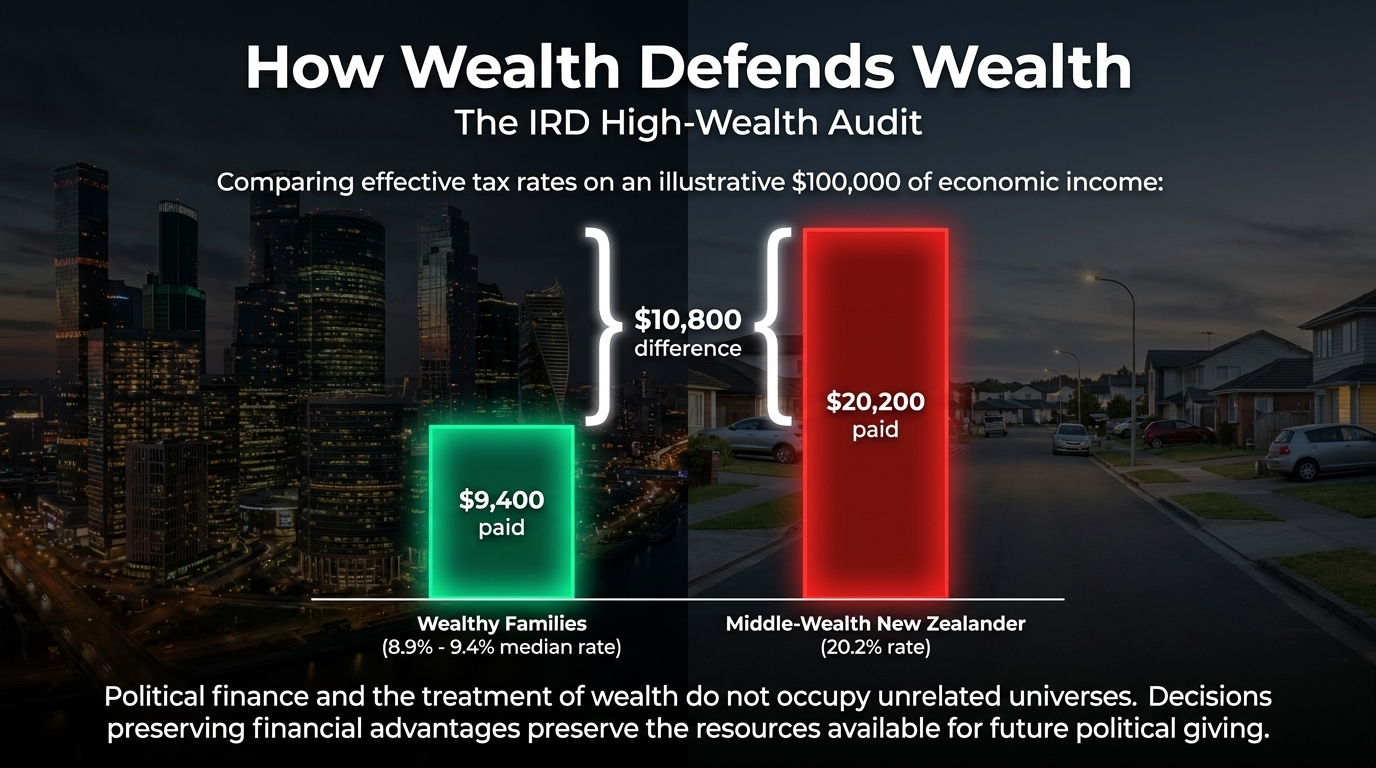
The structural risk is straightforward. Large fortunes provide resources for political finance. Political decisions determine how wealth is taxed and regulated. Decisions preserving financial advantages can preserve the resources available for future political giving.
Nobody needs a secret meeting for that relationship to matter. A donor can sincerely support a party’s existing programme. Sincerity does not make the resulting distribution of political capacity equal.
Newsroom reports Harry Mowbray’s opposition to Labour’s capital gains tax, the Greens’ wealth tax and Opportunity’s land tax in its interview about his electoral campaign. Those are Harry’s stated preferences, not proof of his son Nick’s private motives.
Look, too, at actual policy. The coalition’s 2024 legislation restored residential investment-property interest deductibility and shortened the bright-line test to two years: the Government’s account of the tax changes.
Nicola Willis argued that making rental investment more attractive would increase renters’ options and put downward pressure on rents. The legislation also raised the headline trustee tax rate to 39%, so describing every provision as a gift to wealthy asset owners would be false: the ministers’ explanation.
Examine the rental argument. Test the outcomes. Keep the contrary evidence.
But stop pretending political finance and the treatment of wealth occupy unrelated universes. The parties contesting those rules need resources. People with exceptional wealth can supply exceptional amounts.
That is a democratic issue, not a fundraising curiosity.
Example Three: Getting Through The Door
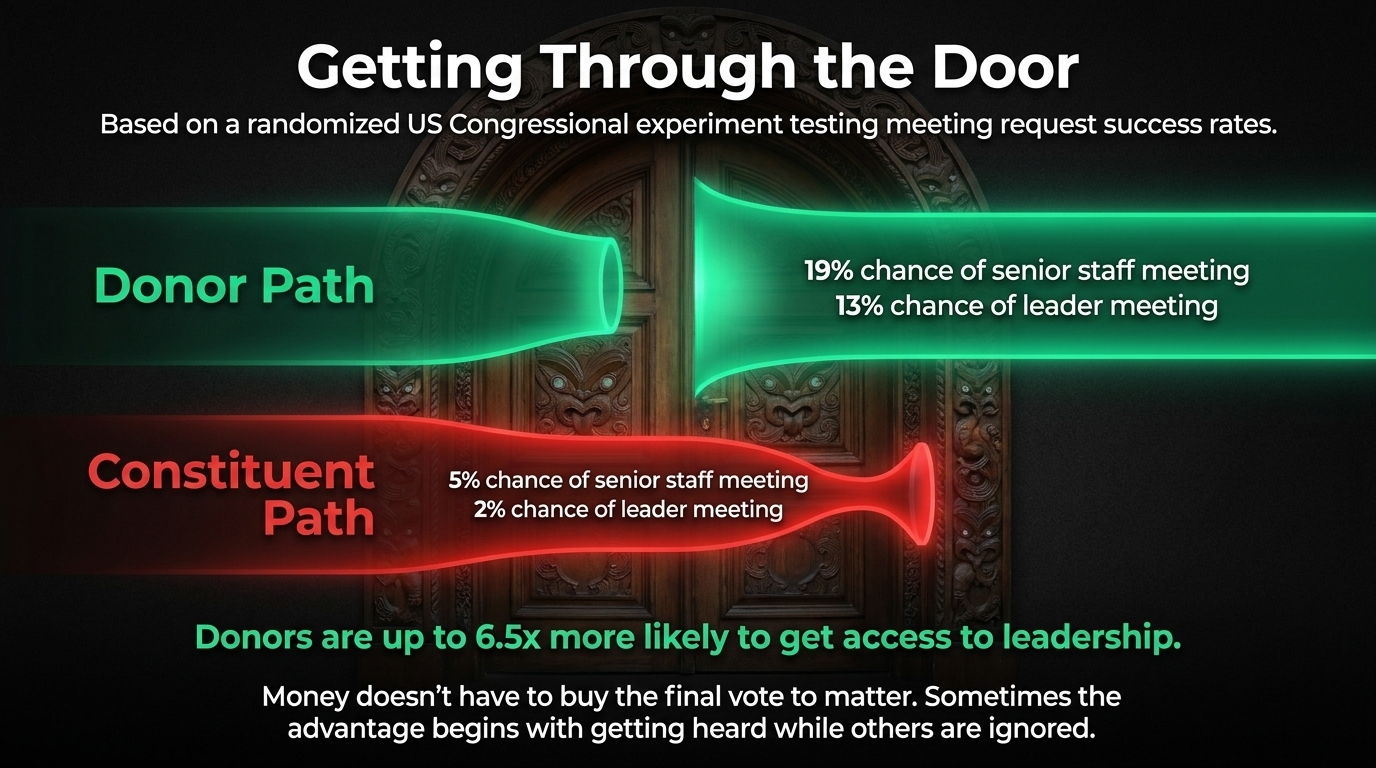
Money does not have to buy the final vote to matter. Sometimes the advantage begins with getting heard.
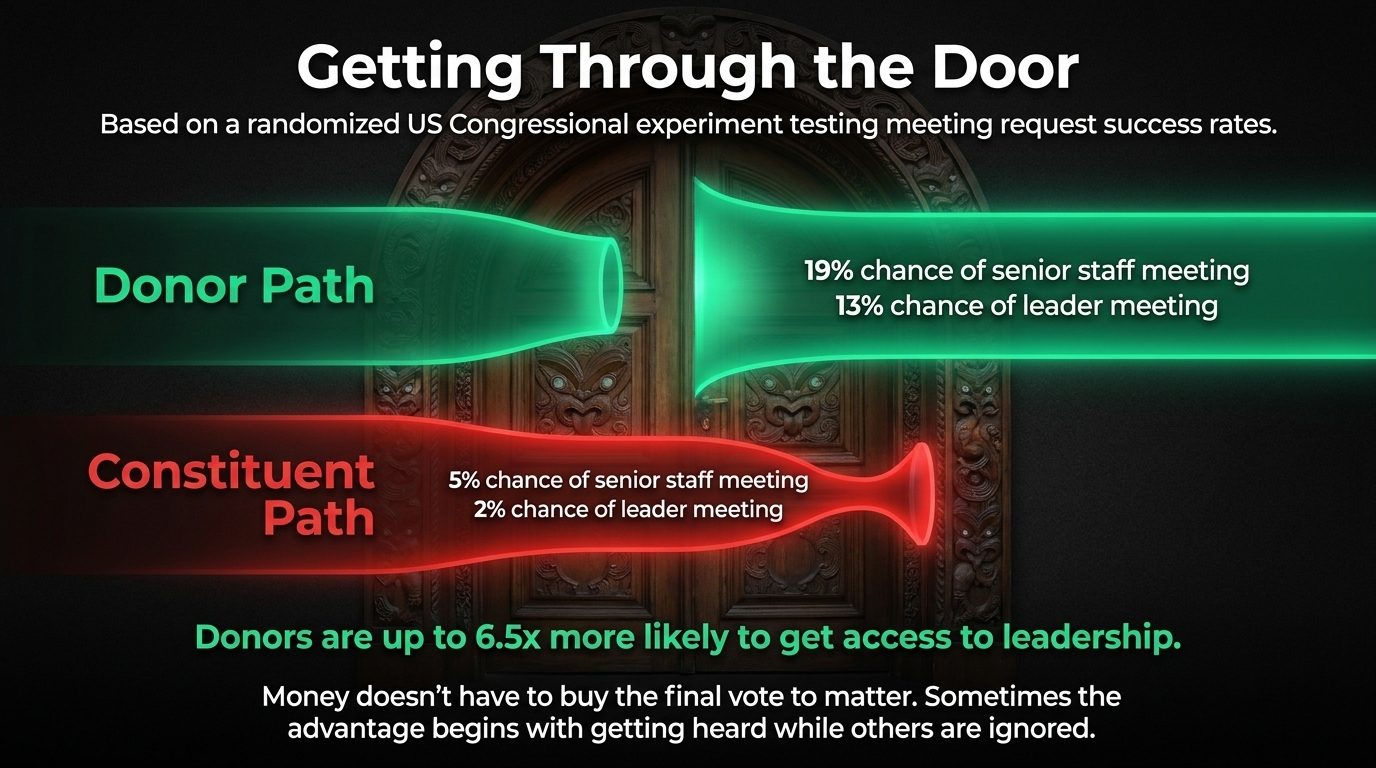
Joshua Kalla and David Broockman conducted a randomised experiment involving meeting requests to 191 American congressional offices. The prospective attendees were political donors, primarily small grassroots donors; requests identified them either as donors or as concerned constituents: the researchers’ account.
Senior-staff meetings occurred for 19% of donor-labelled requests against 5% of constituent-labelled requests. Meetings with the legislator or chief of staff occurred for 13% against 2%: the published findings.
The first gap is 14 percentage points, with a ratio of 3.8 to one. The second is 11 percentage points, with a ratio of 6.5 to one, calculated from those rounded results.
The experiment established differential access in that American setting. It did not establish purchased legislation or identical behaviour in Aotearoa.
For the Western mind, access is a political resource. An argument that reaches a decision-maker gets an opportunity an unanswered request does not.
Through tikanga, the question is whether someone’s mana receives recognition because they belong to the community—or because an office recognises their donor status. Whakapapa and whānau responsibilities do not vanish because they arrive without a financial contribution attached.
The response is practical: visible lobbying, published access arrangements, meaningful conflict disclosures and reliable ways for affected communities to be heard.
Do not wait for a recorded promise of a favour before asking why some people find the door easier to open.
A Quarry Is Not Just A Paper Trail
Ritchie’s quarry interests bring these questions closer to home.
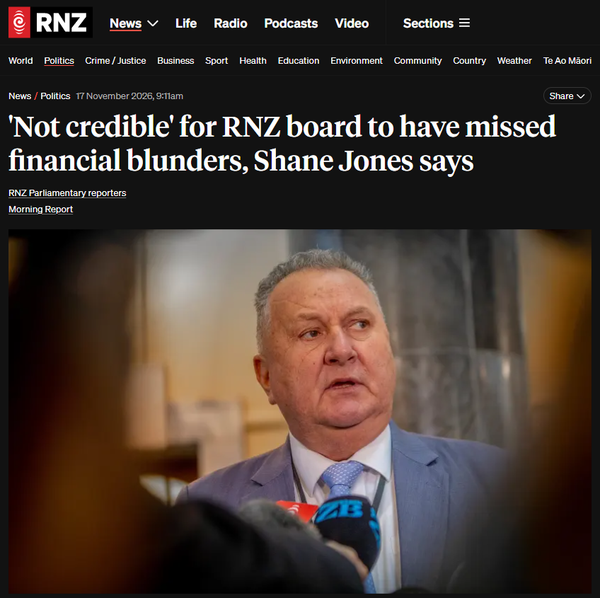
Newsroom’s later summary describes earlier donations of $55,000 to NZ First and Shane Jones ahead of a fast-track expansion bid involving a quarry he jointly owns: its account. RNZ’s earlier itemisation instead records $55,000 to NZ First plus $5,000 to Jones: the original investigation.
Those historical descriptions do not reconcile neatly. Neither establishes a purchased approval.
RNZ also identified more than $500,000 in donations associated through companies and shareholders with fast-track projects. Ministers Chris Bishop and Shane Jones said conflicts were managed; legal scholar Andrew Geddis explained that a donation alone does not automatically establish a conflict, and inclusion for consideration was not final project approval: the investigation and responses.
That is the strongest practical counterargument. A government cannot become incapable of making policy whenever a donor has an interest in the subject. Union donations cannot prevent workplace legislation, any more than business donations automatically prevent economic legislation.
Fine. Then make the safeguards visible and credible.
Show how interests were identified. Explain how decisions were insulated. Give affected communities a meaningful hearing.
“Trust us” is not an accountability system.
Transparency After Voting Is Too Late
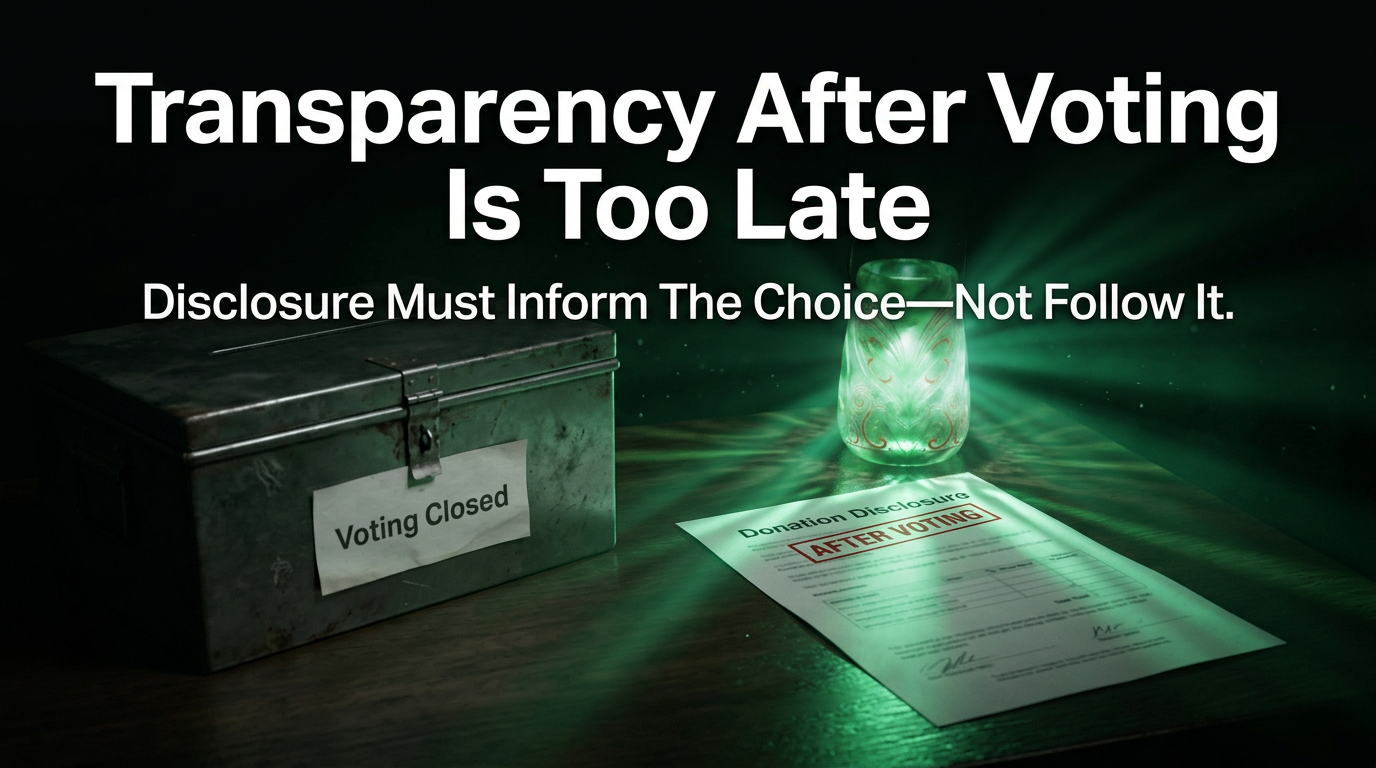
Timing matters as much as disclosure.
The Electoral Commission says qualifying election-year donations exceeding $20,000 must be reported within 20 working days in 2026. The corresponding deadline was ten working days in 2023: the Commission’s published requirements.
A sufficiently late donation can therefore become public after voting. Newsroom documents that problem in its reporting on Ritchie and Hart.
Before voting, disclosure can inform a choice. Afterwards, it supplies information about a choice already made.
An archive matters. But do not serve yesterday’s missing information and congratulate yourself for empowering yesterday’s voter.
Require prompt disclosure that reaches people while their decision is still theirs to make.
Now The Electoral Rules Are The Target
Harry Mowbray’s advocacy goes beyond supporting parties.
Newsroom reports that he assembled wealthy supporters, paid influencers and backed a vote-splitting campaign. He also described a replacement electoral arrangement that he acknowledged was not proportional: the interview about his campaign and proposed system.
His claim that his campaign delivered the election remains his claim. It is not an established measurement of causation.
The interview also reports his characterisation of female swing voters as emotional and his criticism of demands for additional household income: his reported explanation.
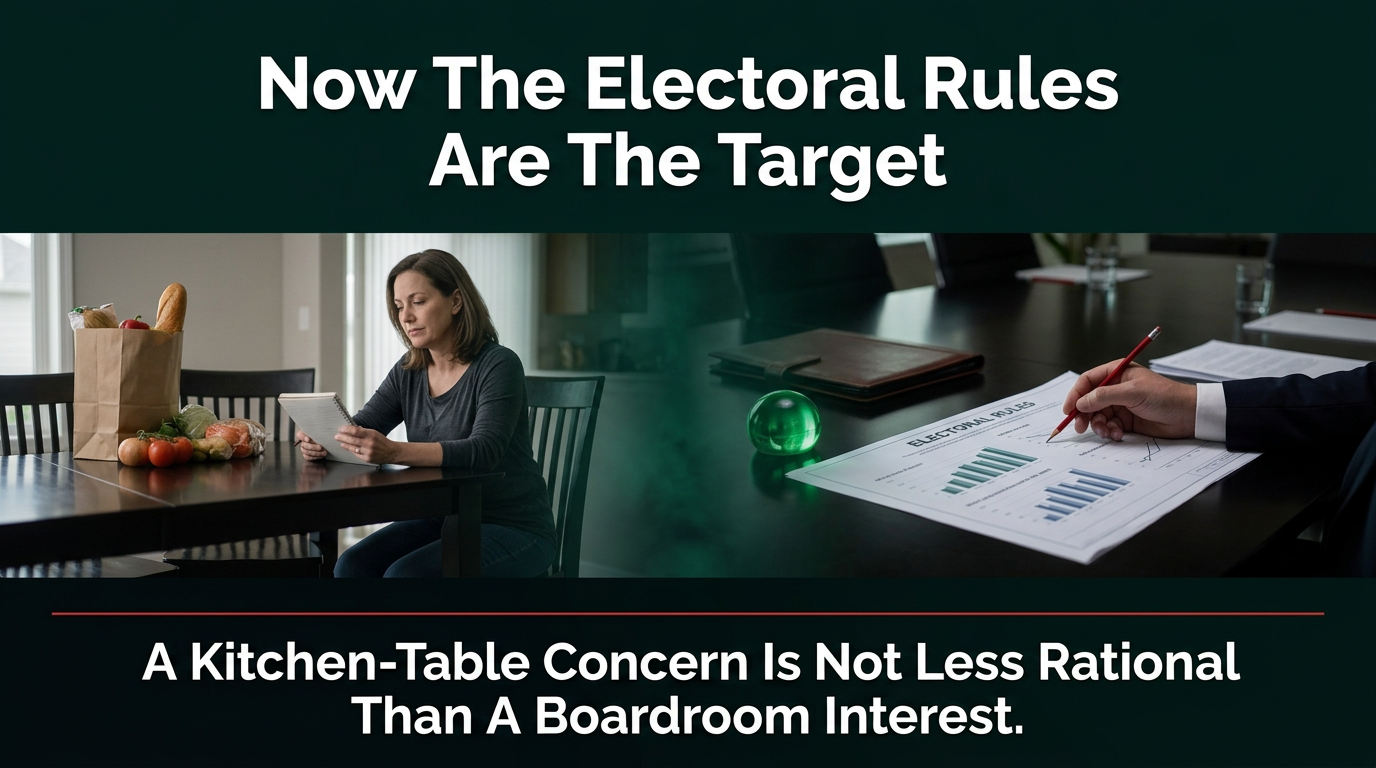
A parent wanting more money for essentials is expressing a material interest. A wealthy man opposing taxes on wealth is expressing a material interest too.
One does not become irrational because it comes from a kitchen table while the other arrives from someone accustomed to being listened to.
I examined the political-finance problem in “Your Fortune Is Not A Mandate”. Wealthy citizens have every right to advocate electoral change.
They have no superior right to define democracy.
My Side Gets No Exemption
Ritchie’s union comparison deserves a consistent answer.
Union donations require transparency and defensible limits. So do corporate donations. So do large contributions from wealthy people supporting the left.
Newsroom’s tally includes at least $678,000 from Phillip Mills to Labour, the Greens and Opportunity: the cross-party donor comparison.
The concern does not disappear because I prefer the recipient’s policies.
Nor is volunteer time equally available. In the illustration above, the person with secure work, transport and childcare has options another supporter lacks. The answer is to broaden participation—not declare that everyone technically had a chance and leave the biggest fortunes in charge of financing the contest.
I do not want a friendlier patron. I want institutions that do not require one.
Whānau Are Not The Collateral
For Māori, this is not an abstract debate about campaign accounts. It concerns who exercises authority over health, rights, resources and the conditions in which whānau live.
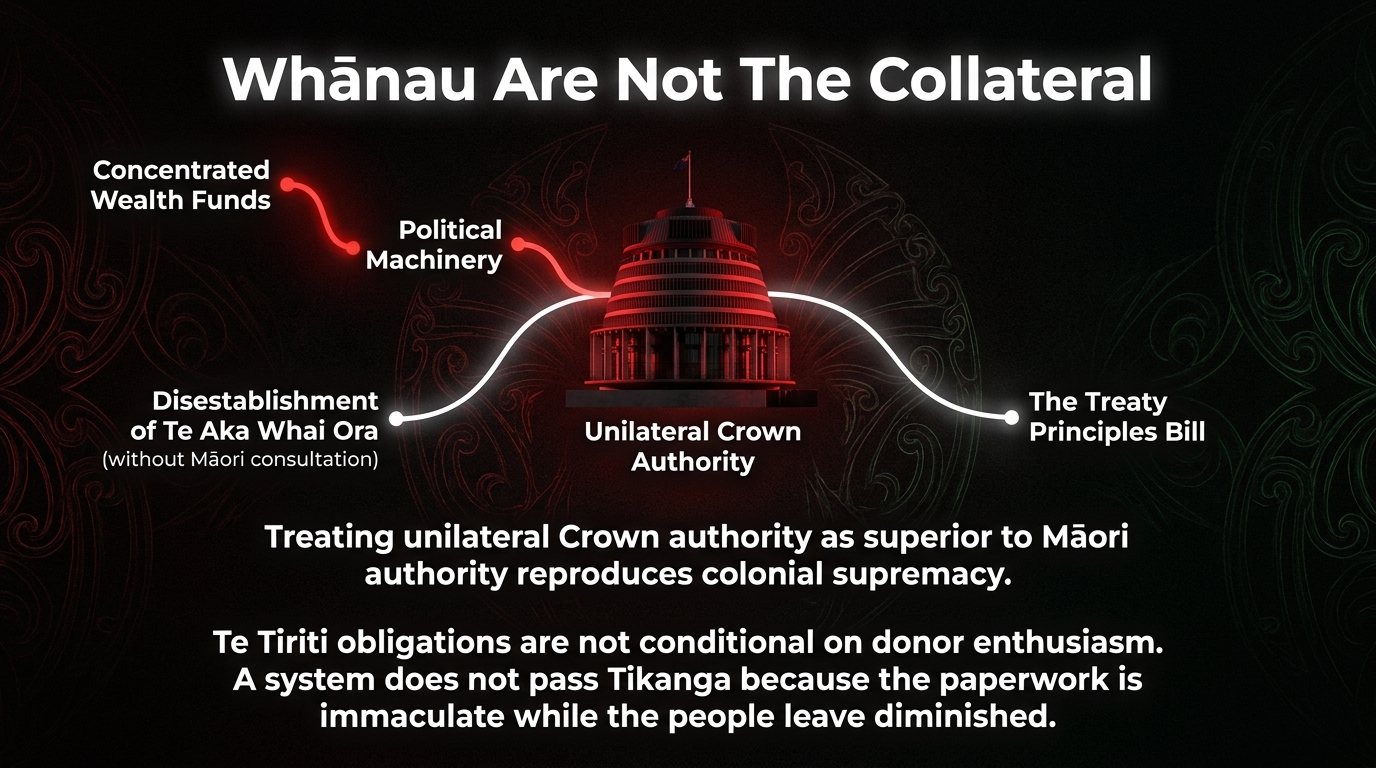
The Waitangi Tribunal found that the Crown disestablished Te Aka Whai Ora without consulting Māori or obtaining substantive official advice, pursuing political ideology rather than evidence and removing a form of redress for earlier failures to recognise tino rangatiratanga: the Tribunal’s findings.
It also found Treaty breaches in the Treaty Principles Bill and Treaty clause review policies, describing an alarming pattern of Crown power being used against Māori rather than to meet Crown obligations: its published findings.
Those findings do not establish that the donors discussed here directed those policies. They establish conduct for which the coalition must answer.
My judgement is that treating unilateral Crown authority as superior to Māori authority reproduces colonial supremacy. I reject the white-supremacist ordering of power in which Māori authority is treated as something the dominant state can remove when politically convenient.
Judge the conduct. Demand accountability from National, ACT and NZ First for the programme they agreed to carry.
Then apply tikanga. Where was the recognition of mana? Where was the respect for whakapapa, wairua and whānau? Where was the authority to shape what happened, rather than endure an announcement?
Te Tiriti obligations are not conditional on donor enthusiasm. Neither is a household’s right to a fair hearing.
Change The Rules, Not The Excuses
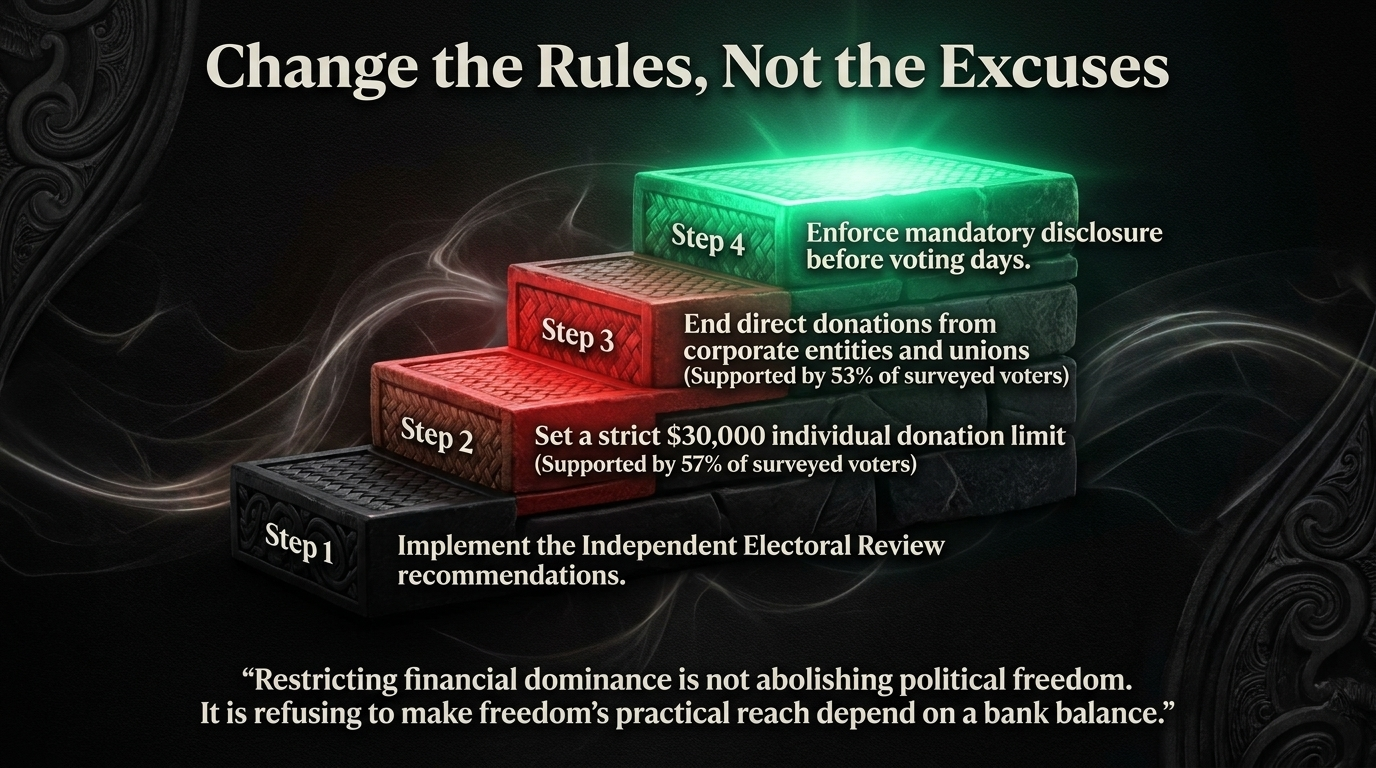
The Independent Electoral Review supplied a starting point: a proposed $30,000 donation cap, an end to corporate donations alongside greater public support, and stronger disclosure. Krewel and Vowles describe those recommendations in their analysis of political funding reform.
Their account of the 2023 Election Study reports 57% support for a $30,000 individual-donation limit and 53% support for prohibiting direct donations from corporate groups and trade unions: the survey findings.
Build from there. Require disclosure before voting. Set meaningful limits with safeguards against splitting contributions through related arrangements. Make lobbying and conflicts visible. Identify paid political promotion.
Public support must broaden democratic competition, not become a comfortable protection scheme for parties already inside Parliament.
And yes, wealthy people retain their voice. They can organise, persuade, publish and contribute within fair rules. Restricting financial dominance is not abolishing political freedom.
It is refusing to make freedom’s practical reach depend on a bank balance.
I Want Our Mokopuna To Inspect This Record

I would love you to click through to my essays because I have designed this work to be useful in daily life. Use it in a kōrero with whānau. Use it to question a headline, check a claim or ask a politician the question their slogan avoided.
There are different ways into the kaupapa. “Your Fortune Is Not A Mandate” includes a long-form podcast, a short-video section and the cited long read.
By my own count, the project holds more than a thousand essays, as I have explained in my account of the growing repository.
I want our mokopuna to look back and see that the Māori Green Lantern and others were documenting neoliberalism, misinformation, disinformation and attacks on Māori rights while they happened. That we were trying to support and protect them.
They deserve a record they can inspect—not another demand that they trust the loudest voice.
Koha Consideration

Who supports and protects this mahi?
You do.
There are no corporate backers behind the Māori Green Lantern. This work is supported through koha, as stated in the project’s public support information.
If this essay helped you separate a citizen’s right to speak from a fortune’s capacity to dominate, consider a koha to support and protect the scrutiny that keeps following the money.
Your koha does not buy a favourable conclusion. It supports accountability and a record for our mokopuna.
Four pathways are available:
Offer A Voluntary Koha.
Subscribe To The Māori Green Lantern.
Make a direct bank transfer: Ivor Jones — 03-1395-0099387-000, as published on the Koha page.
Support Through Facebook.
Unable to koha? No worries, whānau. Follow, subscribe, kōrero and share. Helping reliable information reach someone who needs it is koha too.
Your Fortune Stops At Our Citizenship

I am not waiting for an envelope, a confession or a prosecution before defending democratic equality.
If corruption means a proven criminal exchange, the evidence presented here does not establish one. If we are talking about the corrosion of equal citizenship through dependence on concentrated wealth, then hiding behind lawful paperwork is no answer.
Let the wealthy make their case. Let them persuade their neighbours and give their time alongside everyone else.
But their fortunes must not become a second franchise.
I want political organisations capable of refusing a wealthy supporter without fearing for their survival. I want Māori authority respected without needing a rich person to endorse it. I want whānau heard because the decisions concern their lives.
Then ask the questions that matter: was mana preserved, whakapapa recognised, wairua respected, whānau involved and wellbeing restored? Did the arrangement strengthen mauri—or simply protect an advantage?
An equal-sized ballot paper is not enough if we shrug at everything that makes some voices harder to ignore.
The people who can afford to finance politics must never become more important than the people politics exists to serve.
Disclaimer
This is political commentary grounded in the linked evidence. Criticism targets public conduct, policy and concentrated power; it does not allege bribery, criminality or purchased decisions by any named person. Illustrative calculations are not actual household assessments. Tika, Pono and Tikanga guide my analysis; I do not speak for all Māori, iwi or hapū. Errors will be corrected when supported by evidence.