
"DYING ON THE BOOKS: How ACC Turned PCP Poisoning Into a Waiting Room for Death" - 25 April 2026
The sawmill put PCP into their blood. ACC put delay into their lives. One poisoned the body; the other learned how to poison the aftermath.

Kia ora Aotearoa,
Essay Two of The Green Chain Series | By Ivor Jones, Te Māori Green Lantern | April 2026
He Kupu Whakataki
This is the second essay in The Green Chain Series — a five-part investigation into the PCP poisoning of sawmill workers, the contamination of Whakatāne, and the Crown systems that chose profit, delay, and denial over truth.
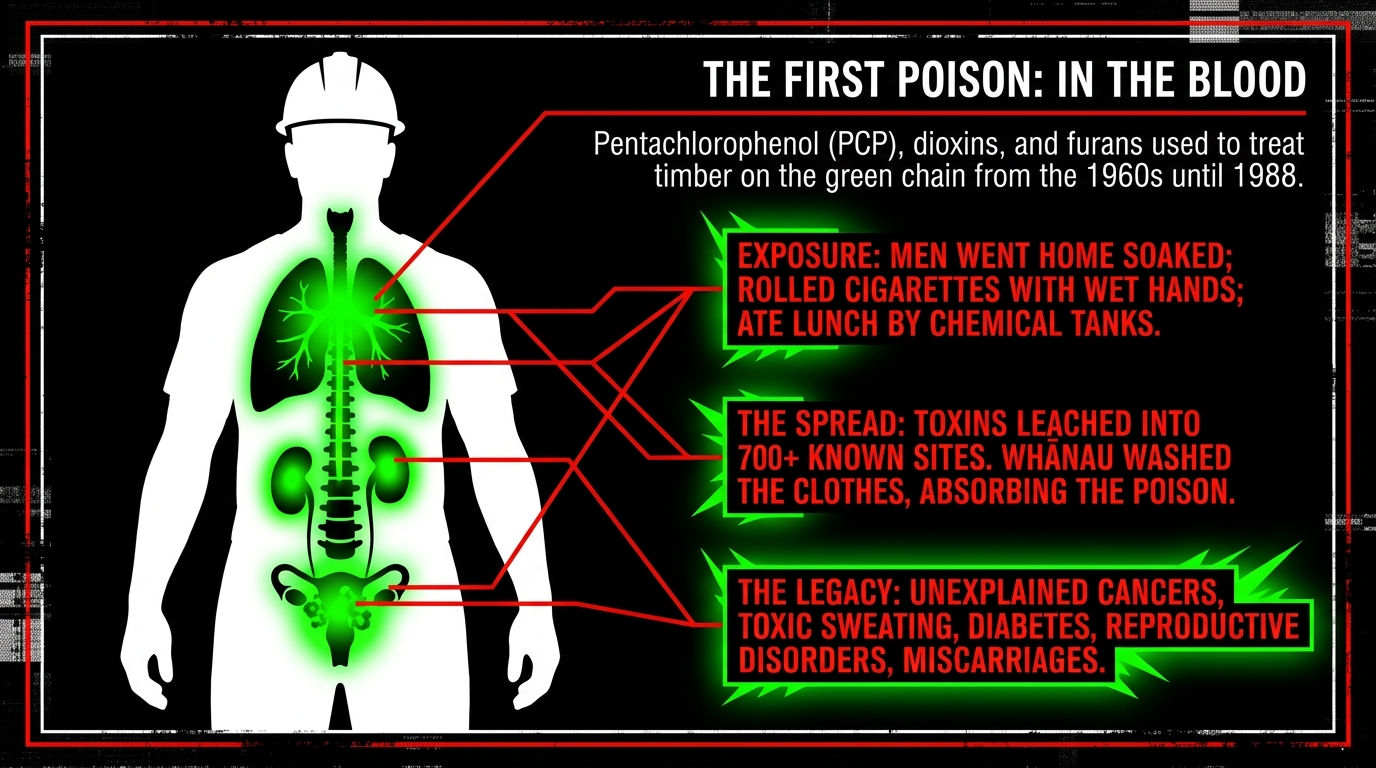
The first poison entered through skin and lungs in the mill, as recorded by Te Ara.
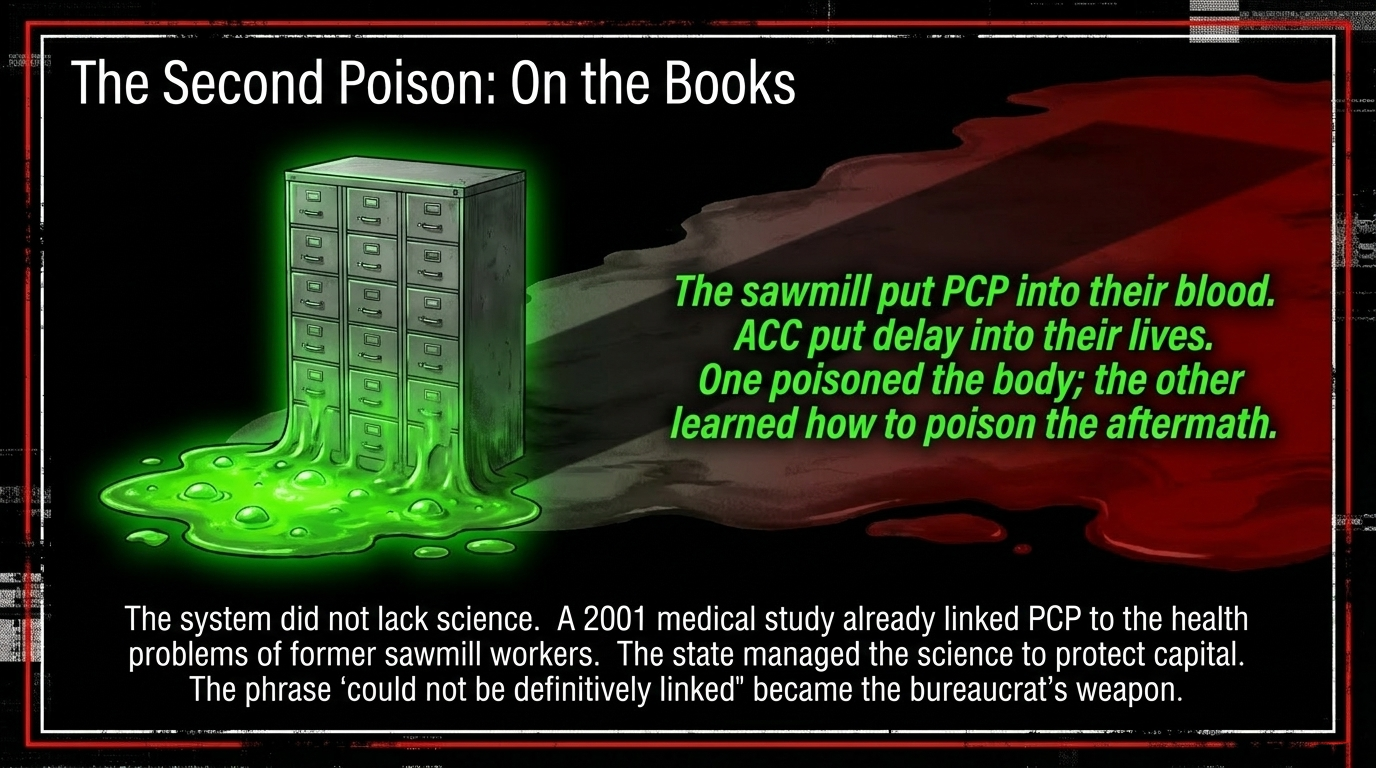
The second poison arrived by letter, by form, by medical threshold, by legislative exclusion, and by the quiet bureaucratic art of making sick men prove the obvious until they ran out of money, breath, or time, as described by Te Ara and E-Tangata.
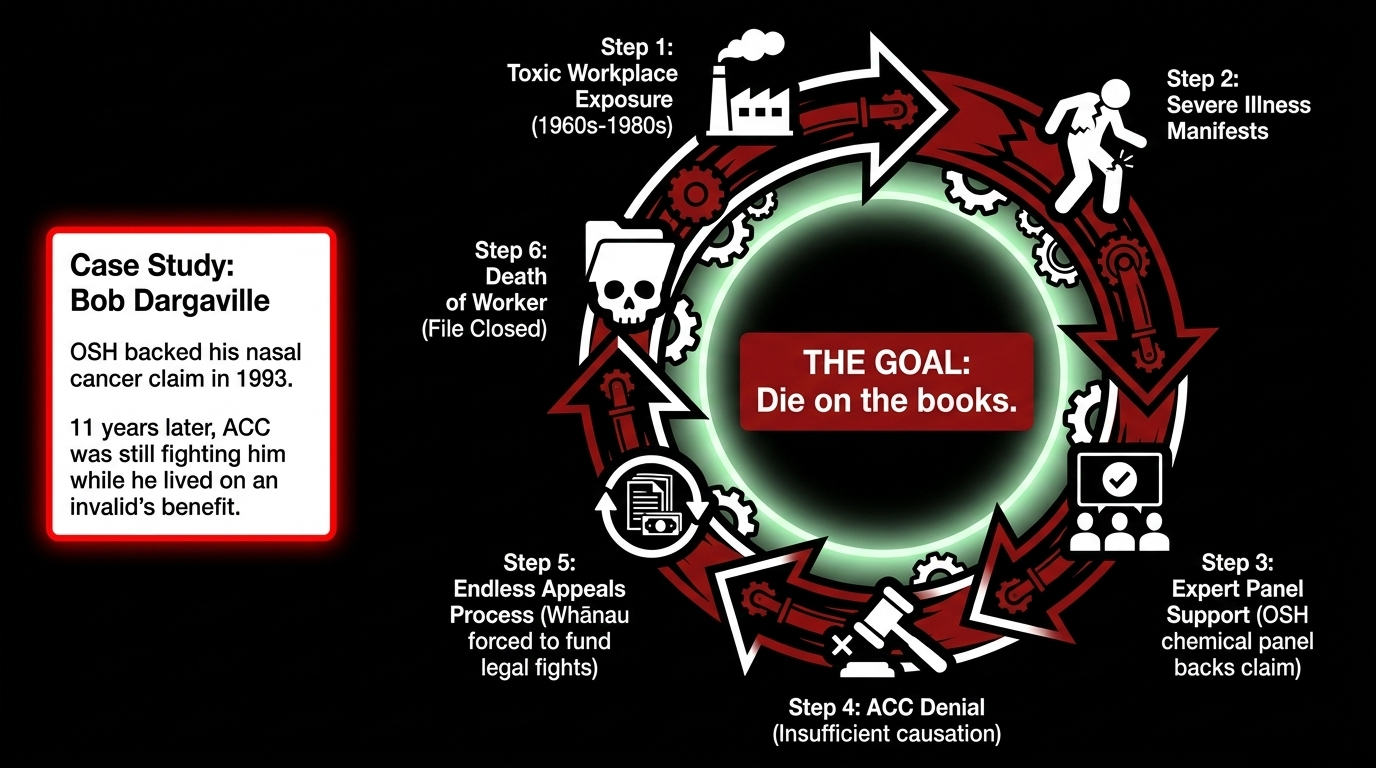
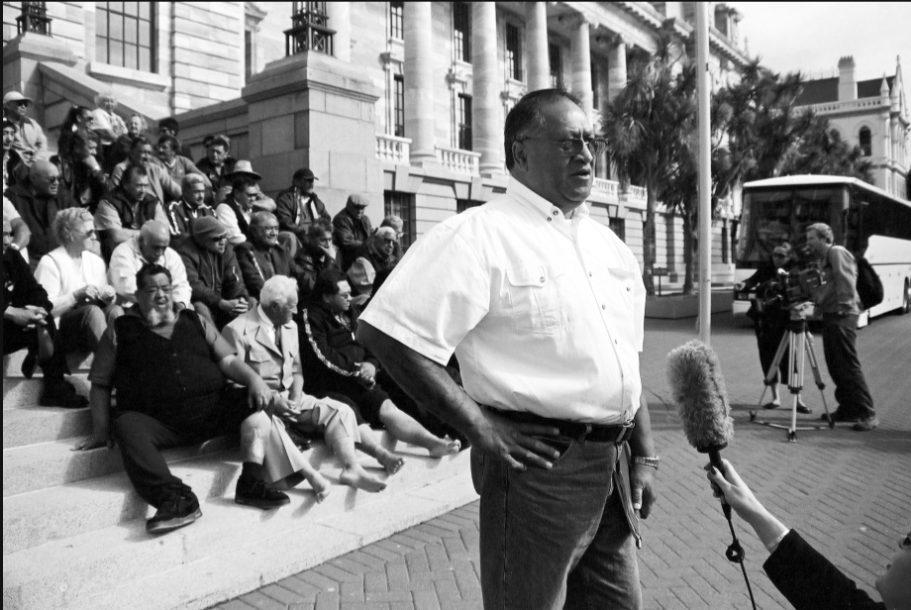
Joe Harawira fought for years to force recognition that PCP, dioxins, and furans had damaged workers, whānau, and whenua, yet Te Ara records that ACC refused workplace compensation because the illnesses could not be definitively linked to employment.
The Deep Dive Podcast
Listen to a lively conversation between two hosts, unpacking and connecting topics in the sources of this essay.
That phrase — could not be definitively linked — is the bureaucrat’s rosary bead. Roll it through the fingers often enough and any dead worker can be turned into a statistical shrug.
This essay retains the core truth of the last one and drives the blade deeper: ACC was not merely passive, cautious, or “evidence-based.”
In this kaupapa, it functioned like a mausoleum clerk for a colonial economy — filing, narrowing, delaying, and waiting for men poisoned in the sawmills to die on the books.
The Machinery of Denial
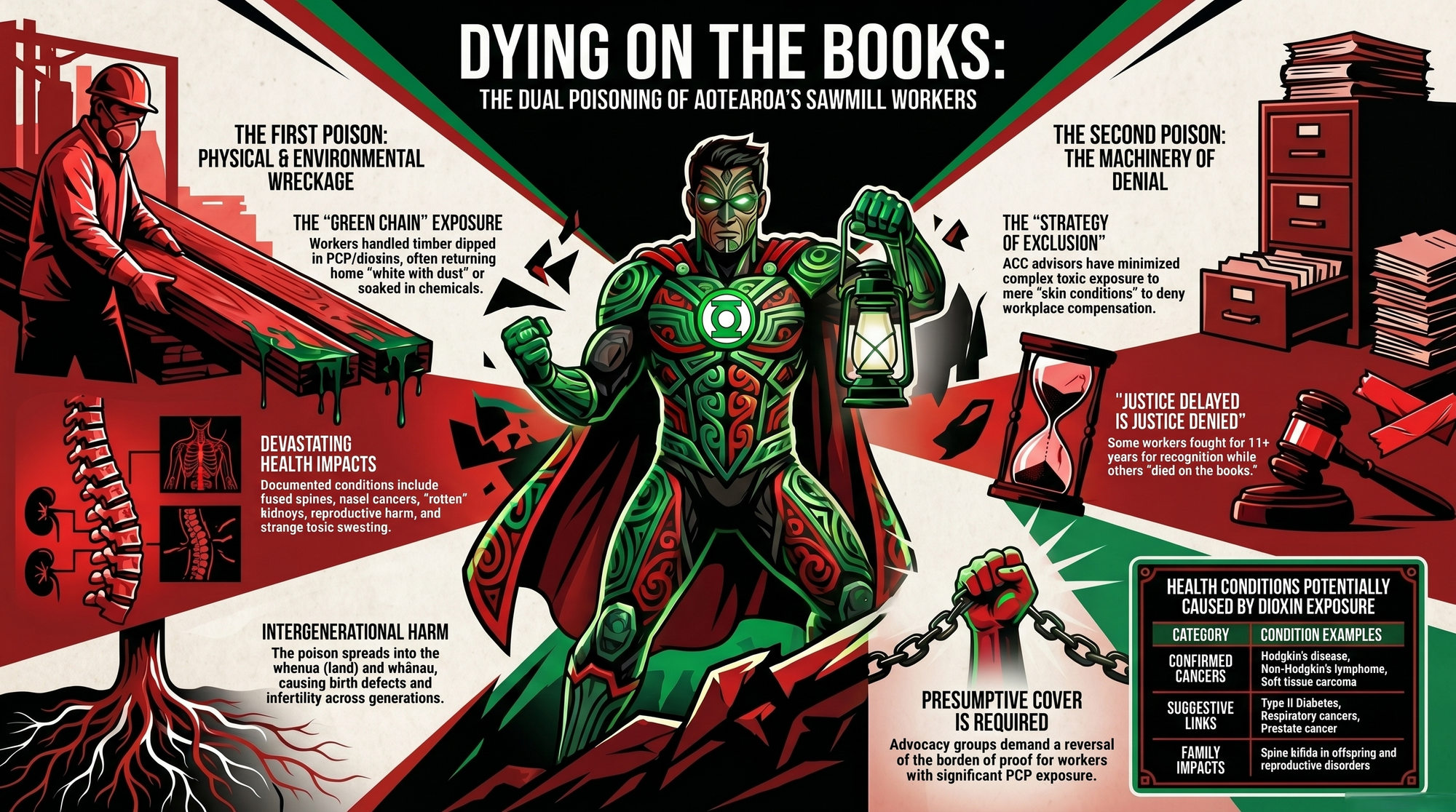
Te Ara states that Joe Harawira regarded the delay in official recognition as an abuse of human rights, and that he specifically challenged the inequities of the Accident Compensation Act 2001 because PCP, dioxins, and furans were excluded from the list of recognised causes of work-related illness.
That matters because once the toxin is excluded, the burden is thrown back onto the sick worker to prove a chain of causation the state already knows is scientifically complex, legally expensive, and humanly exhausting.
That is not neutral process. That is institutional trench warfare. The Crown dug the trench, wrote the rules for crossing it, then stood back and called the bodies in the mud “uncertain.”
The NZ Herald reported that workers had to take the long road for compensation because they did not have the money to fight in court.
Read that sentence properly.
A state-created compensation system forced poisoned workers into pathways the state knew they could not afford. That is not an access problem. That is a design feature.
And design is the key word here.
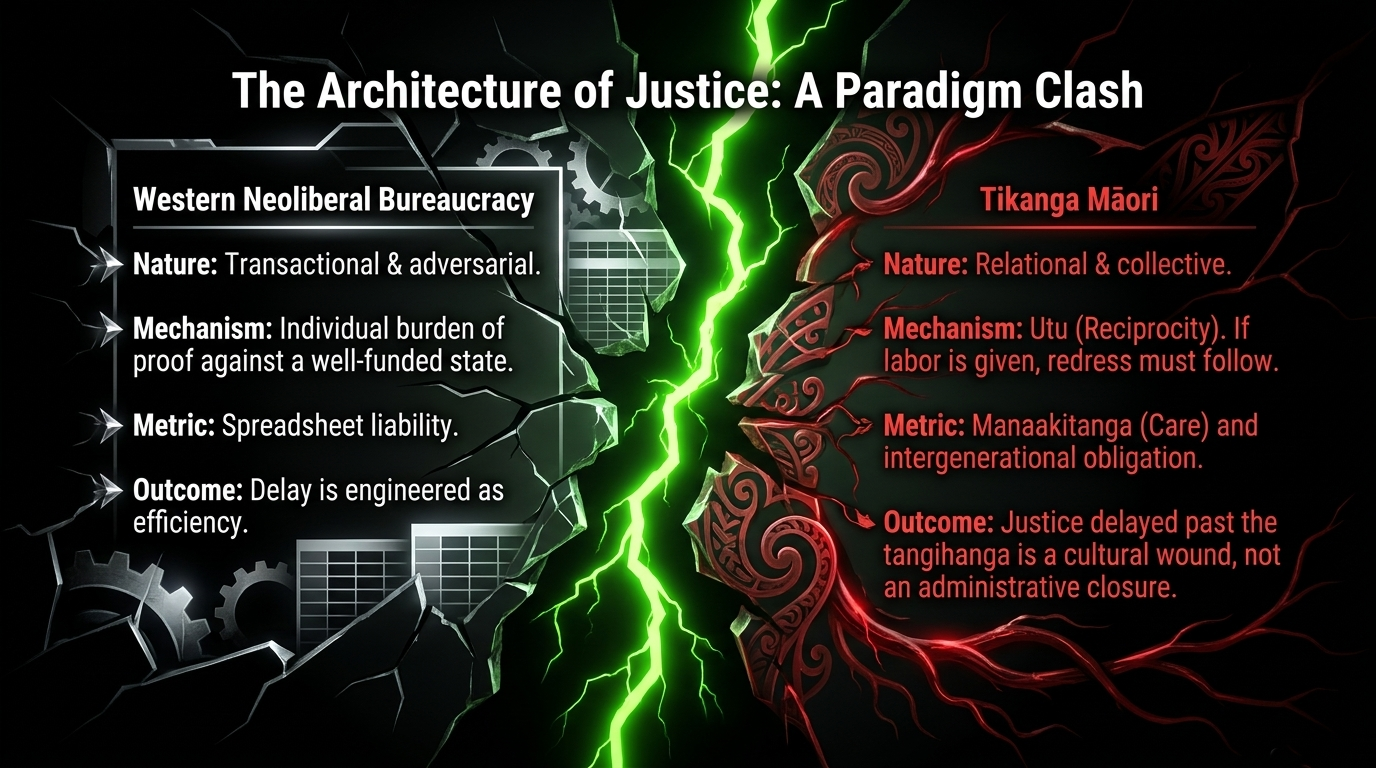
This white supremacist neoliberal state — across ministries, agencies, and decades of respectable lies — has always preferred a clean spreadsheet to a messy obligation.
If the sawmill was the furnace, ACC was the cooling room where the suffering was processed into delays, exclusions, and denials.
Science was not missing. It was managed.
The NZ Herald reported that a 2001 medical study of 62 former sawmill workers found PCP was the probable cause of health problems in about a third of cases. Te Ara likewise records that SWAP used the cohort research to focus on PCP as the probable cause of the community’s health problems. The science was not absent. The science was inconvenient.
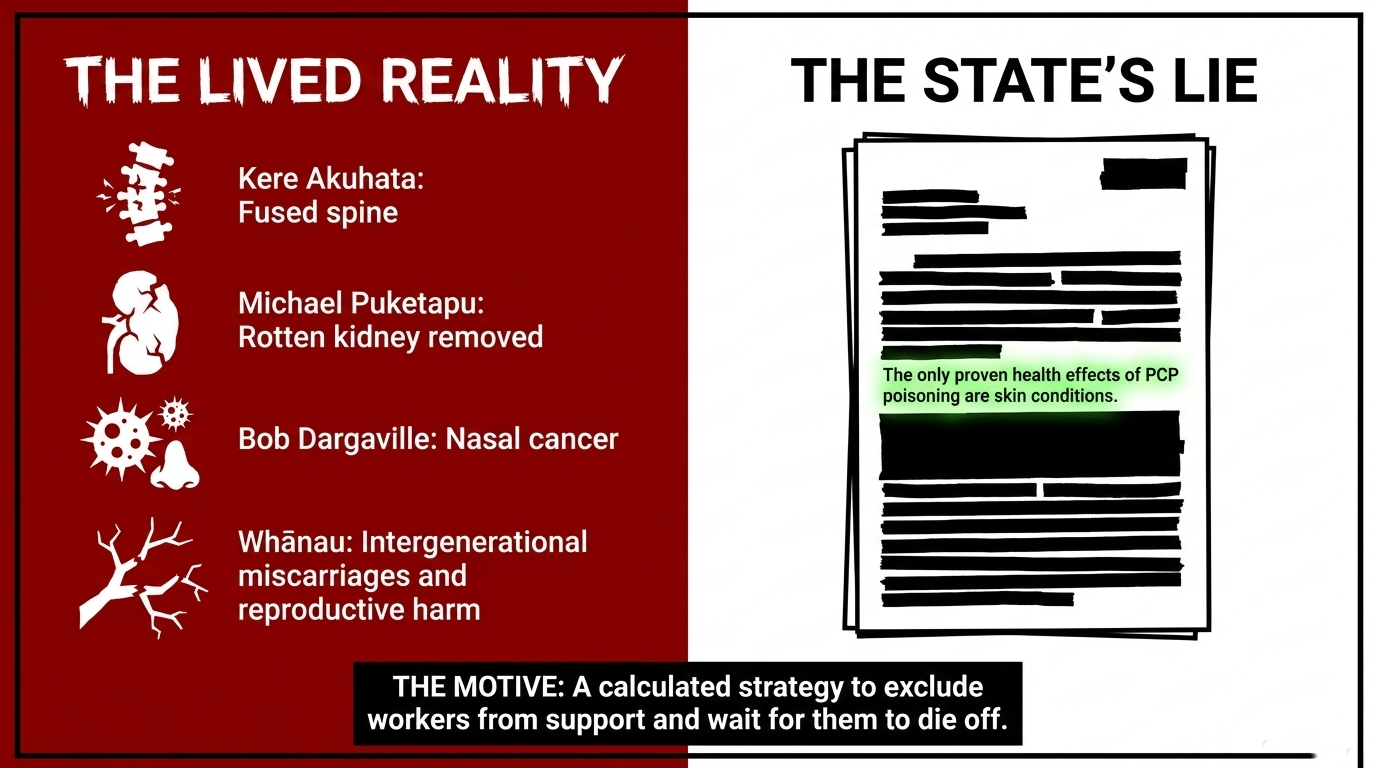
That is why Catherine Delahunty’s account in E-Tangata is so devastating.
She writes that an ACC medical advisor told SWAP the only proven health effects of PCP poisoning were skin conditions, and she identifies that stance as a strategy for excluding workers from support while waiting for them to die off. That is not medicine. That is necropolitics in a clinic coat.
When a bureaucracy shrinks cancers, heart problems, fevers, neurological damage, reproductive harm, and decades of worker testimony down to “skin conditions,” it is not clarifying the evidence. It is bleaching the blood out of the record.
Delay was not a side effect. Delay was the weapon.
A compensation system does not need to defeat every claimant in open court if it can simply outlive them.
Te Ara records that former sawmill workers were dying every year while Joe Harawira fought for recognition. The NZ Herald reported on one former sawmiller with nasal cancer who was still fighting ACC after 11 years even though an expert panel said his disease was caused by workplace exposure.
That is the real timetable of “independent assessment” under settler bureaucracy: long enough to impoverish a man, long enough to exhaust a family, long enough to make death look like administrative closure.
The file does not have to say rejected forever. It only has to say under consideration until the funeral.
The service existed. Justice did not.
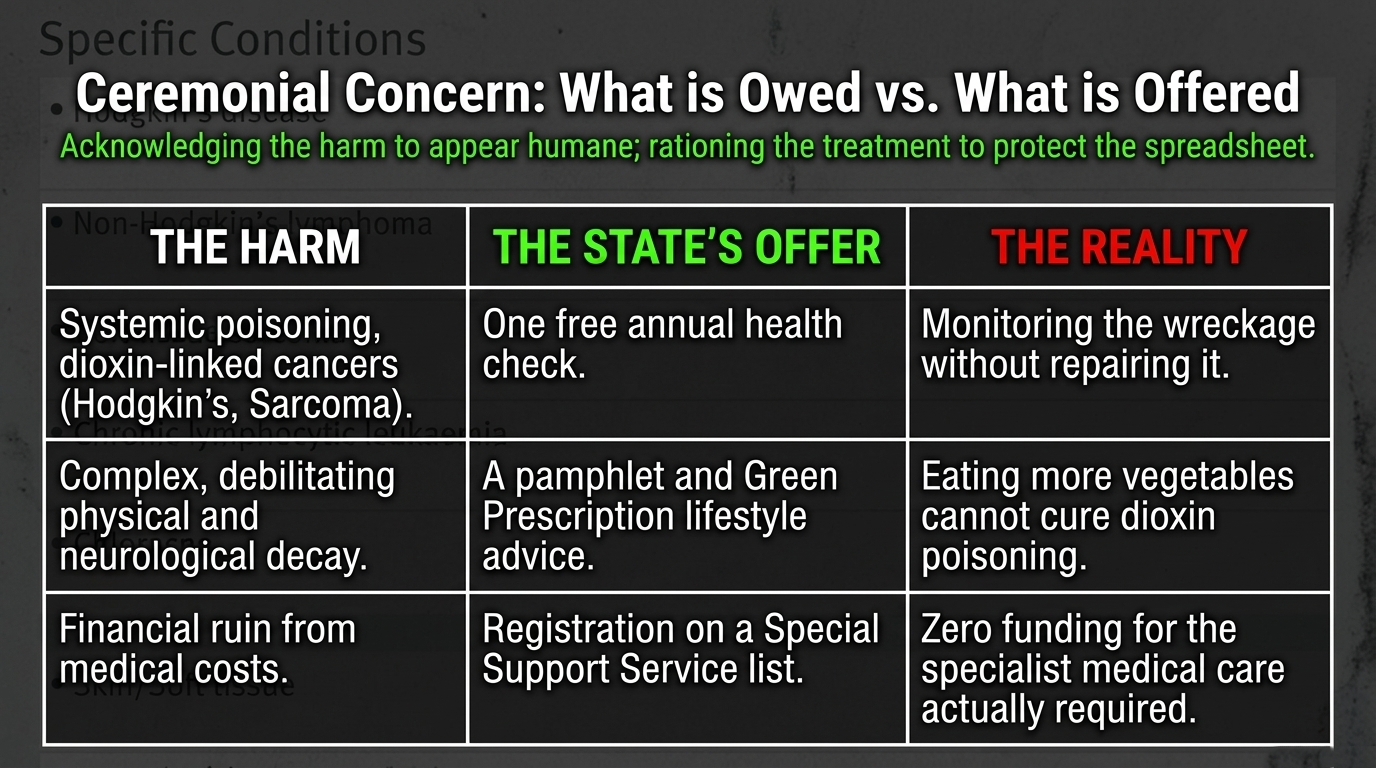
The Te Whatu Ora document for the Special Support Service for Former Sawmill Workers Exposed to PCP sets out a free annual health check focused on exposure history, symptoms, and possible referrals. The same document acknowledges links between dioxin exposure and certain cancers and conditions, and notes suggestive evidence for further harms including Type II diabetes and spina bifida in offspring.
That is the Crown admitting enough to monitor the wreckage while still withholding the full weight of remedy.
E-Tangata reports that these annual checks often amount to generic advice about healthy living while workers still cannot access the specialist care their complex conditions require.
That is the neoliberal trick in its purest form: acknowledge enough harm to appear humane, then ration treatment so tightly that recognition becomes theatre.
One annual check. One cup of bureaucratic pity. One pamphlet. Meanwhile the poison keeps billing the body.
Why the system worked against them
E-Tangata explicitly frames this struggle in terms of racism, class, and capitalism.
The workers were largely manual labourers from places like Whakatāne, Kawerau, and Rotorua, and the NZ Herald described them arriving coughing and spluttering, with headaches, depression, ulcers, diabetes, cancer, and symptoms they could not otherwise explain.
That matters because systems do not harm everyone equally. A corporation meets delay with lawyers. A working-class whānau meets delay with rent, kai, petrol, prescriptions, and a calendar that does not stop just because ACC feels unconvinced. The forms may look neutral. The outcomes are a racialised class map.
This is the western mind’s mistake when it looks at bureaucracy and sees only paper.
Tikanga sees relationship. In tikanga, if labour is given, utu must follow. If harm is done, redress must follow. If a whānau is burdened by the consequences of work that enriched others, manaakitanga and reciprocity demand response. ACC inverted that moral order. It took a relational debt and turned it into a procedural obstacle course.
The human cost was not abstract
E-Tangata records that many SWAP workers have died, that the group is much smaller than it once was, and that workers and whānau have lived with strange cancers, toxic sweating, pain, paralysis, diabetes, reproductive harm, and mental distress.
Te Ara likewise records severe stress, complex health impacts, and intergenerational effects among workers and their families.
Kereama Akuhata and Marama Cook are identified in E-Tangata as co-chairs of SWAP, still pressing ACC to recognise workplace contamination and the needs of poisoned whānau.
So this is not dead history. It is live fire inside living families.
The files remain open because the wounds remain open. That is what dying on the books means.
Three Examples for the Western Mind
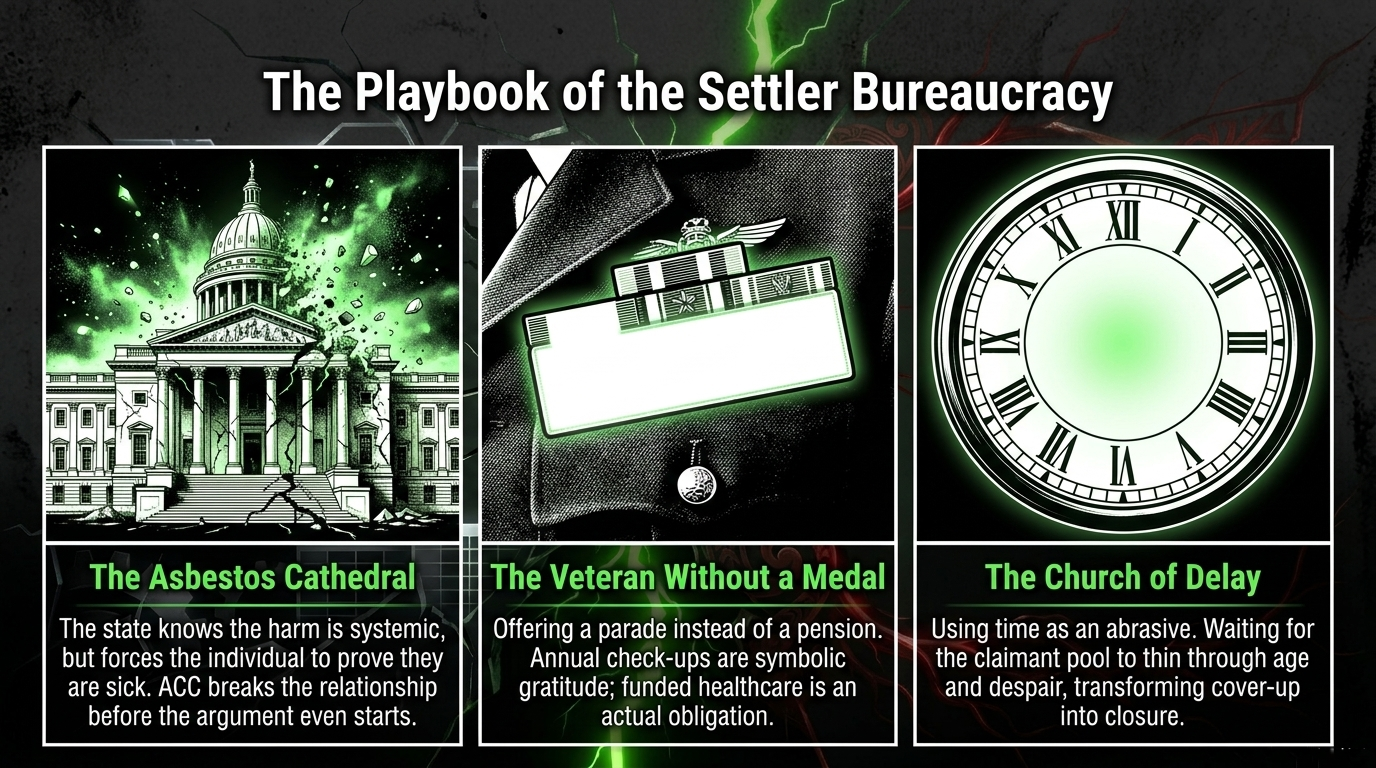
1. The Asbestos Cathedral
If a state knew workers had spent decades handling a carcinogenic substance, then narrowed the recognised harms to skin irritation while lung disease, cancers, and family harm mounted, most western readers would instantly recognise the moral architecture from asbestos scandals.
The NZ Herald reported a study of 62 former workers in which PCP was the probable cause of health problems in about one-third of cases, and the NZ Herald reported an 11-year fight for compensation even after expert support.
That is quantified harm measured not just in disease but in years stolen by process.
The tikanga impact is this: imagine a whare where one side keeps taking from the food basket and the other side is told to prove it is hungry. The relationship is already broken before the argument even starts. ACC broke utu by forcing poisoned workers to beg for what was already morally owed.
Solution: presumptive cover for all former sawmill workers with significant PCP exposure, reversal of the burden of proof, and automatic fast-track review of all historic denials linked to PCP, dioxins, and furans.
2. The Veteran Without a Medal
If soldiers came home from exposure to a toxic agent and were offered an annual check-up, some lifestyle advice, and a decade of causation disputes instead of comprehensive care, the public would call it betrayal.
The Te Whatu Ora support service document confirms the system provides annual medical checks, while E-Tangata reports there is still no money for the specialist medical support many workers need. That is not full redress. That is ceremonial concern.
For the western mind, this is the difference between a parade and a pension. One is symbolic gratitude. The other is actual obligation. Tikanga demands the second.
Quantified harm: the service exists precisely because exposure happened, yet workers still report inadequate specialist support and ongoing disputes over cover, as described by E-Tangata.
Solution: fund specialist toxic exposure clinics, travel support, multidisciplinary care, and whānau-based treatment plans rather than generic annual monitoring.
3. The Church of Delay
If a church knew abuse was systemic, then responded to survivors with delay, narrow definitions, and procedural exhaustion until the claimant pool thinned through age and despair, western institutions would call it scandal and cover-up.
That same moral pattern appears when a poisoned worker spends 11 years fighting after an expert panel backs his case, as reported by the NZ Herald, while Te Ara records workers dying every year during the recognition struggle.
Tikanga impact, translated for the western mind: if justice arrives after the tangihanga, it is not justice. It is paperwork laid on a coffin. Delay becomes a cultural wound because it denies not only money and treatment but dignity, reciprocity, and the proper restoration of mana.
Quantified harm: one former sawmiller fought 11 years; many others died while claims and recognition dragged on, as documented by NZ Herald and Te Ara.
Solution: independent public review of ACC’s handling of PCP claims, published findings, mandatory time limits for toxic exposure claims, and compensation for historic delay itself.
The Pattern The Māori Green Lantern Has Already Traced
This essay does not stand alone. It sits inside a wider architecture of punishment, denial, austerity, and anti-Māori statecraft that The Māori Green Lantern has already mapped in earlier work.
- The Traffic Light Taiaha traces how the state weaponises process and compliance language to punish the vulnerable rather than repair harm.
- The Trapdoor Prime Minister examines how neoliberal governance tears utu out of labour relations and calls the wreckage efficiency.
- The Pātaka Is Ash exposes the colonial logic of giving with one hand while structurally bypassing those most in need.
- The Van Velden Vanishing tracks the dismantling of worker protections under the cover of managerial respectability.
- The Playstation Pogrom names the broader punishment-machine logic that lets bureaucratic harm pose as public policy.
- He Hinaki Māori shows how neoliberal structures trap Māori communities inside systems dressed up as support.
Read together, these essays show the same beast wearing different skins.
In one room it is ACC. In another it is MSD. In another it is health restructuring, labour law, or fiscal policy.
But the theology is the same: starve the poor, doubt Māori, protect capital, and call it governance.
What Justice Requires
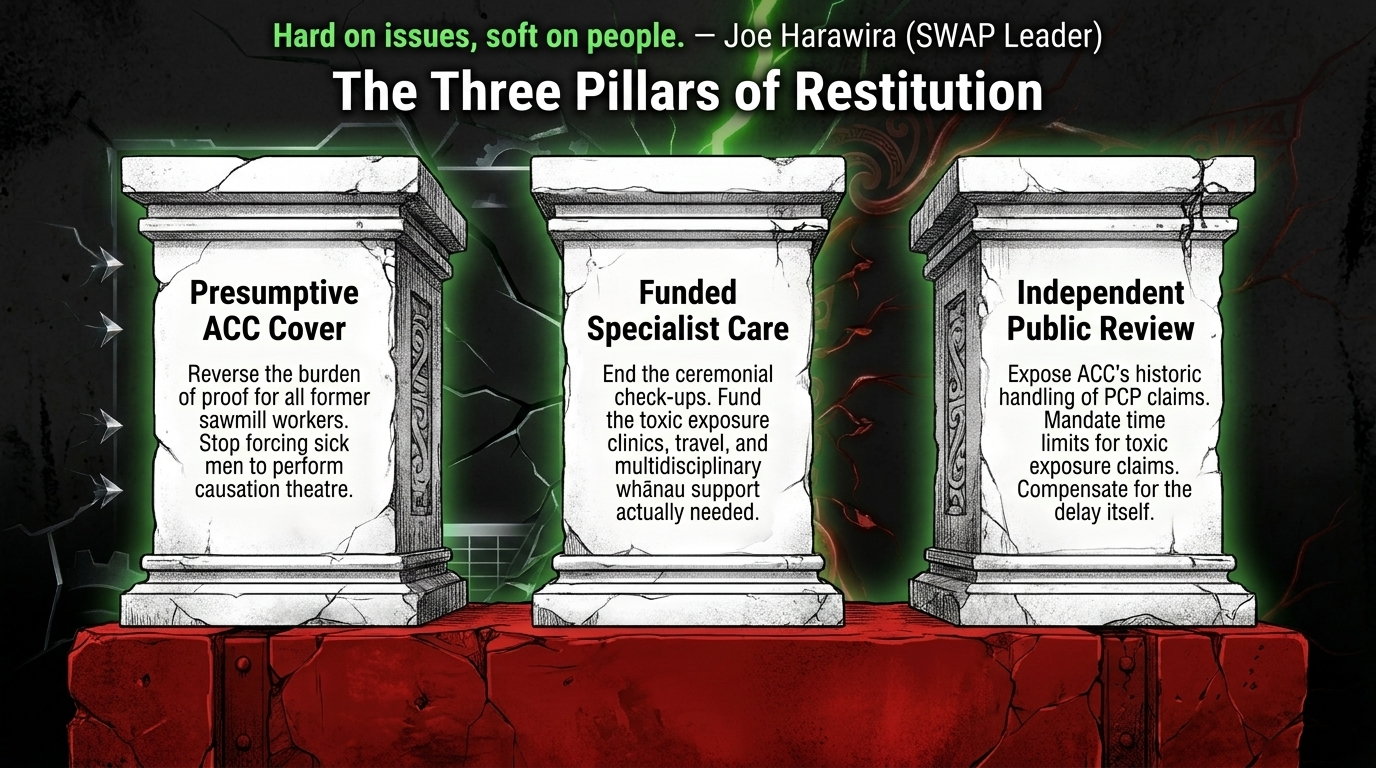
Justice here is not mysterious.
It is simply expensive to the people who caused the harm, which is why they keep pretending it is complicated.
Presumptive ACC cover for former sawmill workers exposed to PCP, dioxins, and furans, because the state already knows enough to stop making sick men perform causation theatre, as shown by Te Ara and the NZ Herald.
- Funded specialist care, not just annual monitoring and lifestyle advice, because the current service acknowledges exposure without fully resourcing treatment, as set out by Te Whatu Ora and criticised by E-Tangata.
- Whānau-inclusive support, because Te Ara and E-Tangata both make clear the harms did not stop with the worker.
- Independent review of ACC’s historic handling of PCP-related claims, including cases delayed for years after expert support, as illustrated by the NZ Herald.
- A public admission that medical minimisation was denial, because shrinking complex toxic exposure to skin complaints was not caution; it was institutional cowardice, as described by E-Tangata.
Anything less is not reform. It is tidier abandonment.
He Whakakapi
The first poisoning happened in the sawmill. The second happened in the file.
PCP entered the body like a trespasser. ACC entered the aftermath like a debt collector for the Crown, counting costs, questioning suffering, and asking poisoned workers to produce one more certificate before permission could be granted to remain human.
One corroded tissue. The other corroded hope.
And that is the art of waiting for men to die. Narrow the science. Delay the claim. Offer a check-up. Demand more proof. Hide behind thresholds. Let uncertainty do the public speaking while time does the killing.
Joe Harawira saw the system for what it was, as recorded by Te Ara. Kereama Akuhata is still fighting the same beast, as described by E-Tangata.
The only remaining question is whether Aotearoa is finally prepared to call administrative cruelty by its proper name.
Tautoko Mai | Support This Mahi
Every koha for this essay says something simple and sharp:
poisoned workers should not have to die proving what the Crown already knows.
It says rangatiratanga includes funding our own truth tellers when Crown agencies, corporate lawyers, and ministerial press releases are all invested in forgetting.
If koha is not possible right now, subscribe, follow, kōrero, and share this essay with your whānau and friends at The Māori Green Lantern — that is koha too.
Four pathways exist:
- Koha direct: Support the Māori Green Lantern
- Subscribe for essays: Subscribe to the Māori Green Lantern
- Direct bank transfer: HTDM — 03-1546-0415173-000
- Facebook: Follow and subscribe on Facebook
Join the Māori Green Lantern at the next essay, which leaves the filing cabinet and walks back to the crime scene.
Essay Three — When the Whenua Bleeds
— follows the poison out of ACC’s paperwork and into Kopeopeo Canal, Whakatāne’s dump sites, contaminated marae land, and poisoned water, where the Crown’s environmental cowardice is written directly into the body of Papatūānuku, as recorded by Te Ara and the SWAP submission to the People’s Inquiry.
Research verified against Te Ara, E-Tangata, NZ Herald, NZ Herald, and Te Whatu Ora.teara.govt+4