"Swimming In Their Sea: How A White Supremacist Neoliberal Government Sold A Kaumātua's Day In Court To Fonterra And Z Energy" - 17 September 2026
They Hand-Delivered A Law To Kill Mike Smith's Case. Then They Told Agriculture It Never Has To Pay For Seventy Percent Of Our Warming. This Is The Receipt.


He Kupu Whakataki — What This Essay Exposes
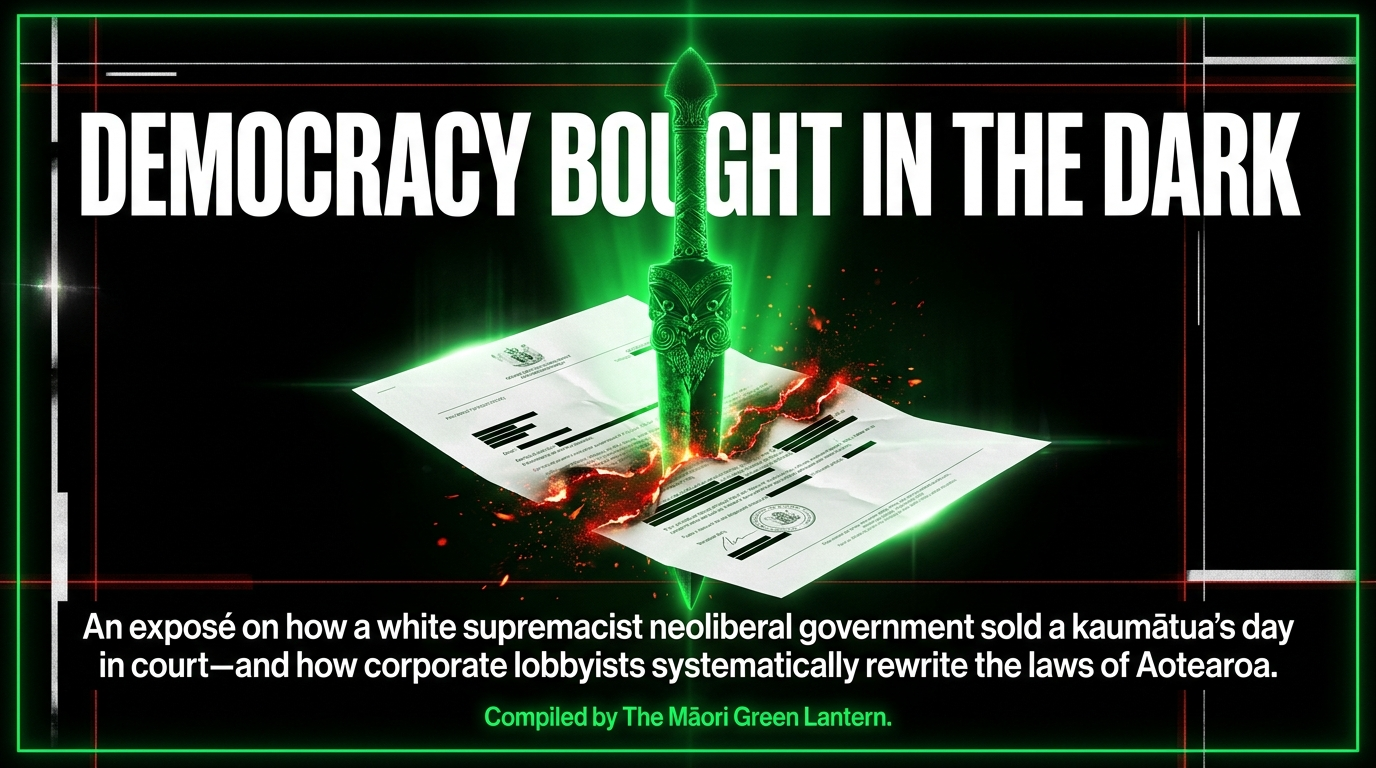
Kia ora whānau, Ivor here, and I'm angry, and I want you to be angry too
— but angry with the receipts in your hand, not just the rage in your chest, because that's the difference between me and the people I'm about to name.
 RNZ | Te Reo Irirangi o Aotearoa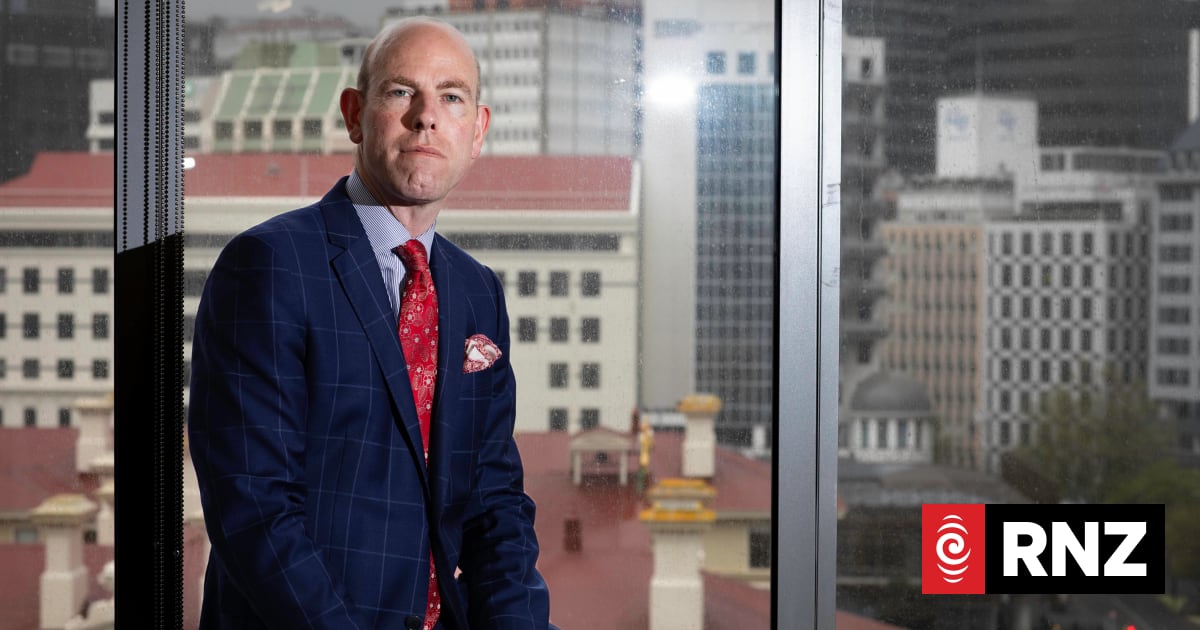
Here's what's coming: a Victoria University study just proved, in the words of 36 sitting and former MPs, ministers, and officials, that New Zealand's democracy is being bought in the dark, as RNZ's The Detail reported this week.
I'm going to show you the specific two-sentence law that Fonterra and Z Energy hand-delivered to the Prime Minister's office to kill a Māori kaumātua's climate case — a case he'd already won at the Supreme Court, according to The Post's investigation.
I'm going to show you the Official Information Act request that "forgot" to mention that document, per NZ Herald's reporting, until the Ombudsman made them admit it.
I'm going to show you Parliament's own select committee report admitting this law breaches te Tiriti o Waitangi.
And I'm going to show you the number this government hopes you never do the maths on: agriculture causes 70 percent of this country's contribution to global warming, and it will pay nothing for it until 2030 at the earliest, confirmed directly by officials in Newsroom's reporting.
This is a repository. Not just an essay — a record.
Somewhere down the track, a mokopuna is going to ask what we knew and when we knew it, and I want the answer to be: we knew, and the Māori Green Lantern wrote it down while it was happening. I'd love for you to sit with the whole kaupapa: there's a podcast where I talk through this in more depth, a short video that breaks the whole thing down if reading's not your thing today, and this — the full 3,000-word cited essay — for those of you who want every citation, every date, every number checked twice.
Use whatever gets through to your whānau. That's the point.
Te Horopaki — Why Lobbying Isn't The Problem, Secrecy Is
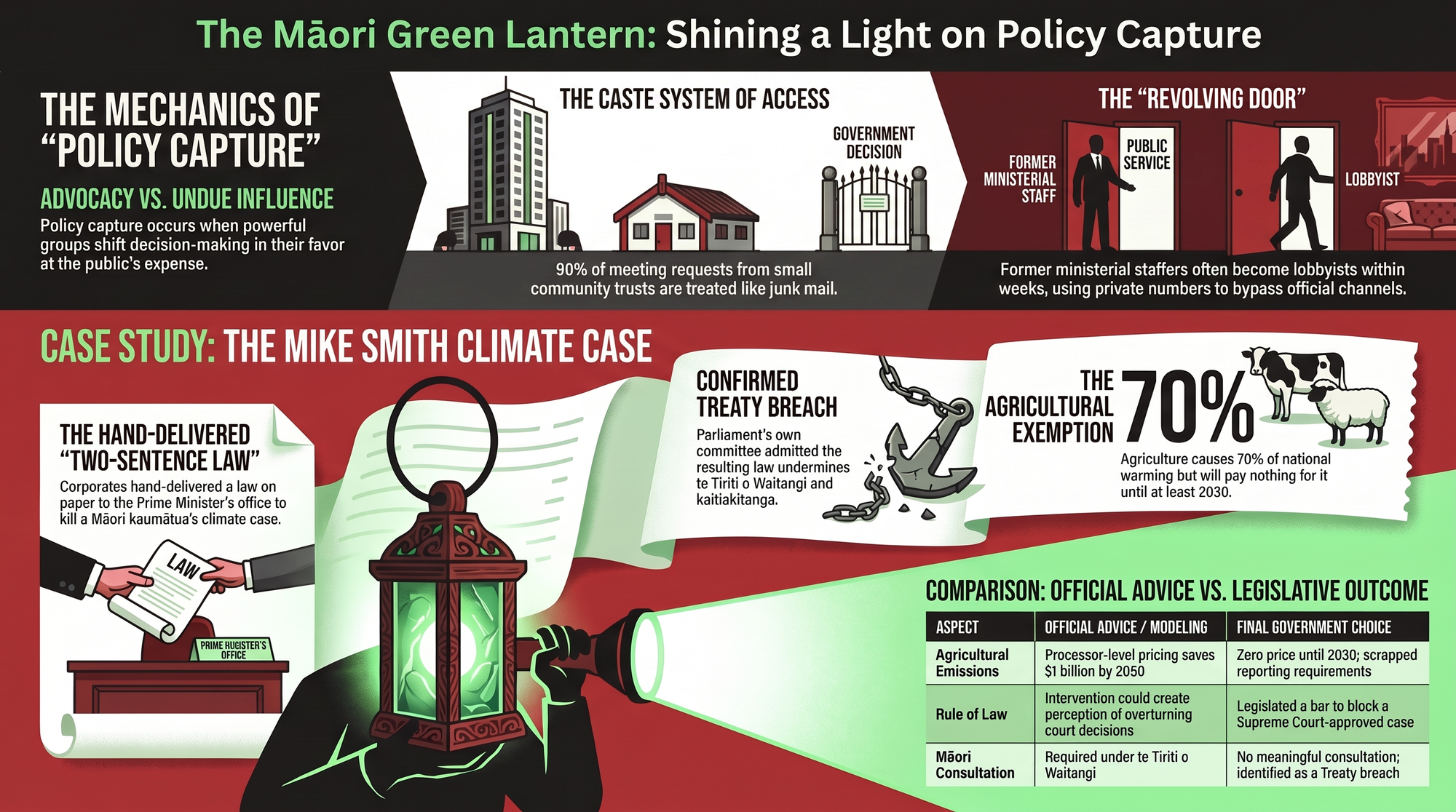
Let's be fair, because pono demands it even when I'm furious: lobbying itself isn't the crime. Iwi lobby. Community groups lobby. Researcher Max Rashbrooke says it himself in his interview with RNZ
— "the act of lobbying is a good, natural and necessary part of the democratic system." I'm not here to pretend otherwise.
What I am here to say is that when there's no lobbying register, no code of conduct, no stand-down period, and ministers can't tell the difference between a former colleague and a paid corporate mouthpiece calling from "down the corridor"
— as Rashbrooke describes in that same RNZ interview and as The Post's coverage of the study confirms
— you don't have democracy anymore. You have a market. And in that market, whānau don't have a seat.
Te Whakarāpopototanga Mātauranga — Read This Line Twice
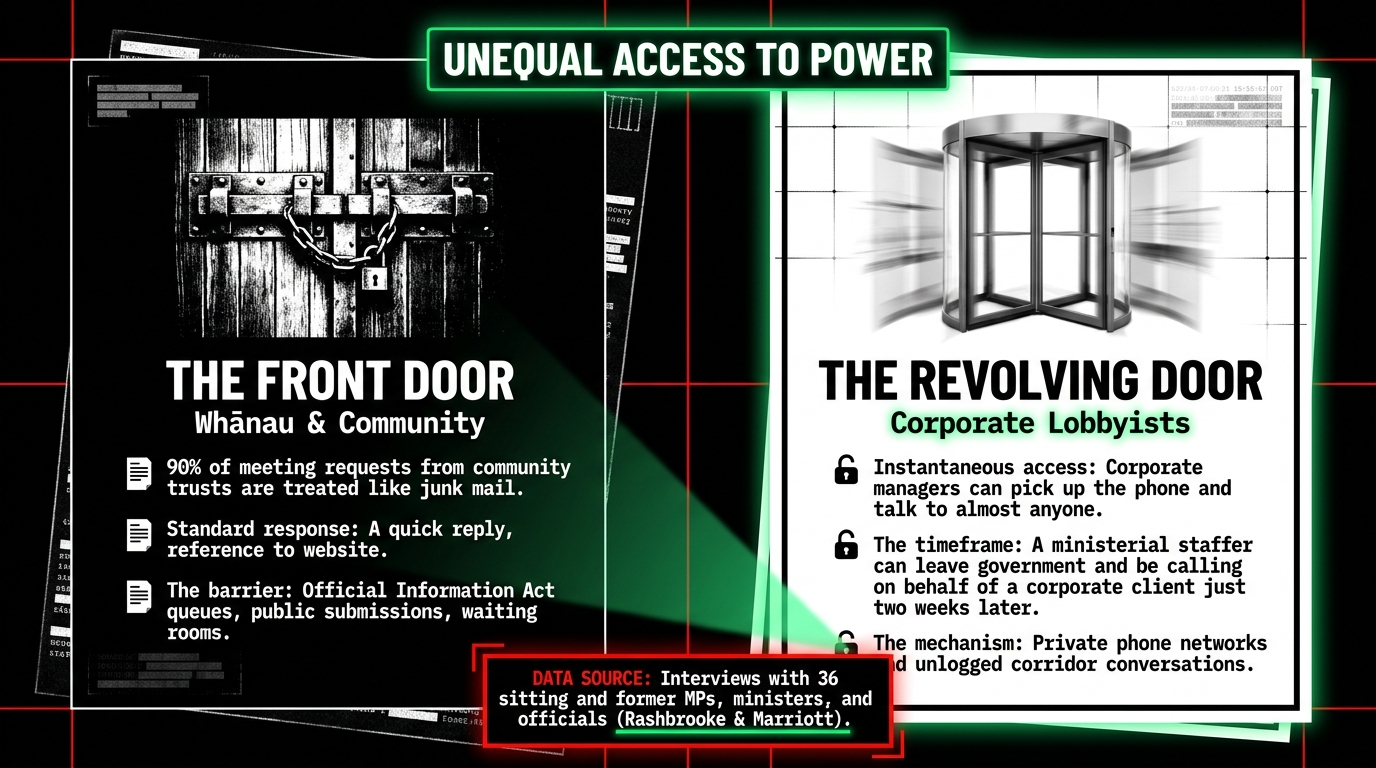
Ninety percent. That's not my number — that's the report's, straight from the mouths of ex-ministers, as documented in The Post's report coverage.
Ninety percent of meeting requests from "small community trusts looking to resolve local resilience problems" got treated like junk mail — "a quick reply, reference to website," according to that same reporting.
Meanwhile corporate managers, in one ex-minister's own words carried in that report, "could pick up the phone and talk to almost anyone." That's not an equal opportunity to influence your own country. That's a caste system with a Beehive address.
The Deep Dive Podcast
Listen to a lively conversation between two hosts, unpacking and connecting topics in the sources of this essay. I apologise in advance for the AI's very harsh pronounciation of reo. Please dont shoot me, :).
Youtube Video
Like video? Here is a short video suppporting the essay. Again, don't shoot the messenger please because of AI's pronounciation. :)
Koha — Who Pays For This?
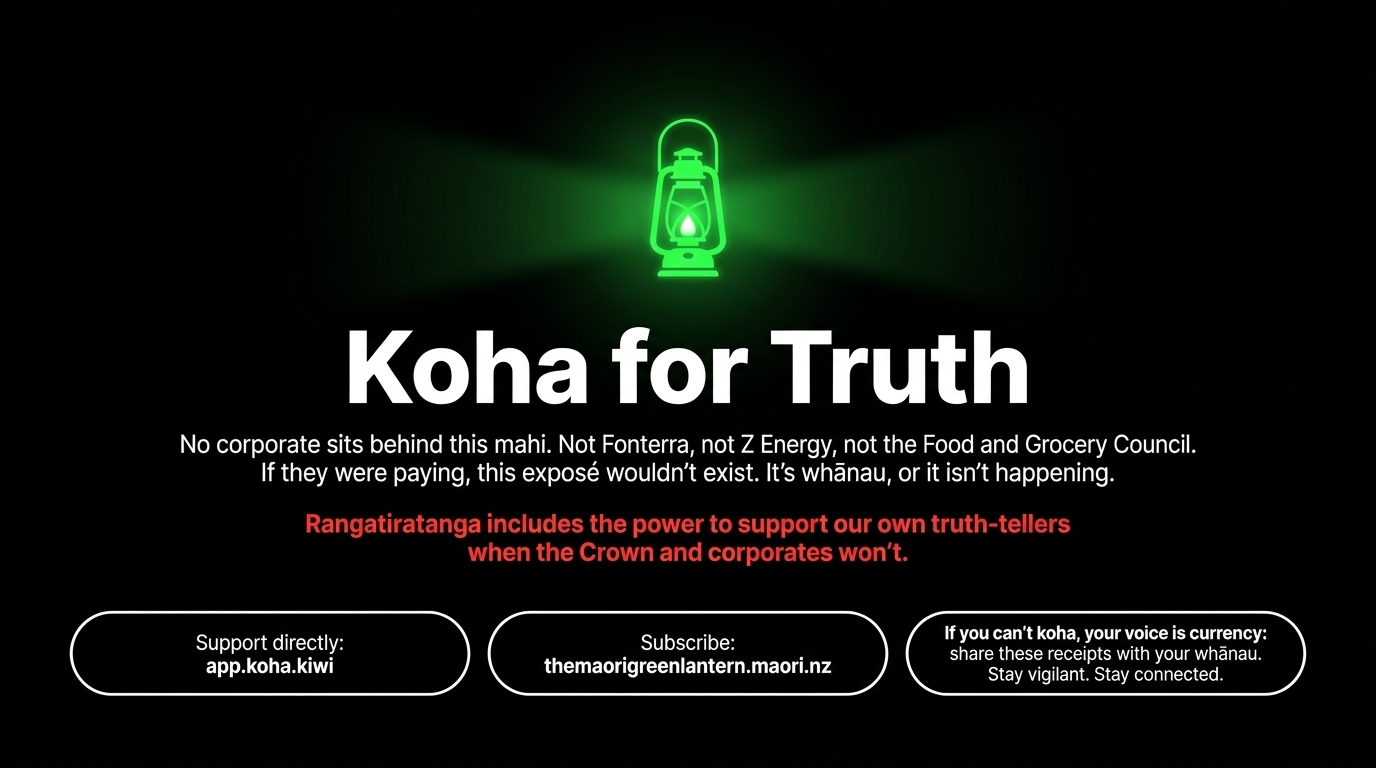
You might be wondering who's funding a lantern-wielding tohunga to chase Fonterra's paperwork through the Official Information Act and Parliament's select committee archives. Nobody. No corporate sits behind this mahi — not Fonterra, not Z Energy, not the Food and Grocery Council, none of the names in this essay. If they were paying, this essay wouldn't exist. It's whānau, or it isn't happening.
Every koha says you'd rather have the receipts than the silence. It says rangatiratanga includes the power to support our own truth tellers when the Crown and the corporates won't hold themselves accountable.
Kia kaha, whānau. Stay vigilant. Stay connected. And if you're able, consider a koha to keep this voice going.
If you can't koha, no worries — subscribing, following, and sharing this with your whānau is koha in itself.
Four pathways exist:
Koha — Support this mahi directly: app.koha.kiwi
Subscribe to receive essays directly and support through subscription: themaorigreenlantern.maori.nz/#/portal/support
Direct bank transfer: Ivor Jones, HTDM 03-1395-0099387-000
Facebook: facebook.com/Themaorigreenlantern
Te Wetewete — Six Things I Verified So You Don't Have To Take My Word For It
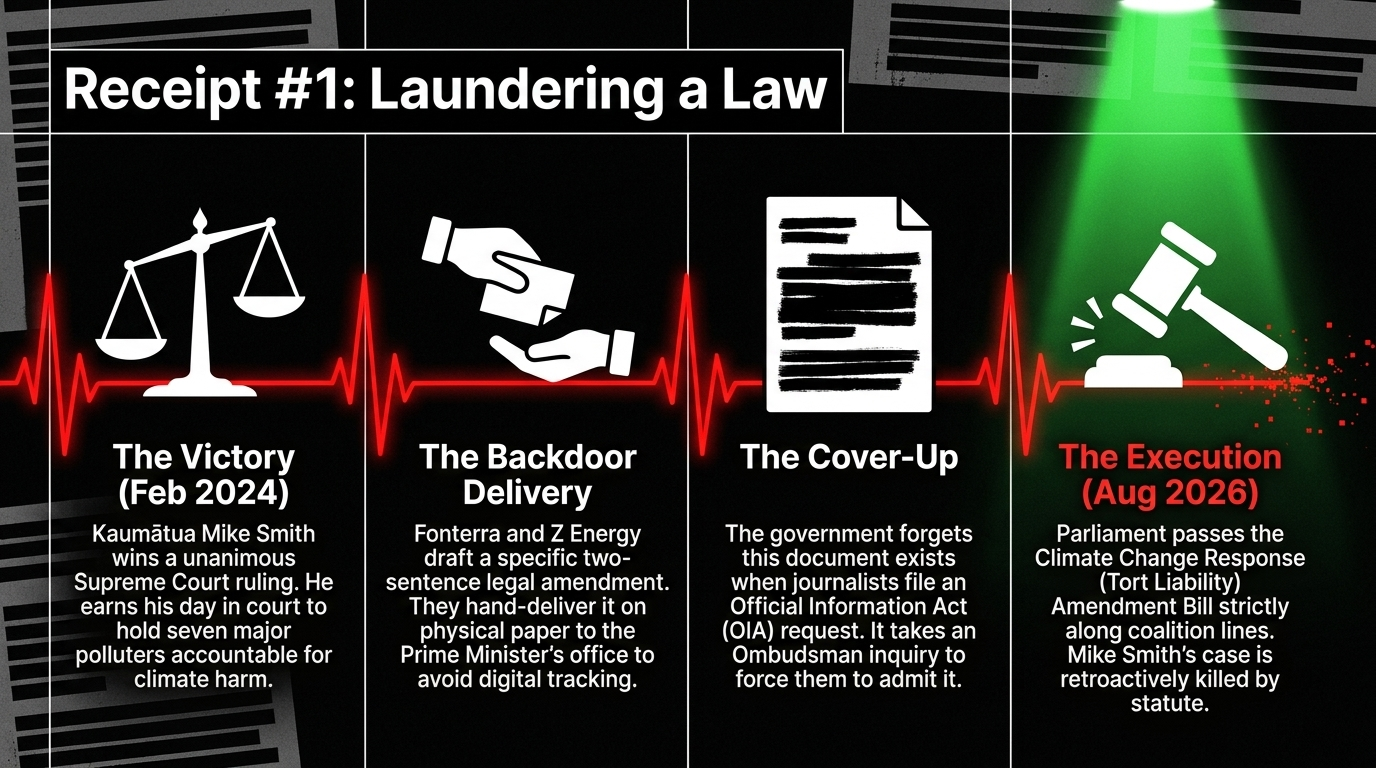
One — The Two Sentences That Killed A Man's Day In Court
Two of this country's largest corporate emitters — confirmed by The Post's investigation and independently by NZ Herald's reporting to be Fonterra and Z Energy
— wrote a specific two-sentence amendment to New Zealand's climate law, printed it on paper, and hand-delivered it to the Prime Minister's office, specifically to dodge the Official Information Act.
That's not lobbying. That's laundering a law through a photocopier so it never touches a public record.
Two — Mike Smith Won. Then They Came For Him Anyway
Mike Smith — Ngāpuhi, Ngāti Kahu, climate spokesperson for the Iwi Chairs' Forum
— took on seven of Aotearoa's biggest polluters: Fonterra, Genesis, Dairy Holdings, NZ Steel, Z Energy, Channel Infrastructure, and BT Mining, as detailed by The Law Association's case summary.
In February 2024, the Supreme Court — unanimously — said his case was arguable and tikanga Māori would be considered, in the Court's own judgment, SC 149/2021 [2024] NZSC 5, a milestone Dentons' legal alert called a breakthrough for common-law climate litigation.
When the truth about the corporate lobbying came out, Smith didn't mince words — he called it a "co-ordinated campaign of secret lobbying," per The Daily Blog's coverage.
That accusation was serious enough that even Christopher Luxon had to announce a Department of Internal Affairs investigation, running alongside a separate Ombudsman inquiry, as that same report confirms.
Read that twice. The Prime Minister had to investigate his own office over a Māori man's climate case.
Three — The OIA Request That "Forgot"
When journalists asked what contact the Beehive had with Fonterra and Z Energy, the answer conveniently left out the exact document those companies had sent, according to both Wikipedia's sourced case chronology and NZ Herald's investigative reporting.
It took a formal Ombudsman complaint — upheld by Chief Ombudsman John Allen — before that omission was even acknowledged, per the Wikipedia entry's cited sources.
If a beneficiary "forgot" a document like that on a WINZ form, they'd be prosecuted. When it's Fonterra, it's a "review."
Four — Parliament's Own Committee Wrote The Word "Treaty Breach"
This is the one I want tattooed on every press release this government puts out.
The Climate Change Response (Tort Liability) Amendment Bill was introduced 29 June 2026 and passed its first reading 30 June 2026, confirmed by Bills.parliament.nz's official record and Tompkins Wake's legal briefing. Its third reading passed 18 August 2026 by a vote of 67 to 53 — strictly along coalition lines — confirmed independently by Buddle Findlay's alert, Newswire's report, and Columbia Law School's climate blog, receiving Royal Assent 23 August 2026 and taking force the next day per Bills.parliament.nz.
Here's what makes it damning: the select committee's own published report on this bill records submitters' evidence that it "undermines te Tiriti o Waitangi and negatively impacts Māori," "undermines the exercise of kaitiakitanga," and "was introduced without meaningful consultation with Māori." Parliament's own paperwork says this. Not me. Them.
Officials had already advised against it, warning this would make New Zealand "the first jurisdiction to legislate a block of this nature," per NZ Herald's investigation.
Lawyers for Climate Action, together with Smith, the National Iwi Chairs Forum Pou Tikanga (spokesperson Tina Ngata), and Climate Clinic Aotearoa, took the fight to the United Nations Special Rapporteur on Climate Change and Human Rights, arguing the bill breaches the right of access to a court, minority rights under Article 27 of the ICCPR, and the International Court of Justice's July 2025 climate due-diligence obligations, as set out in Lawyers for Climate Action's own announcement.
Their spokesperson Laura MacKay said it plainly in their earlier press release: this "strikes at the very heart of the rule of law." An open letter opposing the bill was also signed by environmental NGOs, lawyers, climate scientists and legal academics across Aotearoa and internationally, per that same press release — I could not verify an exact signatory count in any source I fetched, so I'm not going to invent one.
Fairness demands I say this too: Justice Minister Paul Goldsmith's position, per NZ Herald's reporting, is that "the courts are not the right place to resolve claims of harm from climate change."
That's his stated view. Weigh it yourself against his own officials calling it unprecedented, and his own select committee calling it a Treaty breach.
Five — The Number They Hope You Never Check
While the country was distracted by "investor confidence," agriculture quietly walked out of the Emissions Trading Scheme entirely. The bill passed its third reading 21 November 2024, per Parliament's Hansard record, scrapping reporting requirements that Fonterra and Silver Fern Farms had held since 2011, confirmed by Newsroom's investigation, delivering on a coalition election promise from Ministers Todd McClay, Simon Watts, Mark Patterson and Andrew Hoggard as announced on Beehive.govt.nz.
Here's the number, direct from officials, not from me: agricultural greenhouse pollution is behind 70 percent of New Zealand's contribution to global warming — and it will face no price at all until as late as 2030, exactly as Newsroom's officials-sourced reporting states.
Officials' own modelling found that pricing agriculture at the processor level would have saved this country nearly one billion dollars by 2050, with benefits outweighing costs by a ratio of 1.24 to 1, per that same Newsroom investigation.
The government chose the option their own advisers said was worse. On purpose.
Six — This Was Never A Blind Spot, It Was A Choice
Don't let anyone tell you nobody warned them.
A claim about the exact same ETS agricultural exclusion has sat with the Waitangi Tribunal since 2011 — Wai 2347, specifically about Māori landowners' exemption processes under the scheme, documented in the New Zealand Women's Law Journal. A broader claim, Wai 2607, was filed by the Mataatua District Māori Council in 2016 alleging the Crown breached Te Tiriti through inadequate climate policy, per the primary filing record on Climate Case Chart and the NZ Journal of Environmental Law.
In 2023, the Wai 2607 applicants renewed their priority application, directly asking the Tribunal whether the agriculture ETS exclusion was appropriate, as recorded in the Māori Law Review's Hui Tanguru 2024 report and the Waitangi Tribunal's own filed submission — and by February 2024, the Tribunal had granted a formal Climate Change Priority Inquiry, Wai 3325, per Climate Case Chart's record.
The government legislated this exemption into permanence in November 2024 — knowing, in writing, on the record, for over a decade, that Māori had already told the Tribunal this breaches the Treaty.
Ngā Pānga — What This Actually Costs Whānau
Every year without a carbon price on agriculture is a year the bill gets handed to everyone else — to the coastal whānau watching their urupā erode, to the taxpayer covering the gap, to future generations paying for emissions priced at zero today, as Newsroom's reporting and Dentons' case analysis both make plain. Every day the tort bar stands is a day that the one legal remedy the Supreme Court itself said tikanga required be considered no longer exists — for Smith, and for anyone who comes after him, per the Court's judgment and the select committee's report.
Mō Te Hinengaro o Te Uru — Three Examples, Broken Down Plainly
Example one — Folic Acid.
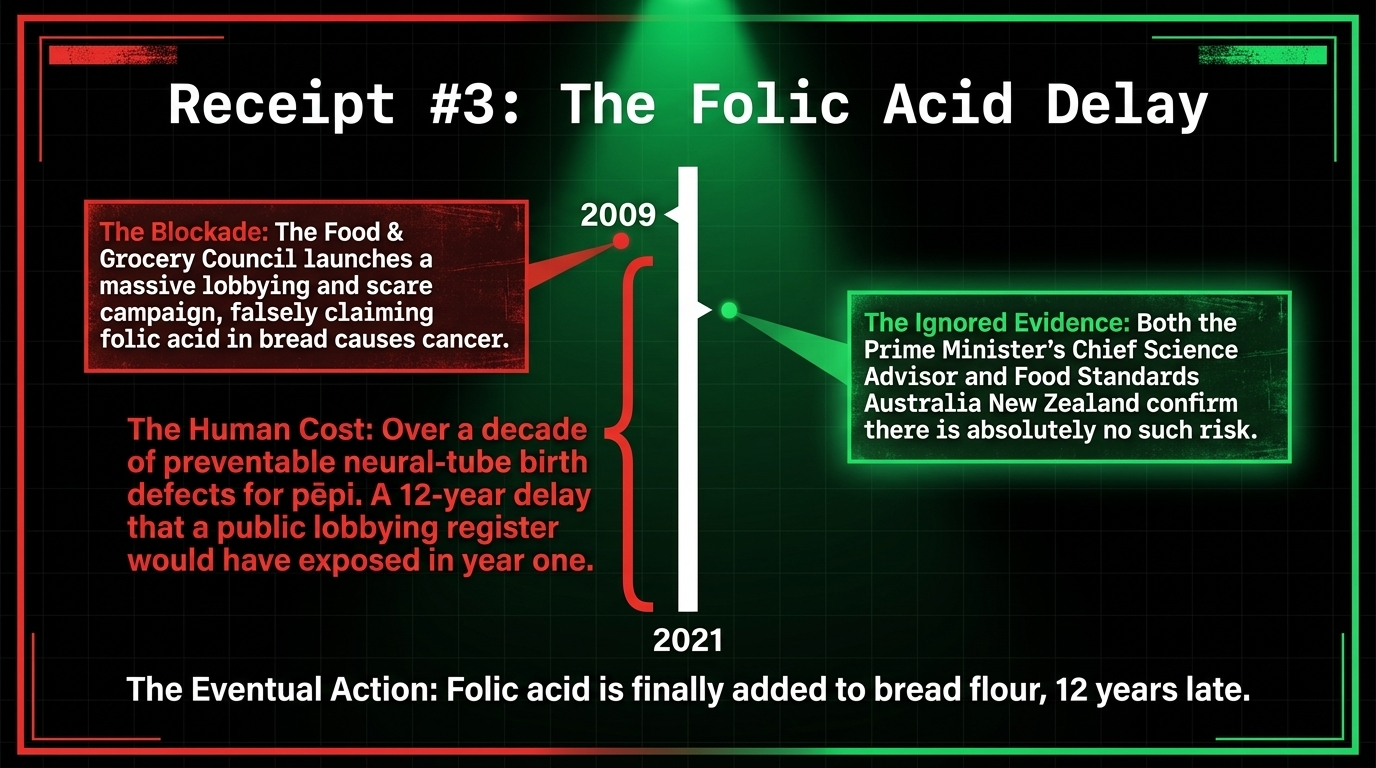
For twelve years — 2009 to 2021 — this country refused to add folic acid to bread flour because the Food and Grocery Council ran a scare campaign claiming it caused cancer, per RNZ's reporting and the Food and Grocery Council's own published history.
The Prime Minister's own Chief Science Advisor found no such risk in this dedicated review, a finding matched by Food Standards Australia New Zealand's own assessment.
Quantified harm: preventable neural-tube birth defects, every single year of that delay, per RNZ's account. Solution: a public lobbying register — the report's own recommendation, detailed in The Post's coverage — would have exposed that scare campaign in year one, not year twelve.
Tikanga impact for the Western mind: think of it as mauri poisoned at the source — decisions about pēpi and whānau wellbeing handed to an industry body's balance sheet instead of open evidence, the exact inversion of collective wellbeing over private profit.
I've written before about this same food-industry muscle strangling this country's cost of living and choice — read The Poisoned Promise: How Nicola Willis Sold You Her Own Grave Robbery As A Rescue for the sequel to this exact playbook.
Example two — The Tort Liability Bar.
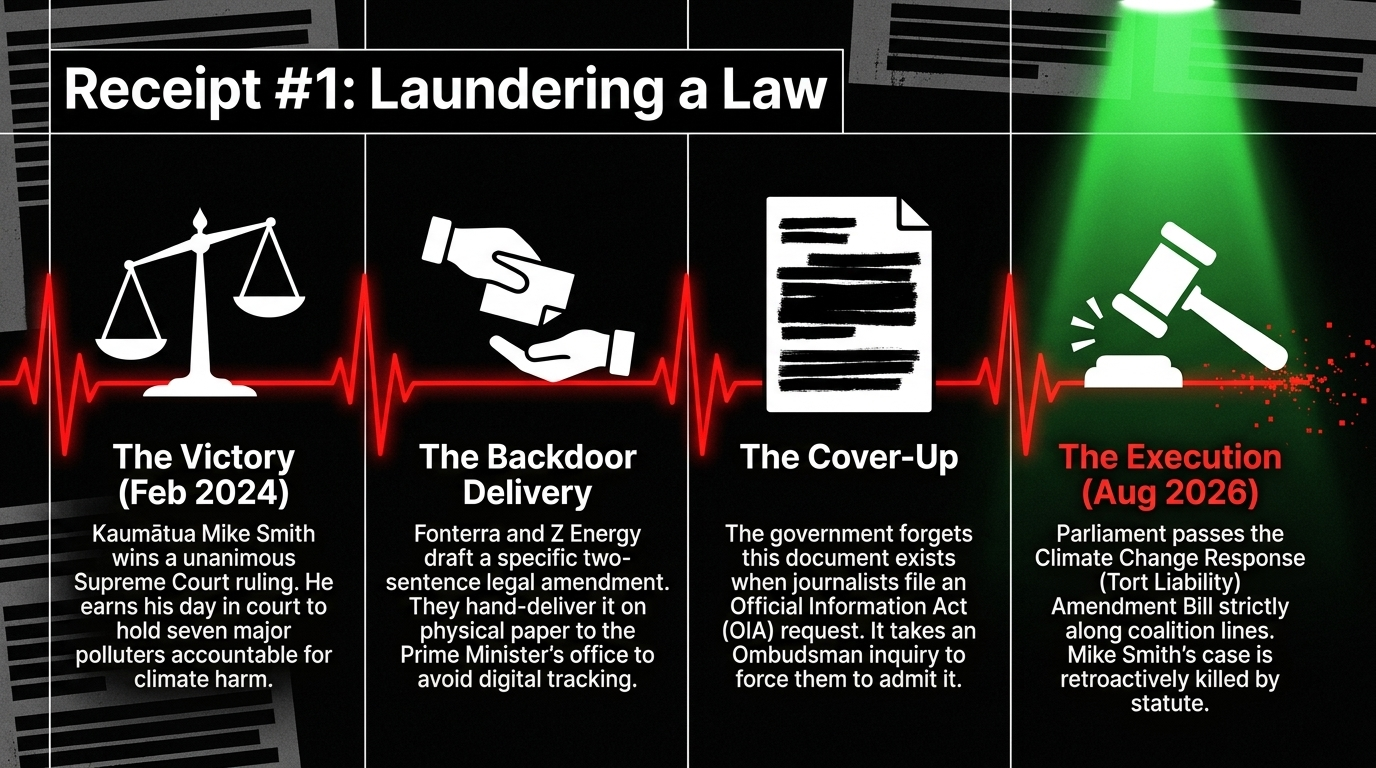
Mike Smith's case, reinstated unanimously by the Supreme Court per the Court's own judgment, was retrospectively slammed shut by a bill Parliament's own select committee admitted was rushed through without meaningful Māori consultation and undermines kaitiakitanga.
Quantified harm: not one case closed — an entire legal category of climate accountability, for every future claimant, removed by statute, per the select committee's own findings.
Solution: the UN complaint's own ask — withdraw or substantially amend the bill before it does more damage, as set out in Lawyers for Climate Action's submission.
Tikanga impact for the Western mind: picture the highest court in the land opening a door grounded in kaitiakitanga, tikanga explicitly on the record — and Parliament welding it shut two years later because two corporates asked nicely, in writing, off the books.
Example three — The ETS Exemption.
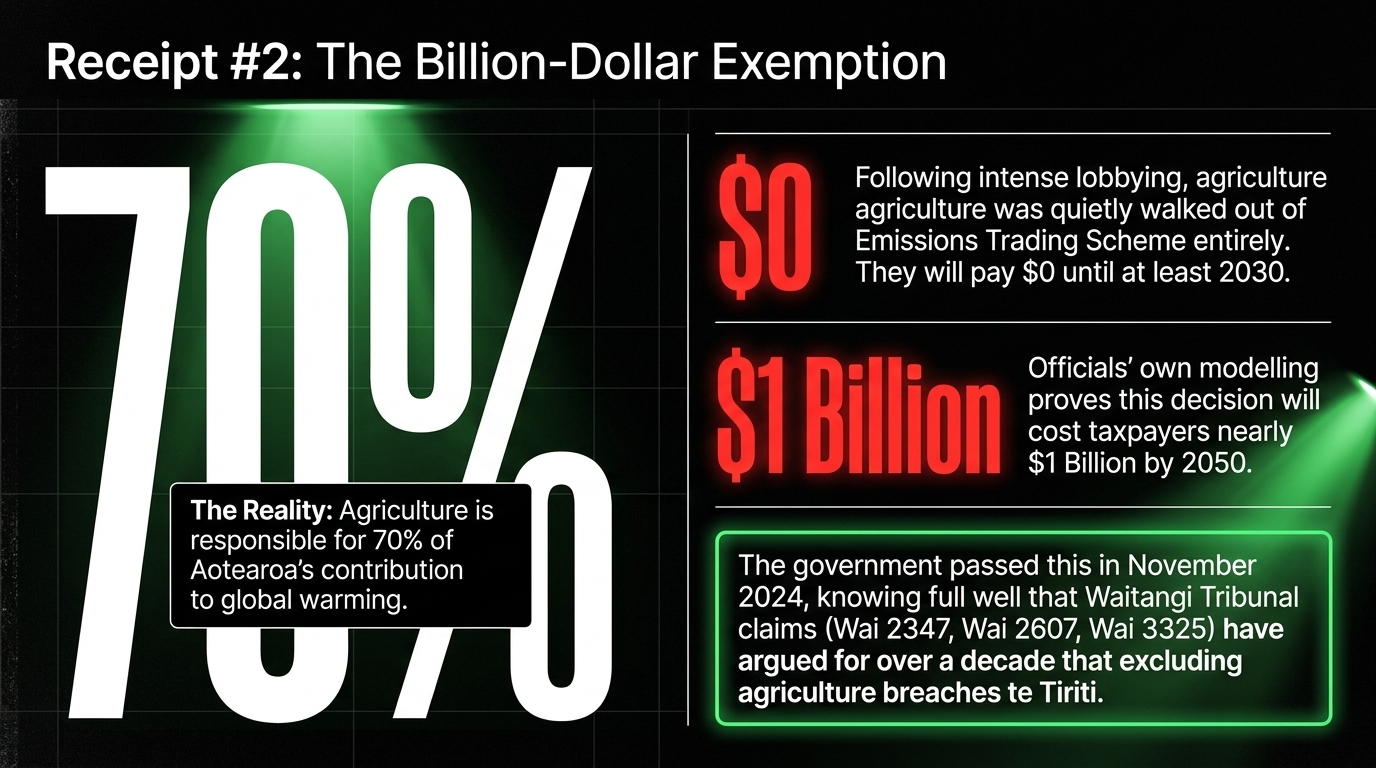
Seventy percent of national warming contribution. Zero price until 2030 at the earliest. A near-billion-dollar loss by 2050, by the government's own officials' modelling
— all per Newsroom's investigation.
A Treaty claim sitting on this exact question since 2011, documented in the New Zealand Women's Law Journal.
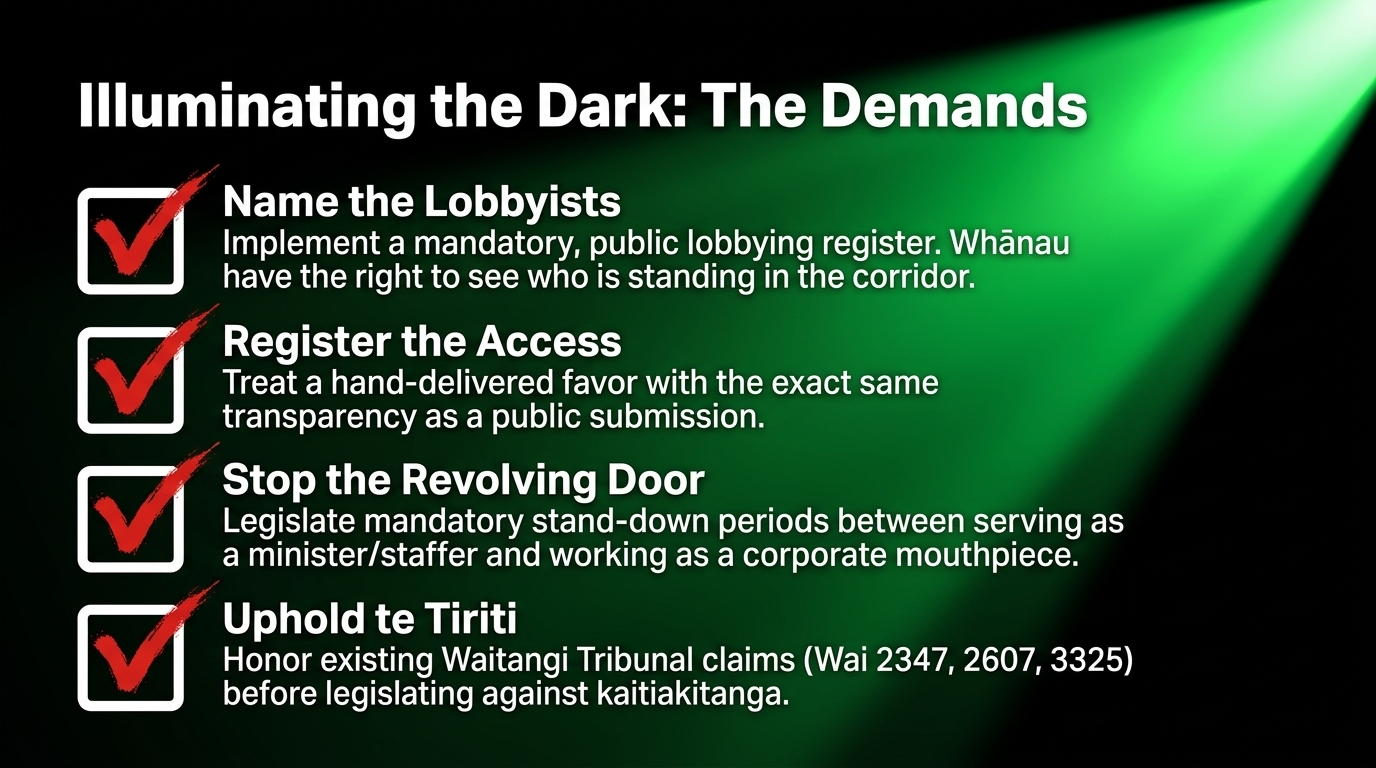
Solution: implement the pricing scheme officials already modelled, and legislate the Regulation of Lobbying Act this report recommends — a public register, mandatory stand-downs, a code of conduct, per The Post's coverage.
Tikanga impact for the Western mind: the mauri of whenua and moana doesn't wait for a 2030 deadline to degrade — it's degrading now, and the bill for that is being quietly handed to the same coastal and customary lands Mike Smith went to the Supreme Court to protect, per Dentons' case analysis and Newsroom's reporting.
Kupu Whakamutunga — Name It

Rangatiratanga means whānau get to see who's standing in the corridor before the door shuts on their case. Right now in Aotearoa, a corporation can hand-deliver a law around the Official Information Act, and a kaumātua fighting for his whenua and moana can be legislated out of his own courtroom victory — after his own government's officials warned against it, per NZ Herald's investigation, after Parliament's own committee wrote down the Treaty breach in black and white, per the select committee's report.
Rashbrooke called this country "a very long way away" from equal democratic access in his interview with RNZ.
Mike Smith called the law that ended his case "corporate protection legislation" that "closes the courthouse doors on ordinary people," per Newswire's report on the bill's first reading.
I call it what it is: a white supremacist neoliberal government choosing its donors over its Treaty partners, in writing, with a paper trail — even when they tried to avoid leaving one.
Name the lobbyists. Register the access. Stop pretending a photocopied favour delivered by hand is the same thing as public consultation.
Mark The Box - Pull The Root

If everything I've just laid bare in this essay made your blood boil then don't just be angry, mark a box on 7 November 2026.
The Green Party is the only parliamentary party campaigning directly against the exact machinery this essay exposes: their 2026 "Drink, Swim, Fish" policy commits to phasing out synthetic nitrogen fertiliser and reducing dairy and sheep numbers — the actual agricultural emissions this government just exempted from any carbon price — while their confirmed pledge to revoke coal, gold, and seabed mining consents granted under the Fast-track Approvals Act takes direct aim at the same fast-tracked, lobbyist-friendly legislative style that killed Mike Smith's day in court.
Co-leaders Marama Davidson and Chlöe Swarbrick have built their 2026 manifesto, "For All Of Us," around taxing wealth instead of taxing whānau, building 40,000 social homes, and capping rent increases — policy aimed squarely at the resourced-versus-unresourced imbalance Rashbrooke's report documented, where corporates "pick up the phone and talk to almost anyone" while community trusts get a form letter.
This is not a perfect party and I won't pretend otherwise — but on the specific rot this essay names, they are the only ones campaigning to pull it out by the root, not manage its symptoms.
Māuri Ora!
Disclaimer
Reflects publicly available reporting, Parliamentary and Tribunal records as of 17 September 2026. Facts are cited with live links; opinions are flagged as opinion. Retraction actioned promptly on verified complaint.