"They Shrank Two Million People Down To Nothing, And Called It Science" - 17 September 2026
The Empire Counted Bones And Called It A Census — And This White Supremacist Neoliberal Government Is Still Using The Same Trick On Your Whānau Today

Kia ora.
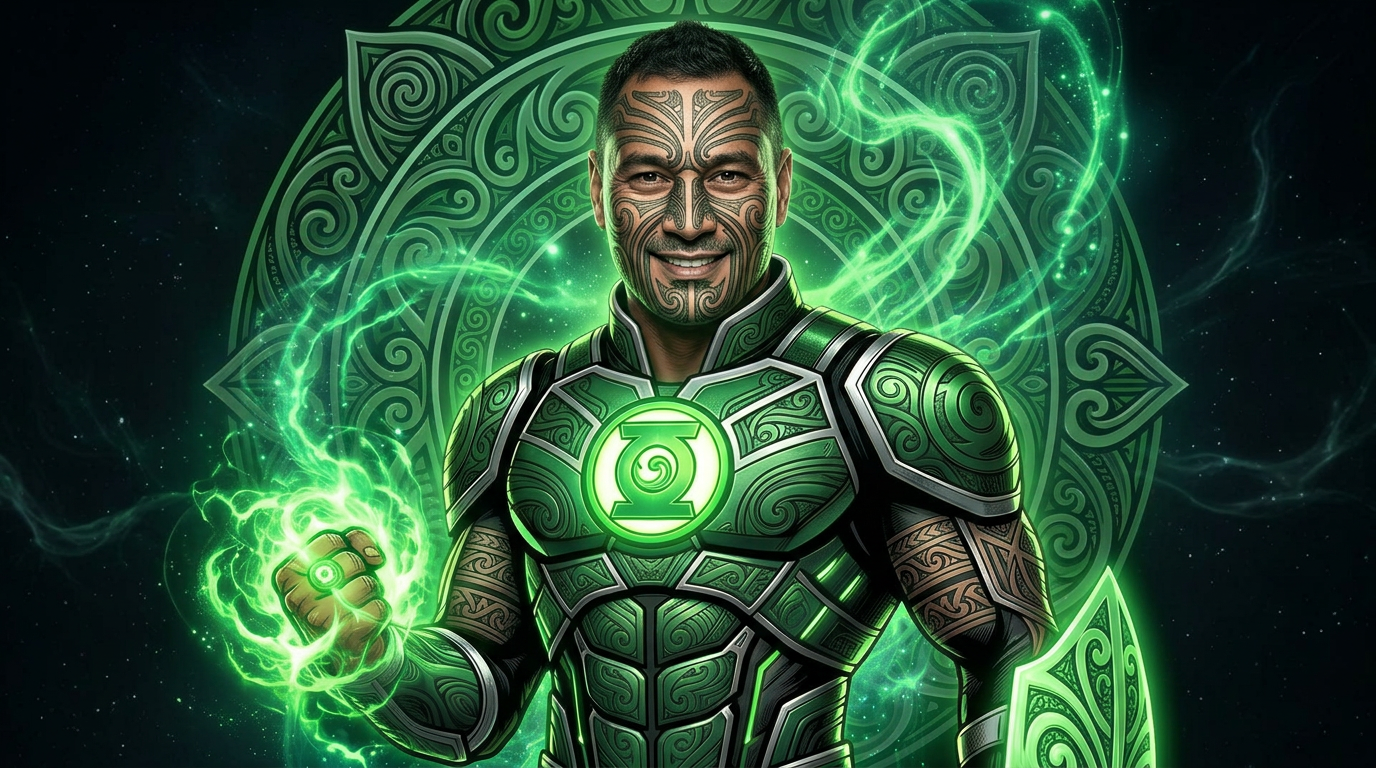
My name is Ivor Jones. I am The Māori Green Lantern.
And I need you to sit down for this one, because I am about to show you an act of arithmetic so cold, so calculated, and so profitable that it makes me want to break something.
Before You Read A Single Word Further
I want you to click on this essay properly — not skim it, read it — because it contains a wealth of information you can use in your daily life, in your kōrero with your tamariki, in your arguments at the dinner table with the uncle who still says "it wasn't that bad."
I have made you an audio podcast that walks through this entire kaupapa in detail. I have made you a short video that explains it in five minutes for the whānau member who won't read past the first paragraph. And for the long-form readers — the ones who want every number checked, every claim sourced, every fiction named — there is a fully cited essay waiting for you right here.
This is a repository. I am building it for our mokopuna, so that in fifty years, when they ask what was known and who said something, they can look back and say: at least there was the Māori Green Lantern warning us.
What This Essay Covers
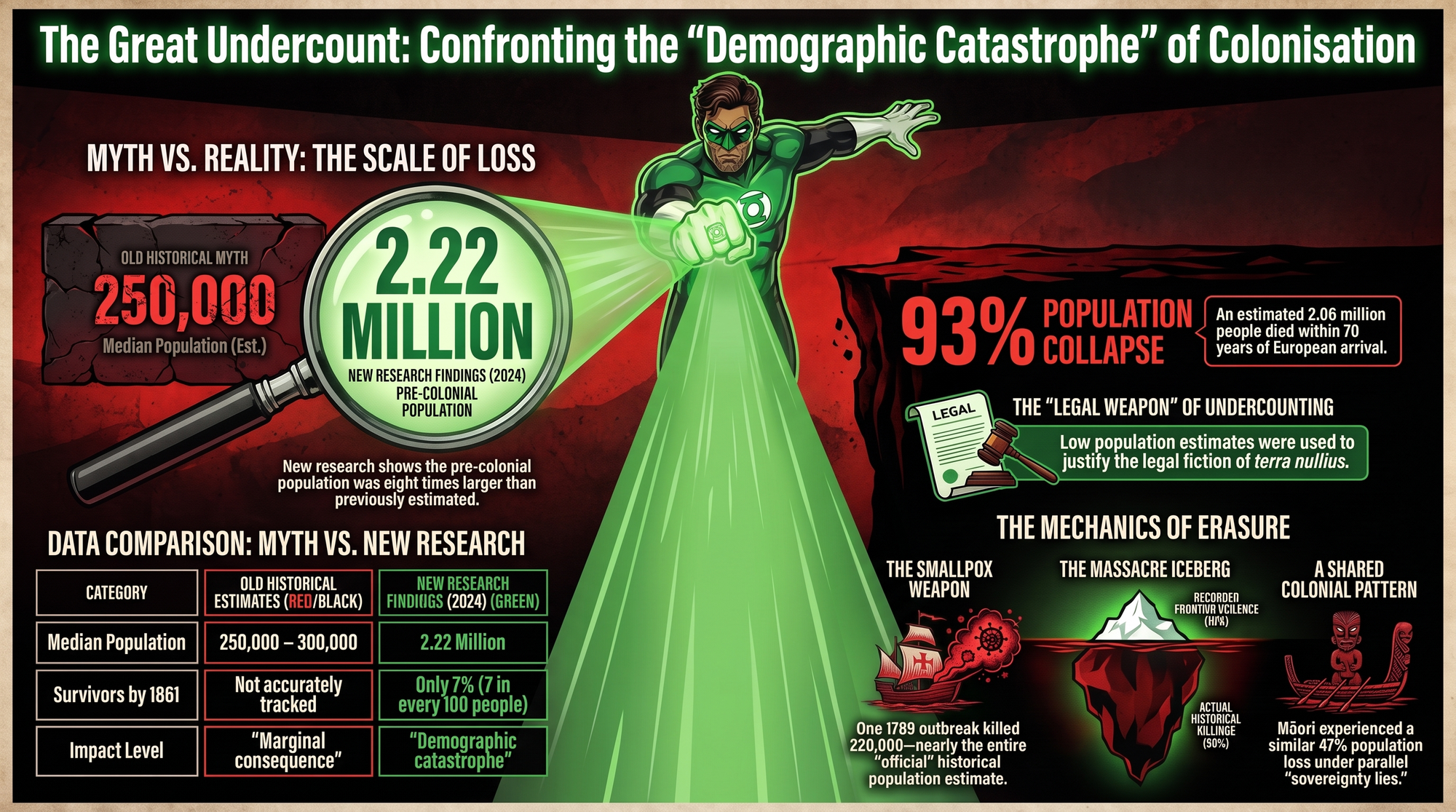
In the next fifteen minutes I am going to show you five things.
 RNZ | Te Reo Irirangi o Aotearoa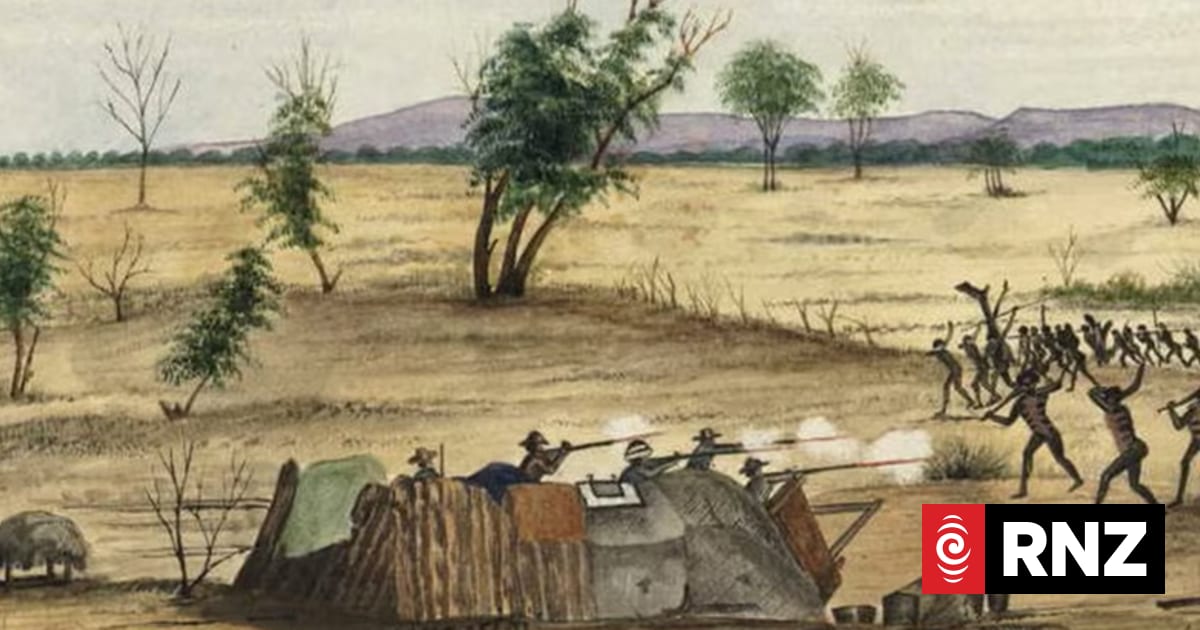
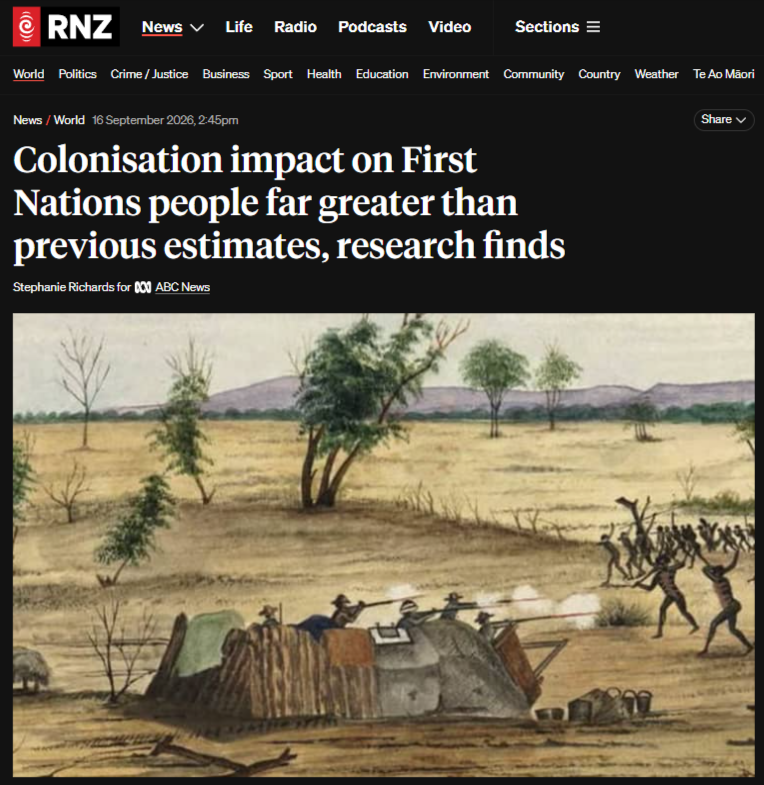
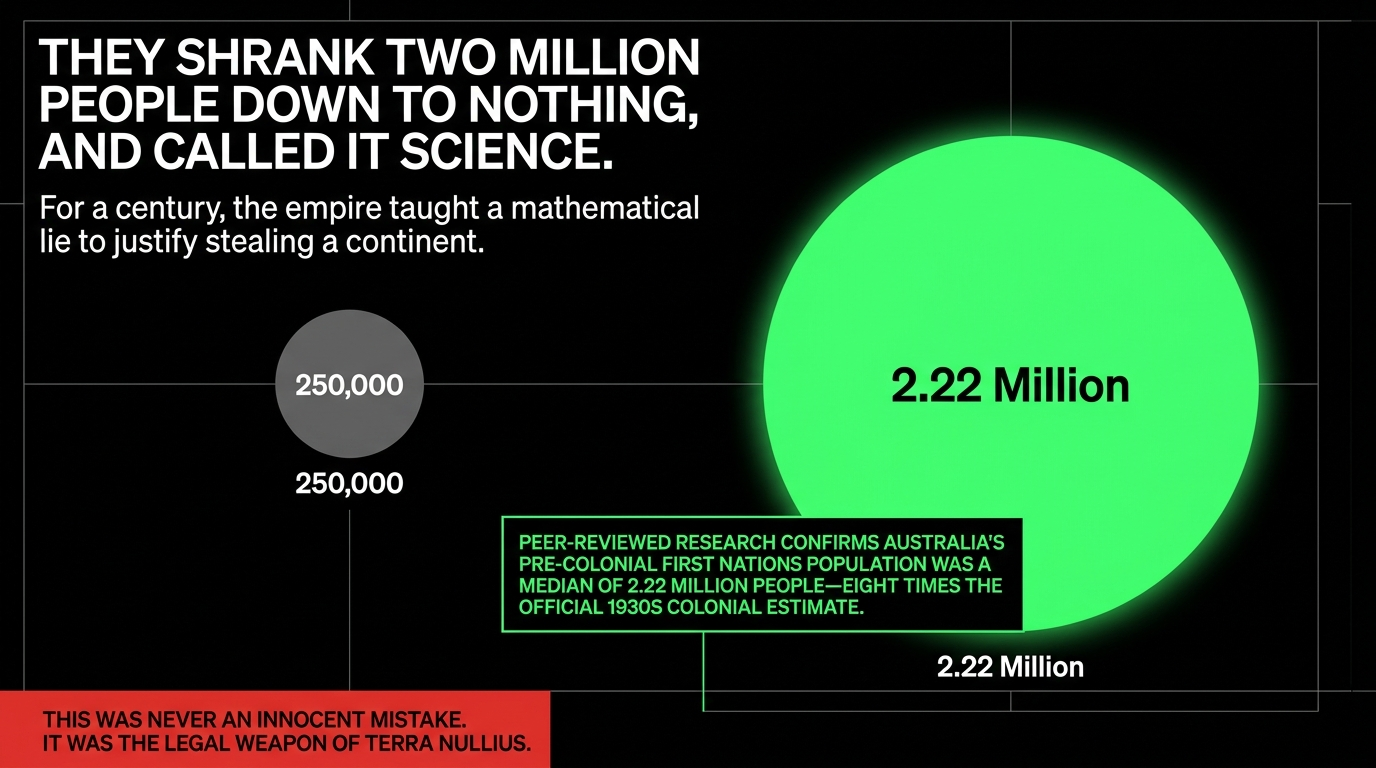
First, that new peer-reviewed research has proven Australia's pre-colonial Indigenous population was 2.22 million people — not the 250,000 the textbooks taught for a century — and that this "small number" was never an innocent mistake, it was the legal weapon that justified stealing a continent.
Second, that a single smallpox outbreak in 1789 killed up to 220,000 people on its own — nearly the entire population the old lie claimed existed.
Third, that the scientist behind this new research says massacre records we already have are likely off by a factor of ten, because most of the killing was done specifically so it would never be recorded.
Fourth, that Aotearoa ran a smaller, but structurally identical, version of the same machine against Māori — and that the sovereignty lie underneath it has never been retired.
And fifth, that this same colonial logic is not history — it is sitting in a press release from this current government right now, dressed up as "efficiency" while it guts Māori health.
The Number That Was Built To Lie
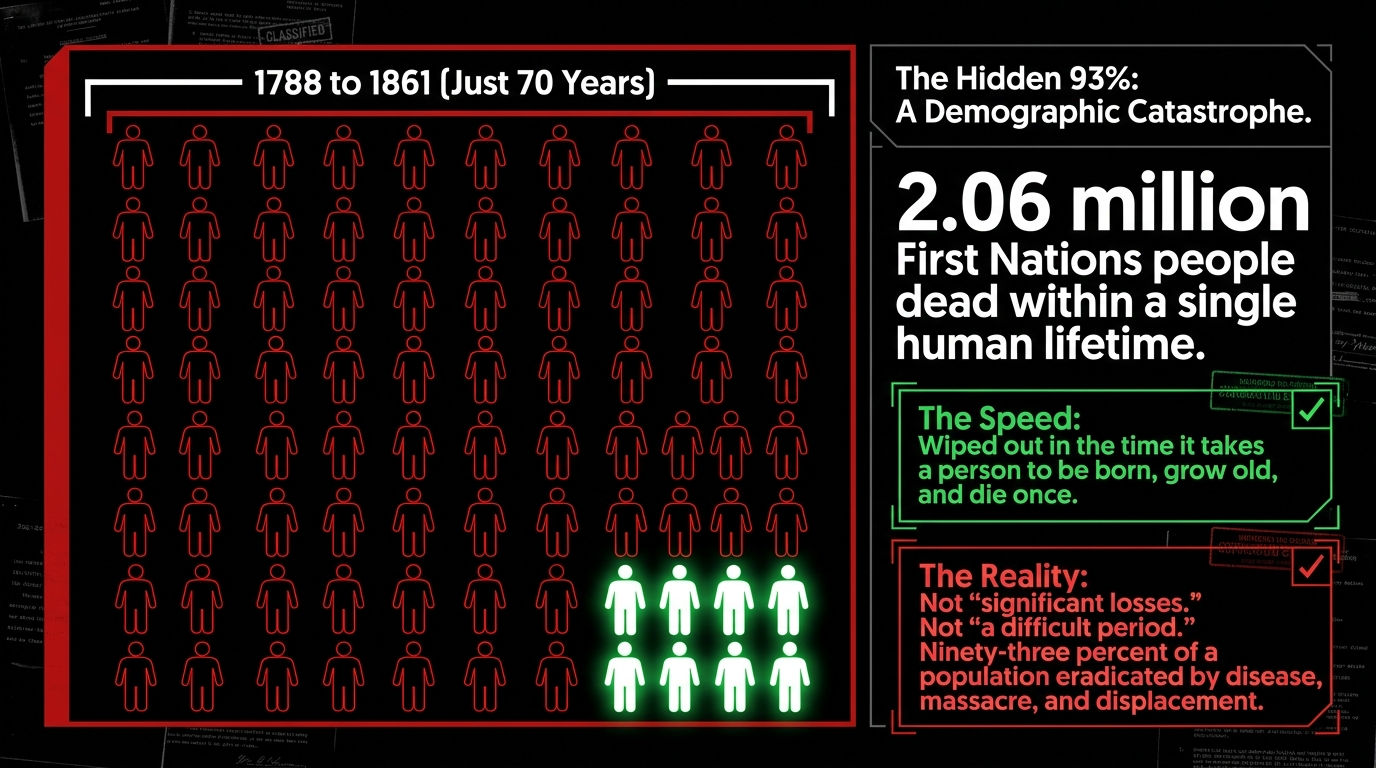
For a hundred years, every history book, every museum plaque, every government department in Australia told the same lie: only 250,000 to 300,000 Aboriginal and Torres Strait Islander people lived on that continent before 1788. That figure came from anthropologist Alfred Radcliffe-Brown in the 1930s — and even he admitted it didn't account for the disease and violence that had already gutted the population by the time anyone started counting, as Flinders University's own research release confirms.
He knew it was wrong. Nobody powerful cared enough to fix it for ninety years.
Now a national research team — led by Associate Professor Alan Williams and Professor Corey Bradshaw, working through the Australian Research Council's Centre of Excellence for Indigenous and Environmental Histories and Futures — has done what should have been done in 1930.
They ignored the colonisers' own headcounts entirely and instead combined archaeological radiocarbon dating, genetic reconstruction and environmental carrying-capacity modelling, as Flinders University explains in detail. Their answer: a median of 2.22 million people.
That is roughly eight times the number the empire has been teaching your children for a century — 2.22 million divided by the old 275,000 midpoint comes out to 8.07, near enough to call it eight-fold.
And here is the part that should make you furious.
That same research, as reported directly by The Guardian, found that an estimated 2.06 million of those 2.22 million people were dead within roughly seventy years.
Do the maths with me: 2.06 million divided by 2.22 million is 92.8 per cent. Not "significant losses." Not "a difficult period." Ninety-three per cent of a population, gone, in the time it takes a person to be born, grow old and die once. Only seven people in a hundred were left standing by 1861.
The Deep Dive Podcast
Listen to a lively conversation between two hosts, unpacking and connecting topics in the sources of this essay. I apologise in advance for the AI's very harsh pronounciation of reo. Please dont shoot me, :).
Youtube Video
Like video? Here is a short video suppporting the essay. Again, don't shoot the messenger please because of AI's pronounciation. 😄
Koha Consideration
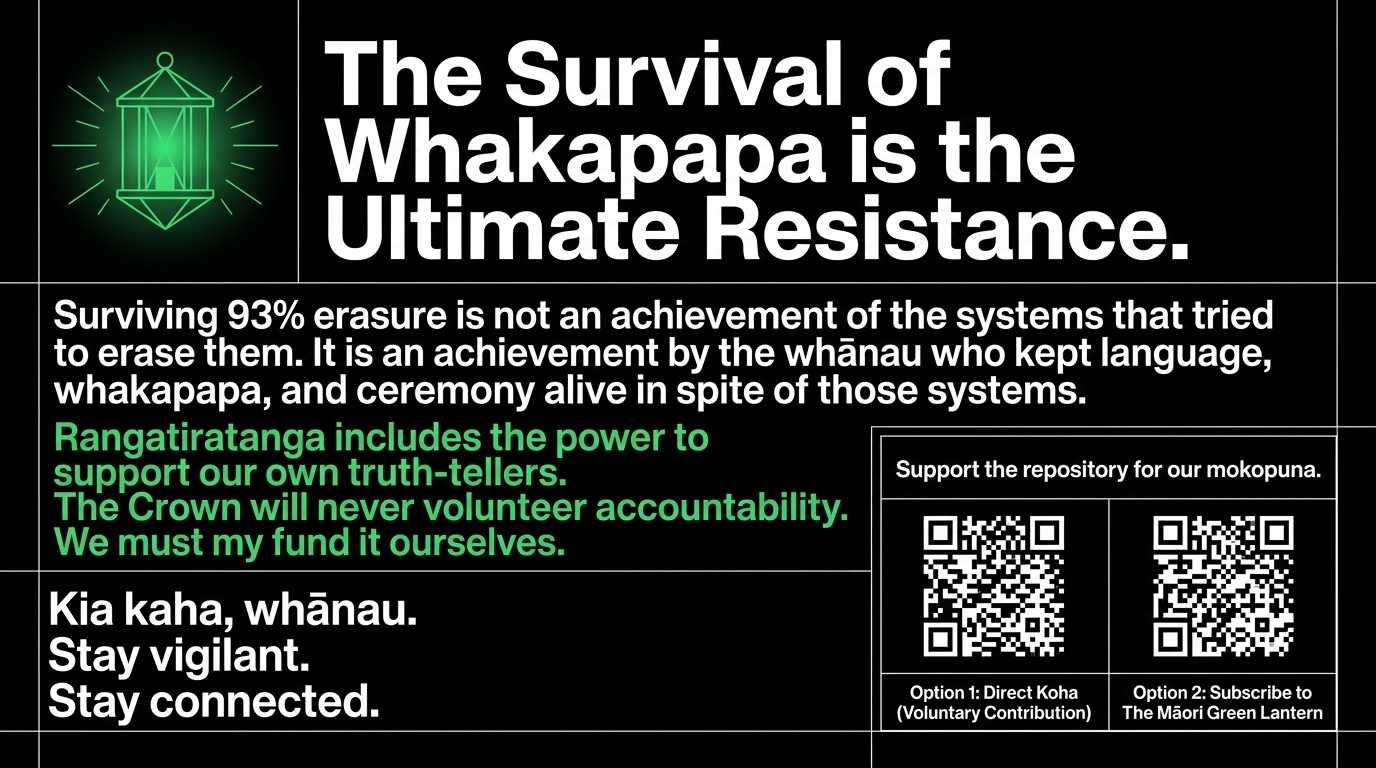
You might ask who is paying me to dig up a hundred years of buried arithmetic and lay it next to a 2024 press release until the pattern is undeniable.
The answer is you do. I am supported through koha, and that is it. There is no corporate line-up funding this essay about a colonial body count and a defunded Māori health authority — no mining company, no ministry, no party donor. Every koha you give tells me whānau are ready to support the accountability that the Crown and its corporate partners will never volunteer to provide. It tells me rangatiratanga includes the power to support our own truth tellers, in numbers, on the record, forever.
Kia kaha, whānau. Stay vigilant. Stay connected. And if you are able, consider a koha to make sure this voice — and this repository for our mokopuna — keeps going.
If you are unable to koha, no worries at all. Subscribe or follow The Māori Green Lantern at themaorigreenlantern.maori.nz, kōrero and share this with your whānau and friends — that is koha in itself.
Four pathways exist:
For those who wish to support this mahi directly with a koha (voluntary contribution): Koha — Support
For those who wish to receive essays directly and support through subscription: Subscribe to The Māori Green Lantern
For those who prefer direct bank transfer, account details are: Ivor Jones, account number 03-1395-0099387-000.
For those on Facebook: facebook.com/Themaorigreenlantern/subscribeThe Deep Dive Podcast
Three Examples For The Doubters — Quantified, Solved, And Explained In Tikanga Terms
Example One: The Smallpox Weapon
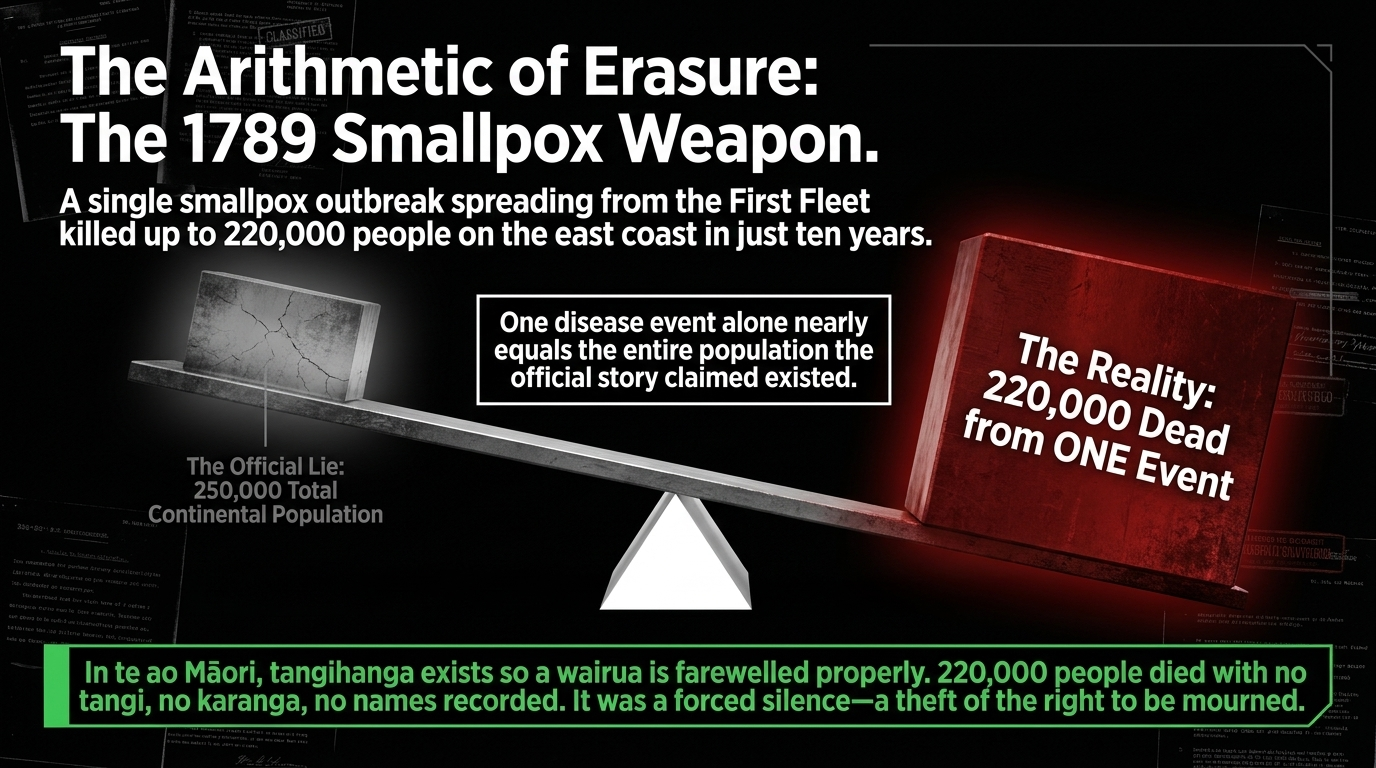
The claim. A single smallpox outbreak that spread from the First Fleet in 1789 killed up to 220,000 First Nations people along the east coast within about ten years, according to Professor Bradshaw's own prior published research, as cited directly by The Guardian.
Quantify the harm. Run the numbers: 220,000 deaths from one outbreak is nearly the entire continental population the old official story claimed existed. One disease event, on its own, could have wiped out the whole "official" Australia.
The solution. Every school curriculum, every museum plaque still displaying the 250,000 figure needs to be pulled down and replaced immediately, with the 220,000 smallpox figure printed alongside it, so a child can see with their own eyes that the old number was mathematically impossible.
The tikanga impact, explained for the Western mind. In te ao Māori, no one dies unmarked. Tangihanga exists so a wairua is farewelled properly, so a name is spoken, so grief has somewhere to go. Two hundred and twenty thousand people died with no tangi, no karanga, no names written down anywhere. That is not simply a death toll. It is a forced silence — a theft of the right to be mourned — inflicted on people who are still, right now, trying to whakapapa back through a wall of unrecorded graves.
I have written about this exact colonial pattern of erased grief before, in "The Broken Covenant: How This Government Is Deliberately Killing Tangata Whaikaha Māori", where I showed how the Waitangi Tribunal's Hauora findings already prove this government inherited — and continued — a system built to look away from Māori death.
Example Two: The Massacre Iceberg
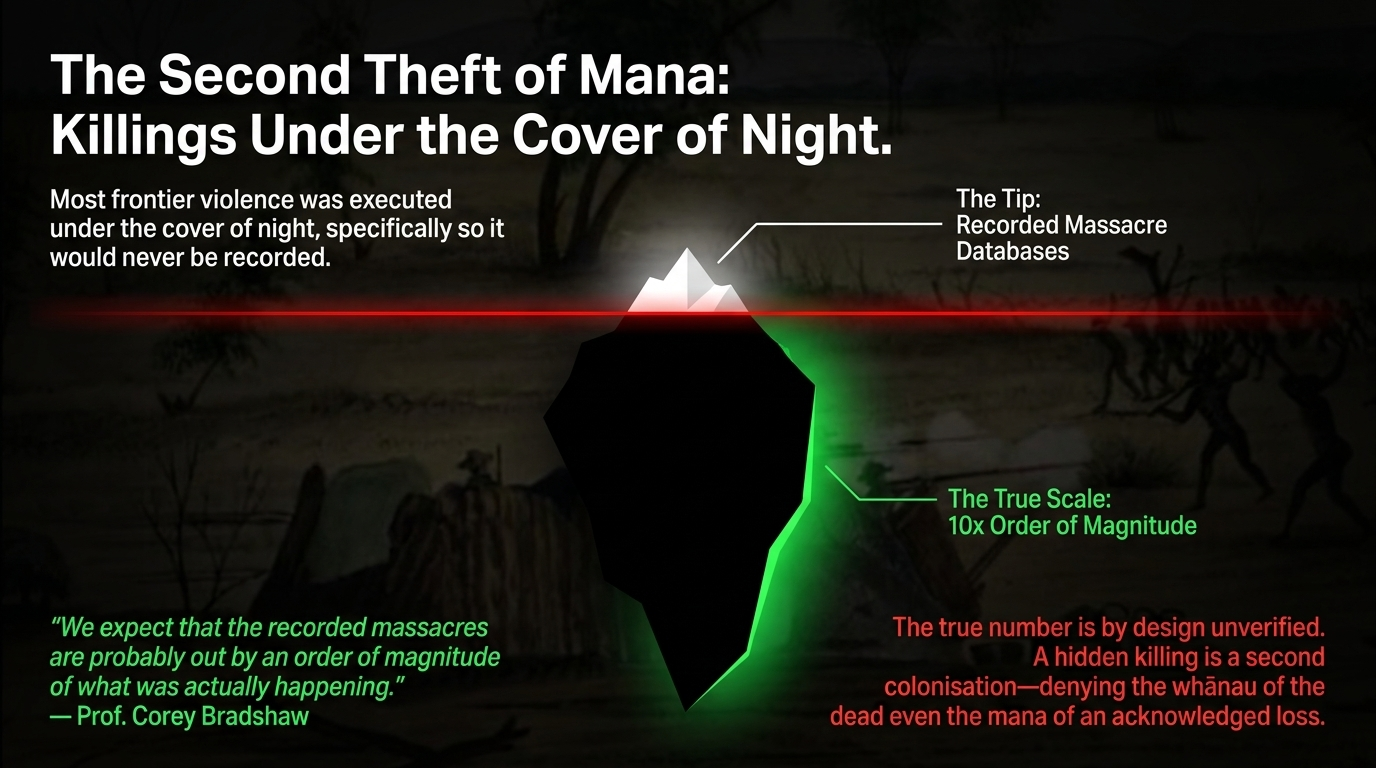
The claim. Professor Bradshaw told journalists he would "bet his career" that existing massacre databases represent only the "tip of the iceberg" — that real frontier killings were probably an order of magnitude higher, because "most of the frontier violence was done under the cover of night," specifically so it would never be recorded, as quoted directly by The Guardian and echoed in the RNZ syndication of this same research.
Quantify the harm. If the existing databases capture roughly a tenth of what actually happened, then every massacre map currently used in Australian truth and reconciliation processes right now is a floor, not a ceiling. The true number of killing events is, by design, not fully knowable — and I will not pretend otherwise. That is Unverified, and it is unverified because the killers planned it that way.
The solution. Every public massacre database and every truth-telling curriculum must carry Bradshaw's own order-of-magnitude warning printed alongside the count, so nobody mistakes an incomplete record for a complete one.
The tikanga impact, explained for the Western mind. Mana is stolen twice here. Once by the killing itself. Then again by the deliberate refusal to record it, which denies the whānau of the dead even the mana of an acknowledged loss. A hidden killing is a second colonisation performed on the exact same wound.
Example Three: The Sovereignty Lie, Running On Both Sides Of The Tasman
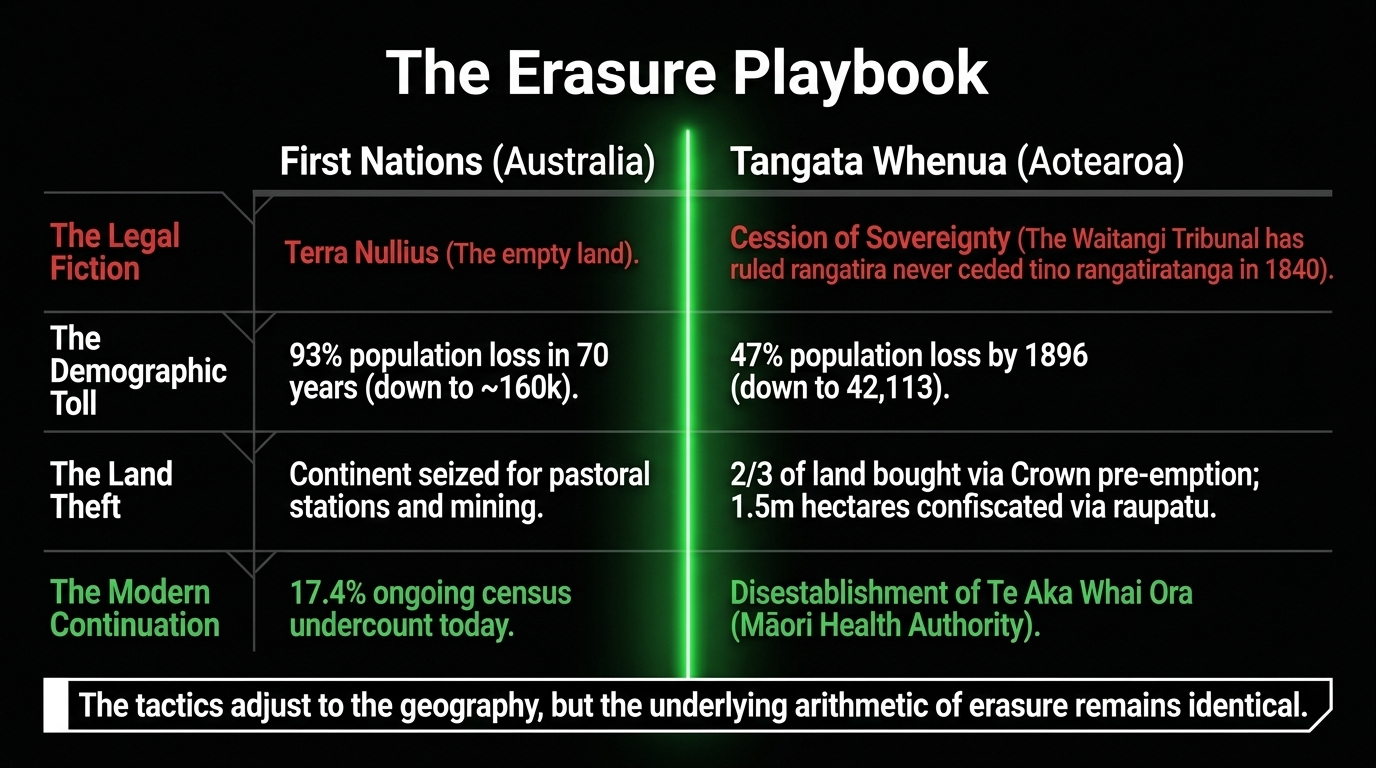
The claim. Professor Bradshaw states it outright: "the entire concept of terra nullius was based on not many people being here," as reported by The Guardian — a legal fiction not overturned in Australian law until the 1992 Mabo decision. Aotearoa ran a parallel fiction.
The Waitangi Tribunal found in its Te Paparahi o Te Raki inquiry that the rangatira who signed te Tiriti in February 1840 did not cede sovereignty at all — they agreed only to share authority with the Governor, as the Tribunal states in its own published findings.
Quantify the harm. Under that same sovereignty lie, roughly two-thirds of New Zealand's entire land area was "bought" from Māori between 1840 and 1865 under Crown pre-emption, as documented by Te Ara — the Crown bought cheap and resold at profit to fund settler immigration. After the New Zealand Wars, a further 1.5 million hectares was confiscated as raupatu in Waikato, Taranaki, Tauranga and the eastern Bay of Plenty, about 15 per cent of the Māori customary land still remaining at the time, as Te Ara records. Meanwhile Māori numbers fell from 70,000–90,000 in 1840 to a low of just 42,113 in 1896, per Te Ara's population history — a proportional loss I calculate at roughly 47 per cent, using the 1840 midpoint of 80,000.
That is horrific on its own terms, and it sits at roughly half the scale of Australia's 93 per cent — a comparison I have calculated from both nations' verified figures, not a claim either research team makes.
The solution. Australia retired terra nullius in law in 1992. Aotearoa has never formally retired the Crown's founding claim to an 1840 cession of sovereignty, even though its own Tribunal has already ruled that cession never happened. That contradiction should end now, in law, not just in academic papers nobody in Cabinet reads.
The tikanga impact, explained for the Western mind. Tino rangatiratanga was never handed over by the rangatira who put their names on te Tiriti. It was simply never given back by the Crown afterward. That is not ancient grievance theatre. It is a live legal and moral debt sitting underneath every Treaty settlement negotiated today.
I have made this exact argument before, at length, in "The Gilded Waka: How the Māori Ruling Class Sailed to Buckingham Palace While Your Tamariki Went Hungry", which traces this exact Article Two rangatiratanga guarantee, and in "Two Kings and a Broken Child", where I set out exactly why Treaty-based land return is not radical — it is the correction of a documented theft.
This Is Not History. It Is A Press Release From Right Now.
Here is where I stop being gentle. Because the same colonial machine that shrank two million people down to 250,000 to justify taking their continent is still running, today, in this country, inside this government's own health portfolio.
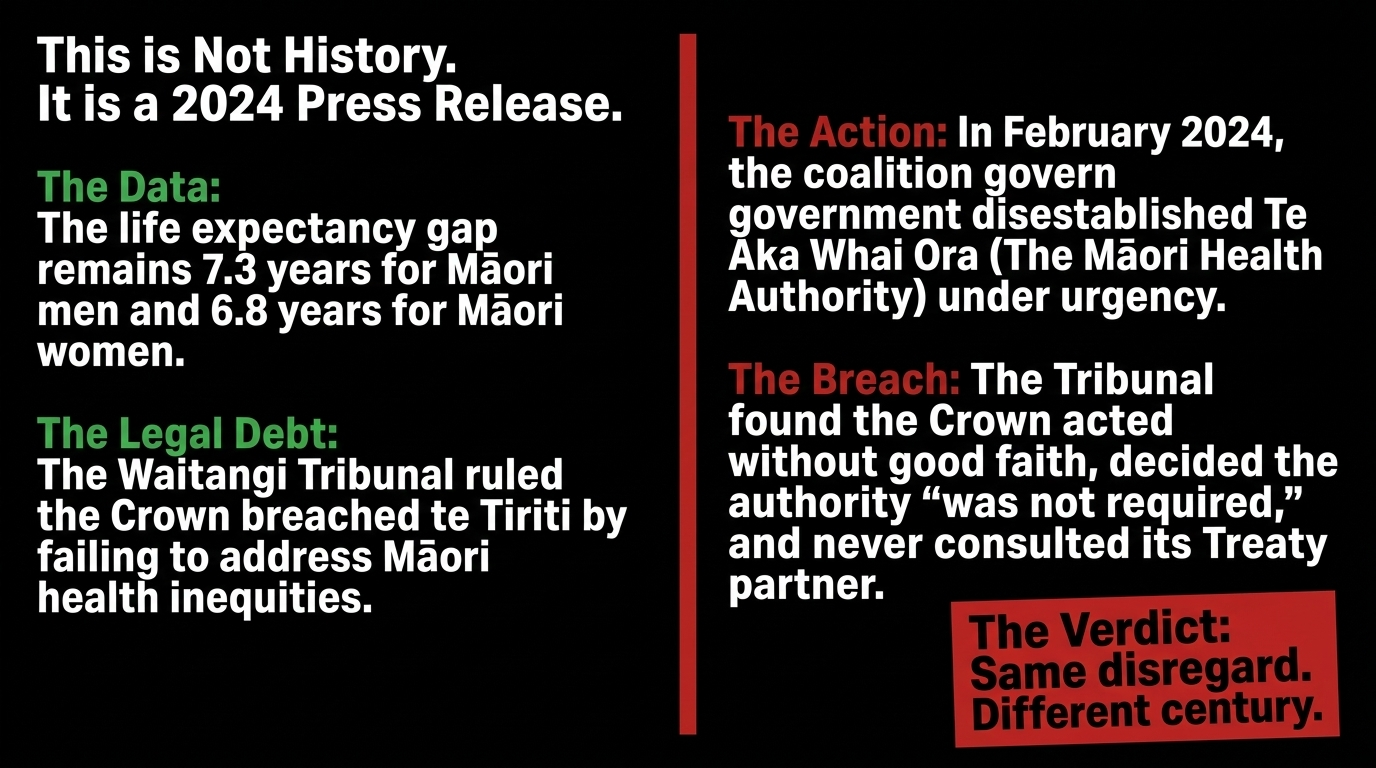
In February 2024, this coalition government disestablished Te Aka Whai Ora — the Māori Health Authority — under urgency. The Waitangi Tribunal's own priority inquiry found the Crown did not act in good faith, that it decided Te Aka Whai Ora "was not required" despite full knowledge of grave Māori health inequities, and that it never consulted its Treaty partner before doing it, exactly as the Tribunal itself has published.
And this sits on top of an earlier, standing finding — the Tribunal's 2019 Hauora report — which already ruled the Crown had breached te Tiriti by failing to actively address Māori health inequities in primary care, as the Tribunal confirmed in its own release.
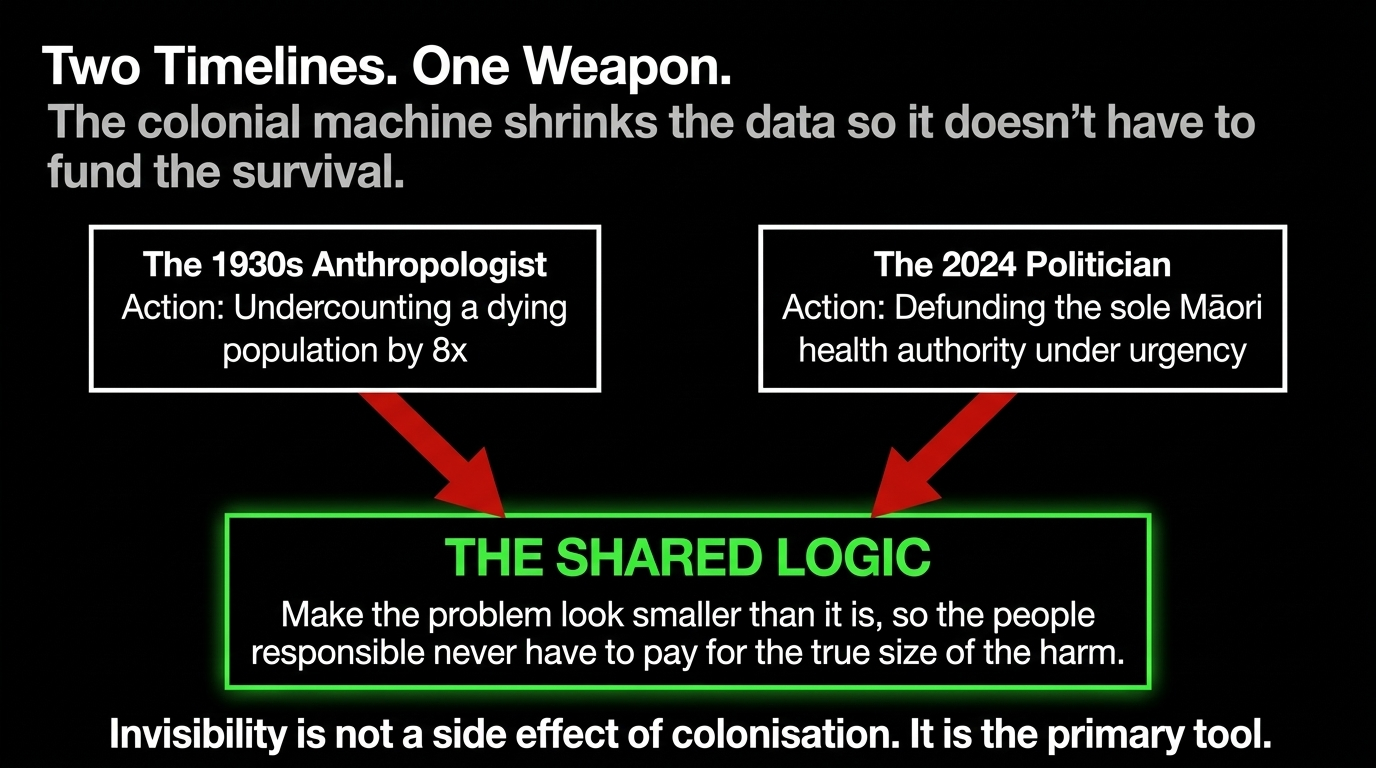
Do you see the pattern yet? A colonial government in 1930 undercounts a population by a factor of eight to justify taking a continent.
A colonial government in 2024 dismantles the one Māori-led health authority built to close a life-expectancy gap that still stands at 7.3 years for men and 6.8 years for women, per Te Ara's own figures, and does it without consultation. Same logic. Same disregard. Different century, same white supremacist neoliberal government wearing a different suit.
I have documented this precise continuity before, in "How a White Supremacist Neoliberal Government Sold Our Surgeries and Still Refuses to Pay the Māori Health Debt", and I am telling you again now: this is not incompetence. Undercounting a dying population and defunding a Māori health authority both serve the exact same purpose. They make the problem look smaller than it is, so the people responsible never have to pay for the true size of the harm.
Name The Beneficiaries. Name The Whānau.
I will not soften this for anyone's comfort. Every pastoral station carved out of "unoccupied" Australian land, every mining lease granted on the same terra nullius fiction, every settler fortune stacked on the assumption nobody was really there — every single one of it rests on arithmetic we now know was wrong by a factor of eight.
Name the dead: an estimated 2.06 million people, most never named, most never mourned by the systems that killed them.
Name the living cost: a 2021 census that still undercounts their descendants by 170,752 people — 17.4 per cent, confirmed directly by the Australian Bureau of Statistics' own assurance panel, a rate that has stayed stuck at roughly 17 per cent across three consecutive censuses, as the ABS itself admits.
Name the ongoing crime in this country: a government that inherited a documented, Tribunal-ruled Treaty breach on Māori health, and answered it by disestablishing the one authority built to fix it.
There is no polite hedge, no "both sides," no reasonable middle ground that survives contact with these numbers.
Professor Larissa Behrendt is right that the survival of these peoples against odds like this is "one of Australian history's most remarkable stories," as The Guardian reports — but that survival belongs to the whānau who kept language, whakapapa and ceremony alive through a mortality event that erased nine in every ten of their ancestors.
It is not an achievement of the systems that tried to erase them.
It is an achievement in spite of every single one of those systems, including the one currently sitting in the Beehive.
Māuri Ora!

Right Of Reply And Legal Note
This essay names public researchers speaking in their professional capacity about published, peer-reviewed research, and cites formal, published findings of a statutory Tribunal of inquiry regarding the actions of a government in its public, official capacity. No living private individual is criticised. Scathing characterisation is directed at institutions, legal doctrines, historical beneficiary classes and a government acting in its public capacity — not at named private persons — and every scathing statement rests on the factual, cited basis set out above. Any named public figure or institution disputing the factual claims in this essay is invited to seek correction within 48 hours by contacting ivor@themaorigreenlantern.maori.nz.
Disclaimer: This essay reflects analysis and opinion by The Māori Green Lantern, based on sources cited and verified at the time of writing. It is published in the public interest to support truth-telling about the history and ongoing effects of colonisation in Australia and Aotearoa. Facts are sourced and linked directly; opinions are the author's own and are clearly identified as such.