"THE $134,250 HANDSHAKE" - 6 June 2026
How David Seymour Paid the Fundraiser, Gutted the Māori Voice, and Called It Governance

Mōrena Aotearoa,
They dressed up patronage as leadership, stripped Te Tiriti out of the medicine house, and handed the keys to a political insider while whānau kept waiting at the pharmacy counter and in the cemetery line.
I am Ivor Jones, The Māori Green Lantern, and I know a rigged table when I see one.
This government keeps turning public institutions into private clubrooms for the politically connected, and the Pharmac story reeks of that old colonial smell: reward your own, erase Māori accountability, and call the whole thing “best practice”.
Erasing The Front Carvings
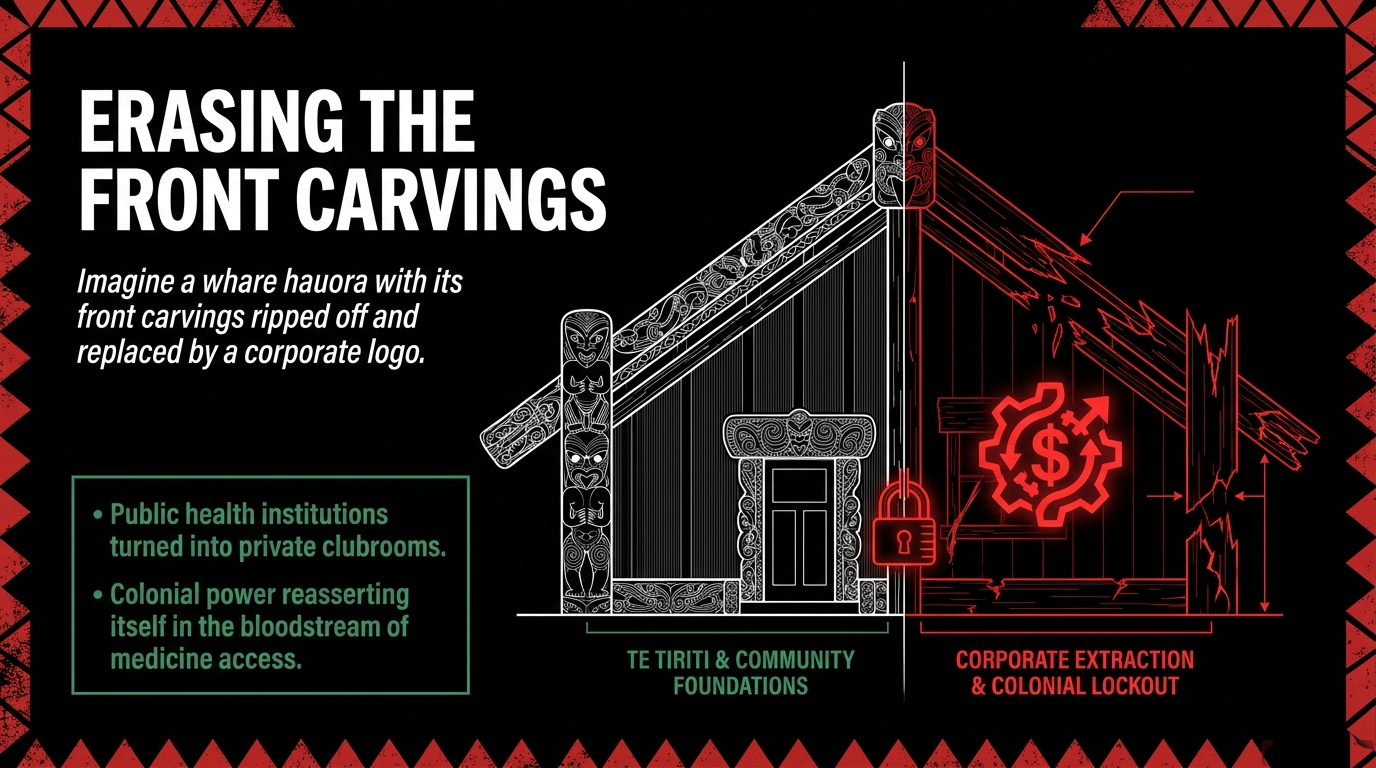
Imagine a whare hauora with its front carvings ripped off and replaced by a corporate logo. That is what happened here.
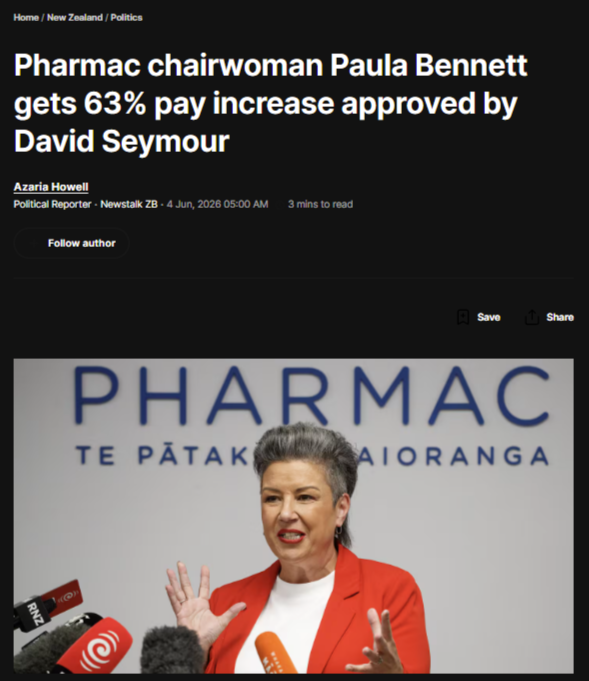
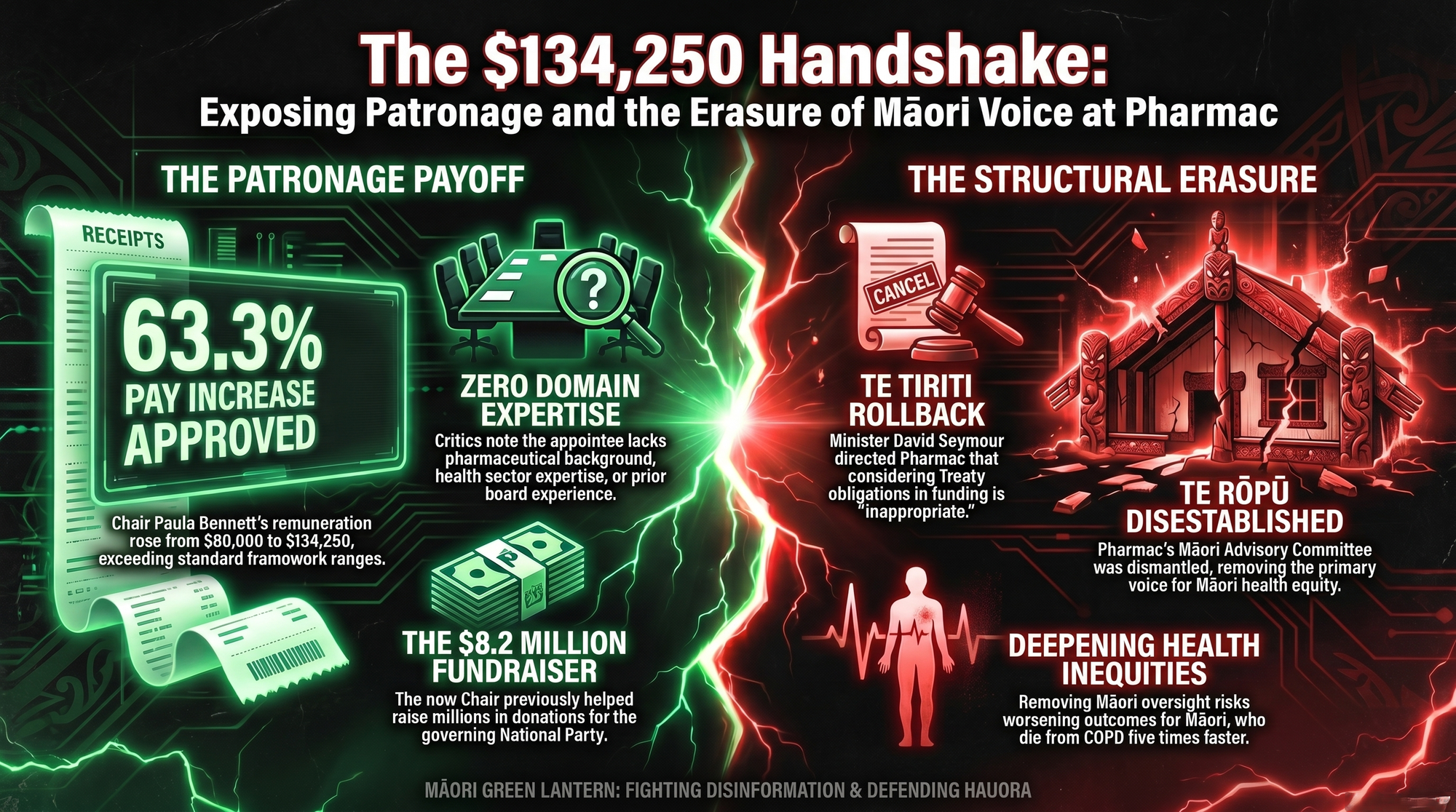
David Seymour, in his role overseeing Pharmac, appointed former National deputy prime minister Paula Bennett as chair, despite public reporting that she had no pharmaceutical background, no health sector expertise, and no prior board governance experience, as documented by Democracy Project and announced by the Beehive.
Then came the payoff.
 Azaria Howell
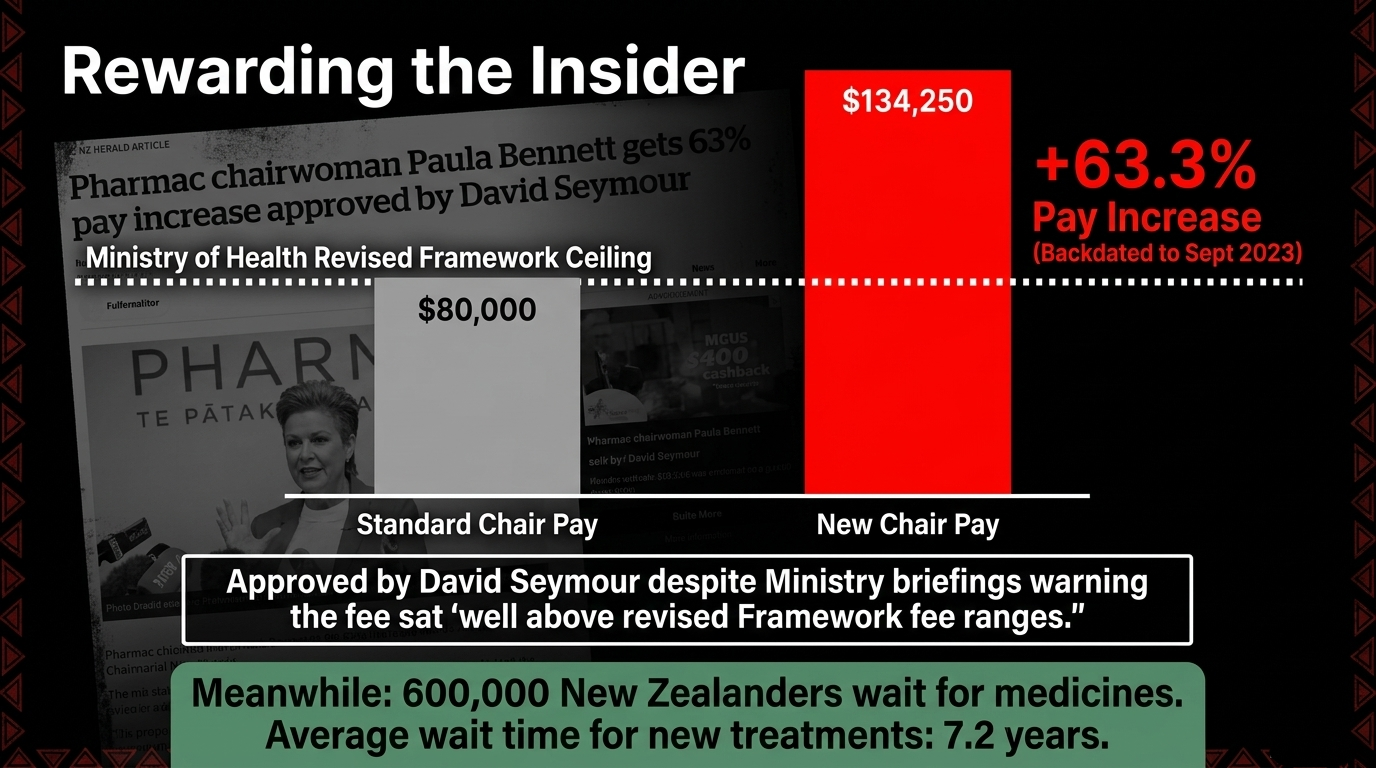
Seymour approved a 63.3% pay rise for Bennett, lifting her remuneration from $80,000 to $134,250 and backdating it to September 2023, while deputy chair and board member fees were also lifted far beyond normal expectations, as confirmed by the NZ Herald and the Ministry of Health briefing.
That same ministry briefing states the proposed fees sat “well above the revised Framework fee ranges”, meaning the government broke the spirit of its own framework to feather the nest of a political ally, as shown in the Ministry of Health response.
That is the handshake. Not a handshake of service. A handshake of patronage.
And it gets filthier.
The Deep Dive Podcast
Listen to a lively conversation between two hosts unpacking the sources, the networks, and the deeper machinery behind this essay — how patronage, neoliberal governance, Treaty rollback, and medicine inequity lock together into one colonial machine.
I apologise in advance for the AI’s rough pronunciation of our reo. The source work is solid. The accent still needs wānanga.
The Illusion Of Meritocracy
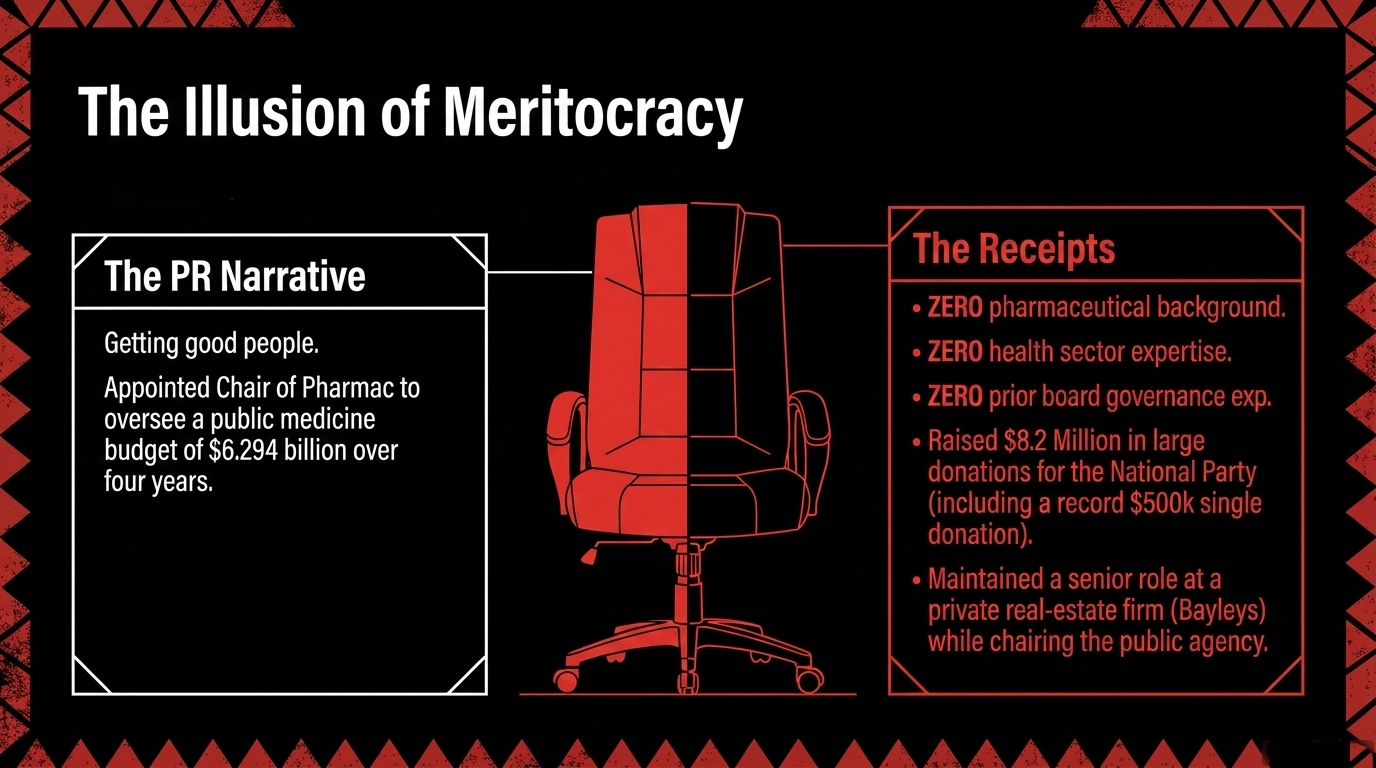
Bennett was not merely an ex-minister drifting into governance after years in the wilderness. Public reporting says she helped raise $8.2 million in large donations for the National Party between 2021 and 2023, including a $500,000 donation described by Democracy Project as the largest single political donation in New Zealand history.
That means the woman rewarded with this public health chairmanship was already a machine for elite money and party power, according to Democracy Project.
So when they tell you this is just about “getting good people”, do not swallow the lie whole.
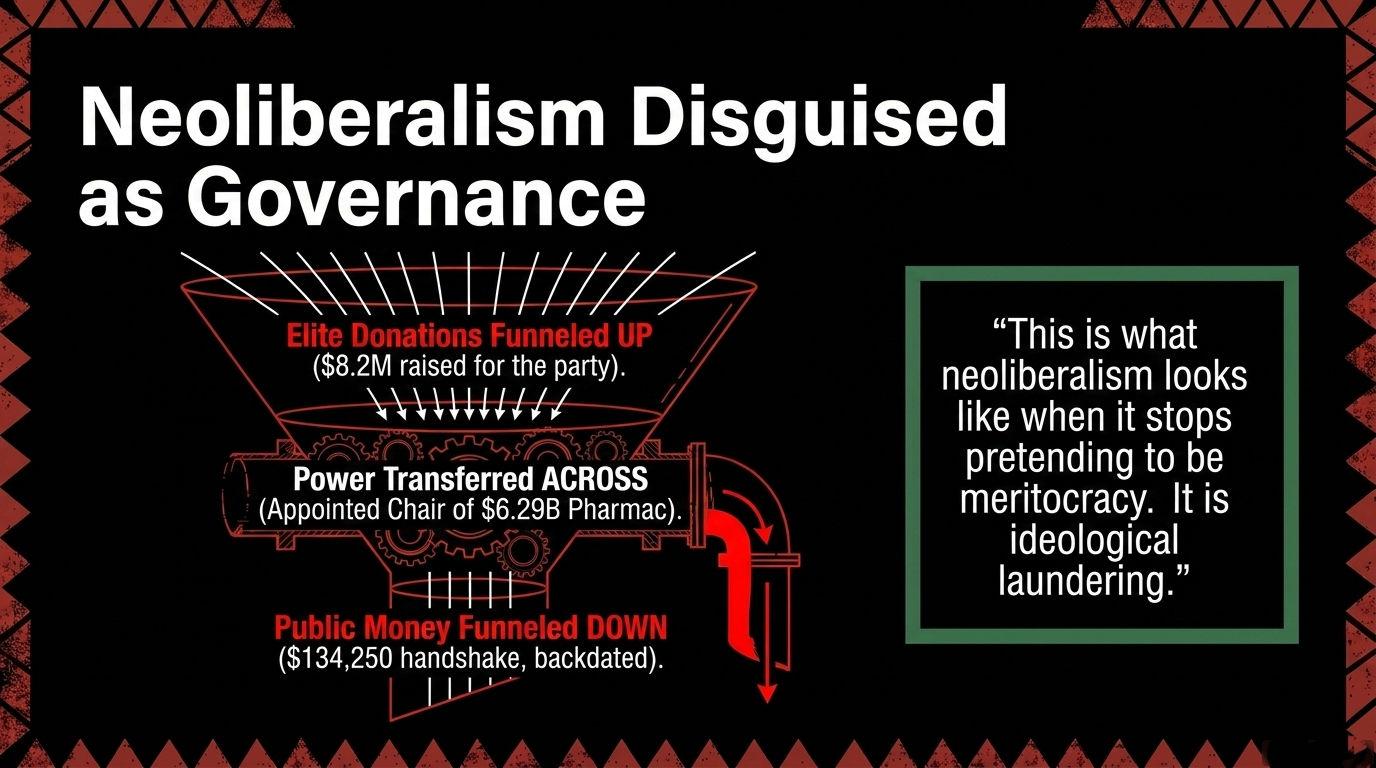
This is what neoliberalism looks like when it stops pretending to be meritocracy.
It is a funnel: donations up, power across, public money back down.
What makes this worse than ordinary cronyism is the target. Pharmac is not a ribbon-cutting agency. Pharmac decides what medicines get funded, when, and for whom. The agency’s decisions shape whether disabled people suffer longer, whether cancer patients wait, whether Māori with chronic illness get timely access, and whether poor families bury loved ones sooner than they should.
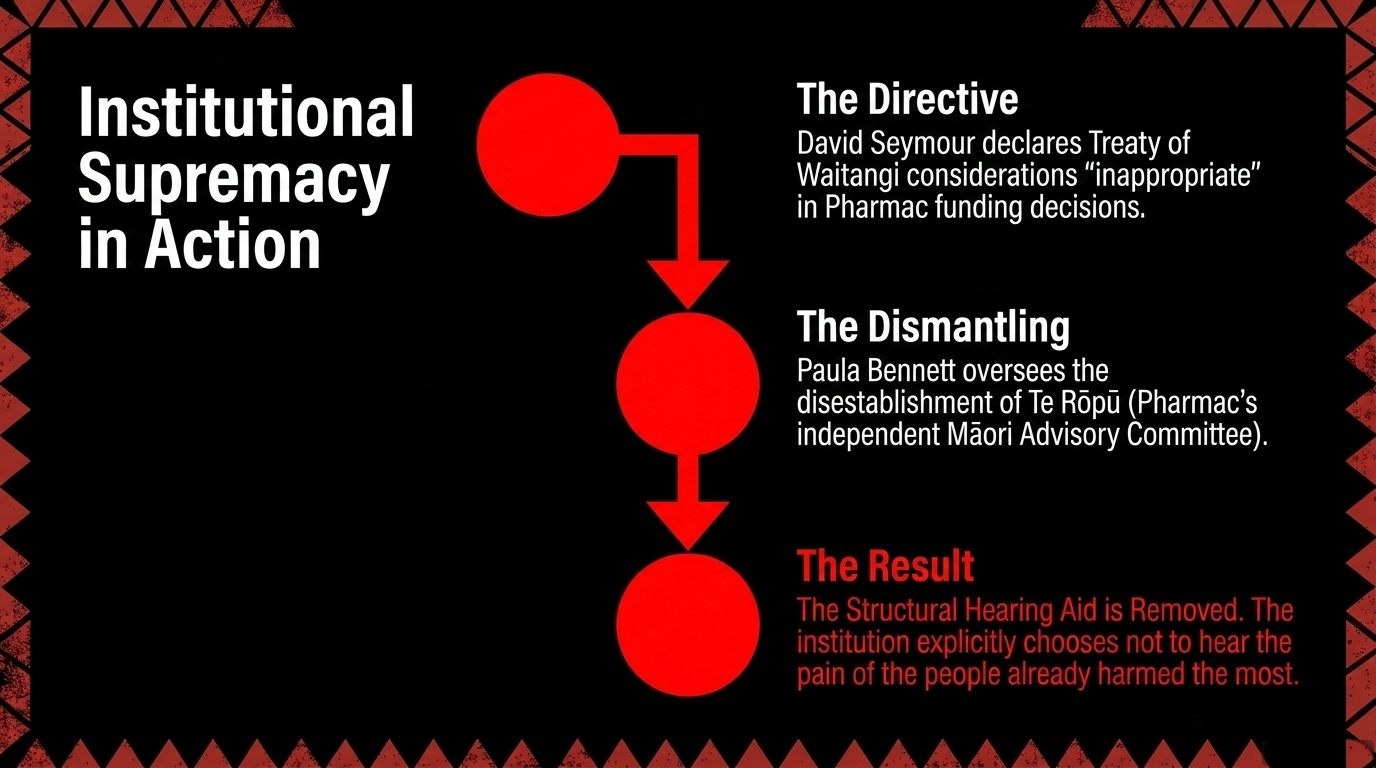
That is why it matters that Seymour later told Pharmac it was “inappropriate” to keep considering the Treaty of Waitangi in funding decisions, as reported by Te Ao News and covered internationally by The Guardian. That is why it matters that, under Bennett’s chairmanship, Te Rōpū — Pharmac’s Māori Advisory Committee — was disestablished, as confirmed in Pharmac’s own OIA release and reported by Te Ao News.
That is why I call this government white supremacist in effect. Because when a government strips Te Tiriti out of medicine decision-making, removes the Māori advisory voice, and installs politically aligned insiders over the top, the outcome is not race-neutral administration. The outcome is colonial power reasserting itself in the bloodstream.
YouTube Video
Prefer video? Here is the short companion piece supporting the essay — a sharper visual walk through the key facts, the money trail, and the structural harm.
Again, do not shoot the messenger over the AI pronunciation. Aim your anger where it belongs: at the people cashing up while whānau are left waiting.
Ngā Hononga Huna — The Hidden Connections
The hidden connections are not even that hidden anymore. They are lying in the open like shell casings.
Paula Bennett remained in her role with Bayleys while chairing Pharmac, saying publicly that she was staying on with the company, as quoted by Democracy Project. So the chair of a public medicines agency simultaneously held a senior role with a private real-estate firm while presiding over an agency funded at $6.294 billion over four years, as announced by the Beehive.
Michael Reddell, a former Reserve Bank chief economist, described Bennett as “a highly political, highly partisan” figure with “no domain expertise and not even any board experience”, as quoted by Democracy Project.
When even a conservative economist looks at your appointment and says the room stinks, the room stinks.
This is not governance. It is ideological laundering. The state takes a party insider, runs her through the rinse cycle of “leadership”, pays her above framework, and hopes the public confuses confidence with legitimacy.
Three Examples For The Western Mind
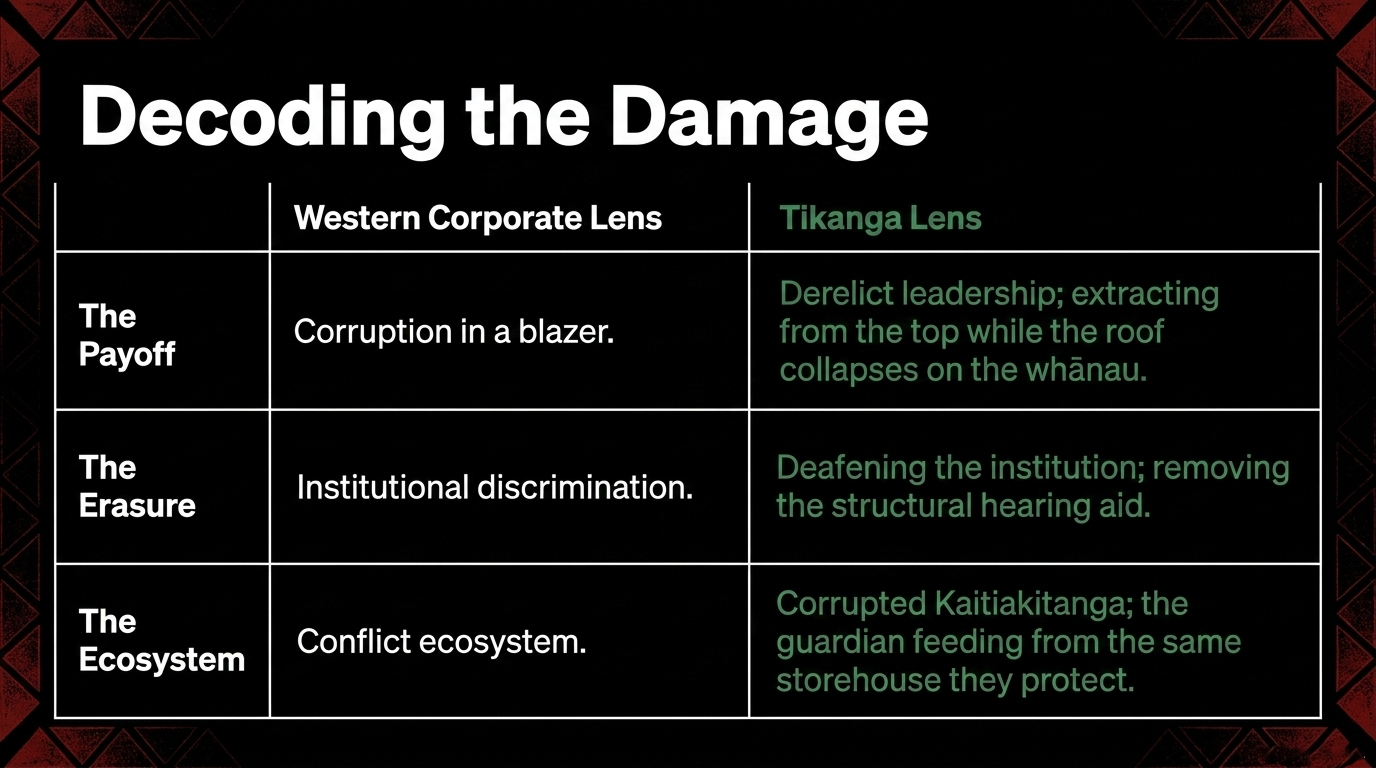
1. If a hospital board hired the prime minister’s fundraiser to run the emergency department, then gave her a 63.3% pay rise above policy settings, you would call it corruption dressed in a blazer.
That is effectively what happened at Pharmac. Bennett’s pay rose from $80,000 to $134,250, and the Ministry of Health explicitly said the proposed fees sat well above the revised fee framework, as shown by the NZ Herald and the Ministry of Health briefing.
Quantified harm: Bennett’s rise alone is roughly $54,250 extra each year, with about $22,500 of that sitting above a simple 35% uplift benchmark. At the same time, more than 600,000 New Zealanders were still waiting for medicines and new treatments were taking an average of 7.2 years to secure funding decisions, according to Medicines NZ.
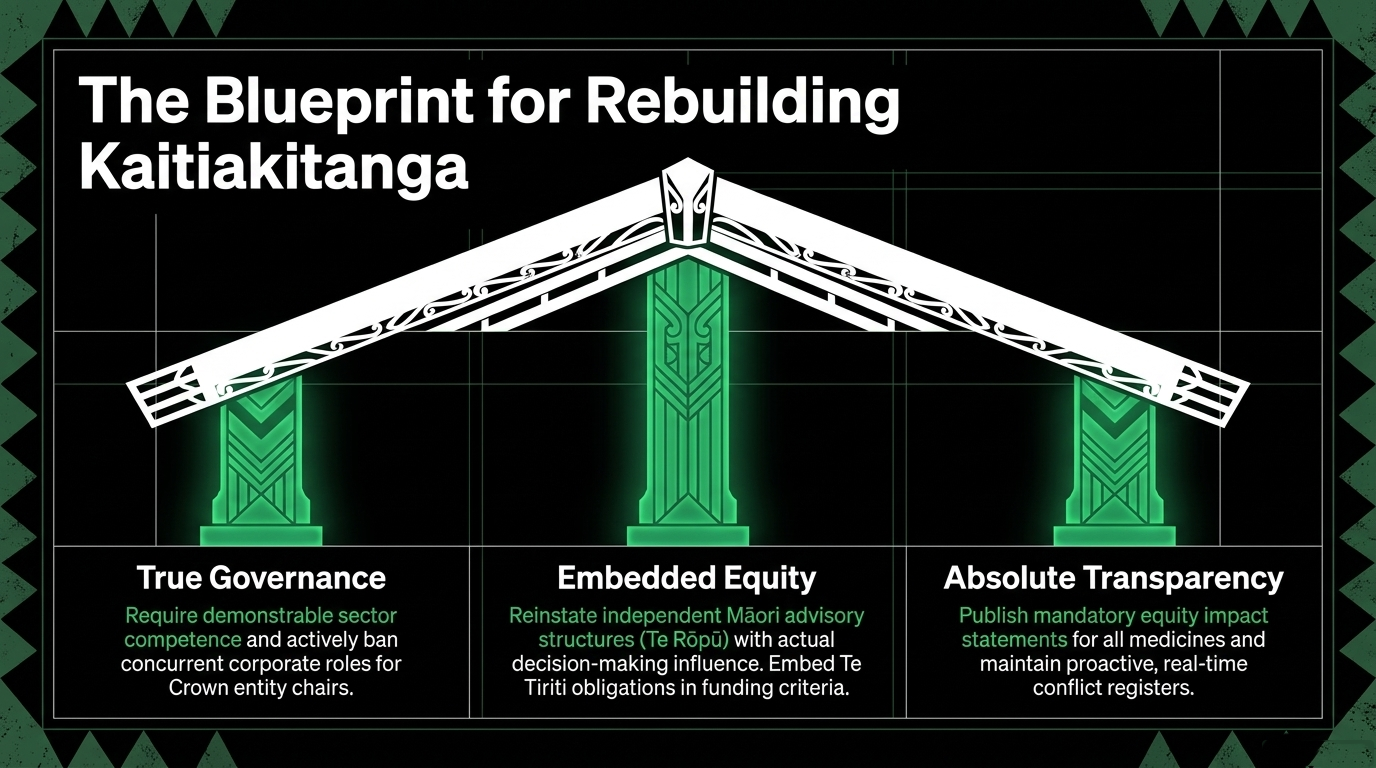
Solution: Crown entity appointments that control life-and-death health decisions should require demonstrable sector competence, full conflict disclosure, and an independent appointments panel with Māori representation.
Tikanga impact explained for the western mind: If trustees of a family estate paid themselves first while the roof collapsed over the children’s bedrooms, you would call them derelict. In tikanga terms, leadership is service bound to collective wellbeing; here, the leadership model is extraction from the top while need piles up underneath.
2. If a school board abolished the only committee representing the students most excluded from achievement, right after ordering staff to stop considering their legal rights, you would call it institutional discrimination.
That is what the Bennett-Seymour line of travel looks like in health. Seymour signalled that Treaty considerations were “inappropriate” in Pharmac funding decisions, as reported by Te Ao News and The Guardian, and Bennett later oversaw the decision to disestablish Te Rōpū, as confirmed by Pharmac’s OIA release.
Quantified harm: Pharmac’s own equity work said it aimed to eliminate inequities in access to medicines by 2025, as set out in Pharmac’s equity framework and the earlier access equity work in Achieving medicine access equity in Aotearoa New Zealand. Pharmac’s own reporting says Māori experience diabetes at three times the rate of other population groups, Māori develop COPD up to 20 years earlier, and Māori die from COPD at five times the rate of non-Māori, as stated by Pharmac’s high-needs medicines report. Te Ao Māori health leaders warned in 2026 that proposed Pharmac changes could deepen inequities and cost lives, according to Te Ao News.
Solution: Reinstate an independent Māori advisory structure with decision influence, embed Te Tiriti obligations in funding criteria, and publish equity impact statements for every major medicines policy change.
Tikanga impact explained for the western mind: Think of Te Rōpū as the structural hearing aid inside an institution that otherwise keeps pretending it cannot hear the people it harms. Removing it is not neutral streamlining; it is choosing not to hear the pain of those already harmed most.
3. If a regulator was chaired by someone tied to private corporate interests and party fundraising networks while overseeing billions in public money, you would call that a conflict ecosystem.
Bennett remained with Bayleys while chairing Pharmac, as reported by Democracy Project, and the agency she chaired sat inside a medicines system with a four-year budget of $6.294 billion, as announced by the Beehive. Democracy Project also reported diary material suggesting lobbying-related concerns around another meeting, though that specific allegation remains corroborated rather than fully verified from a second primary source.
Quantified harm: The harm here is not just a dollar amount. It is institutional trust. Once public confidence goes, every rationing decision, every delayed medicine, and every rejected application starts to look like politics by other means.
Solution: Ban concurrent corporate roles for chairs of major health Crown entities, publish all ministerial appointment rationales in full, and require proactive conflict-of-interest registers updated in real time.
Tikanga impact explained for the western mind: Kaitiakitanga is guardianship without self-dealing. If the guardian is also feeding from the same storehouse, the role has already been spiritually and morally corrupted.
The Wider Pattern
This essay does not stand alone. It sits inside a trail of receipts.
The wider health pattern has already been traced in THE PRESCRIPTION FOR PRIVATISATION, which examined how state and media narratives normalize the starvation of public healthcare while Māori pay the heaviest price.
The wider kaupapa and method behind this work are set out in The Māori Green Lantern: Manifesto of Power, which explains the mission of tracing money flows, policy networks, disinformation, and extraction.
My public identity and role as The Māori Green Lantern are set out at About The Māori Green Lantern, where this mahi is described as kaitiakitanga in the digital realm. That matters because this is not random outrage. It is pattern recognition backed by receipts.
So no, I do not accept the soft language of “controversy” here. A controversy is a quarrel over optics. This is a political insider rewarded above framework to oversee medicine access while the Māori voice is cut out of the room. That is not a controversy. That is a structure of harm.
Koha Consideration
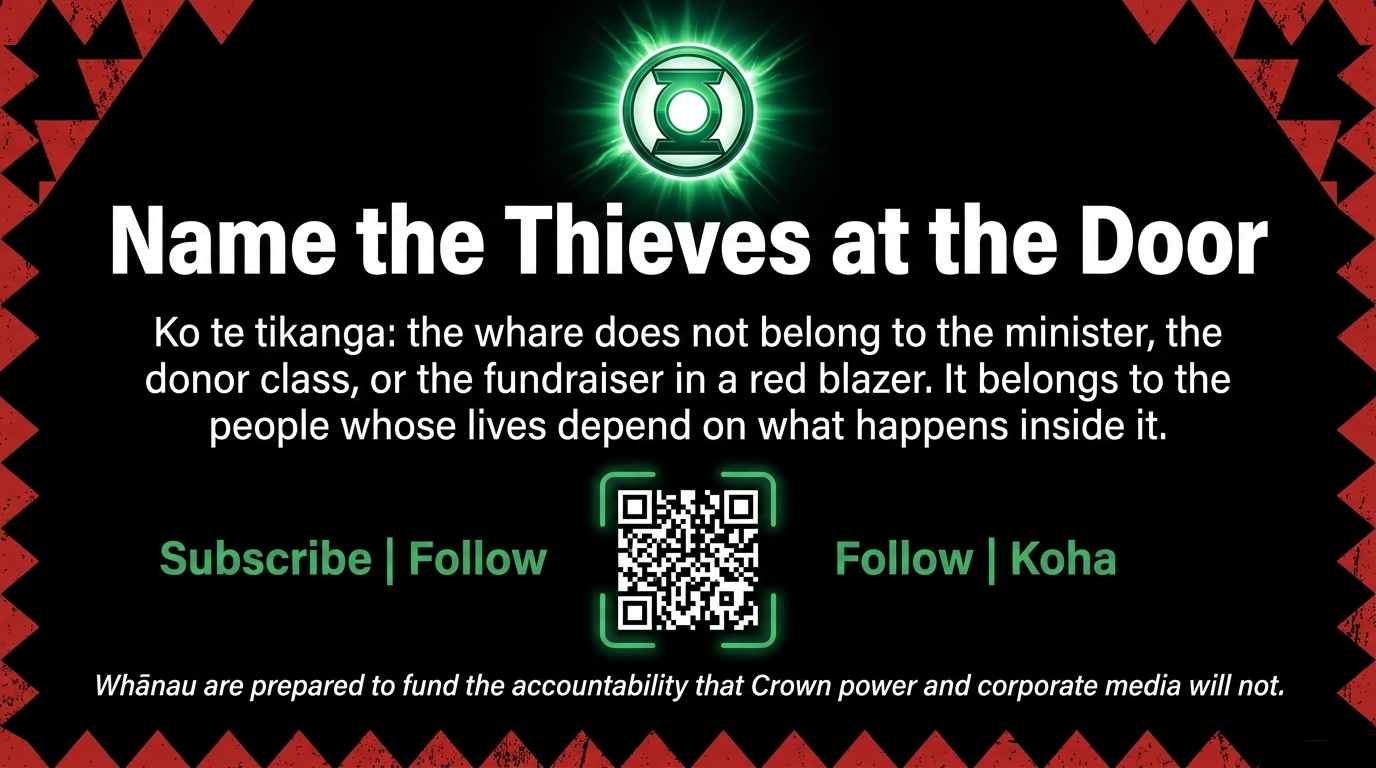
Every koha on this essay says something simple and powerful: whānau are prepared to fund the accountability that Crown power and corporate media will not.
Every contribution backs independent truth-telling against the patronage networks, Treaty rollbacks, and neoliberal vandalism that keep turning public health into a reward scheme for insiders.
If you are able, support this mahi directly through
Koha — Support The Māori Green Lantern.
If a subscription suits you better, support the kaupapa through Subscribe to The Māori Green Lantern.
If bank transfer is easier, the account is HTDM 03-1546-0415173-000. If Facebook is your pā, support there through Facebook subscription.
If you cannot koha, that is all right. Subscribe, follow, share, and put this essay in front of the people who still think this government’s violence only counts when it leaves a bruise you can photograph.
He Kōrero Whakamutunga
They paid the fundraiser. They lifted the fee above framework. They hollowed out the Māori voice. They told Pharmac to stop treating Te Tiriti like a living obligation. Then they expected the country to call that competence.
I call it what it is.
A public medicines agency has been used as another stage for neoliberal theatre, where corporate logic, party loyalty, and colonial comfort are treated as qualifications.
And while the applause track rolls, Māori whānau are expected to keep swallowing the cost in amputations, delayed medicines, preventable illness, and early graves.
Ko te tikanga: the whare does not belong to the minister, the donor class, or the fundraiser in a red blazer. It belongs to the people whose lives depend on what happens inside it. And I will keep naming the thieves at the door.

Research transparency: Searched the verified Māori Green Lantern identity page and prior related essays, confirmed live links for the identity page, manifesto, and one related prior essay, and relied on verified public sources from the NZ Herald, Democracy Project, Beehive, Ministry of Health, Pharmac, Te Ao News, The Guardian, and Medicines NZ.
Disclaimer: This essay is commentary and analysis in the public interest. Factual claims are grounded in the linked sources above. Opinions are expressed as opinion, based on disclosed facts, and named individuals are discussed in their public roles.