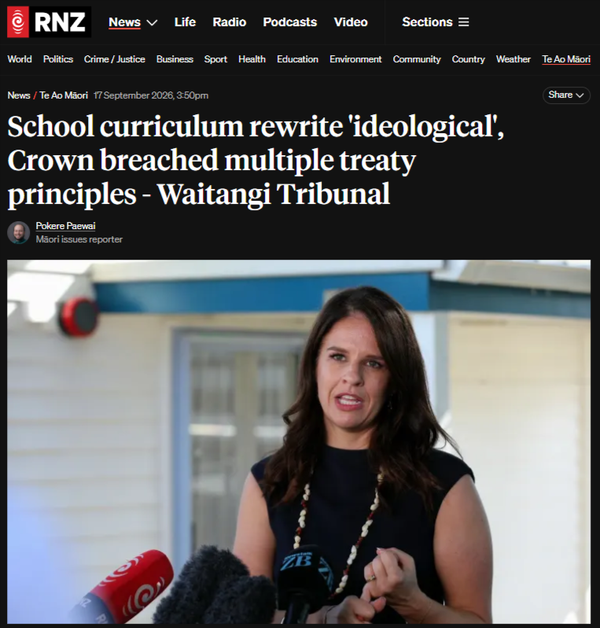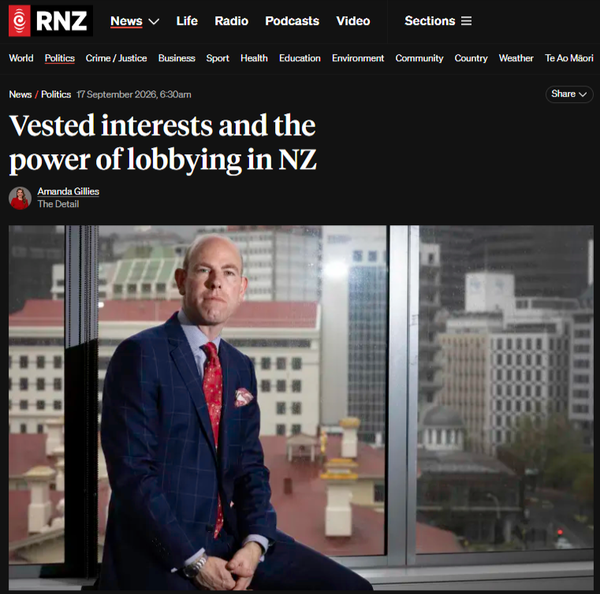
"The Curriculum Con: How a White Supremacist Neoliberal Regime Tried to Bury Te Tiriti in a Filing Cabinet — And Got Caught Digging the Grave" - 23 July 2026
They didn't debate Te Tiriti out of the classroom — they tried to disappear it in a paperwork shuffle, and when the OIA request cracked the cabinet open, they blamed a "mistake." I don't believe in mistakes that happen twice, in the same direction, by the same hand.


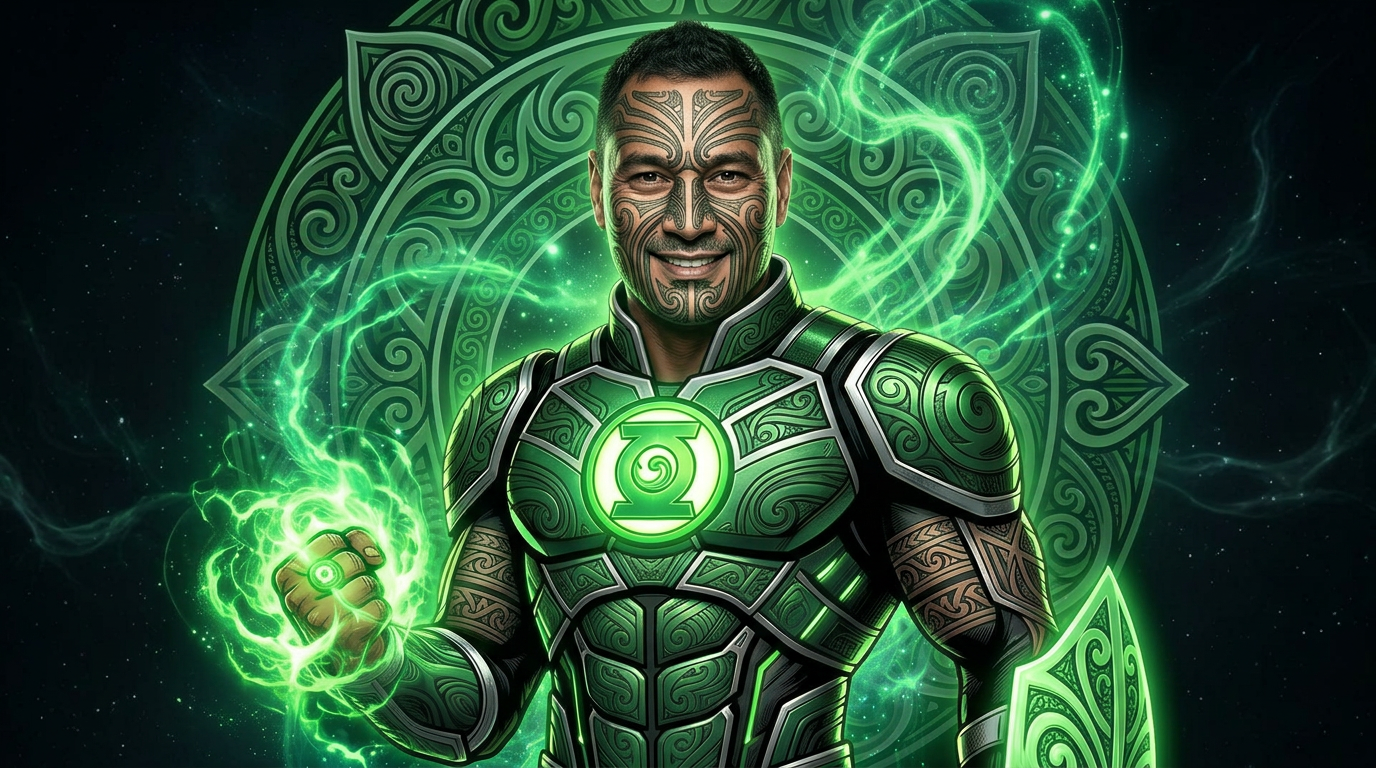
Kia ora koutou. Ko Ivor Jones tōku ingoa. Te Arawa, Ngāti Pikiao tōku Māori whakapapa, he Welsh anō tōku ūkaipō — two peoples who know what it is to have your language beaten out of you in a classroom by people who called it "for your own good."
I am the Māori Green Lantern, and I have watched this government — National, ACT, New Zealand First, a coalition dressed as government but functioning as an asset-stripping crew in borrowed authority — reach into the one place a nation keeps its future, the classroom, and try to quietly cut Te Tiriti o Waitangi out of it like a tumour they were embarrassed to admit they'd grown themselves.
 RNZ | Te Reo Irirangi o Aotearoa
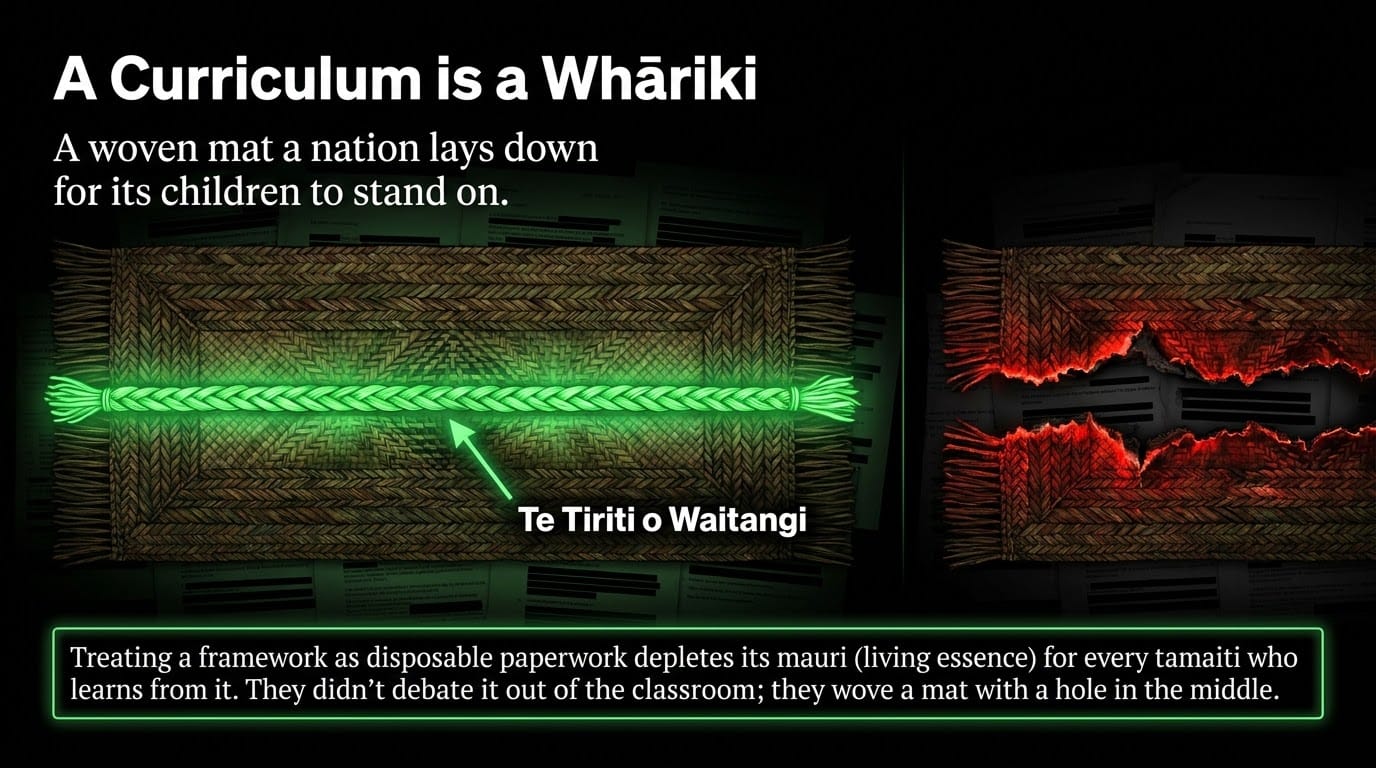
Let me be plain about the metaphor, because it is not decoration — it is diagnosis. A curriculum is a whāriki, a woven mat that a nation lays down for its children to stand on. What Erica Stanford's ministry did in April 2024 was rip out the central thread
— Te Tiriti o Waitangi — weave a whāriki with a hole in the middle, hand it to the minister, watch her sign it, and only put the thread back in when someone shone a torch under the floorboards. That torch was an Official Information Act request.
That someone was a former ministry curriculum writer named Dr Claire Coleman, and whānau, I want you to remember her name, because she is the reason we know any of this at all.
He Horopaki — The Rot Runs Deeper Than One Signature
This is not one minister having a wobble over a Tuesday memo. This is a signature move of a government that has spent two years treating Te Tiriti like an invoice it's trying to dispute.
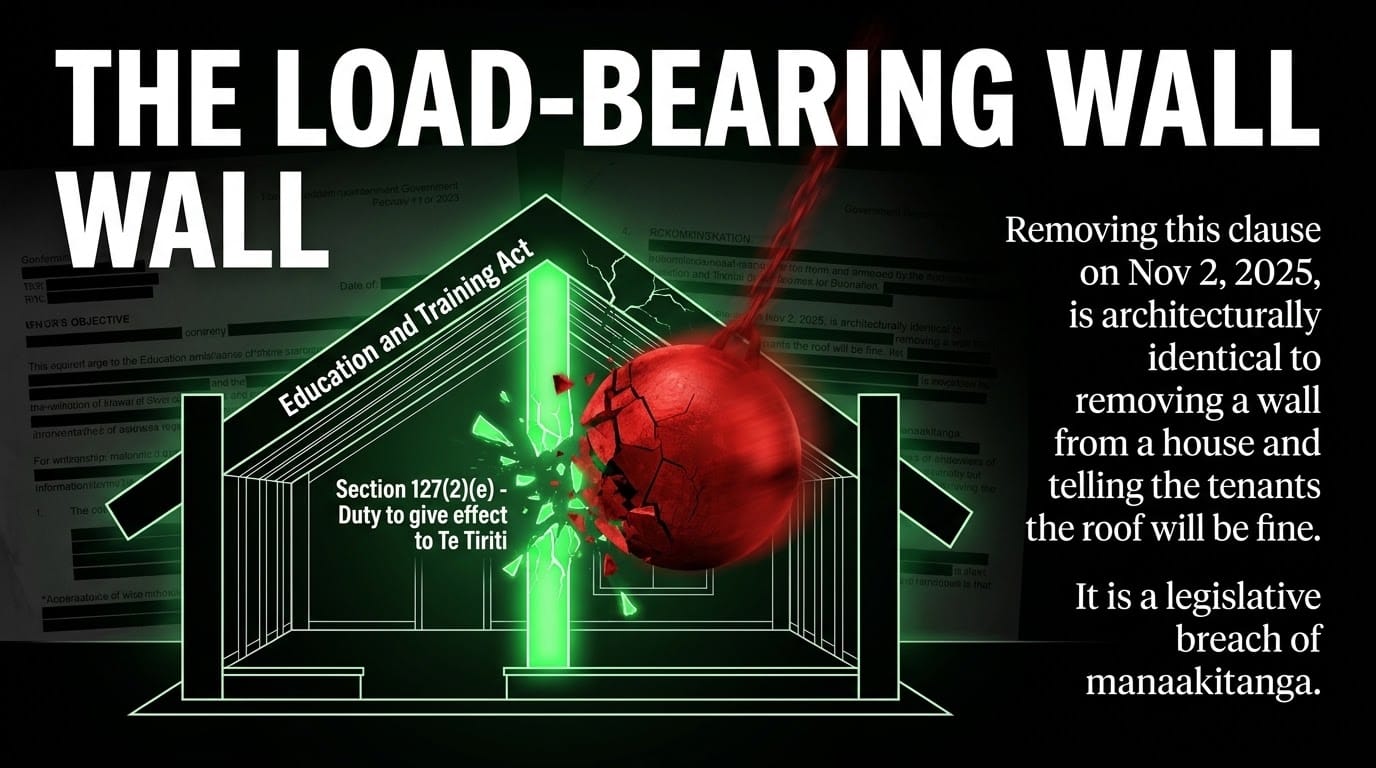
On 2 November 2025, this coalition — bound by a coalition agreement signed with ACT's David Seymour and enabled by National's Christopher Luxon
— ripped section 127(2)(e) clean out of the Education and Training Act, the clause that required school boards to give effect to Te Tiriti o Waitangi.
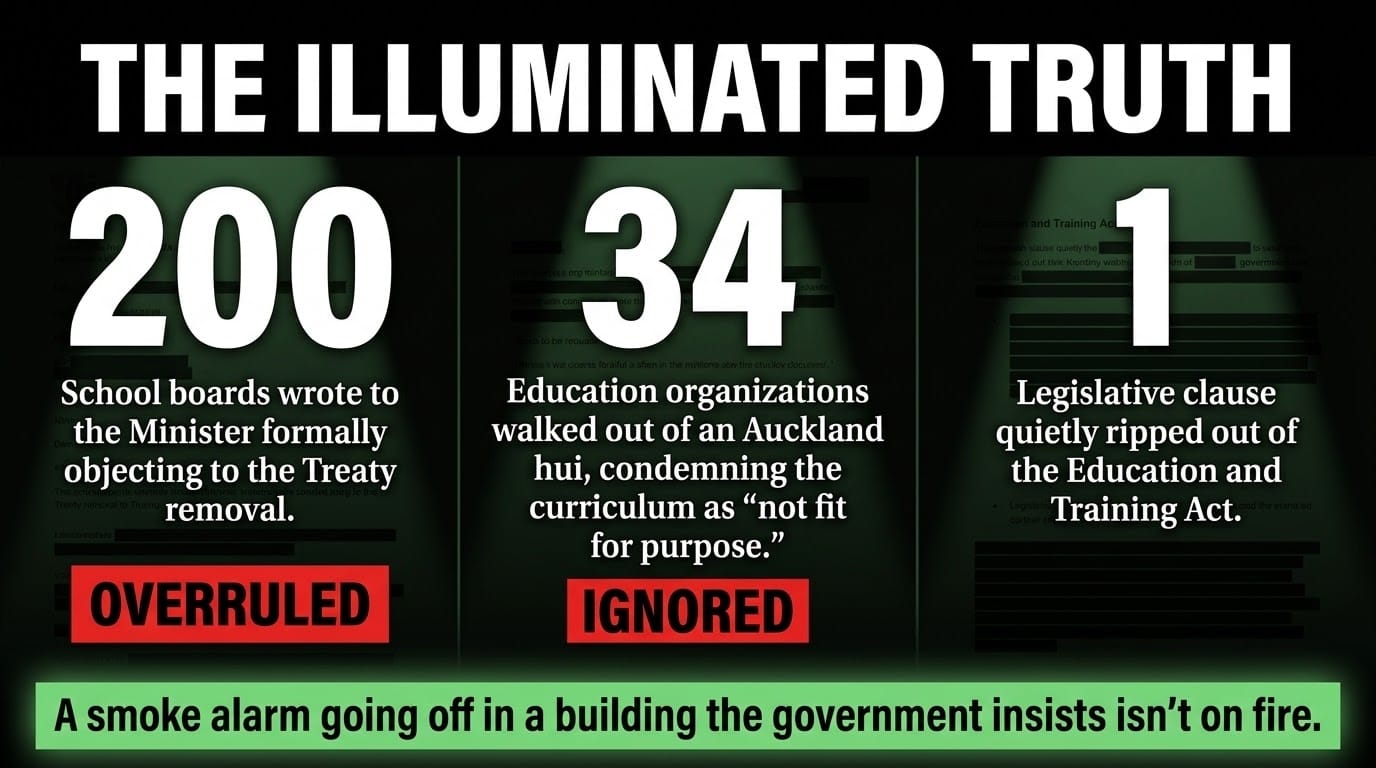
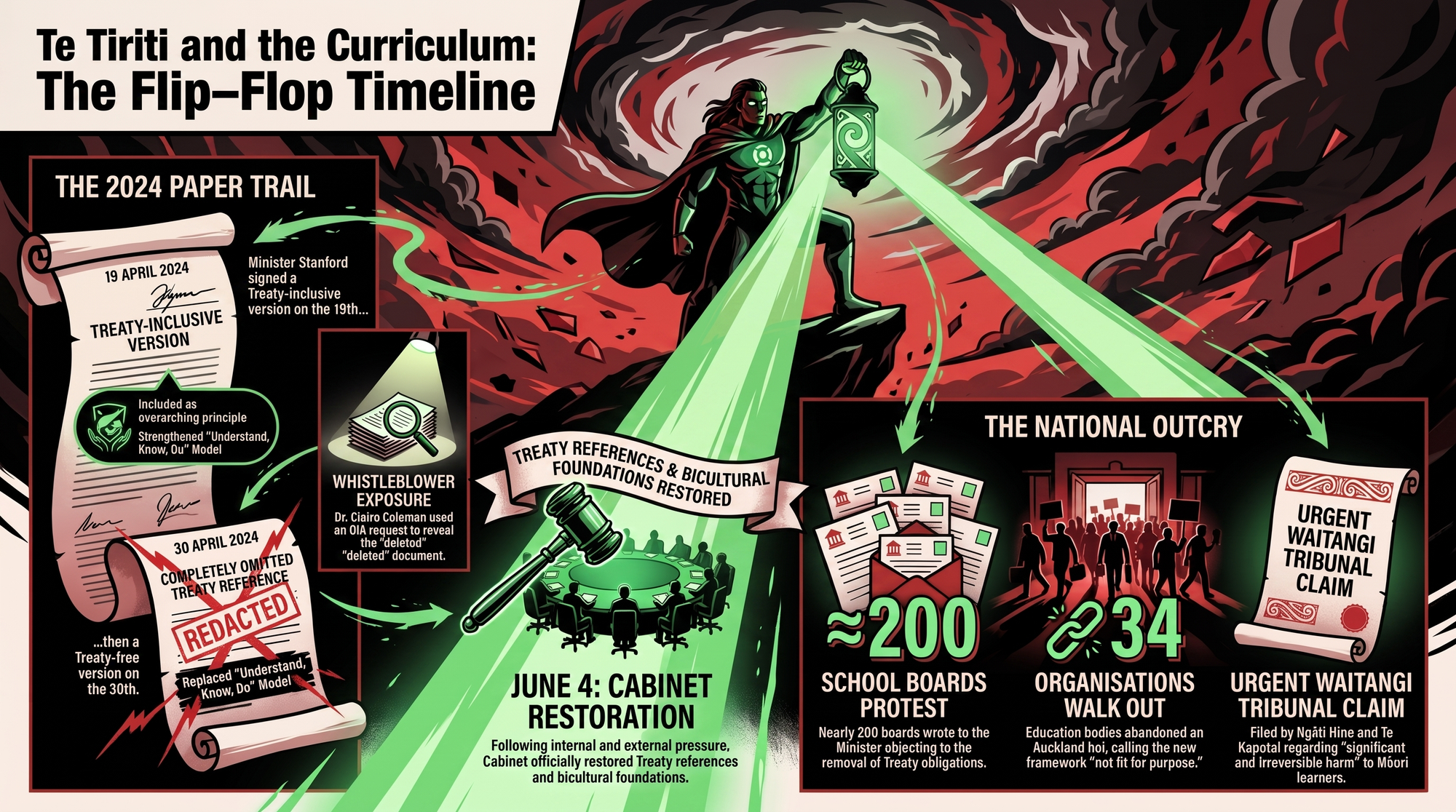
Nearly 200 schools wrote back in protest — 200 governance bodies telling the minister, in writing, that they did not ask for this and did not want it. She proceeded anyway.
Four months later, 34 organisations representing the education sector walked out of a hui in Auckland calling the curriculum framework "not fit for purpose" and "driven by the narrow ideological interests of a small group."
That small group has a name, and I named them in my earlier mahi: Erica Stanford, David Seymour, and the ideological architecture of the New Zealand Initiative — a think tank that draws its playbook from the Atlas Network, the same global funding machine bankrolling the dismantling of indigenous rights from Aotearoa to Alberta.
The Deep Dive Podcast
Two hosts, unpacking this essay's sources — Aroha and Marama. Advance apology for AI pronunciation of te reo; kaitiaki, don't shoot the messenger.
YouTube Video
A short video companion to this essay is available discussing the RNZ curriculum documents and the wider Treaty-in-education pattern. As with the podcast, AI narration mispronounces te reo — kaitiaki, don't shoot the messenger. 😅
Koha Consideration
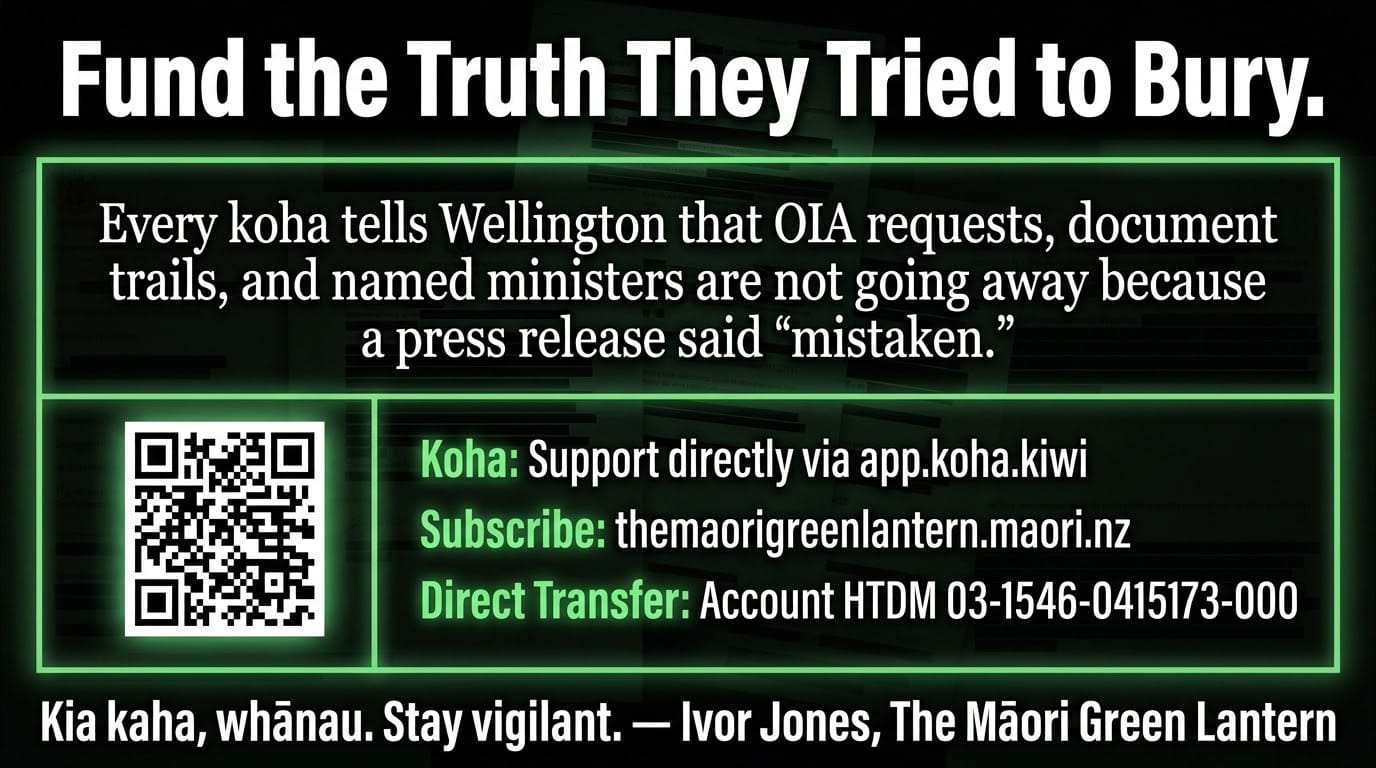
Every koha you give tells the Crown and its curriculum consultants that whānau will fund the truth they tried to bury in a filing cabinet. It tells Wellington that OIA requests, document trails, and named ministers are not going away because a press release said "mistaken." It signals that rangatiratanga includes the power to support our own truth tellers — the Claire Colemans, the 200 school boards, the 34 organisations who walked out and refused to be quiet.
Kia kaha, whānau. Stay vigilant. Stay connected. And if you are able, consider a koha to keep this voice — and this document trail — alive.
If you are unable to koha, no worries. Subscribe or follow the Māori Green Lantern at themaorigreenlantern.maori.nz, kōrero and share this with your whānau and friends — that is koha in itself.
Four pathways exist:
Koha — Support directly via the Koha platform
Subscribe — Receive essays directly and support through subscription
Direct bank transfer — HTDM, account number 03-1546-0415173-000
Facebook — Follow and subscribe
Ngā Mahi Whakamā — Five Verified Revelations, Named Without Flinching
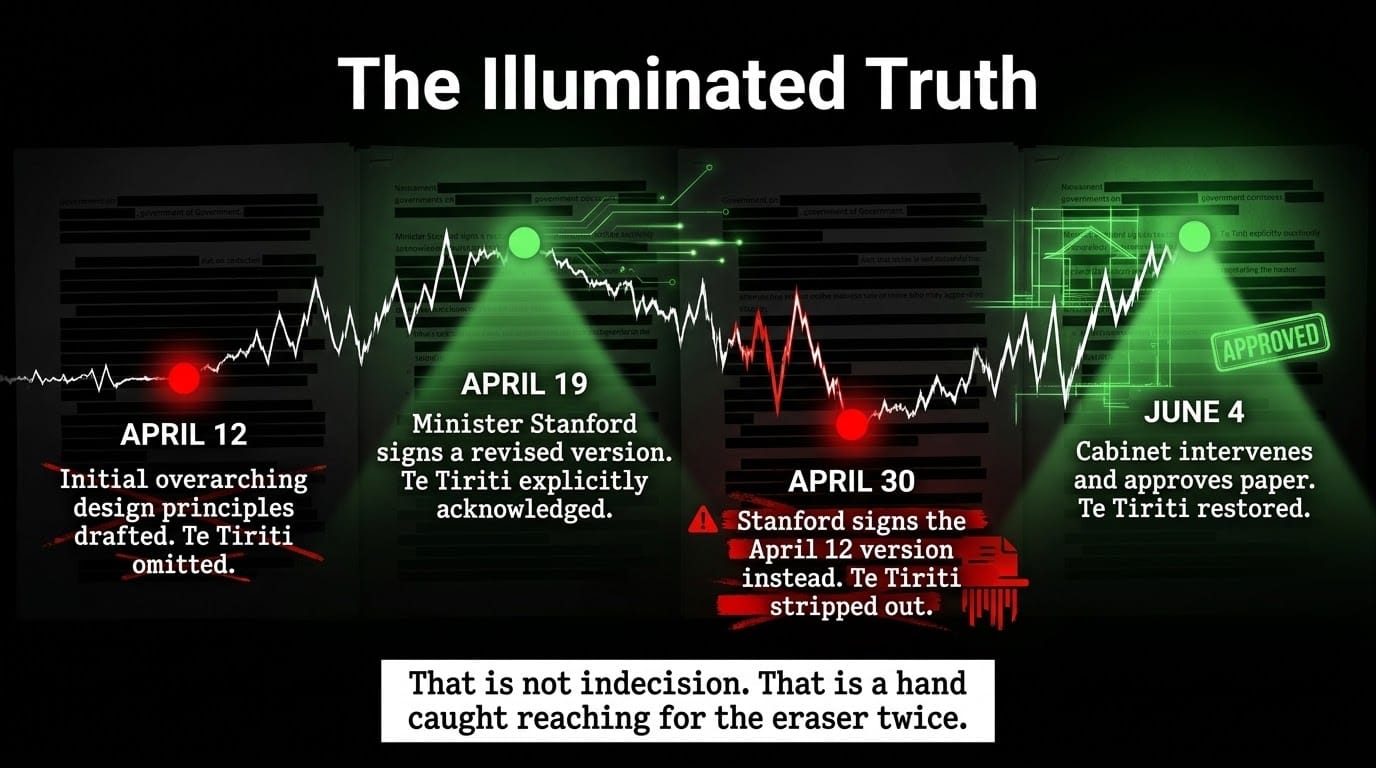
- The minister signed her own contradiction. On 19 April 2024 Stanford signed a curriculum document restoring Te Tiriti. On 30 April 2024, she went back and signed the version with it stripped out again — documented step by step by RNZ. That is not indecision. That is a hand caught reaching for the eraser twice.
- The ministry's alibi collapsed under its own weight. It told RNZ the deletion was tied to the coalition agreement, then withdrew that explanation as "mistaken" — offering nothing to replace it. An institution that cannot explain its own paper trail is an institution that got caught mid-erasure.
- A whistleblower confirmed the real brief was the deletion, not the restoration. Dr Claire Coleman said the Te Tiriti-free document matched exactly what curriculum writers were told to do: strip te reo Māori and Te Tiriti from position papers.
- The profession itself called it what it is. PPTA Te Wehengarua's formal submission describes Te Mātaiaho's transformation from "a Tiriti-grounded, relational framework into a compliance-oriented delivery system" — bureaucratic language for recolonisation wearing a lanyard.
- Iwi took it to the only court that still listens. Ngāti Hine and Te Kapotai, backed by NZEI, filed an urgent Waitangi Tribunal claim arguing the wider removal of Treaty duties would cause "significant and irreversible harm" to Māori learners.
Three Examples for the Western Mind
1. The Filing Cabinet Metaphor — Bureaucratic Sabotage as Policy Instrument.
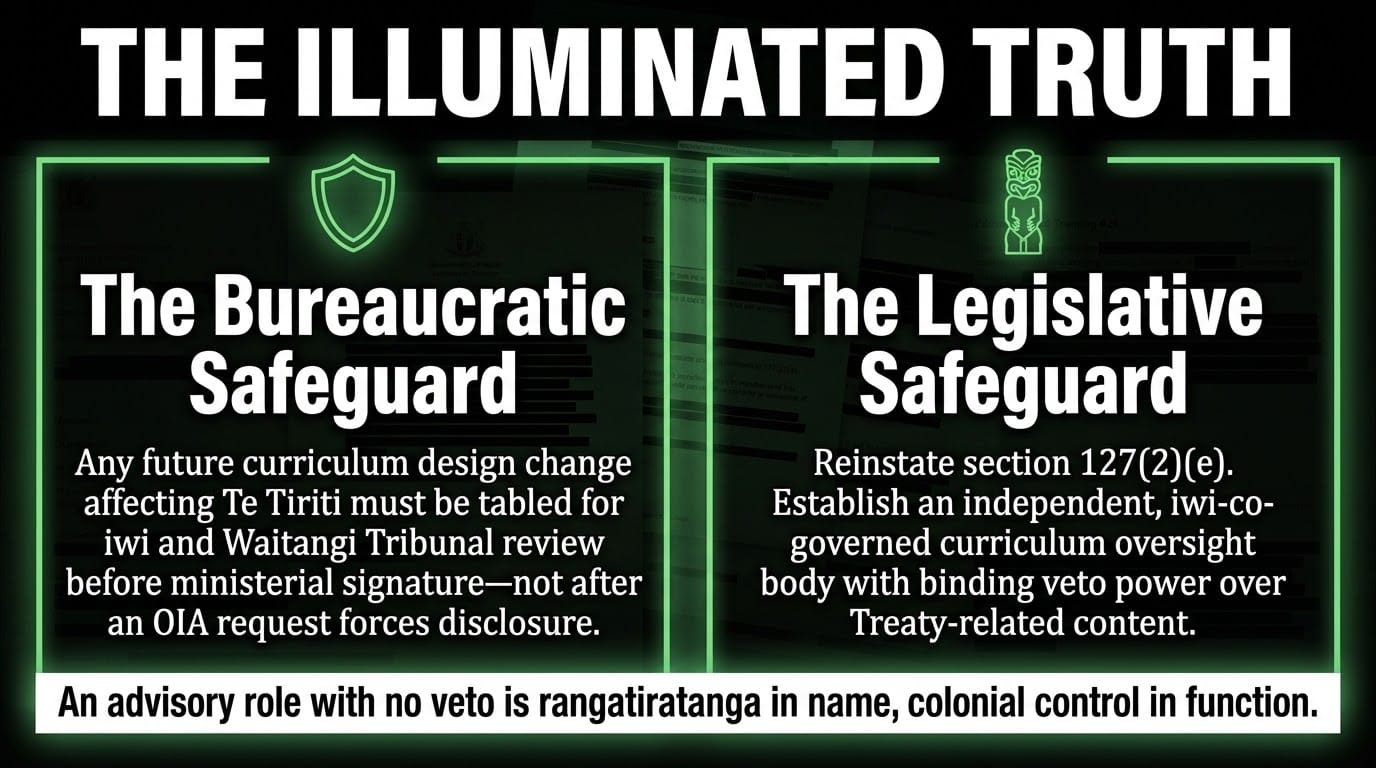
Imagine a company director who signs two versions of the same contract in one month — one that pays the workers, one that doesn't — and chooses the one that doesn't, then tells the shareholders it was "a mistake" when caught. In a private company, that director faces the Serious Fraud Office. In the Ministry of Education, it's called "policy development." Quantified harm: an unknown but real number of curriculum-writing weeks proceeded under Te Tiriti-free design principles before Cabinet corrected course on 4 June 2024 — a gap RNZ's reporting confirms happened but does not quantify in days. Solution: any future curriculum design change affecting Te Tiriti must be tabled for iwi and Waitangi Tribunal review before ministerial signature, not after an OIA request forces disclosure. Tikanga impact for the Western mind: in te ao Māori, a taonga like a curriculum framework is not a draft to be haggled over in private — it carries mauri, a living essence, and treating it as disposable paperwork depletes that mauri for every tamaiti who learns from it. I mapped this same mechanism — concession followed by quiet reversal — in The Crowbar in the Classroom.
2. The Legislative Clause as Load-Bearing Wall.
Section 127(2)(e) was not decoration in the Education and Training Act — it was a load-bearing wall requiring boards to give effect to Te Tiriti. Removing it is architecturally identical to removing a wall from a house and telling the tenants the roof will be fine. Quantified harm: nearly 200 school boards — governance bodies elected to represent their communities — formally objected in writing, and were overruled regardless. Solution: reinstate section 127(2)(e) and legislate a requirement that any future removal of Treaty-related statutory duties requires a Waitangi Tribunal hearing before, not after, enactment. Tikanga impact: this is a breach of manaakitanga at a legislative level — the Crown withdrawing its duty of care and calling the withdrawal "clarity." I detailed the mechanics of this specific removal in Stanford's Treaty Betrayal.
3. The Hui Walkout as a Smoke Alarm Nobody in Wellington Wanted to Hear.
Thirty-four organisations do not walk out of a government hui over a typo. That is a smoke alarm going off in a building the government insists isn't on fire. Quantified harm: a curriculum framework serving every state-school child in Aotearoa was called "not fit for purpose" by the very sector tasked with delivering it. Solution: an independent, iwi-co-governed curriculum oversight body with binding veto power over Treaty-related content — not an "advisory group" stacked with think-tank fellows who can be outvoted by the minister. Tikanga impact: rangatiratanga means Māori exercising authority over matters affecting Māori children — an advisory role with no veto is rangatiratanga in name, colonial control in function. This pattern of ideological capture is what I traced in Stanford's Colonial Classroom.
Tihei Mauri Ora!
Ivor Jones The Māori Green Lantern Fighting Misinformation And Disinformation From The Far Right
Disclaimer: This essay concerns ministers and a ministry acting in public capacity on a matter of significant public interest — Te Tiriti o Waitangi's place in the national curriculum and education law. Facts are drawn from cited sources; characterisations such as "white supremacist neoliberal regime" reflect the author's stated opinion and editorial position, consistent across The Māori Green Lantern's published body of work, and are not assertions of criminal conduct against any named individual. No malice is intended toward any person; criticism addresses institutional pattern, policy, and process.