"One Stroke of the Pen: How a White-Supremacist Neoliberal Government Sold Māori's Seat at the Table to the Highest Bidder" - 23 July 2026
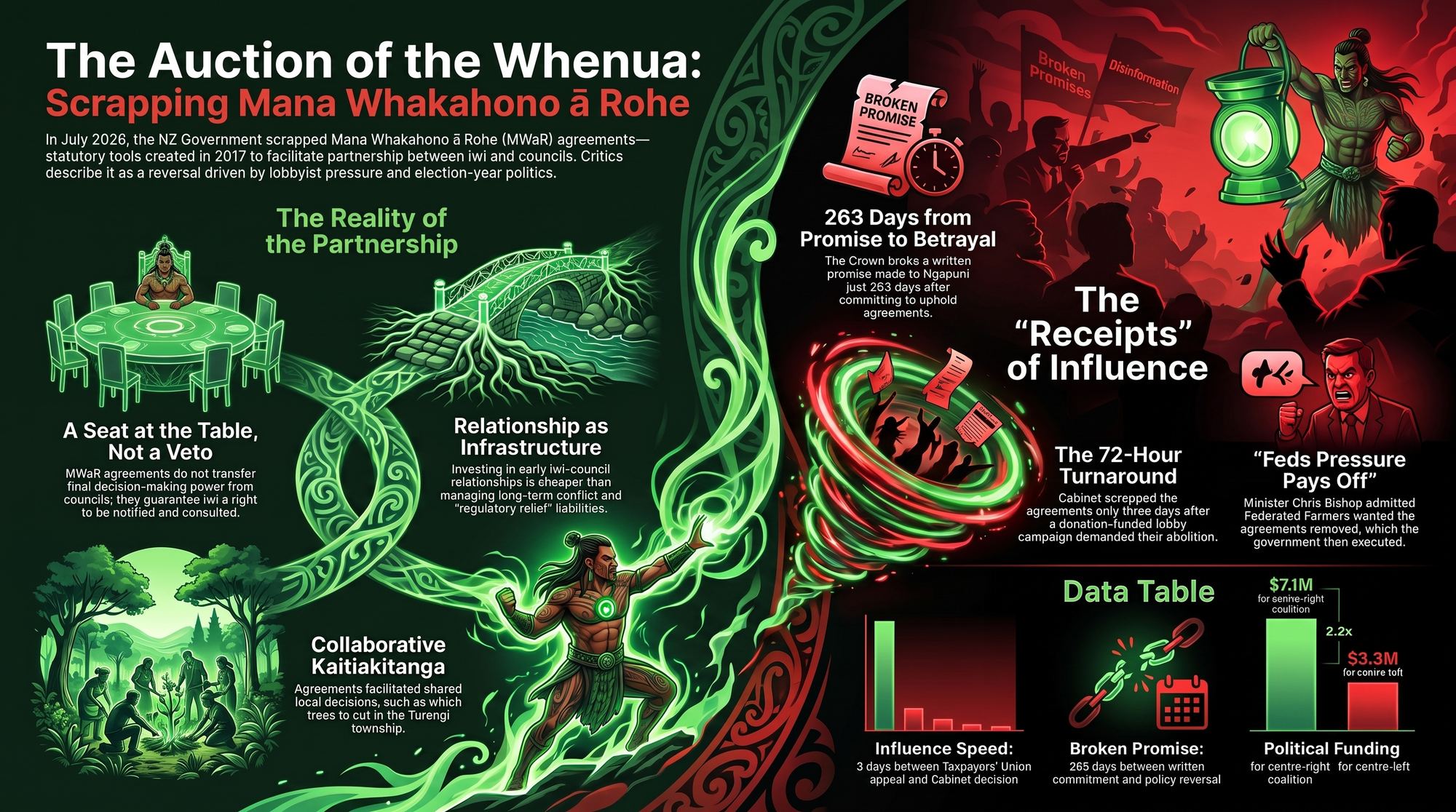
They put their promise to Ngāpuhi in writing, then tore it up 263 days later — because Federated Farmers asked them to and the Taxpayers' Union paid to make them. This is not reform. It is an auction, and the whenua is the lot on the block.


Kia ora ano Aotearoa,
I have watched them fell tōtara before. Not with the honest violence of a storm, but with the quiet cowardice of a man in a hi-vis vest and a clipboard, who never touched the bark, who wrapped his tape around a thirty-year trunk and decided — for a fee — that the tree was in the way of somebody's subdivision. The tree is not diseased. The tree is not dangerous. The tree is simply standing where a donor wants a driveway.
 RNZ | Te Reo Irirangi o Aotearoa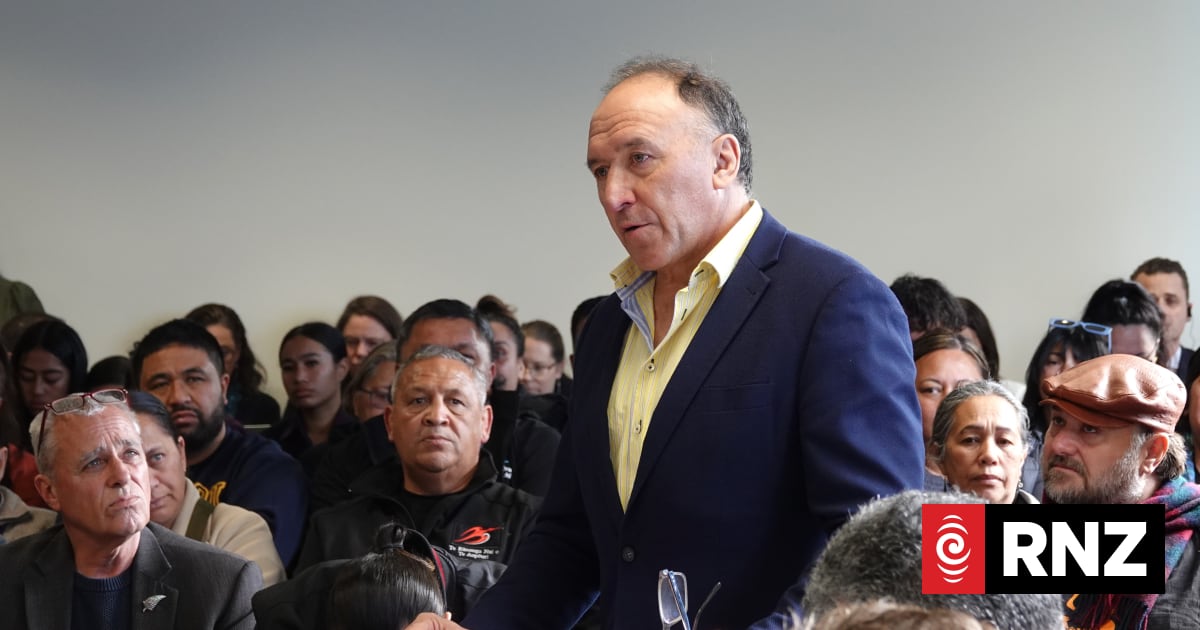
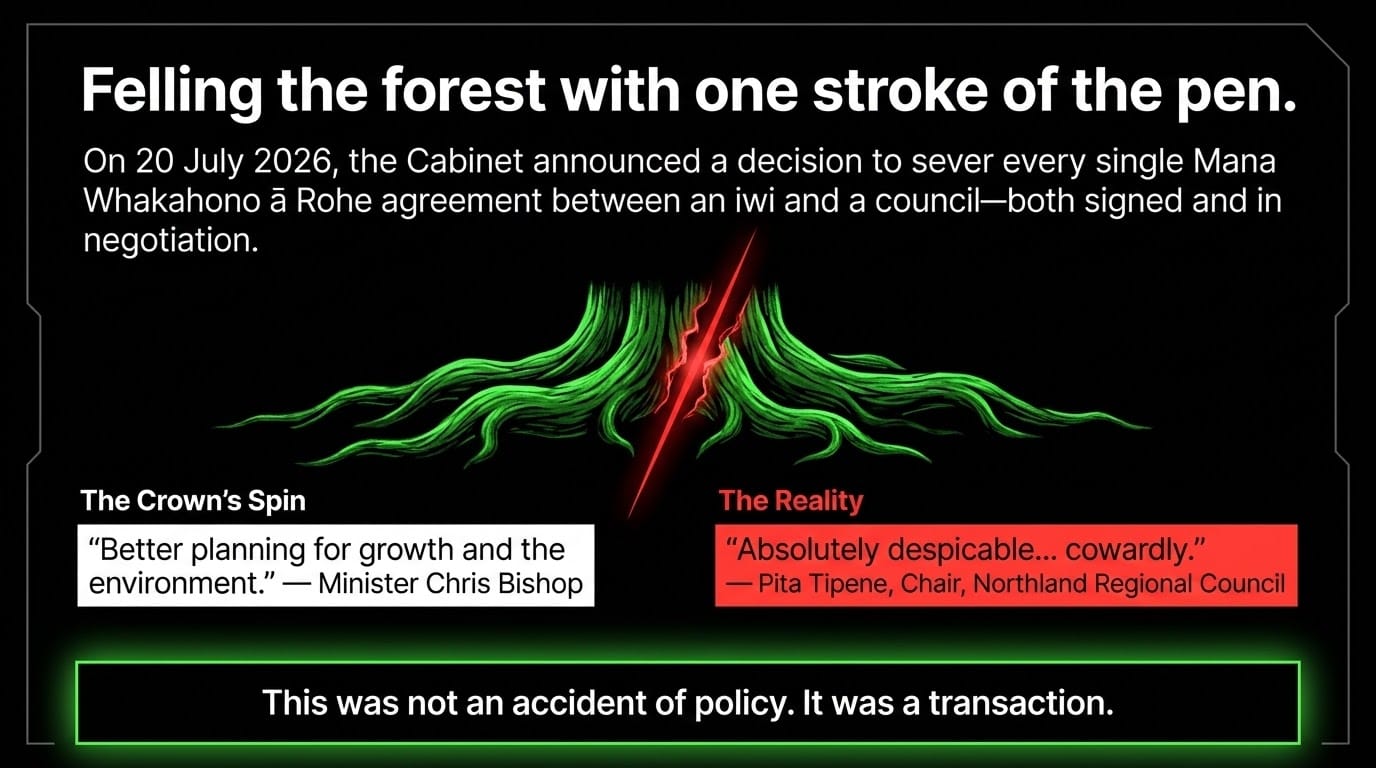
On 20 July 2026, this Government took the tape measure to a whole forest. With a single Cabinet decision it declared that every Mana Whakahono ā Rohe agreement between an iwi and a council
— every one already signed in good faith, every one still being negotiated — would be severed at the root and left to die outside the new planning law (Beehive).
Minister Chris Bishop called it "better planning for growth and the environment." The chair of the Northland Regional Council, Pita Tipene, called it "despicable" and "cowardly" (RNZ).
Tipene was being generous. Because this was no accident of policy, whānau. It was a transaction. The lobbyists named their price, the Minister paid it out of your birthright, and — the arrogance of the powerful being what it is — they left the receipt lying on the table. I am going to read it to you.
Background: what they actually cut, and the lie they told about it
Precision is the taiaha. So let us be precise about the thing they killed.
A Mana Whakahono ā Rohe (MWaR) agreement is a statutory instrument under the Resource Management Act 1991
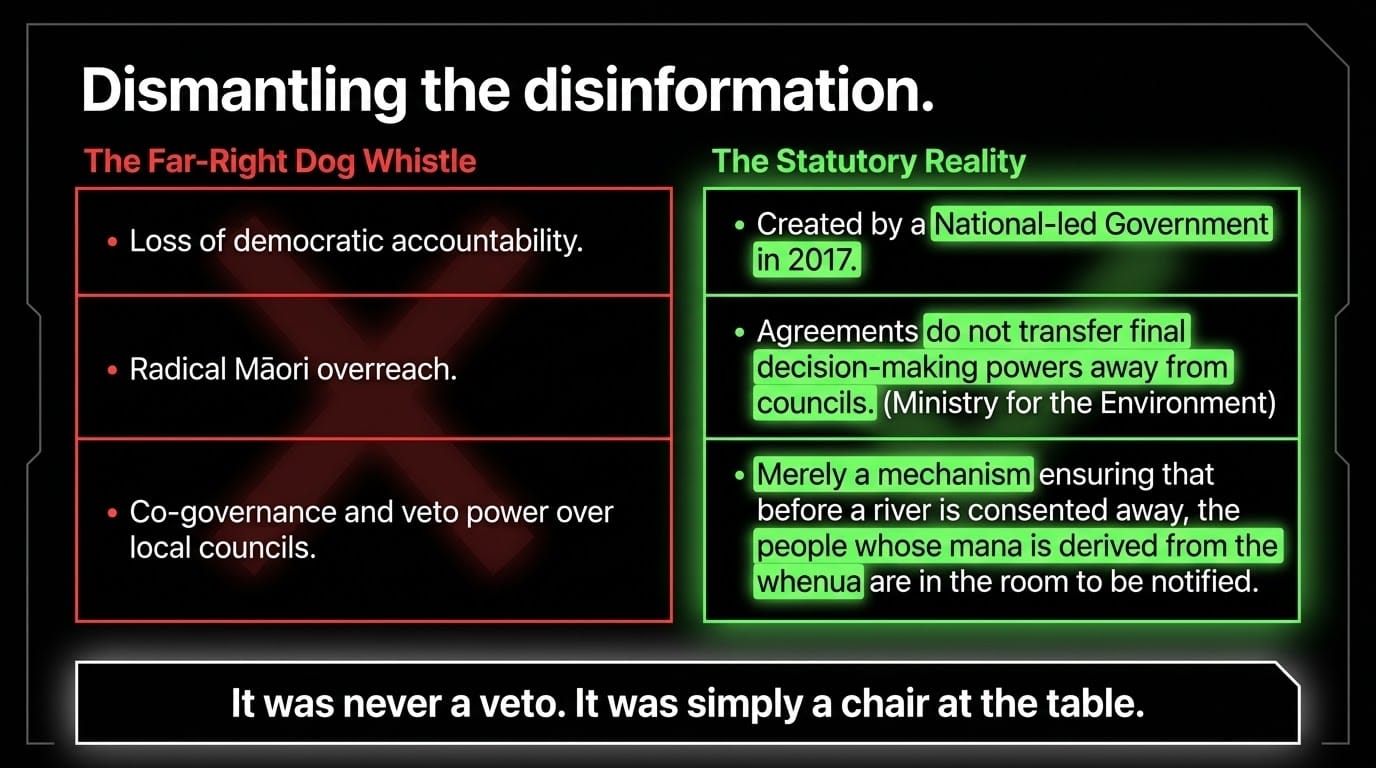
— and here is the first inconvenient truth for a Government pretending this is radical Māori overreach: it was created by a National-led Government in 2017 (Te Ao Māori News).
It lets an iwi authority and a council agree, in writing, how they will work together — planning, information-sharing, engagement, and how Treaty settlement obligations show up in local decisions (Te Ao Māori News).
Now read the sentence they hoped you would never read.
These agreements "do not transfer final decision-making powers away from councils" (Te Ao Māori News).
Te Pāti Māori co-leader Debbie Ngarewa-Packer confirmed it: "They do not transfer decision-making authority to iwi" (Scoop).
The council keeps the pen. Always kept the pen. The agreement guarantees only that before the pen moves, the people whose "mana is derived from the whenua" — Ngāti Hine chair Rowena Tana's words
— are in the room to be told what is about to happen to their awa (RNZ).
That is all they cut. Not a veto. Not co-governance. A chair. The right to be told before your river is consented away to a stranger. And for daring to offer Māori a chair, this Government set fire to the whole room.
The Deep Dive Podcast
Prefer to listen? Two hosts sit down and pull this whole receipt apart — the confession, the three-day turnaround, the broken written promise, and the 110-day runway to the ballot box — connecting the sources behind this essay into one clear thread.
A note from me: I apologise in advance for the AI's very harsh pronunciation of te reo. Please don't shoot the messenger. :)
Youtube
Like video? Here is a short piece supporting the essay — the same evidence, the same taiaha, in a couple of minutes.
Again, don't shoot the messenger over the AI's reo pronunciation. :)
Koha Consideration
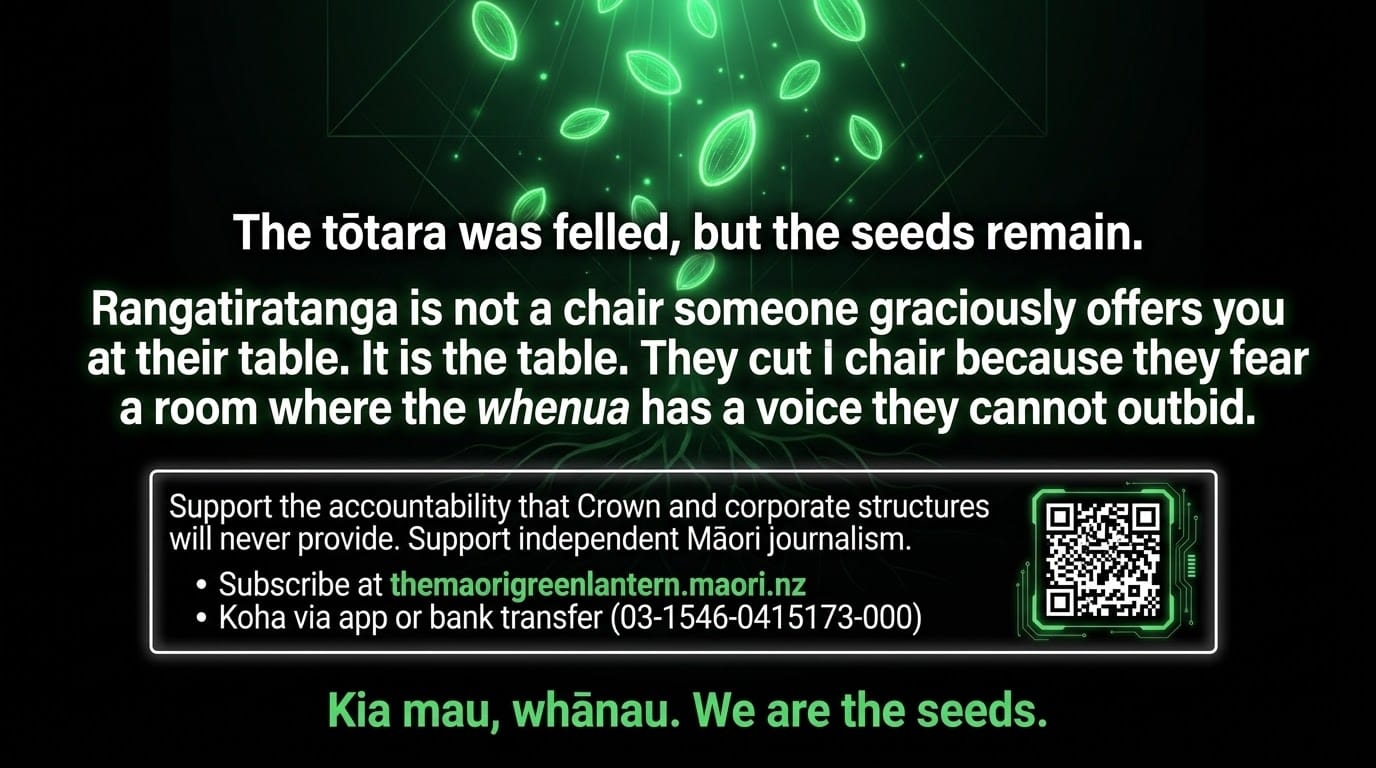
Every koha signals that whānau are ready to support the accountability that Crown and corporate structures will never provide — the accountability that names the lobbyist behind the "reform," the donor behind the lobbyist, and the 263-day-old broken promise behind them both. It signals that rangatiratanga includes the power to support our own truth-tellers, so that the seat at the table can never be quietly auctioned again while no one is watching.
Kia kaha, whānau. Stay vigilant. Stay connected. And if you are able, consider a koha to ensure this voice continues.
If you are unable to koha, no worries. Subscribe or follow The Māori Green Lantern at themaorigreenlantern.maori.nz, kōrero, and share with your whānau and friends — that is koha in itself.
Four pathways exist:
For those who wish to support this mahi directly with a koha (voluntary contribution): Koha — Support.
For those who wish to receive essays directly and support through subscription: Subscribe to The Māori Green Lantern.
For those who prefer direct bank transfer: HTDM, account number 03-1546-0415173-000.
For those on Facebook: facebook.com/Themaorigreenlantern.
The "gold rush" they manufactured, then punished
Here is the story the Government told the country. Councils were rushing into a "flurry" of deals; the number had exploded; therefore the tool itself had become a threat to "democratic accountability" and had to be destroyed.
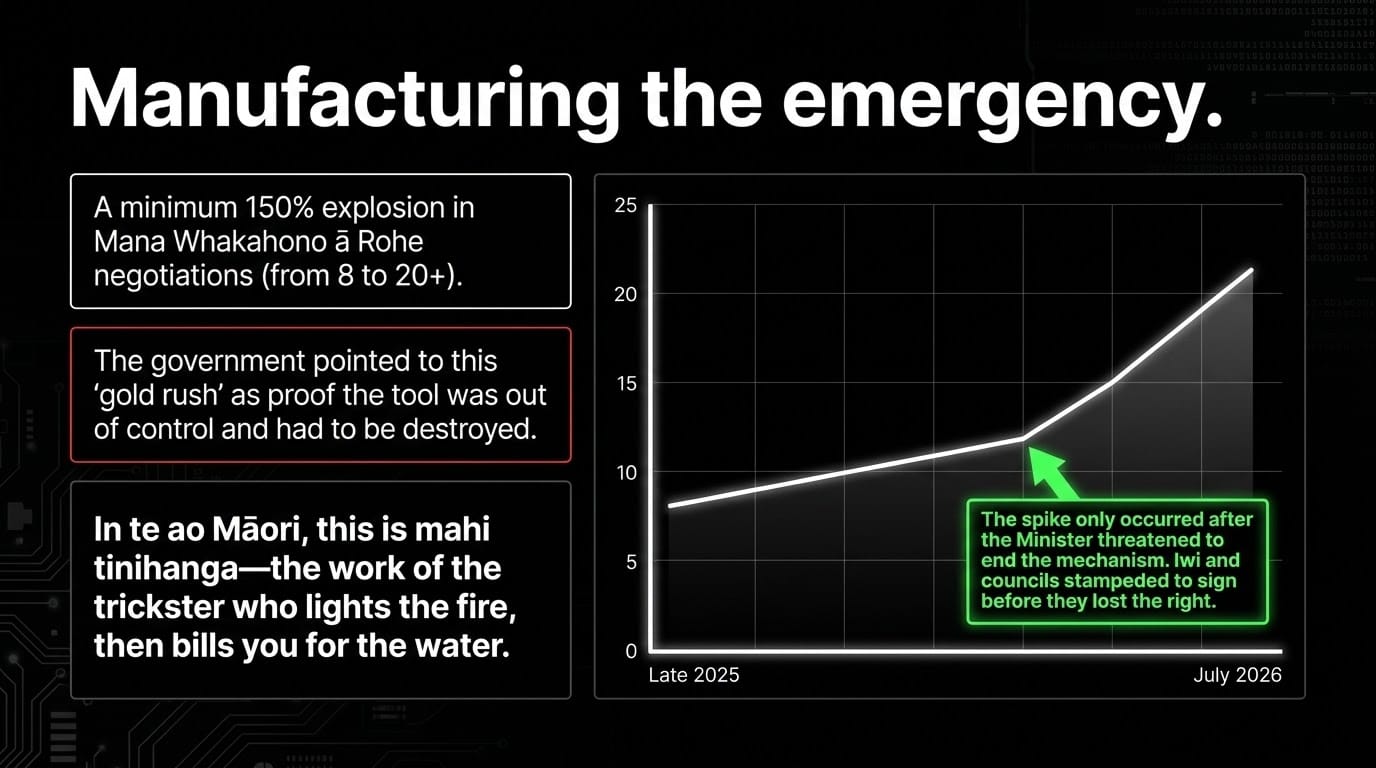
The number did grow. Eight MWaR agreements existed when the bills were introduced in late 2025. By July 2026 "several dozen more" had been agreed or initiated (Beehive); the Ministry for the Environment's own register lists more than twenty in negotiation (Ministry for the Environment; NZ Herald).
But look at what that "flurry" actually was. It was iwi and councils reaching for a lawful tool — the tool National built — faster, because this Government had just announced it was about to weld the door shut. The "gold rush" the Minister condemned was a stampede he started.
He threatened to end the mechanism; iwi and councils rushed to sign before they lost the right; then he pointed at the stampede and said: see, they cannot be trusted with this.
That is not a justification. It is a con — manufacturing the emergency you then claim to be heroically solving. In your logic textbooks it is the self-fulfilling prophecy.
In te ao Māori it is mahi tinihanga: the work of the trickster who lights the fire and then bills you for the water.
Analysis: five receipts the Minister left on the table
Receipt one — the Minister confessed who ordered the killing
You almost never get a confession in politics. This time the Minister handed you one, unprompted.
Asked whether Federated Farmers had influenced the decision, Chris Bishop did not dodge.
He said it out loud: "Federated Farmers wanted us to get rid of Mana Whakahono agreements, which we've done" (Te Ao Māori News).
The NZ Herald traced the same chain in plain daylight: the agreements were axed "as a result of a flurry of new deals being inked or negotiated and a fierce campaign by the Taxpayers' Union and Federated Farmers against the deals" (NZ Herald).
And Federated Farmers, drunk on the win, issued a media release headlined "Feds Pressure Pays Off On Iwi-Council Agreements," crowing that the scrap was "extremely encouraging" (Scoop).
The lobby named its price. The Minister paid it. Then both of them bragged about it in writing. That is not governing. That is a Minister taking dictation.
Receipt two — the campaign was bought and paid for
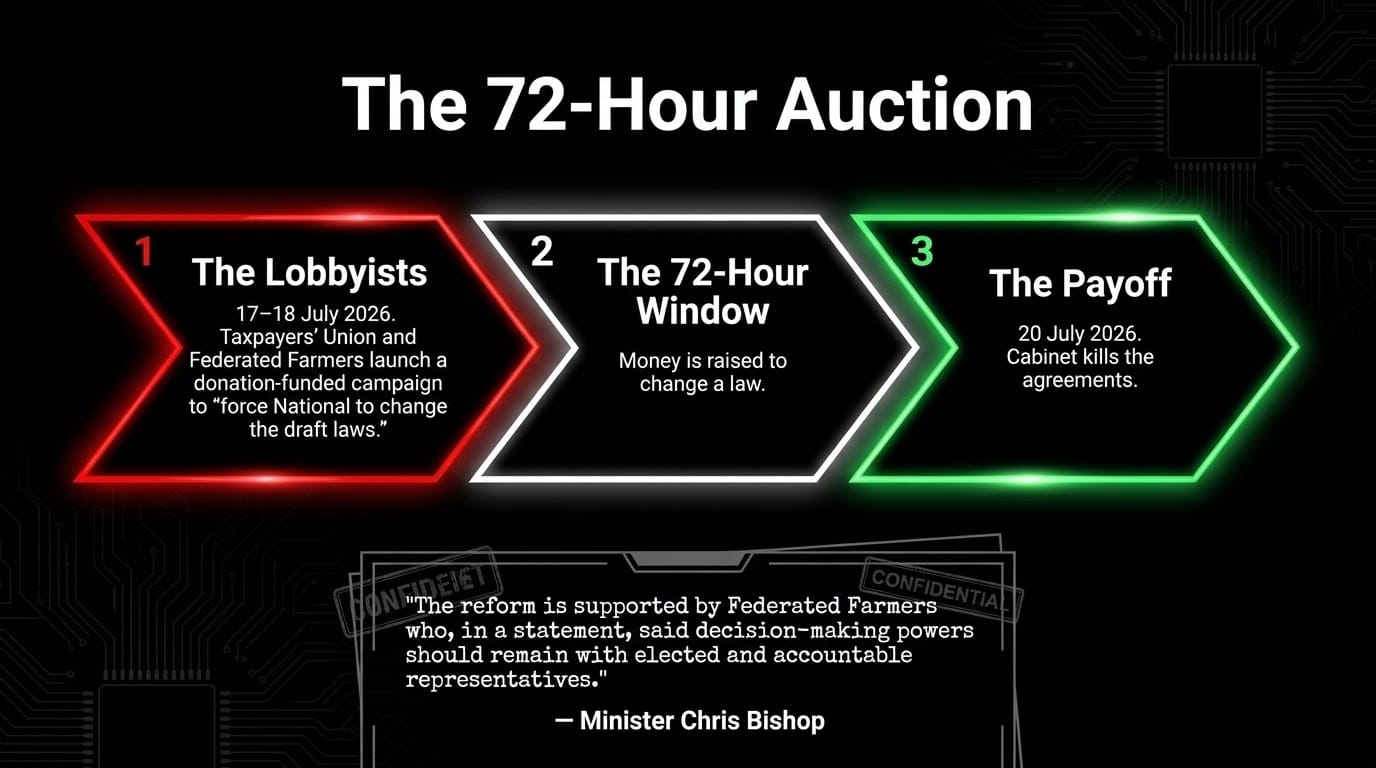
The Taxpayers' Union did not merely hold an opinion. It ran a donation-funded campaign whose explicit purpose was to "force the National Party to see sense" and "abolish, not embed, these undemocratic Mana Whakahono ā Rohe agreements," telling supporters "we have just a few weeks to force National to change the draft laws" — and asking them to put money behind it (Waikanae Watch, republishing the Taxpayers' Union appeal).
Working: that appeal was republished on 17–18 July 2026. Cabinet's decision landed 20 July 2026 — three days later (20 Jul − 17 Jul = 3 days) (Waikanae Watch / Taxpayers' Union; Beehive).
Money was raised to change a law. Seventy-two hours later, the law changed. This is the machinery of purchased influence running in broad daylight — and it ran faster than any Treaty settlement Ngāpuhi has waited a lifetime for.
Receipt three — cui bono? Follow the pūtea, and it leads to the same door
Ask the oldest question there is: who profits, and who feeds the ones who profit?
The three coalition parties — National, ACT and NZ First — are, in the Democracy Project's words, "overwhelmingly characterised by a reliance on large donations from a narrow base of corporate entities and high-net-worth individuals," with National "approximately 60% corporate," ACT's donors "from business, property, and agribusiness backgrounds," and NZ First drawing "significant funding from the primary and extractive industries, including mining, forestry, and transport" (The Democracy Project). In 2024 the centre-right bloc banked $7.1 million in declared donations against the centre-left's $3.3 million (The Democracy Project).
Federated Farmers is the political megaphone of the pastoral sector — the very sector whose land use is most inconvenienced when tangata whenua sit at the consenting table. The extractive and property money funds the parties; the parties remove the Māori seat that might ask awkward questions about extraction and property. The circle closes with an audible click. I do not need to allege a single unlawful dollar changed hands to show you the shape of it — the Minister already told you who lobbied him, and the audit already told you who funds the Minister.
Receipt four — they broke a promise they had made in writing
This is the receipt that should end careers.
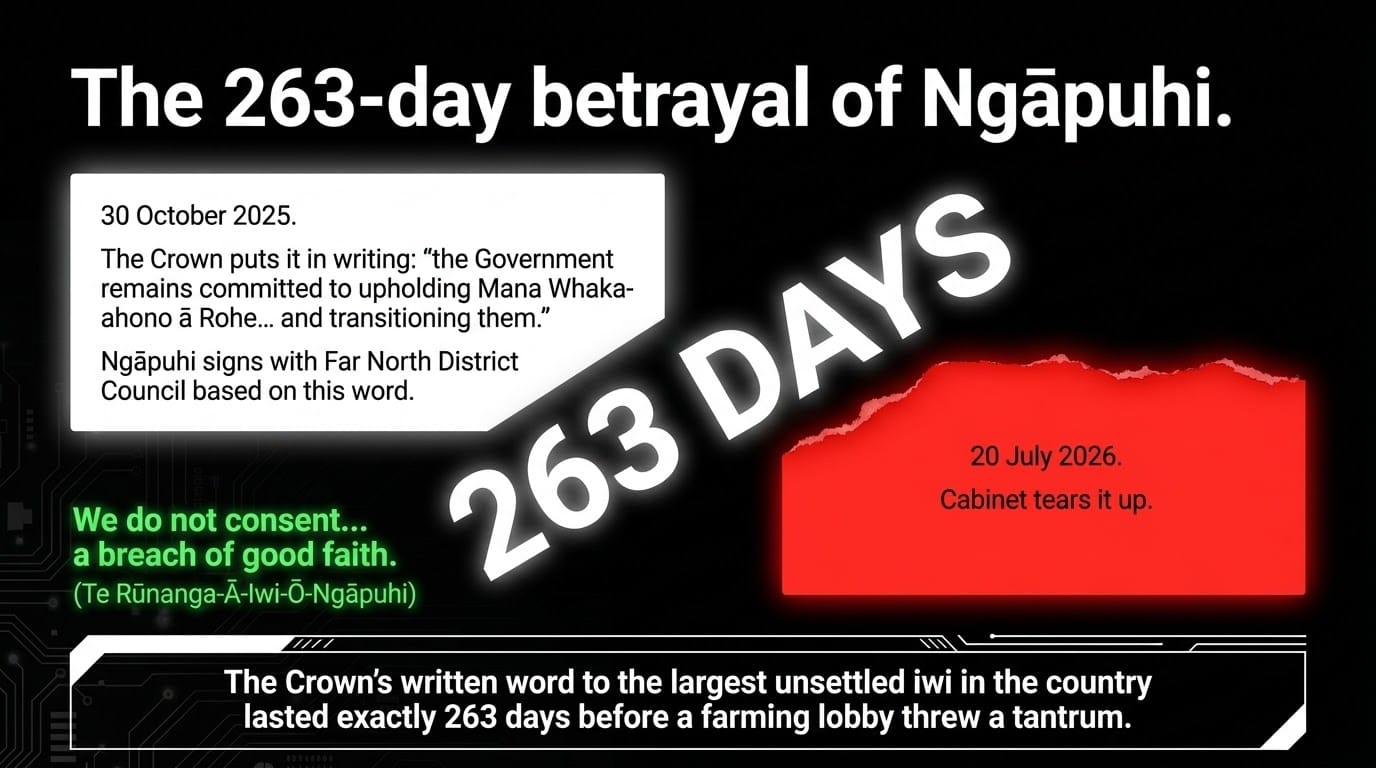
On 30 October 2025, the Ministry for the Environment wrote to the chair of Te Rūnanga-Ā-Iwi-Ō-Ngāpuhi (TRAION) and put it in writing: "the Government remains committed to upholding Mana Whakahono ā Rohe made under the RMA and transitioning them to the new resource management legislation" (TRAION statement, via Scoop).
Ngāpuhi — the largest iwi in the country, still without a Treaty settlement — signed with Far North District Council on the strength of that written word (Ministry for the Environment register). Then, on 20 July 2026, Cabinet tore it up.
Working: 30 Oct 2025 → 20 Jul 2026 = 263 days between the written promise and the betrayal (TRAION, via Scoop; Beehive).
TRAION's reply was total: "We do not consent," calling it "a breach of the good faith, partnership, active protection and good government principles at the heart of the Treaty relationship" (TRAION, via Scoop).
The Crown gave its written word, an iwi relied on it, the Crown reneged the moment a lobby group applied pressure. In any court of contract that is bad faith. Under Te Tiriti it is worse — it is 1840 photocopied and re-signed, the same broken quill dressed up as "guardrails."
Receipt five — the timing is the whole confession
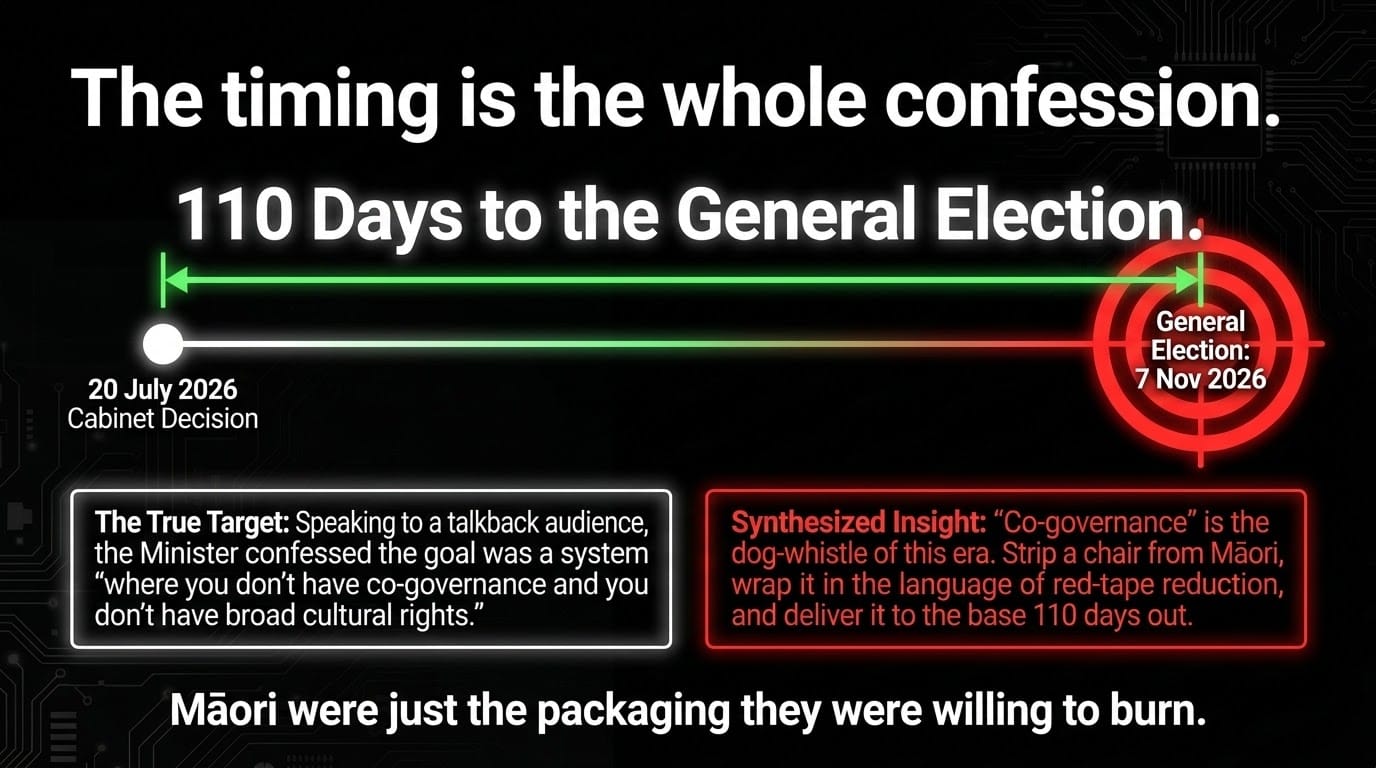
They did not do this in a vacuum. They did it 110 days before a general election — polling day is 7 November 2026 (Electoral Commission).
Working: 20 Jul 2026 → 7 Nov 2026 = 110 days (Beehive; Electoral Commission).
Pita Tipene read the runway exactly: "I think it's getting quite desperate, given that the runway into the general elections is quite short now" (RNZ). And listen to what the Minister confessed the real target was — not to Māori media, but to talkback host Heather du Plessis-Allan, where he thought only the base was listening: the goal is a system "where you don't have co-governance and you don't have broad cultural rights that are asserted" (iHeart / Newstalk ZB).
"Co-governance." The dog-whistle of this era, blown on cue. Strip a chair from Māori, wrap it in the language of red-tape reduction, and deliver it to the base 110 days out. That is not planning policy. That is an election product, and Māori are the packaging they were willing to burn.
Three examples for the Western mind — with the harm quantified, the fix named, and the tikanga made plain
For those who need it made concrete, here are three real cases. And because I do not ask you to take my word alone, I point you to where I have traced this same white-supremacist neoliberal machine before, on my own pages.
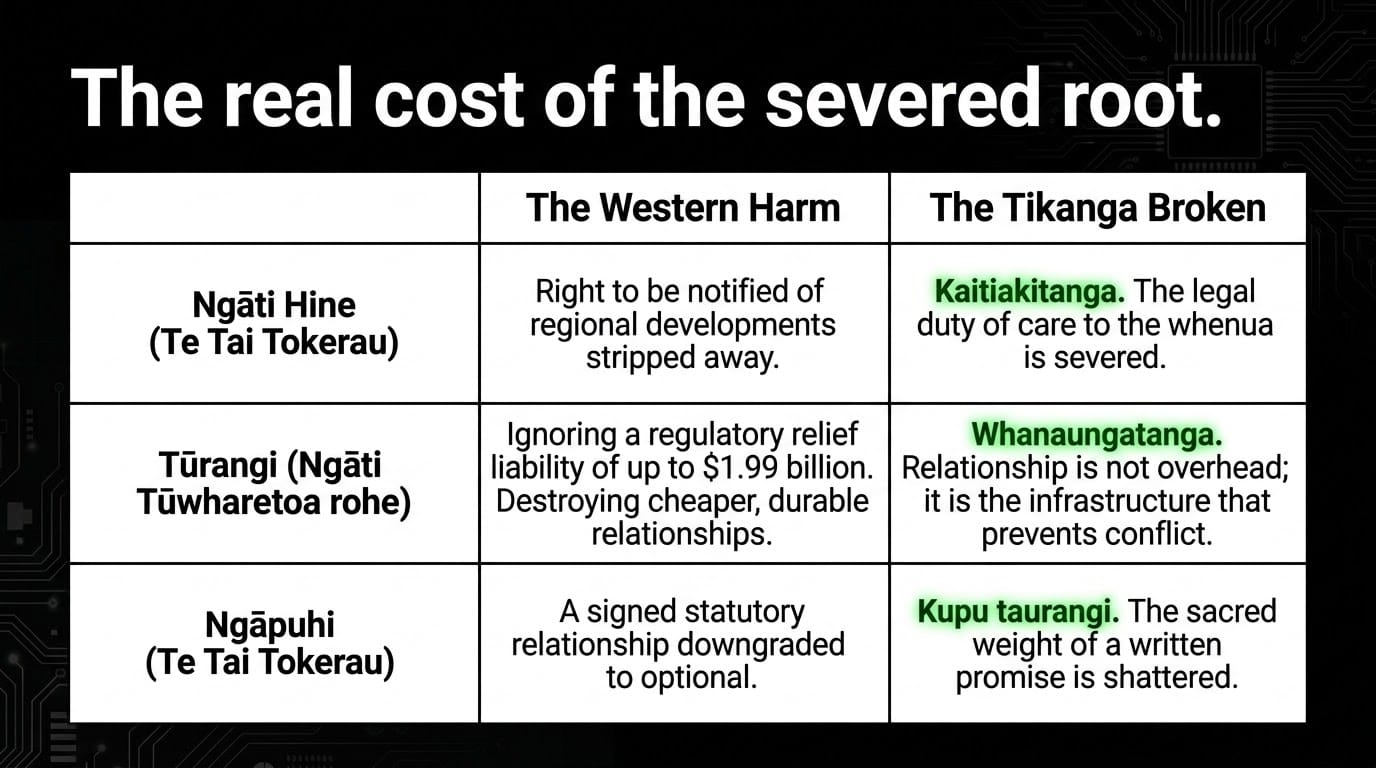
1. Ngāti Hine, Te Tai Tokerau.
Signed with Northland Regional Council in 2024; two further applications lodged with Far North and Whangārei (RNZ).
Core claim: the agreement gave "a seat at the table… rangatira to rangatira," and the right to be notified of "any resource consents, any developments" (RNZ). Harm, quantified: in a rohe where the Māori population is "about 40 percent and as high as 90 percent in some places," that seat is now something a council may simply decline to offer (RNZ).
Solution: the select committee could have amended the bills to enable new agreements to be entered, rather than banning them. Tikanga made plain for the
Western mind: kaitiakitanga is not sentiment — it is a legal duty of care to the whenua, passed down whakapapa. Severing the seat severs the guardian from the thing it is bound to protect.
Imagine being told, by statute, that you no longer have standing to speak for your own grandmother. That is the harm. I traced the same pattern of "reform" dressed over dispossession in how a white-supremacist neoliberal regime turned our wai and moana into profit streams and called it reform.
2. Tūrangi township, Ngāti Tūwharetoa rohe.
Environmental expert Tina Porou gave the plainest example in the land: "We have shared discussions over which trees will be cut down in the Tūrangi township… I know that would scare people having a Māori help decide that" (RNZ).
Core claim: the process was collaborative, not controlling — a conversation about street trees, not a seizure of power.
Harm, quantified: Porou warns scrapping it "would ultimately cost councils more in the long run," because "investing in a relationship at the beginning… is much cheaper than trying to manage a long-term, bad relationship" (RNZ).
The Government's own case rests on a claimed "$13.3 billion in savings over 30 years" while ignoring a "regulatory relief" liability a MartinJenkins report put at between $7 million and $1.99 billion (NZ Herald).
Solution: keep the tool that produces cheaper, more durable outcomes.
Tikanga made plain: whanaungatanga — relationship — is not overhead to be trimmed. It is the infrastructure that prevents conflict before it starts.
And Porou named the true driver: "a racist reaction to having Māori around the table" (Te Ao Māori News). I documented this same instinct — punishing Māori for existing near the whenua — in Petrol on the Green Chain.
3. Ngāpuhi, Te Tai Tokerau.
Core claim: Ngāpuhi relied on a written Crown promise dated 30 October 2025 to sign with Far North District Council (TRAION, via Scoop).
Harm, quantified: 263 days after that written commitment, the largest unsettled iwi in the country had its statutory relationship downgraded to something a council "can simply decline to enter" (TRAION, via Scoop).
Solution: honour the written word; grandfather every signed agreement, exactly as the bills originally provided (Beehive).
Tikanga made plain: kupu taurangi — the sacred weight of a spoken and written promise — is the foundation of mana. A Crown that breaks its written word to Māori the instant a farming lobby objects has told you exactly what its word is worth.
I have charted this same machinery of neoliberal planning grinding down a Māori community in how a neoliberal government is planning Ōpōtiki into its grave while the whenua rises to save it.
Implications: the harm they hope you won't add up
The Government dressed this cut in the language of savings — "$13.3 billion in savings over 30 years," "up to 46 percent" of consents removed (NZ Herald; Otago Daily Times).
But the same reforms saddle ratepayers with a "regulatory relief" liability estimated at between $7 million and $1.99 billion (NZ Herald), and Labour's minority report warned the changes would have "a chilling effect on protections" while concentrating power in the Beehive, where "the minister will determine how the conflict is resolved" (NZ Herald).
The deepest harm is not the lost chair.
It is the precedent this Government has now branded into the record: that a written Crown promise to Māori is worth less than a farming lobby's three-day tantrum.
Te Tōtarahoe o Paerangi chair Tomairangi Mareikura said it with a clarity the Beehive will never match — "It defies belief that with one stroke of the pen, lobbyists can influence government to overlook the value of relationships with iwi, and in doing so, act in a way which privileges one group of New Zealanders over another" (Scoop).
Not fit to lead — not now, not next term
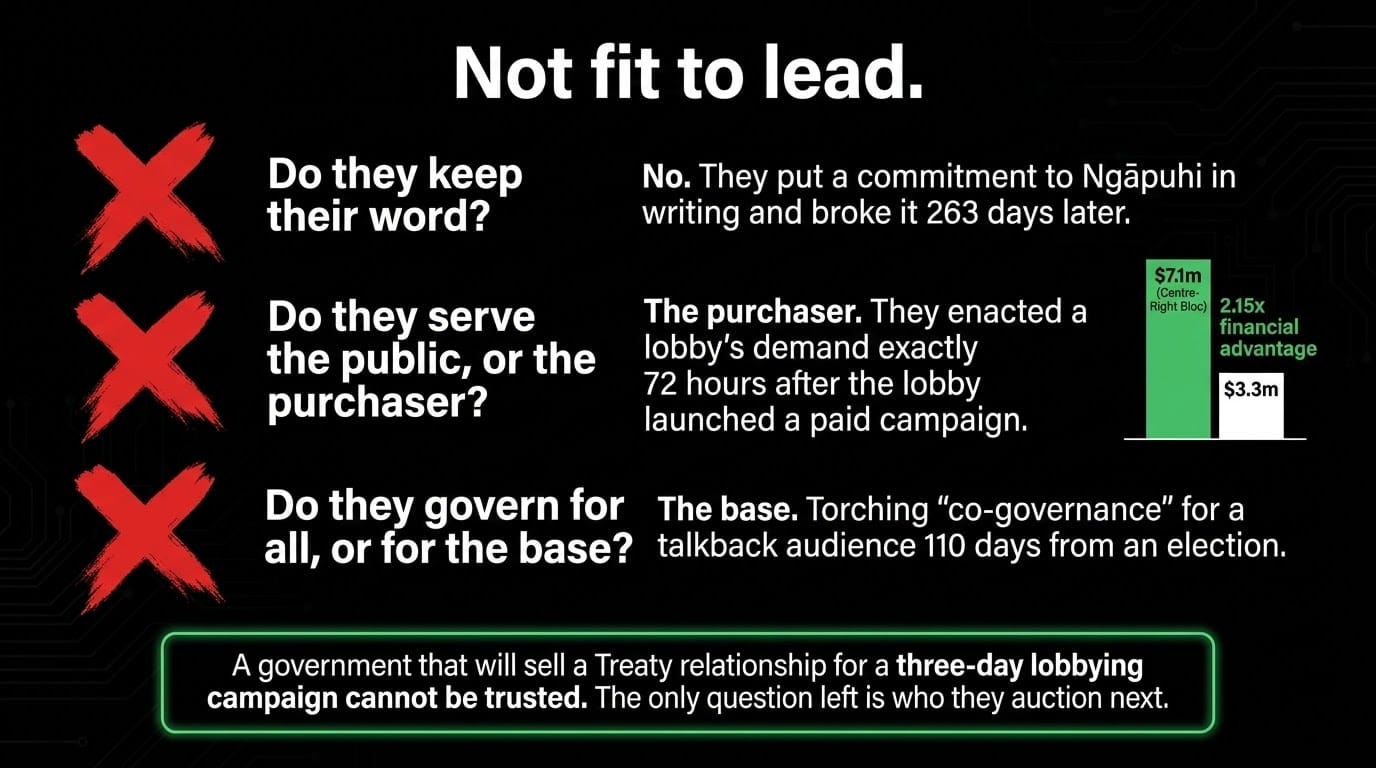
Judge them by their own three tests.
Do they keep their word? No. They put a commitment to Ngāpuhi in writing and broke it 263 days later (TRAION, via Scoop).
Do they serve the public, or the purchaser? The purchaser. The Minister admitted the lobby "wanted us to get rid of" the agreements — and he did (Te Ao Māori News) — three days after a donation-funded campaign demanded exactly that (Waikanae Watch / Taxpayers' Union).
Do they govern for all, or for the base? For the base — 110 days from an election, torching "co-governance" for a talkback audience (iHeart / Newstalk ZB; Electoral Commission).
A government that fails all three of its own tests is not fit to lead now. And a government that has proved it will sell a Treaty relationship for a lobby group's three-day campaign cannot be trusted with the next term either
— because the receipt is already written, the price is already known, and the only question left is who they auction next.
Rangatiratanga is not a chair someone graciously offers you at their table. It is the table. They cut the chair because they fear the table — they fear a room where the whenua has a voice they cannot outbid. Kia mau, whānau. The tōtara they felled for a donor's driveway will leave seeds in that ground long after this Government has been swept off it. We are those seeds.
Mauri Ora!
Ivor Jones The Māori Green Lantern Fighting Misinformation And Disinformation From The Far Right
Public interest statement: This essay concerns the exercise of public power by ministers, government, and organised lobbying groups acting in the public arena on a matter of national significance — the Crown's Treaty obligations and the integrity of law-making. It is published in the public interest under the principles recognised in Durie v Gardiner NZCA 278.
Right of reply: Statements attributed to Minister Chris Bishop, Federated Farmers, the Taxpayers' Union and the Government are drawn from their own public statements, press releases and published sources. Any party named who considers a statement inaccurate is invited to respond; corrections will be made under the retraction protocol.
Disclaimer: This is political commentary and analysis. Factual claims are sourced and hyperlinked to primary and reputable secondary sources, verified at the date of publication (23 July 2026). Opinions are the author's and are flagged as such. Confidence levels are noted against every major claim. Where a source could not be independently verified, this is stated. Nothing here alleges unlawful conduct by any individual; it documents a pattern of public decisions and their documented influences.