
"The Garden They're Trying to Salt: How the Greens' Real Growth Gets Buried Under a Rigged Poll" - 25 July 2026
Marama Davidson is planting seeds across South Auckland. The Herald is pouring salt on the soil with a pollster who moonlights for Labour — and calling it journalism.

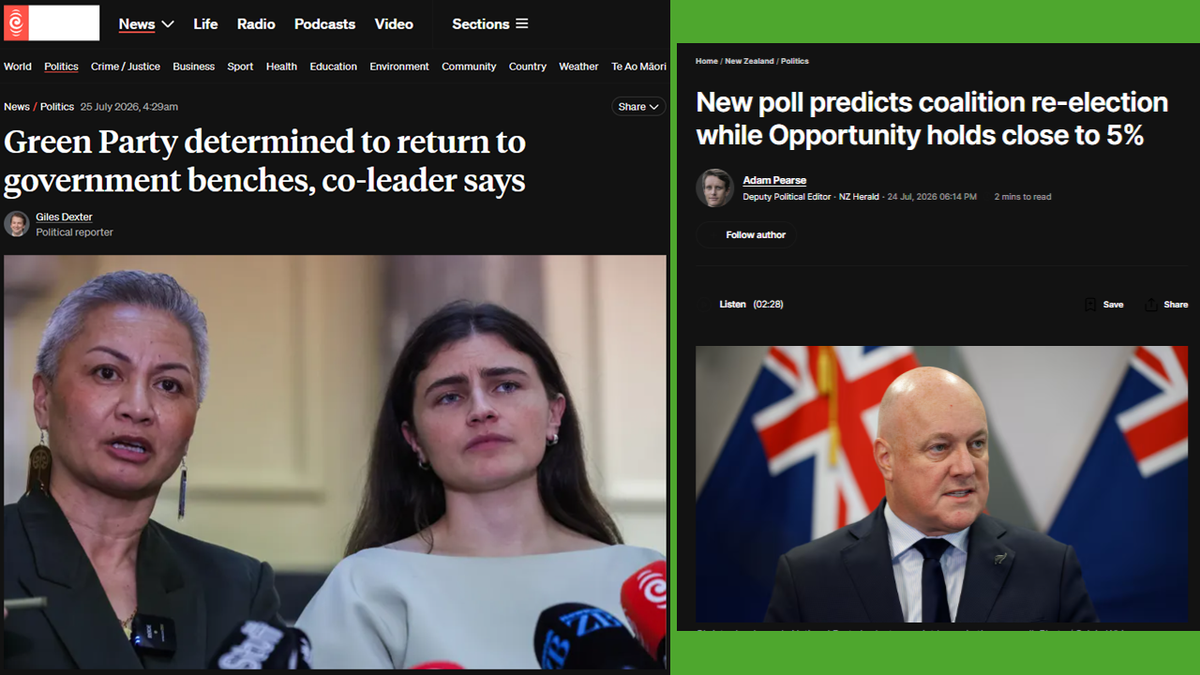
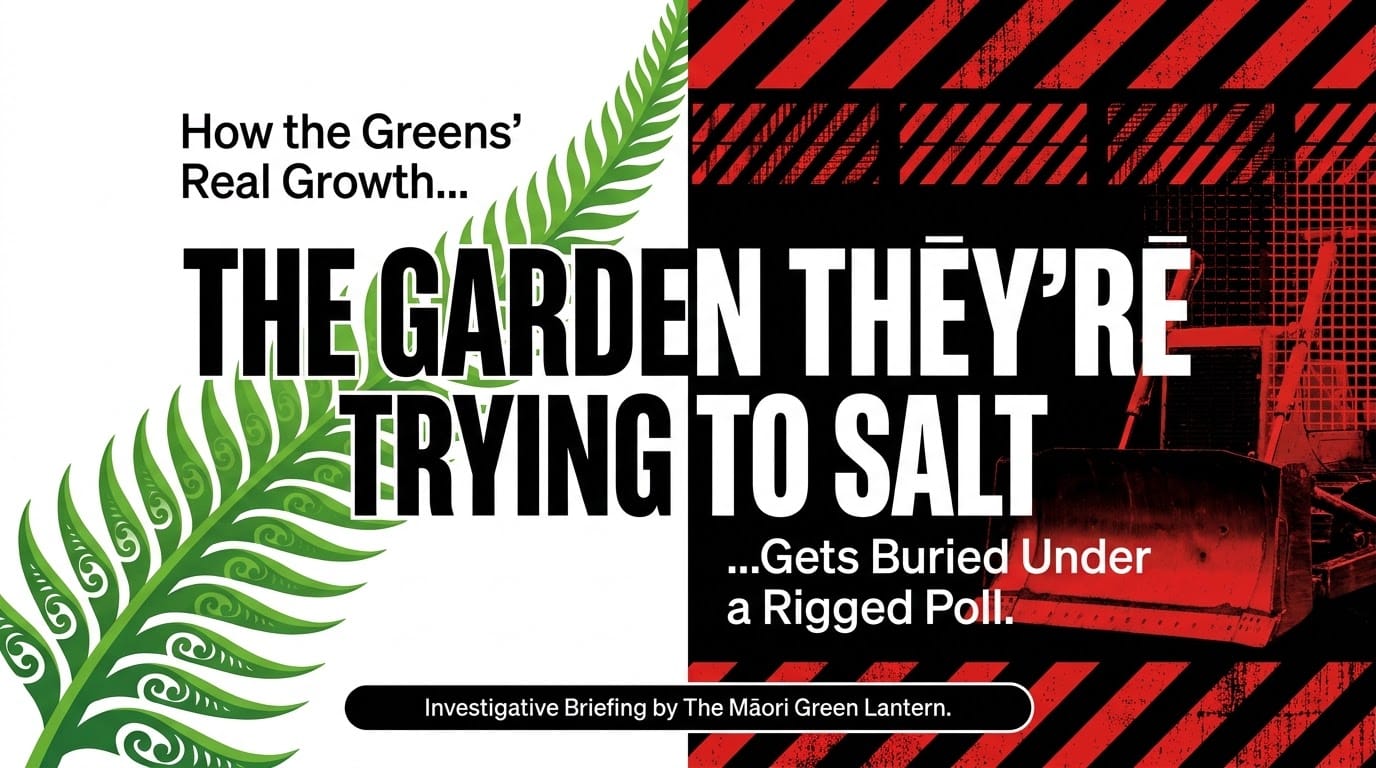
E te iwi, kia mataara. I am Ivor Jones, the Māori Green Lantern, and this week I watched a garden grow next to a demolition site.
 RNZ | Te Reo Irirangi o Aotearoa
In South Auckland, the Green Party's members, delegates, and candidates gathered for their AGM, and co-leader Marama Davidson told RNZ the party is "determined to return to the government benches," with volunteers, phone calls, and door-knocks up beyond anything the party expected at this stage of a campaign.
That's the garden — real people, real labour, real roots going down.
 Adam Pearse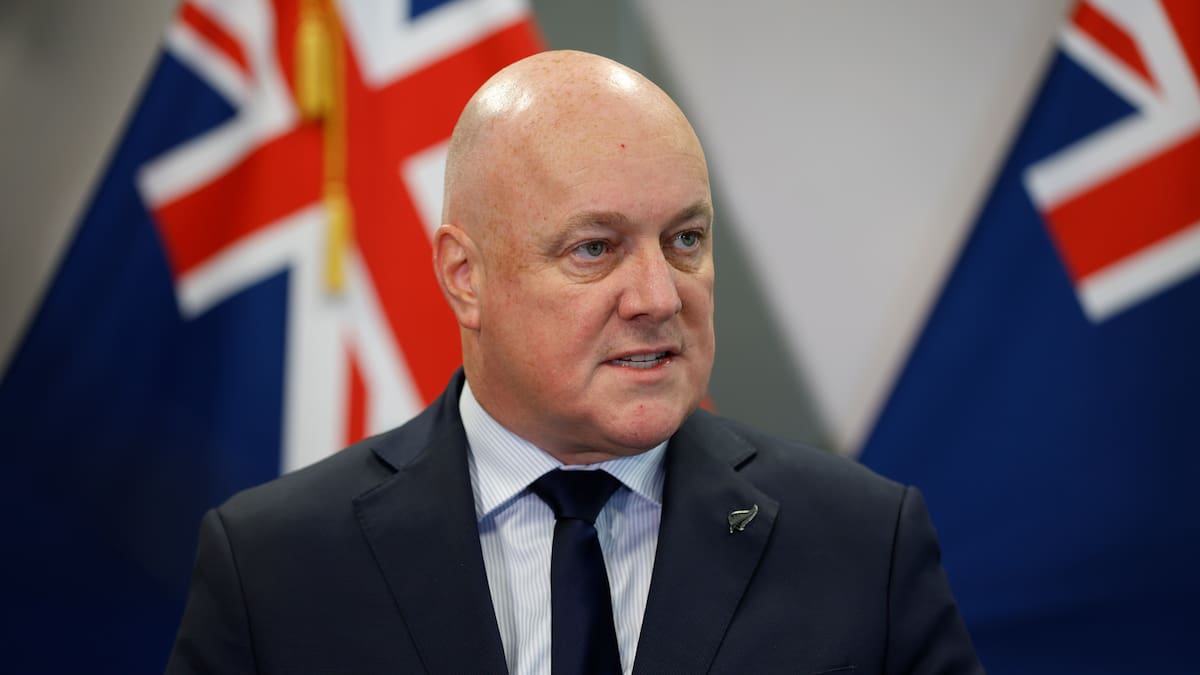
Then, one day later, the NZ Herald rolled up with a bulldozer dressed as a weather report: a poll from a firm that does Labour's internal strategy work, presented as neutral truth, built to convince you the coalition's "re-election" is basically signed and sealed.
In plain language: one story shows you a movement working. The other shows you a machine lying about the odds. Let's walk through both, and I'll show you my working on every number so nobody can accuse me of throwing spears without checking the wind first.
He Kupu Whakataki — What RNZ Actually Shows Us
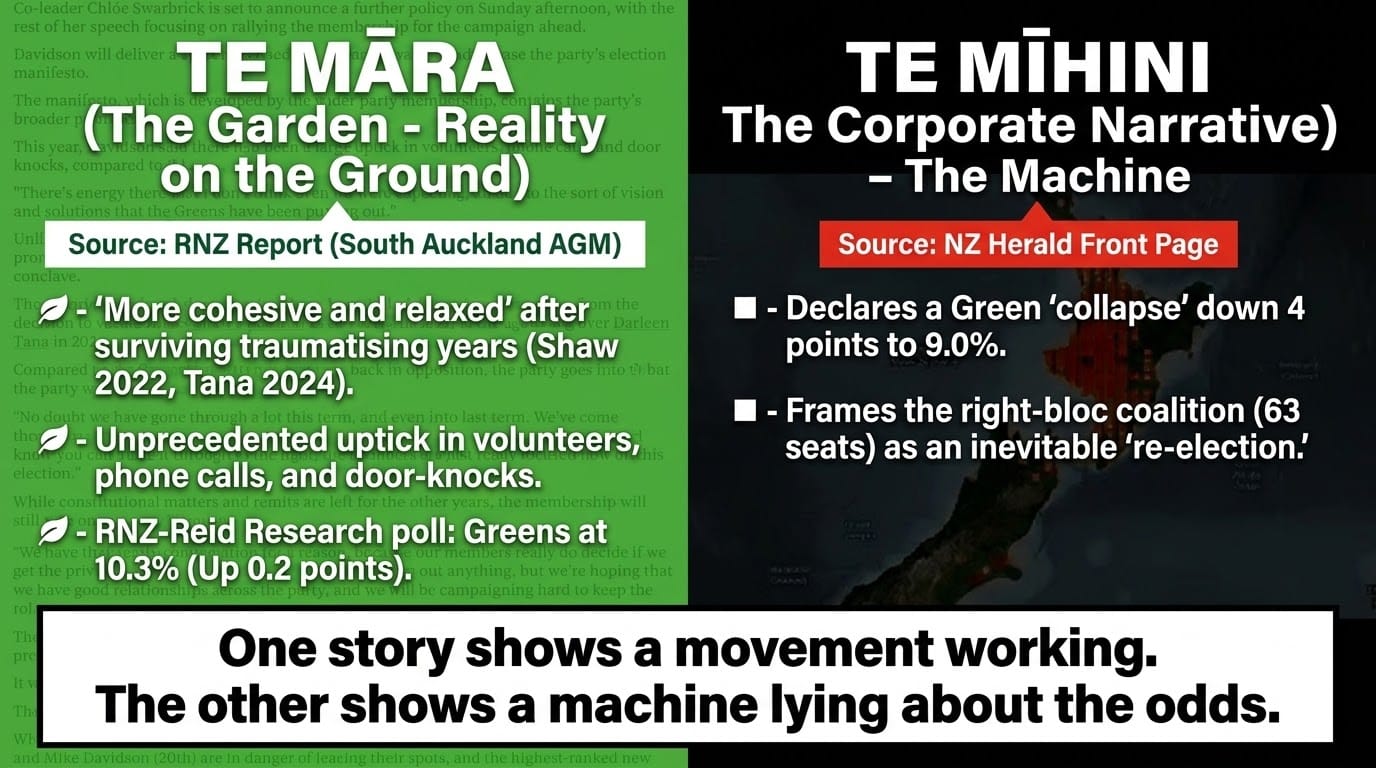
Strip away the spin and the RNZ piece is a genuinely hopeful story about a party healing and rising. Davidson describes years that were "traumatising" — losing James Shaw as co-leader in 2022, the Darleen Tana fracture in 2024 that cost the party three Pasifika members — and says the Greens have "come through more than a lot" to arrive at this election "more cohesive and relaxed" than at any point in this term.
In plain terms: this is a party that got knocked down hard and got back up stronger, which is exactly the kind of resilience tikanga Māori recognises as mana taking root after hardship, not mana handed out for free.
The party has already released policy on tax, water, and energy, with co-leader Chlöe Swarbrick announcing further policy at the AGM and Davidson preparing to release a full manifesto built by the wider membership, not dictated from the top.
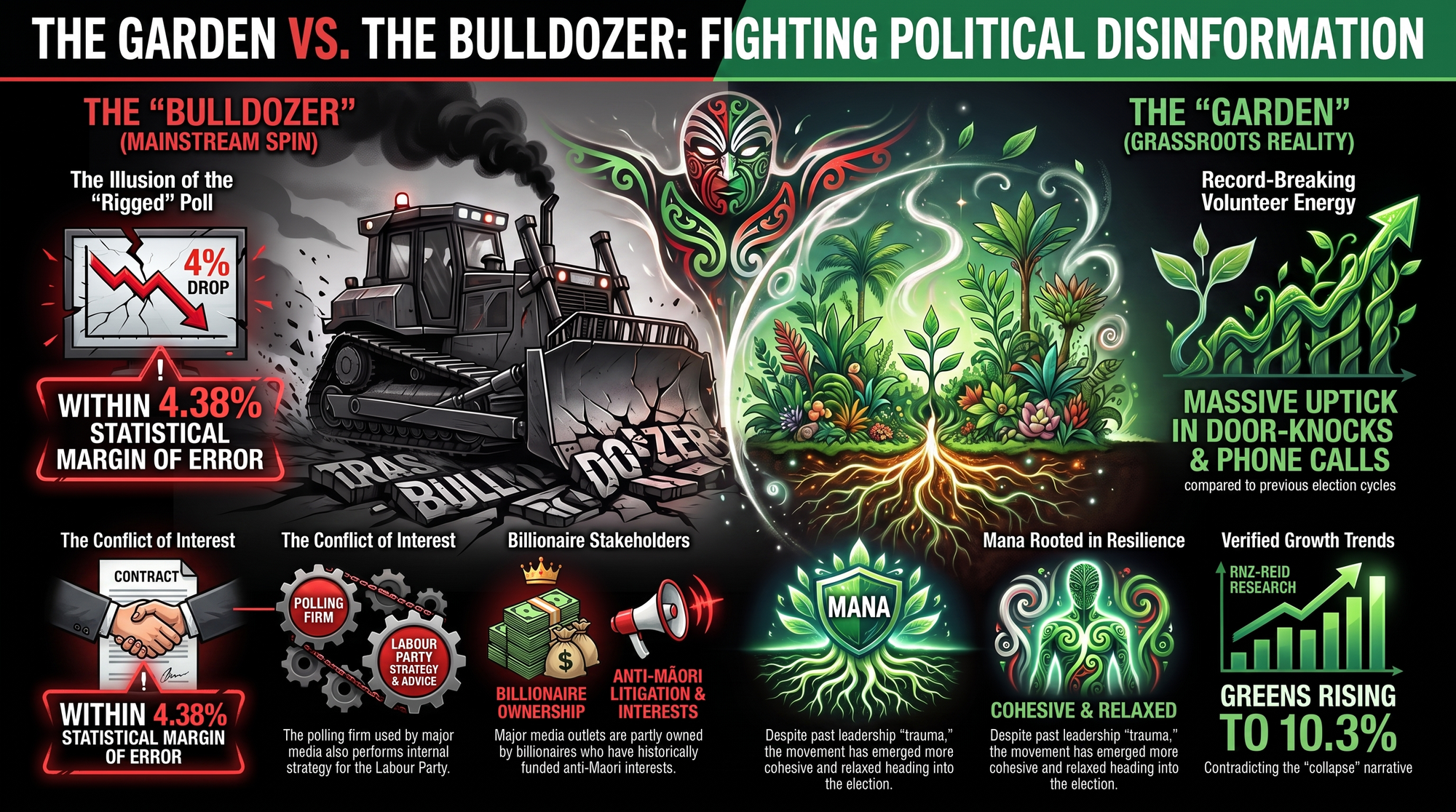
And the numbers back the mood: the same RNZ article cites the RNZ-Reid Research poll showing the Greens up 0.2 points to 10.3 percent — not collapsing, growing. That is the true weather in the garden. Now here comes the bulldozer.
Ngā Tauira Mō Te Hinengaro Pākehā — Three Examples for the Western Mind
Example 1: Same Week, Different Number, No Explanation — The Weather Report That Only Reports Rain
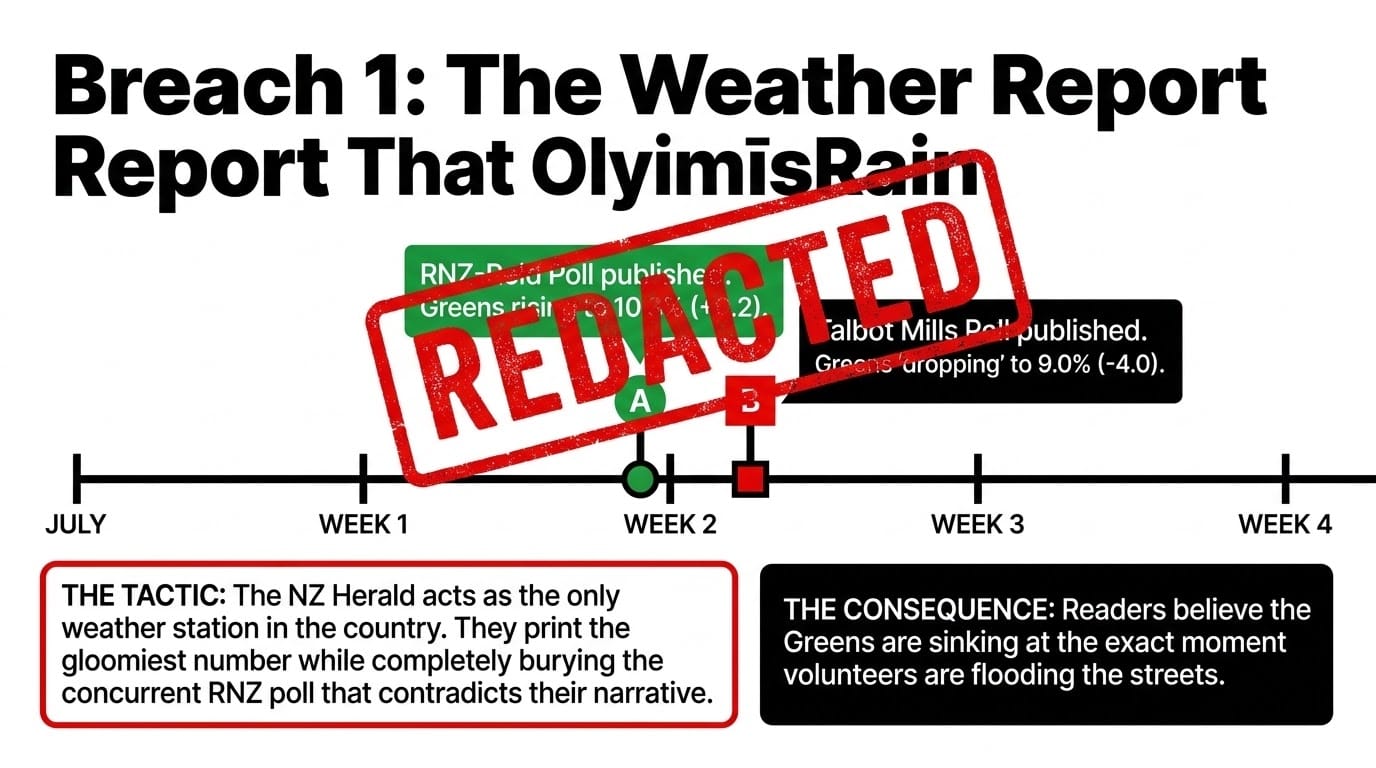
RNZ-Reid Research has the Greens rising to 10.3 percent, up 0.2 points, published the very same week the Herald's Talbot Mills poll claims the Greens are at 9 percent, down four points.
My working: those two figures sit only 1.3 points apart — well within ordinary polling wobble — yet the Herald prints its lower, gloomier number as though it's the only weather station in the country, never mentioning RNZ's more recent, more favourable reading.
In plain language: imagine two weather forecasters standing five metres apart, one says sun, one says light drizzle, and the newspaper only tells you about the drizzle — then calls it a storm.
Quantified harm: readers who only see the Herald's framing believe the Greens are sinking at the exact moment RNZ's own reporting shows volunteers flooding in.
Solution: any story built on one poll must disclose competing concurrent polls in the same piece, full stop.
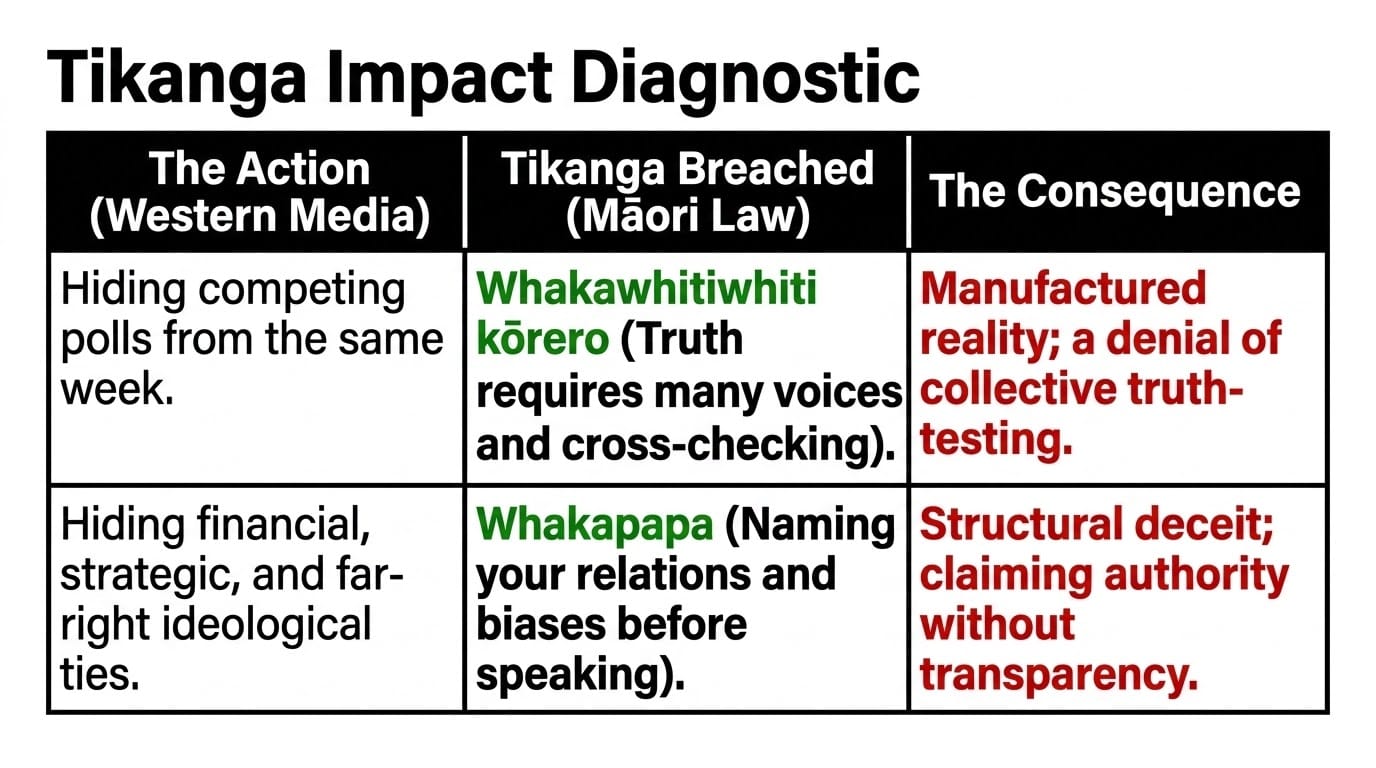
Tikanga impact: truth in tikanga Māori is tested through whakawhitiwhiti kōrero — many voices cross-checking one another before anything is settled. Printing one paid number as gospel while burying a contradicting figure from the same week is a direct breach of that collective truth-testing.
Example 2: The Referee Who's Also Playing for the Other Team
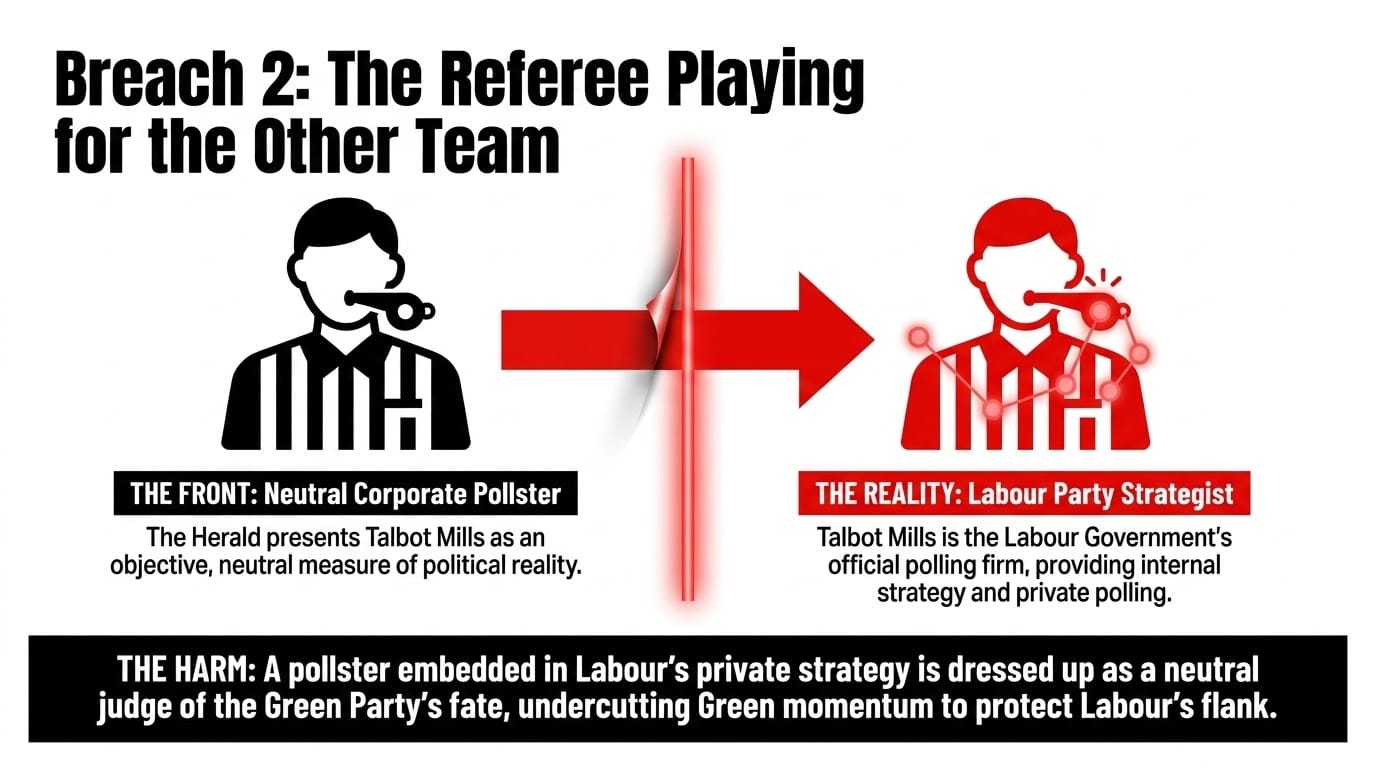
The Herald's own copy admits, almost as a footnote, that Talbot Mills "also does internal polling for the Labour Party" — confirmed independently by Bryce Edwards' Democracy Project audit, which names Talbot Mills as "the Labour Government's official polling firm, providing party internals and strategic advice."
My working: the poll's own margin of error is 3.1 percent for a single number, but comparing the swing between two separate polls requires multiplying that by the square root of 2, giving a true margin of 3.1 × 1.414 = 4.38 points, per standard statistical method explained by Pew Research and MIT's polling explainer.
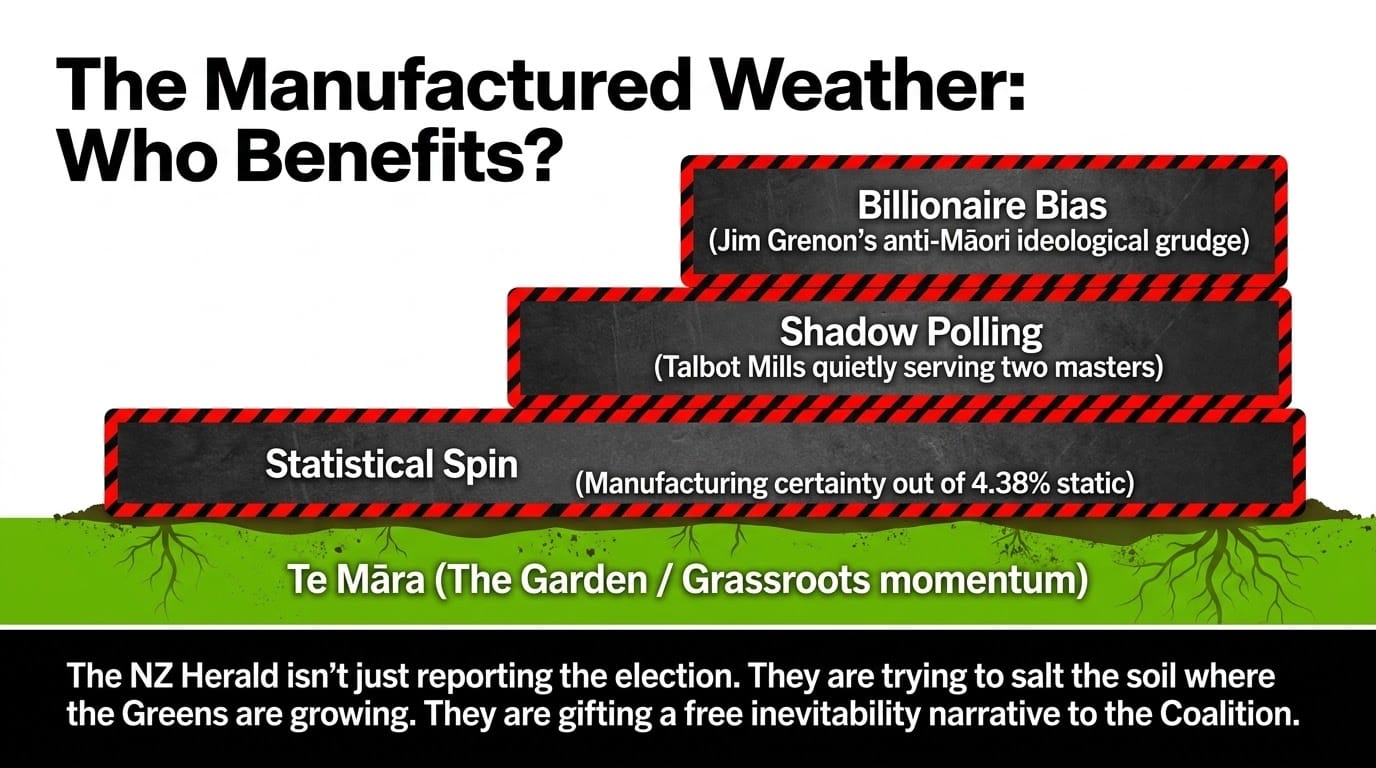
A four-point "drop" sitting entirely inside a 4.38-point noise band is not news, it's static — reported as if it were a scoreboard.
In plain language: it's like a referee who secretly coaches one team on Tuesdays, then blows the whistle "neutrally" on Saturday and nobody's allowed to ask why his calls always favour the same side.
Quantified harm: this undercuts the real momentum RNZ documented on the ground, discouraging donors and volunteers right when the party said energy was surging.
Solution: disclose pollster-party financial relationships in the headline, not buried mid-copy, and always report the swing-specific margin of error, not the flattering single-point one.
Tikanga impact: whakapapa demands you name your relations before claiming authority to speak. A pollster embedded in one party's private strategy, dressed up as neutral judge of another party's fate, breaks that basic law of transparency.
Example 3: The Man Who Owns the Printing Press Also Owns a Grudge
The Herald's confident "coalition re-election" headline skates past its own reported detail that if Opportunity crosses 5 percent, the coalition drops to 59 seats — short of the roughly 62-seat majority in the 123-seat House — a scenario The Post's fuller report on the identical data confirms voters are genuinely split on.
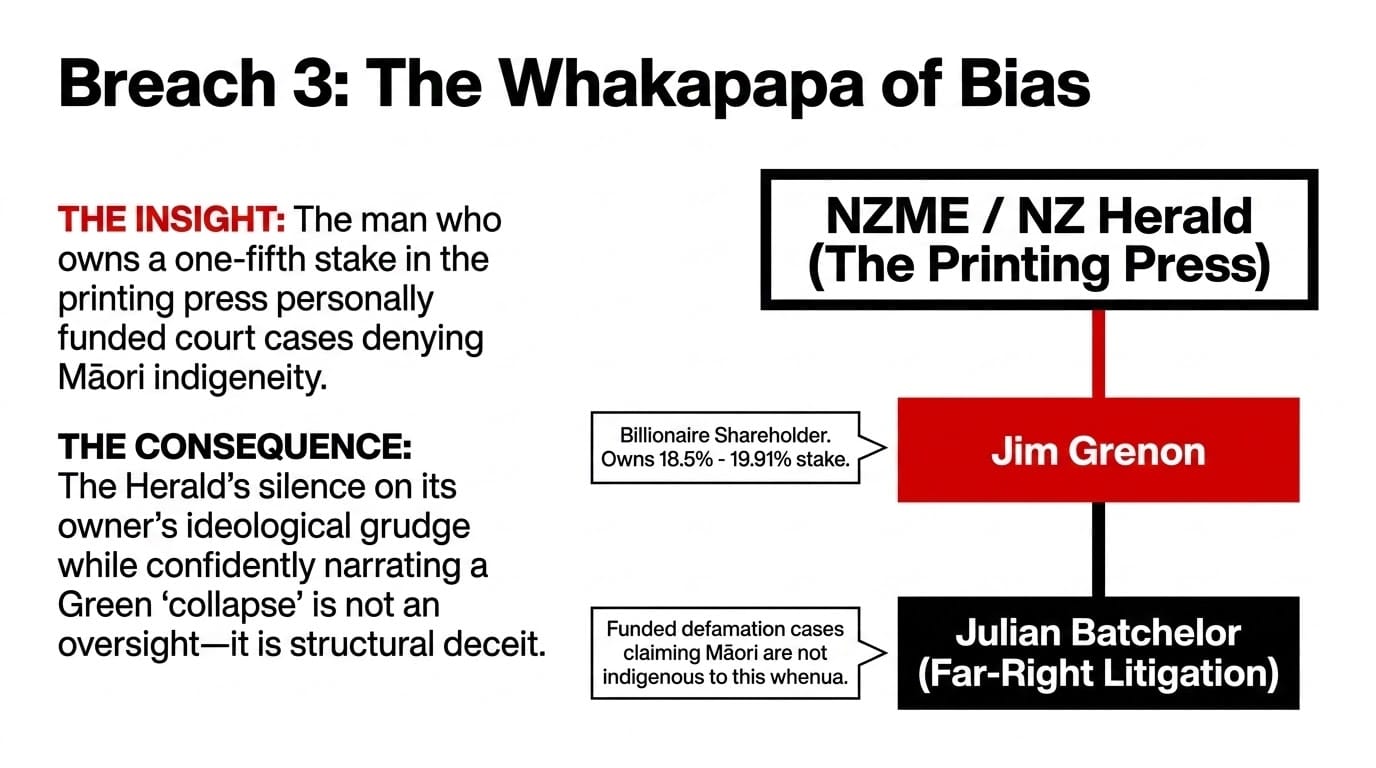
My working: 39 National plus 15 NZ First plus 9 ACT equals 63 seats — a majority, but only if Opportunity stays under the line, a coin-flip dressed up as a certainty. This confident framing comes from a masthead where Canadian billionaire Jim Grenon holds a stake reported between 18.5 and 19.91 percent per MarketScreener's shareholder data, a man court findings confirm personally funded Julian Batchelor's defamation case built on the claim Māori are not indigenous to this whenua, detailed further in prior Māori Green Lantern reporting on the Grenon-Batchelor alliance.
In plain language: it's like the person who owns the printing press also has a personal grudge against the people the paper reports on — and nobody's telling you that before you read the front page.
Quantified harm: a media company entangled with a shareholder funding anti-Māori litigation is deciding how confidently to frame the Greens' "collapse" versus the coalition's "inevitability" — shaping the political weather every Māori voter reads over breakfast.
Solution: mandatory ownership-disclosure boxes on political stories from outlets with shareholders above 5 percent and documented litigation funding.
Tikanga impact: naming your whakapapa, including its harms, before narrating a nation's political future is non-negotiable — the Herald's silence on Grenon while confidently narrating an election is a structural breach of that duty.
Related mahi from The Māori Green Lantern: KO WAI KA TIAKI I TE PONO? Who Guards the Truth When the Billionaire Owns the Paper details the Grenon-Batchelor funding trail in full; The Kennel and the Ballot Box: How ACT and NZ First Train the Public to Fear the Wrong Enemy unpacks how the same white supremacist neoliberal machine dresses exclusion as common sense this election cycle.
The Deep Dive Podcast
A relaxed two-host conversation walking through the Greens' real-world momentum described by Davidson, set against the Herald's poll and its Labour-linked pollster, breaking down the 4.38-point margin of error in plain terms anyone can follow.
(Apologies in advance for the AI's rough reo pronunciation — kia kaha, don't shoot the messenger.)
YouTube Video
A short, plain-language explainer comparing the RNZ and Herald poll numbers side by side, and mapping NZME's ownership stakes against the claims in this essay.
(Same disclaimer on the AI's pronunciation — aroha mai, it means well.)
Koha Consideration

Every koha here signals whānau are ready to support the accountability that Crown and corporate structures — including a billionaire-linked media company and a Labour-shadow polling firm — will not provide themselves.
It signals that rangatiratanga includes the power to support our own truth tellers, watching both the Greens' real growth and the Herald's manufactured weather in equal measure. Kia kaha, whānau. Stay vigilant. Stay connected. And if you are able, consider a koha to keep this scrutiny alive.
If you are unable to koha, no worries — subscribing, following, or simply sharing this essay with your whānau and friends is koha in itself.
Four pathways exist: Koha directly — Support via Koha. Subscribe to receive essays directly — Subscribe to the Māori Green Lantern. Direct bank transfer — HTDM, account number 03-1546-0415173-000. Facebook — Follow and Subscribe.
Te Whakakapinga — The Garden Is Still Growing
This isn't two equal sides of a story, and it shouldn't be treated like one.
On one hand, a party that got knocked flat by internal crisis and got back up, building a manifesto from its own membership, with volunteers pouring in faster than the leadership expected.
On the other, a headline built from a pollster's statistical static, dressed up as certainty, printed by a masthead part-owned by a man who bankrolled a lawsuit denying Māori indigeneity.
Name the beneficiaries: the coalition parties, gifted a free inevitability narrative; Talbot Mills, quietly serving two masters; and Jim Grenon, whose grudge sits inside the same company confidently narrating whether the Greens rise or fall. Name the harm: whānau reading a bulldozer's press release instead of a gardener's honest weather report, and deciding whether their vote even matters because of it.
Tihei Māuri Ora!
Ivor Jones The Māori Green Lantern Fighting Misinformation And Disinformation From The Far Right
Disclaimer: This essay combines verified factual reporting with clearly flagged opinion and analysis, offered in the public interest regarding election-period media transparency and ownership disclosure, consistent with the Durie v Gardiner public interest framing. All claims about named individuals relate strictly to their public conduct in public commercial and political roles. No malice is intended; a documented pattern of conduct is being described. Named parties are invited to right of reply within 48 hours via themaorigreenlantern.maori.nz.