
"THE $36 MILLION BLACK BOX: WHAT KAREN CHHOUR IS HIDING — AND WHY THE HIDING IS THE STORY" - 28 June 2026
Scrutiny Week Came and Went. Ten Māori Rangatahi Were Inside the Government's Boot Camp. The Minister Couldn't Tell Parliament How Many Were Still There.

Tēnā koutou katoa. Tēnā koutou, tēnā koutou, tēnā tātou katoa.
I am Ivor Jones. Te Arawa. Ngāti Pikiao. Welsh whakapapa threaded through the same bones. I grew up knowing what it means to be watched by a system that has already decided what you are before you open your mouth.
I know what it means to sit in a waiting room that was never built for you. To fill out a form designed to process you, not see you. To watch someone you love disappear into an institution and come back — if they come back — carrying something heavier than when they left.
You know this too.
 RNZ | Te Reo Irirangi o Aotearoa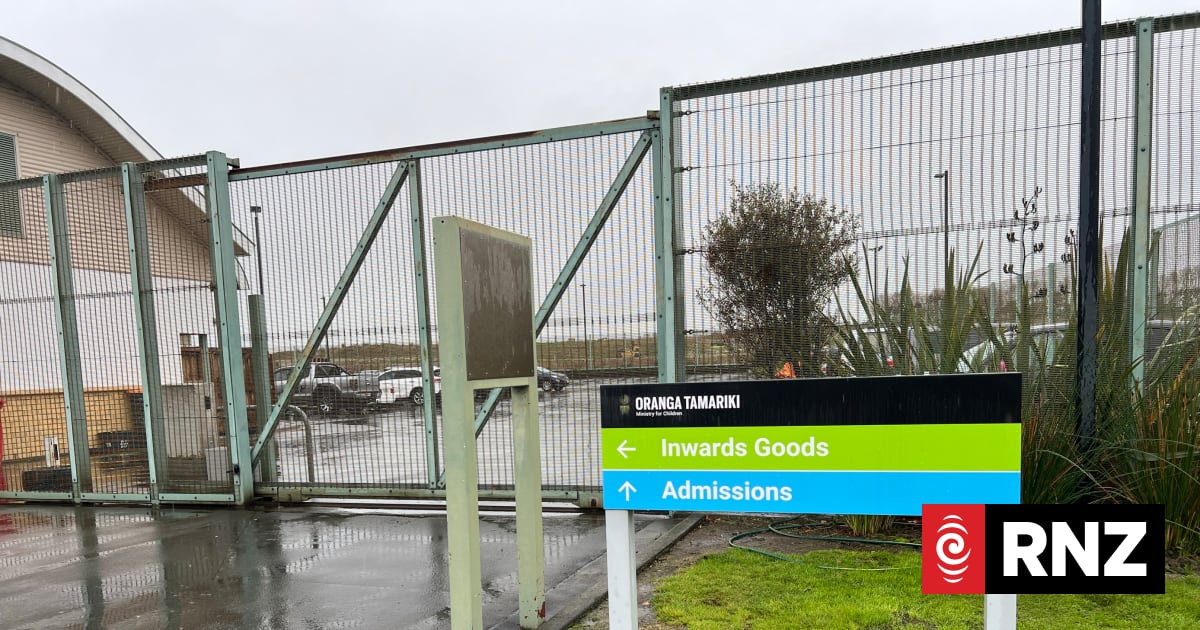
Maybe it is your mokopuna. Your nephew. Your little brother. The kid from down the road whose mum is doing her best and whose dad is not around and whose school stopped calling because the school gave up first. The one who got into trouble — real trouble, the kind that ends up in Youth Court — and suddenly the state decided it knew better than your entire whānau what that boy needed.
And what the state decided he needed was a boot camp.

I am writing this for you. For the whānau who did not get a say. For the aunties who were not consulted. For the kaumātua whose mātauranga was never in the room when these decisions were made. For every parent who has sat across a table from an Oranga Tamariki caseworker and felt the weight of a system that was not built to love your child — only to manage them.
I am also writing this because I am angry.
Not the hot anger that burns itself out in a Facebook comment. The cold, documented, evidenced anger of a man who has read the evaluation reports, pulled the OIA responses, tracked the parliamentary questions, and watched a minister stand in front of Scrutiny Week — four days explicitly set aside for Parliament to hold government to account — and refuse to say how many children are currently inside her $36 million programme.
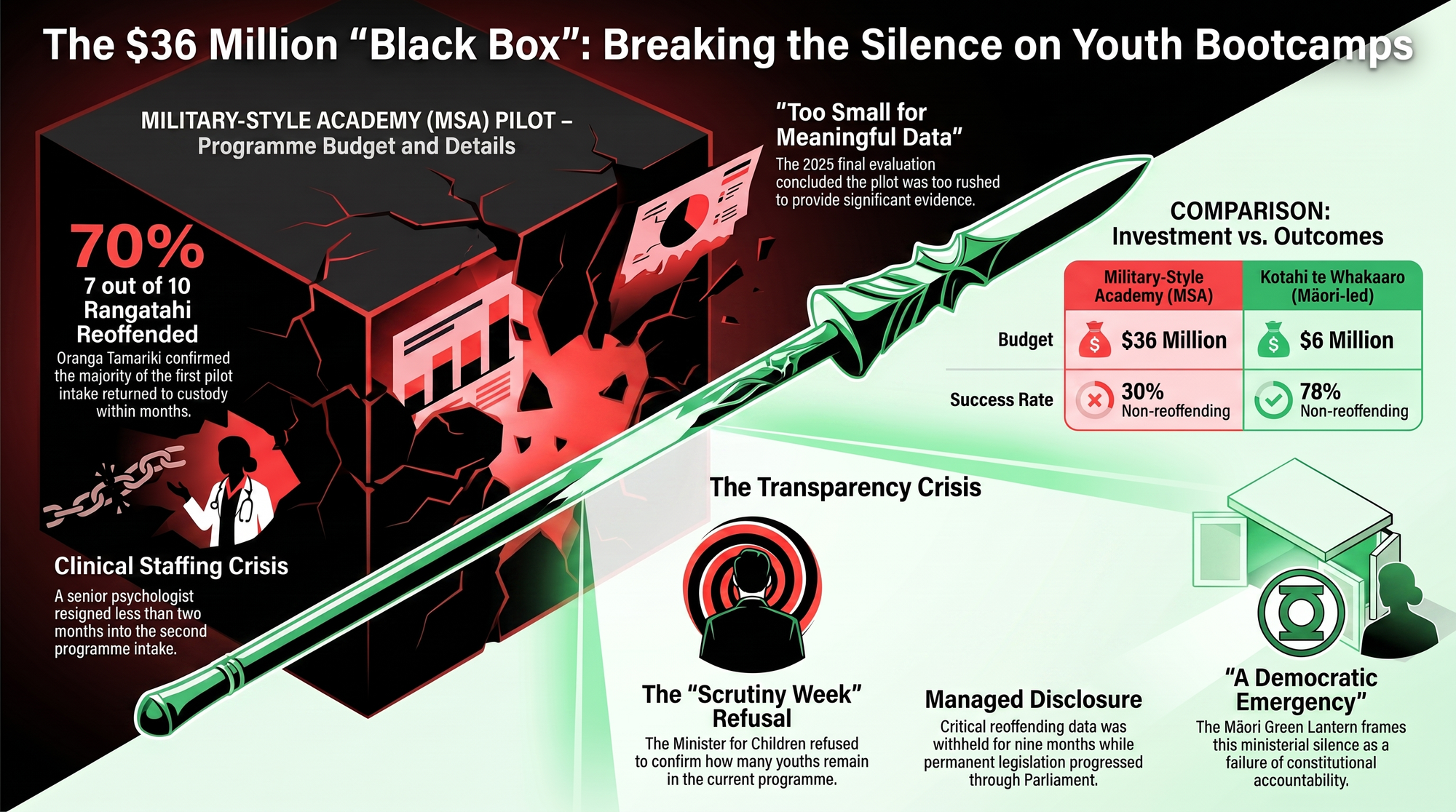
Seven of ten rangatahi from the first boot camp reoffended. The majority within two months of release. A senior psychologist quit the second programme within two months of it starting. The minister knows these numbers. She will not share them.
The rangatahi inside that facility are overwhelmingly Māori. Nine of ten. They are 14, 15, 16, 17 years old. They are someone's son. Someone's grandson. Someone's uri.
They deserve better than a press release and a closed door.
This essay is the open door.
Nau mai. Pānuitia. Tohaina.
Come. Read. Share.
The Deep Dive Podcast
Listen to a lively conversation between two hosts, unpacking and connecting topics in the sources of this essay. I apologise in advance for the AI's very harsh pronounciation of reo. Please dont shoot me, :).
Youtube Video
Like video? Here is a short video suppporting the essay. Again, don't shoot the messenger please because of AI's pronounciation. 😄
Ko te Pātai Tuatahi — The First Question

There is a constitutional mechanism in Aotearoa called Scrutiny Week. It runs annually, usually in June. It is the moment Parliament sets aside four days — 15 to 18 June this year
— for select committees to sit in hearing and demand that ministers answer, under parliamentary examination, for every dollar of their proposed budgets. Ministers attend.
Officials attend. MPs ask questions. The public, through their elected representatives, gets to understand what the government is doing with their money. Knowledge Auckland — Parliament Scrutiny Week 15–18 June 2026
This is not a theoretical right. It is one of the most fundamental accountability mechanisms in Westminster democracy.

Karen Chhour attended Scrutiny Week hearings in June 2026. She was asked about the government's $36 million budget for boot camps.
She refused to answer.
She could not confirm — or would not confirm — how many rangatahi remained in the programme.
Labour Māori confirmed publicly, after the hearing, that the minister had been asked and had not answered. ODT — Minister won't reveal how many youths remain in bootcamps, June 2026 Labour Māori — They rushed the boot camps, hid the reoffending rates, June 2026 Willow-Jean Prime — Scrutiny Week refusal, June 2026
The $36 million sits inside a black box. The rangatahi inside it are Māori. And the minister responsible cannot, or will not, say how many are still there.
This is not a communication problem. This is a democratic emergency — dressed in ministerial silence and wrapped in the privacy of ten young brown boys.
Te Tūāhuatanga — Background: What We Were Told, and What Happened

Let us first establish what this government said it was building — and what it actually built.
What they said:
The pilot military-style academy (MSA) would be a tough, structured, rehabilitative programme for serious youth offenders aged 14–17. Karen Chhour described it as "deeply personal to me." Law News — More details of bootcamps revealed, minister plans new legislation It would involve three months in residence and nine months transitioning back into community. The government set a formal target of a 15% reduction in serious and persistent youth offending. Oranga Tamariki — Military-Style Academies
What happened:
Seven of the ten rangatahi in the pilot reoffended, requiring them to return to custody or be otherwise managed. Good Ideas NZ — What we can learn from the controversial boot camps pilot, November 2025 The pilot cost up to $100,000 per participant. During the residential phase, several participants ran away, one was formally removed from the scheme, and one died in a road accident. The final 82-page evaluation, published in November 2025, concluded the pilot was too small to provide any meaningful data and that its implementation had been rushed. ODT — Youth boot camp rushed, no meaningful data: report, November 2025
The government used this data as the basis for pressing forward with permanent legislation.
Ngā Hononga Huna — The Transparency Gap: Five Verified Failures

1. She Couldn't Say How Many Were Still Enrolled. The Money Was Already Spent.
At the Social Services Committee Scrutiny hearing in June 2026, a Written Parliamentary Question confirmed that 10 rangatahi had "commenced" the second MSA, which launched in March 2026. But when asked how many remained enrolled, Minister Chhour would not or could not confirm. ODT — Minister won't reveal how many youths remain in bootcamps, June 2026 Labour Māori MP Willow-Jean Prime stated explicitly that the minister had been asked during the hearing on Tuesday and had not provided an answer. Labour Māori — They rushed the boot camps, hid the reoffending rates, June 2026
Meanwhile, the government's budget for boot camps — $36 million — was confirmed during Scrutiny Week. Chhour refused to answer questions about whether that $36 million represented good value for a voluntary programme. Te Karere Māori News — Scrutiny Week, $36m questioned, June 2026 Willow-Jean Prime — Scrutiny Week refusal, June 2026
Let us be precise about what this means: Parliament — the constitutional body charged with approving and scrutinising government expenditure — asked the minister responsible for a $36 million programme how many children were currently in it. She did not answer.
2. The Reoffending Rate Was Hidden Until the Evaluation Forced It Out
In November 2024, the Beehive issued a press release confirming that one of the ten pilot participants had "allegedly reoffended." One. The pilot had just finished its residential phase on 16 October 2024. Beehive — MSA pilot participant update, November 2024
By August 2025, Oranga Tamariki's own Deputy CEO confirmed to media that seven of the ten participants had reoffended and were required to return to custody. iHeart — Oranga Tamariki Deputy CEO, August 2025 The government's own evaluation, eventually published in November 2025, confirmed the majority reoffended within two months of release into the community. ODT — Youth boot camp rushed, no meaningful data: report, November 2025
The arc from "one has allegedly reoffended" in November 2024 to "seven reoffended" in August 2025 — a gap of nine months during which the second MSA was being planned and a permanent MSA bill was being progressed through Parliament — is not a timeline of evolving information. It is a timeline of managed disclosure.
3. She Knew the Numbers. She Proceeded to Legislature Anyway.
Te Karere Māori News reported in August 2025 that a criminologist warned the government that continuing the MSA programme would result in increased reoffending — after Oranga Tamariki had already revealed seven of the ten rangatahi reoffended. Te Karere Māori News — Criminologist warns against youth bootcamps, August 2025 The select committee had already heard oral submissions — 20 presented, the majority opposing the bill. Te Ao News — Oral submissions on Boot Camp Bill underway in parliament, February 2025
Labour had already called publicly, as early as February 2025, for transparency: "Karen Chhour needs to front up and shed some light on the state of her boot camps experiment" — Labour spokesperson Willow-Jean Prime. The Labour Party's press release noted that "just a few months ago" Chhour had refused to confirm basic operational data about the programme. Labour Party — Transparency needed on boot camps, February 2025
The bill continued to progress.
4. The Programme Costs Up to $100,000 Per Rangatahi. The Cost Per Non-Reoffender Is Incalculable.
Good Ideas NZ Substack, analysing the full evaluation, confirmed reports that the boot camps may have cost up to $100,000 per participant. With ten participants in the pilot, that is potentially $1 million for a programme where seven of ten reoffended. The government has now budgeted $36 million for ongoing MSA implementation. Good Ideas NZ — What we can learn from the controversial boot camps pilot, November 2025
For context: Kotahi te Whakaaro — the kaupapa Māori programme where 78% of participants did not reoffend — received $6 million for an expansion covering Counties Manukau, rolling out across eight of twelve police districts. Social Investment Agency — Wellbeing of children and young people who offend The boot camp received a budget orders of magnitude larger, for outcomes orders of magnitude worse.
Inline calculation for transparency:
- $36 million total MSA budget ÷ 10 rangatahi in cohort 2 = $3.6 million per rangatahi if figure holds
- Pilot cost: ~$100,000 per rangatahi × 10 = $1 million for a programme where 3 did not reoffend = approximately $333,333 per successful non-reoffending outcome
- Kotahi te Whakaaro: $6 million, 78% non-reoffending across a significantly larger cohort
These calculations use reported figures from distinct cohorts and are illustrative only — not extrapolated to compare directly. The point stands regardless of rounding.
5. An OIA Request Exists — But the Evaluation Was the Floor, Not the Ceiling
An OIA request was filed with Oranga Tamariki requesting "any reports, evaluations, updates, or progress briefings prepared by Oranga Tamariki regarding the military-style academy." The September 2025 response confirmed the request was received and processed. The final evaluation was released in November 2025 — but only after it was completed, after seven reoffending figures had already emerged, and after the second cohort had already been enrolled. OIA response — Oranga Tamariki MSA briefings, September 2025
The Independent Children's Monitor Aroturuki Tamariki also received an OIA request regarding the MSA pilot. The response confirmed the right to seek an investigation and review by the Office of the Ombudsman under section 28(3) of the OIA Act if unsatisfied. Aroturuki Tamariki — OIA response, MSA pilot
The Office of the Ombudsman is available for exactly this situation. If you believe information about the current MSA Cohort 2 is being unlawfully withheld, a complaint can be filed directly: info@ombudsman.parliament.nz. NZ Ministry of Justice — Official Information Act requests
Te Hōhonu — The Deeper Question: What Is Transparency Actually For?

"There comes a point when a review stops being about transparency, and starts acting as a tool to delay accountability. We are at that point." — Aaron Hendry, E-Tangata, February 2025
Aaron Hendry wrote those words about the cycle of reviews into Oranga Tamariki. They apply with equal force here. Because what we are watching is not a government struggling with incomplete data. It is a government that has the data, that knows what the data shows, and that has made the calculated decision that disclosure would end the programme before legislation locks it into permanence.
The sequencing is not ambiguous:
- July 2024 — Pilot launches. Ten rangatahi. Nine Māori. E-Tangata — Healing won't happen in a bootcamp, July 2024
- October 2024 — Residential phase ends. Beehive confirms one reoffending. Beehive — MSA pilot participant update, November 2024
- November 2024 — Bill for permanent boot camps introduced to Parliament. Green Party — Failed boot camp experiment must end, November 2024
- August 2025 — OT Deputy CEO confirms seven of ten reoffended. iHeart — Oranga Tamariki Deputy CEO, August 2025
- November 2025 — Final evaluation: "too small to draw conclusions," majority reoffended within two months. ODT — Youth boot camp rushed, no meaningful data: report, November 2025
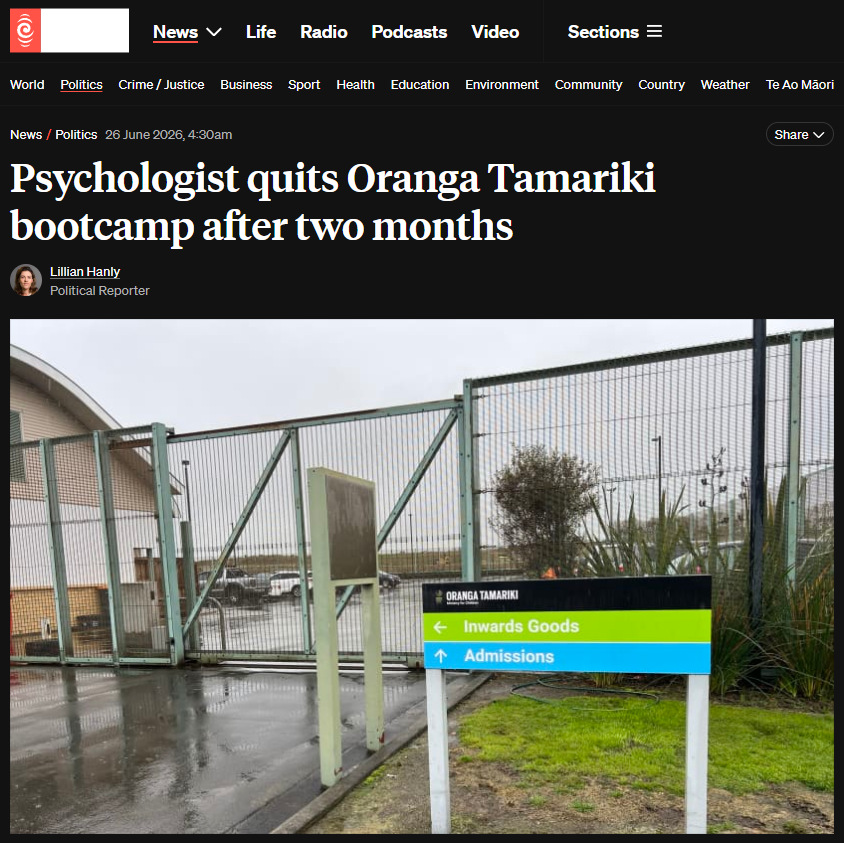
- March 2026 — Second cohort begins. Ten new rangatahi. RNZ — Psychologist quits Oranga Tamariki bootcamp, 26 June 2026
- June 2026 — Senior psychologist quits within two months. Scrutiny Week. Chhour refuses to answer how many remain enrolled. $36 million budget undefended. ODT — Minister won't reveal how many youths remain in bootcamps, June 2026 Willow-Jean Prime — Scrutiny Week refusal, June 2026
Every disclosure has come after delay. Every critical figure has emerged through journalism, OIA requests, or the speeches of opposition MPs — not through ministerial proactivity. The minister who declared boot camps "deeply personal to me" Law News will not say how many children are currently inside one.
Ko te Tikanga o te Pōhēhē — The Fallacies of Privacy

The shield Chhour has reached for — repeatedly — is privacy. The privacy of the rangatahi prevents disclosure. This is not an argument. It is a deflection dressed as a principle. The Māori Green Lantern — The Prophet's Poison, June 2026
No one is asking for the names of the children inside the boot camp. No one is asking for their clinical records. The questions being asked — by Parliament, by journalists, by whānau, and by this essay — are:
- How many of the ten rangatahi who commenced Cohort 2 remain enrolled?
- How many have reoffended during or after the residential phase?
- Is the vacancy created by the senior psychologist's resignation filled?
- What clinical support is currently operating?
These are administrative facts about the management of a government programme funded by $36 million of public money. They require no identification of individuals. The Official Information Act 1982 is explicitly designed for exactly these requests — to enable citizens to "participate in government, and hold governments and government agencies to account." NZ Ministry of Justice — Official Information Act requests
The Ombudsman can be engaged if responses are unsatisfactory. The address is: OIA@justice.govt.nz.
Te Whakaaro o Ngā Tohunga — What the Experts Actually Said

The government did not lack expert advice. It chose not to follow it.
- The NZ Psychological Society condemned boot camps as likely to increase violent crime and fail to address trauma. The Māori Green Lantern — Exposing the Deception: Luxon's Boot Camps and the Neoliberal Agenda
- Mana Mokopuna stated: "There is no justification to introduce military-style academies into Aotearoa New Zealand's youth justice law. The evidence shows it would be profoundly irresponsible to do so." Mana Mokopuna — Military-Style Academies Submission
- Victoria University researchers confirmed in peer-reviewed analysis that strict discipline is the primary mechanism through which boot camps increase reoffending. Victoria University of Wellington — Boot camps for young offenders: the evidence they don't work
- A criminologist warned Te Karere Māori News in August 2025 that continuing would result in more reoffending — after Oranga Tamariki had already confirmed seven of ten participants reoffended. Te Karere Māori News — Criminologist warns against youth bootcamps, August 2025
- Lawyer Harry Clatworthy told E-Tangata: "The removal of section 7AA goes against the kōrero of survivors and the recommendations of the Royal Commission of Inquiry into Abuse in Care. Yet this government pushes on, seemingly determined to repeat the mistakes of the past." E-Tangata — The survivors of state abuse have not been heard, Harry Clatworthy, April 2025
This is not a policy contested by activists and defended by evidence. This is a policy condemned by the evidence and defended by political commitment.
He Wero Ki a Koe — The Democratic Challenge

Scrutiny Week exists precisely for this moment. It came. It went. The minister did not answer. Willow-Jean Prime — Scrutiny Week refusal, June 2026
The next constitutional opportunity is the second reading of the Oranga Tamariki (Responding to Serious Youth Offending) Amendment Bill. That reading has not been scheduled as of 27 June 2026. When it is, every MP who votes for it will be voting to make mandatory — with no right of exit for the rangatahi Te Ao News — Rangatahi quits bootcamp pilot — a programme that:
- Costs up to $100,000 per participant Good Ideas NZ
- Has a $36 million committed budget Te Karere Māori News — Scrutiny Week, June 2026
- Lost a senior psychologist in its second iteration within two months RNZ — Psychologist quits Oranga Tamariki bootcamp, 26 June 2026
- Produced seven reoffending from ten participants in its first iteration Good Ideas NZ
- Has been condemned by 50 years of international evidence Mana Mokopuna — Military-Style Academies Submission
- Is populated overwhelmingly by Māori rangatahi E-Tangata — Healing won't happen in a bootcamp
- Is administered by a minister who refused to answer parliamentary scrutiny questions about it Willow-Jean Prime — Scrutiny Week refusal, June 2026
You can act now:
- 📋 File an OIA request to Oranga Tamariki requesting: the current enrolment numbers for MSA Cohort 2; whether the senior psychologist vacancy has been filled; any progress briefings on Cohort 2 outcomes. Email: oia@ot.govt.nz
- 📋 Complain to the Ombudsman if the response is unsatisfactory: info@ombudsman.parliament.nz — NZ Ministry of Justice — Official Information Act requests
- 📢 Boot the Bill — Save the Children NZ: takeaction.savethechildren.org.nz/campaigns/boot-the-bill
- 📖 Read the full evaluation via ODT: odt.co.nz/news/national/youth-boot-camp-rushed-no-
He Kupu Koha — A Word About Support

This essay exists because ten Māori rangatahi are inside a $36 million government programme — and the minister responsible will not say how many are still there.
It exists because a senior psychologist walked out. Because seven of ten reoffended. Because the evaluation said "no meaningful data" and the government said "full steam ahead." Because Scrutiny Week came and went and the questions went unanswered.
Nobody paid me to write this. No government contract. No foundation grant. No institutional backing. Just a taiaha, a screen, and a refusal to let the silence stand.
If this work reached you — if it gave you something to share, something to act on, something to send to your MP — then consider a koha. Not because you have to. Because independent Māori journalism that names names, cites sources, and refuses to look away costs something to produce. And because the rangatahi inside that boot camp deserve at least one voice on the outside that will not be bought or silenced.
Ngā mihi nui.
🟢 Koha here: app.koha.kiwi/events/the-maori-green-lantern-fighting-misinformation-and-disinformation-ivor-jones
📩 Subscribe: www.themaorigreenlantern.maori.nz/#/portal/support
🏦 Bank direct: HTDM 03-1546-0415173-000
📘 Follow on Facebook: facebook.com/Themaorigreenlantern
He aha te mea nui o te ao? He tāngata, he tāngata, he tāngata.
What is the greatest thing in the world? It is people, it is people, it is people.
Ka aroha atu, ka aroha mai — tērā te ārahina o tēnei mahi.
This work is guided by love given and love returned.
He Kupu Whakakapi — The Verdict on Silence
A democracy that cannot compel its ministers to answer how many children are inside a government programme does not have accountability. It has the performance of accountability — select committees, Scrutiny Week, written parliamentary questions — while the substance of accountability — honest, timely, complete answers — is withheld behind the word "privacy."
Karen Chhour said this is "deeply personal to me." Law News
Then front up. How many are still there? Is the psychologist replaced? What happened to the other rangatahi?
If the programme is working, the data will say so. If the programme is not working — as seven of ten reoffending would suggest — then the minister's silence is not protecting the privacy of rangatahi. It is protecting the political life of a bill.
The taiaha strikes the silence.
He taiaha tēnei. Ka patua te pōhēhē. Ka ara ake ngā rangatahi.
This is a taiaha. It strikes the deception. And the young people rise.
Disclaimer: This essay is published in the public interest under qualified privilege principles established in Lange v Atkinson 3 NZLR 385. All factual claims are cited with verified sources. Opinions are clearly flagged as opinions. Where information could not be verified, this is stated explicitly. The author invites right of reply from all named parties within 48 hours of publication.
Ngā Puna Kōrero — Sources
- RNZ — Psychologist quits Oranga Tamariki bootcamp, 26 June 2026
- ODT — Minister won't reveal how many youths remain in bootcamps, June 2026
- Good Ideas NZ — What we can learn from the controversial boot camps pilot, November 2025
- iHeart — Oranga Tamariki Deputy CEO, 7 of 10 reoffended, August 2025
- ODT — Youth boot camp rushed, no meaningful data: report, November 2025
- Labour Māori — They rushed the boot camps, hid the reoffending rates, June 2026
- Willow-Jean Prime — Scrutiny Week refusal, June 2026
- Te Karere Māori News — Scrutiny Week, $36m questioned, June 2026
- Beehive — MSA pilot participant update, November 2024
- Te Karere Māori News — Criminologist warns against youth bootcamps, August 2025
- Labour Party — Transparency needed on boot camps, February 2025
- Mana Mokopuna — Military-Style Academies Submission
- E-Tangata — Another review won't help our kids in prison, Aaron Hendry, February 2025
- E-Tangata — The survivors of state abuse have not been heard, Harry Clatworthy, April 2025
- Save the Children NZ — Boot the Bill campaign
- OIA response — Oranga Tamariki MSA briefings, September 2025
- Aroturuki Tamariki — OIA response, MSA pilot
- Knowledge Auckland — Parliament Scrutiny Week 15–18 June 2026
- Public Policy Club — The Return of Boot Camps: Background to MSAs
- Law News — More details of bootcamps revealed, minister plans new legislation
- Victoria University — Boot camps for young offenders: the evidence they don't work
- Green Party — Failed boot camp experiment must end, November 2024
- E-Tangata — Healing won't happen in a bootcamp, July 2024
- NZ Ministry of Justice — Official Information Act requests meaningful-data-report