"DP World - THE ZOOM CALL AT THE WHARF: He Aha Tō Ingoa? — What Is Your Name, Dubai?" - 28 June 2026

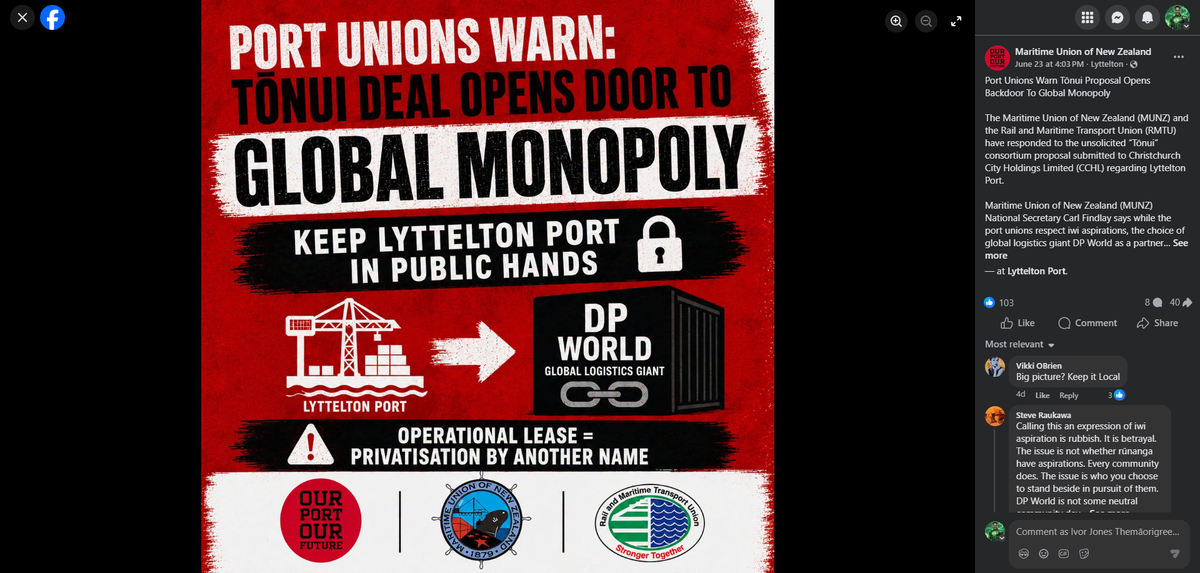
Ko Wai Koe? — The Thirty-Minute Execution
I want you to picture something.
It is the morning of 17 March 2022. Eight hundred seafarers — real people, with kids to feed, rents to pay, lunches packed the night before
— sit down in front of screens.
A pre-recorded Zoom message plays.
Thirty minutes later, they are unemployed.
Security guards are already on the gangplanks — already there, before the Zoom call ended — because the decision was made before the workers sat down.
Agency workers, hired in advance at a fraction of the wage, are ready to replace them before the last man has walked off the ship.
The company that did that is called P&O Ferries. Its parent company — the entity now proposing to run Lyttelton Port, the beating heart of South Island commerce, the harbour that Ngāi Tahu have called Whakaraupō for centuries — is DP World.
I am Ivor Jones — The Māori Green Lantern. Ko Te Arawa tōku waka. I wield the taiaha in this essay, and I name the pattern for what it is: a sovereign wealth machine from Dubai, enabled by a white supremacist neoliberal government that has spent three years systematically dismantling every legal protection Māori and working New Zealanders ever won, is now positioned at the gates of Te Waipounamu's most strategic port.
The taiaha lands here. Let's begin.
The Deep Dive Podcast
Listen to a lively conversation between two hosts unpacking and connecting the threads in this essay — DP World's labour record, the P&O Zoom-call sackings, the OIO law changes, the Tōnui consortium, and what kaitiakitanga really demands at Whakaraupō.
(I apologise in advance for the AI's very harsh pronunciation of te reo — please don't shoot the messenger! 😄)
YouTube Video
Like video? Here is a short video supporting this essay — connecting the DP World pattern from P&O to Australia to Whakaraupō, and naming what the Luxon government's OIO reforms actually do.
(Again, AI's te reo pronunciation — please don't shoot the messenger! 😄)
The P&O Scandal: When DP World Showed You Exactly Who It Is

I do not call this a red flag. I call it a confession.
When P&O's chief executive, Peter Hebblethwaite, faced a UK parliamentary committee after the March 2022 sackings, he admitted on the record that the company had deliberately chosen to break UK employment law
— and chose to do so because paying the statutory penalty was cheaper than consulting the unions.
The man who fired 800 workers via Zoom is still in post. He was not prosecuted. He was not sacked. He was rewarded with continuity.
The International Transport Workers' Federation called it "a shocking disregard by DP World for workers' rights and its own standards."
The RMT Union's Mick Lynch said it was "a transformation in how we treat workers."
The UK Transport Secretary called it "completely unacceptable."
And then — less than eight months later — UK ministers were quietly meeting DP World executives to negotiate new business deals. Records released in 2026 confirm this. The outrage was theatre. The relationship continued.
This is the company proposing to run Whakaraupō.
DP World publishes human rights commitments, modern slavery statements, and whistleblower hotlines. Every word of it is PR scaffolding on a building that fires people via Zoom. The glossy CSR document is not accountability — it is reputation management.
And our government — Christopher Luxon's National-ACT coalition, the same government that has systematically stripped Te Tiriti obligations from legislation — is now weakening the very laws that could stop DP World at the gate.
The Australian Chapter: The Real-Terms Pay Cut and the $84 Million Week
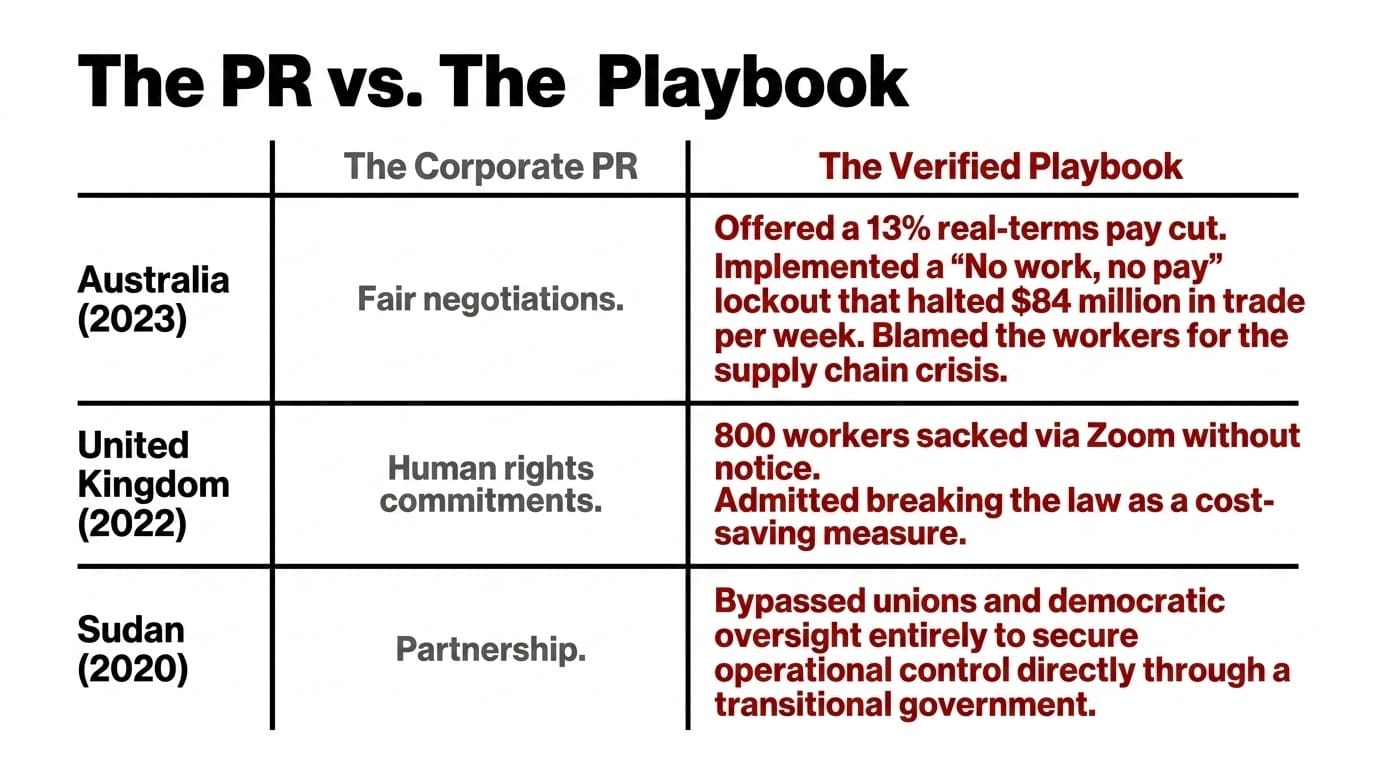
In October 2023, DP World's waterfront workers in Sydney, Brisbane, Melbourne, and Fremantle walked off the job. What did DP World offer them?
A 13% nominal pay rise over four years — below inflation, meaning a real-terms pay cut. When workers responded with partial work bans, DP World announced it would stop paying them entirely, while simultaneously blocking them from performing any duties.
No work. No pay. Financial attrition as union-busting strategy.
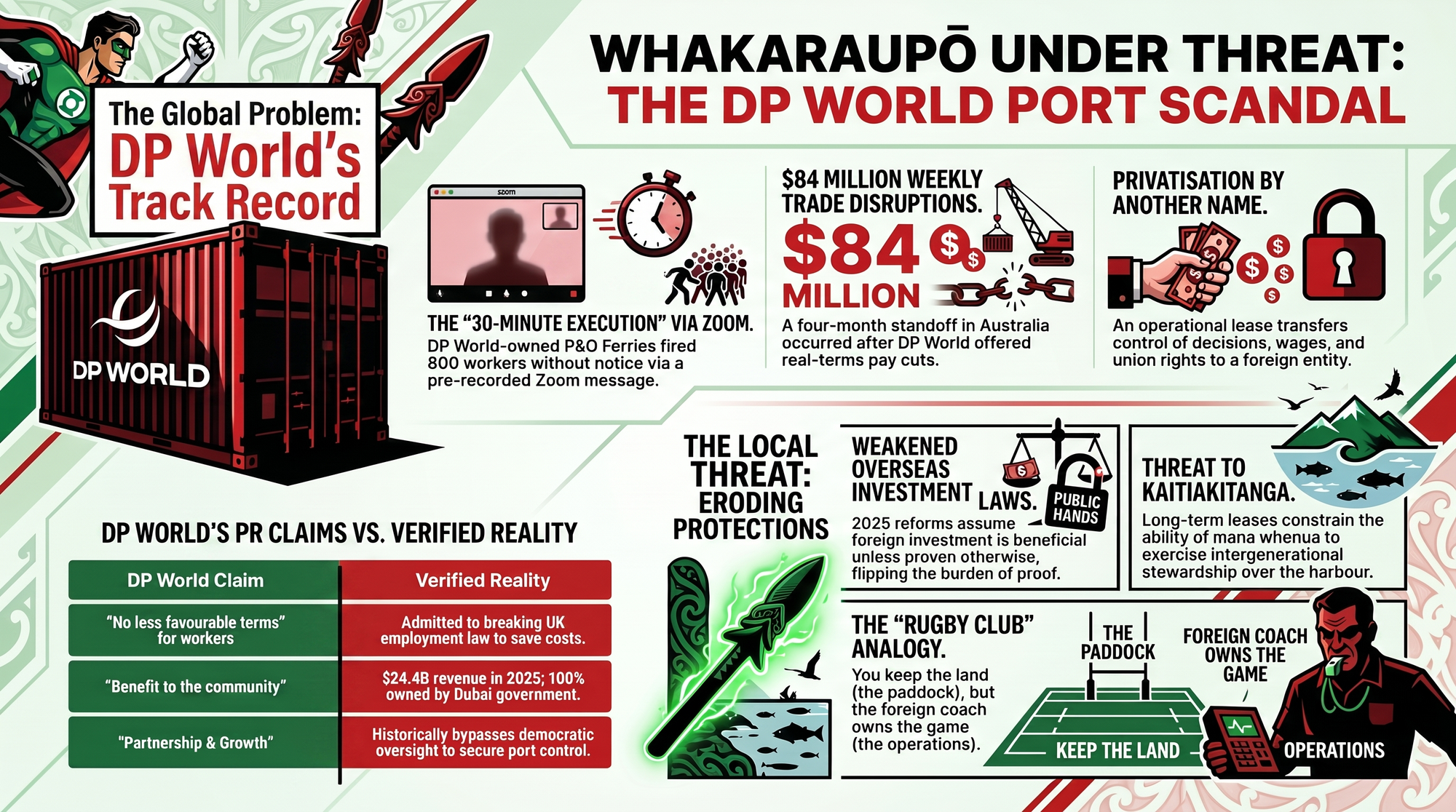
The standoff halted an estimated $84 million in trade per week. A backlog of nearly 55,000 containers piled up at terminals. DP World handles approximately 40% of Australia's total cargo volume — which means when DP World squeezes its workers, the entire national supply chain bleeds. And the workers get blamed for the disruption their employer manufactured.
The Maritime Union of Australia described DP World as a company that "ticks all the boxes: exploitation, hoarding profits, sacking workers, robots over humans, and paying little to no tax."
The dispute eventually settled in February 2024, with workers winning a 23.5% pay rise over four years. But it took four months of strikes and union solidarity that most workers cannot sustain.
Lyttelton Port workers don't have Australian union density. They don't have Australian industrial law protections. And they already know what DP World's opening offer looks like.
Whakaraupō Is Already Being Restructured — Before DP World Arrives
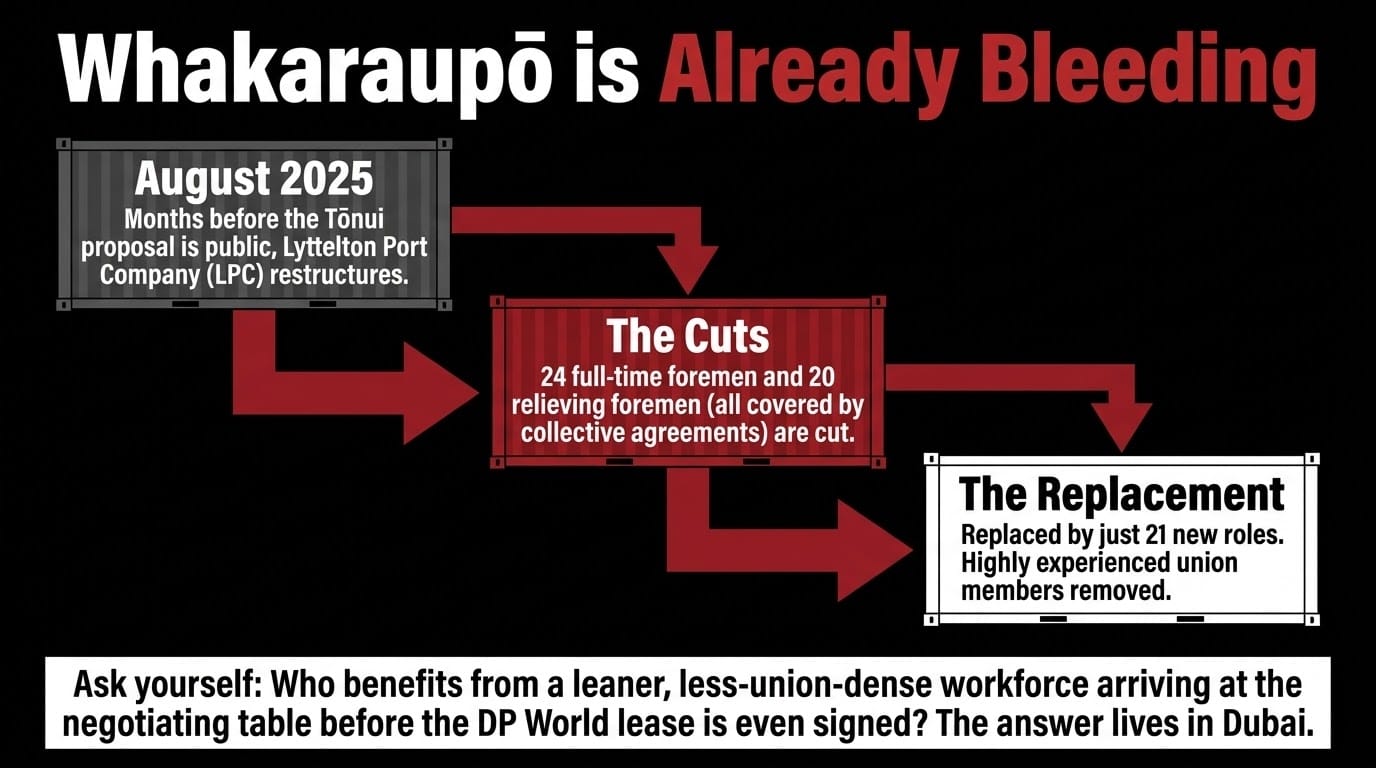
Here is what the mainstream media has almost entirely missed.
In August 2025 — months before the Tōnui proposal became public — Lyttelton Port Company was already restructuring its workforce. An Employment Court ruling allowed LPC to proceed with cutting 24 full-time foremen and at least 20 relieving foremen — workers covered by collective agreements — replacing them with just 21 new roles.
Workers described the decision as "disappointing" and mourned the loss of "highly experienced" colleagues.
Ask yourself: who benefits from a leaner, less-union-dense workforce arriving at the negotiating table — before any operating licence with DP World is even signed?
The answer is not the workers. The answer lives in a boardroom in Dubai.
Three Examples for the Western Mind
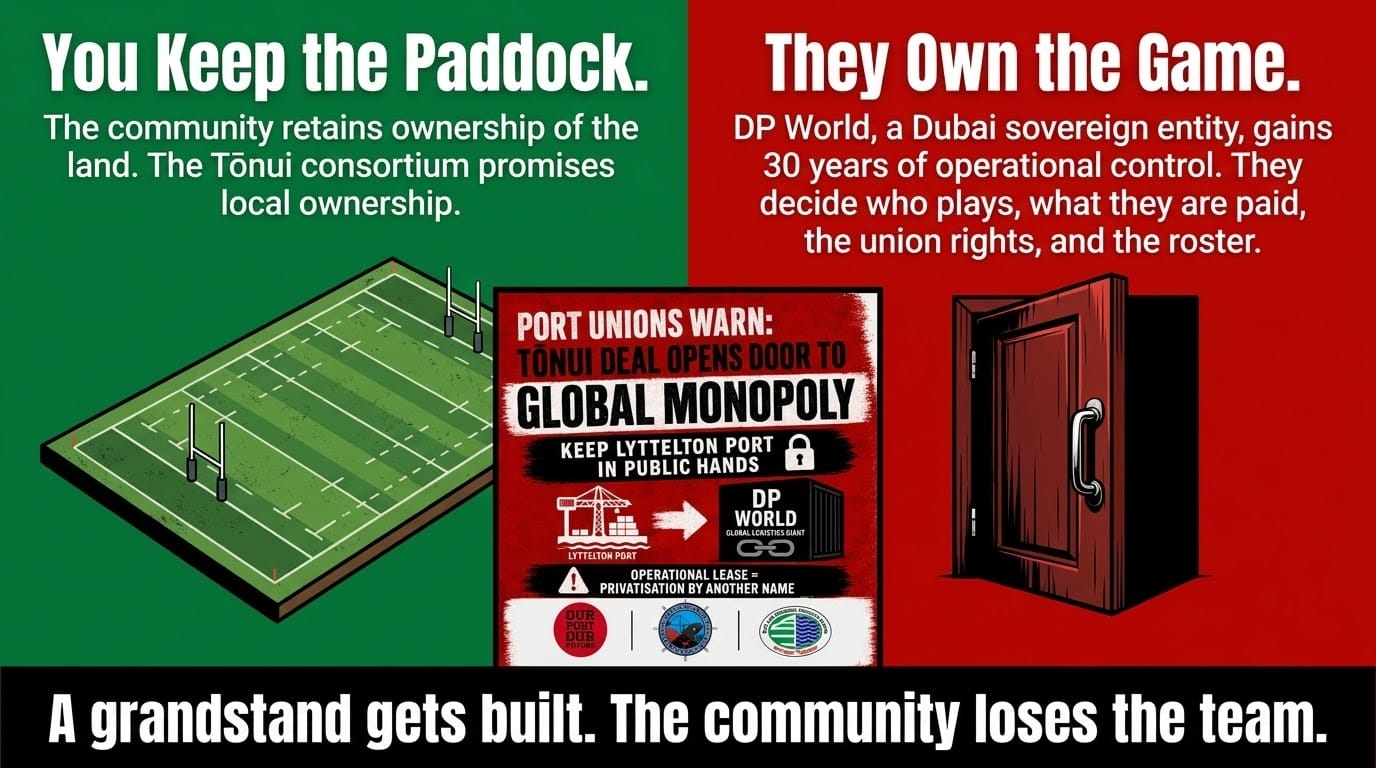
Example One — The Rugby Club Analogy (Understanding the Lease)
Imagine your local rugby club — community-owned, generations of whānau on that turf — is struggling for funds. A wealthy overseas coach offers to run the team, pay for the new grandstand, and manage all operations for 30 years. He promises no player will be worse off. The club keeps the land.
Sounds reasonable.
Now imagine that coach's last three clubs: one team had 800 players sacked via a Zoom call. Another had their pay cut in real terms after a four-month standoff. A third had management rights quietly shifted to an entity in a country with no democratic port oversight.
The grandstand got built. The community lost the team.
That is exactly what is being proposed at Whakaraupō. The land stays. The operations — the decisions about who works, at what wage, under what roster, with what union rights — transfer to a Dubai sovereign entity for decades. The community keeps the paddock. DP World gets the game.
Example Two — The P&O Playbook Quantified (What It Costs Workers)
In the P&O sackings of 2022, 800 maritime workers lost their jobs with zero notice. They were replaced by agency workers hired at a far lower wage rate. The company's chief executive admitted to parliament that breaking UK employment law was the cheaper option.
In Lyttelton, the current workforce includes foremen and waterfront workers whose collective agreements were negotiated over years of union solidarity. If DP World applies the same logic — and their track record across Australia, the UK, and Sudan shows they always do — the "no less favourable terms" guarantee in the Tōnui proposal is worth exactly what it costs to ignore: nothing.
The harm quantified: If DP World achieves at Lyttelton a wage suppression equivalent to what it attempted in Australia — a below-inflation pay offer across more than 1,500 workers — the real-terms loss to South Island port worker households runs into millions of dollars annually, ripped directly from Ōtautahi whānau and redirected to Dubai sovereign capital that reported $24.4 billion in revenue in 2025.
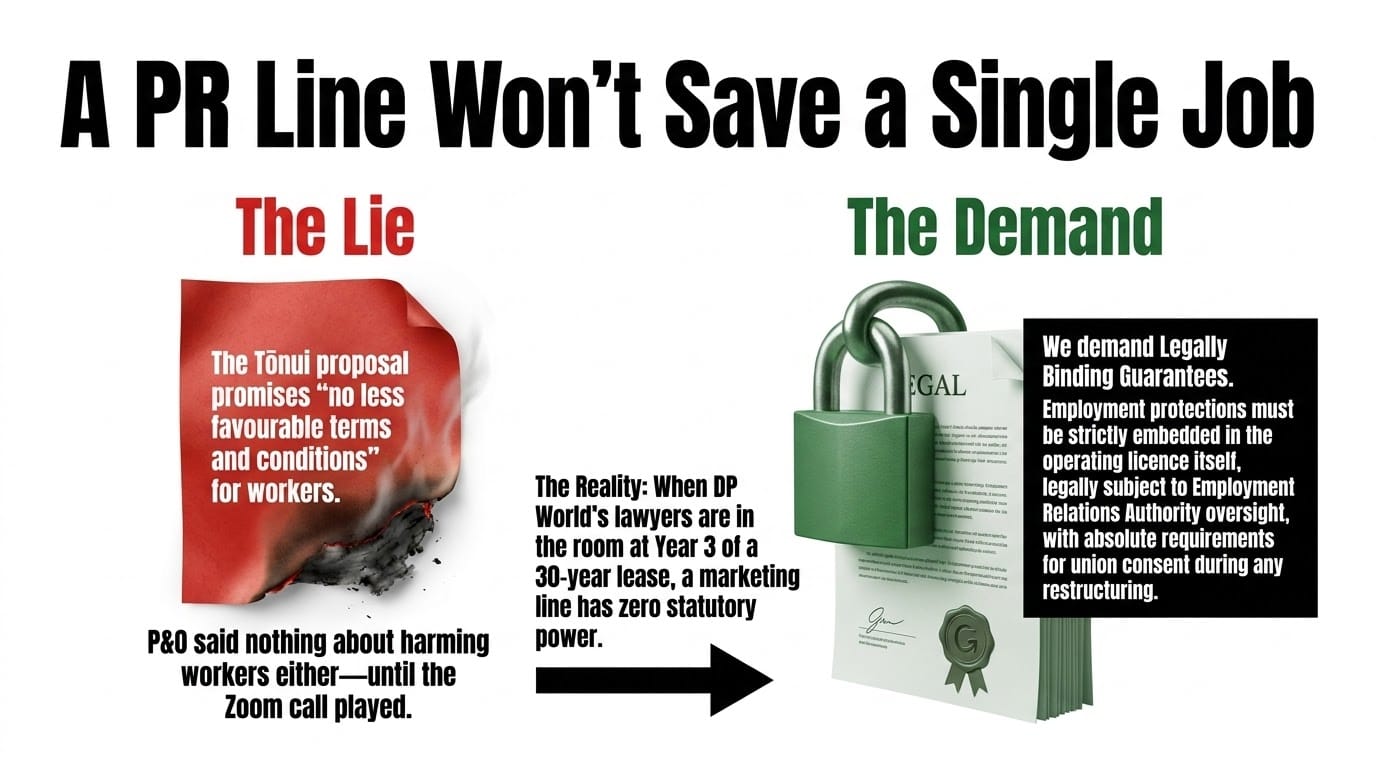
The solution: Legally binding employment guarantees — not proposal-document promises — embedded in any operating licence, subject to Employment Relations Authority oversight. Any restructuring of the workforce during the licence period must require union consent and independent review. This is not radical. It is what NZ employment law already demands of every other employer in this country. The question is whether CCHL will demand it of DP World.
Example Three — The OIO Law Change: The Key Under the Mat
Let me explain what David Seymour is actually doing with the Overseas Investment Act — because most people have no idea.
Before 2025, a foreign entity seeking to take operational control of sensitive NZ infrastructure had to demonstrate a "benefit to New Zealand." The burden was on them to prove they were good for us. Under the National-ACT government's OIO reforms announced by Associate Finance Minister David Seymour in February 2025, that test is being replaced with a streamlined "national interest test" — reframing the Act's purpose to "reflect the benefit international investment can provide."
The reforms consolidate the regime's core tests with the assumption that an investment can proceed unless risk factors are identified — the default flips from scrutiny to approval. The Overseas Investment (National Interest Test and Other Matters) Amendment Bill was introduced to Parliament in June 2025.
In plain English: the door swings the other way now. The default assumption becomes that foreign investment is beneficial. You have to prove it isn't.
For a tikanga audience: In te ao Māori, the host does not surrender their marae to the manuhiri simply because the visitor brought gifts. The manuhiri earns the right to speak on the marae through relationship, through whakapapa, through demonstrated commitment to the kaupapa of the house. The OIO reforms invert that tikanga entirely. They make the gifts the argument. They turn the marae over to whoever arrives with the largest cheque.
This is not just a legal change. It is a civilisational inversion — and the Luxon-Seymour government has engineered it in plain sight.
Five Hidden Connections: Verified and Named
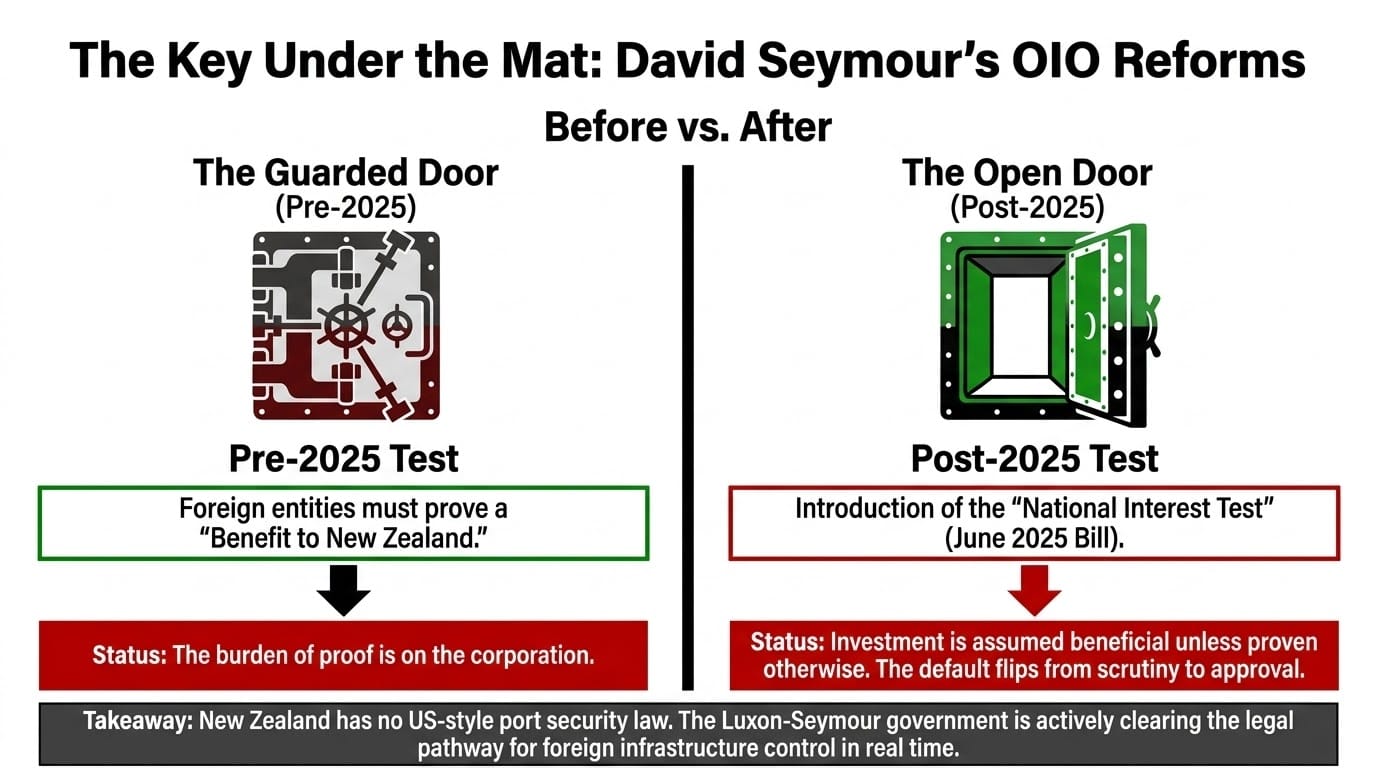
Connection One — The OIO Door Is Being Widened in Real Time.
Associate Finance Minister David Seymour announced OIO reforms in February 2025, reframing the Act's purpose to favour foreign investment inflow. A management lease of Lyttelton Port — if structured as an operating licence rather than an ownership transfer — may not even require OIO consent. The Overseas Investment (National Interest Test and Other Matters) Amendment Bill was introduced to Parliament in June 2025 and is currently at second reading.
The legal pathway is being cleared, in real time, as DP World submits its proposal. This is not coincidence. This is the neoliberal machine working exactly as designed.
Connection Two — CCHL Is Under Fiscal Pressure, and DP World Knows It.
Christchurch City Council's 2026/27 annual plan proposes a 7.58% average rates increase, collecting $912.6 million from ratepayers. CCHL exists as a commercial buffer between the Council and its assets
— a buffer that is under sustained financial pressure.
When rates are climbing and infrastructure demands are mounting, a proposal offering "private capital for future port development without burdening ratepayers" is politically seductive — regardless of the long-term cost. DP World is not making a charitable offer.
It is exploiting a fiscal pressure point with the precision of a sovereign wealth fund that has done this before: in Sudan, in Australia, in the United Kingdom.
Connection Three — The Sudan Pattern and the Democratic Bypass.
Port workers declared they would "completely reject the sale of even a small portion of our territory to the UAE."
The deal was pursued through the transitional government — bypassing unions, bypassing workers, targeting the asset holder directly.
The Lyttelton proposal follows identical structural logic: approach CCHL (the asset holder), frame it as partnership, move before public scrutiny catches up, and present workers with a fait accompli.
Connection Four — The US Already Said No. NZ Has No Equivalent Law.
When DP World acquired P&O in 2006, the US Congress passed legislation to block DP World's operational control of US port terminals on national security grounds.
New Zealand has no port security law, no strategic infrastructure protection framework, and — under the Seymour-engineered OIO reforms — will soon have a weaker investment screening regime than existed five years ago.
A Dubai sovereign entity can now enter the heart of South Island supply infrastructure with fewer legislative obstacles than ever. The same government that is stripping Te Tiriti protections from legislation is holding the door open.
Connection Five — The Workforce Guarantee Has No Legal Teeth.
The Tōnui proposal states workers would retain "no less favourable terms and conditions."
This is a claim in a marketing document — not a statutory guarantee, not a collective agreement term, not a ruling of the Employment Relations Authority. P&O said nothing about harming workers either — until the Zoom call. DP World's approach in Australia was to propose below-inflation pay, then freeze wages when workers pushed back.
A promise in a proposal document is not a protection. It is a PR line. And when the operating company's lawyers are in the room at year three of a thirty-year lease, that line will not save a single job.
The Tikanga Frame: What Kaitiakitanga Actually Demands
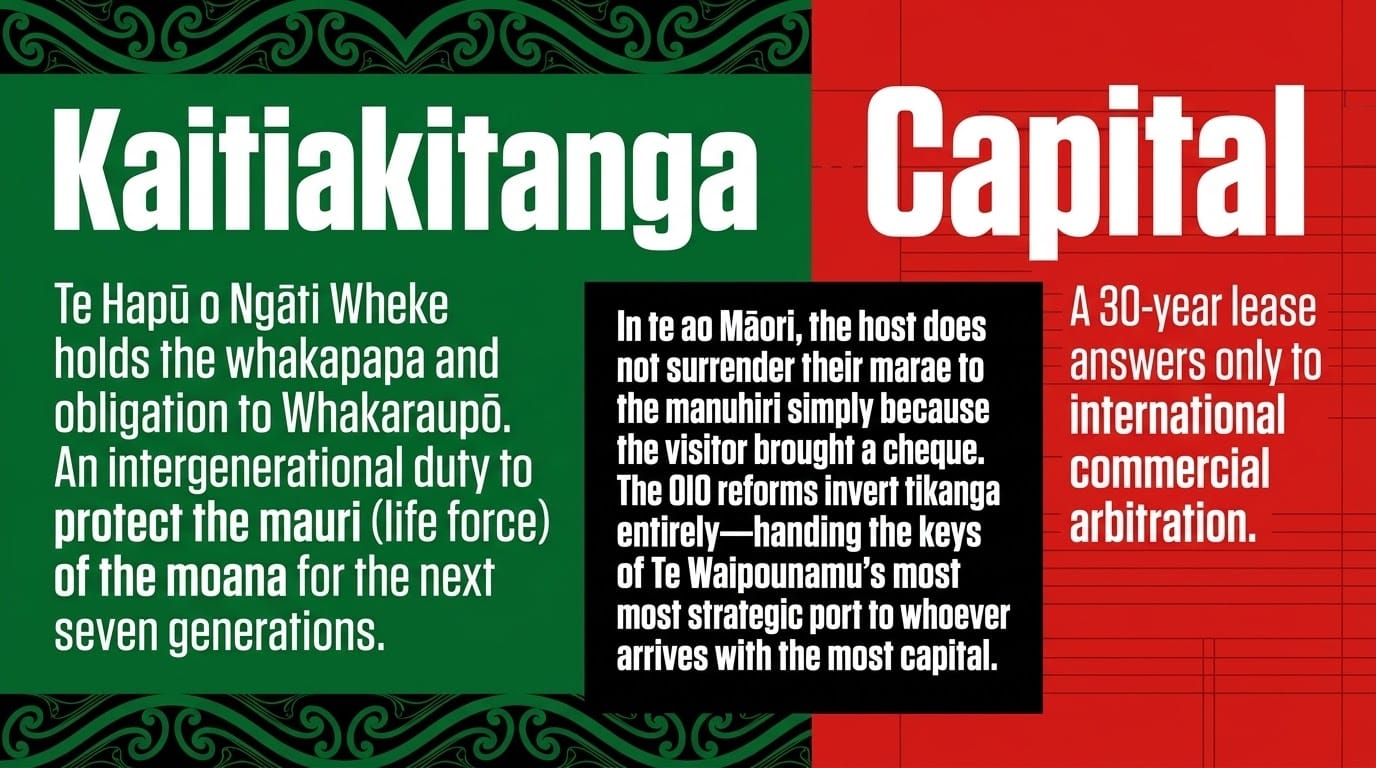
Te Hapū o Ngāti Wheke are the mana whenua of Whakaraupō. Their relationship with that harbour is not a business relationship. It is whakapapa — the obligation passed from their tūpuna through every generation to protect the mauri of the harbour for the ones who come after. The harbour was named for the raupō reed that grew on its shores. Waitaha arrived first. Ngāti Māmoe followed. Ngāi Tahu secured it.
A joint statement between LPC and Ngāi Tahu in 2020 acknowledged "Whakaraupō is of immense cultural significance to Ngāi Tahu" and that "tangata whenua associations with Whakaraupō extend over many centuries."
Kaitiakitanga is active, accountable, intergenerational stewardship — the obligation to ask, before any decision: What does this do to the mauri of this place for those who come in seven generations?
A thirty-year operating lease with a Dubai sovereign entity answers that question with a contract written in international commercial arbitration law — not tikanga, not Te Tiriti, not the voice of the hapū on the northern shore at Rāpaki.
And here is the part that should enrage every person reading this: the same National-ACT coalition that has been systematically stripping Te Tiriti obligations from legislation
— and described that process as "efficiency"
— has now engineered an investment law that assumes foreign capital is good until proven otherwise.
It has not just opened the door to DP World. It has handed them the key, oiled the hinges, and told the tangata whenua to be grateful for the investment.
The three rūnanga in the Tōnui consortium — Te Hapū o Ngāti Wheke, Te Ngāi Tūāhuriri Rūnanga, and Te Taumutu Rūnanga — are not villains. They are Māori leaders navigating a colonial economic system designed to ensure Māori always choose between inadequate options.
I hold them with aroha — and I hold them to account with the same taiaha I use on everyone else, because that is what whakapapa demands.
Related MGL Essays — The Pattern Is Not New
This is not the first time The Māori Green Lantern has tracked the convergence of white supremacist neoliberalism with the systematic dispossession of Māori sovereignty. The DP World proposal is a symptom of a system I have been naming for three years.
- "The Golden Mirage: How Foreign Powers Exploit New Zealand's Resources, Sovereignty, and Digital Future" — The structural template for foreign capital exploitation of NZ strategic assets, with direct relevance to the DP World bid.
- "POTAKA — The Neoliberal Māori and the Five-Million-Hectare Betrayal" — How the "neoliberal Māori" archetype is weaponised to give colonial dispossession a brown face — and the structural risk this creates when Māori names are on a deal that ultimately serves foreign capital.
- "THE ACCELERATOR HAS NO BRAKES: They Deleted the Treaty and Called It Progress" — How the OIO reforms sit within a broader legislative programme of Treaty erasure.
- "The Hobson's Pledge Production Line" — The conveyor belt from far-right lobby groups to the Cabinet table that manufactures the legal dismantling of tino rangatiratanga — the same system now weakening investment screening for foreign port operators.
- "Government Economic Spin: More Spin Than a Front-Load Washing Machine" — Luxon and Willis as architects of the neoliberal machine that makes deals like Tōnui politically possible.
Who Benefits, Who Bears the Cost
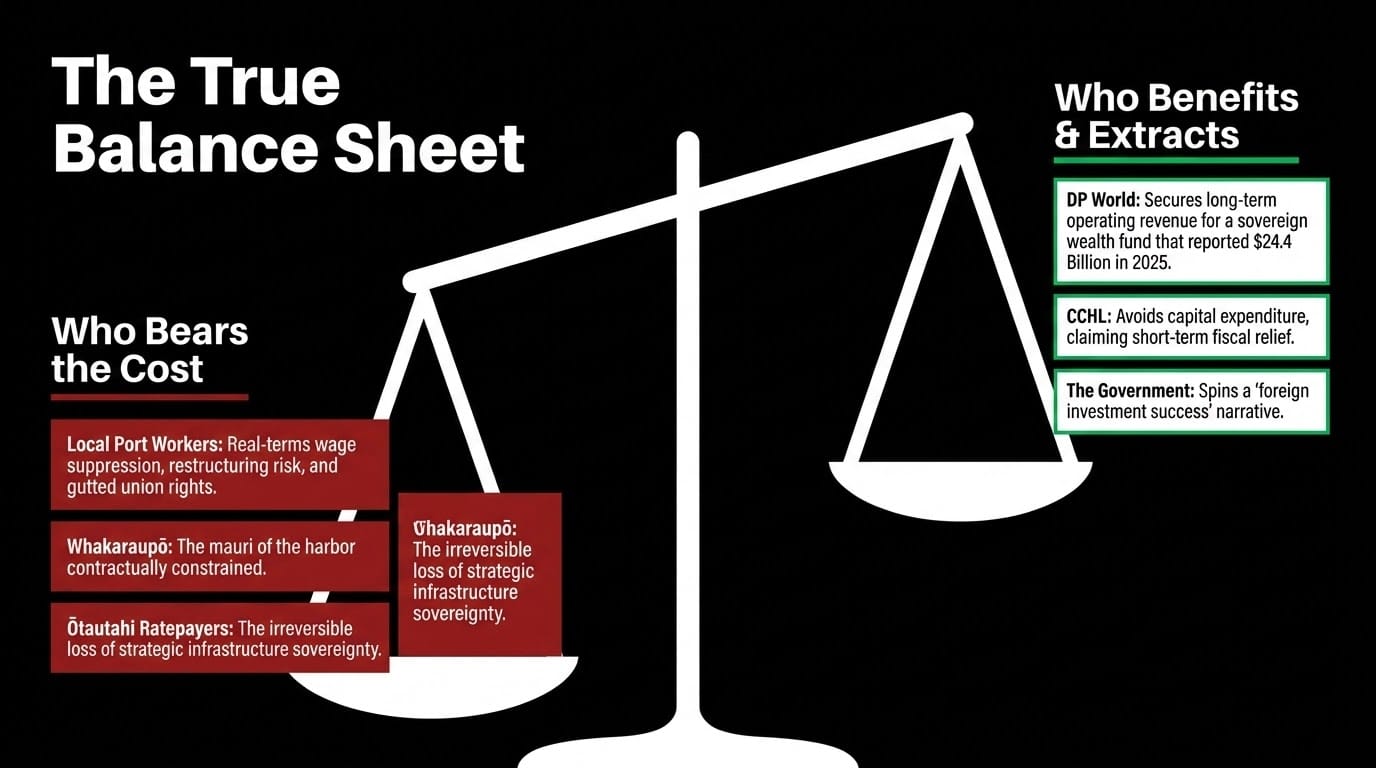
| Beneficiary | Benefit | Who Bears the Cost |
|---|---|---|
| DP World / Dubai sovereign capital | Long-term operating revenue from NZ's South Island port | Port workers: wages, conditions, union rights |
| Three Ngāi Tahu rūnanga | Equity stake, commercial returns | Whakaraupō's mauri if kaitiakitanga is contractually constrained |
| CCHL | Avoided capital expenditure, private investment inflow | Ratepayers lose strategic infrastructure sovereignty |
| Christchurch City Council | Short-term fiscal relief from rates pressure | Long-term dividend risk if operating returns are extracted offshore |
| National-ACT government | "Foreign investment" narrative | NZ strategic sovereignty, Māori rights, worker protections |
The Moral Verdict
DP World fired 800 workers via Zoom. It proposed real-terms pay cuts to Australian waterfront workers. It restructured past union coverage in the UK. It moved on Port Sudan before democratic oversight could respond. It reported $24.4 billion in revenue in 2025. The Government of Dubai indirectly owns 100% of DP World through Port and Free Zone World FZE (PFZW), a subsidiary of Dubai World.
This is the entity now proposing to run the most strategically significant port in Te Waipounamu — the harbour that Ngāi Tahu have defended, fished, and mourned over for centuries.
The three rūnanga in the Tōnui consortium are not villains. They are Māori leaders navigating a colonial economic system designed to ensure Māori always choose between inadequate options. I hold them with aroha — and I hold them to account with the same taiaha I use on everyone else. Their whānau — and the workers on those wharves — deserve the full truth about who DP World is, what it does when a worker picks up a picket sign, and what "no less favourable terms" is worth the morning after a Zoom call.
The Luxon-Seymour government has spent three years stripping the legal architecture that once protected working Māori and Pasifika from exactly this kind of predatory foreign capital. It weakened the OIO. And now, with the door wide open, a Dubai sovereign wealth machine walks through it — carrying a consortium of rūnanga as the welcome mat.
I will not let this pass without naming it.
Ko Whakaraupō tōku moana. Ko ngā kaimahi tōku iwi. Ka whawhai tonu mātou — mō āke tonu atu.
Whakaraupō is my harbour. The workers are my people. We will fight on — for ever and ever.
Tautoko — Support This Mahi: Koha Consideration
800 workers lost their jobs to a Zoom call. A government that is weakening the laws that could stop it happening at Whakaraupō just opened the gate. This essay exists because whānau are willing to support the accountability that Crown and corporate structures will never provide.
Every koha to The Māori Green Lantern is a signal: that rangatiratanga includes the power to support our own truth tellers. That the workers on that wharf deserve someone willing to name DP World's pattern before the lease is signed — not after the Zoom call plays.

Kia kaha, whānau. Stay vigilant. Stay connected. And if you are able, consider a koha to ensure this voice continues.
If you are unable to koha — no worries! Subscribe, follow, kōrero, and share with your whānau and friends. That is koha in itself.
Four pathways to support this mahi:
Koha (voluntary contribution): Support The Māori Green Lantern via Koha
Subscribe to receive essays directly: Subscribe to The Māori Green Lantern
Direct bank transfer: HTDM, account number 03-1546-0415173-000
Facebook: Follow and subscribe on Facebook
Ko Ivor Jones tēnei — The Māori Green Lantern — fighting misinformation and disinformation from the far right.
themaorigreenlantern.maori.nz
Right of reply: DP World NZ, Tōnui consortium, Te Hapū o Ngāti Wheke, Te Ngāi Tūāhuriri Rūnanga, Te Taumutu Rūnanga, CCHL, and Lyttelton Port Company are invited to respond at themaorigreenlantern.maori.nz.
Legal disclaimer: This essay is published in the public interest under qualified privilege (Lange v Atkinson 3 NZLR 385). All factual claims are sourced and cited. Opinions are identified as such and rest on a verified factual basis. No malice is intended or implied. Retraction protocol available on complaint. NZ Defamation Act 1992 compliance confirmed.