"THE ACCELERATOR HAS NO BRAKES: They Deleted the Treaty and Called It Progress" - 11 June 2026
They took Gareth Morgan's promise to Māori, quietly shredded it in a rebrand, and handed you a $20,000 cheque that doesn't cover rent — and called it the future.


Mōrena Aotearoa,
I have held the taiaha for over 1,000 essays. I have named the white supremacist neoliberal government for what it is. I have traced the networks, followed the money, named the names.
And today I am turning the taiaha on something more dangerous than a villain
— I am turning it on a charming friend.
Because the charming friend who says nothing about Te Tiriti while the government is swinging a wrecking ball through every Treaty protection in the law is not your ally.
They are the polished face of the same colonial logic. The machine is cleaner. The seats are comfortable. The destination was never yours.
🎧 The Deep Dive Podcast
Listen to a lively conversation between two hosts unpacking and connecting the evidence in this essay.
⚠️ I apologise in advance for the AI's very harsh pronunciation of te reo Māori. Please don't shoot me — the kōrero is real even if the accent is a disaster. 😄
Two hosts. Thirty minutes. Full interrogation of the Opportunity Party's whakapapa, its deleted Treaty promise, its land tax time bomb, and what it means for whānau in 2026.
📺 Youtube Video
Like video? Here is a short video supporting the essay.
⚠️ Again — don't shoot the messenger because of the AI's pronunciation. The evidence is what matters. 😄
A Machine Built for Someone Else's Journey
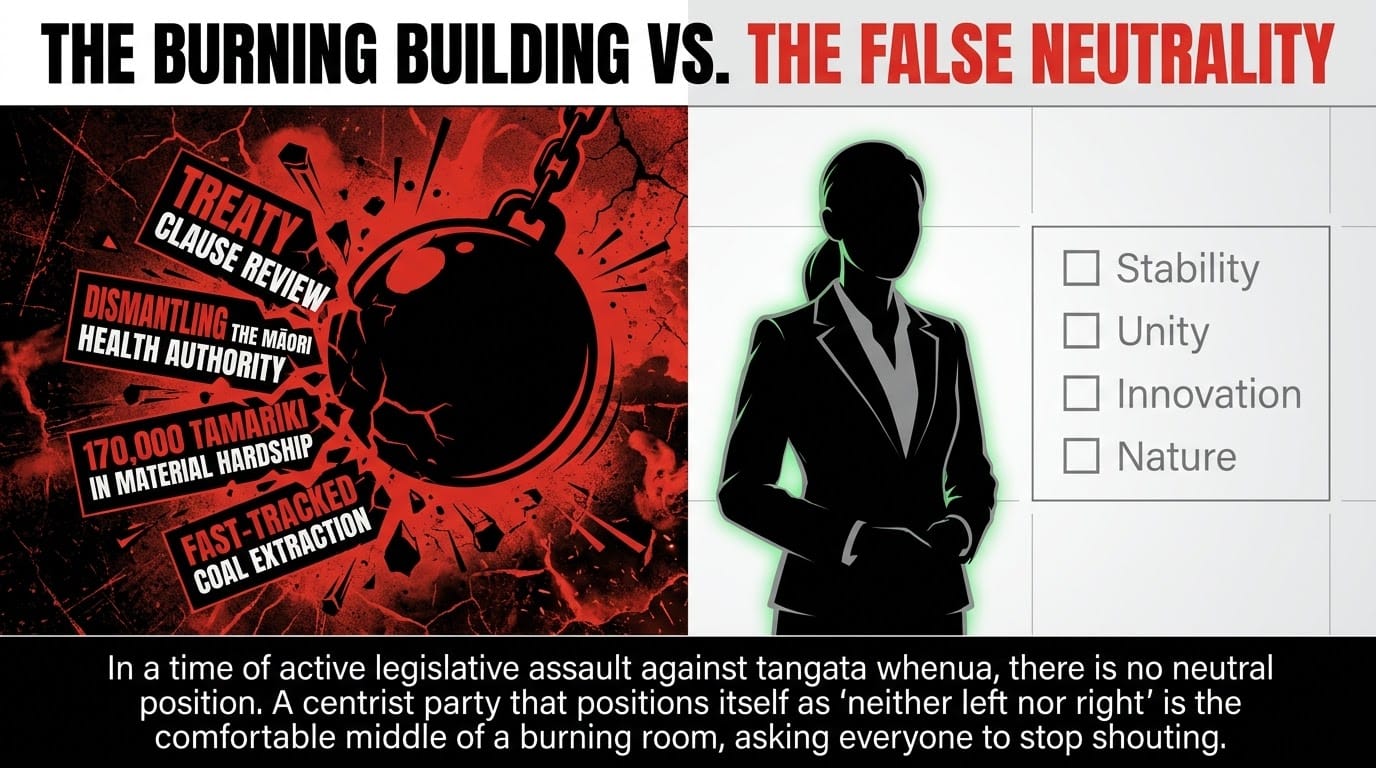
Picture Aotearoa in 2026. The government is swinging a Te Tiriti wrecking ball through every protective clause in New Zealand law. The Waitangi Tribunal is under political attack. 170,000 tamariki are in material hardship. More than one in four Māori whānau report their family is doing badly or not well at all — higher than in 2018. Unemployment is rising. The imprisonment rate is climbing again, and it is Māori bodies filling those cells.
 RNZ News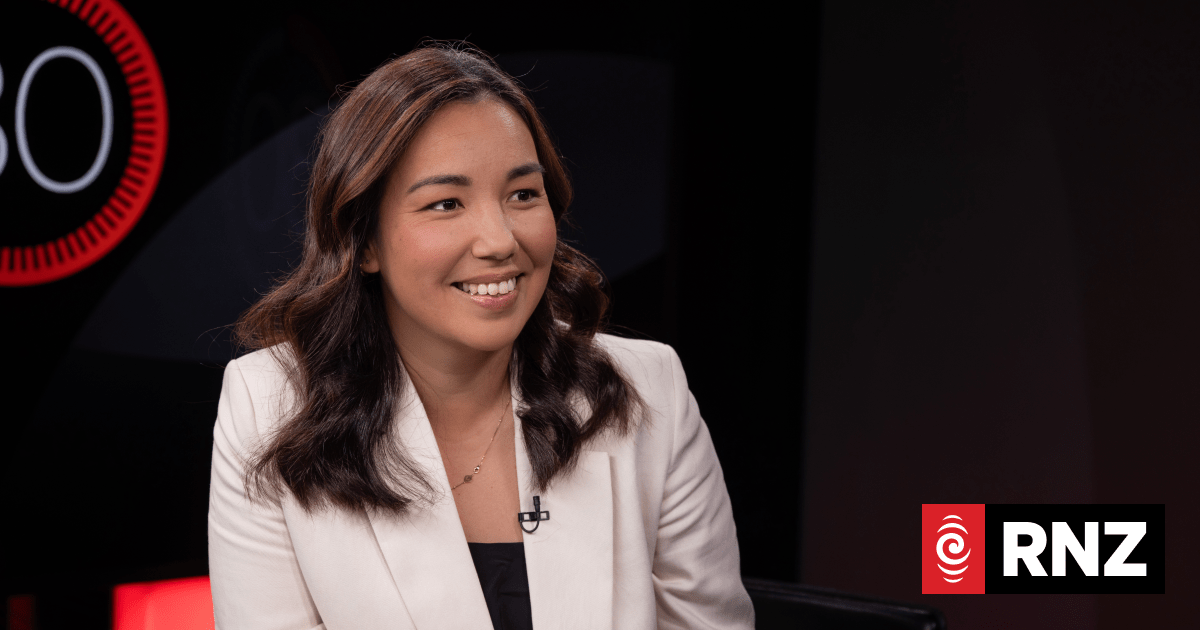
Into this burning landscape drives a gleaming electric vehicle. Zero emissions. Wi-Fi enabled. The driver is charming and intelligent. She speaks about sustainability, innovation, stability. She says kia ora at the start of the interview and means it warmly.
The only problem: she has never once said what the destination is for tangata whenua. And in a thirty-minute nationally broadcast interview, she does not say Te Tiriti once.
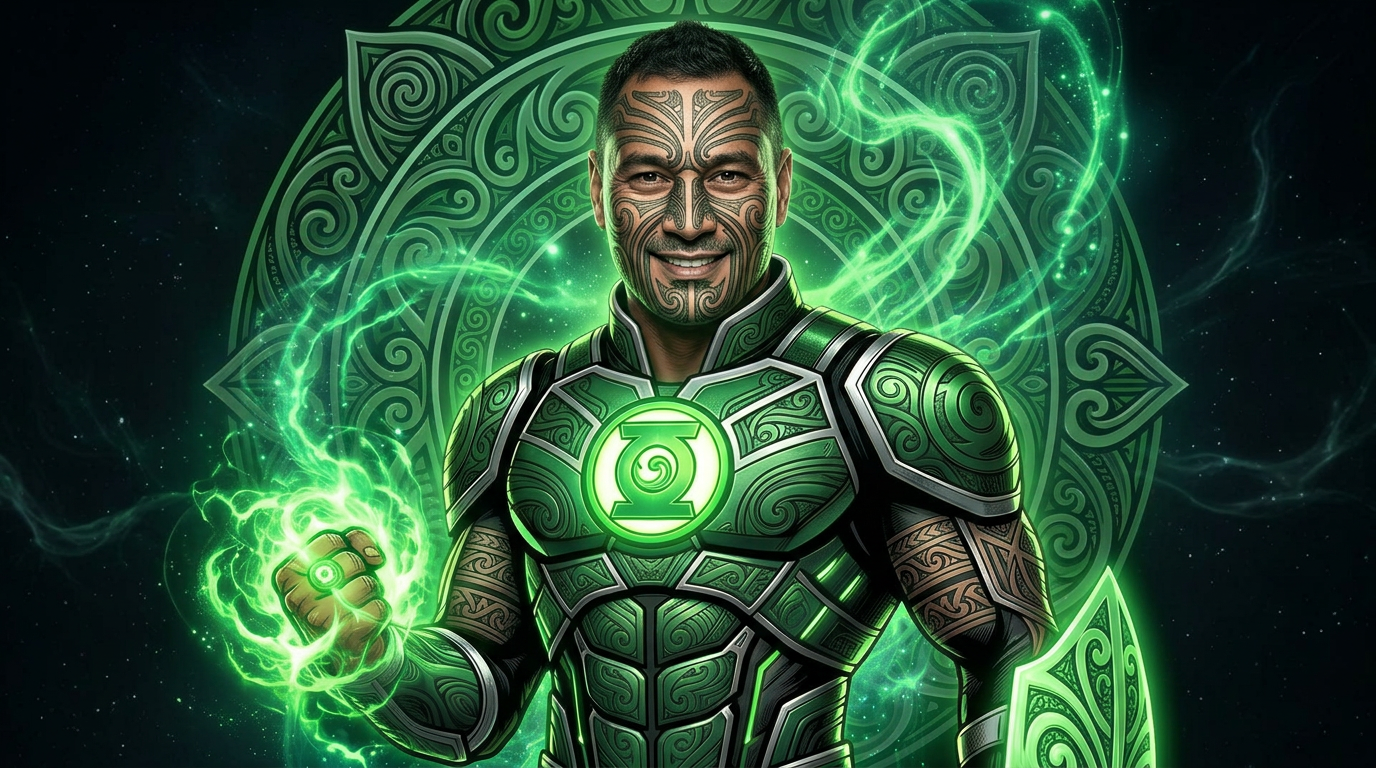
I am Ivor Jones, The Māori Green Lantern — Te Arawa, Ngāti Pikiao, Welsh whakapapa. I have been tracking and exposing the misinformation, white supremacy, racism, and neoliberalism of this government for over 1,000 essays. Today I interrogate not the obvious enemy, but the smiling accelerator. Because some of the most effective instruments of colonial continuity are built by people who genuinely believe they are building the future.
The Whakapapa: What Was Built, What Was Promised, What Was Deleted
Let me trace the whakapapa of this party with the precision it deserves.
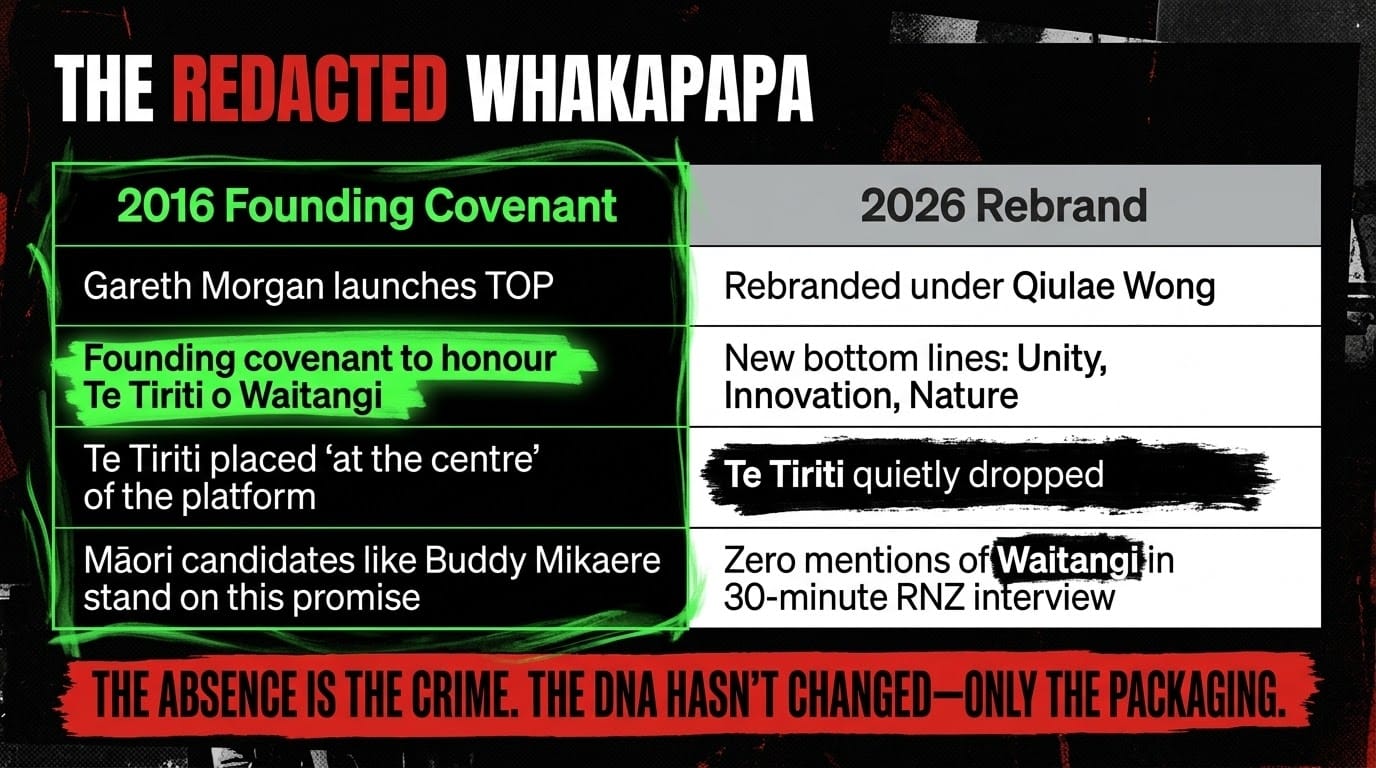
In November 2016, multi-millionaire economist Gareth Morgan launched The Opportunities Party (TOP) with a public promise to honour Te Tiriti o Waitangi — as reported by RNZ on the day of launch.
That was not a footnote. That was the founding covenant with Māori communities considering this party as an alternative.
In 2017, the party declared the Treaty "at the centre" of its platform, sending Māori candidates out to publicly make that case.
In 2018, respected Māori lawyer Buddy Mikaere stood for TOP — writing in E-Tāngata that TOP approached policy through rigorous research without deferring to left-right ideology. He trusted the whakapapa.
Also in 2018, when ACT introduced a Treaty Principles Bill, The Opportunities Party submitted against it
— calling it "constitutionally inappropriate, historically flawed and procedurally illegitimate," and explicitly naming Te Tiriti as "a binding agreement between Crown and Māori and fundamental to our Constitutional arrangements." That was a party with a spine.
Now look at 2026.
The party has been rebranded as the Opportunity Party — note the quiet drop of the 's', the quiet drop of the vision.
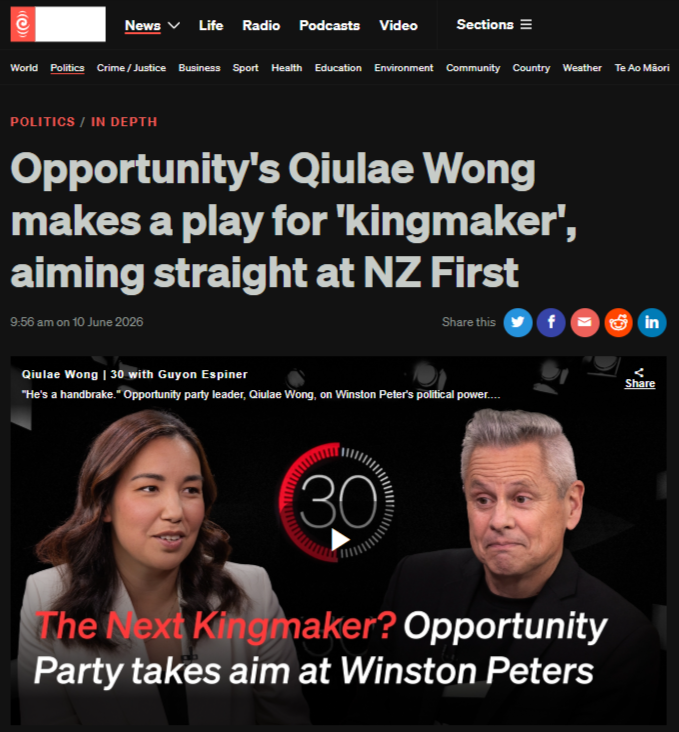
Its new leader, Qiulae Wong, became leader in November 2025. Its coalition bottom lines for 2026 are, as reported by 1News: unity, innovation, and nature.
Te Tiriti is not a bottom line.
Tino rangatiratanga is not a bottom line.
The Waitangi Tribunal is not a bottom line.
Māori freehold land is not a bottom line.
In a 30-minute nationally broadcast interview with Guyon Espiner, Wong does not say Te Tiriti once. Does not say Waitangi once. Does not say tino rangatiratanga, mana whenua, kaitiakitanga, or Māori constitutional rights
— even while discussing fishing, the moana, the environment, and the future of New Zealand.
This is not an oversight. This is a decision.
A leader with 15 years in sustainability, seven months in the role, standing for Parliament in November — she knows what she said and what she chose not to say.
The whakapapa has been quietly deleted in the rebrand. The people who trusted it — Buddy Mikaere, the Māori communities who took TOP's 2016 covenant seriously — were not told. They were just left to notice the absence.
That absence is the crime.
Three Examples for the Western Mind
For those unfamiliar with how colonial structures operate, here are three examples that make the harm visible, quantify it, and name the solution and tikanga impact.
Example 1: The Land Tax Time Bomb on Māori Freehold Land
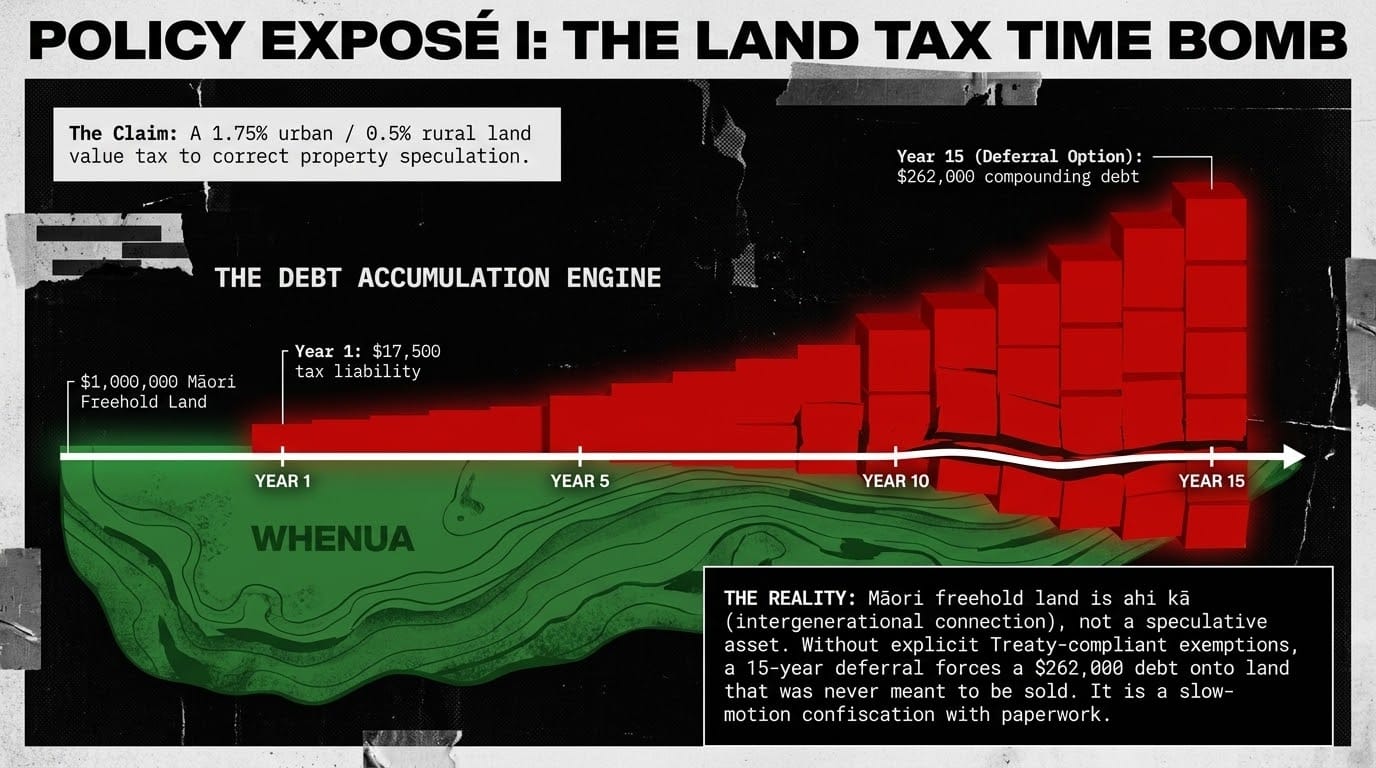
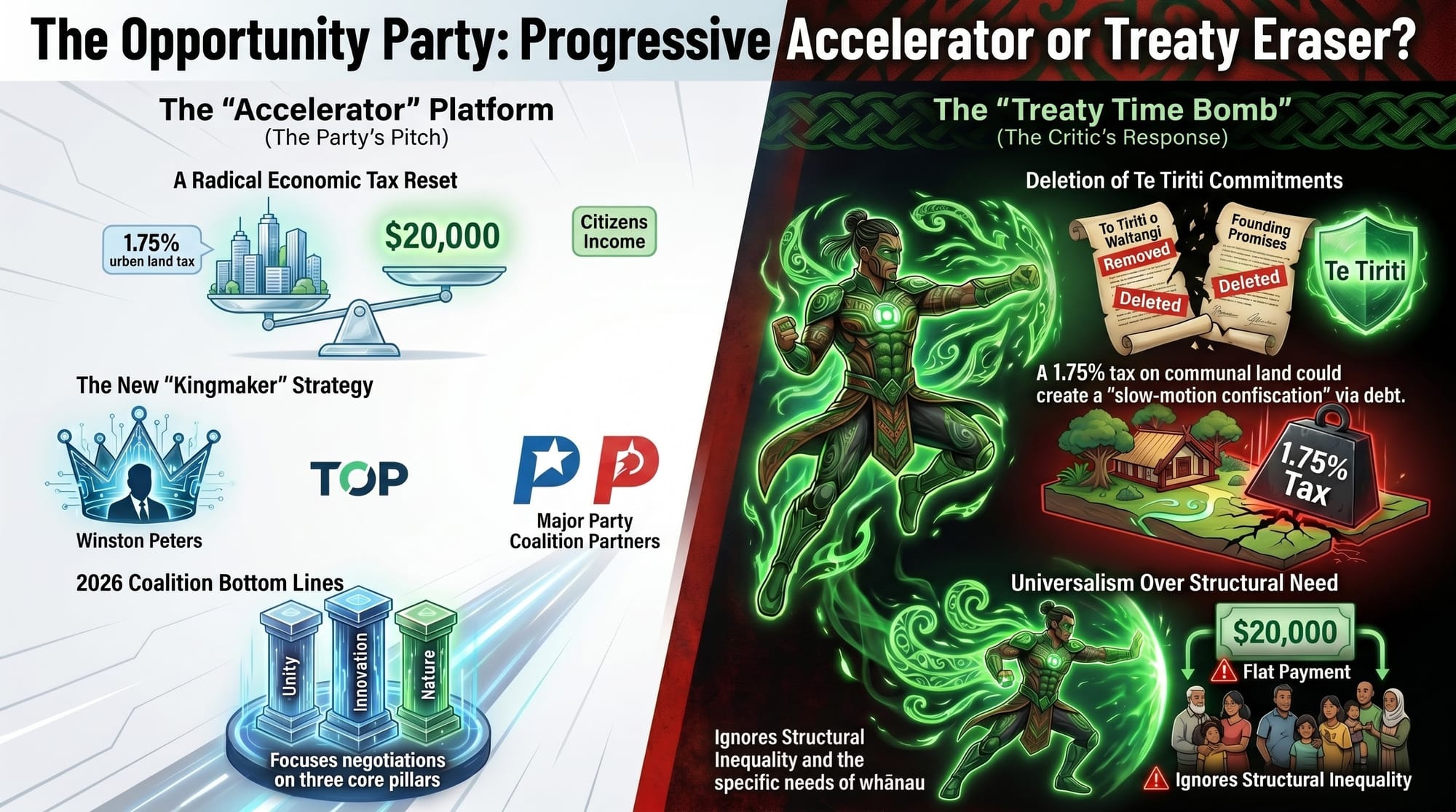
The Claim: The Opportunity Party proposes a 1.75% annual urban land value tax on all land. Wong presents this as a bold, progressive, evidence-based reform that will correct New Zealand's unhealthy reliance on property speculation.
The Quantified Harm: Māori freehold land — held under Te Ture Whenua Māori Act 1993 — is communally owned. It is not a speculative investment. It is whakapapa made physical: ahi kā, the connection between generations, the visible proof of the covenant the Crown has been breaking since 1840. A 1.75% tax on $1 million of Māori freehold land = $17,500 per year in obligations. Wong's own "deferral" option — pay when the land is sold or passes to the next generation — means a whānau that holds for 15 years accumulates a $262,000 debt on land they were never meant to sell. That debt is a structural incentive toward alienation. The 1967 Māori Affairs Amendment Act — which compelled conversion of multiply-owned Māori land into general title — has been called one of the largest Māori land grabs in New Zealand history. This tax, without explicit carve-outs, risks becoming its 21st-century successor.
The Tikanga Impact (for the western mind): Imagine your family has one piece of land. You did not buy it. You did not inherit it as a single person. It belongs to your grandparents, your parents, you, your children, your mokopuna not yet born. It is not an investment. It is identity. It is spirituality. It is the place you return to. Now imagine a government says: we are taxing that land, and if you cannot pay, you can defer — but the debt accumulates until someone sells it. For a Western mind, this sounds like a payment plan. For tangata whenua, it is a slow-motion confiscation with paperwork. The solution is explicit, Treaty-compliant, legally robust exemptions for Māori freehold land — not silence.
What the Opportunity Party Has Said About This: Nothing. The party has made no public statement on Māori freehold land under its land value tax. In the 30-minute interview, it was never raised and never volunteered.
Example 2: The Universal Benefit That Erases Structural Need
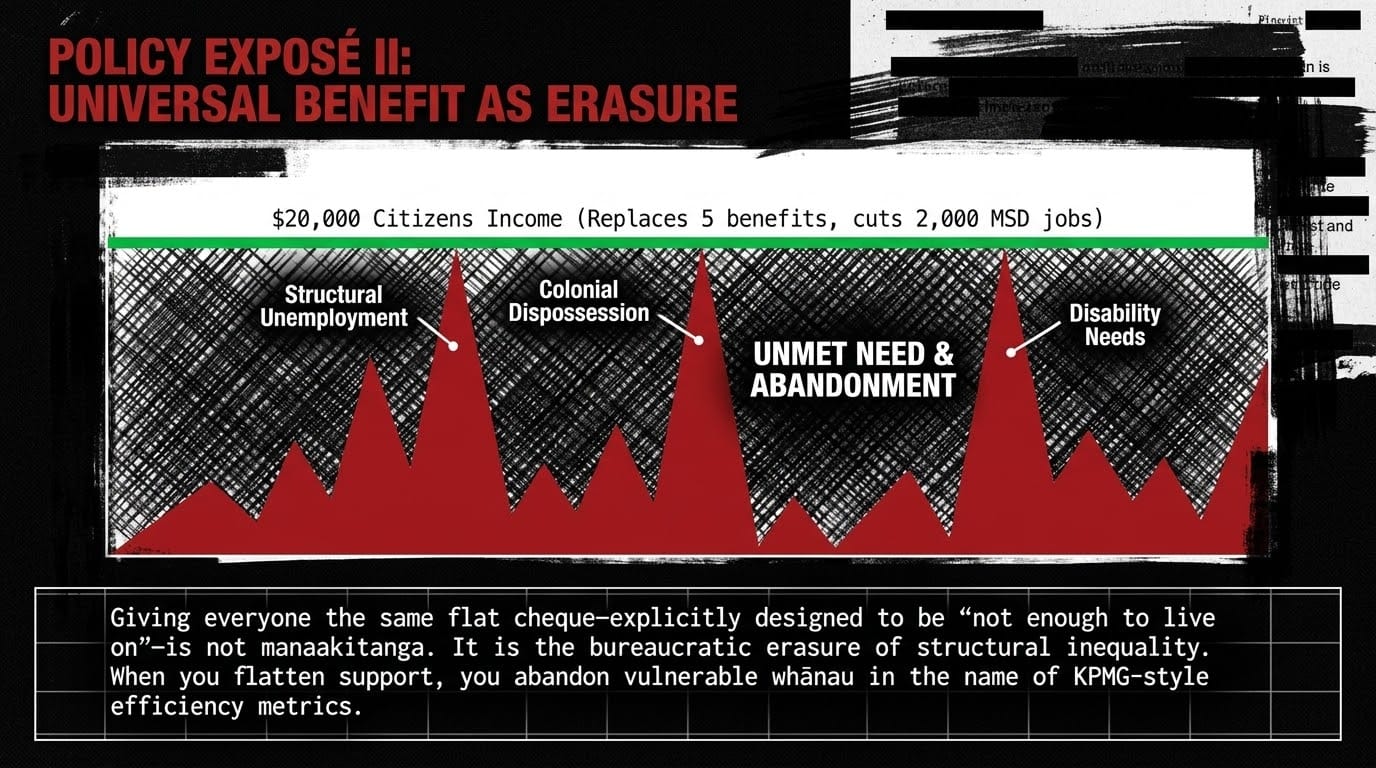
The Claim: The Opportunity Party proposes replacing five welfare benefits with a flat, universal Citizens Income of $20,000 per year, tax-free, for every adult. Wong says this would save 2,000 MSD jobs and simplify the system. She confirms it is "not enough to live on" — by design, to incentivise work.
The Quantified Harm: Māori are disproportionately represented among beneficiaries — a direct result of colonial land dispossession, structural unemployment, and deliberate policy choices made by successive governments. As the Salvation Army's State of the Nation 2025 confirms, more than one in four Māori whānau report doing badly or not well — with Māori unemployment, youth unemployment, and welfare reliance all increasing in 2024. The existing system, for all its cruelty and bureaucratic violence, is at least designed to respond to individual need. A flat $20,000 — explicitly not enough to live on — does not respond to the needs of a solo mother in Flaxmere, a disabled rangatahi in Gisborne, or a kaumātua in Ōpōtiki with a chronic health condition. It responds to the needs of a policy designer who wants to simplify their model.
The Tikanga Impact (for the western mind): In tikanga Māori, manaakitanga means ensuring the wellbeing of those in your care — not as a transaction, but as a sacred obligation. A system that gives everyone the same thing regardless of need is not manaakitanga. It is the bureaucratic erasure of need, dressed as simplicity. When you flatten support, you do not lift those at the bottom — you abandon them with a cheque that doesn't cover rent, while telling yourself you've been generous. The solution is a Citizens Income built on top of, not replacing, targeted support — and designed with Māori wellbeing frameworks, not KPMG efficiency metrics.
What the Opportunity Party Has Said About This: Wong says "top-ups" remain for disability and child support, and that "no one will receive less than they receive now." But she has not committed to increasing support, nor has she addressed how this model interacts with the structural causes of Māori poverty.
Example 3: The Fishing Policy That Forgets the Tangata Whenua of the Moana
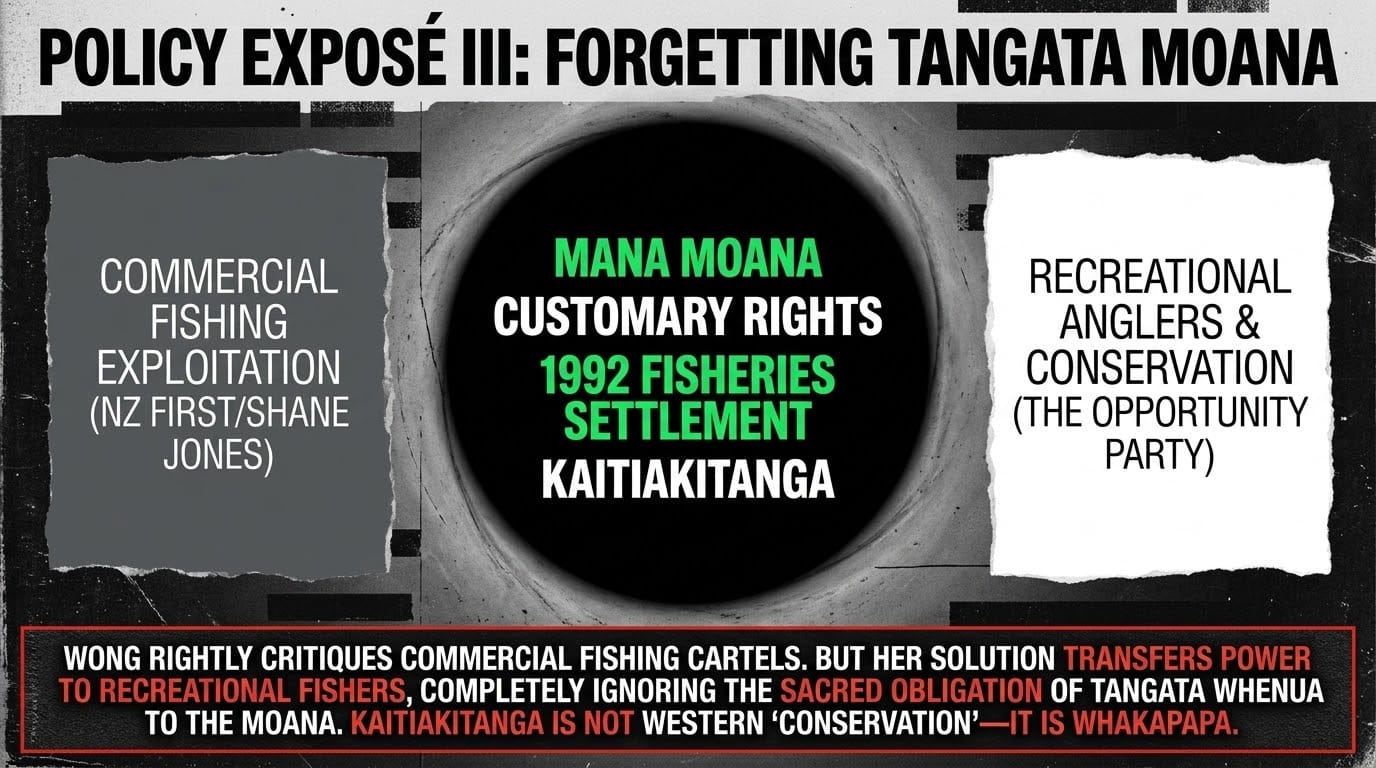
The Claim: Wong's most pointed attack is on NZ First's commercial fishing relationships. She calls for the "preference for the commercial fishing industry" to be "clawed back," citing Shane Jones' Fisheries Amendment Bill — which initially proposed doubling commercial catch limits, allowing vessels to land baby snapper and tarakihi, before recreational fisher protests forced a partial retreat. This is, as RNZ reported, one of Opportunity's coalition priorities.
The Quantified Harm: Wong frames this entirely in terms of recreational fishers and conservation — not once mentioning Māori customary fishing rights, the 1992 Fisheries Settlement, the Waitangi Tribunal's findings on customary take, or the obligations of the Crown under the Marine and Coastal Area (Takutai Moana) Act. The commercial fishing industry has extracted billions from waters Māori never ceded. Shane Jones' bill, as I have previously documented, is not an isolated scandal — it is part of a pattern in which corporate access to Māori lands, fisheries, and coastal areas is advanced through political capture. Wong is right that NZ First has been a corporate fishing vehicle. But her solution — returning the oceans to "recreational fishers and conservation" — still does not return the moana to its tangata kaitiaki.
The Tikanga Impact (for the western mind): Kaitiakitanga is not conservation. Conservation is a European concept that positions nature as something humans manage from outside. Kaitiakitanga is the sacred obligation of tangata whenua to the moana, the awa, the ngahere — not as managers, but as kin. The moana is not a resource. It is whakapapa. When Wong says she wants to "claw back" the fishing preference, she is describing a transfer of power from commercial fishers to recreational fishers — not to the tangata whenua who hold mana moana. The solution is co-governance of fisheries with mana whenua at the table — not a better deal for recreational anglers.
The White Supremacist Neoliberal Context: Why Silence Is Complicity
I want to be precise here, because the accusation demands precision.
The current Luxon-Peters-Seymour government has:
- Swung a Te Tiriti wrecking ball through New Zealand law via the Treaty Clause Review
- Attempted to redefine the principles of the Treaty through the Treaty Principles Bill — defeated by massive public resistance, as I documented in Defending Sovereignty: How Grassroots Power Toppled a Colonial Agenda
- Dismantled the Māori Health Authority
- Stripped Māori-specific protections for children in state care
- Starved the tamariki — 170,000 in material hardship while committing $5.8 billion to US arms dealers in defence spending
- Fast-tracked coal extraction, as I exposed in The Empty Seam
- Built a factory that turns brown children into prisoners, as I documented in The Nursery of Cages
- Starved the school lunch programme and handed it to a multinational corporation while Brazil feeds 40 million children with dignity, culture and fresh kai
This is the burning building. And the Opportunity Party's response to the burning building is: let's talk about stability.
As I wrote in He Hinaki Māori: The Trap Woven in Silk Feathers:
"They don't want to free you. They want to cage you in a whare that looks like home."
A centrist party that positions itself as "neither left nor right" during an active anti-Māori legislative assault is not neutral. It is the comfortable middle of a burning room, asking everyone to stop shouting.
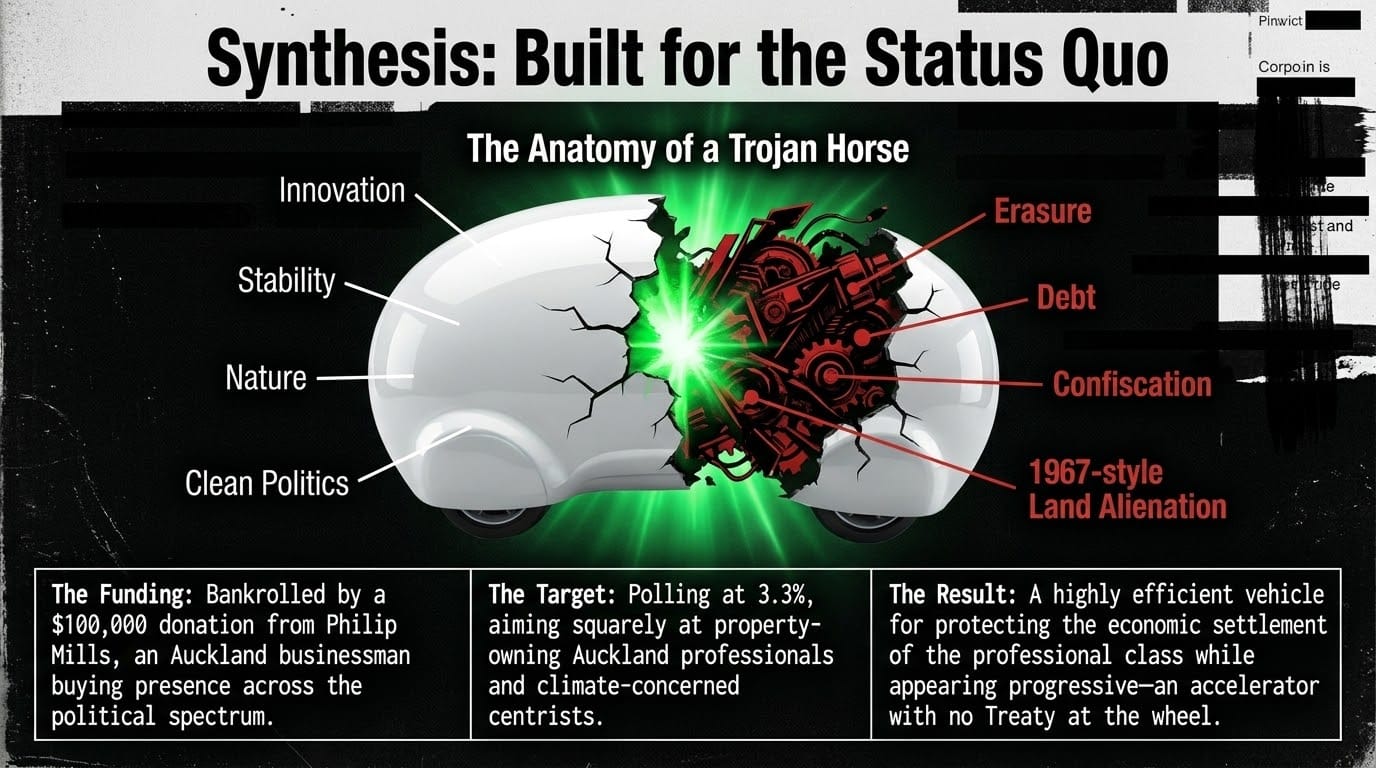
Wong calls herself and her party "an accelerator to the future" versus Winston Peters' "handbrake." But an accelerator with no Treaty at the wheel is just driving faster toward the same cliff. And as I have previously documented in Winston Peters: A Walking Contradiction, the Peters model of kingmaking has exploited exactly this kind of political vacuum
— the space between parties willing to be all things to all people.
Tina Ngata writes in E-Tāngata's 2026 Election Survival Guide:
"For those who want to see Te Tiriti upheld in our country's systems of power, it's time to vote for the kaupapa, not a party."
The Opportunity Party does not have a Te Tiriti kaupapa in 2026. It has a policy manifesto and a deleted covenant.
The Hidden Network: Donor Money, Professional Class Politics, and the Absent Voices
The Opportunity Party's major donor in 2024 was Philip Mills — $100,000 — a prominent Auckland businessman known for funding Labour and the Greens. A donor who spreads money across the political spectrum is not funding democracy. He is buying presence at multiple tables. The Opportunity Party, which will work with anyone and requires only "unity, innovation, and nature," is an exceptionally efficient vehicle for that kind of influence.
The voices present in the Opportunity Party's public platform in 2026: a sustainability consultant turned politician with a KPMG background, a Sāmoan candidate used to signal Pacific credibility, and a donor base that crosses political divides with ease because it does not threaten the economic settlement that benefits it.
The voices absent: kaumātua, rangatahi, urban Māori communities, Waitangi Tribunal practitioners, tangata Tiriti constitutional scholars, mana whenua environmental managers, and the communities inside the neoliberal poverty trap that this party's own economic DNA helped build.
The Opportunity Party polling at 3.3% in May 2026 and targeting the professional, sustainability-minded centre. If it breaks 5%, it enters Parliament as a kingmaker with no Treaty bottom line, a land tax with no Māori freehold protections, a UBI that replaces needs-based support with a flat payment explicitly described as "not enough to live on" — and it will do all of this while calling it progress.
The Five Fallacies Named and Destroyed
Fallacy 1 — The False Neutrality:
A party that refuses to take a position on tino rangatiratanga during an active anti-Māori legislative assault is not neutral. There is no neutral position on Te Tiriti. You uphold it or you don't. "Stability" during a colonial project is collaboration with the colonial project.
Fallacy 2 — Universalism as Equity:
Giving everyone the same $20,000 is not justice when everyone did not start from the same place. It is the erasure of structural inequality in the name of simplicity — the same logic that was used to dismantle the Māori Health Authority. "We're treating everyone the same" has been the lie at the heart of every colonial reform since 1840.
Fallacy 3 — The Rebrand as Renewal:
The Opportunity Party is not a new party. It is Gareth Morgan's economic experiment — TOP 1.0, 2.0, 3.0, and now 4.0 — with a quietly deleted Treaty commitment. As The Spinoff confirmed, each iteration has tried and failed at 5%. The DNA has not changed. Only the packaging has.
Fallacy 4 — The Accelerator Metaphor:
Acceleration in the wrong direction does not become progress because it is fast. The Native Land Court moved very quickly. The 1967 Māori Affairs Amendment Act was administered efficiently. The demolition of the Māori Health Authority was completed on schedule. Speed and modernity are not the same as justice. Whose future? Who set the coordinates?
Fallacy 5 — The Morgan Inheritance:
The original TOP's Treaty commitment did not survive the rebrand. A party that deletes its constitutional obligations when it rebrands has told you everything you need to know about how it will treat those obligations when it enters a coalition negotiation at 3 AM with a government that wants to keep its majority.
The Verdict: Name the Beneficiaries, Name the Whānau Being Harmed
Who benefits from the Opportunity Party's 2026 platform:
Auckland professionals who own property and want a fairer tax system. Business owners exhausted by regulatory instability. Climate-concerned centrists who found the Greens too activist under their current leadership. Impact investors and donors who want a presence at the coalition table regardless of who wins.
Who bears the unexamined risk:
Māori freehold land trusts facing a 1.75% annual tax liability with no stated protections — a potential $262,000 debt over 15 years on land that was never meant to be sold. Beneficiaries — disproportionately Māori — whose individualised support is replaced by $20,000 that does not cover rent. Rangatahi who were promised in 2016 that this party put Te Tiriti at its centre. And every whānau in Aotearoa that needs someone at the table with a Treaty bottom line, not a "unity, innovation, and nature" bottom line.
The Obligation: Questions That Must Be Answered Before November
The Opportunity Party and Qiulae Wong are invited — in the spirit of genuine accountability, not malice — to answer the following on the public record before the November 2026 election:
- What is your explicit position on Māori freehold land under your land value tax? Will you legislate Treaty-compliant exemptions?
- What is the constitutional status of Te Tiriti o Waitangi under an Opportunity Party-supported government?
- What are your bottom lines for Māori — not for "nature," not for "unity," but specifically for tangata whenua?
- What is your position on the Waitangi Tribunal? Will you strengthen or protect it?
- Why was the Treaty commitment that Gareth Morgan made in 2016 removed from the party's 2026 coalition bottom lines?
Until those questions are answered publicly and specifically, the answer for Māori voters is the one Tina Ngata gave us in E-Tāngata: vote for the kaupapa, not the machine. Vote for the destination, not the accelerator. And never, ever mistake a beautiful road for one that leads home.
🌿 Koha Consideration
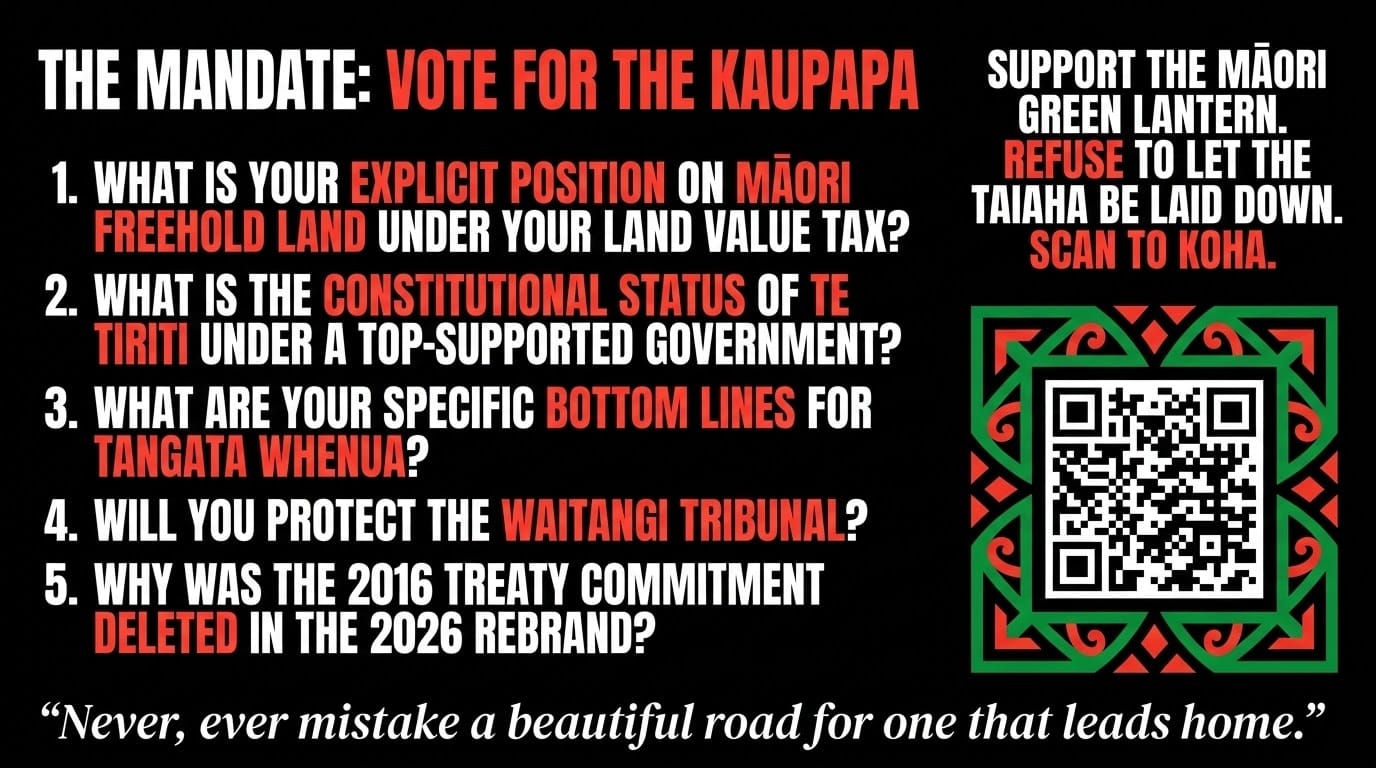
Every time this government swings the wrecking ball through Te Tiriti, it counts on silence. Every time a party deletes its Treaty covenant in a rebrand, it counts on no one noticing.
This essay — naming the deleted promise, tracing the whakapapa, quantifying the land tax harm, protecting the whenua — is only possible because whānau support the accountability that Crown and corporate structures will not provide.
The Opportunity Party has Philip Mills. It has KPMG alumni. It has $100,000 donors.
Tangata whenua have the Māori Green Lantern — and the koha of those who refuse to let the taiaha be laid down.
If this essay reached you through a whānau member's share, a Facebook post, a late-night scroll
— that share was koha.
That act of spreading the truth is rangatiratanga in practice.
If you are able to contribute financially to keep this voice alive and independent, four pathways exist:
Koha Platform: Support directly here — because naming the deleted Treaty covenant and protecting Māori freehold land from a land tax time bomb is exactly the mahi koha was designed to fund.
Subscribe: themaorigreenlantern.maori.nz — receive every essay directly. Be the first to know when the next accelerator with no brakes appears.
Bank Transfer: HTDM | 03-1546-0415173-000
Facebook: Follow and subscribe here
If you cannot koha — no worries at all, e hoa. Share this essay. Kōrero about it with your whānau. Send it to that person who said
"the Opportunity Party seems reasonable."
That is koha. That is the taiaha swinging.
Kia kaha, whānau. Stay vigilant. Stay connected. The accelerator is running. Make sure you know where it's going before you get in.
He aha te mea nui o te ao? He tangata, he tangata, he tangata.
What is the greatest thing in the world? It is people, it is people, it is people.
Ko au ko Ivor Jones — The Māori Green Lantern. Te Arawa. Ngāti Pikiao. Welsh whakapapa. Tūturu.
www.themaorigreenlantern.maori.nz
Disclosure & Research Transparency
Tools used: Web search, full transcript analysis (30 Minutes with Guyon Espiner), RNZ article, E-Tāngata archives, TOP Treaty Principles Bill submission, The Spinoff, 1News, Salvation Army State of the Nation 2025, Waitangi Tribunal, NZ History.
Date of research and publication: 11 June 2026.
Opinions are flagged separately from verified facts throughout.
Right of reply: The Opportunity Party and Qiulae Wong are invited to respond publicly.
Public interest framing: This essay is published in the public interest under the qualified privilege and public interest defences of the Defamation Act 1992 (NZ). All persons named are discussed in their public political capacity only. Pattern of structural harm is documented. No malice is asserted or implied. No personal wrongdoing is alleged.