"The $2.6 Billion Helicopter Heist" - 8 June 2026
When the Crown says there is no money for whānau but finds billions for war machines, the ledger itself becomes a confession.

Mōrenna ano Aotearoa,
I am Ivor Jones, The Māori Green Lantern — Te Arawa, Ngāti Pikiao, Welsh whakapapa — and I know a shell game when I see one.
This is not a neutral procurement story. It is a story about who the state is willing to protect, who it expects to pay, and who it leaves outside in the cold.
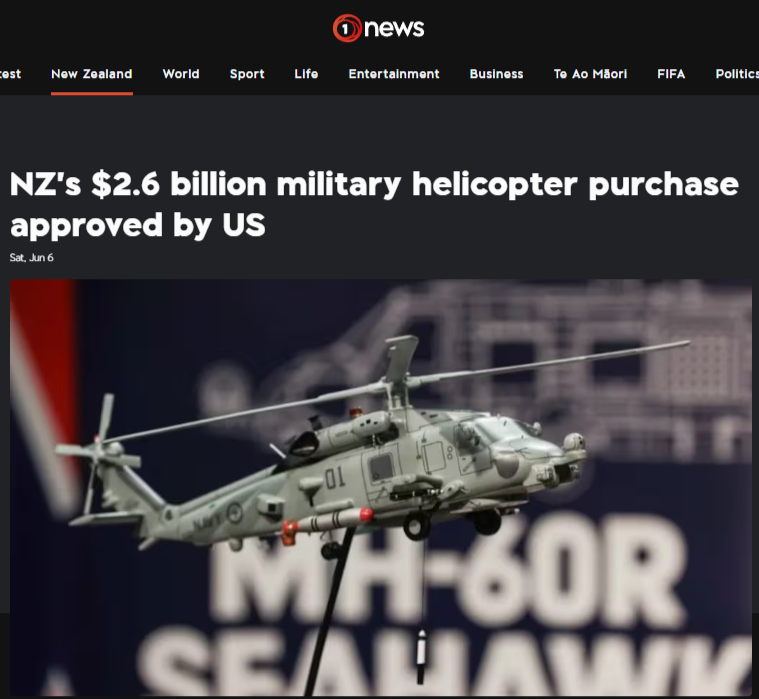
The US State Department has approved a possible Foreign Military Sale to New Zealand of five MH-60R multi-mission helicopters and related equipment at an estimated total cost of US$1.5 billion
— approximately NZ$2.6 billion.
This was confirmed in the 1News/RNZ report on the US approval, and the Ministry of Defence's own maritime helicopter replacement project page confirms that more than NZ$2 billion has already been budgeted for the project on the New Zealand side, covering capital costs, operating costs, training infrastructure, support equipment, and future uncrewed vertical take-off capability.
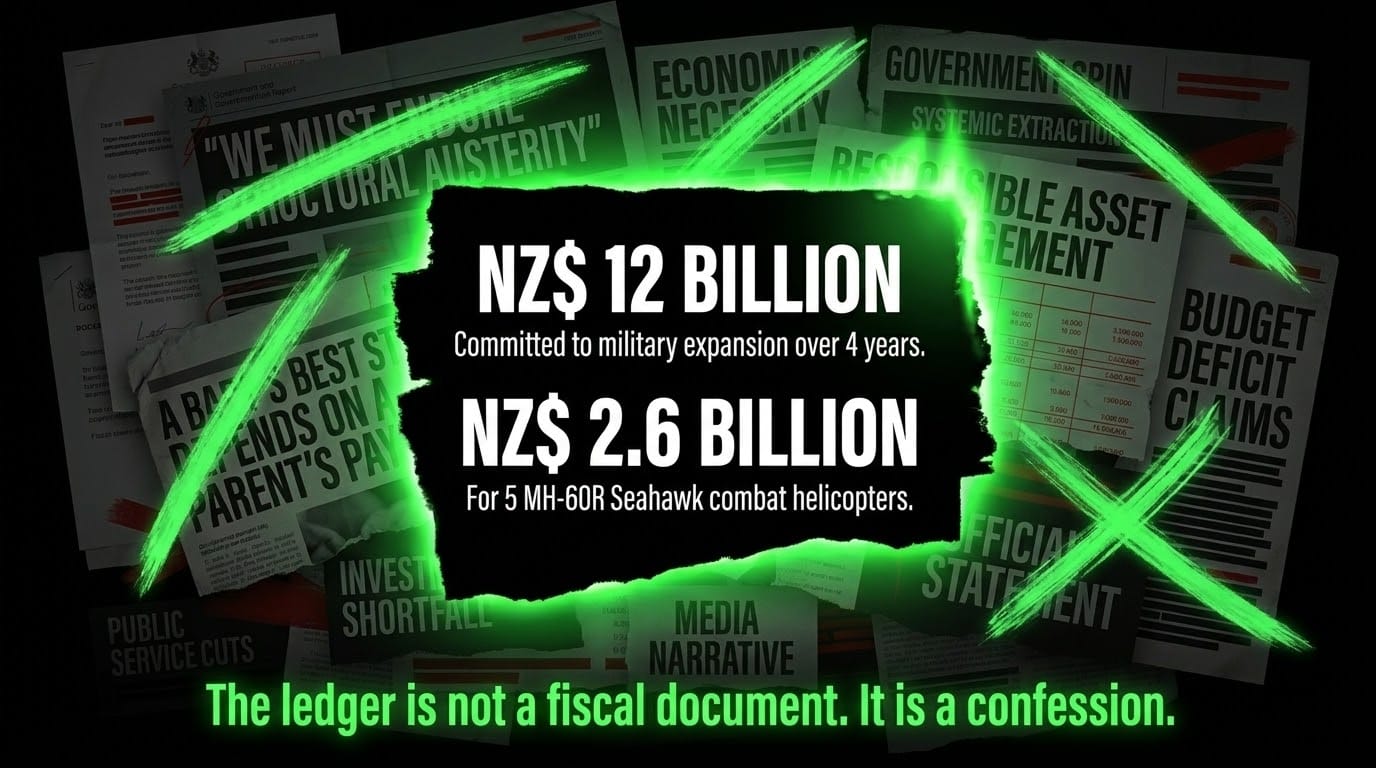
Judith Collins and Winston Peters wrapped that helicopter purchase into a wider NZ$2.7 billion aviation package, as detailed in the Beehive announcement on defence helicopter and plane decisions, including NZ$620 million in capital costs and NZ$80.86 million in four-year operating costs for two Airbus A321XLR aircraft alongside the helicopters.
The NZDF's own summary of the decision frames it explicitly around increasing "lethality and defensive capability"
— language that tells you everything about the values being embedded in this purchase.
And that NZ$2.7 billion sits inside a larger plan. As reported by Reuters on New Zealand's defence uplift, the Government intends to spend roughly NZ$9 billion in new defence outlays over four years, lifting total defence spending toward more than 2 percent of GDP within eight years — a structural commitment confirmed in the Defence Capability Plan release from the Ministry of Defence and the Beehive's multi-billion dollar defence plan announcement.
That is the verified skeleton. The flesh on those bones is political choice. The Government is not forced by nature or geography to make these its highest priorities. It is choosing to do so. And that choice forecloses other choices, forever, for years at a time.
The Deep Dive Podcast
Listen to a lively conversation between two hosts unpacking and connecting the sources in this essay — the MH-60R deal, the wider NZ$12 billion defence uplift, the cuts to hauora Māori, the housing programme that was scrapped, the tax burden on households, and what tikanga tells us about a state that chooses war machines over whānau.
I apologise in advance for the AI's very harsh pronunciation of our reo. Please don't shoot me. 😊
YouTube Video
Like video? Here is a short video supporting this essay and connecting the dots between the helicopter deal, the NZ$12 billion defence expansion, and the costs silently distributed across every household in Aotearoa.
There Is No Money - The Lie

Imagine a landlord who refuses to fix the roof, lets the mould climb the walls, ignores the damp pressing into the bedroom where the tamariki sleep, pockets the rent, and then arrives in a polished ute with a brand-new gun safe strapped to the tray. He calls it "responsible planning." This Government calls its version "combat capability."
The helicopters are not abstract objects. As the US State Department notice and the 1News/RNZ report both confirm, these aircraft are armed with Mk 54 anti-submarine torpedoes, AGM-114 Hellfire air-to-surface missiles, crew-served machine guns, and Advanced Precision Kill Weapon Systems. The MH-60R OIA document released by the Ministry of Defence shows the full scope of what is being embedded into future NZDF capability
— a three-tranche project that starts with aircraft and grows into infrastructure, training systems, and drones.
This is not a one-off purchase. It is a long-run redirection of what the state thinks it is for.
Three Examples For The Western Mind
The Hospital And The Hangar
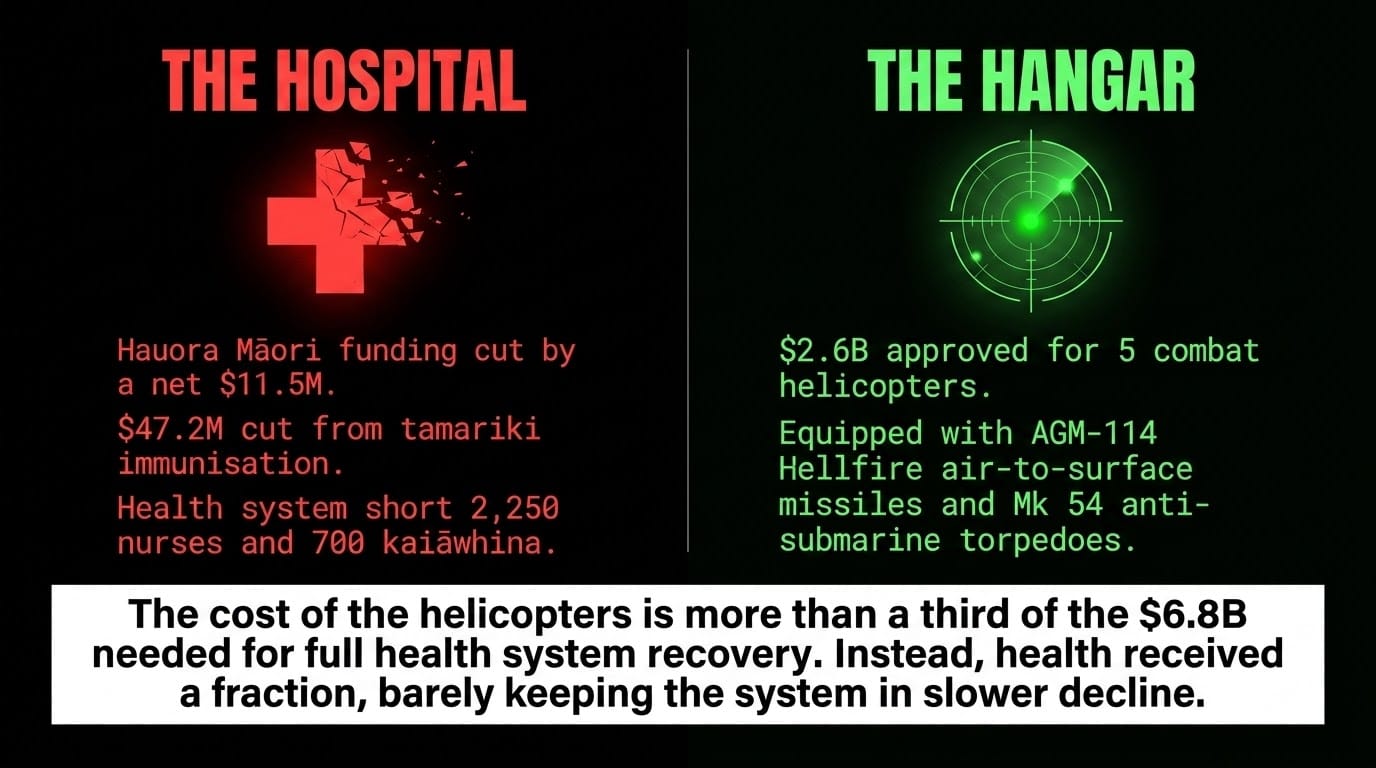
A hospital ward and a military hangar are both claims on the Crown. But they are not treated equally, and the gap is not subtle.
The Defence Capability Plan and Reuters' reporting on the pace of military expansion show a government that has found the urgency and the architecture for long-run military uplift. That same Government's wider fiscal positioning treats health, education, and social infrastructure as subjects of restraint.
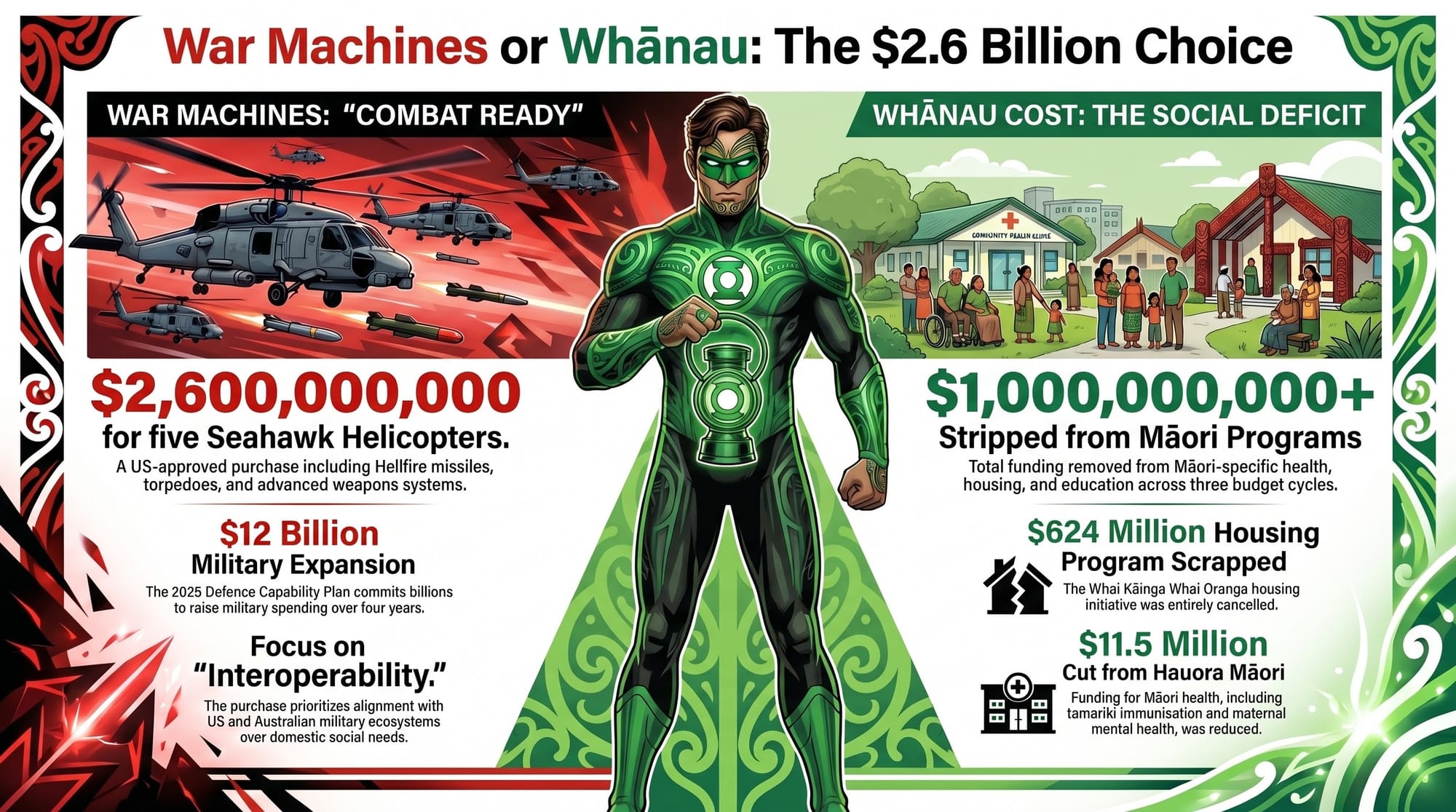
The core verified claim is simple: more than NZ$2 billion earmarked for a helicopter project inside a NZ$12 billion defence plan is money that cannot simultaneously be spent on nurses, GP clinics, public hospitals, or kaupapa Māori health providers. The Ministry of Defence project page and Beehive release make the scale of the commitment unmistakable.
Quantified harm: The helicopter package alone exceeds the total annual health budgets of many regional District Health Boards that were already under severe pressure before the DHB system was restructured. Any precise per-household figure for this deal is not yet publicly stated — the final contract price and cash-flow are still being confirmed as the Ministry of Defence project page itself signals — but the structural consequence is not ambiguous: permanent defence uplift narrows fiscal room for everything else.
Solution: A tikanga-aligned security framework would treat hauora as the foundation of genuine security. That means restoring Māori-led health infrastructure, backing kaupapa Māori providers at scale, and subjecting every defence capital commitment to a side-by-side social-cost audit before it receives Cabinet sign-off.
Tikanga impact for the Western mind: If you build a wall around a treasure house while leaving the people outside in the rain, you have protected the wrong thing. Tikanga does not separate security from wellbeing. They are the same obligation. When the Crown inverts that order, it is not making a technical error. It is making a moral one.
The Cold Home And The Combat Brief
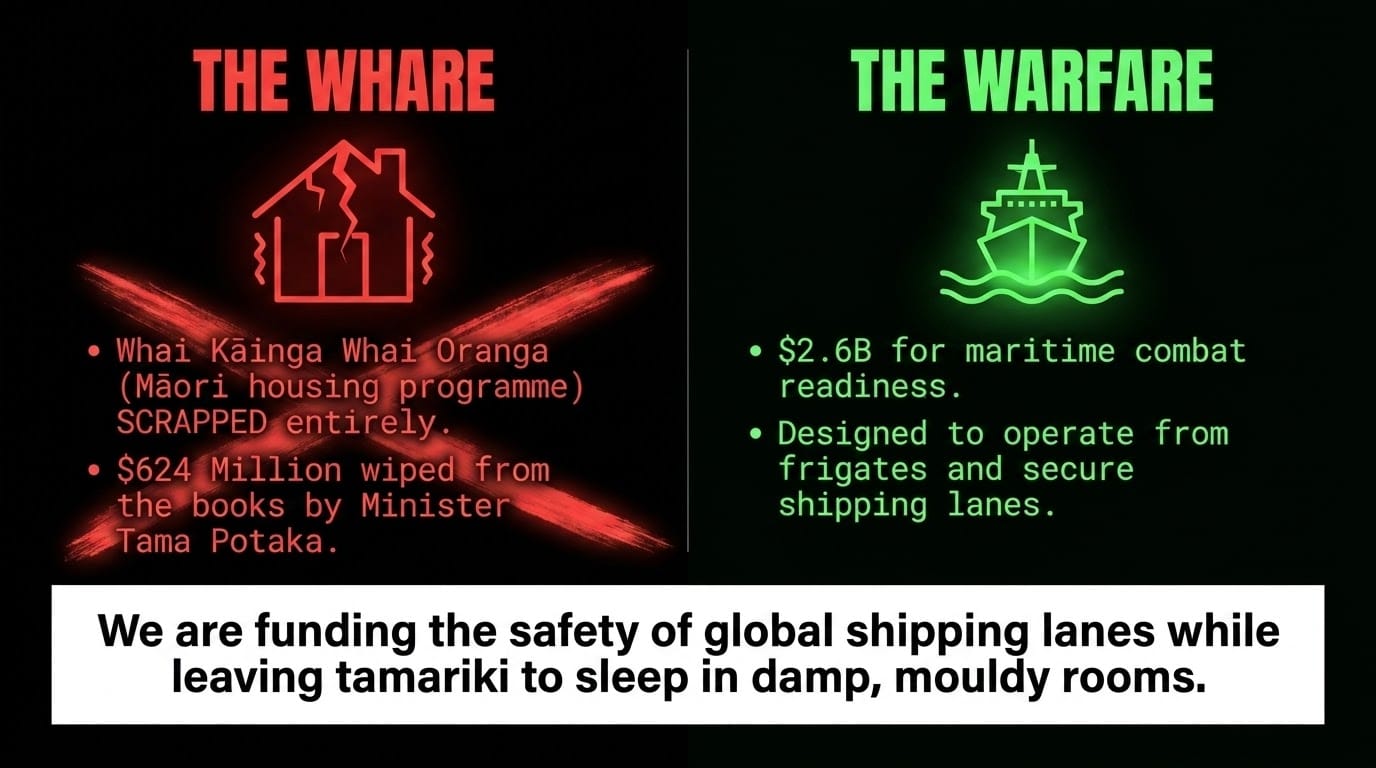
A damp, mouldy home is a security crisis for the whānau living in it. Rheumatic fever is preventable. Cold-related illness is preventable. Overcrowding is a policy choice, not a natural disaster.
But the Beehive announcement and the US State Department sale notice frame security in terms of shipping lane protection, interoperability with allied forces, and "warfare threats" — not in terms of whether tamariki are sleeping dry.
Earlier Māori Green Lantern investigations have traced this same structural displacement in The Whare Is on Fire and the Government Is Handing Out Fines and He Hīnaki Māori: The Trap Woven in Silk Feathers. The pattern is consistent: structural harm is managed at the margins while power is theatrically displayed at the centre.
Quantified harm: More than NZ$2 billion for helicopters is money that cannot also be spent on Kāinga Ora builds, iwi housing providers, or cold-home retrofit schemes. That is not an opinion. That is arithmetic.
Solution: Cap military capital expansion until the housing deficit is measurably reduced. Fund iwi and hapū-led housing programmes at a scale proportionate to the helicopter spend. Define national security by whether tamariki sleep warm and dry — not by whether frigates can deploy on short notice to the Red Sea.
Tikanga impact for the Western mind: Manaakitanga — the obligation to care for people — is not optional when resources are available. It is the measure of whether leadership is legitimate. A government that finds urgency for Hellfire missiles but not for houses has told you, in the plainest possible terms, whose safety it is managing.
The Receipt In Your Pocket
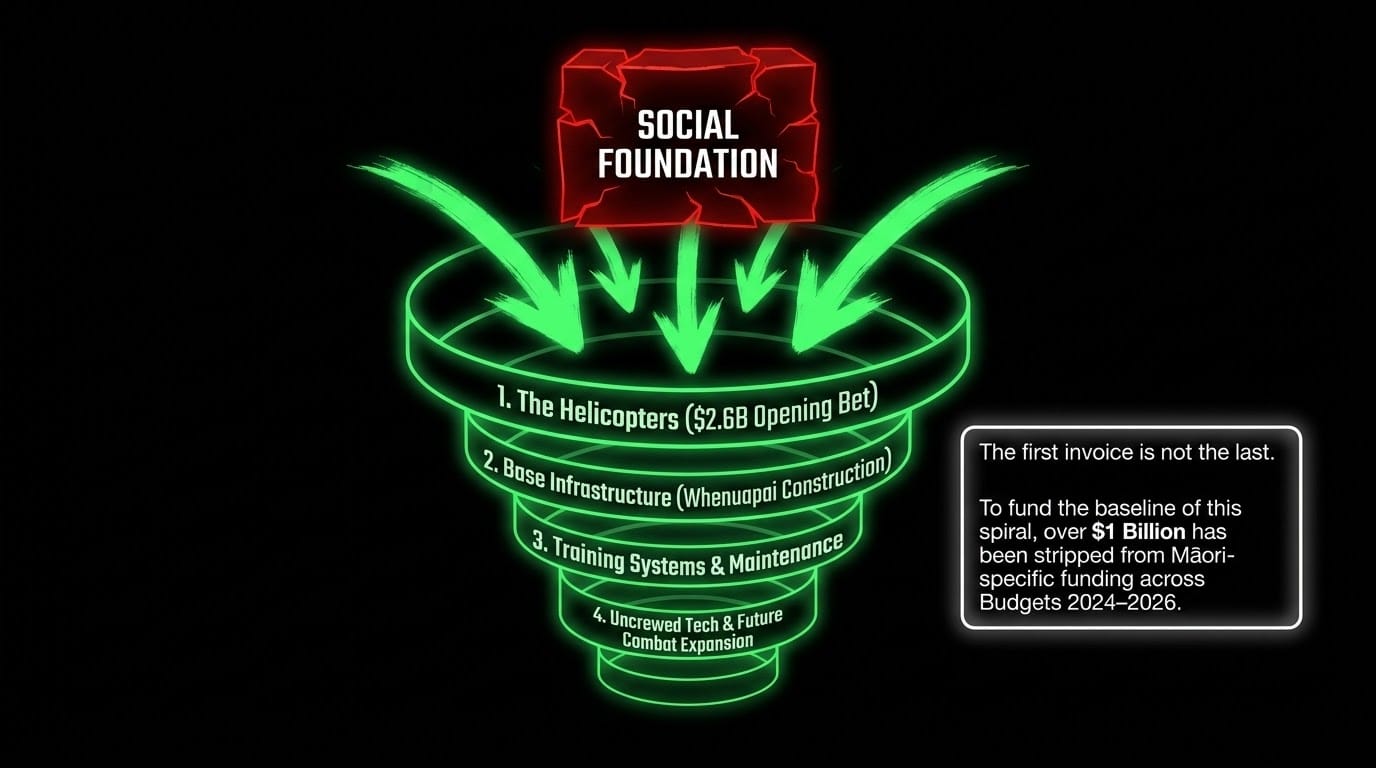
No one will send whānau an itemised invoice marked "Seahawk." That is not how Crown financing works. But as the Defence Capability Plan release, the Beehive's multi-billion dollar defence plan, and Reuters all confirm, this is a permanent structural lift in defence spending.
It is financed through the general Crown accounts, meaning through taxation, borrowing, and the reprioritisation of public resources.
In a tax system still heavily weighted toward GST and PAYE, the recurring cost of higher defence baselines lands hardest on those who spend the largest share of their income on essentials. The GST on bread. The PAYE on wages. The pressure on every other service whenever fiscal space is squeezed from the top by a locked-in defence commitment.
Quantified harm: As previously noted in the Māori Green Lantern analysis of the 2026 Budget, pandemic-era MIQ spending of around NZ$1.2 billion was framed as roughly NZ$660 per household. The helicopter package alone is more than double that, inside a defence uplift nearly twenty times larger, and it does not end — it becomes the new baseline from which future increases are measured.
Solution: Shift the tax burden upward onto wealth and capital. Reduce reliance on GST for funding military ambition. Establish a Te Tiriti–grounded public interest test that requires any defence capital commitment above NZ$1 billion to demonstrate its social cost alongside its strategic rationale.
Tikanga impact for the Western mind: If the feast is financed by those already counting slices of bread, you are not witnessing shared sacrifice for shared security. You are watching hierarchy institutionalise itself in the budget.
Hidden Connections: Who Benefits While Whānau Pay
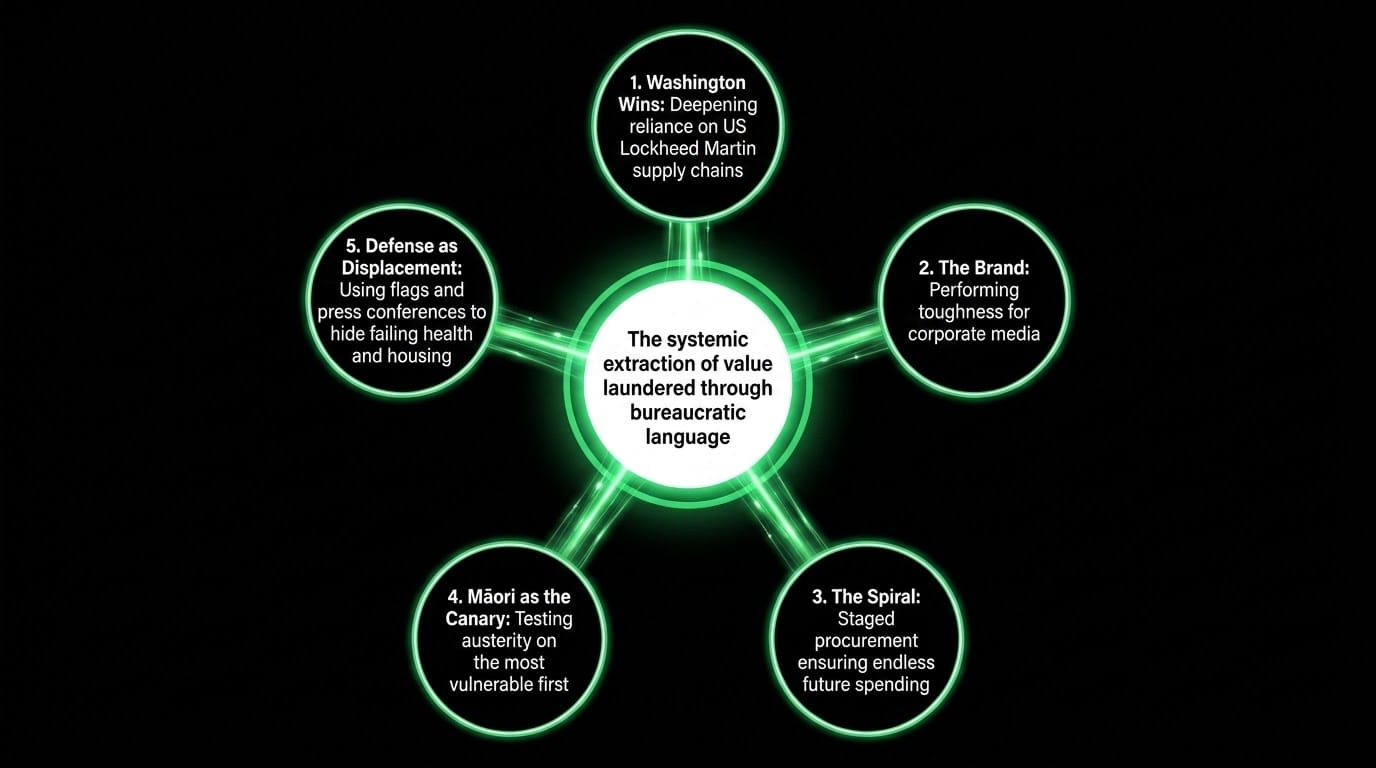
Connection one: Washington wins. The US State Department notice is explicit that the purpose of the sale is to improve New Zealand's "capability to meet current and future warfare threats" and to strengthen interoperability with allied forces. The MH-60R sits within Lockheed Martin's production ecosystem. This is not a neutral technology transfer. It is an alignment purchase — buying New Zealand deeper into US military supply chains, US strategic doctrine, and US expectations of allied deployment. As this Māori Green Lantern essay on Trump's Iran War and New Zealand's genuflection documented, this Government has already shown its willingness to subordinate New Zealand's independent foreign policy to Washington's mood.
Connection two: The brand beats the person. "Combat capable." "Interoperable." "Lethality." These are not neutral technical terms. They are the vocabulary of a Government building a specific political brand — one that performs toughness for allies, that demonstrates willingness to spend for prestige, that signals to the corporate press that National is governing for grown-ups. The cost of that brand is borne by the people who needed the NZ$1 billion in Māori funding that was stripped, by the nurses who were not hired, by the tamariki who will not get school lunches after 2026.
Connection three: The procurement spiral. As the Ministry of Defence project page documents, the helicopter purchase is staged. It begins with aircraft, then moves to infrastructure and hangar construction at Whenuapai, then to training systems, then to uncrewed capability additions. Each tranche requires the next. The first invoice is a commitment to all subsequent invoices. The system is self-expanding once embedded. The Beehive's multi-billion dollar defence plan and Reuters' reporting confirm this is not a one-generation purchase but a new permanently elevated baseline.
Connection four: Māori as the canary. When the Crown strips Māori funding, it is not only harming Māori. It is demonstrating its willingness to harm the most economically exposed communities first, because it knows that mainstream media will not lead with the story, that polling will not punish the decision, and that the harm will be absorbed quietly by the people who have always been expected to absorb it quietly. As this essay on the neoliberal assault on universal rights and He Hīnaki Māori showed: the trap is structural, not accidental.
Connection five: Defence as displacement. This is the oldest trick in the imperial playbook. When you cannot answer the housing question, answer the defence question instead. When you cannot fix the health system, announce a new weapons system instead. When you cannot explain why Māori children are sicker and poorer than they should be in one of the world's wealthiest nations, announce a purchase that comes with flags, press conferences, and the language of national security. The smoke fills the room. The leaking roof stays unrepaired.
Naming The Moral Failure
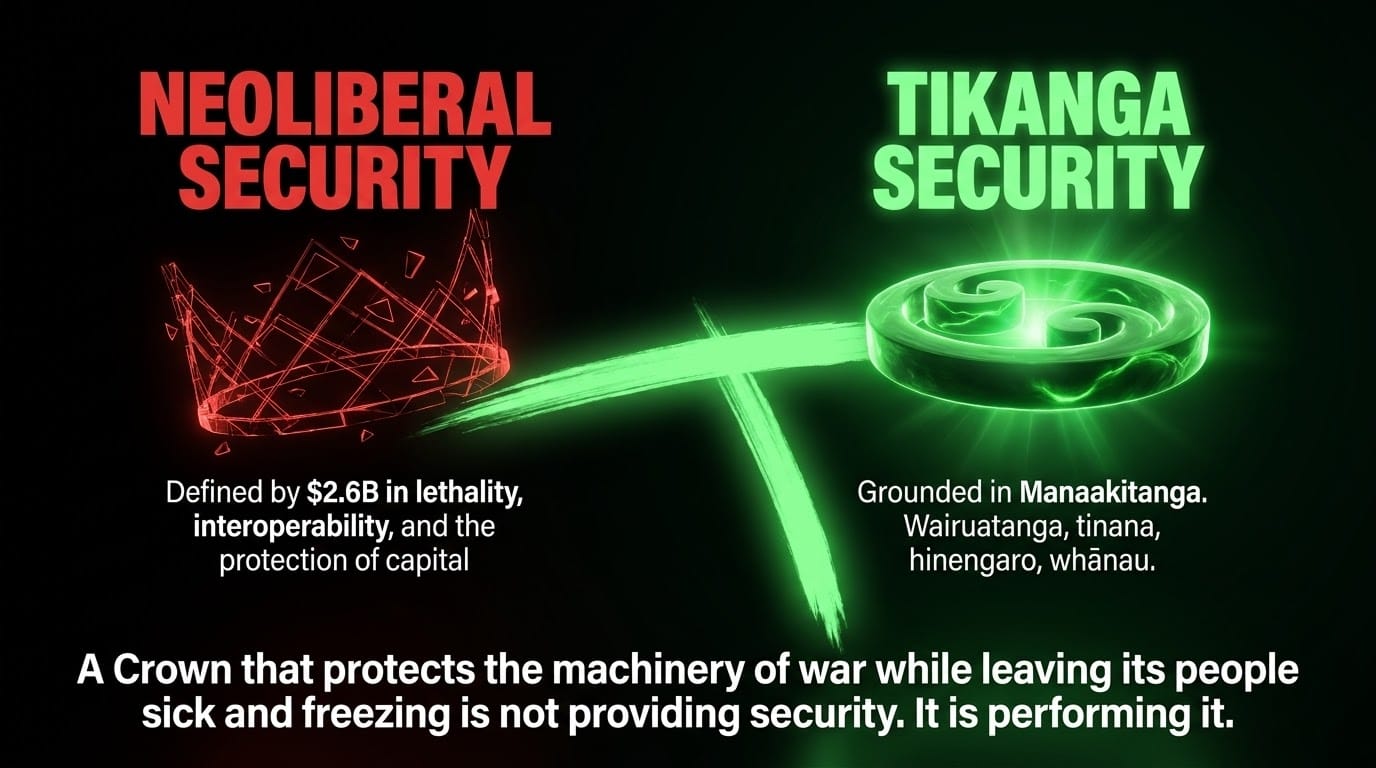
This is a Government that has made its choices visible in the numbers. It has not hidden them. It has announced them at press conferences, put them in Beehive releases, had ministers stand in front of cameras to explain how much they are spending on helicopters and how much they are cutting from Māori development, health, housing, and education.
The numbers are real. The priorities are stated. The beneficiaries are named in the procurement documents. The losers are named in the Labour releases and the kaitiaki reports and the NZNO statements and the whānau who are doing the maths at the supermarket checkout.
This is not complexity. This is clarity.
A government that cuts hauora Māori funding by a net NZ$11.5 million and simultaneously purchases NZ$2.6 billion in armed combat helicopters has made a moral statement.
It has said: the safety of the shipping lane matters more than the health of your tamariki.
It has said: Washington's approval matters more than the damp house where your kuia is sleeping.
It has said: military prestige is urgent and structural, and whānau wellbeing is optional and deferred.
As this Māori Green Lantern body of work — including Tribute to the Conqueror, Selling the Stars, Starving the Seeds, The Whare Is on Fire and the Government Is Handing Out Fines, and The Polished Boot on Papatūānuku's Neck
— has shown across hundreds of essays and thousands of sources: the harm is not incidental to the policy. The harm is the policy.
Dispossession does not happen by accident in a wealthy state with a competent bureaucracy. It happens by design, sustained over time, protected by language, and occasionally celebrated by a helicopter announcement.
Rangatiratanga is not just the right to govern. It is the power to name what is happening and to refuse to be governed by comfortable lies.
This essay is that refusal.
Koha Consideration

Every koha for this kaupapa signals that whānau are ready to support the accountability that the Crown and its corporate allies will not provide. \
In the specific terms of this essay: it is a refusal to let a NZ$2.6 billion combat helicopter deal, a NZ$12 billion military expansion, and more than NZ$1 billion in stripped Māori funding pass unremarked, uncontested, and without consequence.
This mahi is supported by the people it serves. Not by the defence industry. Not by the Crown. Not by the political donors who gather at Parliament's receptions while the whānau they helped impoverish queue at the food bank down the road.
Rangatiratanga includes the power to support our own truth tellers. This is that power in practice.
Kia kaha, whānau. Stay vigilant. Stay connected. And if you are able, consider a koha to ensure this voice continues.
If you cannot koha right now, kaua e māharahara. Subscribe or follow The Māori Green Lantern at themaorigreenlantern.maori.nz, kōrero with your whānau and friends, and share this essay widely. That is koha too. That is the network that cannot be defunded.
Four pathways:
Koha — Support via the Koha platform
Subscribe — Receive essays directly
Direct bank transfer — HTDM, 03-1546-0415173-000
Facebook — Subscribe on Facebook

Ivor Jones | The Māori Green Lantern | themaorigreenlantern.maori.nz | June 2026
Legal and transparency note
Public interest framing: This essay analyses the use of public money, the conduct of ministers in their official capacities, and the implications of government defence and fiscal policy for ordinary people in Aotearoa. It is written in the public interest and comments on matters that directly affect whānau across this country.
Research transparency: Core factual claims are sourced from the US State Department, the Ministry of Defence, the Beehive, 1News/RNZ, Reuters, Kaitiaki Hauora, the Labour Party, Hāpai Te Hauora, and the PSA. All core URLs verified live.
Right of reply: Ministers named here are public officials acting in their official capacities. Any new factual allegations beyond the public record cited above would be subject to right of reply before publication.