"THE WAKA WITH A HIDDEN HELM — AND THE MAN RUNNING IT" - 10 June 2026
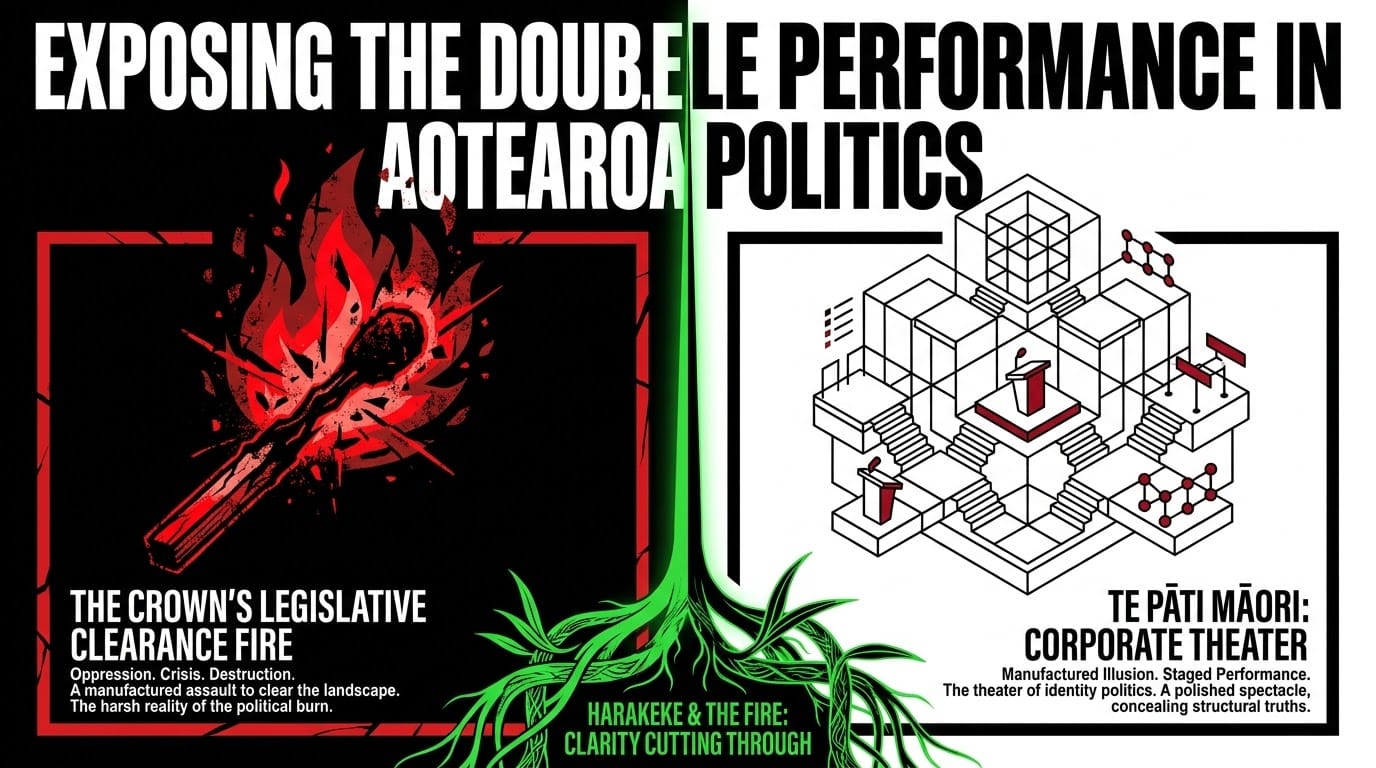
Behind the TikTok haka and the polished performance, Te Pāti Māori increasingly looks less like a people’s movement and more like John Tamihere’s tightly controlled political vehicle

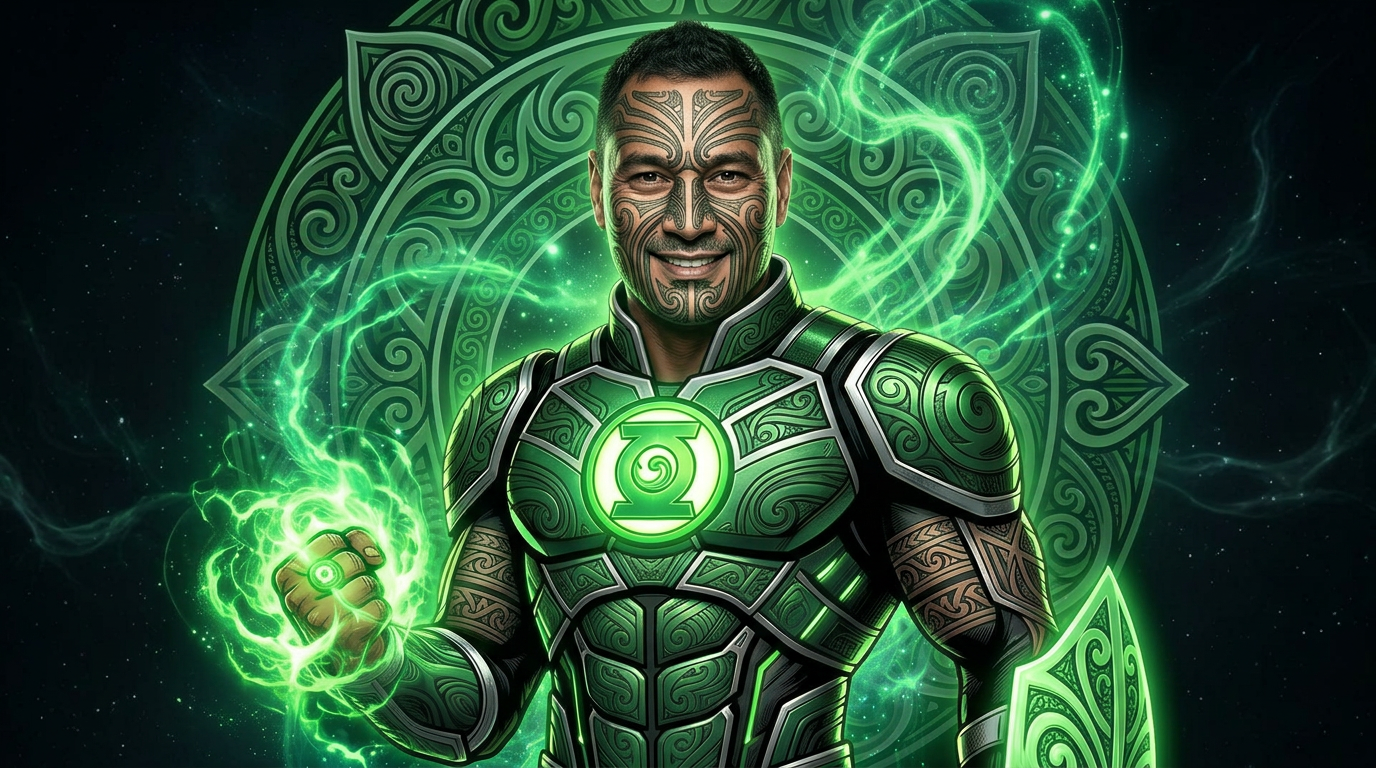
Mōrena Aotearoa,
"I'm going to name every deflection, every inflated claim, every unanswerable question, every half-truth laundered in liberation language. Not because Rawiri is the enemy. But because our people deserve an honest account, not a managed one."
— Ivor Jones, The Māori Green Lantern
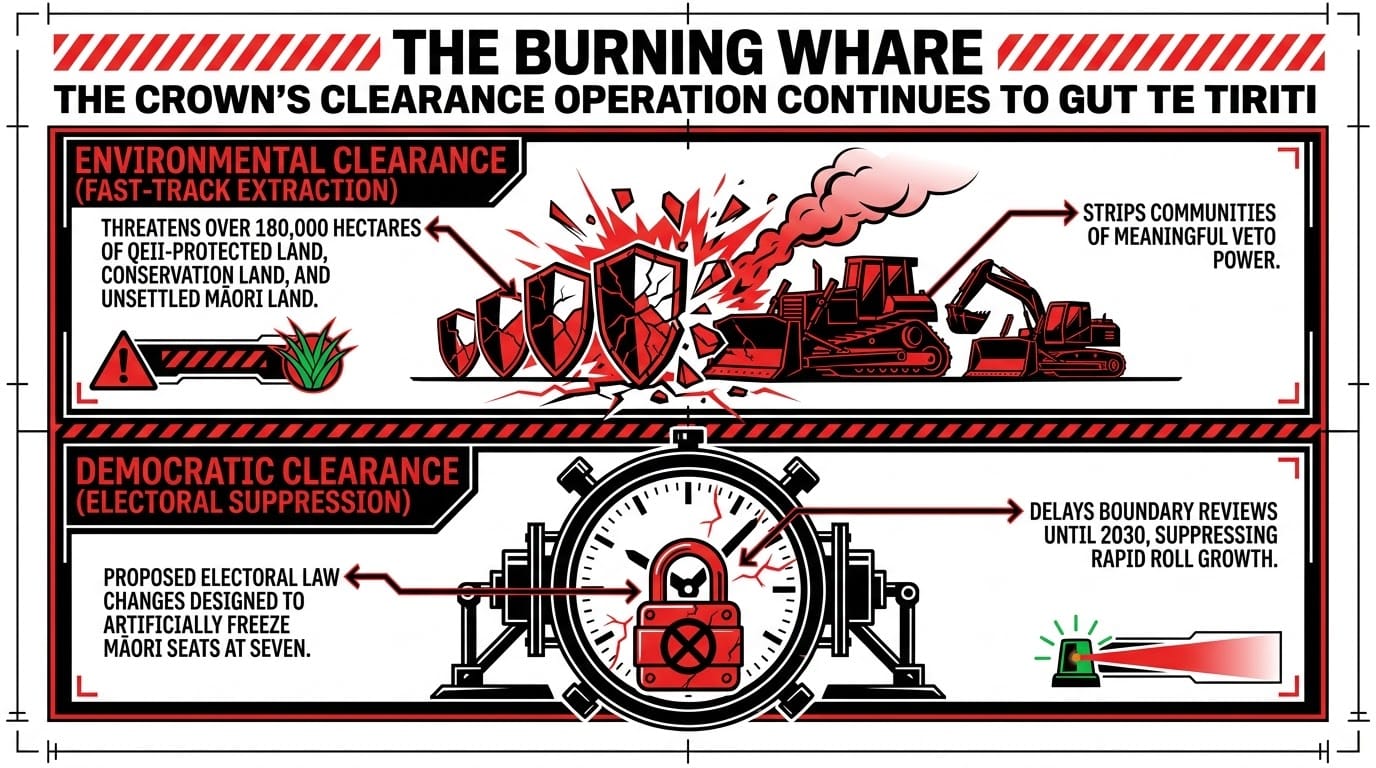
The whare is on fire. That much remains true. The coalition government is still gutting Te Tiriti, fast-tracking extraction, and trying to freeze Māori political power before it can be used against them, as laid out in E-Tangata's analysis of the fast-track regime and Te Ao Māori News reporting on proposed electoral changes.
But here is the harder truth: not every fire alarm is independent of the wiring.
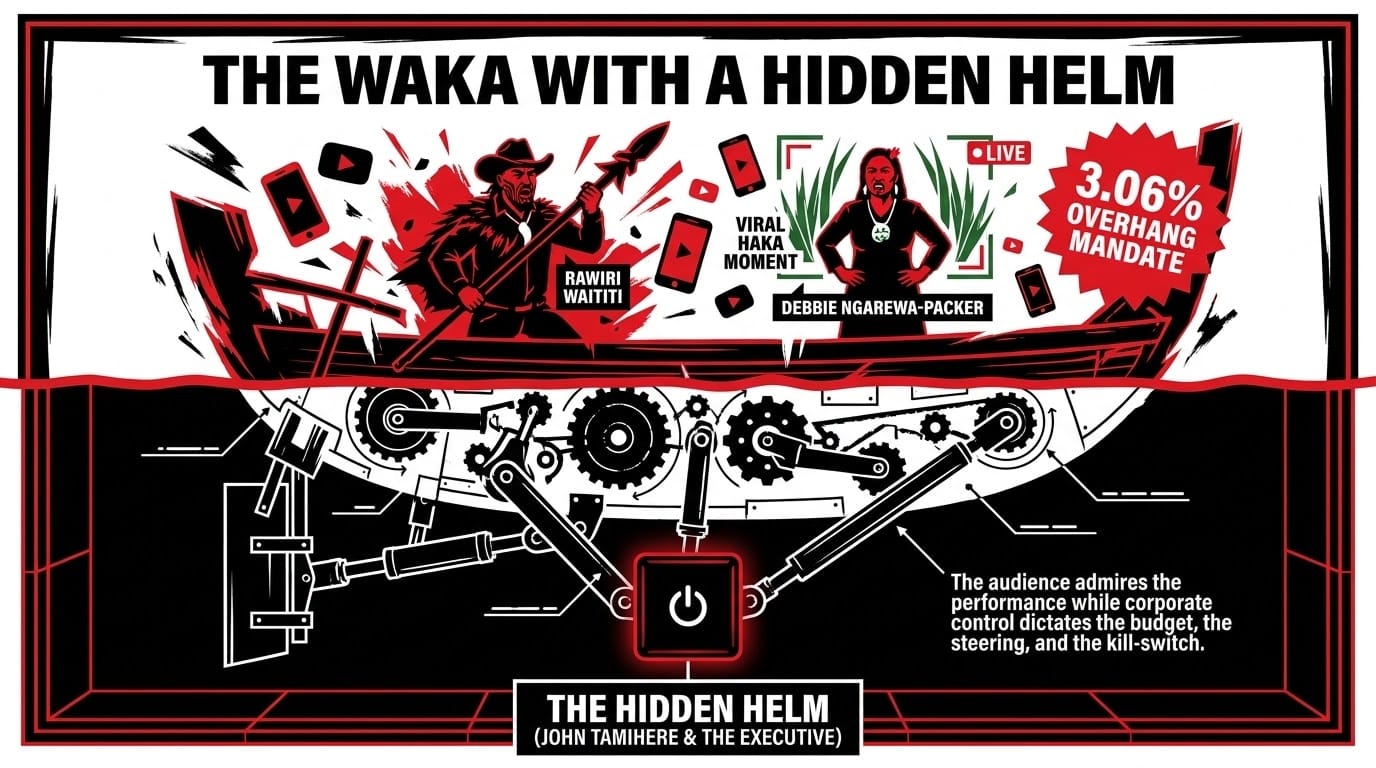
I write this as Ivor Jones, The Māori Green Lantern, and I am no longer prepared to pretend that Te Pāti Māori is simply a rough-edged but authentic grassroots uprising. The available evidence points to something uglier and more cynical. It looks increasingly like a political vehicle whose public face is Rawiri Waititi and Debbie Ngarewa-Packer, while the steering, the machinery, and the kill-switch sit deeper inside a corporate-style structure controlled by John Tamihere.
If that sounds harsh, good. It should. Because Māori do not need more choreography disguised as constitutional liberation. We do not need a liberation movement where the audience is told to admire the haka while somebody else controls the stage lights, the microphone, the budget, the security guards, and the exits.
The Deep Dive Podcast
Listen to a lively conversation between two hosts unpacking the machinery behind this essay — the fast-track regime, the attempted freezing of Māori political representation, the Kapa-Kingi ruling, and the evidence that Te Pāti Māori's public image and internal control structure may be very different things. I apologise in advance for the AI's harsh pronunciation of te reo. Please don't shoot me. 🙂
YouTube video
The Crown's Project Is Still Clearance
Let us not lose sight of the arsonists in cabinet. This coalition government's programme is still a co-ordinated clearance operation: clear Te Tiriti from law, clear Māori from meaningful decision-making, clear the environmental barriers to extraction, and clear the democratic pathways Māori might use to resist.
The fast-track framework opens pathways for high-impact projects on conservation land, QEII-protected land, and unsettled Māori land, while weakening meaningful Māori power, as explained by E-Tangata.
The same pattern appears in the proposed electoral law changes challenged by Te Pāti Māori, which could delay Māori boundary reviews and keep Māori seats at seven even if roll growth justifies eight, according to Te Ao Māori News.
That remains the backdrop. But a backdrop can also become camouflage. And that is where Te Pāti Māori itself must now be examined with the same merciless clarity we apply to the Crown.
The Māori Roll Is Real — The Performance Around It Is Not Liberation
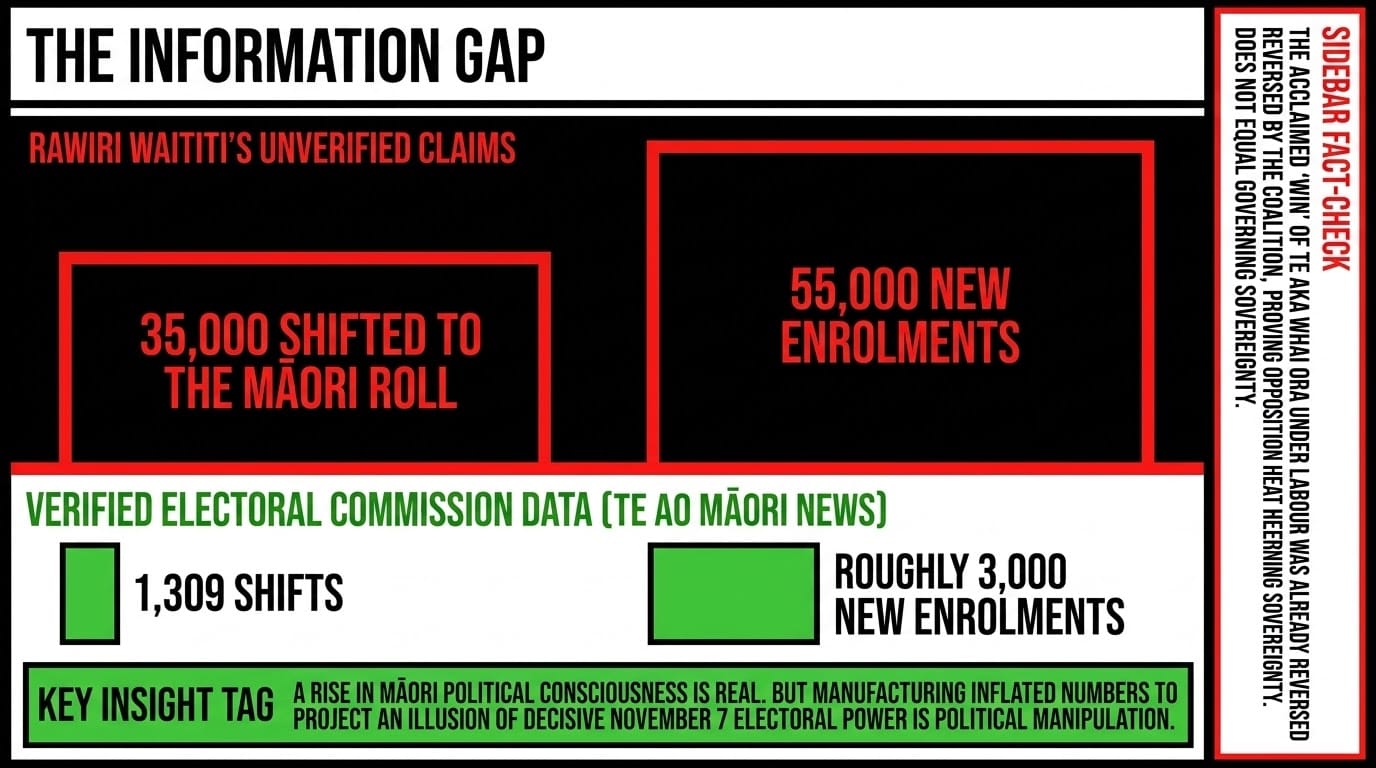
The growth of the Māori roll is real. In November 2024, 1,779 people joined the Māori roll within three weeks, including 1,309 shifts from the general roll, as reported by Te Ao Māori News.
By March 2025, reporting noted more than 3,000 new voters on the Māori roll while Rawiri Waititi linked Māori participation directly to the 2026 election strategy, again in Te Ao Māori News.
But Rawiri has claimed in public that 35,000 shifted from the general roll to the Māori roll and 55,000 newly enrolled. There is no publicly available Electoral Commission data confirming those specific figures in any verified reporting used in this analysis. The directional trend is real. The specific numbers Rawiri cited are not confirmed by any available source. ❌ Unverified — the 35,000/55,000 figures
Worse, Te Ao Māori News reported that any roll growth triggering an eighth Māori seat
"won't be clear until after the next census, due in 2028, so won't affect the 2026 election."
The suggestion that current roll numbers will deliver decisive November 7 power is therefore overstated against the electoral mechanics. Te Ao Māori News
That growth matters. But it does not automatically validate the political machine claiming ownership of it. A rise in Māori political consciousness is not the same thing as a mandate for John Tamihere's command structure.
Māori roll mobilisation belongs to the people, to hīkoi, to rage, to whakapapa, to communities who are sick of being managed. It does not belong to whatever executive apparatus later steps in front of the camera to claim the harvest.
So yes, the Māori roll is still the loaded gun the state is trying to jam.
But we should also ask: who exactly wants to hold that gun, and who gets told to clap while it is waved around for optics?
The Hidden Helm: Tamihere, The Executive, And The Corporate Shell
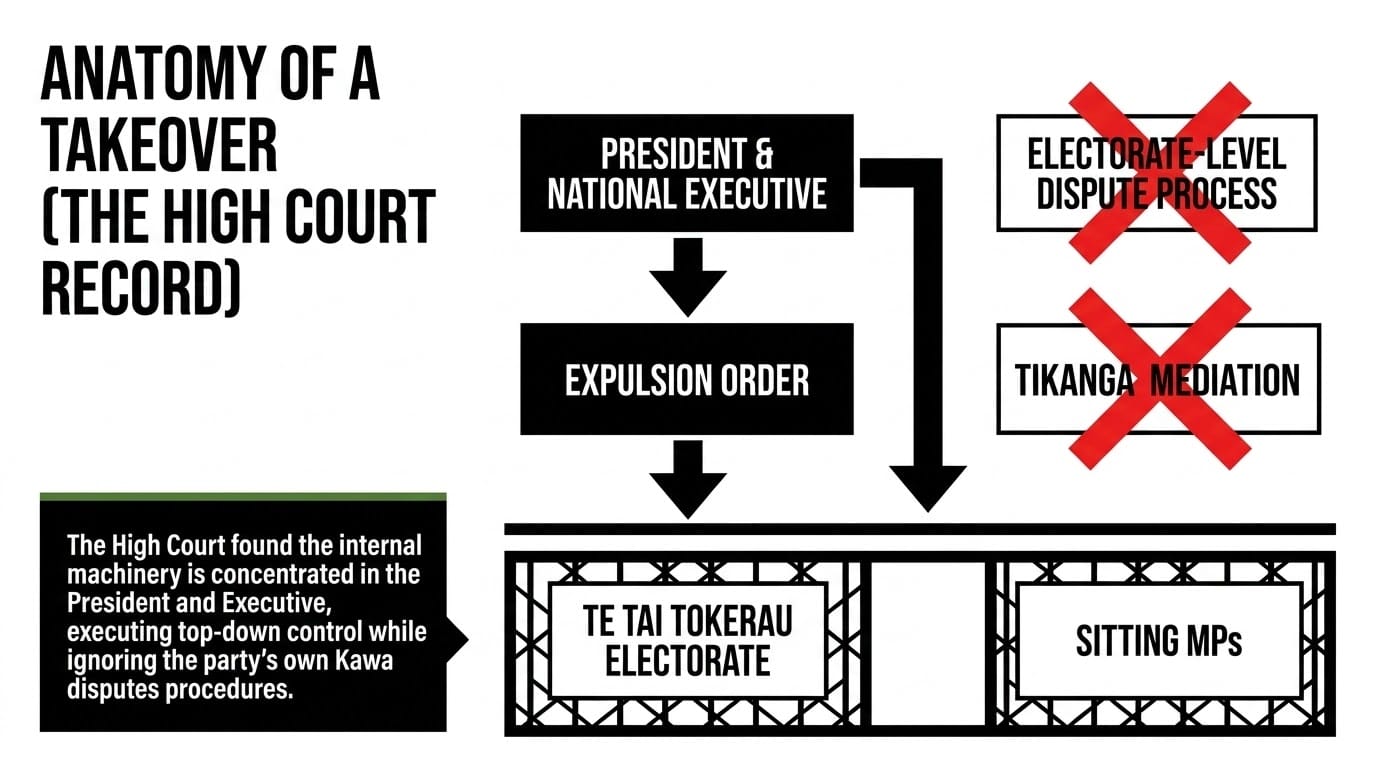
This is where the performance stops and the paperwork begins. The High Court judgment in Kapa-Kingi v Tamihere NZHC 517 records that Te Pāti Māori's formal machinery is concentrated in the president, the National Executive, and the National Council, with the president sitting at the centre of that structure, as shown in the live High Court judgment.
Justice Radich records that John Tamihere was elected and then confirmed as president, and that the executive included the president, co-leaders, vice-presidents, and party officers — all inside the formal power structure that dealt with Kapa-Kingi's suspension and expulsion, according to the judgment.
The Court also records that the executive controlled key invitations to National Council meetings, excluded Te Tai Tokerau and all MPs from one critical gathering, and relied on pre-circulated material to frame the case against Kapa-Kingi before decisions were made, as set out in the High Court judgment.
That is not decentralised rangatiratanga. That is not whānau-led accountability. That is a command structure.
And when a command structure is fronted by Rawiri's performance politics and Debbie's moral authority while real procedural power sits elsewhere, the phrase "political vehicle" stops being metaphor and starts becoming technical description.
Te Ao Māori's reporting on the hearing sharpened the point further: Kapa-Kingi's challenge argued that disputes should have begun at electorate level and moved through the party's own dispute processes, but that this did not happen.
Instead, authority flowed downward from the top, with Tamihere and the executive exercising decisive control, according to Te Ao Māori News.
TikTok Radicalism, Boardroom Control: The Seven Deflections Fact-Checked
This is the poison at the centre of the waka. Rawiri Waititi and Debbie Ngarewa-Packer are highly effective symbols. They know how to occupy a clip, a headline, a meme, a parliamentary moment.
They know how to project heat.
But heat is not sovereignty. Virality is not constitutional transformation. And a TikTok-ready performance of defiance means very little if the underlying organisation is run through a structure where a president and executive can override processes, marginalise electorates, and force internal critics into the High Court just to get the Kawa followed. KAPA-KINGI v TAMIHERE NZHC 517
So let us go claim by claim.
Claim 1 — "Electorates run Te Pāti Māori. The party belongs to the people."
❌ FALSE — DIRECTLY CONTRADICTED BY THE HIGH COURT
The High Court found formal power sits with the president, National Executive, and National Council — not the electorates. Te Tai Tokerau and all sitting MPs were excluded from the key hui that decided Kapa-Kingi's fate. The disputes process required by the party's own Kawa was never initiated at electorate level. Tamihere held structural protection under the constitution that meant even multiple electorates opposing him could not easily remove him. KAPA-KINGI v TAMIHERE NZHC 517
This is not a bottom-up movement. The court record, the constitution, and the conduct of the expulsion all tell the same story: top-down executive control dressed in bottom-up rhetoric.
Claim 2 — "35,000 moved to the Māori roll. 55,000 new enrolments."
❌ UNVERIFIED — SIGNIFICANTLY INFLATED
The verified data shows 1,779 additional people on the Māori roll in three weeks in November 2024, and over 3,000 new voters added by March 2025. Not 35,000 and 55,000. No Electoral Commission source available to this analysis confirms those numbers. Te Ao Māori News
Rawiri is using unverified, significantly inflated numbers to make an electoral claim the available data does not support at that scale.
Claim 3 — "Te Matatini and Te Aka Whai Ora came directly from our manifesto."
🔶 PARTIALLY TRUE — BUT SELF-SERVING AND ALREADY REVERSED
John Tamihere himself confirmed these policies "were writ large in Te Pāti Māori policy," so the advocacy is real, according to Te Ao Māori News. 🔶 Corroborated
However, Te Pāti Māori held only two seats and no coalition role under Labour. Labour introduced and legislated Te Aka Whai Ora. There is a significant difference between campaigning on something and governing it into existence. More critically, Te Aka Whai Ora was then abolished by the coalition government, meaning the win Rawiri cites has already been reversed — and Te Pāti Māori, in opposition, could not stop it.
Claim 4 — "We stayed silent out of respect for process."
❌ THIS DOES NOT SURVIVE THE COURT RECORD
The Court found no proper tikanga process was initiated. Kapa-Kingi proposed a tikanga-based mediated discussion. That proposal was not taken up. The leadership chose the executive pathway over the tikanga pathway — and then described their silence as principled restraint. Calling that principled is reframing an accountability failure as a virtue. KAPA-KINGI v TAMIHERE NZHC 517 and Te Ao Māori News
Claim 5 — "We won't be anyone's junior partner. We negotiate as equals."
🔶 ASPIRATIONAL — BUT HISTORY AND STRUCTURE UNDERCUT IT
Te Pāti Māori entered a confidence and supply arrangement with the National-led government under Key from 2008, accepting cabinet roles, and was widely criticised for failing to translate proximity into meaningful Māori gains. That arrangement lasted until 2017, when the party was voted out of Parliament entirely — rejected by the electorates it claimed to serve. At 3.06% of the party vote in 2023, its leverage is electorate-based overhang — structurally fragile for claiming equal negotiating power. Te Pāti Māori history, Wikipedia; (2023 results): 1News
Claim 6 — "Māori will decide the next government."
❌ OVERSTATED — THE ELECTORAL TIMELINE DOES NOT SUPPORT THIS
Te Ao Māori News reported specifically that any extra Māori seat will not be confirmed until after the 2028 census. Te Pāti Māori acknowledged this when it warned that proposed electoral changes could freeze seats at seven. That warning only makes sense if the party knows the eighth seat is not currently available — which directly contradicts the framing that current roll growth already delivers decisive power. Te Ao Māori News
Claim 7 — "The crisis was growing pains."
❌ REFRAMING ACCOUNTABILITY AS INEVITABILITY
The High Court does not describe structural strain. It describes a specific, traceable sequence of choices: the executive chose not to initiate the Kawa's dispute procedure; meetings were convened that excluded critical parties; a tikanga resolution was declined; expulsion was processed through a mechanism the Court found unlawful. None of that is an accident of rapid growth. Those are decisions. Growing fast does not make unlawful process lawful. KAPA-KINGI v TAMIHERE NZHC 517
The Seven Questions Rawiri Never Answered
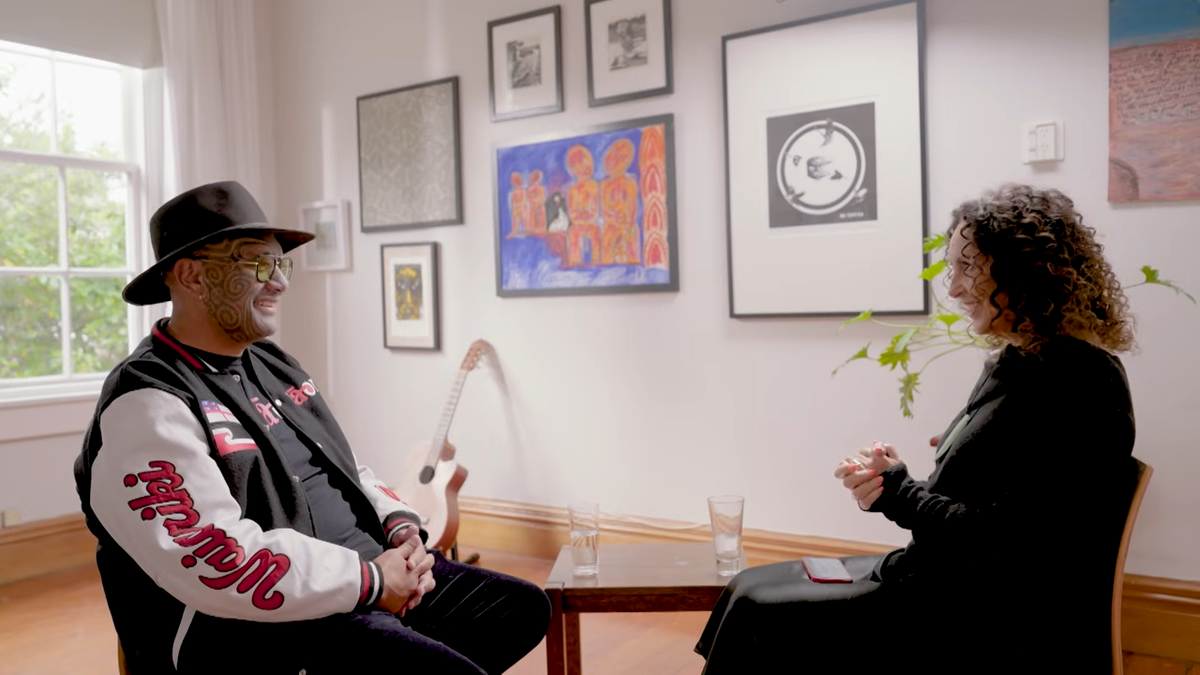
Across the full interview, Rawiri does not address — and was not pressed enough on — the following:
- Who controls the National Executive? Answer: Tamihere, the co-leaders, and party officers. Not electorates.
- Why was Kapa-Kingi's tikanga mediation proposal rejected? Not addressed.
- Why were Te Tai Tokerau and sitting MPs excluded from critical hui? Not addressed.
- If electorates govern, why did a High Court have to order the party to follow its own Kawa? Not addressed.
- What is Tamihere's specific daily role in the party's governance? Not addressed.
- How does 3.06% of the party vote constitute "the mandate of Māori"? Not challenged.
- If Māori roll numbers are decisive, why is Te Pāti Māori simultaneously warning that an eighth seat is being suppressed? Not resolved.
These are not hostile questions. They are the questions any accountable political vehicle should answer easily. The fact that they go unanswered is itself part of the story.
The Convenient Spectacle Of Māori Self-Destruction Still Serves The Crown
Here is the bitter irony. Even if Te Pāti Māori is partly performance, its implosion still serves the Crown. Every week spent watching internal warfare is still a week the coalition can keep moving on fast-track approvals, Treaty rollback, and suppressive electoral change.
The High Court found that Mariameno Kapa-Kingi's suspension and expulsion processes were unlawful, that the party did not comply with its own Kawa disputes procedures, and that she was excluded from relevant processes, as confirmed in the High Court judgment.
So yes, the party handed ammunition to the state. But the lesson is no longer just that Māori disunity helps the Crown. The lesson is that a corporate-style internal machine wrapped in liberation language can damage Māori trust from the inside while still feeding the Crown from the outside.
Three Examples For The Western Mind
Example 1: Fast-track extraction is a corporate smash-and-grab dressed as efficiency
Core claim: The fast-track regime privileges development over meaningful Māori rights and environmental safeguards, and may expose conservation land, QEII-protected land, and unsettled Māori land to extractive projects, as described by E-Tangata.
Quantified harm: QEII covenants protect over 180,000 hectares of land across more than 5,000 covenants, yet QEII-protected land is not expressly excluded from fast-track eligibility, according to E-Tangata.
Impact on tikanga for the western mind: In western governance language, this strips communities of meaningful veto power over major land-use decisions. In tikanga terms, it degrades whenua from ancestor to commodity and treats relationship as an inconvenience to be processed by ministers.
Solution: Repeal or radically amend the fast-track framework so projects affecting Māori rights, unsettled claims, conservation land, and QEII-protected areas cannot proceed without free, prior, and meaningful Māori consent.
Relevant Māori Green Lantern essay: Democracy on Fast-Forward: How National, ACT, and NZ First Are Gutting Aotearoa — The Māori Green Lantern.
Example 2: Freezing Māori seats is voter suppression in a necktie
Core claim: Proposed electoral changes could delay Māori boundary reviews and keep Māori seats at seven despite roll growth that may justify eight, as reported by Te Ao Māori News.
Quantified harm: In November 2024, 1,779 people joined the Māori roll in three weeks, including 1,309 shifts from the general roll, according to Te Ao Māori News.
Impact on tikanga for the western mind: In western democratic terms, this is representational distortion. In tikanga terms, it tells Māori that even when they organise and mobilise lawfully, the state will change the counting rules to keep them politically smaller than they are.
Solution: Scrap the suppressive changes and let Māori seat allocation reflect actual roll numbers in real time.
Relevant Māori Green Lantern essay: The Numbers Are a Loaded Gun — and It's Pointed at Your Whānau — The Māori Green Lantern.
Example 3: Te Pāti Māori's internal machine looks like controlled branding, not shared rangatiratanga
Core claim: The High Court found that Kapa-Kingi's expulsion process did not comply with the Kawa and that she was excluded from the relevant processes, while hearing coverage highlighted arguments that disputes should have started at electorate level rather than through top-down executive control, according to the High Court judgment and Te Ao Māori News.
Quantified harm: The Court records Te Pāti Māori rose from zero seats in 2017 to six in 2023, meaning the governance breakdown struck at a moment of major electoral growth, as stated in the High Court judgment.
Impact on tikanga for the western mind: In western organisational language, this is a governance failure caused by concentrated executive power and process breakdown. In tikanga terms, it is a rupture of whakapapa relationships and a denial of collective balance. The people are invited to perform the movement, but not necessarily to govern it.
Solution: Any political entity claiming tikanga legitimacy must decentralise real power, lodge disputes at electorate level first, bind leadership to independent tikanga processes, and stop using performance as cover for managerial control.
Relevant Māori Green Lantern essay: The Split Tōtara and the Arsonists Who Lit the Match — The Māori Green Lantern.
Why The Western Mind Keeps Missing The Double Performance
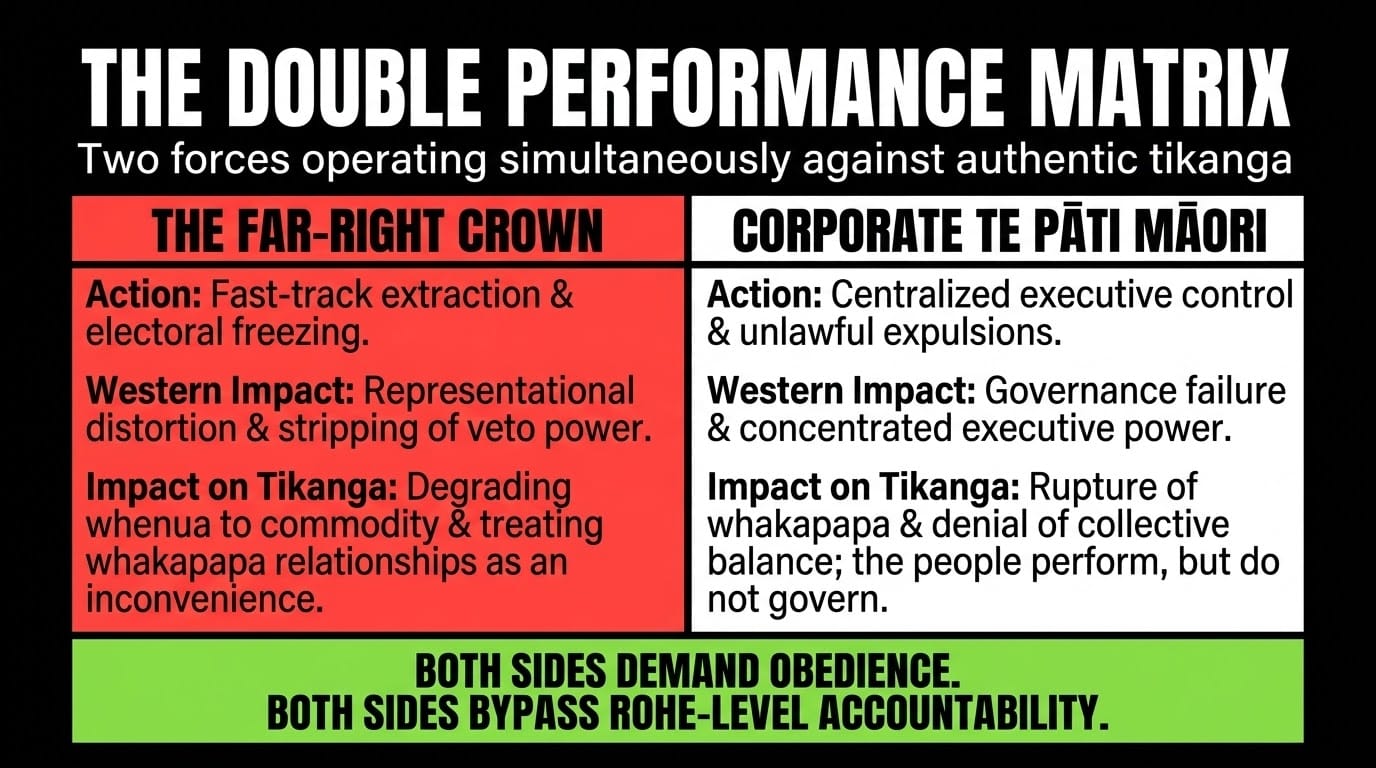
The western mind keeps asking whether haka in Parliament is performative, but it usually asks the question lazily. The real issue is not that Māori symbolism exists. The real issue is that two performances are happening at once.
The Crown performs democratic legitimacy while gutting Māori rights through law. Te Pāti Māori performs decentralised liberation while evidence suggests a highly centralised executive machine behind the curtain. E-Tangata and Te Ao Māori News.
That is why this moment is so dangerous. Māori can be tricked from both sides: brutalised by the state, then emotionally managed by a party machine that speaks the language of liberation while concentrating control.
The Whakapapa Of The Māori Party: Born From Rupture, Hollowed By Scale, Dead In Its Current Form
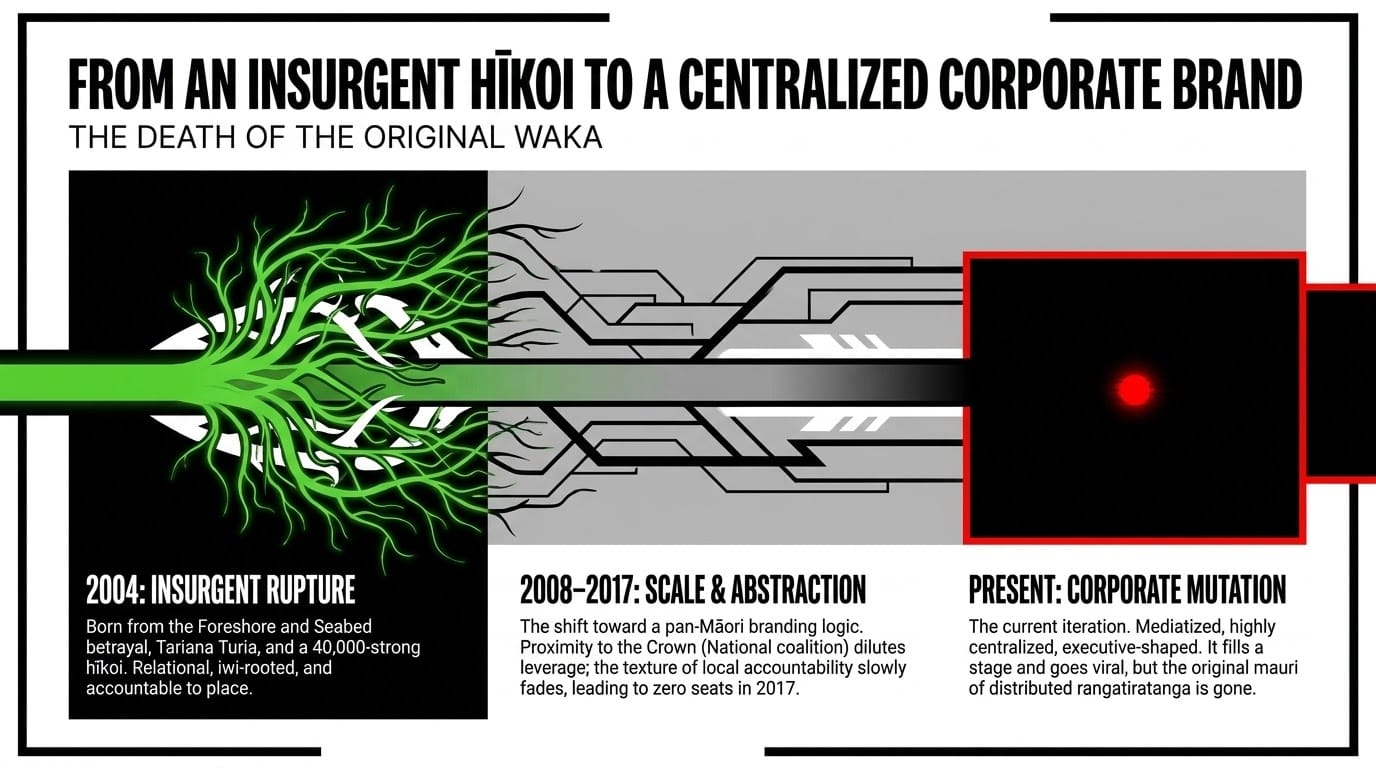
To understand why the current Te Pāti Māori feels so unstable, so over-managed, and so disconnected from the Māori mind, you have to go back to its birth. The Māori Party was born out of the Foreshore and Seabed rupture in 2004, after Tariana Turia broke with Labour over legislation that undermined Māori rights, and after a 40,000-strong hīkoi helped generate the political force that became the new party, as described by Te Pāti Māori's own history page and Te Ara's account of Māori representation.
That origin matters because the party's whakapapa was not originally corporate. It was insurgent, relational, and born from a specific breach of trust between Māori communities and a major party that expected obedience. Tariana Turia and Pita Sharples gave the party its founding face, while Whatarangi Winiata and others gave it institutional shape, according to Te Pāti Māori's own history.
But even early on, there was a strategic tension in its whakapapa. E-Tangata's How the Māori Party lost its way argues that the party was strongest when it was trying to be an independent Māori voice grounded in the Māori electorates, and that it lost focus when it tried to broaden itself beyond that clear purpose, as argued by E-Tangata.
That is the first death. Not electoral death, not yet. Conceptual death. The moment a Māori political vehicle forgets that Māori are not a market segment but a network of whakapapa obligations, rohe, hapū, marae, and iwi, it begins to die from abstraction. Māori are not just "the Māori vote". Māori are local. Māori are tribal. Māori are still answerable to place.
The second death came through scale and substitution. Over time, the party's original whakapapa as an iwi-and-electorate-rooted response to Crown betrayal was replaced by a more pan-Māori branding logic. A pan-Māori corporate body may speak the language of liberation while steadily losing the texture of local accountability.
And now comes the third movement: not resurrection, but mutation. The current Te Pāti Māori is not simply the original Māori Party revived. It is an evolved formation — more mediatized, more centralised, more executive-shaped, and more corporate in operation, as suggested by the gap between its public messaging and the internal power structures exposed in the High Court judgment.
If that assessment is right, then the current form is dead in the specific sense that matters most: dead as a believable vehicle of distributed Māori rangatiratanga. It may still contest elections. It may still produce viral moments. It may still fill a stage. But a thing can still move after the mauri has gone.
Why Mariameno Matters: Localisation Inside The Current Electoral Paradigm
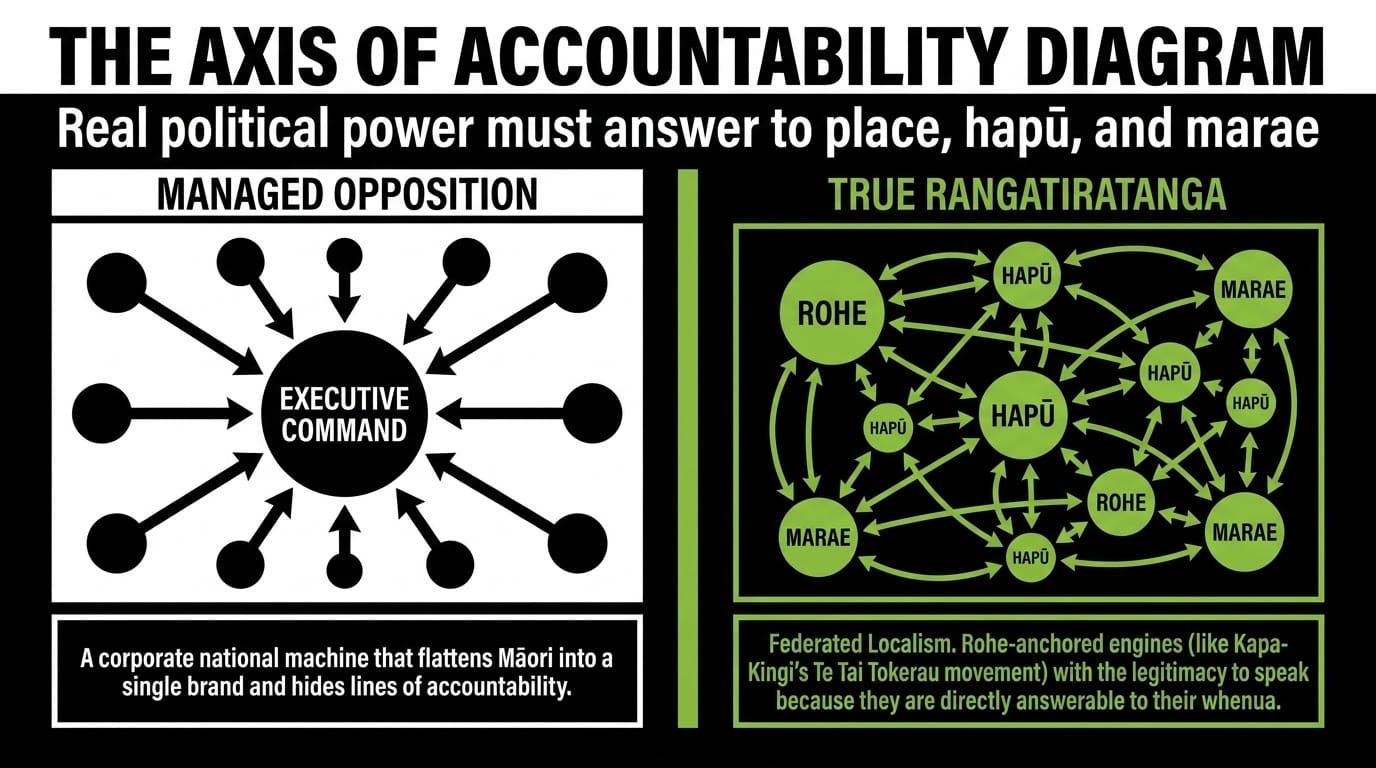
This is why Mariameno Kapa-Kingi matters far beyond personal grievance or factional fallout. Her post-split move was not to announce a new pan-Māori machine claiming to speak for everyone.
She announced a movement rooted in Te Tai Tokerau and explicitly framed it as a model for stronger regional and Māori-led representation, with communities having greater control over decision-making, according to Te Ao Māori News.
Her own words are telling: "Our foundation is Te Tai Tokerau. Our responsibility spans across the motu," and the new movement hopes to inspire other rohe to build "independent political powerhouses" reflecting local aspirations and identity, as reported by Te Ao Māori News.
That is not anti-Māori unity. It is a different model of it. Not fake unity from the top down, but federated strength from the bottom up. Not a single corporate command centre speaking over the motu, but multiple rohe-grounded engines with the legitimacy to speak because they are actually answerable to place.
That does not mean localisation is easy. Rohe politics can still fracture, and localism alone does not inoculate anyone against ego, money, or manipulation. But it does mean the axis of accountability is clearer. People know where you come from. They know who can challenge you. They know which marae, which hapū, which aunties, which histories sit behind you. A corporate national machine can hide those lines. A rohe movement has to wear them on its face.
What survives from the party's whakapapa is still precious: the insistence that Māori need an independent political voice; the lesson that major parties will always sacrifice Māori if the centre demands it; the memory of Tariana Turia's rupture and the hīkoi that birthed a movement, as reflected in Te Pāti Māori's history, Te Ara, and E-Tangata's reflection on how the party lost its way.
What may come next is not the restoration of the old party, but the emergence of something more honest to the Māori mind: localised, tribal, rohe-anchored, mutually allied where needed, but not flattened into a single executive-controlled pan-Māori brand.
If Mariameno holds that key, then the future may not belong to the current Māori Party at all. It may belong to a different whakapapa of representation altogether.
Koha And Accountability
Every koha to this mahi says that whānau are prepared to support the kind of fearless analysis that neither the Crown nor party machines want.
This essay is about more than exposing government theft. It is about refusing managed opposition, refusing symbolic crumbs, and refusing to let Māori liberation be reduced to a brand exercise run through a command structure.
If this essay has helped put names to the hidden helm as well as the arsonists, and you are able, consider a koha to keep this voice alive.
If you are not able to koha, that is all good — subscribe, follow, share the essay with your whānau and friends, and carry the kōrero. That too is koha.
Four pathways exist:
For those who wish to support this mahi directly with a koha, please visit Koha — Support The Māori Green Lantern
For those who wish to receive essays directly and support through subscription, visit Subscribe to The Māori Green Lantern
For those who prefer direct bank transfer: HTDM, 03-1546-0415173-000
For those on Facebook, support here: The Māori Green Lantern on Facebook
Kia kaha, whānau. Stay vigilant. Stay connected. The taiaha is knowledge, and every machine built to manage Māori fears an informed people.
Transparency
Research date: 10 June 2026.
Tools used: search_web, fetch_url. Sources consulted: High Court of New Zealand (live judgment fetched), E-Tangata (live), Te Ao Māori News (live), 1News (archived), John Tamihere's own public post-election statement (Te Ao Māori News, live), Te Pāti Māori history (live), Te Ara (live), Wikipedia (corroborated), Newstalk ZB (live).
Disclaimer: This essay is published in the public interest. It analyses public policy, court findings, and public political conduct. Rawiri Waititi, John Tamihere, and Debbie Ngarewa-Packer are named in their public and political capacity only. Verified facts are linked to source material. Clearly interpretive statements are presented as opinion grounded in those facts. No malice is asserted. Right of reply applies under standard journalistic practice.